
Revision Notes
A Level Business: Business structure and Size of business (Cambridge 9609) – Revision Notes
Condensed revision notes for sections 1.2 and 1.3 of Cambridge A Level Business 9609: sectors, ownership forms, size measures, small firms and growth.
- Subject
- Business
- Level
- AS LEVEL
- Topic
- Business and its environment
- Author
- Marlbridge Academic Team
- Updated
- Reviewed by
- Salman Ahmad (what this means)
Aligned to Cambridge A Level Business (9609), For examination in 2026, 2027 and 2028. Official specification .
Syllabus page (what it covers and how it is assessed): Cambridge A Level Business.
Syllabus points this page covers
9609 (AS Level)
- 1.2 Business structure
- 1.3 Size of business
Found an error? Report a correction.
Need help with this topic? Request a free trial class for A Level Business (9609).
These notes condense sections 1.2 (Business structure) and 1.3 (Size of business) of the Cambridge International AS & A Level Business 9609 syllabus for examination in 2026, 2027 and 2028. They belong to the AS Level topic Business and its environment. For full explanations and worked examples, read the study guide. Then test yourself with the practice questions.
Related pages: Enterprise (1.1), topic revision notes, the Cambridge A Level Business hub, the checklist and the free diagnostics.
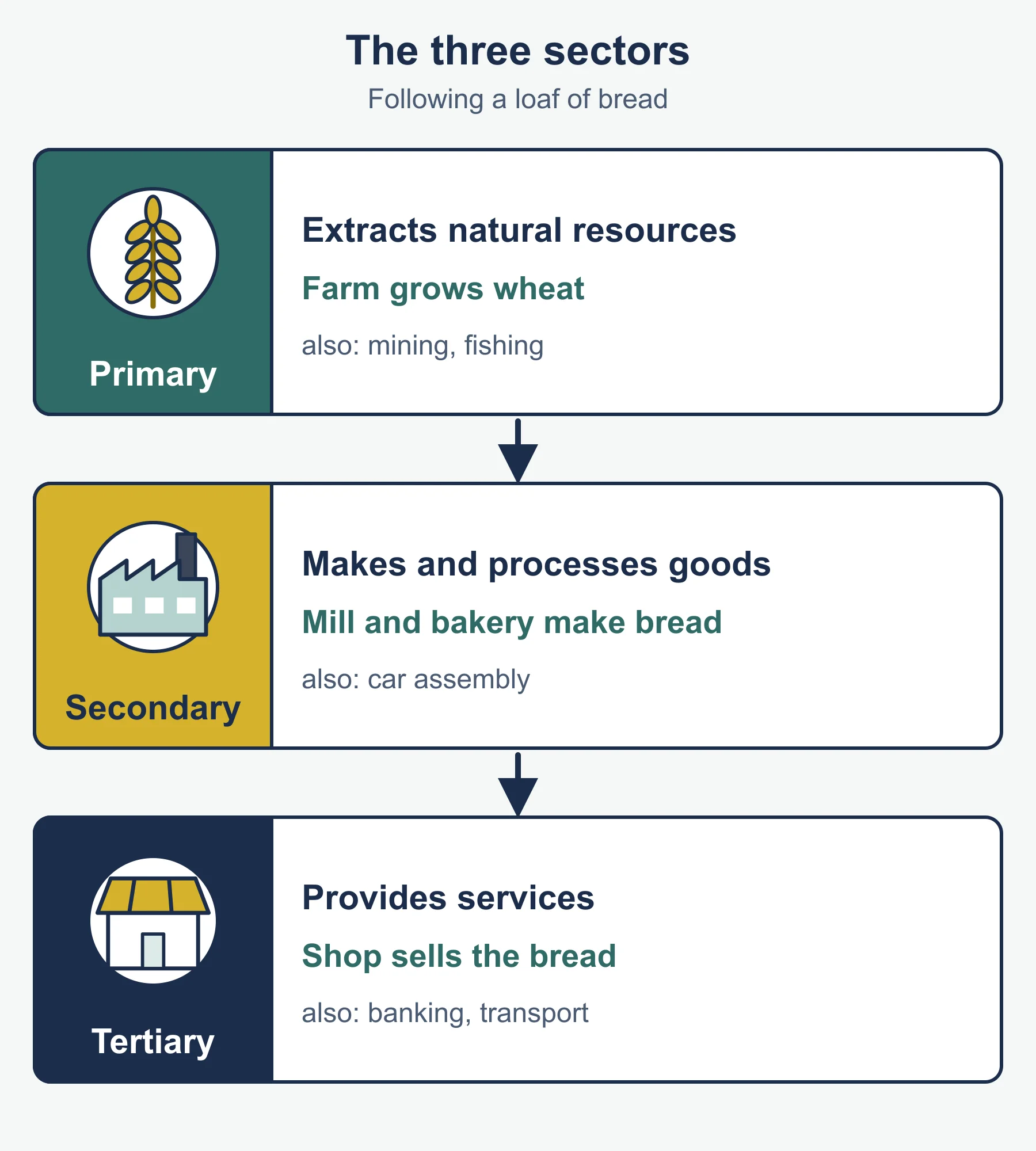
1.2.1 Sectors
| Sector | Activity | Quick test |
|---|---|---|
| Primary | Extracting or growing raw materials | Is it taken from the ground, sea or land? |
| Secondary | Making and building | Does it turn materials into products? |
| Tertiary | Services | Is the output a service? |
| Quaternary | Knowledge and information | Is the output research, data or software? |
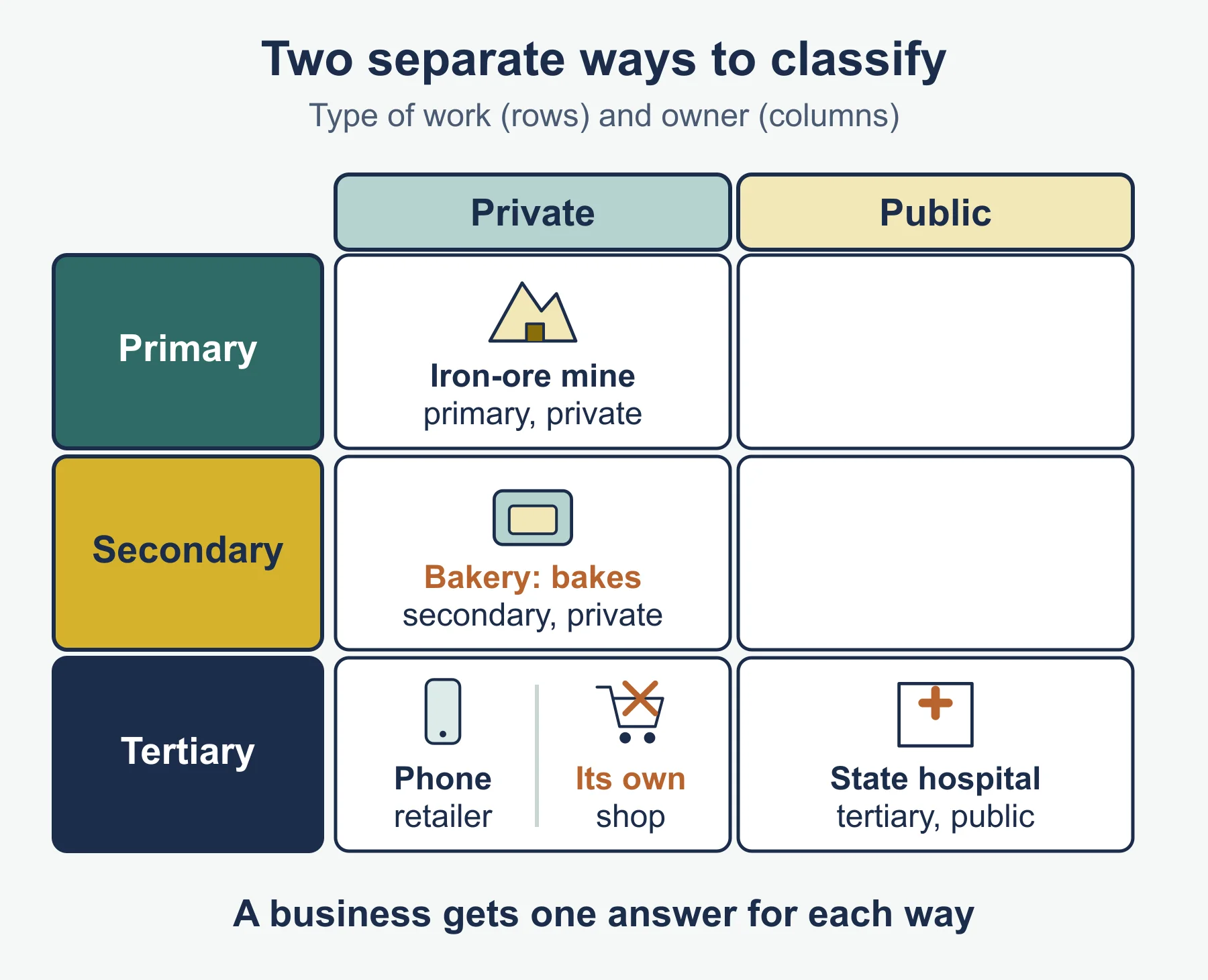
- Public sector: owned and controlled by the state, usually providing services.
- Private sector: owned by individuals or shareholders, mostly profit-seeking.
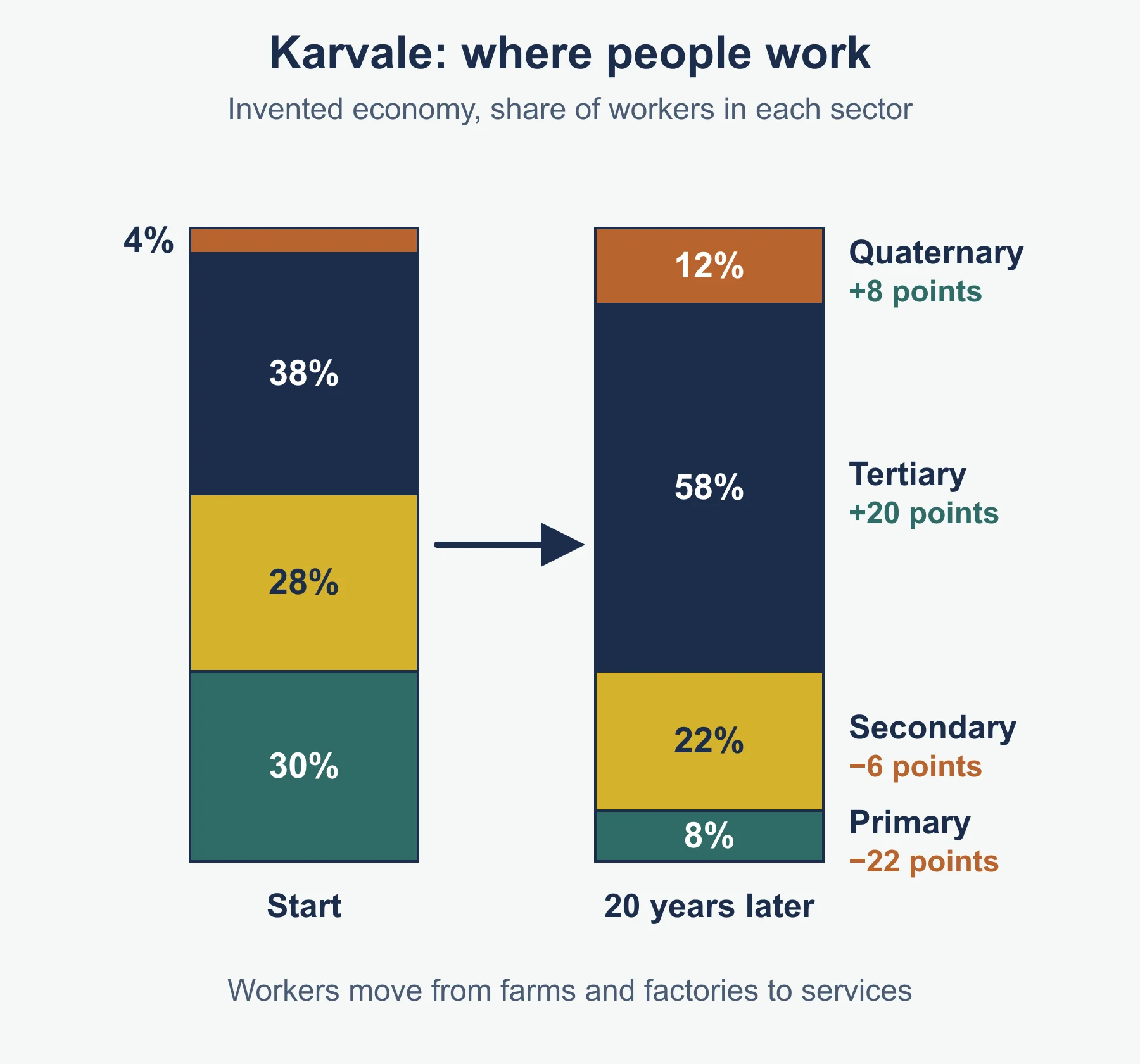
Changing importance
- Reasons: rising incomes, mechanisation, production moving abroad, new technology, government policy.
- Consequences: structural unemployment, retraining needs, regional decline, new industries.
Distinction: reasons explain why the shift happened; consequences describe what follows. Do not mix them.
1.2.2 Ownership
| Form | Liability | One strength | One weakness |
|---|---|---|---|
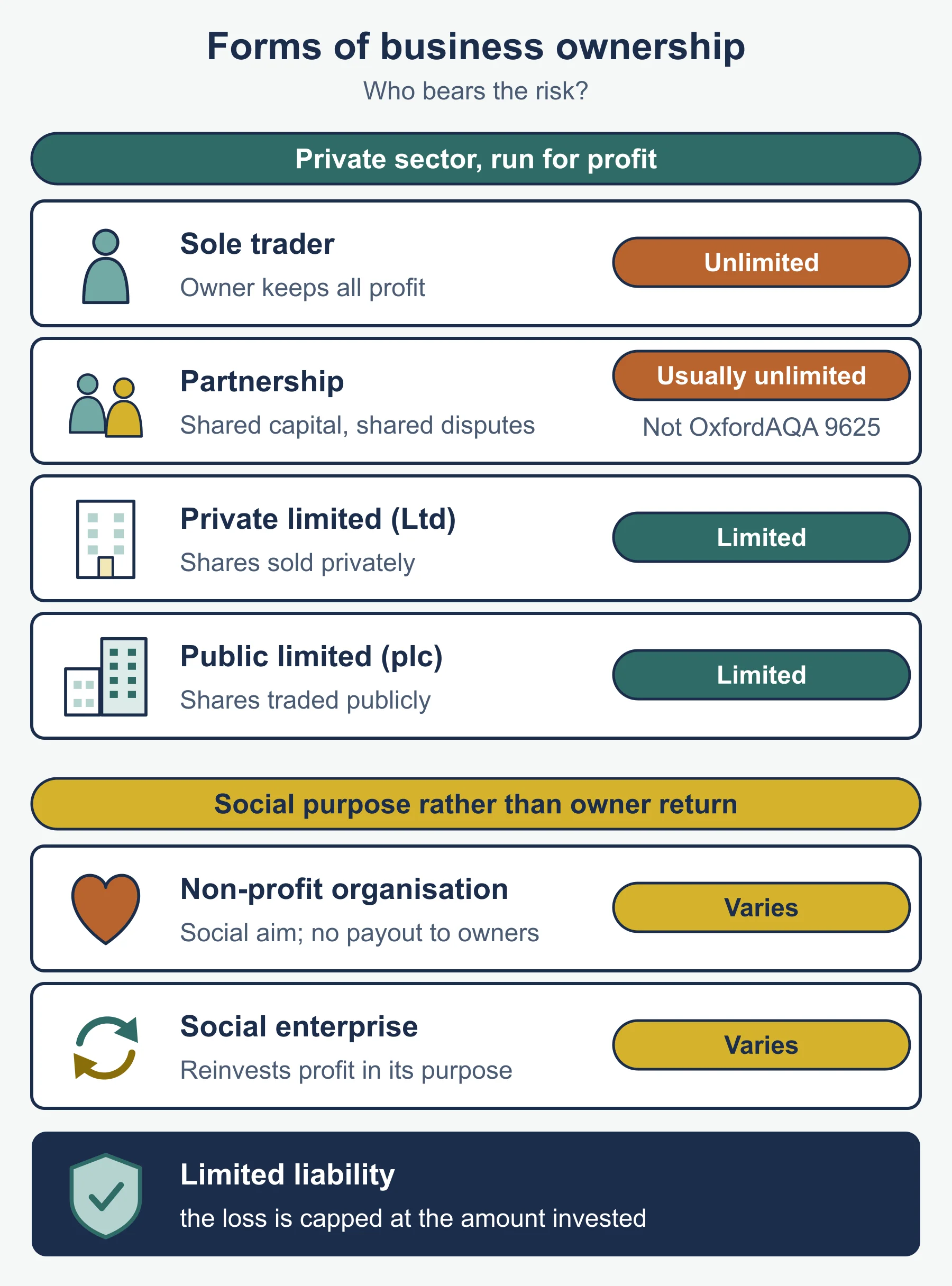
| Sole trader | Unlimited | Total control | All risk on one person |
| Partnership | Unlimited | Shared skills and capital | Disputes, joint risk |
| Private limited company | Limited | Owners protected | Shares not freely sold |
| Public limited company | Limited | Large capital from share sales | Takeover risk, control separate from ownership |
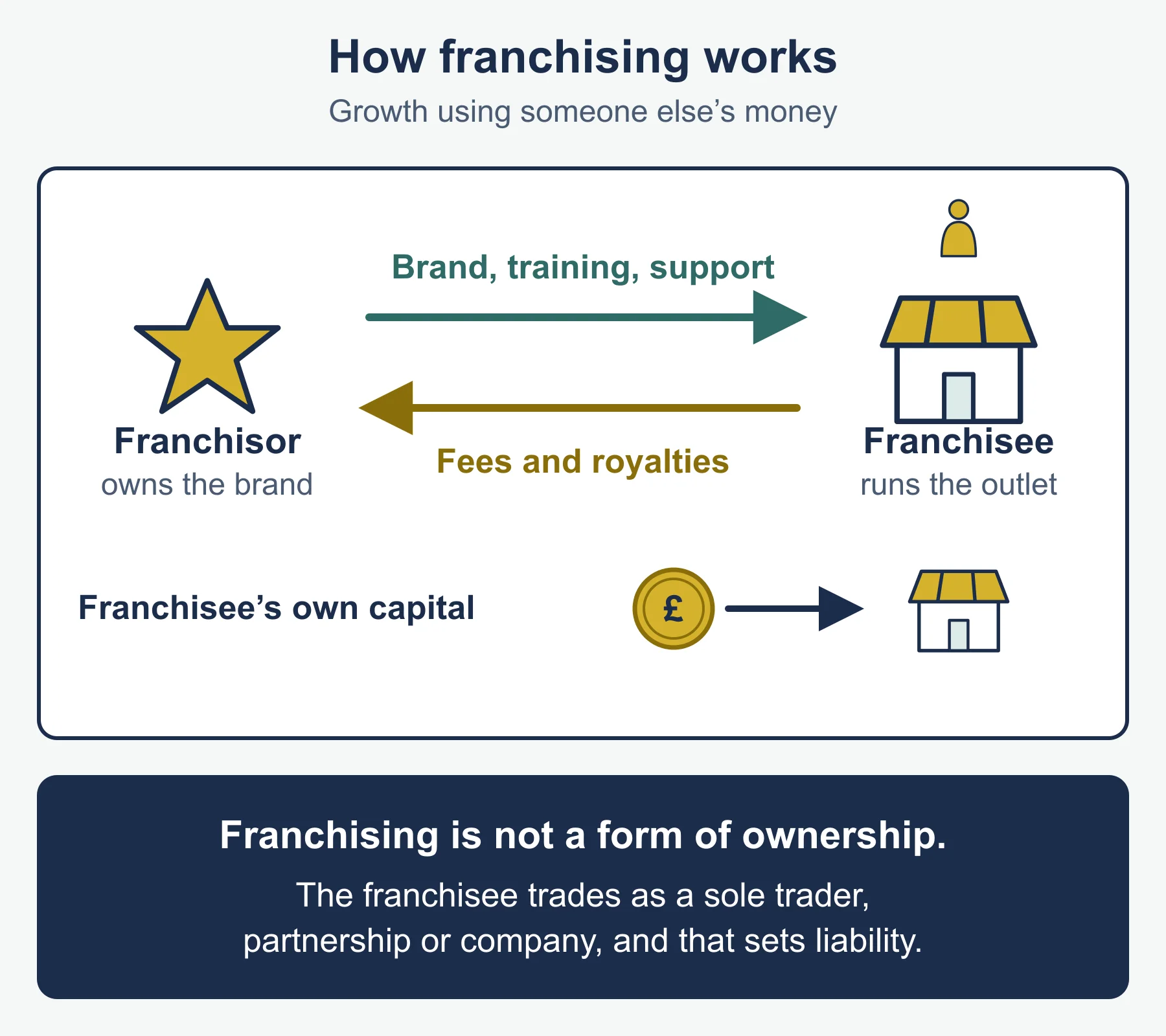
| Franchise | Depends on the form the franchisee takes | Proven brand | Fees and rules |
| Co-operative | Depends on how it is set up | Shared benefit | Slow decisions |
| Joint venture | Depends on how it is set up | Shared cost and expertise | Disagreements |
| Social enterprise | Depends on how it is set up | Social aim attracts support | Profit limited by the aim |
Liability
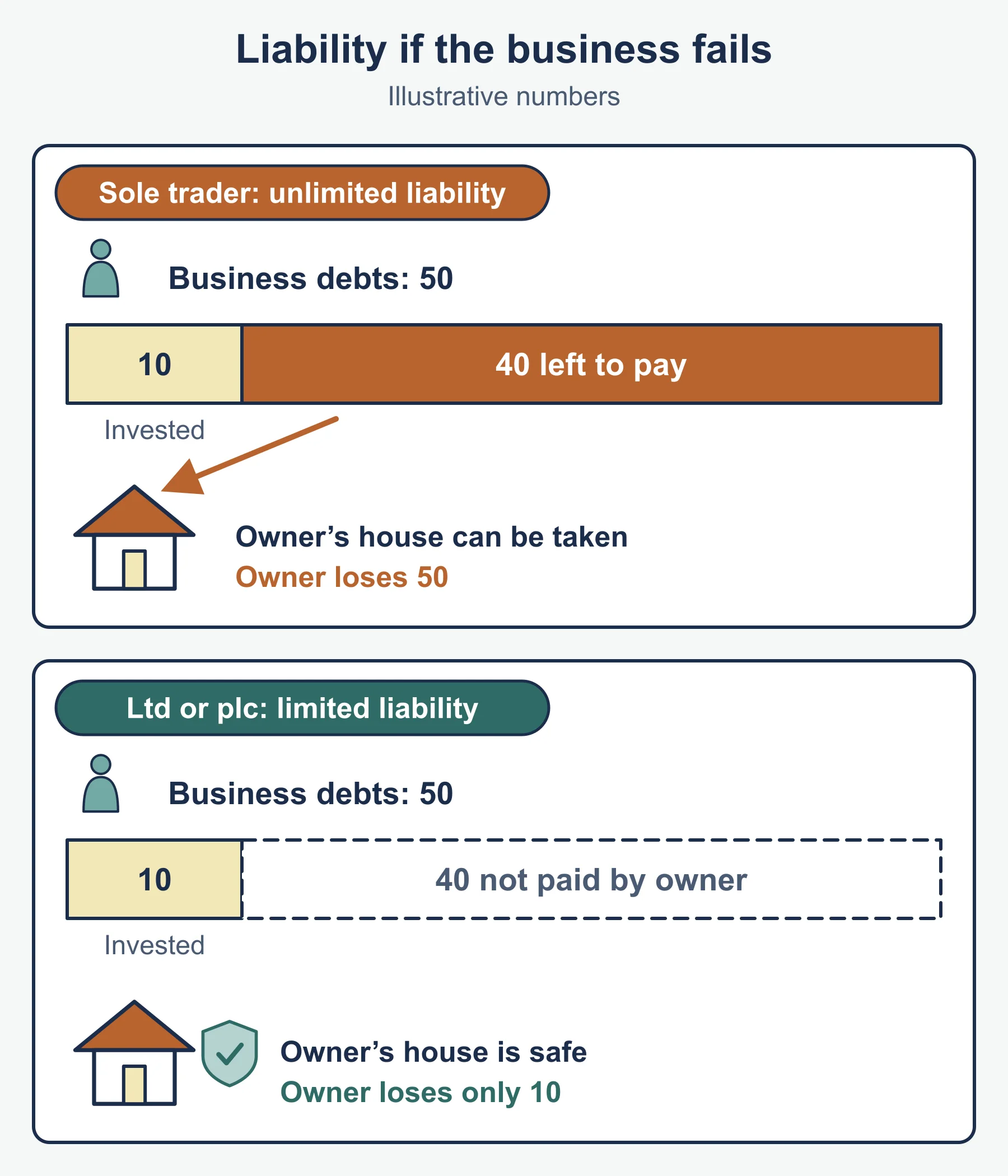
- Unlimited: personal assets can pay business debts.
- Limited: owners lose only what they invested.
- It matters because it affects how willing people are to take risks and invest.
Method: choosing a form
- Note the risk the owner faces.
- Note how much finance is needed.
- Note how much control the owner wants.
- Note the aims: profit, social benefit, rapid spread, or shared ownership.
- Pick the form where the key factor is best met, and state the trade-off.
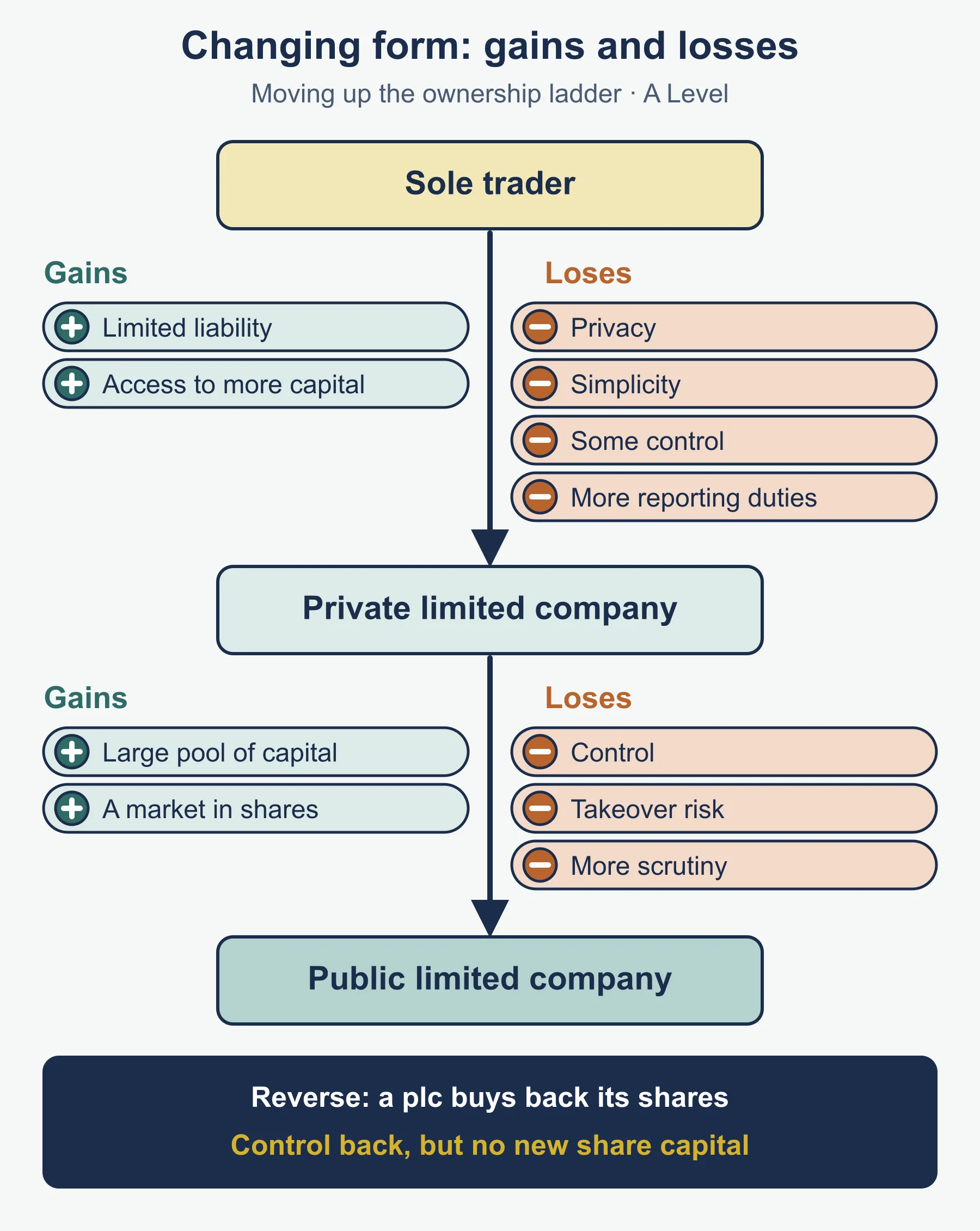
Changing form
| Move | Gain | Loss |
|---|---|---|
| Sole trader to private limited company | Limited liability, easier finance | Simplicity, privacy, more duties |
| Private to public limited company | Large capital, tradable shares | Control, takeover risk, scrutiny |
| Public to private | Control, less short-term pressure | Access to share capital |
1.3.1 Measuring size
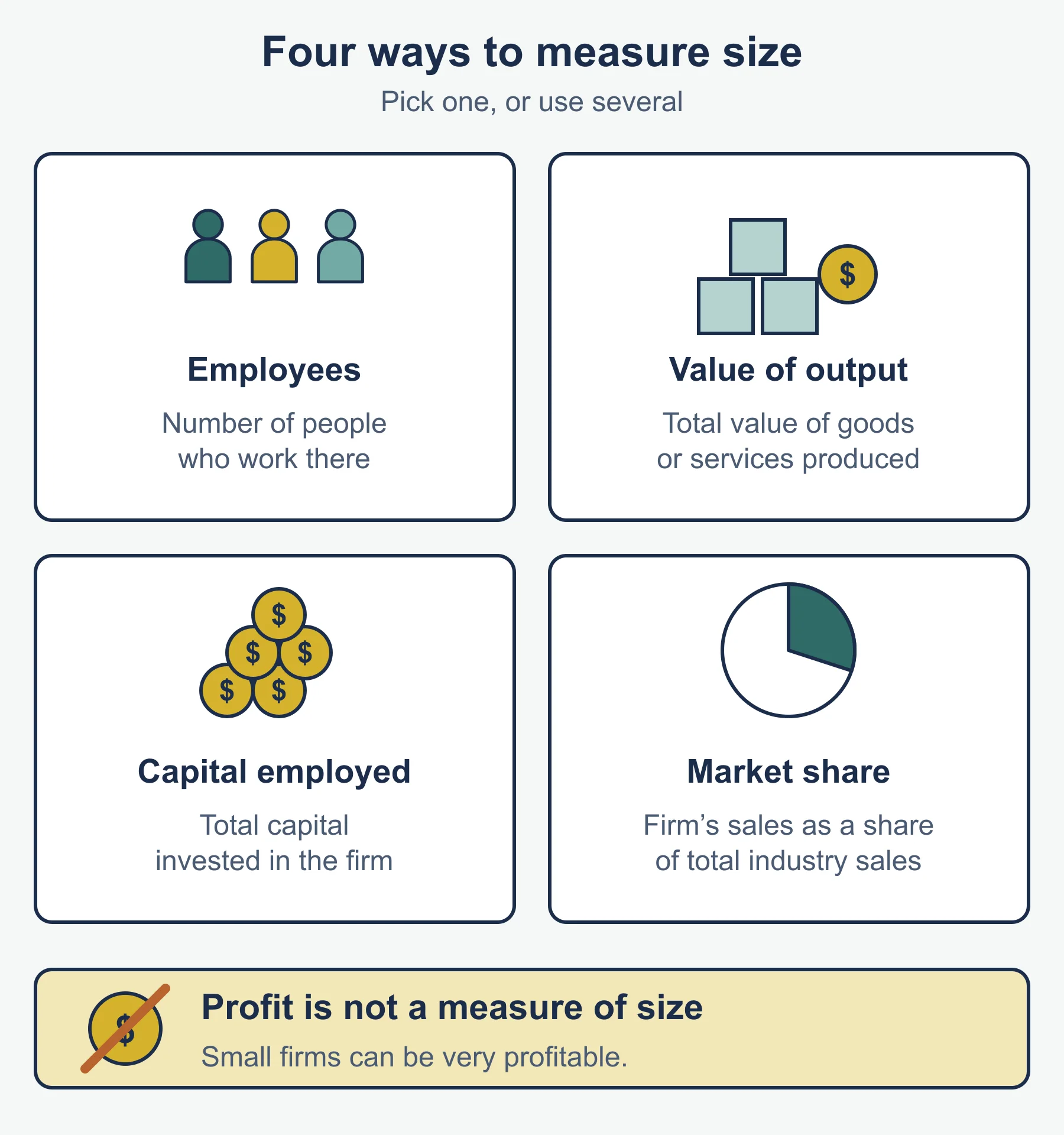
| Measure | Standard form | Weakness |
|---|---|---|
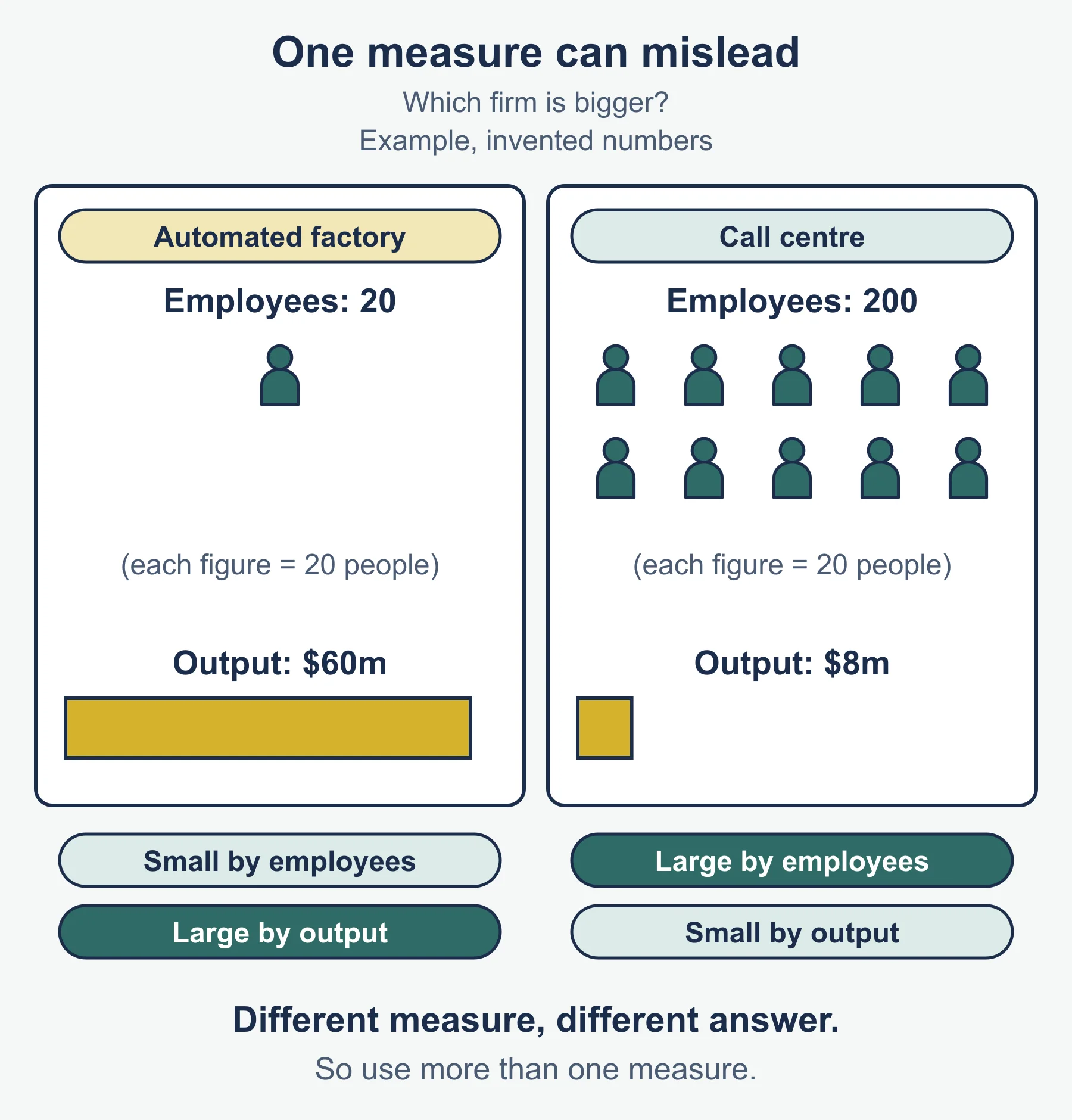
| Employees | Headcount | Misleading if machines do the work |
| Revenue | Price times quantity sold | Ignores profit and assets |
| Capital employed | Issued shares + reserves + non-current liabilities (syllabus finance section) | Depends on asset values |
| Market share | Firm sales ÷ market sales × 100 | Depends on how the market is defined |
The syllabus does not list the measures in 1.3.1. These are the standard ones. It asks how appropriate each is, so tie your choice to what the question wants to know.
1.3.2 Small businesses and family businesses
- Small, advantages: personal service, flexibility, quick decisions, low overheads.
- Small, disadvantages: limited finance, few economies of scale, vulnerable to large rivals, owner overload.
- Family, strengths: commitment, trust, long-term view.
- Family, weaknesses: limited management talent, disputes, succession.
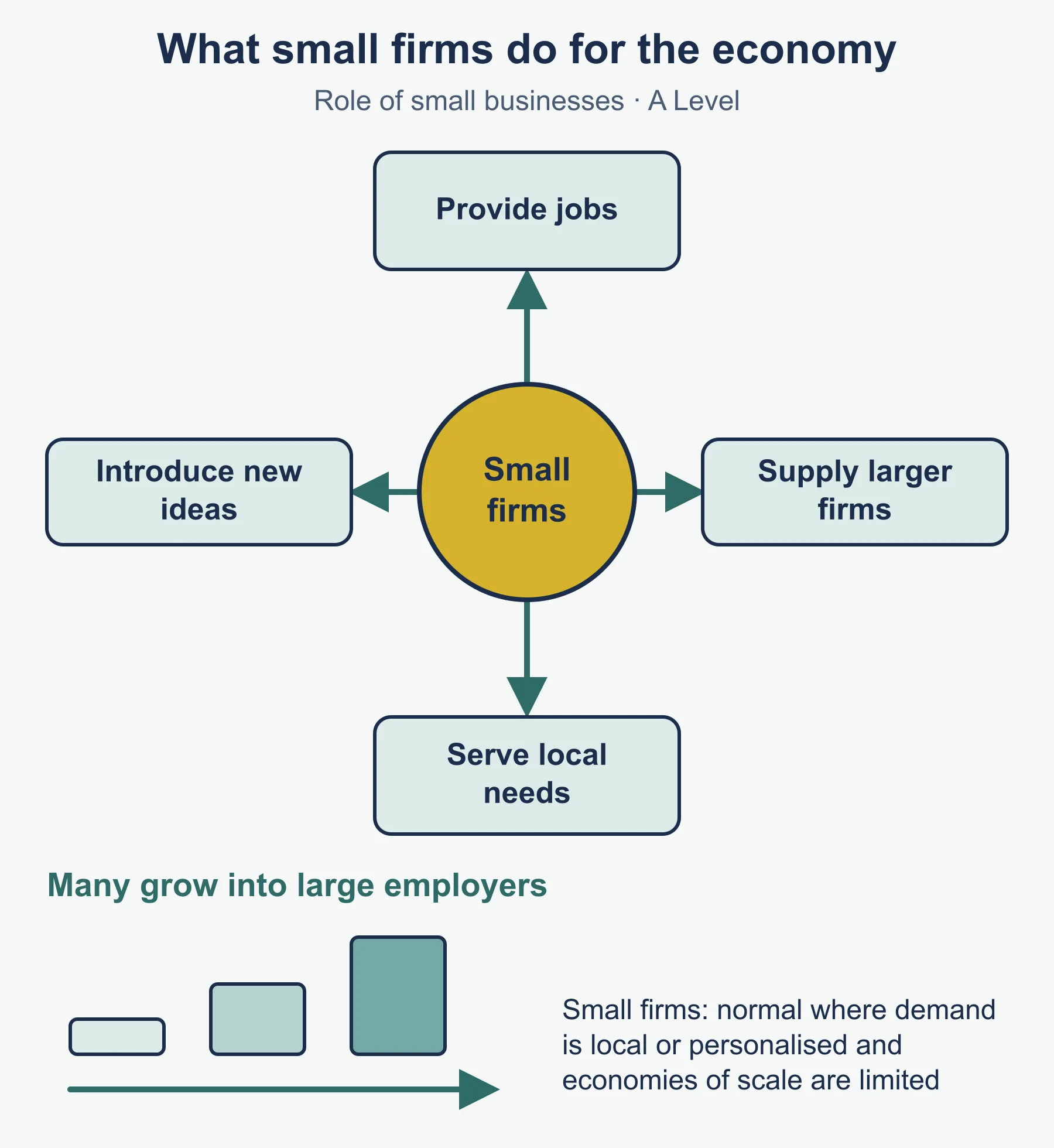
- Economy: jobs, new ideas, suppliers to large firms, local service.
- Industrial structure: small firms are common where demand is local, personal or specialised, and large-scale production brings little advantage.
1.3.3 Growth
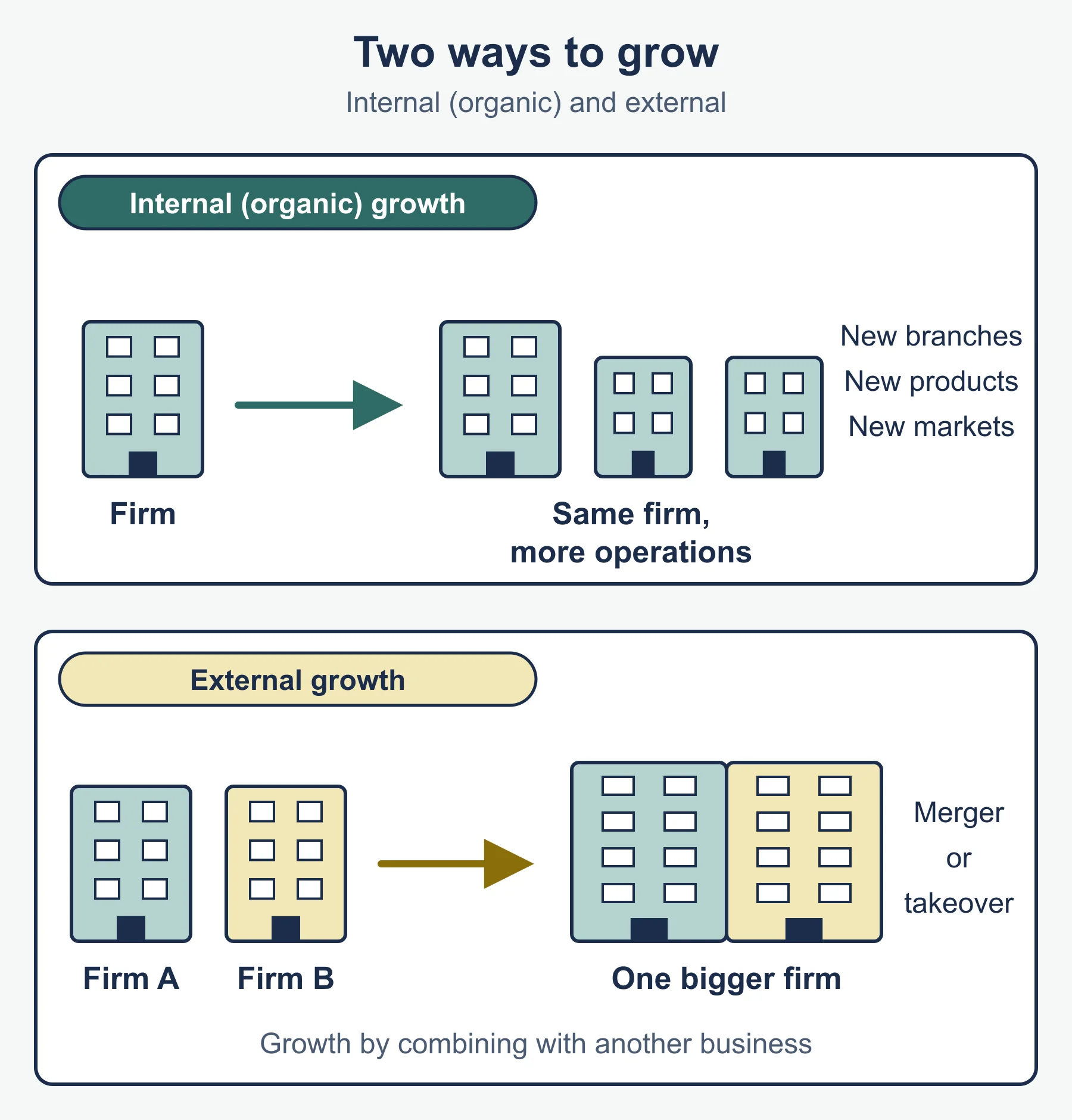
Organic: growth from the business’s own resources, such as new products, new markets and extra outlets. Slower, but keeps control. Reasons: economies of scale, market share, profit and security.
External:
| Term | Meaning |
|---|---|
| Merger | Two firms agree to combine |
| Takeover | One firm buys control of another |
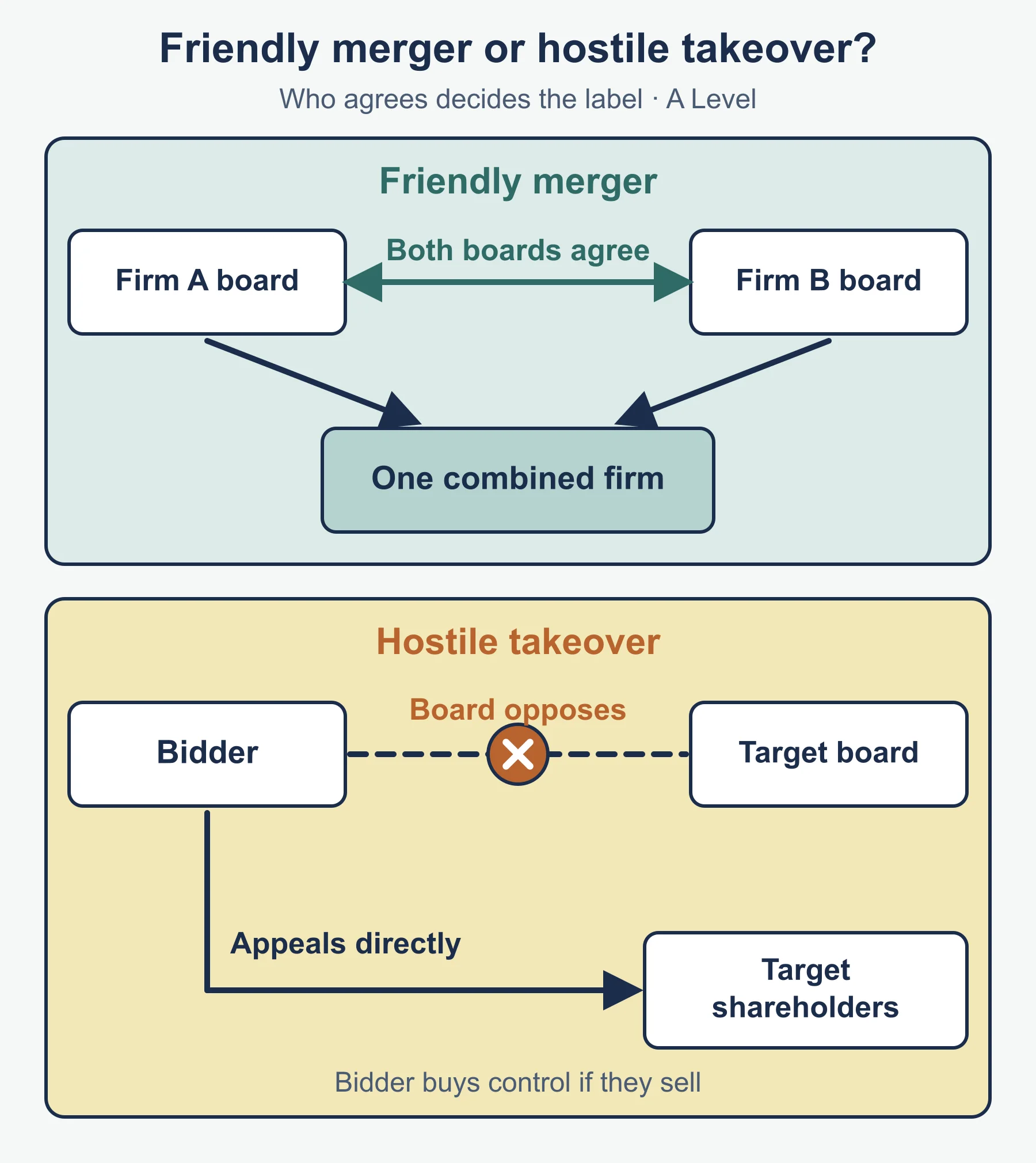
| Friendly merger | Both boards agree |
| Hostile takeover | Target’s board opposes; bidder appeals to shareholders |
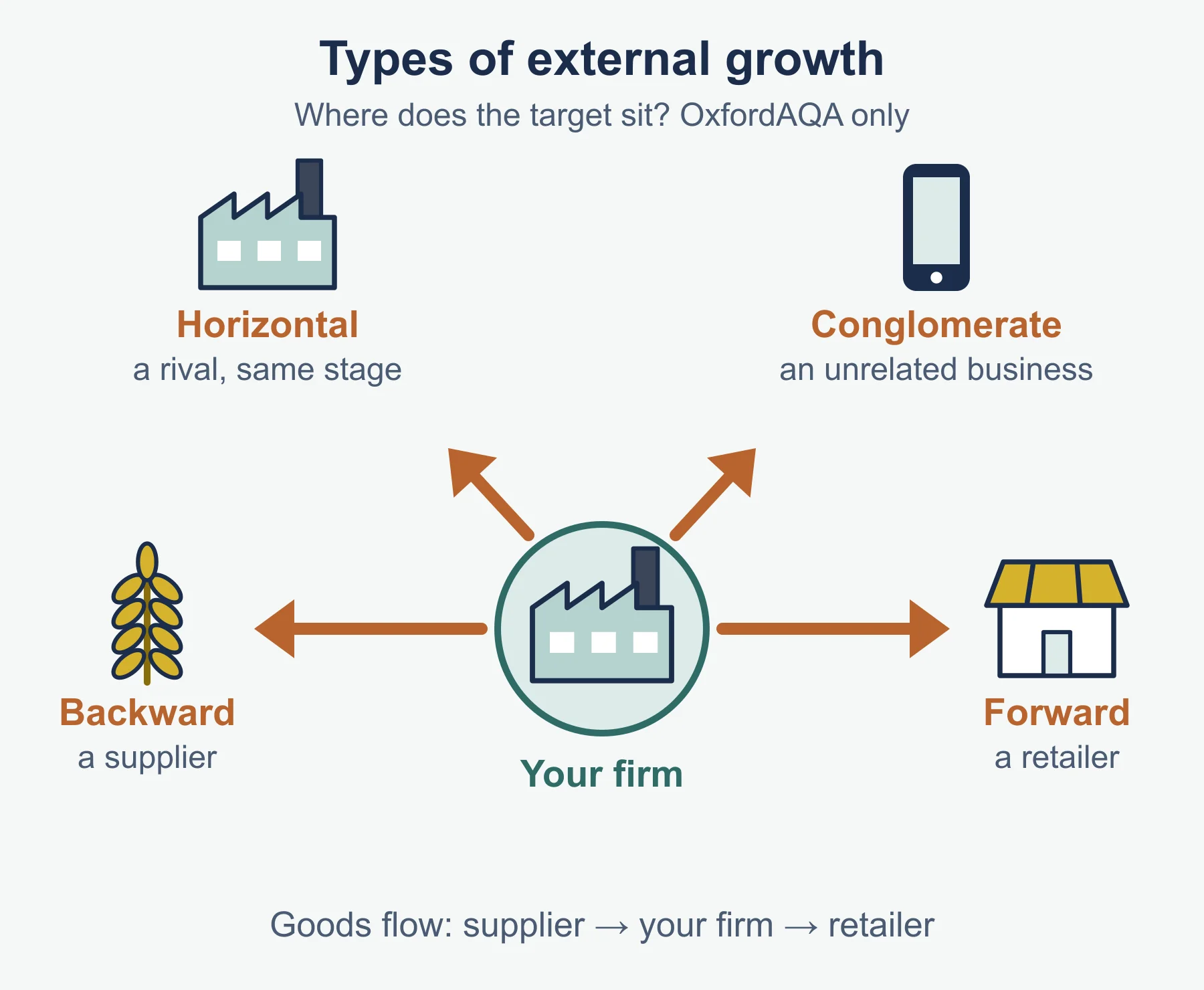
| Horizontal | Same industry, same stage |
| Vertical backward | Towards a supplier |
| Vertical forward | Towards customers |
| Conglomerate diversification | Unrelated industry |
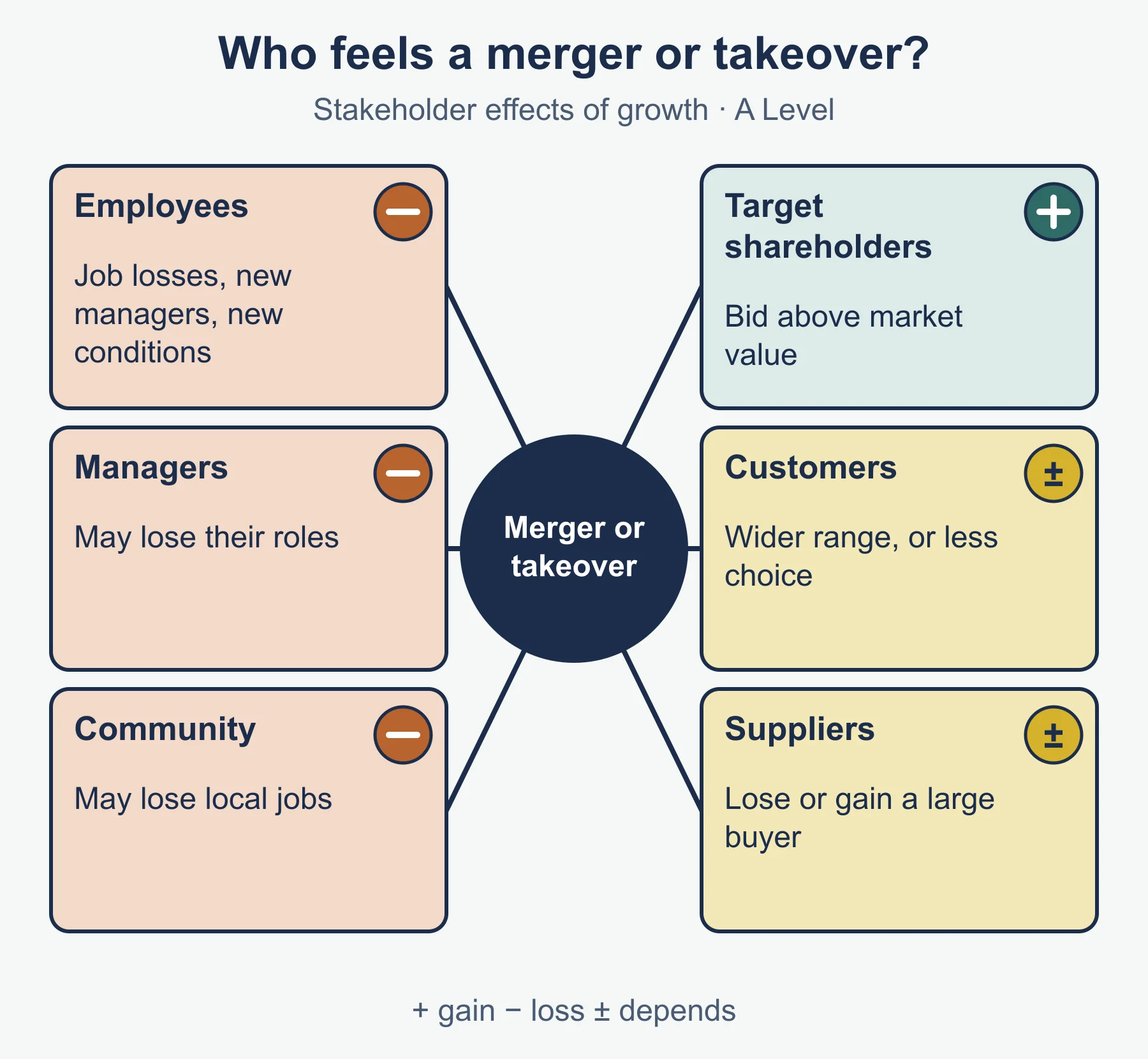
- Stakeholder effects: employees (jobs, conditions), target shareholders (price), customers (choice), suppliers (new or lost buyer), managers (roles), community (local jobs).
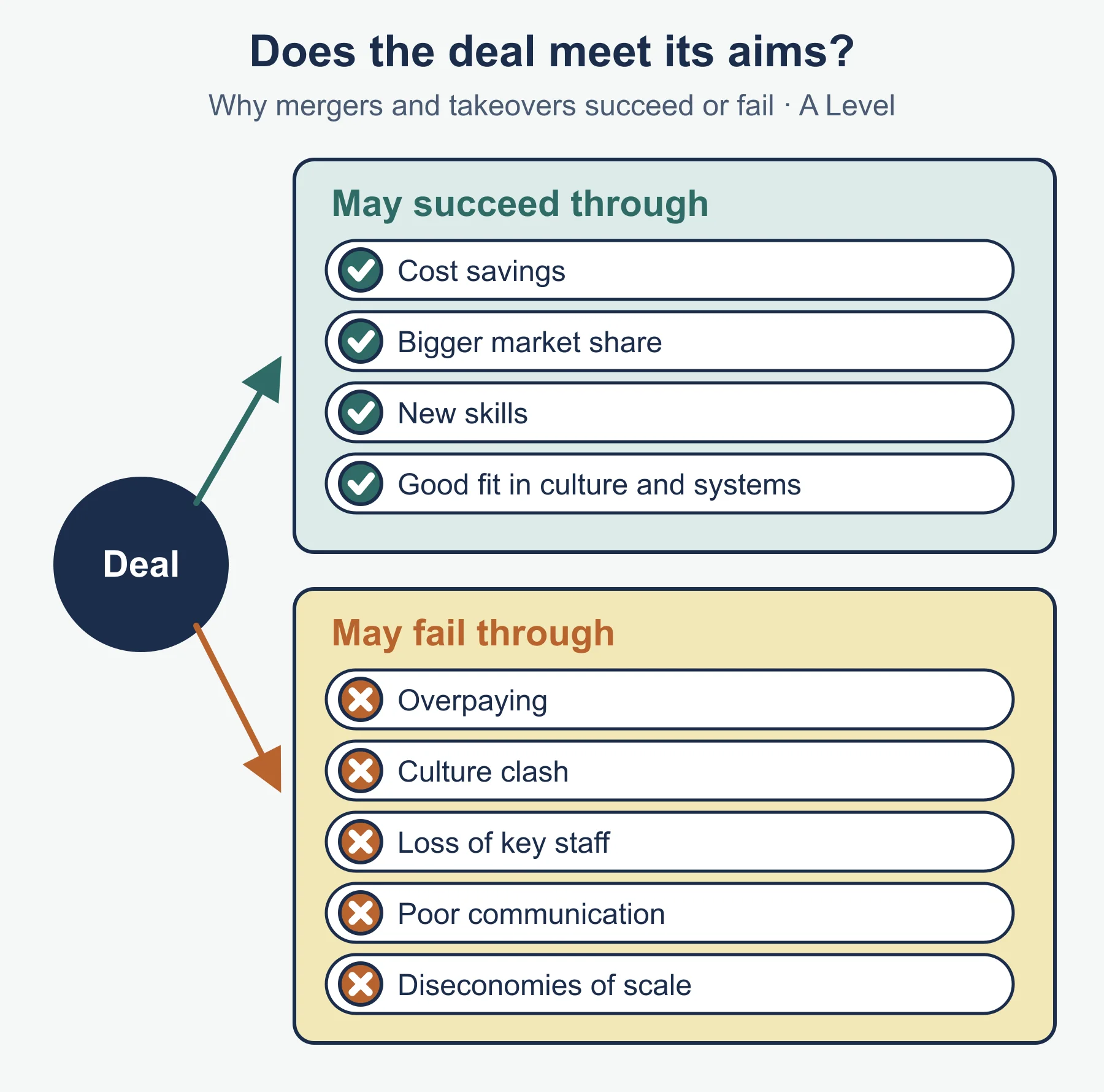
- Success factors: cost savings, bigger market share, new skills, good fit.
- Failure factors: overpaying, culture clash, loss of key staff, diseconomies of scale.
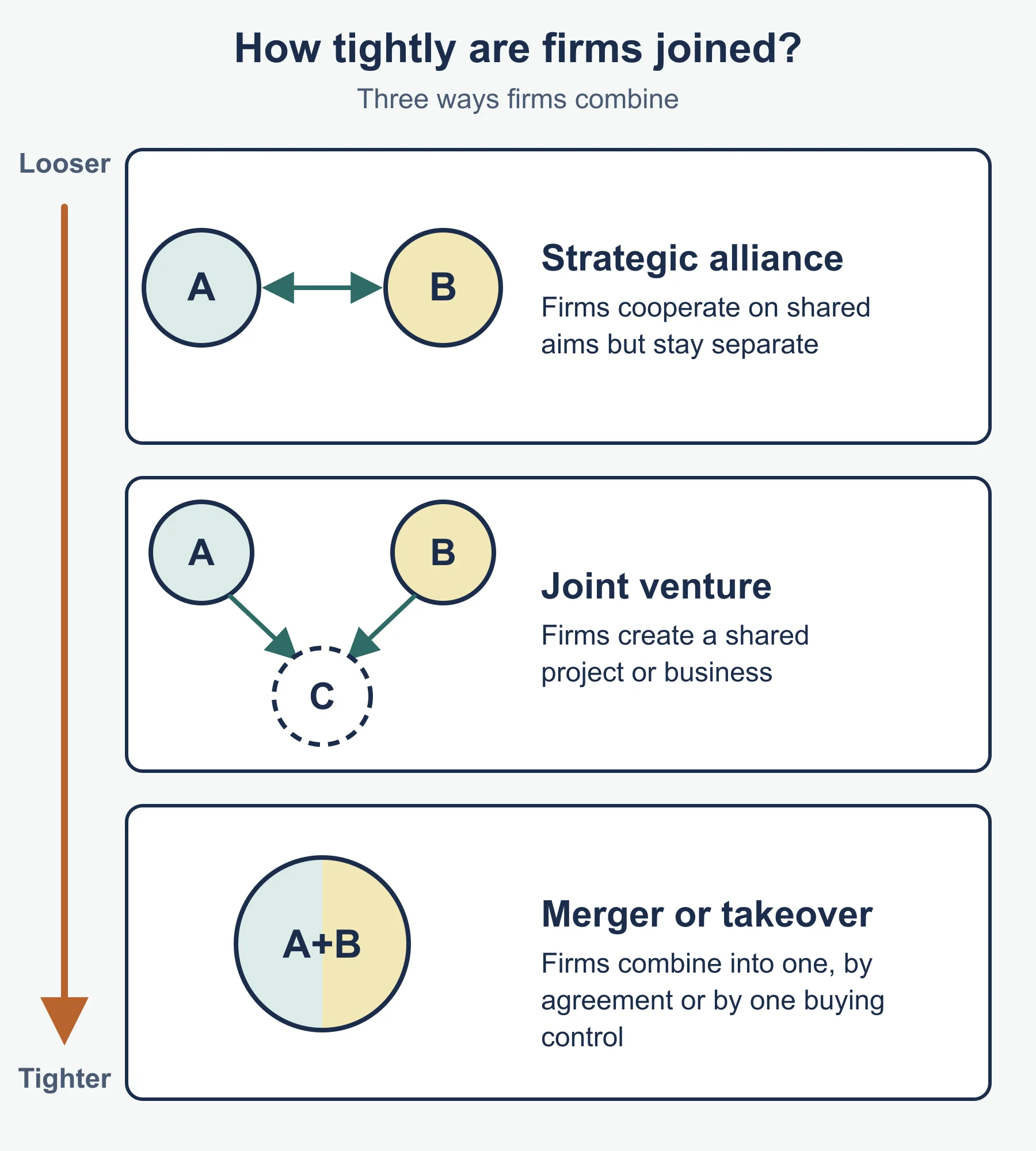
- Joint venture: a shared project or business. Strategic alliance: cooperation while staying separate. Both are cheaper and less committing than merging, but risk disputes and sharing know-how.
Method: judging a deal
- Identify the type of deal.
- State the objective, such as growth, cost saving or entry to a new market.
- Give one reason it could achieve the objective.
- Give one reason it might not.
- Judge, and state what the outcome depends on.
Must-know distinctions
- Merger and takeover: a merger is agreed by both sides; a takeover is one firm buying control, and may be friendly or hostile.
- Horizontal and vertical: horizontal joins firms at the same stage of production; vertical joins different stages of one chain.
- Joint venture and strategic alliance: a joint venture creates a shared project or business; an alliance is cooperation without a new shared entity.
- Organic and external growth: organic uses the firm’s own resources; external joins with, or buys, another firm.
- Private and public limited company: both give limited liability, but only a public limited company can sell shares to the general public on a stock exchange.
- Revenue and capital employed: revenue measures sales in a period; capital employed measures funds invested in the business.
- Franchise and co-operative: a franchise runs on a brand owner’s system and fees; a co-operative is run for its members.
Worked reminders
Sector shift. In an invented economy the tertiary share of employment rises from 38% to 58%. The change is 58 - 38 = 20 percentage points, not 20%. Say “percentage points” when comparing two shares.
Liability. A sole trader’s business owes £50,000 and its assets sell for £35,000. The shortfall is £15,000. Unlimited liability means that sum can be taken from personal assets. A limited company owner’s loss would stop at the money invested.
Choosing a size measure. A question about the number of jobs a firm provides points to employees. A question about financial strength points to revenue or capital employed. A question about competitive power points to market share. Always say why the chosen measure fits.
Spotting the growth type. Ask three questions. Is the target in the same industry? If yes, is it at the same stage of the chain (horizontal) or a different stage (vertical)? If it is in an unrelated industry, the move is conglomerate diversification. For vertical moves, ask whether the target supplies the buyer (backward) or is nearer the final customer (forward).
Quick self-test
- Which sector does a company selling weather-data analysis belong to?
- State the effect of limited liability on an owner’s personal assets.
- A firm has revenue of £6m in a market worth £40m. What is its market share?
- Revenue rises from £5.0m to £5.6m. What is the percentage growth?
- A firm has issued shares of £4m, reserves of £2.5m and non-current liabilities of £3m. What is its capital employed, using the syllabus finance formula?
- A baker buys a farm that grows its wheat. Name the type of growth.
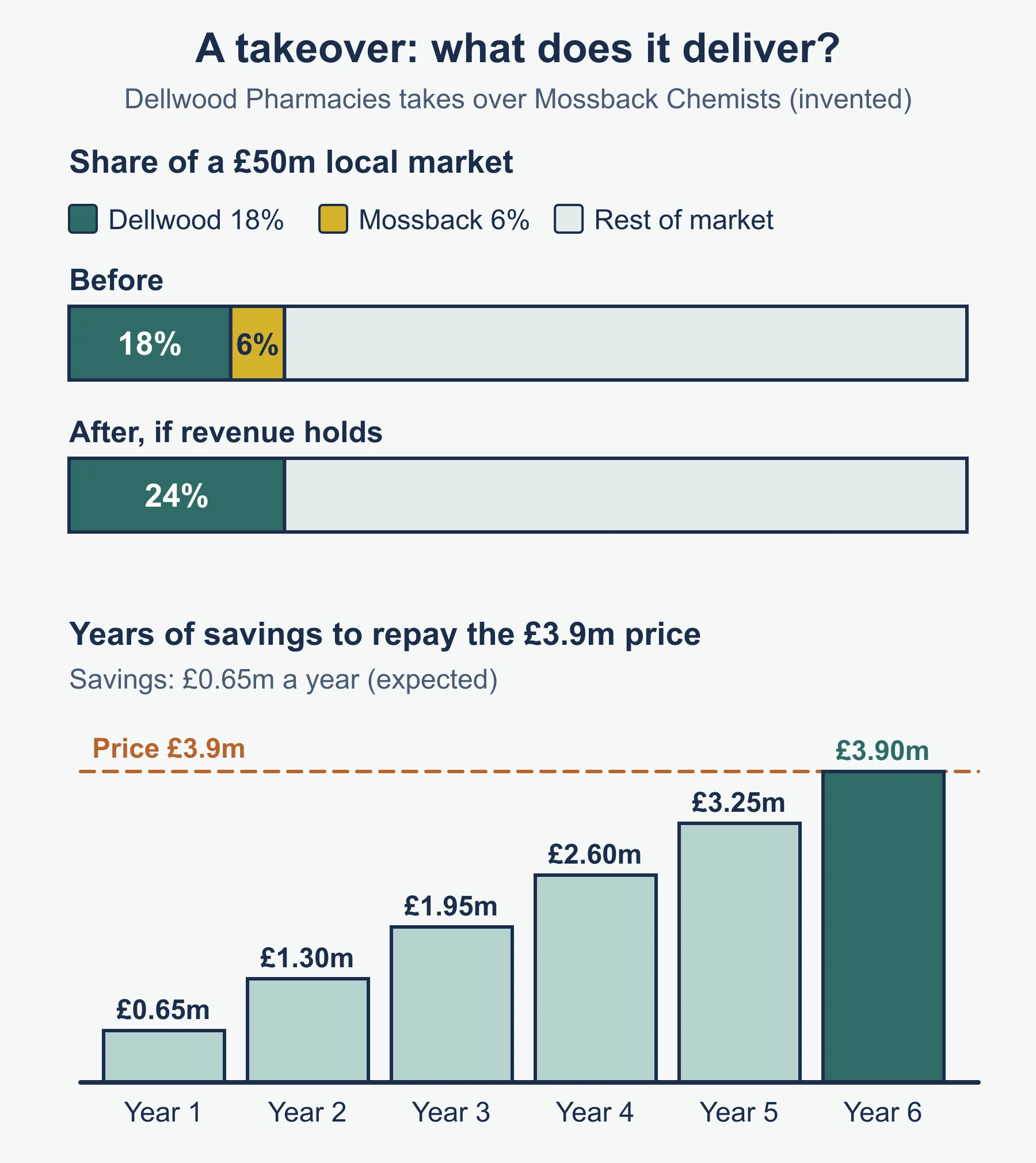
- Firm A has 15% of a market and merges with firm B with 9%. What is the combined share if sales hold?
- A takeover costs £2.4m and saves £0.6m a year. How many years of savings cover the price?
- Give one reason why a business might choose a strategic alliance rather than a merger.
- State one weakness of using employee numbers to measure size.
Answers
- Quaternary (knowledge and information).
- They can lose only what they invested; personal assets are protected.
- 6 ÷ 40 × 100 = 15%.
- (5.6 - 5.0) ÷ 5.0 × 100 = 12%.
- 4 + 2.5 + 3 = £9.5m.
- Vertical backward (towards the supplier).
- 15% + 9% = 24%.
- 2.4 ÷ 0.6 = 4 years.
- It gives access to skills or markets with less cost and commitment, and the firms stay separate.
- It understates the size of capital-intensive firms that need few workers.
Where marks are usually lost
- Describing an ownership form instead of applying it to the business in the question.
- Confusing unlimited liability with the business being unable to fail.
- Mixing up backward and forward integration. Backward is towards the supplier.
- Giving reasons for a sector shift when consequences were asked for, or the reverse.
- Choosing one size measure without saying why it suits the question.
- Answering an evaluate question with one side only and no judgement.
- Listing stakeholders affected by a takeover without saying how each is affected.
- Saying a merger always saves money. It depends on fit, price and integration.
Frequently asked questions
What is the quaternary sector? The quaternary sector is knowledge and information activity, such as research, data analysis and software. Cambridge AS and A Level Business 9609 uses four sectors: primary, secondary, tertiary and quaternary.
What is the difference between a joint venture and a strategic alliance? In a joint venture, firms create a shared project or business, often sharing its ownership. A strategic alliance is cooperation between firms without forming a new shared business.
How can you measure the size of a business? Common measures are number of employees, revenue, capital employed and market share. Each has a weakness, so choose the measure that suits the question, for example employees for a question about jobs.
Why do some mergers and takeovers fail? Common reasons are overpaying for the target, culture clashes, loss of key staff and diseconomies of scale. Success depends on fit, price and how well the businesses are integrated.
Official syllabus
Cambridge International AS & A Level Business 9609 syllabus for examination in 2026, 2027 and 2028, published by Cambridge University Press & Assessment (Cambridge International Education).
Get free revision emails (optional)
Occasional emails with practice questions, worked explanations and links to free resources for the qualification and subjects you choose. No spam, and you can unsubscribe from any email. The free tools on this site never need an email.
Related resources
-
Study guides
A Level Business: Enterprise (Cambridge 9609)
Study guide to section 1.1 Enterprise of Cambridge AS & A Level Business 9609: business activity, entrepreneurs, intrapreneurs and business plans.
Business · Cambridge · AS Level
Read guide -
Practice questions
A Level Business: Enterprise (Cambridge 9609) – Practice Questions
Original practice questions with worked answers on 1.1 Enterprise for Cambridge AS & A Level Business 9609: short answer, calculation and case study.
Business · Cambridge · AS Level
Try questions -
Revision notes
A Level Business: Enterprise (Cambridge 9609) – Revision Notes
Condensed revision notes for 1.1 Enterprise in Cambridge AS & A Level Business 9609, with a self-test and the usual ways marks are lost.
Business · Cambridge · AS Level
Revise topic
Related articles
-
teaching
A Level tuition in Dubai: Cambridge or Pearson Edexcel International A Level?
Schools in Dubai and Abu Dhabi teach either Cambridge International AS & A Level or Pearson Edexcel International A Level. How the two are structured, why it matters for tuition, and how online classes from Lahore work.
9 October 2026
-
curriculum guides
Choosing subjects at IGCSE and A Level
How subject choices at 14 and 16 affect university options later, and how to keep pathways open without overloading a timetable.
28 July 2026
Studying this with a teacher
Working through Business AS LEVEL?
This page is free and stays free. If you would rather be taught it, Marlbridge runs Business classes one-to-one and in small groups of up to 15, online in your own time zone. The first trial class is free. WhatsApp replies within an hour (8am–11pm Pakistan time, every day); email the same day.
Cambridge Business teachers at Marlbridge

