
Study Guides
A Level Business: Business objectives and Stakeholders in a business (Cambridge 9609)
Step-by-step guide to business objectives and stakeholders for Cambridge AS & A Level Business 9609, sections 1.4 and 1.5, with worked examples.
- Subject
- Business
- Level
- AS LEVEL
- Topic
- Business and its environment
- Author
- Marlbridge Academic Team
- Updated
- Reviewed by
- Salman Ahmad (what this means)
Aligned to Cambridge A Level Business (9609), For examination in 2026, 2027 and 2028. Official specification .
Syllabus page (what it covers and how it is assessed): Cambridge A Level Business.
Syllabus points this page covers
9609 (AS Level)
- 1.4 Business objectives
- 1.5 Stakeholders in a business
Found an error? Report a correction.
Need help with this topic? Request a free trial class for A Level Business (9609).
This guide teaches sections 1.4 (Business objectives) and 1.5 (Stakeholders in a business) of the Cambridge International AS & A Level Business 9609 syllabus for examination in 2026, 2027 and 2028. Both sections sit in AS Level topic 1, Business and its environment, and A Level candidates also need them. Every point the syllabus lists is covered below, each with its own heading, and the examples use invented businesses.
Go to the Cambridge A Level Business hub for the full course, tick off points on the printable checklist, and use the free 10-minute diagnostics to find weak spots. The companion pages are the revision notes and the practice questions. For the whole of topic 1 see the topic overview guide, revision notes and practice paper.
What the syllabus lists
| Section | Points you must be able to handle |
|---|---|
| 1.4.1 | Objectives in the private sector, public sector and social enterprises; why objectives matter; CSR and the triple bottom line; mission statement, aims, objectives, strategy and tactics |
| 1.4.2 | Stages of decision-making and the role of objectives; objectives changing over time; targets and budgets; communicating objectives and the effect on the workforce; SMART; ethics |
| 1.5.1 | Stakeholders as individuals or groups with an interest; internal and external; roles, rights and responsibilities |
| 1.5.2 | Impact of decisions and reactions; impact of stakeholder aims; accountability; conflict between aims; effect of changing objectives |
1.4.1 Objectives by type of organisation
An objective is a specific goal that a business sets itself to achieve. The syllabus asks about three kinds of organisation.
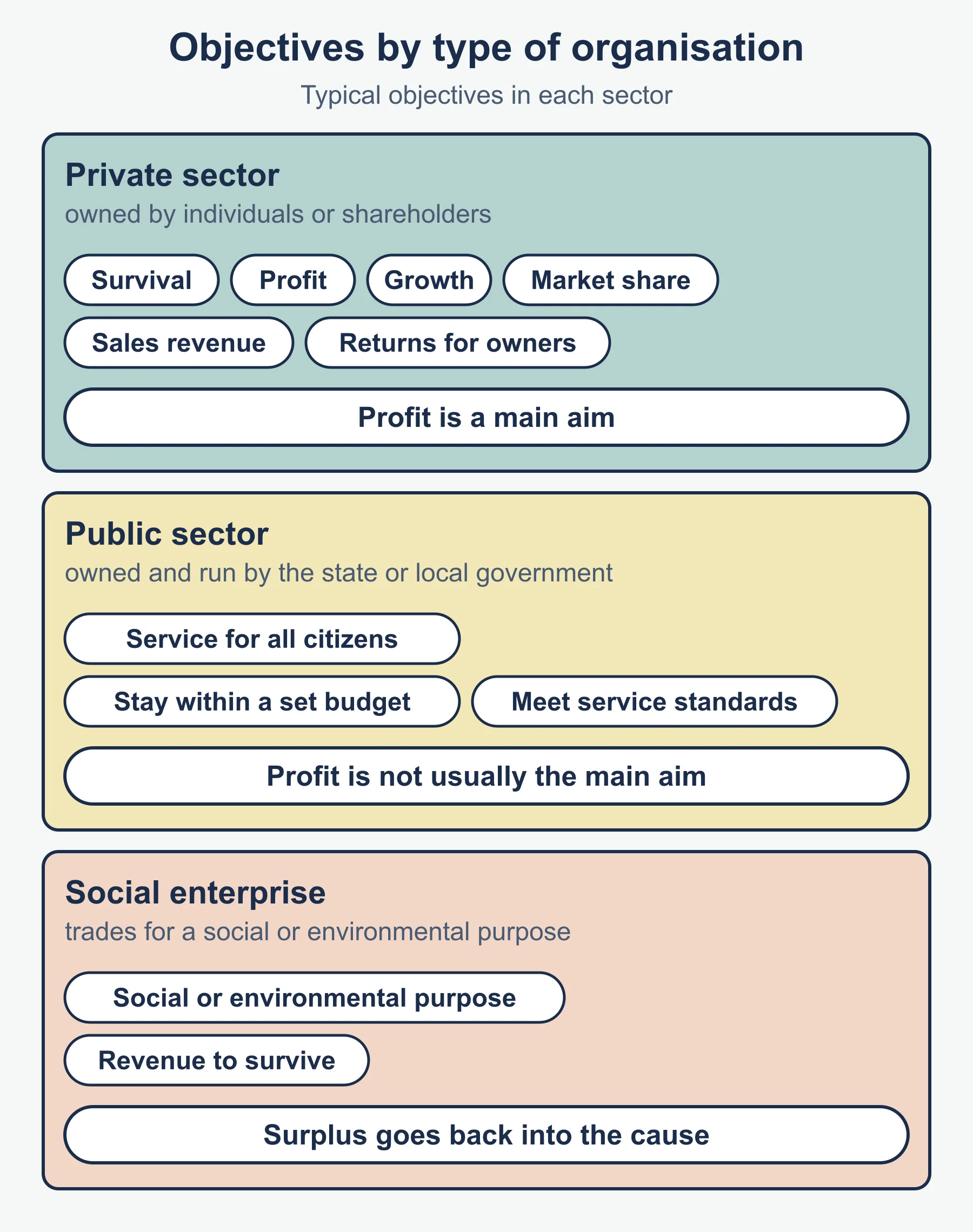
- Private-sector businesses are owned by individuals or shareholders. Typical objectives are survival, profit, growth, market share, sales revenue and returns for owners.
- Public-sector organisations are owned and run by the state or local government. Typical objectives are providing a service to all citizens, keeping within a set budget, and meeting service standards. Profit is usually not the main aim.
- Social enterprises trade to meet a social or environmental purpose. They need revenue to survive, but they put most of their surplus back into the cause rather than paying it out to owners.
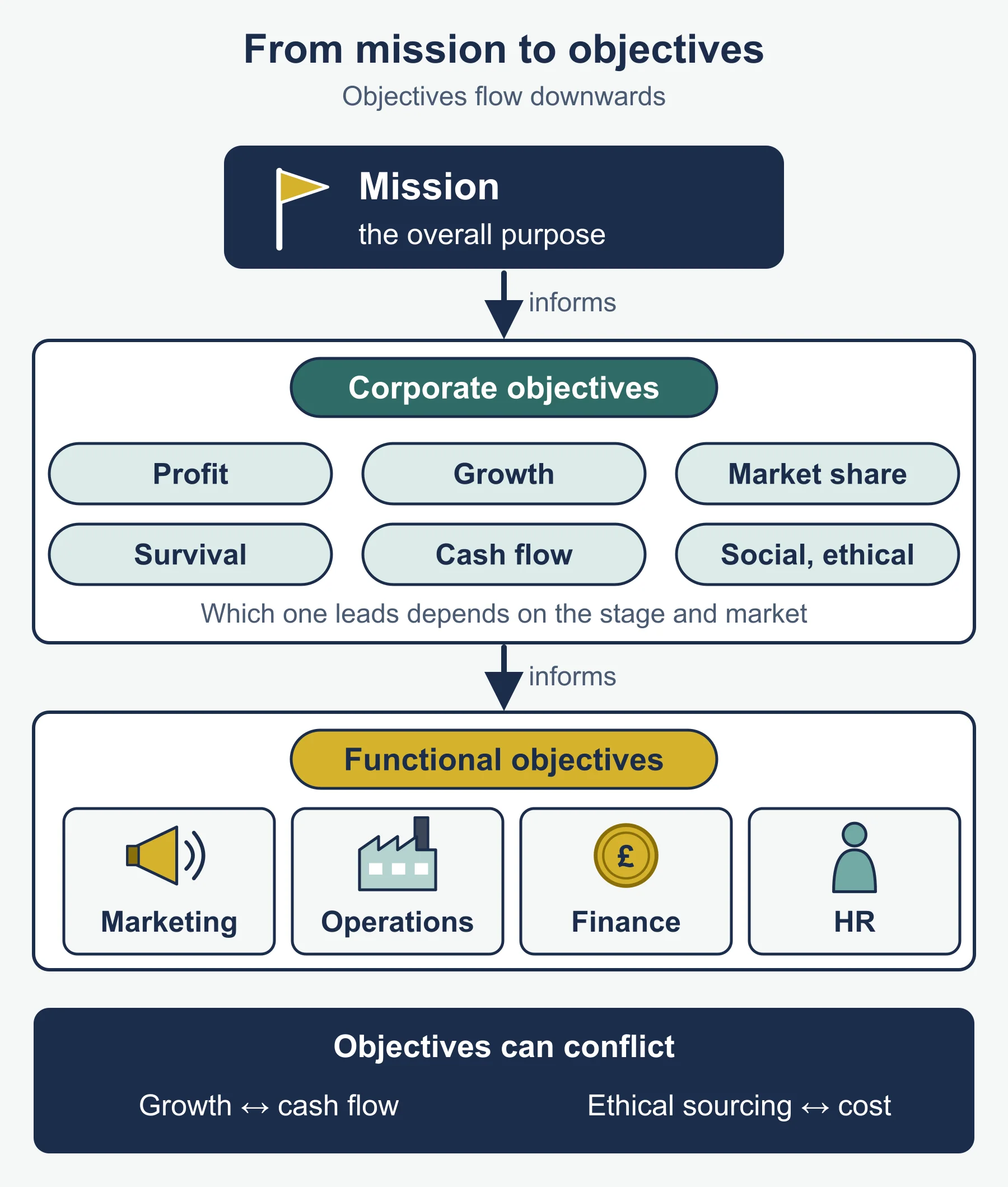
Objectives matter because they give direction, let managers judge success, support motivation, and keep departments pulling the same way. Without them, a decision has nothing to be tested against.
Corporate social responsibility and the triple bottom line
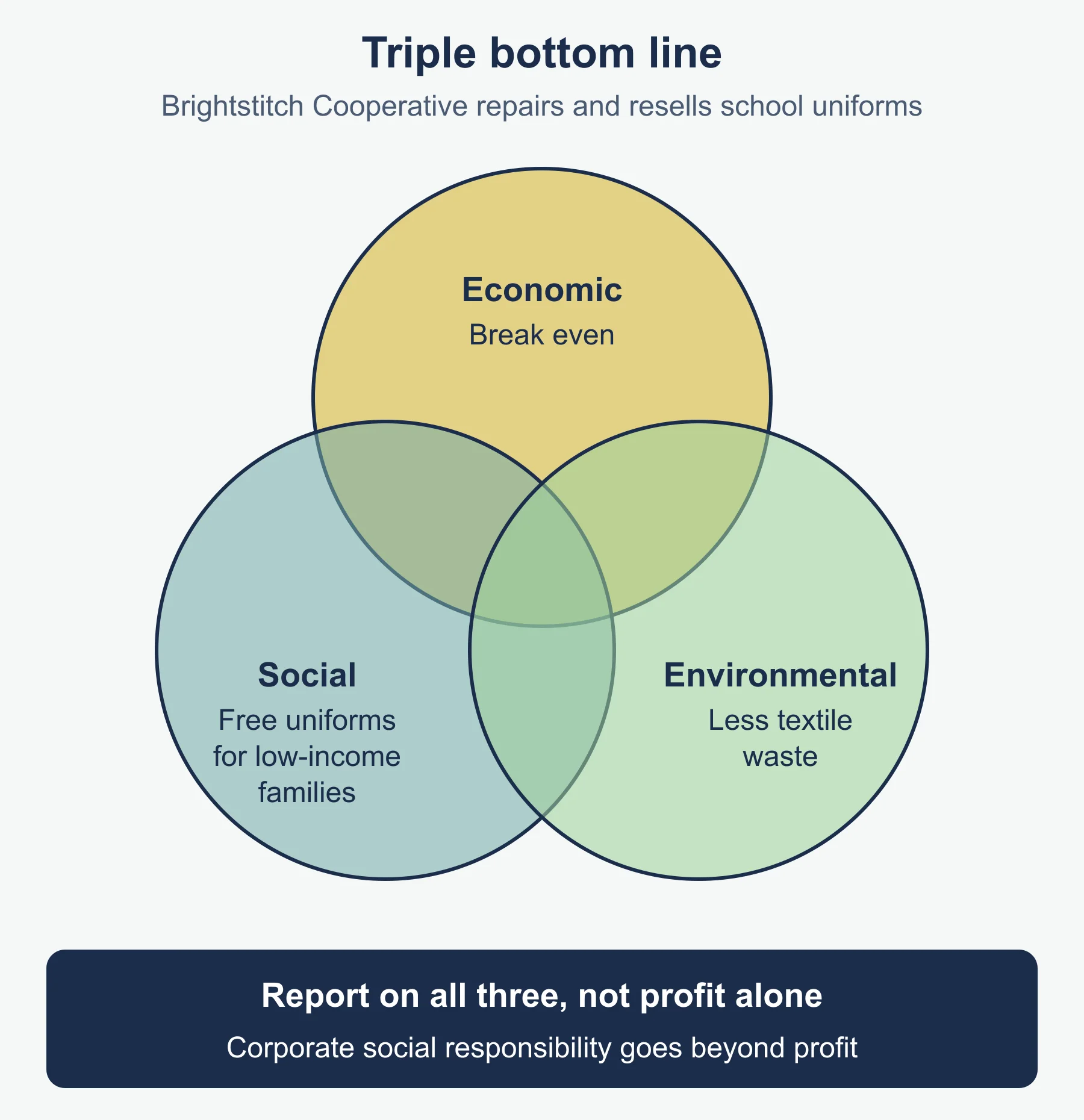
Corporate social responsibility (CSR) means a business accepts responsibilities to society beyond making a profit. The triple bottom line judges performance on three sets of objectives: economic (financial), social and environmental. A business using it reports on all three, not profit alone.
Mission statement, aims, objectives, strategy and tactics
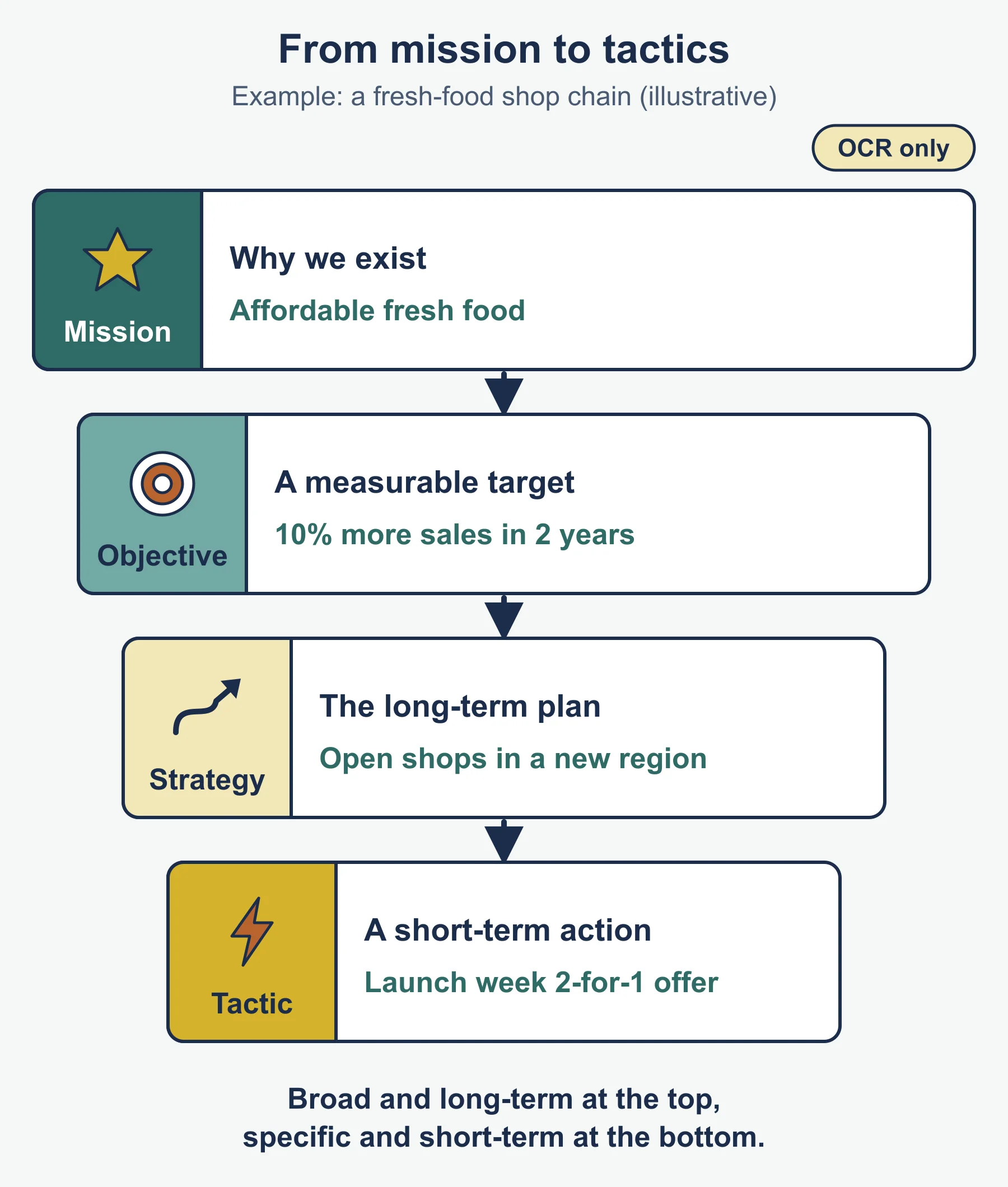
These form a chain from the broad to the specific.
| Level | Meaning | Example (Sundrift Stationery) |
|---|---|---|
| Mission statement | The overall purpose and values | “Make good paper goods that last” |
| Aim | A broad long-term intention | Become the leading independent stationery brand in the region |
| Objective | A measurable goal | Raise sales revenue by 15% within 12 months |
| Strategy | The long-term plan to reach the objective | Expand into corporate gift orders |
| Tactics | Short-term actions that carry out the strategy | A launch discount for the first 20 corporate customers |
A common error is to treat a mission statement as a target. It has no number and no deadline.
1.4.2 Objectives and business decisions
Stages of decision-making
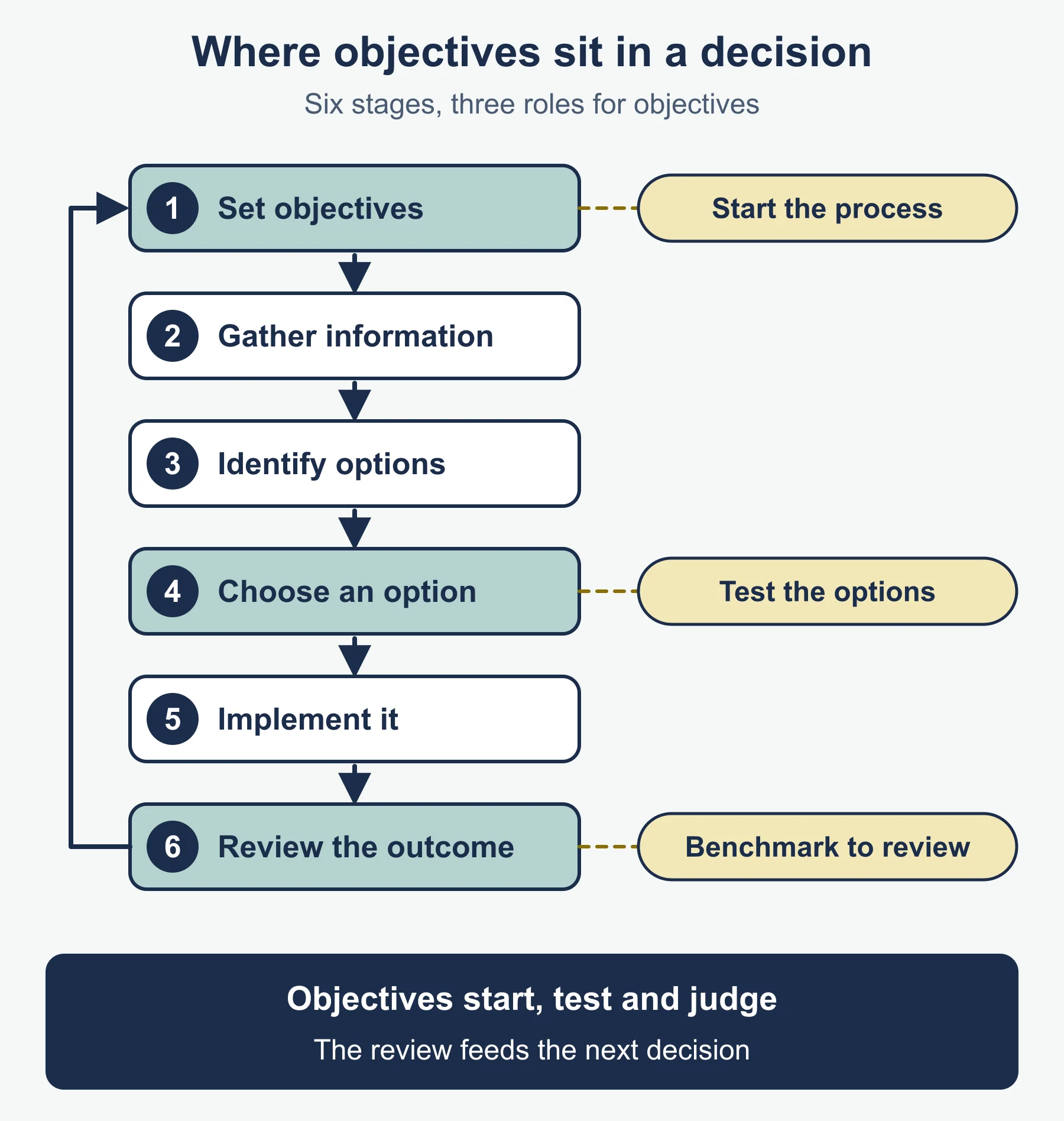
The syllabus asks for the stages and the role of objectives in them. Textbooks describe the stages in slightly different ways, so this is a standard form: set objectives, gather information, identify options, choose an option, implement it, and review the outcome. Objectives matter at three points. They start the process, they act as the test when options are compared, and they are the benchmark in the final review.
How objectives change over time
Objectives are not fixed. A business may change them because of:
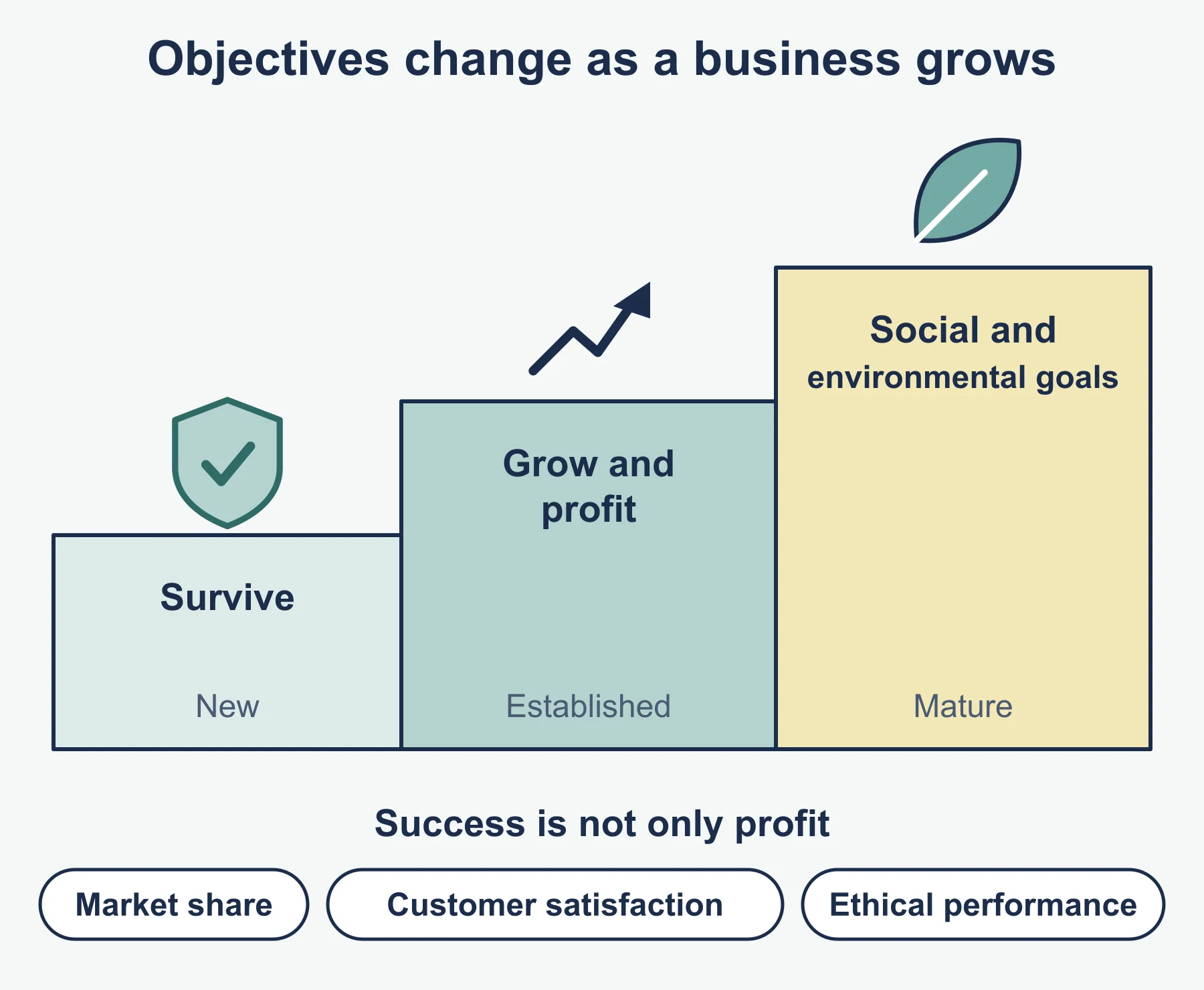
- its stage of development (survival first, then growth or market share);
- a recession or a boom;
- new competitors or new technology;
- a change of owner, manager or law;
- pressure from stakeholders.
Translating objectives into targets and budgets
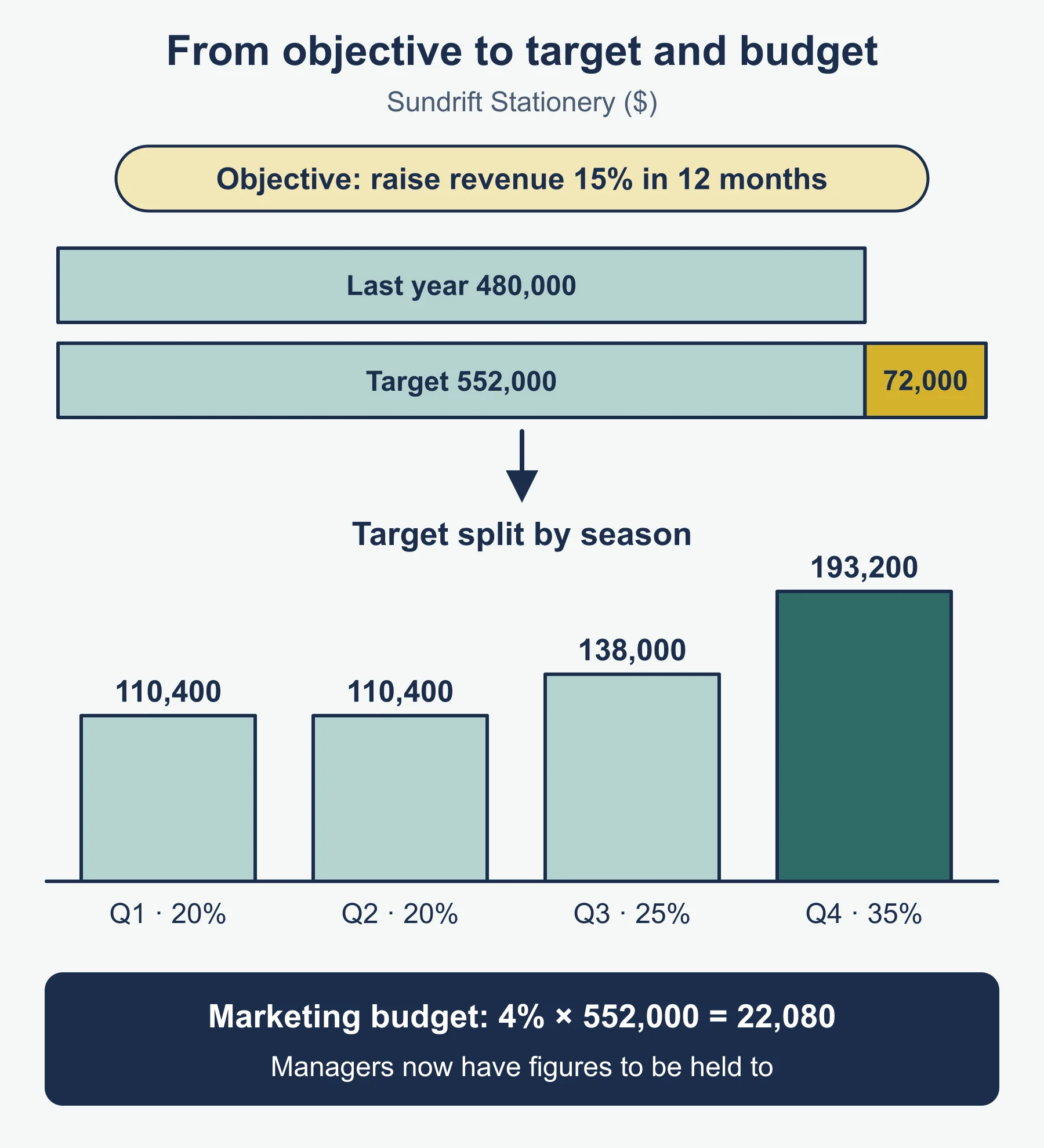
A target breaks an objective into figures for a department, product or period. A budget is a financial plan setting the money available or expected.
Worked example. Sundrift Stationery had sales revenue of $480,000 last year. Its objective is a 15% rise within 12 months.
- Revenue target: 480,000 × 1.15 = 552,000.
- Quarterly targets, using the seasonal pattern of 20%, 20%, 25% and 35%: 110,400, 110,400, 138,000 and 193,200. These add back to 552,000.
- A marketing budget set at 4% of the target: 0.04 × 552,000 = 22,080.
The managers now have figures they can be held to, and the review stage can compare actual results with them.
Communicating objectives and the effect on the workforce
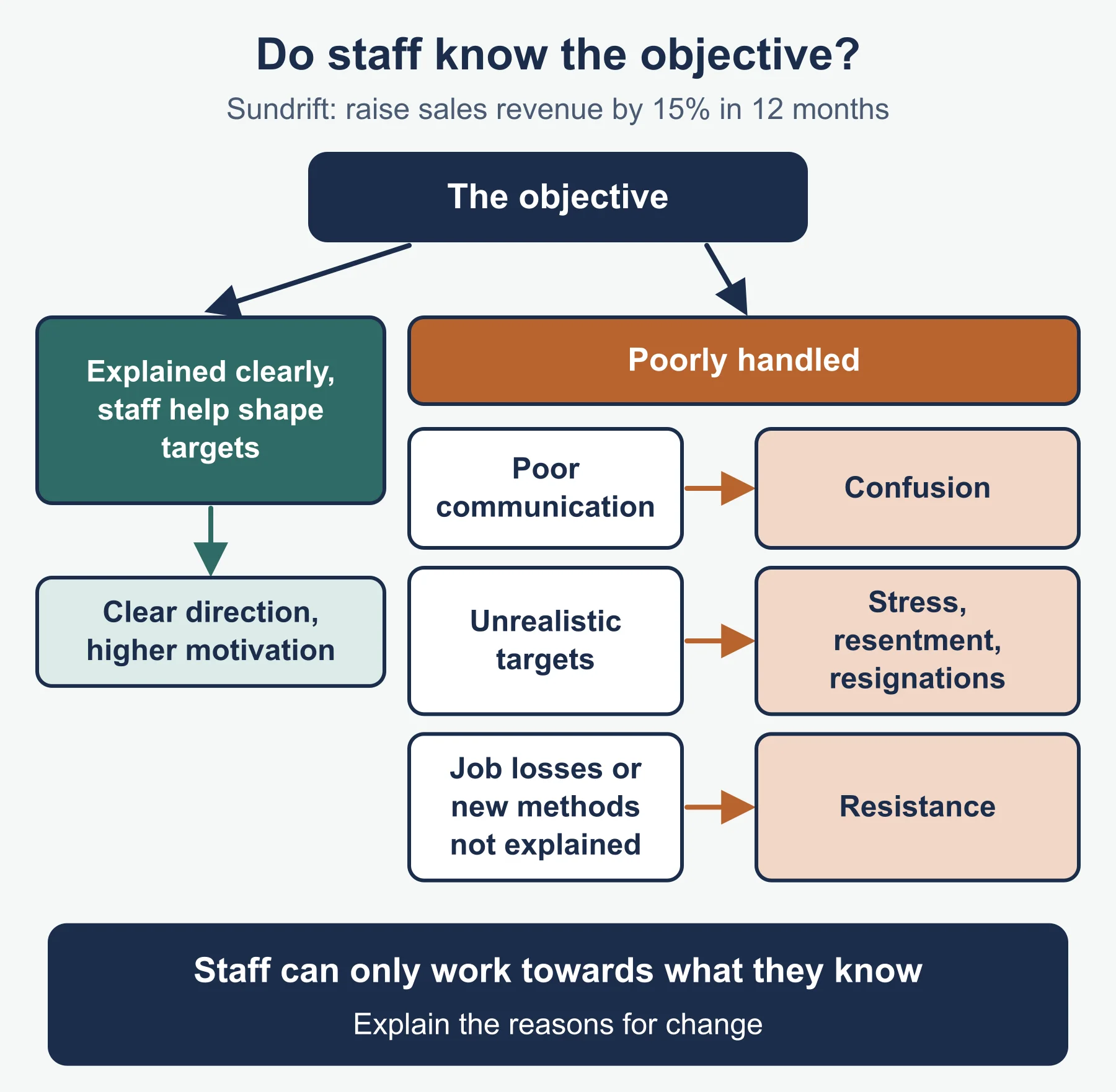
Employees can only work towards objectives they know about. Clear communication gives direction and can raise motivation, particularly if staff help shape the targets. Poor communication causes confusion, and unrealistic targets can cause stress, resentment or resignations. If an objective means job losses or a new way of working, staff are likely to resist unless the reasons are explained.
SMART objectives
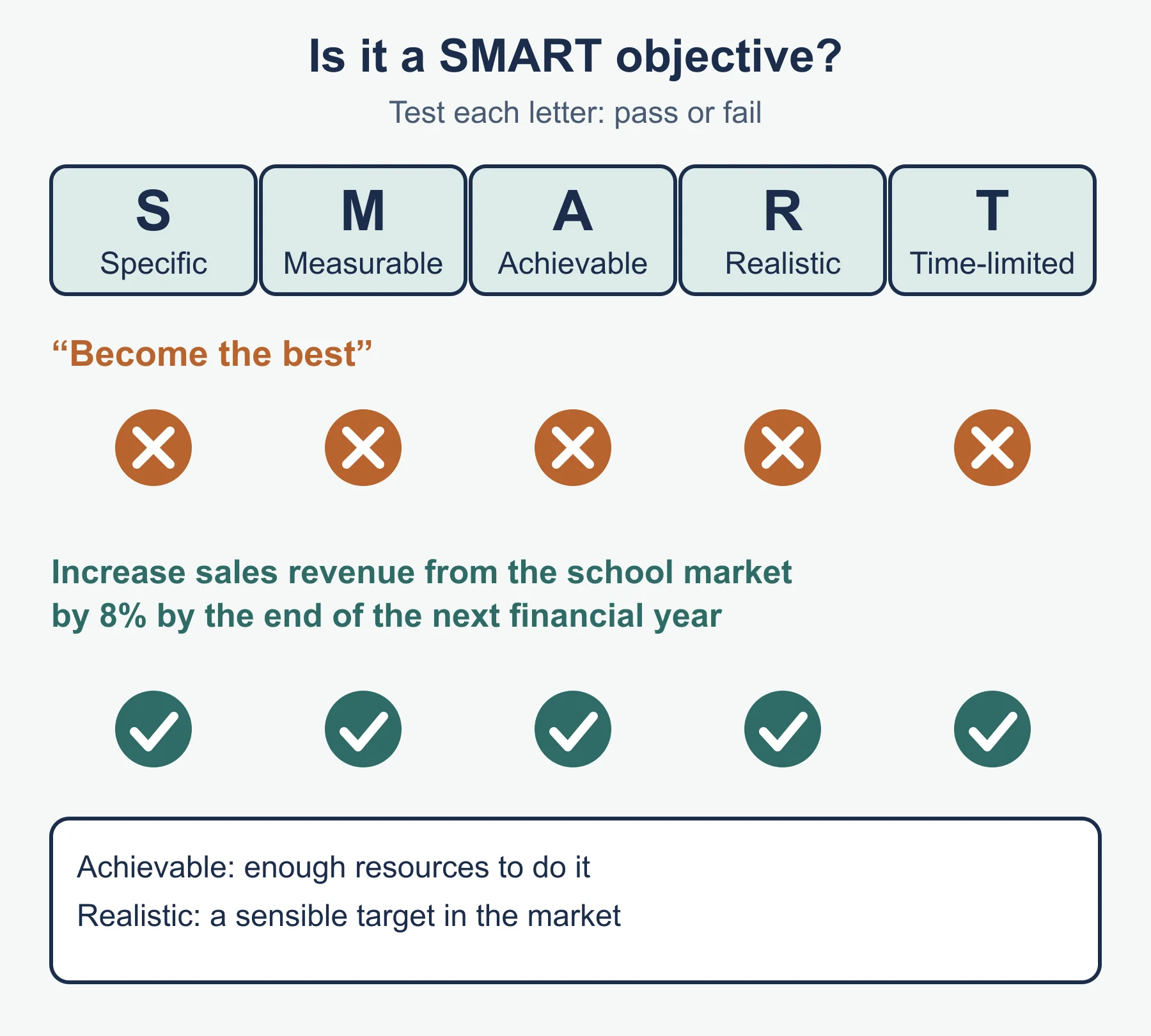
A SMART objective is specific, measurable, achievable, realistic and time-limited. “Become the best” fails every test. “Increase sales revenue from the school market by 8% by the end of the next financial year” passes. Be ready to say which element of a given objective is missing, and note that “achievable” and “realistic” overlap, so use the context to separate them: achievable concerns resources, realistic concerns whether the target is sensible in the market.
Ethics
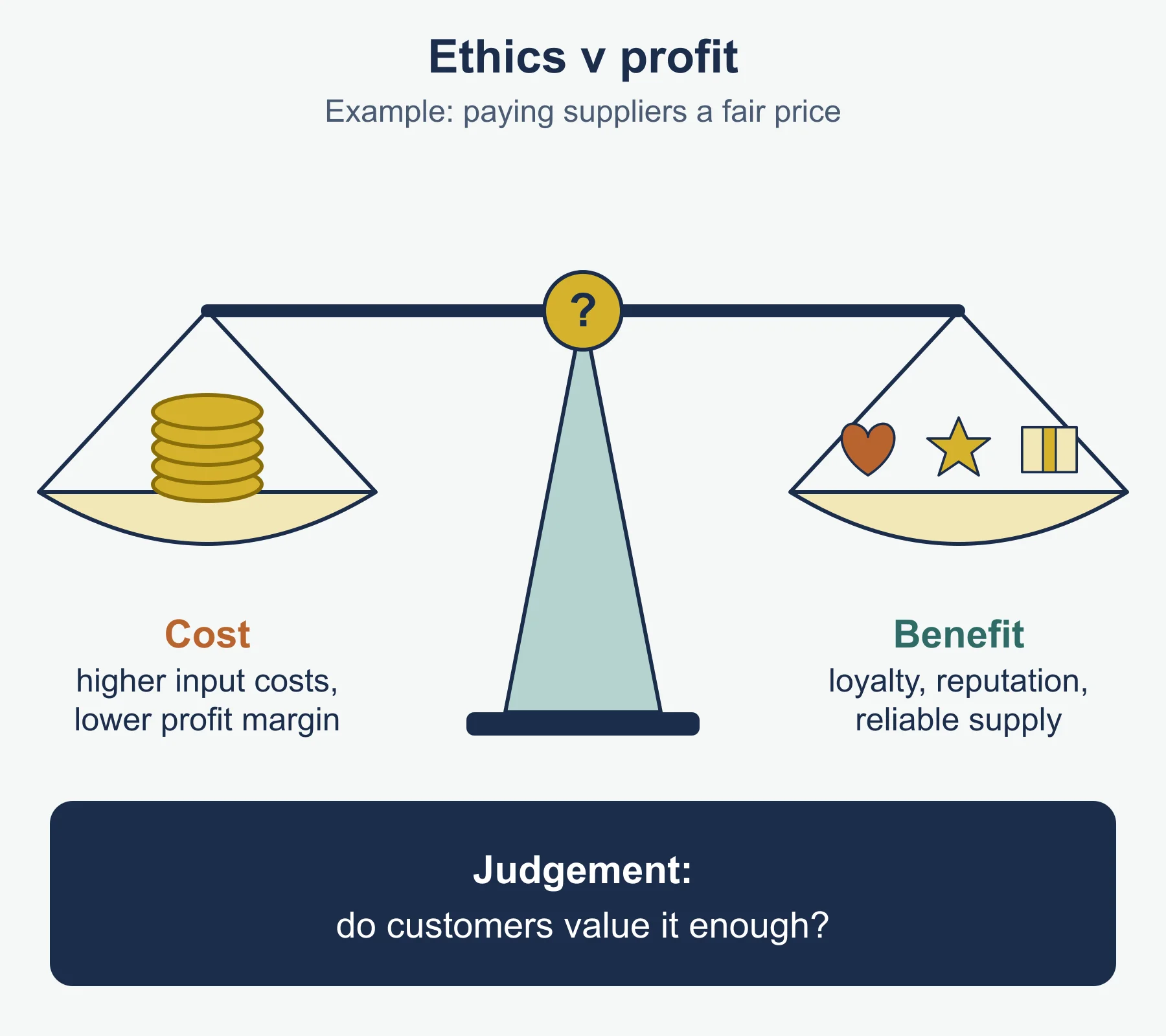
Ethics are the moral principles that guide behaviour. They can shape objectives, for example by rejecting profit from unsafe products, and they can shape activities, such as fair pay for suppliers. An ethical stance may raise costs or limit sales in the short term. It can also build reputation and customer loyalty.
1.5.1 Business stakeholders
A stakeholder is an individual or group with an interest in the activities of a business. Shareholders are one group among many.
| Type | Examples |
|---|---|
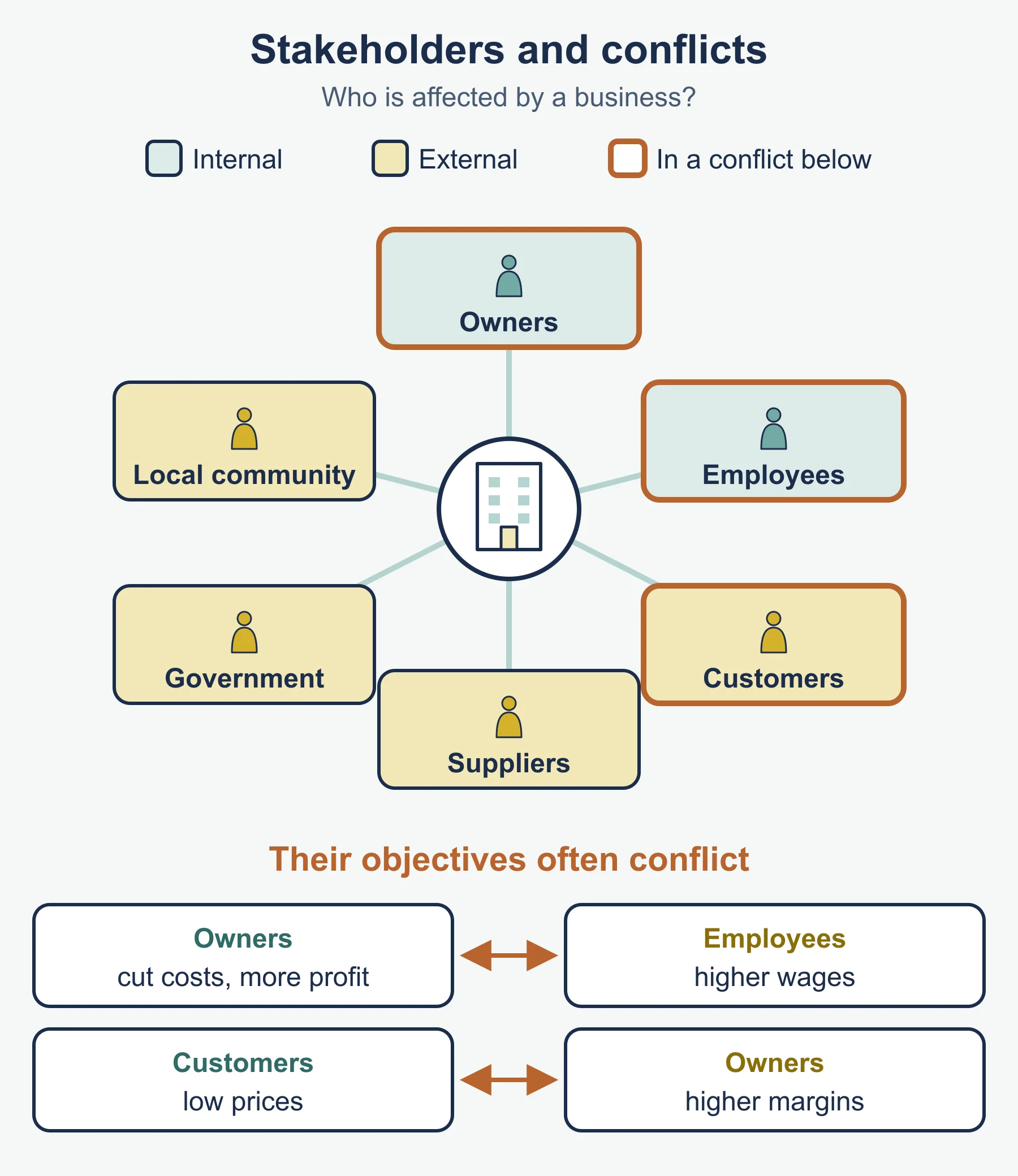
| Internal (inside the business) | Owners and shareholders, directors and managers, employees |
| External (outside it) | Customers, suppliers, lenders, government, local community, pressure groups |
Owners can be classed as internal because they work in or control the business. Some books place shareholders of a large company outside day-to-day operations, so say how you are classing them if the context is unclear.
Roles, rights and responsibilities
| Stakeholder | Role | Rights | Responsibilities |
|---|---|---|---|
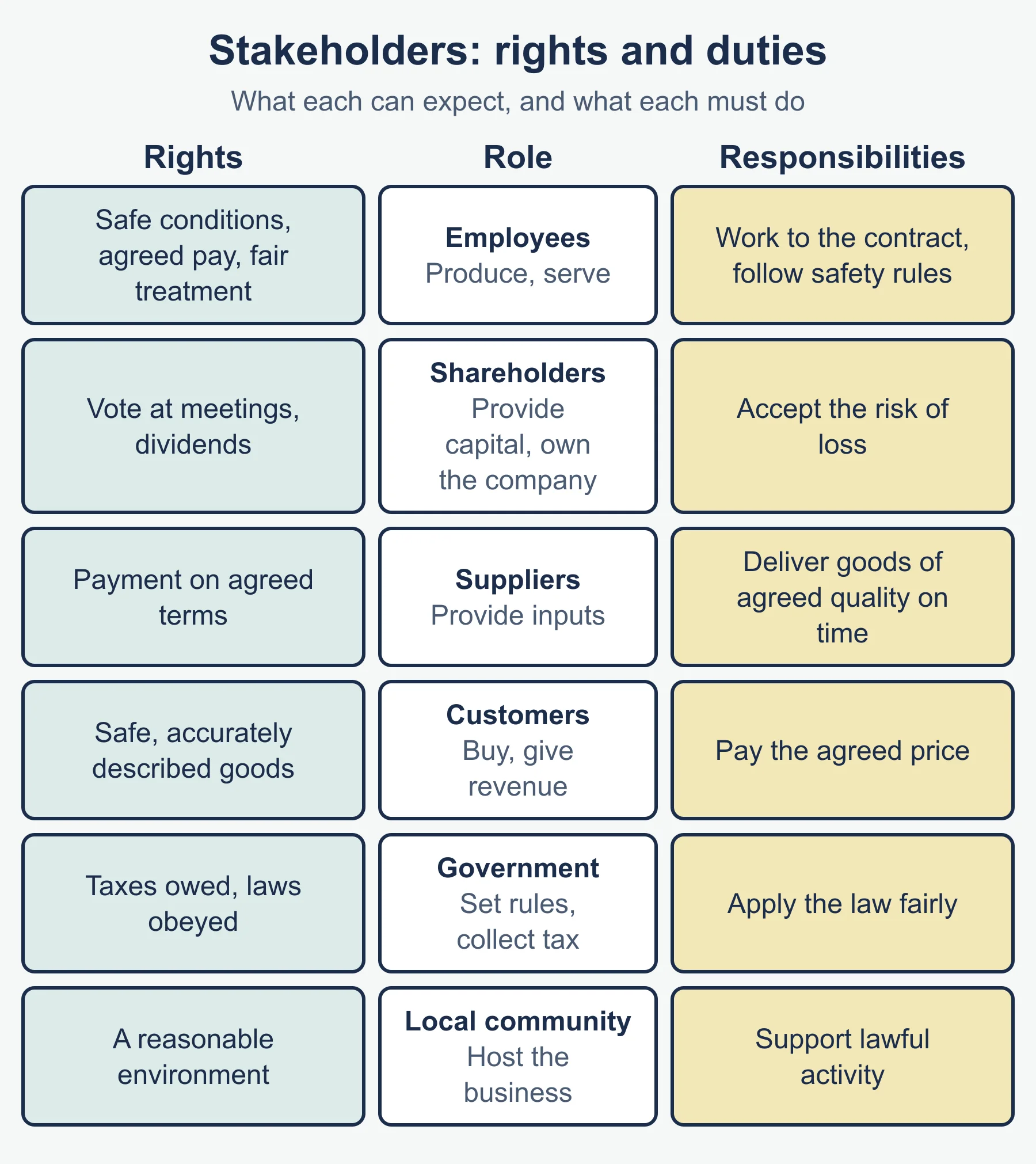
| Employees | Produce and serve | Safe conditions, agreed pay, fair treatment | Work to the contract, follow safety rules |
| Shareholders | Provide capital and own the company | Vote at meetings, share in profits through dividends | Accept the risk of loss |
| Suppliers | Provide inputs | Payment on agreed terms | Deliver goods of agreed quality on time |
| Customers | Buy and give revenue | Safe, accurately described goods | Pay the agreed price |
| Government | Sets rules and collects tax | Taxes owed, laws obeyed | Apply the law fairly |
| Local community | Hosts the business | A reasonable environment | Support lawful activity |
Keep legal rights general. Name the right, not a statute.
1.5.2 Relative importance, influence and accountability
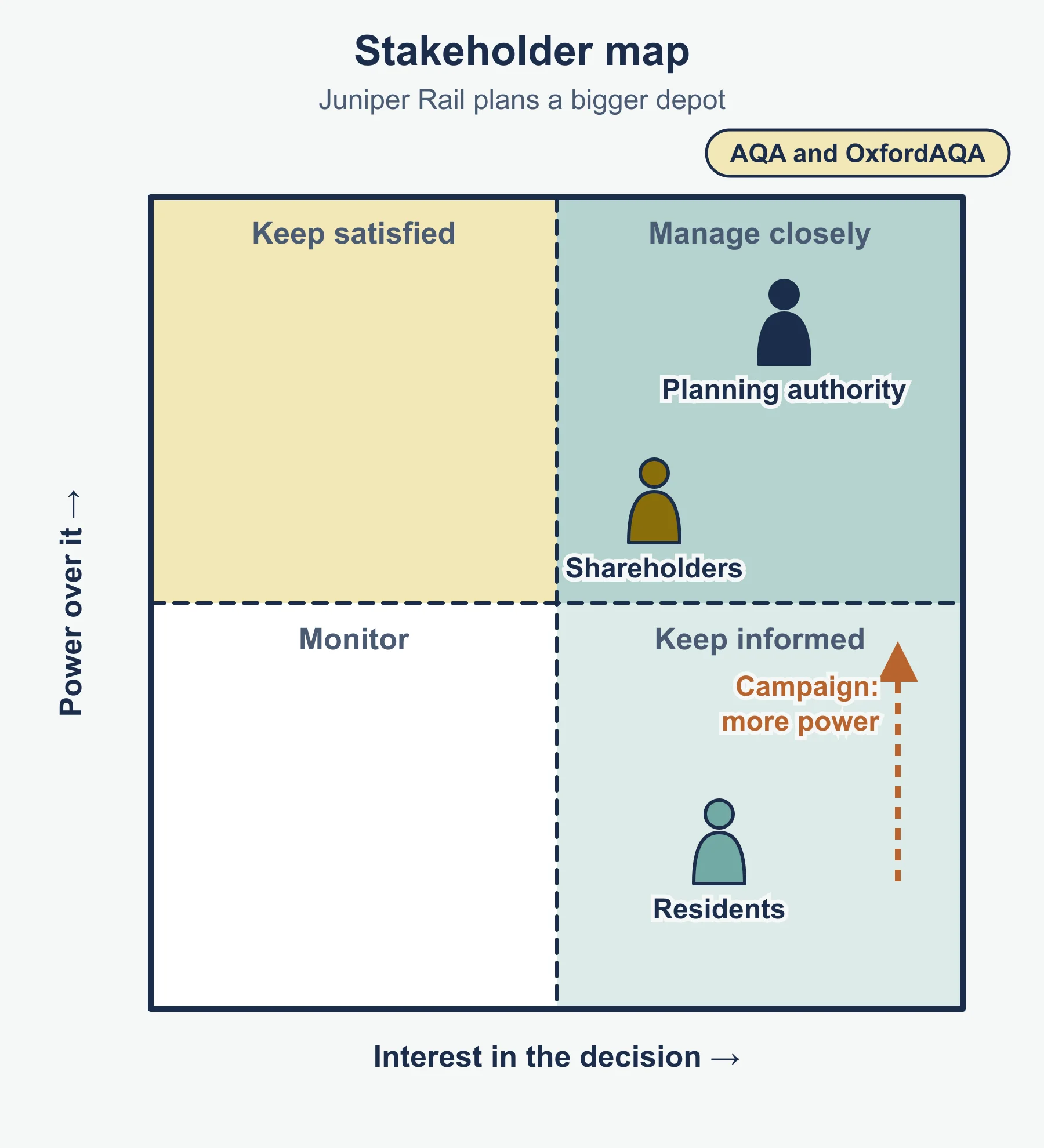
Stakeholders differ in their influence (power to affect the decision) and in how much a decision affects them. A major lender, a large customer or the government usually has more influence than a small community group, though a well-organised campaign can change that.
Impact of decisions and reactions
For any decision, ask who gains, who loses, and what each group can do about it. Reactions range from support, to complaints, to withdrawing something the business needs: labour, custom, credit or supply.
Impact of stakeholder aims on decisions
Stakeholders also shape decisions before they are made. Lenders may refuse finance for a risky plan, and customers’ tastes decide which products are worth launching.
Accountability
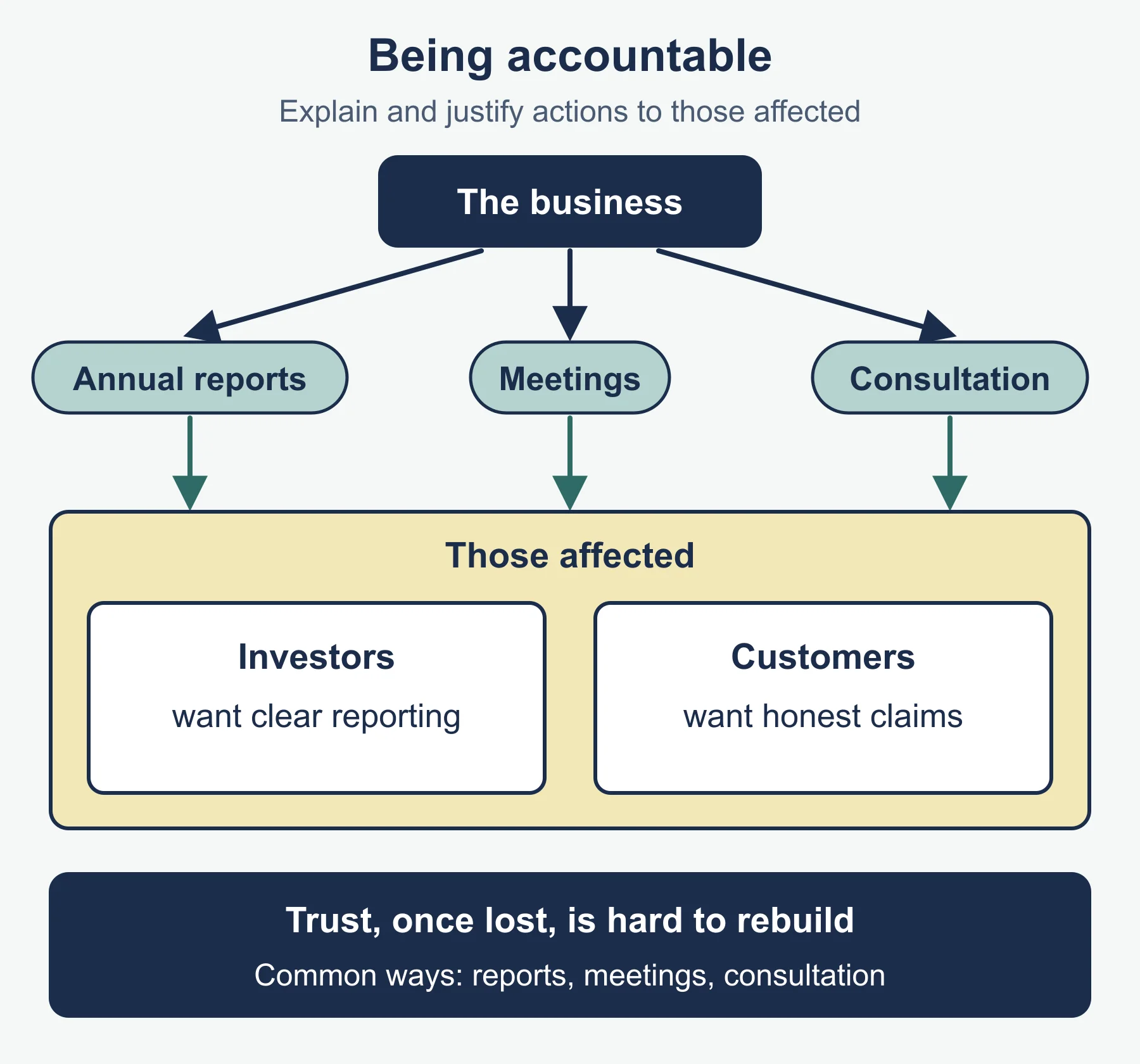
A business is accountable when it explains and justifies its actions to those affected. It needs to be, because stakeholders hold things it relies on: investors want clear reporting, customers want honest claims, and trust, once lost, is hard to rebuild. Annual reports, meetings and consultation are common ways to do it.
Conflict
Conflict arises because aims differ. Higher pay for staff reduces profit; lower prices for customers reduce margins; a supplier wants higher prices than the business wants to pay.
Changing objectives and the effect on stakeholders
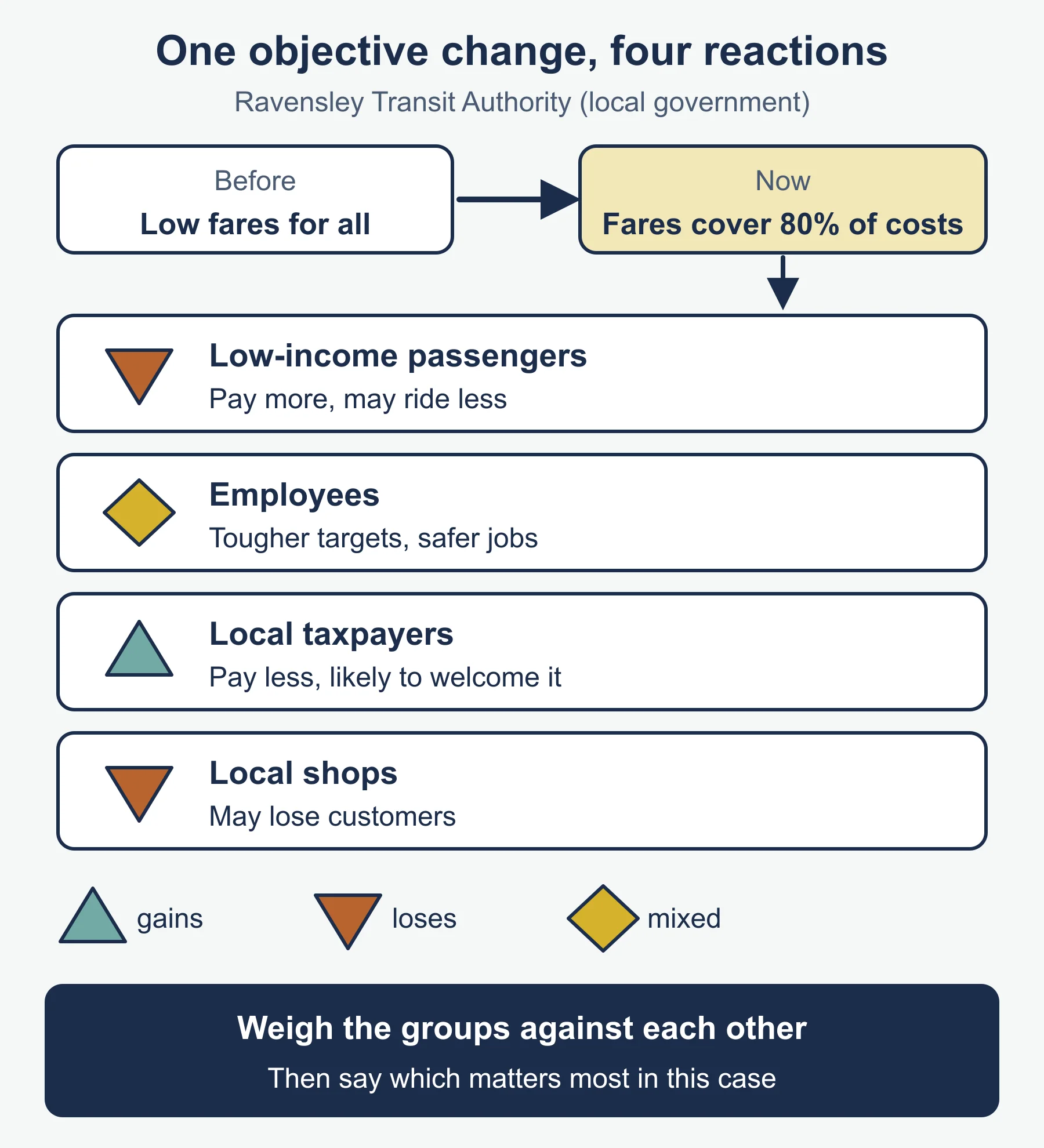
Worked example. Ravensley Transit Authority is a local government body whose objective was low fares for all. Pressure on public funds leads it to adopt a new objective: cover 80% of running costs from fares.
- Passengers on low incomes face higher fares and may react by using the service less.
- Employees may face tougher efficiency targets, but jobs could be safer if the service is financially stable.
- Local taxpayers pay less, so they probably welcome the change.
- Local shops may lose customers if passenger numbers fall.
A strong answer weighs these groups against each other and says which matters most in this case.
A third type: a social enterprise in practice
Brightstitch Cooperative repairs and resells school uniforms and puts its surplus into free uniforms for low-income families. Its mission is social, its financial objective is to break even, and its environmental objective is less textile waste. Its stakeholders therefore care about the triple bottom line, not profit alone. Use this model when asked how objectives differ by sector.
Common errors
- Using “stakeholder” and “shareholder” as if they mean the same thing.
- Listing stakeholders without saying how a decision affects each.
- Calling any aim a SMART objective without checking for a deadline and a measure.
- Writing that all stakeholders can be satisfied at once.
- Ignoring the context: the same decision has different effects in a small firm and a large one.
Frequently asked questions
What are typical objectives of public-sector organisations? Public-sector organisations are owned and run by the state or local government, so typical objectives include providing a service to all citizens, staying within budget and meeting service standards, rather than maximising profit.
What is a social enterprise? A social enterprise trades to meet a social or environmental purpose. It needs revenue to survive, but its surplus is mostly reinvested in that purpose.
How are objectives turned into targets and budgets? A target breaks an objective into figures for a department, product or period. A budget allocates the money needed to reach that target, so managers have figures they can be held to.
What is accountability to stakeholders? A business is accountable when it explains and justifies its actions to those affected by them. It matters because the business relies on stakeholders’ trust, and annual reports, meetings and consultation are common ways to provide it.
Official syllabus
Cambridge International AS & A Level Business 9609 syllabus for examination in 2026, 2027 and 2028, published by Cambridge University Press & Assessment (Cambridge Assessment International Education), sections 1.4 and 1.5.
Get free revision emails (optional)
Occasional emails with practice questions, worked explanations and links to free resources for the qualification and subjects you choose. No spam, and you can unsubscribe from any email. The free tools on this site never need an email.
Related resources
-
Practice questions
A Level Business: Business objectives and Stakeholders in a business (Cambridge 9609) – Practice Questions
Original practice questions with worked answers on business objectives (1.4) and stakeholders (1.5) for Cambridge AS & A Level Business 9609.
Business · Cambridge · AS Level
Try questions -
Revision notes
A Level Business: Business objectives and Stakeholders in a business (Cambridge 9609) – Revision Notes
Condensed recall notes on business objectives (1.4) and stakeholders (1.5) for Cambridge AS & A Level Business 9609, with a short self-test.
Business · Cambridge · AS Level
Revise topic -
Study guides
A Level Business: Business strategy (Cambridge 9609)
Study guide to section 6.2 Business strategy in Cambridge A Level Business 9609: strategic tools, decision trees, corporate planning and crisis management.
Business · Cambridge · A Level
Read guide
Related articles
-
teaching
A Level tuition in Dubai: Cambridge or Pearson Edexcel International A Level?
Schools in Dubai and Abu Dhabi teach either Cambridge International AS & A Level or Pearson Edexcel International A Level. How the two are structured, why it matters for tuition, and how online classes from Lahore work.
9 October 2026
-
curriculum guides
Choosing subjects at IGCSE and A Level
How subject choices at 14 and 16 affect university options later, and how to keep pathways open without overloading a timetable.
28 July 2026
Studying this with a teacher
Working through Business AS LEVEL?
This page is free and stays free. If you would rather be taught it, Marlbridge runs Business classes one-to-one and in small groups of up to 15, online in your own time zone. The first trial class is free. WhatsApp replies within an hour (8am–11pm Pakistan time, every day); email the same day.
Cambridge Business teachers at Marlbridge

