
Study Guides
A Level Business: Business structure and Size of business (Cambridge 9609)
Study guide to sections 1.2 and 1.3 of Cambridge AS & A Level Business 9609: sectors, ownership, measuring size, small firms and growth.
- Subject
- Business
- Level
- AS LEVEL
- Topic
- Business and its environment
- Author
- Marlbridge Academic Team
- Updated
- Reviewed by
- Salman Ahmad (what this means)
Aligned to Cambridge A Level Business (9609), For examination in 2026, 2027 and 2028. Official specification .
Syllabus page (what it covers and how it is assessed): Cambridge A Level Business.
Syllabus points this page covers
9609 (AS Level)
- 1.2 Business structure
- 1.3 Size of business
Found an error? Report a correction.
Need help with this topic? Request a free trial class for A Level Business (9609).
This guide covers sections 1.2 (Business structure) and 1.3 (Size of business) of the Cambridge International AS & A Level Business 9609 syllabus for examination in 2026, 2027 and 2028. Both sections belong to the AS Level topic Business and its environment. AS questions on them can appear on Paper 1 and Paper 2, and A Level candidates are assumed to know them for Papers 3 and 4.
Use it with the revision notes and the practice questions. Enterprise (1.1) is in this guide, and the whole topic is summarised in the topic overview, topic revision notes and topic practice questions. Course pages: Cambridge A Level Business hub and checklist. To find weak spots first, try the free diagnostics.
What you must cover
| Syllabus point | You must be able to |
|---|---|
| 1.2.1 Economic sectors | Classify primary, secondary, tertiary and quaternary activity; public and private sectors; explain why and with what consequences their relative importance changes |
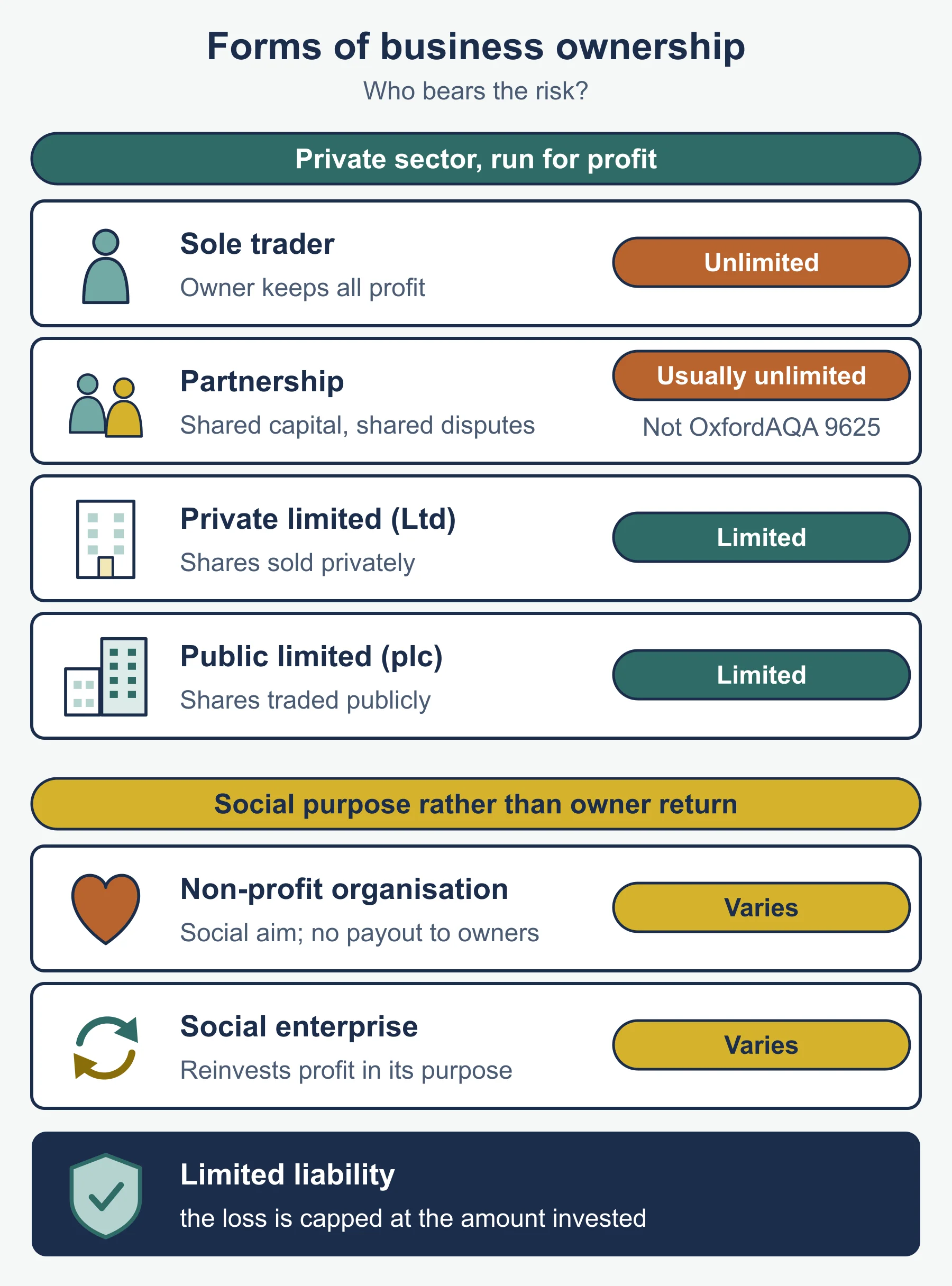
| 1.2.2 Business ownership | Describe sole traders, partnerships, private limited companies, public limited companies, franchises, co-operatives, joint ventures and social enterprises; judge which suits a situation; explain unlimited and limited liability; weigh changing from one form to another |
| 1.3.1 Measurements of business size | Judge how appropriate each method of measuring size is |
| 1.3.2 Significance of small businesses | Advantages and disadvantages of being small; family businesses; role in the economy; role in industrial structure |
| 1.3.3 Business growth | Organic growth; horizontal, vertical (backward and forward) and conglomerate growth; friendly merger and hostile takeover; effects on stakeholders; why a deal may or may not meet its objectives; joint ventures and strategic alliances |
1.2.1 Economic sectors
The four sectors
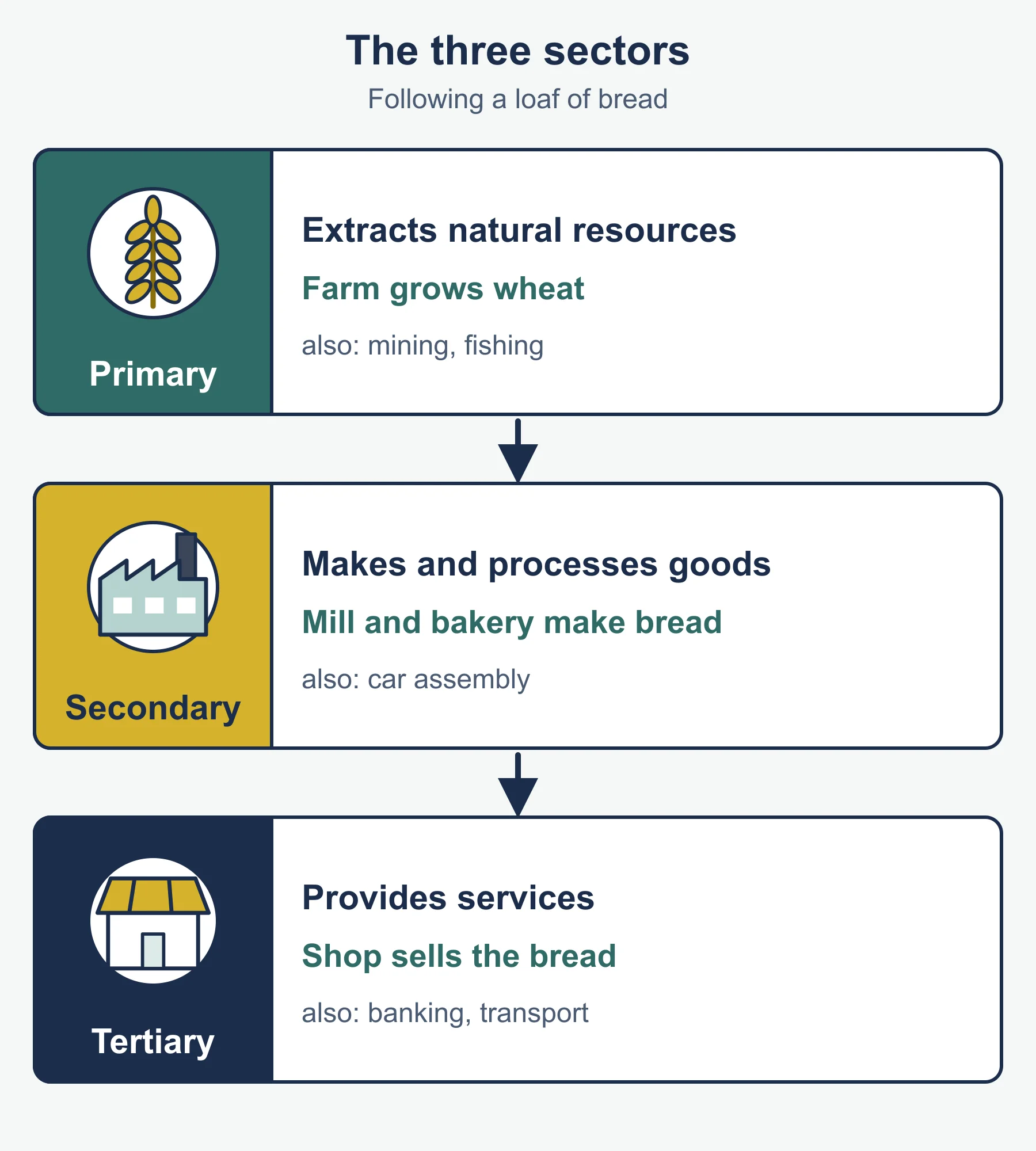
- Primary: extracting or growing raw materials, for example farming, fishing and mining.
- Secondary: turning materials into products, such as manufacturing and construction.
- Tertiary: providing services, such as retail, transport, banking and teaching.
- Quaternary: knowledge-based activity, such as research, data analysis and software development.
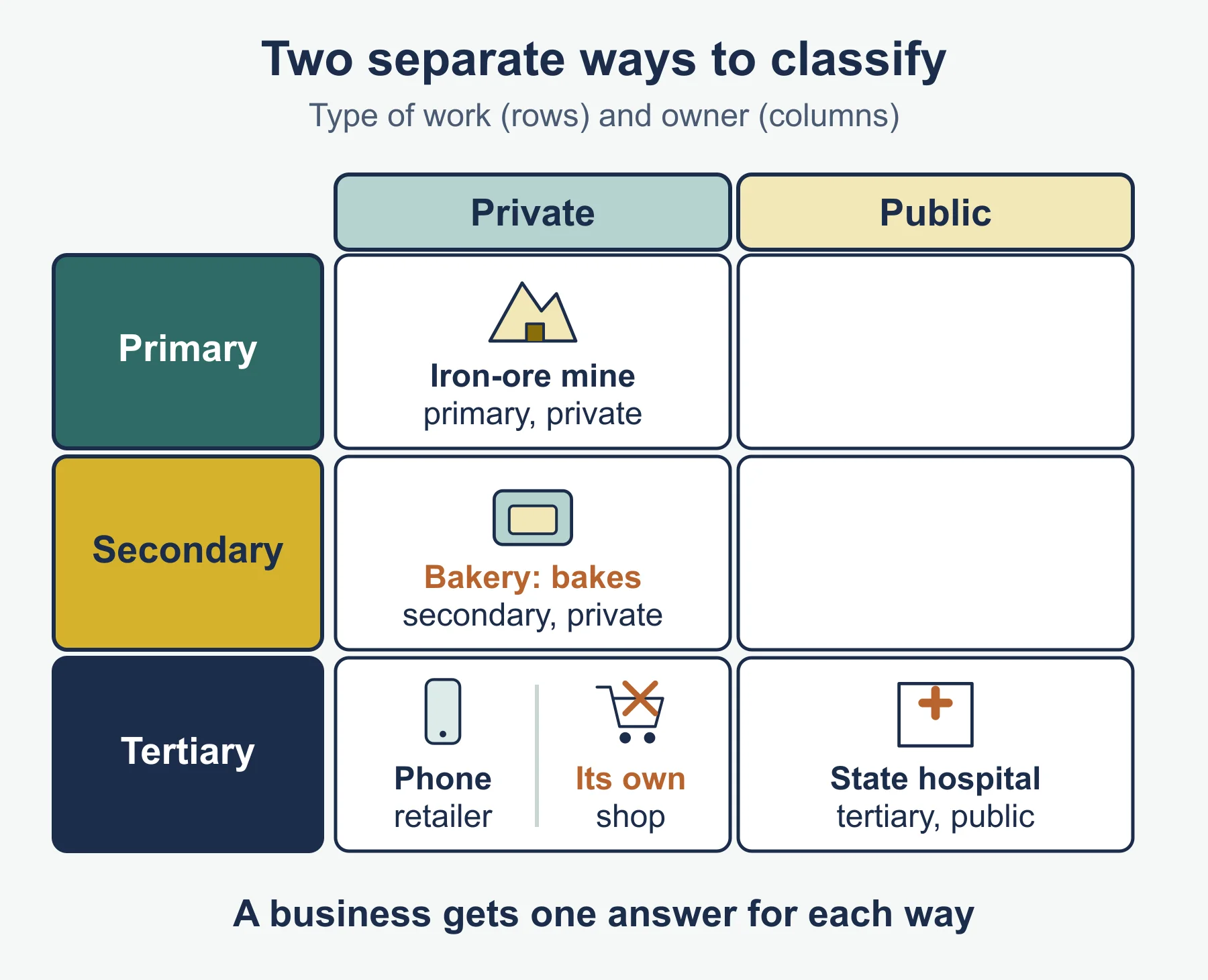
A business can span sectors, so say which activity you are classifying.
Public and private sectors. The public sector is owned and controlled by the state, for example a state-run hospital or rail service. The private sector is owned by individuals or groups of shareholders, and most of its businesses aim to make a profit.
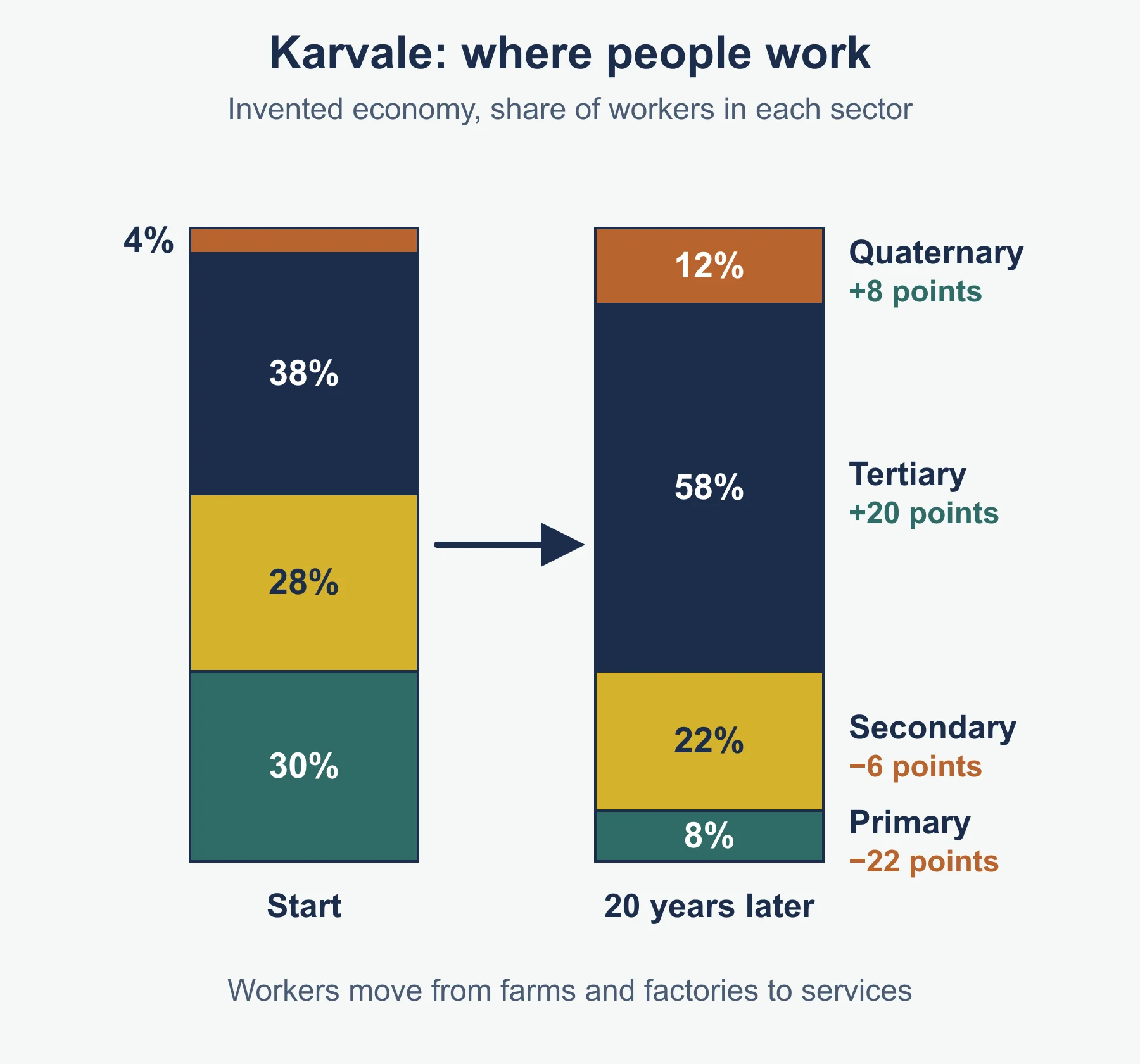
Why relative importance changes, and what follows. Consider an invented economy, Karvale, and the share of workers in each sector over twenty years.
| Sector | Start | Twenty years later | Change (percentage points) |
|---|---|---|---|
| Primary | 30% | 8% | -22 |
| Secondary | 28% | 22% | -6 |
| Tertiary | 38% | 58% | +20 |
| Quaternary | 4% | 12% | +8 |
Both columns total 100%, so the shares are comparable. The changes below are typical reasons:
- Rising incomes shift spending towards services and leisure.
- Mechanisation lets farms and factories produce more with fewer workers.
- Firms move production to lower-cost countries and import the goods.
- Technology creates demand for knowledge work.
- Government policy may change the size of the public sector.
Typical consequences are structural unemployment where old industries close, a need for retraining, regional decline where one sector was concentrated, and new opportunities in growing sectors. Keep reasons apart from consequences.
1.2.2 Business ownership
Liability is the first thing to master.
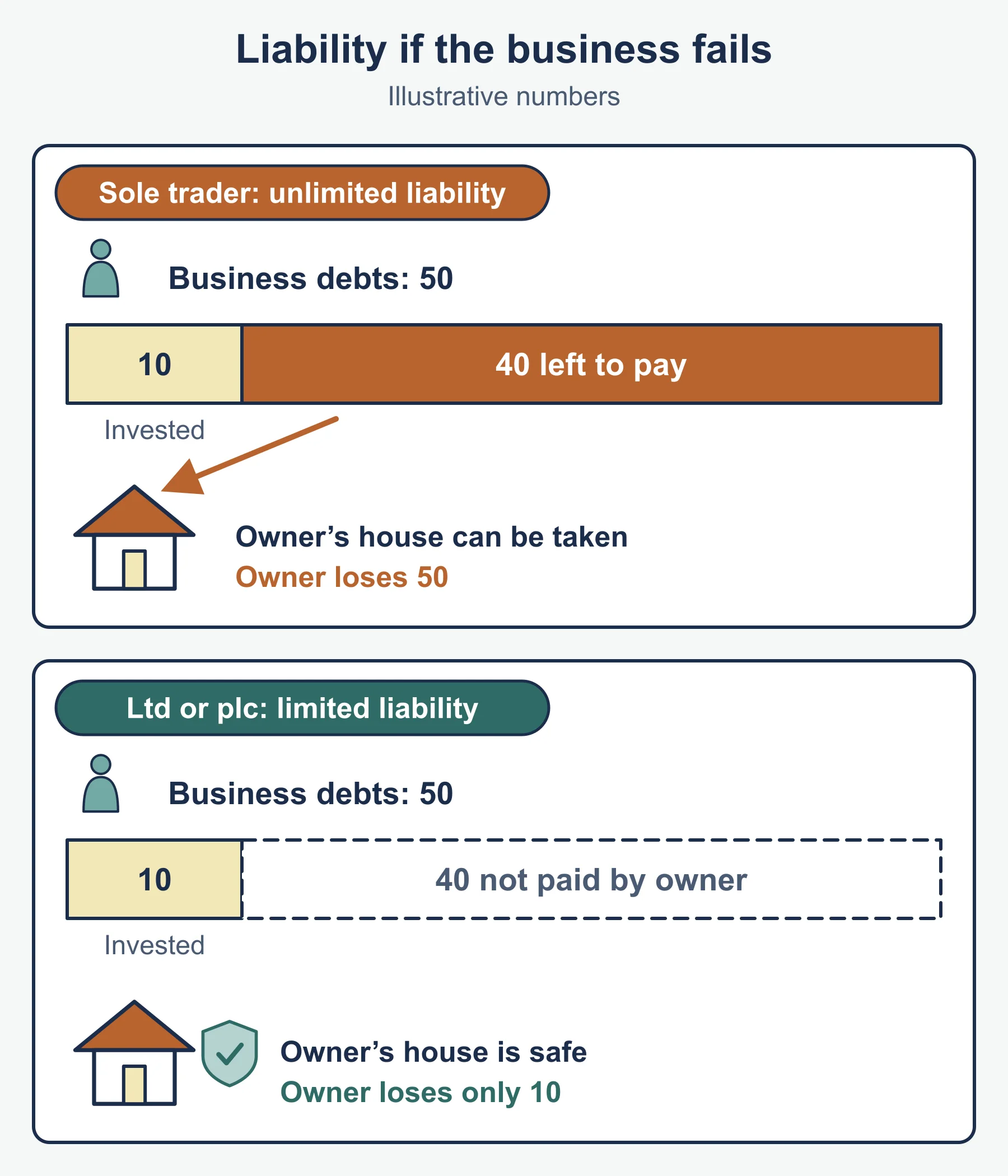
- Unlimited liability: the owner is personally responsible for all business debts, so personal assets can be used to pay them.
- Limited liability: the most an owner can lose is the money put into the firm. Personal assets are protected.
Worked example. Thistlebeck Joinery is a partnership run by Imran and Gwen. It closes owing £90,000 while its assets sell for £60,000.
- Shortfall = £90,000 - £60,000 = £30,000.
- Under unlimited liability, creditors can pursue the partners’ personal assets for that £30,000. If shared equally, that is £15,000 each, and in general terms a creditor may pursue one partner for more than their share if the other cannot pay.
- Had the firm been a private limited company in which the owners had invested £20,000 in shares, the most they could lose is that £20,000. Creditors would bear the rest.
Limited liability makes it less risky to start or invest in a business.
The eight forms the syllabus names
| Form | Main features | Typical advantages | Typical disadvantages |
|---|---|---|---|
| Sole trader | One owner, unlimited liability | Full control, keeps all profit, simple | Risk falls on one person, hard to raise capital |
| Partnership | Two or more owners share decisions and profit, unlimited liability | More capital and skills, shared workload | Disagreements, joint risk, profit shared |
| Private limited company | Owned by shareholders, limited liability, shares not offered to the general public | Limited liability, separate legal identity, easier to raise capital than sole trader | More formal duties, owners cannot freely sell shares |
| Public limited company | Limited liability, shares can be bought by the public on a stock exchange | Large capital, easy to buy and sell shares | Takeover risk, pressure for short-term results, ownership separated from control |
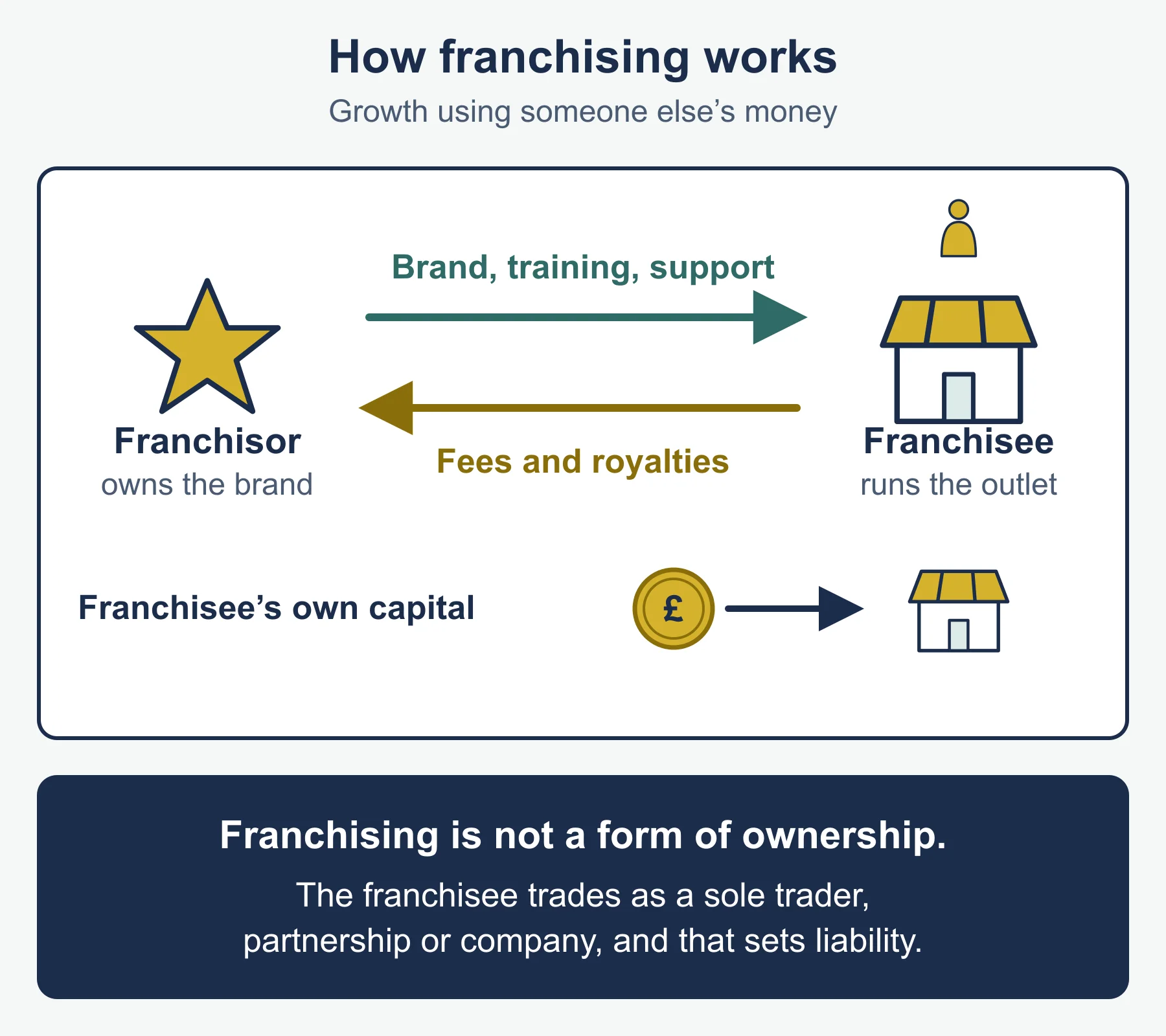
| Franchise | The franchisor lets a franchisee use its brand and system, usually for fees | Proven model, brand recognition, support | Fees cut profit, rules limit independence |
| Co-operative | Owned and run for the benefit of members, who typically share control | Shared benefit and commitment | Slower decisions, limited ways to raise capital |
| Joint venture | Two or more businesses cooperate on a specific project, often sharing ownership of it | Shared cost, risk and expertise | Disputes, culture clash, shared profit |
| Social enterprise | Trades to achieve social or environmental aims, profits mostly reinvested | Mission appeals to customers and staff | Profit may be limited, so funding can be harder |
Appropriateness means matching the form to the circumstances: risk, finance needed, wish for control, and aims. A cleaner working alone suits sole trader status. A business needing heavy investment and wanting to protect owners suits a limited company. A firm wanting rapid expansion with little capital might choose franchising. A group sharing aims and benefits may pick a co-operative. Name the factor that matters most for the business given.
Example. Pellerin Pizza is a franchisor. A franchisee gets a trusted brand but pays fees and cannot change the menu freely. Pellerin expands using the franchisee’s capital, but one poor outlet can harm the whole brand.
Changing form.
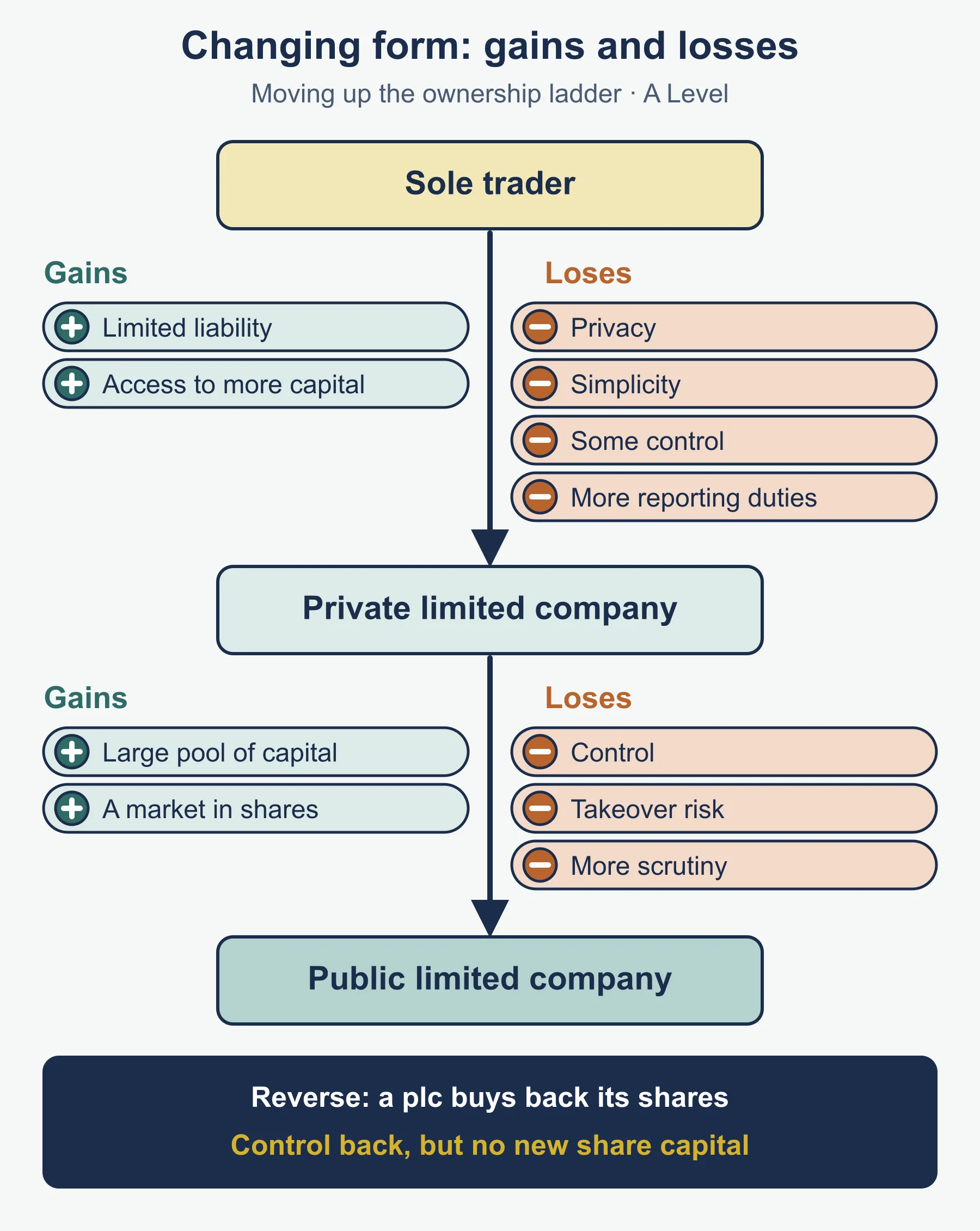
- Sole trader to private limited company: gains limited liability and access to more capital; loses privacy, simplicity and some control, and faces more reporting duties.
- Private limited to public limited: gains a large pool of capital and a market in shares; loses control, faces takeover risk and more scrutiny.
- Moving the other way, for example a public limited company buying back its shares to become private, restores control and reduces short-term pressure but cuts access to new share capital.
A judgement answer says which gain or loss matters more for this business and why.
1.3.1 Measurements of business size
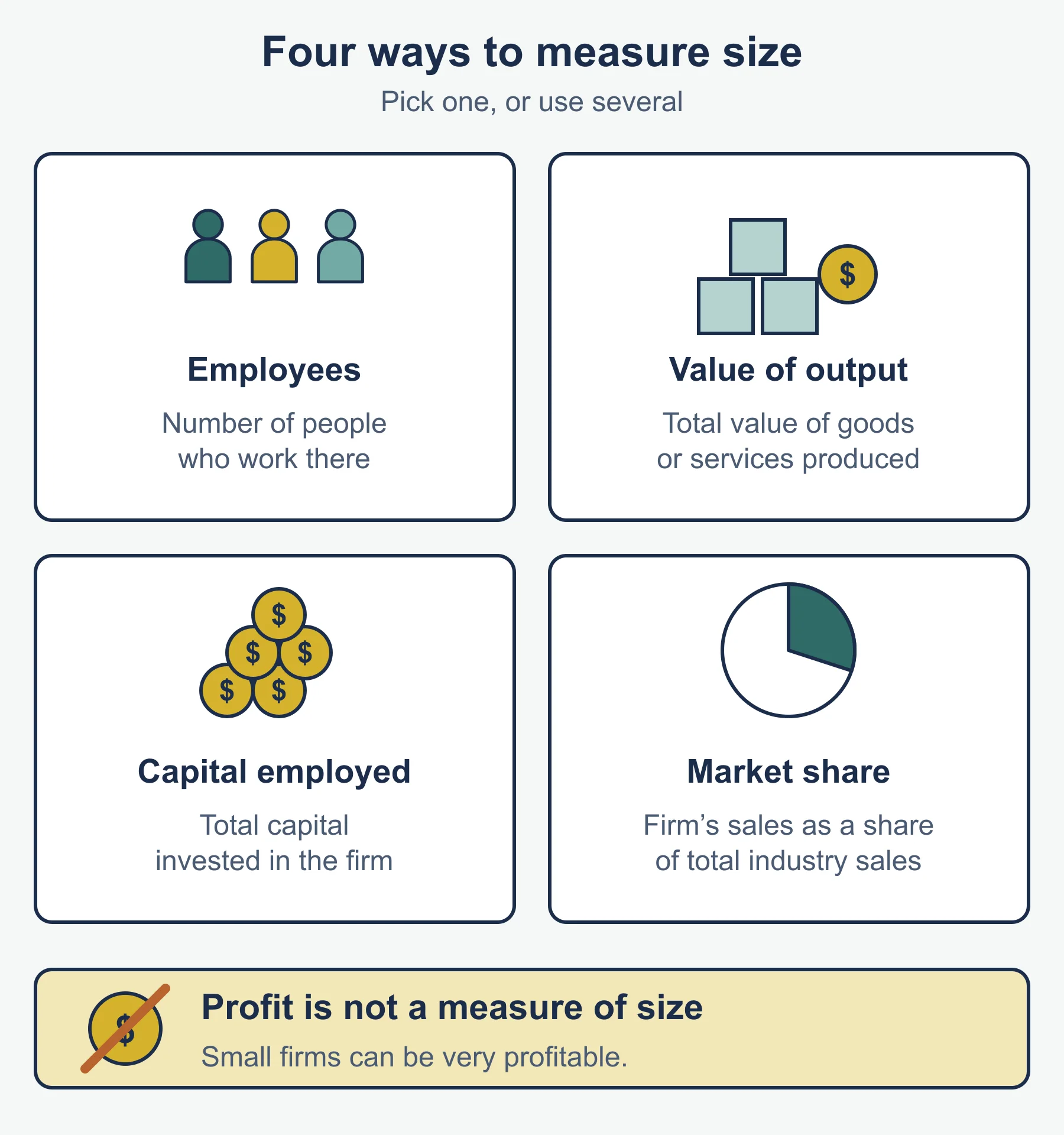
The syllabus asks how appropriate each method is, not for one correct method. Common measures are the number of employees, sales revenue, capital employed, and market share. These are standard measures; the syllabus does not list them in this section.
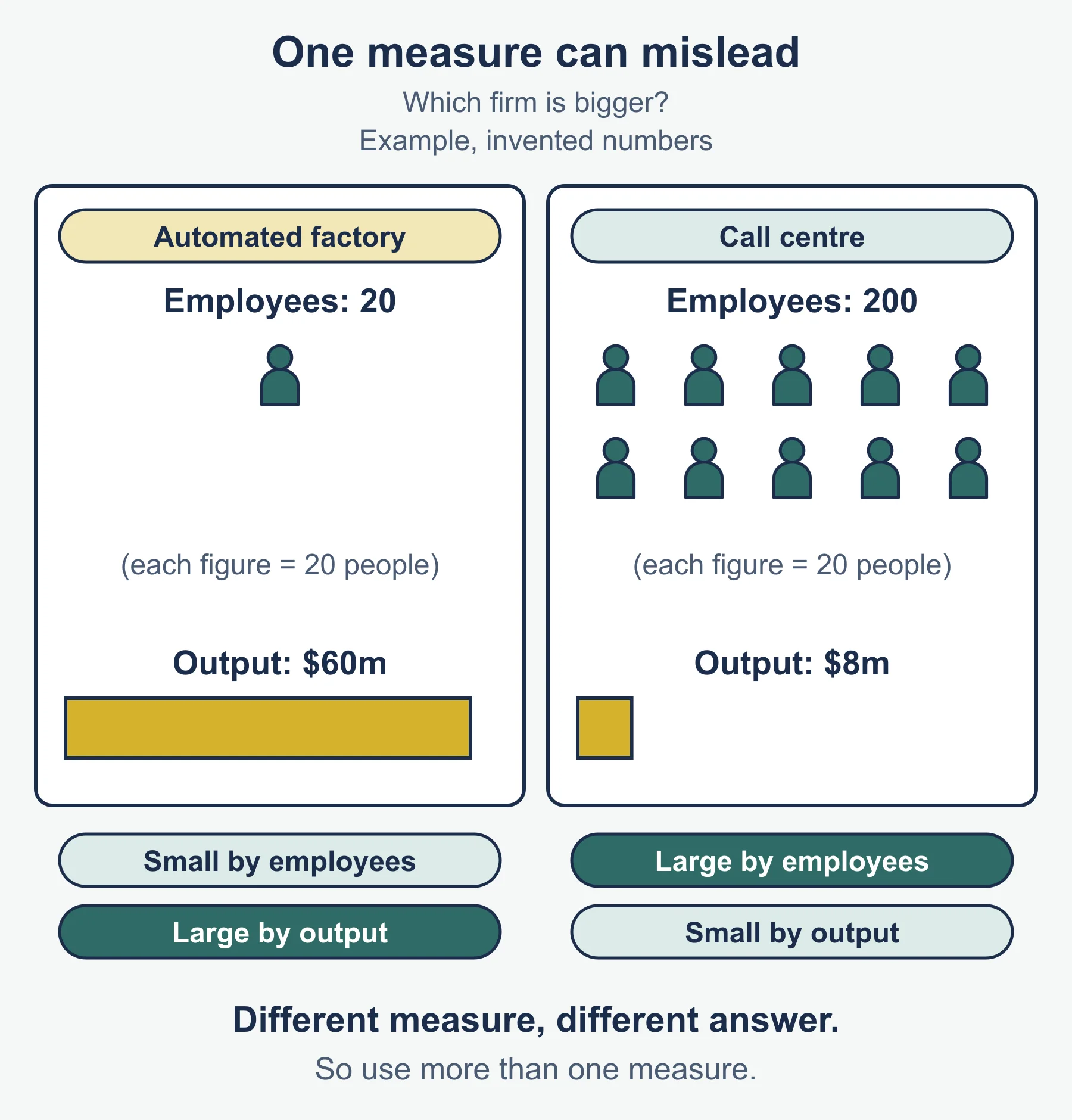
- Employees: easy to find, but misleading for businesses that use machines more than people.
- Revenue: shows sales activity, but says nothing about profit or the assets used.
- Capital employed: in the syllabus finance section, capital employed = issued shares + reserves + non-current liabilities. It shows the funds invested, but depends on how assets are valued.
- Market share: the standard form is firm sales ÷ total market sales × 100. It shows relative position, but depends on how widely the market is defined.
Worked example. Compare two businesses.
| Measure | Salthouse Cycles | Wetherly Bottling |
|---|---|---|
| Employees | 260 | 35 |
| Revenue | £12.0m | £42m |
| Capital employed | not given | £54m (£18m shares + £9m reserves + £27m non-current liabilities) |
| Market revenue | £80m | £420m |
| Market share | 12.0 ÷ 80 × 100 = 15% | 42 ÷ 420 × 100 = 10% |
By employees, Salthouse is larger. By revenue and capital employed, Wetherly is far larger. Revenue per employee is about £46,200 for Salthouse and £1.2m for Wetherly, so the bottler is capital-intensive. Market share depends on each firm’s own market, so comparing 15% with 10% across different markets says little. The right measure depends on the question: employment effects point to employees; financial strength to revenue or capital employed; competitive power to market share.
1.3.2 Significance of small businesses
Advantages of being small: closer contact with customers, quick decisions, flexibility, lower overheads and personal service. Disadvantages: limited finance, few economies of scale, owner overload, and vulnerability to larger competitors and to the loss of one customer or key person.
Family businesses are owned and often run by family members.
- Strengths: shared commitment, trust, a long-term view, and pride in reputation.
- Weaknesses: a limited pool of management talent, family disputes that spill into the business, resistance to outside ideas, and difficulty handing over to the next generation.
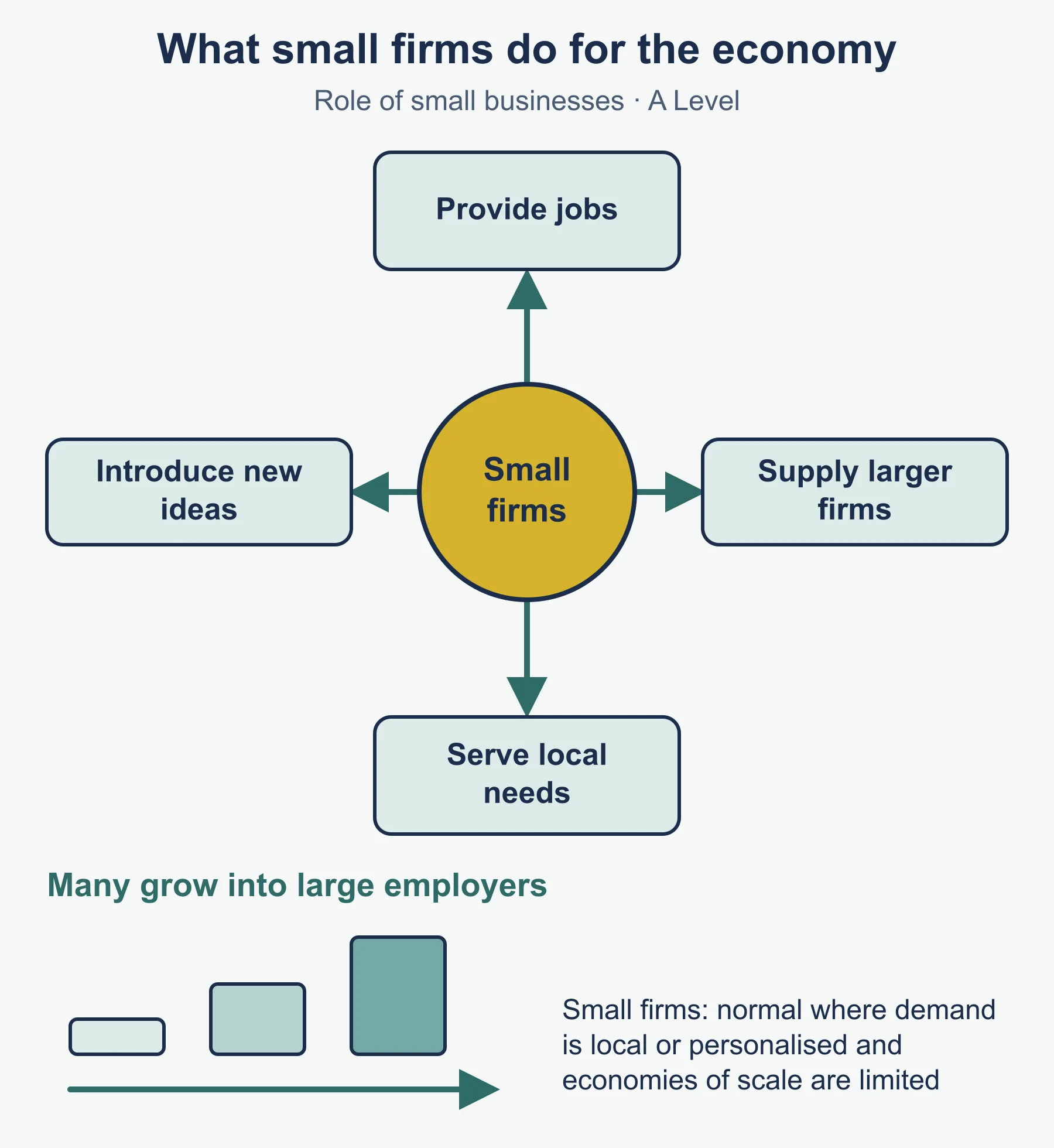
Role in the economy. Small businesses provide jobs, introduce new ideas, supply larger firms and serve local needs. Many grow into large employers.
Industrial structure. In some industries small firms are the normal form because demand is local or personalised and economies of scale are limited. Examples are hairdressing, local repairs and specialist craft goods. Large firms may find niches unprofitable, so small firms survive alongside them.
1.3.3 Business growth
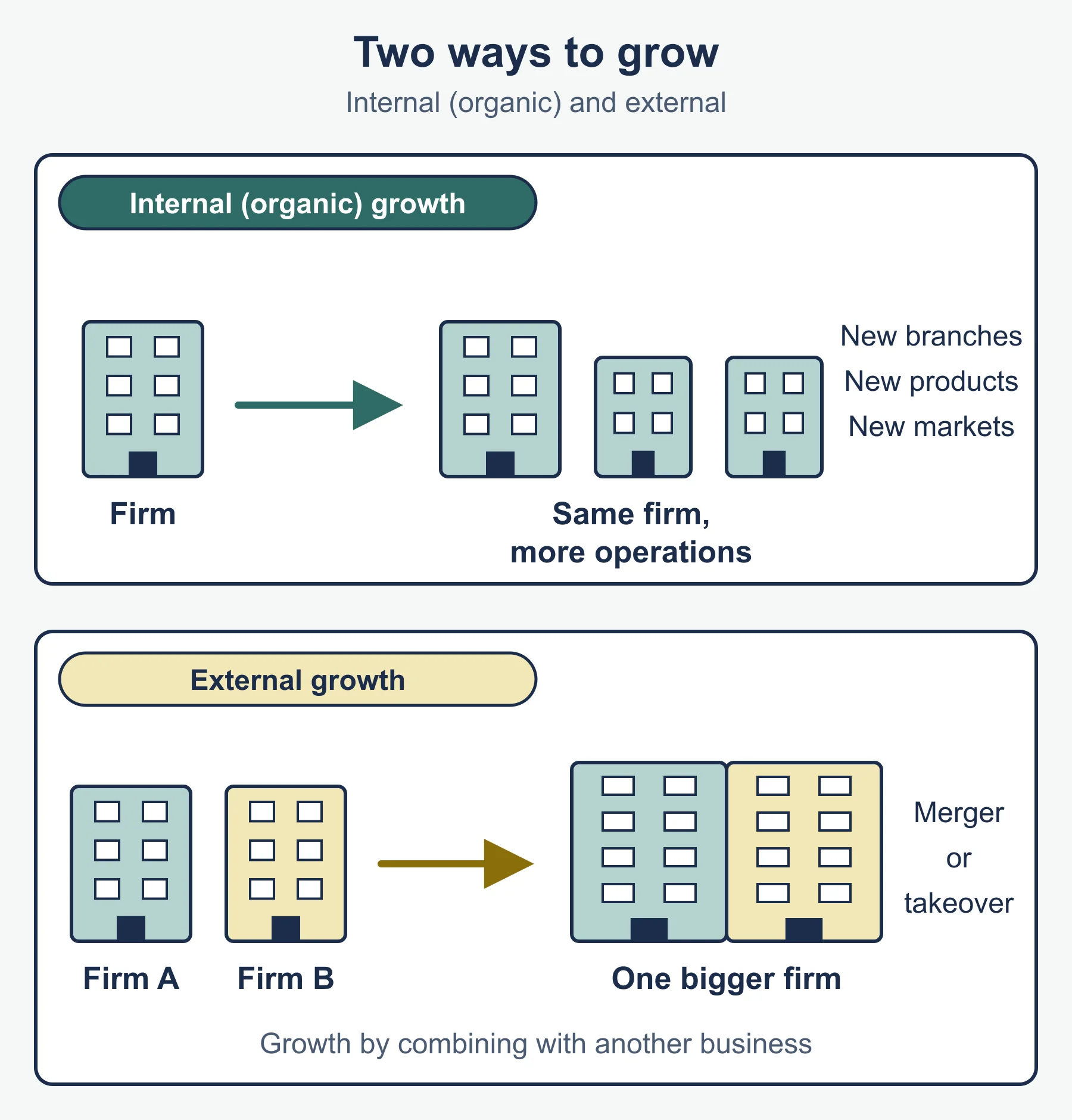
Organic (internal) growth means expanding using the business’s own resources. Why: to gain economies of scale, market share, profit and security. How: new products, new markets, more outlets, extra capacity, more marketing. It is slower, but keeps control and builds on existing strengths.
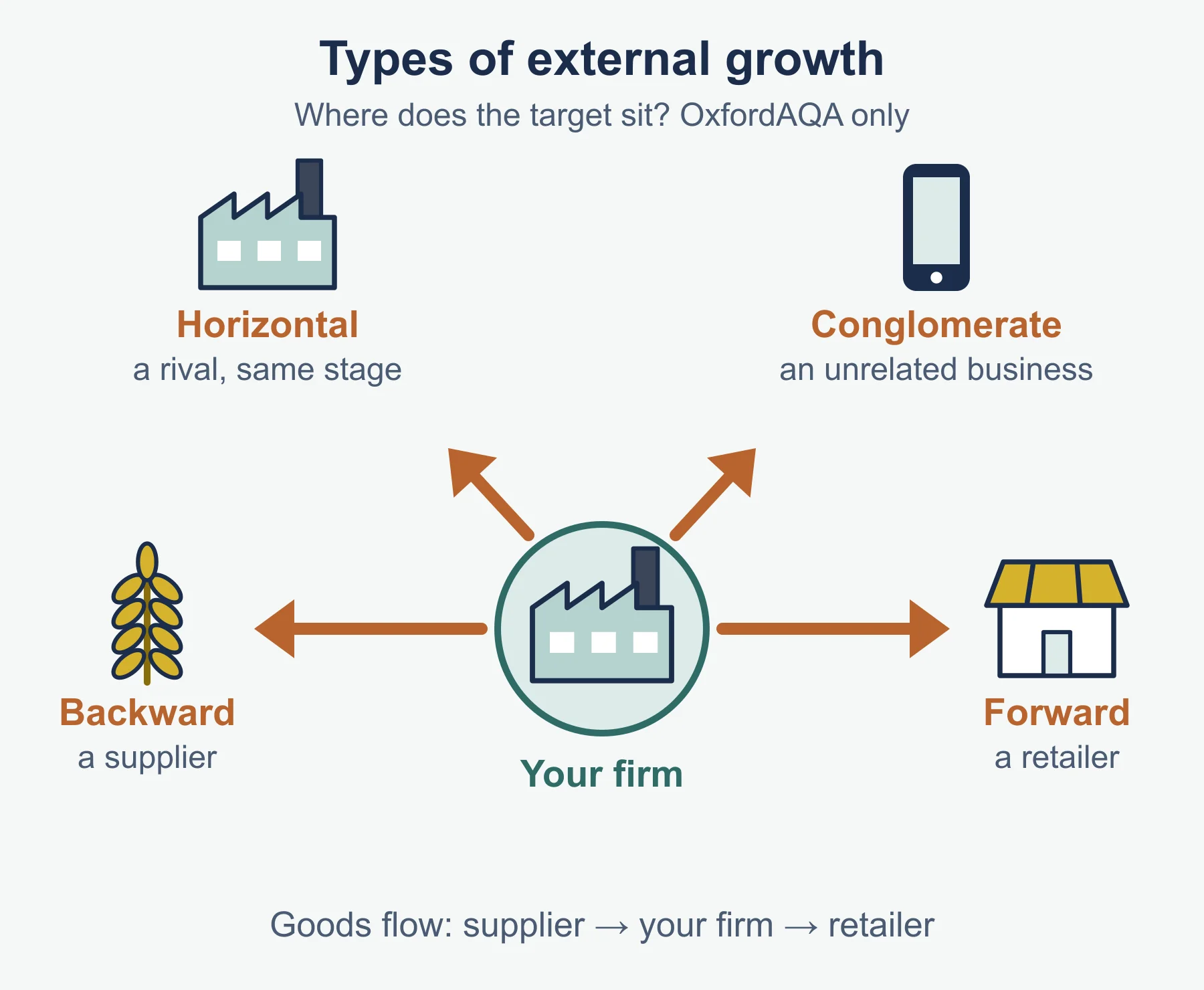
External growth joins with another business.
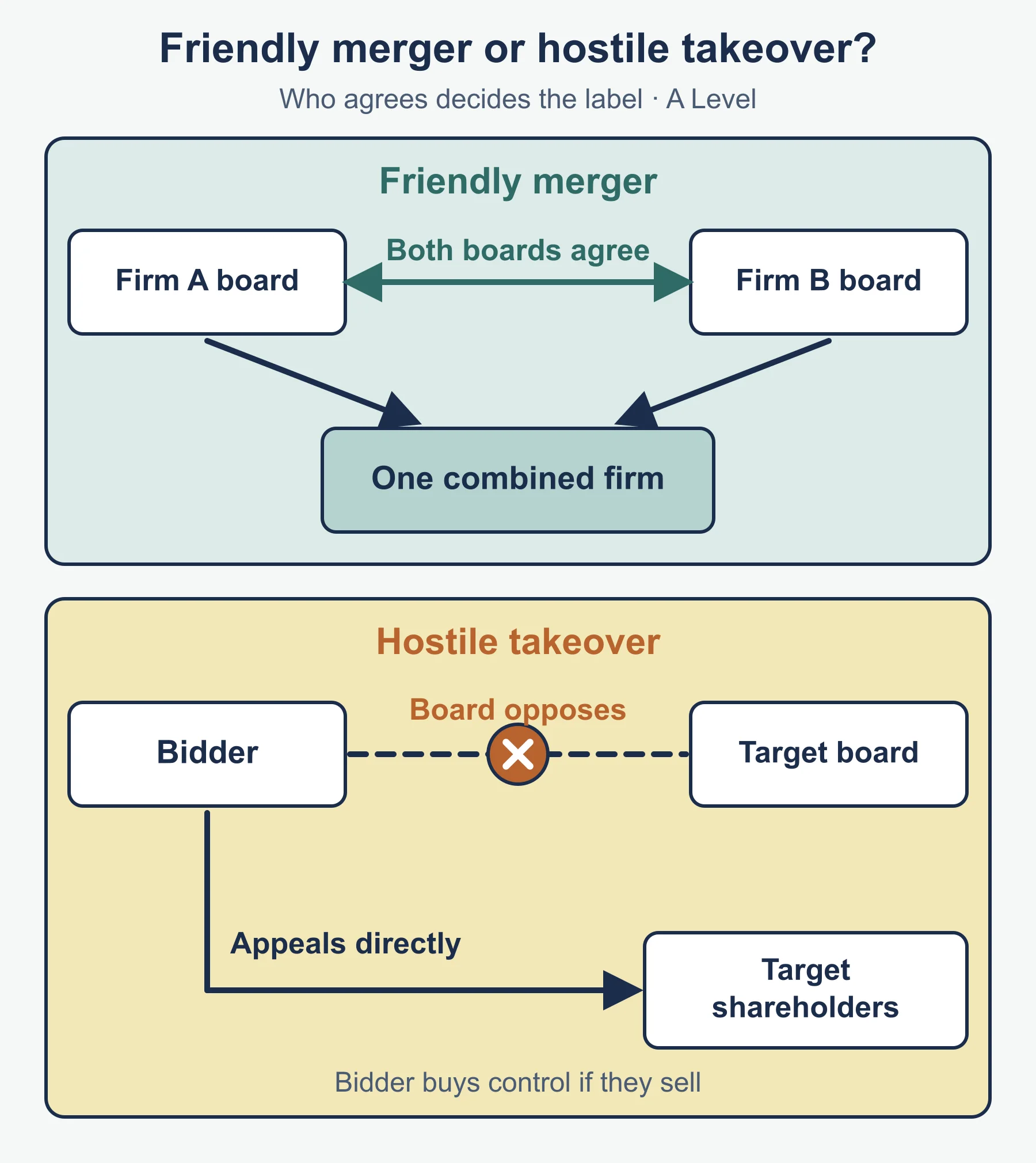
- Merger: two firms agree to combine into one. A friendly merger is agreed by both boards.
- Takeover: one firm buys control of another. A hostile takeover is opposed by the target’s board; the bidder appeals directly to shareholders.
| Type | Meaning | Example |
|---|---|---|
| Horizontal | Same industry, same stage | Two pharmacy chains join |
| Vertical backward | Towards a supplier | A pharmacy chain buys a medicine wholesaler |
| Vertical forward | Towards the customer | A wholesaler buys pharmacies |
| Conglomerate diversification | Unrelated industries | A pharmacy chain buys a hotel |
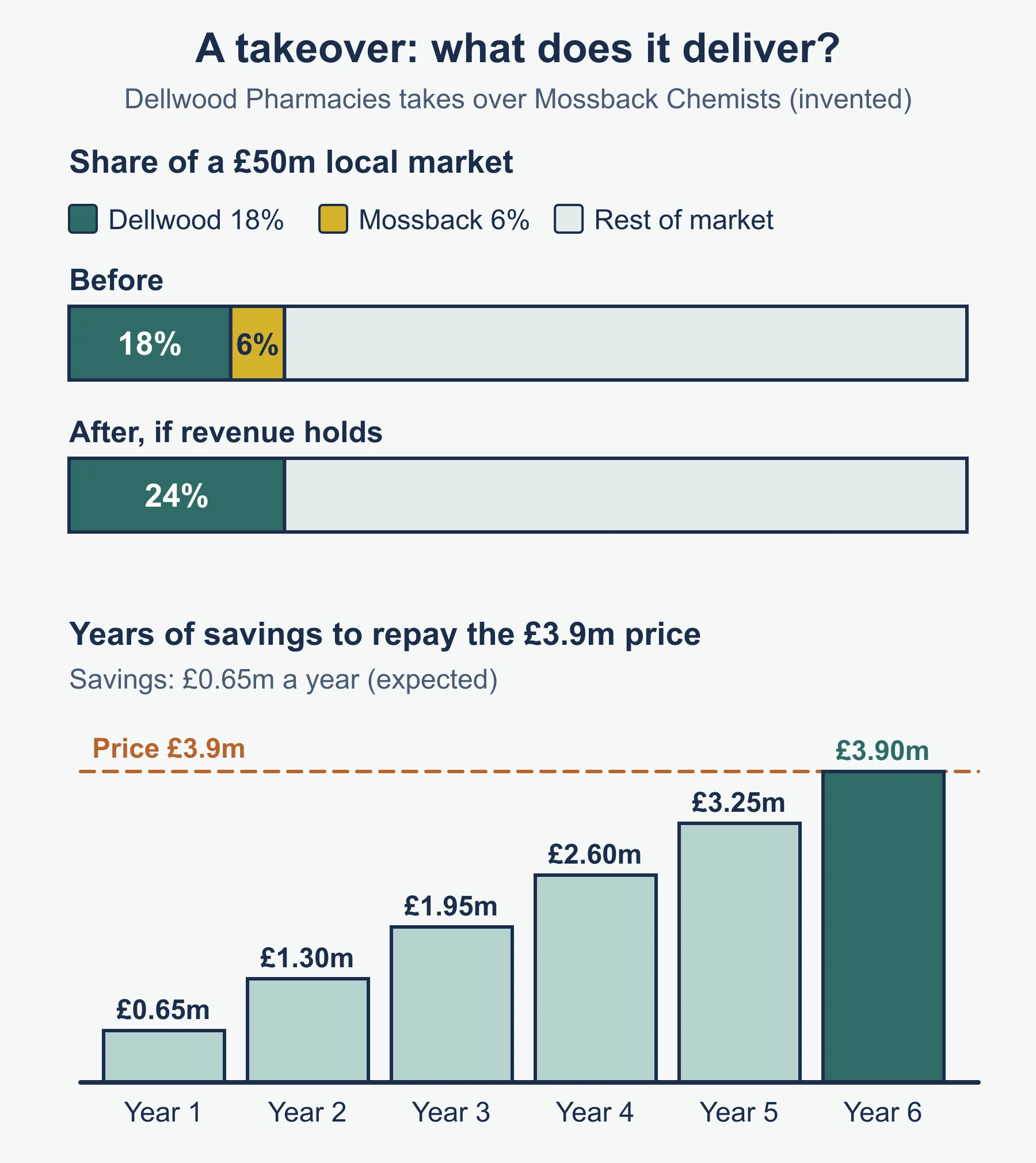
Worked example. Dellwood Pharmacies has revenue of £9.0m in a local market worth £50m. It takes over Mossback Chemists, with revenue of £3.0m, for £3.9m, and expects savings of £0.65m a year.
- Market shares before: 9.0 ÷ 50 = 18% and 3.0 ÷ 50 = 6%.
- Combined share if revenue holds: 12.0 ÷ 50 = 24%.
- Years of savings to cover the price: 3.9 ÷ 0.65 = 6.0 years.
Bigger share and lower costs are gains, but six years is a long wait and assumes the savings arrive and customers stay.
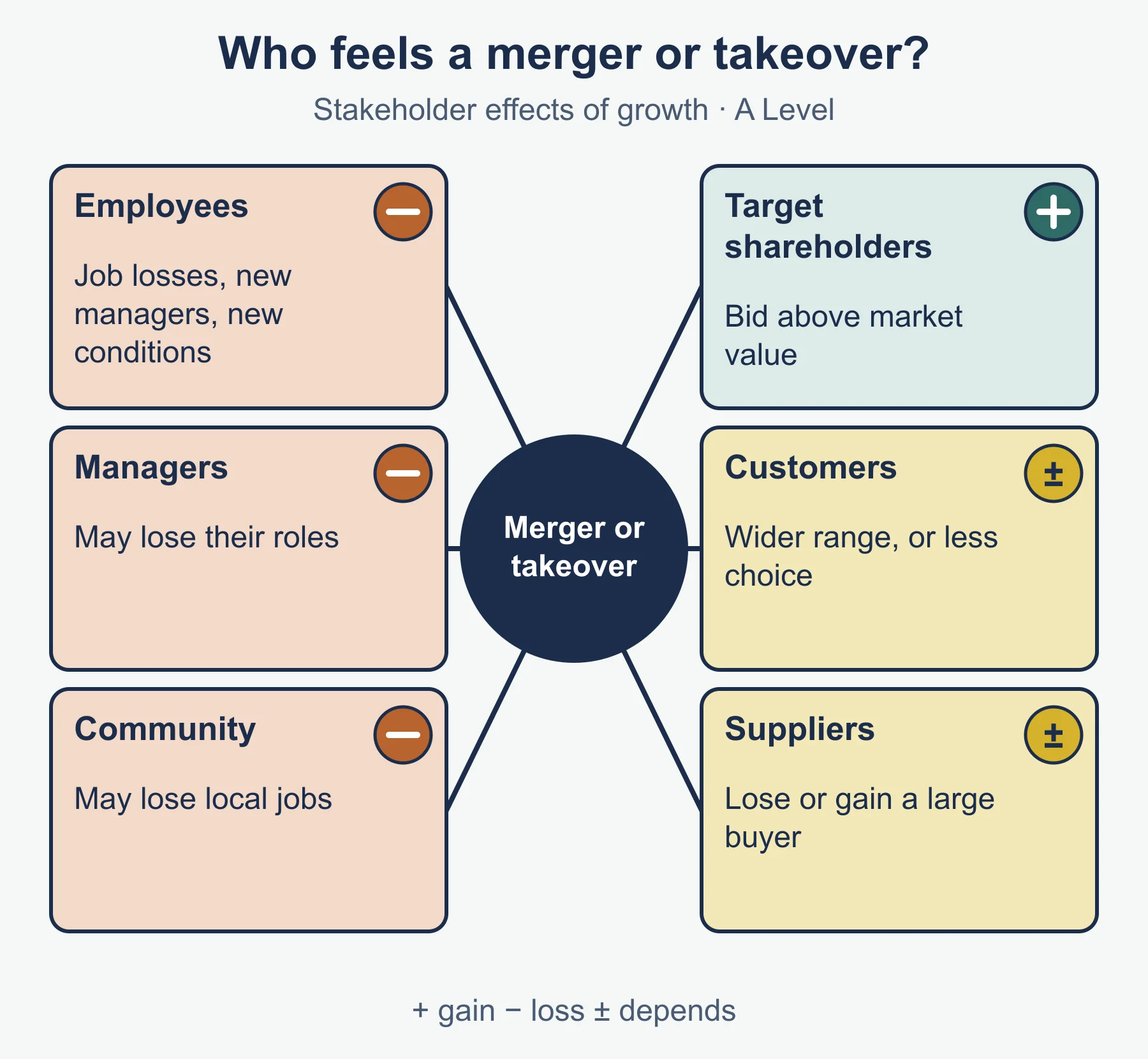
Impact on stakeholders. Employees may face job losses, new managers and changed conditions; shareholders of the target may gain from a bid price above market value; customers may get a wider range or less choice; suppliers may lose or gain a large buyer; managers may lose their roles; the community may lose local jobs.
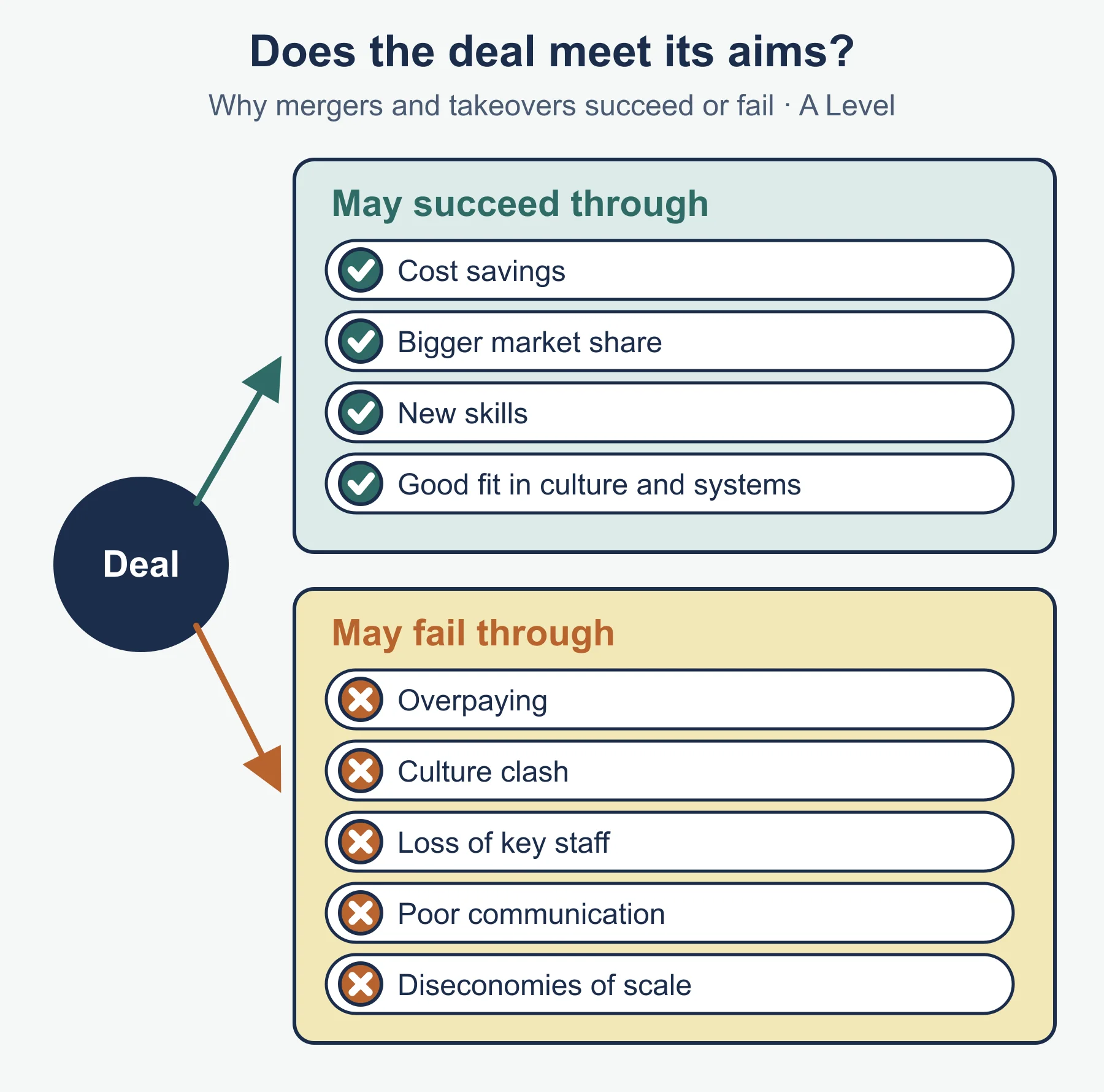
Why a deal may or may not achieve its objectives. It may succeed when it brings cost savings, a bigger market share, new skills, and a good fit in culture and systems. It may fail through overpaying, clashes of culture, loss of key staff, poor communication, and diseconomies of scale in the enlarged firm.
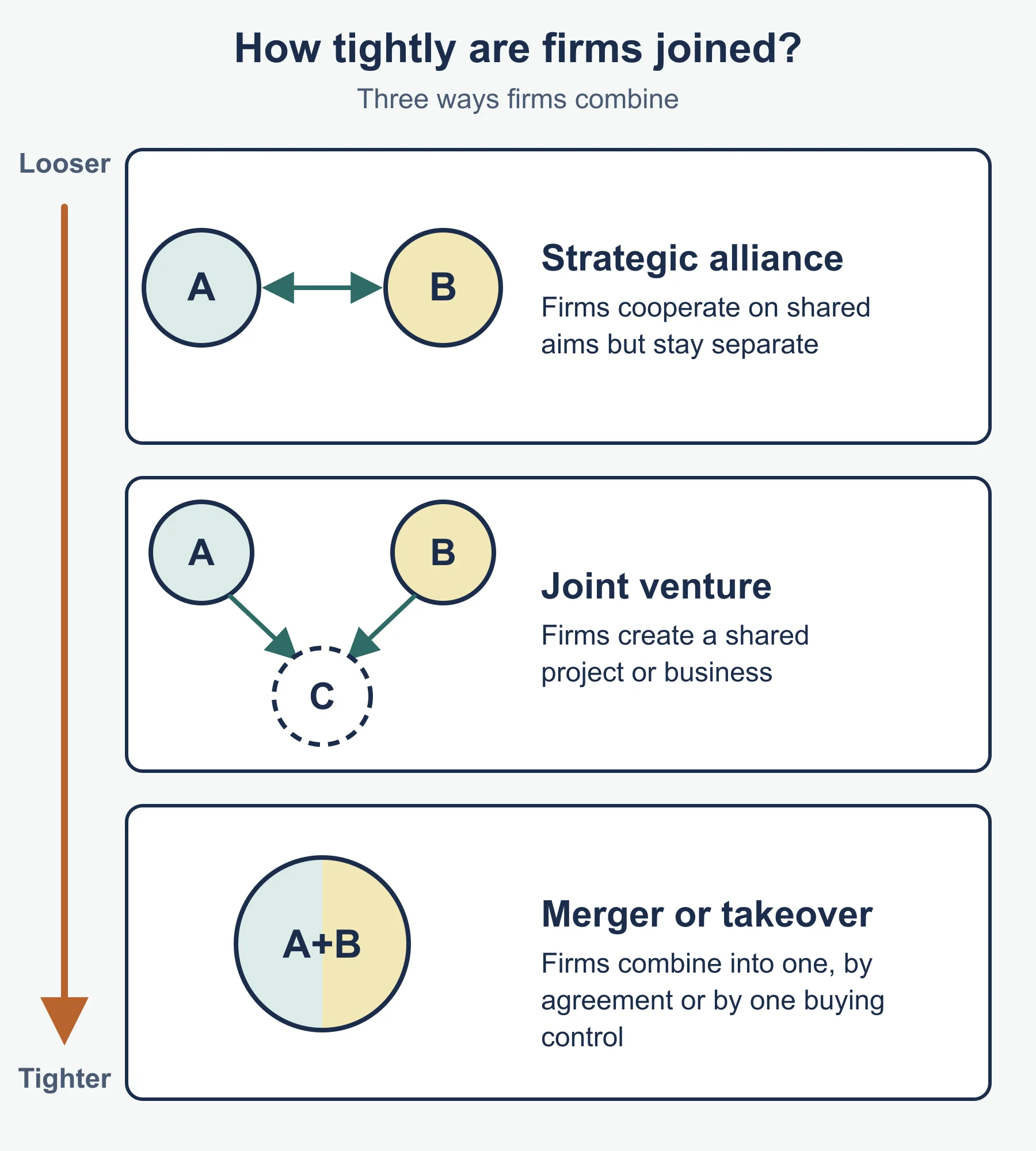
Joint ventures and strategic alliances. In a joint venture, firms create a shared project or business. In a strategic alliance, firms cooperate on shared aims but stay separate. Both give access to skills, markets or technology with less cost and commitment than a merger. Drawbacks include disagreements, unequal contributions, and sharing know-how with a possible later competitor.
Common errors
- Listing features of an ownership form without saying why it suits the business in the stem.
- Calling a vertical move horizontal. Check whether the target is at the same stage of the chain.
- Treating one measure of size as always correct.
- Giving reasons for a sector shift when the question asks for consequences.
- Writing that limited liability stops the business losing money. It limits the owners’ personal loss.
Frequently asked questions
Which forms of business ownership are in Cambridge 9609 section 1.2.2? The syllabus names eight: sole trader, partnership, private limited company, public limited company, franchise, co-operative, joint venture and social enterprise.
What is the difference between limited and unlimited liability? With unlimited liability, the owner is personally responsible for all business debts, so personal assets can be used to pay them. With limited liability, the most an owner can lose is the money put into the firm.
Why has the importance of the primary sector fallen in many economies? Rising incomes shift spending towards services, mechanisation lets farms and factories produce more with fewer workers, and firms move production to lower-cost countries.
What are the advantages of being a small business? Closer contact with customers, quick decisions, flexibility and low overheads. Drawbacks include limited finance, few economies of scale and vulnerability to larger rivals.
Official syllabus
Cambridge International AS & A Level Business 9609 syllabus for examination in 2026, 2027 and 2028, published by Cambridge University Press & Assessment (Cambridge International Education).
Get free revision emails (optional)
Occasional emails with practice questions, worked explanations and links to free resources for the qualification and subjects you choose. No spam, and you can unsubscribe from any email. The free tools on this site never need an email.
Related resources
-
Practice questions
A Level Business: Business structure and Size of business (Cambridge 9609) – Practice Questions
Twelve original questions with worked answers on sections 1.2 and 1.3 of Cambridge A Level Business 9609: sectors, ownership, size and growth.
Business · Cambridge · AS Level
Try questions -
Revision notes
A Level Business: Business structure and Size of business (Cambridge 9609) – Revision Notes
Condensed revision notes for sections 1.2 and 1.3 of Cambridge A Level Business 9609: sectors, ownership forms, size measures, small firms and growth.
Business · Cambridge · AS Level
Revise topic -
Study guides
A Level Business: Enterprise (Cambridge 9609)
Study guide to section 1.1 Enterprise of Cambridge AS & A Level Business 9609: business activity, entrepreneurs, intrapreneurs and business plans.
Business · Cambridge · AS Level
Read guide
Related articles
-
teaching
A Level tuition in Dubai: Cambridge or Pearson Edexcel International A Level?
Schools in Dubai and Abu Dhabi teach either Cambridge International AS & A Level or Pearson Edexcel International A Level. How the two are structured, why it matters for tuition, and how online classes from Lahore work.
9 October 2026
-
curriculum guides
Choosing subjects at IGCSE and A Level
How subject choices at 14 and 16 affect university options later, and how to keep pathways open without overloading a timetable.
28 July 2026
Studying this with a teacher
Working through Business AS LEVEL?
This page is free and stays free. If you would rather be taught it, Marlbridge runs Business classes one-to-one and in small groups of up to 15, online in your own time zone. The first trial class is free. WhatsApp replies within an hour (8am–11pm Pakistan time, every day); email the same day.
Cambridge Business teachers at Marlbridge

