
Study Guides
A Level Business: Human resource management (HRM) (Cambridge 9609)
Study guide to section 2.1 Human resource management (HRM) of Cambridge AS & A Level Business 9609: workforce planning, recruitment, training and unions.
- Subject
- Business
- Level
- AS LEVEL
- Topic
- Human resource management
- Author
- Marlbridge Academic Team
- Updated
- Reviewed by
- Salman Ahmad (what this means)
Aligned to Cambridge A Level Business (9609), For examination in 2026, 2027 and 2028. Official specification .
Syllabus page (what it covers and how it is assessed): Cambridge A Level Business.
Syllabus points this page covers
9609 (AS Level)
- 2.1 Human resource management (HRM)
Found an error? Report a correction.
Need help with this topic? Request a free trial class for A Level Business (9609).
This guide teaches section 2.1 Human resource management (HRM) of the Cambridge International AS & A Level Business 9609 syllabus for examination in 2026, 2027 and 2028. Section 2.1 is part of Topic 2, an AS Level topic that A Level candidates also study, and has seven parts, 2.1.1 to 2.1.7.
Use it with the revision notes and the practice questions. For Topic 2 as a whole, see the Topic 2 study guide, revision notes and practice questions. Course links: the Cambridge A Level Business hub, the printable checklist and the free diagnostics.
What section 2.1 covers
| Part | Focus |
|---|---|
| 2.1.1 Purpose and roles of HRM | Role of HRM in meeting organisational objectives |
| 2.1.2 Workforce planning | Workforce plan; labour turnover; high and low turnover |
| 2.1.3 Recruitment and selection | Job descriptions, person specifications, methods, internal and external, selection, contracts |
| 2.1.4 Redundancy and dismissal | Voluntary and involuntary redundancy; fair and unfair dismissal |
| 2.1.5 Morale and welfare | Work-life balance; diversity and equality |
| 2.1.6 Training and development | Induction, on-the-job, off-the-job; intrapreneurship; multi-skilling and flexibility |
| 2.1.7 Management and workforce relations | Cooperation; trade unions; collective bargaining |
Money below is in dollars; every business is invented.
2.1.1 Purpose and roles of HRM
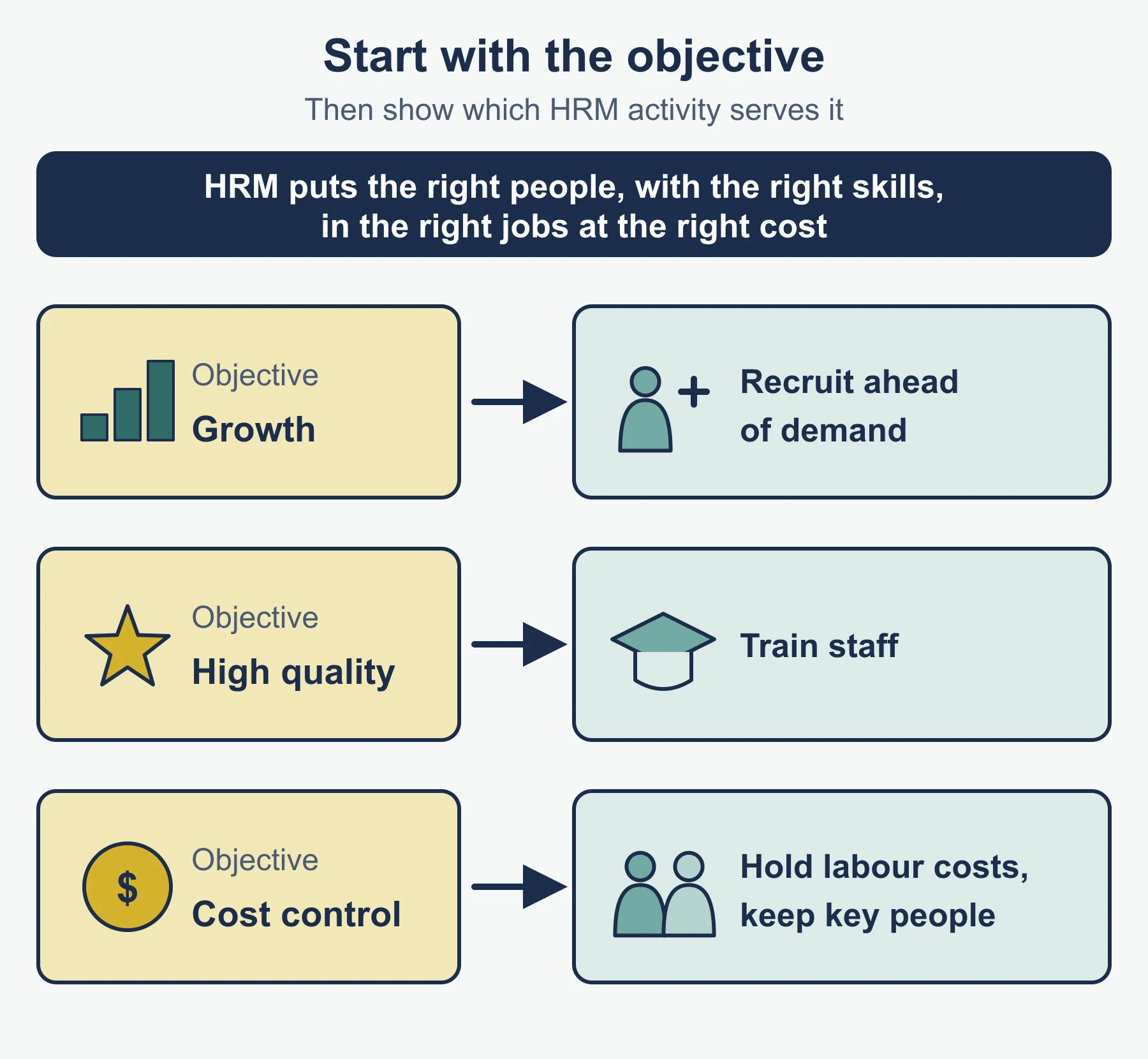
Human resource management deals with a business’s people: planning how many it needs, finding, training and keeping them and, sometimes, parting with them. Its role in meeting organisational objectives is to put the right people, with the right skills, in the right jobs at the right cost.
The link to objectives is what earns marks. A business aiming for growth needs HRM to recruit ahead of demand. One aiming at high quality needs training. One aiming at cost control needs HRM to hold down labour costs without driving out the people it needs. State the objective first, then show which HRM activity serves it.
2.1.2 Workforce planning
A workforce plan sets out how many staff, with which skills, a business will need and how it will get them. The reasons are to avoid shortages that lose sales, avoid surplus staff who raise costs, give time for recruitment and training, and prepare for change. Its role is to compare the workforce needed (from sales forecasts) with the workforce held (allowing for leavers) and so show the gap.
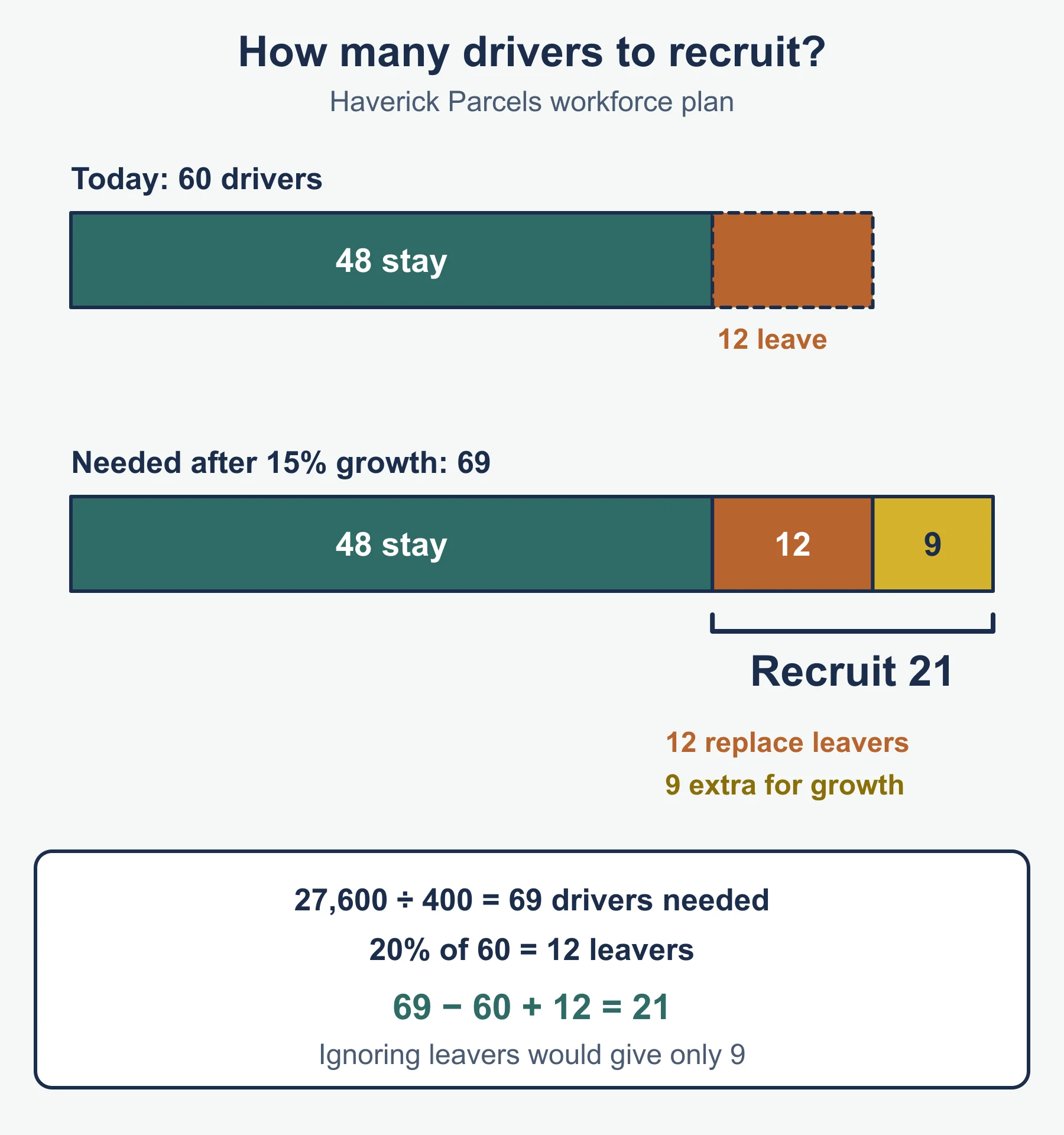
Worked example: Haverick Parcels. Haverick delivers 24,000 parcels a week. One driver handles 400 parcels a week, so it employs 24,000 ÷ 400 = 60 drivers. It forecasts 15% growth, which is 27,600 parcels, needing 27,600 ÷ 400 = 69 drivers. Experience says 20% of drivers leave each year: 12 of the 60. It must recruit 69 - 60 + 12 = 21 drivers. Ignoring leavers would give only 9.
Measuring labour turnover
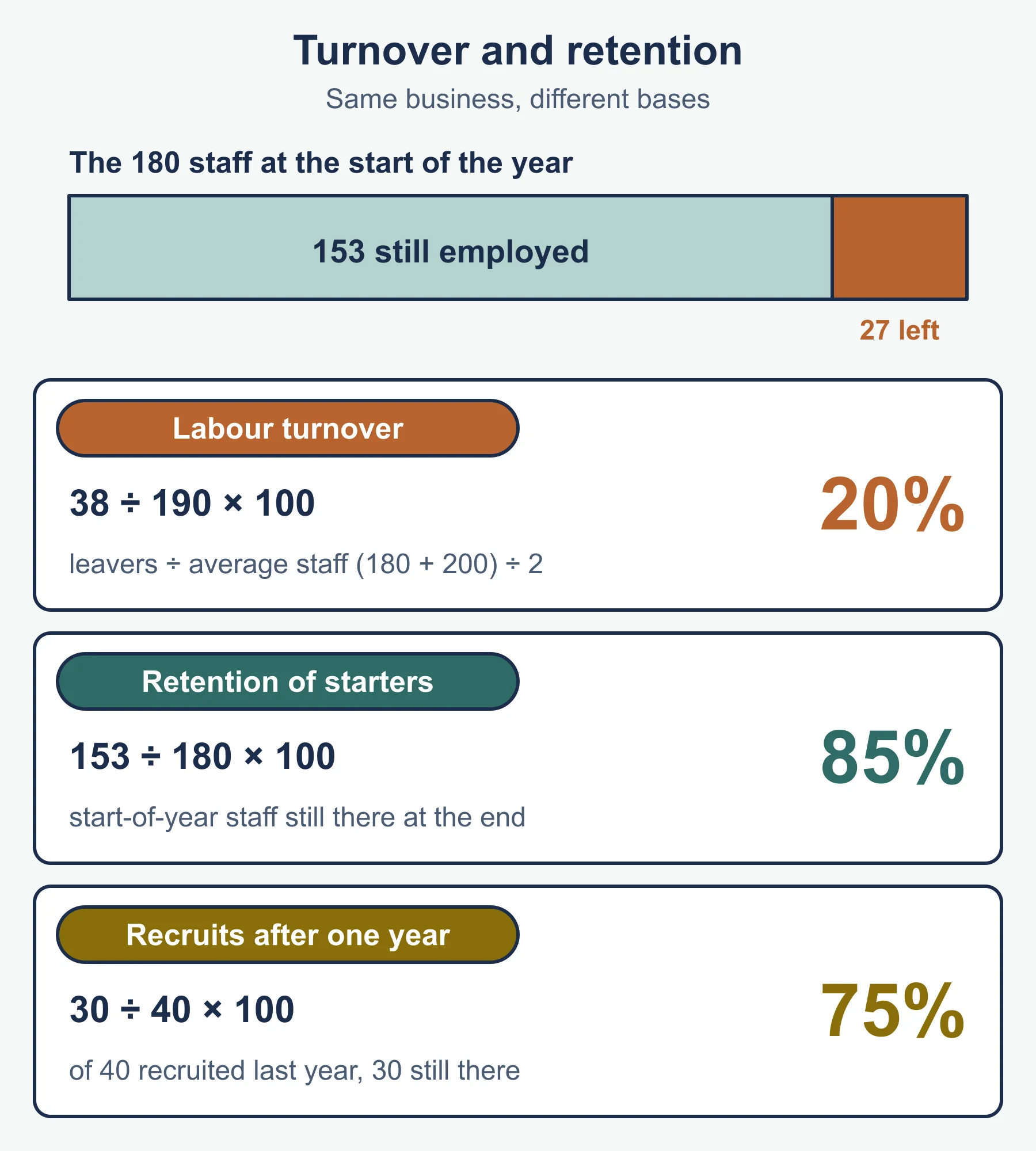
Labour turnover is the rate at which employees leave a business over a period. The standard form of the calculation is:
labour turnover (%) = (number of employees who leave in the period ÷ average number of employees in the period) × 100
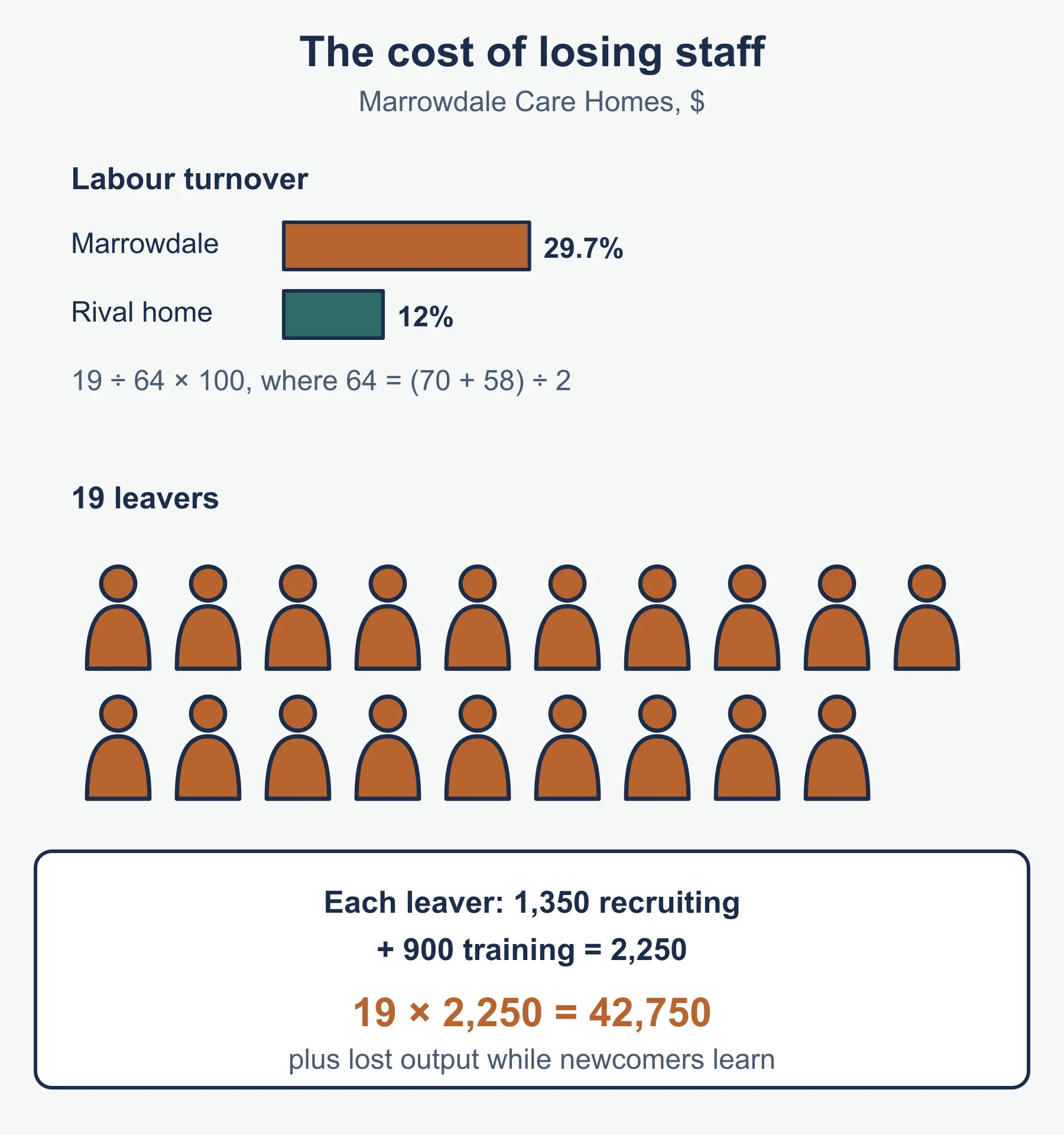
Worked example: Marrowdale Care Homes. Marrowdale employed 70 care staff at the start of the year and 58 at the end. Average employed = (70 + 58) ÷ 2 = 64. Nineteen people left. Labour turnover = 19 ÷ 64 × 100 = 29.7%. A rival home reports 12%, so Marrowdale loses staff far faster.
If each leaver costs 1,350 to recruit and 900 to train, the direct cost is 19 × (1,350 + 900) = 42,750. Lost output while newcomers learn is extra.
Implications of high and low turnover
High turnover raises recruitment and training costs, disrupts teams and customers, and can signal low morale, poor pay or poor management. It may be harmless in seasonal work where staff expect to move on. Low turnover brings stable teams, experience and lower costs, but can mean few new ideas, blocked promotion and staff who stay because they cannot find better jobs. Judge turnover against the type of business and rivals, and ask why people leave.
2.1.3 Recruitment and selection
The process and its documents
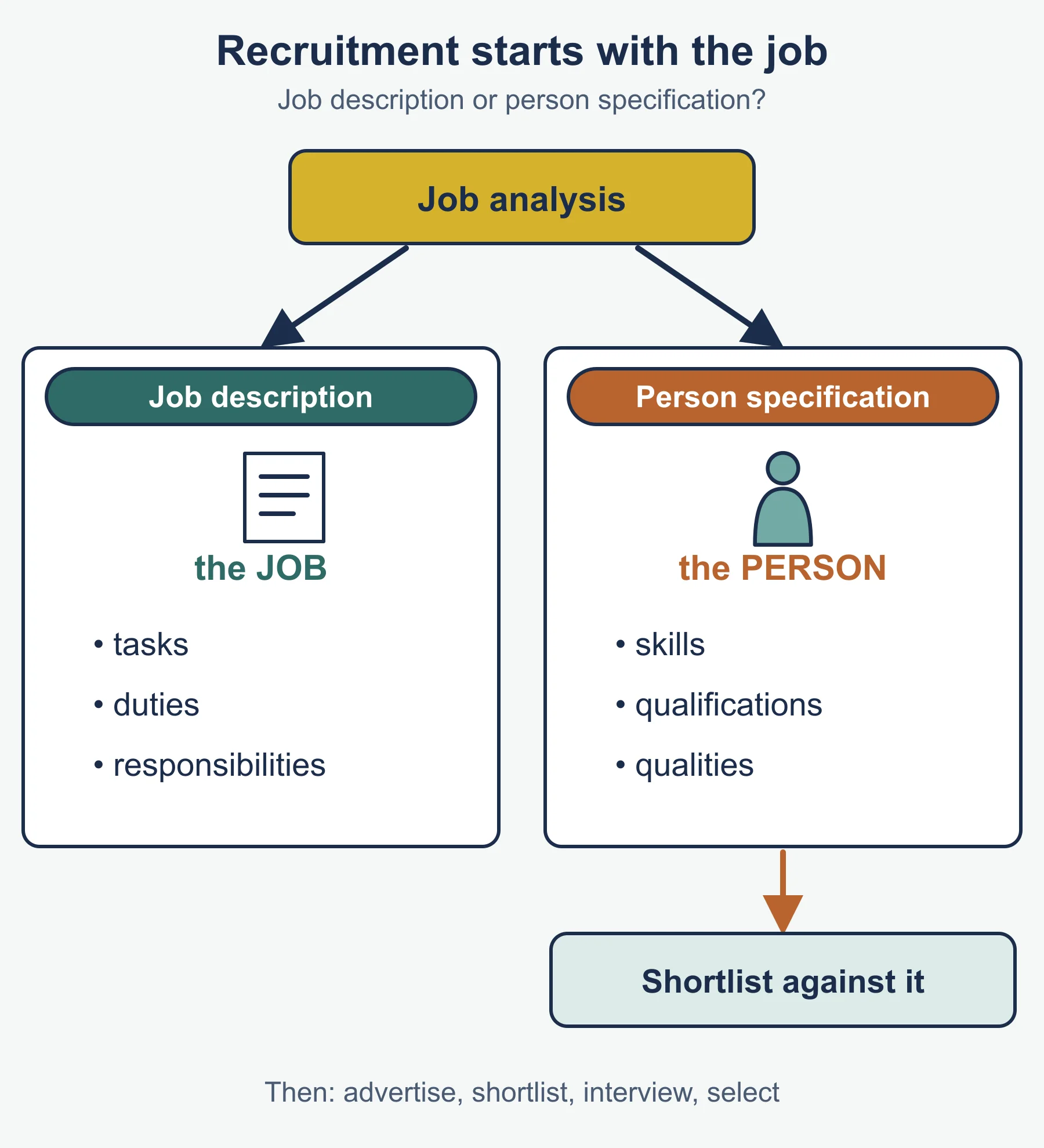
Recruitment is attracting suitable applicants. A job description lists the title, purpose, main duties, reporting line and conditions. A person specification lists the qualifications, skills, experience and personal qualities needed. One describes the job; the other the ideal person. Together they guide the advertisement and the choice.
Recruitment methods
- Job advertisements in newspapers, trade journals or on the business’s own premises or site reach those who see them, so the medium sets the audience. Wide advertising also brings unsuitable applicants.
- Employment agencies find and sometimes screen candidates for a fee. They save management time but cost more.
- Online recruitment through job websites, social networks and the business’s own site is fast, cheap and wide-reaching, but can bring applications that cost time to filter.
Internal and external recruitment
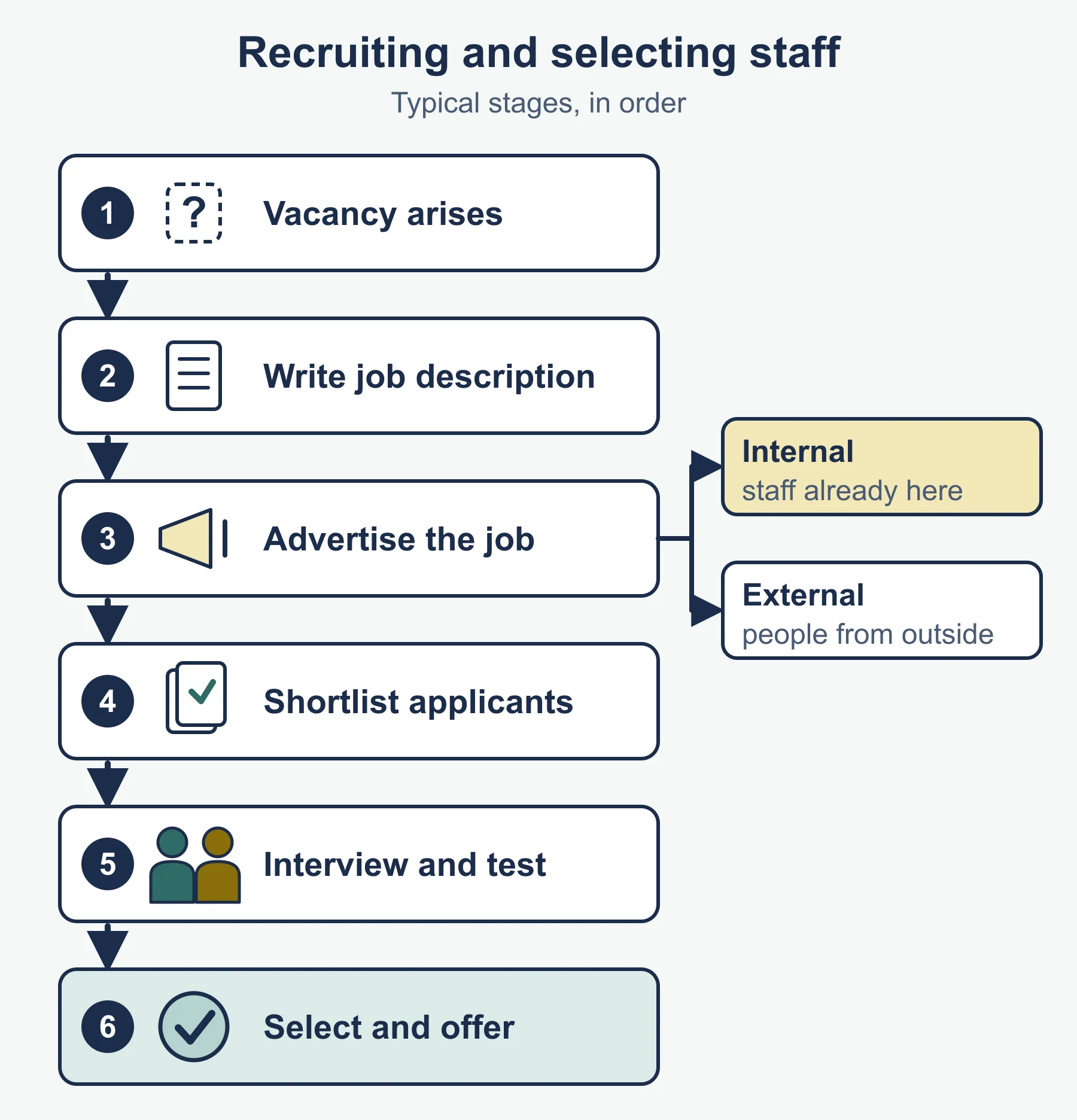
Internal recruitment fills a post from within the business. It is cheaper and faster, both sides know each other, and promotion prospects can motivate staff. It leaves a vacancy elsewhere, offers few fresh ideas, and can upset those not chosen. External recruitment gives a wider choice and new skills, but costs more, takes longer and carries more risk.
Worked example: Skarrow Hotel. The head receptionist is retiring. The night supervisor has worked there nine years and knows the booking system. The hotel is also about to open a conference wing, needing someone who has run corporate events. Internal appointment is quick and shows that promotion is possible, but it leaves the night shift without a supervisor and gives no events experience. An agency costs more but could bring that experience. A sound judgement is to advertise externally, since event skills are the deciding need, while inviting the night supervisor to apply.
Selection methods
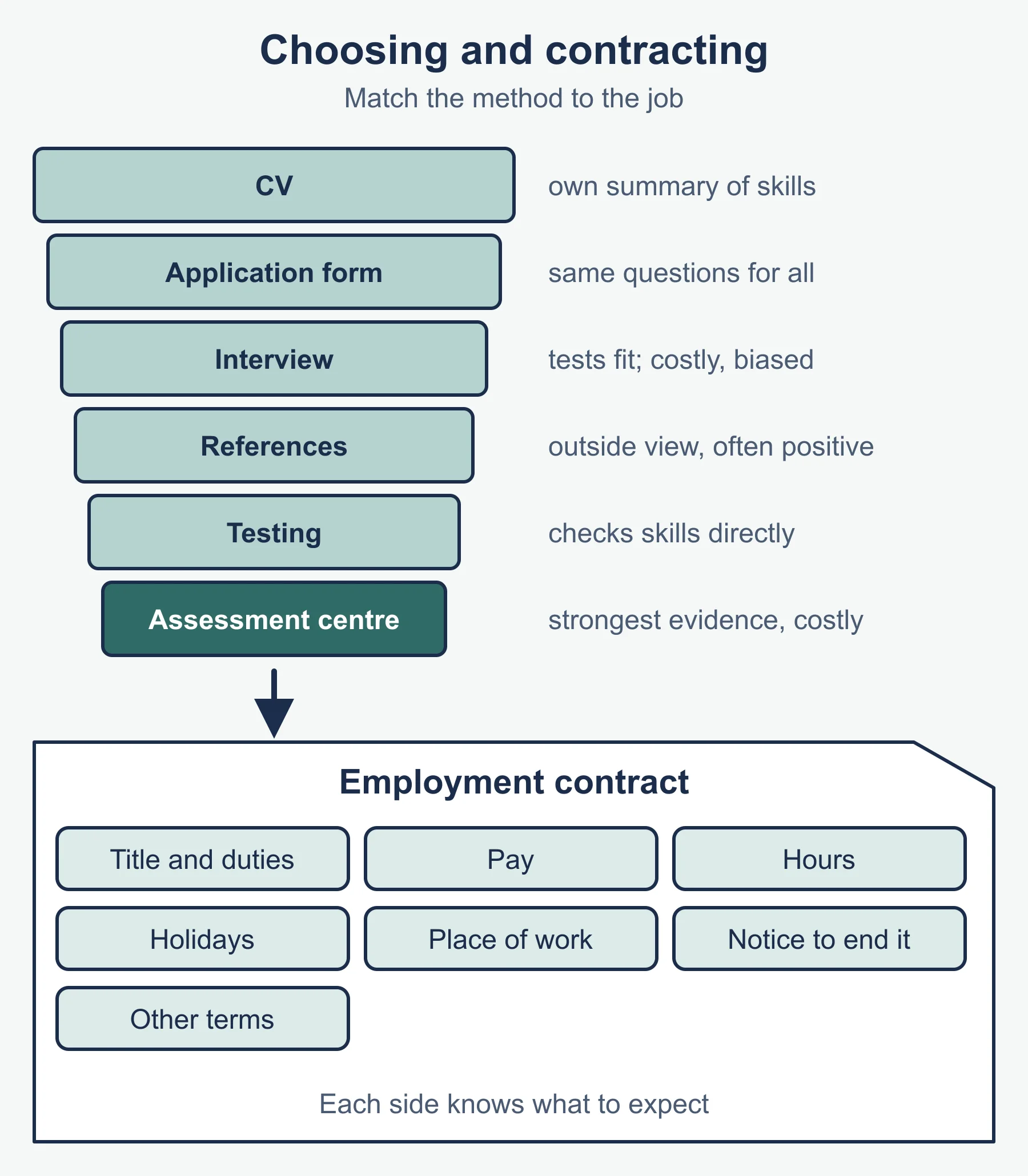
Selection is choosing among applicants. A curriculum vitae (also called a résumé) is the applicant’s own summary of education, experience and skills. An application form asks everyone the same questions, which makes comparison easier. Interviews let the business test communication and fit, but are costly and open to bias. References from past employers or teachers give an outside view, though they tend to be positive. Testing checks skills or aptitude directly (a typing test, say). Assessment centres combine tasks, group exercises, tests and interviews over a day or more: the strongest evidence for skilled posts, but expensive. Match methods to the job.
Employment contracts
An employment contract is the agreement between employer and employee. In general terms it sets out the job title and duties, pay, hours, holidays, place of work, notice needed to end it and the other terms of employment. It makes clear what each side can expect. Detail depends on the country and type of employment, so none is given here.
2.1.4 Redundancy and dismissal
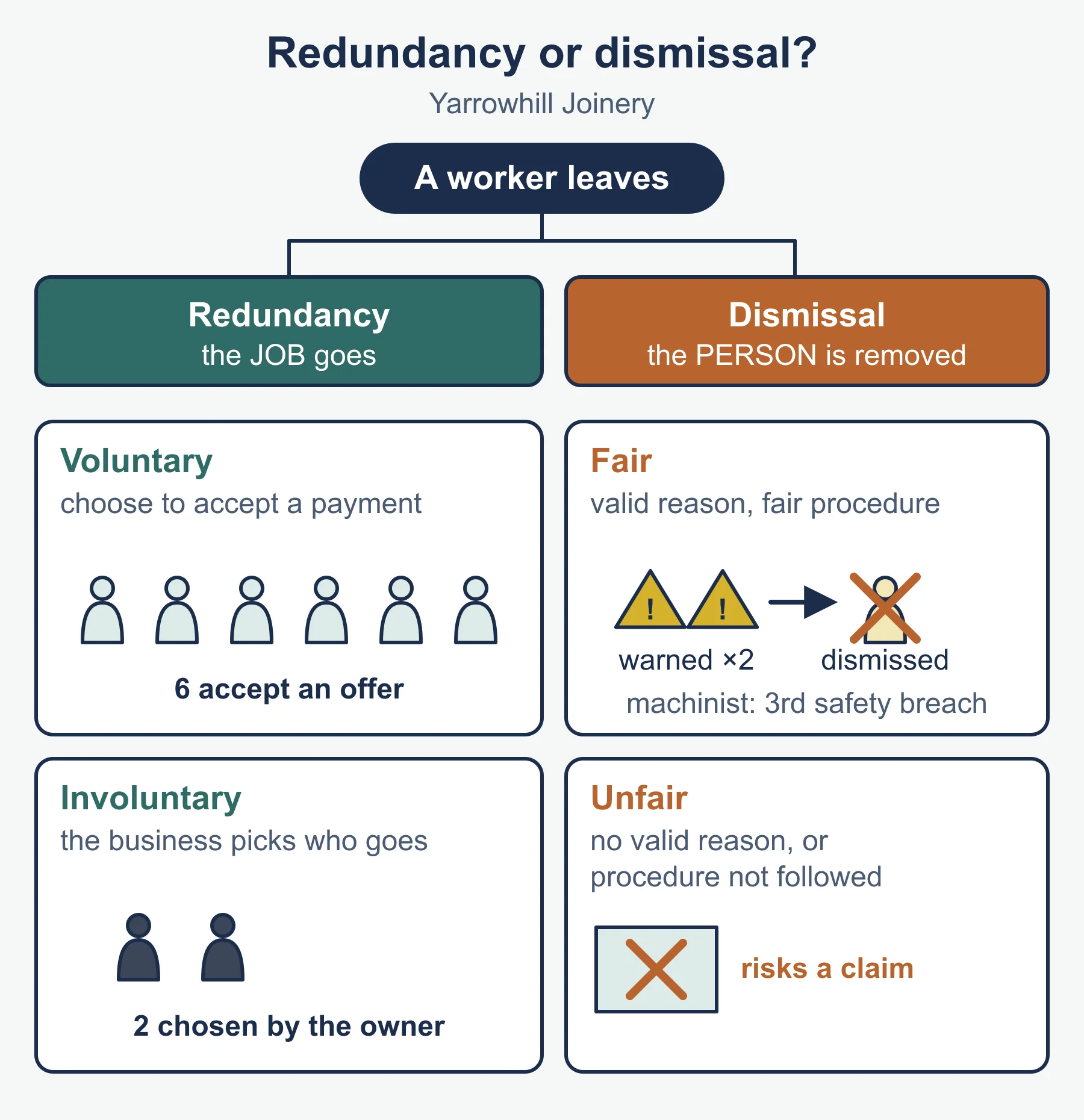
Redundancy happens when a job is no longer needed, for example through closure, falling demand or new technology. It is about the post, not the person. Voluntary redundancy is where employees choose to accept an offer to leave, often with a payment. Involuntary redundancy is where the business selects people to go, and they have no choice.
Dismissal is the employer ending a contract because of something about the employee. Fair dismissal rests on a valid reason, such as serious misconduct or continuing poor performance after warnings, with a proper procedure. Unfair dismissal has no valid reason, or the reason is valid but the procedure was not followed. Rules differ between countries.
Worked example: Yarrowhill Joinery. Demand for staircases falls by a third. Six workers accept a payment to leave (voluntary redundancy). Two more posts must still go, and the owner picks them (involuntary redundancy). Separately, a machinist is warned twice about safety breaches, retrained, then dismissed after a third breach: a fair dismissal, with a valid reason and a fair procedure. The first two cases are about jobs; the third is about conduct.
Impact: redundancy cuts costs but costs money now, can lower the morale of those who stay, and may lose skills needed later. Unfair dismissal risks a claim, lost trust and a poor employer reputation.
2.1.5 Morale and welfare
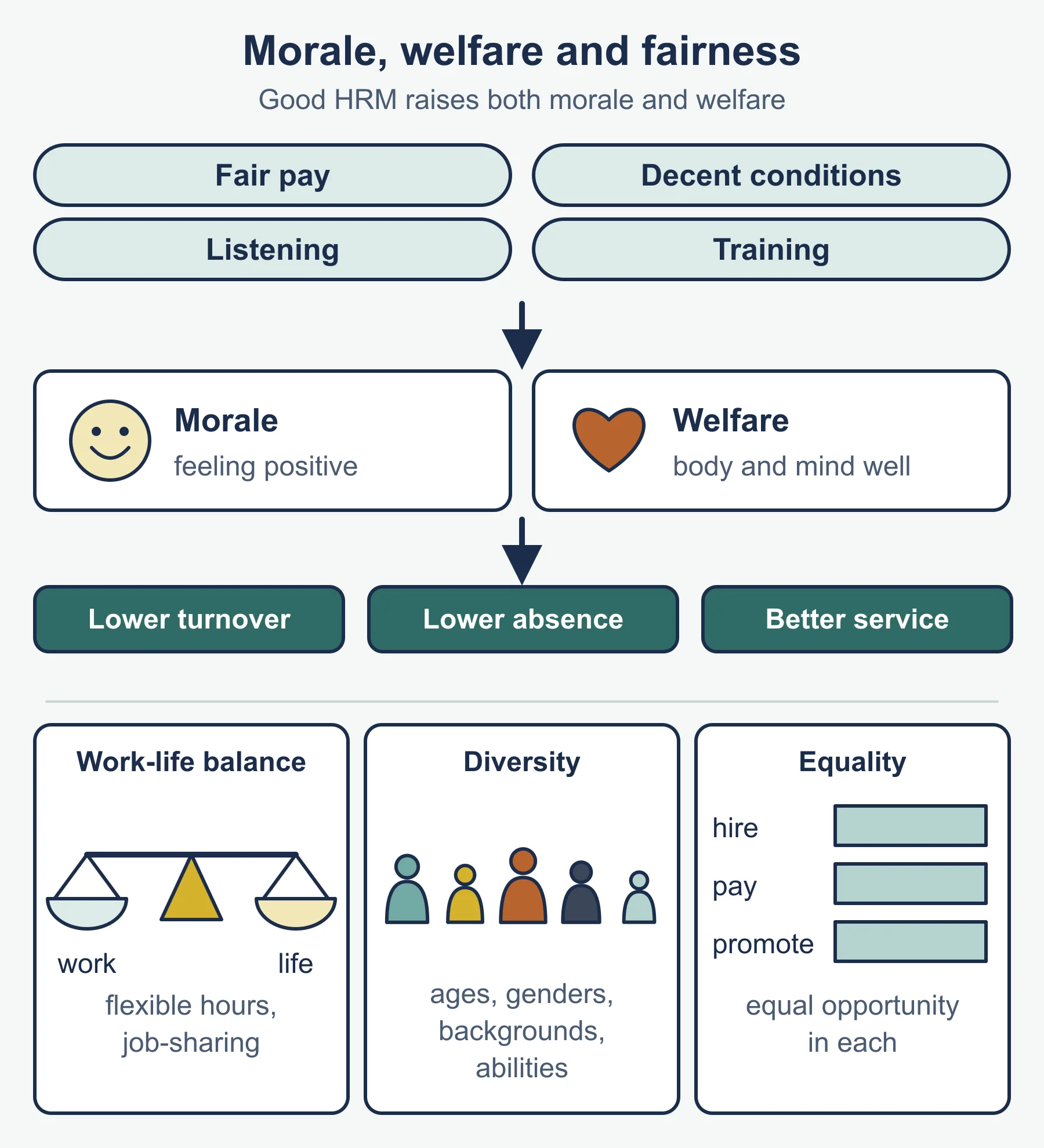
Morale is how positive employees feel about the business and their work. Welfare is provision for their physical and mental wellbeing, from safe conditions to support services. Good HRM raises both through fair pay, decent conditions, listening and training. High morale tends to bring lower turnover, lower absence and better service.
Work-life balance is the balance between time given to work and time for family, rest and interests. Flexible hours, part-time work, job-sharing, home working and reasonable workloads help. The business gains loyalty and applicants, but faces harder scheduling.
Diversity means a workforce of people with different ages, genders, backgrounds and abilities. Equality means fair treatment and equal opportunity in recruitment, pay and promotion. Benefits include a wider talent pool, varied ideas, a better understanding of customers and a good reputation. Costs include training managers, changing procedures, and conflict if change is poorly handled.
2.1.6 Training and development
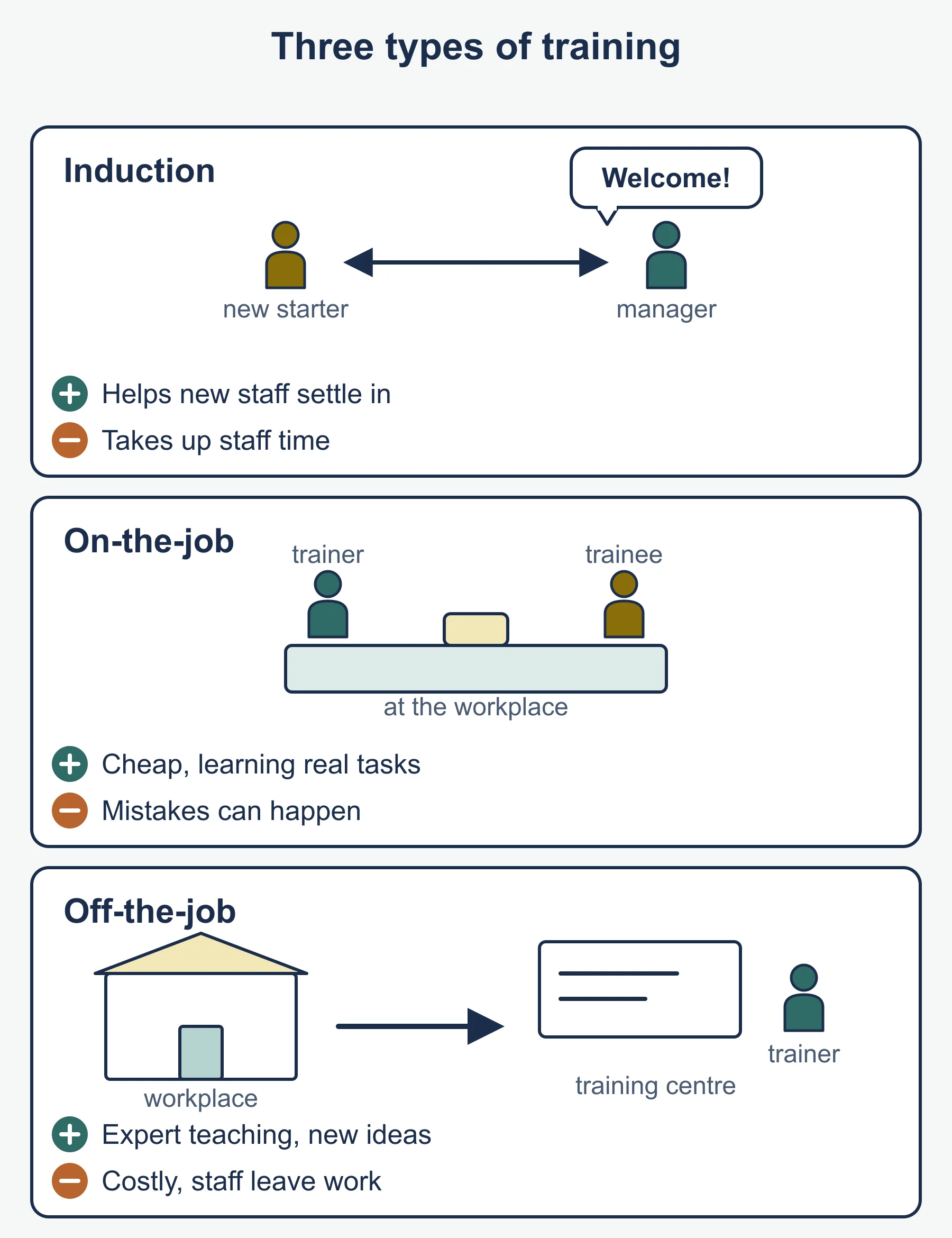
- Induction introduces a new starter to the business, colleagues, safety rules and the job, helping people settle quickly.
- On-the-job training is learning the real job beside an experienced colleague. It is cheap and practical, but quality depends on the trainer, and bad habits can be passed on.
- Off-the-job training takes place away from the workplace, such as in a college. It can teach wider or specialist skills, but costs more, and work goes undone meanwhile.
The impact of training and development on a business is better skills, quality and productivity, higher morale, and lower turnover where staff feel invested in. The costs are fees, time away and the risk that trained staff leave for rivals.
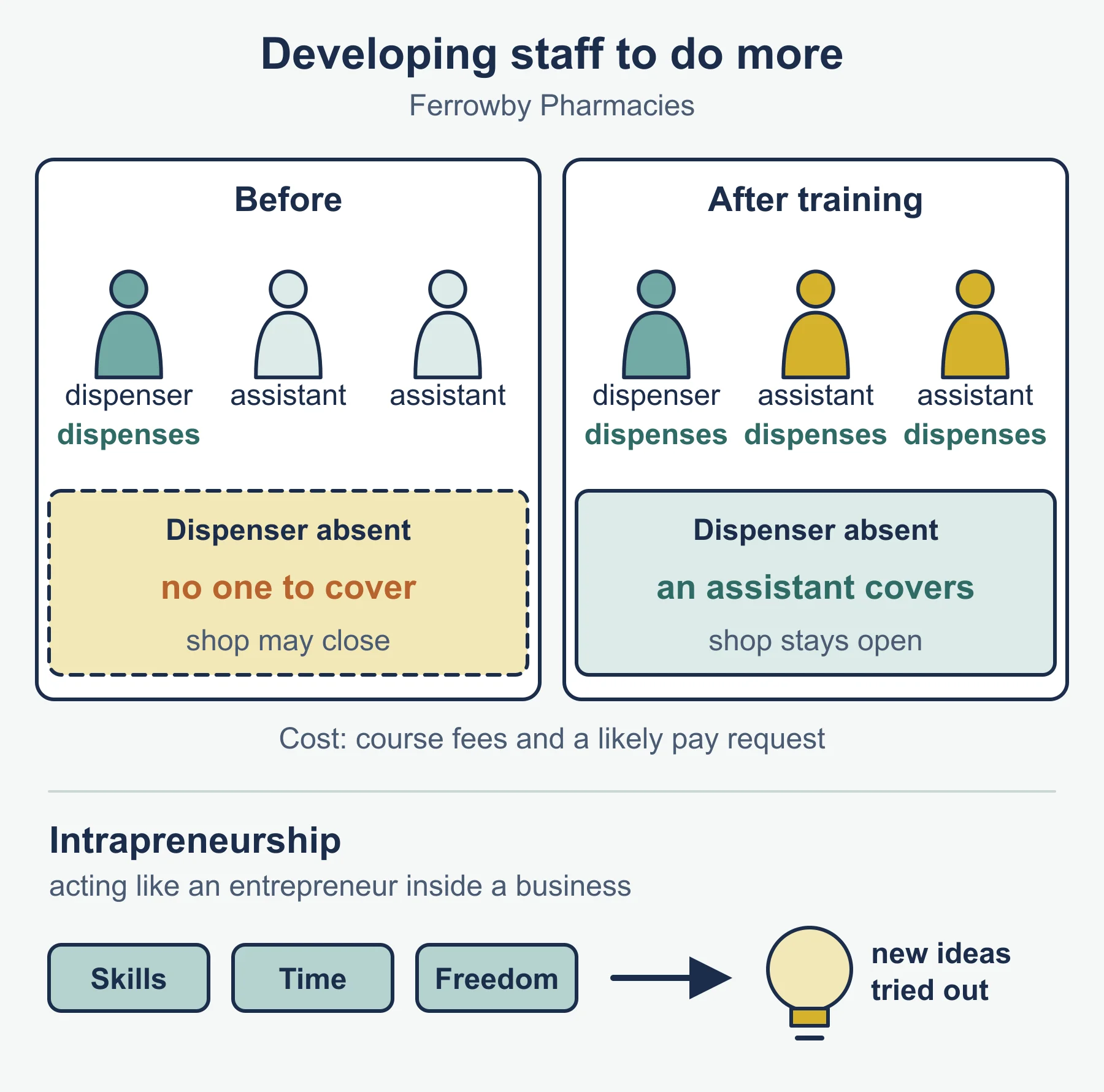
Intrapreneurship is acting entrepreneurially inside an established business. Development that encourages it gives staff skills, time and freedom to suggest and try new ideas. Multi-skilling trains employees to do several jobs. Flexibility means they can move between tasks or cover absence. Benefits are easier cover and more varied work. Costs are training time and possibly higher pay.
Worked example: Ferrowby Pharmacies. A new dispenser has a morning of induction, four weeks on-the-job beside a senior colleague, then one day off-the-job on a medicines course. Later two counter assistants learn to dispense under supervision, so a shop can stay open when someone is absent: multi-skilling and flexibility. The cost is course fees and a likely pay request.
2.1.7 Management and workforce relations
Cooperation between management and workforce benefits both sides. The business gains smoother change, fewer disputes and better ideas. Employees gain security, a say in decisions and better conditions. Methods include consultation, suggestion schemes and sharing information. Cooperation takes time and can slow decisions.
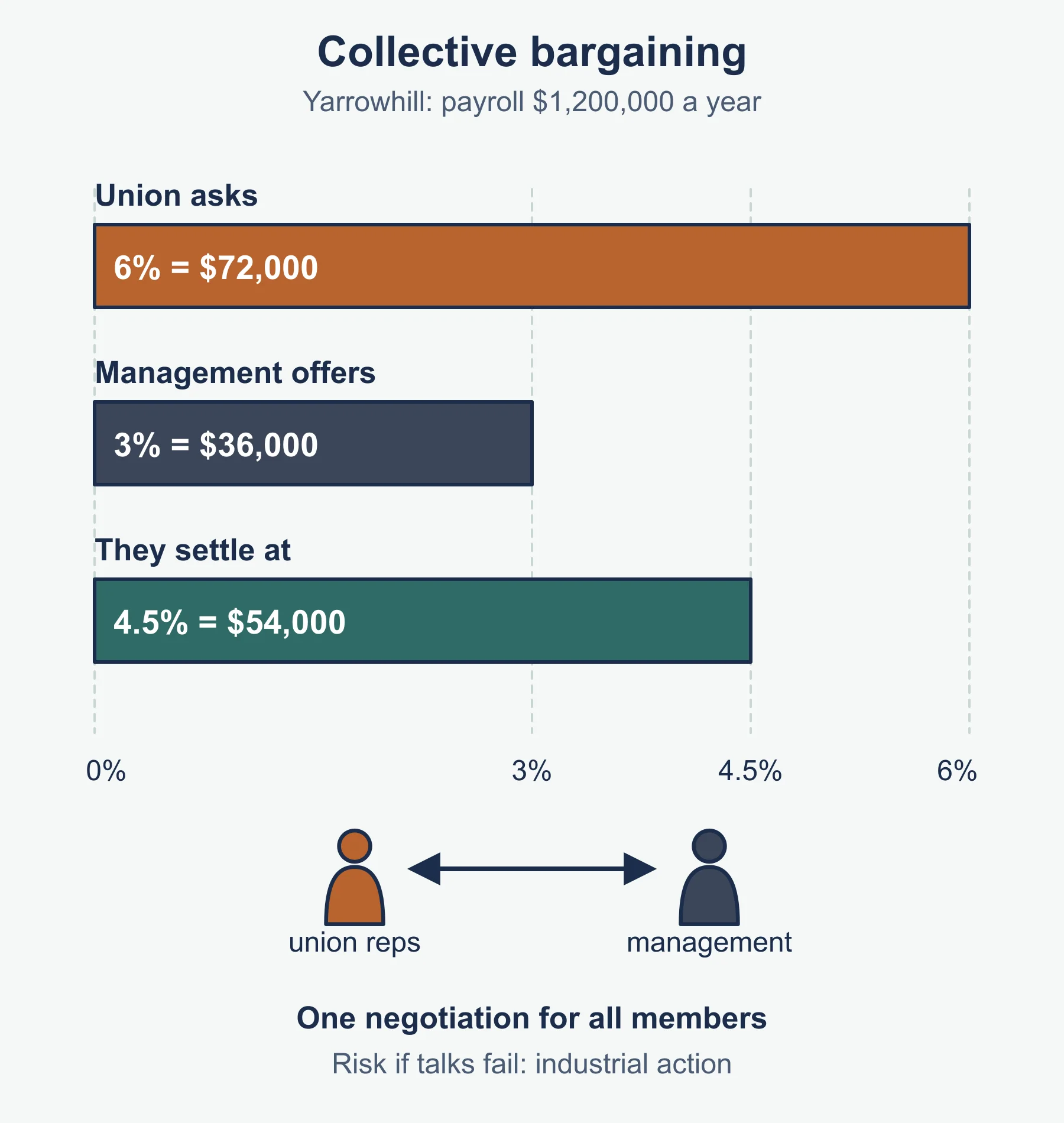
A trade union is an organisation of employees formed to protect and advance their interests. Collective bargaining is negotiation between employers and union representatives on behalf of all members, covering pay, hours and conditions. Union members speak with one voice.
Worked example: pay talks at Yarrowhill. The payroll is 1,200,000 a year. The union asks for 6% (72,000 extra), management offers 3% (36,000) and they settle at 4.5%, which is 54,000. For employees, union involvement can bring better pay, safer conditions and protection in disputes. For the employer it brings one negotiation instead of many and a clear channel of communication, but also higher costs, slower decisions and the threat of industrial action if talks fail.
Common errors
- Writing labour turnover as a count of leavers, or using the opening headcount instead of the average.
- Mixing up redundancy (the job goes) with dismissal (the person is removed).
- Listing recruitment methods without saying why one fits the case.
- Describing a job description as a list of qualities (that is the person specification).
- Treating training as only a cost.
Next, try the practice questions or a free diagnostic.
Frequently asked questions
What does section 2.1 Human resource management cover in Cambridge 9609? The purpose and roles of HRM, workforce planning, recruitment and selection, redundancy and dismissal, morale and welfare, training and development, and management and workforce relations.
What is a fair dismissal? A fair dismissal has a valid reason, such as serious misconduct or continued poor performance after warnings, and follows a proper procedure. Without a valid reason or the right procedure, the dismissal is unfair.
What is multi-skilling? Multi-skilling means training staff to do several jobs, so they can cover absence or move to where work is needed and the business has less idle time.
Why does HRM matter to a business’s objectives? HRM plans, recruits, trains and keeps the people a business needs. A business aiming for growth, for example, needs HRM to have enough staff with the right skills in time.
Official syllabus
Cambridge International AS & A Level Business 9609 syllabus for examination in 2026, 2027 and 2028, published by Cambridge University Press & Assessment, section 2.1 Human resource management (HRM).
Get free revision emails (optional)
Occasional emails with practice questions, worked explanations and links to free resources for the qualification and subjects you choose. No spam, and you can unsubscribe from any email. The free tools on this site never need an email.
Related resources
-
Practice questions
A Level Business: Human resource management (HRM) (Cambridge 9609) – Practice Questions
Original practice questions with worked answers on section 2.1 Human resource management (HRM) for Cambridge AS & A Level Business 9609.
Business · Cambridge · AS Level
Try questions -
Revision notes
A Level Business: Human resource management (HRM) (Cambridge 9609) – Revision Notes
Condensed revision notes on section 2.1 Human resource management (HRM), Cambridge AS & A Level Business 9609, with a short self-test and answers.
Business · Cambridge · AS Level
Revise topic -
Study guides
A Level Business: Leadership and Human resource management (HRM) strategy (Cambridge 9609)
Study guide to sections 7.3 Leadership and 7.4 HRM strategy of Cambridge A Level Business 9609: leadership theories, EQ, flexible contracts, MBO and AI.
Business · Cambridge · A Level
Read guide
Related articles
-
teaching
A Level tuition in Dubai: Cambridge or Pearson Edexcel International A Level?
Schools in Dubai and Abu Dhabi teach either Cambridge International AS & A Level or Pearson Edexcel International A Level. How the two are structured, why it matters for tuition, and how online classes from Lahore work.
9 October 2026
-
curriculum guides
Choosing subjects at IGCSE and A Level
How subject choices at 14 and 16 affect university options later, and how to keep pathways open without overloading a timetable.
28 July 2026
Studying this with a teacher
Working through Business AS LEVEL?
This page is free and stays free. If you would rather be taught it, Marlbridge runs Business classes one-to-one and in small groups of up to 15, online in your own time zone. The first trial class is free. WhatsApp replies within an hour (8am–11pm Pakistan time, every day); email the same day.
Cambridge Business teachers at Marlbridge

