
Revision Notes
A Level Business: Human resource management (HRM) (Cambridge 9609) – Revision Notes
Condensed revision notes on section 2.1 Human resource management (HRM), Cambridge AS & A Level Business 9609, with a short self-test and answers.
- Subject
- Business
- Level
- AS LEVEL
- Topic
- Human resource management
- Author
- Marlbridge Academic Team
- Updated
- Reviewed by
- Salman Ahmad (what this means)
Aligned to Cambridge A Level Business (9609), For examination in 2026, 2027 and 2028. Official specification .
Syllabus page (what it covers and how it is assessed): Cambridge A Level Business.
Syllabus points this page covers
9609 (AS Level)
- 2.1 Human resource management (HRM)
Found an error? Report a correction.
Need help with this topic? Request a free trial class for A Level Business (9609).
These revision notes condense section 2.1 Human resource management (HRM) of the Cambridge International AS & A Level Business 9609 syllabus for examination in 2026, 2027 and 2028. It is an AS Level section that A Level candidates also study. For full explanations and worked examples, read the study guide first, then test yourself with the practice questions.
Broader Topic 2 pages (which also cover motivation and management) are the Topic 2 revision notes and Topic 2 study guide. Course links: the Cambridge A Level Business hub, the printable checklist and the free diagnostics.
2.1.1 and 2.1.2: Purpose, workforce planning and labour turnover
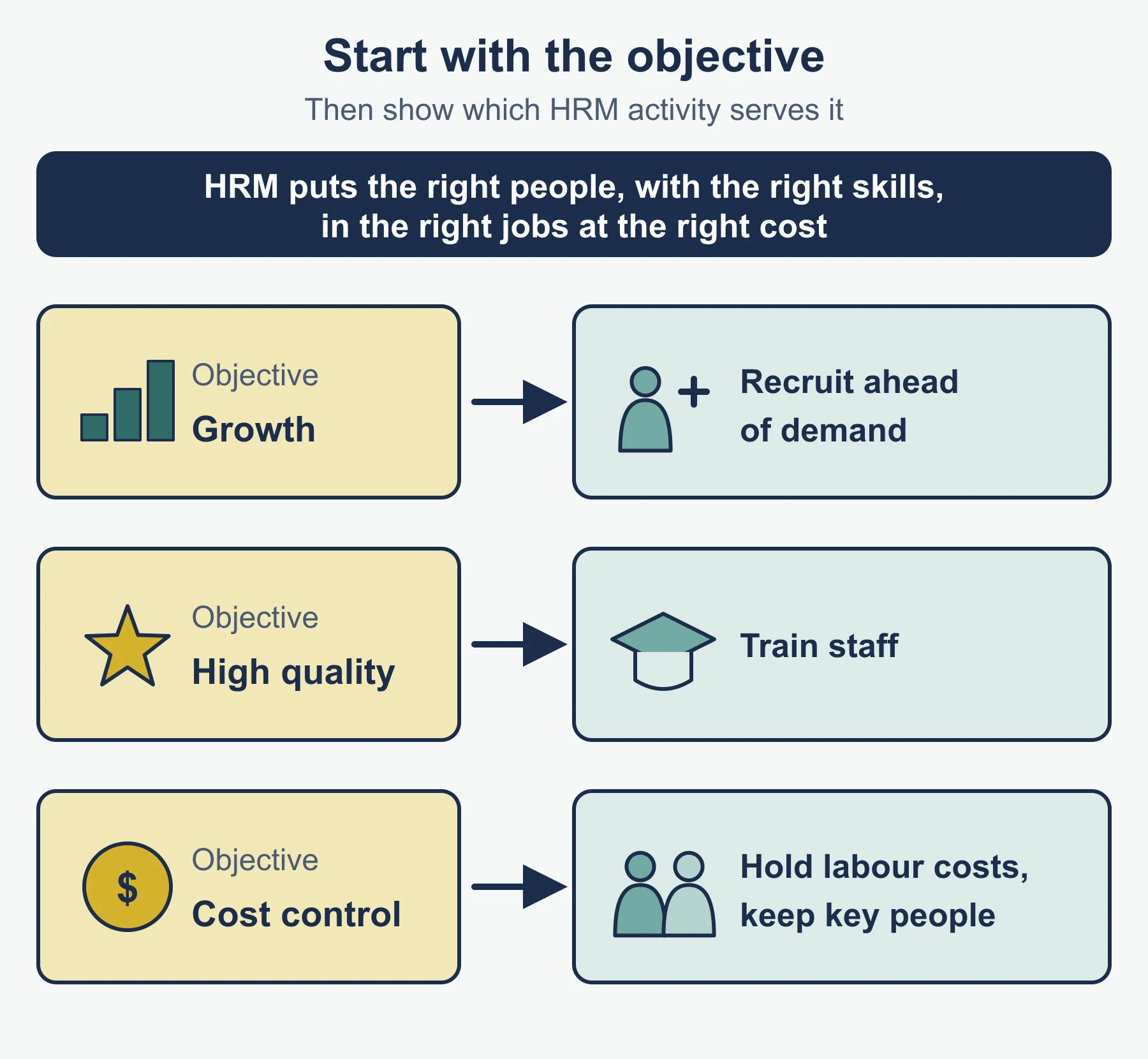
- HRM manages the people side of the business: planning, recruiting, training, keeping and, if necessary, releasing staff. Its role is to supply the people the objectives need. Always name the objective (growth, quality, cost control, reputation) and the HRM action that serves it.
- A workforce plan compares the staff needed in future with the staff the business has, allowing for leavers, and shows the gap.
- Reasons for it: avoid shortages and surpluses, allow time to recruit and train, prepare for change, control costs.
| Item | Formula or definition |
|---|---|
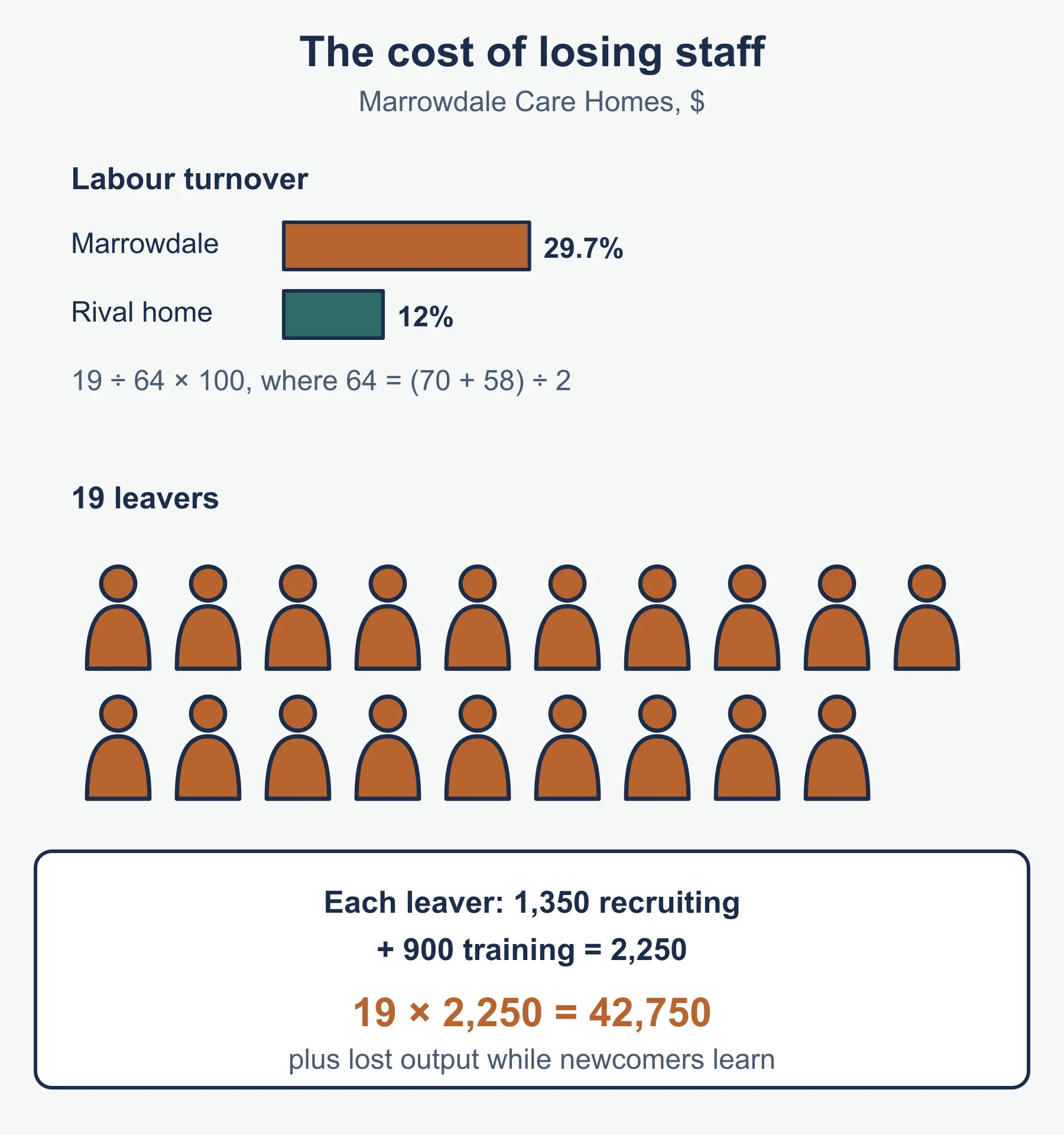
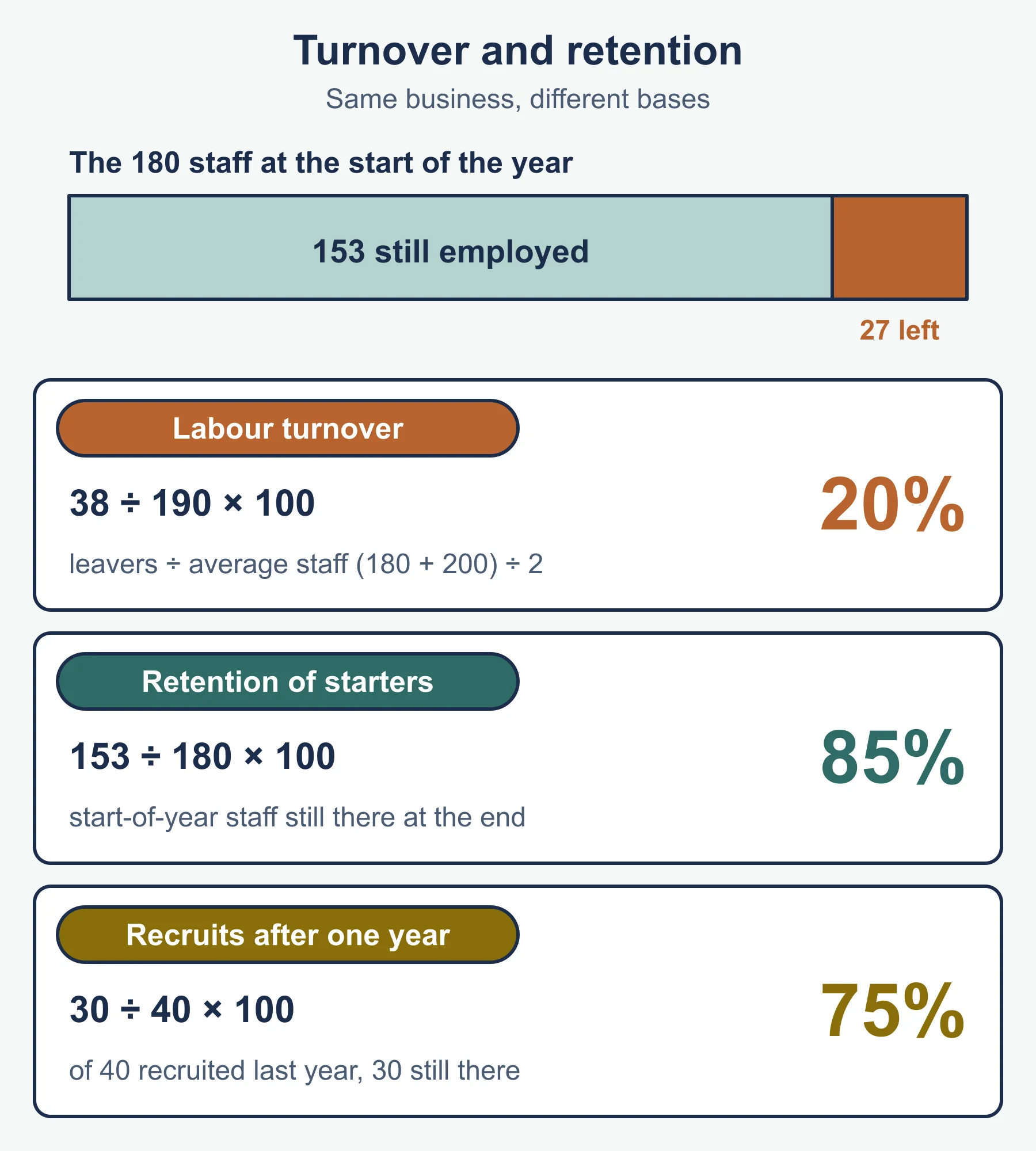
| Labour turnover (%) | (leavers in the period ÷ average number employed) × 100 (standard form) |
| Average employed | (opening number + closing number) ÷ 2, when only those are given |
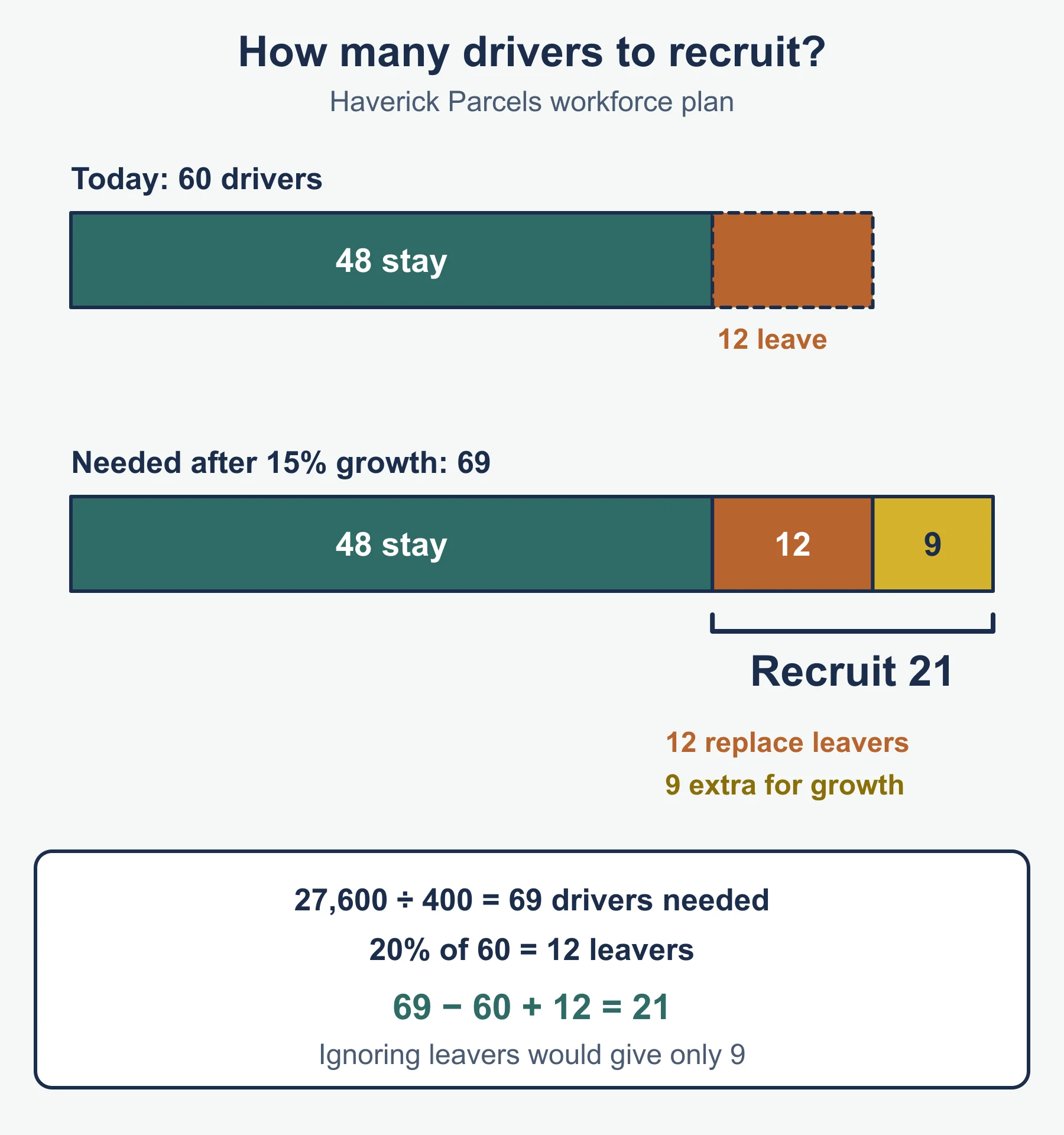
| Staff to recruit | staff needed - staff now + expected leavers |
Method in steps for a workforce plan: (1) find staff needed from forecast output; (2) take away current staff; (3) add expected leavers; (4) state the recruitment and training needed.
Small reminder. A shop employs 32 at the start of a year and 28 at the end, and 6 leave. Average = 30. Turnover = 6 ÷ 30 × 100 = 20%.
| High turnover | Low turnover | |
|---|---|---|
| Costs | More recruitment and training | Few, but pay may be high for long-serving staff |
| Operations | Lost skills, disruption, weaker service | Stable teams and experience |
| Signals | Low morale, poor pay or management (or normal in seasonal work) | Contentment, or staff with nowhere else to go |
| Risk | Quality falls | Few new ideas, blocked promotion |
2.1.3: Recruitment and selection
| Term | Meaning |
|---|---|
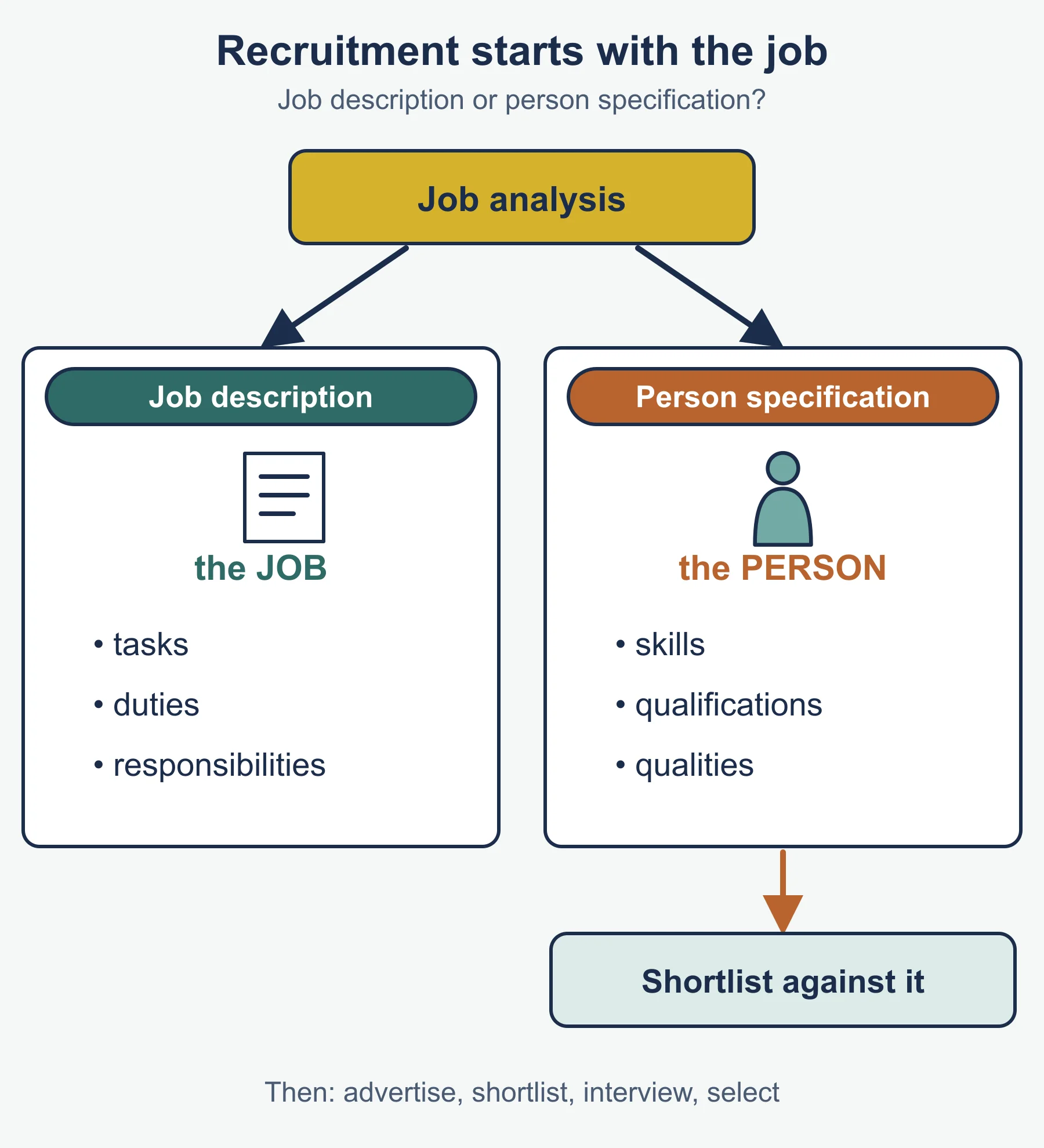
| Job description | Title, purpose, duties, reporting line, conditions: describes the job |
| Person specification | Qualifications, skills, experience, qualities: describes the ideal person |
| Job advertisement | Notice in print or online; the medium decides who sees it |
| Employment agency | Finds and may screen candidates for a fee; good for specialist or urgent posts |
| Online recruitment | Job sites and social networks; fast, cheap, wide reach, but many applications to filter |
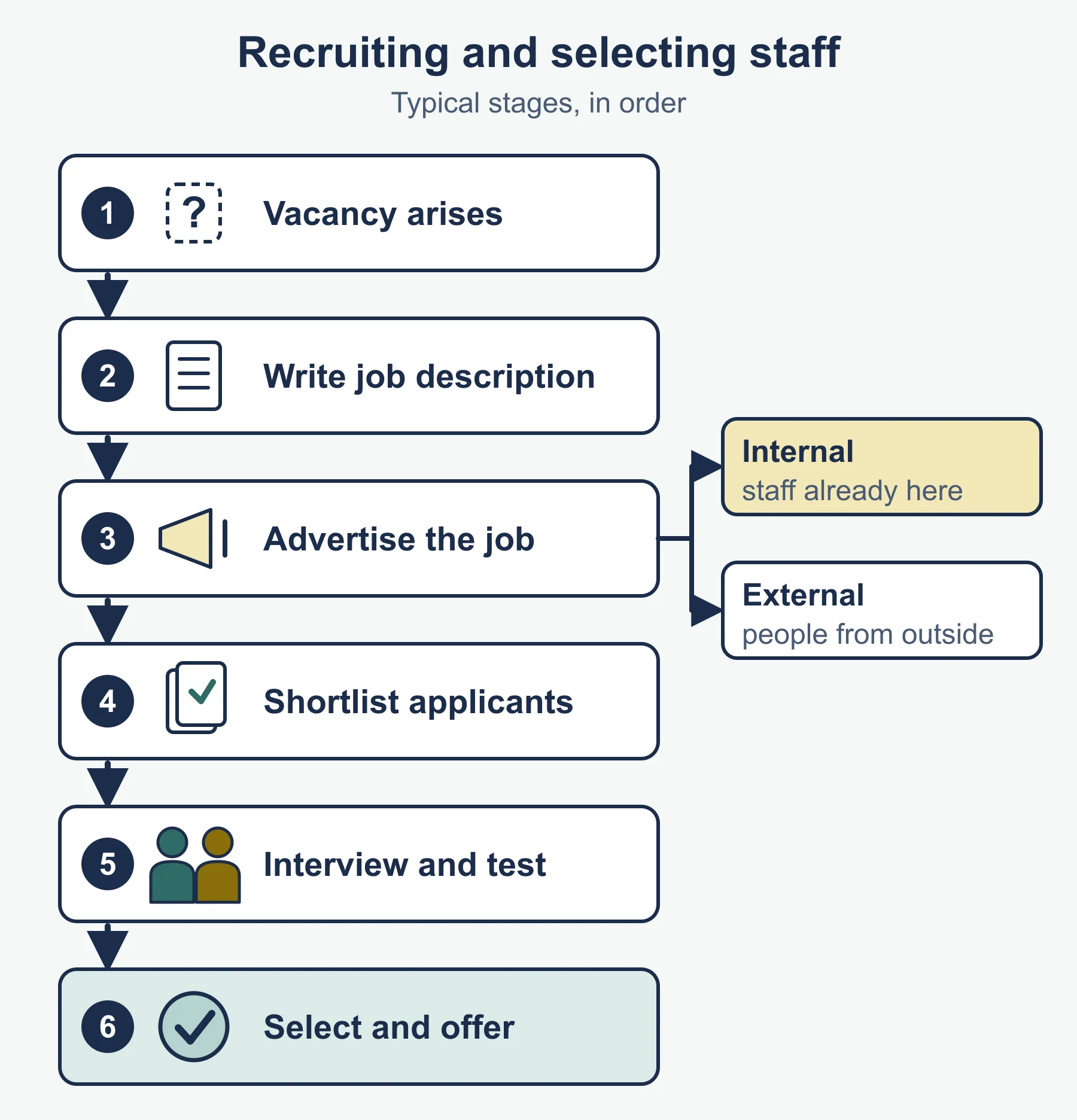
| Internal | Cheaper, faster, known person, motivates; narrow choice, leaves a gap, no fresh ideas |
| External | Wider choice, new ideas and skills; dearer, slower, riskier |
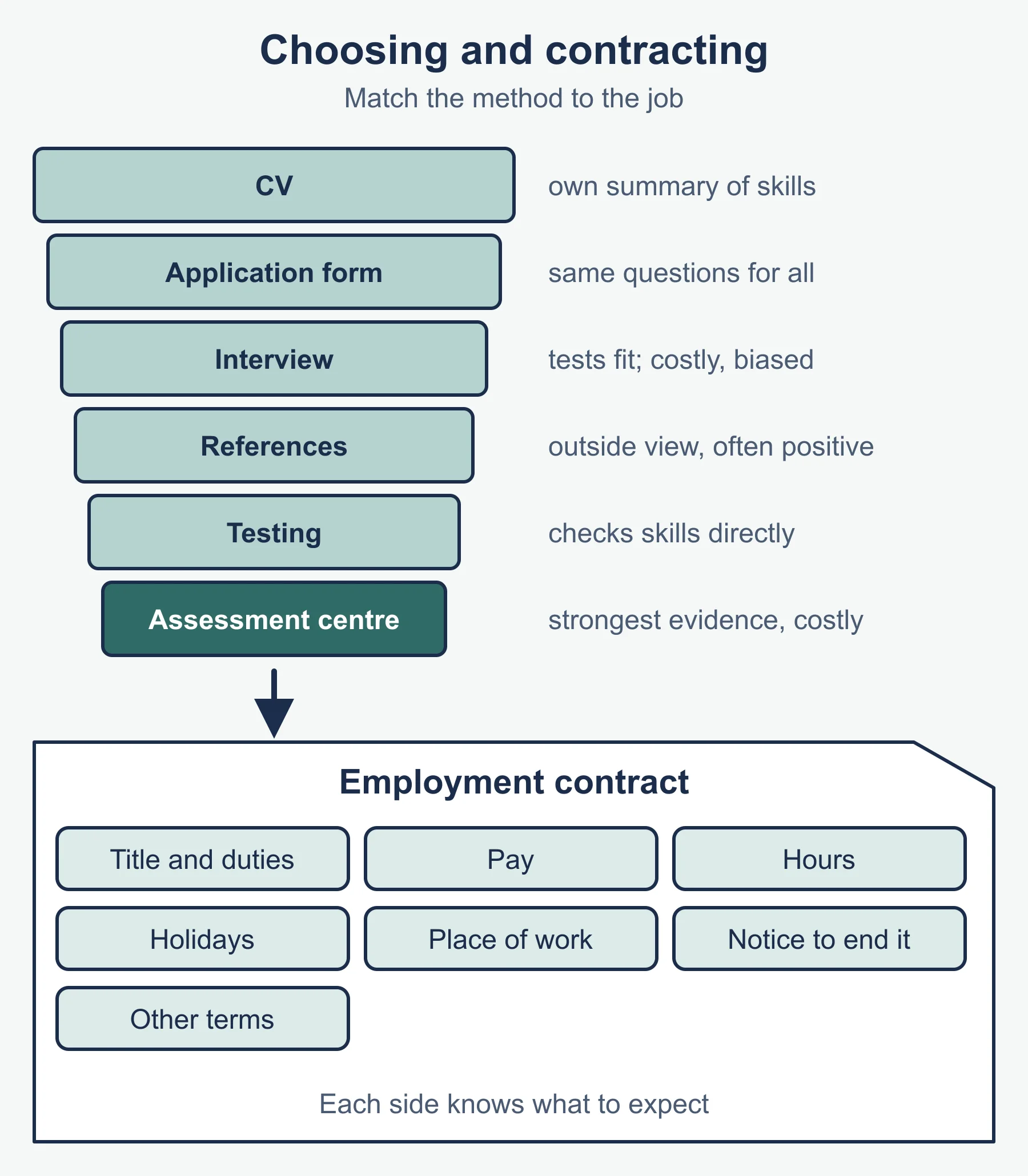
Selection methods, one line each
- Curriculum vitae (résumé): applicant’s own summary; quick, but written by the applicant.
- Application form: same questions for all; easy to compare.
- Interview: tests communication and fit; costly and open to bias.
- References: outside view of the person; usually favourable.
- Testing: checks skills or aptitude directly.
- Assessment centre: several tasks over a day or more; best evidence, highest cost.
Employment contract: the agreement between employer and employee. In general it covers duties, pay, hours, holidays, place of work and notice. It makes expectations clear for both sides; detail varies by country.
Must-know distinction: job description (the job) versus person specification (the person).
2.1.4: Redundancy and dismissal
| Type | Key idea |
|---|---|
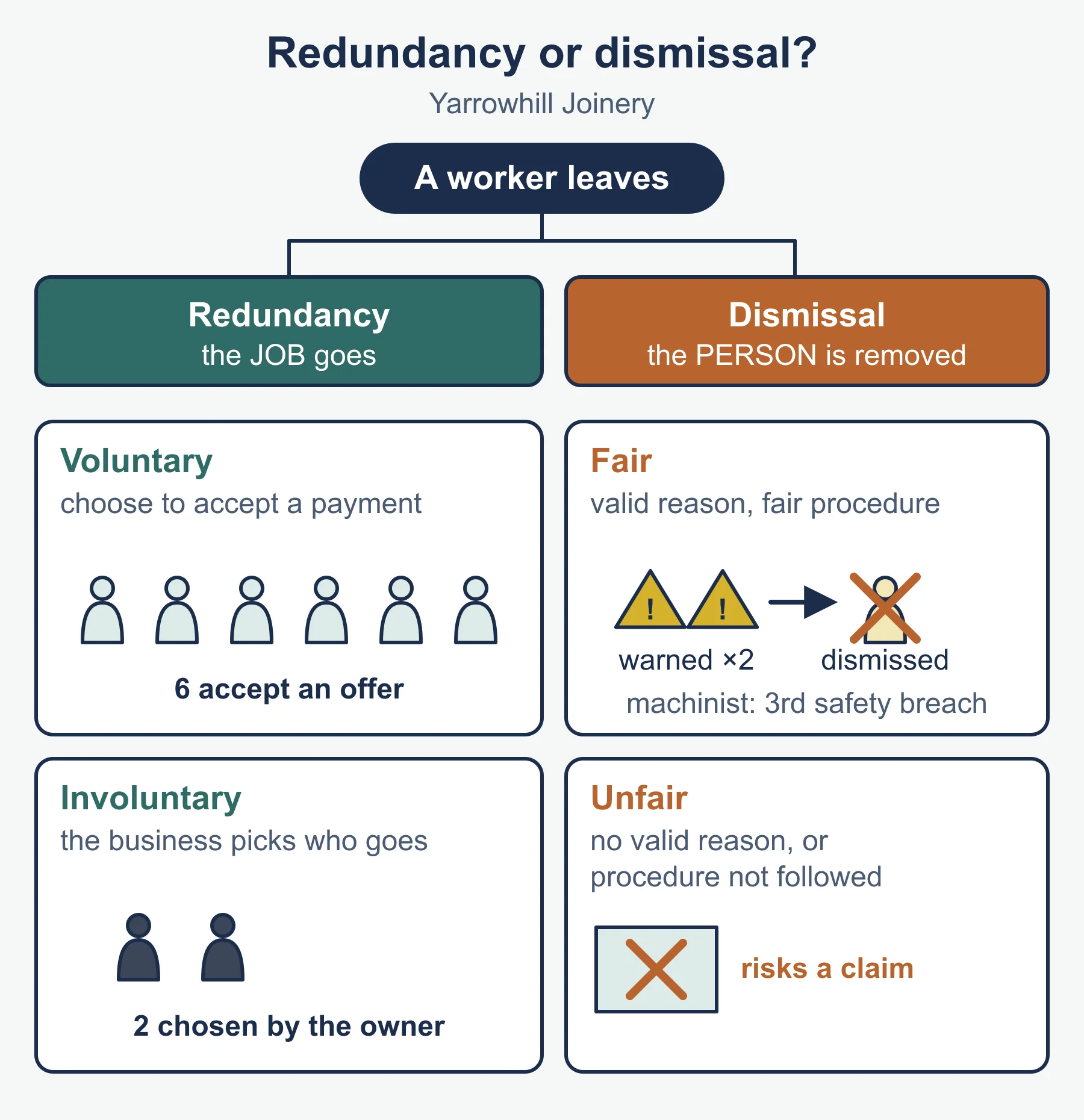
| Voluntary redundancy | Job no longer needed; the employee chooses to accept an offer to leave |
| Involuntary redundancy | Job no longer needed; the business chooses who goes |
| Fair dismissal | Valid reason (such as serious misconduct or continued poor performance after warnings) and a proper procedure |
| Unfair dismissal | No valid reason, or the procedure was not followed |
Redundancy is about the job. Dismissal is about the person. Impact of redundancy: cuts costs but brings payments now, lowers morale of those who stay, risks lost skills and reputation. Unfair dismissal risks a claim, lost trust and a poor employer image. Do not add legal detail the question does not ask for.
2.1.5: Morale, welfare, work-life balance, diversity and equality
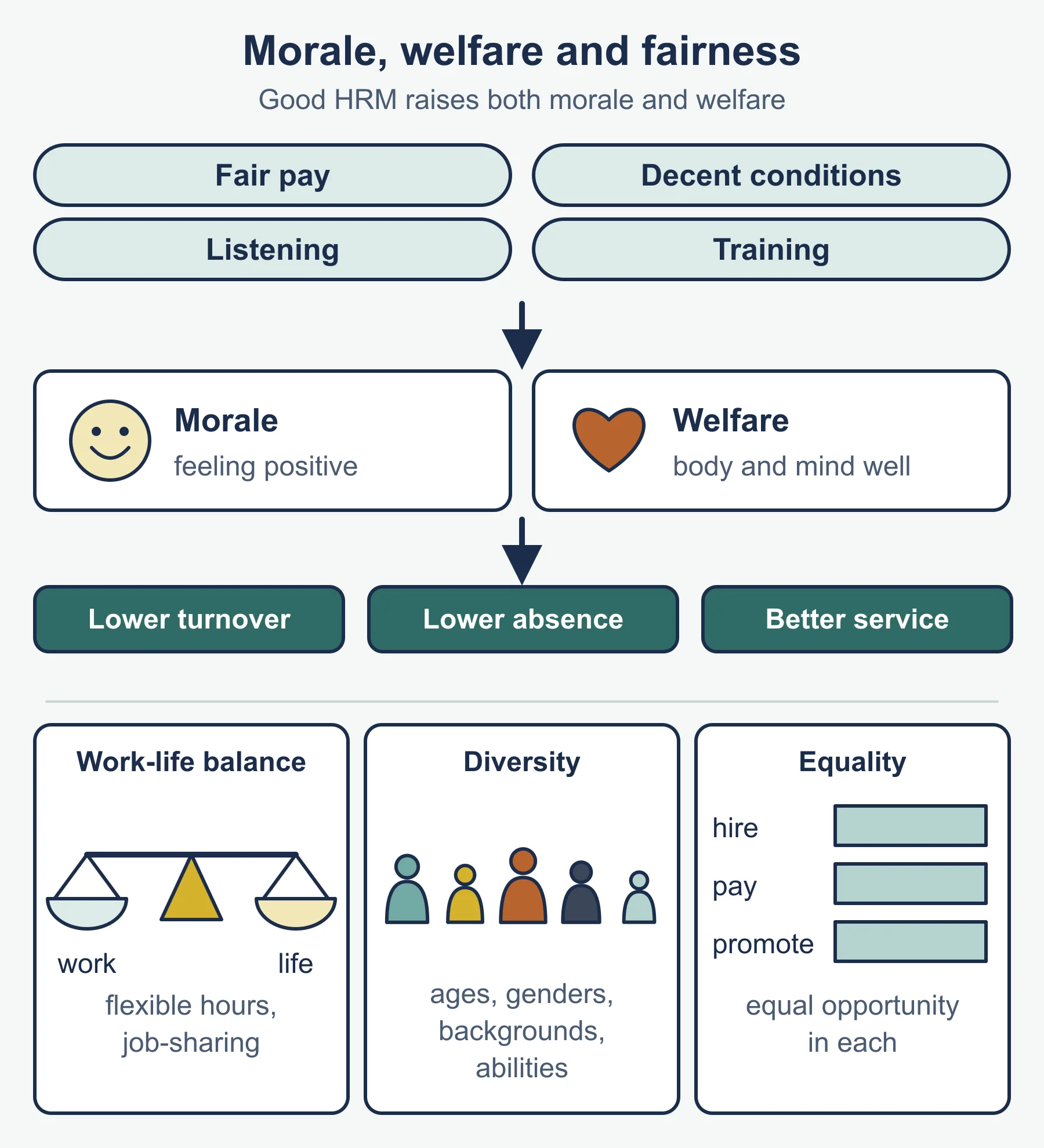
- Morale: how positive staff feel about the business and their work.
- Welfare: provision for physical and mental wellbeing.
- Good HRM raises both (fair pay, safe conditions, listening, training) and so lowers turnover and absence.
- Work-life balance: flexible hours, part-time work, job-sharing, home working, reasonable workloads. Gains: loyalty, wider pool of applicants. Costs: harder scheduling, less supervision.
- Diversity: a workforce of varied backgrounds, ages and abilities. Equality: fair treatment and equal opportunity.
- Benefits of diversity and equality: wider talent pool, more ideas, better understanding of customers, better reputation. Costs: management training, changed procedures, possible conflict if poorly handled.
2.1.6: Training and development
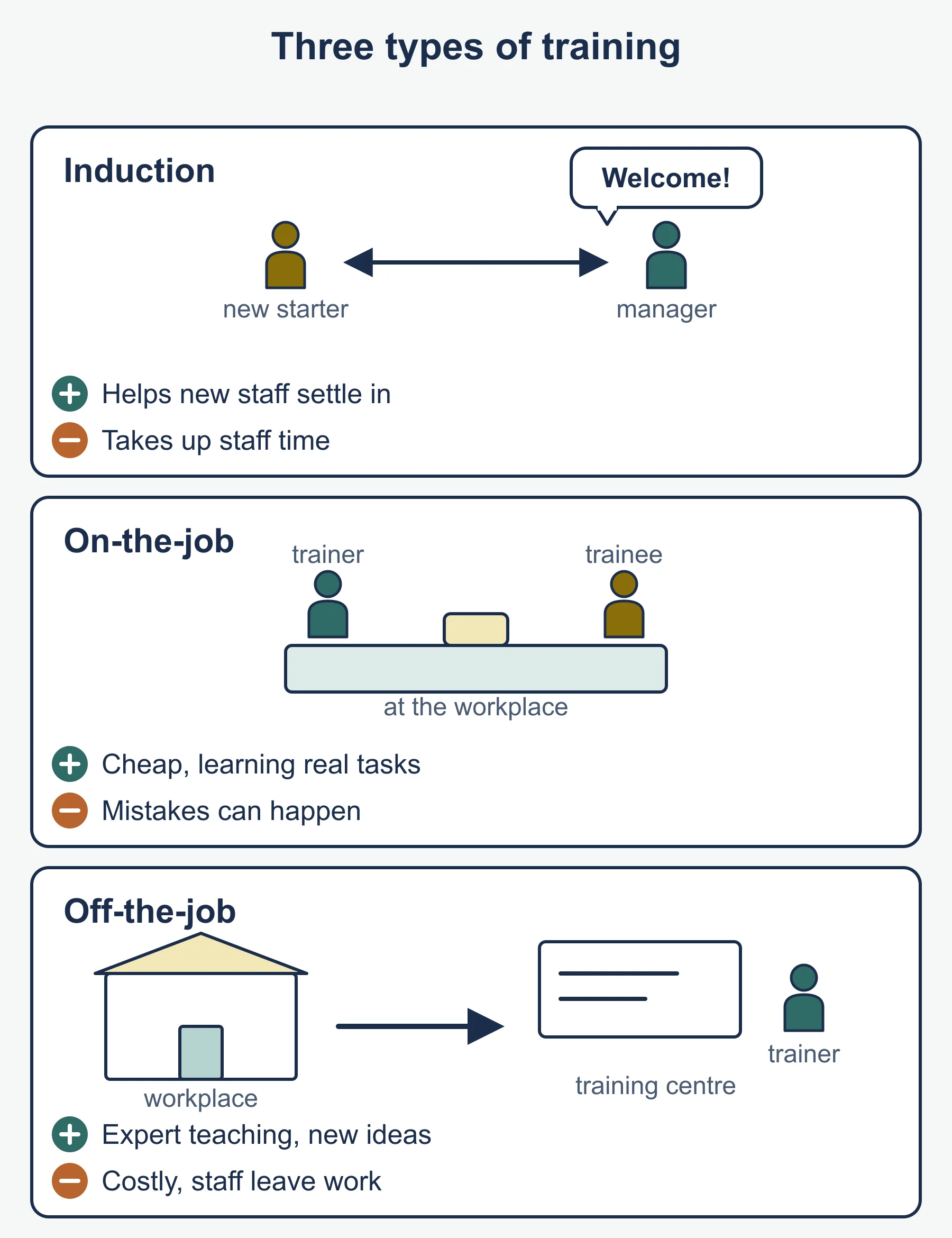
| Type | Pros | Cons |
|---|---|---|
| Induction | Settles new starters fast; covers safety | Only an introduction |
| On-the-job | Cheap, practical, trainee still productive | Depends on trainer; bad habits |
| Off-the-job | Expert, wider skills | Costly; work left undone |
- Impact: better skills, quality, productivity and morale, lower turnover; costs are fees, time, and the risk of trained staff leaving.
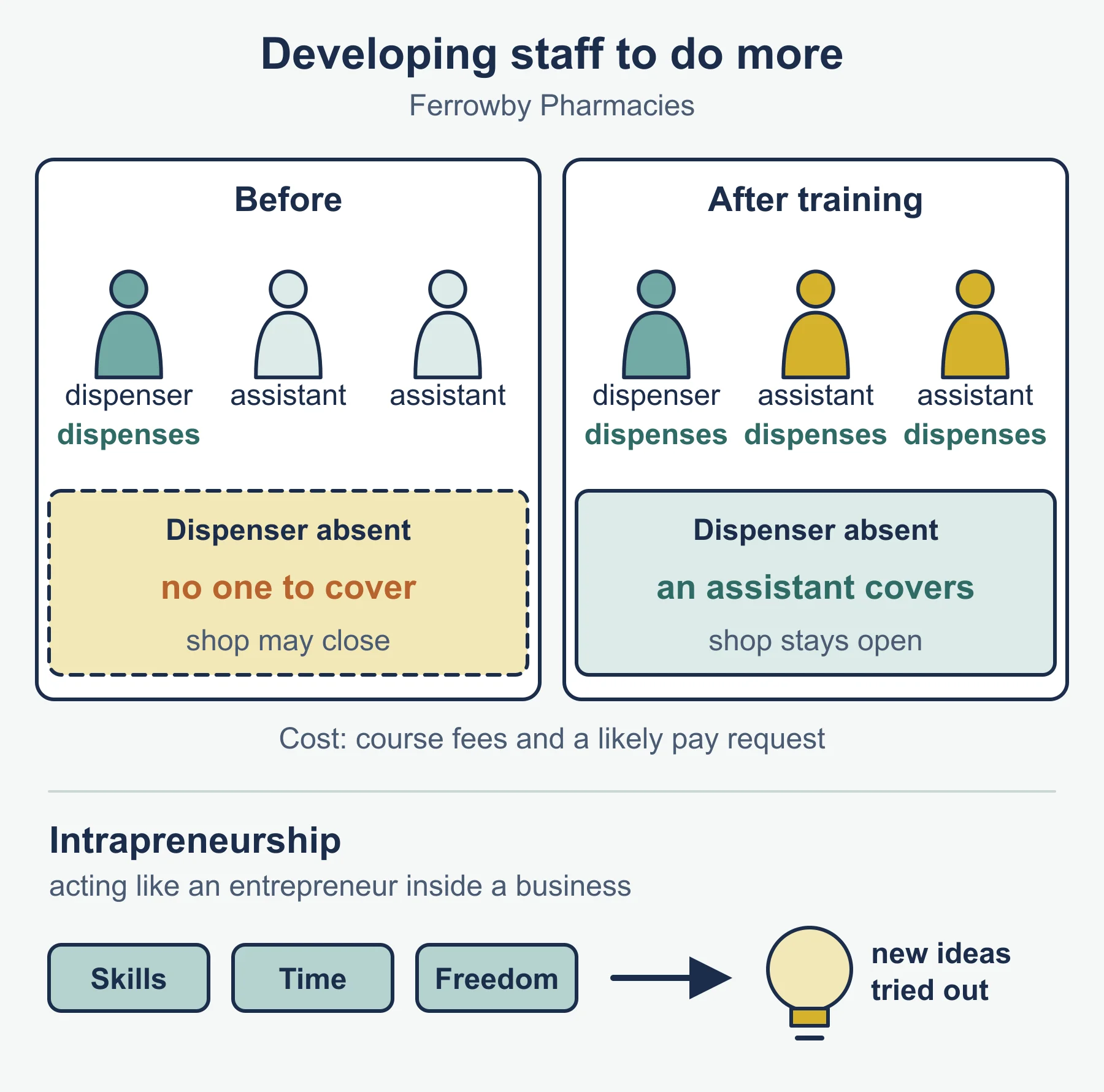
- Intrapreneurship: developing staff to act entrepreneurially inside the business, so that new ideas and better processes come from within, without setting up a new firm.
- Multi-skilling: staff trained for several jobs. Flexibility: staff can move or cover. Gains: cover for absence, less idle time. Costs: training time and possible higher pay.
2.1.7: Management and workforce relations
- Cooperation benefits the business (smoother change, fewer disputes, better ideas) and employees (security, a say, better conditions). It can slow decisions.
- Trade union: organisation of employees formed to protect and advance their interests.
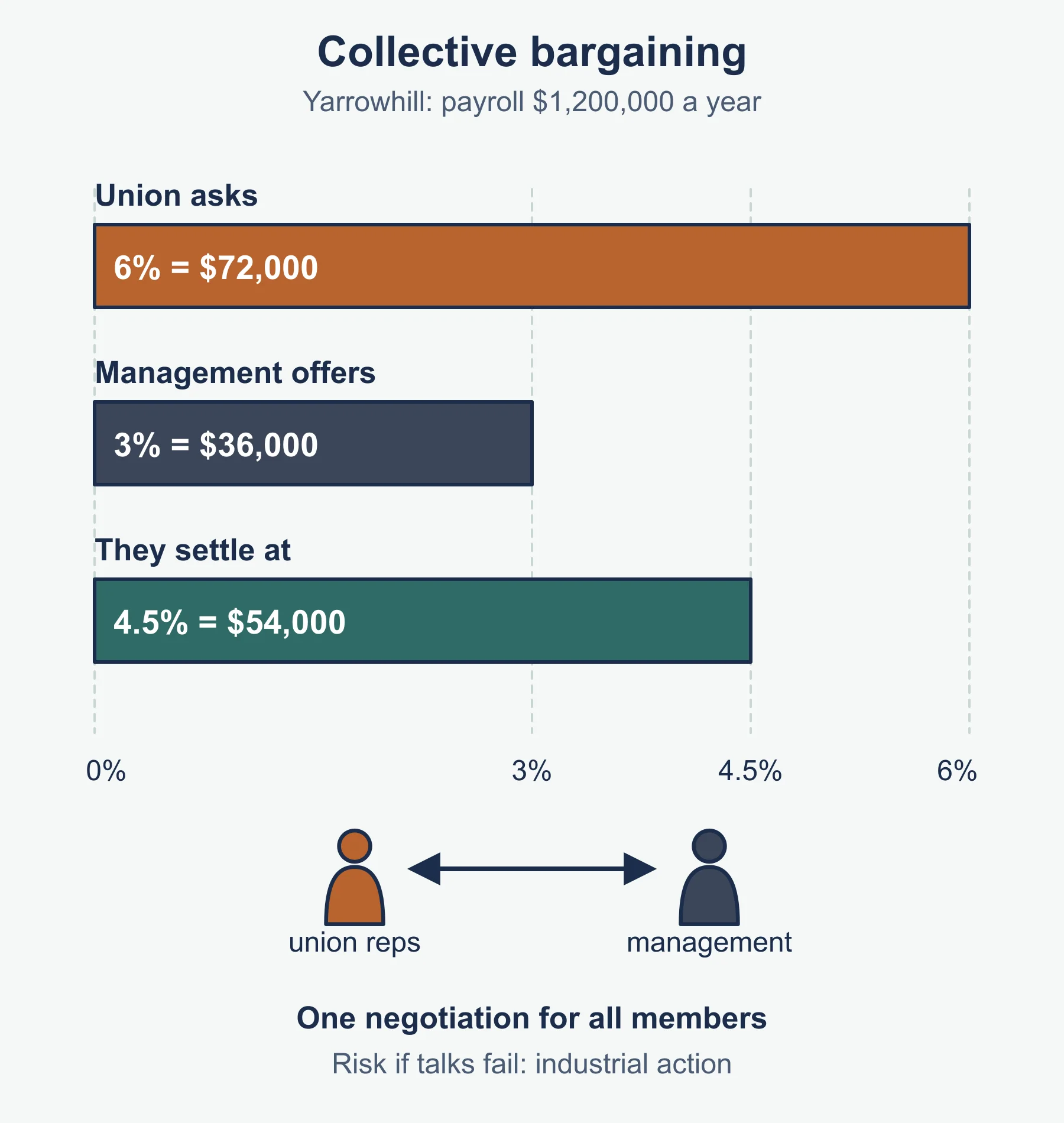
- Collective bargaining: negotiation between employer and union representatives for all members, on pay, hours and conditions.
- For employees: more bargaining power, protection. For employers: one negotiation and a clear channel, but higher costs, slower decisions and the risk of industrial action.
Quick self-test
- A business has 42 staff at the start of a year and 38 at the end. Nine leave. Calculate labour turnover.
- A firm has 40 staff, needs 46, and expects 15% of the current staff to leave. How many must it recruit?
- Define redundancy.
- State one difference between fair and unfair dismissal.
- State the difference between a job description and a person specification.
- State one advantage of external recruitment.
- State one disadvantage of off-the-job training.
- What is collective bargaining?
- Payroll is 800,000 and a pay deal gives 3.5%. How much extra does the deal cost?
- Give one benefit to a business of a diverse workforce.
- Why use average employees rather than the opening figure in the turnover formula?
- Give one benefit of multi-skilling to a business.
Answers
- Average = (42 + 38) ÷ 2 = 40. Turnover = 9 ÷ 40 × 100 = 22.5%.
- Leavers = 15% of 40 = 6. Recruit 46 - 40 + 6 = 12.
- Loss of a job because the post is no longer needed, not because of the employee’s conduct or performance.
- Fair dismissal has a valid reason and a proper procedure; unfair dismissal has no valid reason or the procedure was not followed.
- The job description describes the job (duties); the person specification describes the person needed (skills, experience, qualities).
- Wider choice of candidates, or new ideas and skills.
- It costs more, and work is left undone while the employee is away.
- Negotiation between employers and union representatives acting for all members on pay, hours and conditions.
- 800,000 × 0.035 = 28,000.
- Any one of: wider pool of talent, more varied ideas, better understanding of different customers, better reputation.
- The workforce changes during the period, so the average gives a fairer base for the rate.
- Staff can cover absence or move to where work is needed, so less idle time.
Where marks are usually lost
- Giving the leaver count instead of a percentage for turnover.
- Dividing by opening staff when the average is the standard base.
- Forgetting leavers when working out how many to recruit.
- Mixing up a job description with a person specification.
- Giving a list of internal and external pros and cons without choosing one for the case.
- Treating redundancy and dismissal as the same thing.
- Describing high turnover as always bad, without asking what type of business it is.
- Stating that training is always worth it, without weighing cost and the risk of trained staff leaving.
- Giving a union a one-sided effect, when employers and employees are each affected both ways.
- Adding legal rules the question did not ask about.
Frequently asked questions
How do you work out how many staff to recruit in a workforce plan? Staff to recruit equals staff needed minus staff now plus expected leavers. Forgetting the leavers is a common error.
Is high labour turnover always bad? Not always. It raises recruitment and training costs and disrupts teams, but it can be normal in seasonal work, and very low turnover can mean few new ideas and blocked promotion.
What is the difference between voluntary and involuntary redundancy? In both, the job is no longer needed. In voluntary redundancy the employee chooses to accept an offer to leave; in involuntary redundancy the business chooses who goes.
What is collective bargaining? Collective bargaining is negotiation between the employer and trade union representatives acting for all members, for example on pay and conditions.
Official syllabus
Cambridge International AS & A Level Business 9609 syllabus for examination in 2026, 2027 and 2028, published by Cambridge University Press & Assessment, section 2.1 Human resource management (HRM).
Get free revision emails (optional)
Occasional emails with practice questions, worked explanations and links to free resources for the qualification and subjects you choose. No spam, and you can unsubscribe from any email. The free tools on this site never need an email.
Related resources
-
Study guides
A Level Business: Leadership and Human resource management (HRM) strategy (Cambridge 9609)
Study guide to sections 7.3 Leadership and 7.4 HRM strategy of Cambridge A Level Business 9609: leadership theories, EQ, flexible contracts, MBO and AI.
Business · Cambridge · A Level
Read guide -
Practice questions
A Level Business: Leadership and Human resource management (HRM) strategy (Cambridge 9609) – Practice Questions
Original practice questions with worked answers on leadership, EQ, flexible contracts, performance, MBO and AI for Cambridge A Level Business 9609 7.3-7.4.
Business · Cambridge · A Level
Try questions -
Revision notes
A Level Business: Leadership and Human resource management (HRM) strategy (Cambridge 9609) – Revision Notes
Condensed revision notes for Cambridge A Level Business 9609 sections 7.3 and 7.4: leadership theories, EQ, flexible contracts, MBO, IT and AI.
Business · Cambridge · A Level
Revise topic
Related articles
-
teaching
A Level tuition in Dubai: Cambridge or Pearson Edexcel International A Level?
Schools in Dubai and Abu Dhabi teach either Cambridge International AS & A Level or Pearson Edexcel International A Level. How the two are structured, why it matters for tuition, and how online classes from Lahore work.
9 October 2026
-
curriculum guides
Choosing subjects at IGCSE and A Level
How subject choices at 14 and 16 affect university options later, and how to keep pathways open without overloading a timetable.
28 July 2026
Studying this with a teacher
Working through Business AS LEVEL?
This page is free and stays free. If you would rather be taught it, Marlbridge runs Business classes one-to-one and in small groups of up to 15, online in your own time zone. The first trial class is free. WhatsApp replies within an hour (8am–11pm Pakistan time, every day); email the same day.
Cambridge Business teachers at Marlbridge

