
Study Guides
A Level Business: Motivation and Management (Cambridge 9609)
Study guide to 2.2 Motivation and 2.3 Management in Cambridge AS & A Level Business 9609: theories, pay methods, styles and worked examples.
- Subject
- Business
- Level
- AS LEVEL
- Topic
- Human resource management
- Author
- Marlbridge Academic Team
- Updated
- Reviewed by
- Salman Ahmad (what this means)
Aligned to Cambridge A Level Business (9609), For examination in 2026, 2027 and 2028. Official specification .
Syllabus page (what it covers and how it is assessed): Cambridge A Level Business.
Syllabus points this page covers
9609 (AS Level)
- 2.2 Motivation
- 2.3 Management
Found an error? Report a correction.
Need help with this topic? Request a free trial class for A Level Business (9609).
This guide covers sections 2.2 Motivation and 2.3 Management of the Cambridge International AS & A Level Business 9609 syllabus for examination in 2026, 2027 and 2028. Both are AS Level content, so they are examined on Paper 1 and Paper 2 and are assumed knowledge for the A Level papers. The wider topic, including recruitment and training, is in the Human resource management study guide. Condensed recall is in the revision notes and the earlier HRM revision notes. Test yourself with the practice questions and the wider HRM practice set. Course links: the Cambridge A Level Business hub, the checklist and the free diagnostics.
What the syllabus lists
| Section | What you must be able to do |
|---|---|
| 2.2.1 | Explain the need to motivate employees to achieve business objectives |
| 2.2.2 | Explain human need simply, and how needs may or may not be met at work |
| 2.2.3 | Outline the content theories (Taylor, Mayo, Maslow, Herzberg, McClelland) and the process theory (Vroom) |
| 2.2.4 | Apply the theories; compare eight payment methods; compare nine non-financial motivators; describe ways employees can take part in management and control |
| 2.3.1 | Describe the four traditional manager functions, the role of managers (Fayol, Mintzberg), managers’ contribution to performance, four management styles and McGregor’s Theory X and Theory Y |
2.2.1 and 2.2.2 Why motivate, and what people need
Motivation is the desire to put effort into a task. A business has objectives such as profit, growth, quality or survival, and employees deliver them. Staff who are motivated tend to work harder, stay longer and take more care. That can raise productivity, reduce labour turnover and absence, and lift service quality. Staff who are not motivated tend to do the minimum. Motivation is therefore a tool of management and leadership: managers cannot complete every task themselves, so they have to get results through other people.
A human need is something a person must have, or strongly wants, to feel secure or fulfilled. Needs range from food and shelter to belonging and a sense of achievement. Work can meet some of them directly: a wage buys housing and food, a team gives belonging, a promotion gives status. Work can also fail to meet them. Long unpredictable shifts may damage health, a temporary contract removes security, and a repetitive task offers no sense of achievement. Employees also differ, so one job can satisfy one person and not another.
2.2.3 The theories
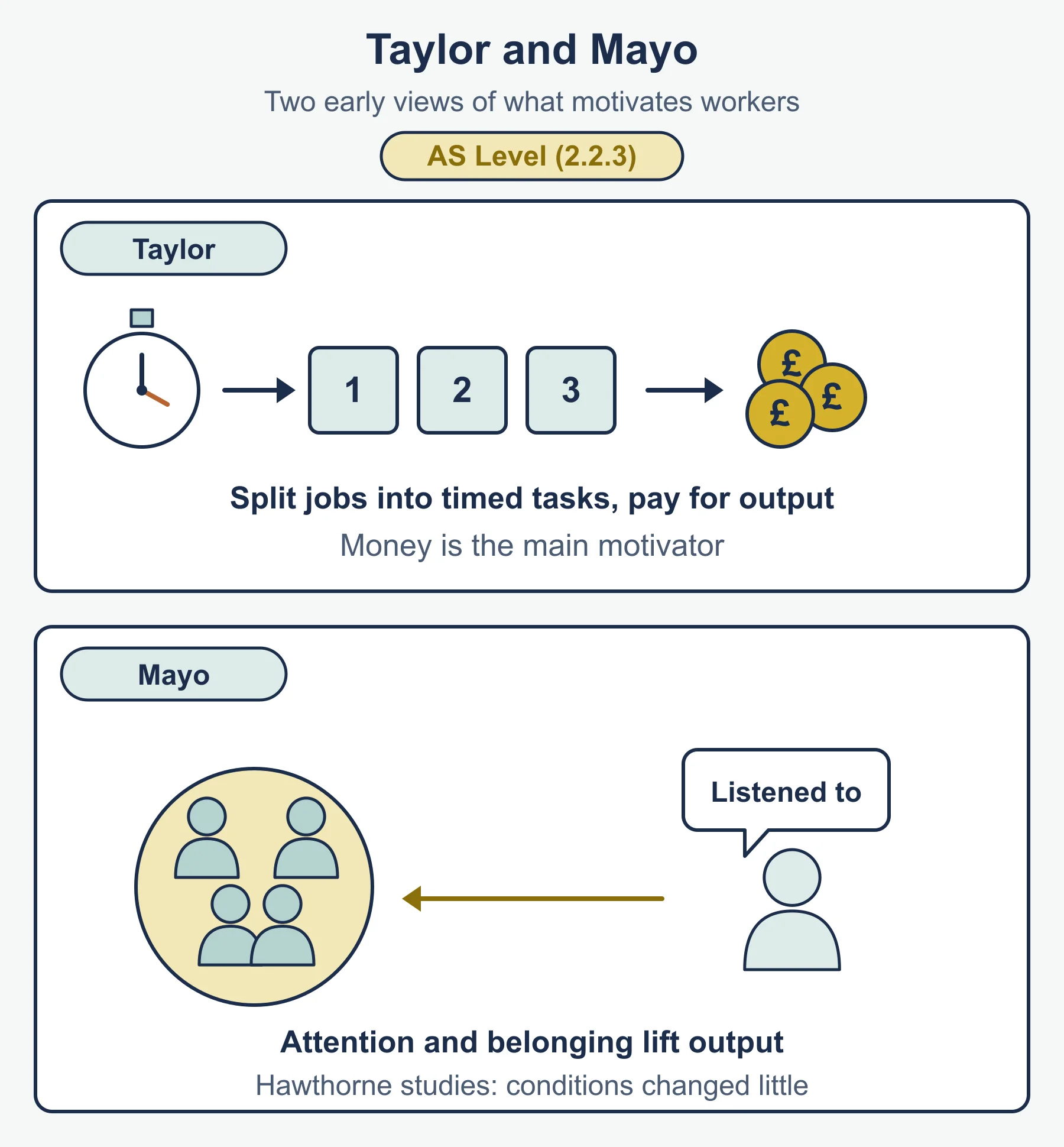
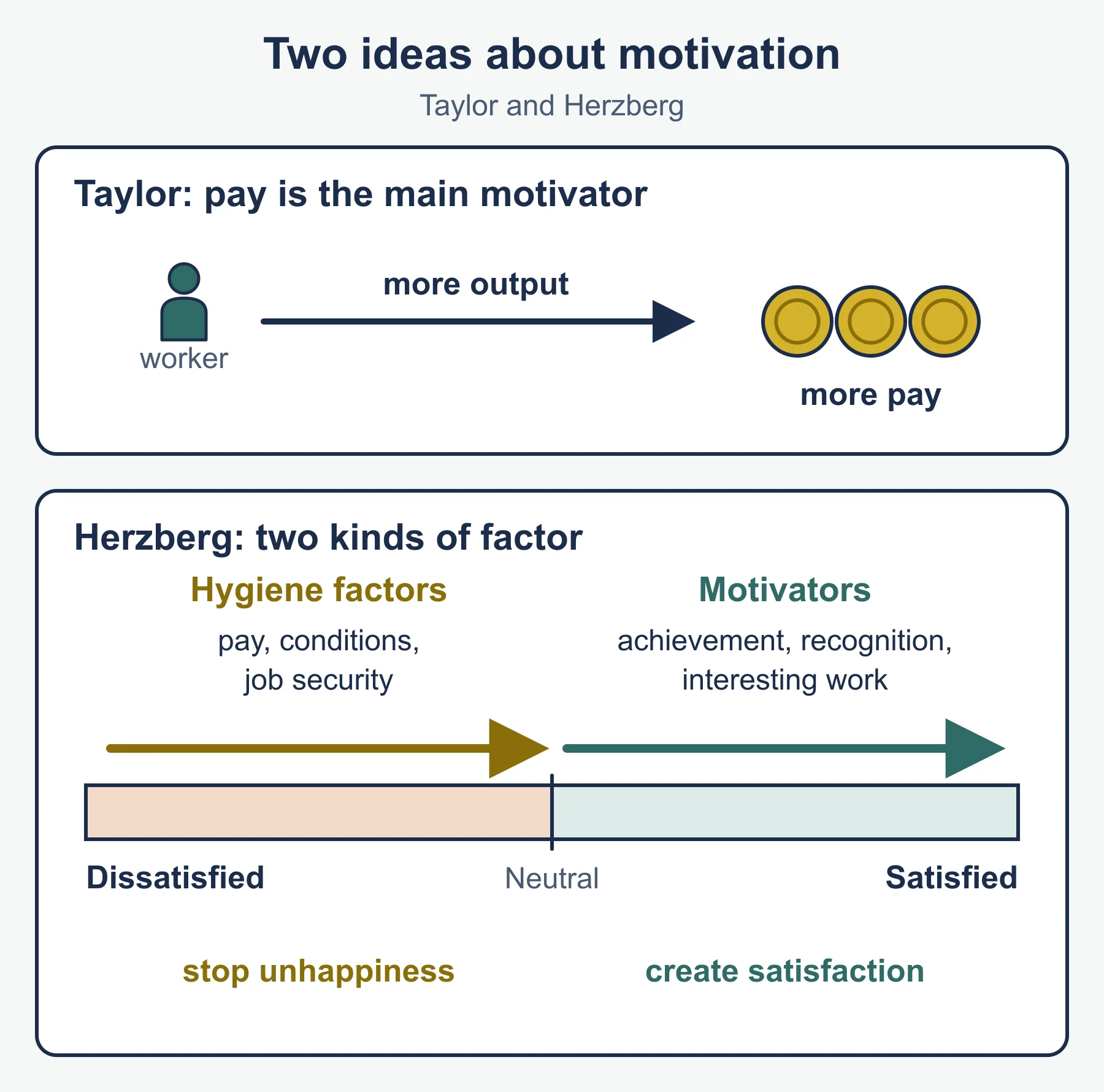
Taylor (scientific management). Workers are mainly motivated by money. Taylor broke jobs into simple tasks, timed them to find the fastest method and paid by output. Management plans and workers carry out instructions. His ideas suit repetitive work.
Mayo (human relations, from the Hawthorne studies). Output rose when workers received attention and were treated as a group, even when conditions did not change much. Social needs, belonging and being listened to matter. Mayo’s ideas support teamwork and consultation.
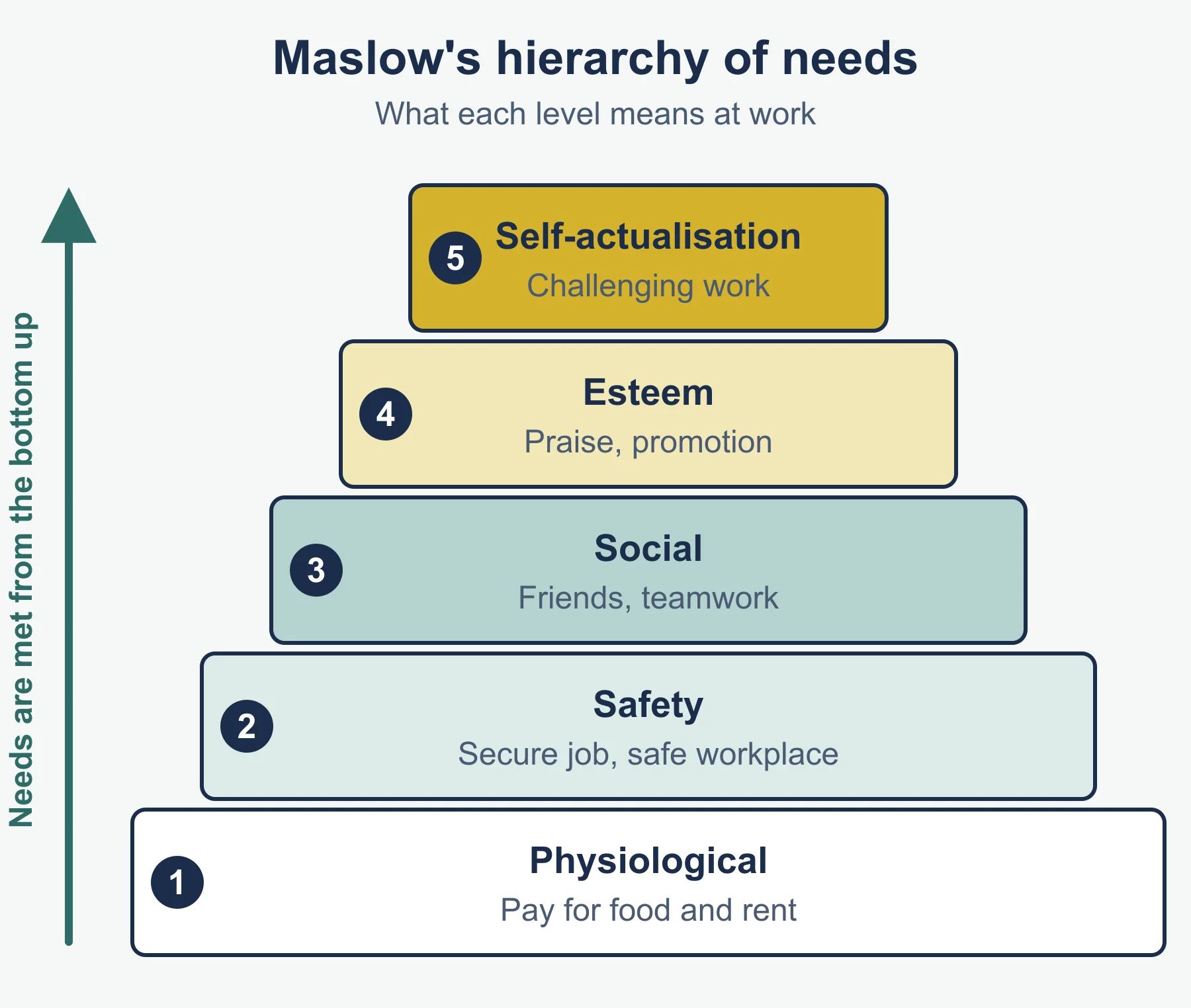
Maslow (hierarchy of needs). Needs sit in five levels: physiological, safety, social (belonging), esteem and self-actualisation. A lower need must be reasonably met before a higher one motivates. At work: wages and rest breaks (physiological), secure contracts (safety), team membership (social), recognition and status (esteem), and chances to use and grow one’s abilities (self-actualisation). Criticism: people do not always climb in order, and the same reward means different things to different people.
Herzberg (two-factor theory). Hygiene factors, such as pay, working conditions, supervision, company policy and job security, can cause dissatisfaction if poor, but improving them does not motivate for long. Motivators, such as achievement, recognition, responsibility, the work itself and advancement, create satisfaction. A manager should remove dissatisfaction first, then add motivators.
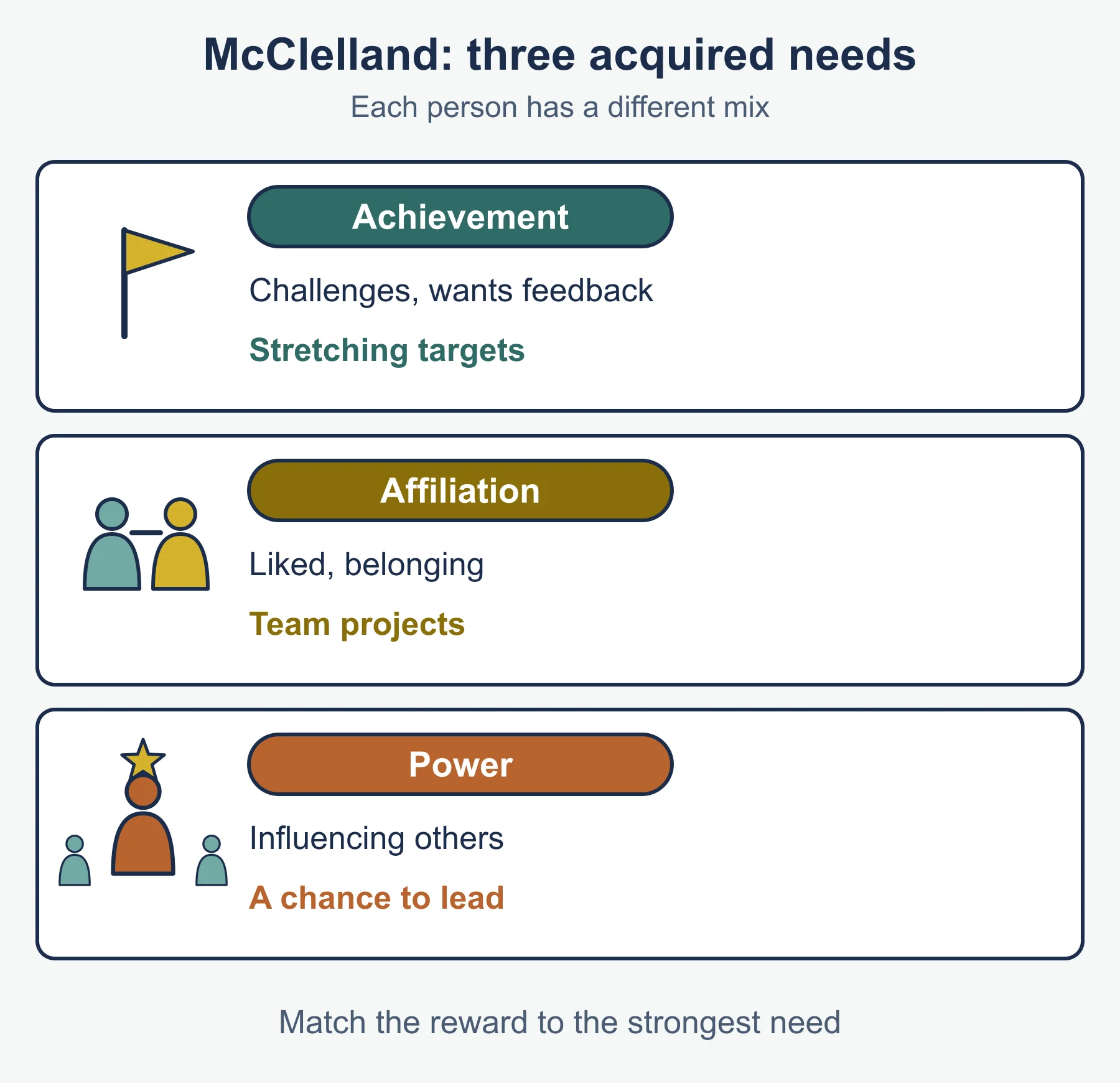
McClelland (acquired needs). People are driven by differing strengths of three needs: achievement (taking on challenges, wanting feedback), affiliation (liking, belonging) and power (influencing others). A high achiever may respond to stretching targets, a person high in affiliation to team projects, and a person high in power to a chance to lead.
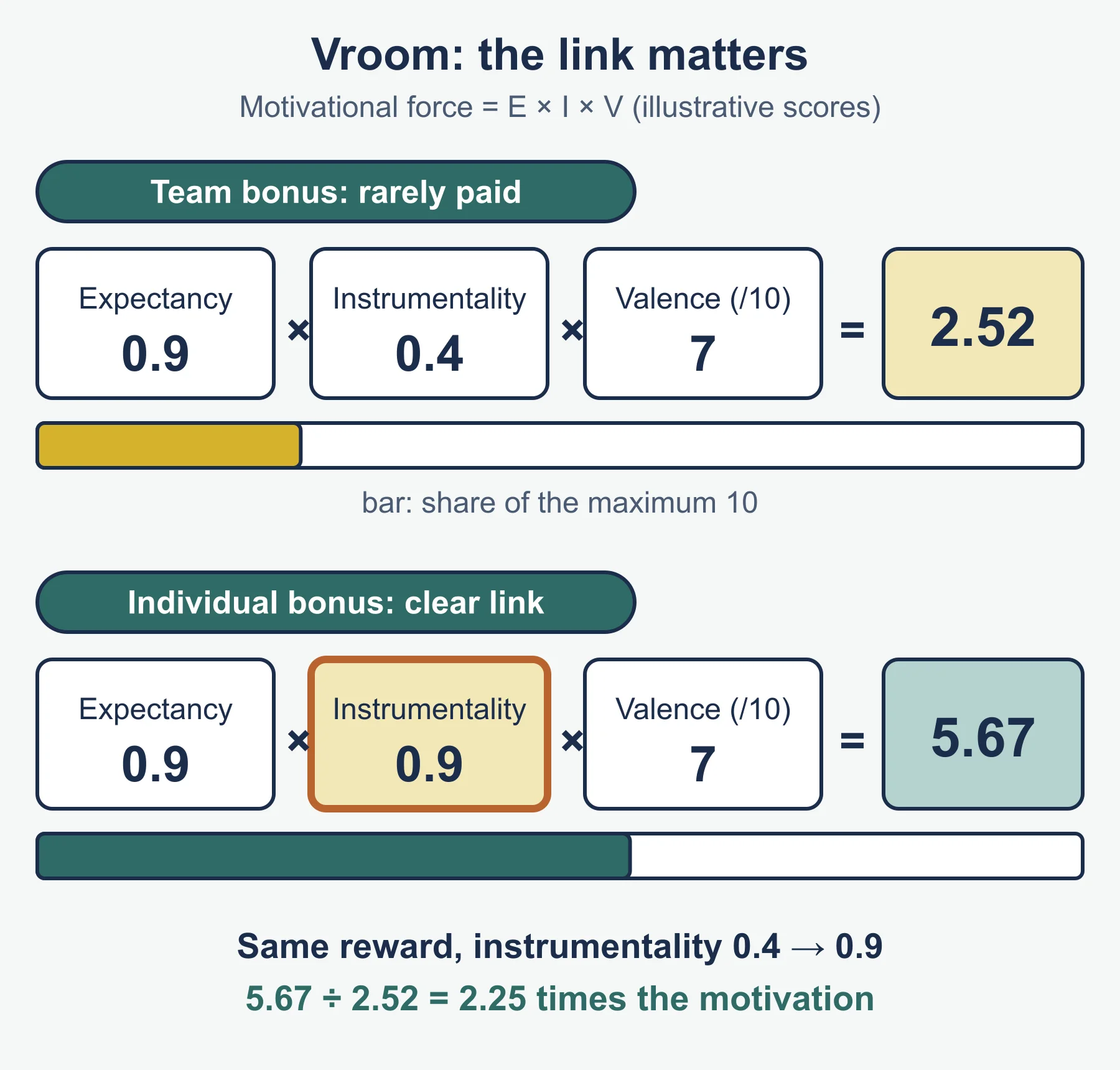
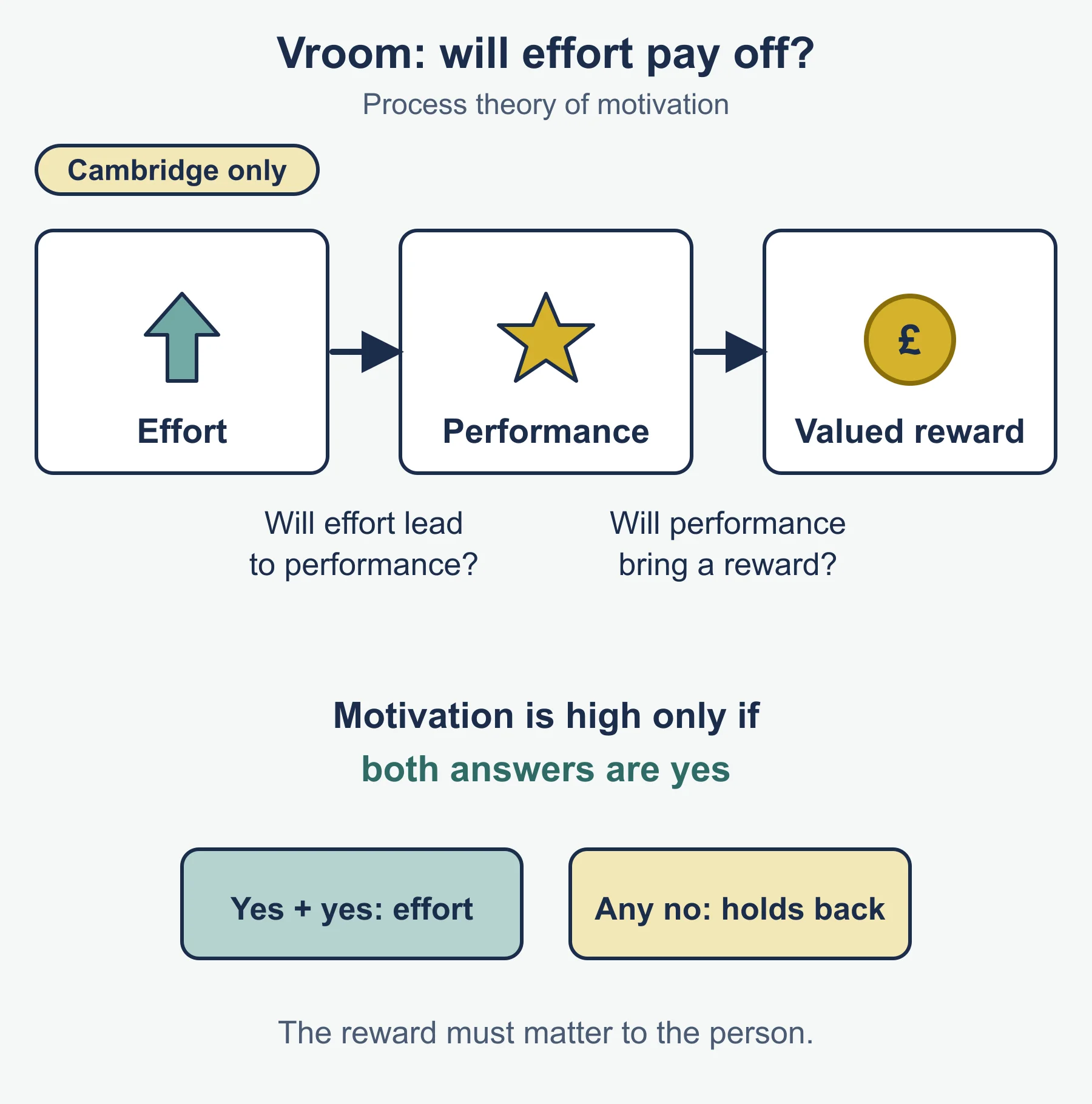
Vroom (expectancy, the process theory). Content theories ask what motivates. A process theory asks how motivation works. Vroom’s view is that people choose how much effort to give by weighing three beliefs: expectancy (effort will lead to good performance), instrumentality (good performance will lead to a reward) and valence (how much the reward is wanted). The standard form is motivational force = expectancy × instrumentality × valence. If any term is zero, motivation is zero. The scores below are illustrative, not data from the syllabus.
Worked example. Calder Reach Logistics offers drivers a bonus if the whole depot hits its delivery target. A driver rates expectancy 0.9 (hard work usually hits the target), instrumentality 0.4 (the depot as a whole often misses, so the bonus is rarely paid) and valence 7 out of 10.
0.9 × 0.4 × 7 = 2.52The bonus is changed to an individual one. Instrumentality rises to 0.9:
0.9 × 0.9 × 7 = 5.67The reward is unchanged, but the driver now sees a clear link between performance and pay, so motivational force more than doubles (5.67 / 2.52 = 2.25 times). The problem lay in the link, not the size of the reward.
2.2.4 Theories in practice: financial motivators
| Method | How it works | Fits best | Main drawback |
|---|---|---|---|
| Time based (hourly rate) | Hours × rate | Work where output is hard to count | Little link to output |
| Salary | Fixed annual sum, paid monthly | Professional or managerial roles | No direct reward for extra effort |
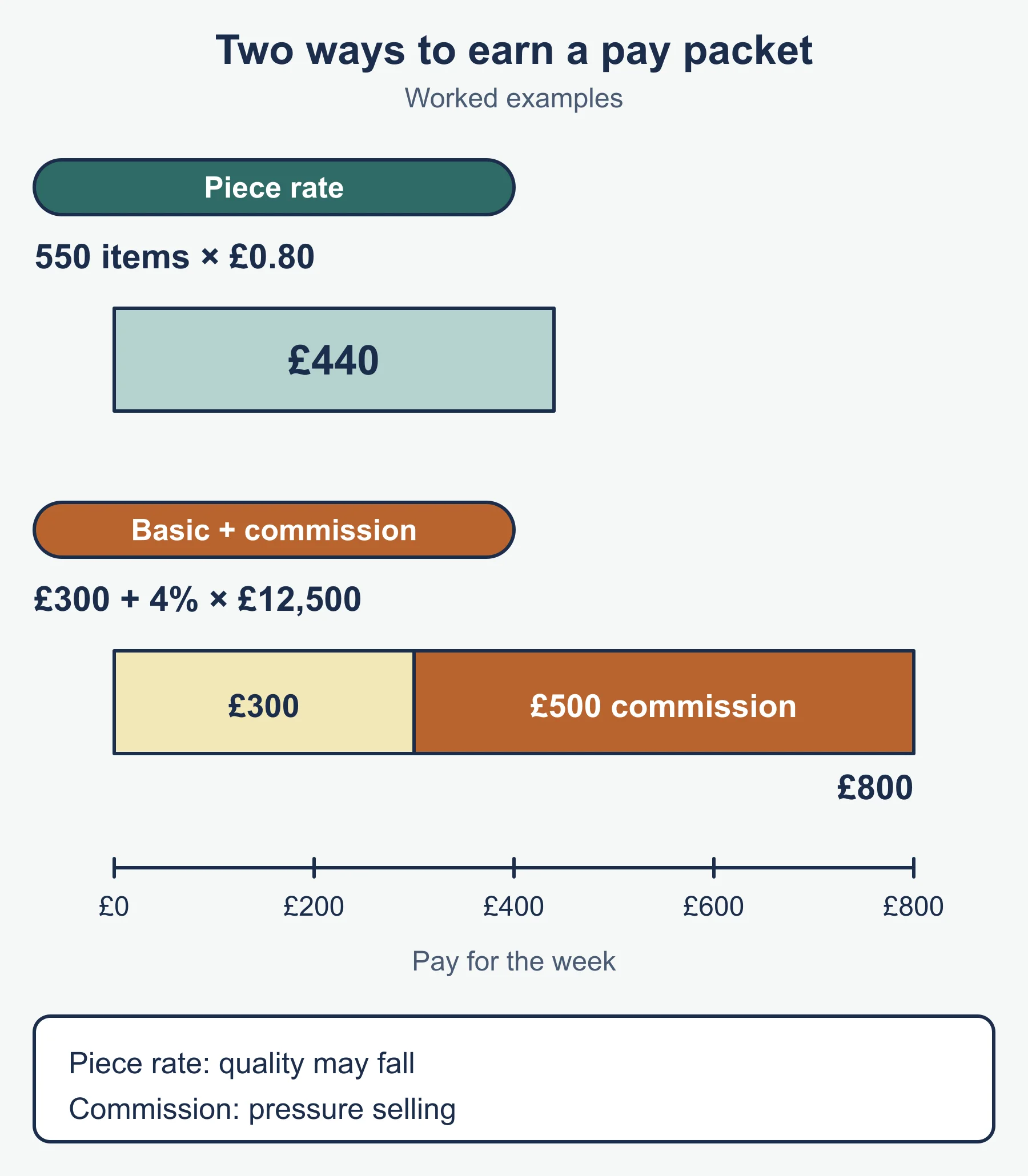
| Piece rate | Pay per unit made | Repetitive output | Quality may fall; unfair if machines break |
| Commission | Percentage of sales | Selling roles | Pressure selling; unstable income |
| Bonuses | Extra lump sum for meeting a target | Short-term goals | Effect fades; targets can be gamed |
| Profit sharing | Share of profit | Building loyalty to the business | Individual effort has a weak effect on profit |
| Performance-related pay (PRP) | Pay linked to assessed performance | Roles with measurable goals | Appraisal can feel subjective |
| Fringe benefits | Non-cash extras: company car, health cover, staff discount | Retaining skilled staff | Costly; may be valued unequally |
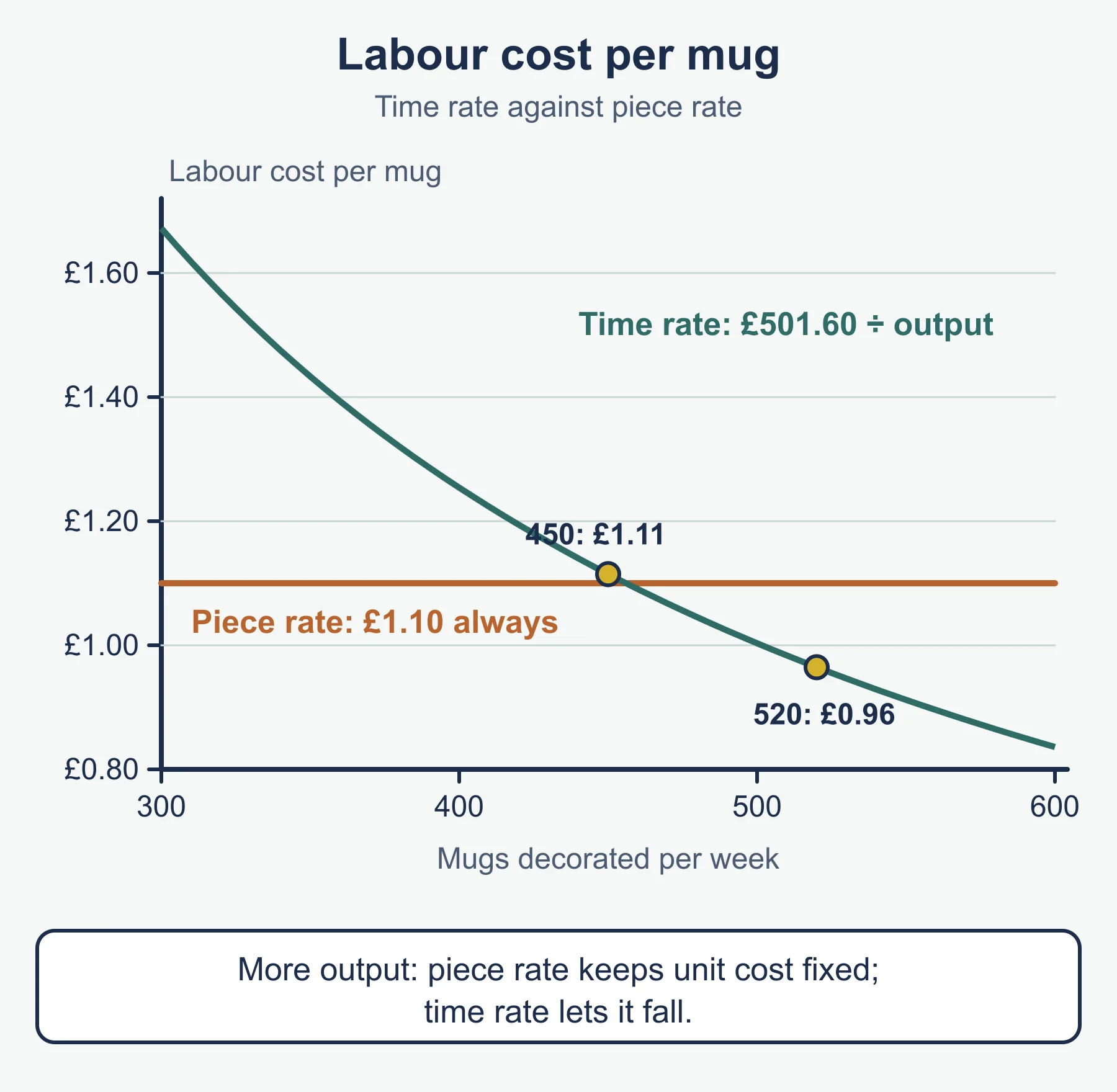
Worked example: time rate against piece rate. At Thornwick Hollow Pottery a decorator can be paid £13.20 an hour for a 38-hour week, or £1.10 per mug decorated. In a typical week she decorates 450 mugs.
Time rate: 13.20 × 38 = £501.60
Piece rate: 1.10 × 450 = £495.00
Pay is about the same, but the business’s cost per mug differs when output changes. At 520 mugs:
Piece rate: 520 × 1.10 = £572.00, still £1.10 per mug
Time rate: £501.60 / 520 = £0.96 per mug (it was £1.11 at 450)
Piece rate keeps labour cost per unit fixed and rewards the worker for extra output, but encourages rushing. Time rate gives the firm a falling labour cost per unit when output rises, but gives the worker no gain.
Worked example: commission. An Orrin Vale Tailors sales adviser earns £1,900 a month basic plus 4% commission on monthly sales above £15,000. In a month of £26,500 sales:
Commission: 0.04 × (26,500 − 15,000) = 0.04 × 11,500 = £460
Total pay: 1,900 + 460 = £2,360
Commission share: 460 / 2,360 = 19.5%
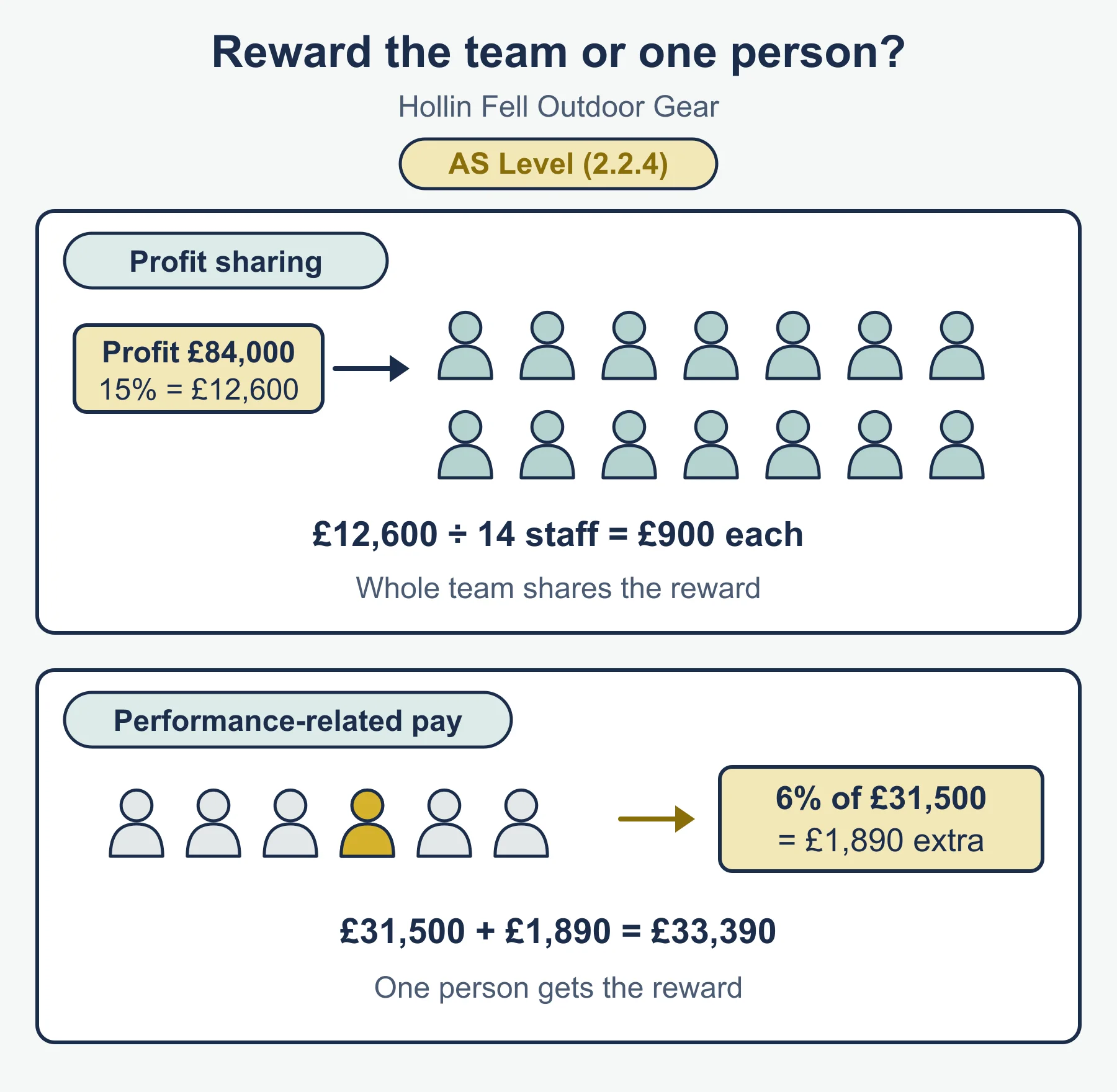
Worked example: profit sharing and PRP. Hollin Fell Outdoor Gear shares 15% of profit equally among 14 staff. With profit of £84,000 the pool is £12,600, so each gets £900. One employee also earns PRP of 6% on a £31,500 salary: £1,890 extra, making £33,390. Notice the contrast: profit sharing rewards the whole team, PRP rewards one person.
2.2.4 Non-financial motivators and participation
Link each method to a theory, because exam answers gain from that link.
- Training and development: builds skills and confidence; links to Maslow’s esteem and self-actualisation and to Herzberg’s advancement.
- Opportunities for promotion: a ladder with visible steps; esteem needs and McClelland’s achievement.
- Status: a title or office signals standing; esteem. It can annoy those without it.
- Job re-design: changing the tasks in a job, for example rotating tasks to reduce boredom.
- Job enrichment: adding responsibility, planning or decision-making to a job; Herzberg’s motivators.
- Team working: groups share tasks and goals; Mayo’s social needs and McClelland’s affiliation. Weak members may be carried.
- Empowerment: giving employees the authority to take decisions about their own work, with the resources to carry them out.
- Participation: involving employees in decisions that affect them.
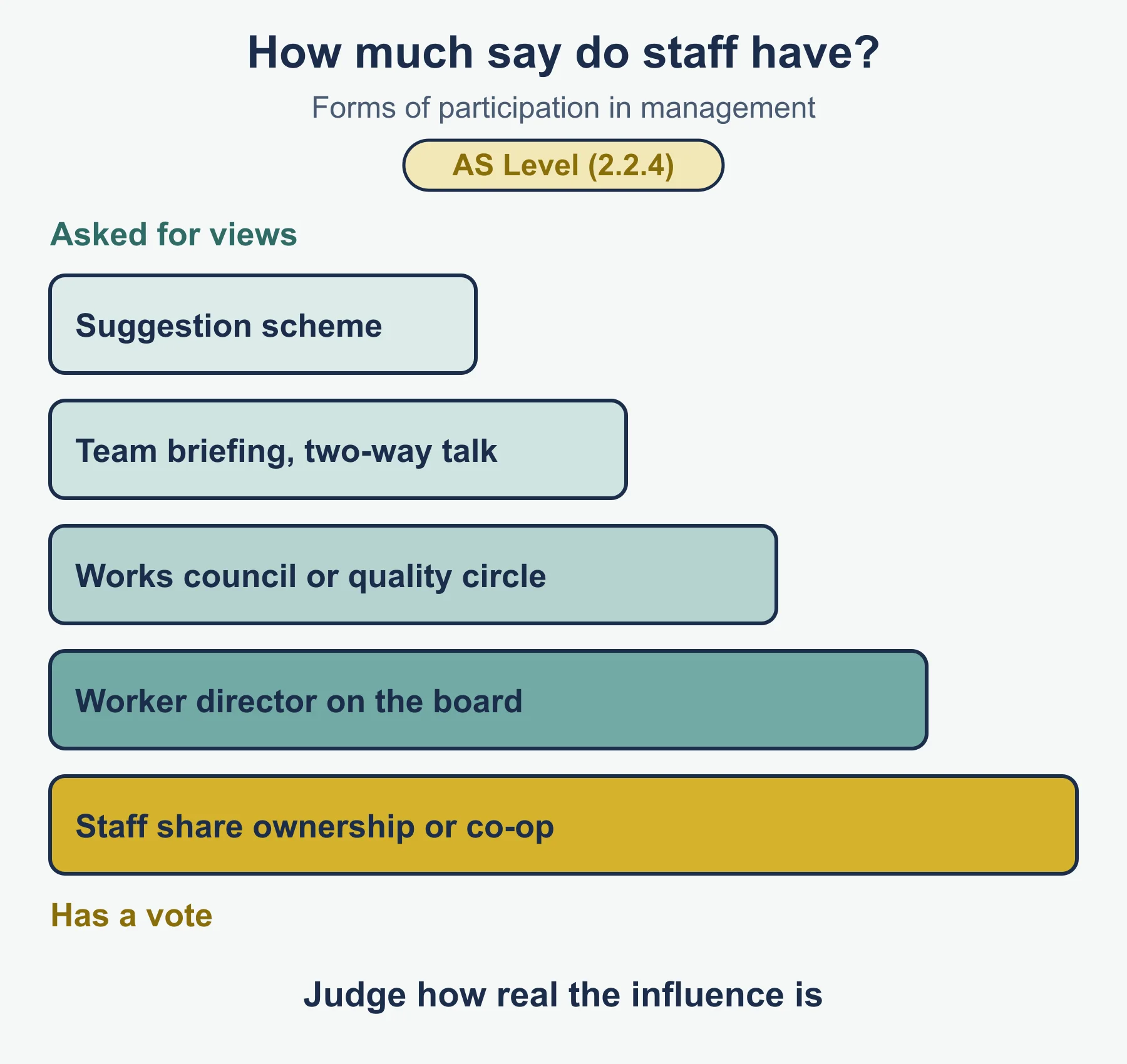
Participation in management and control can take several forms: a works council or consultation committee; suggestion schemes; quality circles; team briefings with two-way discussion; employee representatives or worker directors on the board; and employee share ownership or a co-operative, where staff share control. These range from being asked for views to having a vote, so judge how real the influence is. Benefits include better ideas, more commitment and less resistance to change. Costs include slower decisions and raised expectations that managers may not meet.
Choosing a method. Match the method to the people and the job. A repetitive, low-paid, short-term role may respond to piece rate or a bonus. A skilled professional with a comfortable salary may value autonomy and enrichment. Whatever you choose, check the cost and whether the effect will last.
2.3.1 Management and managers
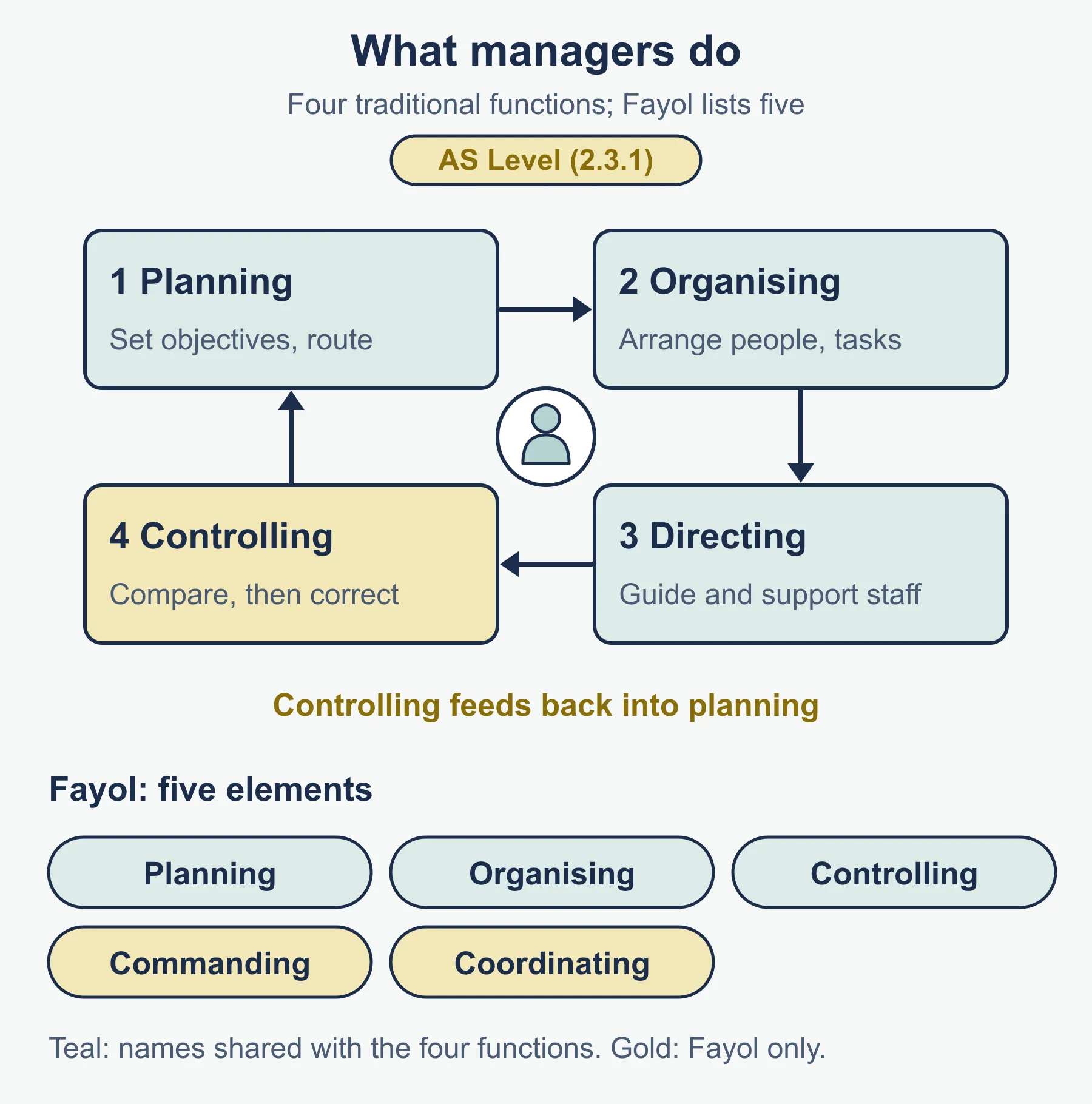
The traditional functions of a manager are four:
- Planning: deciding objectives and the route to them.
- Organising: arranging people, tasks and resources.
- Directing: guiding and supporting staff so work is done (also called leading).
- Controlling: comparing results with plans and taking corrective action.
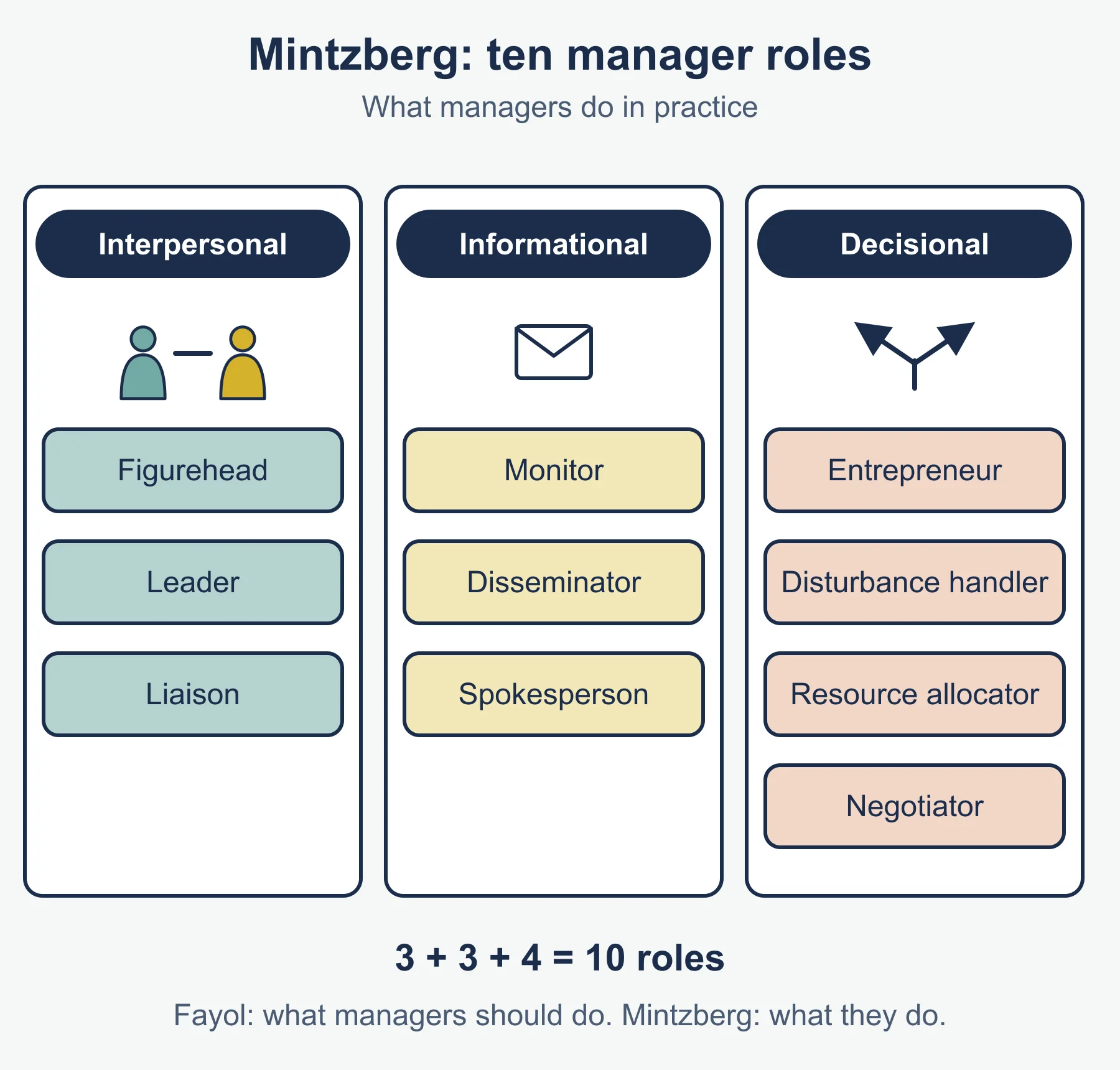
Fayol described management as a set of elements. In the standard form there are five: planning, organising, commanding, coordinating and controlling. Fayol is about what managers do in principle. Mintzberg observed what managers do in practice: their days are fragmented and reactive, and they fill ten roles in three groups (standard form).
| Group | Roles |
|---|---|
| Interpersonal | Figurehead, leader, liaison |
| Informational | Monitor, disseminator, spokesperson |
| Decisional | Entrepreneur, disturbance handler, resource allocator, negotiator |
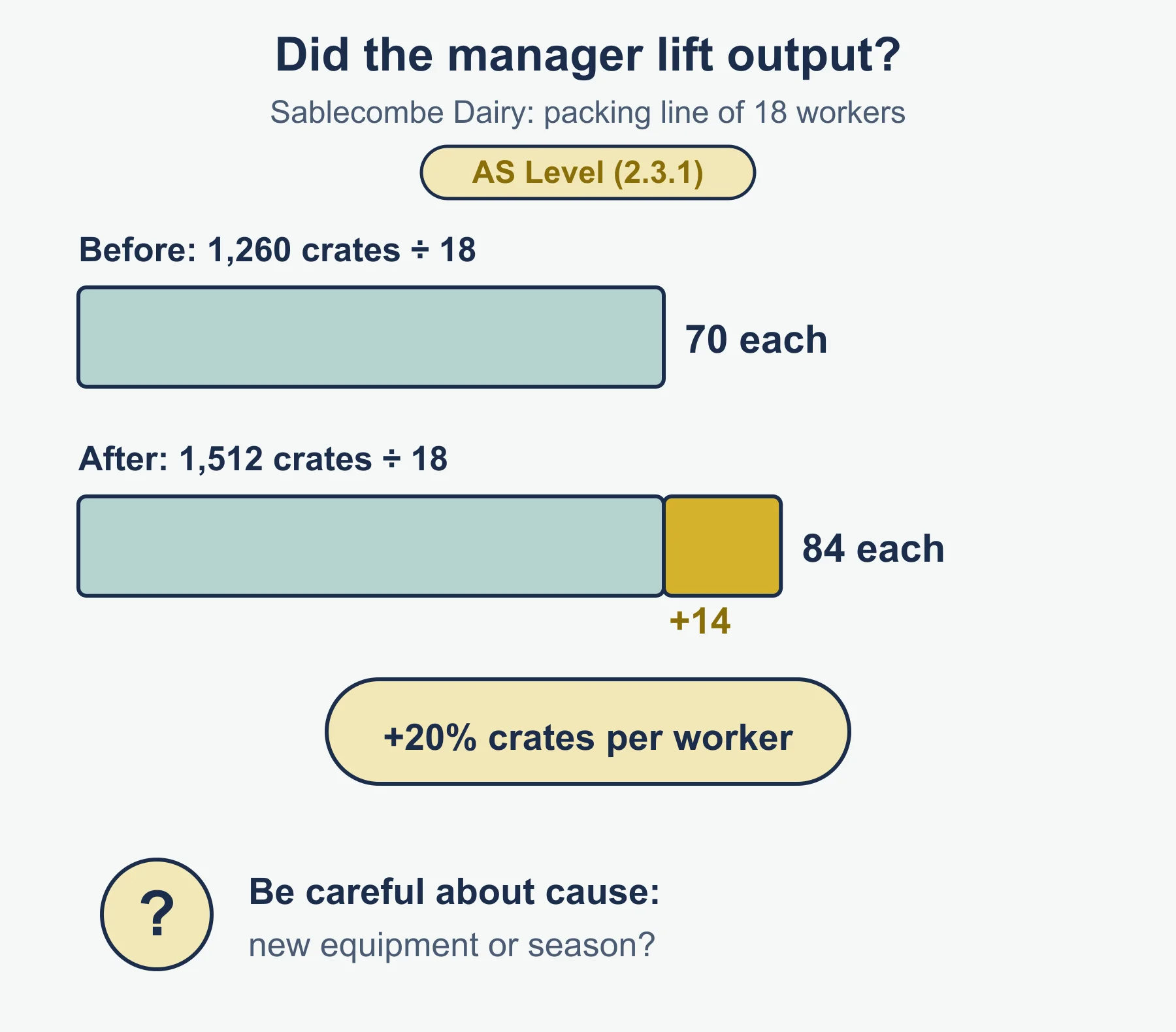
Contribution to performance. Managers affect results by setting clear direction, allocating resources well, motivating staff, solving problems and controlling cost and quality. Worked example: after a new supervisor reorganised shifts at Sablecombe Dairy, an 18-person packing line rose from 1,260 to 1,512 crates a day.
Before: 1,260 / 18 = 70 crates per worker
After: 1,512 / 18 = 84 crates per worker
Change: (1,512 − 1,260) / 1,260 = 20%
Be careful about cause. The rise may owe something to new equipment or seasonal demand, so look for evidence in the case before crediting the manager.
Management styles.
| Style | Description | Suits | Risk |
|---|---|---|---|
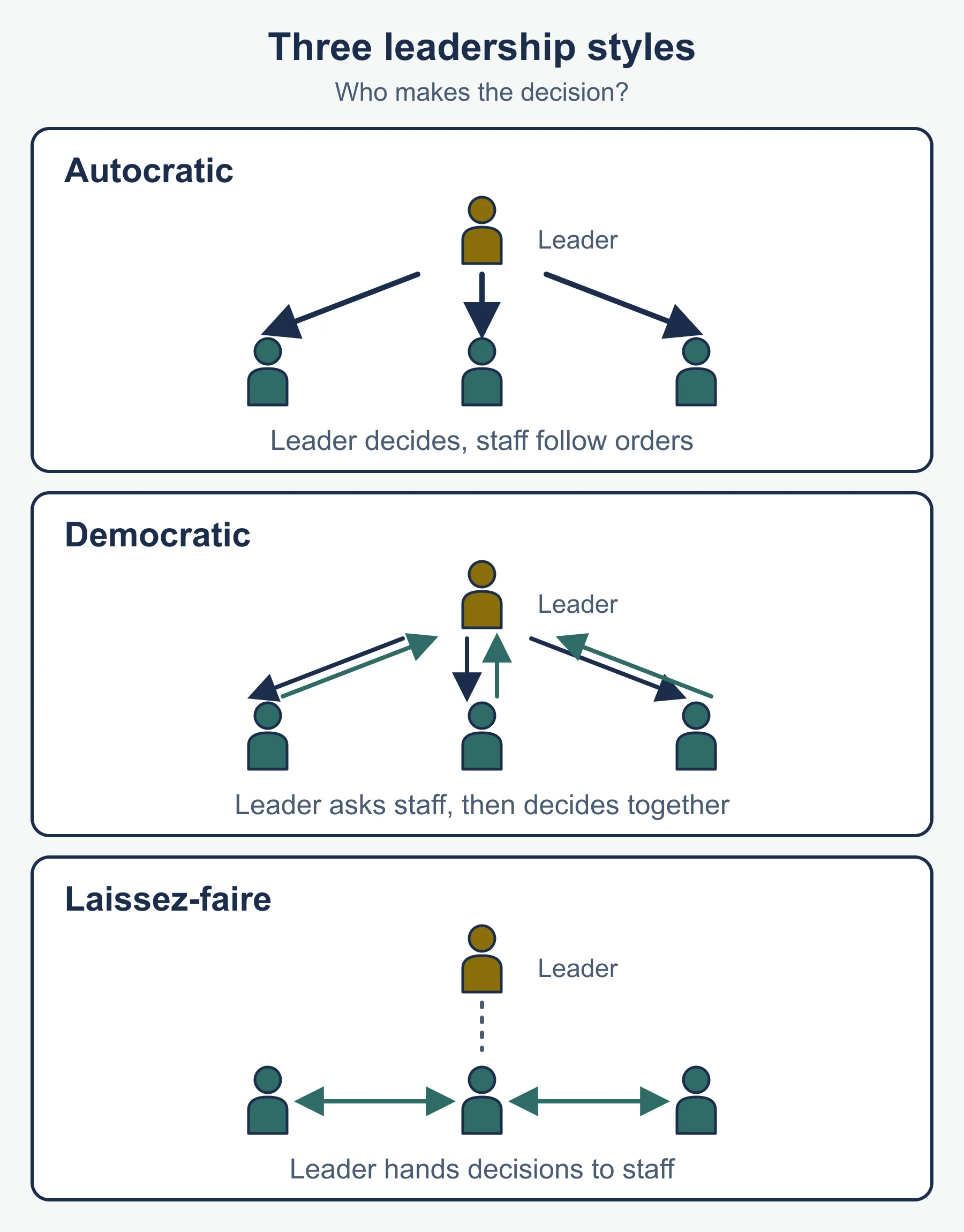
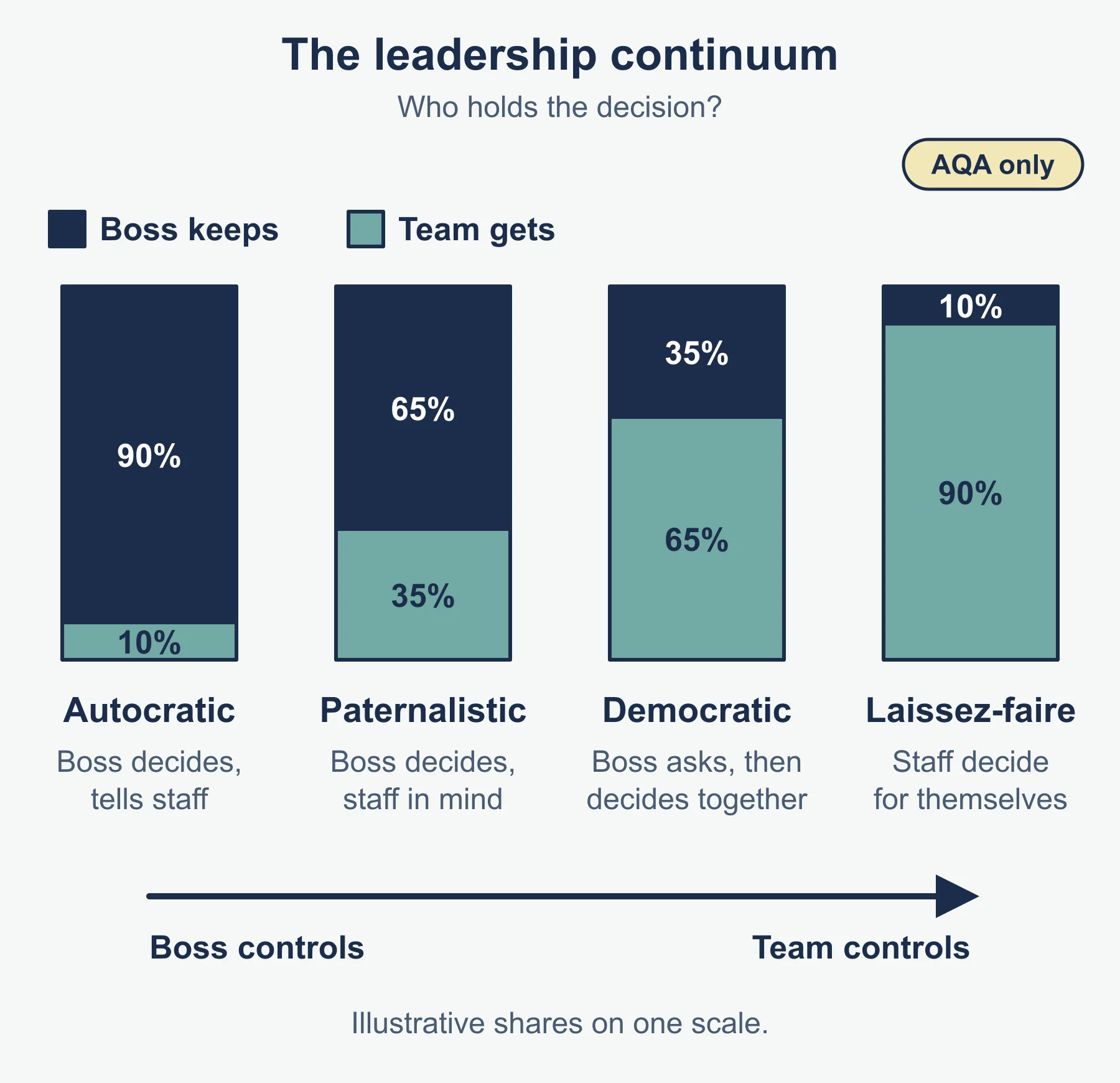
| Autocratic | Manager decides and instructs | Crisis, unskilled or inexperienced staff | Low morale, no ideas |
| Democratic | Staff are consulted and influence decisions | Skilled staff, complex decisions | Slow |
| Laissez-faire | Staff are left to decide how to work | Experienced, self-motivated experts | Lack of direction |
| Paternalistic | Manager decides, but with concern for staff welfare and explains why | Staff who value security and loyalty | Staff may feel talked down to |
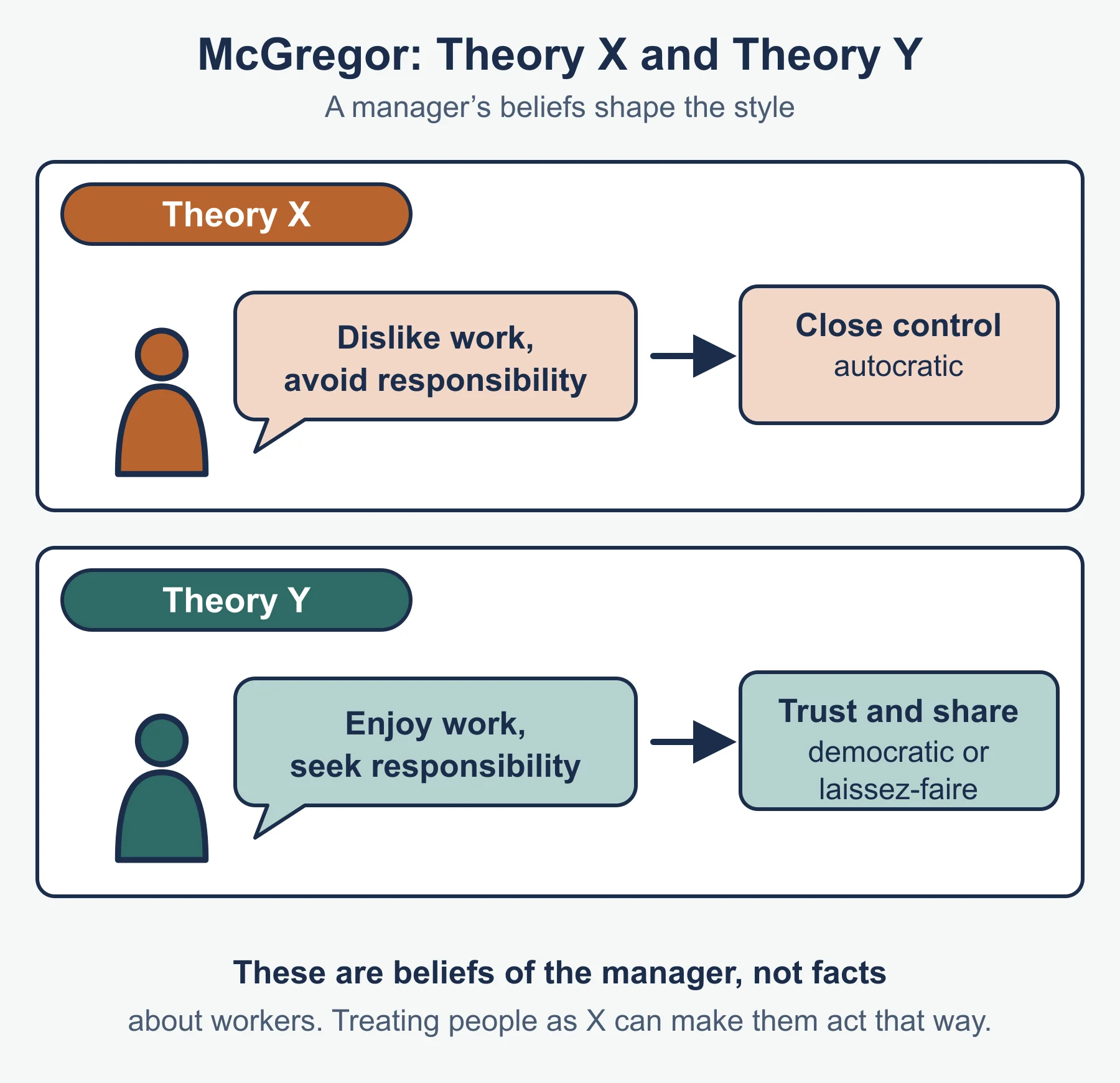
McGregor. A Theory X manager assumes people dislike work, avoid responsibility and need close control and threats or rewards, which leads to autocratic management. A Theory Y manager assumes people can enjoy work, seek responsibility and are self-directed, which leads to democratic or laissez-faire management. The theories describe a manager’s beliefs, not the workers themselves. Treating people as Theory X can itself make them behave that way.
Common errors
- Describing a theory without applying it to the case.
- Saying money is the only motivator, or that it never works. The answer depends on the workforce.
- Confusing job enrichment (more responsibility) with job re-design in general.
- Treating a style as always good or always bad. Justify it by the situation.
- Calling a profit-share a bonus for individual effort.
Frequently asked questions
What are the four traditional functions of a manager? Planning, organising, directing (also called leading) and controlling, as covered in Cambridge 9609 section 2.3.
What is the difference between job enrichment and job re-design? Job re-design is any change to the tasks in a job, such as rotating tasks to reduce boredom. Job enrichment specifically adds responsibility, planning or decision-making to a job.
What is a paternalistic management style? The manager still makes the decisions but shows concern for staff welfare and explains the reasons. It suits staff who value security but can be seen as patronising.
Is money a motivator? It depends on the workforce and the job. Taylor saw pay as the main motivator, while Herzberg treats pay as a hygiene factor, so answers should avoid saying money always or never motivates.
Official syllabus
Cambridge International AS & A Level Business 9609, syllabus for examination in 2026, 2027 and 2028, published by Cambridge University Press & Assessment, sections 2.2.1 to 2.3.1.
Get free revision emails (optional)
Occasional emails with practice questions, worked explanations and links to free resources for the qualification and subjects you choose. No spam, and you can unsubscribe from any email. The free tools on this site never need an email.
Related resources
-
Practice questions
A Level Business: Motivation and Management (Cambridge 9609) – Practice Questions
Original practice questions with worked answers on 2.2 Motivation and 2.3 Management in Cambridge AS & A Level Business 9609.
Business · Cambridge · AS Level
Try questions -
Revision notes
A Level Business: Motivation and Management (Cambridge 9609) – Revision Notes
Condensed revision notes for 2.2 Motivation and 2.3 Management in Cambridge AS & A Level Business 9609, with a self-test and common lost marks.
Business · Cambridge · AS Level
Revise topic -
Study guides
A Level Business: Organisational structure and Business communication (Cambridge 9609)
Study guide to 7.1 Organisational structure and 7.2 Business communication in Cambridge A Level Business, with worked examples on span and delayering.
Business · Cambridge · A Level
Read guide
Related articles
-
teaching
A Level tuition in Dubai: Cambridge or Pearson Edexcel International A Level?
Schools in Dubai and Abu Dhabi teach either Cambridge International AS & A Level or Pearson Edexcel International A Level. How the two are structured, why it matters for tuition, and how online classes from Lahore work.
9 October 2026
-
curriculum guides
Choosing subjects at IGCSE and A Level
How subject choices at 14 and 16 affect university options later, and how to keep pathways open without overloading a timetable.
28 July 2026
Studying this with a teacher
Working through Business AS LEVEL?
This page is free and stays free. If you would rather be taught it, Marlbridge runs Business classes one-to-one and in small groups of up to 15, online in your own time zone. The first trial class is free. WhatsApp replies within an hour (8am–11pm Pakistan time, every day); email the same day.
Cambridge Business teachers at Marlbridge

