
Study Guides
A Level Business: Organisational structure and Business communication (Cambridge 9609)
Study guide to 7.1 Organisational structure and 7.2 Business communication in Cambridge A Level Business, with worked examples on span and delayering.
- Subject
- Business
- Level
- A LEVEL
- Topic
- Human resource management
- Author
- Marlbridge Academic Team
- Updated
- Reviewed by
- Salman Ahmad (what this means)
Aligned to Cambridge A Level Business (9609), For examination in 2026, 2027 and 2028. Official specification .
Syllabus page (what it covers and how it is assessed): Cambridge A Level Business.
Syllabus points this page covers
9609 (A Level)
- 7.1 Organisational structure
- 7.2 Business communication
Found an error? Report a correction.
Need help with this topic? Request a free trial class for A Level Business (9609).
This guide covers sections 7.1 Organisational structure and 7.2 Business communication of the Cambridge International AS & A Level Business 9609 syllabus for examination in 2026, 2027 and 2028. These are A Level topics, which the syllabus assesses on Paper 3 and Paper 4, with the AS content assumed knowledge. Use it with the revision notes and the practice questions. Earlier HRM ideas are in the Topic 2 study guide, and the A Level HRM practice set tests other topic 7 ideas. See also the course hub, the checklist and the free diagnostics.
What the syllabus lists
| Section | You must be able to |
|---|---|
| 7.1.1 | Link objectives to structure: purpose and attributes |
| 7.1.2 | Compare functional, flat, narrow and matrix structures; explain product, function and geographical grouping; explain structural change; use the formal-structure terms |
| 7.1.3 | Relate delegation to accountability; describe accountability processes; judge the impact of delegation |
| 7.1.4 | Relate span of control to levels; separate authority from responsibility; explain control versus trust |
| 7.1.5 | Assess centralisation and decentralisation |
| 7.1.6 | Distinguish line from staff functions and their conflicts |
| 7.2.1 to 7.2.5 | Purposes, methods, channels, barriers, and management’s role in communication |
7.1.1 Objectives and structure
An organisational structure shows how people are grouped, who reports to whom and where decisions are made. Its purpose is to help the business reach its objectives. The attributes the syllabus lists are:
- Flexibility: the structure can change as markets, technology or customers change.
- Meeting the needs of the business: a firm with a goal of low costs may want few layers; a firm competing on innovation may want teams that cross departments.
- Allowing for growth and development: new products, sites or staff can be added without confusion over who is in charge.
- Encouraging intrapreneurship: staff are free to act like entrepreneurs inside the firm, proposing and running new ideas. A rigid hierarchy that sends every idea upwards tends to discourage this.
7.1.2 Types of structure and formal features
Formal-structure terms, in plain words:
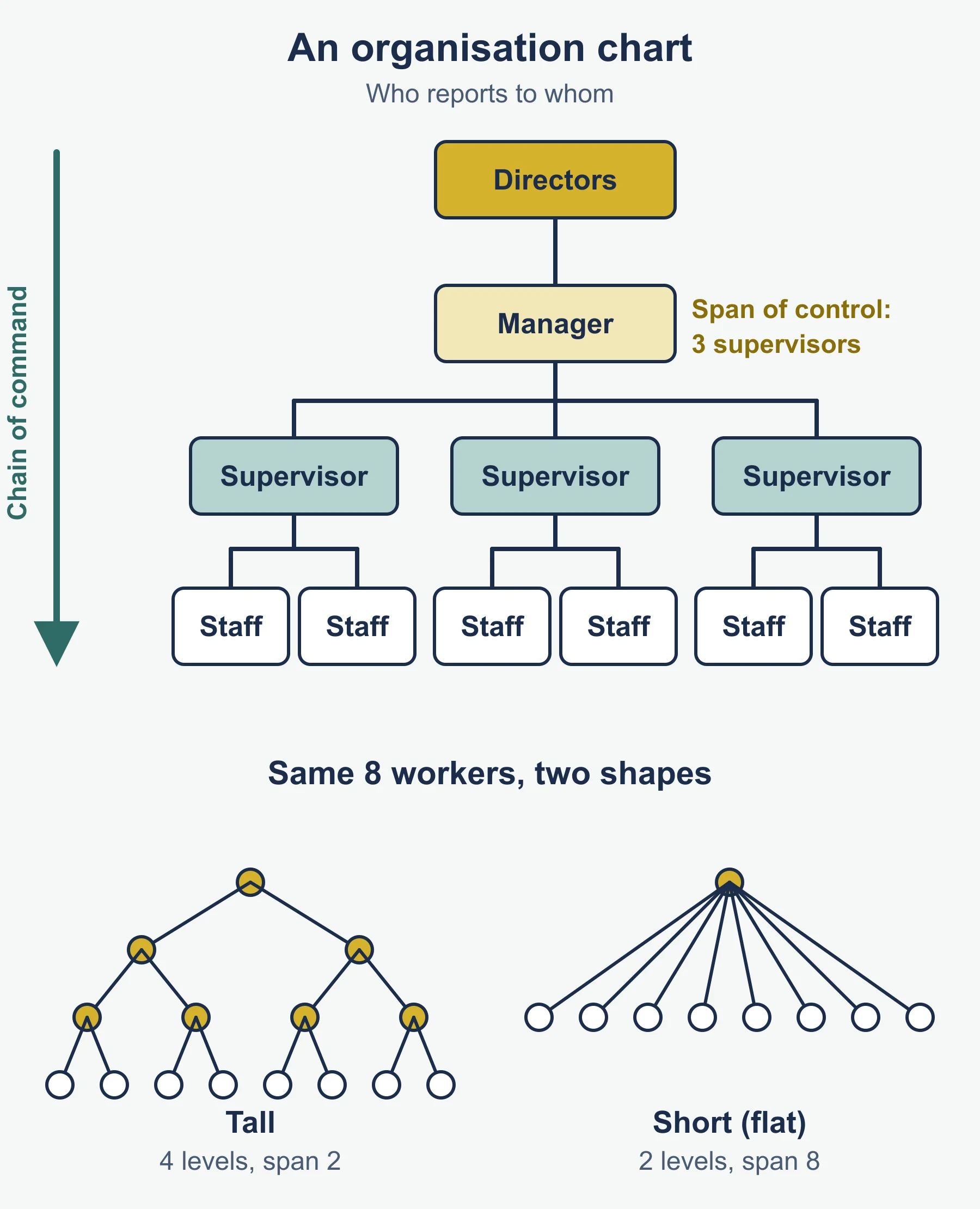
- Levels of hierarchy: the layers of management from top to bottom.
- Chain of command: the route along which orders travel downwards and reports travel upwards, level by level.
- Span of control: the number of subordinates reporting directly to one manager.
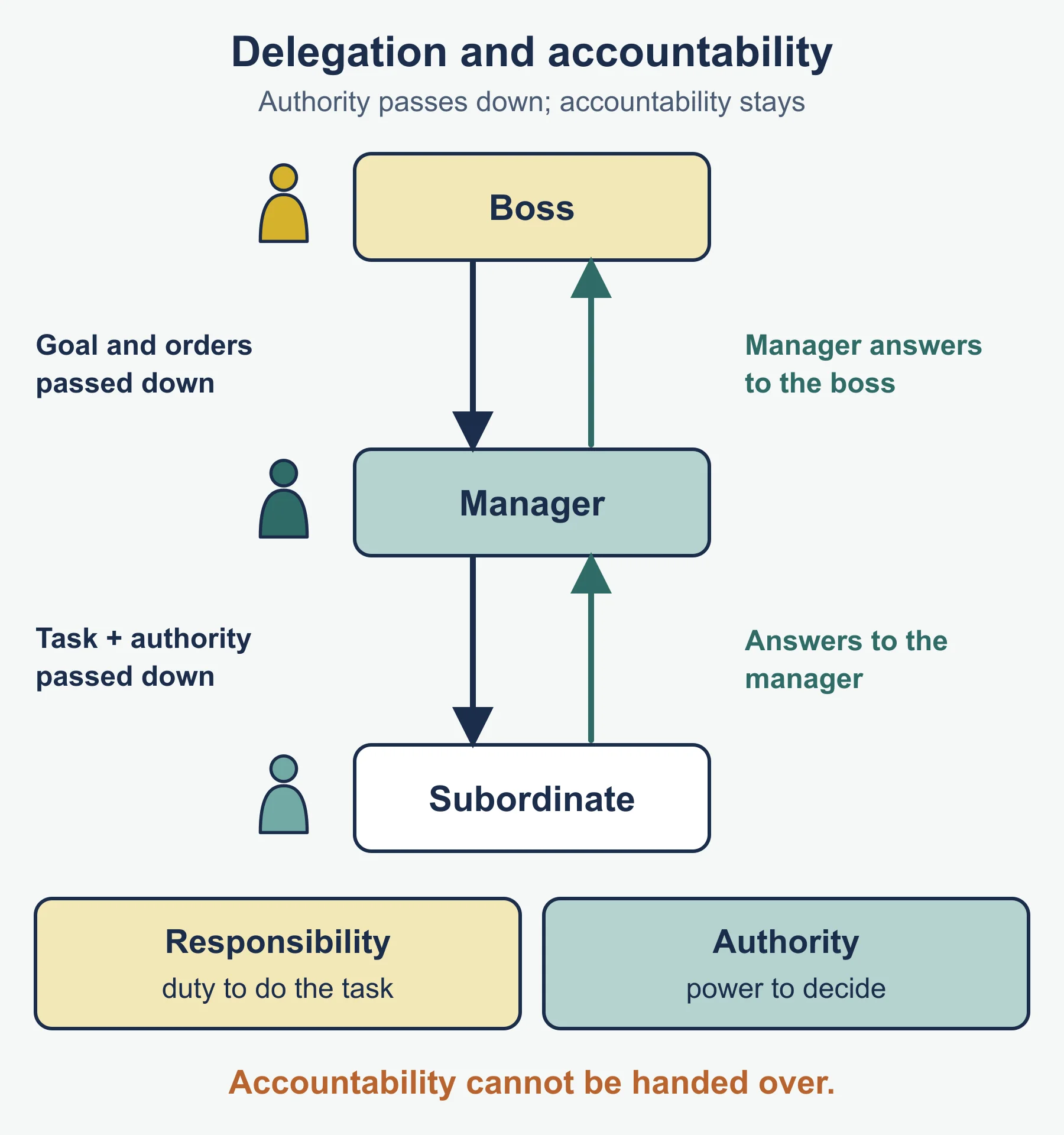
- Responsibility: the duty to carry out a task. Authority: the power to make decisions and instruct others. Delegation: passing authority for a task to a subordinate. Accountability: having to answer for the result.
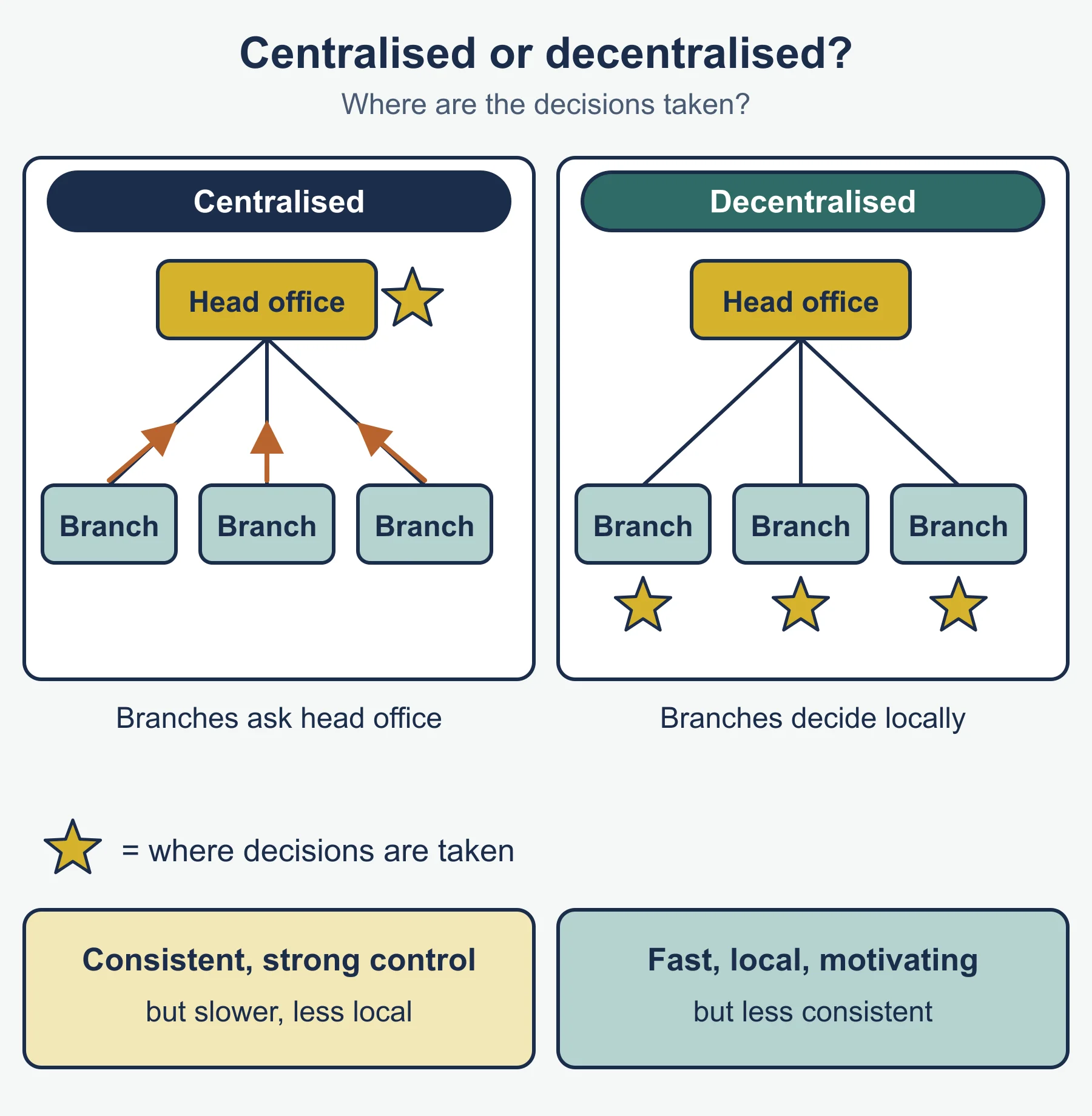
- Centralised: key decisions taken at the top. Decentralised: decisions taken lower down.
| Structure | Advantages | Disadvantages |
|---|---|---|
| Functional (grouped by finance, marketing, operations and so on) | Specialist expertise; clear careers; avoids duplicated skills | Departments may pursue their own aims; slow cross-department decisions |
| Hierarchical, narrow (tall): many levels, small spans | Close supervision; clear promotion steps; tight control | Slow communication; higher management cost; distance from customers |
| Hierarchical, flat: few levels, wide spans | Faster communication; lower cost; more delegation and job enrichment | Managers may be overloaded; fewer promotion steps; weaker supervision |
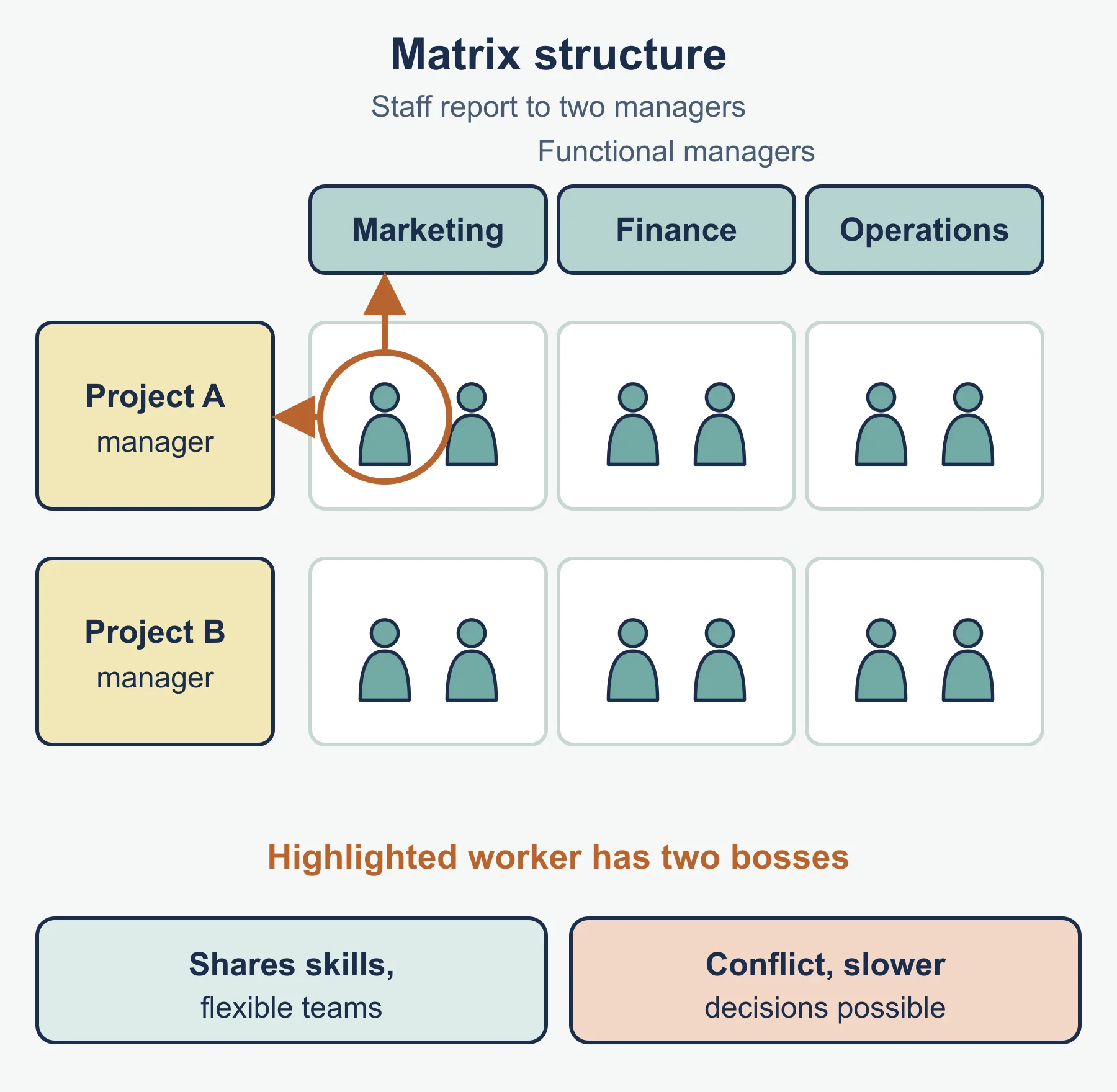
| Matrix: staff report to a functional manager and a project or product manager | Shares skills across projects; flexible; teamwork | Two bosses can cause conflict and confusion; slower decisions; needs good communication |
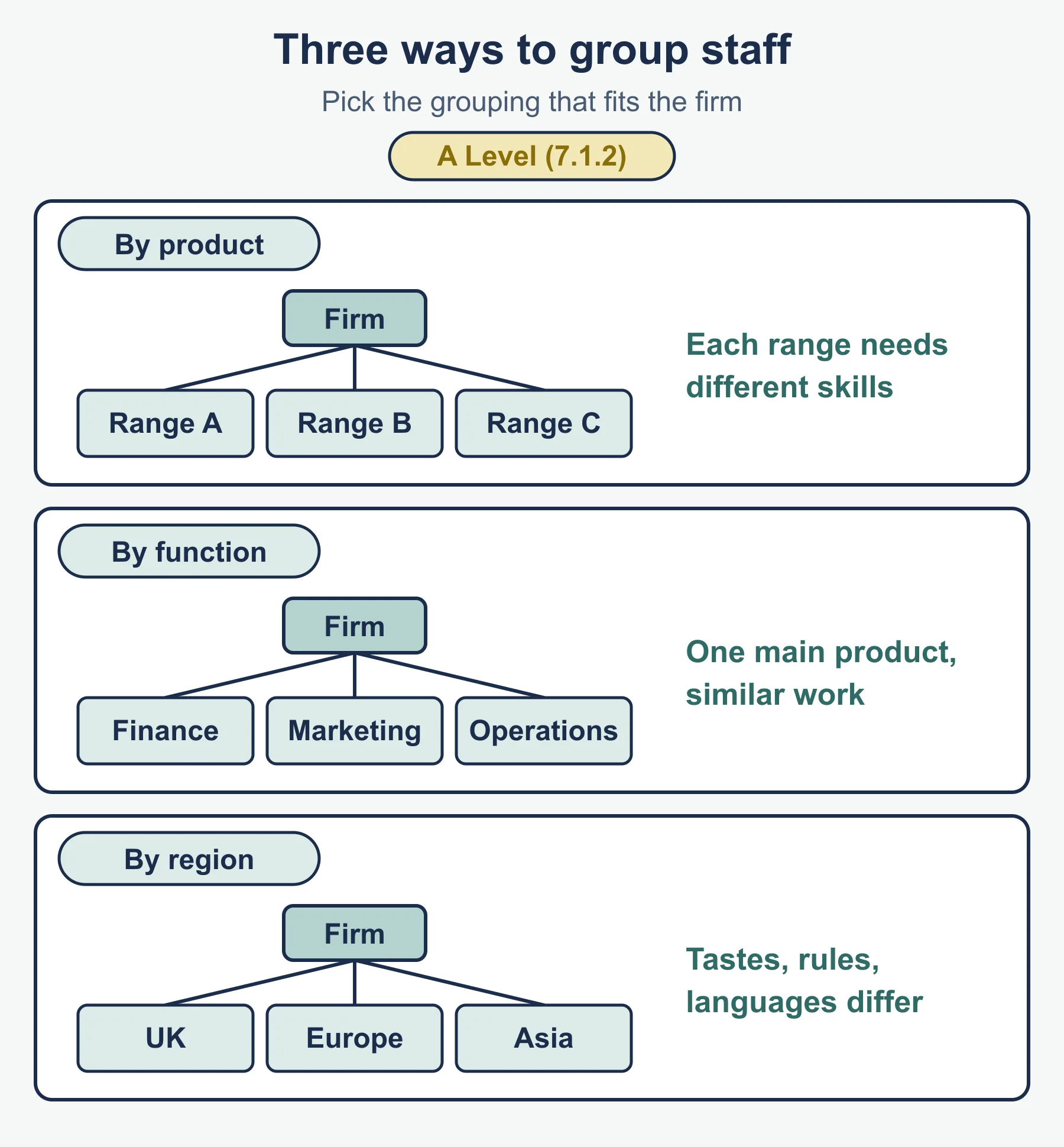
Why group by product, function or geographical area? A firm with distinct product ranges that need different skills may split by product so each division can focus on its market. A firm with one main product and similar work in each department may split by function for efficiency. A firm selling across regions or countries with different tastes, rules or languages may split by geographical area, so local managers can respond quickly. Many firms mix these, for example functions inside each region.
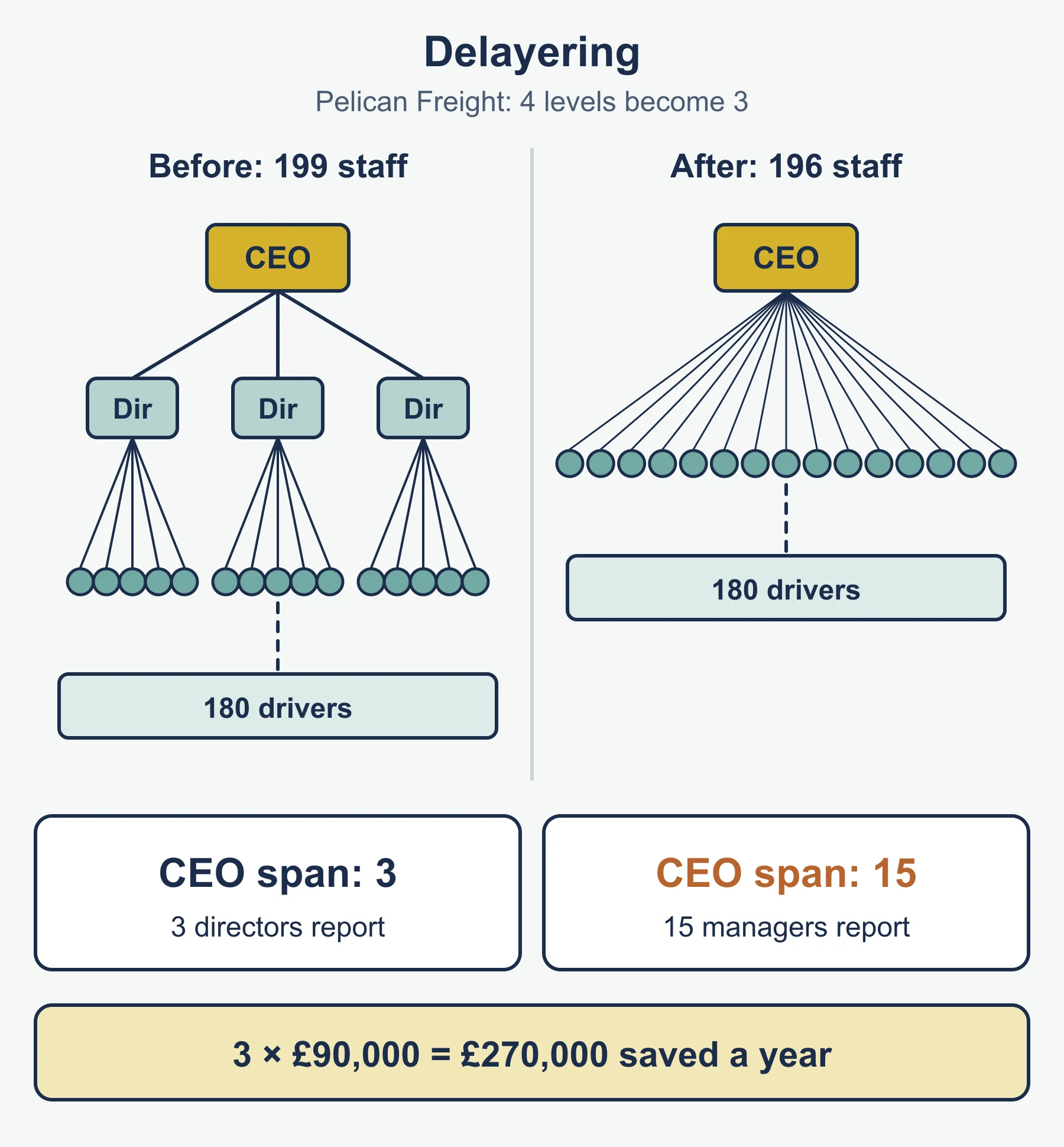
Reasons structures change: growth (more staff makes the old structure unwieldy, so divisions or regions appear), delayering (removing one or more layers to cut costs and speed decisions), new strategy, new technology, or a merger. Ways of changing include delayering, widening spans, creating divisions and moving to project teams.
Worked example: span of control and levels
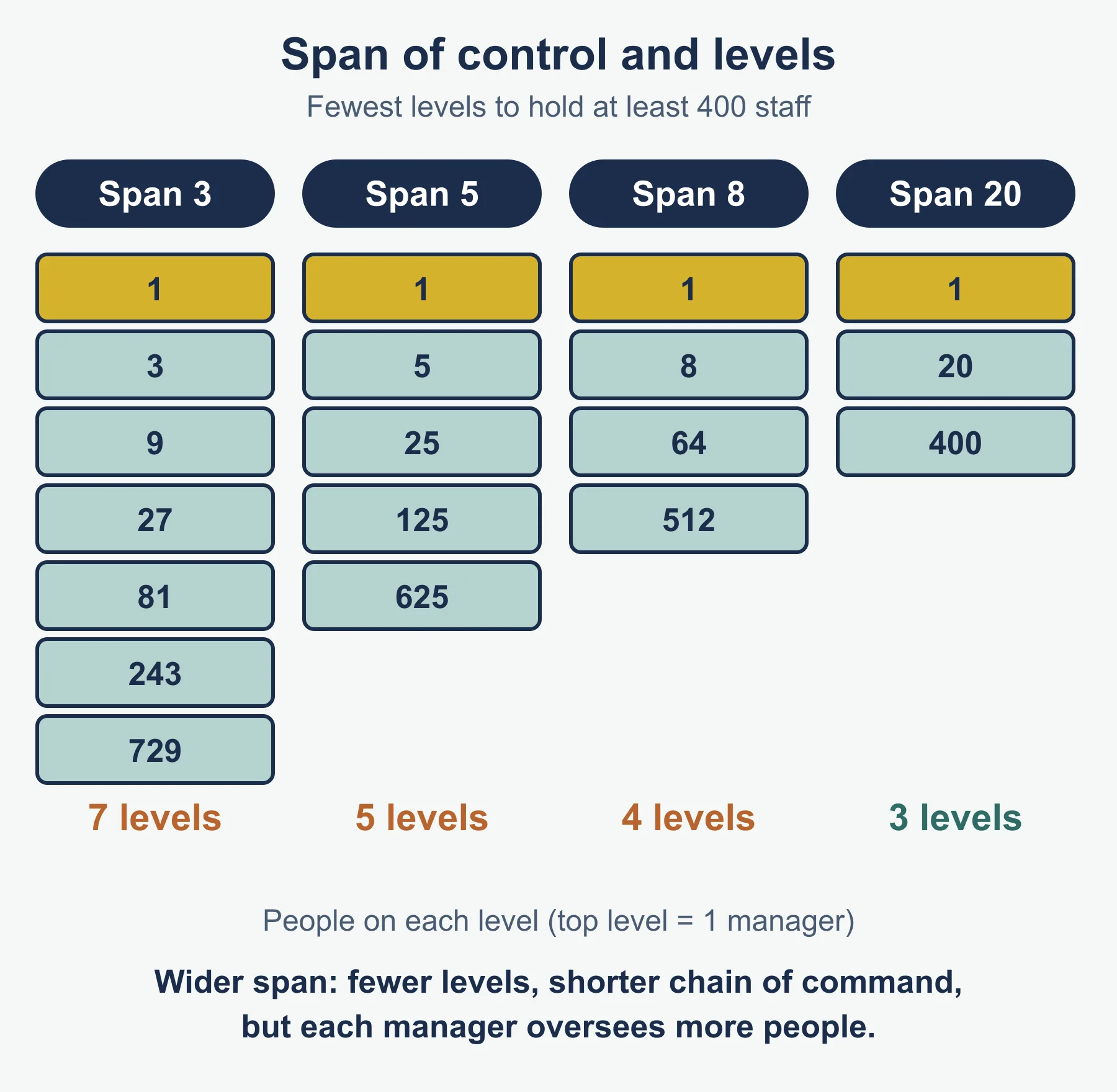
Zennorby Bakeries has about 400 staff. For each span, find the fewest levels needed for a full pyramid to hold at least 400 people. The people at a level equal the span multiplied by the number at the level above. Add the levels to get the total.
| Span of control | People on each level | Total | Levels |
|---|---|---|---|
| 3 | 1, 3, 9, 27, 81, 243, 729 | 1,093 | 7 |
| 5 | 1, 5, 25, 125, 625 | 781 | 5 |
| 8 | 1, 8, 64, 512 | 585 | 4 |
| 20 | 1, 20, 400 | 421 | 3 |
Level counts are fewest possible; a real firm will rarely fill a pyramid exactly. The pattern is the point. A narrow span forces many levels, and a wide span allows few. Widening the span from 3 to 20 cuts the hierarchy from seven levels to three, which shortens the chain of command, but each manager then oversees far more people.
7.1.3 Delegation and accountability
Delegation passes authority for a task to a subordinate. Accountability stays with the delegator: a manager can hand over the task but cannot hand over the duty to answer to a superior for its result. The subordinate becomes responsible for doing the task and accountable to the manager for how well it was done.
Accountability processes include reporting lines, targets and key performance indicators, appraisal and performance reviews, regular reports and meetings, audits, and sanctions or rewards for results. Companies also answer to shareholders and boards through published accounts.
Impact of delegation: it frees managers for strategic work, develops and motivates staff, speeds decisions near the customer and prepares successors. Risks are mistakes by inexperienced staff, inconsistent decisions, extra training cost and managers who feel they are losing control.
7.1.4 Control, authority and trust
The span of control and the levels of hierarchy move in opposite directions for a given workforce, as the table above shows. Wide spans mean flatter structures.
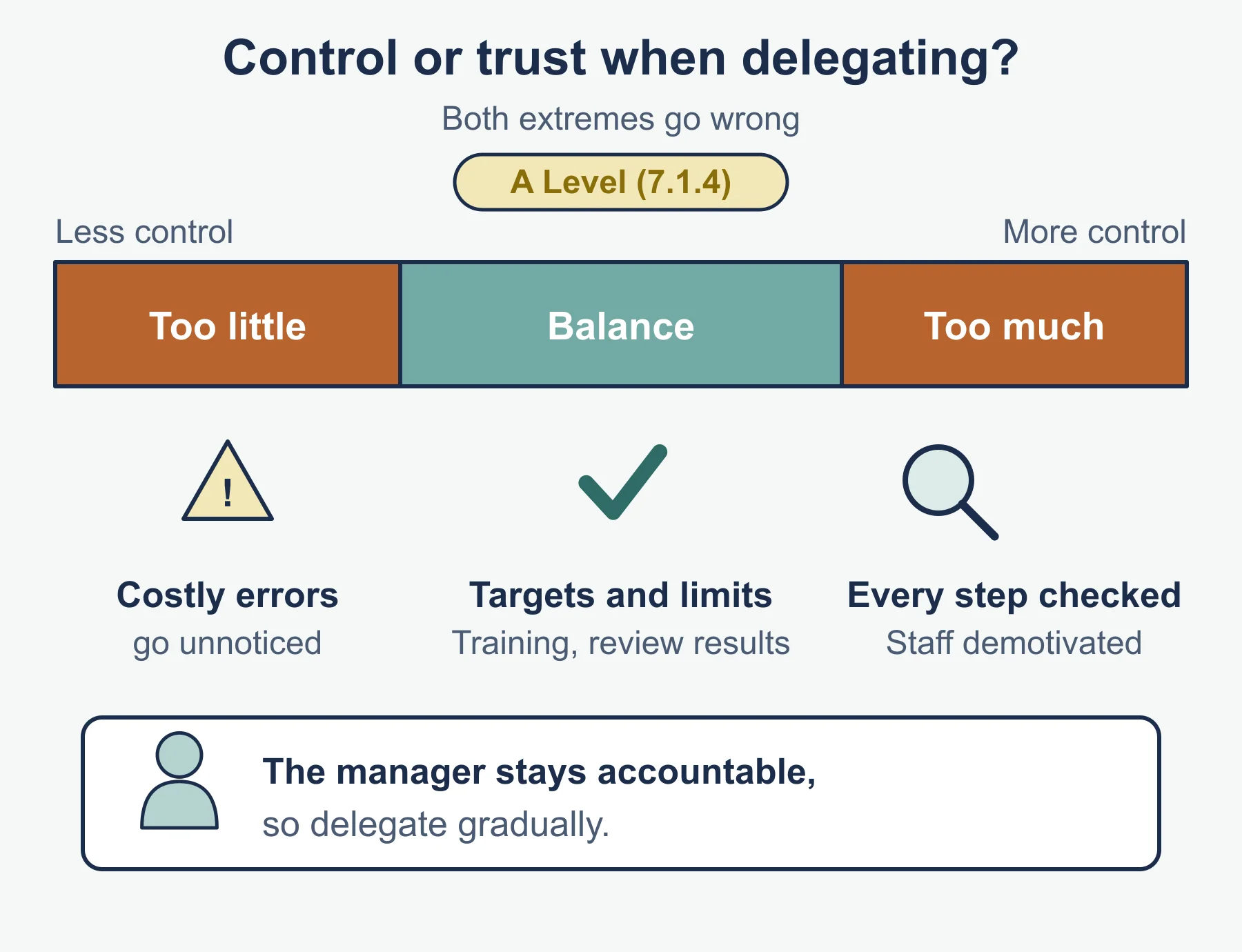
Authority and responsibility are different. Responsibility is the duty to complete a task. Authority is the power to take the decisions needed to complete it. A supervisor made responsible for a delivery target without authority to order overtime or change routes has responsibility but not enough authority, which causes frustration.
Control and trust can conflict. A manager who delegates must trust the subordinate to decide well, yet remains accountable. Too much control (checking every step) defeats the purpose of delegating and can demotivate staff. Too little control risks costly errors. Managers resolve this by delegating gradually, setting clear targets and limits, giving training and reviewing results rather than every action.
7.1.5 Centralisation and decentralisation
| Centralised | Decentralised | |
|---|---|---|
| Decisions | Taken by senior managers | Taken by local or lower-level managers |
| Benefits | Consistency; strong control; economies of scale in buying; clear direction | Faster, locally informed decisions; motivation; develops managers; senior managers free for strategy |
| Costs | Slow; senior managers overloaded; lower motivation; may ignore local needs | Inconsistency; duplication; harder control; risk of poor decisions |
Suitable choices depend on the business. A bank protecting its brand and reducing risk may centralise lending rules. A chain of restaurants in different cities might decentralise menus and local marketing while centralising purchasing.
7.1.6 Line and staff
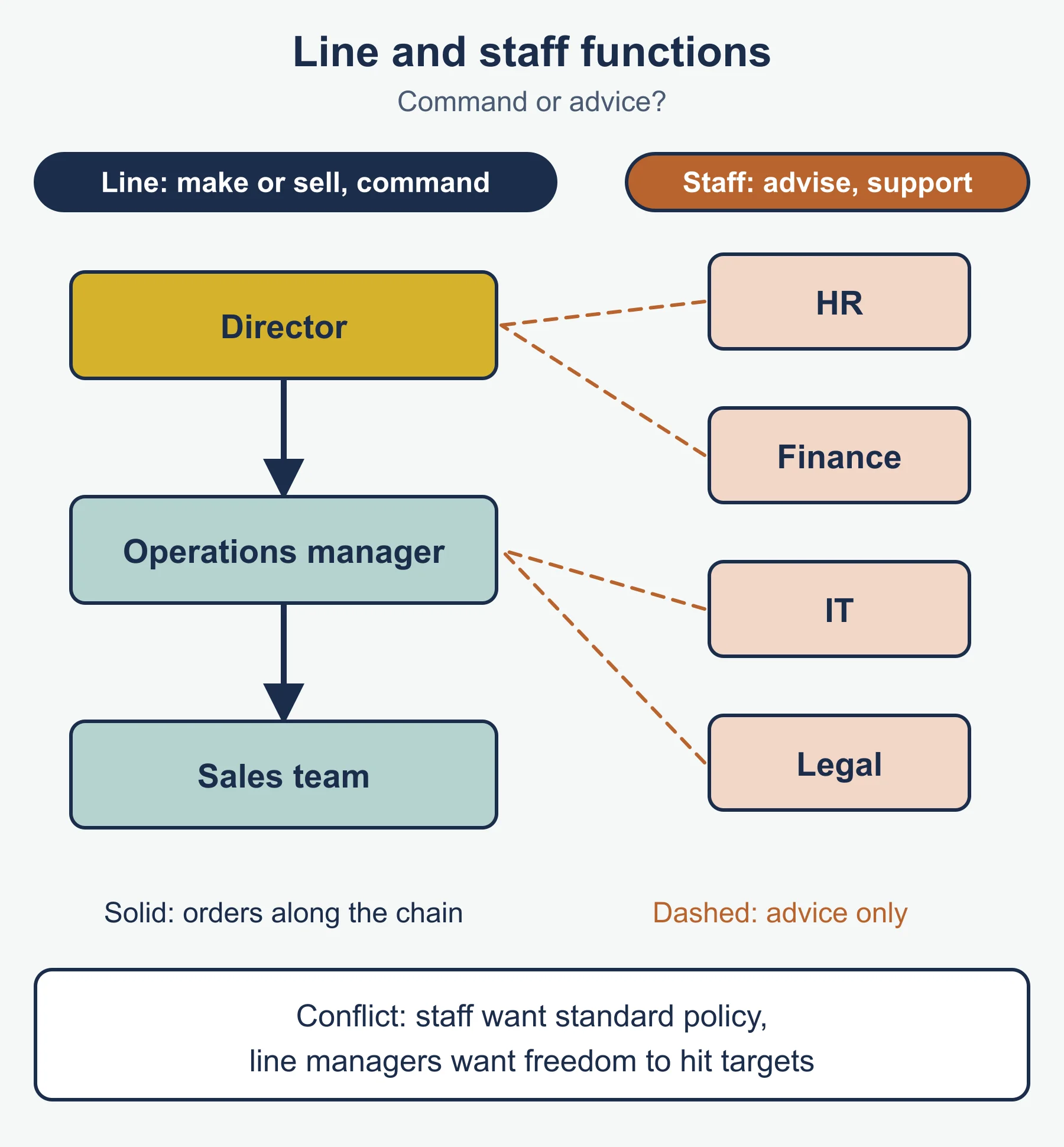
Line functions are directly involved in producing or selling the product, such as operations and sales. Line managers hold direct authority over their staff in the chain of command. Staff functions support the line with advice and services, such as human resources, finance, IT and legal. Staff specialists advise rather than command line managers.
Conflicts arise because staff specialists may want standard policies while line managers want freedom to hit targets; line managers may resent advice from people without operational experience; staff may feel ignored; and both can compete for budgets. A human resources department insisting on a long recruitment process may frustrate an operations manager who needs workers this week.
7.2.1 Purposes of communication
Communication is essential when giving instructions, sharing information about targets and performance, motivating and consulting staff, coordinating departments, dealing with customers and suppliers, handling a crisis, and during change such as a restructure, where silence invites rumour.
7.2.2 Methods of communication
| Method | Examples | Strengths | Weaknesses |
|---|---|---|---|
| Spoken | Meetings, phone calls, presentations | Immediate; feedback and tone; personal | No record unless noted; time-consuming; misunderstood in noise or at distance |
| Written | Letters, reports, memos, notice boards | Permanent record; detailed; can be checked | Slow; no instant feedback; may be unread |
| Electronic | Email, messaging, video calls, intranet | Fast; reaches many; cheap per message; records kept | Overload; impersonal; needs technology and security |
| Visual | Charts, diagrams, video, posters | Quick to grasp; helps complex data | Can oversimplify; needs design skill; may need explanation |
Choose the method to fit the message: a redundancy announcement suits a face-to-face meeting followed by a written confirmation, whereas a changed delivery time suits a short message.
7.2.3 Channels of communication
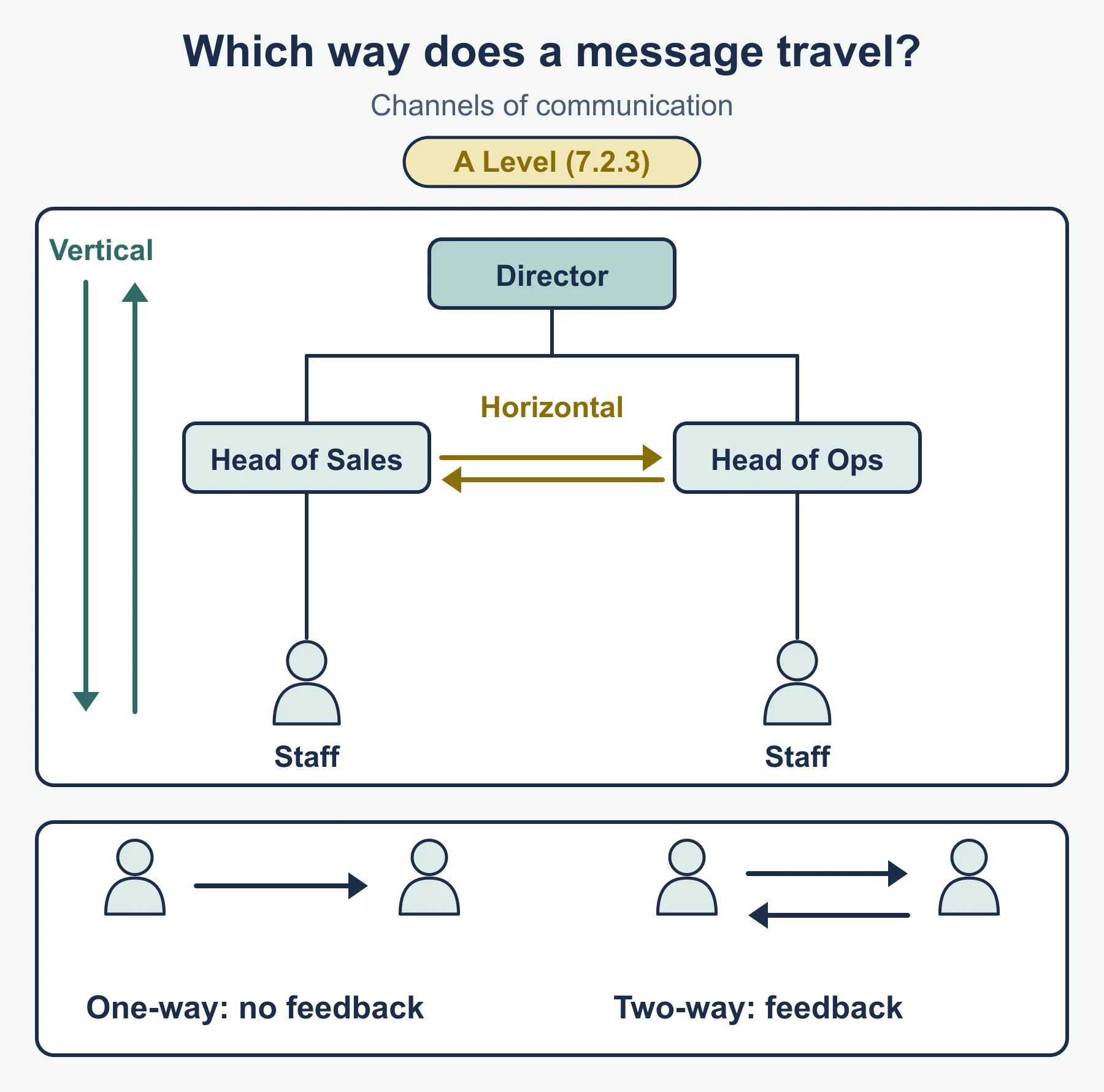
A channel is the route a message takes through the structure. One-way communication runs from sender to receiver without feedback, such as a notice. Two-way communication involves feedback and response, such as a discussion. Vertical communication runs up and down the hierarchy; horizontal communication runs between people at the same level, such as between two department heads.
Problems: in tall structures, messages pass through many levels and become delayed or distorted; one-way channels give no check that the message was understood; horizontal channels may be missing in a functional structure, causing silos; wide channels risk overload.
7.2.4 Barriers to communication
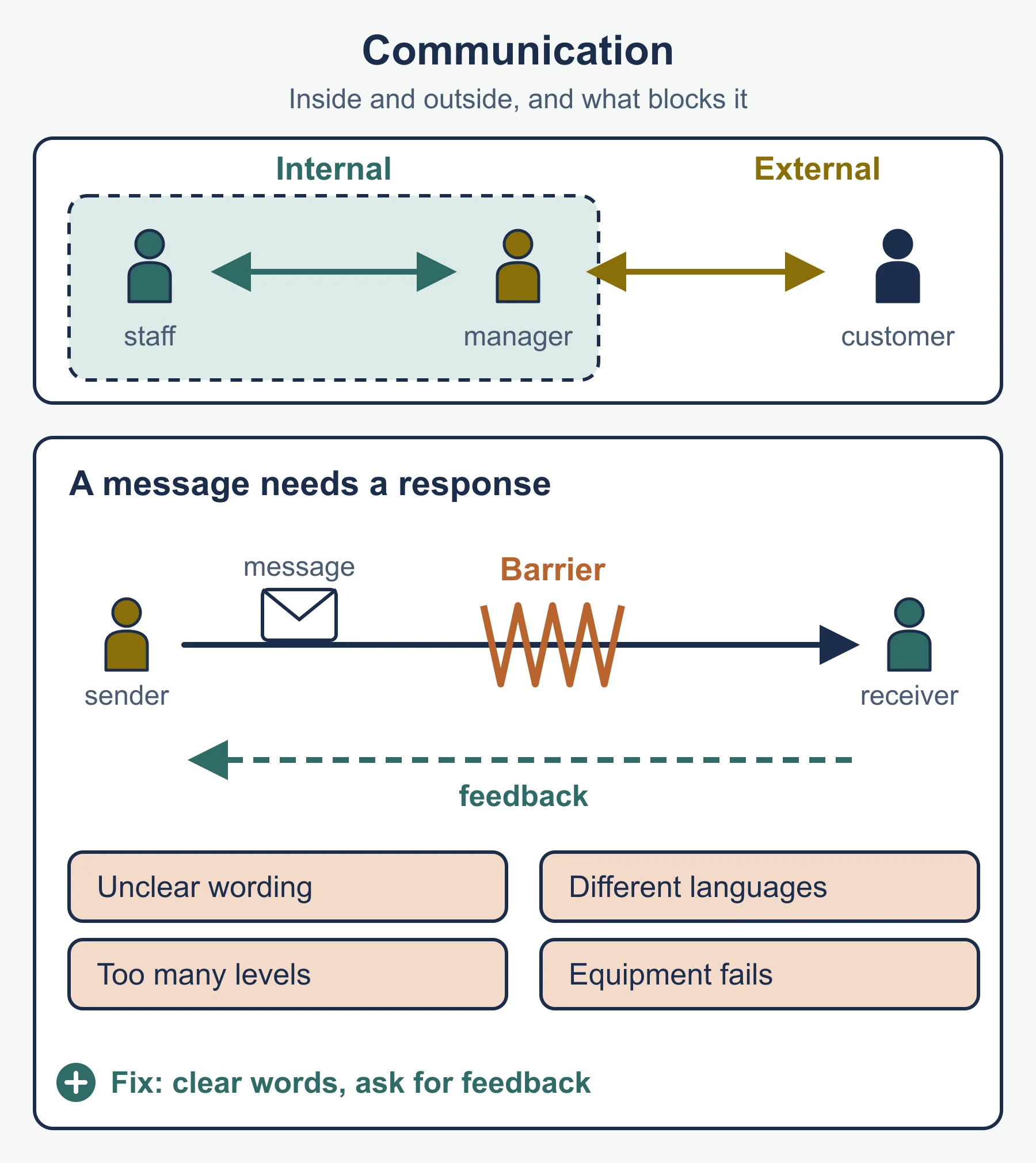
| Barrier | Example | Way to overcome |
|---|---|---|
| Jargon or language | Technical terms used with non-specialists | Plain language; agreed glossary; translation |
| Poor channel choice | Complex change sent as one brief text | Match method to message; follow up in person |
| Overload | Hundreds of daily emails | Filter messages; set priorities; summaries |
| Distance or time zones | Overseas sites | Scheduled video calls; shared platforms |
| Attitudes and mistrust | Staff expect bad news | Honest, regular updates; listening |
| Many levels | Distorted message | Delayering; direct briefings |
| Technical failure | System outage | Backup methods |
7.2.5 The role of management
Informal communication, such as conversations in corridors or social messaging groups, is not part of the formal chain of command. It can build relationships, spread useful information quickly and reveal staff concerns, but it also carries rumour and may bypass managers.
Good communication improves efficiency by reducing errors and rework, speeding decisions, aligning departments and raising motivation and retention. Poor communication causes wasted time, missed deadlines and conflict.
Managers improve communication by choosing suitable methods, creating two-way channels (suggestion schemes, team meetings, surveys), cascading key messages with checks, training staff, using clear language and acting on feedback.
Worked example: communication cost
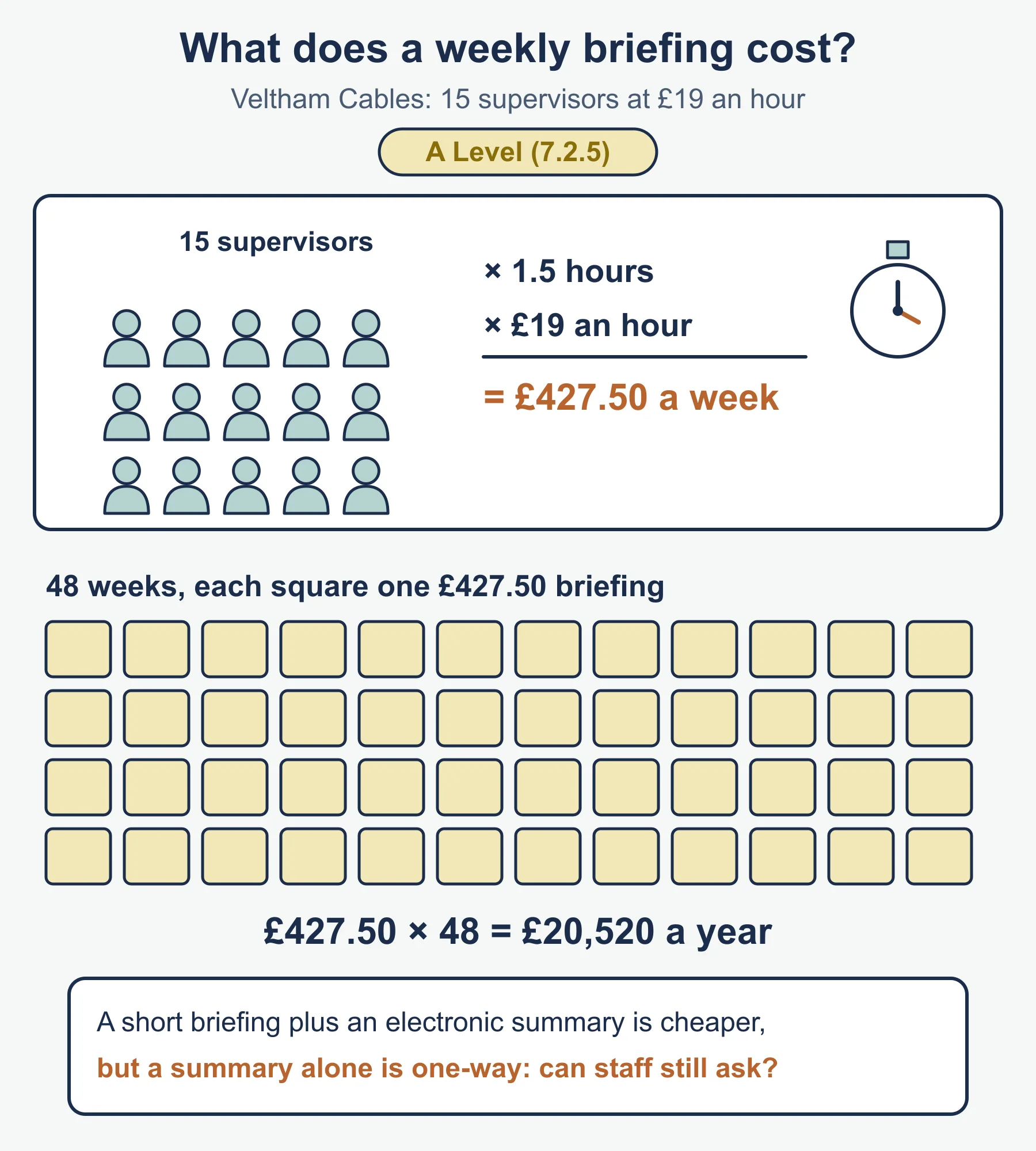
Veltham Cables holds a weekly 1.5-hour briefing for 15 supervisors paid on average £19 per hour. Cost per meeting: 15 x 1.5 x 19 = £427.50. Over 48 weeks this is £20,520. Moving to a 20-minute briefing plus a short electronic summary would not just cut cost; the manager must also ask whether supervisors can still ask questions, because a summary alone is one-way.
Worked example: delayering
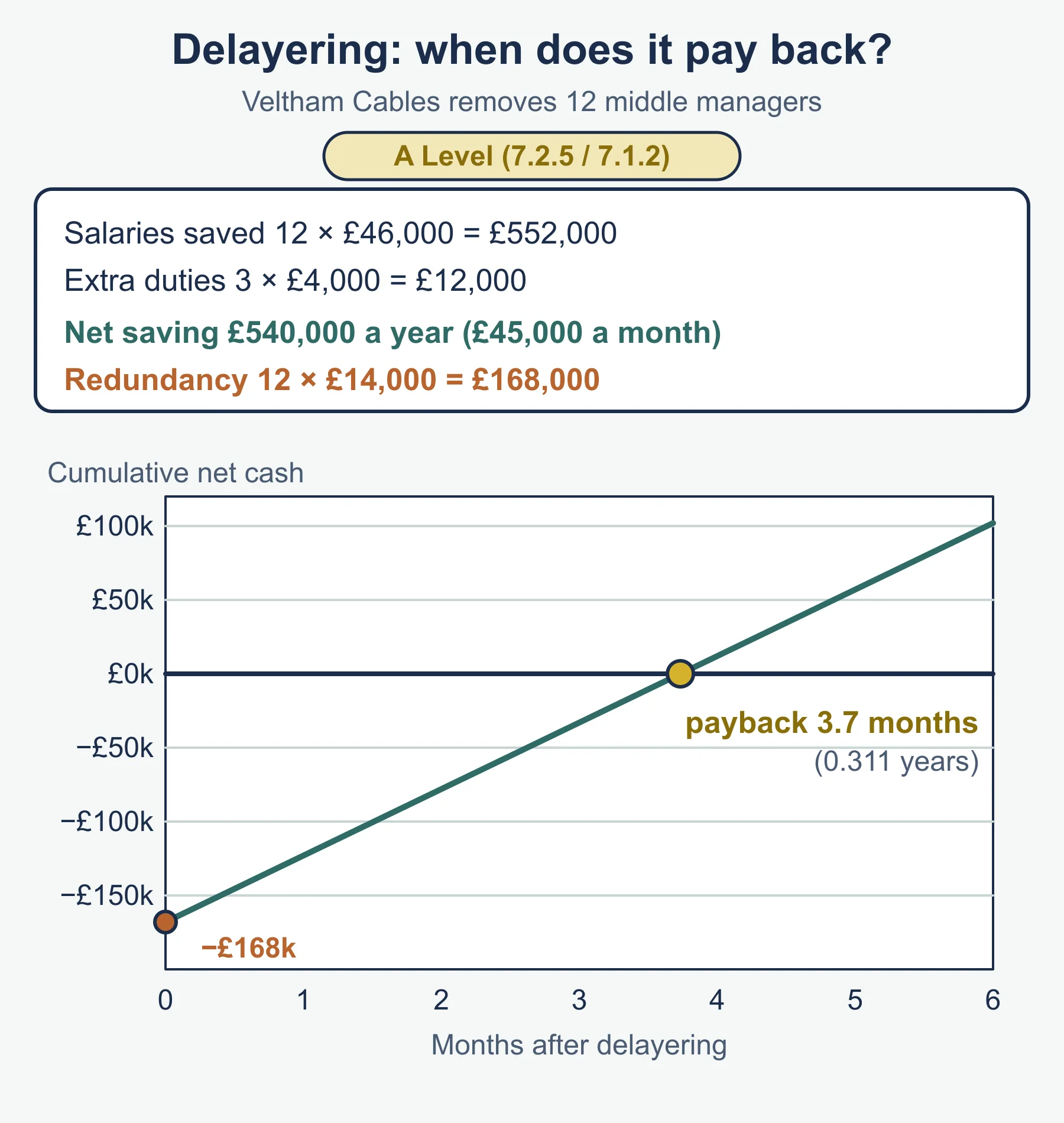
Veltham Cables removes a layer of 12 middle managers. Salaries are £46,000 each: saving 12 x 46,000 = £552,000 a year. Three team leaders take on extra duties for £4,000 each (£12,000). Net annual saving: £540,000. Redundancy costs 12 x £14,000 = £168,000. Payback: 168,000 / 540,000 = 0.311 years, about 3.7 months. A good evaluation then asks whether the remaining managers can cope with wider spans.
Common errors
- Mixing up authority (the power to decide) with responsibility (the duty to complete a task).
- Saying delegation transfers accountability to the subordinate.
- Describing flat structures as always better; the answer depends on the business and context.
- Listing barriers without saying how to overcome them, when the syllabus asks for both.
- Treating informal communication as only a problem.
Frequently asked questions
What is the link between span of control and levels of hierarchy? For a given workforce they move in opposite directions: a wider span of control means fewer levels of hierarchy, and a narrower span means more levels.
What makes a good organisational structure in Cambridge 9609? The attributes listed are flexibility, meeting the needs of the business, allowing for growth and development, and encouraging intrapreneurship.
What are the main barriers to communication? Jargon or language, poor choice of channel, information overload, distance or time zones, attitudes and mistrust, too many levels, and technical failure. Each should be paired with a way to overcome it.
Are flat structures always better than tall structures? No. Flat structures give faster communication and lower cost but can overload managers, while tall structures give close supervision but slower communication. The right choice depends on the business.
Official syllabus
Cambridge International AS & A Level Business 9609 syllabus for examination in 2026, 2027 and 2028, published by Cambridge International: sections 7.1 and 7.2.
Get free revision emails (optional)
Occasional emails with practice questions, worked explanations and links to free resources for the qualification and subjects you choose. No spam, and you can unsubscribe from any email. The free tools on this site never need an email.
Related resources
-
Practice questions
A Level Business: Organisational structure and Business communication (Cambridge 9609) – Practice Questions
Original practice questions with worked answers on organisational structure and business communication for Cambridge A Level Business.
Business · Cambridge · A Level
Try questions -
Revision notes
A Level Business: Organisational structure and Business communication (Cambridge 9609) – Revision Notes
Condensed revision notes for 7.1 Organisational structure and 7.2 Business communication in Cambridge A Level Business, with a self-test.
Business · Cambridge · A Level
Revise topic -
Practice questions
A Level Business: Human Resource Management (A Level) — Practice Questions (Cambridge 9609)
Worked practice questions on flexible contracts, core and peripheral workers, hard and soft HRM, MBO and matrix structures for Cambridge A Level Business 9609.
Business · Cambridge · A Level
Try questions
Related articles
-
teaching
A Level tuition in Dubai: Cambridge or Pearson Edexcel International A Level?
Schools in Dubai and Abu Dhabi teach either Cambridge International AS & A Level or Pearson Edexcel International A Level. How the two are structured, why it matters for tuition, and how online classes from Lahore work.
9 October 2026
-
curriculum guides
Choosing subjects at IGCSE and A Level
How subject choices at 14 and 16 affect university options later, and how to keep pathways open without overloading a timetable.
28 July 2026
Studying this with a teacher
Working through Business A LEVEL?
This page is free and stays free. If you would rather be taught it, Marlbridge runs Business classes one-to-one and in small groups of up to 15, online in your own time zone. The first trial class is free. WhatsApp replies within an hour (8am–11pm Pakistan time, every day); email the same day.
Cambridge Business teachers at Marlbridge

