
Revision Notes
A Level Business: Organisational structure and Business communication (Cambridge 9609) – Revision Notes
Condensed revision notes for 7.1 Organisational structure and 7.2 Business communication in Cambridge A Level Business, with a self-test.
- Subject
- Business
- Level
- A LEVEL
- Topic
- Human resource management
- Author
- Marlbridge Academic Team
- Updated
- Reviewed by
- Salman Ahmad (what this means)
Aligned to Cambridge A Level Business (9609), For examination in 2026, 2027 and 2028. Official specification .
Syllabus page (what it covers and how it is assessed): Cambridge A Level Business.
Syllabus points this page covers
9609 (A Level)
- 7.1 Organisational structure
- 7.2 Business communication
Found an error? Report a correction.
Need help with this topic? Request a free trial class for A Level Business (9609).
These are condensed notes for sections 7.1 Organisational structure and 7.2 Business communication of the Cambridge International AS & A Level Business 9609 syllabus for examination in 2026, 2027 and 2028. They are A Level content, assessed on Paper 3 and Paper 4. For full explanations and worked examples, read the study guide, then try the practice questions. Other topic 7 ideas are in the A Level HRM practice set and the AS foundations are in the Topic 2 revision notes. Course links: the Cambridge A Level Business hub, the checklist and the free diagnostics.
7.1.1 Objectives and structure
| Attribute of a good structure | Recall |
|---|---|
| Flexibility | Can adapt to change in markets or technology |
| Meets business needs | Fits the objectives, for example low cost or innovation |
| Allows growth and development | Room for new products, sites and staff |
| Encourages intrapreneurship | Staff free to propose and run new ideas inside the firm |
Purpose: to organise people so the business can reach its objectives.
7.1.2 Formal structure vocabulary
| Term | One-line definition |
|---|---|
| Levels of hierarchy | Layers of management from top to bottom |
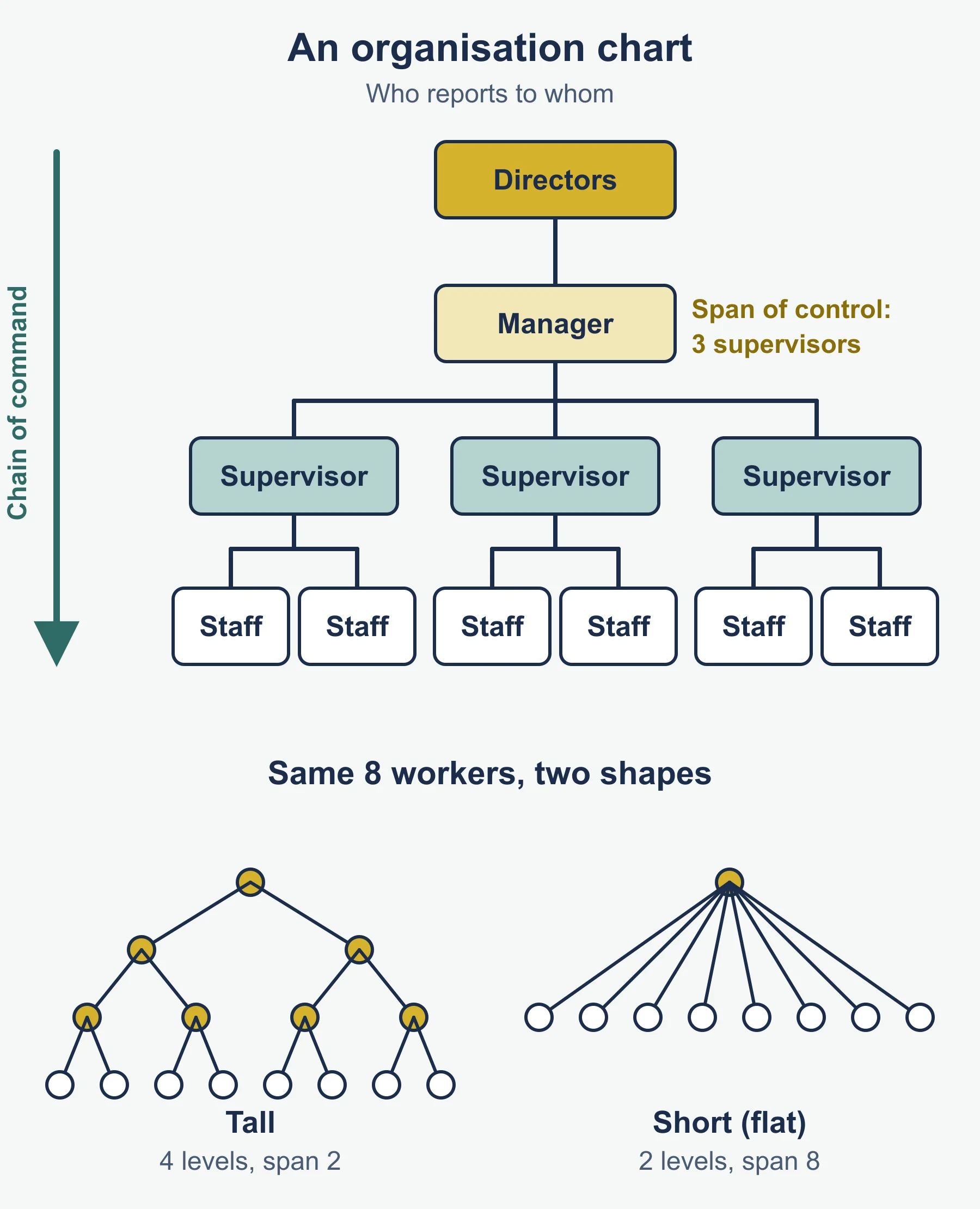
| Chain of command | Path orders follow downwards and reports follow upwards |
| Span of control | Number of subordinates reporting directly to a manager |
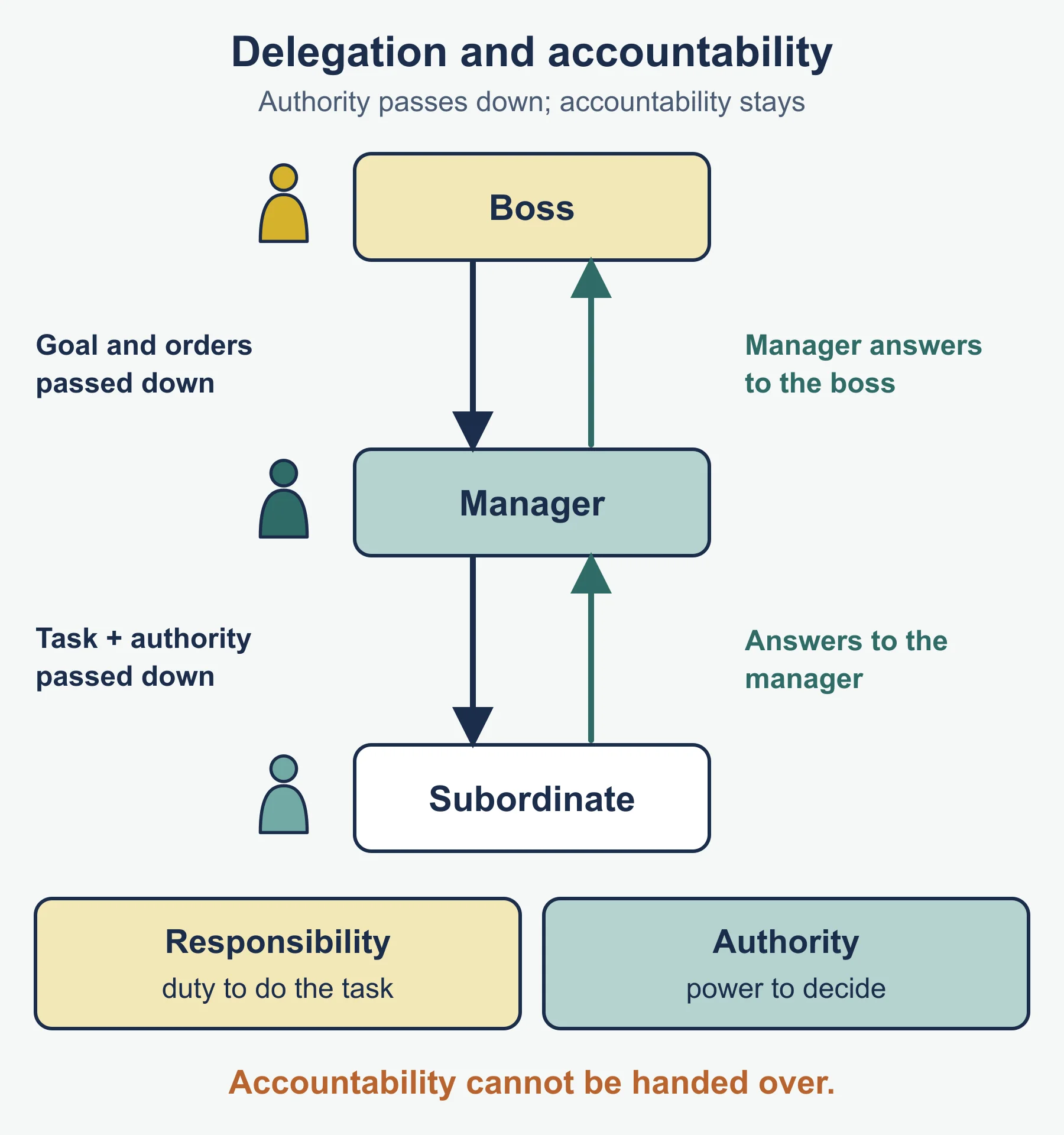
| Responsibility | Duty to complete a task |
| Authority | Power to decide and instruct |
| Delegation | Passing authority for a task down |
| Accountability | Having to answer for the result |
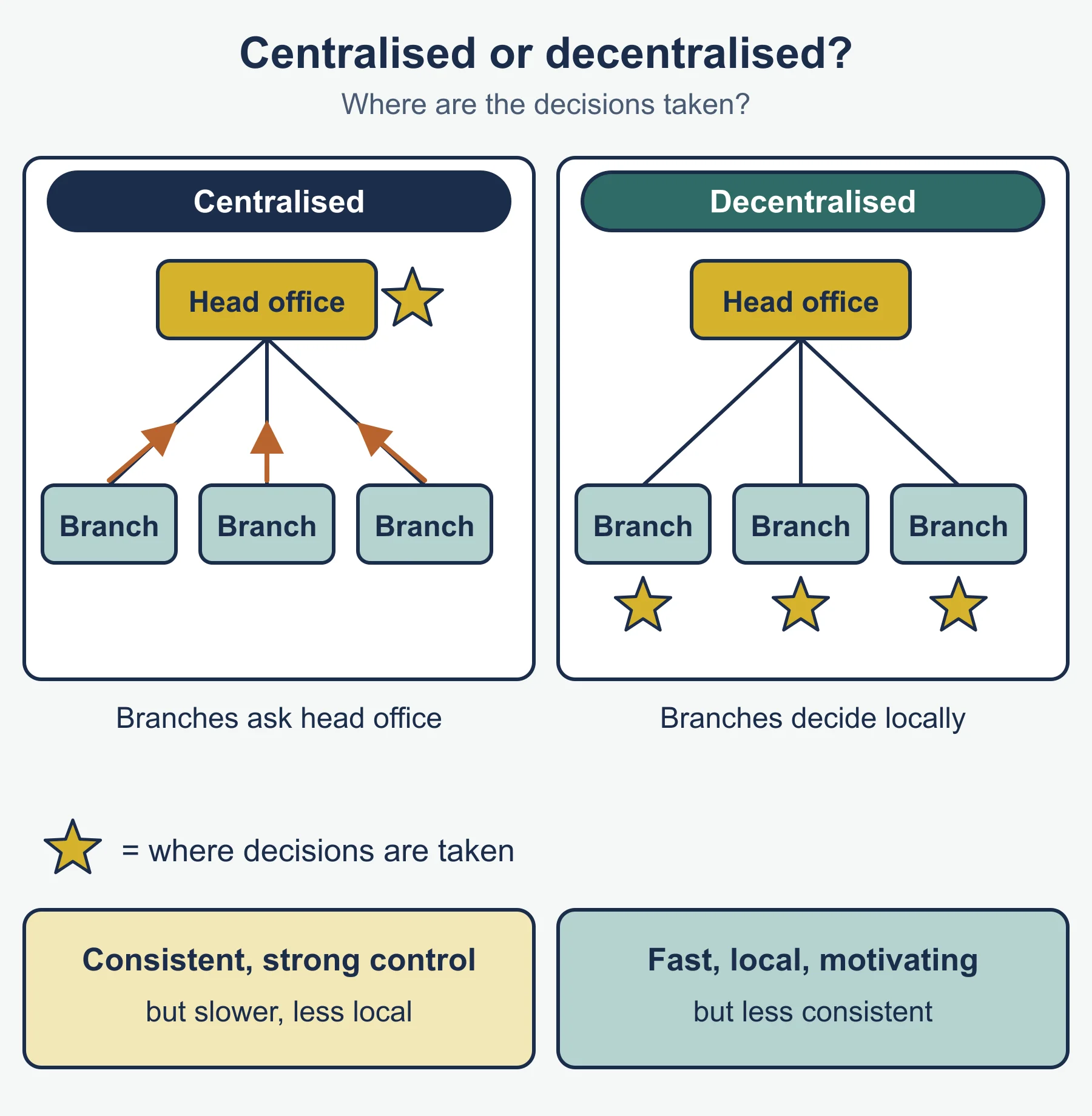
| Centralised | Key decisions made at the top |
| Decentralised | Decisions made lower down |
7.1.2 Types of structure
| Structure | Key advantage | Key disadvantage |
|---|---|---|
| Functional | Specialist expertise | Departments pursue own aims |
| Narrow (tall) | Close control; promotion steps | Slow, costly communication |
| Flat | Fast communication; lower cost | Overloaded managers |
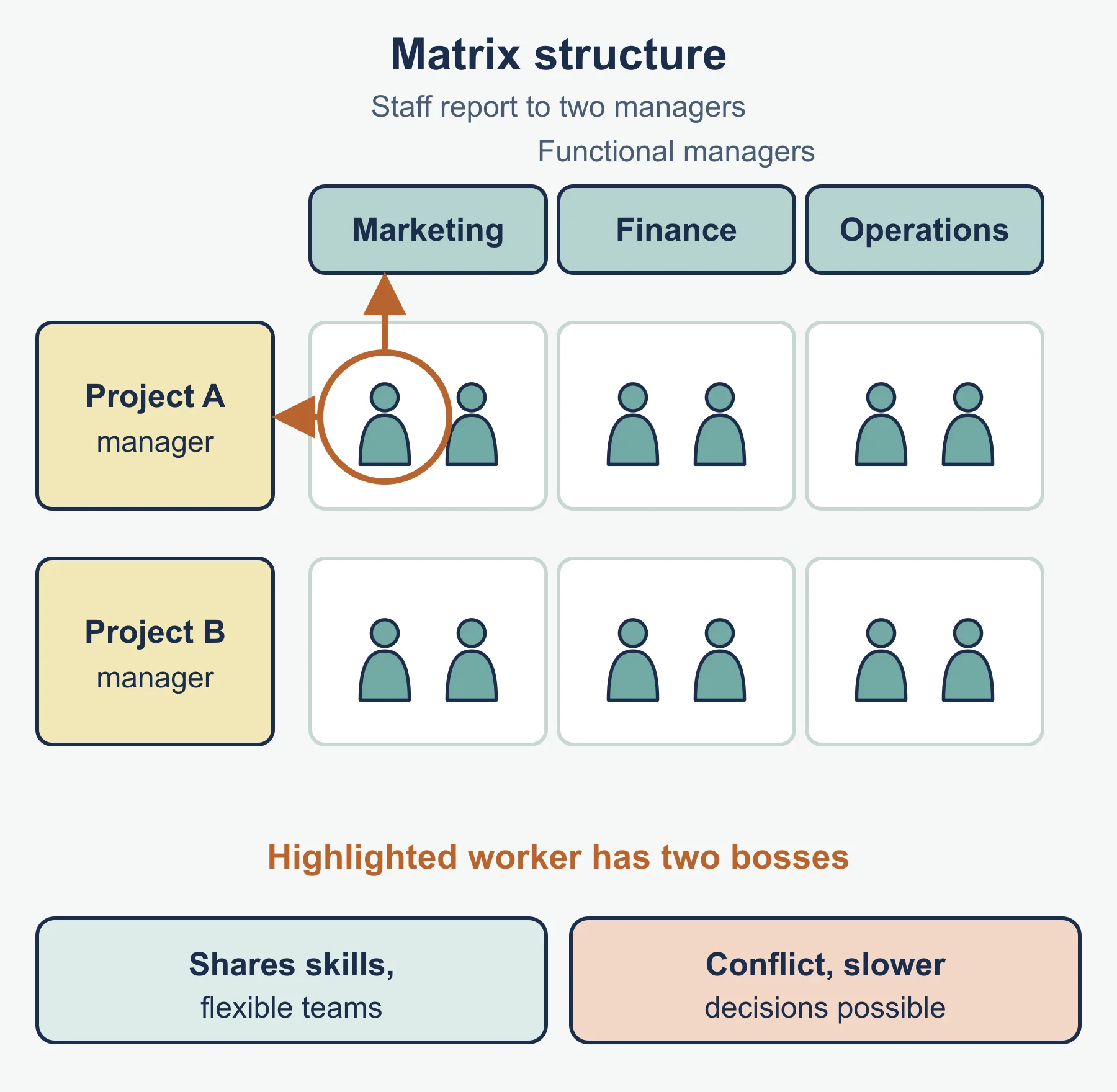
| Matrix | Skills shared across projects | Two bosses, possible conflict |
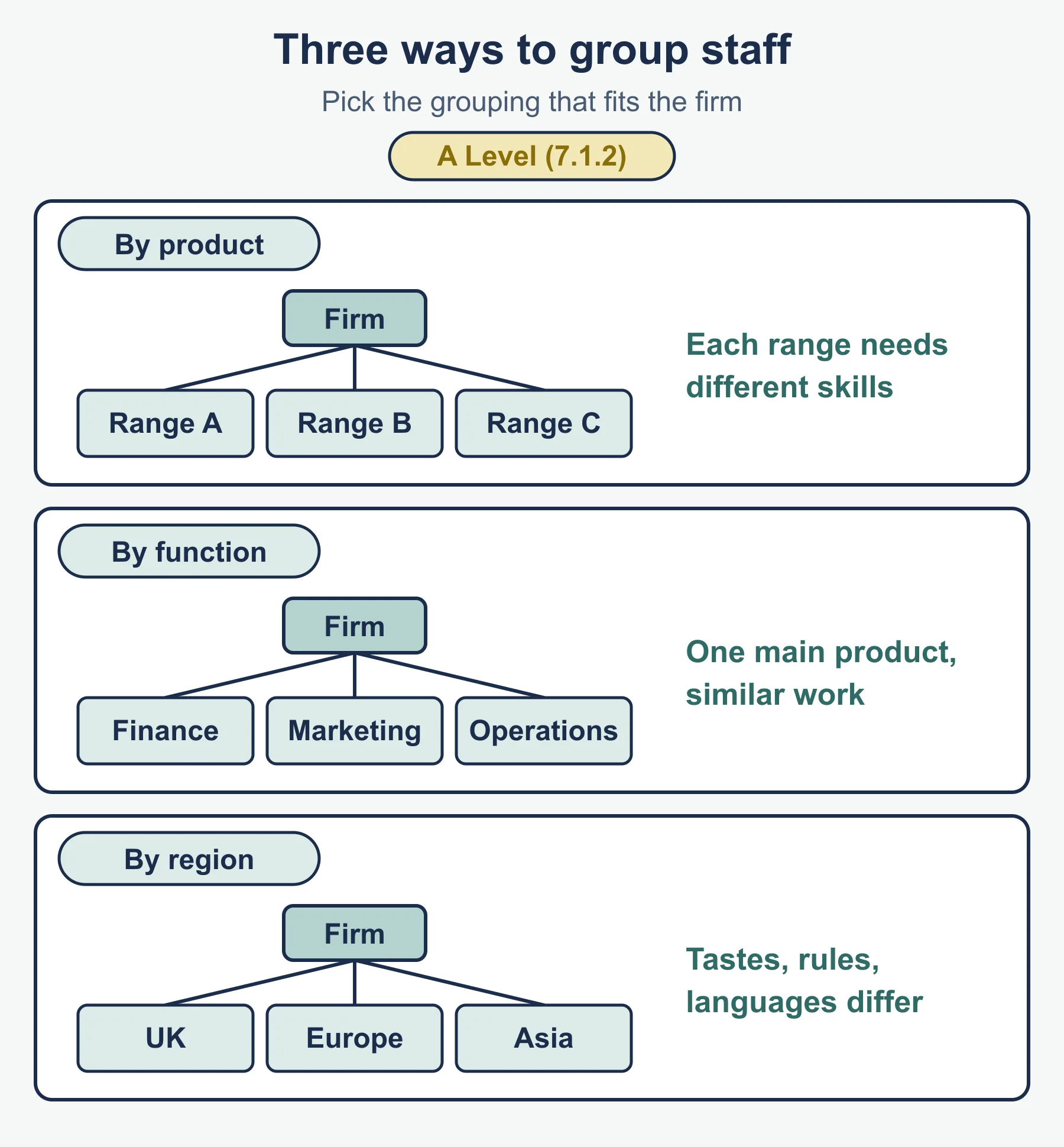
Grouping choices
- Product: separate ranges needing different skills and markets.
- Function: similar work, one main product, specialist efficiency.
- Geographical area: regions or countries with different customers, rules or languages.
Why structures change
- Growth: more staff and sites outgrow the old design.
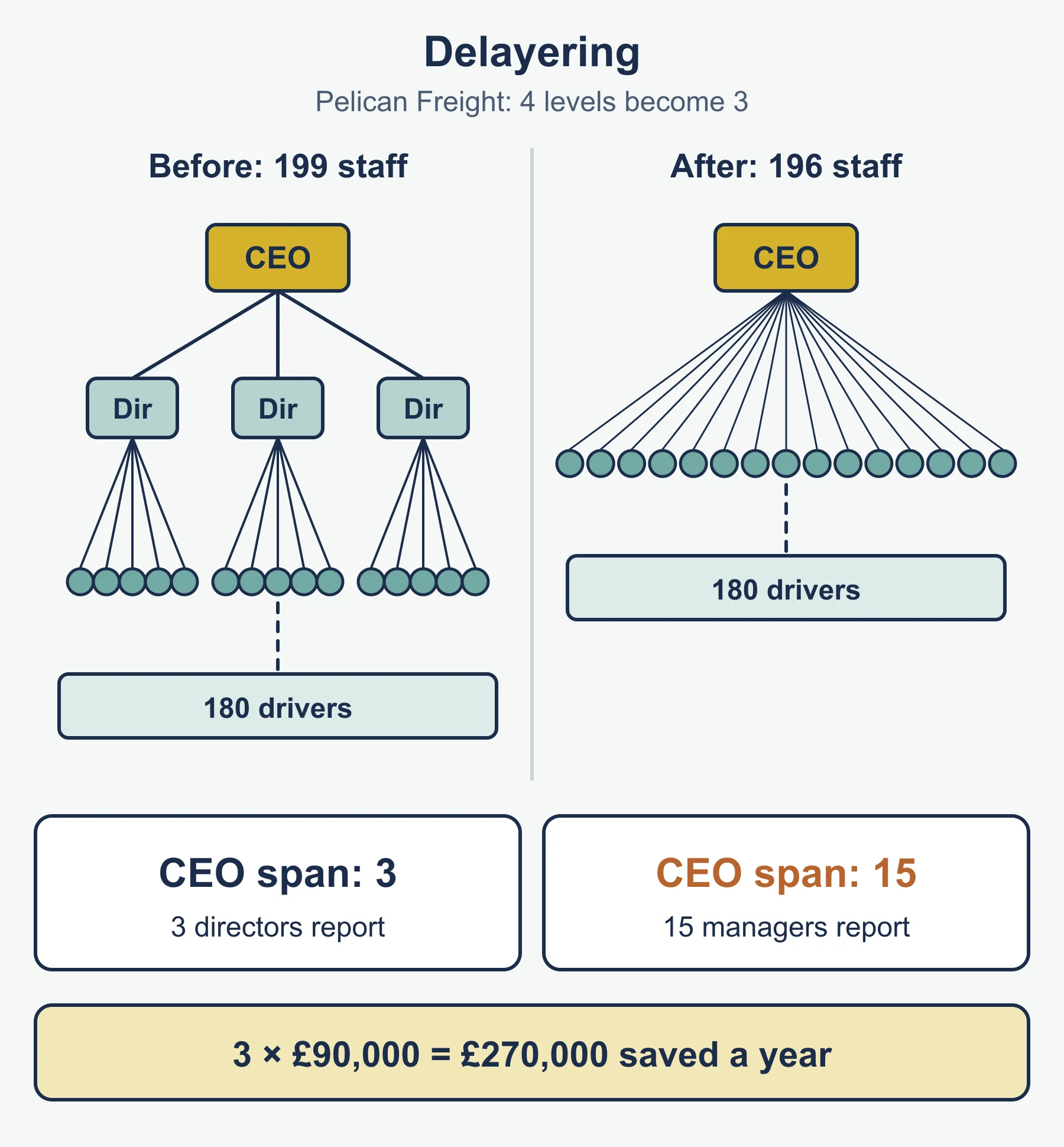
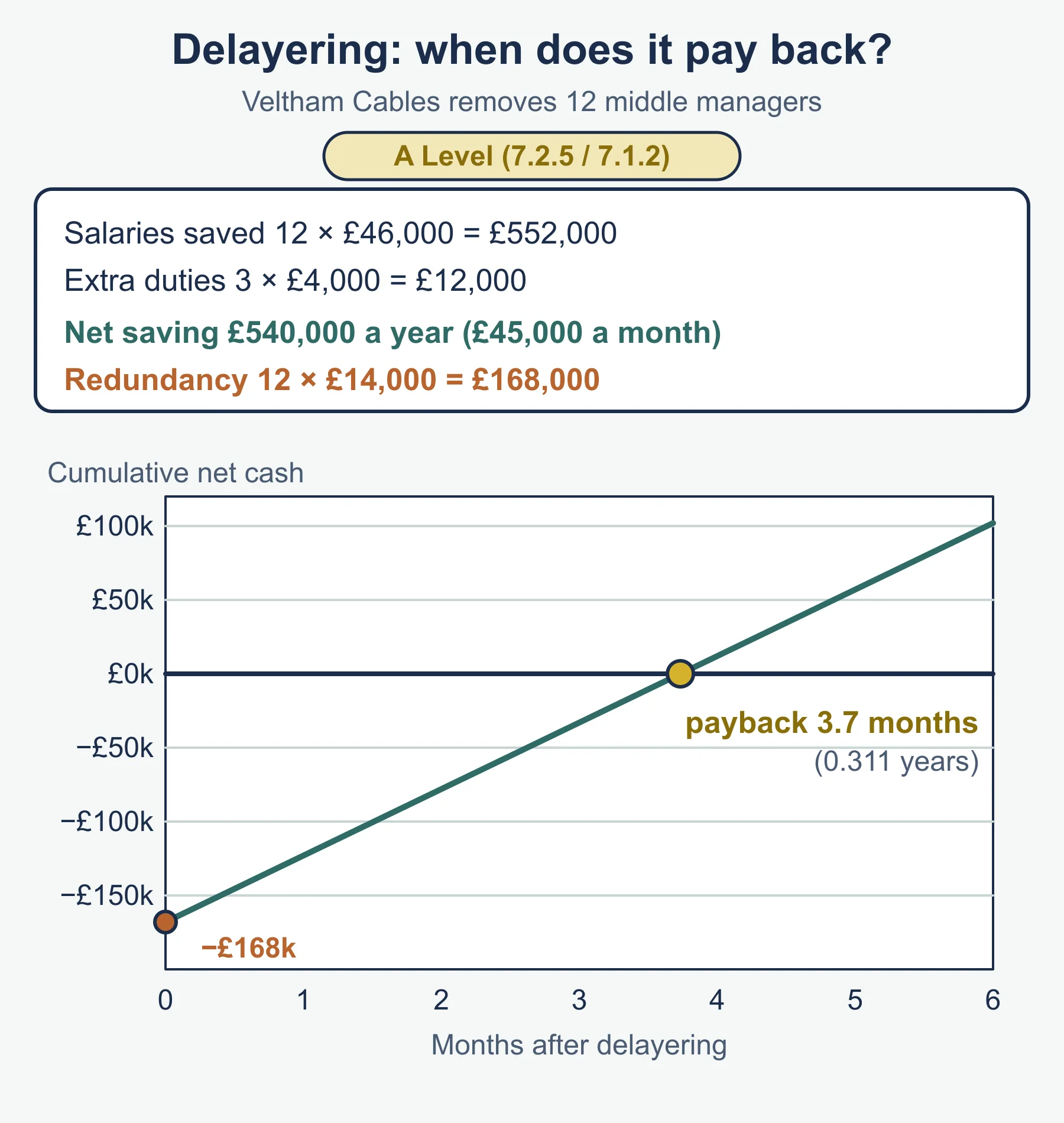
- Delayering: removing management layers to cut cost and speed decisions.
- Also: new strategy, technology, mergers.
Method in steps: span and levels
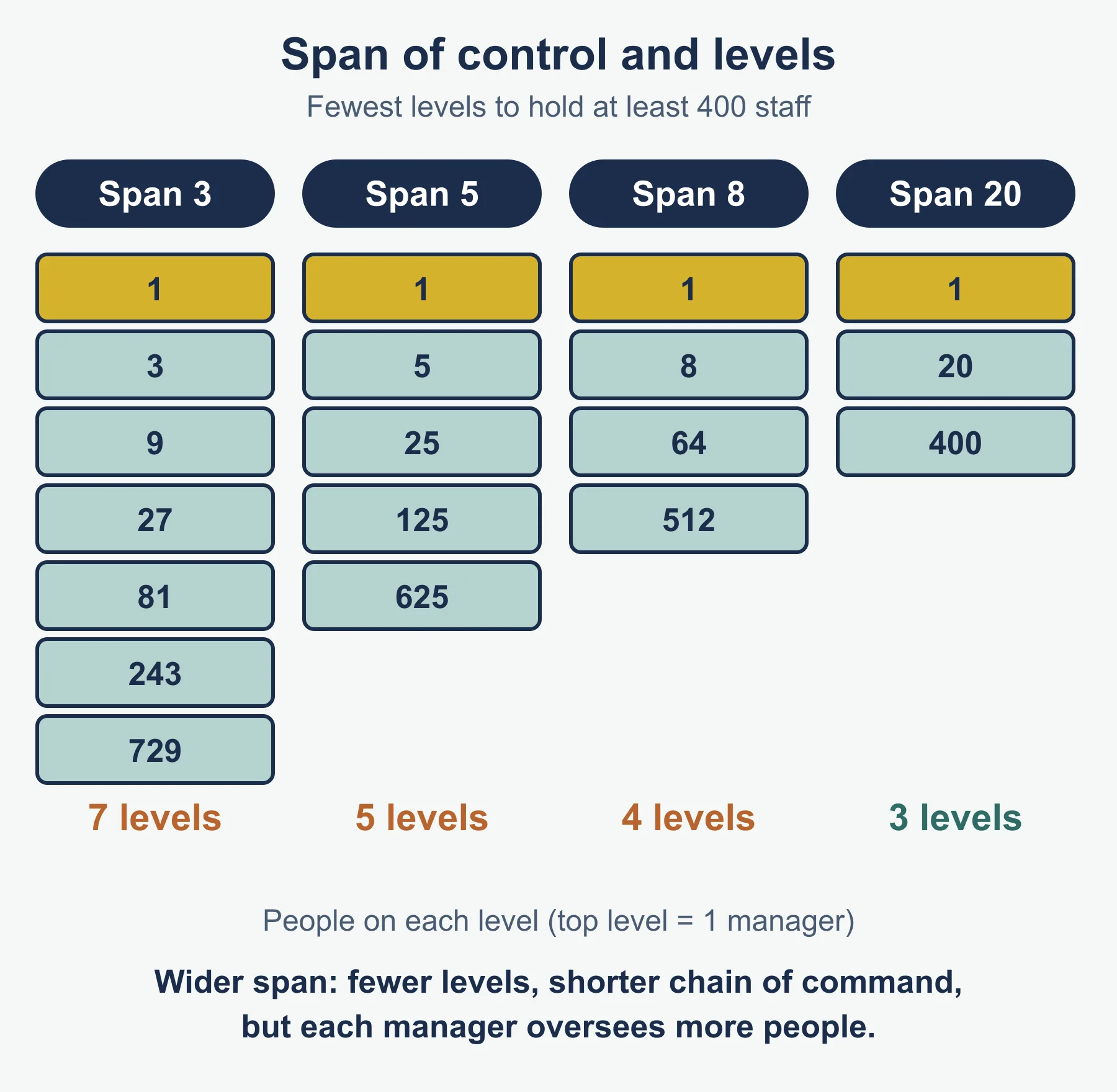
- Write the people on each level: 1, then the span, then span squared, and so on.
- Add the levels until the total reaches the workforce.
- Count the levels. A wider span means fewer levels.
Reminder: with a span of 4, the first four levels hold 1, 4, 16 and 64 people, a total of 85. With a top post whose span is 6, and six managers each with a span of 8, the three levels hold 1, 6 and 48 people, a total of 55.
Method in steps: delayering evaluation
- Annual saving = salaries of removed posts less extra pay for staff given extra duties.
- One-off cost = redundancy and retraining.
- Payback = one-off cost divided by annual net saving.
- Weigh the figures against wider spans, lost experience, morale and communication.
7.1.3 Delegation and accountability
- Authority can be delegated; ultimate accountability stays with the delegator.
- Accountability processes: reporting lines, targets and indicators, appraisal, reports, meetings, audits, rewards and sanctions.
- Positive impact: frees managers, develops and motivates staff, faster local decisions.
- Negative impact: errors, inconsistency, training cost, loss of control.
7.1.4 Control, authority and trust
| Distinction | Recall |
|---|---|
| Span versus levels | For a given workforce, wider span means fewer levels |
| Authority versus responsibility | Power to decide versus duty to do |
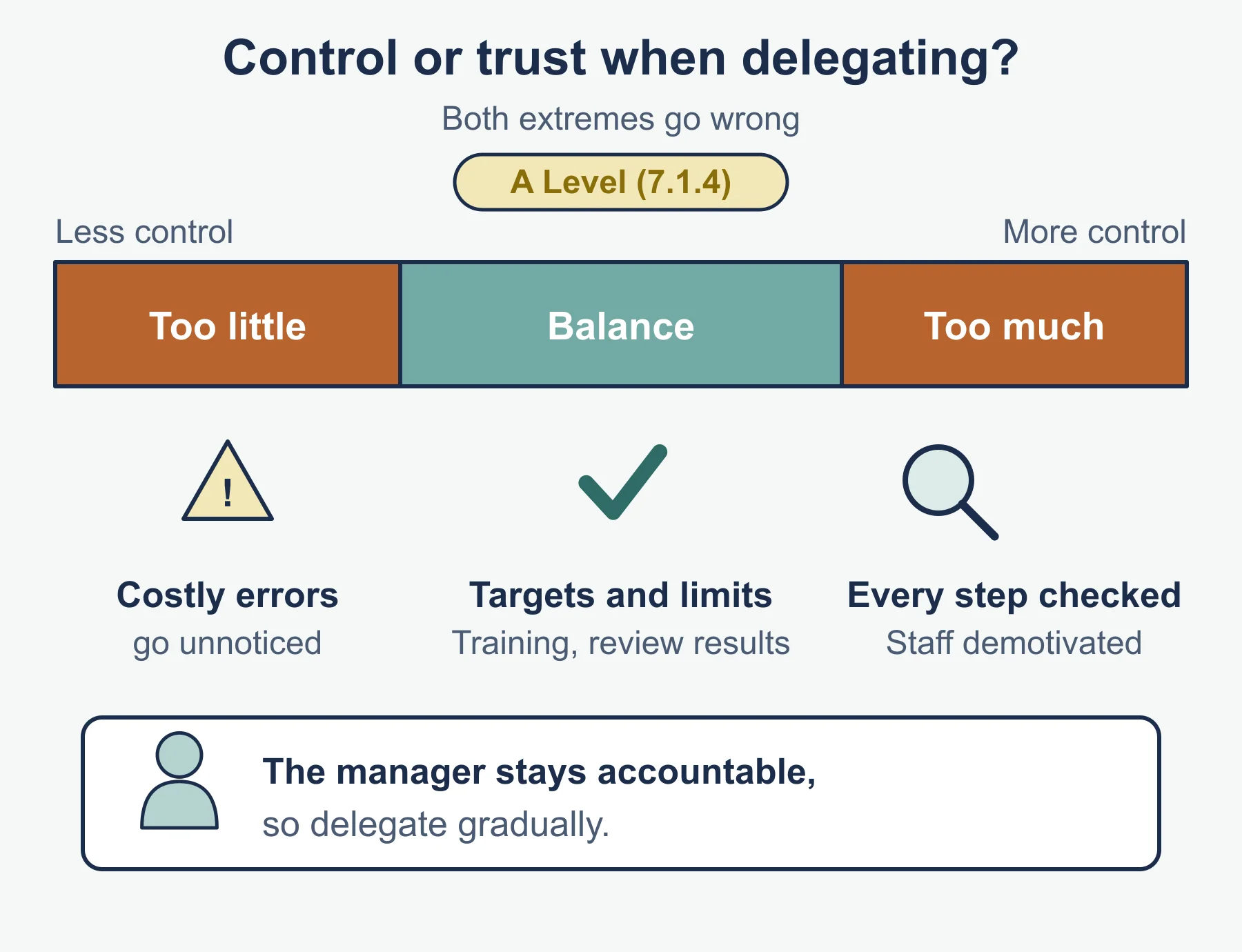
| Control versus trust | Checking everything wastes delegation; checking nothing risks error |
Resolve the conflict by clear targets and limits, training, gradual delegation and review of results.
7.1.5 Centralisation and decentralisation
| Centralised | Decentralised | |
|---|---|---|
| Plus | Consistency, control, scale economies | Speed, local knowledge, motivation |
| Minus | Slow, overloaded top, ignores local needs | Inconsistency, duplication, weaker control |
Typical judgement: it depends on how different local markets are, how skilled local managers are and the cost of a mistake.
7.1.6 Line and staff
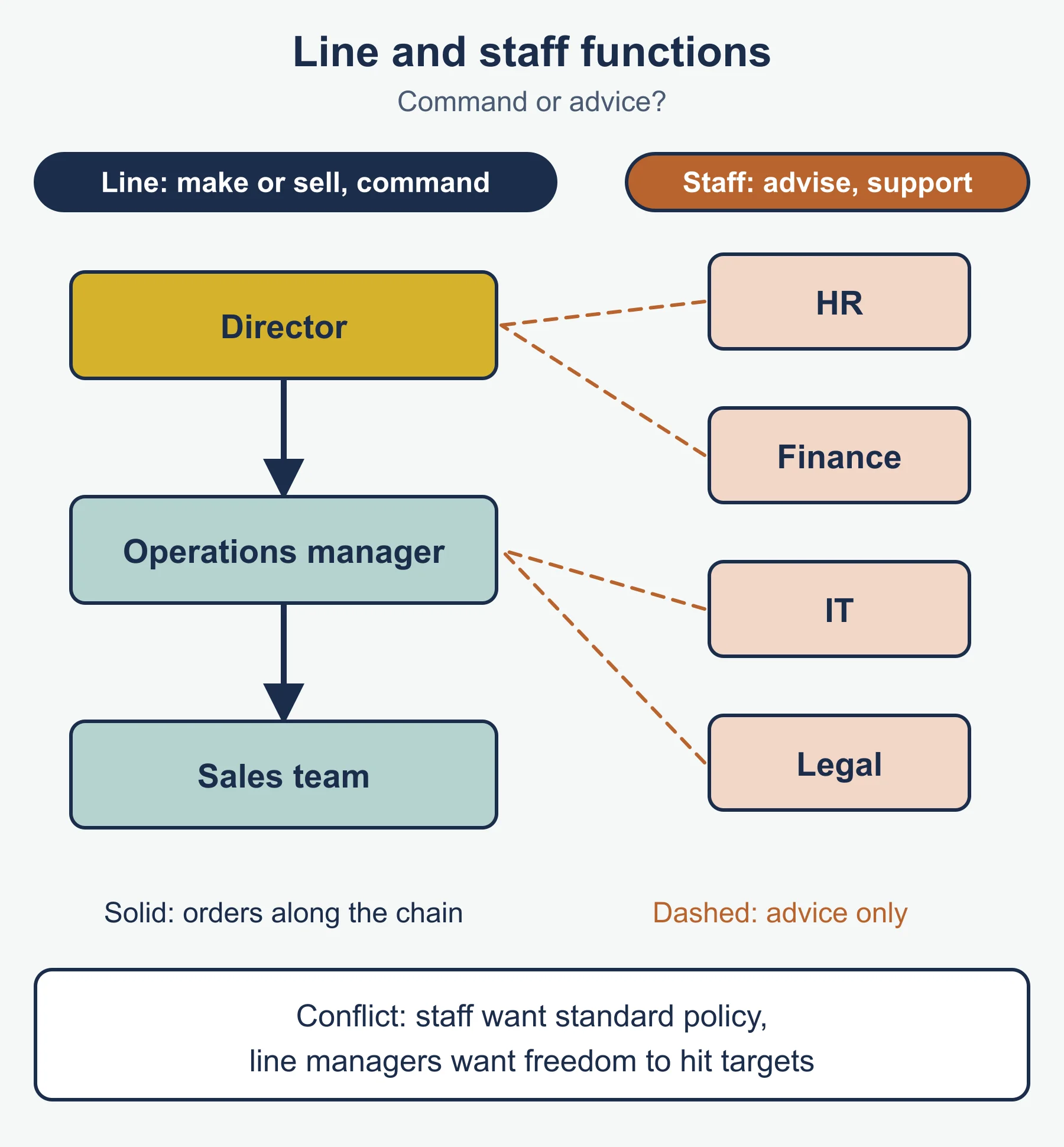
- Line: directly produces or sells (operations, sales); has authority in the chain of command.
- Staff: supports and advises (human resources, finance, IT, legal).
- Conflicts: standard policy versus freedom to hit targets; advice from people without operational experience; competition for budgets; resentment of delays.
7.2.1 and 7.2.2 Purposes and methods
Essential when: giving instructions, sharing targets, motivating, consulting, coordinating, dealing with customers and suppliers, crises, and change.
| Method | Strength | Weakness |
|---|---|---|
| Spoken | Immediate feedback | No record |
| Written | Permanent record | Slow, no instant feedback |
| Electronic | Fast, wide reach | Overload, impersonal |
| Visual | Quick for data | Can oversimplify |
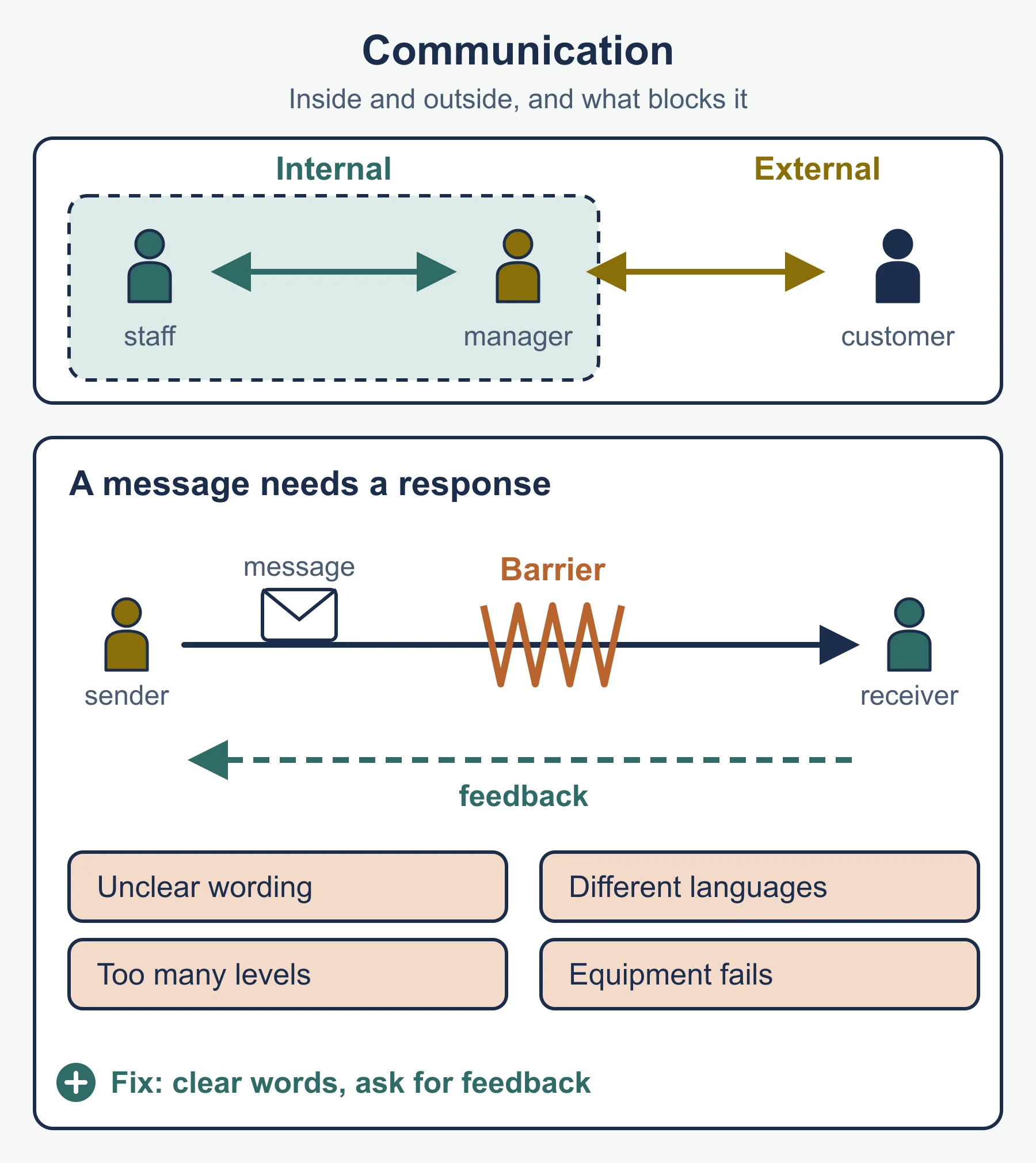
7.2.3 Channels
| Pair | Meaning |
|---|---|
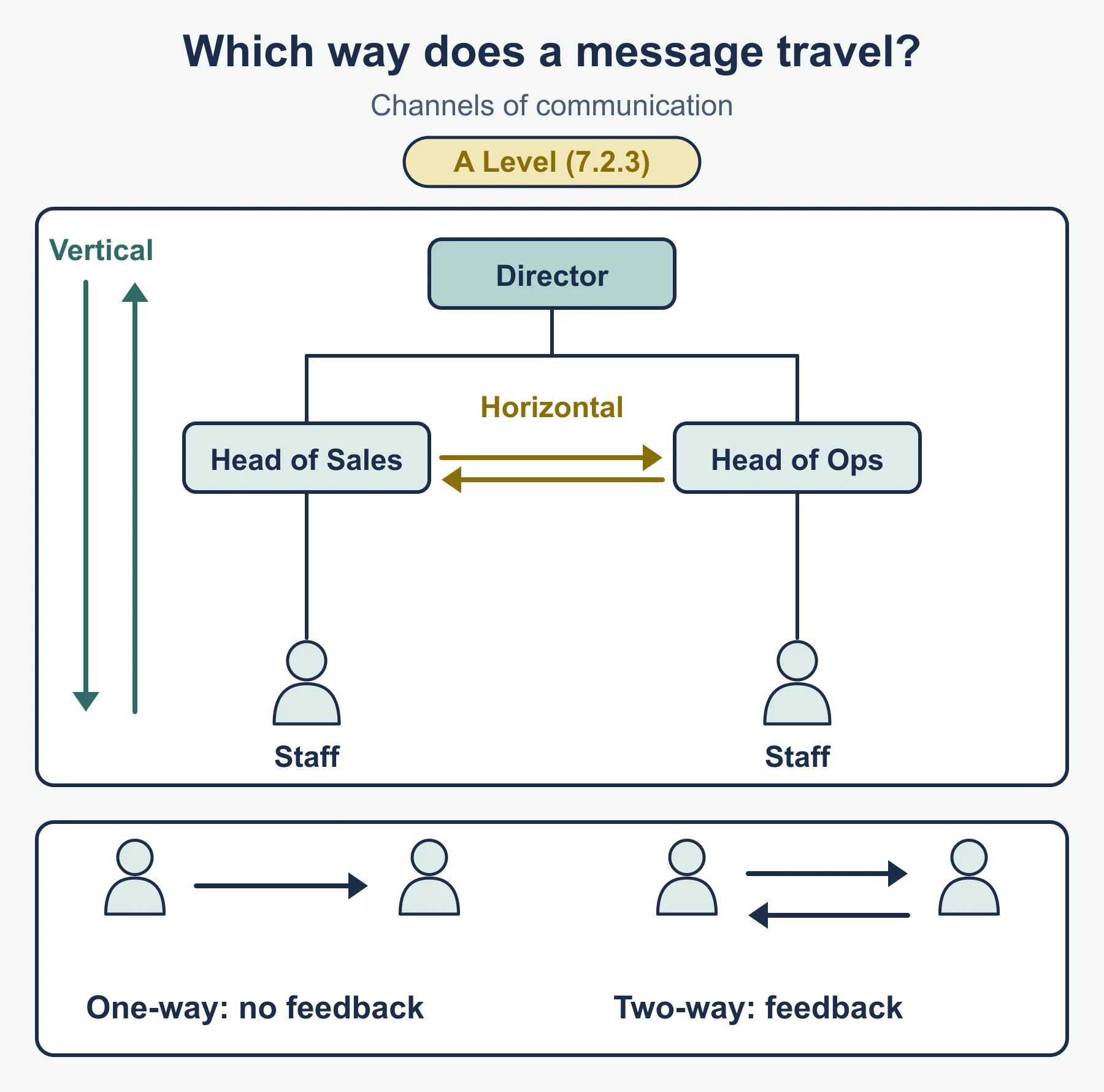
| One-way | Sender to receiver, no feedback |
| Two-way | Feedback and response |
| Vertical | Up and down the hierarchy |
| Horizontal | Between people at the same level |
Problems: delay and distortion through many levels; no check of understanding in one-way messages; missing horizontal links; overload.
7.2.4 and 7.2.5 Barriers and management’s role
| Barrier | Remedy |
|---|---|
| Jargon | Plain language |
| Wrong method | Match method to message |
| Overload | Prioritise and summarise |
| Distance | Scheduled video calls |
| Mistrust | Honest, regular updates |
| Many levels | Delayering, direct briefings |
- Informal communication: speeds information and shows concerns, but spreads rumour.
- Efficiency link: fewer errors, quicker decisions, better coordination, higher motivation.
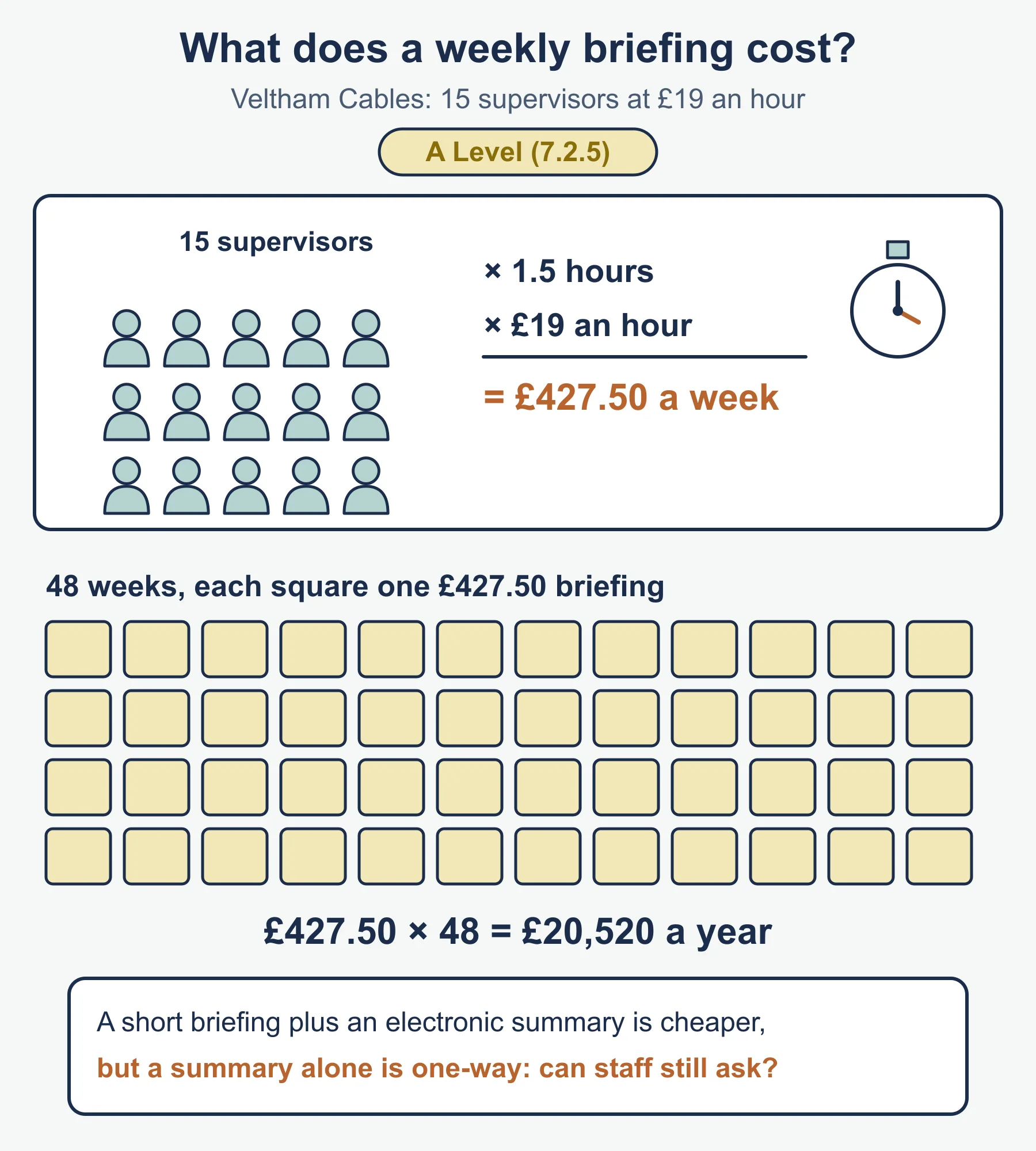
- Improvements: two-way channels, team briefings with checks on understanding, training, acting on feedback.
Must-know distinctions
- Delegation versus decentralisation: delegation passes a task and its authority to one subordinate; decentralisation spreads decision-making across the whole organisation as a policy.
- Authority versus responsibility: a team leader told to cut waste (responsibility) but not allowed to change suppliers (no authority) is set up to fail.
- Staff function versus line function: a payroll team advises and supports; a production manager has authority over the shop floor.
- Formal versus informal communication: a team briefing follows the chain of command; a chat at the coffee machine does not.
- One-way versus two-way: a memo is one-way; a team meeting with questions is two-way.
Using the command words
Cambridge lists command words including Define, Identify, Explain, Calculate, Analyse, Assess, Evaluate, Justify and Advise. Match your answer to the word.
| Command word | What to write for this topic |
|---|---|
| Define | A precise meaning of a term such as span of control |
| Identify | Name the feature, barrier or method, with no explanation needed |
| Explain | A reason or relationship, linked to the case |
| Calculate | Working with the figures given, then the answer |
| Analyse | A developed chain of cause and effect, for example wider span to less supervision to errors |
| Assess, Evaluate, Justify | Both sides, applied to the case, ending in a reasoned judgement |
| Advise | A suggested course of action with reasons |
Evaluation prompts
Use these to turn description into judgement.
- Size and growth: is the business small enough for one decision-maker, or large enough to need layers?
- Skills: do local managers have the skill to take the decisions delegated to them?
- Cost of mistakes: where errors are costly, tighter control may be justified.
- Time frame: delayering may cut costs quickly, while the effect on morale and communication may take longer to show.
- Context: the best structure or method depends on the business, the message and the people involved.
Quick self-test
- Define span of control.
- State what happens to the number of levels if the span is widened.
- Give one disadvantage of a matrix structure.
- Calculate the people in a hierarchy of four levels where every manager has a span of 3, including the top post.
- Does a manager who delegates a task stay accountable for it?
- Give one reason a business might use a geographical structure.
- Name one conflict between line and staff functions.
- Give one weakness of written communication.
- Distinguish vertical from horizontal communication.
- Give one benefit and one risk of informal communication.
Answers
- The number of subordinates reporting directly to one manager.
- The number of levels falls.
- Staff answer to two managers, which can cause conflict or confusion.
- 1 + 3 + 9 + 27 = 40 people.
- Yes; authority is passed down but accountability stays with the delegator.
- Customers, rules or languages differ by region, so local managers need to respond.
- Staff specialists want standard policy; line managers want freedom to meet targets.
- It is slow and gives no instant feedback.
- Vertical runs up and down the hierarchy; horizontal runs between people at the same level.
- Benefit: quick information. Risk: rumour spreading.
Where marks are usually lost
- Describing a type of structure without applying it to the business in the case.
- Treating accountability as something that transfers fully to the subordinate.
- Confusing authority with responsibility.
- Writing that flat structures are always best, with no judgement about context.
- Listing barriers to communication without any remedy.
- Giving advantages and disadvantages of a method but never choosing one for the situation.
- Calculating a delayering saving and not weighing it against non-financial effects.
- Ignoring the difference between formal and informal channels.
Frequently asked questions
Does a manager stay accountable after delegating a task? Yes. Authority for the task can be passed down, but ultimate accountability stays with the manager who delegated it.
What is the difference between delegation and decentralisation? Delegation passes a task and its authority to one subordinate. Decentralisation moves decision-making lower down the whole organisation.
What is the difference between line and staff functions? Line functions directly produce or sell, such as operations and sales, and have authority in the chain of command. Staff functions support and advise, such as human resources, finance, IT and legal.
What is a matrix structure? In a matrix structure, staff report to both a functional manager and a project or product manager. It shares skills across projects, but having two bosses can cause conflict or confusion.
Official syllabus
Cambridge International AS & A Level Business 9609 syllabus for examination in 2026, 2027 and 2028, published by Cambridge International: sections 7.1 and 7.2.
Get free revision emails (optional)
Occasional emails with practice questions, worked explanations and links to free resources for the qualification and subjects you choose. No spam, and you can unsubscribe from any email. The free tools on this site never need an email.
Related resources
-
Practice questions
A Level Business: Human Resource Management (A Level) — Practice Questions (Cambridge 9609)
Worked practice questions on flexible contracts, core and peripheral workers, hard and soft HRM, MBO and matrix structures for Cambridge A Level Business 9609.
Business · Cambridge · A Level
Try questions -
Practice questions
A Level Business: Human Resource Management — Practice Questions (Cambridge 9609)
Practice questions with worked answers on recruitment, motivation and management for Topic 2 Human resource management in Cambridge AS & A Level Business 9609.
Business · Cambridge · AS Level
Try questions -
Revision notes
A Level Business: Human Resource Management — Revision Notes (Cambridge 9609)
Condensed revision notes on recruitment, motivation and management for Cambridge AS & A Level Business Topic 2 Human resource management (9609).
Business · Cambridge · AS Level
Revise topic
Related articles
-
teaching
A Level tuition in Dubai: Cambridge or Pearson Edexcel International A Level?
Schools in Dubai and Abu Dhabi teach either Cambridge International AS & A Level or Pearson Edexcel International A Level. How the two are structured, why it matters for tuition, and how online classes from Lahore work.
9 October 2026
-
curriculum guides
Choosing subjects at IGCSE and A Level
How subject choices at 14 and 16 affect university options later, and how to keep pathways open without overloading a timetable.
28 July 2026
Studying this with a teacher
Working through Business A LEVEL?
This page is free and stays free. If you would rather be taught it, Marlbridge runs Business classes one-to-one and in small groups of up to 15, online in your own time zone. The first trial class is free. WhatsApp replies within an hour (8am–11pm Pakistan time, every day); email the same day.
Cambridge Business teachers at Marlbridge

