
Study Guides
A Level Business: Leadership and Human resource management (HRM) strategy (Cambridge 9609)
Study guide to sections 7.3 Leadership and 7.4 HRM strategy of Cambridge A Level Business 9609: leadership theories, EQ, flexible contracts, MBO and AI.
- Subject
- Business
- Level
- A LEVEL
- Topic
- Human resource management
- Author
- Marlbridge Academic Team
- Updated
- Reviewed by
- Salman Ahmad (what this means)
Aligned to Cambridge A Level Business (9609), For examination in 2026, 2027 and 2028. Official specification .
Syllabus page (what it covers and how it is assessed): Cambridge A Level Business.
Syllabus points this page covers
9609 (A Level)
- 7.3 Leadership
- 7.4 Human resource management (HRM) strategy
Found an error? Report a correction.
Need help with this topic? Request a free trial class for A Level Business (9609).
This guide teaches sections 7.3 Leadership and 7.4 Human resource management (HRM) strategy of the Cambridge International AS & A Level Business 9609 syllabus for examination in 2026, 2027 and 2028. Topic 7 is an A Level topic. The syllabus says that Paper 3 and Paper 4 are based on A Level content (topics 6.1 to 10.4), with AS content assumed, so these sections are examined through case studies.
Use it with the revision notes and the practice questions. Earlier work you will draw on: section 2.1 HRM, motivation and management and the Topic 7 practice questions. Course links: the Cambridge A Level Business hub, the printable checklist and the free diagnostics.
All businesses are invented. Money is in dollars.
What 7.3 and 7.4 cover
| Part | Content |
|---|---|
| 7.3.1 Leadership | Purpose; roles (directors, managers, supervisors, worker representatives); qualities of a good leader |
| 7.3.2 Theories | Trait, behavioural, contingency, power and influence, transformational |
| 7.3.3 Emotional intelligence (EQ) | Goleman’s four competencies |
| 7.4.1 Approaches to HRM | Hard and soft HRM; flexible contracts; poor performance; improving performance; MBO; IT and AI |
7.3.1 Leadership
Purpose of leadership. Leadership sets a direction and persuades people to follow it. It turns objectives into a vision people understand, motivates staff, makes decisions and guides the business through change.
Leadership roles. Different people lead at different levels.
| Role | What it does |
|---|---|
| Directors | Set the strategy and objectives, appoint senior managers and answer to the owners |
| Managers | Turn strategy into plans, organise resources and lead departments |
| Supervisors | Direct day-to-day work, solve problems on the spot and pass information up and down |
| Worker representatives | Speak for employees, put their views to management and take part in consultation |
A worker representative usually has influence rather than authority over decisions, but can shape colleagues’ opinion.
Qualities of a good leader. Typical qualities are vision, clear communication, decisiveness, integrity, empathy, willingness to delegate, adaptability and the confidence to take responsibility. No list suits every business. A start-up facing uncertainty may need decisiveness and adaptability most. A hospital team may need empathy and integrity most. Choose the qualities the case makes important and link them to a result such as motivation or lower turnover.
7.3.2 Theories of leadership
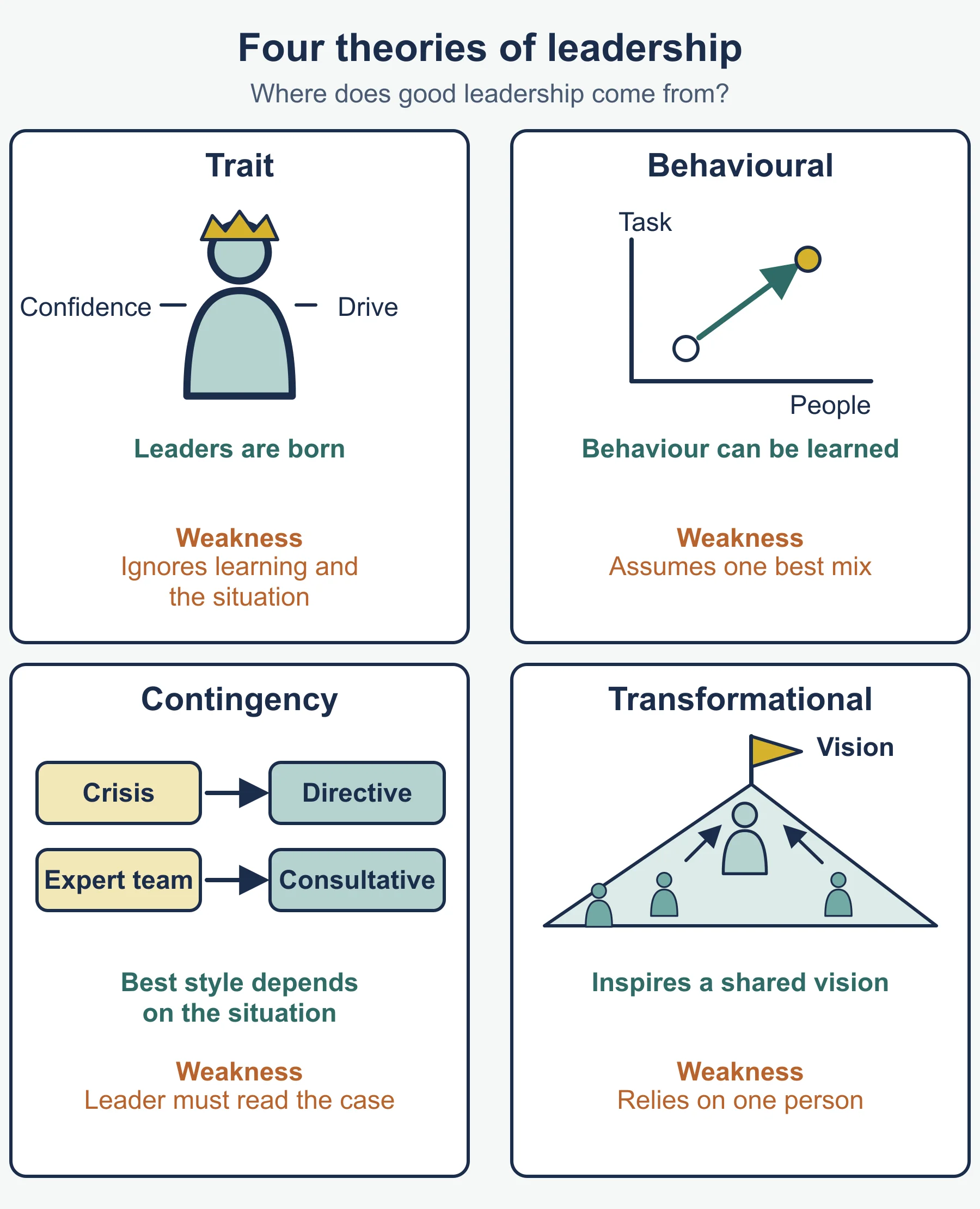
The syllabus names five types of theory. Where it does not give the detail, the descriptions below are the standard forms.
Trait theory. Good leaders have certain personal characteristics, such as confidence or drive, so leaders are born. Strength: it lists qualities to look for when appointing. Weakness: no single set of traits works everywhere, and it ignores learning and the situation.
Behavioural theory. What leaders do matters, not what they are. Behaviour can be learned, so leaders can be trained. A common split is between task-focused behaviour (targets, deadlines) and people-focused behaviour (support, welfare). Weakness: it assumes one best behaviour, but the best mix changes with the people and the problem.
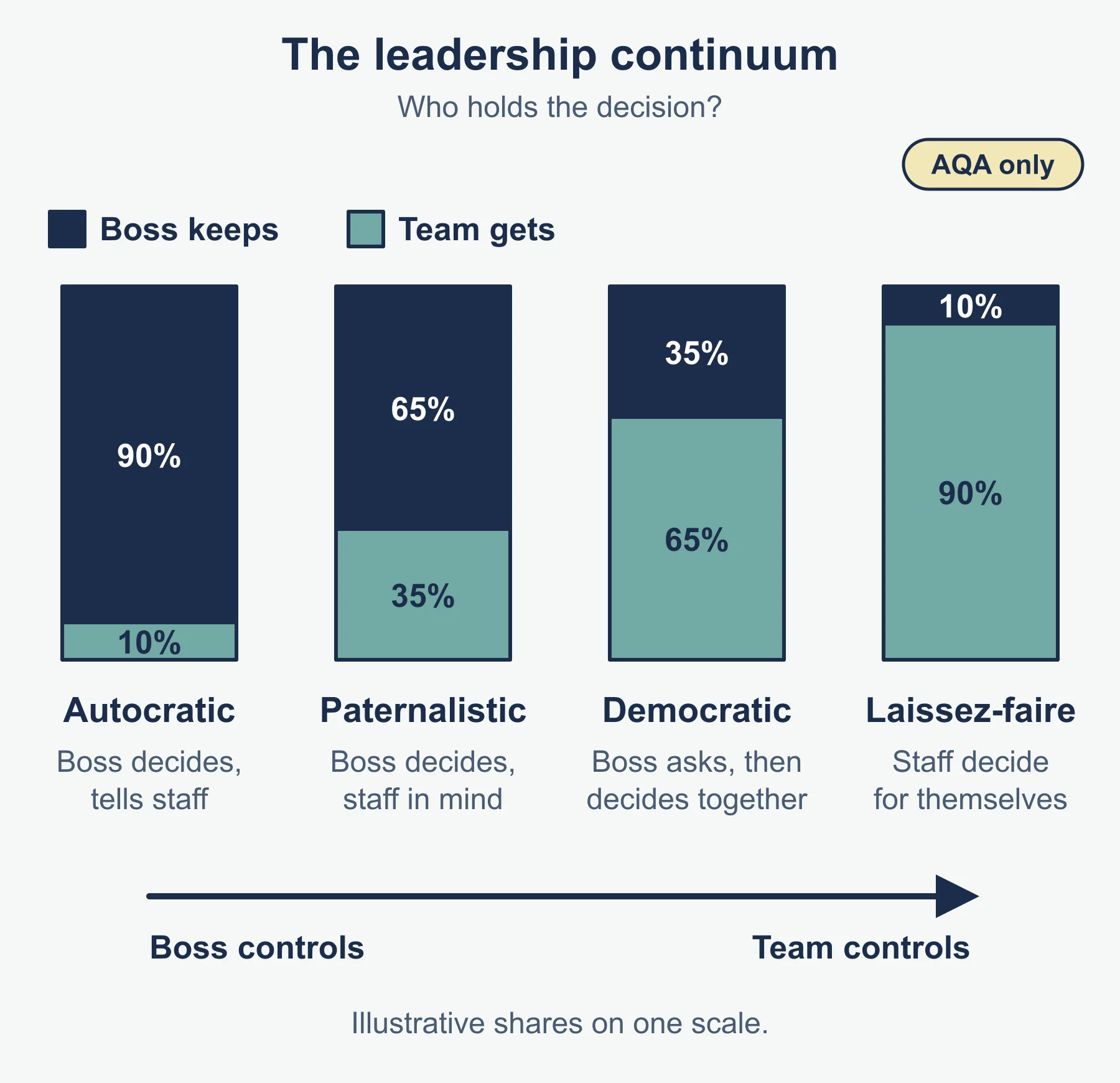
Contingency theory. There is no one best style. The best leadership depends on the situation: the task, the skills and attitude of the team, the time available and the leader’s own strengths. A leader may need to be directive in a crisis and consultative with experts. This links to the management styles in motivation and management.
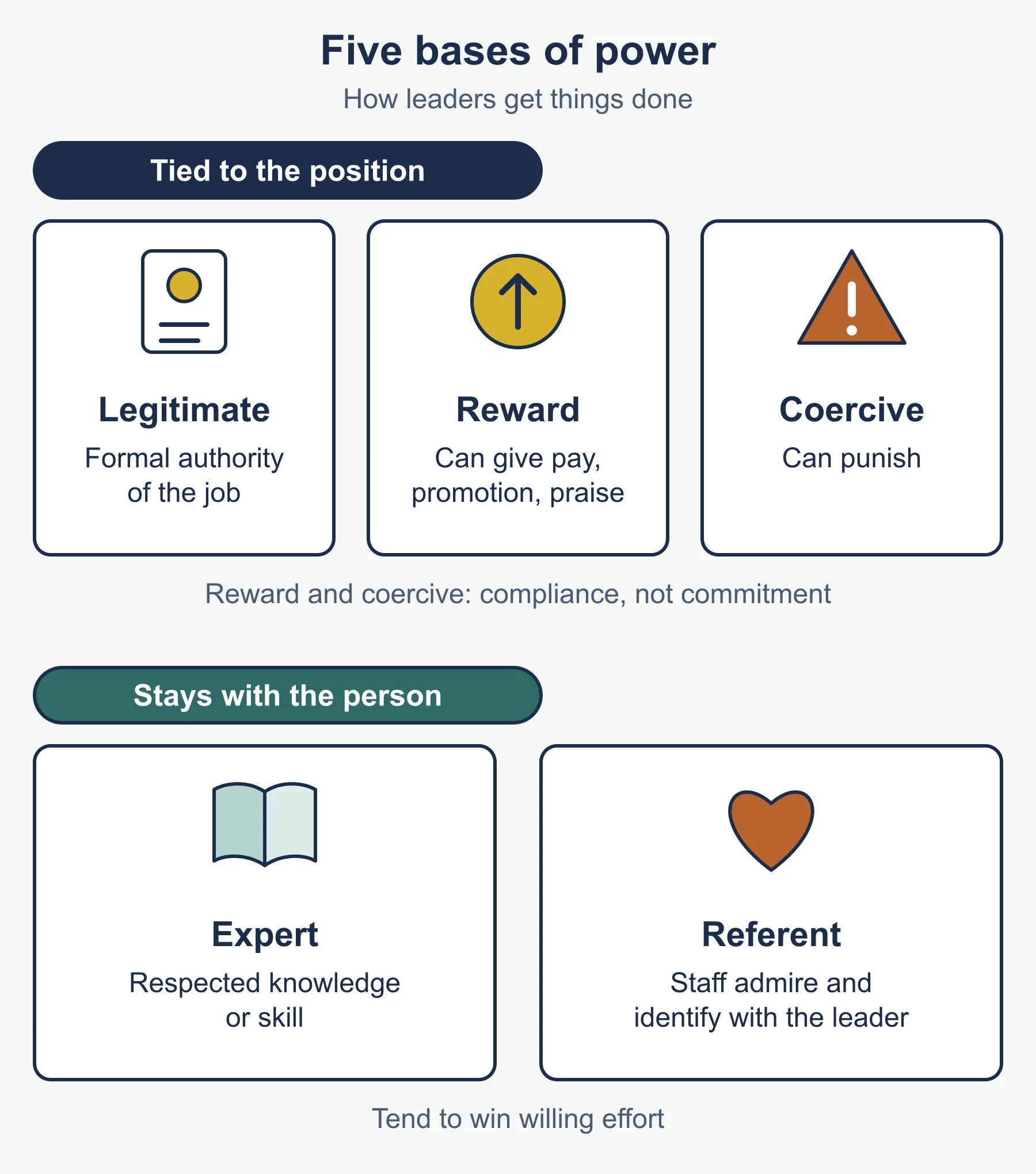
Power and influence. Leaders get things done through the power they hold. A standard classification gives five bases:
- Legitimate: the formal authority of the position.
- Reward: the ability to give pay, promotion or praise.
- Coercive: the ability to punish.
- Expert: respected knowledge or skill.
- Referent: staff admire and identify with the leader.
Reward and coercive power can produce compliance but not commitment. Expert and referent power tend to win willing effort, and they stay with the person rather than the job title.
Transformational leadership. The leader inspires followers to move beyond self-interest to achieve a shared vision, through charisma, communicating a compelling purpose, challenging staff to think differently and showing interest in each person’s development. It is often set against transactional leadership, which relies on rewards and penalties for meeting set targets. Strength: it suits change and builds commitment. Weakness: it depends on one inspiring person, may be draining for staff, and a vision can be wrong.
Which theory when? Match the case. A crisis points to contingency (a directive approach for now). A business needing big change points to transformational. A question on why a manager is obeyed but not respected points to power and influence.
7.3.3 Emotional intelligence (EQ)
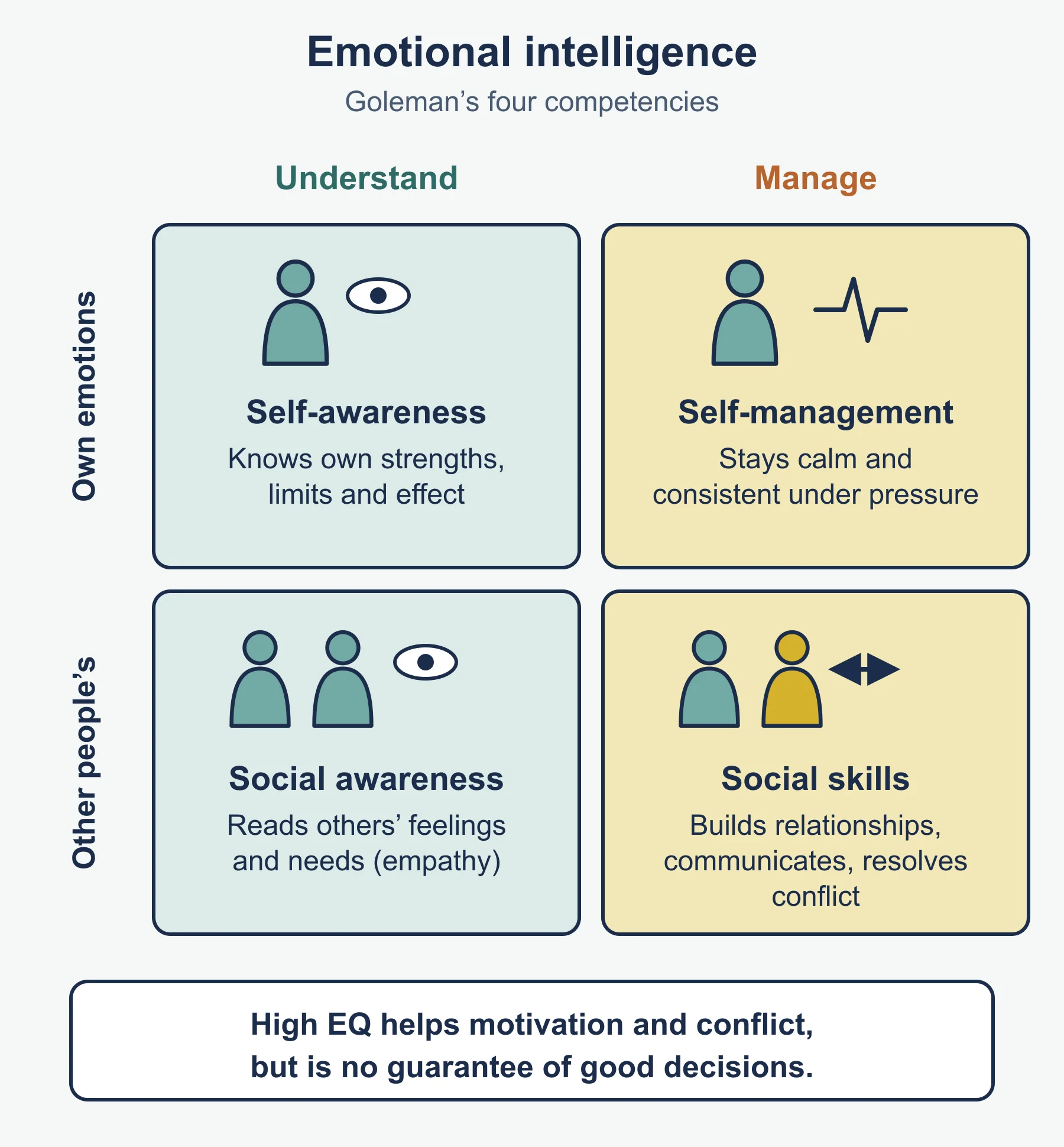
Emotional intelligence is the ability to understand and manage your own emotions and those of other people. The syllabus gives Goleman’s four competencies:
| Competency | Meaning for a leader |
|---|---|
| Self-awareness | Knows own strengths, limits and effect on others |
| Self-management | Controls impulses and stays calm and consistent under pressure |
| Social awareness | Reads others’ feelings and needs, including empathy |
| Social skills | Builds relationships, communicates, resolves conflict and influences people |
A leader high in EQ is likely to motivate staff and handle conflict well, which can lower absenteeism and labour turnover. A high-EQ leader can still make poor strategic decisions, so EQ is one factor, not a guarantee.
7.4.1 Approaches to HRM
Hard and soft HRM
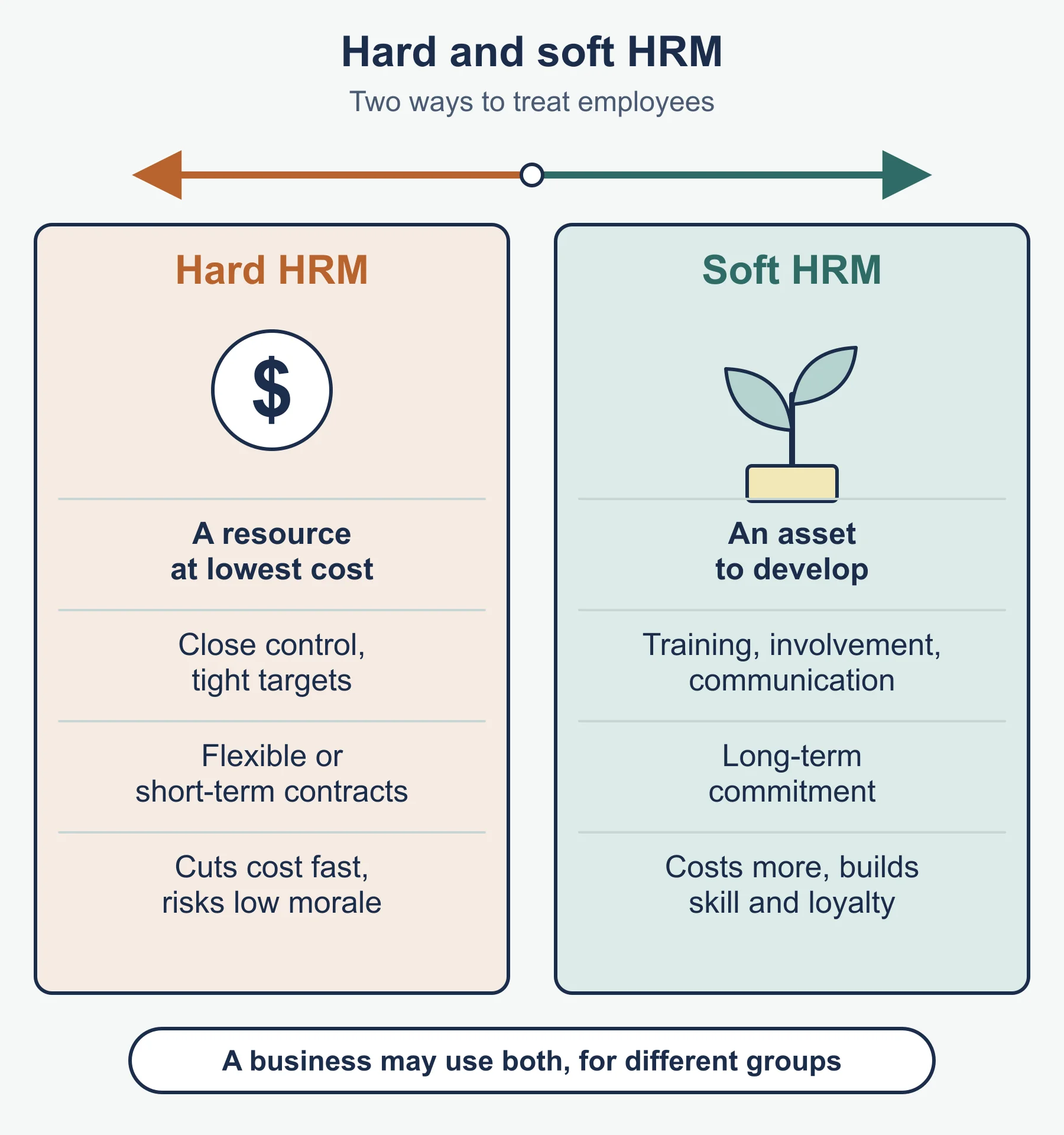
Hard HRM treats employees as a resource to be used at lowest cost. It uses close control, tight targets, and flexible or short-term contracts. Soft HRM treats employees as a valuable asset to be developed. It uses training, involvement, communication and long-term commitment. Hard HRM may cut costs quickly but risk low morale and high turnover. Soft HRM may cost more but build skill and loyalty. A business may use both, for different groups.
Flexible working contracts
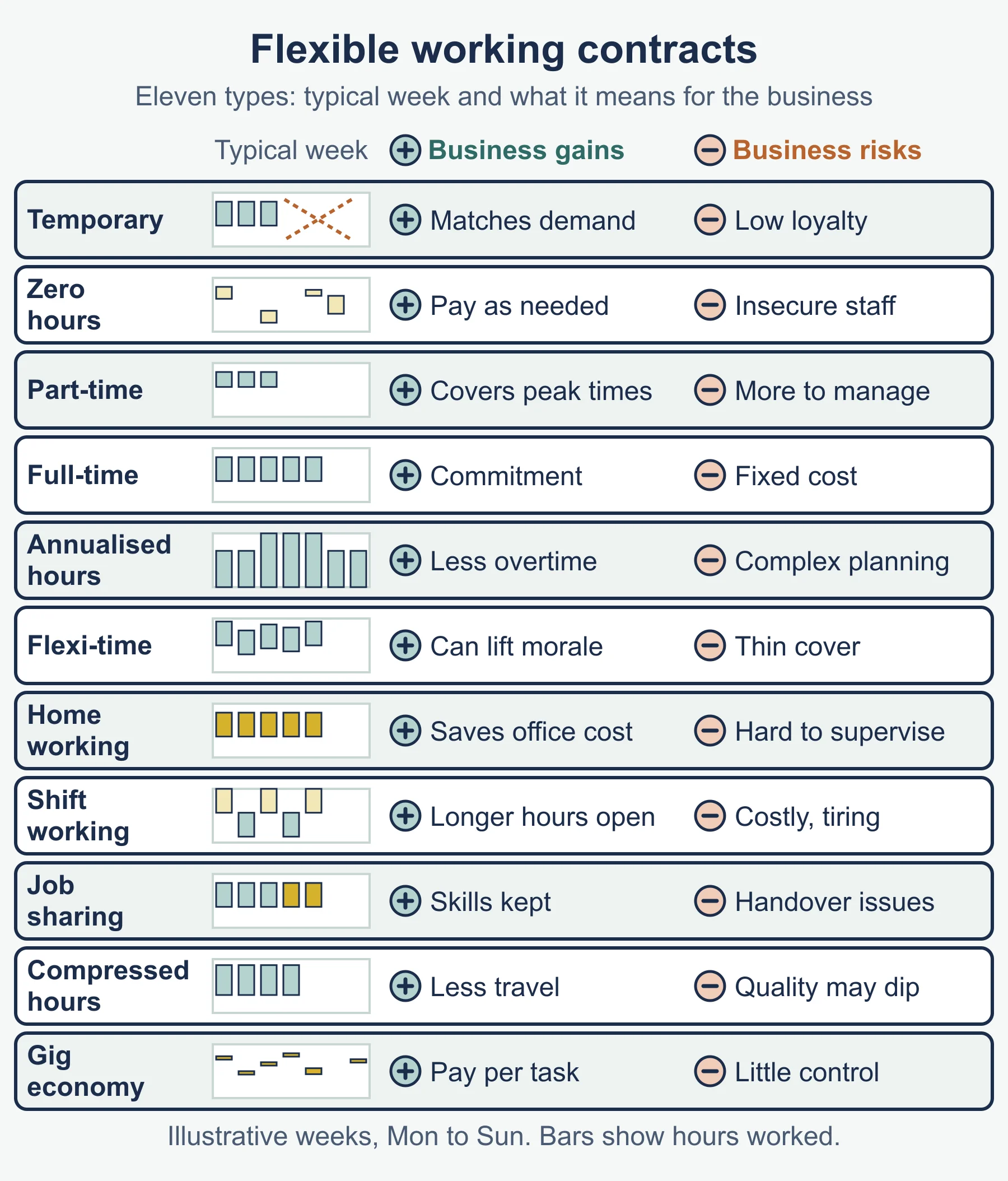
| Contract | Advantage to business | Disadvantage to business |
|---|---|---|
| Temporary | Labour matches demand; no long-term commitment | Low loyalty; repeated recruitment and training |
| Zero hours | Pay only for hours needed | Insecure staff, high turnover, poor commitment |
| Part-time | Cover peak times; flexible | More staff to manage; less continuity |
| Full-time | Continuity, commitment and skills | Fixed cost even when demand is low |
| Annualised hours | Hours set per year, spread to match demand; less overtime | Planning is complex; staff may resent unpredictable weeks |
| Flexi-time | Staff choose start and finish within limits; can raise morale | Cover may be thin; harder to arrange meetings |
| Home working | Saves office costs; wider recruitment | Harder to supervise; weaker team spirit |
| Shift working | Longer opening or production hours | Higher pay, tiredness, handover problems |
| Job sharing | Skills retained; cover for absence | Handover and communication issues |
| Compressed hours | Same hours in fewer days; less travel | Long days can reduce quality |
| Gig economy | Paid per task; no sick or holiday pay; scalable | Little control or loyalty; reputation risk |
For employees the same features cut both ways: flexibility and work-life balance against insecurity and less pay.
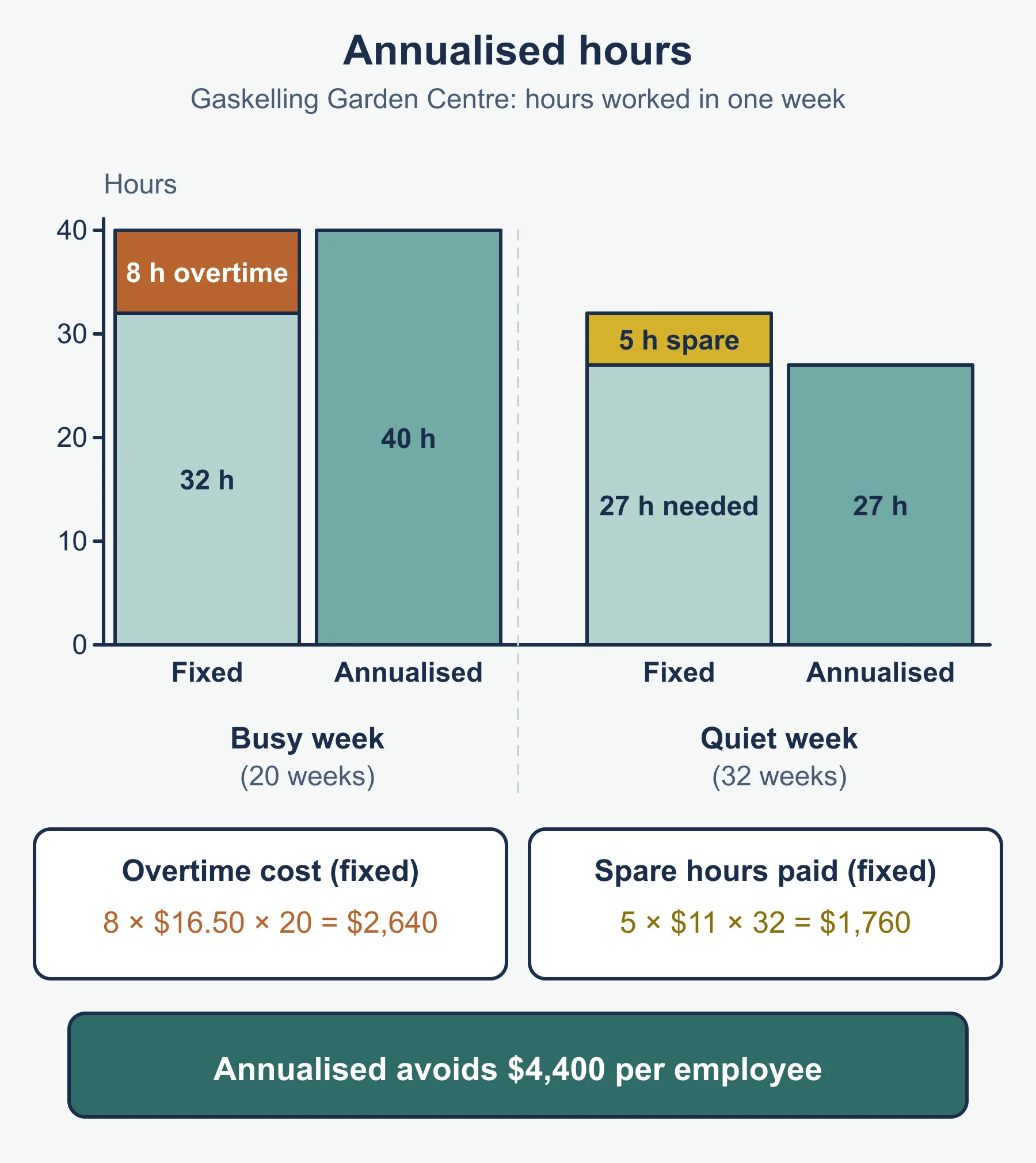
Worked example: annualised hours at Gaskelling Garden Centre. A contract is 32 hours a week, 52 weeks, so 32 × 52 = 1,664 hours a year. The centre needs 40 hours a week for 20 busy weeks (800 hours). The remaining 1,664 − 800 = 864 hours are spread over 32 weeks: 864 ÷ 32 = 27 hours a week. With a fixed 32-hour week at 11 an hour, busy weeks need 8 hours of overtime at time and a half: 8 × 16.50 × 20 weeks = 2,640. Quiet weeks pay 5 spare hours: 5 × 11 × 32 = 1,760. The annualised contract avoids 4,400 per employee.
Measuring poor employee performance
Performance is measured against a standard. Common measures:
- Labour productivity: output ÷ number of employees.
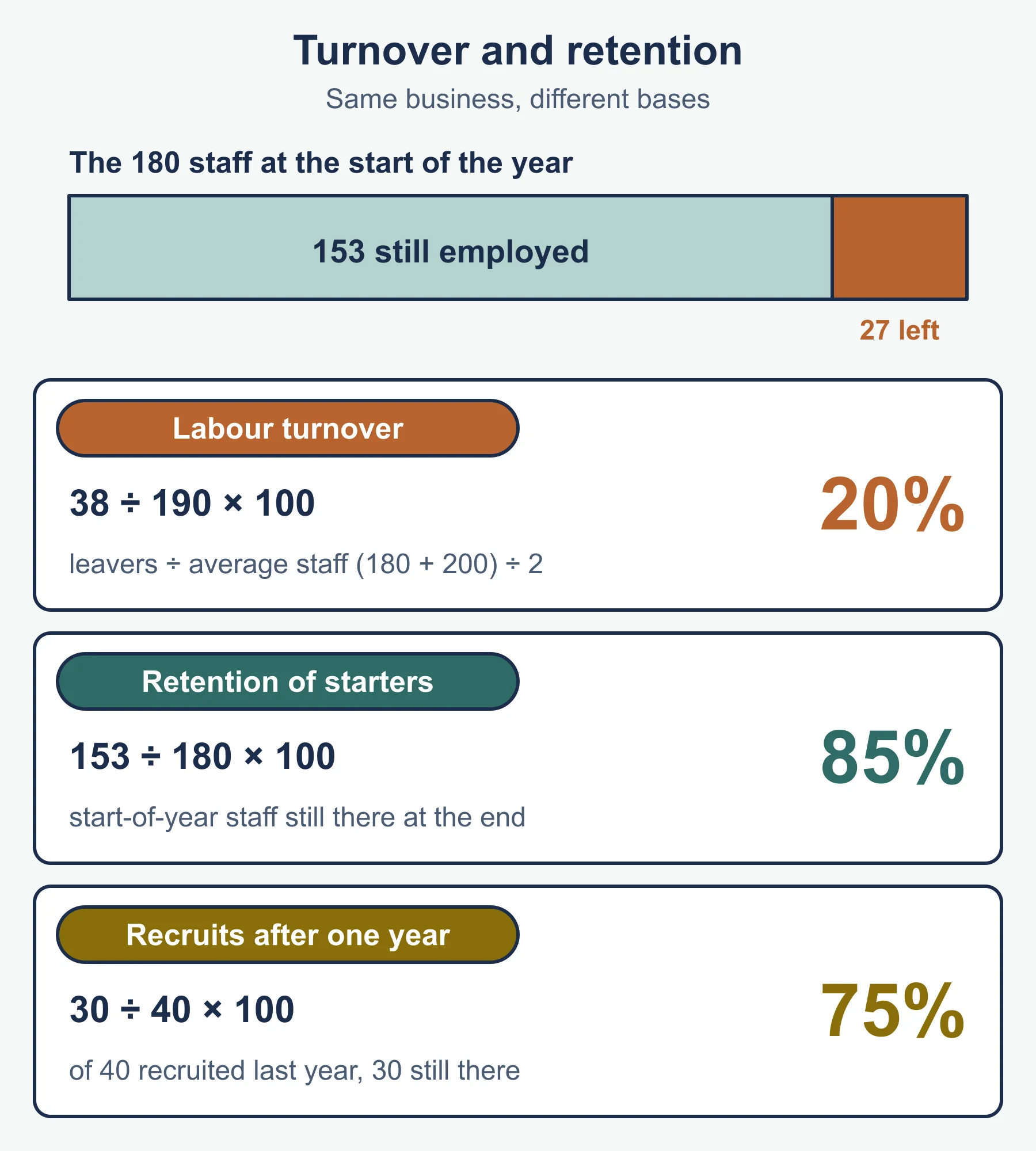
- Labour turnover (%): leavers ÷ average employees × 100.
- Absenteeism rate (%): days lost ÷ days available × 100. These are the standard forms.
- Quality and complaints: defects, returns, customer complaints.
- Targets and appraisals: results against agreed objectives.
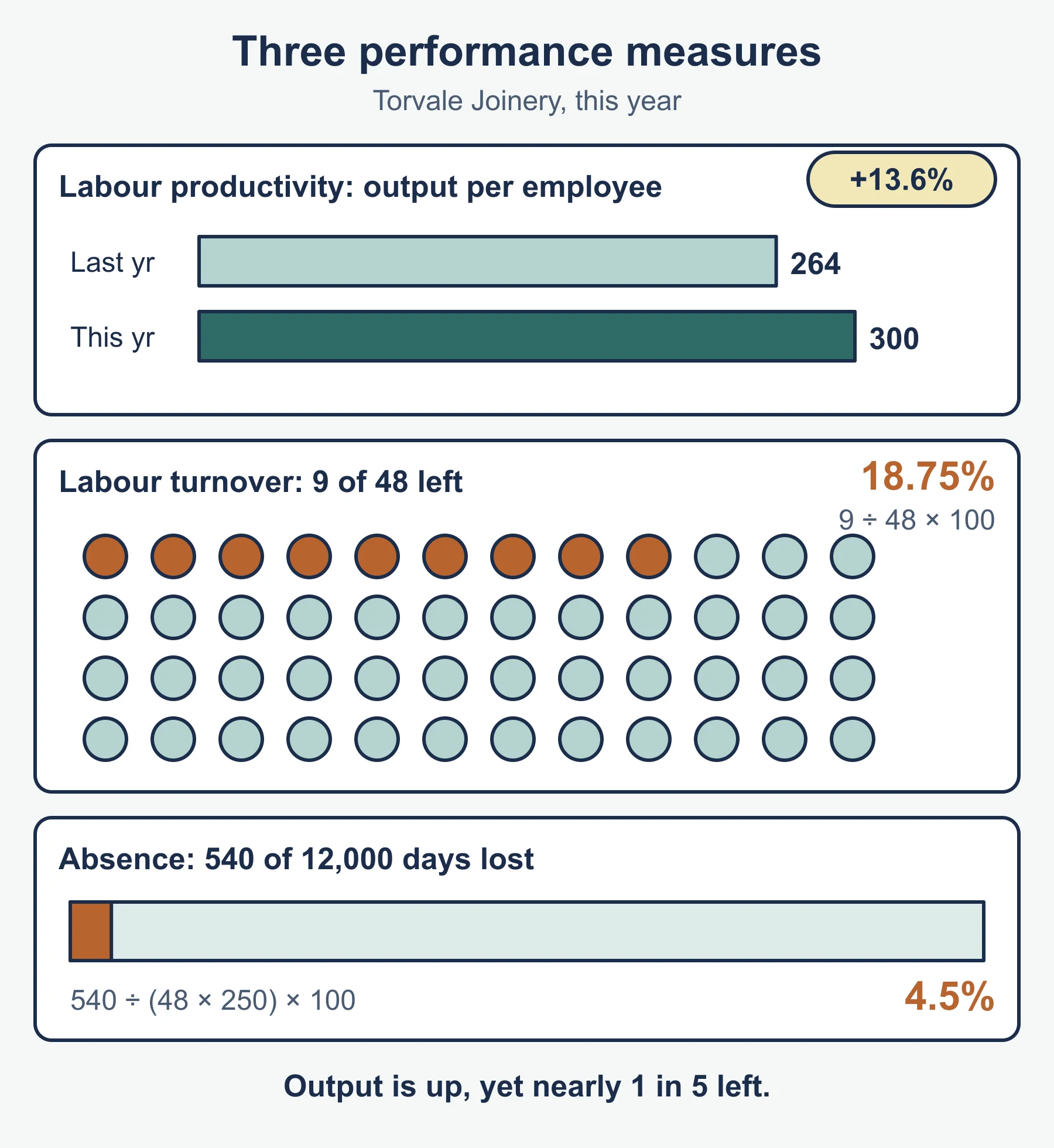
Worked example: Torvale Joinery. Average employees were 50 last year and 48 this year. Output was 13,200 and 14,400 units.
Productivity: 13,200 / 50 = 264; 14,400 / 48 = 300
Change: (300 - 264) / 264 = 13.6%
Turnover: 9 leavers / 48 x 100 = 18.75%
Absence: 540 days / (48 x 250) x 100 = 4.5%
Productivity rose, yet turnover of 18.75% suggests problems. One figure never tells the whole story, so compare measures with past years and rivals.
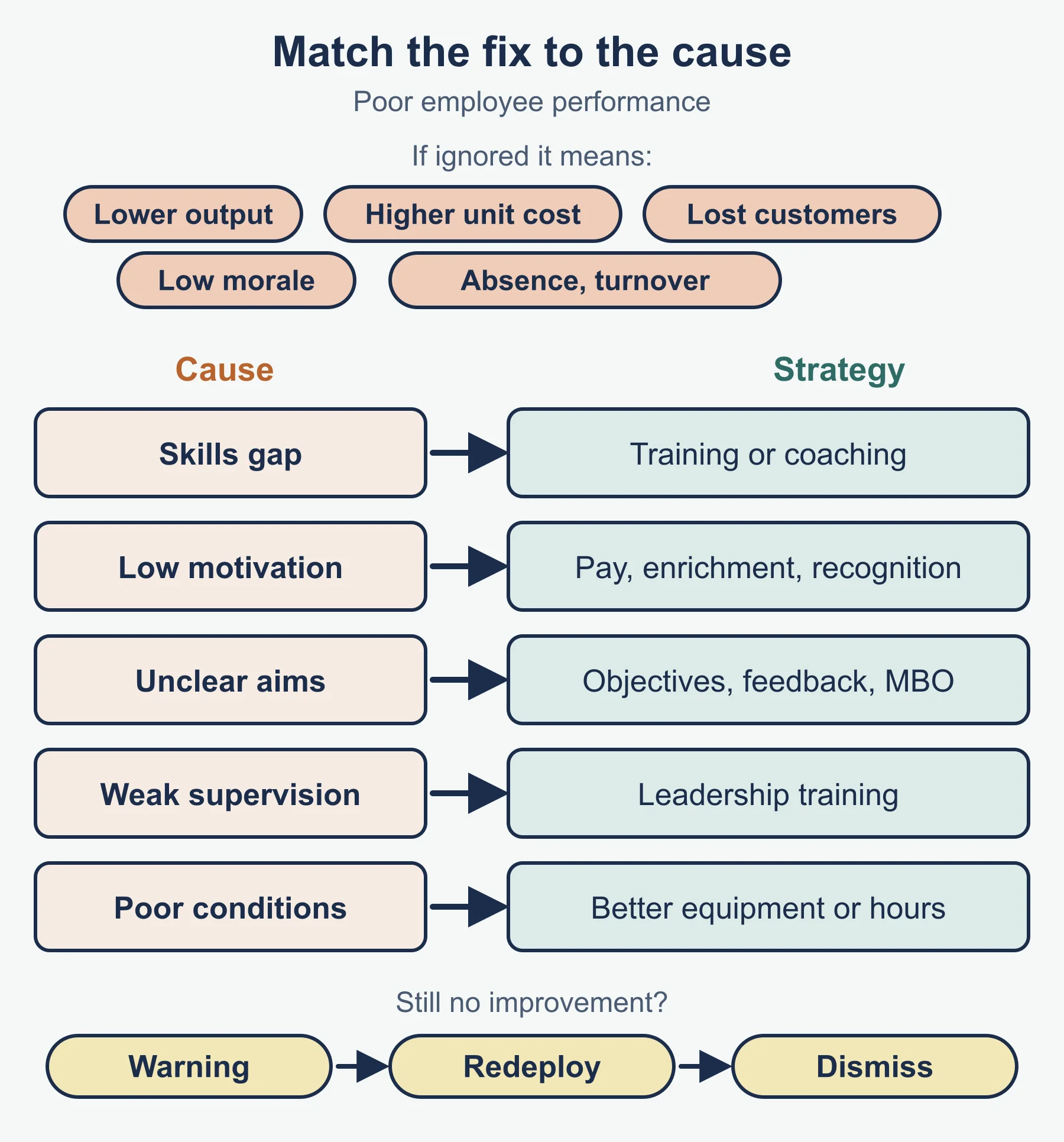
Causes. Poor recruitment or selection, too little training, low motivation, weak leadership, unclear objectives, poor working conditions or equipment, and personal or health problems.
Consequences. Lower output and quality, higher unit costs, lost customers, low morale, more absence and turnover, and the cost of discipline and replacement.
Strategies for improving performance
Match the strategy to the cause. For a skills gap: training or coaching. For low motivation: a better pay system, job enrichment or recognition (see motivation and management). For unclear aims: clear objectives and feedback, including MBO. For weak supervision: leadership training. For poor conditions: better equipment or hours. If all else fails: warnings, redeployment or dismissal.
Management by Objectives (MBO)
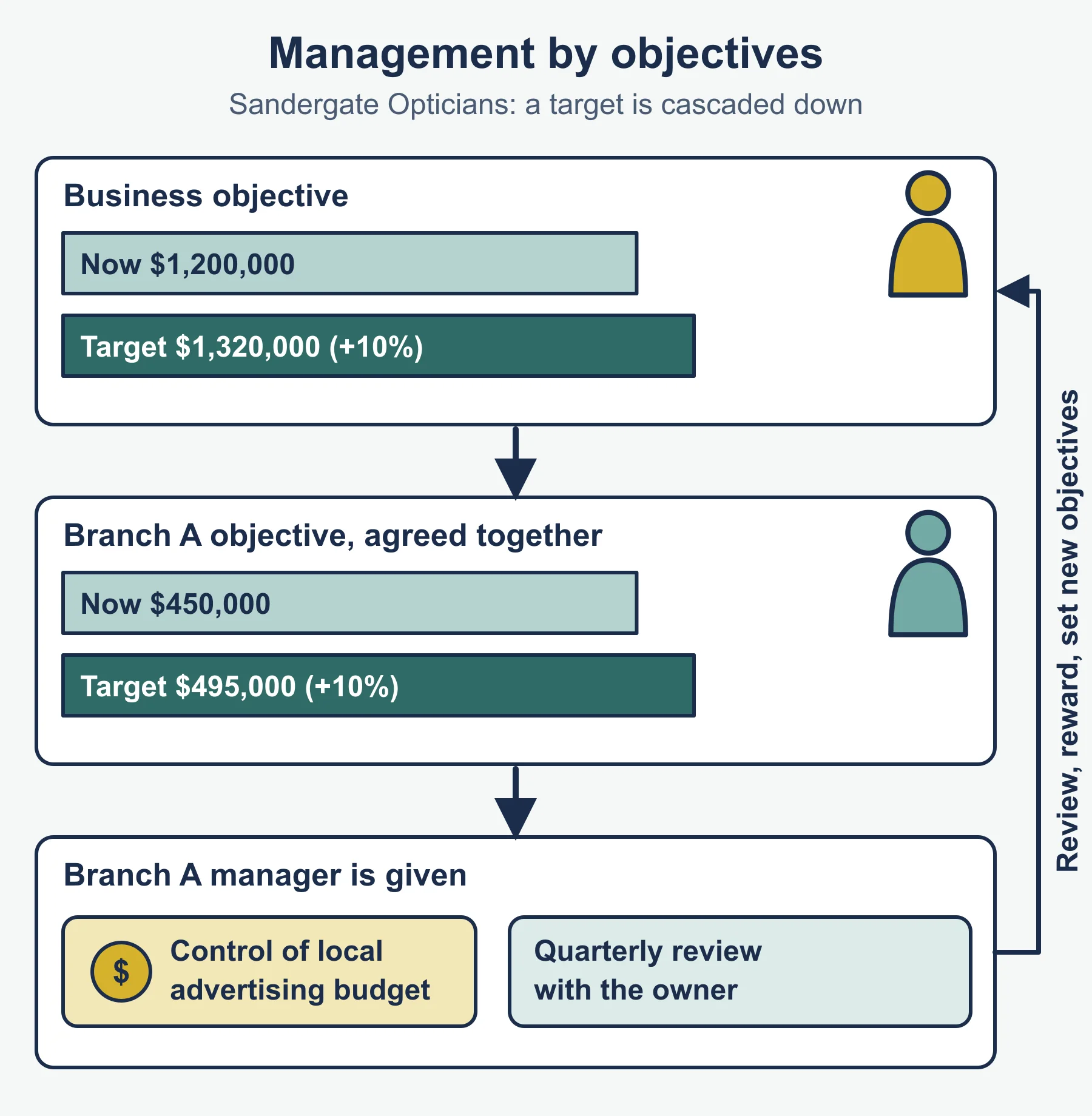
Under MBO the business’s objectives are cascaded into objectives for each department and employee, which are agreed with the employee.
Implementation, step by step: set business objectives; share them; agree specific, measurable individual objectives; give the resources and authority to meet them; monitor and review progress regularly; reward results and set new objectives.
Worked example: Sandergate Opticians. The firm wants sales up 10%, from 1,200,000 to 1,320,000. Branch A, now at 450,000, agrees an objective of 495,000. Its manager gets control of the local advertising budget and meets the owner each quarter.
Usefulness: staff know what to aim for and feel involved, and the business can compare results with aims. Limitations: it takes time, objectives may be set too easily or out of date, and it may focus staff on measurable targets only. It works best with skilled, trusted staff.
The changing role of IT and AI in HRM
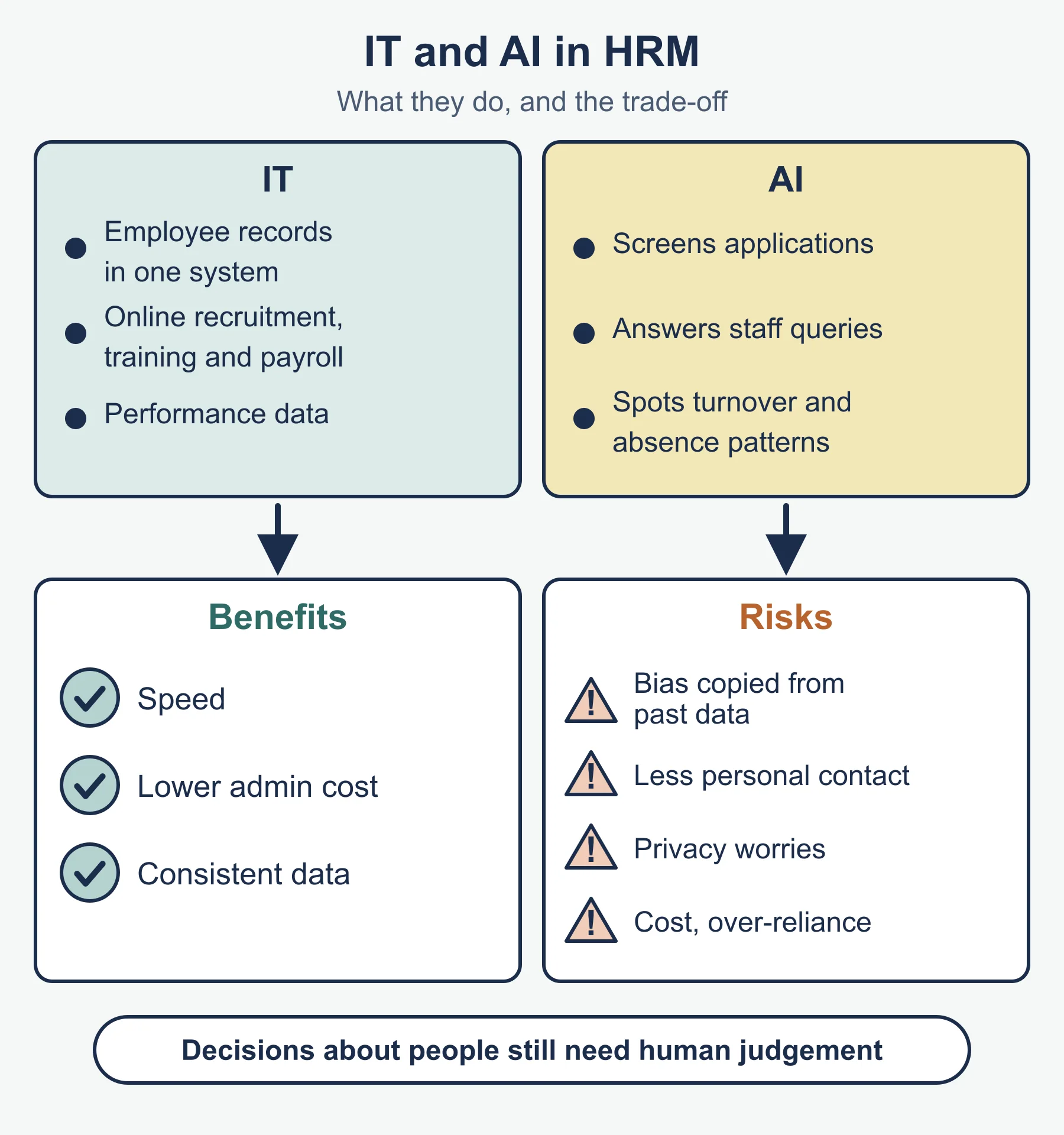
IT holds employee records in one system, supports online recruitment, training and payroll, and tracks performance data. AI can screen applications, answer staff queries and analyse patterns in turnover or absence to help planning. Benefits: speed, lower administration cost and consistent handling of data. Risks: bias copied from past data, loss of personal contact, privacy worries about monitoring staff, system cost and over-reliance. Decisions affecting people still need human judgement.
Exam technique
Papers 3 and 4 give a case study. The syllabus says the last part of Question 3 and of Question 4 on Paper 3, Question 5 on Paper 3, and both essays on Paper 4 should show evaluation. Use the case figures, weigh both sides, then give a reasoned judgement. Judge leadership by context and flexible contracts by the workforce and the market.
Common errors
- Calling any firm leader “transformational”.
- Treating hard HRM as bad and soft HRM as good in all cases.
- Giving an advantage to employees when the question asks about the business.
- Computing labour turnover with the starting figure, not the average.
- Naming a strategy without linking it to the cause of the poor performance.
Frequently asked questions
Which leadership theories are in Cambridge 9609 section 7.3? The syllabus names five types: trait, behavioural, contingency, power and influence, and transformational leadership.
What is Management by Objectives (MBO)? Under MBO, the business’s objectives are cascaded into objectives for each department and employee, agreed with them and reviewed. It is most useful when staff are skilled and trusted and results can be measured.
Is hard HRM always worse than soft HRM? No. Each can suit different groups of staff or situations, so judge which approach fits the business and evidence in the case rather than treating one as always better.
How are IT and AI changing HRM? They support online recruitment and automated screening, online training, central records and payroll, and performance tracking. The risks include hidden bias, data privacy concerns and staff feeling watched.
Official syllabus
Cambridge International AS & A Level Business 9609 syllabus for examination in 2026, 2027 and 2028, published by Cambridge University Press & Assessment. This guide covers sections 7.3.1 to 7.3.3 and 7.4.1.
Get free revision emails (optional)
Occasional emails with practice questions, worked explanations and links to free resources for the qualification and subjects you choose. No spam, and you can unsubscribe from any email. The free tools on this site never need an email.
Related resources
-
Practice questions
A Level Business: Leadership and Human resource management (HRM) strategy (Cambridge 9609) – Practice Questions
Original practice questions with worked answers on leadership, EQ, flexible contracts, performance, MBO and AI for Cambridge A Level Business 9609 7.3-7.4.
Business · Cambridge · A Level
Try questions -
Revision notes
A Level Business: Leadership and Human resource management (HRM) strategy (Cambridge 9609) – Revision Notes
Condensed revision notes for Cambridge A Level Business 9609 sections 7.3 and 7.4: leadership theories, EQ, flexible contracts, MBO, IT and AI.
Business · Cambridge · A Level
Revise topic -
Study guides
A Level Business: Motivation and Management (Cambridge 9609)
Study guide to 2.2 Motivation and 2.3 Management in Cambridge AS & A Level Business 9609: theories, pay methods, styles and worked examples.
Business · Cambridge · AS Level
Read guide
Related articles
-
teaching
A Level tuition in Dubai: Cambridge or Pearson Edexcel International A Level?
Schools in Dubai and Abu Dhabi teach either Cambridge International AS & A Level or Pearson Edexcel International A Level. How the two are structured, why it matters for tuition, and how online classes from Lahore work.
9 October 2026
-
curriculum guides
Choosing subjects at IGCSE and A Level
How subject choices at 14 and 16 affect university options later, and how to keep pathways open without overloading a timetable.
28 July 2026
Studying this with a teacher
Working through Business A LEVEL?
This page is free and stays free. If you would rather be taught it, Marlbridge runs Business classes one-to-one and in small groups of up to 15, online in your own time zone. The first trial class is free. WhatsApp replies within an hour (8am–11pm Pakistan time, every day); email the same day.
Cambridge Business teachers at Marlbridge

