
Revision Notes
A Level Business: Motivation and Management (Cambridge 9609) – Revision Notes
Condensed revision notes for 2.2 Motivation and 2.3 Management in Cambridge AS & A Level Business 9609, with a self-test and common lost marks.
- Subject
- Business
- Level
- AS LEVEL
- Topic
- Human resource management
- Author
- Marlbridge Academic Team
- Updated
- Reviewed by
- Salman Ahmad (what this means)
Aligned to Cambridge A Level Business (9609), For examination in 2026, 2027 and 2028. Official specification .
Syllabus page (what it covers and how it is assessed): Cambridge A Level Business.
Syllabus points this page covers
9609 (AS Level)
- 2.2 Motivation
- 2.3 Management
Found an error? Report a correction.
Need help with this topic? Request a free trial class for A Level Business (9609).
These are condensed notes for sections 2.2 Motivation and 2.3 Management of the Cambridge International AS & A Level Business 9609 syllabus for examination in 2026, 2027 and 2028 (AS Level content, examined on Paper 1 and Paper 2). For full explanations and worked examples, read the study guide. Then try the practice questions. Recruitment, training and workforce relations are in the Topic 2 revision notes and Topic 2 study guide. Course links: the Cambridge A Level Business hub, the checklist and the free diagnostics.
2.2.1 and 2.2.2 Why motivate; human needs
| Idea | Recall |
|---|---|
| Motivation | The desire to put effort into work |
| Why it matters | Staff deliver the objectives; motivated staff raise productivity and quality, and cut absence and labour turnover |
| Human need | Something a person must have, or strongly wants, for security or fulfilment |
| Met at work | Pay (basic needs), secure contract (safety), team (belonging), promotion (status), challenge (achievement) |
| Not met at work | Insecure contract, isolated or repetitive work, no say, poor conditions |
2.2.3 Theories at a glance
| Theorist | Type | Core claim | Practical message |
|---|---|---|---|
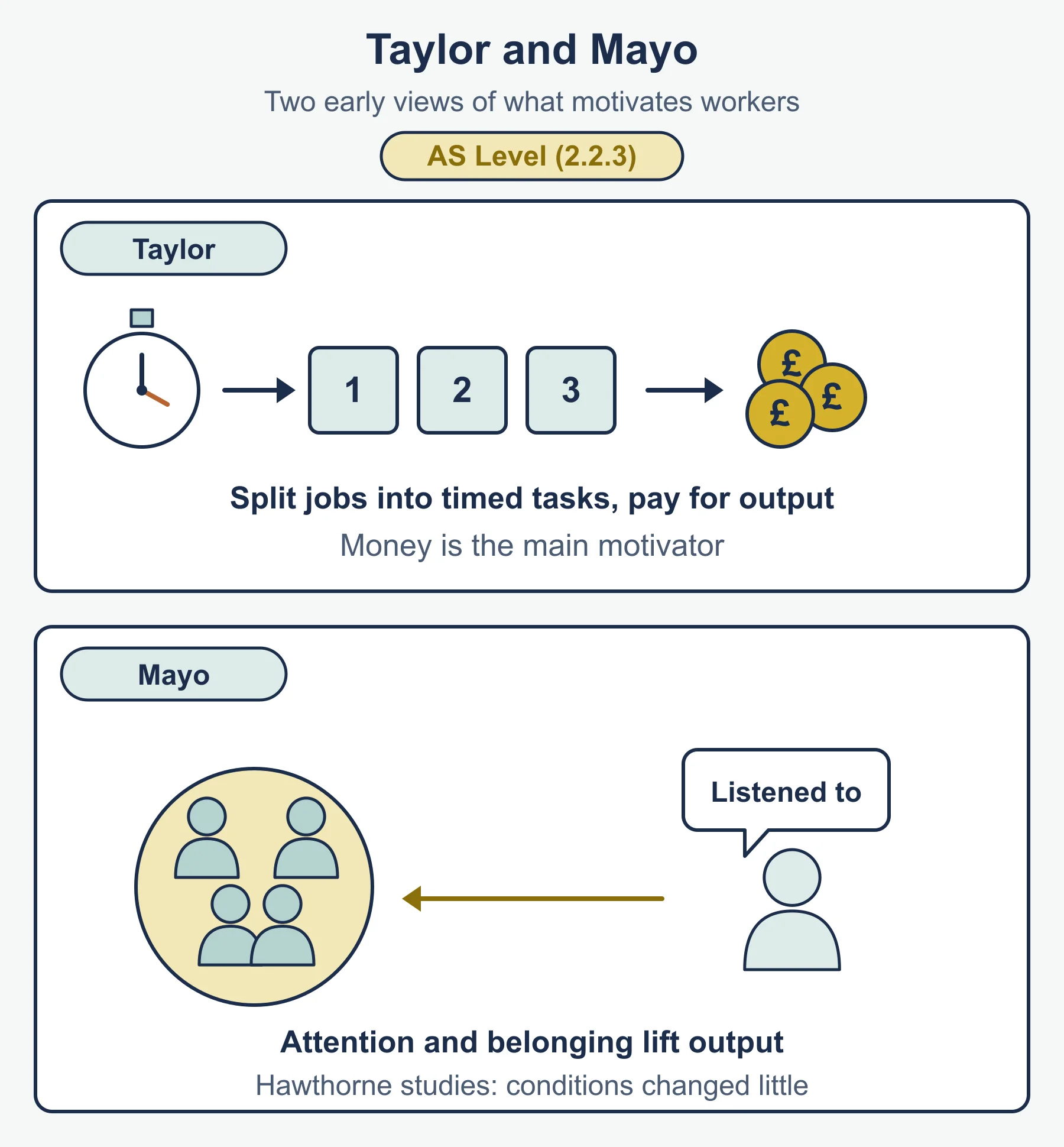
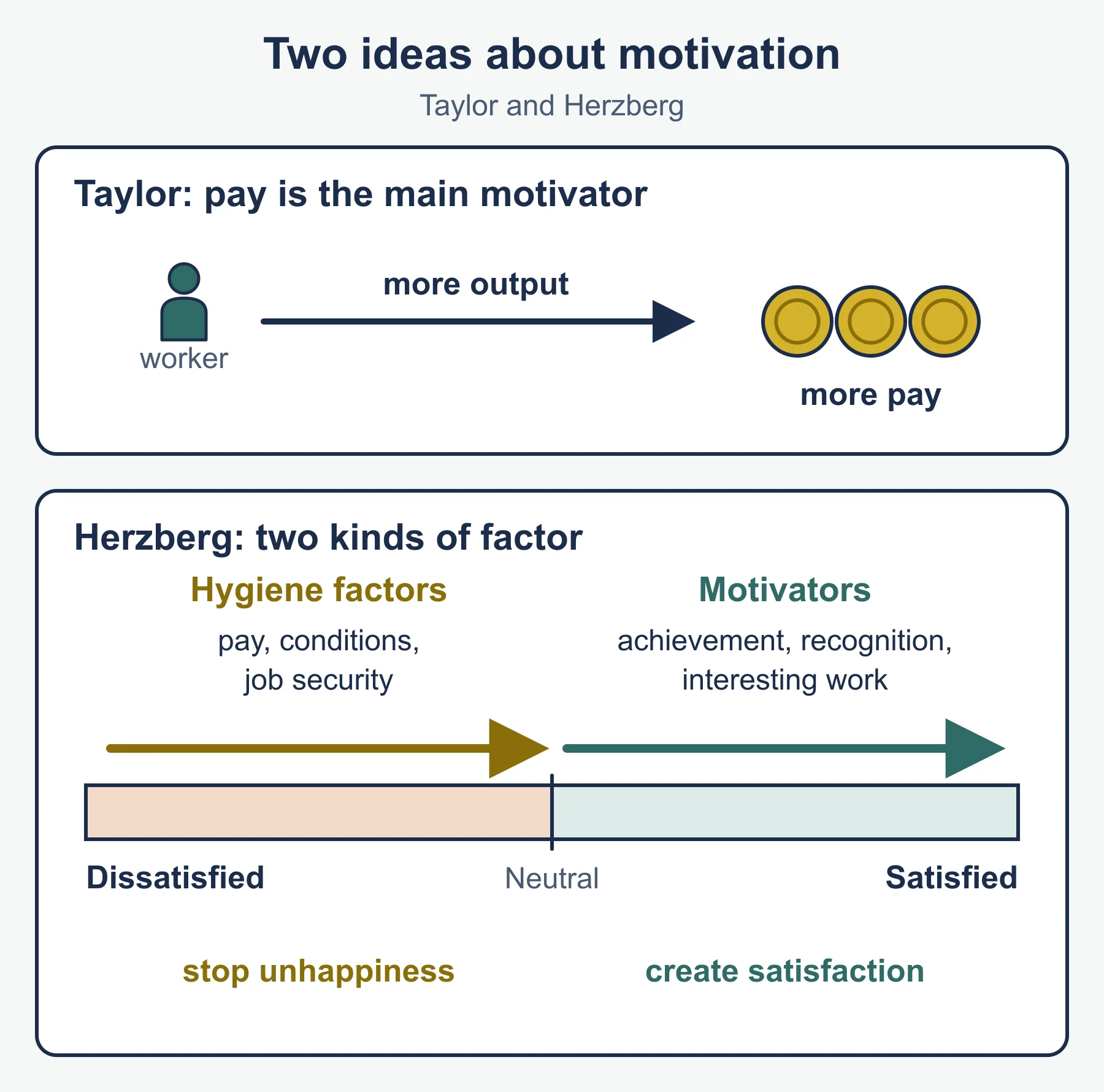
| Taylor | Content | Money is the main motivator; break jobs into timed tasks | Pay by output; supervise closely |
| Mayo | Content | Attention, belonging and group norms lift output (Hawthorne studies) | Consult, build teams |
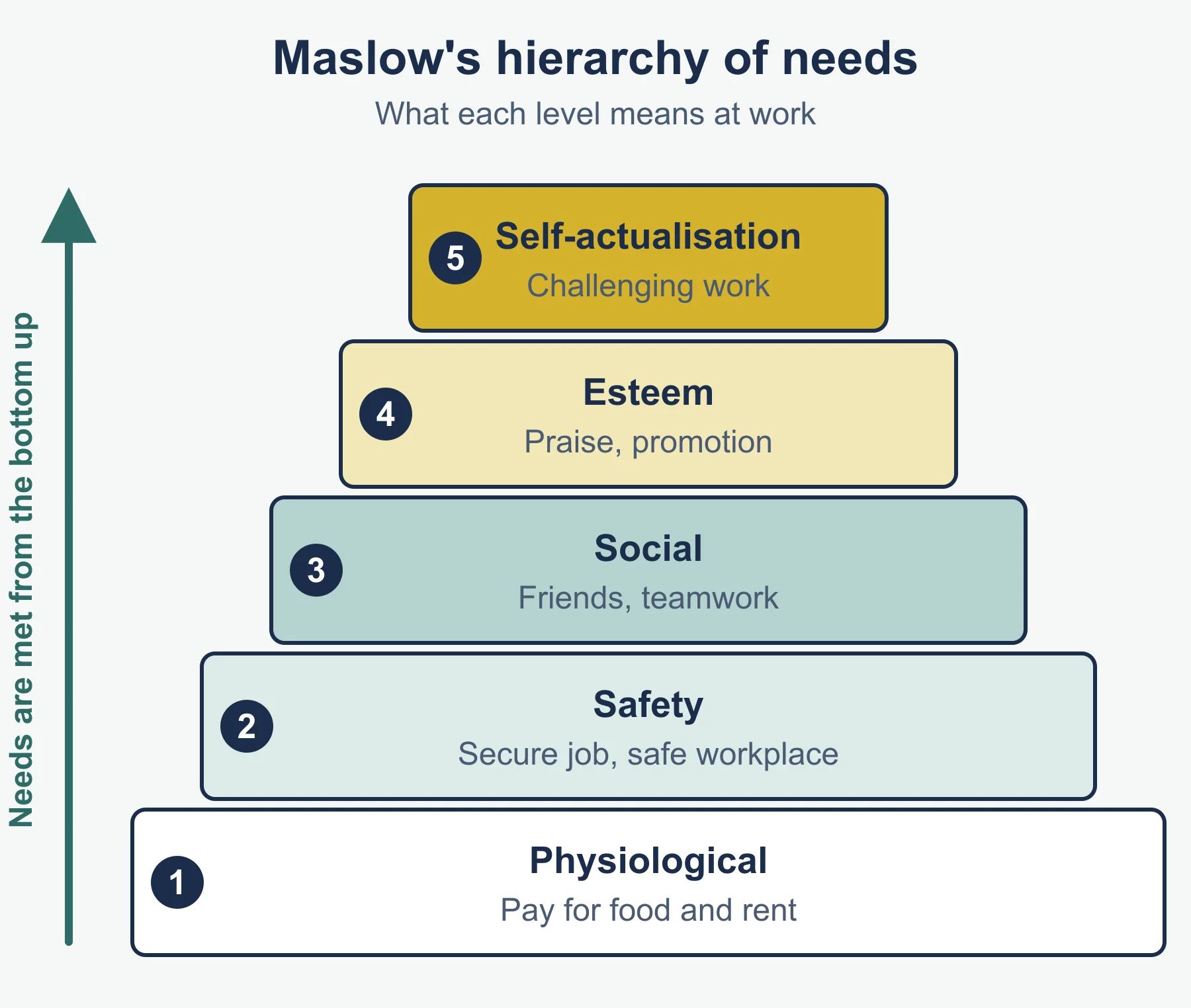
| Maslow | Content | Five needs in order: physiological, safety, social, esteem, self-actualisation | Find which level is unmet |
| Herzberg | Content | Hygiene factors prevent dissatisfaction; motivators create satisfaction | Fix hygiene, then enrich |
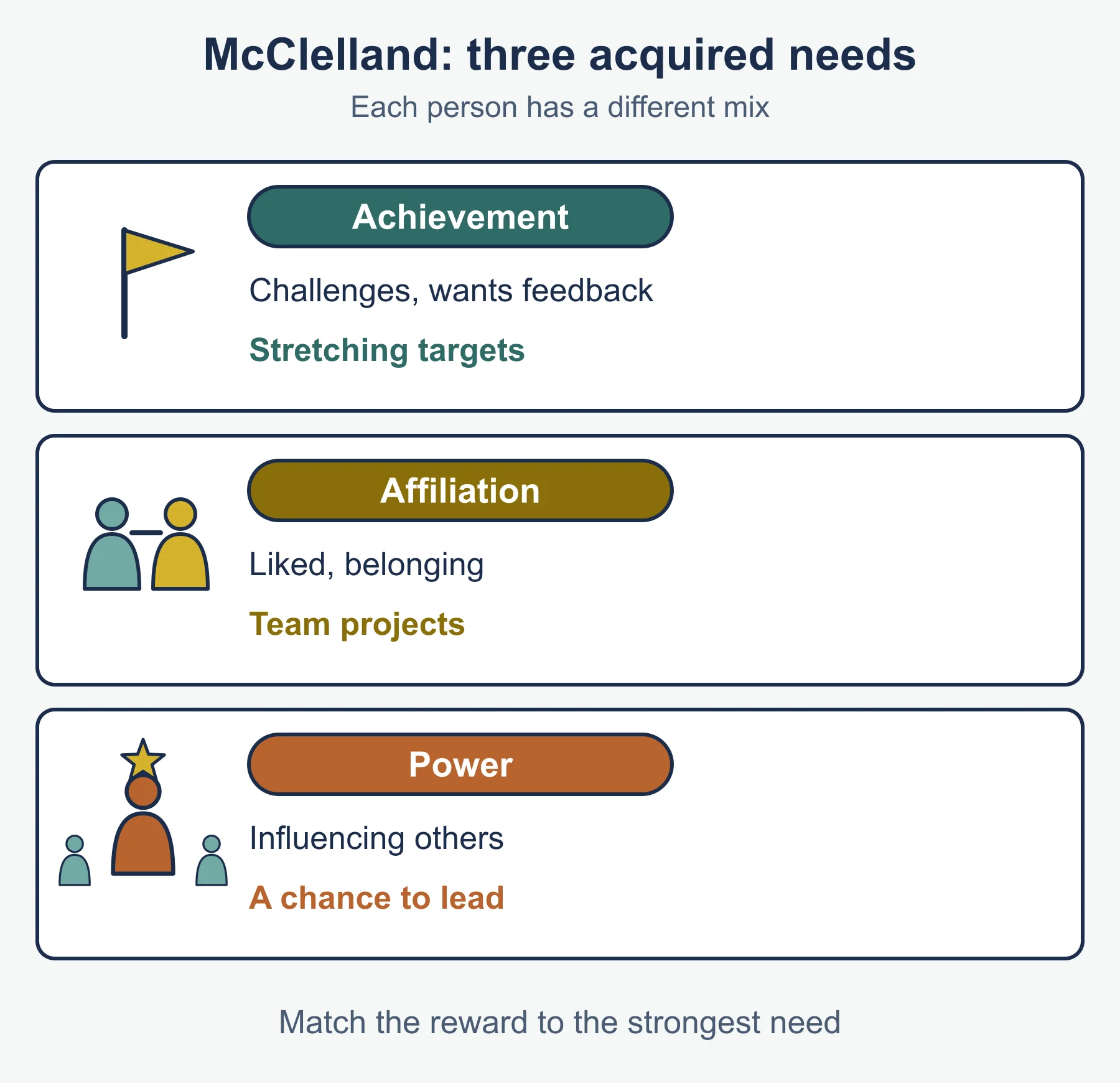
| McClelland | Content | Needs for achievement, affiliation, power differ by person | Match tasks to the person |
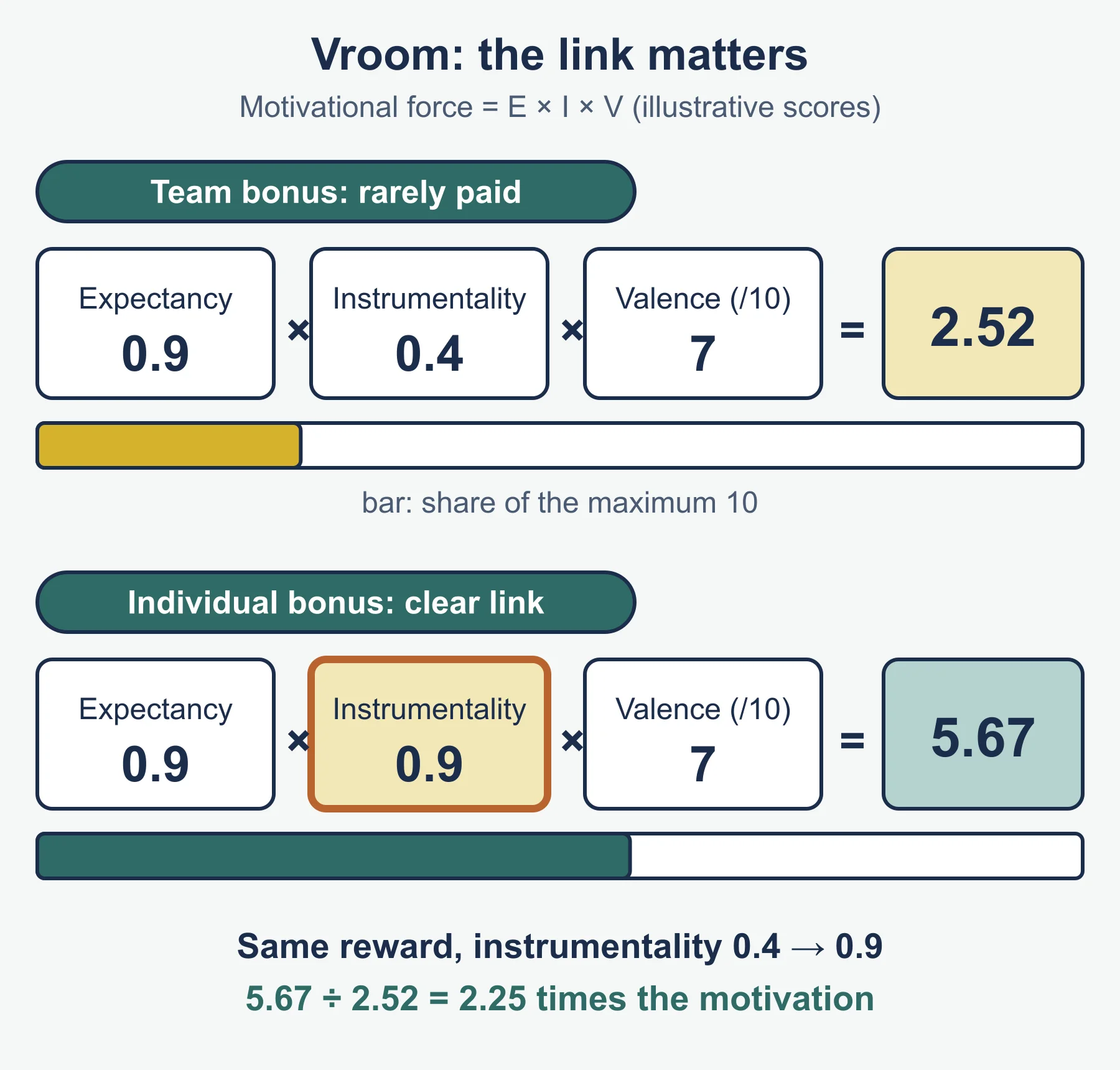
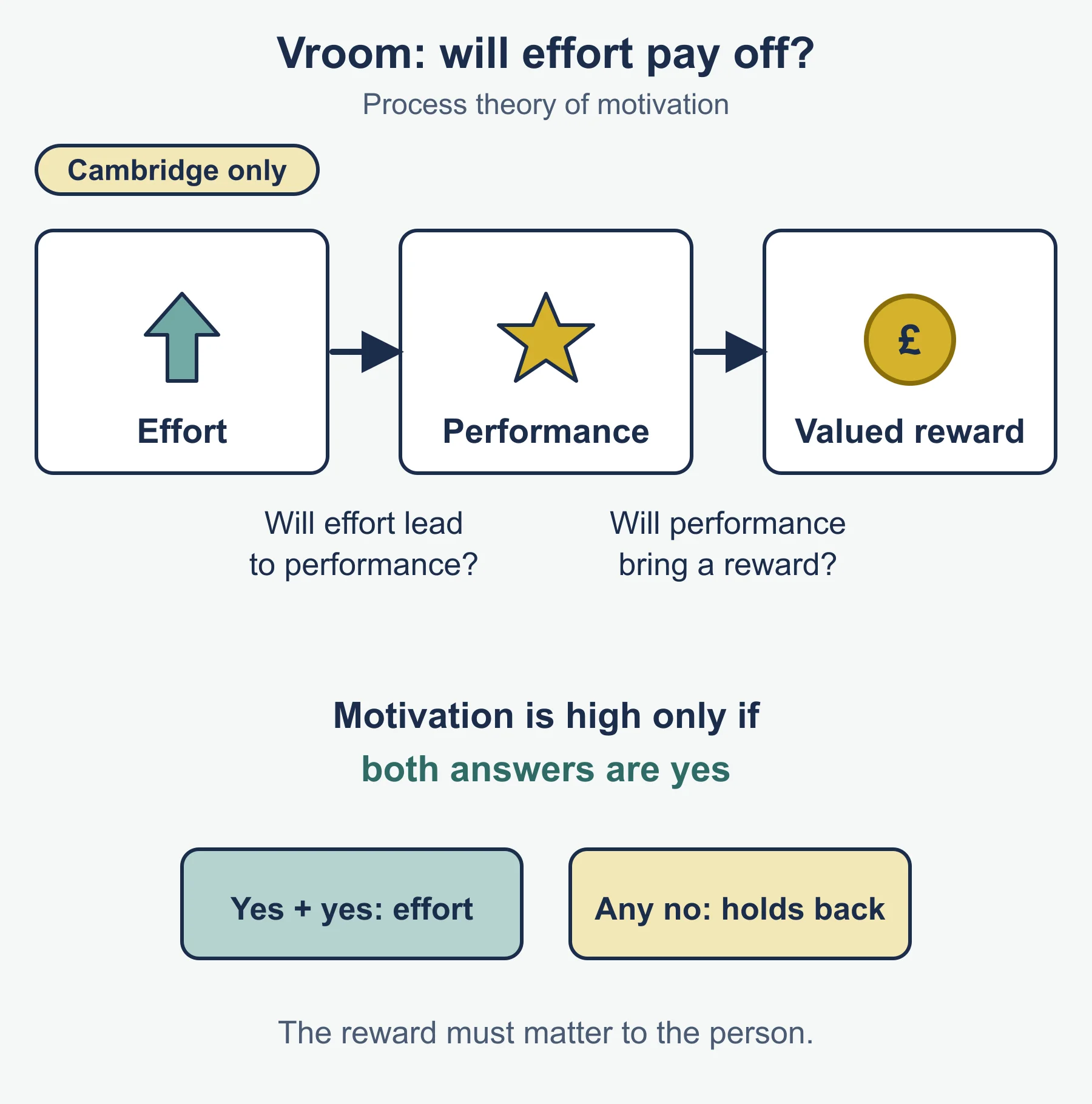
| Vroom | Process | Effort depends on expectancy, instrumentality and valence | Make the effort-reward link clear and the reward wanted |
Herzberg sorting
| Hygiene factors | Motivators |
|---|---|
| Pay, working conditions, supervision, company policy, job security | Achievement, recognition, responsibility, the work itself, advancement |
Vroom in steps
- Score expectancy (effort leads to performance), between 0 and 1.
- Score instrumentality (performance leads to reward), between 0 and 1.
- Score valence (how much the reward is wanted).
- Multiply: motivational force = expectancy × instrumentality × valence (standard form).
- If any score is zero, the product is zero.
Reminder: expectancy 0.5, instrumentality 0.8, valence 9 gives 0.5 × 0.8 × 9 = 3.6. Raise only the valence of an unreachable reward and the force does not rise much.
2.2.4 Motivation methods
Financial
| Method | One-line definition | One strength | One weakness |
|---|---|---|---|
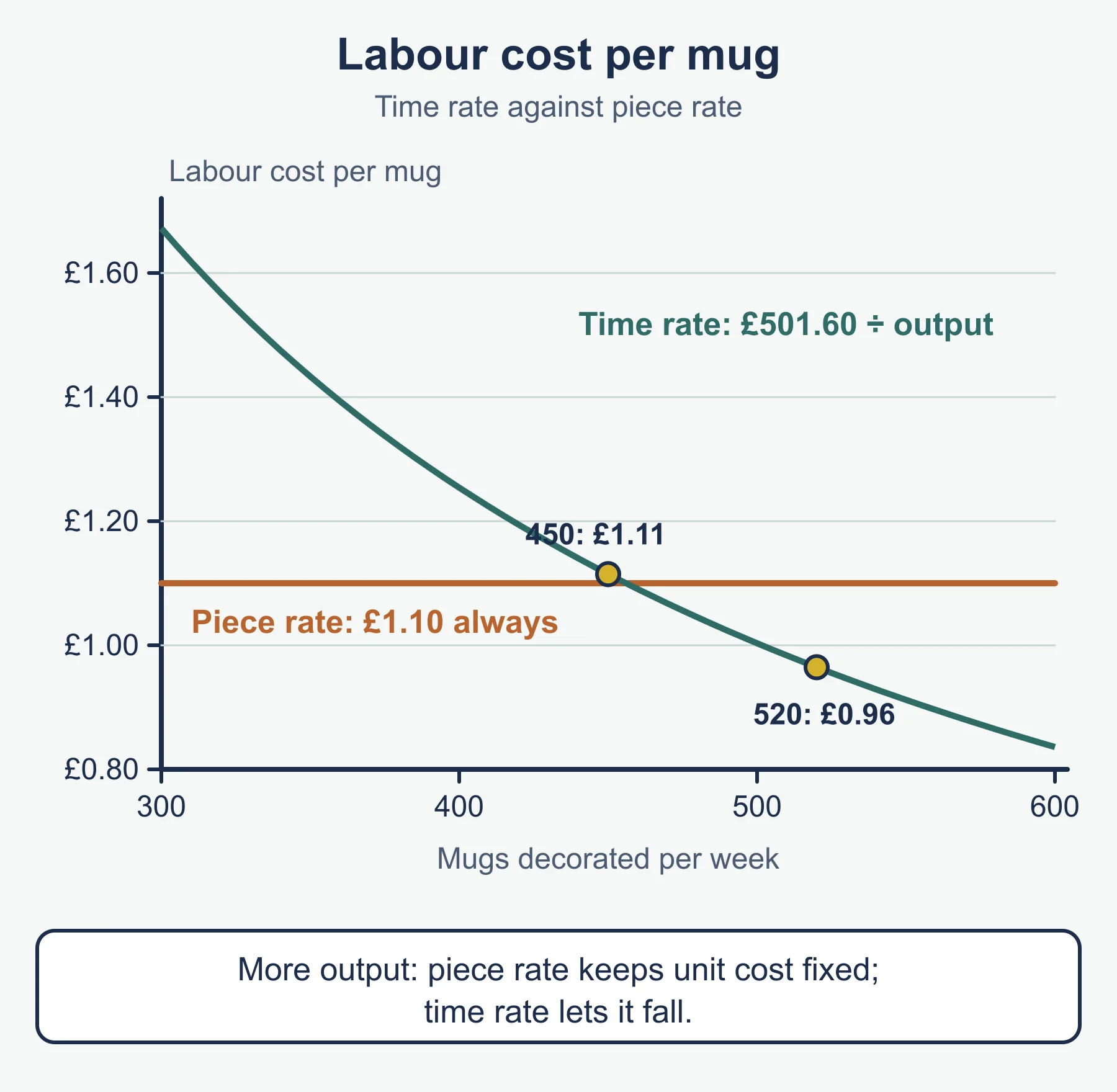
| Time based | Hours worked × hourly rate | Simple, predictable | No link to output |
| Salary | Fixed annual pay | Secure | No extra reward for effort |
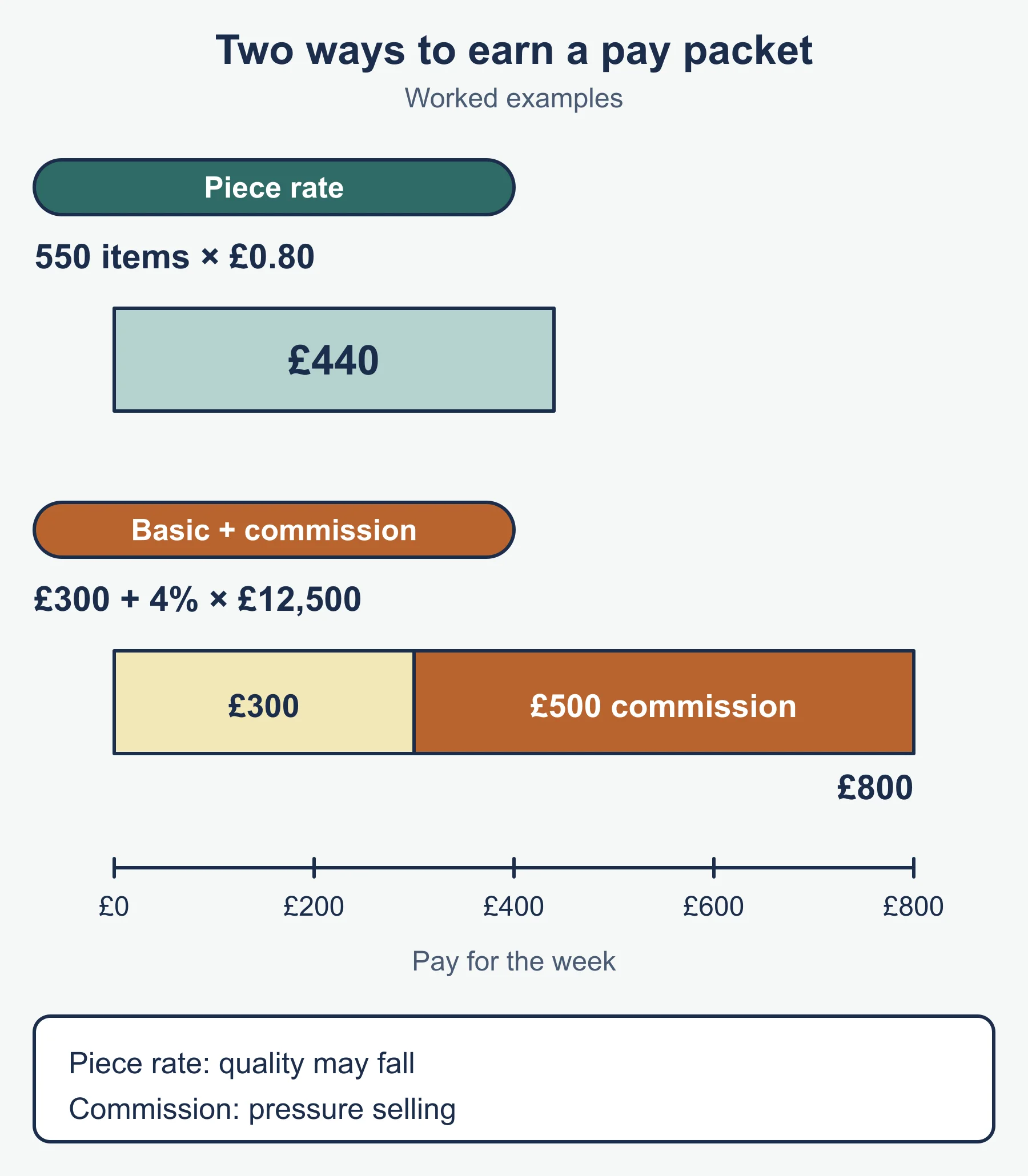
| Piece rate | Pay per unit | Rewards output | Quality, rushing |
| Commission | Percentage of sales | Drives selling | Pressure selling, uncertain income |
| Bonus | Lump sum for a target | Focuses effort | Fades; target gaming |
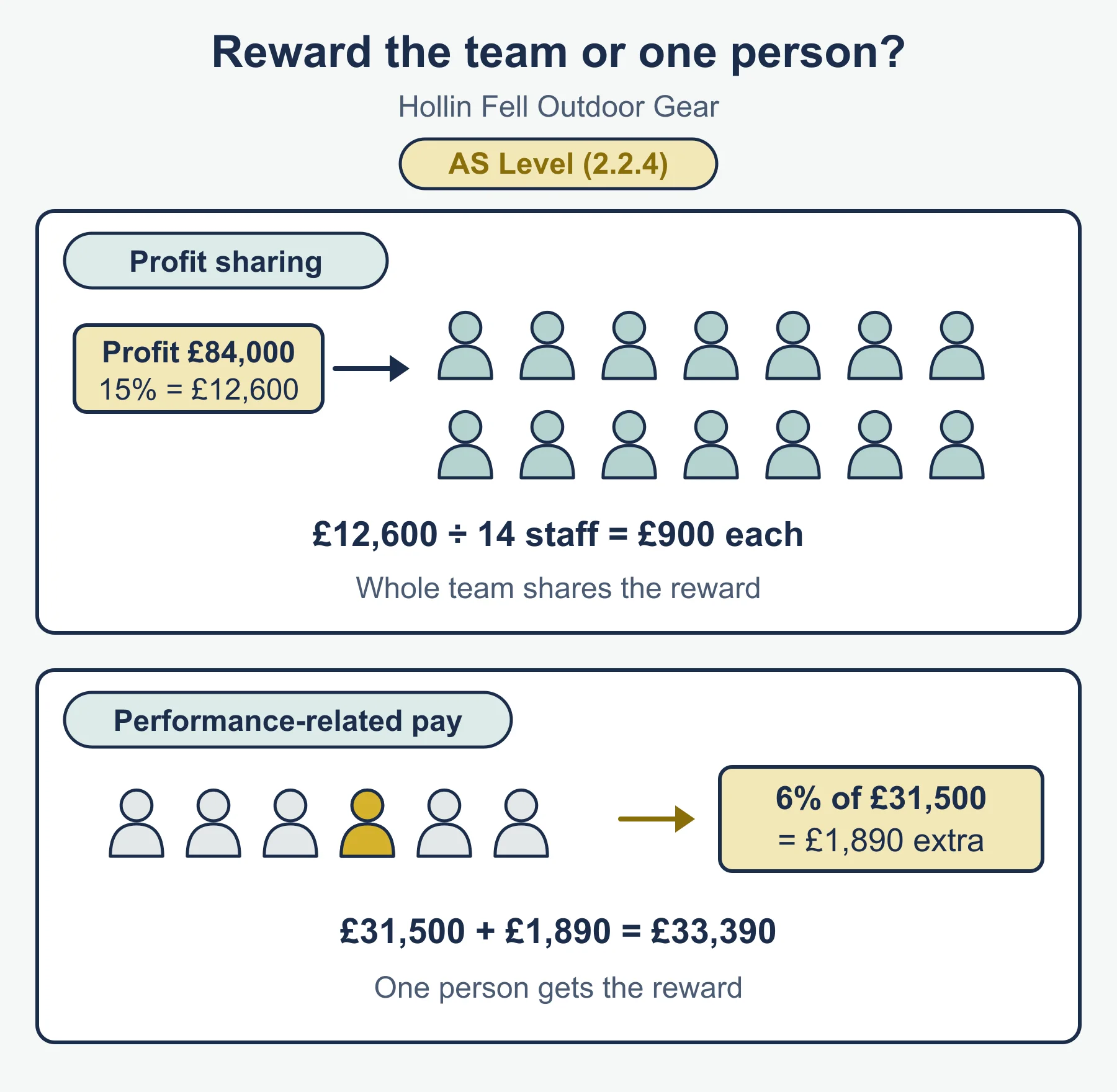
| Profit sharing | Share of profit | Loyalty, team feeling | Weak individual link |
| PRP | Pay tied to assessed performance | Rewards results | Appraisal bias |
| Fringe benefits | Non-cash extras | Retains staff | Cost; uneven value |
Quick calculations (standard forms):
- Time-based pay = hours × rate. Example: 40 × £12.50 = £500.
- Piece-rate pay = units × rate per unit. Example: 620 × £0.75 = £465.
- Commission = rate × qualifying sales. Example: 5% of £8,000 = £400.
- Profit share per person = pool ÷ number of staff. Example: 10% of £60,000 = £6,000, shared by 12 staff = £500 each.
Non-financial
| Method | What it is | Theory link |
|---|---|---|
| Training | Gives skills and confidence | Maslow esteem, Herzberg advancement |
| Promotion opportunities | A career path | Esteem, McClelland achievement |
| Development | Longer-term growth beyond the current job | Self-actualisation |
| Status | Title, office, standing | Esteem |
| Job re-design | Changing tasks to reduce boredom | Herzberg (the work itself) |
| Team working | Shared tasks and goals | Mayo, McClelland affiliation |
| Empowerment | Authority to decide own work | Responsibility |
| Participation | Involvement in decisions | Mayo, esteem |
| Job enrichment | More planning, responsibility, decisions | Herzberg motivators |
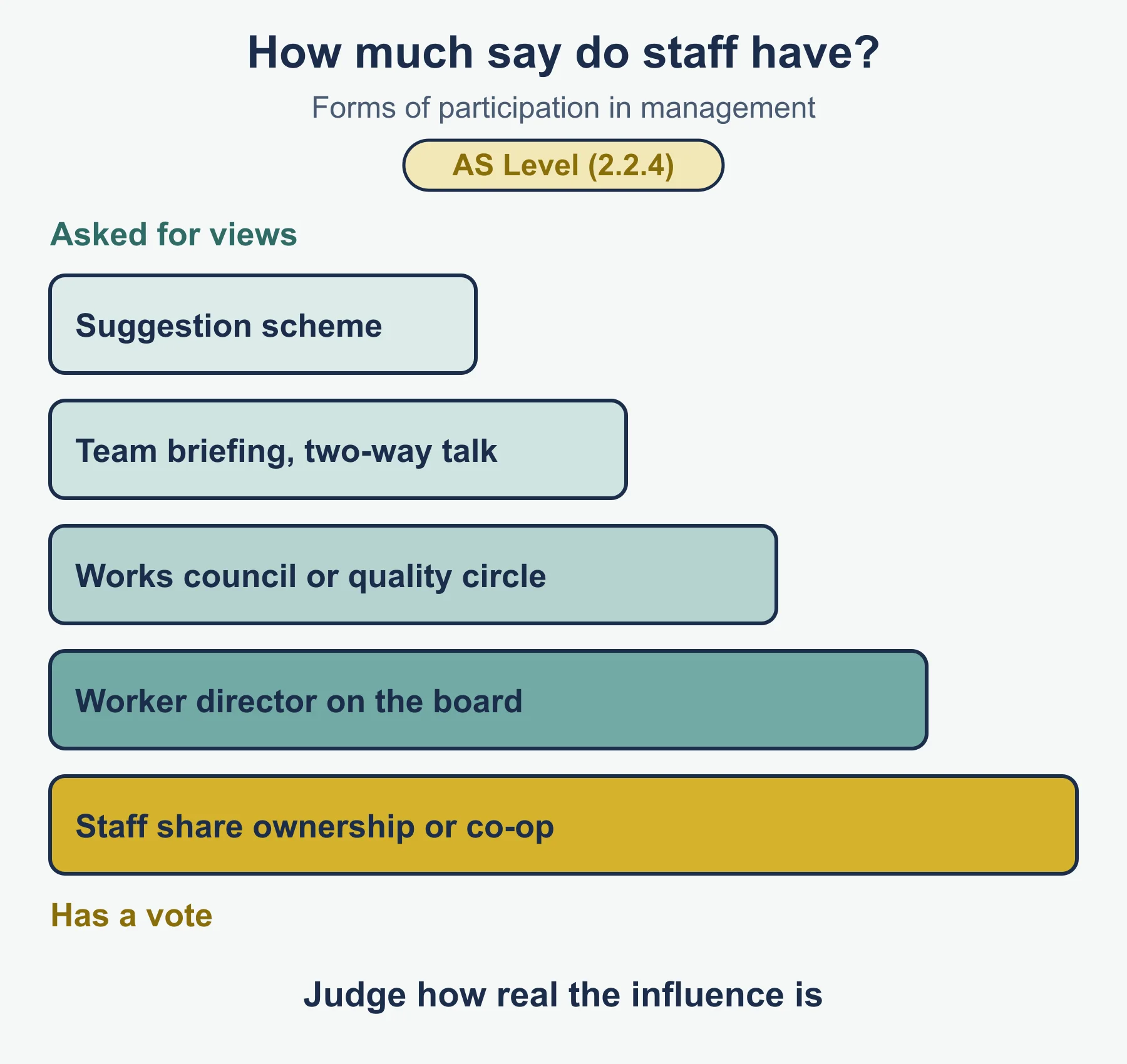
Employee participation in management and control
- Works council or consultation committee.
- Suggestion schemes and quality circles.
- Team briefings with two-way discussion.
- Employee representatives or worker directors on the board.
- Employee share ownership or co-operative structure.
Judge each by how real the influence is: being informed, being asked, or having a vote.
Choosing
- Repetitive, short-term, low-paid work: piece rate or bonus can work, but watch quality.
- Skilled, well-paid staff: autonomy, enrichment and development tend to matter more.
- Always say why a method fits this workforce and what could stop it working.
2.3.1 Management
Functions and thinkers
| Item | Recall |
|---|---|
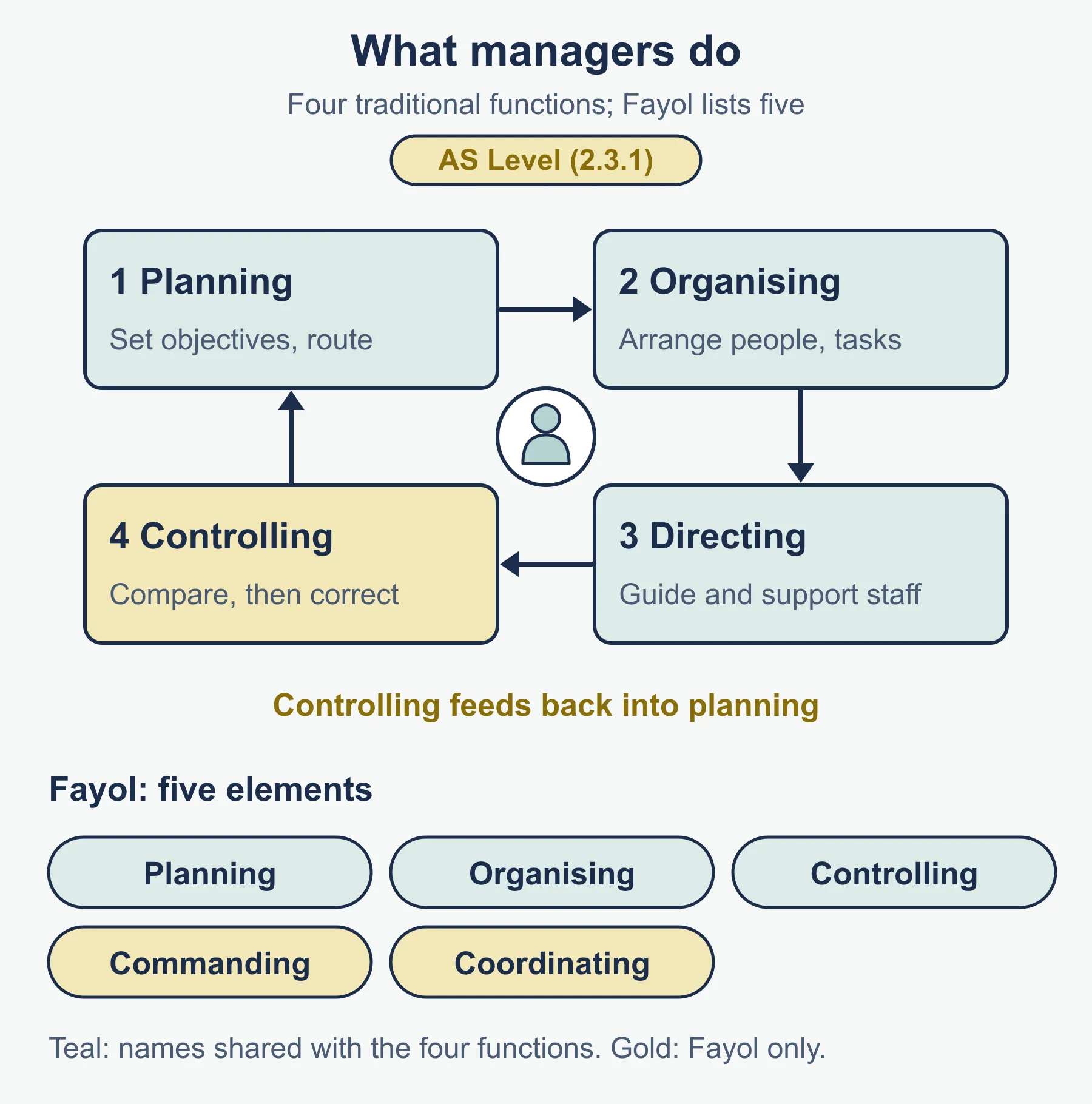
| Four traditional functions | Planning, organising, directing, controlling |
| Fayol (standard form) | Five elements: planning, organising, commanding, coordinating, controlling |
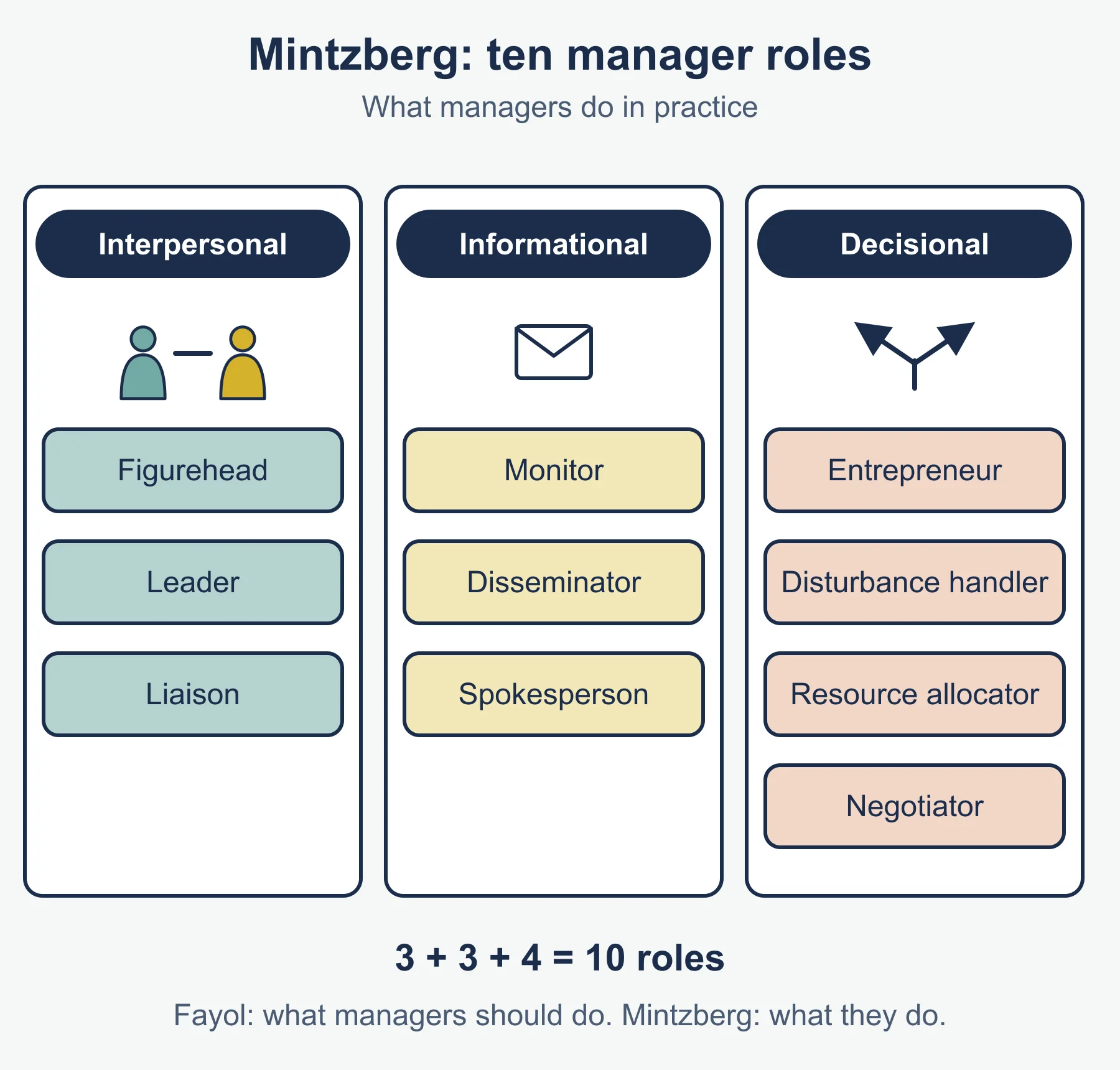
| Mintzberg (standard form) | Ten roles. Interpersonal: figurehead, leader, liaison. Informational: monitor, disseminator, spokesperson. Decisional: entrepreneur, disturbance handler, resource allocator, negotiator |
| Fayol against Mintzberg | Fayol sets out what managers should do; Mintzberg observed what they actually do, which is fragmented and reactive |
| Contribution to performance | Direction, resource allocation, motivation, problem solving, cost and quality control |
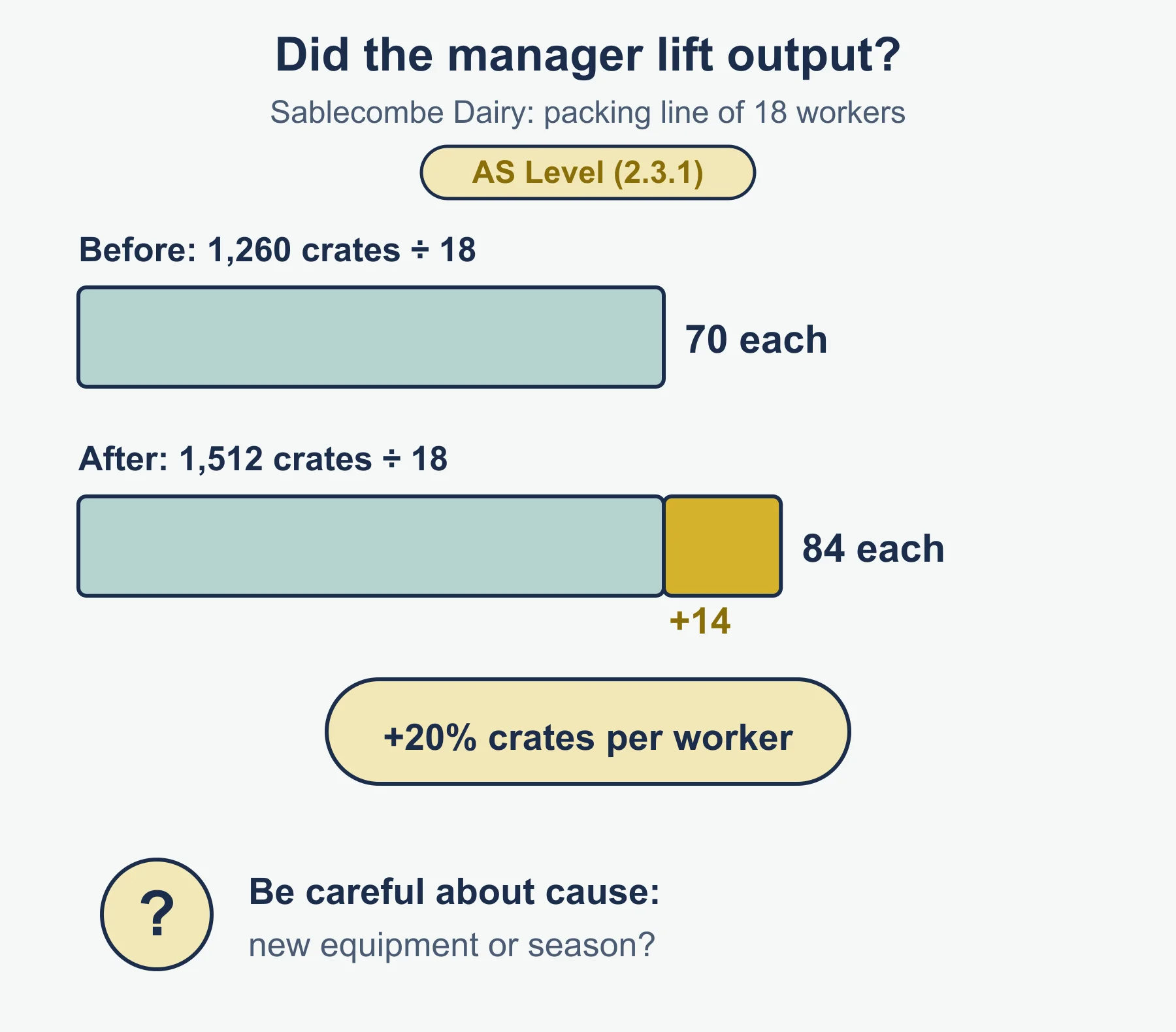
Reminder of the output calculation: output per worker = total output ÷ number of workers. A line of 16 workers moving from 960 to 1,080 units a day goes from 60 to 67.5 per worker, a rise of 12.5%. Say what else could explain the change before crediting the manager.
Styles
| Style | Who decides | Best when | Main risk |
|---|---|---|---|
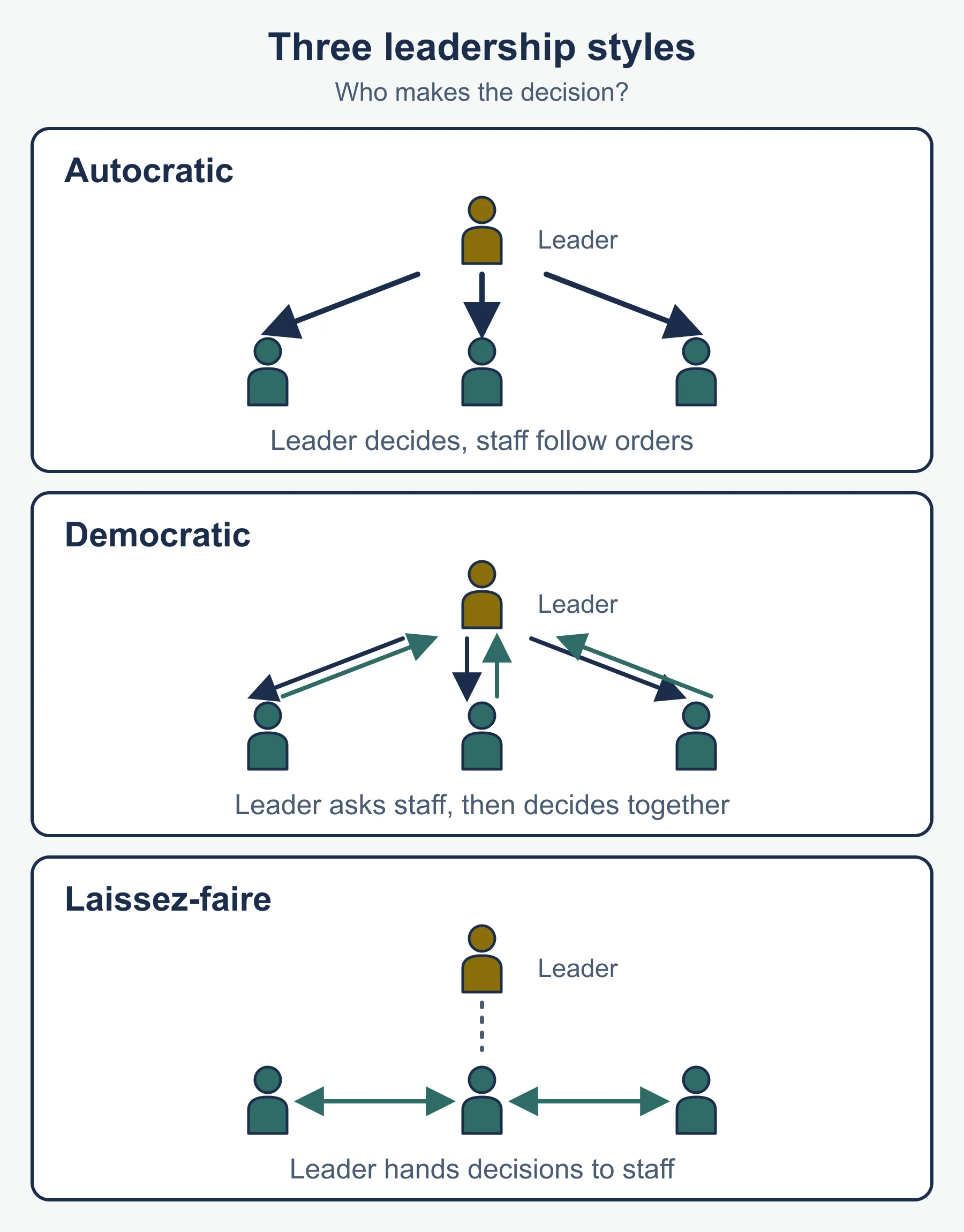
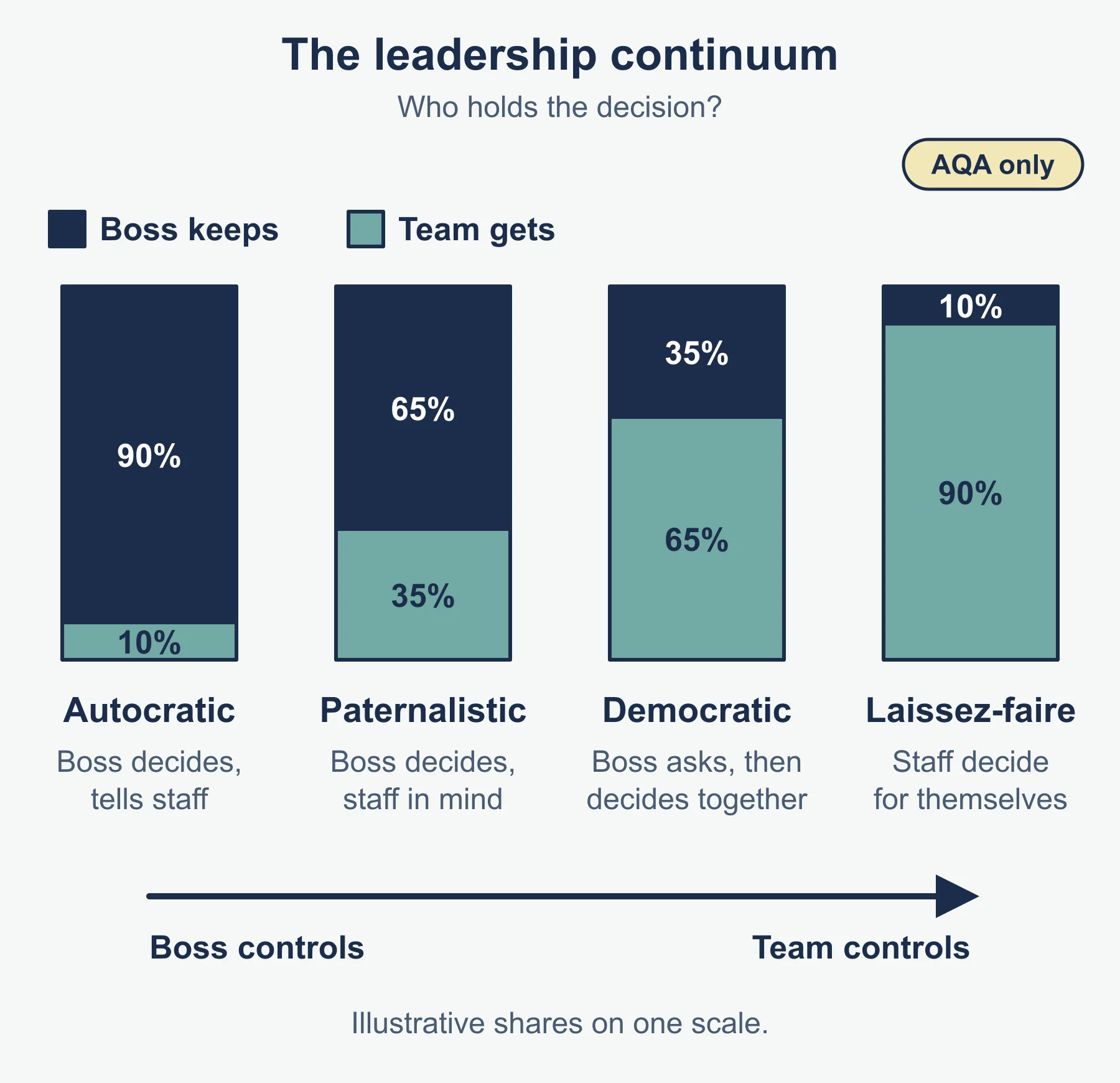
| Autocratic | Manager alone | Crisis; inexperienced staff | Low morale, lost ideas |
| Democratic | Manager after consulting | Skilled staff; complex choices | Slow |
| Laissez-faire | Staff themselves | Expert, self-motivated team | Drift, no direction |
| Paternalistic | Manager, with explained concern for welfare | Staff valuing security | Seen as patronising |
McGregor
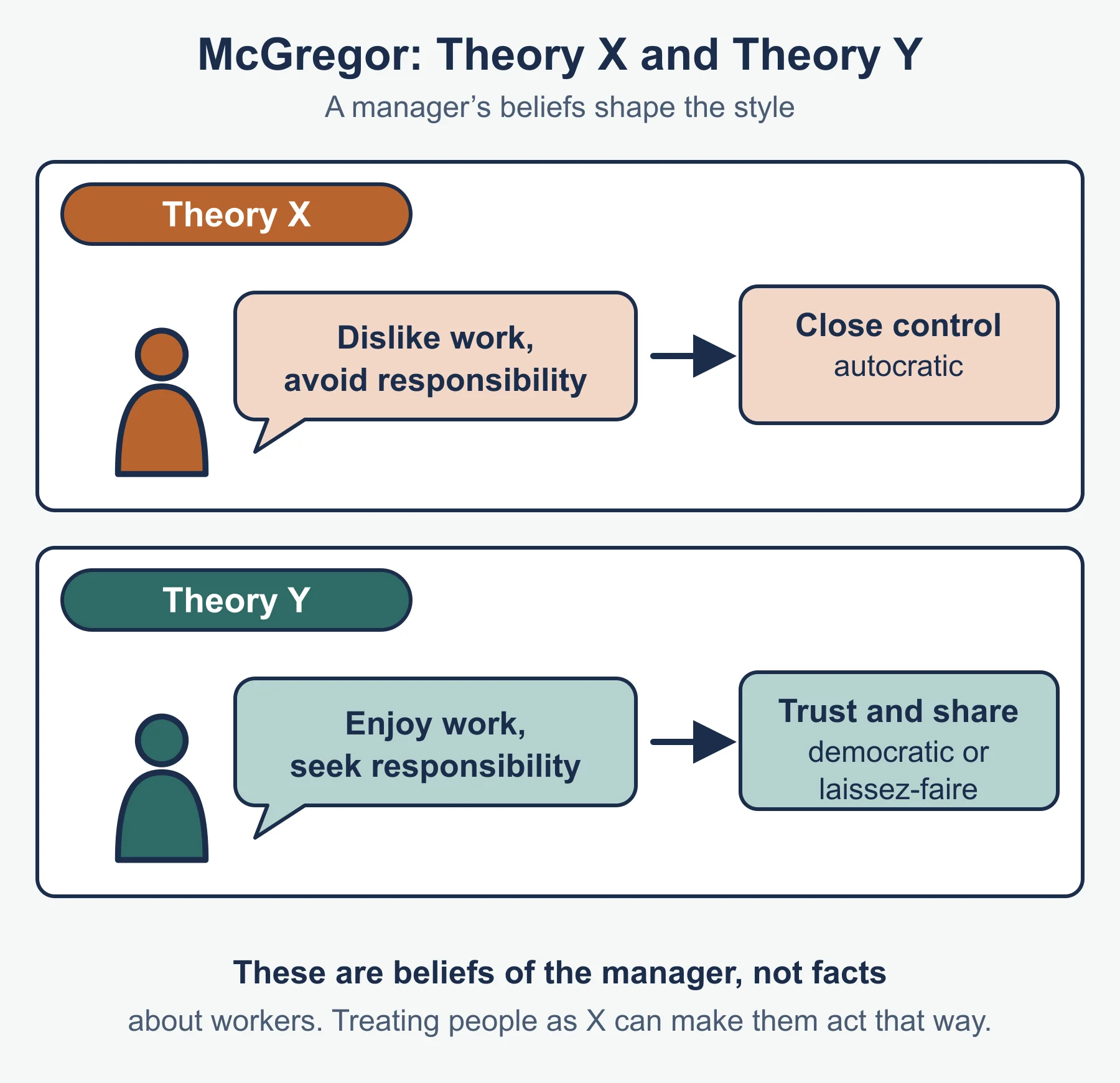
| Theory X manager | Theory Y manager |
|---|---|
| Assumes people dislike work and avoid responsibility | Assumes people can enjoy work and seek responsibility |
| Close control, rules, pay as the lever | Delegation, trust, involvement |
| Usually autocratic | Usually democratic or laissez-faire |
These are a manager’s beliefs, not facts about staff.
Applying theories to a case
| Evidence in the case | Theory to use | Likely advice |
|---|---|---|
| Staff say they feel invisible and unheard | Mayo, Herzberg (recognition) | Consultation, praise, team meetings |
| Complaints about pay and rest areas, not about the work | Herzberg hygiene factors | Fix them, then add motivators |
| One lower-level need is clearly unmet | Maslow | Meet it before offering higher rewards |
| Staff differ widely in what they want | McClelland | Offer a choice of tasks and rewards |
| Staff doubt that effort will be rewarded | Vroom (instrumentality) | Make the link between performance and reward visible |
| Output is simple, countable and repetitive | Taylor | Piece rate, with quality checks |
Evaluation prompts
- Does the workforce respond more to money or to responsibility?
- Is the cost of the method lower than the gain in output or retention?
- Will the effect last, or fade once the novelty ends?
- Could the method cause a problem such as lower quality or resentment?
- What is the time frame: a quick fix or a lasting change?
- Is there a better alternative for this particular group of employees?
A judgement uses your answers to these prompts. Say which is most important in this case, and why.
Must-know distinctions
- Content theory (what motivates) against process theory (how motivation is formed).
- Hygiene factor (prevents dissatisfaction) against motivator (creates satisfaction).
- Job re-design (any change to tasks) against job enrichment (more responsibility and decisions).
- Empowerment (authority to act in the job) against participation (a say in wider decisions).
- Profit sharing (whole team) against PRP (the individual).
- Paternalistic (decides, explains, cares) against democratic (consults and shares the decision).
- Fayol (principles) against Mintzberg (observed roles).
Quick self-test
- State the five levels in Maslow’s hierarchy, from lowest to highest.
- Classify as hygiene factor or motivator: (a) job security, (b) recognition.
- Identify the three needs in McClelland’s theory.
- A worker is paid £0.75 per unit and makes 620 units. Calculate pay.
- A salesperson earns 5% commission on £8,000 of sales. Calculate the commission.
- State what Vroom means by valence.
- A Theory Y manager is most likely to use which style?
- Name the four traditional functions of a manager.
- Give one reason why profit sharing may do little to raise an individual’s effort.
- Name the three groups of Mintzberg’s roles.
Answers
- Physiological, safety, social, esteem, self-actualisation.
- (a) Hygiene factor. (b) Motivator.
- Achievement, affiliation and power.
- 620 × 0.75 = £465.
- 0.05 × 8,000 = £400.
- How much the individual values the reward on offer.
- Democratic or laissez-faire.
- Planning, organising, directing, controlling.
- Each person’s share depends on the whole business’s profit, so one person’s extra effort changes the pay very little.
- Interpersonal, informational, decisional.
Where marks are usually lost
- Listing theories without linking them to the employees in the case.
- Naming a pay method without saying why it fits this workforce.
- Treating money as either always or never a motivator.
- Mixing up hygiene factors and motivators, especially pay.
- Writing “the manager caused the improvement” when the case offers another explanation.
- Calling every consultation democratic management, when the manager may still decide alone.
- A calculation with no working or no unit.
- Evaluation answers that list advantages and disadvantages but never reach a judgement.
Frequently asked questions
What is the difference between content and process theories of motivation? Content theories, such as Taylor, Mayo, Maslow, Herzberg and McClelland, explain what motivates people. Vroom’s expectancy theory is a process theory: it explains how motivation is formed.
How do you calculate motivational force in Vroom’s theory? The standard form multiplies expectancy by instrumentality by valence. If any one of the three scores is zero, the motivational force is zero.
What is the difference between Fayol and Mintzberg? Fayol set out principles of what managers should do, as elements of management. Mintzberg observed what managers actually do and grouped it into ten roles: interpersonal, informational and decisional.
What is the difference between Theory X and Theory Y managers? A Theory X manager assumes people dislike work and avoid responsibility, so uses close control and pay. A Theory Y manager assumes people can enjoy work and seek responsibility, so uses delegation and trust. These are a manager’s beliefs, not facts about staff.
Official syllabus
Cambridge International AS & A Level Business 9609, syllabus for examination in 2026, 2027 and 2028, published by Cambridge University Press & Assessment, sections 2.2.1 to 2.3.1.
Get free revision emails (optional)
Occasional emails with practice questions, worked explanations and links to free resources for the qualification and subjects you choose. No spam, and you can unsubscribe from any email. The free tools on this site never need an email.
Related resources
-
Study guides
A Level Business: Organisational structure and Business communication (Cambridge 9609)
Study guide to 7.1 Organisational structure and 7.2 Business communication in Cambridge A Level Business, with worked examples on span and delayering.
Business · Cambridge · A Level
Read guide -
Practice questions
A Level Business: Organisational structure and Business communication (Cambridge 9609) – Practice Questions
Original practice questions with worked answers on organisational structure and business communication for Cambridge A Level Business.
Business · Cambridge · A Level
Try questions -
Revision notes
A Level Business: Organisational structure and Business communication (Cambridge 9609) – Revision Notes
Condensed revision notes for 7.1 Organisational structure and 7.2 Business communication in Cambridge A Level Business, with a self-test.
Business · Cambridge · A Level
Revise topic
Related articles
-
teaching
A Level tuition in Dubai: Cambridge or Pearson Edexcel International A Level?
Schools in Dubai and Abu Dhabi teach either Cambridge International AS & A Level or Pearson Edexcel International A Level. How the two are structured, why it matters for tuition, and how online classes from Lahore work.
9 October 2026
-
curriculum guides
Choosing subjects at IGCSE and A Level
How subject choices at 14 and 16 affect university options later, and how to keep pathways open without overloading a timetable.
28 July 2026
Studying this with a teacher
Working through Business AS LEVEL?
This page is free and stays free. If you would rather be taught it, Marlbridge runs Business classes one-to-one and in small groups of up to 15, online in your own time zone. The first trial class is free. WhatsApp replies within an hour (8am–11pm Pakistan time, every day); email the same day.
Cambridge Business teachers at Marlbridge

