
Study Guides
A Level Business: The nature of operations (Cambridge 9609)
Study guide to the nature of operations for Cambridge AS & A Level Business: added value, productivity, sustainability and operations methods.
- Subject
- Business
- Level
- AS LEVEL
- Topic
- Operations management
- Author
- Marlbridge Academic Team
- Updated
- Reviewed by
- Salman Ahmad (what this means)
Aligned to Cambridge A Level Business (9609), For examination in 2026, 2027 and 2028. Official specification .
Syllabus page (what it covers and how it is assessed): Cambridge A Level Business.
Syllabus points this page covers
9609 (AS Level)
- 4.1 The nature of operations
Found an error? Report a correction.
Need help with this topic? Request a free trial class for A Level Business (9609).
This guide follows the Cambridge International AS & A Level Business 9609 syllabus for examination in 2026, 2027 and 2028. It covers section 4.1, The nature of operations, which is AS Level content (topic 4, Operations management). The syllabus says AS content is assumed knowledge in the A Level case-study papers, so it stays useful for the full A Level.
The same section has a revision notes page and a practice set. Section 4.2 (inventory, capacity and just in time) is covered by the existing operations practice questions. Course links: Cambridge A Level Business hub, the printable checklist and the free diagnostics.
What 4.1 asks you to do
| Syllabus point | Skills the syllabus expects |
|---|---|
| 4.1.1 The transformational process | Use the factors of production: land, labour, capital and enterprise. Describe the stages from inputs to outputs. Explain how operations contribute to added value. |
| 4.1.2 Efficiency, effectiveness, productivity and sustainability | Explain why each matters. Measure labour productivity. Assess the impact of measures to improve the sustainability of operations. |
| 4.1.3 Capital intensive and labour intensive operations | Give the benefits and limitations of each. |
| 4.1.4 Operations methods | Compare job, batch, flow and mass customisation, with advantages and disadvantages of each, and the problems of changing from one method to another. |
4.1.1 The transformational process
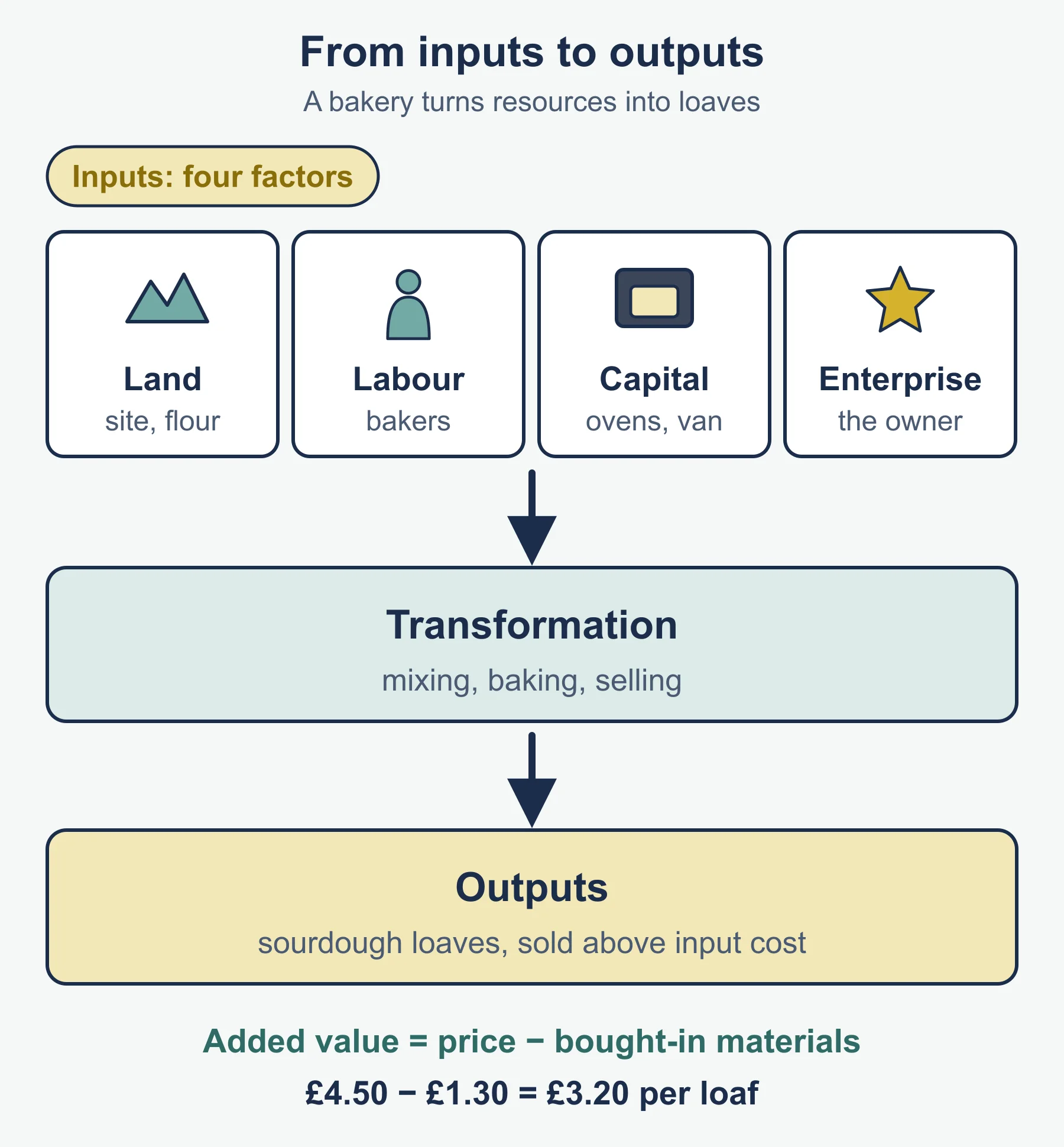
Operations is the part of a business that turns resources into the goods or services customers buy. The process has three stages.
- Inputs: the resources put in, such as raw materials, components, staff time, machines, energy and finance.
- Transformation: the work that changes the inputs, such as baking, assembling, cutting, treating a patient or processing a loan.
- Outputs: the finished goods or completed services that go to customers.
Services follow the same pattern. A hairdresser’s inputs are staff skill, premises, products and the customer’s time. The output is the finished haircut.
Factors of production
The syllabus names four. Learn each with an example drawn from the business in the question.
| Factor | Meaning | Example in a bakery |
|---|---|---|
| Land | Natural resources and the site the business uses | The shop site, flour grown on farms, water |
| Labour | The human effort used in production | Bakers, shop assistants, delivery drivers |
| Capital | Man-made resources used to produce | Ovens, mixers, vans, the building fit-out |
| Enterprise | Organising the other factors and taking the risk | The owner who starts the bakery and risks savings |
Exam answers often lose marks by listing the four factors without applying them. Name the actual oven, worker or site.
Added value
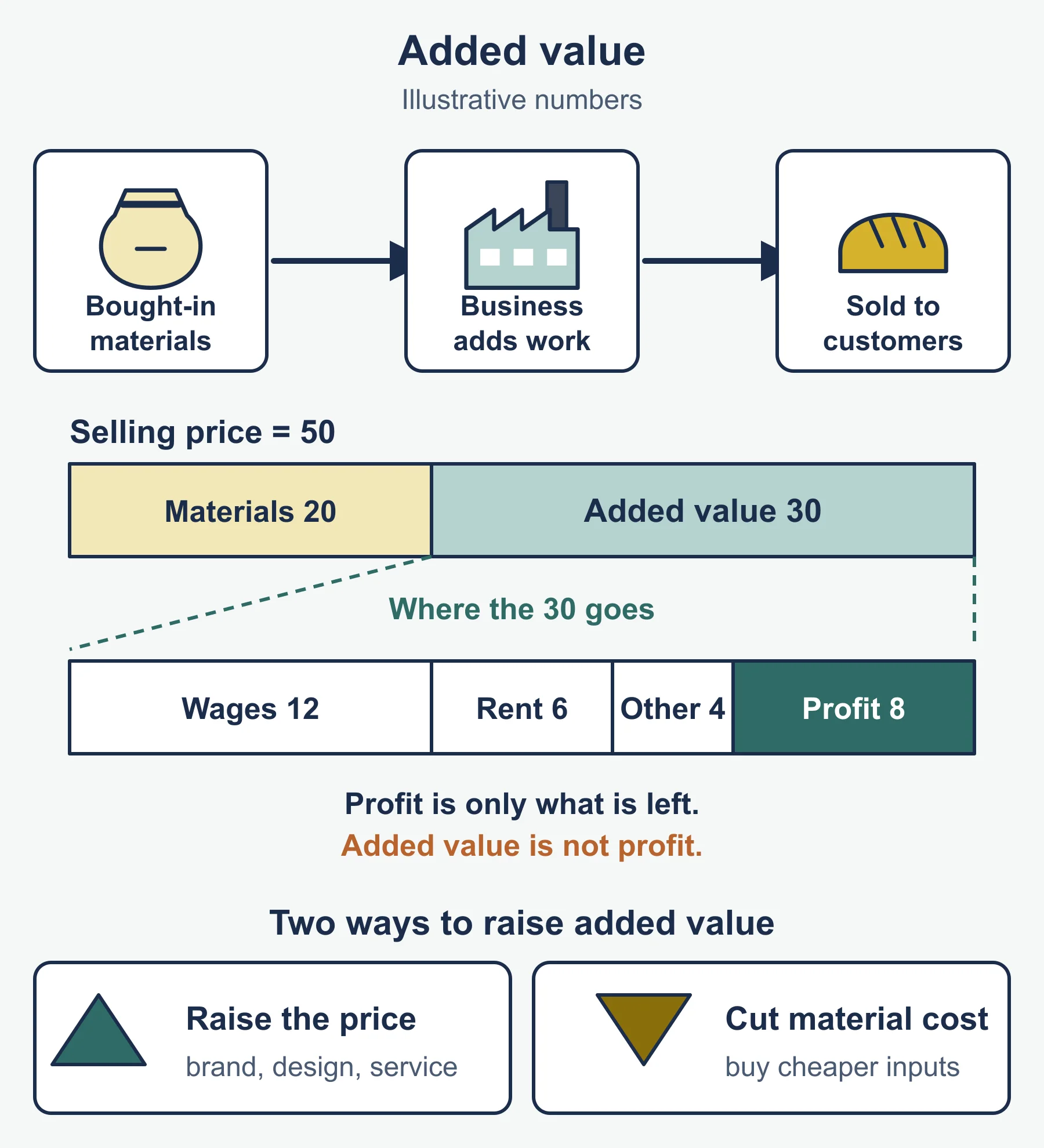
Added value is what is left of a product’s selling price once you take away the cost of the materials and components bought in to make it. That is the standard definition, and the syllabus point asks how operations contribute to it. Operations add value by transforming cheap inputs into something customers pay more for.
Worked example. Stainby Bakehouse sells a sourdough loaf for £4.50. Flour, yeast, salt and packaging bought in cost £1.30 per loaf.
- Added value per loaf = £4.50 - £1.30 = £3.20.
- At 2,500 loaves a week, added value = 2,500 x £3.20 = £8,000.
- As a share of the selling price: 3.20 / 4.50 x 100 = 71.1%.
Added value is not profit. The £8,000 must still pay wages, rent, energy and other costs. A business can raise added value by raising the price customers will accept (better quality, branding, service) or by buying in cheaper inputs. If Stainby could charge £4.80 for the same loaf with the same input cost, added value would rise to £3.50.
4.1.2 Efficiency, effectiveness, productivity and sustainability
The syllabus asks for the importance of all four, so give each a plain meaning and a reason it matters.
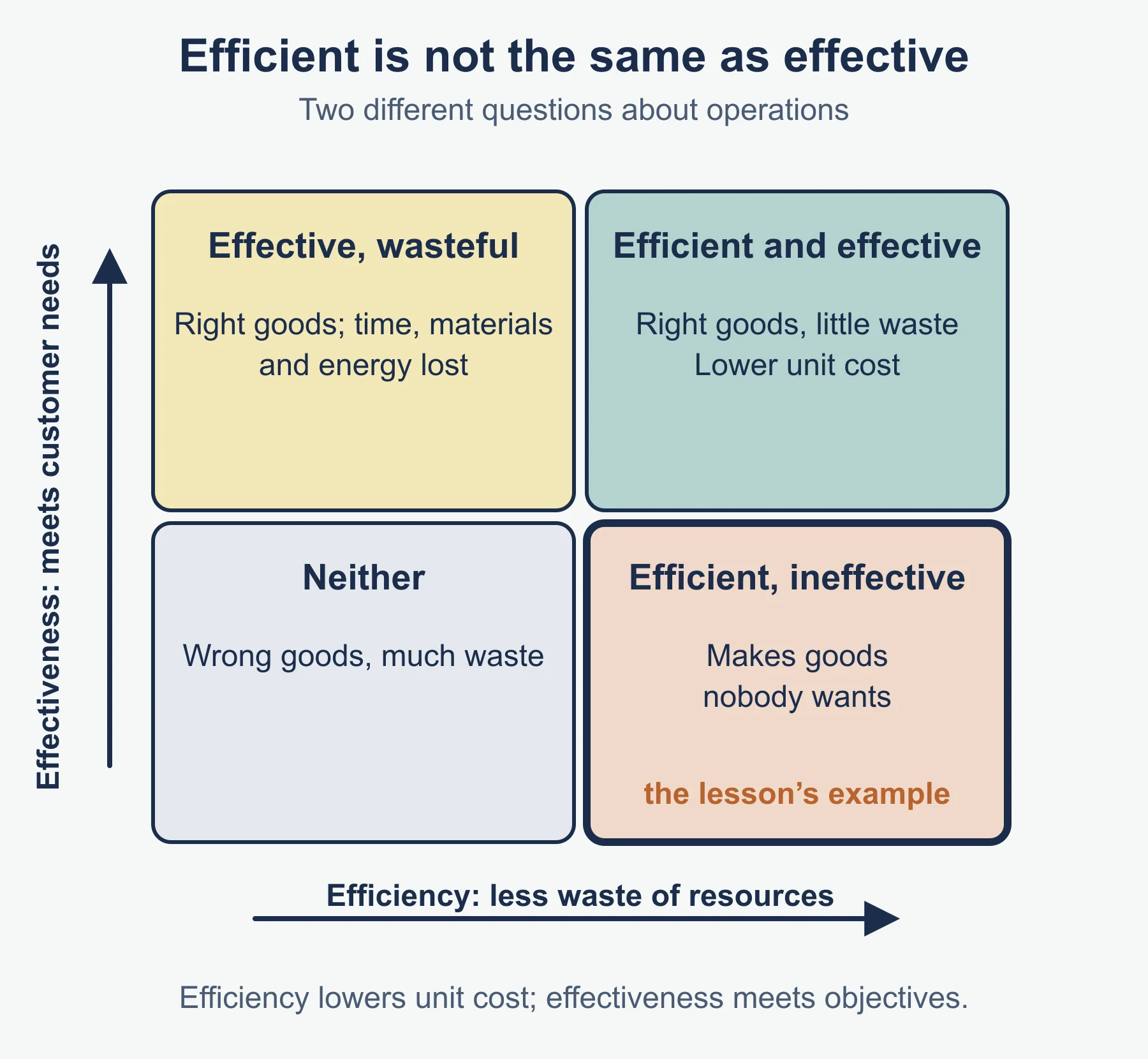
- Efficiency: producing output with the least waste of resources such as time, materials and energy. It lowers unit costs.
- Effectiveness: achieving what the business set out to do, such as meeting customer needs and its objectives. A very efficient factory can be ineffective if it makes goods nobody wants.
- Productivity: the amount of output produced from the inputs used. Higher productivity usually means lower cost per unit.
- Sustainability: operating in a way that does not use up resources or damage the environment, so the business can keep operating in future.
Measuring labour productivity
The standard form is:
labour productivity = output in a period / number of employees in that period
You can also divide by hours worked, which is useful when staff work different hours.
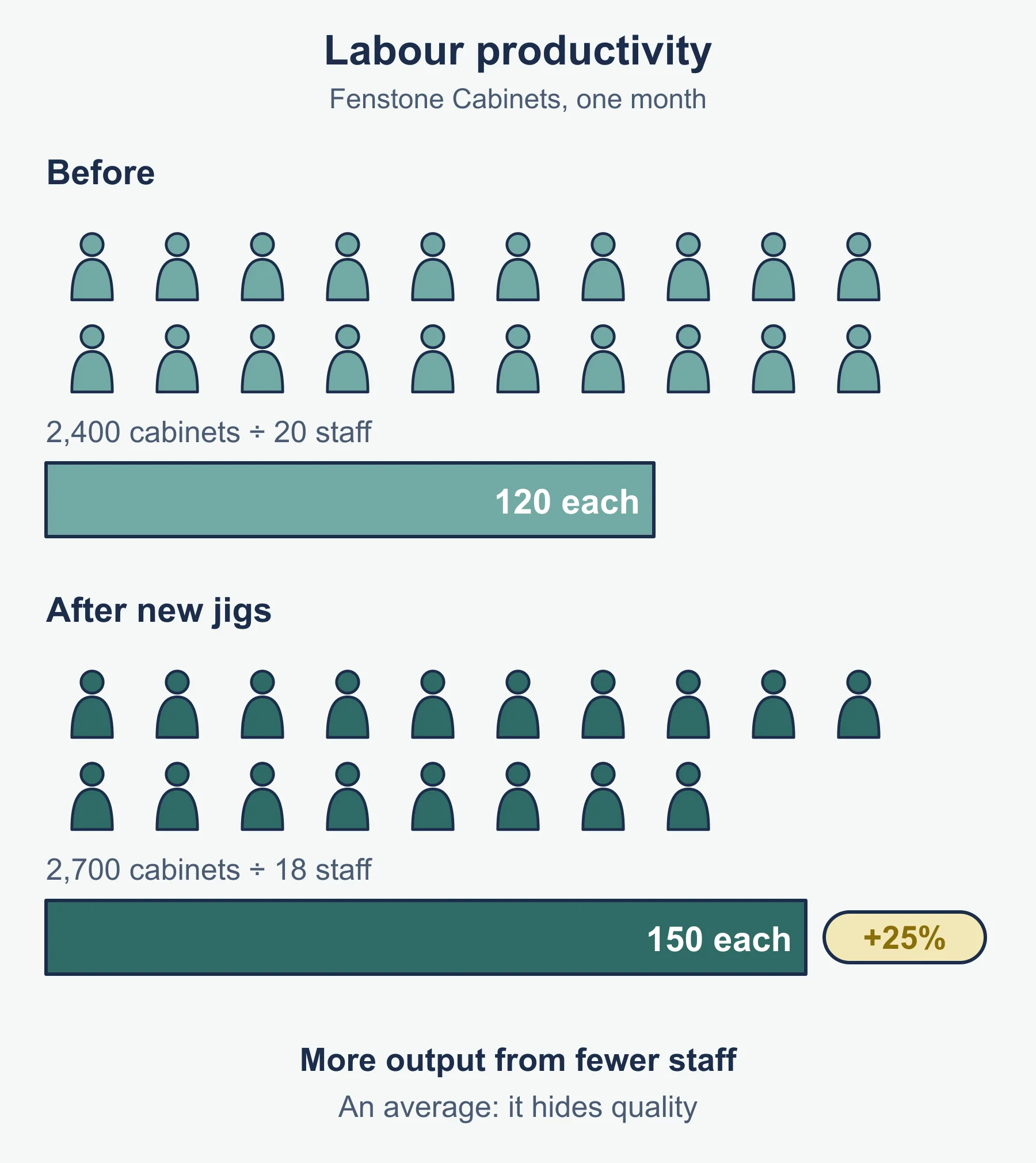
Worked example. Fenstone Cabinets made 2,400 cabinets in a month with 20 staff. After buying jigs that speed up assembly, it made 2,700 with 18 staff.
- Before: 2,400 / 20 = 120 cabinets per employee.
- After: 2,700 / 18 = 150 cabinets per employee.
- Change: (150 - 120) / 120 x 100 = +25%.
Higher productivity can lower labour cost per unit. Output rises while fewer staff are needed. But the figure is an average. It does not show quality, and it can rise because of new machinery, not because staff work harder.
Sustainability: impact of measures
Measures include cutting energy use, recycling or reusing waste, using renewable energy and sourcing materials responsibly. The syllabus asks for their impact on the business, so weigh both sides.
| Possible impacts | Examples |
|---|---|
| Costs may fall | Lower energy bills, less waste to dispose of |
| Costs may rise at first | Equipment, new suppliers, staff training |
| Image and demand | Customers who value sustainability may buy more |
| Regulation and risk | Fewer problems with rules and local objections |
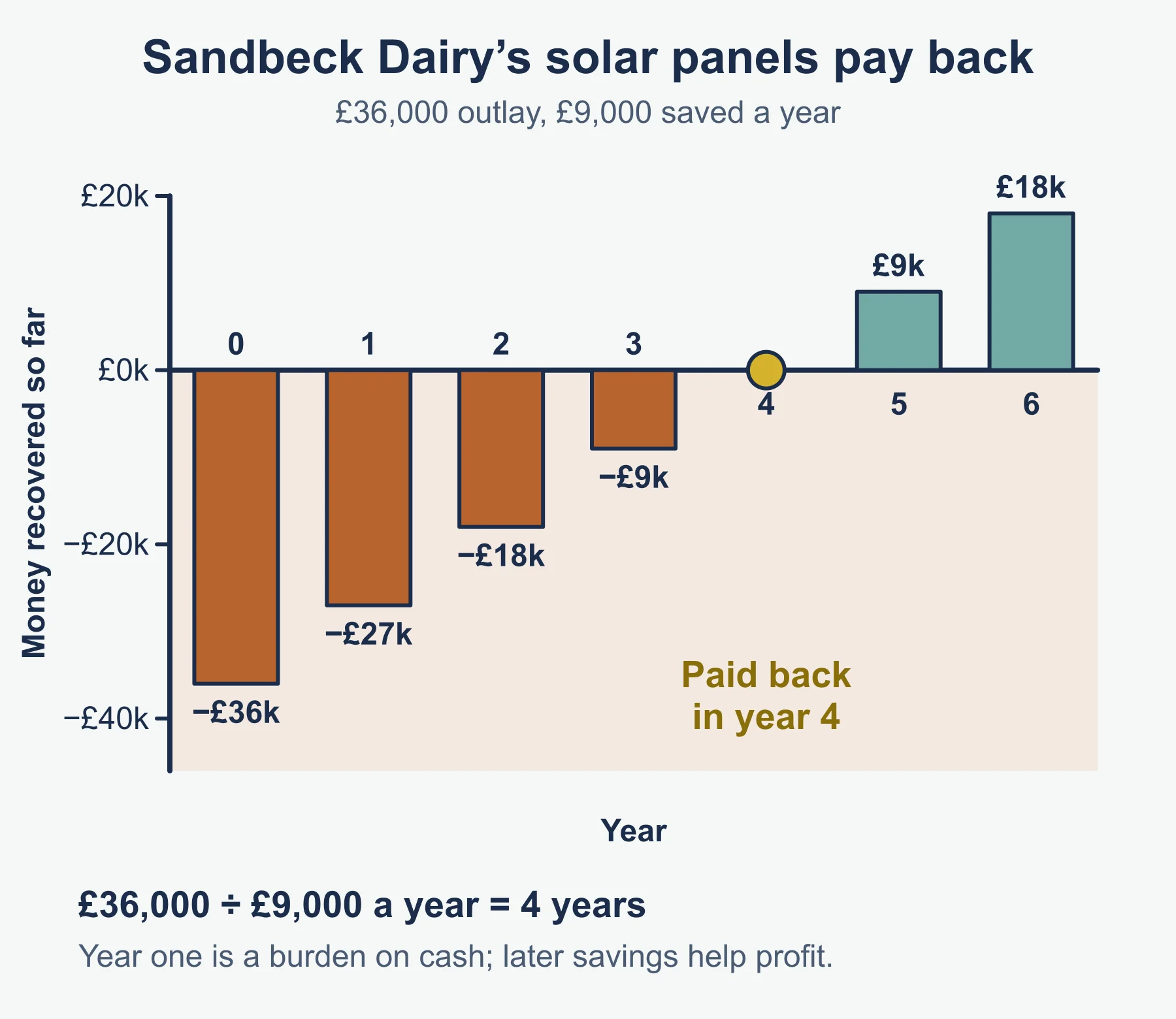
Worked example. Sandbeck Dairy spends £36,000 on solar panels and saves £9,000 a year on electricity. It recovers the outlay in 36,000 / 9,000 = 4 years. In year one the cost is a burden on cash. Later the saving helps profit. The decision depends on whether the dairy can fund the outlay and expects to stay on the site long enough.
4.1.3 Capital intensive and labour intensive operations
A capital intensive business relies mainly on machinery and technology. A labour intensive business relies mainly on people. Most businesses use both. The question is which dominates.
| Benefits | Limitations | |
|---|---|---|
| Capital intensive | Lower variable cost per unit at high output. Consistent quality. Can run long hours. | High fixed costs and set-up cost. Hard to change products. Breakdowns can halt output. Output must be high to pay off. |
| Labour intensive | Flexible. Can change products or customise. Personal service. Lower fixed costs. | Higher variable cost per unit. Quality varies. Wages rise over time. Output is limited by the number of staff. |
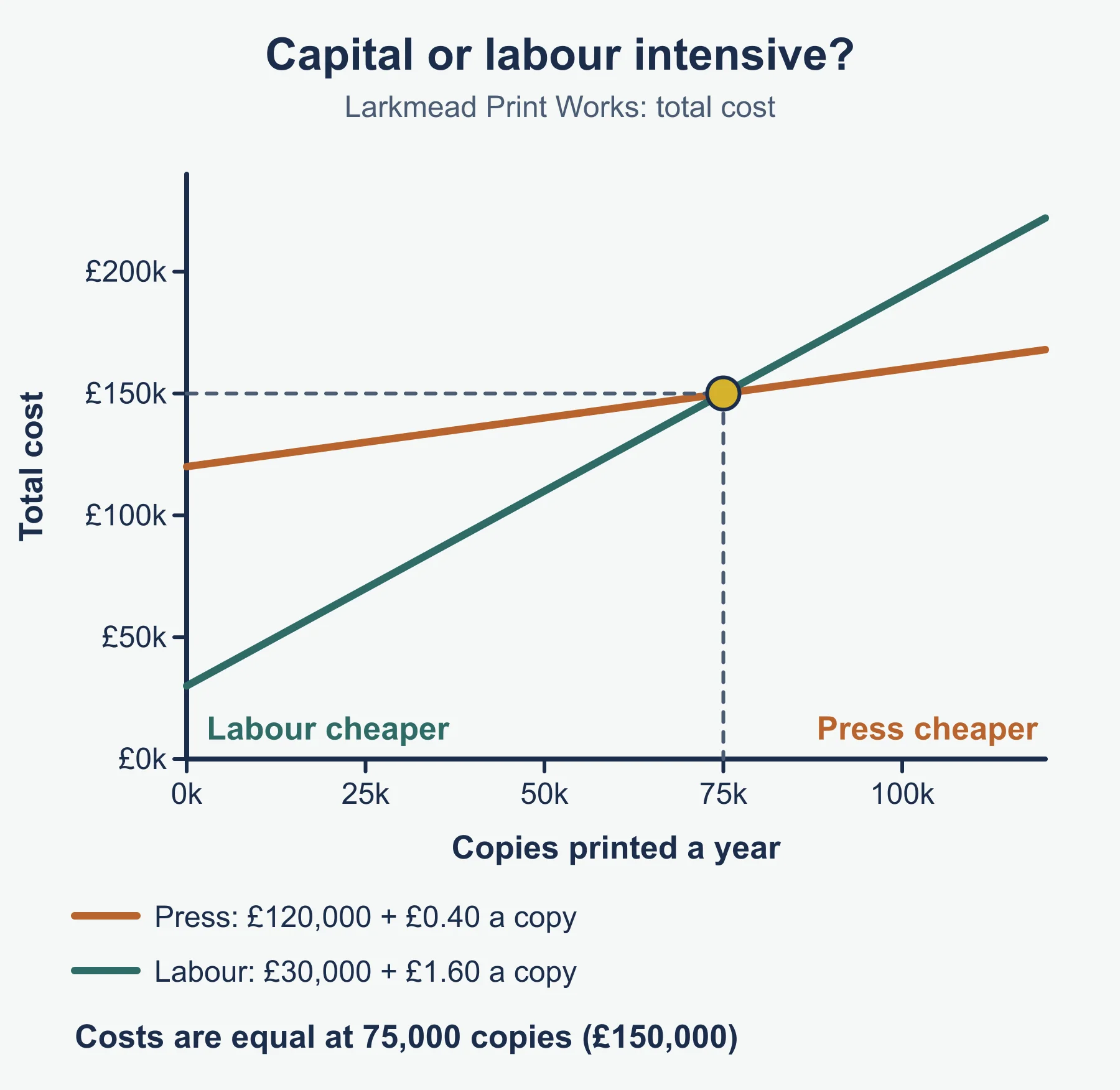
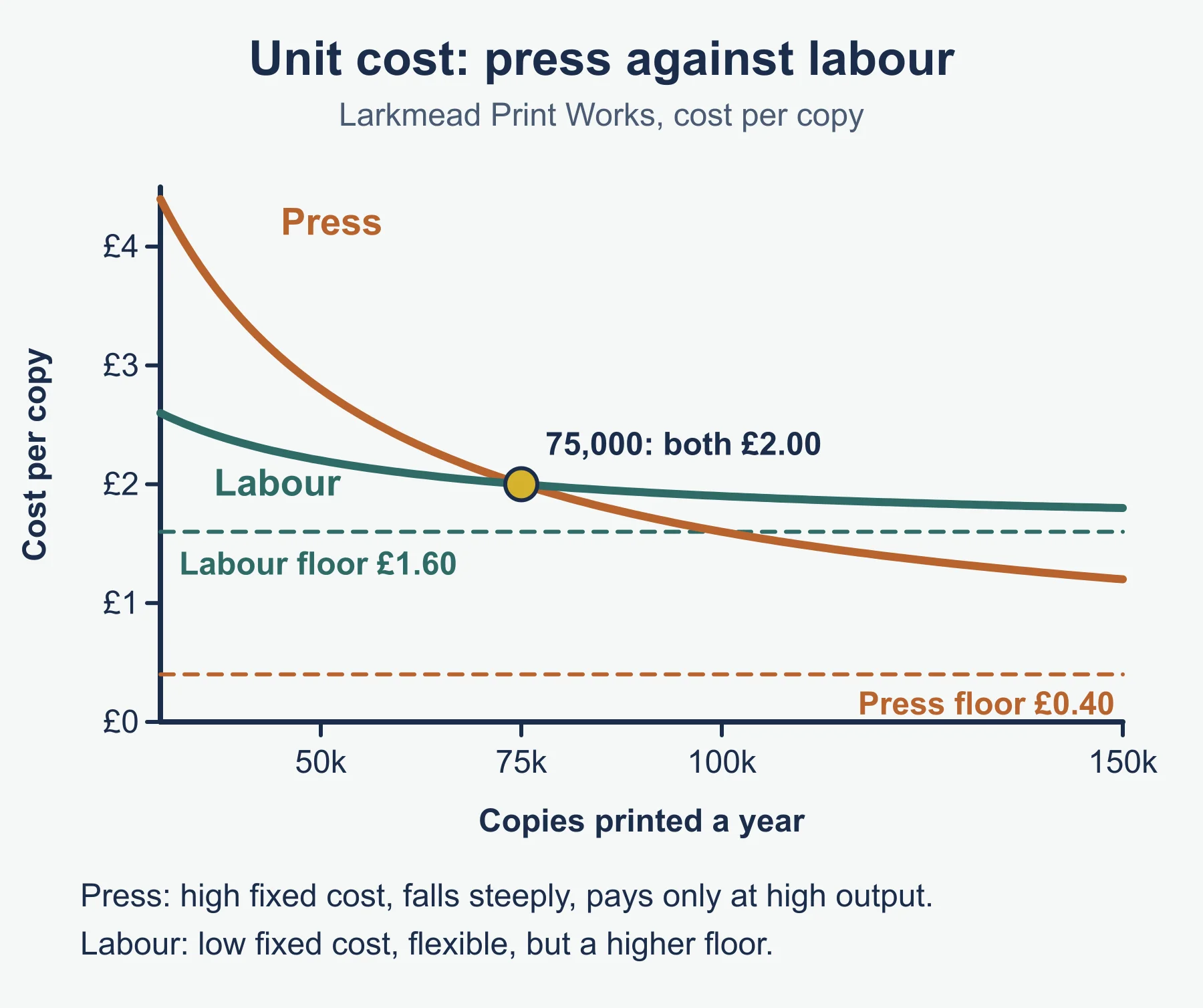
Worked example. Larkmead Print Works can run a capital intensive press, with fixed costs £120,000 a year and variable costs £0.40 a copy. The alternative is a labour intensive set-up with fixed costs £30,000 and variable costs £1.60 a copy.
- Total cost (press) = 120,000 + 0.40Q. Total cost (labour) = 30,000 + 1.60Q.
- Costs are equal when 120,000 + 0.40Q = 30,000 + 1.60Q. So 90,000 = 1.20Q, and Q = 75,000 copies.
- At 50,000 copies: press £140,000, labour £110,000. Labour is cheaper.
- At 100,000 copies: press £160,000, labour £190,000. The press is cheaper (unit cost £1.60 against £1.90).
Judgement: if Larkmead expects well over 75,000 copies a year, the press is cheaper. If demand is uncertain or the work varies, the lower fixed cost and flexibility of labour may be the safer choice. Always link your advice to the figures and the stated demand.
4.1.4 Operations methods
| Method | What it is | Advantages | Disadvantages |
|---|---|---|---|
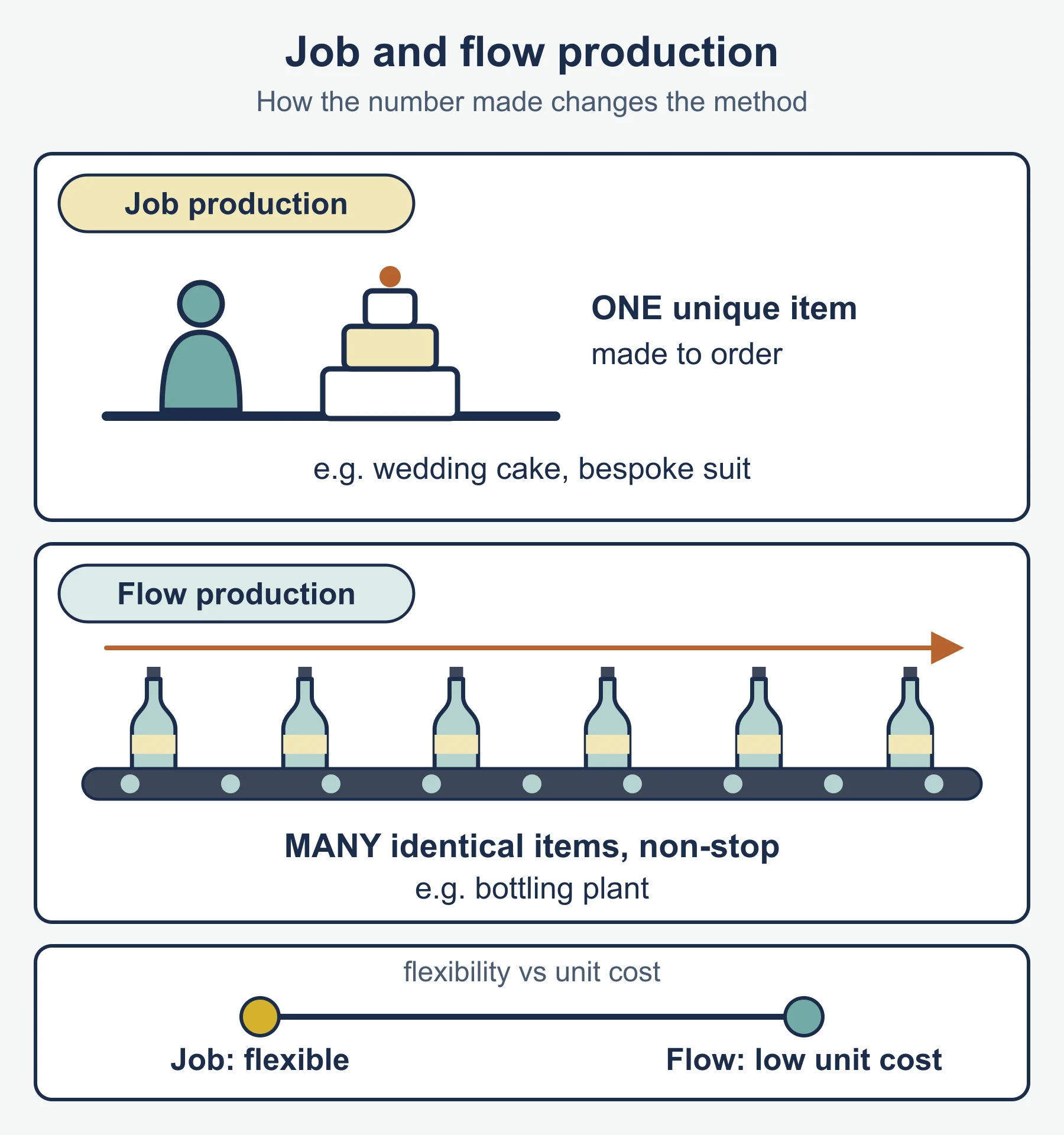
| Job | One-off, made to a customer’s own specification | High quality. Flexible. Can charge a premium. Motivating, skilled work. | Slow. High cost per unit. Needs skilled labour. Hard to plan. |
| Batch | A group of identical items made together, then the process switches to another batch | Some flexibility. Cost per unit lower than job. Can switch products. | Time lost changing between batches. Work-in-progress between stages. Less efficient than flow. |
| Flow | Continuous production of standardised items, often mass production, along a line | Lowest unit cost at high volume. Can run all day. Easy to control. | Very high set-up cost. Inflexible. Repetitive work can demotivate. Stoppages are costly. |
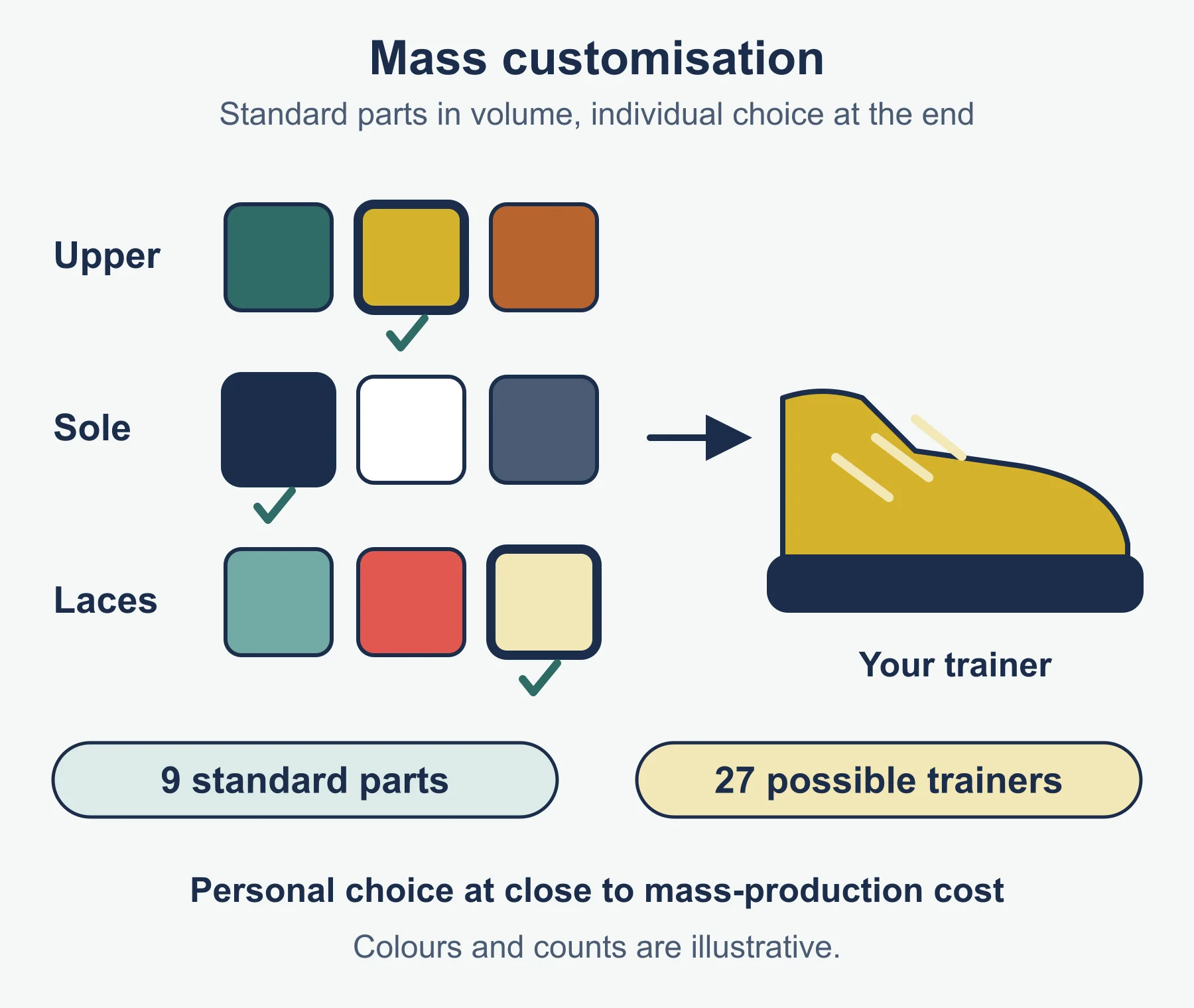
| Mass customisation | Producing standardised parts in volume but combining them to meet individual customer choices | Customers get personal choice at close to mass-production cost. Can charge more. | Needs flexible systems and technology. Complex to manage. Customers wait for their order. |
Examples: a made-to-measure suit is job production. A bakery making 500 rolls then 300 cakes is batch. A canning line is flow. A website where you choose the colours of your trainers is mass customisation.
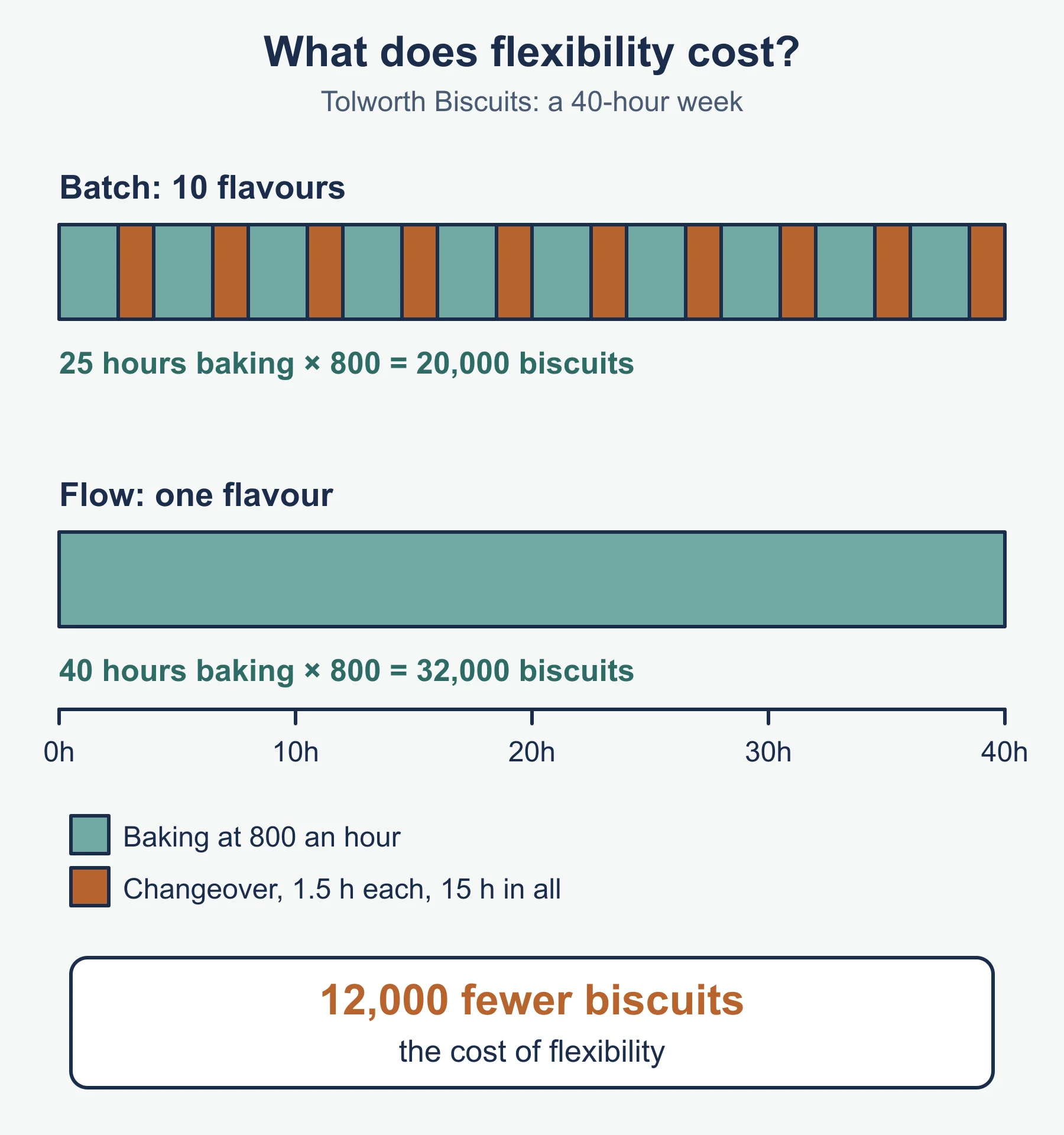
Worked example (batch against flow). Tolworth Biscuits has a baking line that can run 40 hours a week and makes 800 biscuits an hour. Under batch production it switches between 10 flavour runs a week, and each changeover takes 1.5 hours.
- Time lost = 10 x 1.5 = 15 hours. Production time = 40 - 15 = 25 hours, which is 62.5% of the week.
- Output = 25 x 800 = 20,000 biscuits.
- If the line made one flavour with no changeovers, output would be 40 x 800 = 32,000 biscuits, which is 12,000 more.
That gap is the cost of flexibility. Tolworth must decide if the choice of flavours earns enough extra revenue to justify it.
Problems of changing method
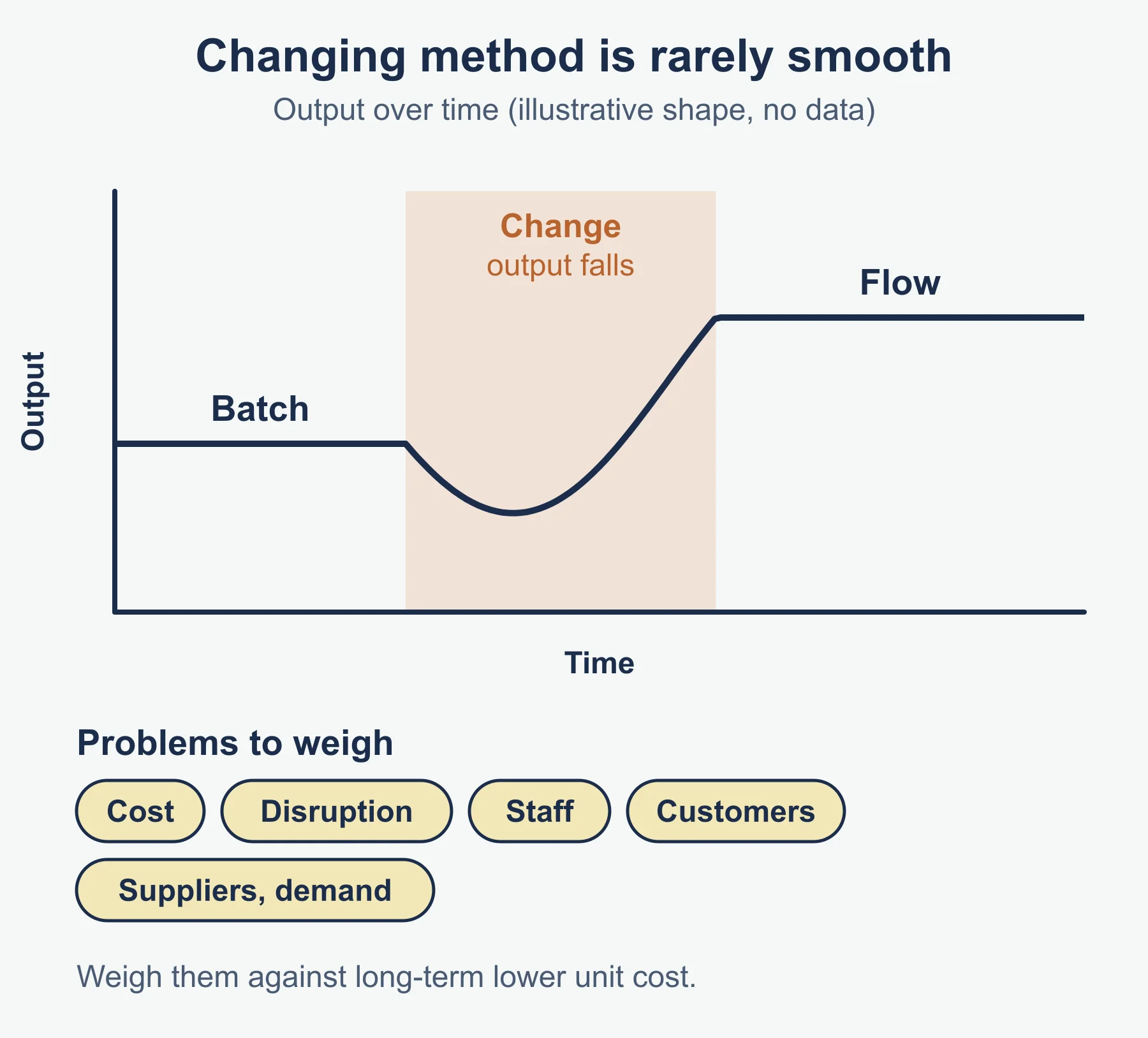
Moving from one method to another is rarely easy. Common problems:
- Cost: new machinery, layout changes and training.
- Disruption: output may fall while the change happens.
- Staff: new skills are needed, jobs may go or change, and resistance is likely. Craft workers may lose job satisfaction when moving towards flow.
- Quality and customers: a business known for bespoke work may lose its reputation if it moves to standard products.
- Supply and demand: suppliers may need to deliver differently, and the market must be large enough for higher output.
A good evaluation weighs these against long-term benefits such as lower unit cost. It also considers timing: a change in a quiet period costs less.
Common errors
- Defining added value as profit.
- Listing factors of production with no link to the business in the question.
- Treating productivity and production as the same thing. Production is the total output. Productivity is output per input.
- Saying capital intensive is always cheaper. It is cheaper per unit only at high enough output.
- Saying labour intensive means no machines at all.
- Describing batch production as “small scale flow”. The key feature is the switch between batches.
- Giving advantages and disadvantages with no reference to the business, its product, its volume or its customers.
Frequently asked questions
What is the transformational process in operations? Inputs, such as materials, staff time and machines, are transformed through work such as baking or assembling into outputs: finished goods or completed services. Services follow the same pattern.
What is mass customisation? Mass customisation means producing standardised parts in volume but combining them to meet individual customer choices, giving variety at a lower cost than job production.
When is capital intensive production cheaper than labour intensive? Only above the output at which their total costs are equal. Below that output, the option with lower fixed costs is cheaper; above it, the option with lower variable cost per unit wins.
What problems arise when a business changes its operations method? The cost of new machinery, layout changes and training, disruption to output, staff resistance and new skills, risk to quality or brand image, and the need for suppliers and demand to support the new method.
Official syllabus
Cambridge International AS & A Level Business 9609 syllabus, for examination in 2026, 2027 and 2028, published by Cambridge University Press & Assessment (Cambridge International). Section 4.1, The nature of operations.
Get free revision emails (optional)
Occasional emails with practice questions, worked explanations and links to free resources for the qualification and subjects you choose. No spam, and you can unsubscribe from any email. The free tools on this site never need an email.
Related resources
-
Practice questions
A Level Business: The nature of operations (Cambridge 9609) – Practice Questions
Original practice questions with worked answers on the nature of operations for Cambridge AS & A Level Business: productivity, methods and sustainability.
Business · Cambridge · AS Level
Try questions -
Revision notes
A Level Business: The nature of operations (Cambridge 9609) – Revision Notes
Condensed revision notes for Cambridge AS & A Level Business section 4.1: added value, productivity, sustainability and operations methods.
Business · Cambridge · AS Level
Revise topic -
Practice questions
A Level Business: Operations Management (A Level) — Practice Questions (Cambridge 9609)
Worked practice questions on TQM, quality assurance, kaizen, critical path analysis, location decisions and diseconomies of scale for Cambridge 9609 Business.
Business · Cambridge · A Level
Try questions
Related articles
-
teaching
A Level tuition in Dubai: Cambridge or Pearson Edexcel International A Level?
Schools in Dubai and Abu Dhabi teach either Cambridge International AS & A Level or Pearson Edexcel International A Level. How the two are structured, why it matters for tuition, and how online classes from Lahore work.
9 October 2026
-
curriculum guides
Choosing subjects at IGCSE and A Level
How subject choices at 14 and 16 affect university options later, and how to keep pathways open without overloading a timetable.
28 July 2026
Studying this with a teacher
Working through Business AS LEVEL?
This page is free and stays free. If you would rather be taught it, Marlbridge runs Business classes one-to-one and in small groups of up to 15, online in your own time zone. The first trial class is free. WhatsApp replies within an hour (8am–11pm Pakistan time, every day); email the same day.
Cambridge Business teachers at Marlbridge

