
Revision Notes
Cambridge International AS & A Level English Language (9093): Section B: Child Language Acquisition – Revision Notes
Recall notes for Cambridge 9093 Paper 3 Child Language Acquisition: stages to age 8, phonology, Halliday's functions, five theories and transcript notation.
- Subject
- English
- Level
- A LEVEL
- Topic
- Paper 3 – Language Analysis
- Author
- Marlbridge Academic Team
- Updated
- Reviewed by
- Ammar Bilal (what this means)
Aligned to Cambridge A Level English (9093), 2024-2026. Official specification .
Syllabus page (what it covers and how it is assessed): Cambridge A Level English Language.
Found an error? Report a correction.
Need help with this topic? Request a free trial class for A Level English Language (9093).
Condensed recall for Paper 3 Section B. For explanations and an annotated transcript, use the Child Language Acquisition study guide.
The task in brief
- One compulsory question, 25 marks, half of Paper 3.
- A transcript of a child or children aged 0-8, possibly with other speakers.
- Analyse how the speakers use language, with specific detail, linked to wider study.
- AO1, AO4, AO5.
Stages (ages approximate)
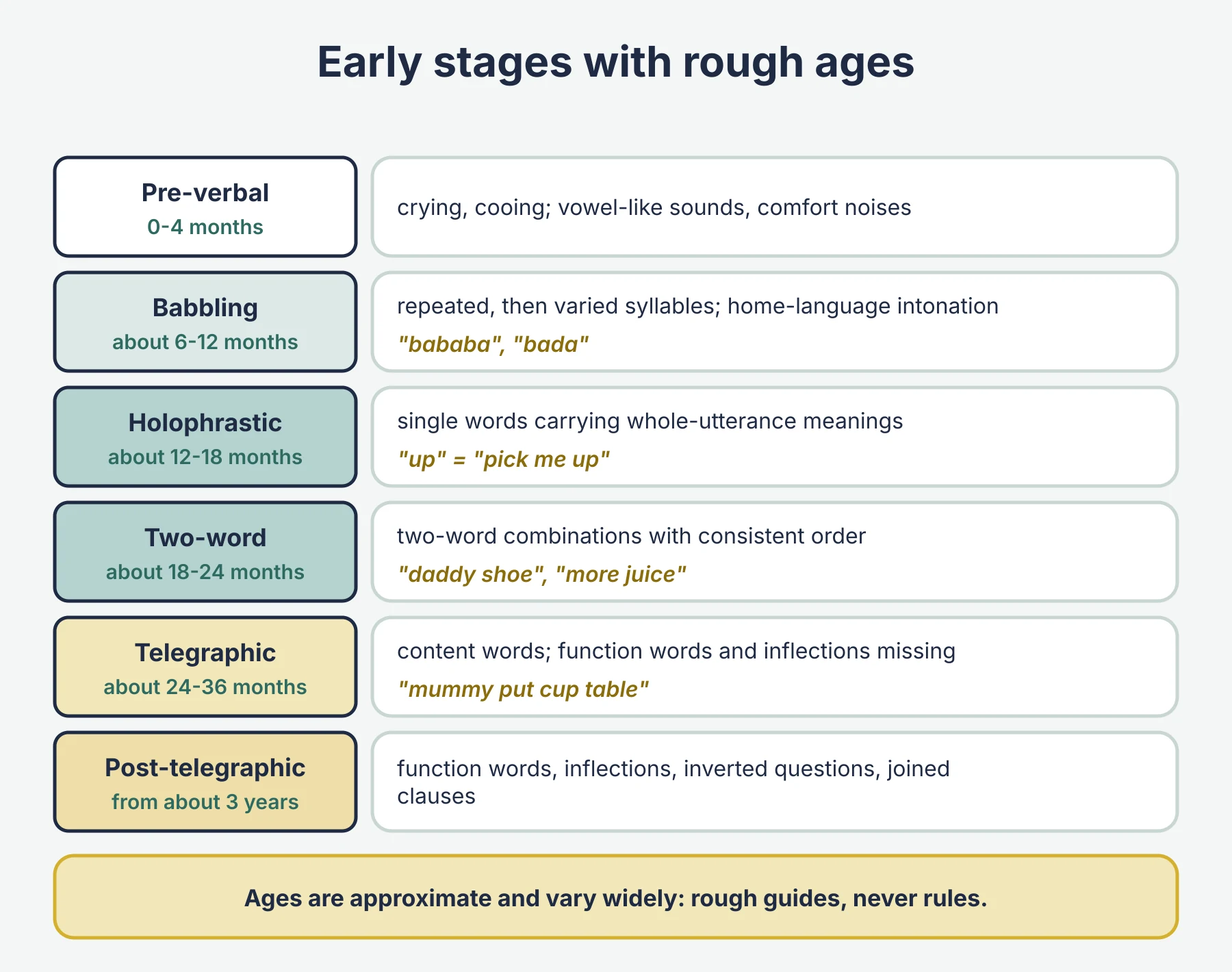
- Cooing (0-4 months) then babbling (about 6-12 months): reduplicated “mamama”, then variegated “madaba”.
- Holophrastic (about 12-18 months): one word, whole meaning.
- Two-word (about 18-24 months): “doggy bark”, consistent word order.
- Telegraphic (about 24-36 months): content words only, “baby want milk”.
- Post-telegraphic (3 years on): function words, inflections, inverted questions, subordinate clauses.
- Ages 4-8: complex sentences, narrative sequencing, pragmatic control, influence of schooling and reading.
Grammar to spot
- Overgeneralisation (virtuous error): “runned”, “foots”, “goodest”.
- Pronoun case: “me want”, “him did it”.
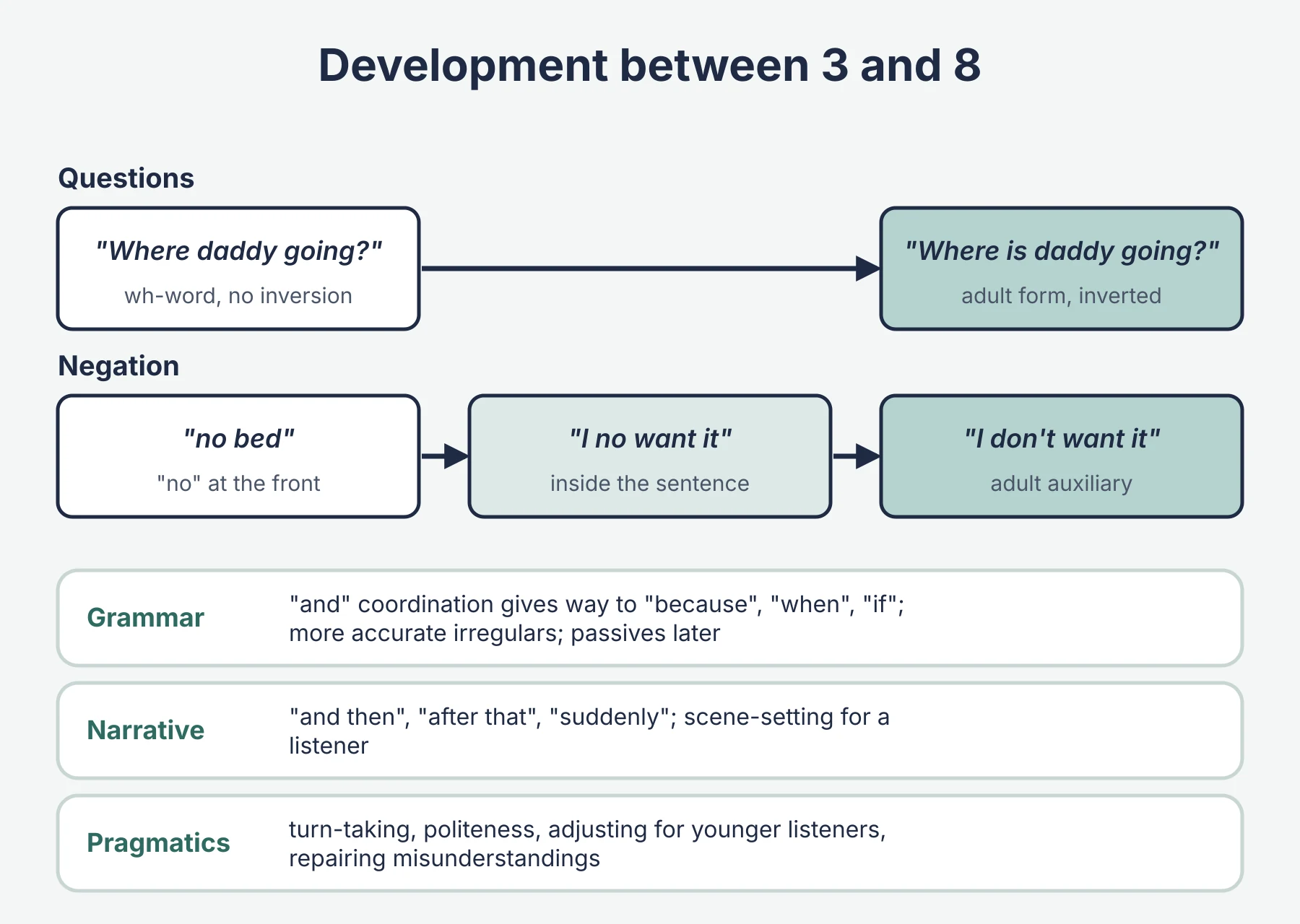
- Negation path: “no sleep” to “I no sleep” to “I don’t want to sleep”.
- Question path: rising intonation (“Mummy go?”) to “wh-” without inversion (“Where mummy go?”) to adult form.
- Coordination to subordination: “and… and… and” to “because”, “when”, “so that”.
Phonology to spot
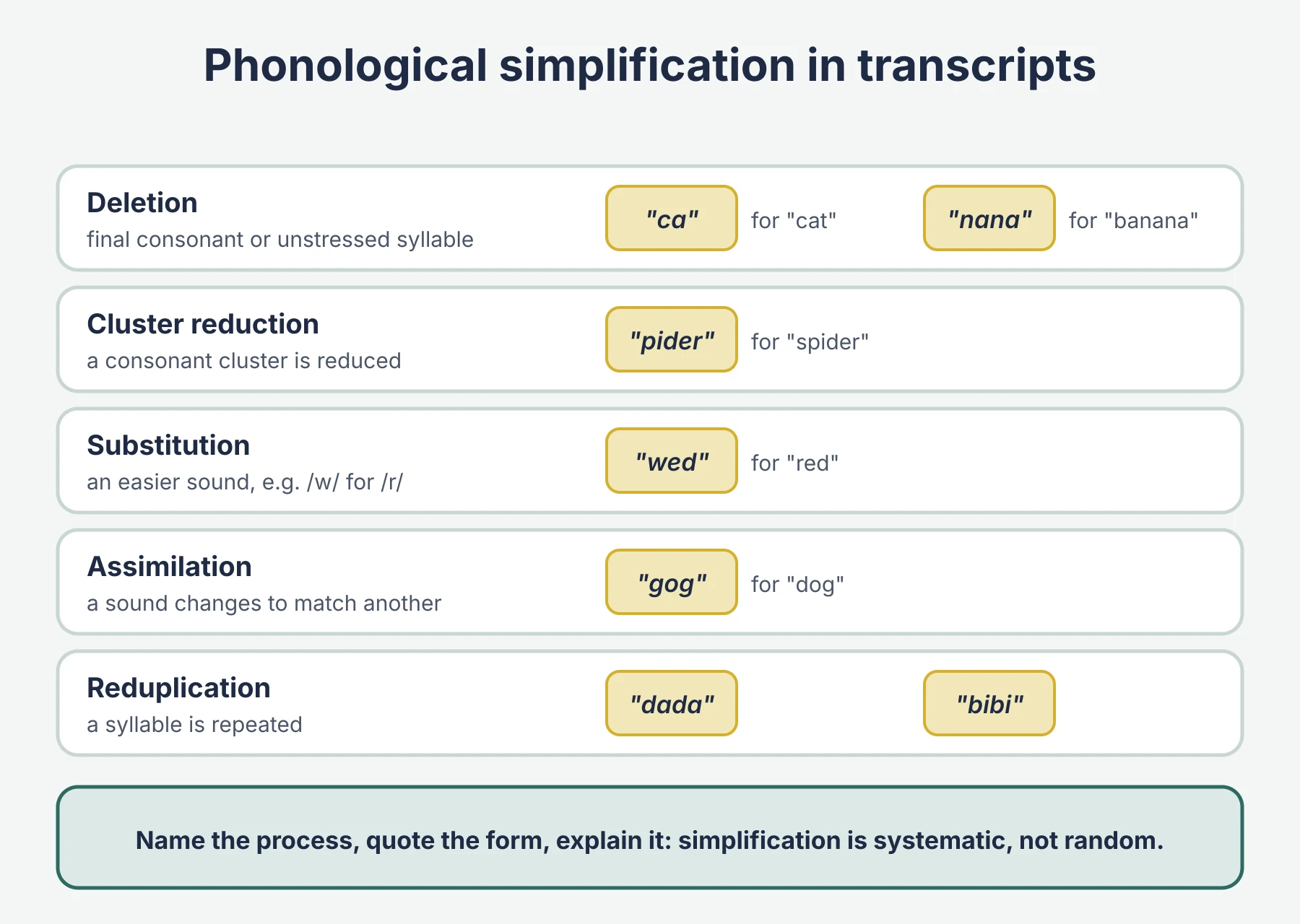
| Process | Example |
|---|---|
| Final consonant deletion | “bi” for “bib” |
| Unstressed syllable deletion | “raffe” for “giraffe” |
| Consonant cluster reduction | “tar” for “star” |
| Substitution (e.g. gliding) | “yeyo” for “yellow” |
| Assimilation | “gock” for “sock” |
| Reduplication | “wawa” for “water” |
Semantics to spot
- Overextension: one word for too wide a category (“dog” for all four-legged animals).
- Underextension: too narrow (“cat” only for the family pet).
- Early lexis: names for people, food, toys, animals; social words (“bye-bye”).
Halliday’s seven functions
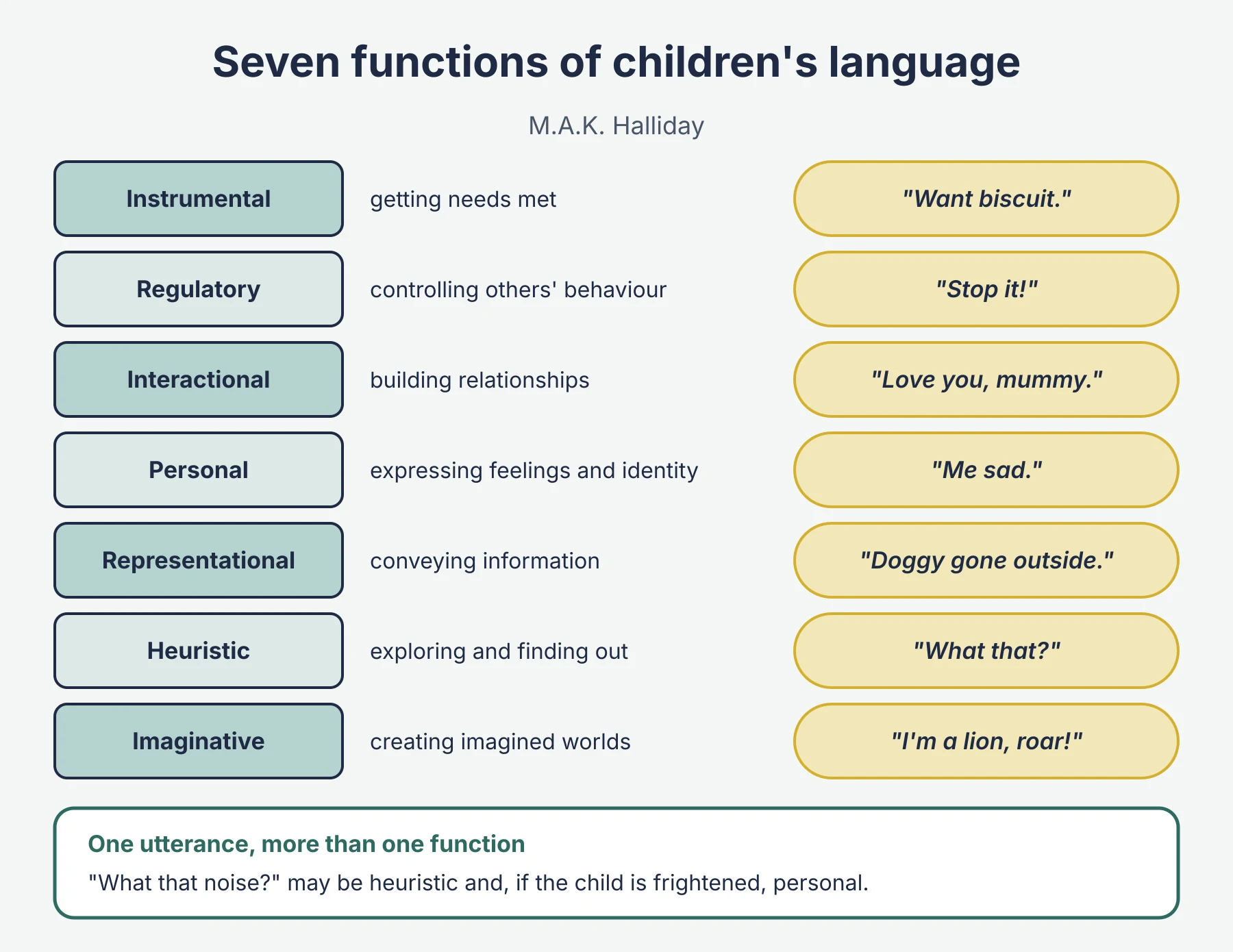
| Function | Key idea | Example |
|---|---|---|
| Instrumental | I want | “More apple.” |
| Regulatory | Do as I say | “Go away!” |
| Interactional | Me and you | “Hello, grandma.” |
| Personal | Here I am | “I’m tired.” |
| Representational | Telling you | “Car is red.” |
| Heuristic | Tell me why | “Why moon there?” |
| Imaginative | Let’s pretend | “This is my rocket.” |
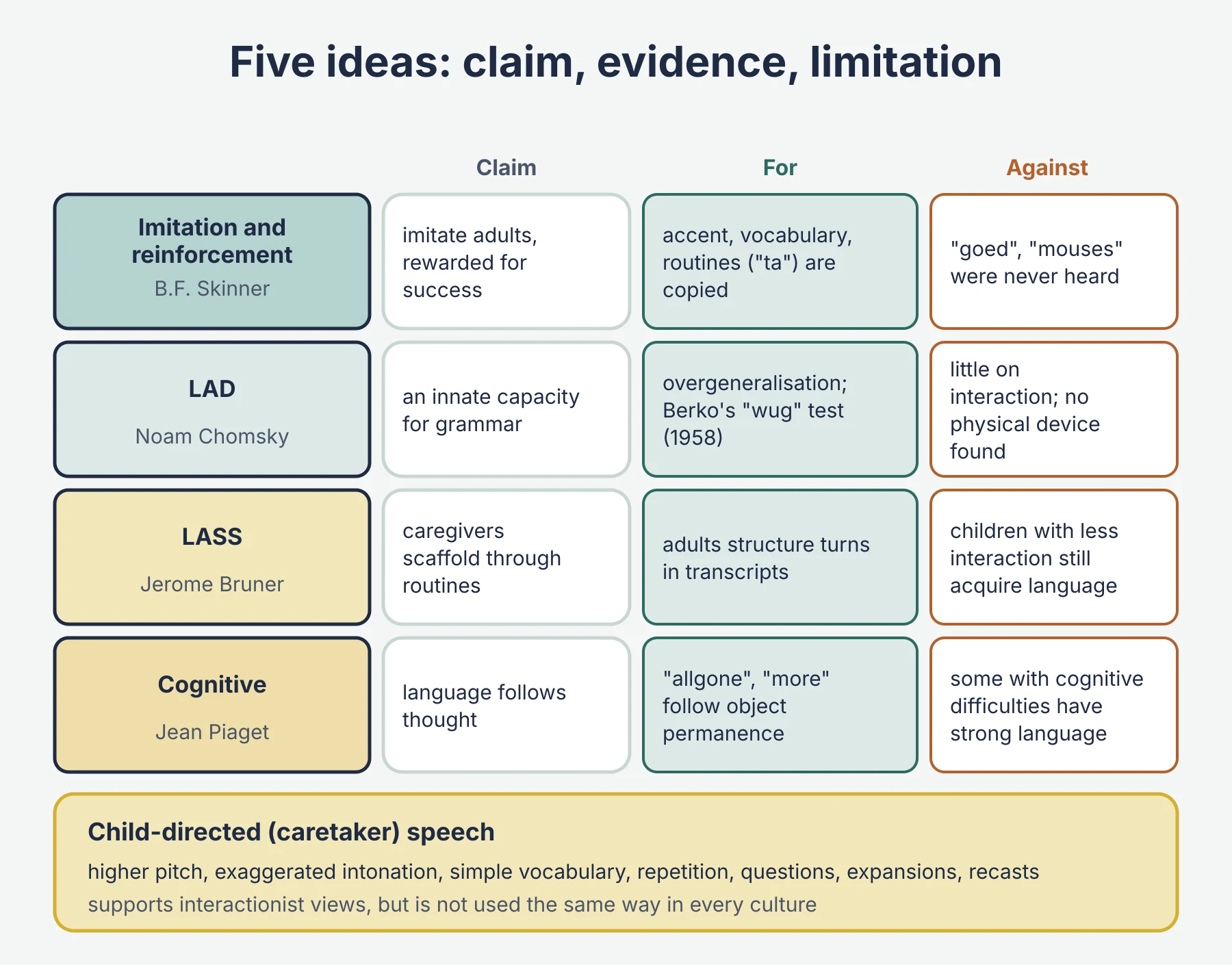
Theories: claim, for, against
| Theory | Claim | For | Against |
|---|---|---|---|
| Imitation and reinforcement (Skinner) | Learning by copying and reward | Accent, routines, vocabulary | Overgeneralisations are not copied |
| LAD (Chomsky) | Innate grammatical capacity | Overgeneralisation; Berko’s “wug” test (1958) | Underplays interaction; no identified physical device |
| LASS (Bruner) | Caregivers scaffold language | Routines, book reading, turn-structuring | Language develops where child-directed interaction is limited |
| Cognitive development (Piaget) | Concepts before words | “Allgone” after object permanence | Language and cognition can develop separately |
| Child-directed speech | Adults adapt speech to support learning | Recasts, expansions, questions | Varies across cultures; children learn without it |
Adult speech features
- Recast: correct form returned without correction (“Me goed” / “You went? Where did you go?”).
- Expansion: adult adds detail (“Doggy!” / “Yes, a big brown doggy”).
- Prompting questions: hand the child the turn.
- Repetition, high pitch, exaggerated intonation, simplified lexis.
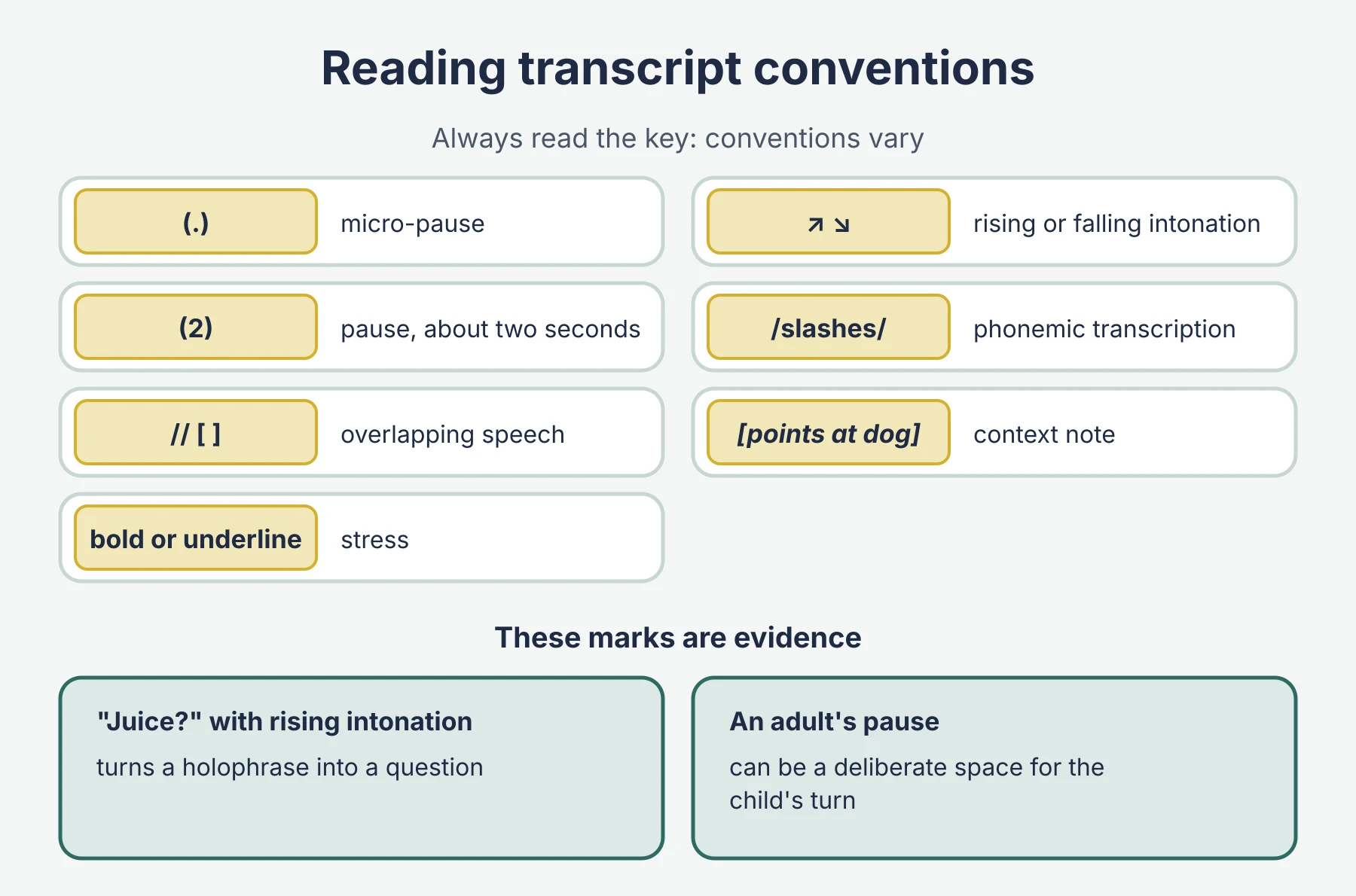
Transcript notation (always check the key)
- (.) micro-pause; (2) timed pause
- // or [ overlap
- bold or underline: stress
- arrows: rising or falling intonation
- /slashes/: phonemic transcription
- [brackets] or italics: context
Paragraph formula
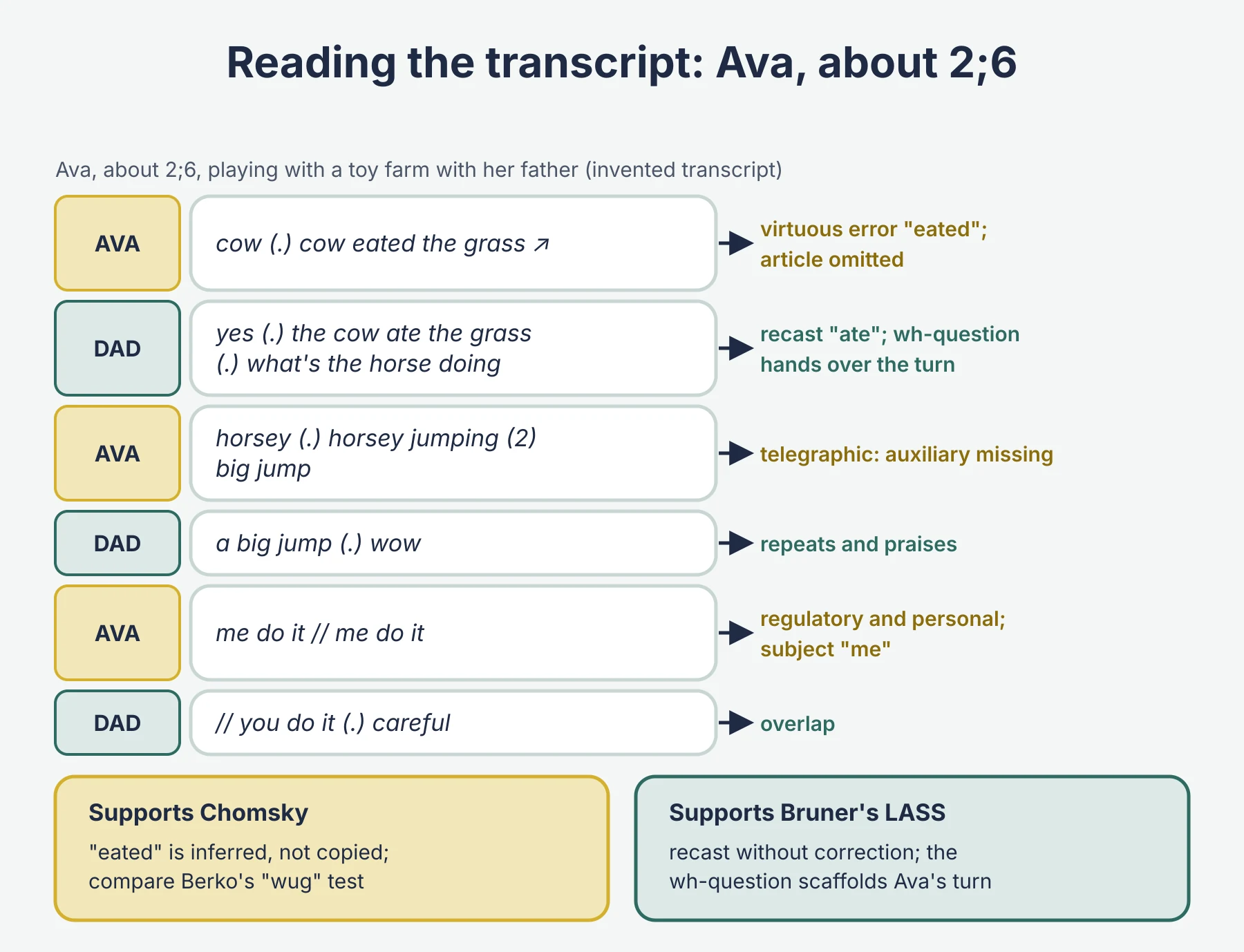
- Quote the exact form, with notation if relevant: “cow eated” or “/wed/”.
- Name the feature and the level: past-tense overgeneralisation (grammar); substitution (phonology).
- Interpret: what the child can do and what is still developing.
- Theorise: which theory the evidence supports or challenges, and why.
- Qualify: one transcript is limited evidence, so use “suggests” or “may indicate”.
Example chain: “Want ball ↗” (rising intonation) is a telegraphic utterance functioning as a question; the child signals interrogative meaning through intonation before using auxiliaries or inversion, which suggests pragmatic intent develops ahead of grammatical form.
Exam traps
- Calling forms “mistakes” instead of explaining the rule.
- Treating ages as fixed.
- Ignoring the adult or the notation.
- Leading with theory and adding data afterwards.
- Stating a theory without a limitation.
- Overclaiming from one transcript.
Self-test
- Name the four stages listed in the syllabus.
- What is a virtuous error?
- Give an example of consonant cluster reduction.
- What is the difference between overextension and underextension?
- Which Halliday function is “Why is it raining?”
- Which function is “Give me that!”?
- What did Berko’s “wug” test show?
- What is the key difference between Chomsky’s LAD and Bruner’s LASS?
- Give one criticism of imitation and reinforcement theory.
- What is a recast?
- What does (2) mean in a transcript?
- Why should you analyse the adult in a transcript?
Answers: 1. Babbling, holophrastic, telegraphic and post-telegraphic. 2. An error that shows the child applying a grammatical rule, such as “goed”. 3. “poon” for “spoon” (or similar). 4. Overextension uses a word for too wide a category; underextension uses it for too narrow a category. 5. Heuristic. 6. Regulatory (it may also be instrumental). 7. That children apply plural endings to invented words, so they have learned a rule rather than copied forms. 8. The LAD is an innate capacity in the child; the LASS is the support provided by caregivers through interaction. 9. Children produce forms they have never heard, such as “mouses”, which imitation cannot explain. 10. An adult repeating a child’s utterance in its adult form, without explicit correction. 11. A pause of about two seconds. 12. Because the question asks about the speakers, and adult responses are evidence for or against interactionist theories.
Try the Child Language Acquisition practice questions, then review the whole paper with the Paper 3 revision notes.
Related resources
-
Study guides
Cambridge A-Level English Language: Paper 3 Language Analysis (9093)
Cambridge 9093 Paper 3 Language Analysis: language change from Early Modern English to today, and the stages and theories of child language acquisition.
English · Cambridge · A Level
Read guide -
Revision notes
Cambridge A Level English Language 9093: Paper 3 — Revision Notes
Condensed notes on Cambridge 9093 Paper 3 Language Analysis: processes and theories of language change, and the stages and theories of child language learning.
English · Cambridge · A Level
Revise topic -
Practice questions
A Level English Language: Paper 3 Language Analysis — Practice Questions
Original practice with full worked answers on language change and child language acquisition for Cambridge 9093 Paper 3 Language Analysis (A Level only).
English · Cambridge · A Level
Try questions
Get free revision emails (optional)
Occasional emails with practice questions, worked explanations and links to free resources for the qualification and subjects you choose. No spam, and you can unsubscribe from any email. The free tools on this site never need an email.