
Study Guides
Cambridge International AS & A Level English Language (9093): Section B: Child Language Acquisition
Cambridge 9093 Paper 3 Section B: stages from babbling to post-telegraphic speech, Halliday's functions, theories and how to analyse a child's transcript.
- Subject
- English
- Level
- A LEVEL
- Topic
- Paper 3 – Language Analysis
- Author
- Marlbridge Academic Team
- Updated
- Reviewed by
- Ammar Bilal (what this means)
Aligned to Cambridge A Level English (9093), 2024-2026. Official specification .
Syllabus page (what it covers and how it is assessed): Cambridge A Level English Language.
Found an error? Report a correction.
Need help with this topic? Request a free trial class for A Level English Language (9093).
Section B of Paper 3 Language Analysis in Cambridge International AS & A Level English Language (9093) is built on a single transcript. A child or children between the ages of 0 and 8 are talking, often with an adult or an older sibling, and you must explain what their language shows. This guide covers the four areas of knowledge the syllabus lists, the transcript conventions you must read accurately, and a method for turning observations into a theory-based essay.
What the question asks
Section B is one compulsory question worth 25 marks, half of Paper 3. You analyse ways in which the speakers in the transcript use language, referring to specific details and relating your observations to ideas and examples from your wider study. It assesses AO1 (reading and understanding texts), AO4 (linguistic concepts, issues and approaches) and AO5 (analysing and synthesising language data).
Notice “the speakers”: adults’ language is part of the data. How a parent responds to a child is evidence for or against particular theories.
Knowledge 1: the main stages of early development
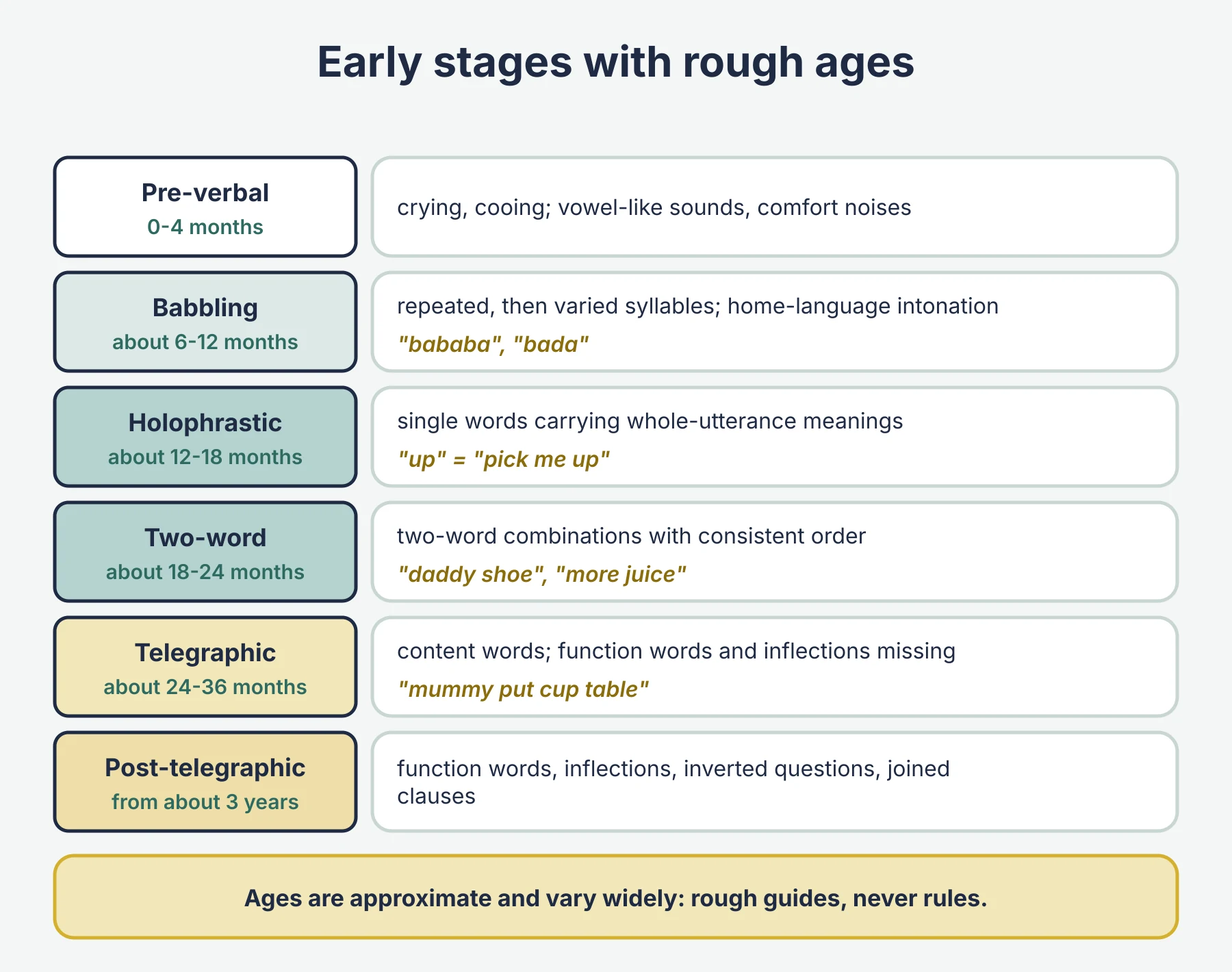
The syllabus names babbling, holophrastic, telegraphic and post-telegraphic stages. Ages are approximate and vary widely between children; use them as rough guides, never as rules.
| Stage | Rough age | What to look for |
|---|---|---|
| Pre-verbal: crying, cooing | 0-4 months | Vowel-like sounds, comfort noises |
| Babbling | about 6-12 months | Repeated consonant-vowel syllables (“bababa”), later varied (“bada”); intonation patterns of the home language |
| Holophrastic | about 12-18 months | Single words carrying whole-utterance meanings: “up” as “pick me up” |
| Two-word | about 18-24 months | Two-word combinations with consistent order: “daddy shoe”, “more juice” |
| Telegraphic | about 24-36 months | Content words with function words and inflections missing: “mummy put cup table” |
| Post-telegraphic | from about 3 years | Function words, inflections, questions with inversion, longer and joined clauses |
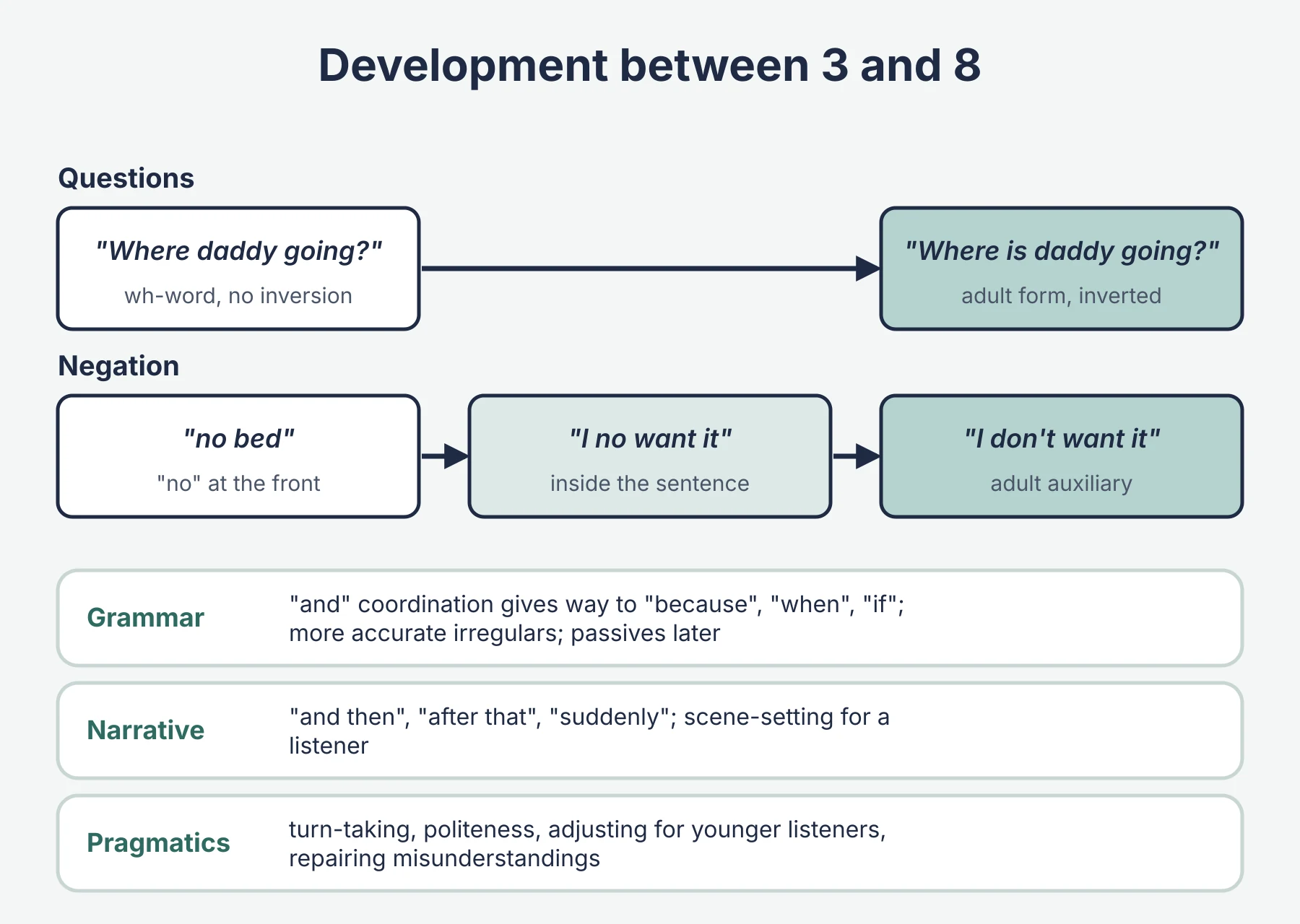
Between 3 and 8, development continues in ways examiners reward you for noticing:
- Grammar: coordination with “and” gives way to subordination with “because”, “when”, “if”; more accurate irregular forms; passive voice appears later.
- Questions: early “wh-” questions without inversion (“Where daddy going?”) become adult forms (“Where is daddy going?”).
- Negation: early “no” placed at the front (“no bed”) moves inside the sentence (“I no want it”) before adult auxiliaries appear (“I don’t want it”).
- Narrative: older children sequence events with “and then”, “after that”, “suddenly”, and begin to set scenes for a listener.
- Pragmatics: turn-taking, politeness (“please”, indirect requests), adjusting speech for younger listeners, and repairing misunderstandings.
Phonological features in transcripts
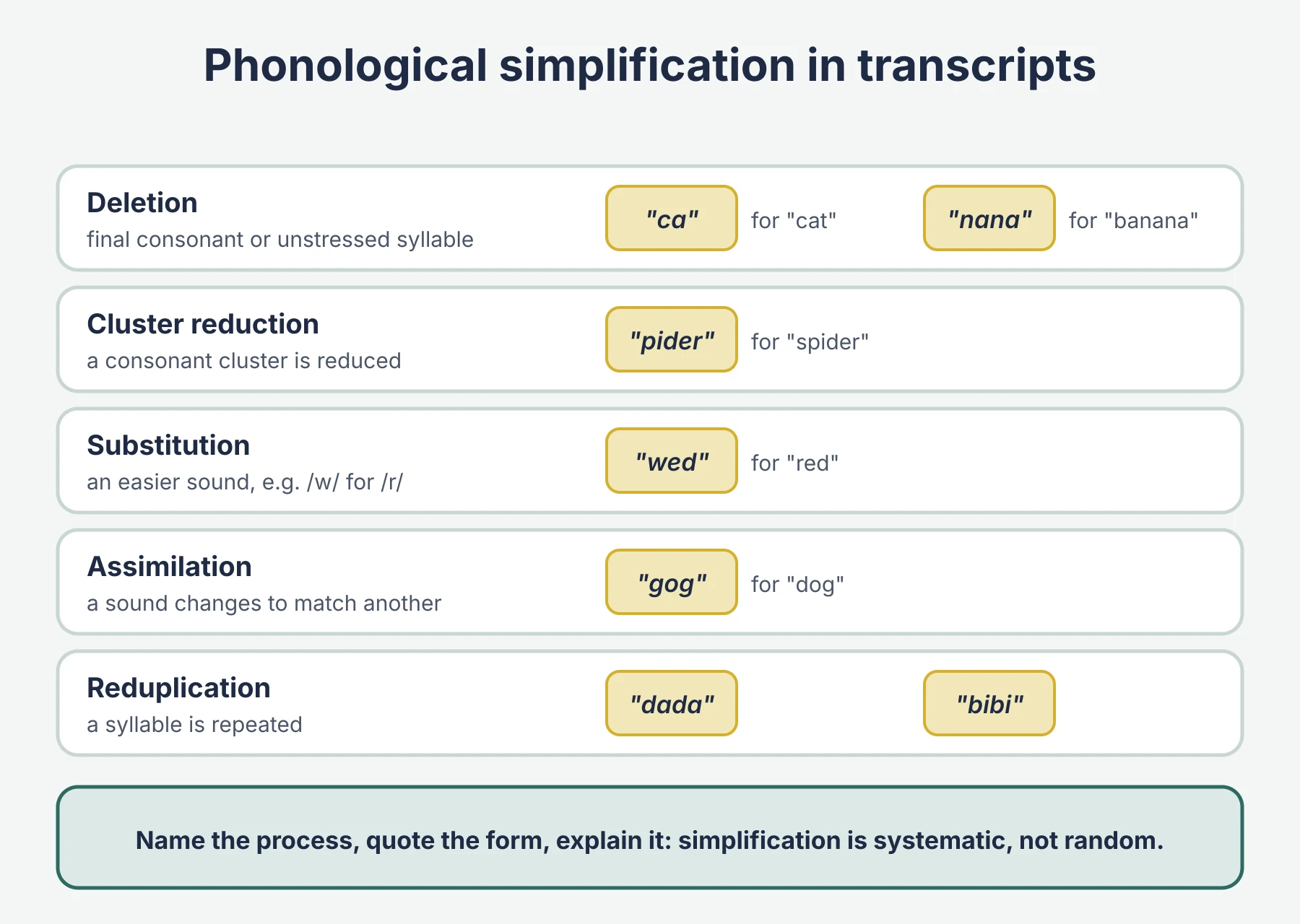
Transcripts may show a child’s pronunciation using phonemic symbols (the syllabus includes a reference table of IPA symbols). Common simplification processes:
- Deletion: dropping final consonants (“ca” for “cat”) or unstressed syllables (“nana” for “banana”).
- Consonant cluster reduction: “pider” for “spider”.
- Substitution: one sound replaced by an easier one, such as /w/ for /r/ (“wed” for “red”).
- Assimilation: one sound changed to match another in the word (“gog” for “dog”).
- Reduplication: repeating a syllable (“dada”, “bibi”).
Name the process, quote the form, and explain what it shows: the child is simplifying systematically, not randomly.
Knowledge 2: the functions of children’s language
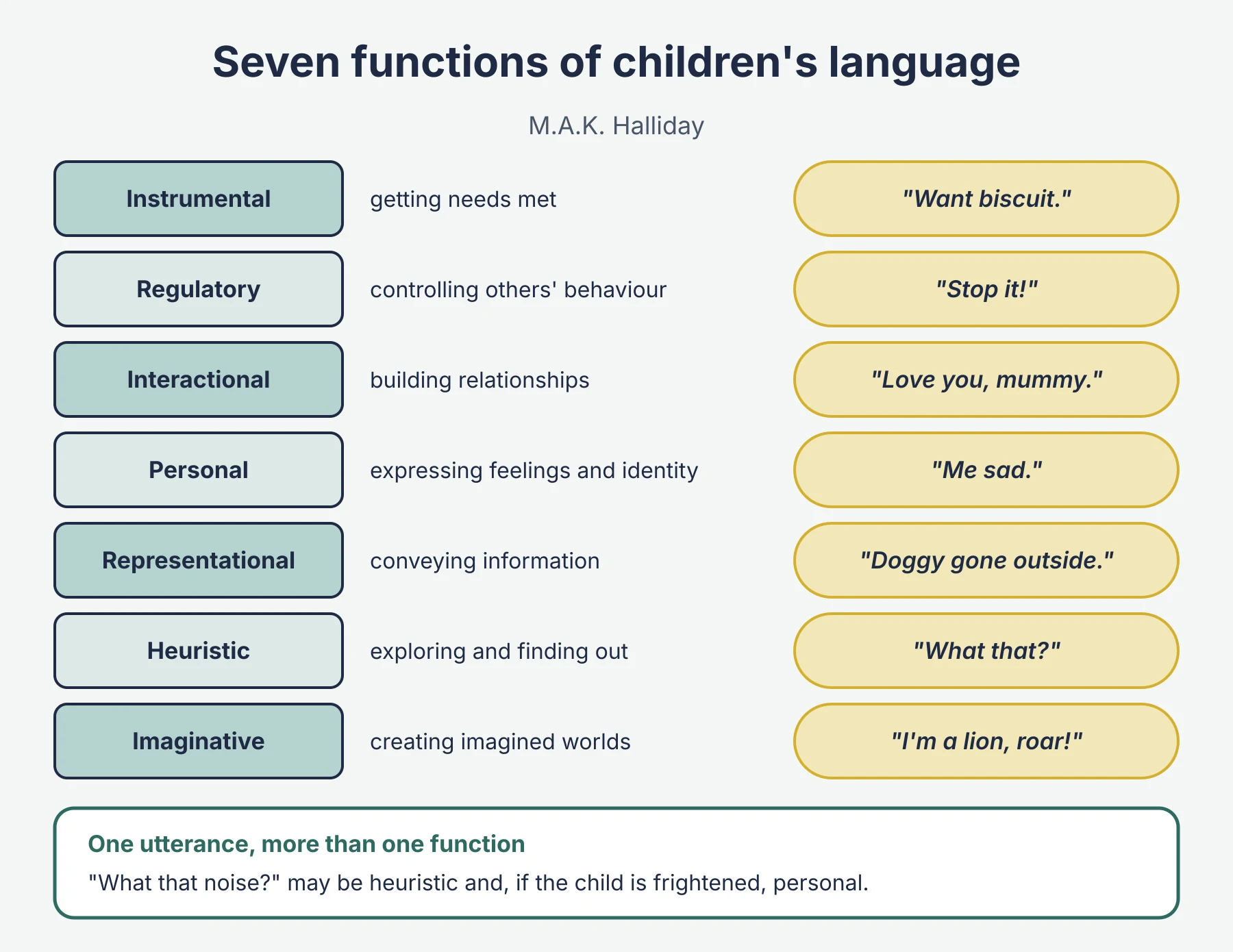
The syllabus lists seven functions, from M.A.K. Halliday’s work on early language.
| Function | Purpose | Child example |
|---|---|---|
| Instrumental | Getting needs met | “Want biscuit.” |
| Regulatory | Controlling others’ behaviour | “Stop it!” |
| Interactional | Building relationships | “Love you, mummy.” |
| Personal | Expressing feelings and identity | “Me sad.” |
| Representational | Conveying information | “Doggy gone outside.” |
| Heuristic | Exploring and finding out | “What that?” |
| Imaginative | Creating imagined worlds | “I’m a lion, roar!” |
One utterance can serve more than one function. “What that noise?” may be heuristic and, if the child is frightened, personal. Saying so shows judgement.
Knowledge 3: theories and theorists
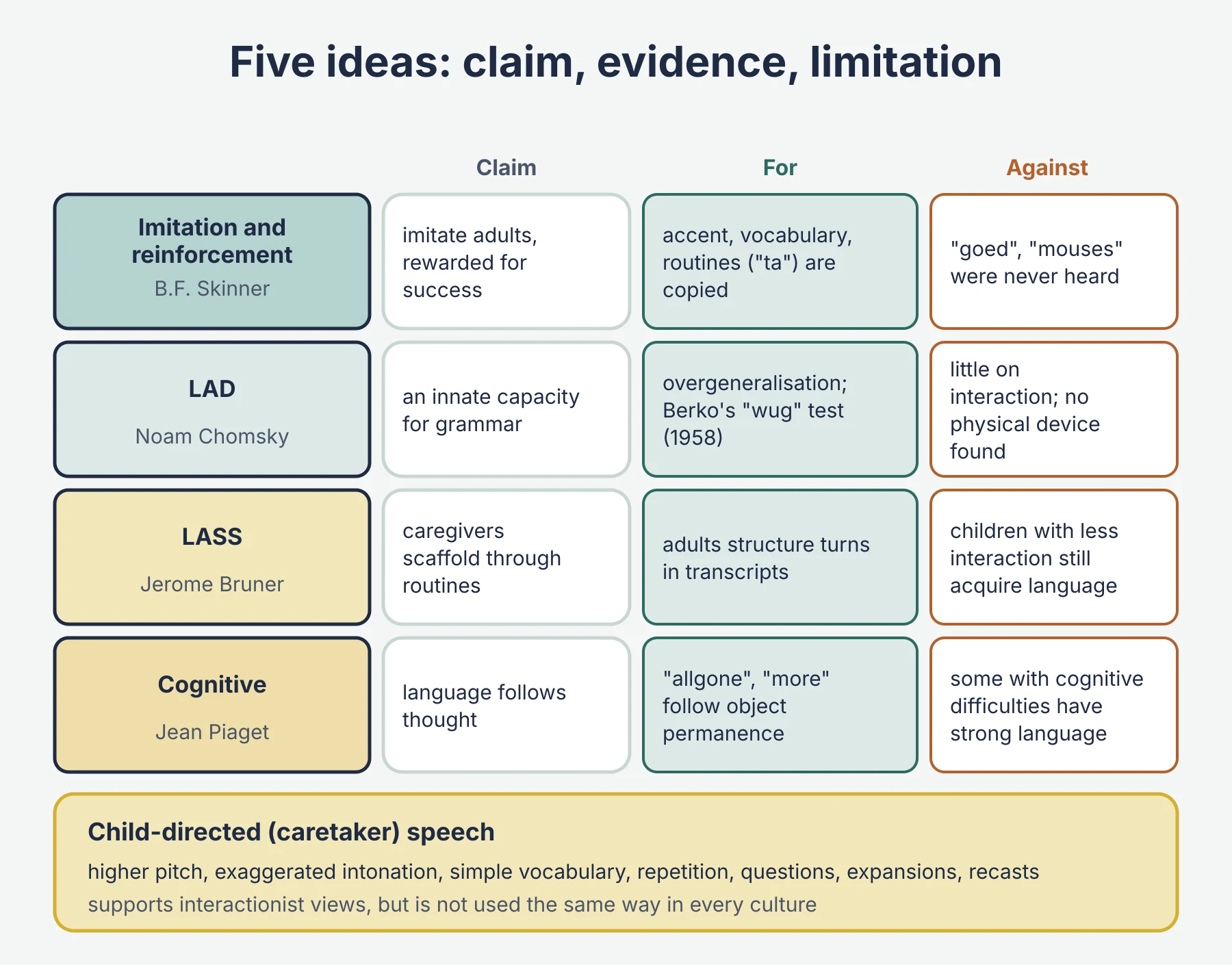
The syllabus names five ideas. For each, know the claim, the evidence for it, and a limitation.
Imitation and reinforcement theory. Associated with B.F. Skinner’s behaviourism: children learn by imitating adults and being rewarded for successful attempts. For: accent, vocabulary and routines (“bye-bye”, “ta”) are clearly copied. Against: children produce forms they have never heard, such as “goed” and “mouses”.
Language acquisition device (LAD). Noam Chomsky’s nativist proposal that humans have an innate capacity for grammar. For: overgeneralisations show children inferring rules; Jean Berko’s “wug” test (1958) showed children adding plural endings to invented words. Against: it says little about the role of interaction, and no specific physical device has been identified.
Language acquisition support system (LASS). Jerome Bruner’s interactionist answer to Chomsky: caregivers scaffold language through routines, such as picture-book reading and games like peekaboo, in which the child gradually takes over the adult’s role. For: transcripts often show adults structuring turns. Against: children in communities with less child-directed interaction still acquire language.
Cognitive development theory. Associated with Jean Piaget: language follows thought, so a child must grasp a concept before using words for it. For: words such as “allgone” or “more” appear after a child understands that objects persist and can recur. Against: some children with cognitive difficulties develop strong language, which suggests the two can be separate.
Child-directed (caretaker) speech. The way adults adapt their speech: higher pitch, exaggerated intonation, simplified vocabulary, repetition, questions, expansions and recasts. It supports interactionist views, but it is not used in the same way in every culture.
Knowledge 4: transcript conventions
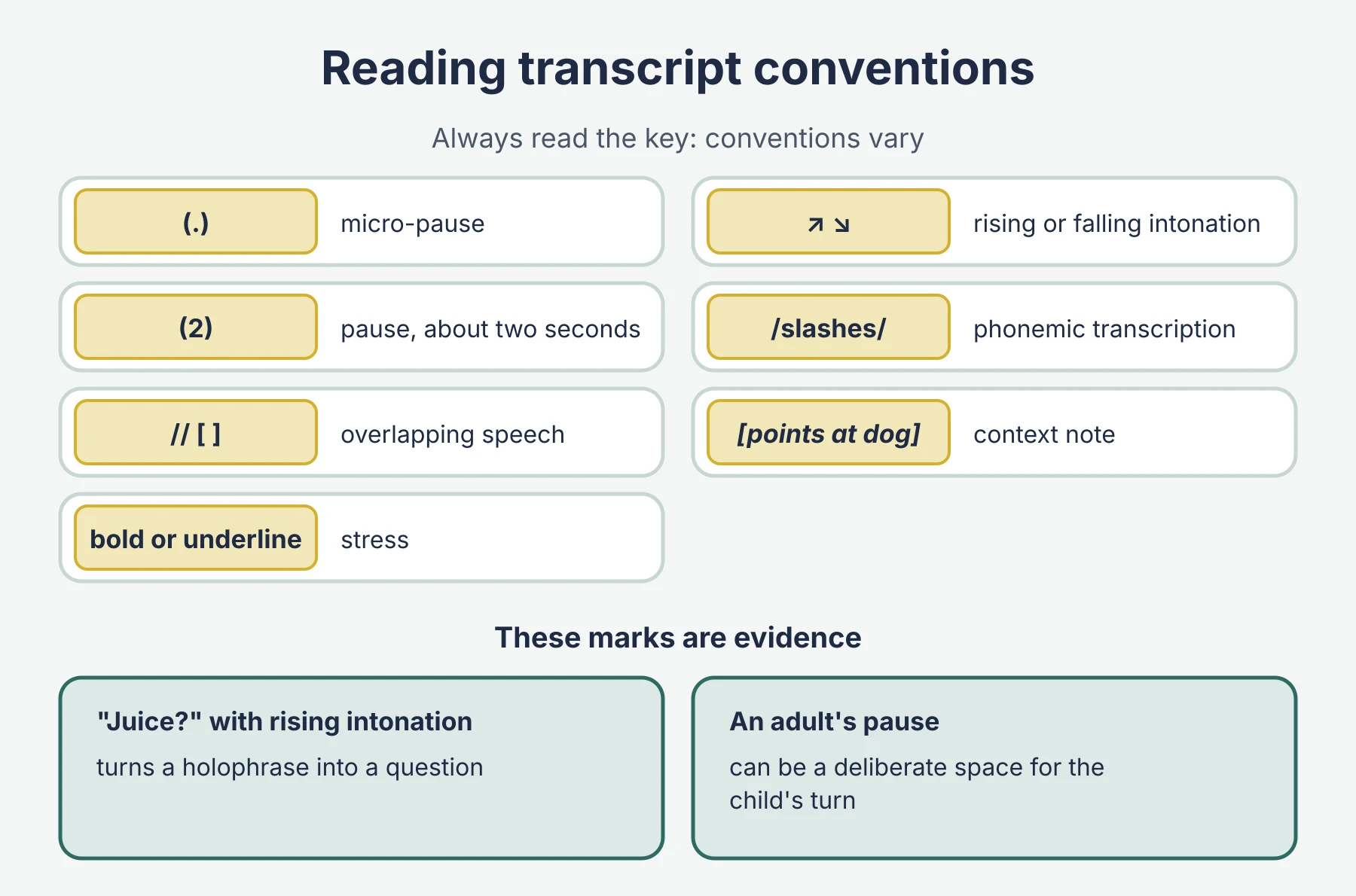
Always read the key, because conventions vary. Commonly:
- (.) micro-pause; (2) a pause of about two seconds.
- // or square brackets mark overlapping speech.
- Bold or underlining marks stress.
- Arrows or symbols mark rising or falling intonation.
- /slashes/ enclose phonemic transcription.
- Italic or bracketed notes give context, such as [points at dog].
Pauses, overlaps and intonation are evidence. A child’s rising intonation on “Juice?” can turn a holophrase into a question; an adult’s pause can be a deliberate space for the child’s turn.
Worked example
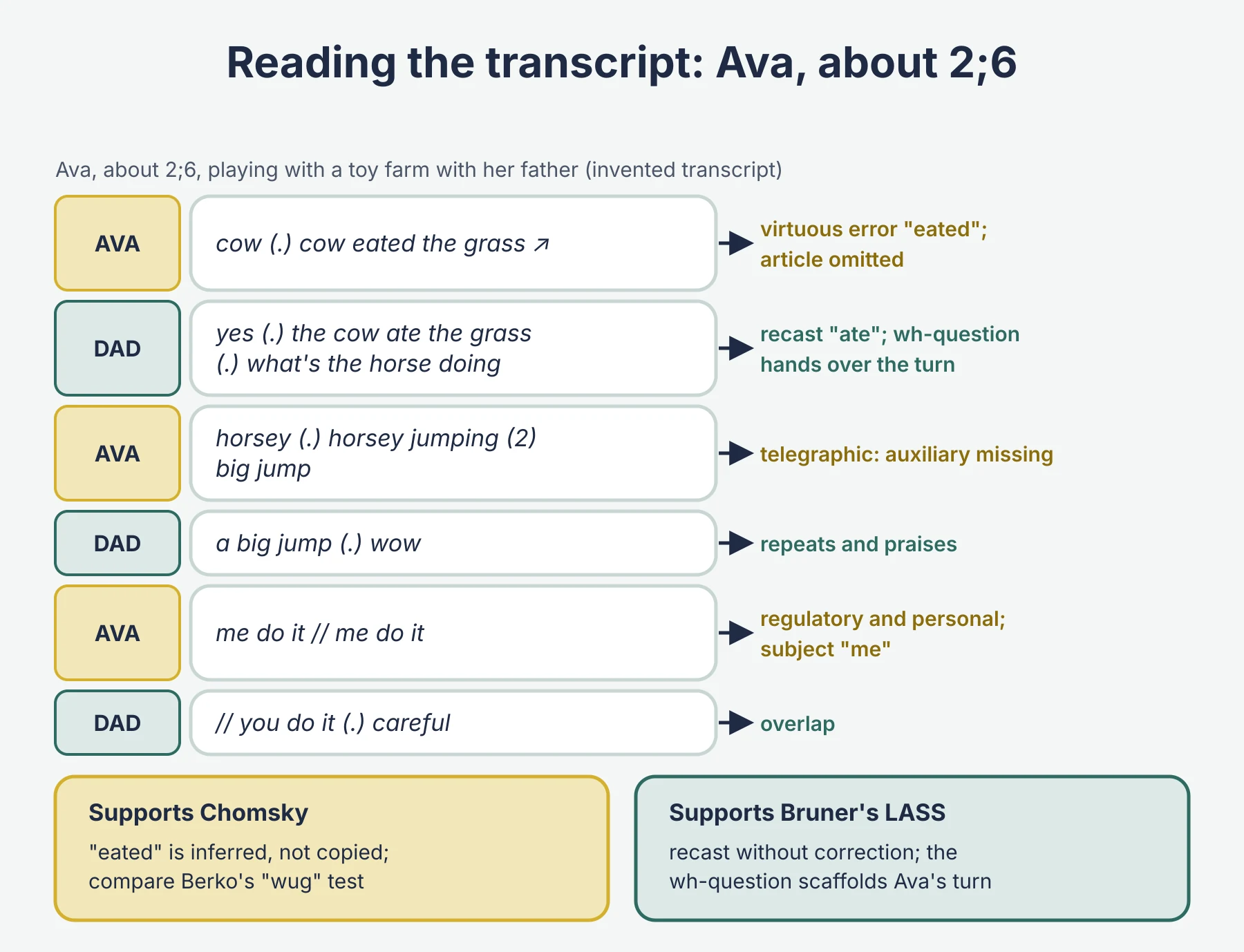
Transcript (original, invented for this guide). Ava is about 2 years 6 months; she is playing with a toy farm with her father.
AVA:    cow (.) cow eated the grass ↗
DAD:    yes (.) the cow ate the grass (.) what's the horse doing
AVA:    horsey (.) horsey jumping (2) big jump
DAD:    a big jump (.) wow
AVA:    me do it // me do it
DAD:         // you do it (.) careful
Analysis paragraph:
Ava’s “cow eated the grass” is telegraphic in omitting the article before “cow” but post-telegraphic in its inflection: the past tense “-ed” is applied to the irregular “eat”, a virtuous error showing she has inferred a rule rather than copied a form, since her father would not say “eated”. This supports Chomsky’s view of rule-based acquisition, as Berko’s experiment also suggests. Her father’s reply recasts the verb (“ate”) without correcting her directly, then asks a “wh-” question that hands her the next turn, a pattern of child-directed speech that Bruner’s LASS would see as scaffolding. Ava’s “me do it”, repeated and overlapping her father’s speech, is regulatory and personal at once, asserting independence, while her non-standard subject pronoun “me” shows pronoun case is still developing.
The paragraph quotes precise forms, names features and stages, uses both speakers, and weighs two theories against the same evidence.
Common mistakes
- Treating ages as fixed and labelling a child “behind” or “advanced”.
- Calling children’s forms “mistakes” without explaining the rule behind them.
- Ignoring the adult speaker, or the transcript conventions.
- Reciting a theory before or without the data.
- Assigning one Halliday function to every utterance without considering overlap.
- Writing about stages only, with no phonology, pragmatics or interaction.
Exam technique
Begin with a short overview: the speakers, their ages, the context and the most striking features. Organise the body by language level or theme (phonology, lexis and semantics, grammar, pragmatics and interaction), with each paragraph moving from transcript evidence to concept to evaluation of a theory. Use “suggests” and “may indicate” rather than certainty: one transcript is limited evidence. Conclude by judging which theories the data best support.
Keep going
Related resources
-
Practice questions
Cambridge International AS & A Level English Language (9093): Section B: Child Language Acquisition – Practice Questions
Original practice for Cambridge 9093 Paper 3 Child Language Acquisition: stages, phonology, functions, theories and transcript analysis, with full answers.
English · Cambridge · A Level
Try questions -
Revision notes
Cambridge International AS & A Level English Language (9093): Section B: Child Language Acquisition – Revision Notes
Recall notes for Cambridge 9093 Paper 3 Child Language Acquisition: stages to age 8, phonology, Halliday's functions, five theories and transcript notation.
English · Cambridge · A Level
Revise topic -
Study guides
Cambridge A-Level English Language: Paper 3 Language Analysis (9093)
Cambridge 9093 Paper 3 Language Analysis: language change from Early Modern English to today, and the stages and theories of child language acquisition.
English · Cambridge · A Level
Read guide
Get free revision emails (optional)
Occasional emails with practice questions, worked explanations and links to free resources for the qualification and subjects you choose. No spam, and you can unsubscribe from any email. The free tools on this site never need an email.