
Revision Notes
Cambridge International AS & A Level English Language (9093): Section A: Language Change – Revision Notes
Recall notes for Cambridge 9093 Paper 3 Language Change: dating features, word-formation and semantic terms, named theories and how to read n-grams.
- Subject
- English
- Level
- A LEVEL
- Topic
- Paper 3 – Language Analysis
- Author
- Marlbridge Academic Team
- Updated
- Reviewed by
- Ammar Bilal (what this means)
Aligned to Cambridge A Level English (9093), 2024-2026. Official specification .
Syllabus page (what it covers and how it is assessed): Cambridge A Level English Language.
Found an error? Report a correction.
Need help with this topic? Request a free trial class for A Level English Language (9093).
Condensed recall for Paper 3 Section A. For full explanations and a worked synthesis paragraph, use the Language Change study guide.
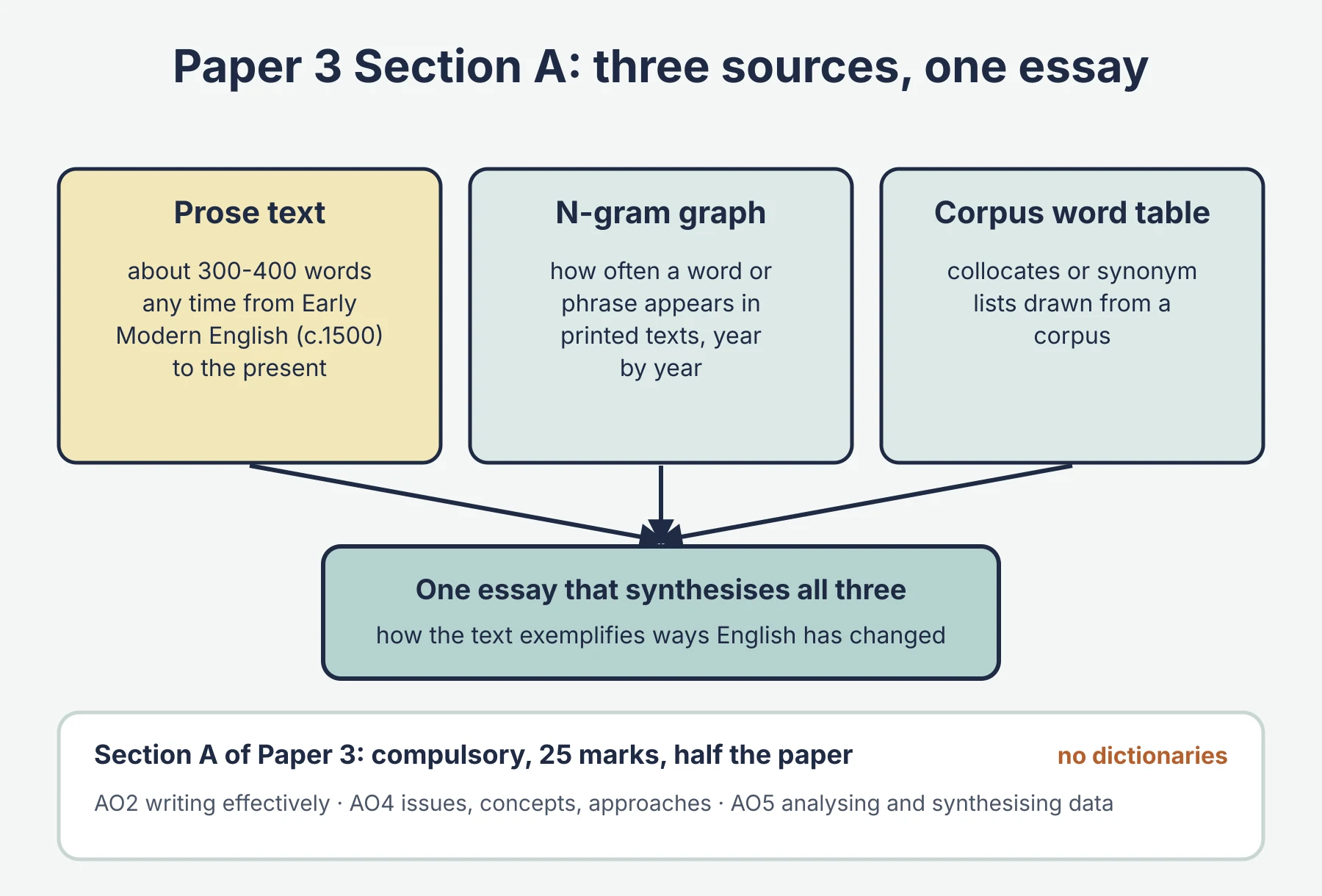
The task in brief
- One compulsory question, 25 marks, half of Paper 3.
- Three sources: a prose text (about 300-400 words, from c.1500 to the present), an n-gram graph and a word table of corpus data.
- Analyse how the prose text exemplifies change, supported by both data sources and wider study.
- AO2 (writing), AO4 (linguistic concepts and issues), AO5 (analysing and synthesising data).
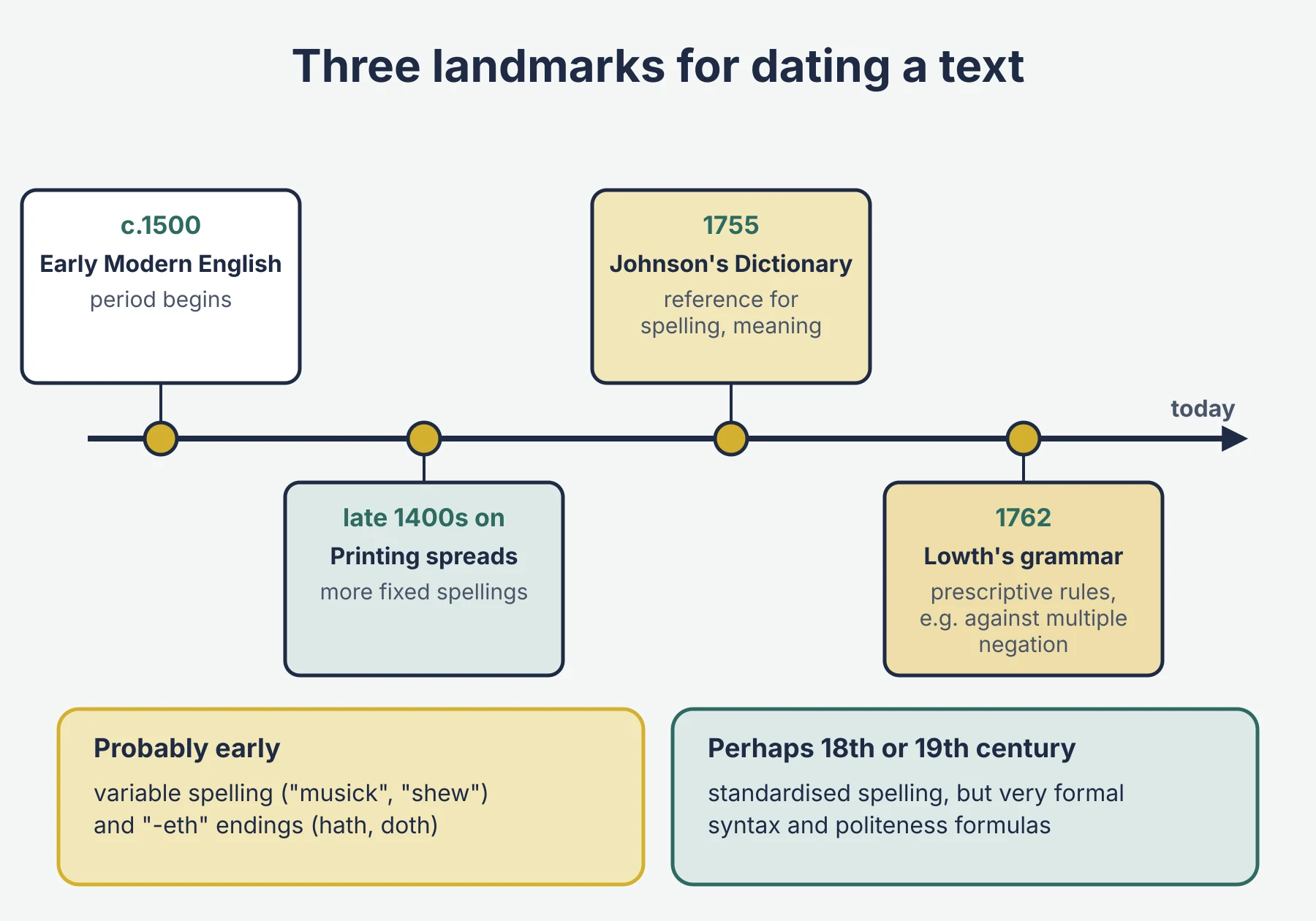
Dating a text: quick features list
Likely Early Modern (c.1500 to late 1600s)
- Variable spelling within one text; final “-e” (“olde”); u/v and i/j interchanged.
- “-eth” and “-est” verb endings; “thou/thee/thy” in use.
- Negatives and questions without “do”: “I know not”, “Came he home?”
- Heavy capitalisation and long s (ſ).
Likely eighteenth or nineteenth century
- Mostly standard spelling with some variants (“musick”, “shew”).
- Capitalised nouns fading; long s disappearing.
- Long, balanced periodic sentences; formal Latinate lexis.
- Elaborate politeness formulas in letters.
Likely twentieth century to now
- Shorter sentences; contractions; informal tenor even in public texts.
- Recent borrowings and coinages; acronyms and initialisms; conversion (“to google”).
- Graphology of digital or mass-market print.
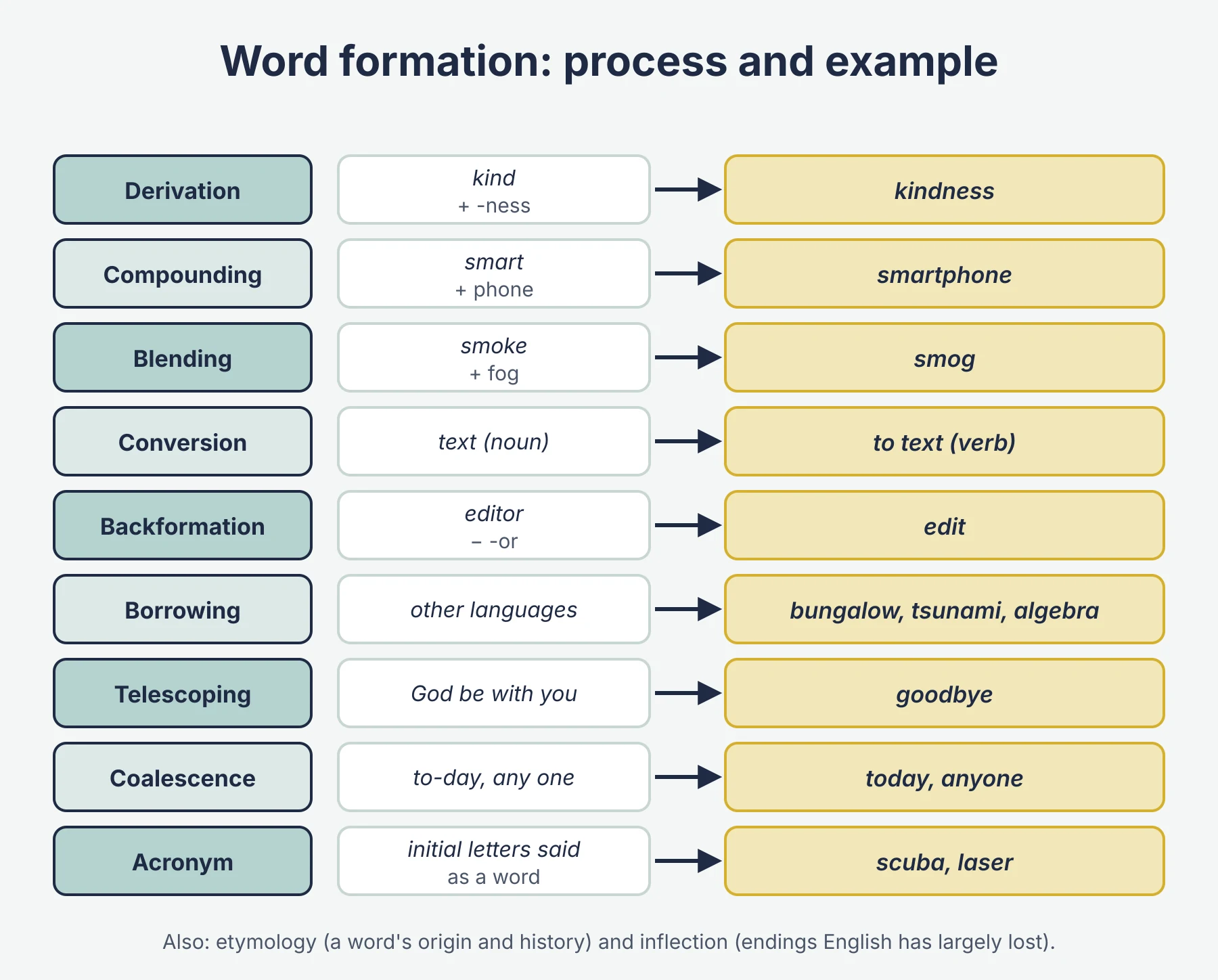
Key terms
| Term | Definition | Example |
|---|---|---|
| Etymology | Origin and history of a word | “salary” traced to Latin “salarium” |
| Derivation | New word by adding affixes | “happy” to “unhappiness” |
| Inflection | Grammatical ending marking tense, number or person | “-eth” in “hath” |
| Telescoping | A phrase compressed into a shorter word | “goodbye” from “God be with you” |
| Coalescence | Separate forms merging into one | “to-day” to “today” |
| Acronym | Initials pronounced as a word | “radar”, “scuba” |
| Conversion | Change of word class, same form | “a text” to “to text” |
| Compounding | Two words joined | “blackboard” |
| Backformation | Removing a supposed affix | “babysit” from “babysitter” |
| Blending | Parts of two words fused | “motel” from motor and hotel |
| Borrowing | Word taken from another language | “shampoo”, “ketchup” |
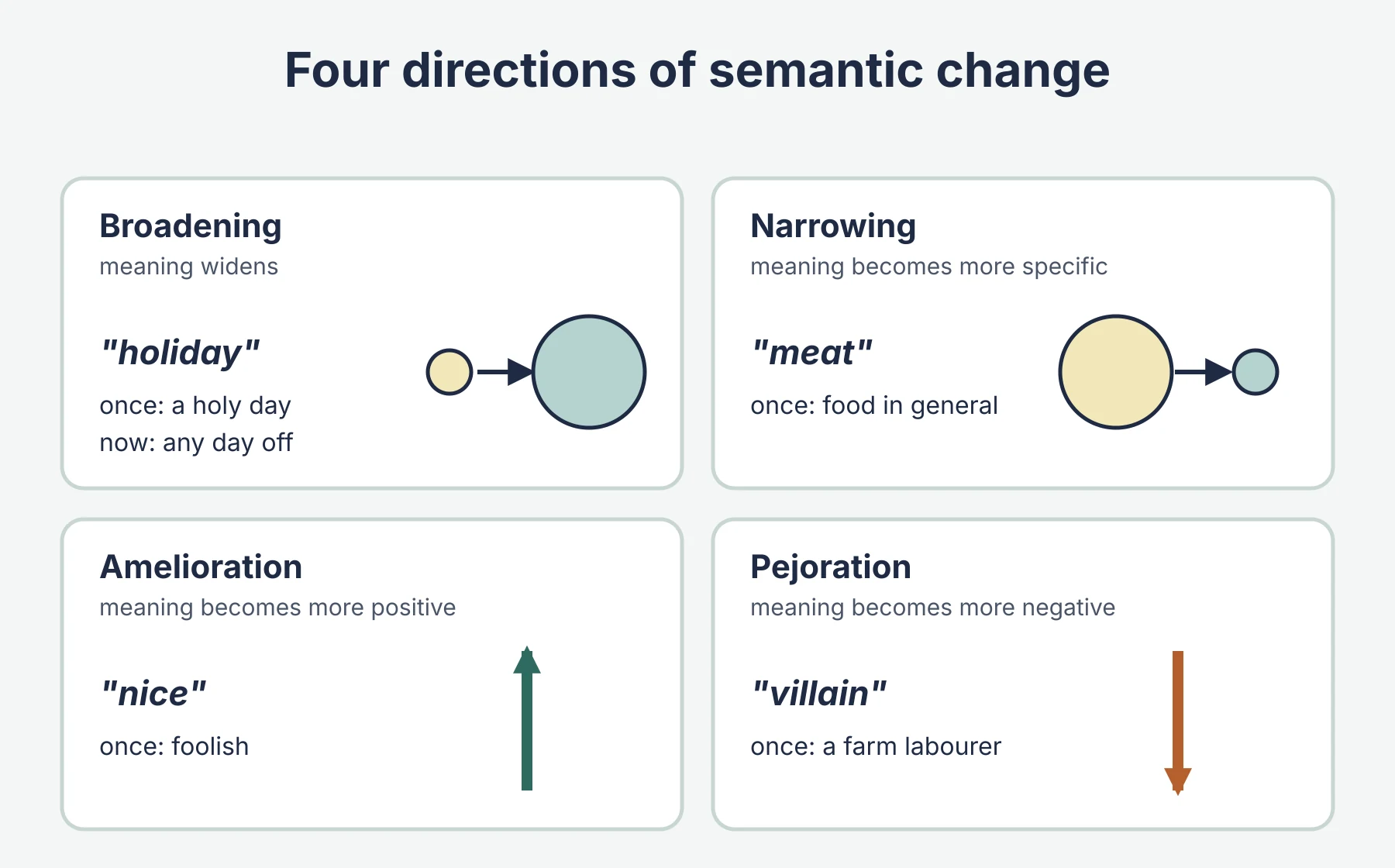
| Broadening | Meaning widens | “holiday” |
| Narrowing | Meaning becomes more specific | “meat”, “girl” (once a child of either sex) |
| Amelioration | Meaning becomes more positive | “nice”, “knight” |
| Pejoration | Meaning becomes more negative | “villain”, “silly” |
The named theories in one line each
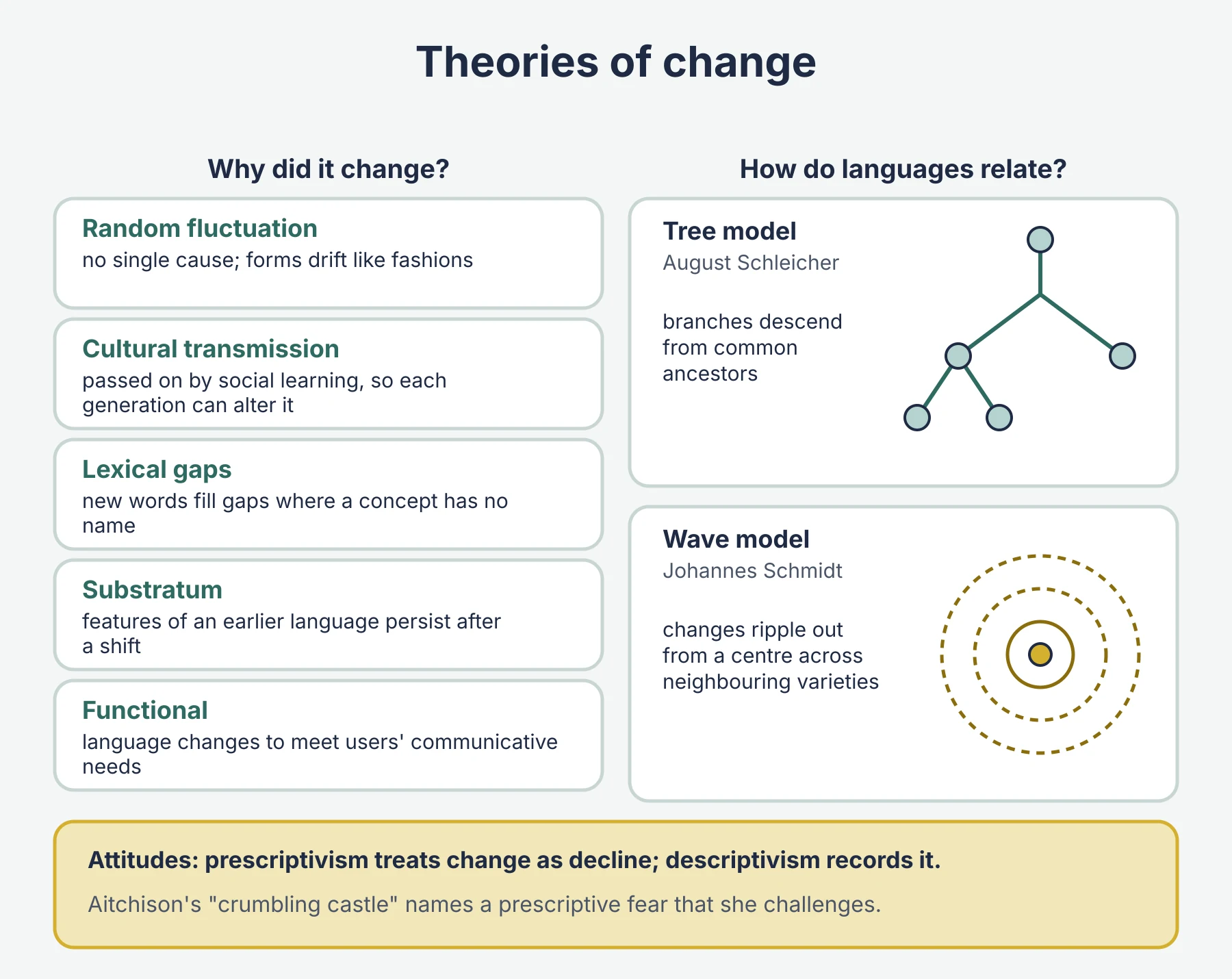
- Random fluctuation: some change has no single cause; forms drift like fashion.
- Cultural transmission: language passes between generations by social learning, so each generation can alter it.
- Lexical gaps: new words fill gaps where a concept lacks a name.
- Substratum: features of a population’s earlier language persist after it shifts to English.
- Functional theory: language changes to meet users’ new communicative needs.
- Tree model (Schleicher): languages branch from common ancestors.
- Wave model (Schmidt): changes spread outward across neighbouring varieties.
Attitudes: prescriptivism (change as decline) versus descriptivism (change recorded without judgement).
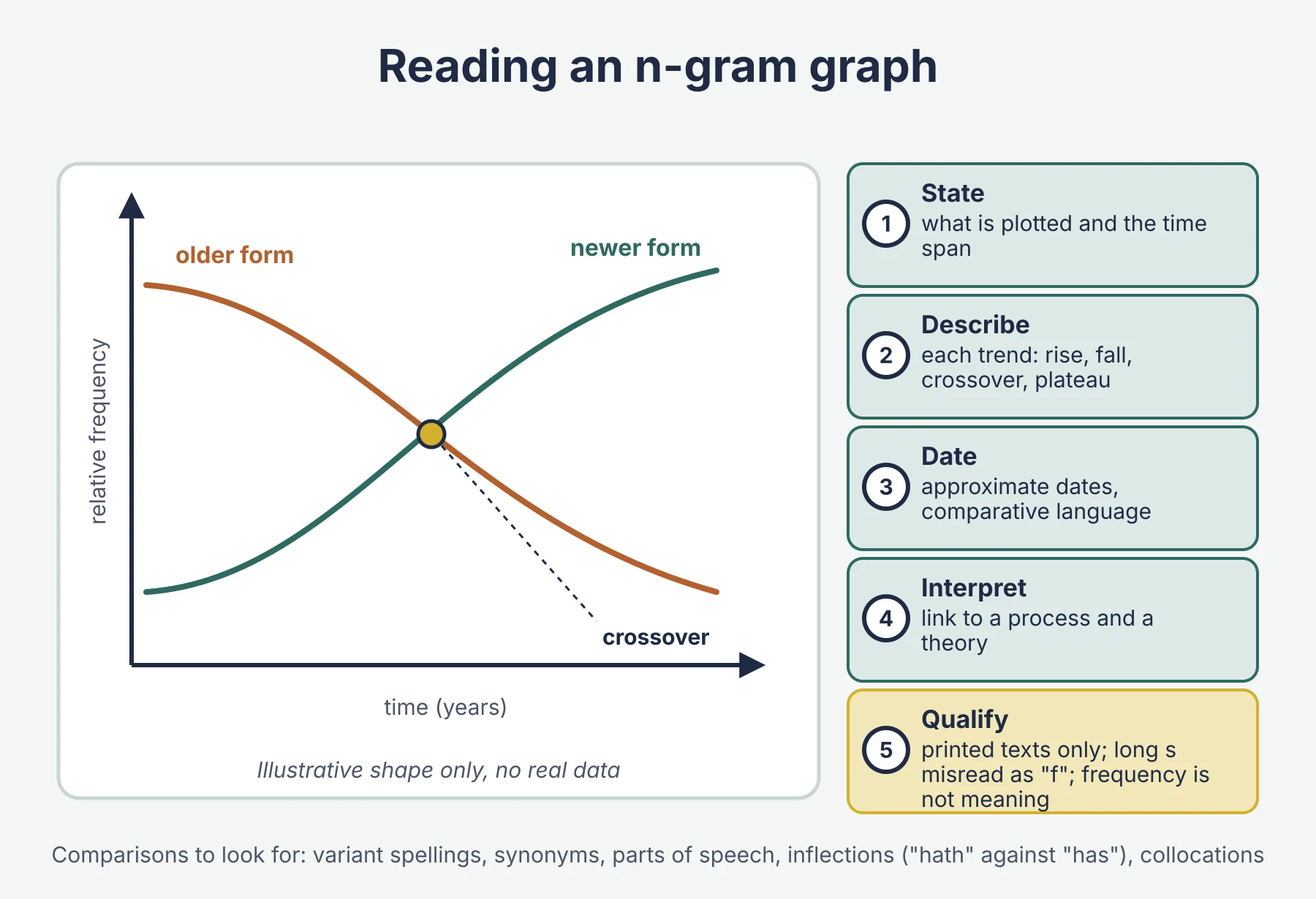
Reading an n-gram graph: five steps
- What: which words or forms, which years.
- Trend: rise, fall, crossover, plateau, for each line.
- When: approximate dates in comparative language.
- Why: process (standardisation, borrowing, semantic shift) plus theory.
- Limits: printed-book corpus; formal bias; scanning errors (long s read as “f”); frequency is not meaning.
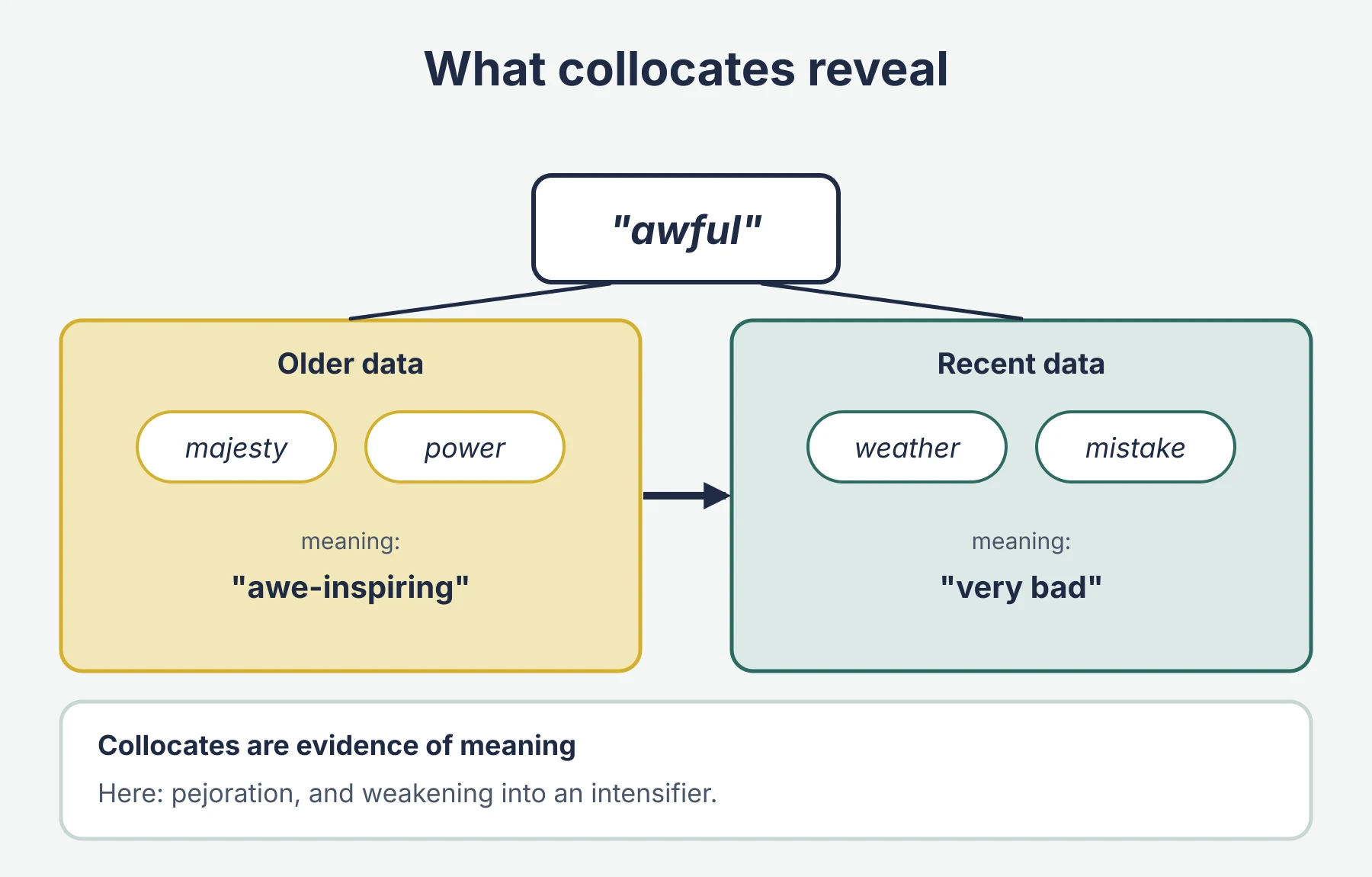
Reading a corpus word table
- Collocates reveal meaning: compare collocates of one word across periods to show semantic change.
- Synonym lists show competition: which word wins a semantic space, and when.
- Always quote two or three items from the table rather than describing it vaguely.
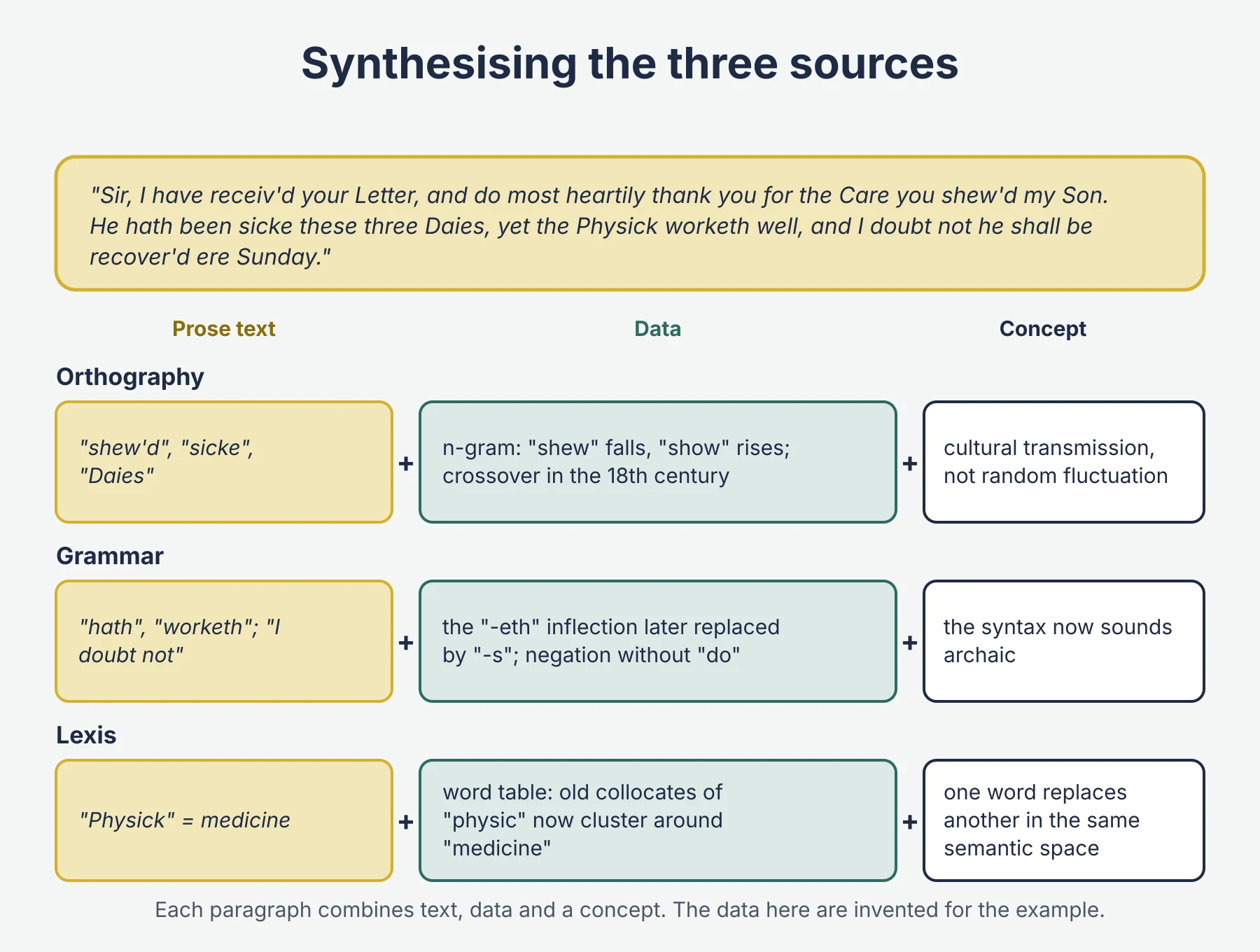
Paragraph formula
Feature in the prose text (quoted, named) + data that confirm or complicate it (graph or table, with dates) + process + theory or concept that explains it.
Exam traps
- Spotting archaic features without dating or explaining them.
- Describing data without interpreting it, or interpreting without describing.
- Ignoring one of the three sources.
- Calling older forms errors.
- Using a theory as a label only.
- Treating n-gram frequency as evidence of a change in meaning.
- Separating the essay into “the text” and then “the data”.
Self-test
- What three sources does Section A provide?
- Which assessment objectives does the question assess?
- Give two features of Early Modern English morphology.
- What does a negative such as “I fear not” show about older syntax?
- Define backformation with an example.
- What is the difference between broadening and narrowing?
- Give an example of amelioration.
- What does the vertical axis of an n-gram graph show?
- Give two limitations of n-gram evidence.
- How can a collocate list show semantic change?
- Which theory explains a new word created to name a new invention?
- What does the wave model claim?
Answers: 1. A prose text of about 300-400 words, an n-gram graph and a word table of corpus data. 2. AO2, AO4 and AO5. 3. Third-person “-eth” (hath, doth); second-person “-est” (thou knowest). 4. Negation without the auxiliary “do”, which later became standard. 5. Creating a new word by removing what looks like an affix: “edit” from “editor”. 6. Broadening widens a meaning (“holiday” from holy day to any day off); narrowing makes it more specific (“meat” from any food to animal flesh). 7. “Nice” (once foolish) or “knight” (once a servant). 8. Relative frequency: the proportion of all words in the corpus for each year. 9. Any two: the corpus is printed books, so it over-represents formal writing; scanning errors such as long s read as “f”; frequency does not show meaning; spoken usage is not represented. 10. Different collocates in different periods show a word being used in different contexts, so its meaning has shifted. 11. The theory of lexical gaps (functional theory is also creditable). 12. That changes spread outward from a centre across neighbouring varieties, like ripples, rather than only down branches of a family tree.
Practise with the Language Change practice questions, and see the whole paper in the Paper 3 revision notes.
Related resources
-
Study guides
Cambridge International AS & A Level English Language (9093): Section B: Child Language Acquisition
Cambridge 9093 Paper 3 Section B: stages from babbling to post-telegraphic speech, Halliday's functions, theories and how to analyse a child's transcript.
English · Cambridge · A Level
Read guide -
Practice questions
Cambridge International AS & A Level English Language (9093): Section B: Child Language Acquisition – Practice Questions
Original practice for Cambridge 9093 Paper 3 Child Language Acquisition: stages, phonology, functions, theories and transcript analysis, with full answers.
English · Cambridge · A Level
Try questions -
Revision notes
Cambridge International AS & A Level English Language (9093): Section B: Child Language Acquisition – Revision Notes
Recall notes for Cambridge 9093 Paper 3 Child Language Acquisition: stages to age 8, phonology, Halliday's functions, five theories and transcript notation.
English · Cambridge · A Level
Revise topic
Get free revision emails (optional)
Occasional emails with practice questions, worked explanations and links to free resources for the qualification and subjects you choose. No spam, and you can unsubscribe from any email. The free tools on this site never need an email.