
Study Guides
Cambridge International AS & A Level English Language (9093): Section A: Language Change
Cambridge 9093 Paper 3 Section A: features of English from Early Modern to today, change processes, theories, and reading n-gram graphs and corpus tables.
- Subject
- English
- Level
- A LEVEL
- Topic
- Paper 3 – Language Analysis
- Author
- Marlbridge Academic Team
- Updated
- Reviewed by
- Ammar Bilal (what this means)
Aligned to Cambridge A Level English (9093), 2024-2026. Official specification .
Syllabus page (what it covers and how it is assessed): Cambridge A Level English Language.
Found an error? Report a correction.
Need help with this topic? Request a free trial class for A Level English Language (9093).
Section A of Paper 3 Language Analysis in Cambridge International AS & A Level English Language (9093) asks you to explain how English has changed from the Early Modern period to the present, using three pieces of evidence at once. This guide covers what the section requires, the features and processes you need to recognise, the named theories, and how to read the two kinds of quantitative data the paper always includes.
What the question gives you
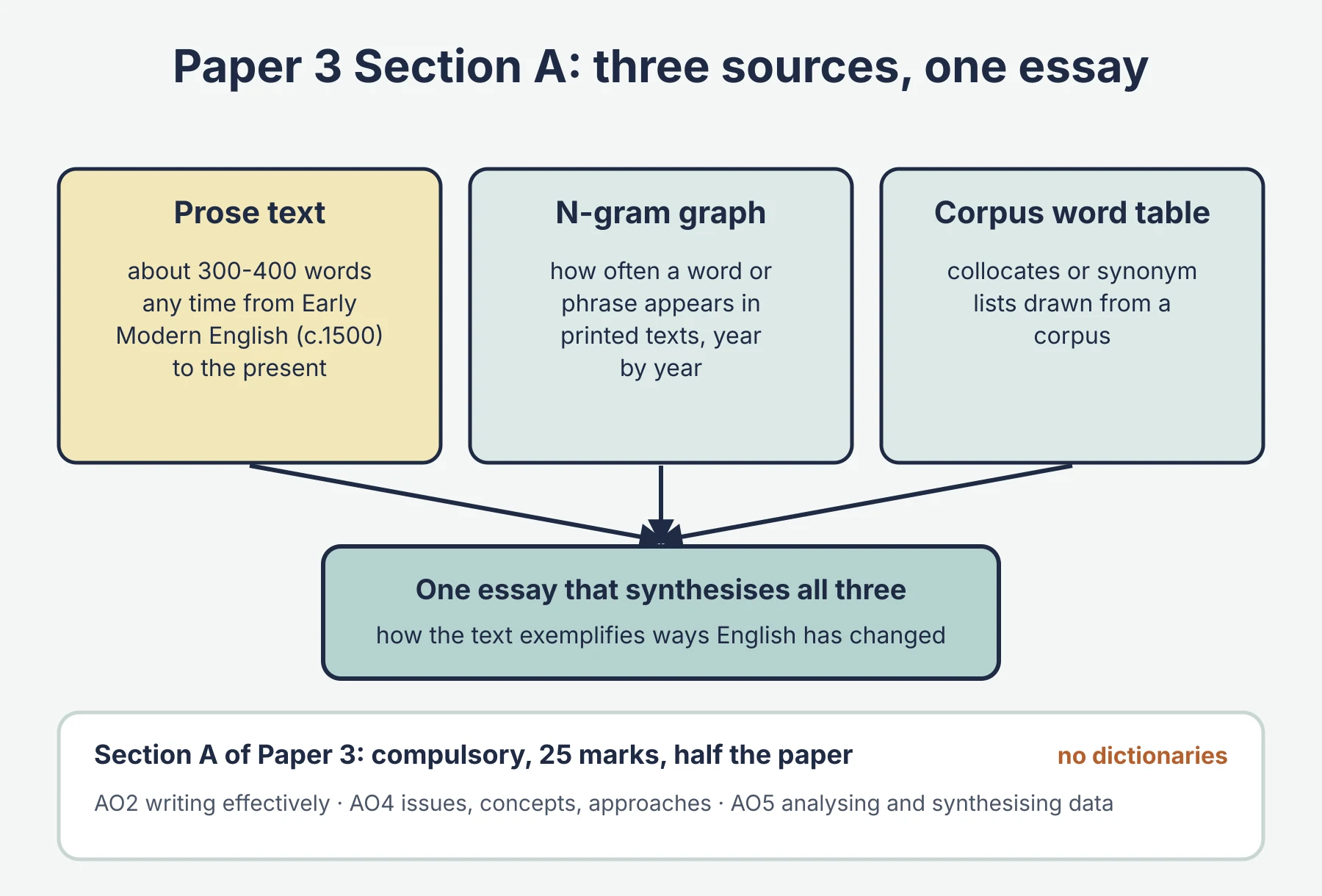
Section A is one compulsory question worth 25 marks, half of Paper 3. You respond to three texts:
- a prose text of about 300-400 words, written at any time from the Early Modern English period (beginning c.1500) to the present day, in any of the forms listed for the AS papers (letters, diaries, advertisements, travel writing and so on);
- an n-gram graph;
- a word table of corpus data.
You analyse how the prose text exemplifies ways in which English has changed, supporting your answer with both data sources and with your wider study. The question assesses AO2, AO4 and AO5: writing effectively, understanding linguistic issues, concepts and approaches, and analysing and synthesising language data. Dictionaries are not allowed.
Knowing the period: features by language level
The syllabus asks for “the chronology and essential features” of English from Early Modern to Contemporary English, and lists the levels to examine. Learn at least one feature per level that marks an older text.
| Level | Features that mark an older text |
|---|---|
| Graphology | Long s (ſ) in medial positions, capitalised common nouns, ornate typefaces, ampersands |
| Orthography | Variable spelling before dictionaries (“musick”, “publick”, “shew”); interchangeable u/v and i/j; “ye” with y standing for an older letter for “th” |
| Phonology | Spellings that hint at older pronunciations; rhymes that no longer work |
| Morphology | Third-person “-eth” (hath, doth, maketh); second-person “-est” (thou knowest) |
| Grammar | “Thou/thee” alongside “you”; older past forms; multiple negation in early texts |
| Syntax | Questions and negatives without “do” (“Know you not?”, “I fear not the storm”); long periodic sentences with heavy subordination |
| Lexis | Archaic words; Latinate borrowings; words still in use but with older meanings |
| Semantics | Meanings that have broadened, narrowed, ameliorated or pejorated |
| Pragmatics | Elaborate politeness in letters (“your most humble and obedient servant”); deferential forms of address |
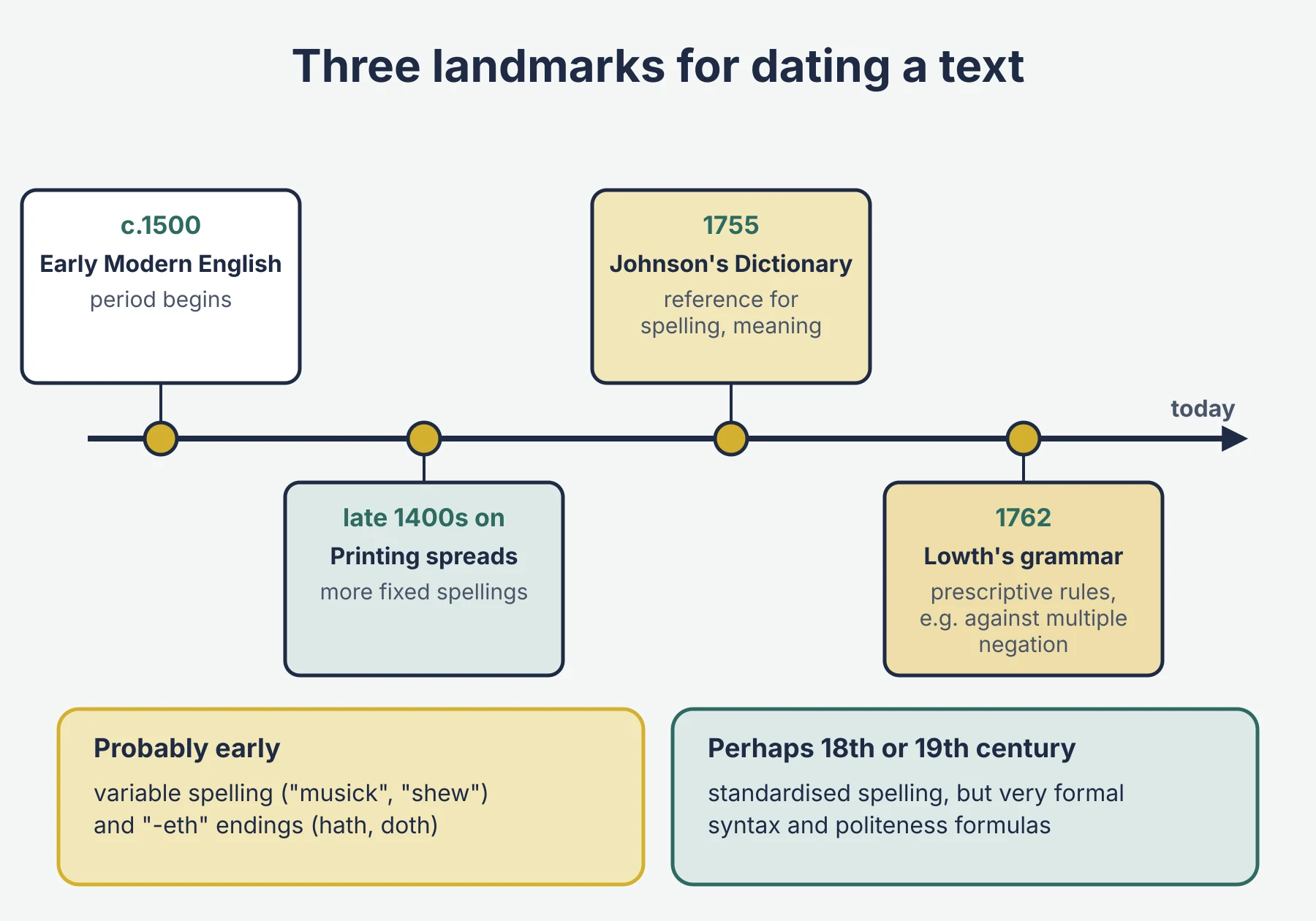
Three landmarks help you place a text. The spread of printing from the late fifteenth century encouraged more fixed spellings. Samuel Johnson’s Dictionary of the English Language (1755) became a reference point for spelling and meaning. Eighteenth-century prescriptive grammars, such as Robert Lowth’s (1762), promoted rules that stigmatised forms like multiple negation. A text with variable spelling and “-eth” endings is probably early; one with standardised spelling but very formal syntax and politeness formulas may be eighteenth or nineteenth century.
Processes of change: the concept vocabulary
The syllabus lists the concepts and terminology below. Each needs a definition and an example you can produce under pressure.
Word formation
- Etymology: the origin and history of a word.
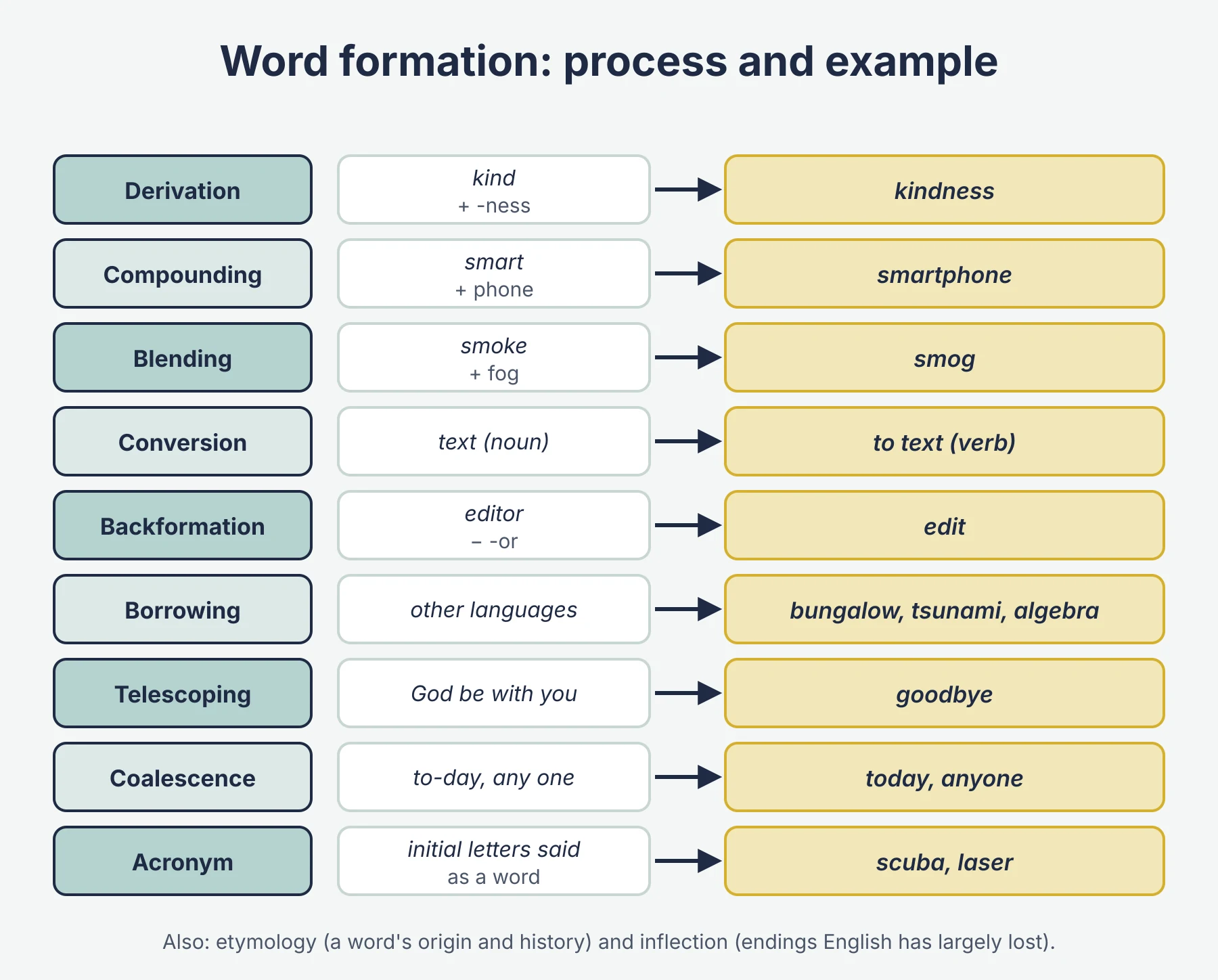
- Derivation: forming a new word by adding affixes (“kind” to “kindness”).
- Inflection: grammatical endings that mark tense, number or person; English has lost many over time.
- Compounding: joining words (“smartphone”).
- Blending: fusing parts of words (“smog” from smoke and fog).
- Acronym: initial letters pronounced as a word (“scuba”, “laser”).
- Conversion: a word changing class without changing form (the noun “text” used as a verb).
- Backformation: removing a supposed affix to create a new word (“edit” from “editor”, “burgle” from “burglar”).
- Borrowing: taking words from other languages (“bungalow”, “tsunami”, “algebra”).
- Telescoping: compressing a phrase into a shorter word, as “goodbye” developed from “God be with you”.
- Coalescence: separate forms merging into one, as “to-day” became “today” and “any one” became “anyone”; the term is also used for two sounds merging in speech.
Semantic change
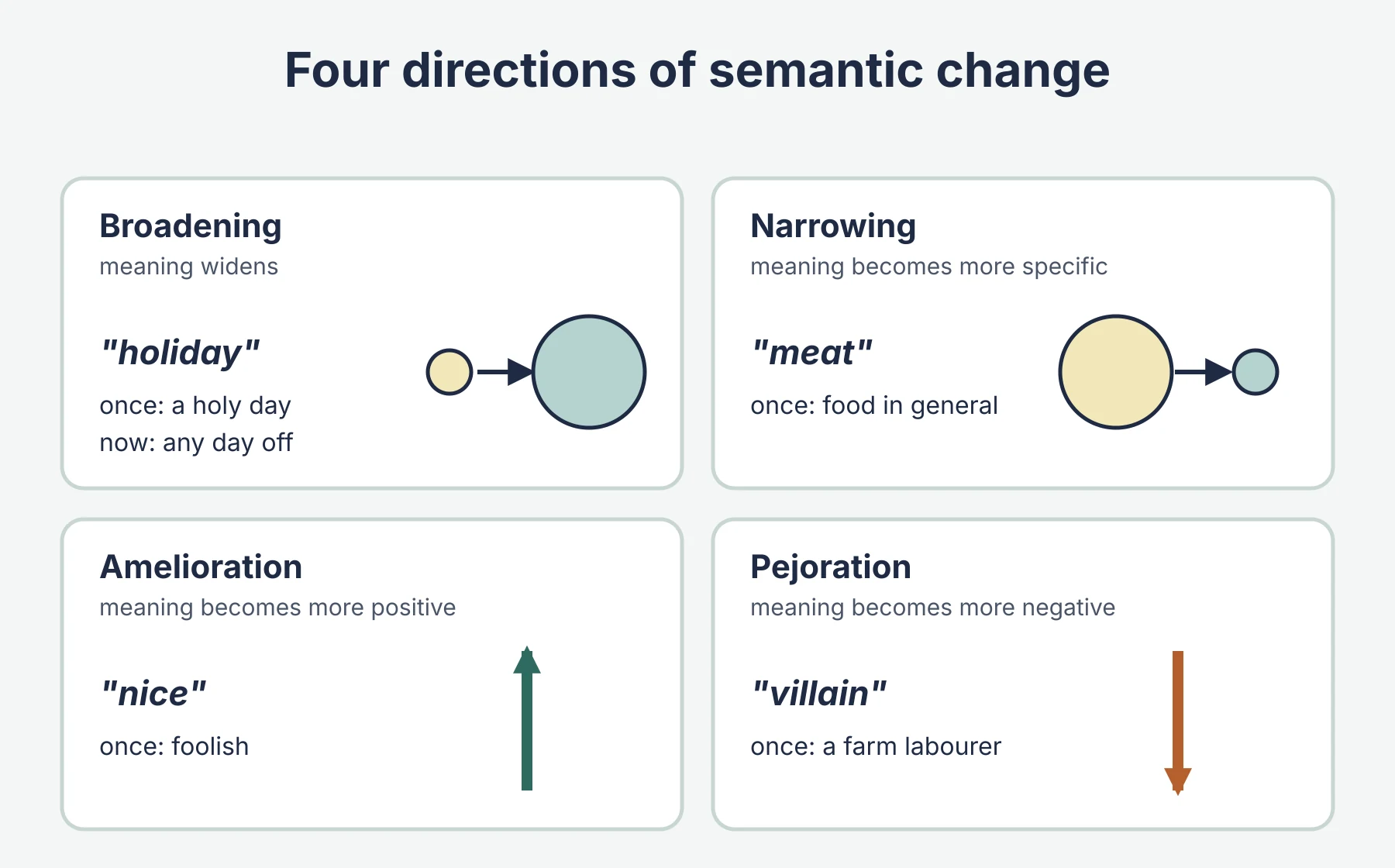
- Broadening: meaning widens (“holiday”, once a holy day, now any day off).
- Narrowing: meaning becomes more specific (“meat”, once food in general).
- Amelioration: meaning becomes more positive (“nice”, once meaning foolish).
- Pejoration: meaning becomes more negative (“villain”, once a farm labourer).
Theories and theorists
The syllabus names these theories. Use them to explain why a change happened, not just to label it.
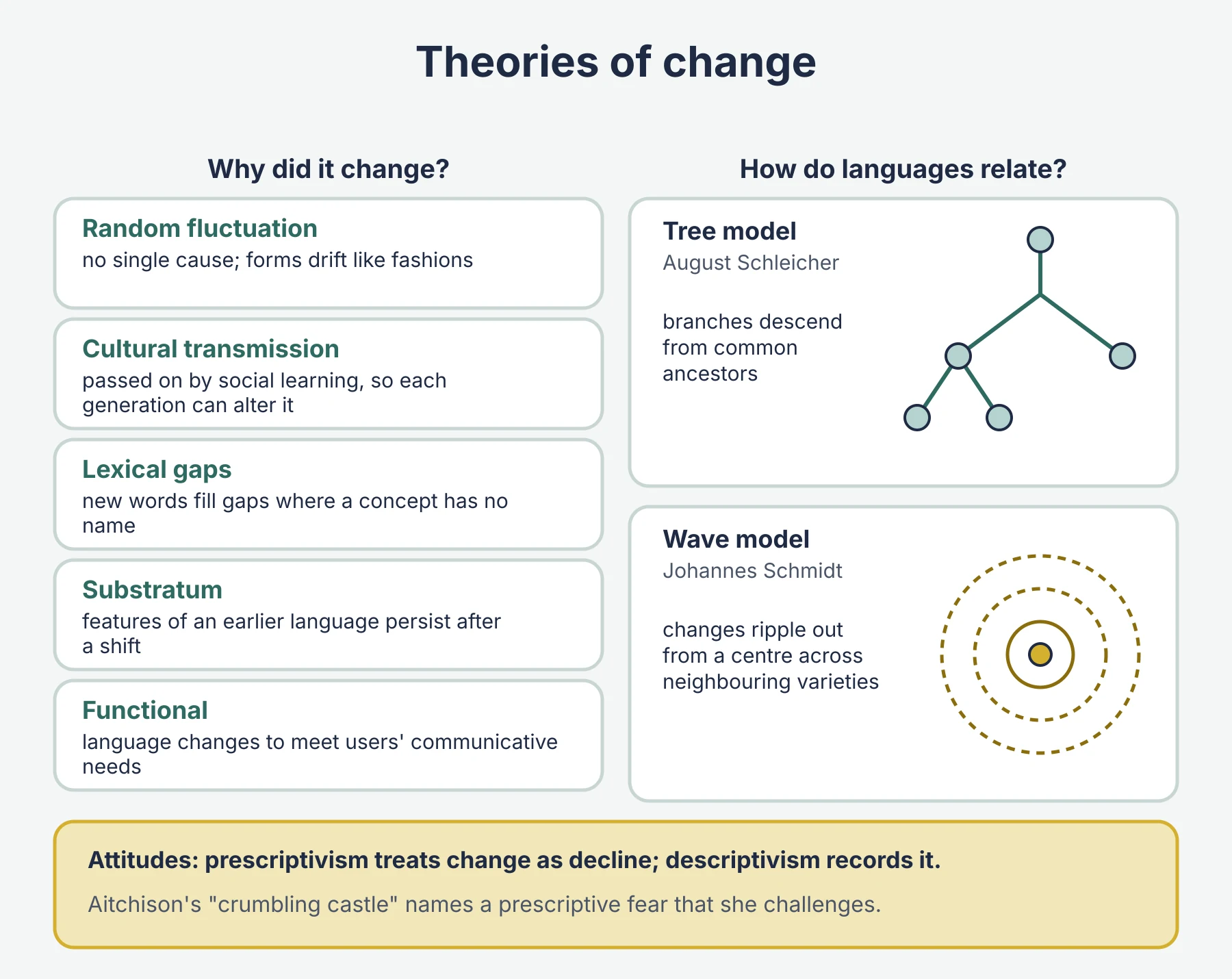
- Random fluctuation theory: some changes have no single identifiable cause; forms drift in and out of use, rather as fashions do.
- Cultural transmission theory: language is passed from one generation to the next through social learning, not biology, so each generation can alter what it passes on.
- Theory of lexical gaps: new words are created or borrowed to fill gaps where a concept has no name, which explains much technological vocabulary.
- Substratum theory: when a population shifts to a new language, features of its earlier language persist in the new one, as with features of Irish in the English of Ireland.
- Functional theory: language changes to meet the communicative needs of its users, so new contexts (the internet, new professions) produce new forms.
- Tree model: associated with August Schleicher, it presents languages as branches descending from common ancestors, as English descends within the Germanic branch.
- Wave model: associated with Johannes Schmidt, it presents changes spreading outward from a centre across neighbouring varieties, like ripples, which explains shared features that cut across family branches.
A useful contrast for attitudes: prescriptivism treats change as decline; descriptivism records it without judgement. Jean Aitchison’s image of language as a “crumbling castle” names a prescriptive fear that she challenges.
Reading the data
N-gram graphs
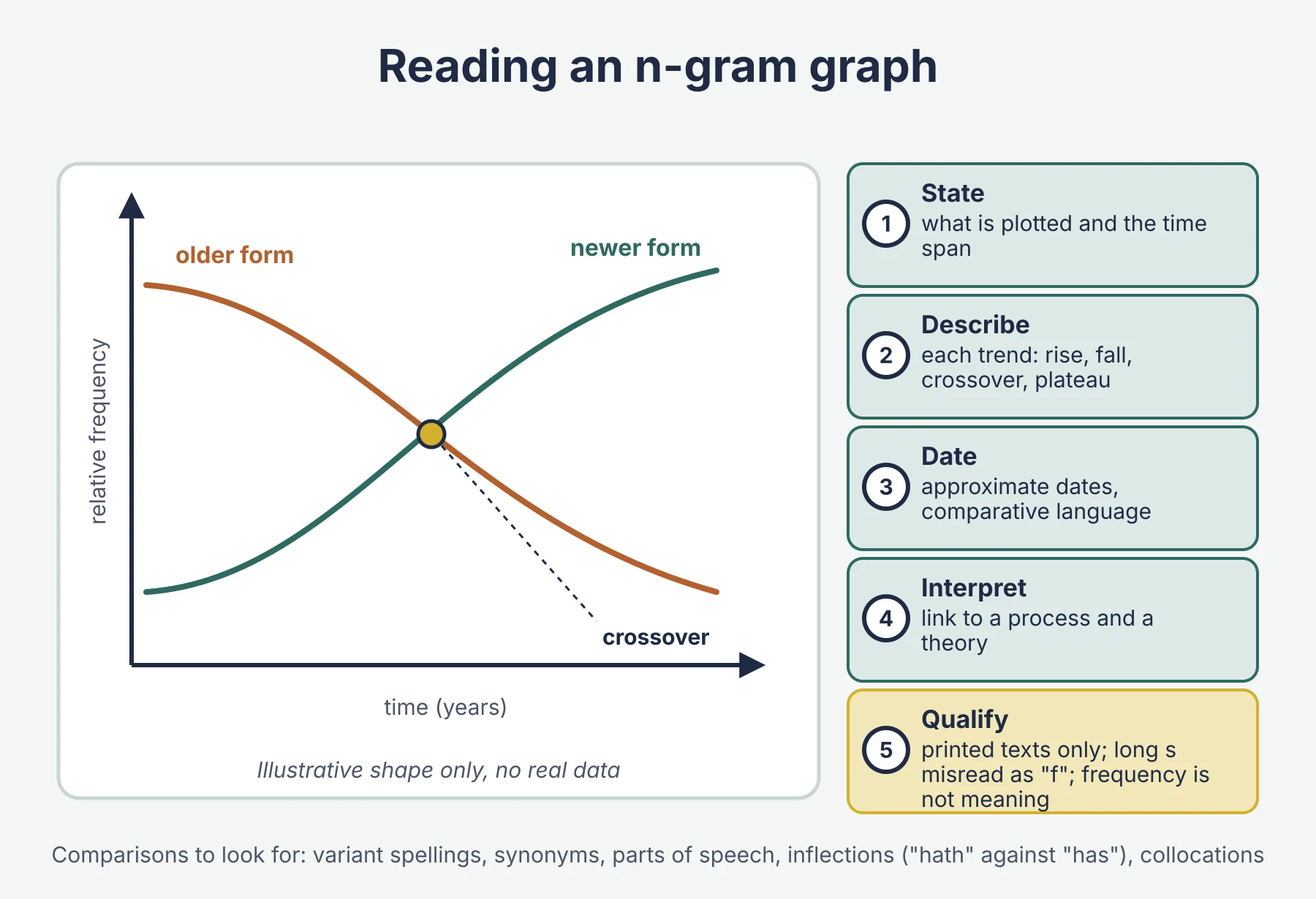
An n-gram graph plots how often a word or phrase appears in a large collection of printed texts, year by year. The horizontal axis shows time; the vertical axis shows relative frequency, the proportion of all words in that year’s texts. The syllabus suggests comparisons of related words (variant spellings, synonyms), parts of speech, inflections (“hath” against “has”) and collocations.
When reading a graph:
- State what is plotted and the time span.
- Describe the trend for each line: rise, fall, crossover point, plateau.
- Give approximate dates and use comparative language (“by around 1800, the newer form overtakes…”).
- Interpret: link the trend to a process (standardisation, borrowing, semantic change) and a theory.
- Qualify: the corpus is of printed texts, so it over-represents formal writing; older scans can misread long s as “f”; a fall in frequency is not the same as a change in meaning.
Corpus word tables
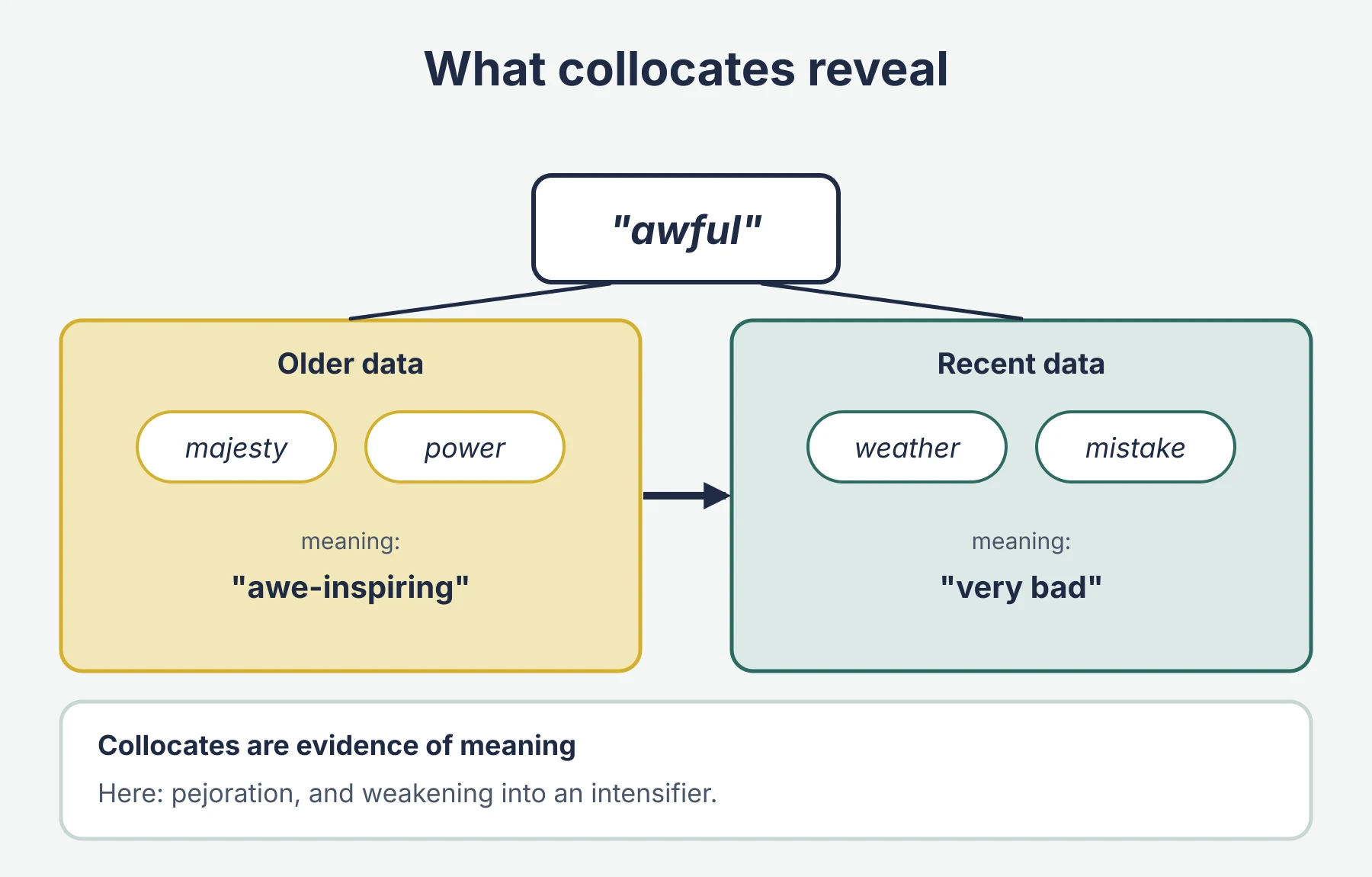
A word table lists data drawn from a corpus, such as the collocates of a word (words that frequently occur near it) in different periods, or synonym lists. Collocates are evidence of meaning: if “awful” collocates with “majesty” and “power” in older data but with “weather” and “mistake” in recent data, its meaning has shifted from “awe-inspiring” towards “very bad”, an example of pejoration and of weakening into an intensifier.
Worked example: synthesising three sources
Prose extract (original, written for this guide in the style of a seventeenth-century letter):
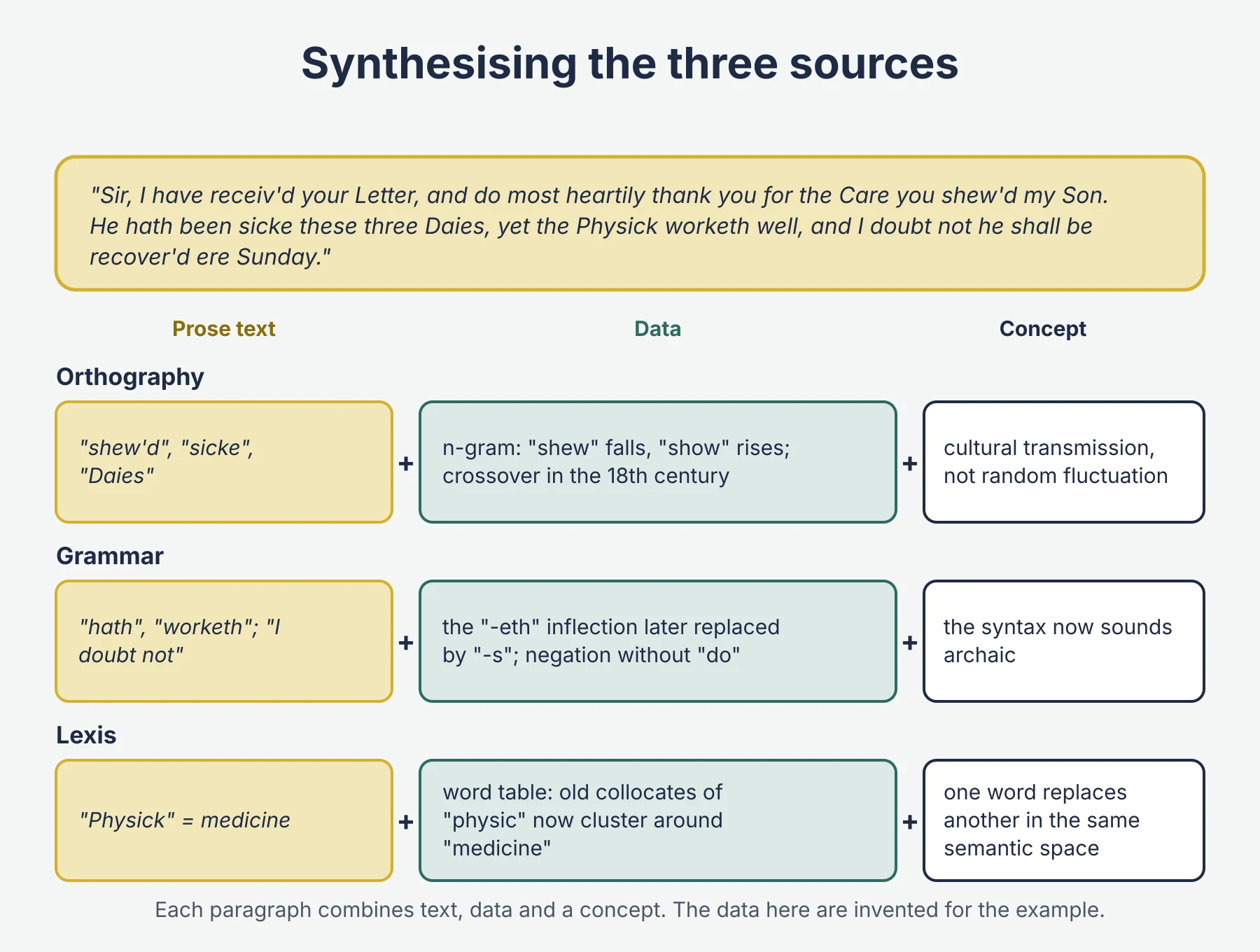
Sir, I have receiv’d your Letter, and do most heartily thank you for the Care you shew’d my Son. He hath been sicke these three Daies, yet the Physick worketh well, and I doubt not he shall be recover’d ere Sunday.
Data (described, invented for this example): an n-gram graph shows “shew” falling steadily while “show” rises, crossing over in the eighteenth century; a word table shows “physic” collocating with “doctor”, “remedy” and “purge” in older texts, while recent collocates of “medicine” include the same words.
Analysis paragraph:
The extract’s orthography marks it as pre-standard: “shew’d”, “sicke” and “Daies” show the variable spelling common before Johnson’s Dictionary, and the n-gram data confirm that “shew” gave way to “show” during the eighteenth century. The steady, one-directional curve fits a cultural transmission explanation better than random fluctuation: once printers and dictionary-makers fixed one spelling, later generations learned it as the correct form. Grammatically, “hath” and “worketh” retain the “-eth” inflection that “-s” later replaced, while “I doubt not” negates without “do”, a syntax that now sounds archaic. Lexically, “Physick” here means medicine, a sense that survives today only in “physician”; the word table shows the collocates that once clustered around “physic” now clustering around “medicine”, evidence of one word replacing another in the same semantic space.
The paragraph moves between all three sources, names features precisely and uses a theory to explain the data rather than to decorate the answer.
Common mistakes
- Feature-spotting archaic forms without dating or explaining them.
- Describing the n-gram graph without interpreting it, or interpreting it without describing it.
- Treating n-gram data as complete evidence of all English use.
- Naming a theory without connecting it to a specific change in the data.
- Calling older forms “wrong” or “mistakes”.
- Writing about the prose text and the data in separate halves of the essay.
Exam technique
Open with a short overview placing the text in time, with reasons. Organise paragraphs by language level or process, each combining evidence from the prose text, the graph or the table, and a concept or theory. Quote sparingly and precisely. End with a judgement about which processes the text best exemplifies. Because AO4 and AO5 dominate, every paragraph should show both conceptual knowledge and handling of data.
Keep going
Related resources
-
Practice questions
Cambridge International AS & A Level English Language (9093): Section A: Language Change – Practice Questions
Original practice for Cambridge 9093 Paper 3 Language Change: word formation, semantic change, theories, n-gram and corpus data, with worked answers.
English · Cambridge · A Level
Try questions -
Revision notes
Cambridge International AS & A Level English Language (9093): Section A: Language Change – Revision Notes
Recall notes for Cambridge 9093 Paper 3 Language Change: dating features, word-formation and semantic terms, named theories and how to read n-grams.
English · Cambridge · A Level
Revise topic -
Study guides
Cambridge International AS & A Level English Language (9093): Section B: Child Language Acquisition
Cambridge 9093 Paper 3 Section B: stages from babbling to post-telegraphic speech, Halliday's functions, theories and how to analyse a child's transcript.
English · Cambridge · A Level
Read guide
Get free revision emails (optional)
Occasional emails with practice questions, worked explanations and links to free resources for the qualification and subjects you choose. No spam, and you can unsubscribe from any email. The free tools on this site never need an email.