
Revision Notes
Cambridge International AS & A Level English Language (9093): Section B: Language and the Self – Revision Notes
Recall notes for Cambridge 9093 Paper 4 Language and the Self: nativism and empiricism, Sapir-Whorf and universalism, prestige, accent and genderlect studies.
- Subject
- English
- Level
- A LEVEL
- Topic
- Paper 4 – Language Topics
- Author
- Marlbridge Academic Team
- Updated
- Reviewed by
- Ammar Bilal (what this means)
Aligned to Cambridge A Level English (9093), 2024-2026. Official specification .
Syllabus page (what it covers and how it is assessed): Cambridge A Level English Language.
Found an error? Report a correction.
Need help with this topic? Request a free trial class for A Level English Language (9093).
Condensed recall for Paper 4 Section B. For full explanations and a model paragraph, use the Language and the Self study guide.
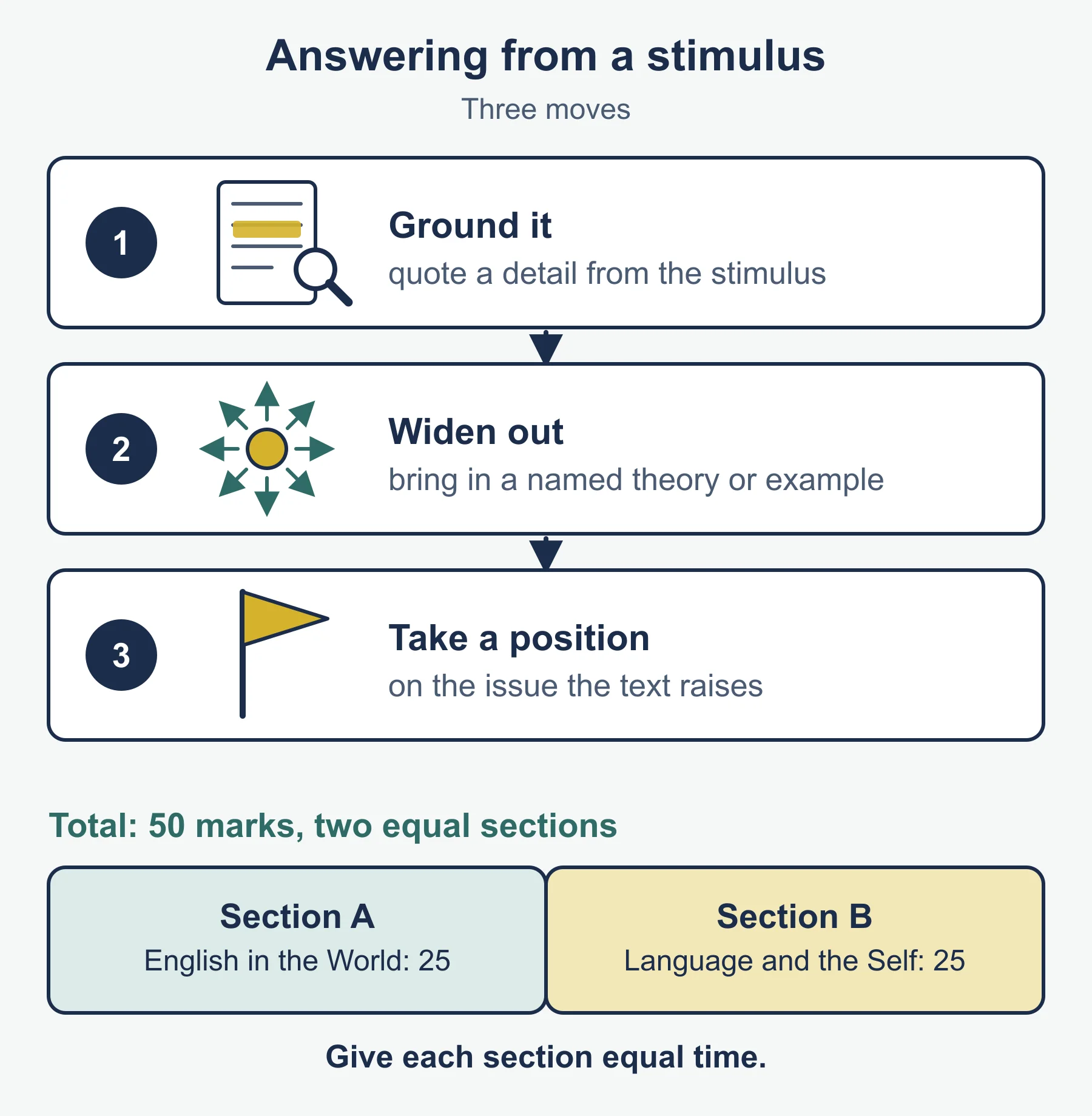
The task in brief
- One compulsory essay, 25 marks, half of Paper 4.
- A text of about 400-500 words on language and the self.
- Discuss the most important issues it raises about a specified aspect of language and the self.
- Refer to specific details and to theories, theorists and studies.
- AO1, AO2, AO4.
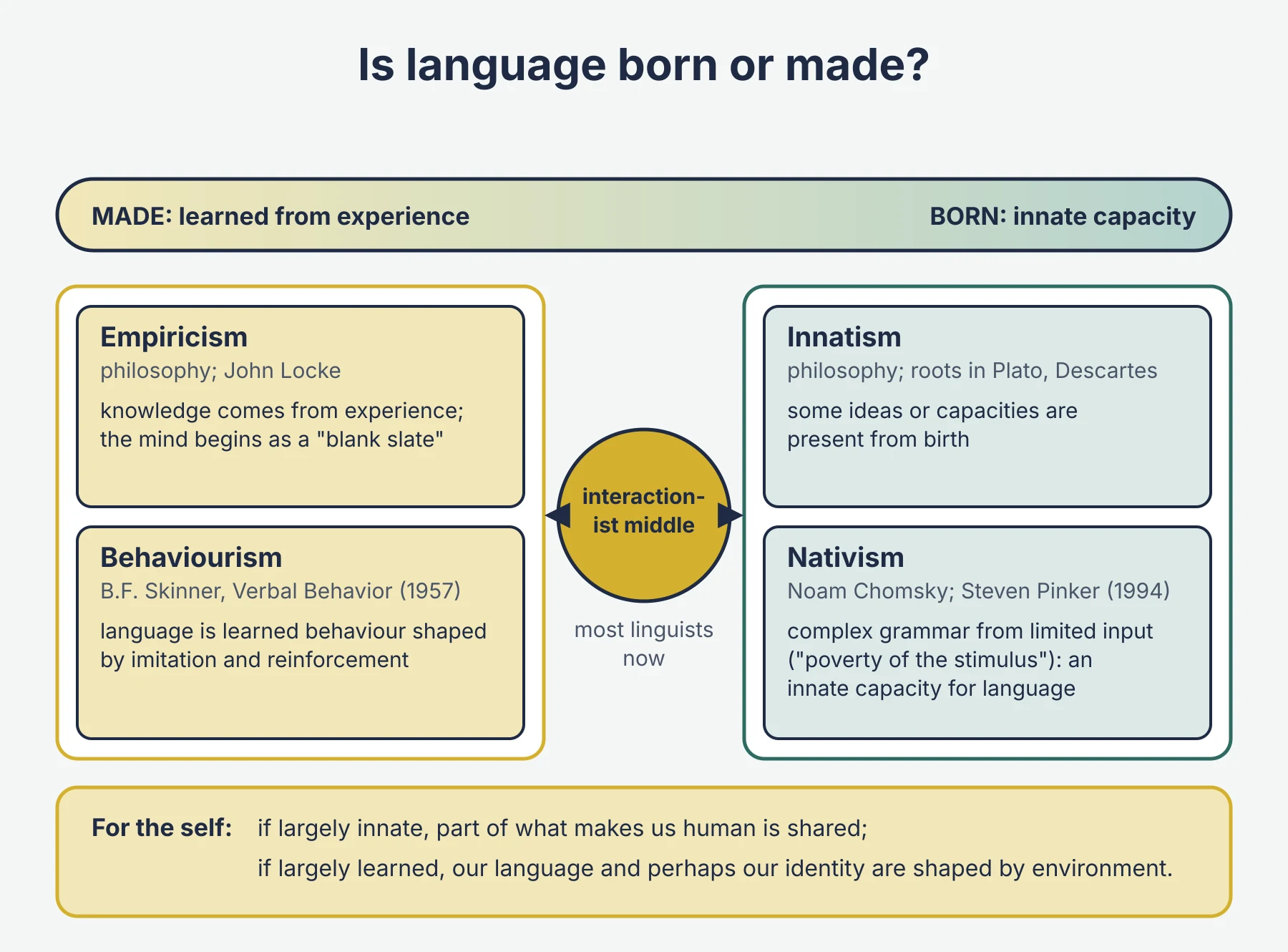
Strand 1: innateness and learning
| Position | Claim | Key names |
|---|---|---|
| Empiricism | Knowledge comes from experience; the mind starts as a blank slate | John Locke |
| Behaviourism | Language is learned through imitation and reinforcement | B.F. Skinner, Verbal Behavior (1957) |
| Innatism | Some ideas or capacities are present at birth | Philosophical roots in Plato and Descartes |
| Nativism | An innate capacity for language explains acquisition from limited input | Noam Chomsky; Steven Pinker, The Language Instinct (1994) |
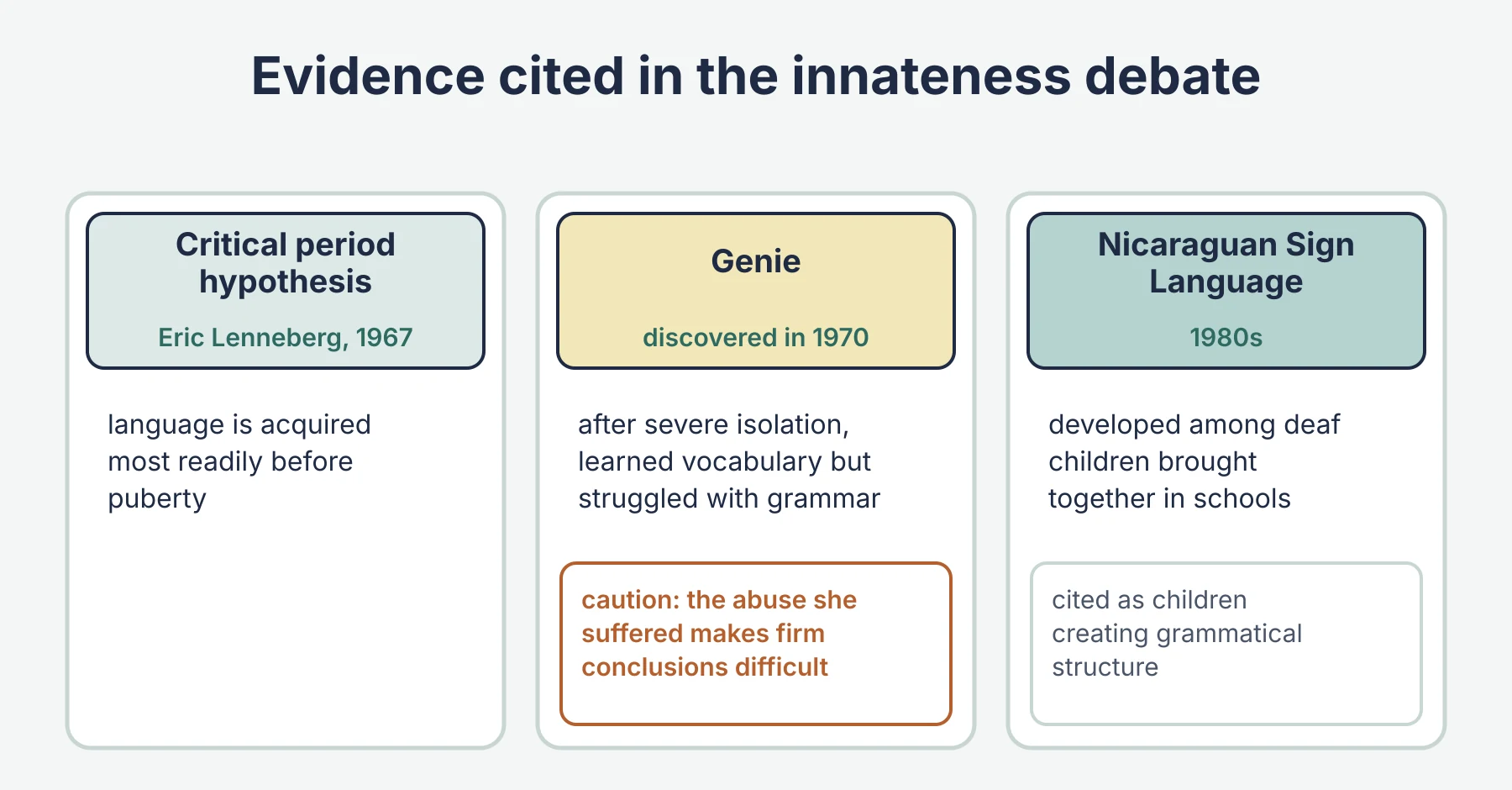
Evidence to cite with care:
- Critical period hypothesis (Lenneberg, 1967): acquisition is easiest before puberty.
- Genie (discovered 1970): vocabulary learned, grammar limited; abuse complicates conclusions.
- Nicaraguan Sign Language (1980s): deaf children developed a grammatically structured sign language.
- Poverty of the stimulus: children acquire rules not clearly present in their input.
Strand 2: language and thought
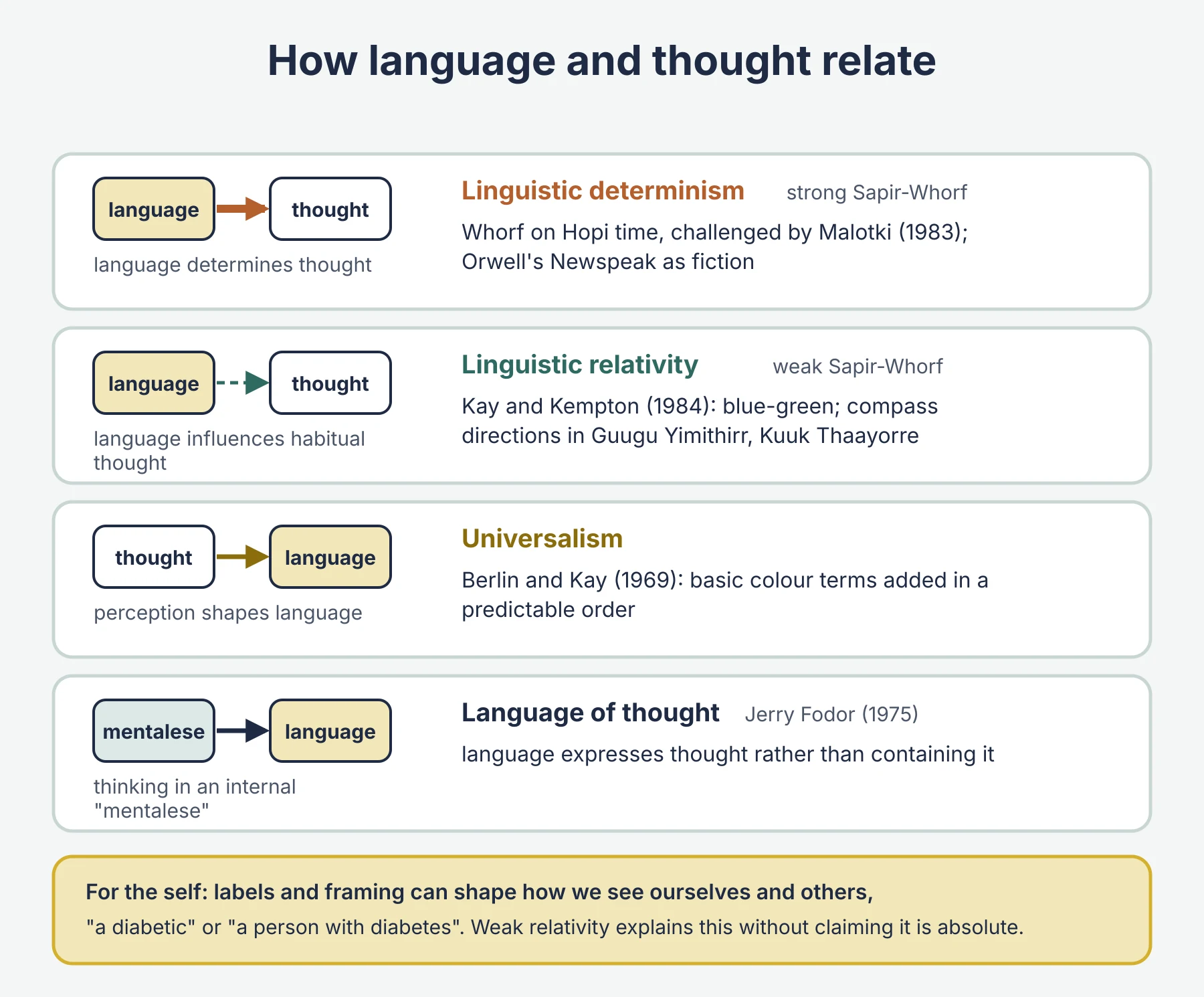
| Position | Claim | Evidence or example |
|---|---|---|
| Linguistic determinism (strong Sapir-Whorf) | Language determines thought | Whorf on Hopi time, challenged by Malotki (1983); Orwell’s Newspeak as illustration |
| Linguistic relativity (weak Sapir-Whorf) | Language influences habitual thought | Kay and Kempton (1984), blue-green judgements; compass-direction languages such as Guugu Yimithirr |
| Universalism | Shared human cognition shapes all languages | Berlin and Kay (1969), basic colour terms |
| Language of thought hypothesis | Thought occurs in an internal code, “mentalese” | Jerry Fodor (1975) |
Applied to the self: labels, euphemism and framing (“person with diabetes” against “diabetic”) influence self-perception without determining it.
Strand 3: language and social identity
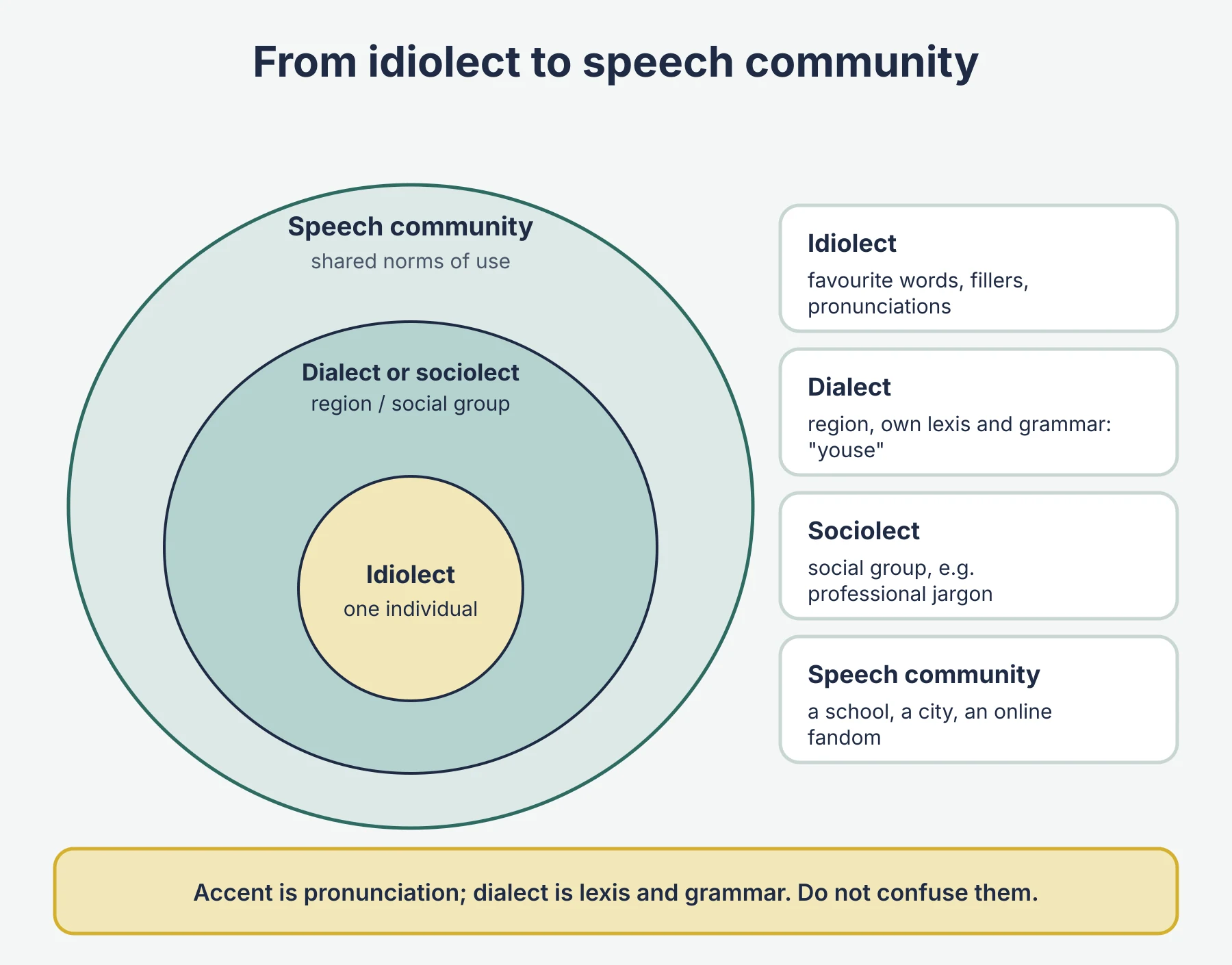
- Idiolect: an individual’s unique language use.
- Dialect: a regional variety with its own lexis and grammar.
- Sociolect: a variety linked to a social group, such as class, age or occupation.
- Accent: pronunciation only.
- Speech community: a group sharing norms of language use.
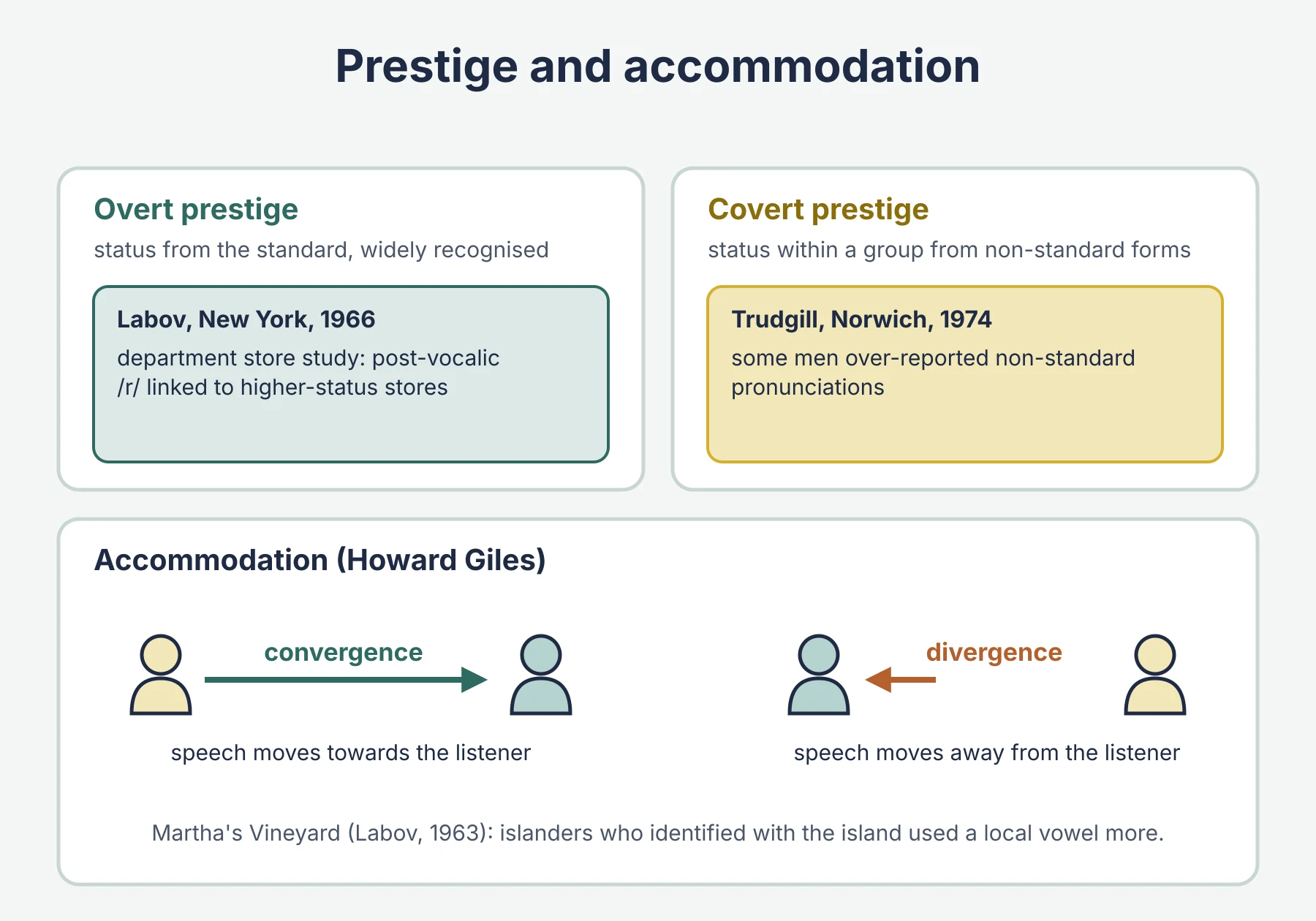
- Overt prestige: status from standard forms. Labov (1966), New York department stores and post-vocalic /r/.
- Covert prestige: in-group status from non-standard forms. Trudgill (1974), Norwich men over-reporting non-standard forms.
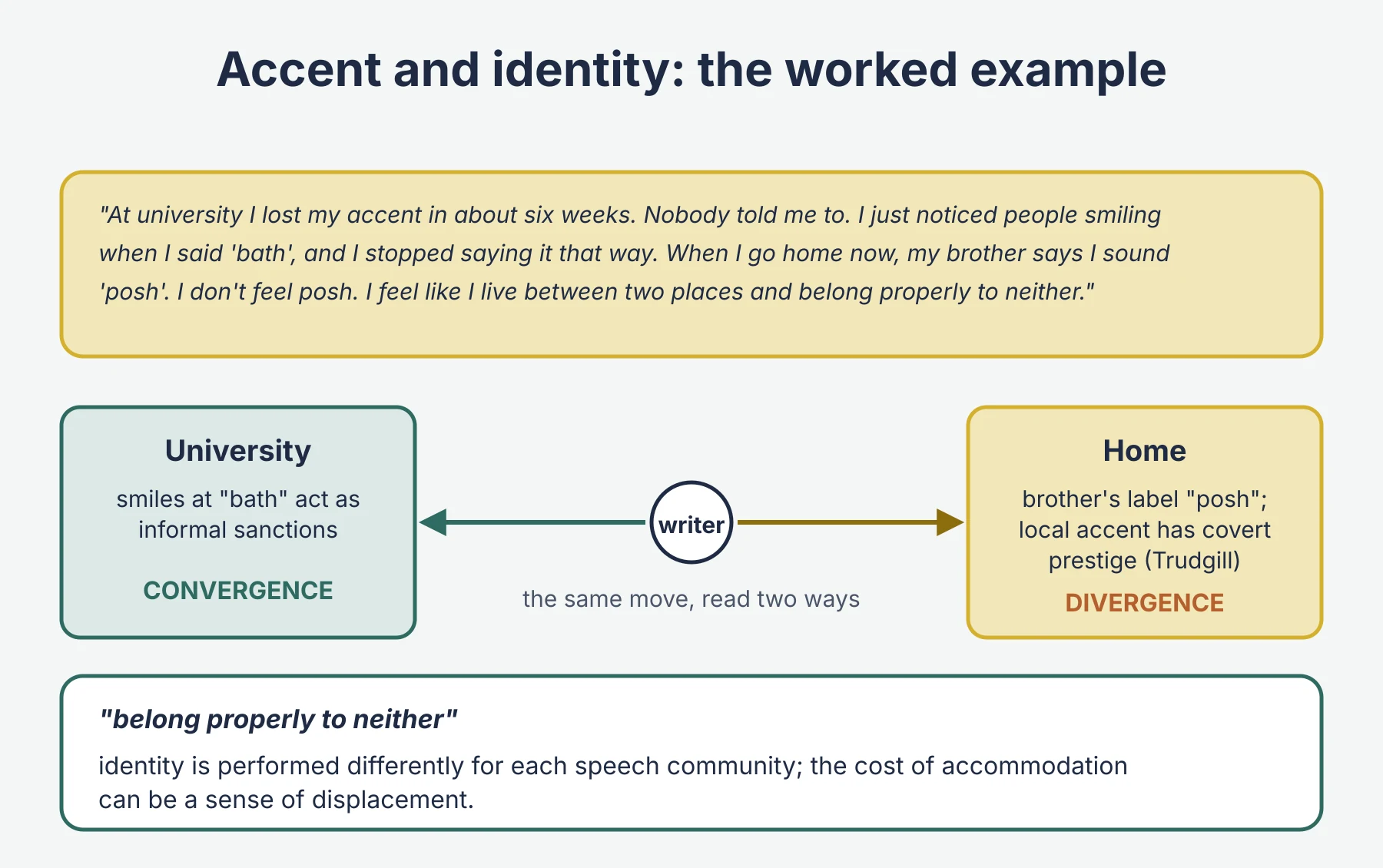
- Accent as identity: Labov (1963), Martha’s Vineyard vowels used more by islanders who identified with the island.
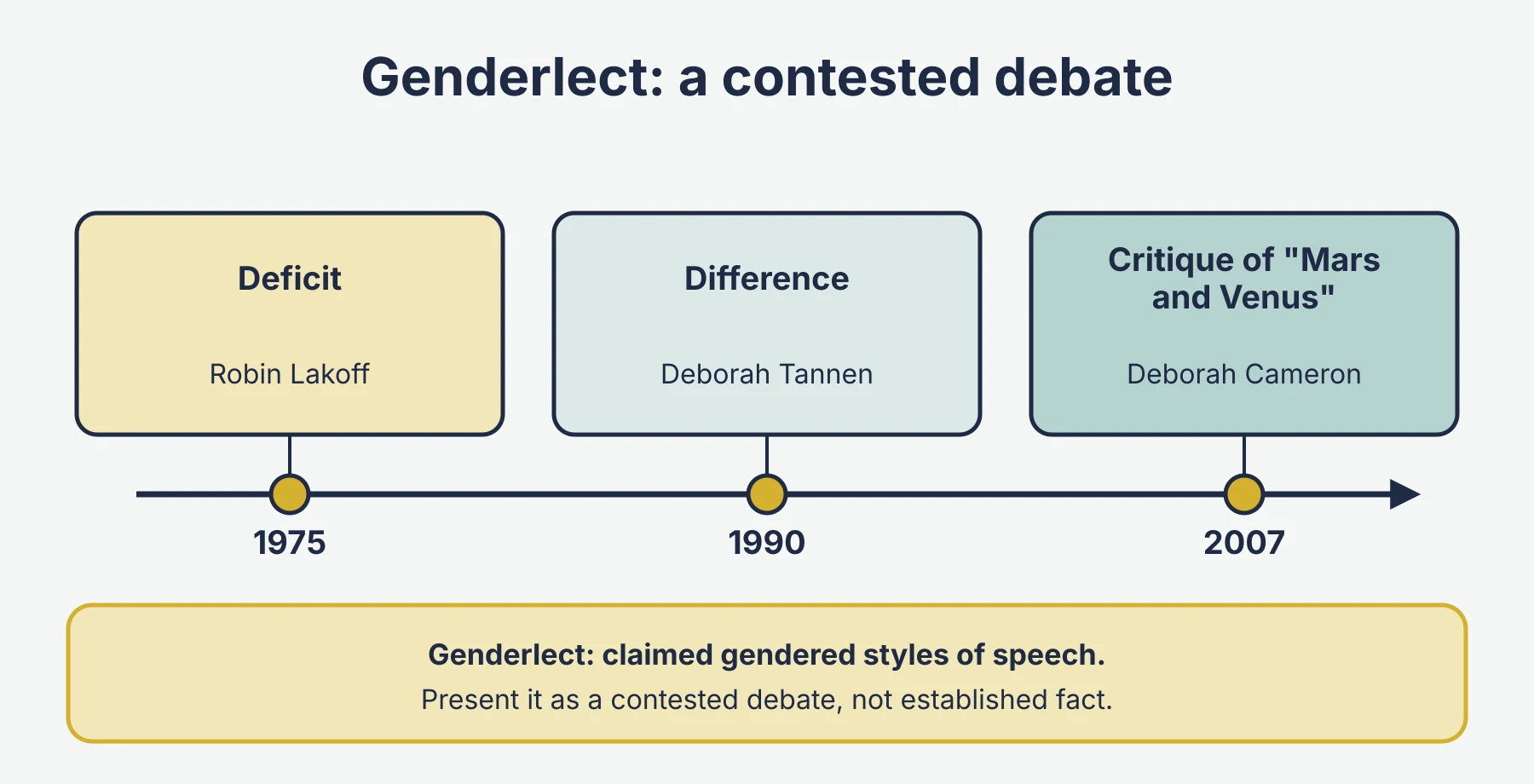
- Genderlect: Lakoff (1975), deficit; Tannen (1990), difference; Cameron (2007) argues differences are overstated.
- Accommodation (Giles): convergence and divergence.
- Inclusion and exclusion: slang, jargon, in-jokes, and accent judgements mark insiders and outsiders.
Key terms
| Term | Meaning |
|---|---|
| Poverty of the stimulus | The argument that input alone is too limited to explain acquired grammar |
| Critical period | A window in which language is most readily acquired |
| Mentalese | The internal language of thought proposed by Fodor |
| Linguistic relativity | Language influences thought |
| Linguistic determinism | Language determines thought |
| Convergence | Shifting one’s speech towards a listener’s |
| Divergence | Shifting one’s speech away from a listener’s to stress difference |
| Standard English | The codified variety used in education and formal writing; not an accent |
Essay method
- Identify the specified aspect and which strand or strands it involves.
- Select and rank three or four issues from the text.
- Each paragraph: quotation, concept, study, evaluation.
- Conclude with a judgement answering the question.
Exam traps
- Collapsing strong and weak Sapir-Whorf into one claim.
- Treating Lakoff or Tannen as settled fact.
- Muddling accent and dialect.
- Misdating or inventing study findings.
- Listing theories with no link to the text.
- Ignoring one strand that the text clearly raises.
Self-test
- Which three strands make up Section B’s content?
- What is the difference between empiricism and nativism?
- What does “poverty of the stimulus” mean?
- Why is the Genie case limited as evidence?
- Distinguish linguistic determinism from linguistic relativity.
- What did Kay and Kempton’s study suggest?
- How do Berlin and Kay’s findings support universalism?
- What is the language of thought hypothesis?
- What did Labov find in the New York department stores?
- What is covert prestige, and which study is it associated with?
- What is the difference between Lakoff’s and Tannen’s approaches to genderlect?
- Define convergence and divergence.
Answers: 1. Innateness and learning; language and thought; language and social identity. 2. Empiricism holds that knowledge comes from experience; nativism holds that humans have an innate capacity for language. 3. Children acquire grammatical rules that their limited, imperfect input does not clearly provide. 4. Her severe isolation and abuse mean her difficulties cannot be attributed to missing the critical period alone. 5. Determinism claims language decides what we can think; relativity claims it only influences habitual thought. 6. That having separate words for blue and green can affect how speakers judge colour differences near the boundary. 7. They argued that languages add basic colour terms in a broadly predictable order, suggesting shared perception shapes language. 8. Fodor’s proposal that thinking occurs in an internal code, mentalese, separate from any spoken language. 9. Post-vocalic /r/ in “fourth floor” was more frequent among staff in higher-status stores, linking it to overt prestige. 10. Status gained within a group from non-standard forms; Trudgill’s Norwich study. 11. Lakoff saw women’s language as deficient and less powerful; Tannen saw male and female styles as different but equal. 12. Convergence is adjusting speech towards a listener’s; divergence is adjusting it away to stress difference.
Try the Language and the Self practice questions, then the Paper 4 revision notes.
Related resources
-
Study guides
Cambridge A-Level English Language: Paper 4 Language Topics (9093)
Cambridge 9093 Paper 4 Language Topics: English as a global language, Kachru's Three Circles, pidgins and creoles, and how language shapes identity.
English · Cambridge · A Level
Read guide -
Practice questions
A Level English Language: Paper 4 Language Topics — Practice Questions
Original stimulus-based discussion questions with model structures on English in the World and Language and the Self for Cambridge 9093 Paper 4.
English · Cambridge · A Level
Try questions -
Revision notes
Cambridge A Level English Language 9093: Paper 4 — Revision Notes
Condensed notes on Cambridge A Level English Language 9093 Paper 4 Language Topics: English in the World and Language and the Self, with key models.
English · Cambridge · A Level
Revise topic
Get free revision emails (optional)
Occasional emails with practice questions, worked explanations and links to free resources for the qualification and subjects you choose. No spam, and you can unsubscribe from any email. The free tools on this site never need an email.