
Study Guides
Cambridge International AS & A Level English Language (9093): Section B: Language and the Self
Cambridge 9093 Paper 4 Section B: innateness and learning, linguistic relativity and universalism, and how accent, dialect and sociolect build identity.
- Subject
- English
- Level
- A LEVEL
- Topic
- Paper 4 – Language Topics
- Author
- Marlbridge Academic Team
- Updated
- Reviewed by
- Ammar Bilal (what this means)
Aligned to Cambridge A Level English (9093), 2024-2026. Official specification .
Syllabus page (what it covers and how it is assessed): Cambridge A Level English Language.
Found an error? Report a correction.
Need help with this topic? Request a free trial class for A Level English Language (9093).
Section B of Paper 4 Language Topics in Cambridge International AS & A Level English Language (9093) asks how language communicates our sense of self and helps to build it. The syllabus divides the topic into three strands: whether language is innate, learned or both; how language and thought relate; and how we use language, consciously and unconsciously, to construct social identities. This guide takes each strand in turn, then shows how to use your knowledge on an unseen text.
What the question asks
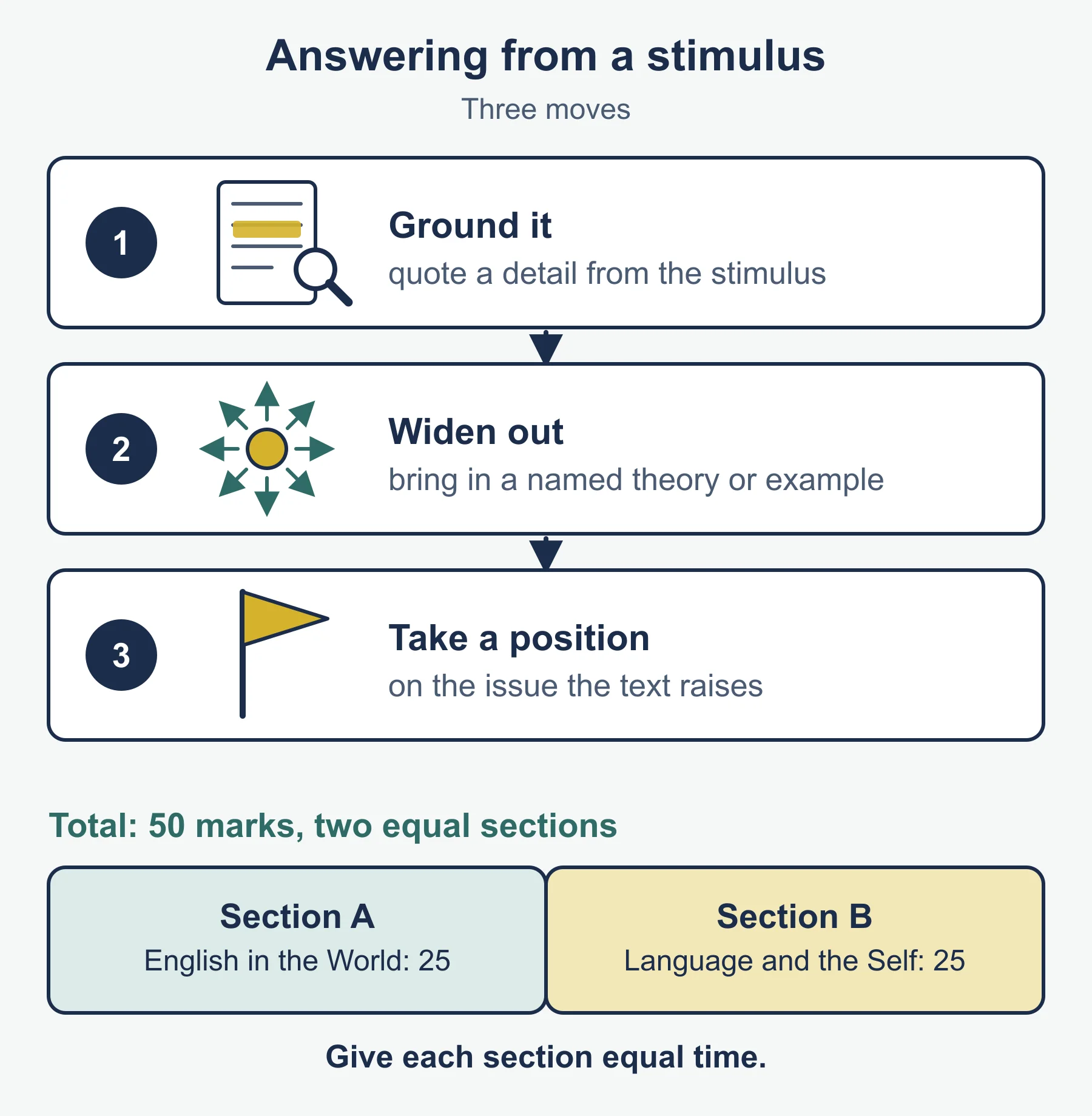
Section B is one compulsory question worth 25 marks, half of Paper 4. You read about 400-500 words of text on language and the self and discuss the most important issues it raises in relation to a specified aspect of the relationship between language and the self. You refer to specific details from the text and relate them to theories, theorists and studies from your wider research. The question assesses AO1, AO2 and AO4.
The specified aspect might focus on one strand (for example accent and identity) or ask you to connect two (for example whether the language we grow up with shapes how we think). Read it carefully before you read the text.
Strand 1: innateness and learning
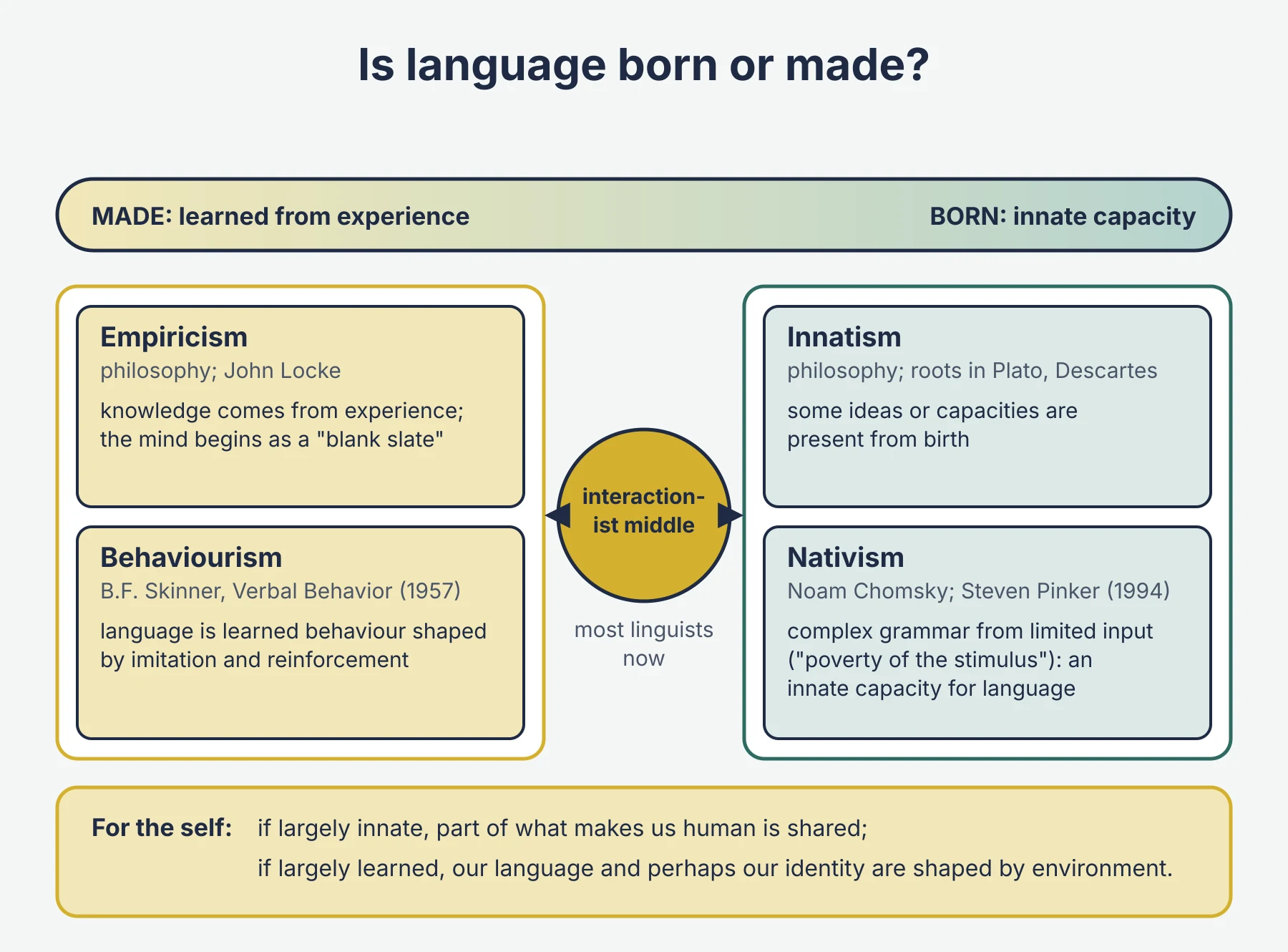
The syllabus examples are behaviourism, innatism, nativism and empiricism. These are positions on one question: how much of our capacity for language is born and how much is made?
- Empiricism is the philosophical view, associated with John Locke, that knowledge comes from experience; the mind begins as a “blank slate”.
- Behaviourism applies this to language. B.F. Skinner’s Verbal Behavior (1957) explained language as learned behaviour shaped by imitation and reinforcement.
- Innatism is the philosophical view that some ideas or capacities are present from birth, a position with roots in thinkers such as Plato and Descartes.
- Nativism is the linguistic version. Noam Chomsky argued that children acquire complex grammar from limited and imperfect input (the “poverty of the stimulus”), so humans must have an innate capacity for language. Steven Pinker’s The Language Instinct (1994) popularised the view.
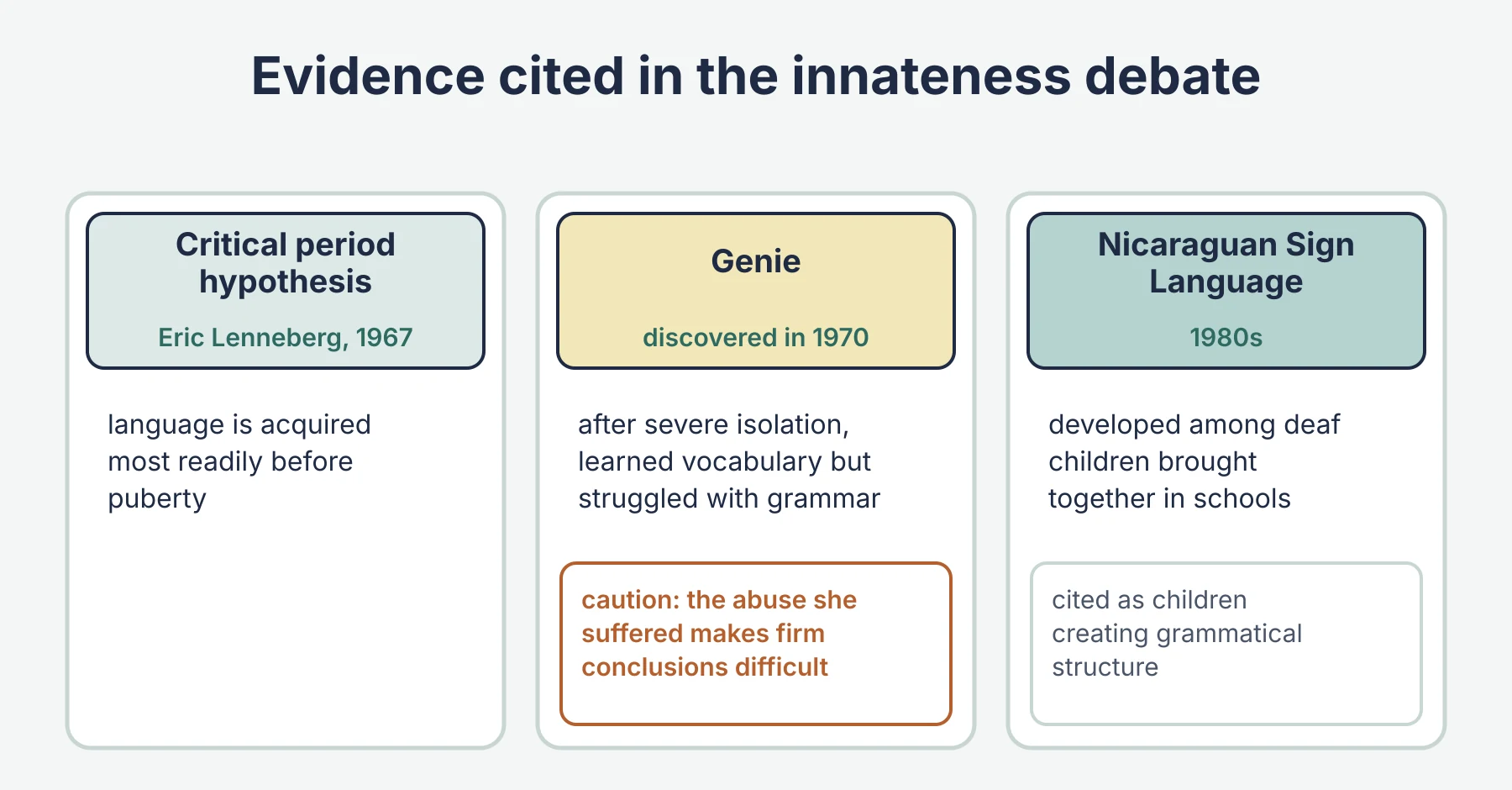
Evidence often cited: the critical period hypothesis, associated with Eric Lenneberg (1967), proposes that language is acquired most readily before puberty; the case of Genie, a girl discovered in 1970 after severe isolation, who learned vocabulary but struggled with grammar, is often used to support it, though the abuse she suffered makes firm conclusions difficult. Nicaraguan Sign Language, which developed among deaf children brought together in schools in the 1980s, is cited as evidence that children create grammatical structure.
For the self, the point is this: if language is largely innate, part of what makes us human is shared; if it is largely learned, our language, and perhaps our identity, is shaped by our environment. Most linguists now take an interactionist middle position.
Strand 2: language and thought
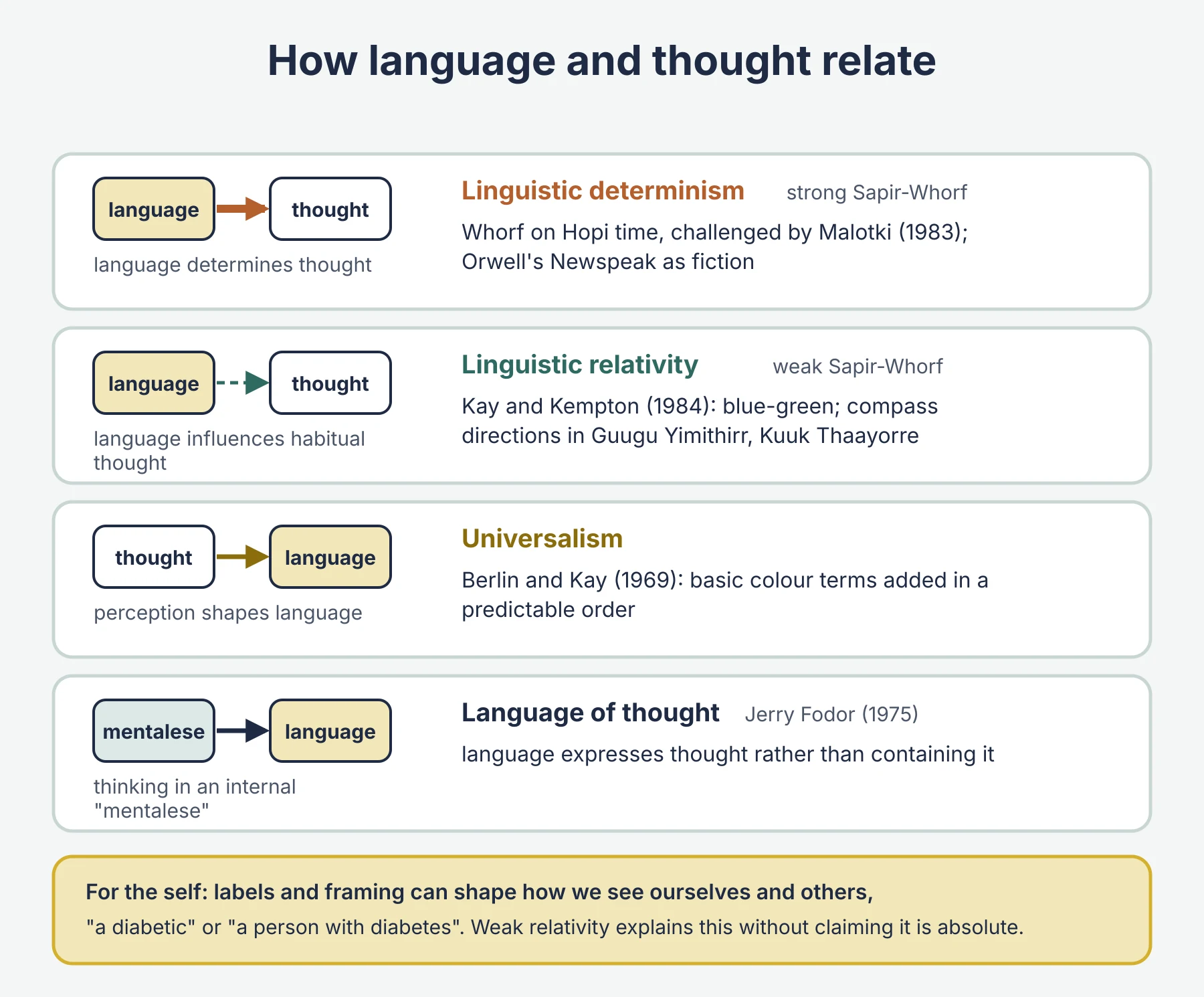
The syllabus examples are linguistic relativity and determinism, universalism, and the language of thought hypothesis.
Linguistic determinism, the strong form of the Sapir-Whorf hypothesis, claims that language determines thought: we cannot think what our language cannot express. Benjamin Lee Whorf’s claims about how the Hopi language expresses time were later challenged by Ekkehart Malotki’s research (1983). George Orwell’s Newspeak in Nineteen Eighty-Four is a fictional illustration of the idea.
Linguistic relativity, the weak form, claims that language influences habitual thought and perception without imprisoning it. Kay and Kempton (1984) found that speakers of English, which distinguishes “blue” and “green”, judged colour differences on the blue-green boundary differently from speakers of Tarahumara, which does not. Research on languages such as Guugu Yimithirr and Kuuk Thaayorre, which use compass directions where English uses “left” and “right”, suggests speakers develop strong orientation habits.
Universalism stresses what all humans share. Berlin and Kay (1969) argued that languages add basic colour terms in a broadly predictable order, suggesting perception shapes language rather than the reverse.
The language of thought hypothesis, developed by Jerry Fodor (1975), proposes that thinking takes place in an internal mental code (“mentalese”) distinct from any spoken language. If so, our language is a way of expressing thought rather than its container.
Applied to the self: euphemism, labels and framing can shape how we see ourselves and others. A person described as “a diabetic” rather than “a person with diabetes” may experience the label differently. The weak relativist view explains this influence without claiming it is absolute.
Strand 3: language and social identity
The syllabus examples are speech communities, prestige, idiolect, dialect, sociolect, genderlect, variation, standard and non-standard features, inclusion and exclusion, and speech sounds and accents.
| Concept | Meaning | Study or example |
|---|---|---|
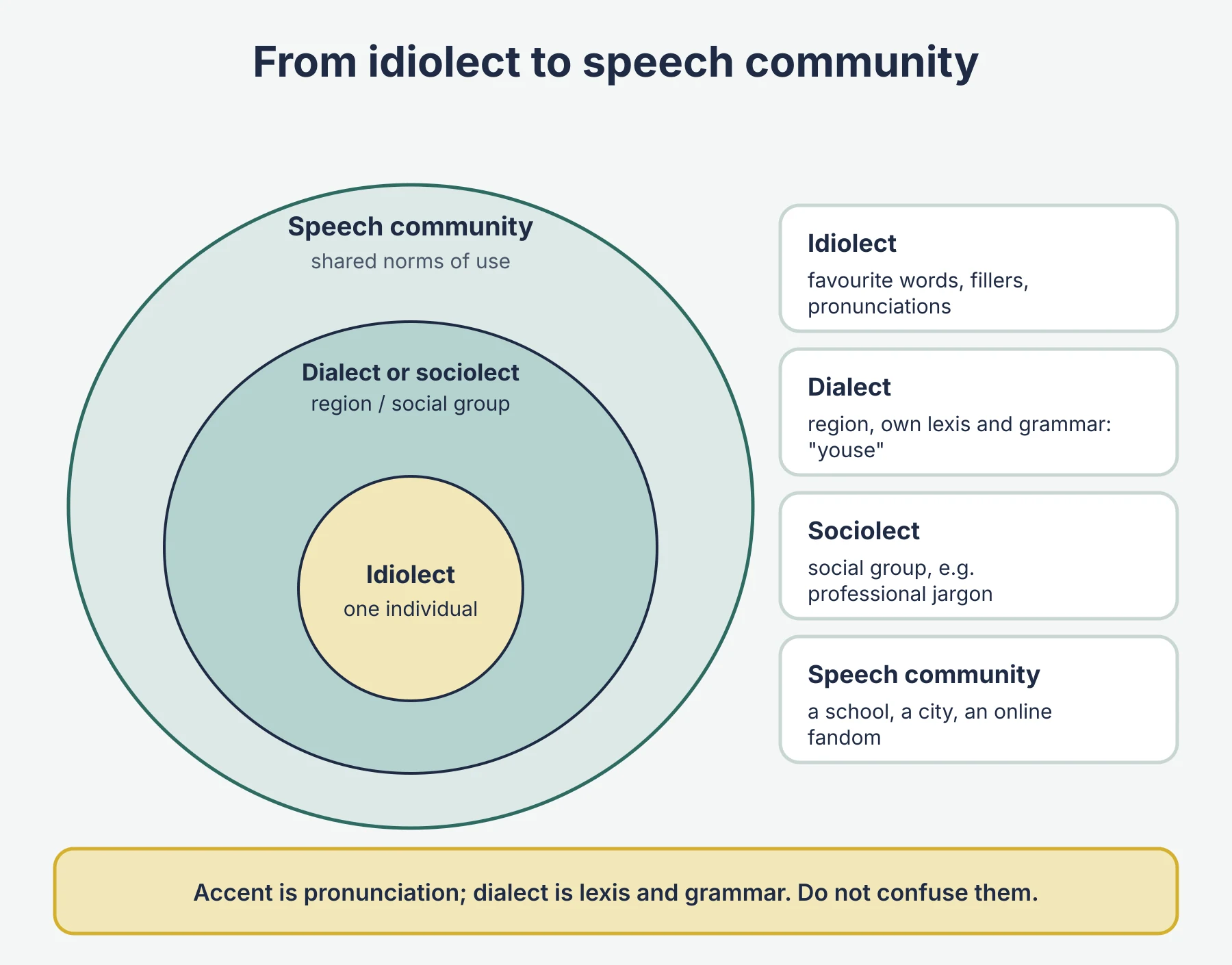
| Idiolect | An individual’s unique way of using language | Favourite words, fillers, pronunciations |
| Dialect | A variety marked by region, with its own lexis and grammar | “Youse” as a plural “you” |
| Sociolect | A variety associated with a social group, such as class or occupation | Professional jargon |
| Speech community | A group sharing norms of language use | A school, a city, an online fandom |
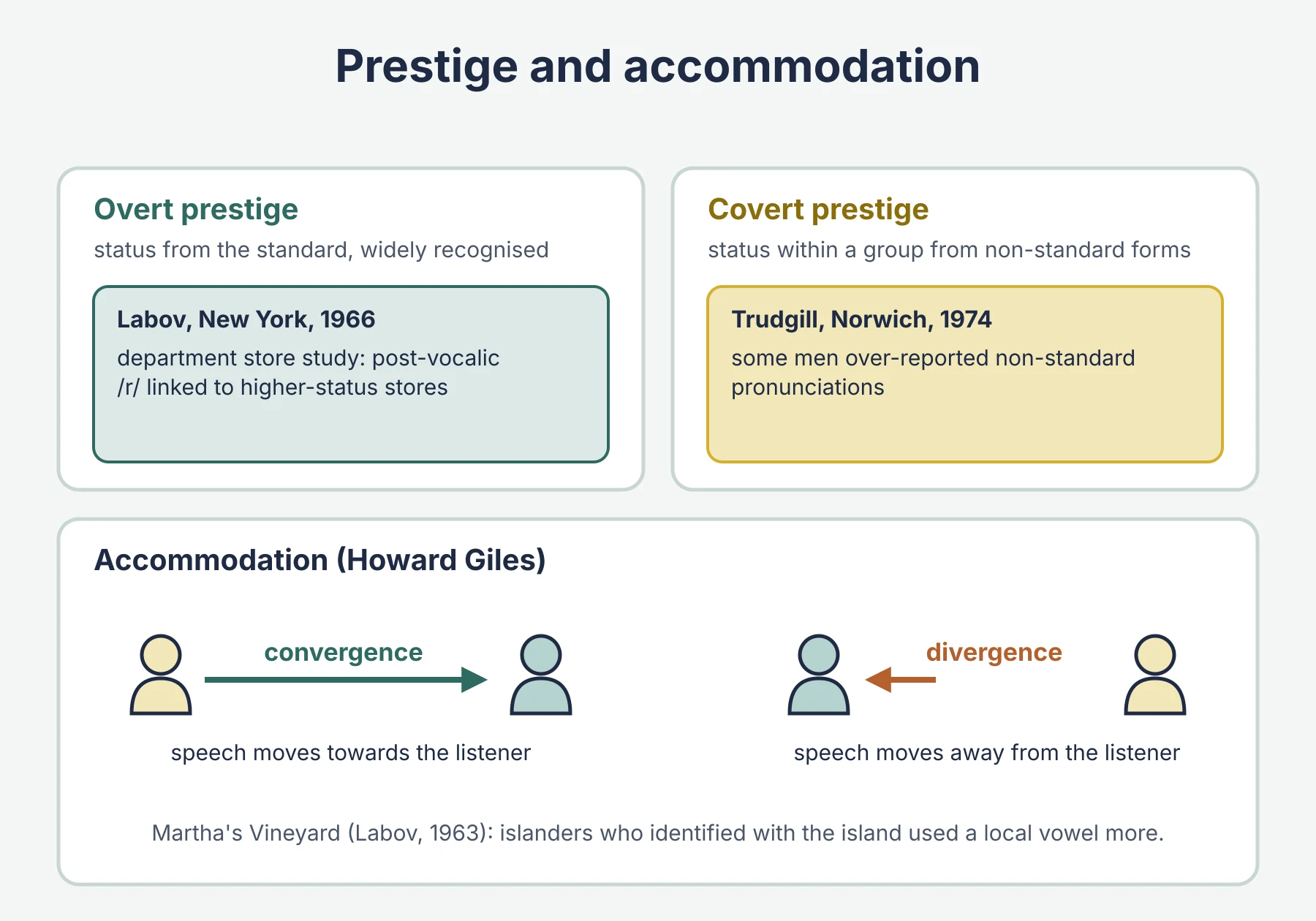
| Overt prestige | Status from the standard, widely recognised | William Labov’s New York department store study (1966): post-vocalic /r/ linked to higher-status stores |
| Covert prestige | Status within a group from non-standard forms | Peter Trudgill’s Norwich study (1974): some men over-reported non-standard pronunciations |
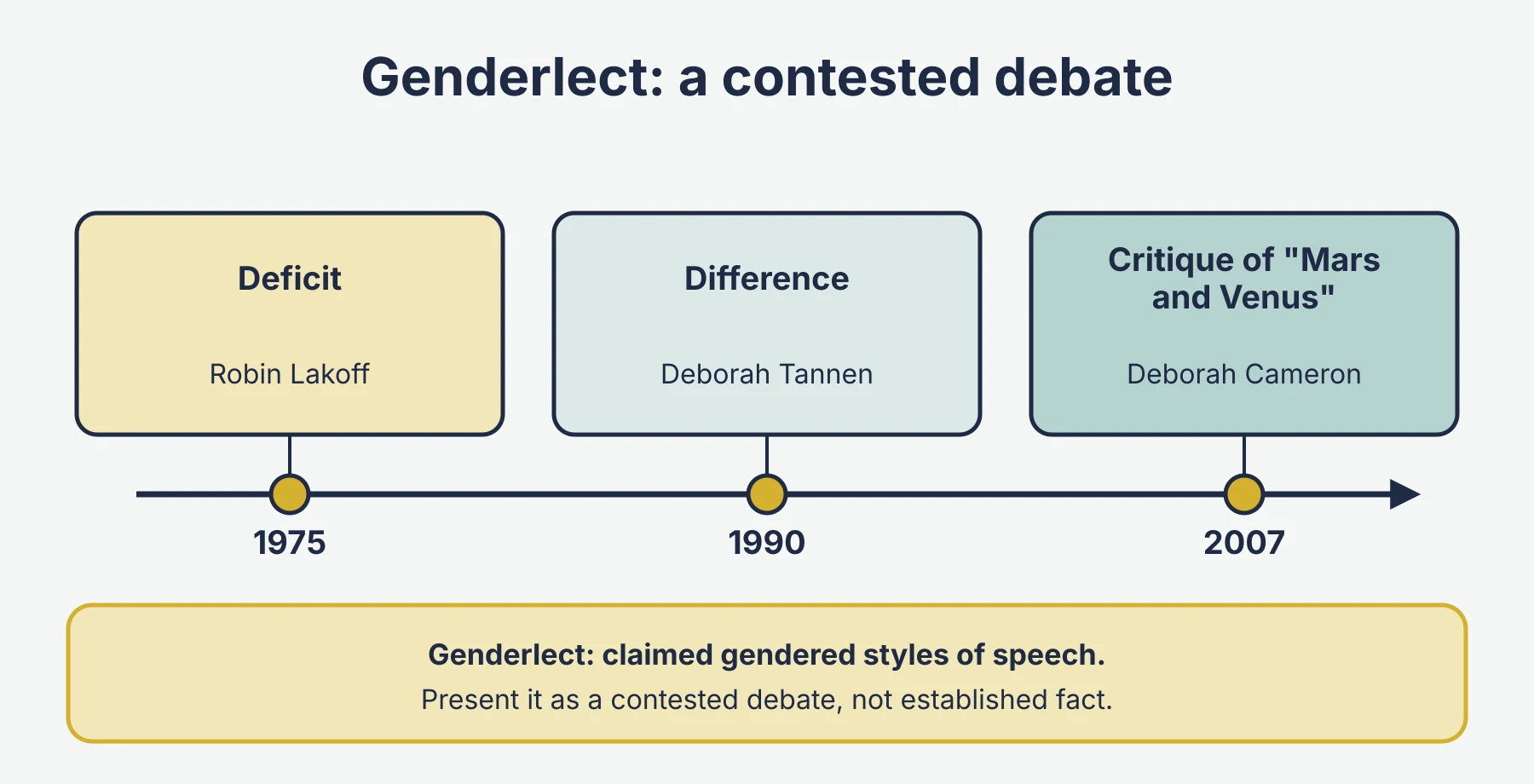
| Genderlect | Claimed gendered styles of speech | Robin Lakoff (1975), deficit; Deborah Tannen (1990), difference; Deborah Cameron’s critique of the “Mars and Venus” model (2007) |
| Accommodation | Adjusting speech towards (convergence) or away from (divergence) a listener | Howard Giles’s communication accommodation theory |
Labov’s study on Martha’s Vineyard (1963) found that islanders who identified strongly with the island used a distinctive local vowel pronunciation more, an early demonstration that accent can be an act of identity. Inclusion and exclusion work through shared lexis, slang and in-jokes, which mark insiders and shut out others.
Worked example: using the text
Extract from a stimulus (original, written for this guide):
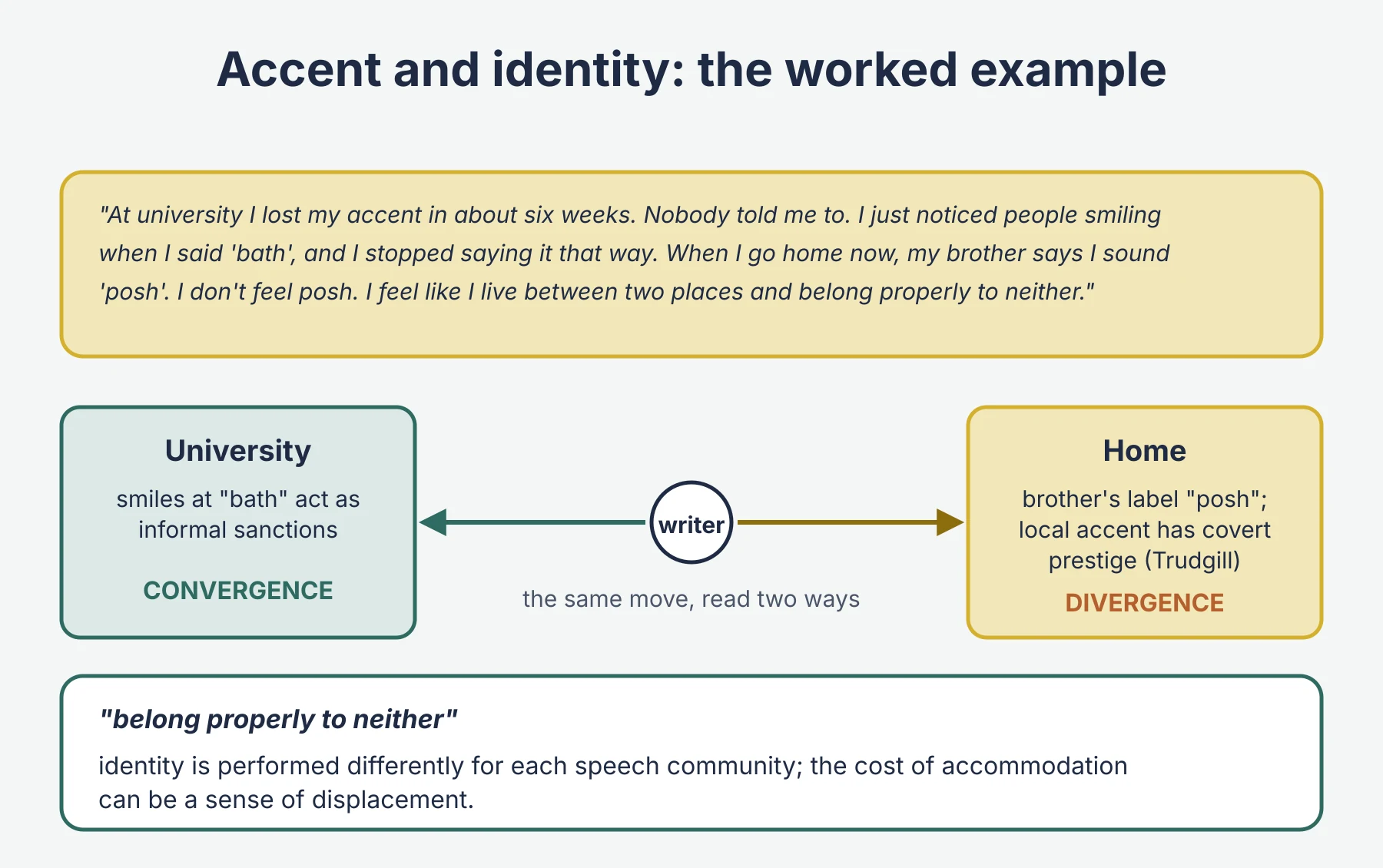
At university I lost my accent in about six weeks. Nobody told me to. I just noticed people smiling when I said “bath”, and I stopped saying it that way. When I go home now, my brother says I sound “posh”. I don’t feel posh. I feel like I live between two places and belong properly to neither.
Specified aspect: how accent relates to identity.
Model paragraph:
The writer’s change of accent, achieved without being told, shows how prestige operates through subtle social signals: the smiles at “bath” act as informal sanctions, and the writer converges towards the dominant accent, as Giles’s accommodation theory predicts. Yet the brother’s label “posh” shows that the same move is divergence at home, where the local accent carries covert prestige of the kind Trudgill identified. The final sentence, “belong properly to neither”, suggests identity is not a fixed possession but something performed differently for each speech community, and that the cost of accommodation can be a sense of displacement.
Common mistakes
- Treating the Sapir-Whorf hypothesis as one claim rather than a strong and a weak version.
- Presenting genderlect research as established fact rather than a contested debate.
- Citing studies without dates or with invented findings.
- Confusing accent (pronunciation) with dialect (lexis and grammar).
- Discussing only one strand when the text clearly raises another.
- Summarising the text rather than discussing its issues.
Exam technique
Underline the specified aspect, then read the text for issues that connect to it. Choose three or four issues, rank them, and give each a paragraph that quotes the text, names a concept, applies a study and evaluates. Conclude with a judgement. Write in controlled, cohesive academic prose (AO2), and handle research cautiously: “suggests”, “has been challenged by”, “remains debated”.
Keep going
Related resources
-
Practice questions
Cambridge International AS & A Level English Language (9093): Section B: Language and the Self – Practice Questions
Original practice for Cambridge 9093 Paper 4 Language and the Self: innateness, language and thought, prestige and identity, and stimulus essays, with answers.
English · Cambridge · A Level
Try questions -
Revision notes
Cambridge International AS & A Level English Language (9093): Section B: Language and the Self – Revision Notes
Recall notes for Cambridge 9093 Paper 4 Language and the Self: nativism and empiricism, Sapir-Whorf and universalism, prestige, accent and genderlect studies.
English · Cambridge · A Level
Revise topic -
Study guides
Cambridge A-Level English Language: Paper 4 Language Topics (9093)
Cambridge 9093 Paper 4 Language Topics: English as a global language, Kachru's Three Circles, pidgins and creoles, and how language shapes identity.
English · Cambridge · A Level
Read guide
Get free revision emails (optional)
Occasional emails with practice questions, worked explanations and links to free resources for the qualification and subjects you choose. No spam, and you can unsubscribe from any email. The free tools on this site never need an email.