
Revision Notes
Cambridge International AS & A Level English Language (9093): Section A: English in the World – Revision Notes
Recall notes for Cambridge 9093 Paper 4 English in the World: spread of English, Kachru and Schneider, creoles, the continuum, policies and ethical debates.
- Subject
- English
- Level
- A LEVEL
- Topic
- Paper 4 – Language Topics
- Author
- Marlbridge Academic Team
- Updated
- Reviewed by
- Ammar Bilal (what this means)
Aligned to Cambridge A Level English (9093), 2024-2026. Official specification .
Syllabus page (what it covers and how it is assessed): Cambridge A Level English Language.
Found an error? Report a correction.
Need help with this topic? Request a free trial class for A Level English Language (9093).
Condensed recall for Paper 4 Section A. For full explanations and a model paragraph, use the English in the World study guide.
The task in brief
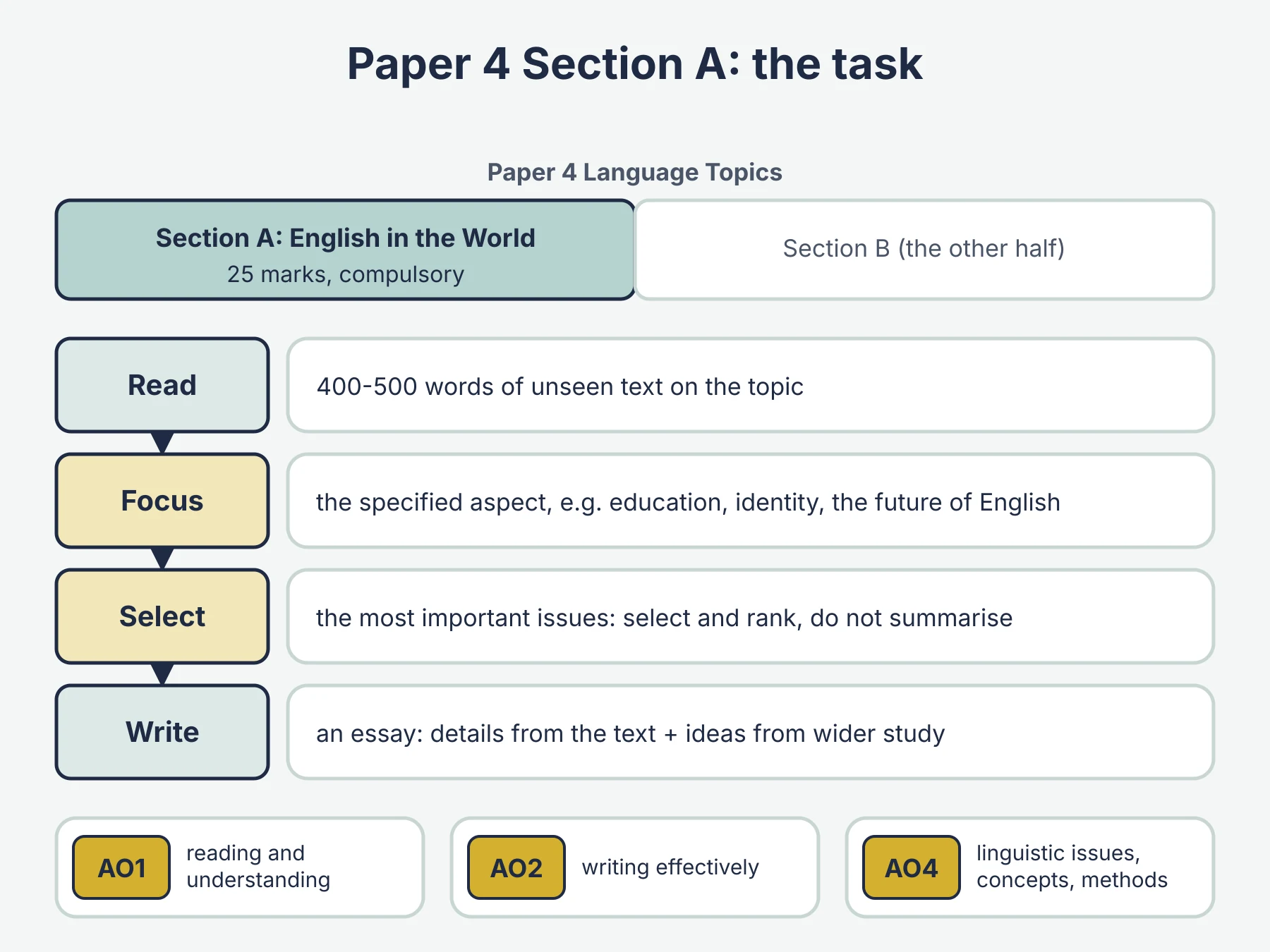
- One compulsory essay, 25 marks, half of Paper 4.
- A text of about 400-500 words on English in the world.
- Discuss the most important issues the text raises about a specified aspect of the role and status of English.
- Refer to specific details from the text and to your wider study.
- AO1 (reading), AO2 (writing), AO4 (concepts and issues).
Area 1: historical development
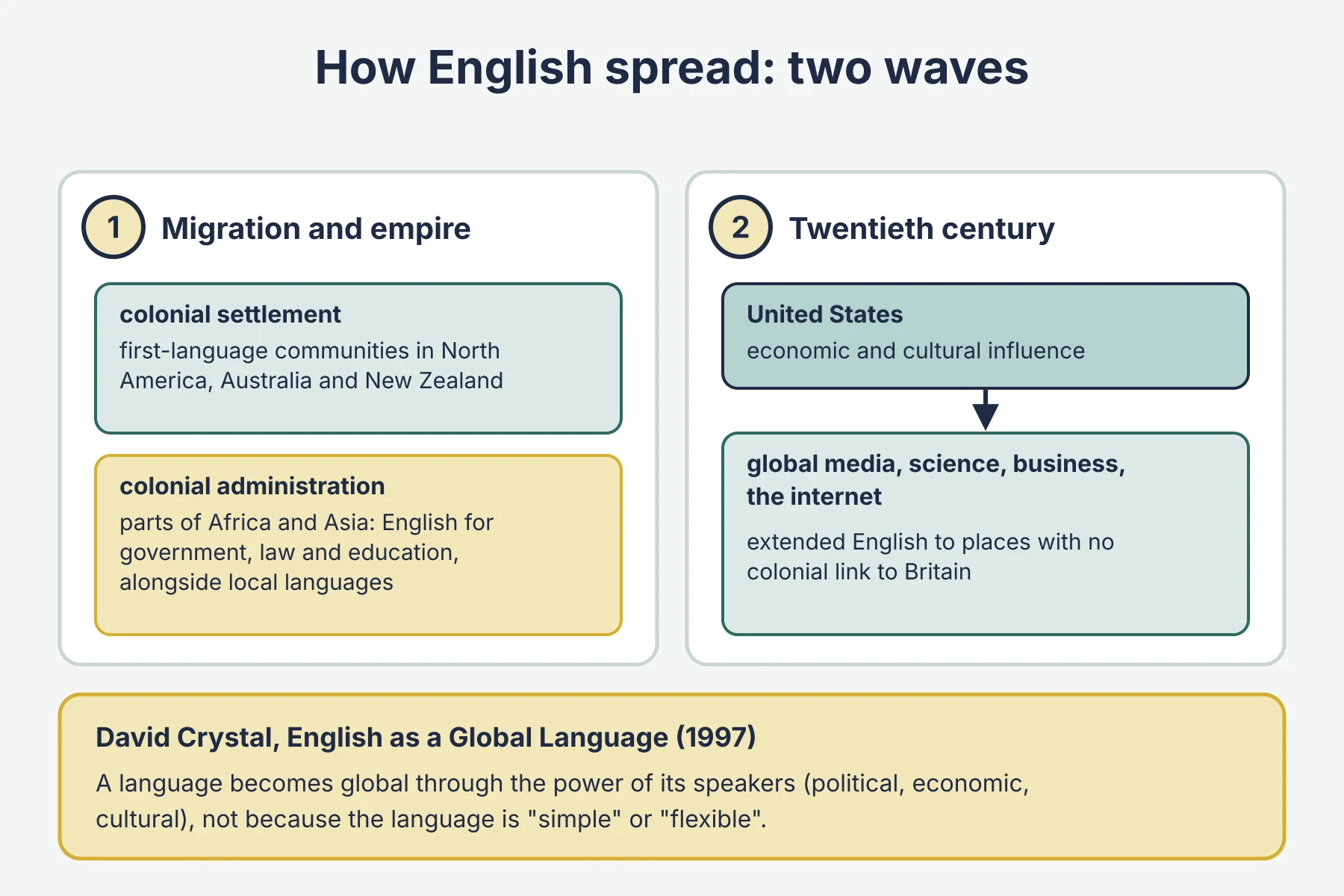
- Colonial spread: settlement created first-language communities; administration made English a language of law, government and education in many colonies.
- Later spread: US economic and cultural influence; media, science, business, the internet.
- Crystal (1997): a language becomes global through the power of its speakers, not its own qualities.
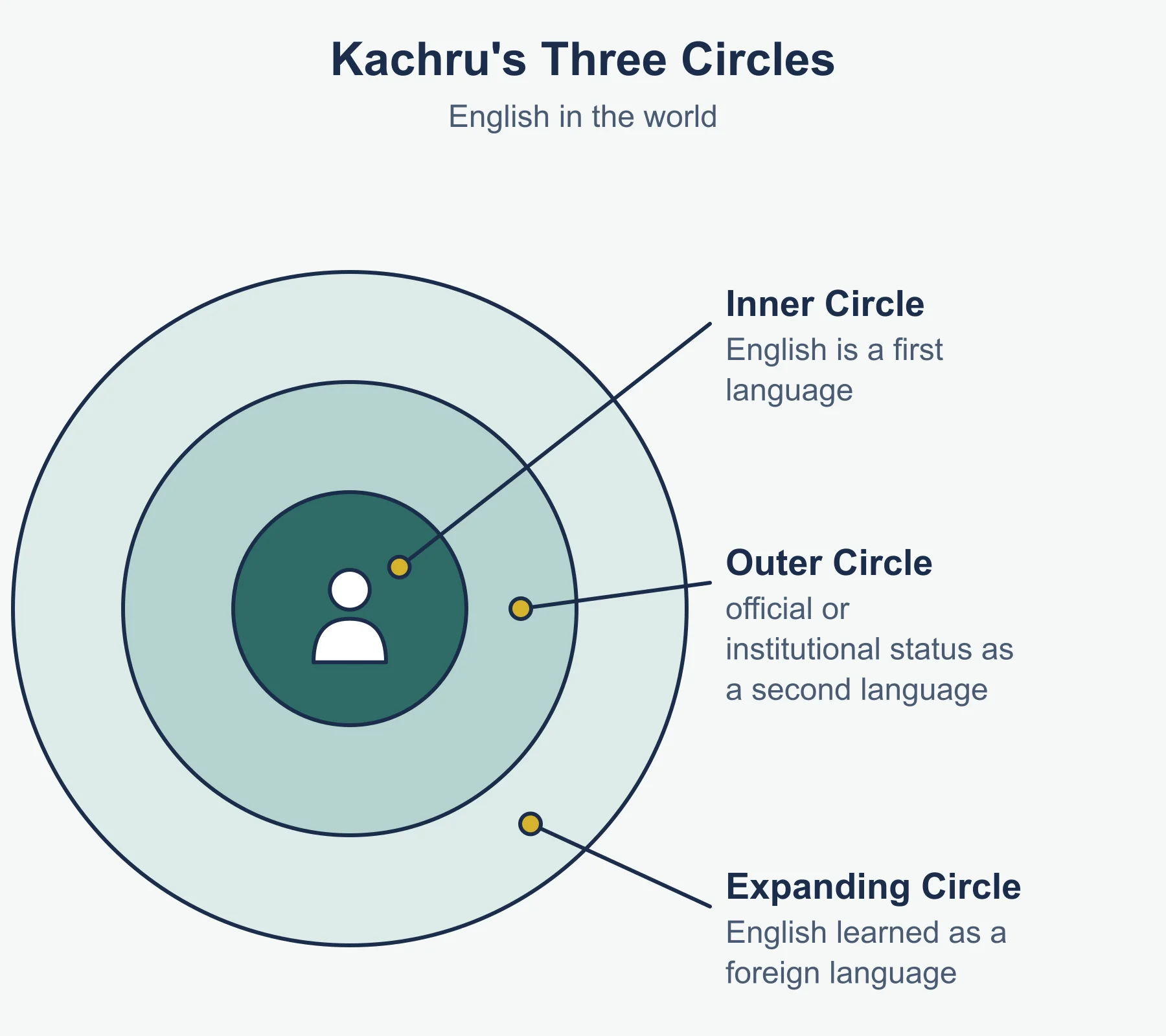
- Kachru (1985): inner, outer and expanding circles.
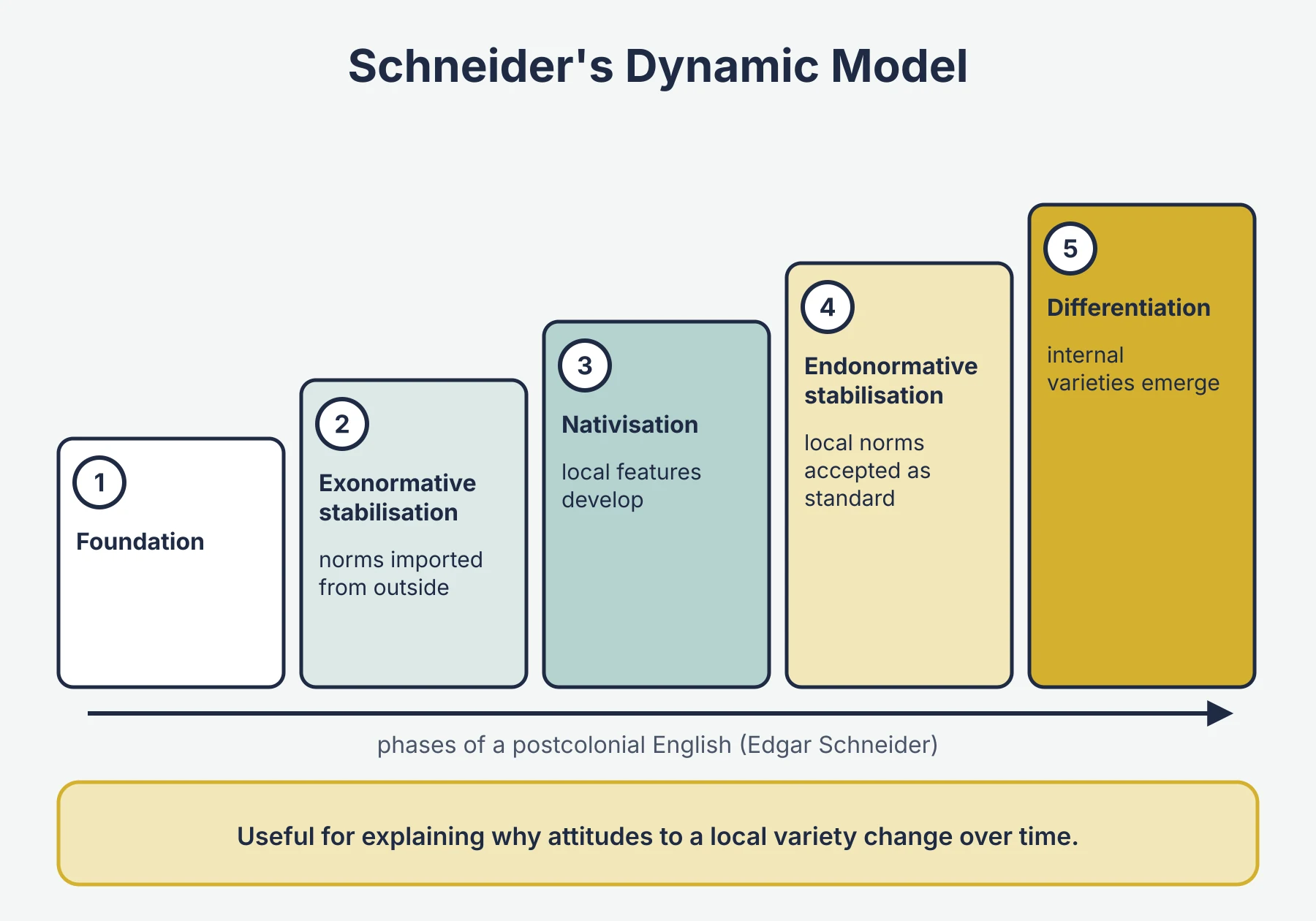
- Schneider’s Dynamic Model: foundation, exonormative stabilisation, nativisation, endonormative stabilisation, differentiation.
- Multilingualism: English shares domains with other languages; code-switching is normal.
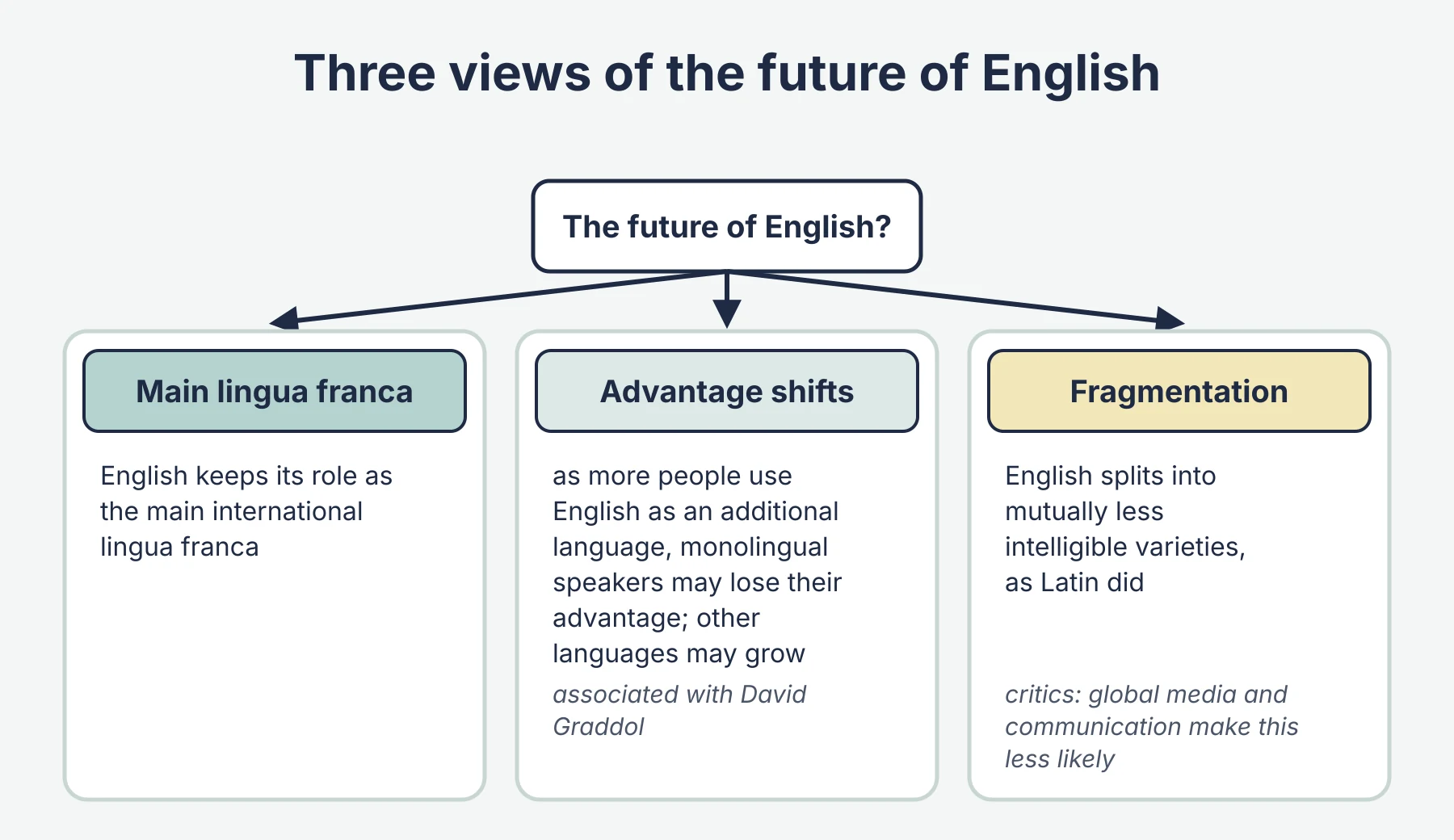
- Future of English: continued lingua franca; growth of other languages and a shrinking advantage for monolingual English speakers (Graddol); fragmentation into separate varieties (disputed).
Area 2: varieties
- Standard Englishes: codified national standards; the plural “Englishes” signals equal linguistic validity.
- Non-standard varieties: carry local and group identity; covert prestige.
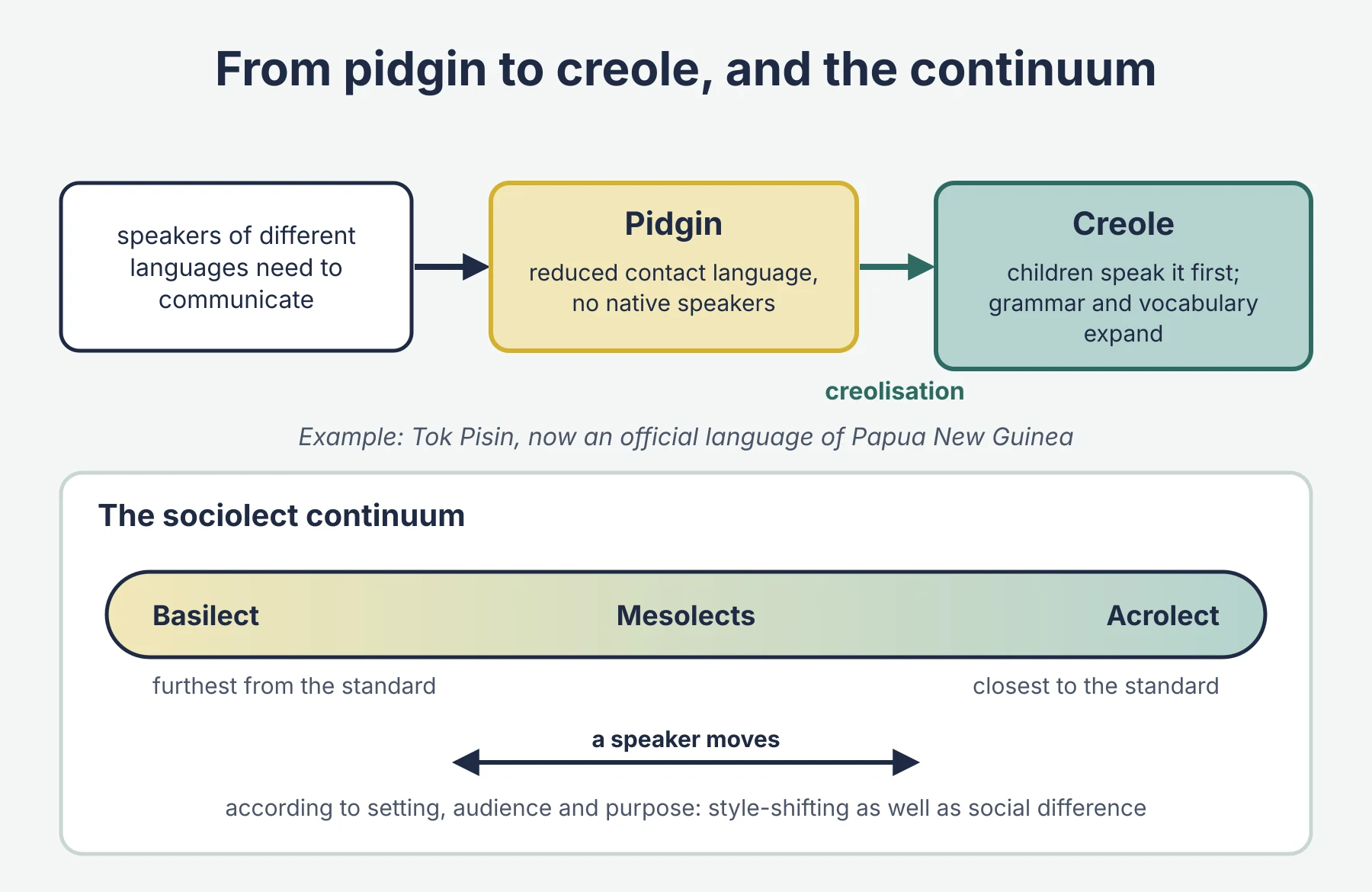
- Pidgin: reduced contact language, no native speakers.
- Creole: a pidgin that has become a first language, with expanded grammar and lexis. Example: Tok Pisin.
- Sociolect continuum: basilect, mesolect, acrolect; speakers shift along it by context.
- Policies: Singapore’s Speak Good English Movement (2000); France’s Toubon Law (1994); English alongside Hindi for Indian national government purposes.
- Unofficial attitudes: employers, schools, families and media ranking accents and varieties.
Area 3: ethics
| Issue | Core argument | Counter-argument |
|---|---|---|
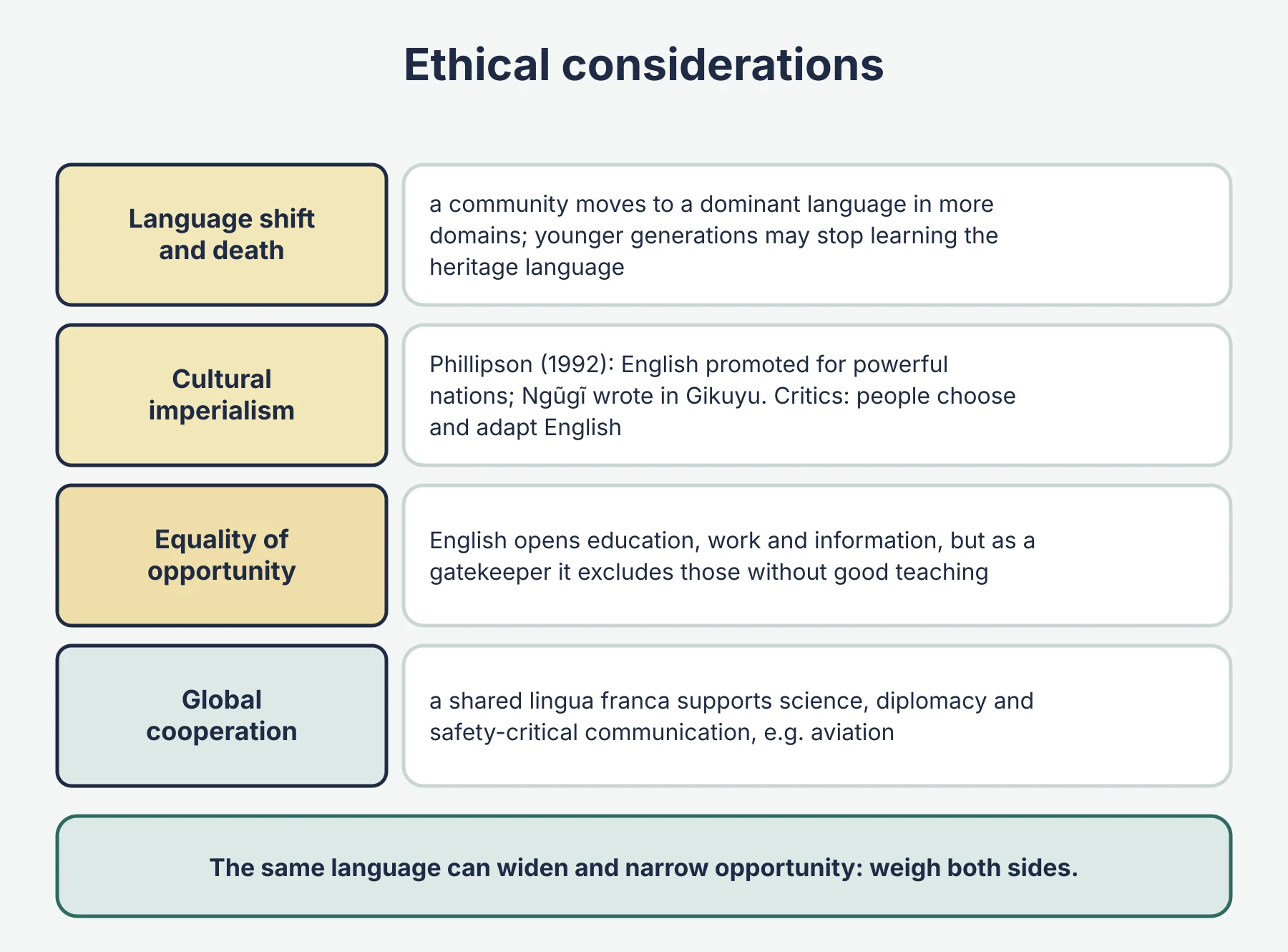
| Language shift and death | Dominant languages push heritage languages out of domains until children stop learning them | Communities can maintain heritage languages through policy and choice |
| Cultural imperialism | Phillipson (1992): English is promoted to serve powerful nations; Ngũgĩ wa Thiong’o chose to write in Gikuyu | Speakers adopt and adapt English for their own purposes |
| Equality of opportunity | English opens access to education, work and information | Where English is a gatekeeper, those without access are excluded |
| Global cooperation | A lingua franca supports science, diplomacy and aviation | Non-native users may be disadvantaged by native-speaker norms |
Key terms
| Term | Meaning |
|---|---|
| Lingua franca | A shared language used between speakers with different first languages |
| Inner circle | Countries where English is the main first language |
| Outer circle | Countries where English has an institutional role after colonial history |
| Expanding circle | Countries where English is learned as a foreign language for international use |
| Nativisation | Development of local features in a transplanted variety |
| Endonormative | Taking norms from within the community |
| Exonormative | Taking norms from outside, often from a former colonial power |
| Code-switching | Moving between languages or varieties in one interaction |
| Language shift | A community moving from one language to another over generations |
| Language death | A language losing its last speakers |
| Acrolect / basilect | The variety closest to / furthest from the standard on a continuum |
| Linguistic imperialism | Dominance of one language maintained through unequal power and resources |
Essay method
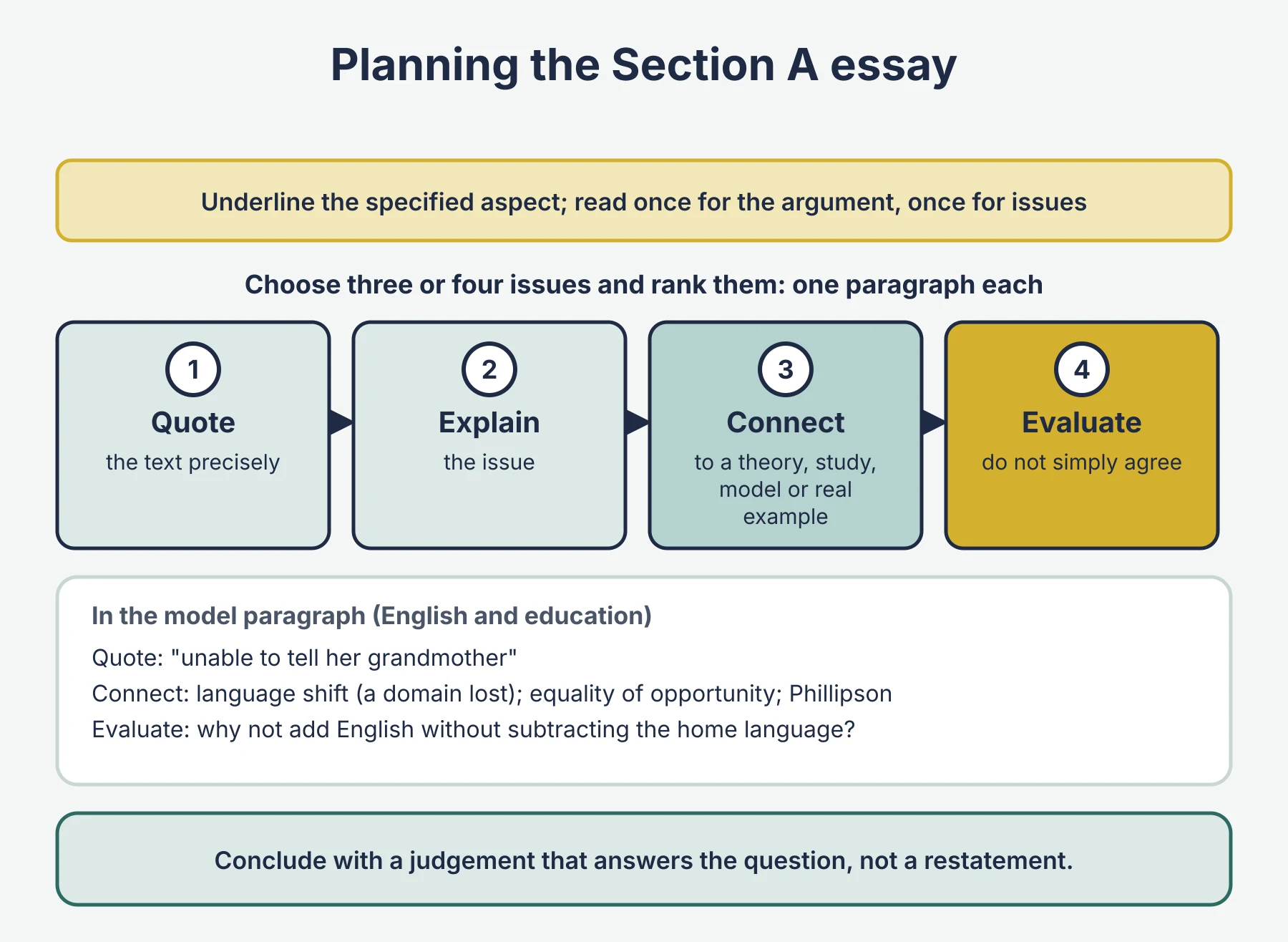
- Underline the specified aspect.
- Pick three or four issues from the text; rank them.
- Each paragraph: quote, issue, concept or example, evaluation.
- Conclude with a judgement that answers the question.
Exam traps
- Summarising the text instead of selecting issues.
- Drifting from the specified aspect into a general global-English essay.
- Kachru described but not evaluated.
- Calling creoles or outer-circle varieties “broken” or “incorrect”.
- One-sided arguments.
- Invented statistics.
Self-test
- What does the Section A question ask you to discuss?
- Which assessment objectives does Section A assess?
- What is Crystal’s explanation of why a language becomes global?
- Name Kachru’s three circles.
- Give two criticisms of Kachru’s model.
- List the five phases of Schneider’s Dynamic Model.
- What is the difference between a pidgin and a creole?
- What do the terms basilect and acrolect mean?
- Give one example of a language policy concerning English.
- What does Phillipson argue in Linguistic Imperialism?
- Give one argument that English widens opportunity and one that it narrows it.
- Why is the plural “Englishes” significant?
Answers: 1. The most important issues the text raises in relation to a specified aspect of the role and status of English in the world. 2. AO1, AO2 and AO4. 3. Through the power (political, economic, cultural) of its speakers, not the language’s own features. 4. Inner, outer and expanding. 5. Any two: it is based on nations rather than speakers; countries contain speakers of every type; it keeps the inner circle at the centre; it does not capture English as a lingua franca between non-native users. 6. Foundation, exonormative stabilisation, nativisation, endonormative stabilisation, differentiation. 7. A pidgin is a reduced contact language with no native speakers; a creole is a pidgin that has become a community’s first language, with expanded grammar and vocabulary. 8. The basilect is the variety furthest from the standard on a continuum; the acrolect is closest to it. 9. Any one: Singapore’s Speak Good English Movement (2000); France’s Toubon Law (1994). 10. That the spread of English has been actively promoted and maintains the dominance of powerful nations. 11. Widens: access to education, employment and information. Narrows: it becomes a gatekeeper that excludes those without good English teaching. 12. It signals that many varieties are valid and that no single variety owns the language.
Try the English in the World practice questions, then the Paper 4 revision notes for both sections.
Related resources
-
Study guides
Cambridge International AS & A Level English Language (9093): Section B: Language and the Self
Cambridge 9093 Paper 4 Section B: innateness and learning, linguistic relativity and universalism, and how accent, dialect and sociolect build identity.
English · Cambridge · A Level
Read guide -
Practice questions
Cambridge International AS & A Level English Language (9093): Section B: Language and the Self – Practice Questions
Original practice for Cambridge 9093 Paper 4 Language and the Self: innateness, language and thought, prestige and identity, and stimulus essays, with answers.
English · Cambridge · A Level
Try questions -
Revision notes
Cambridge International AS & A Level English Language (9093): Section B: Language and the Self – Revision Notes
Recall notes for Cambridge 9093 Paper 4 Language and the Self: nativism and empiricism, Sapir-Whorf and universalism, prestige, accent and genderlect studies.
English · Cambridge · A Level
Revise topic
Get free revision emails (optional)
Occasional emails with practice questions, worked explanations and links to free resources for the qualification and subjects you choose. No spam, and you can unsubscribe from any email. The free tools on this site never need an email.