
Study Guides
Cambridge International AS & A Level English Language (9093): Section A: English in the World
Cambridge 9093 Paper 4 Section A: how English became global, models of spread, varieties and creolisation, language policies and the ethics of a world language.
- Subject
- English
- Level
- A LEVEL
- Topic
- Paper 4 – Language Topics
- Author
- Marlbridge Academic Team
- Updated
- Reviewed by
- Ammar Bilal (what this means)
Aligned to Cambridge A Level English (9093), 2024-2026. Official specification .
Syllabus page (what it covers and how it is assessed): Cambridge A Level English Language.
Found an error? Report a correction.
Need help with this topic? Request a free trial class for A Level English Language (9093).
Section A of Paper 4 Language Topics in Cambridge International AS & A Level English Language (9093) asks you to discuss the role and status of English around the world. You respond to an unseen text and write an essay that connects it to your wider study. This guide sets out the three knowledge areas in the syllabus, the theories and studies that support each, and a method for answering the question you will actually face.
What the question asks
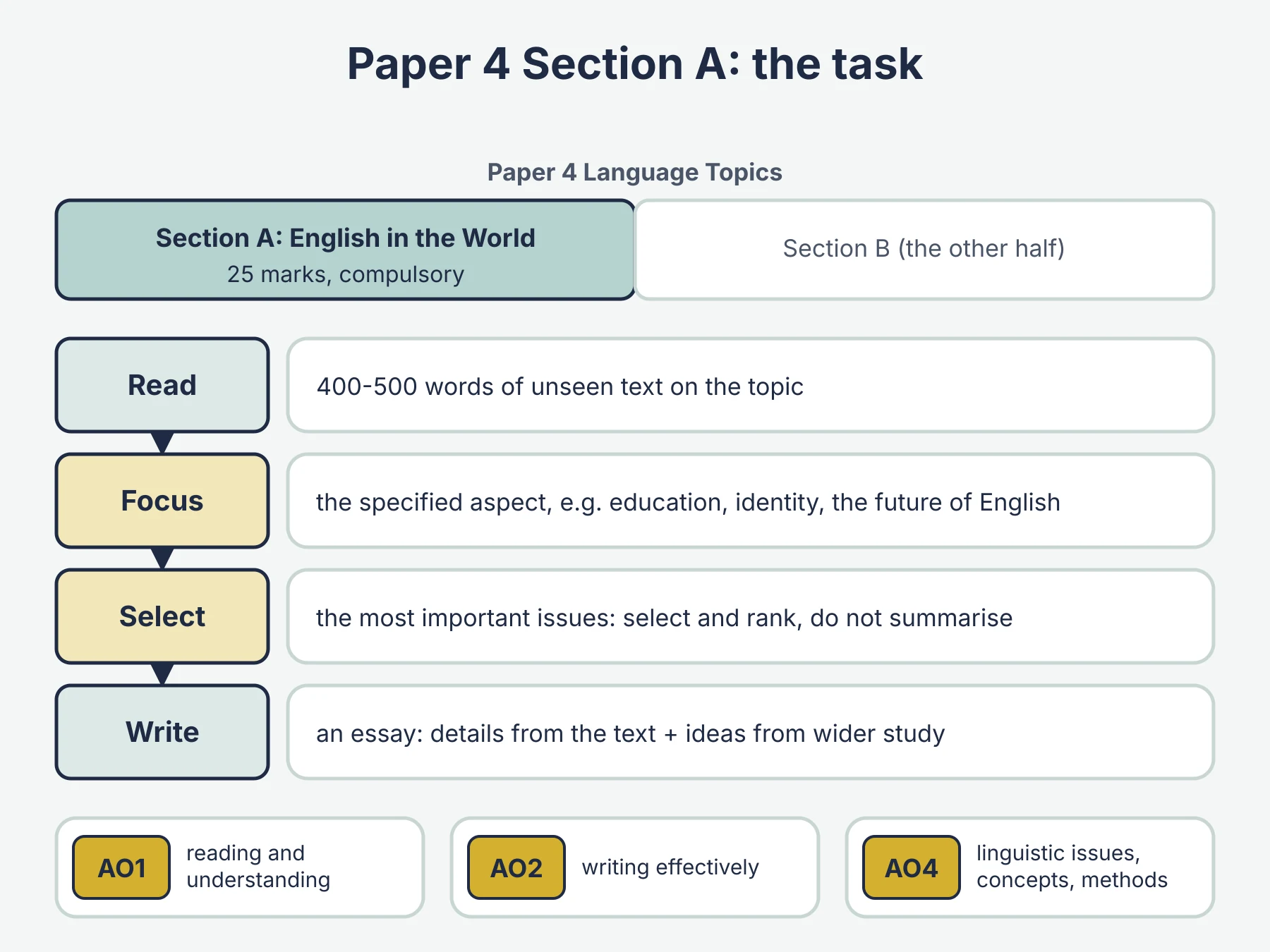
Section A is one compulsory question worth 25 marks, half of Paper 4. You read about 400-500 words of text on the topic and write an essay discussing the most important issues the text raises in relation to a specified aspect of the role and status of English in the world. You must refer to specific details from the text and relate them to ideas and examples from your wider study. The question assesses AO1 (reading and understanding), AO2 (writing effectively) and AO4 (linguistic issues, concepts, methods and approaches).
Two phrases deserve attention. “Most important issues” means you select and rank; you do not summarise everything. “A specified aspect” means the question narrows the topic, for example to education, identity or the future of English, and your essay must stay on that aspect.
Area 1: the historical development of English as a “global” language
The syllabus examples are colonialism, cultural influence and effects, the concentric circles model, multilingualism and the future of English.
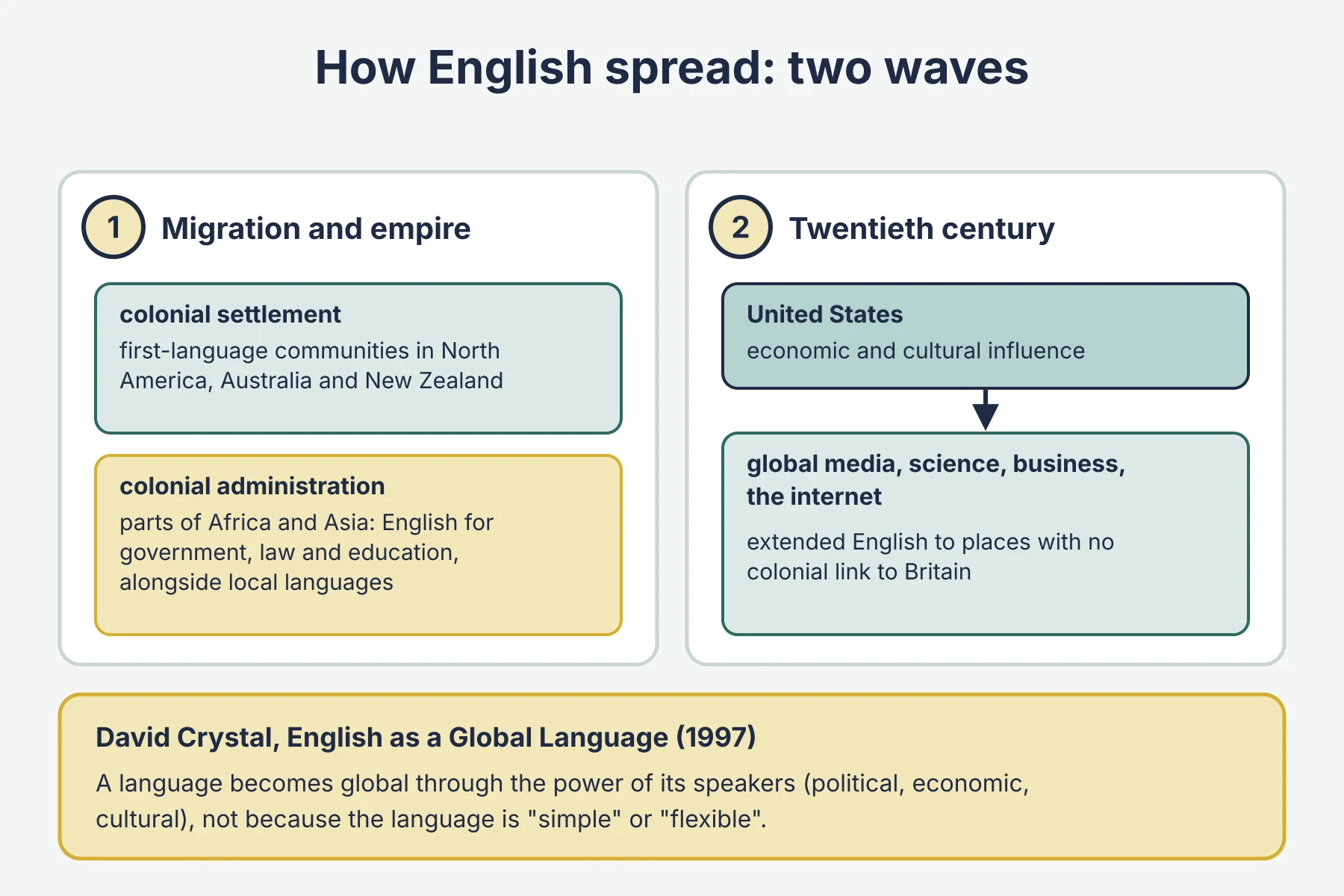
Two waves of spread. English first spread through migration and colonial settlement, which created first-language communities in North America, Australia and New Zealand, and through colonial administration in parts of Africa and Asia, where English became a language of government, law and education alongside local languages. In the twentieth century, the economic and cultural influence of the United States, followed by global media, science, business and the internet, extended English into places with no colonial link to Britain.
David Crystal, in English as a Global Language (1997), argues that a language becomes global because of the power of its speakers, political, economic and cultural, not because of anything in the language itself. This is a useful counter to claims that English spread because it is “simple” or “flexible”.
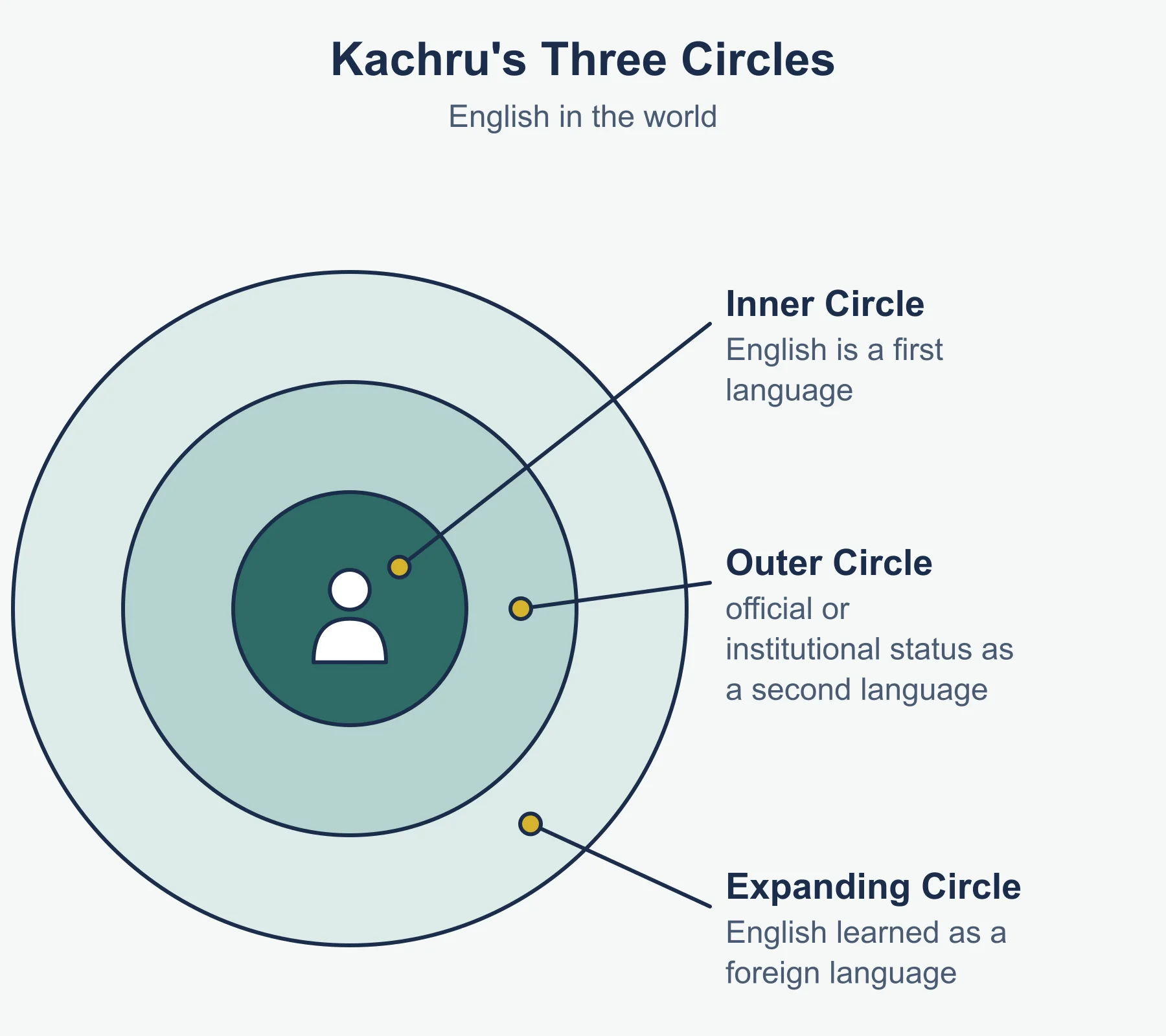
The concentric circles model. Braj Kachru’s model (1985) describes an inner circle where English is the main first language, an outer circle where it has an institutional role after colonial history, and an expanding circle where it is learned as a foreign language for international use. It is valuable because it treats outer-circle Englishes as varieties in their own right. Common criticisms: it is based on nations rather than speakers; many countries contain speakers of every type; and it implies the inner circle remains the centre.
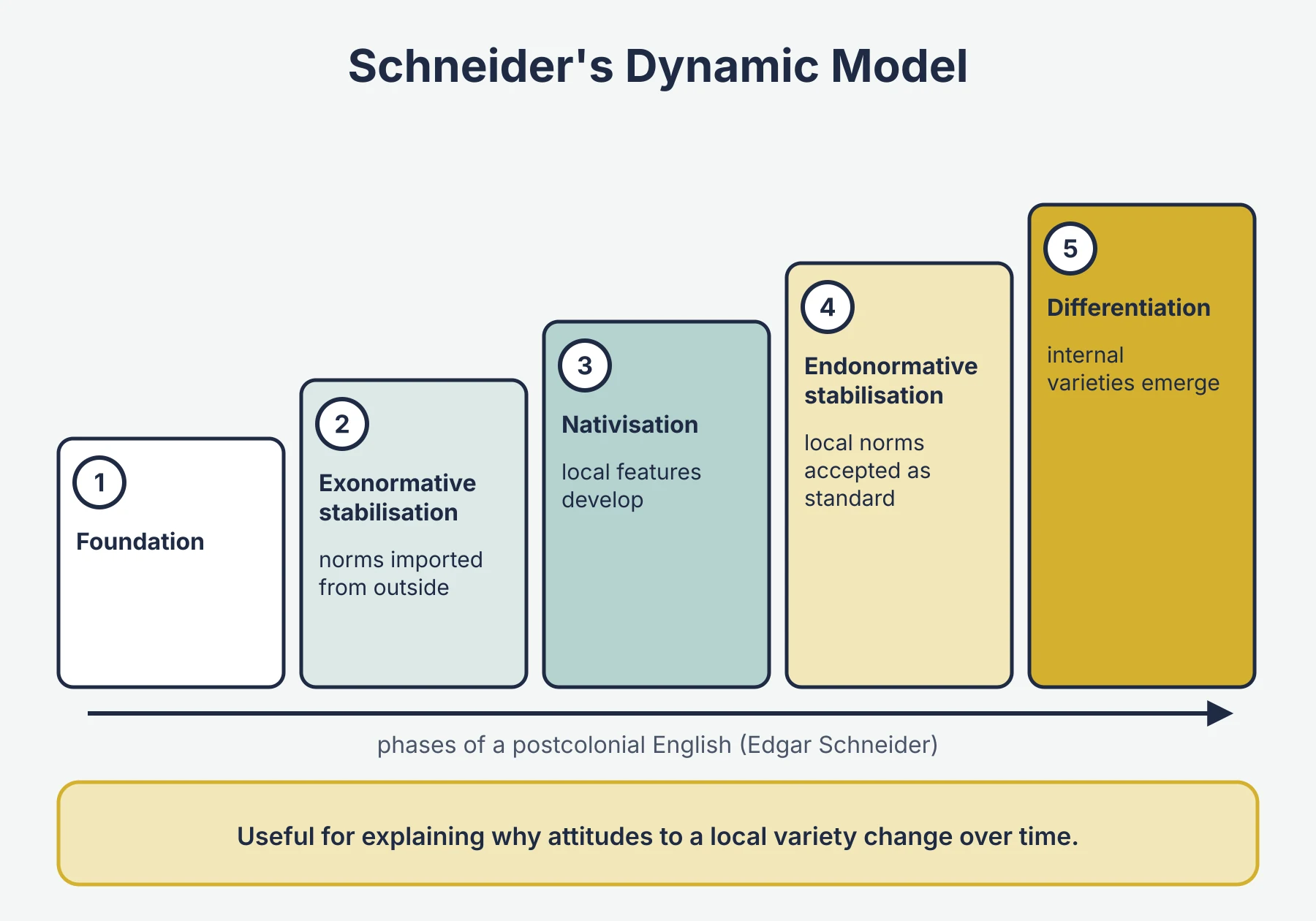
Schneider’s Dynamic Model. Edgar Schneider proposes that postcolonial Englishes pass through five phases: foundation, exonormative stabilisation (norms imported from outside), nativisation (local features develop), endonormative stabilisation (local norms are accepted as standard) and differentiation (internal varieties emerge). It is useful for explaining why attitudes to a local variety change over time.
Multilingualism. Most users of English worldwide are multilingual. English typically occupies particular domains (higher education, business, the internet) while other languages hold home, religion and local community. Code-switching between English and other languages is normal, skilled behaviour, not a failure of either language.
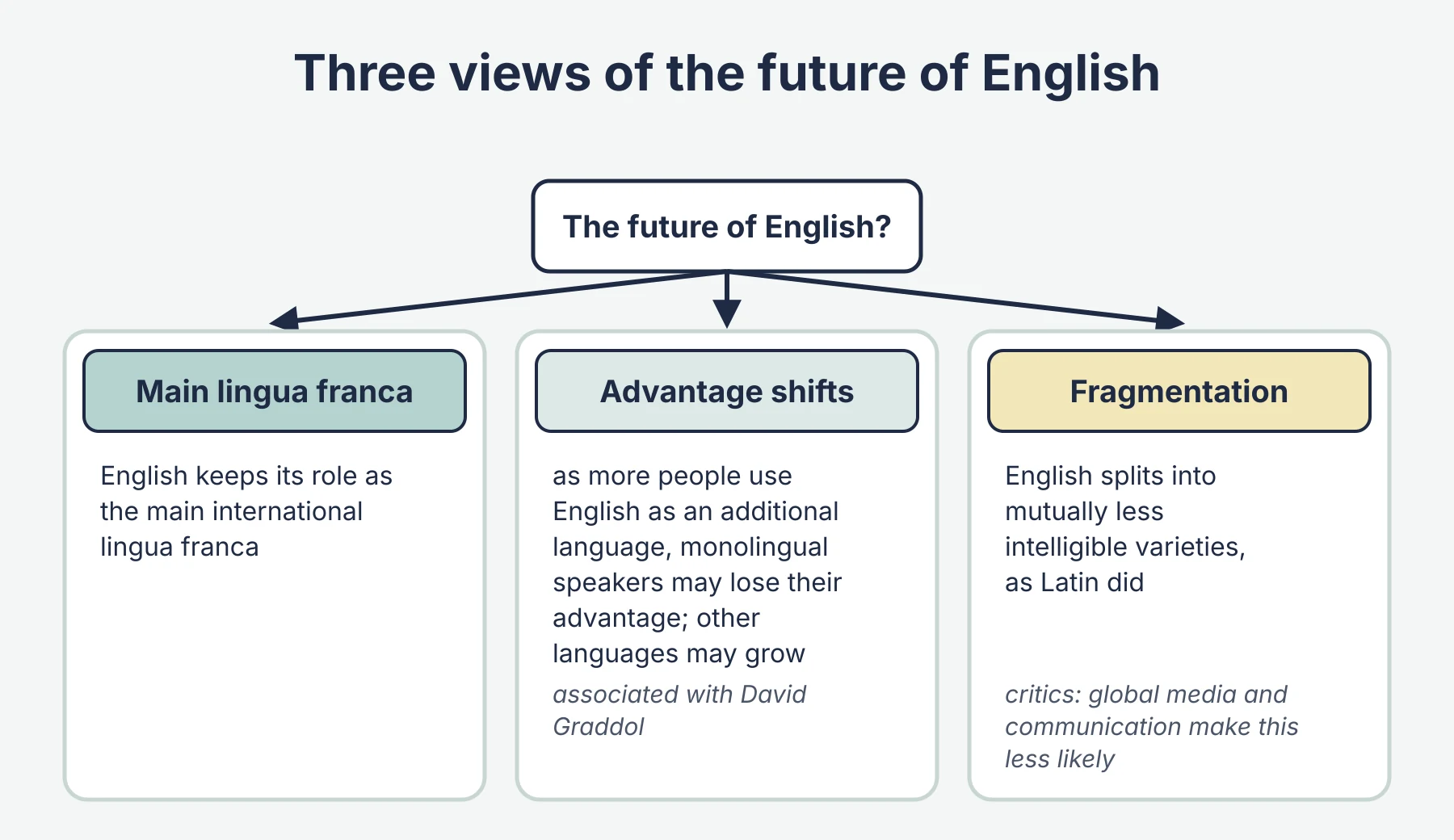
The future of English. Arguments diverge. One view expects English to keep its role as the main international lingua franca. Another, associated with David Graddol’s work for the British Council, suggests that as more people use English as an additional language, monolingual English speakers may lose their advantage, and that other languages may grow in international importance. A third expects English to fragment into mutually less intelligible varieties, as Latin did; critics answer that global media and communication make this less likely.
Area 2: varieties of English
The syllabus examples are standard and non-standard “Englishes”, creolisation, the sociolect continuum, and official and unofficial attitudes and policies.
Standard and non-standard Englishes. Several countries now have codified standards with their own dictionaries and usage, such as Australian or Indian English. Within each, non-standard varieties carry local identity. The plural “Englishes” signals a pluralist view: no single variety owns the language.
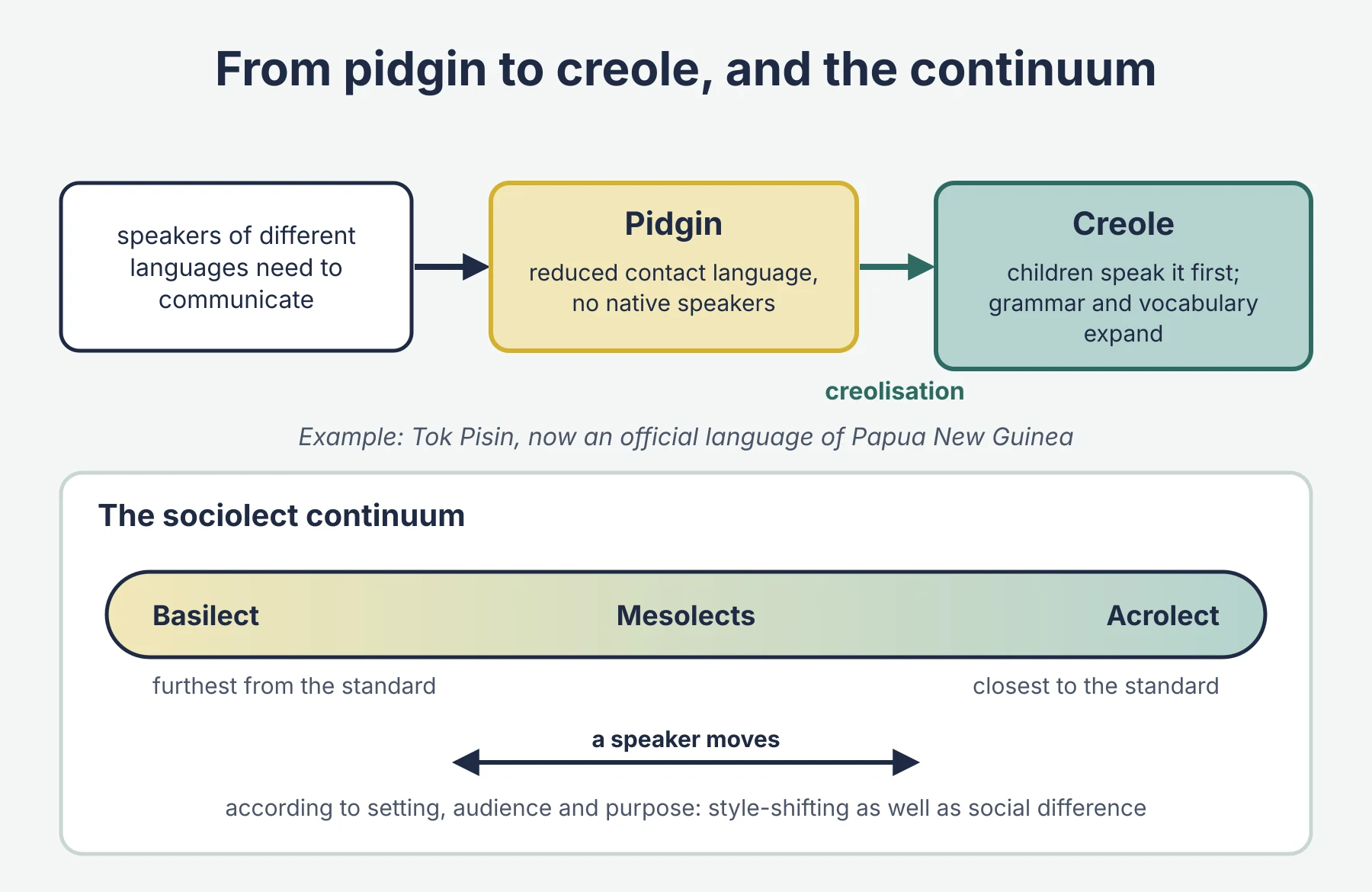
Creolisation. When speakers of different languages need to communicate, a pidgin may form: a reduced contact language with no native speakers. When children grow up speaking it as a first language, it creolises, expanding its grammar and vocabulary into a full language. Tok Pisin, now an official language of Papua New Guinea, is a well-known example of a pidgin that has creolised.
The sociolect continuum. In many creole-speaking communities, speech varies along a scale from the basilect (furthest from the standard), through mesolects, to the acrolect (closest to the standard). Speakers move along it according to setting, audience and purpose, which makes the continuum a model of style-shifting as well as of social difference.
Attitudes and policies. Governments and institutions take positions on English and its local forms. Singapore’s Speak Good English Movement, launched in 2000, promoted standard English over Singlish, while many Singaporeans value Singlish as a marker of identity. France’s 1994 Toubon Law requires French in certain public and commercial contexts, a policy partly aimed at limiting English. In India, English is used alongside Hindi for official purposes of the national government. “Unofficial” attitudes matter too: employers, parents, schools and media often rank accents and varieties, which shapes how speakers are treated.
Area 3: ethical considerations
The syllabus examples are language shift and death, cultural imperialism, equality of opportunity and global cooperation.
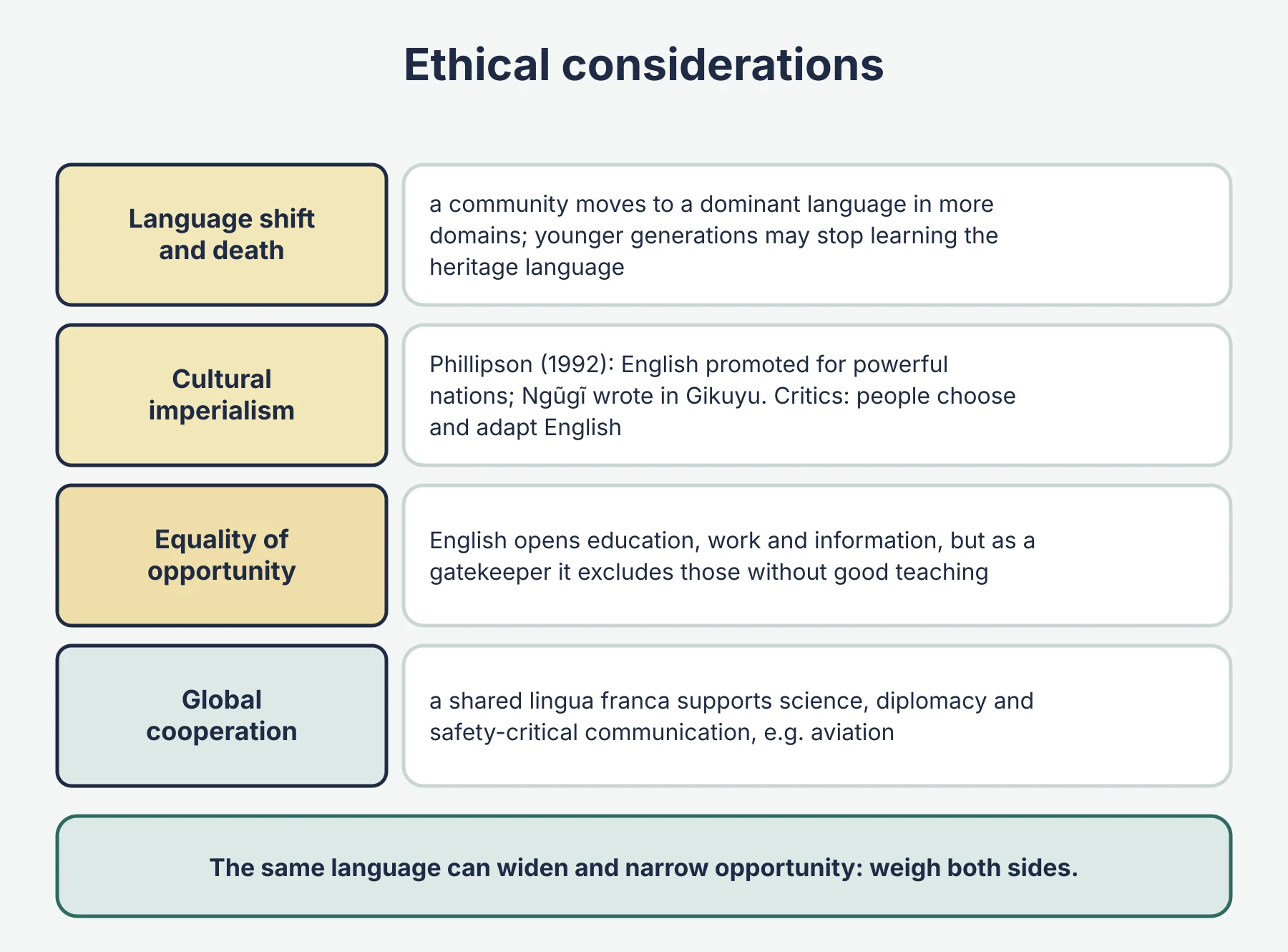
- Language shift and death. When a community moves to a dominant language in more and more domains, younger generations may stop learning the heritage language. English is one of several dominant languages involved, along with national languages.
- Cultural imperialism. Robert Phillipson’s Linguistic Imperialism (1992) argues that the spread of English has been actively promoted and serves the interests of powerful nations. The Kenyan writer Ngũgĩ wa Thiong’o, in Decolonising the Mind (1986), explained his decision to write in Gikuyu rather than English. Critics of Phillipson argue that people choose English for their own purposes and adapt it.
- Equality of opportunity. English can open access to education, employment and information, but where it is a gatekeeper, those without access to good English teaching are excluded. The same language can widen and narrow opportunity.
- Global cooperation. A shared lingua franca supports science, diplomacy and safety-critical communication; English is the standard language of international aviation, for example.
Worked example: using the text
Extract from a stimulus (original, written for this guide):
In our city’s best schools, children are now forbidden to speak their home language in class. Teachers say it is for the pupils’ own good: “English is the language of the future.” Yet my daughter came home last week unable to tell her grandmother what she had learned.
Specified aspect: English and education.
Model paragraph:
The writer’s most significant issue is the cost of English-medium education to family and heritage languages. The teachers’ claim that English is “the language of the future” reflects the equality-of-opportunity argument: English can give access to higher education and international work. But the anecdote of the daughter “unable to tell her grandmother” shows the mechanism of language shift, in which the heritage language loses a domain, here the classroom, and with it the vocabulary to discuss new knowledge. Phillipson would read the ban as evidence of English being imposed as superior; a pluralist position, closer to the multilingual reality most English users live in, would ask why the school cannot add English without subtracting the home language.
The paragraph quotes the text precisely, names the issue, applies two concepts, and evaluates rather than simply agreeing with the writer.
Planning the essay
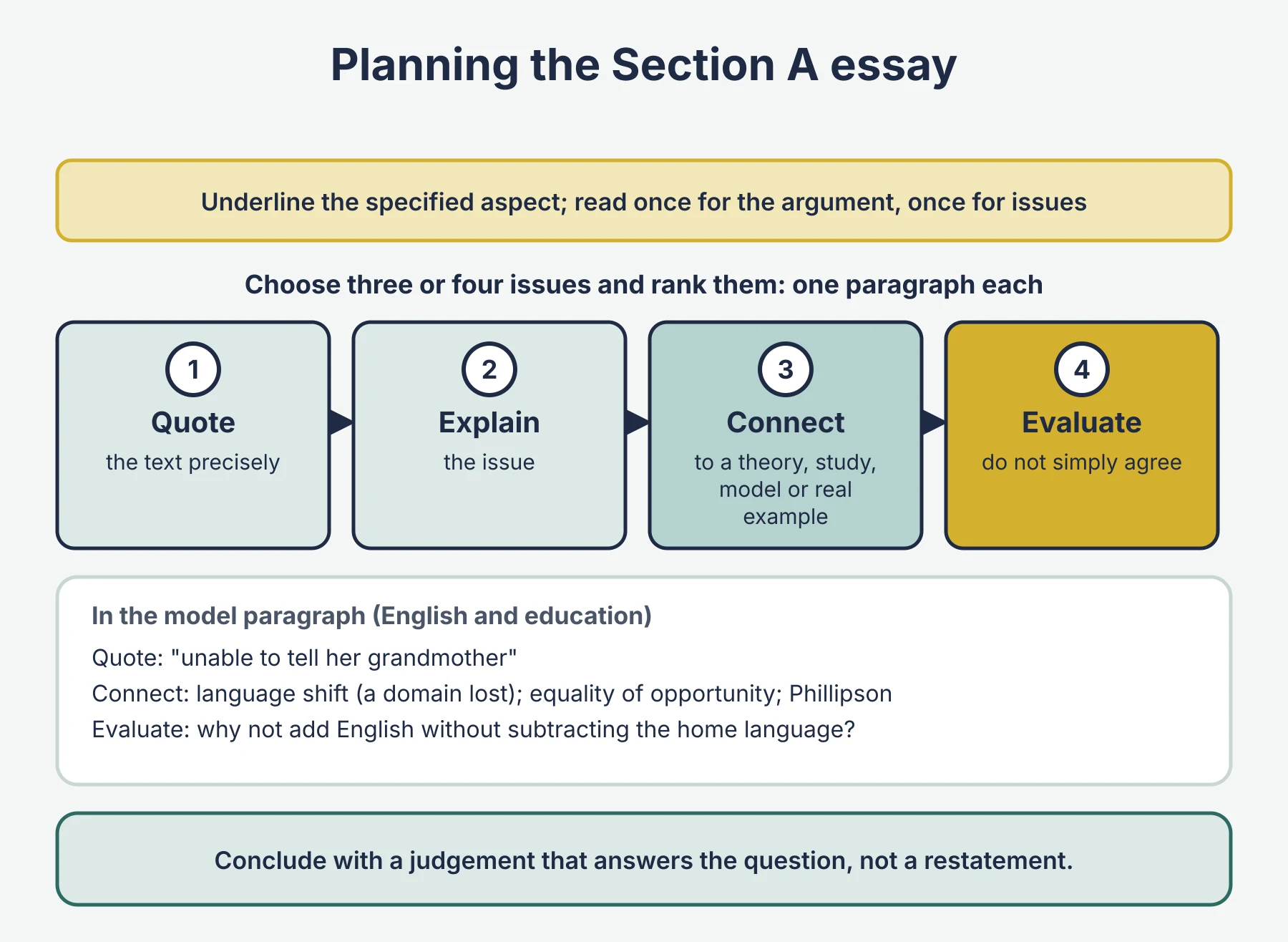
- Underline the specified aspect. Read the text once for its argument and once for issues relevant to that aspect.
- Choose three or four issues and rank them. Each becomes a paragraph.
- For each issue: quote the text, explain the issue, connect it to a theory, study, model or real example, and evaluate.
- Conclude with a judgement that answers the question rather than restating points.
Common mistakes
- Summarising the text paragraph by paragraph.
- Writing a general essay on global English that drifts from the specified aspect.
- Describing Kachru’s circles without applying or evaluating them.
- Treating outer-circle or creole varieties as “broken” English.
- Presenting the spread of English as wholly positive or wholly negative.
- Inventing statistics. Use well-established examples instead.
Exam technique
The command word is usually discuss: write about issues in depth in a structured way. Aim for balance and judgement. Use the text as a springboard, never as the whole answer: each paragraph should show reading of the text (AO1), knowledge of concepts (AO4) and controlled, cohesive writing (AO2).
Keep going
Related resources
-
Practice questions
Cambridge International AS & A Level English Language (9093): Section A: English in the World – Practice Questions
Original practice for Cambridge 9093 Paper 4 English in the World: models of spread, creoles, policies, ethics and stimulus-based essay planning, with answers.
English · Cambridge · A Level
Try questions -
Revision notes
Cambridge International AS & A Level English Language (9093): Section A: English in the World – Revision Notes
Recall notes for Cambridge 9093 Paper 4 English in the World: spread of English, Kachru and Schneider, creoles, the continuum, policies and ethical debates.
English · Cambridge · A Level
Revise topic -
Study guides
Cambridge International AS & A Level English Language (9093): Section B: Language and the Self
Cambridge 9093 Paper 4 Section B: innateness and learning, linguistic relativity and universalism, and how accent, dialect and sociolect build identity.
English · Cambridge · A Level
Read guide
Get free revision emails (optional)
Occasional emails with practice questions, worked explanations and links to free resources for the qualification and subjects you choose. No spam, and you can unsubscribe from any email. The free tools on this site never need an email.