
Revision Notes
Cambridge A Level Literature in English (9695): Paper 1 Section B – Poetry – Revision Notes
Quick-recall notes for Cambridge 9695 Paper 1 Section B Poetry: metre, form and imagery terms, (a) and (b) answer shapes, traps and a 12-question self-test.
- Subject
- English Literature
- Level
- AS LEVEL
- Topic
- Paper 1 – Drama and Poetry
- Author
- Marlbridge Academic Team
- Updated
- Reviewed by
- Ammar Bilal (what this means)
Aligned to Cambridge A Level English Literature (9695), 2024-2026. Official specification .
Syllabus page (what it covers and how it is assessed): Cambridge A Level English Literature.
Syllabus points this page covers
9695 (AS Level)
- 1.2 Section B: Poetry
Found an error? Report a correction.
Need help with this topic? Request a free trial class for A Level English Literature (9695).
Condensed notes for the poetry half of Paper 1. For worked explanation and an annotated model paragraph, use the Paper 1 Section B Poetry study guide.
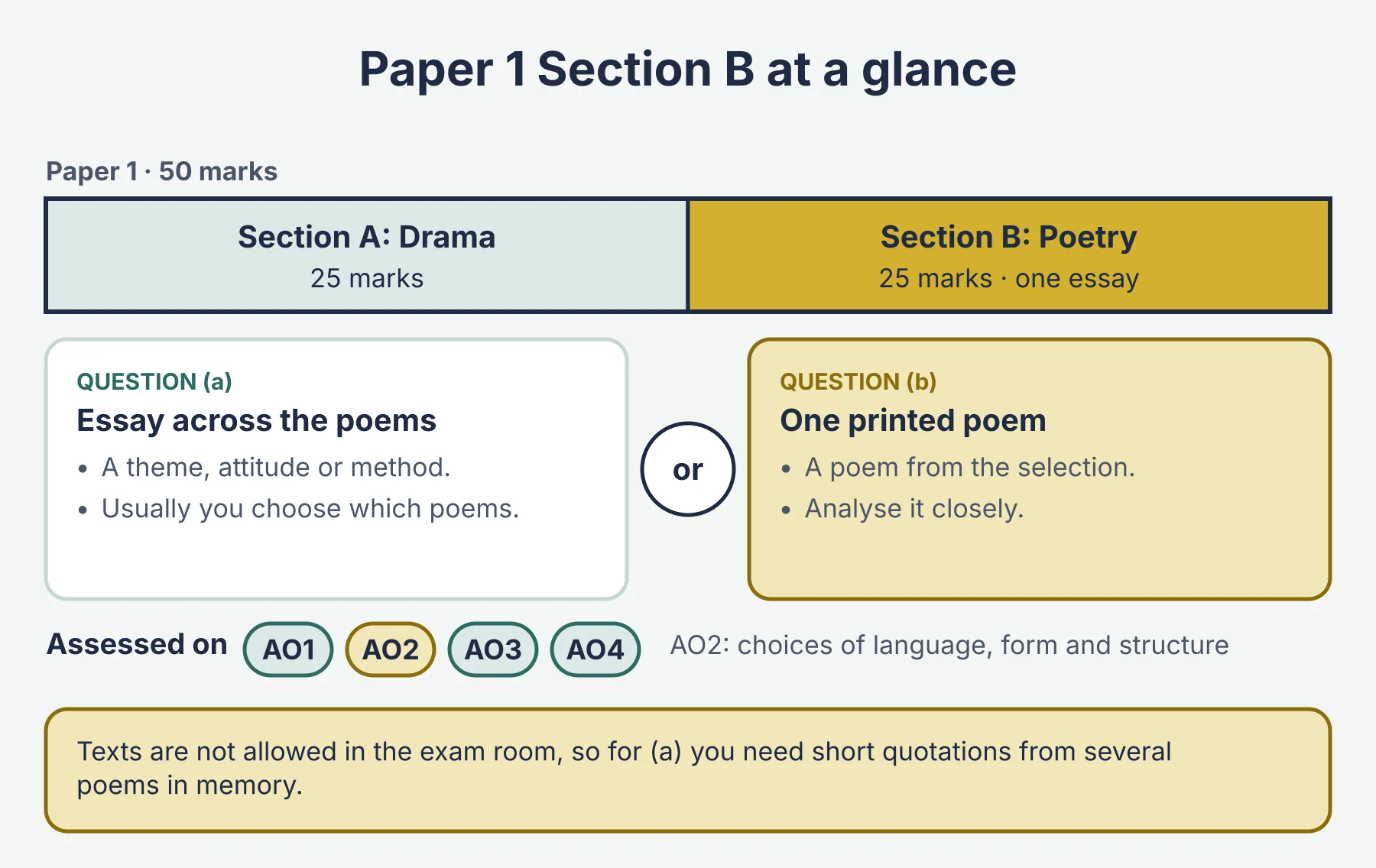
Section B in five lines
- One essay on one poetry set text, worth 25 marks.
- (a): discuss a focus across poems from your selection. (b): analyse a printed poem from the selection.
- Assessed on AO1 to AO4, each 25% of the paper.
- Closed book: quotations for (a) must come from memory.
- Learn the poems the syllabus names in your selection, not the whole collection.
Reading order for any poem
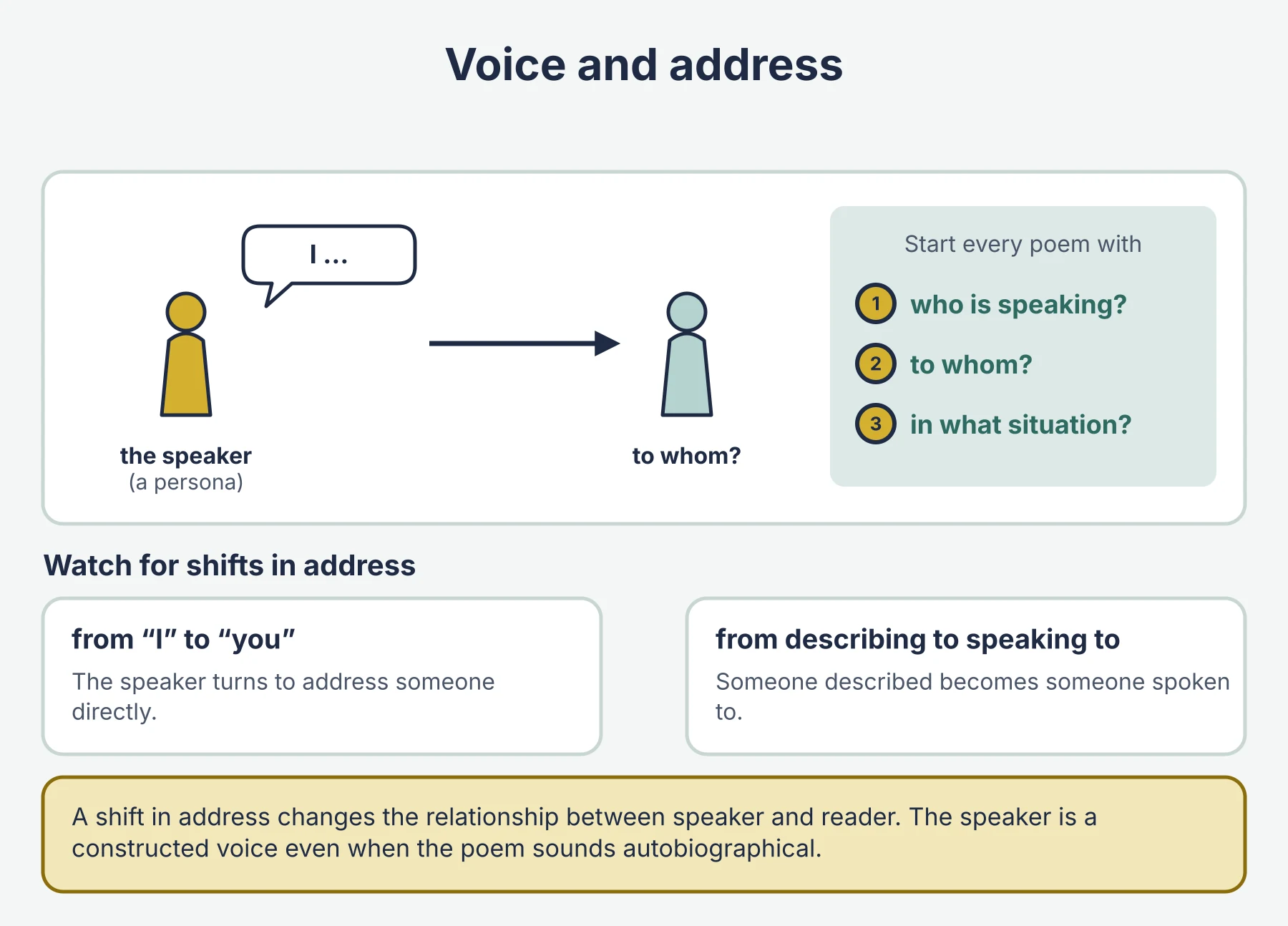
- Speaker and situation: who, to whom, where, when.
- Movement: what changes between opening and ending; where the turn falls.
- Form: stanza pattern, line length, rhyme, metre, and any disruption.
- Language: image clusters, diction, register, sound.
- Effect: what each choice does to meaning or tone at that point.
Key terms
| Term | Definition | Typical effect to discuss |
|---|---|---|
| Persona | The constructed speaking voice | Allows irony; the speaker may not be the poet |
| Apostrophe | Addressing an absent person, object or idea | Urgency, longing, or a one-sided relationship |
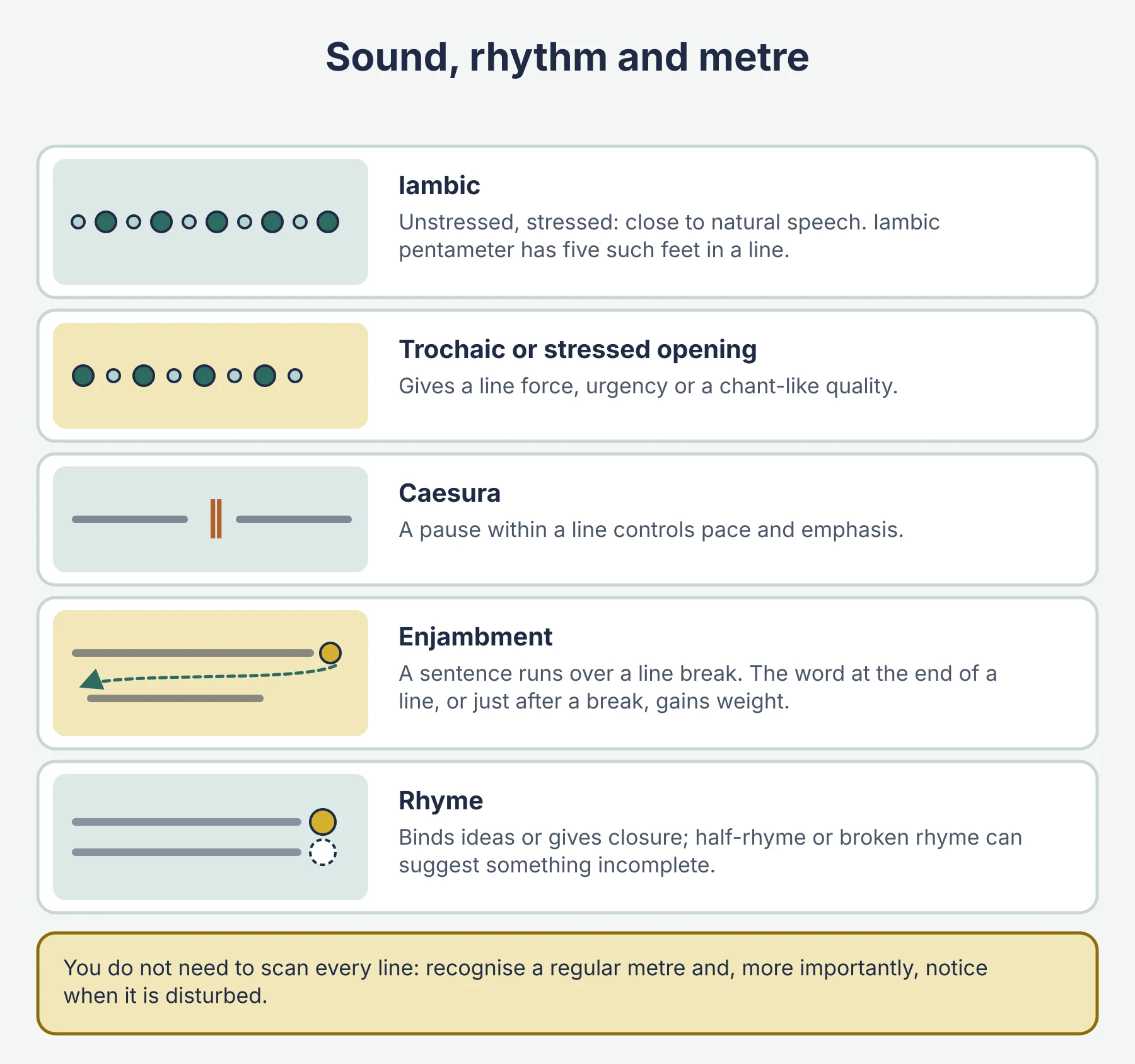
| Iamb | Unstressed then stressed syllable | Speech-like, steady movement |
| Trochee | Stressed then unstressed syllable | Force, chant, insistence |
| Iambic pentameter | Five iambs per line | The “default” line; departures stand out |
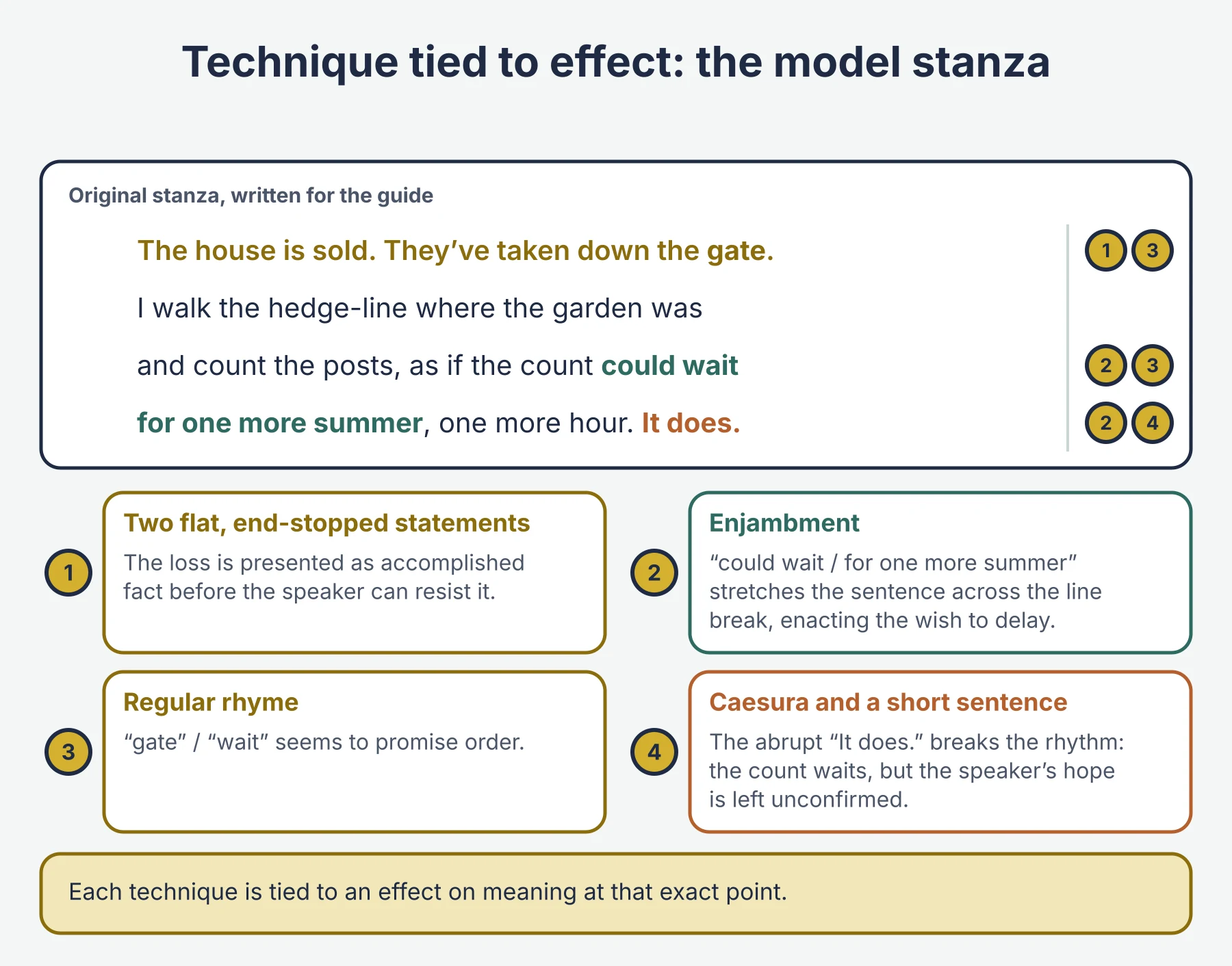
| Caesura | A pause within a line | Hesitation, emphasis, a break in thought |
| Enjambment | A sentence running over a line end | Momentum, overflow, delayed meaning |
| End-stopping | A line ending with punctuation | Control, finality, deliberate pacing |
| Volta | A turn in argument or mood | Reframes what came before |
| Half-rhyme | Near rhyme on consonants or vowels | Unease, incompleteness |
| Refrain | A repeated line or phrase | Insistence, memory, ritual |
| Anaphora | Repetition at the start of successive lines | Building rhetoric, accumulation |
| Juxtaposition | Placing contrasting images side by side | Tension, irony |
| Semantic field | Words from one area of meaning | Builds an attitude across a poem |
Forms to recognise
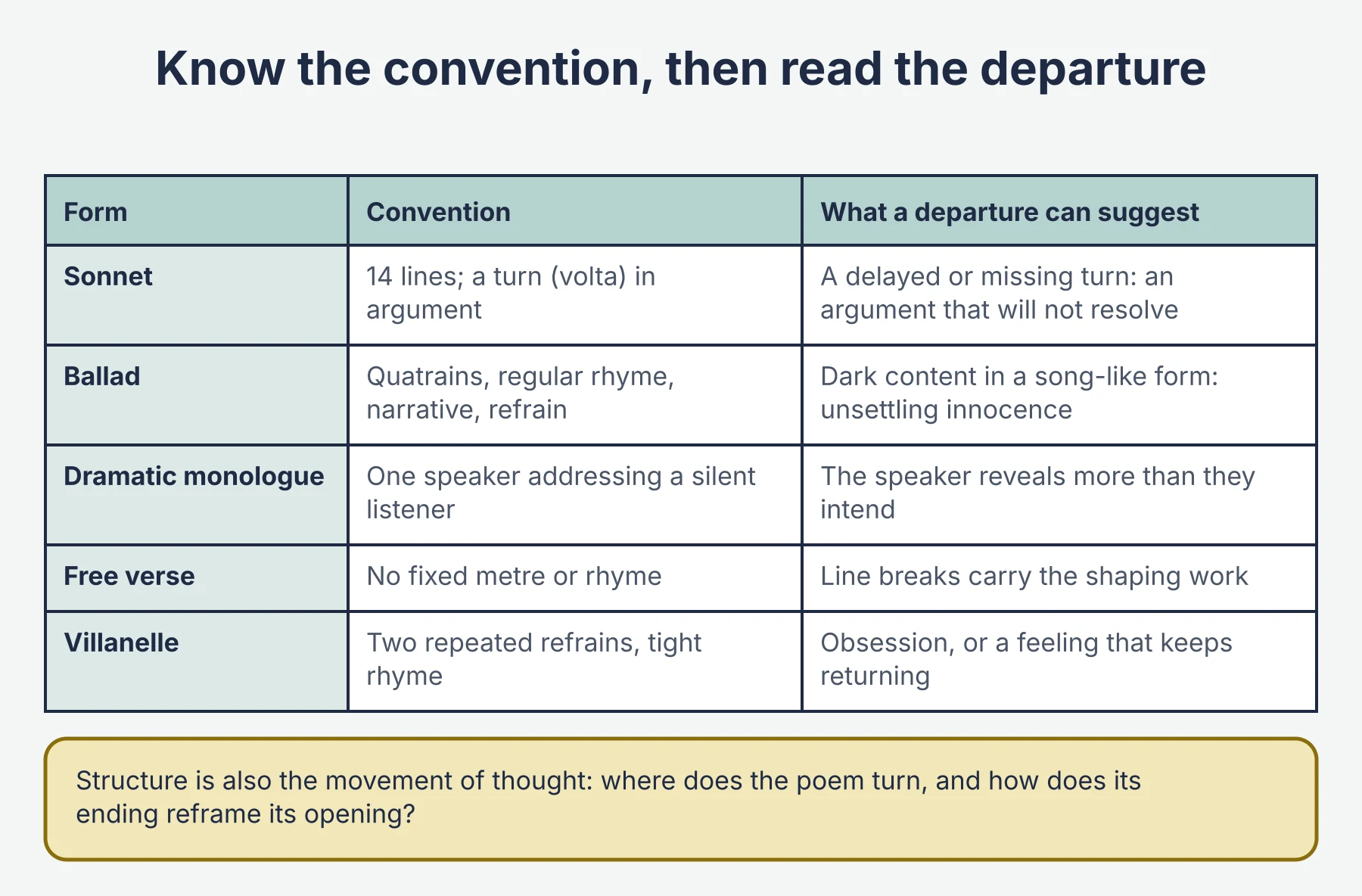
- Sonnet: 14 lines with a turn; the turn’s position is part of the argument.
- Ballad: quatrains, narrative, refrain; simple music can make dark subject matter more disturbing.
- Dramatic monologue: one speaker, silent listener; the speaker reveals more than intended.
- Lyric: a short poem of personal feeling; ask how feeling is shaped, not just what it is.
- Free verse: no fixed pattern; comment on where lines break and why.
- Paired poems: in a collection, poems may answer each other (as Blake’s Songs of Innocence and Songs of Experience do), so a link between paired poems is strong AO1.
Answer shapes
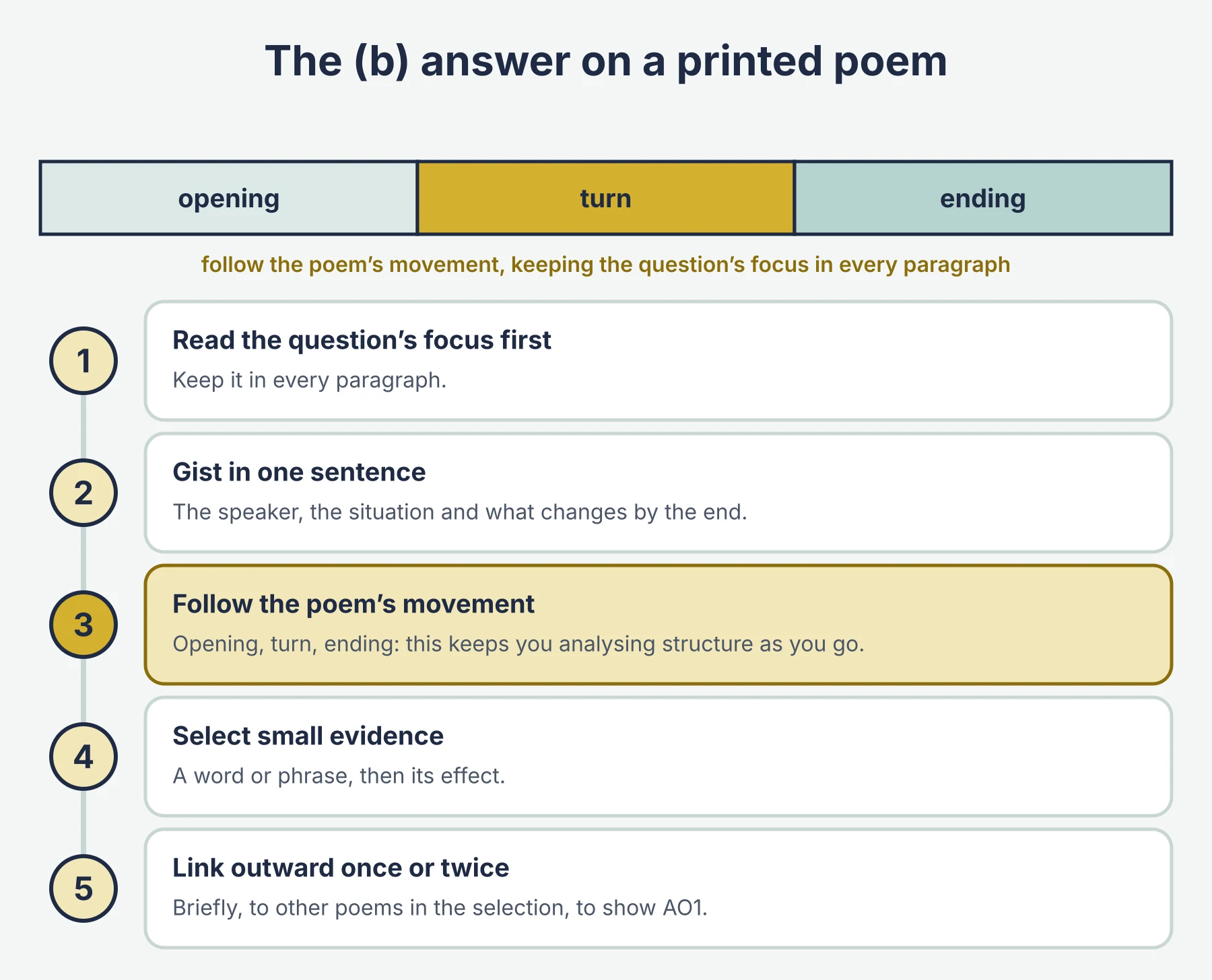
(b) printed poem
- One-sentence gist and thesis tied to the question.
- Follow the poem’s movement: opening, turn, ending.
- Short quotation, technique, effect, every time.
- One or two brief links to other poems in the selection.
- Conclusion that answers the question’s wording.
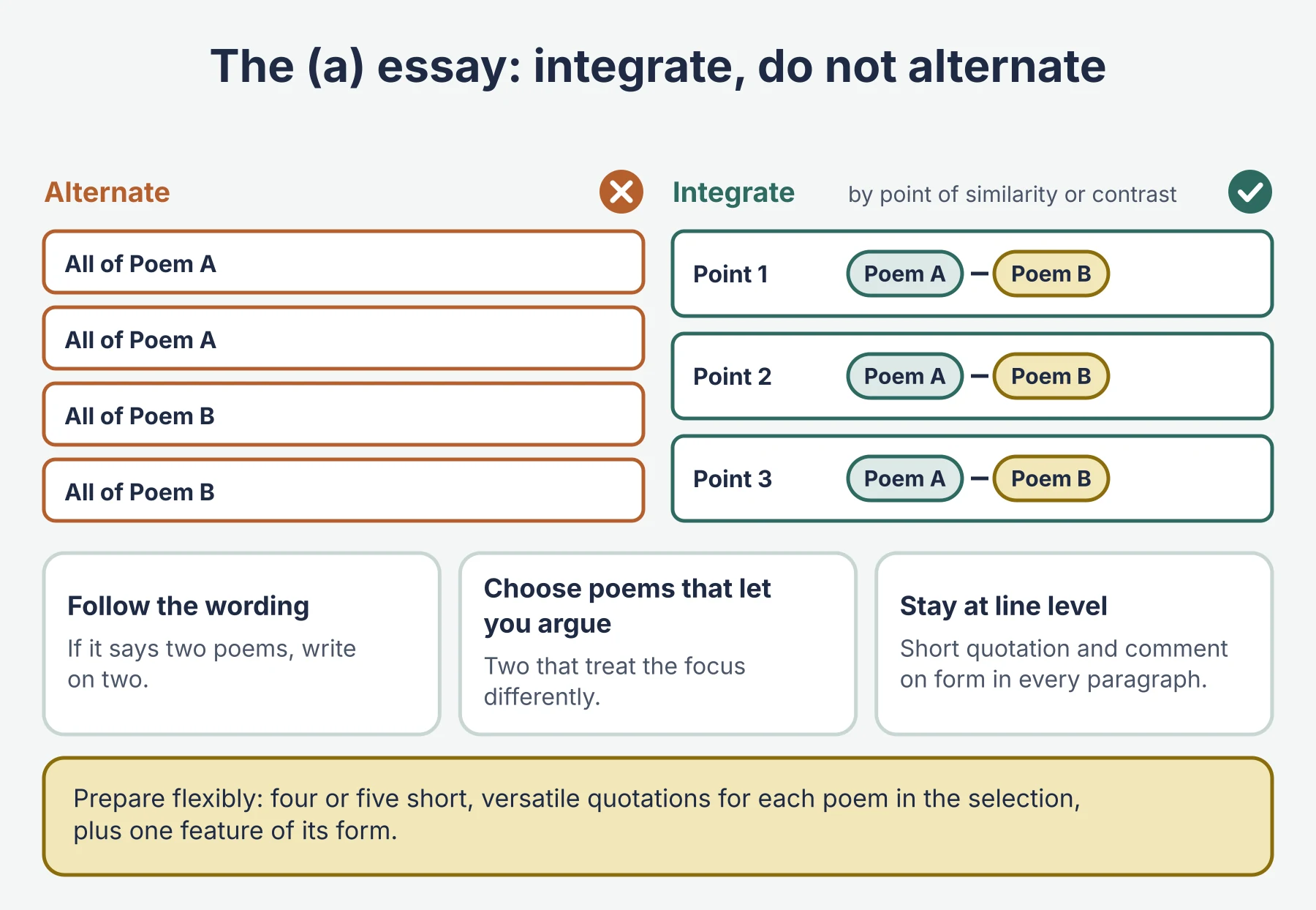
(a) across the selection
- Check how many poems the question asks for, and use exactly that number.
- Choose poems that treat the focus differently.
- Integrate: organise by point, moving between poems.
- Keep line-level analysis in every paragraph.
Memory preparation for (a)
For each named poem in your selection, keep a card with:
- four or five short quotations (three to six words each);
- one feature of form or structure and its effect;
- two themes or attitudes it could support;
- one other poem it pairs or contrasts with.
Exam traps
- Stanza-by-stanza paraphrase: describing content rather than analysing method.
- Technique tour: listing devices without a shared argument.
- Poet equals speaker: treating every “I” as autobiography.
- Scansion without point: labelling metre correctly and stopping.
- Ignoring the question’s focus in a (b) answer and writing a general commentary instead.
- Spreading too thin in (a): mentioning many poems without developing any.
- Missing the turn: stopping before the final lines, where many poems reframe themselves.
Set poetry texts
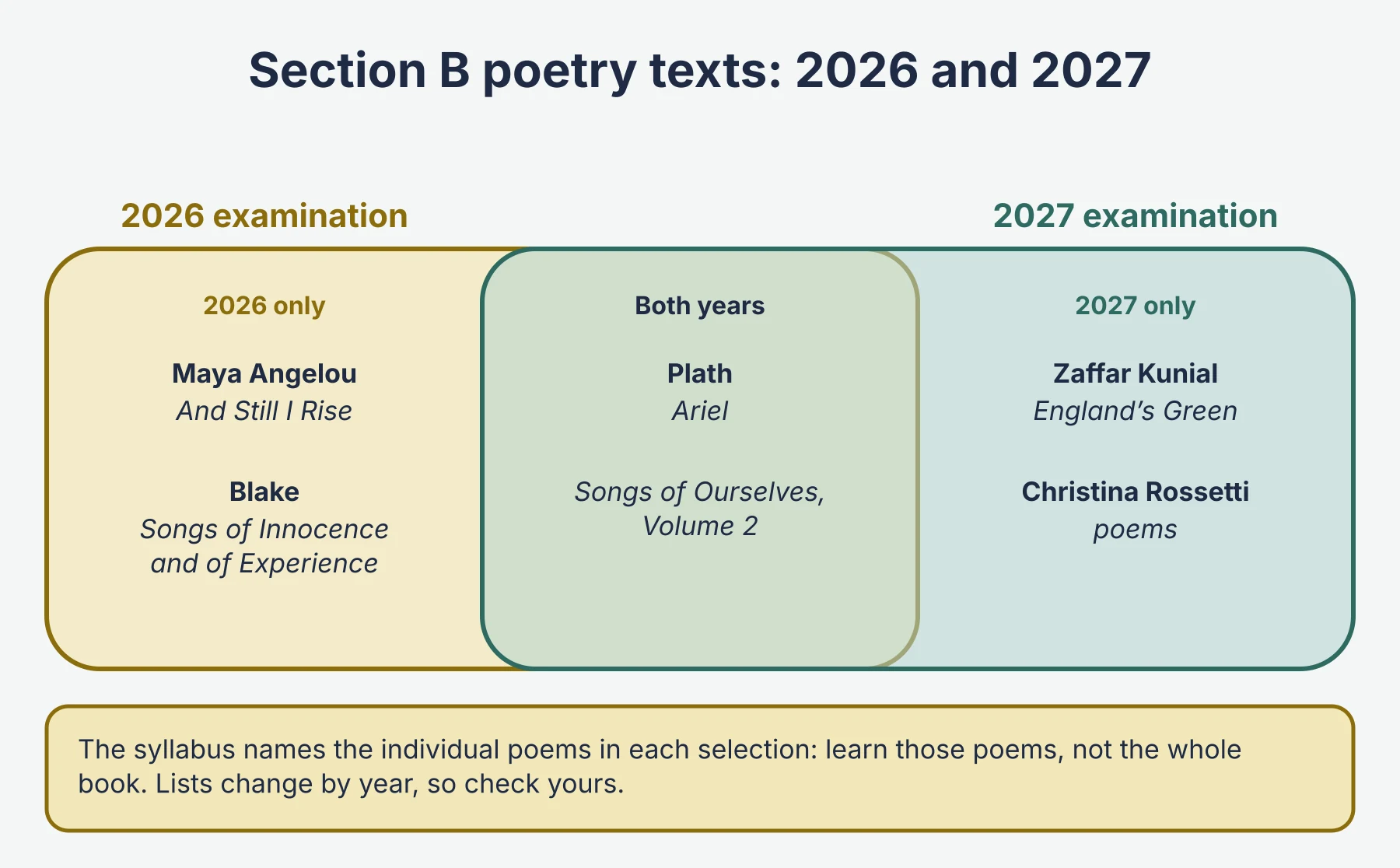
For 2026: Angelou, And Still I Rise; Blake, selected Songs of Innocence and of Experience; Plath, selected Ariel (1965); Songs of Ourselves, Volume 2 selection. For 2027: Kunial, selected England’s Green; Plath, selected Ariel; Rossetti, selected poems; Songs of Ourselves, Volume 2 selection. Confirm the named poems for your year in the syllabus.
Self-test
- What is printed on the paper for a Section B (b) question?
- Which assessment objectives are tested in Section B?
- What is a persona, and why does it matter?
- Define enjambment and give one possible effect.
- What is the difference between a caesura and end-stopping?
- How many syllables, and in what pattern, make up a line of regular iambic pentameter?
- What is a volta?
- What can half-rhyme suggest?
- Why might a ballad’s regular music make its content more disturbing?
- In an (a) answer, what should you check first about the number of poems?
- Why is integrating two poems better than writing about them one after the other?
- What four things should a memory card for each set poem contain?
Answers: 1. One poem from the set selection. 2. AO1, AO2, AO3 and AO4. 3. The constructed speaking voice; it may differ from the poet, which opens irony and interpretation. 4. A sentence running over a line end; it can create momentum or delay meaning until the next line. 5. A caesura is a pause within a line; end-stopping is punctuation at the end of a line. 6. Ten syllables in five iambs, each unstressed then stressed. 7. A turn in argument or mood. 8. Unease or incompleteness, because the rhyme is not quite fulfilled. 9. The contrast between song-like form and dark content unsettles the reader. 10. Whether the question names a number of poems, so you write on exactly that many. 11. It keeps the essay argued by point and makes comparison visible. 12. Short quotations, a feature of form with its effect, themes it supports, and a poem it pairs with.
Related resources
-
Study guides
A Level English Literature: Paper 1 - Drama and Poetry (Cambridge 9695)
The format and structure of Paper 1 Drama and Poetry – an AS Level paper for Cambridge International A Level English Literature 9695, 2024-2026 series.
English Literature · Cambridge · AS Level
Read guide -
Practice questions
A Level English Literature: Paper 1 – Drama and Poetry — Practice Questions
Original practice for Cambridge 9695 Paper 1 Drama and Poetry: recall checks and two passage commentaries on new extracts, with full indicative answers.
English Literature · Cambridge · AS Level
Try questions -
Revision notes
A Level English Literature: Paper 1 – Drama and Poetry — Revision Notes
Condensed notes on Paper 1 Drama and Poetry: format, timing, (a) and (b) questions and AO1 to AO4, for Cambridge International A Level Literature 9695.
English Literature · Cambridge · AS Level
Revise topic
Get free revision emails (optional)
Occasional emails with practice questions, worked explanations and links to free resources for the qualification and subjects you choose. No spam, and you can unsubscribe from any email. The free tools on this site never need an email.