
Study Guides
Cambridge A Level Literature in English (9695): Paper 1 Section B – Poetry
Close reading for Cambridge 9695 Paper 1 Section B Poetry: voice, form, metre and imagery, (a) essays across a selection and (b) answers on a printed poem.
- Subject
- English Literature
- Level
- AS LEVEL
- Topic
- Paper 1 – Drama and Poetry
- Author
- Marlbridge Academic Team
- Updated
- Reviewed by
- Ammar Bilal (what this means)
Aligned to Cambridge A Level English Literature (9695), 2024-2026. Official specification .
Syllabus page (what it covers and how it is assessed): Cambridge A Level English Literature.
Syllabus points this page covers
9695 (AS Level)
- 1.2 Section B: Poetry
Found an error? Report a correction.
Need help with this topic? Request a free trial class for A Level English Literature (9695).
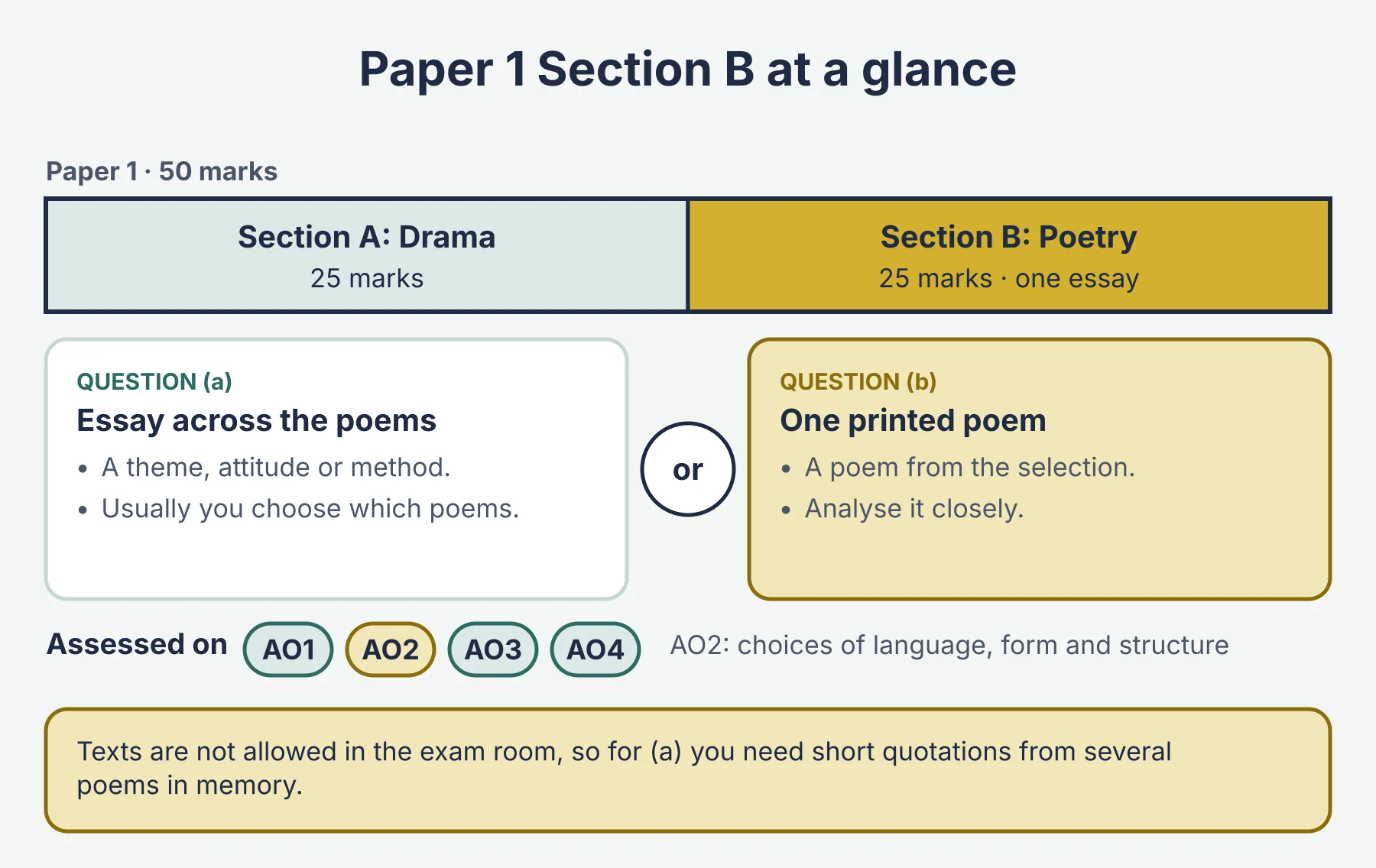
Section B of Paper 1 asks for one essay on a poetry set text: a collection or a selection of poems by one poet, or the Songs of Ourselves anthology selection. It carries 25 marks, half of the paper, and is assessed on AO1 to AO4. This guide focuses on the reading skills the section rewards and on how to shape each type of answer. For the paper as a whole, see the Paper 1 overview.
What the section asks of you
On each set text there is a choice. The (a) question is an essay that asks you to discuss a theme, attitude or method across the poems you have studied; usually you choose which poems to write about. The (b) question prints one poem from the selection and asks you to analyse it closely. Texts are not allowed in the exam room, so for (a) you need short quotations from several poems in memory.
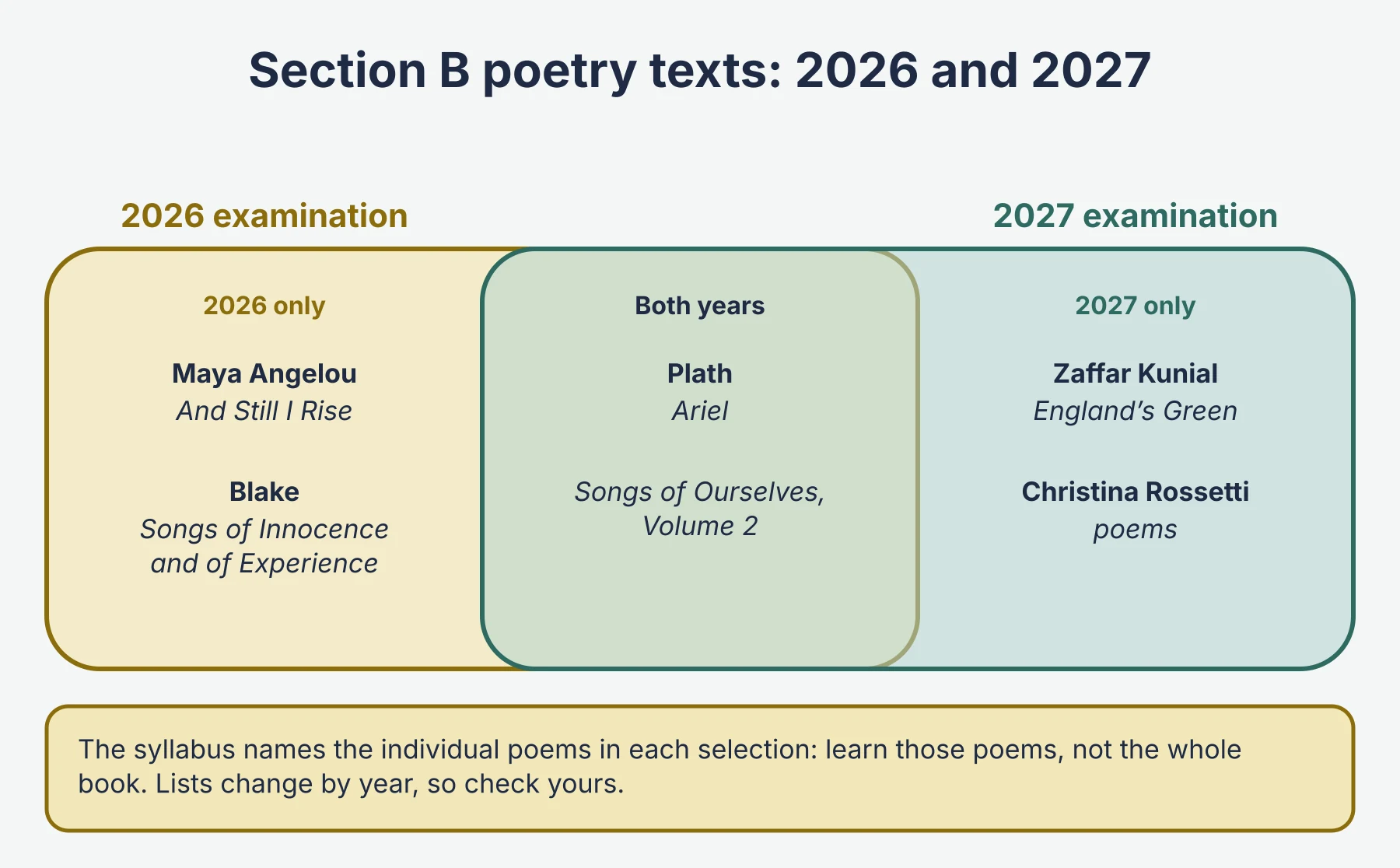
For 2026 the set poetry texts are Maya Angelou’s And Still I Rise, selected poems from Blake’s Songs of Innocence and of Experience, selected poems from Plath’s Ariel (1965) and a selection from Songs of Ourselves, Volume 2. For 2027 they are selected poems from Zaffar Kunial’s England’s Green, Plath’s Ariel, Christina Rossetti’s poems and Songs of Ourselves, Volume 2. The syllabus names the individual poems in each selection; learn those poems, not the whole book. Lists change by year, so check yours.
The key idea: form is part of the meaning
AO2 asks how a poet’s choices of language, form and structure shape meaning. In poetry, form is unusually visible: line length, stanza shape, rhyme and rhythm are choices you can see and hear. The strongest answers treat these as part of the argument of the poem, not as a separate checklist at the end.
Voice and address
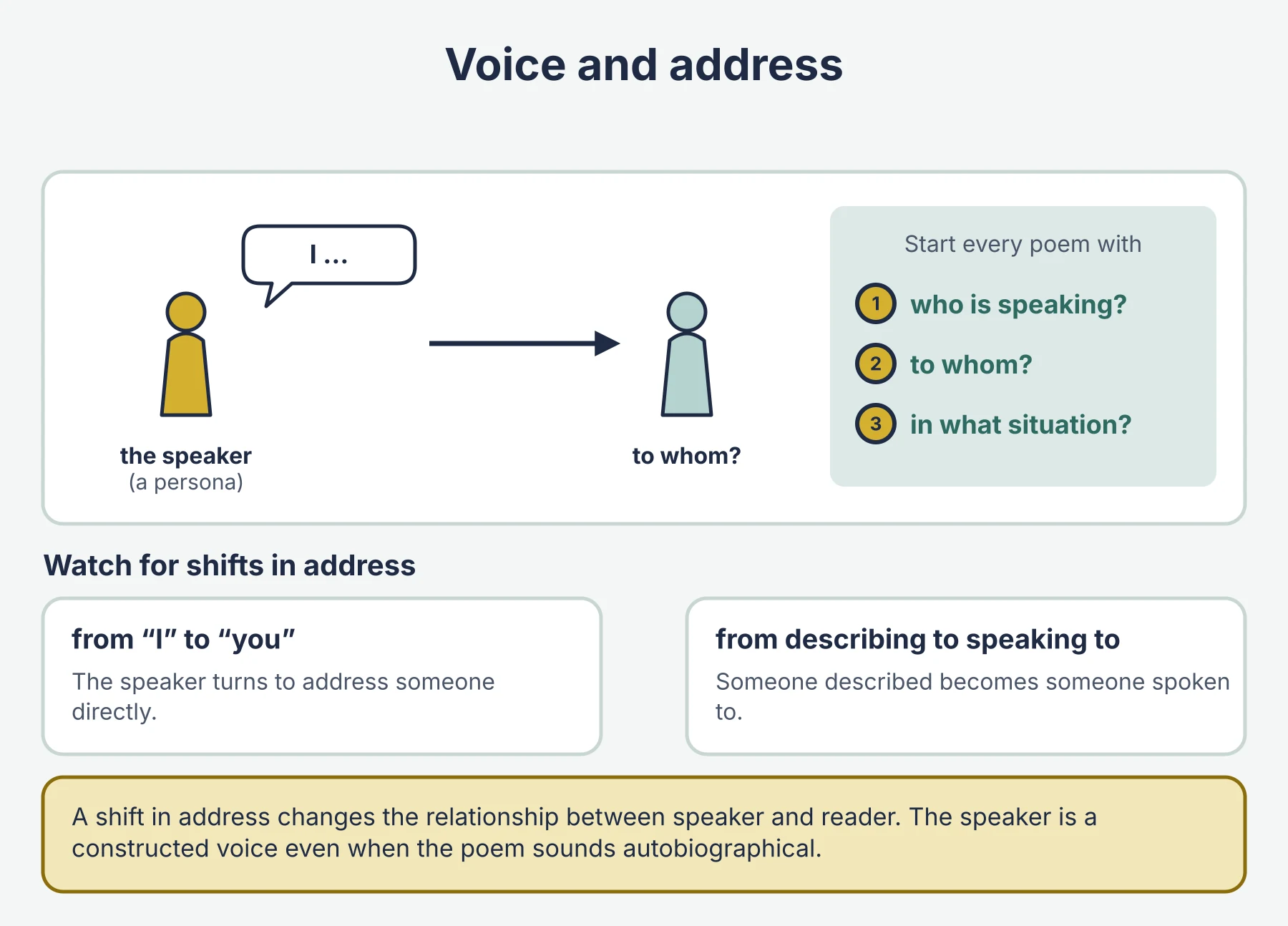
Start every poem with three questions: who is speaking, to whom, and in what situation? The speaker is a constructed voice (a persona), even when the poem sounds autobiographical. Look for shifts in address: a poem that moves from “I” to “you”, or from describing someone to speaking to them, changes the relationship between speaker and reader.
Imagery and diction
- Patterns, not single images. A cluster of related images (light, water, enclosure, machinery) builds an attitude across a poem or a whole selection.
- Register. A sudden technical, childlike or archaic word stands out against the surrounding diction, and often marks the poem’s emotional centre.
- Connotation. Discuss what a word suggests, not just what it denotes.
Sound, rhythm and metre
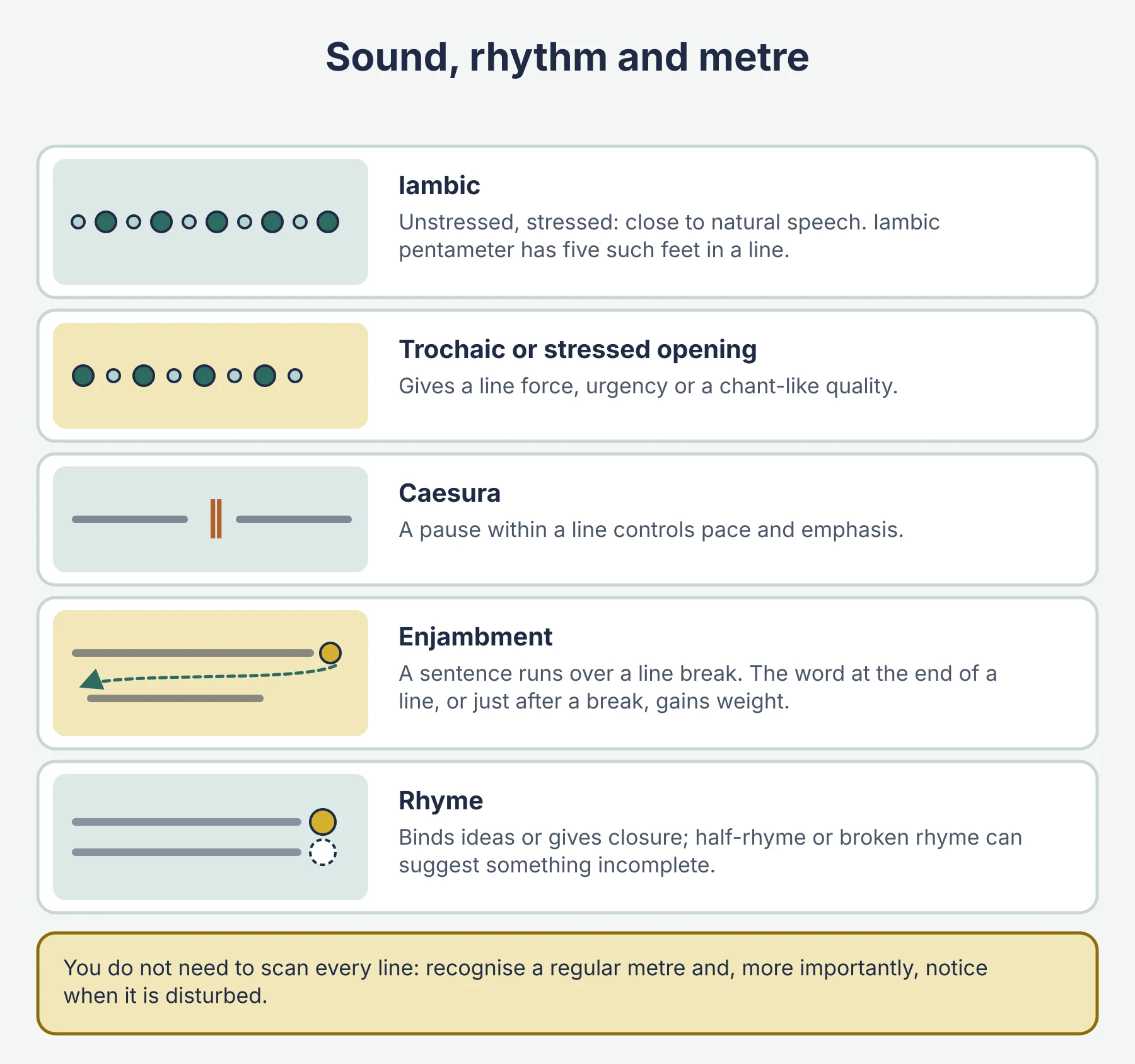
You do not need to scan every line, but you should recognise a regular metre and, more importantly, notice when it is disturbed.
- Iambic rhythm (unstressed, stressed) is close to natural English speech; iambic pentameter has five such feet in a line.
- A trochaic or stressed opening can give a line force, urgency or a chant-like quality.
- Caesura (a pause within a line) and enjambment (a sentence running over a line break) control pace and emphasis. The word placed at the end of a line, or just after a break, gains weight.
- Rhyme can bind ideas together, give closure, or, when it is half-rhyme or broken, suggest something incomplete.
Form and structure
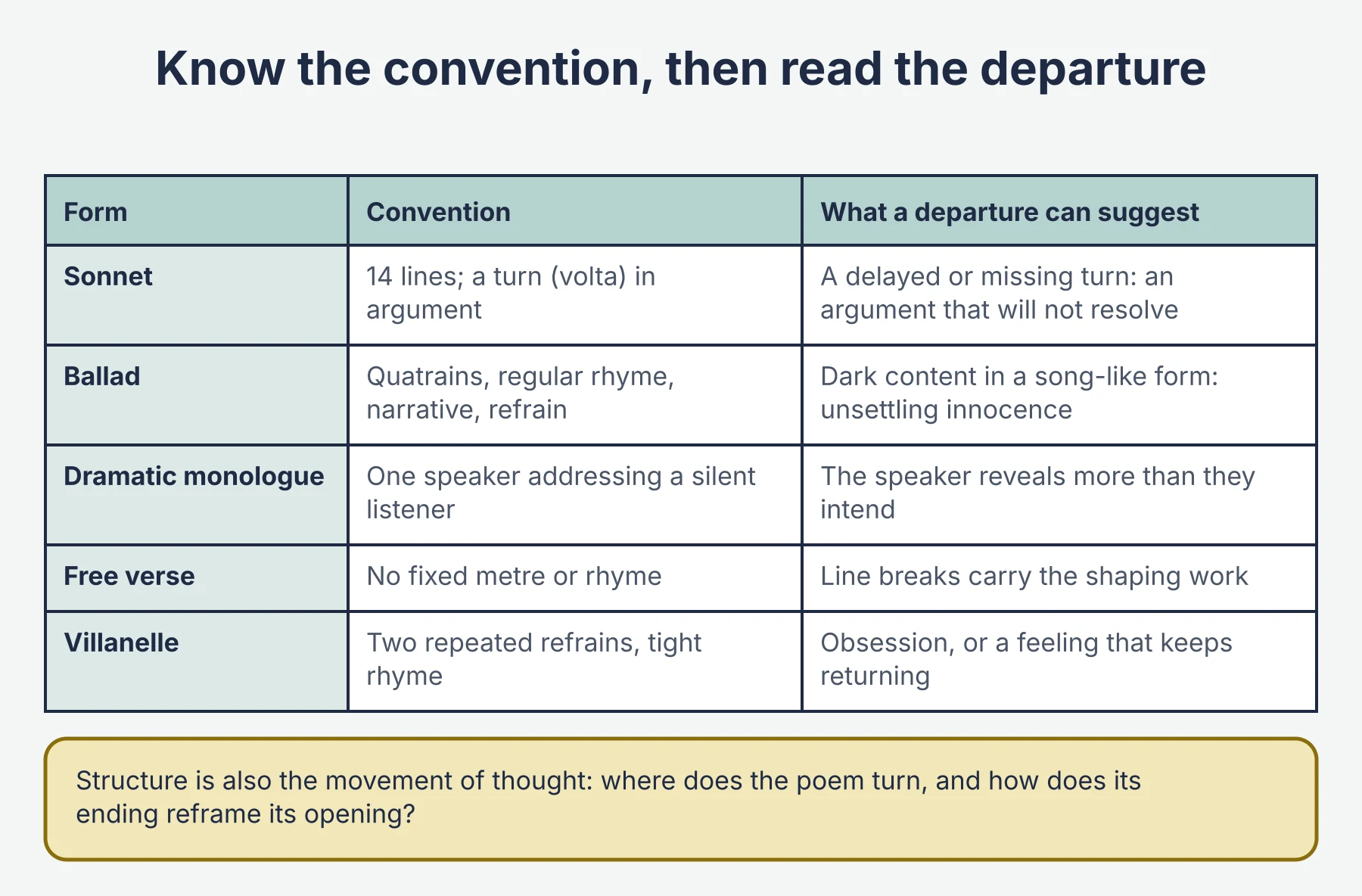
Know the conventions of the forms you are likely to meet, so you can say how a poem uses or departs from them:
| Form | Convention | What a departure can suggest |
|---|---|---|
| Sonnet | 14 lines; a turn (volta) in argument | A delayed or missing turn: an argument that will not resolve |
| Ballad | Quatrains, regular rhyme, narrative, refrain | Dark content in a song-like form: unsettling innocence |
| Dramatic monologue | One speaker addressing a silent listener | The speaker reveals more than they intend |
| Free verse | No fixed metre or rhyme | Line breaks carry the shaping work |
| Villanelle | Two repeated refrains, tight rhyme | Obsession, or a feeling that keeps returning |
Structure is also the movement of thought: where does the poem turn, and how does its ending reframe its opening?
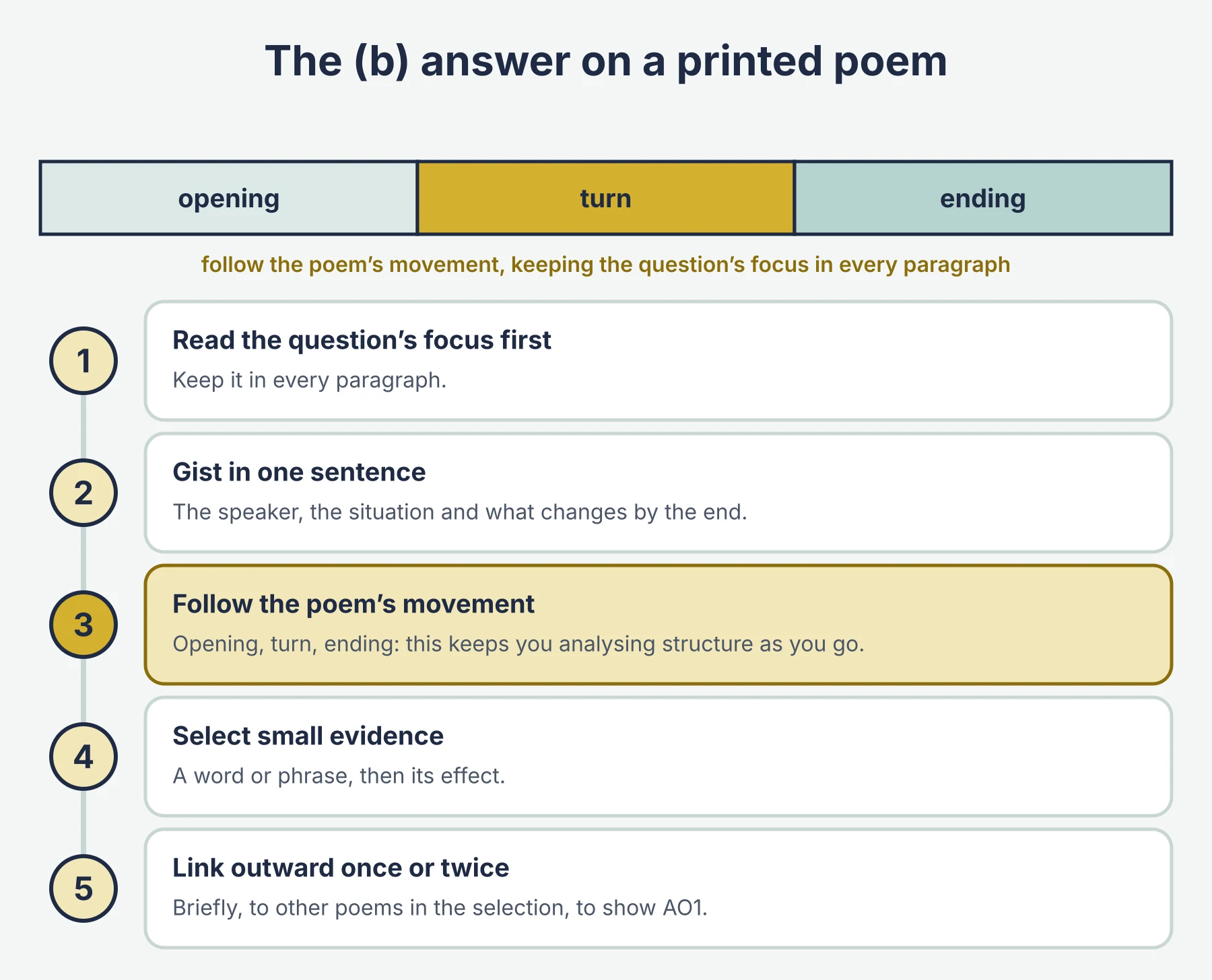
Writing the (b) answer on a printed poem
- Read the question’s focus first and keep it in every paragraph.
- Gist in one sentence: the speaker, situation and what changes by the end.
- Follow the poem’s movement: opening, turn, ending. This keeps you analysing structure as you go.
- Select small evidence: a word or phrase, then its effect.
- Link outward once or twice to other poems in the selection, briefly, to show AO1.
Annotated model paragraph
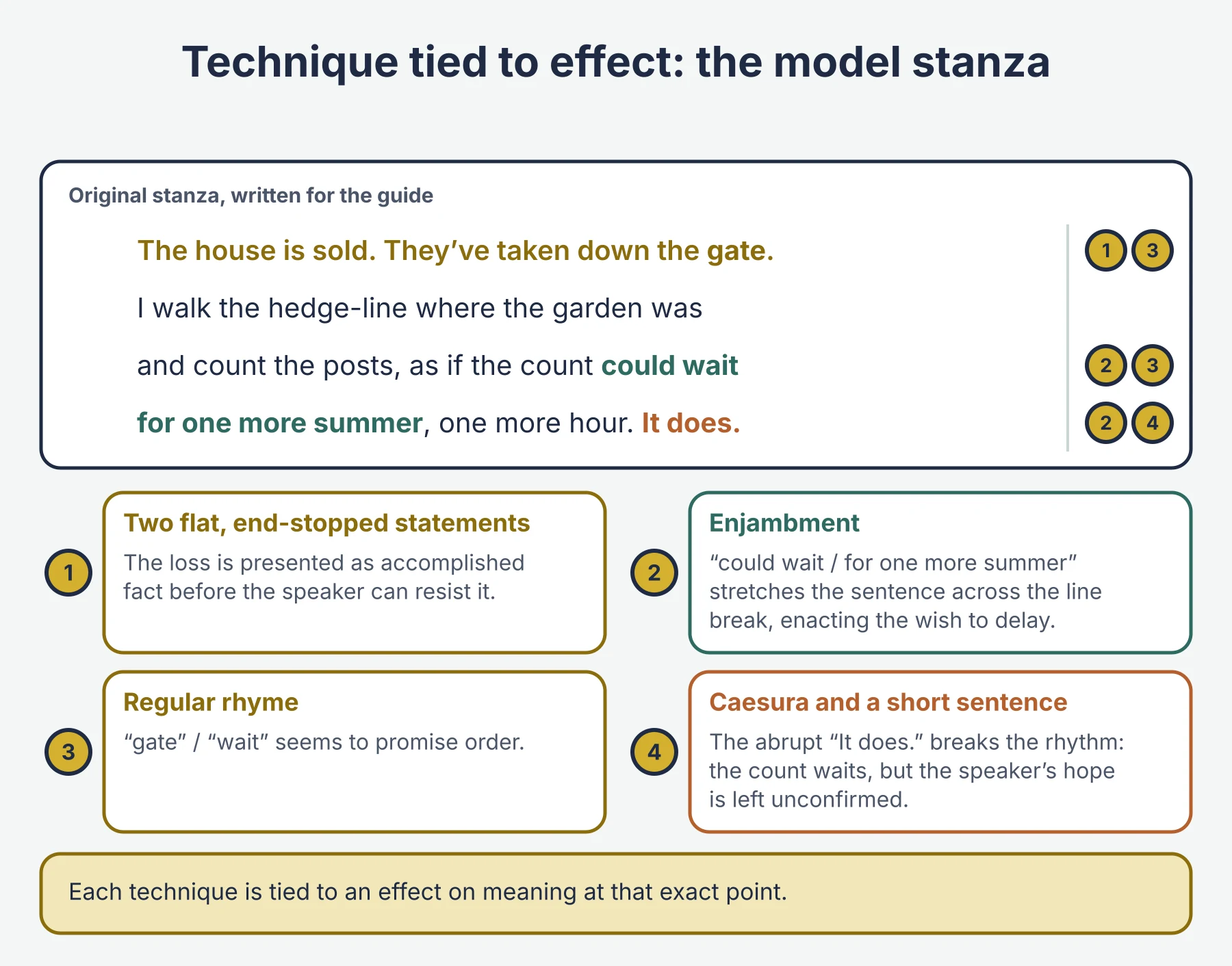
The stanza below is original, written for this guide.
The house is sold. They’ve taken down the gate. I walk the hedge-line where the garden was and count the posts, as if the count could wait for one more summer, one more hour. It does.
A strong paragraph might read:
The stanza opens with two flat, end-stopped statements, so the loss is presented as accomplished fact before the speaker can resist it. The enjambment that follows (“could wait / for one more summer”) stretches the sentence across the line break, enacting the wish to delay. The regular rhyme (“gate”/“wait”) seems to promise order, but the final, abrupt “It does.” breaks the rhythm with a caesura and a short sentence, an ambiguous answer: the count waits, but the speaker’s hope is left unconfirmed.
Notice that each technique is tied to an effect on meaning at that exact point.
Writing the (a) essay across the selection
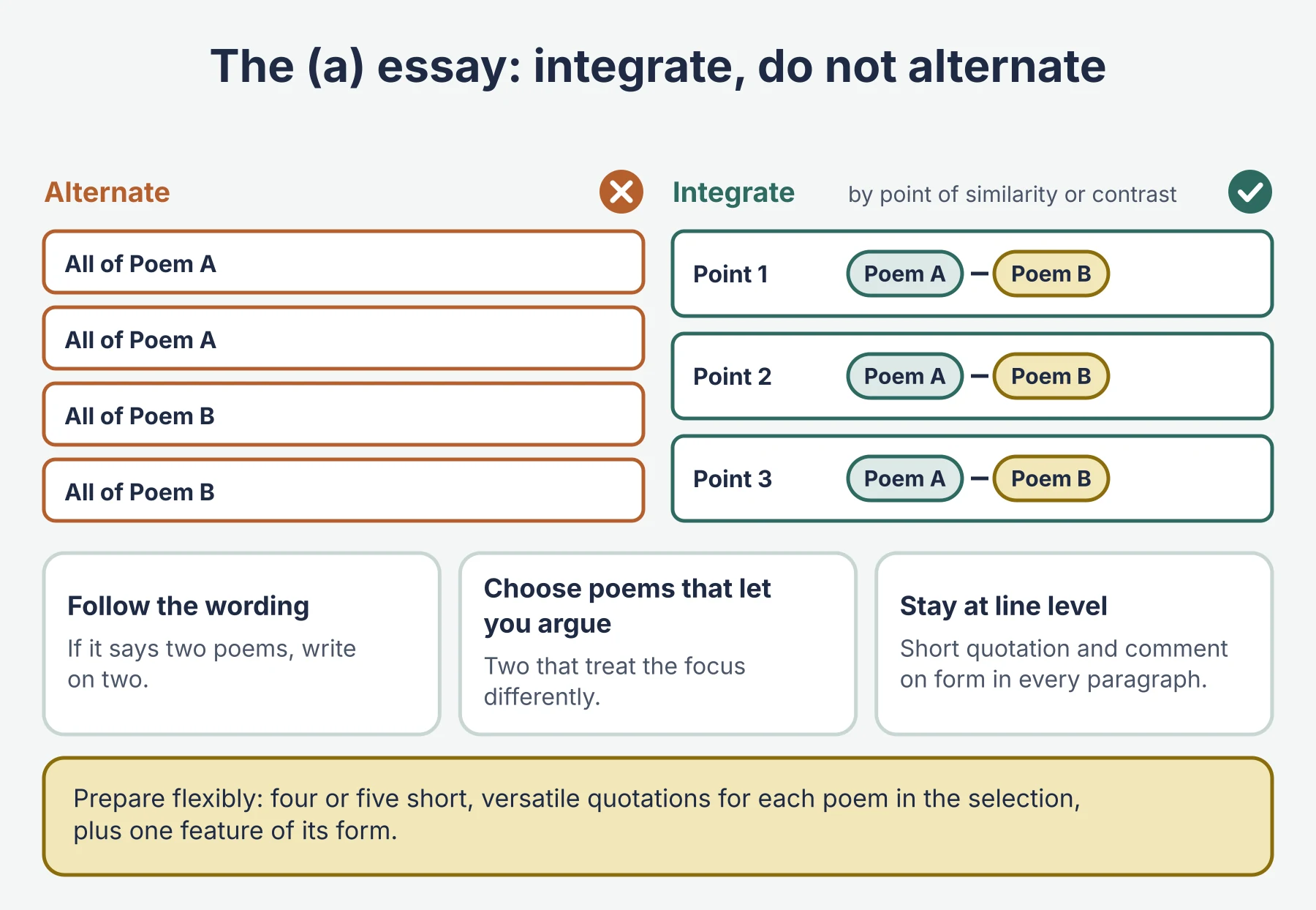
An (a) question typically asks you to discuss ways in which the poet presents a subject or uses a method in two poems or in your selection. Follow the wording exactly: if it says two poems, write on two.
- Choose poems that let you argue. Two poems that treat the focus differently give you a comparison with direction.
- Integrate rather than alternate. Avoid writing all of one poem then all of the other; move between them by point of similarity or contrast.
- Keep analysis at line level. Range does not excuse generality; each paragraph still needs short quotation and comment on form.
- Prepare flexibly. Learn four or five short, versatile quotations for each poem in the selection, plus one feature of its form.
Command words and question wording
The syllabus’s command words include discuss (write about a topic in depth in a structured way), analyse (examine in detail to show meaning and how elements relate) and comment (give an informed opinion), alongside phrases such as “In what ways…?” and “How far, and in what ways…?”. A question that says “considering form and structure” or “paying close attention to language” is telling you where the AO2 marks are; make that feature visible in every paragraph.
Common mistakes
- Paraphrase. Explaining what each stanza “is saying” in turn, with no analysis of how.
- The technique tour. Listing alliteration, a metaphor and some enjambment with no shared argument.
- Poet equals speaker. Assuming every “I” is the poet’s own life, which narrows interpretation.
- Metre without effect. Labelling iambic pentameter correctly and then saying nothing about it.
- Ignoring the ending. Many poems turn in their final lines; an answer that stops early misses the turn.
- Too many poems in (a). Brief mentions of five poems are weaker than developed analysis of two.
Practise and revise this section
- Paper 1 Section B Poetry revision notes — terms, forms, traps and a self-test.
- Paper 1 Section B Poetry practice questions — original poems with mark-scheme style answers.
- Paper 1 Section A Drama study guide — the other half of the paper.
Written against the Cambridge International AS & A Level Literature in English 9695 syllabus for 2024, 2025 and 2026.
Related resources
-
Practice questions
Cambridge A Level Literature in English (9695): Paper 1 Section B – Poetry – Practice Questions
Original practice for Cambridge 9695 Paper 1 Section B Poetry: terms, metre and form, plus structured analysis of new poems, with mark-scheme style answers.
English Literature · Cambridge · AS Level
Try questions -
Revision notes
Cambridge A Level Literature in English (9695): Paper 1 Section B – Poetry – Revision Notes
Quick-recall notes for Cambridge 9695 Paper 1 Section B Poetry: metre, form and imagery terms, (a) and (b) answer shapes, traps and a 12-question self-test.
English Literature · Cambridge · AS Level
Revise topic -
Study guides
A Level English Literature: Paper 1 - Drama and Poetry (Cambridge 9695)
The format and structure of Paper 1 Drama and Poetry – an AS Level paper for Cambridge International A Level English Literature 9695, 2024-2026 series.
English Literature · Cambridge · AS Level
Read guide
Get free revision emails (optional)
Occasional emails with practice questions, worked explanations and links to free resources for the qualification and subjects you choose. No spam, and you can unsubscribe from any email. The free tools on this site never need an email.