
Revision Notes
Cambridge A Level Literature in English (9695): Paper 1 Section A – Drama – Revision Notes
Quick-recall notes for Cambridge 9695 Paper 1 Section A Drama: dramatic terms, staging evidence, (a) and (b) answer shapes, exam traps and a self-test.
- Subject
- English Literature
- Level
- AS LEVEL
- Topic
- Paper 1 – Drama and Poetry
- Author
- Marlbridge Academic Team
- Updated
- Reviewed by
- Ammar Bilal (what this means)
Aligned to Cambridge A Level English Literature (9695), 2024-2026. Official specification .
Syllabus page (what it covers and how it is assessed): Cambridge A Level English Literature.
Syllabus points this page covers
9695 (AS Level)
- 1.1 Section A: Drama
Found an error? Report a correction.
Need help with this topic? Request a free trial class for A Level English Literature (9695).
Condensed notes for the drama half of Paper 1. For the full method and an annotated model paragraph, use the Paper 1 Section A Drama study guide.
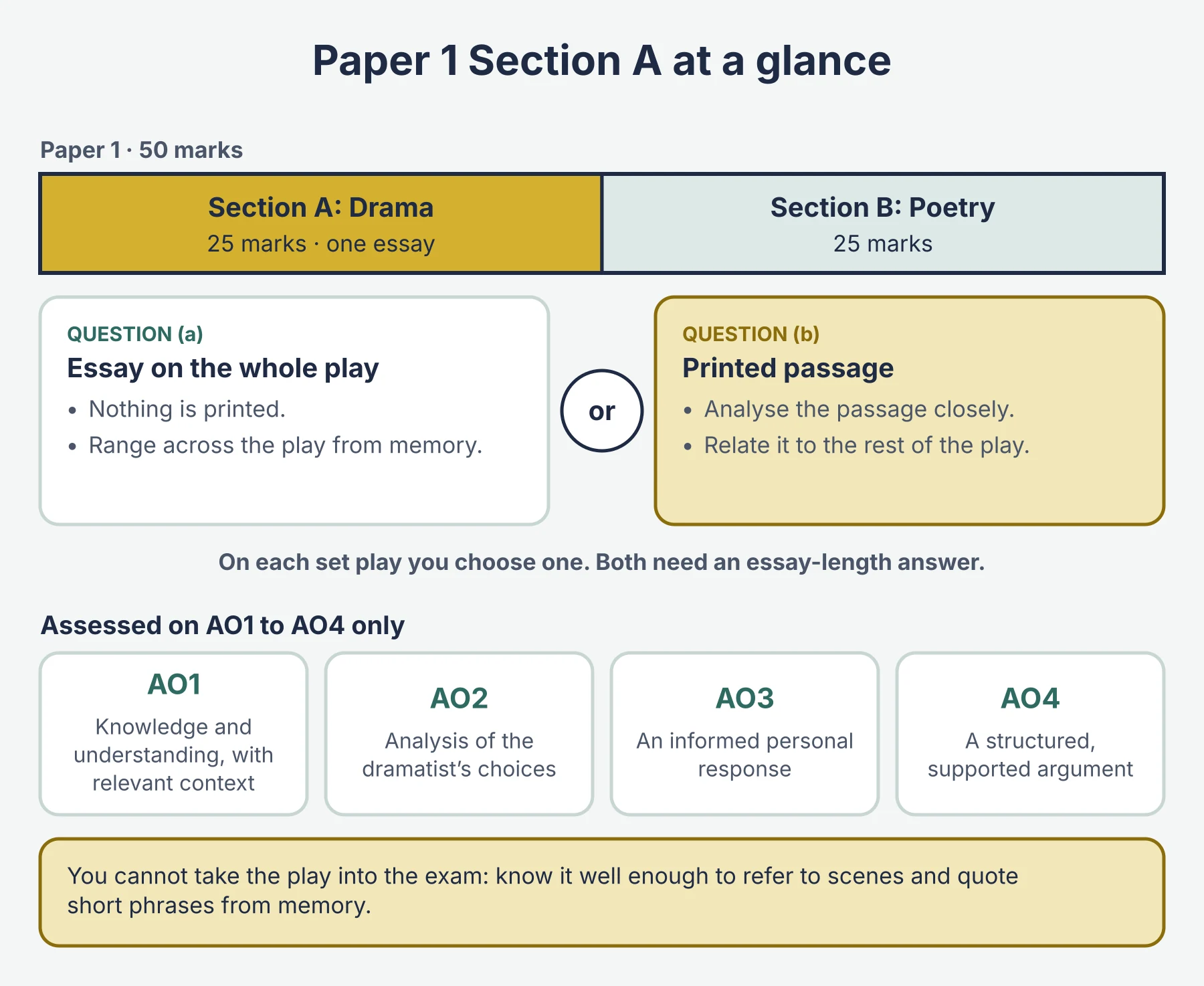
Section A in five lines
- One essay on one set play, worth 25 marks (half of Paper 1).
- Choice on each play: (a) whole-play essay, or (b) essay on a printed passage, related to the whole play.
- Assessed on AO1 to AO4; AO5 (other readers’ opinions) is not required on this paper.
- Closed book: no set texts, no dictionaries.
- Sharing a two-hour paper with Section B Poetry, so roughly an hour, including planning.
The one principle
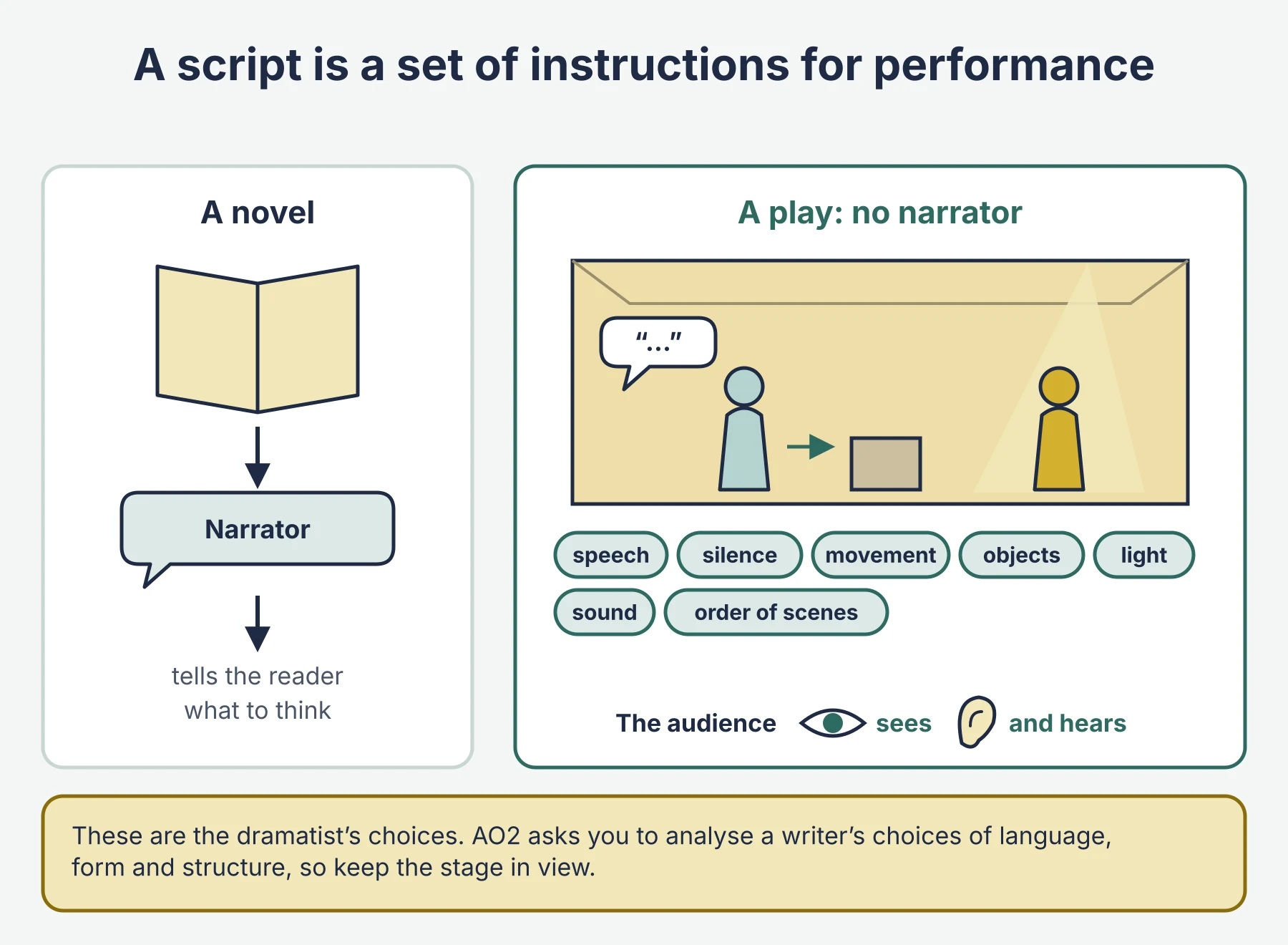
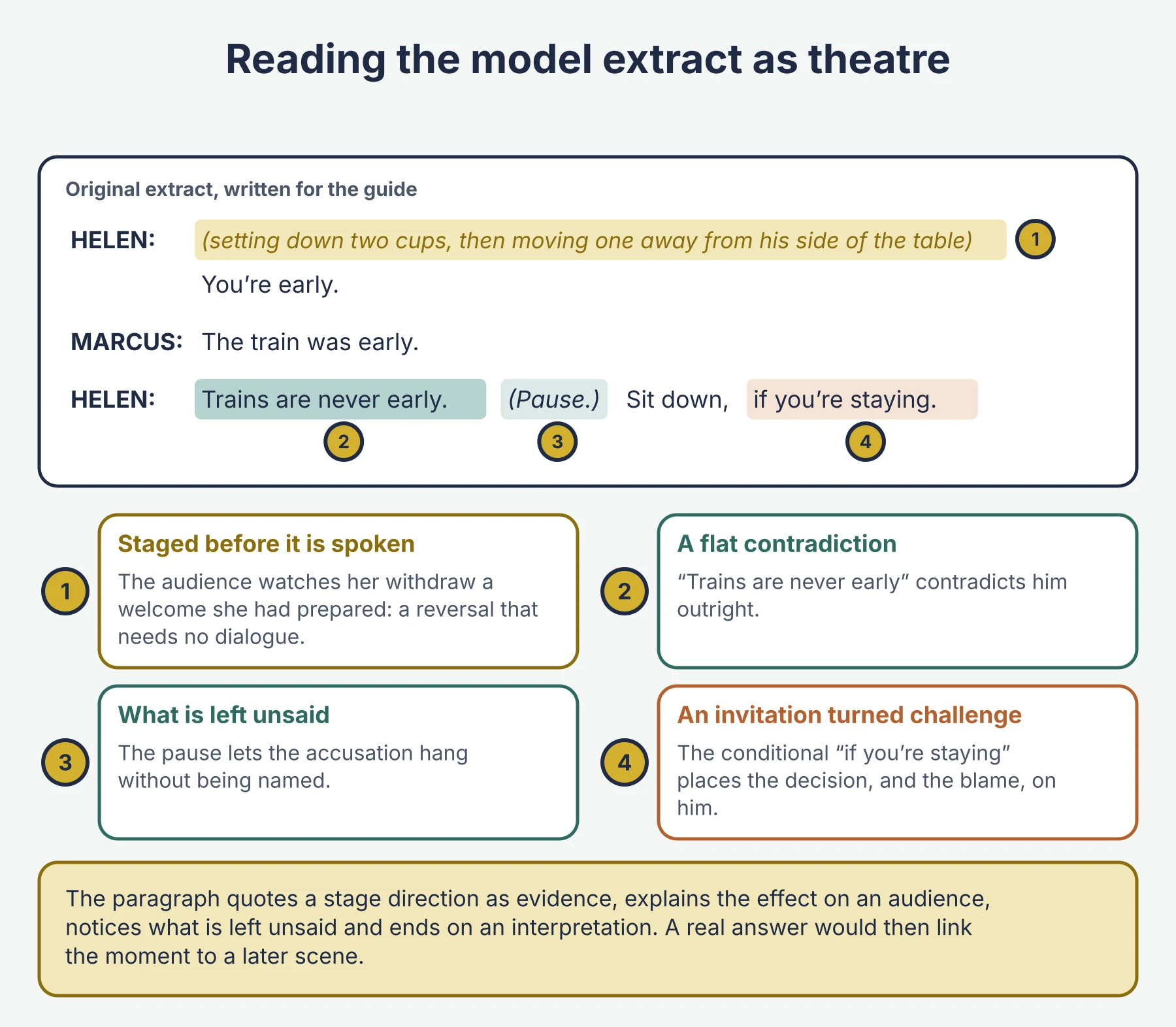
A play is written to be performed. Every point should be about what an audience sees and hears, and how the dramatist controls it. “The reader” is the wrong default word; “the audience” or “the spectator” keeps your answer dramatic.
Key terms
| Term | Meaning | What to say about it |
|---|---|---|
| Stage direction | Printed instruction about movement, sound, setting or delivery | Quote it as evidence; ask what the audience sees |
| Embedded direction | An instruction built into dialogue (“kneel”, “look there”) | Common in early modern plays with few printed directions |
| Dramatic irony | Audience knows more than a character | Lines gain a second meaning; tension or comedy rises |
| Soliloquy | A character alone, speaking thoughts aloud | Direct access to motive; audience made confidant or accomplice |
| Aside | A line heard by the audience but not by others on stage | Splits the stage; creates complicity |
| Subtext | Meaning beneath what is said | Look for evasion, jokes as weapons, sudden topic shifts |
| Stichomythia | Rapid alternating single lines | Duel-like rhythm; conflict or wit |
| Exposition | Information the audience needs, delivered early | How is it disguised as natural talk? |
| Peripeteia | A reversal of fortune | Often marks the structural turning point |
| Anagnorisis | A moment of recognition or discovery | Shifts what the audience and character understand |
| Foil | A character who sharpens another by contrast | Use to discuss presentation, not just personality |
| Metatheatre | A play drawing attention to its own theatricality | Masques, plays within plays, characters as performers |
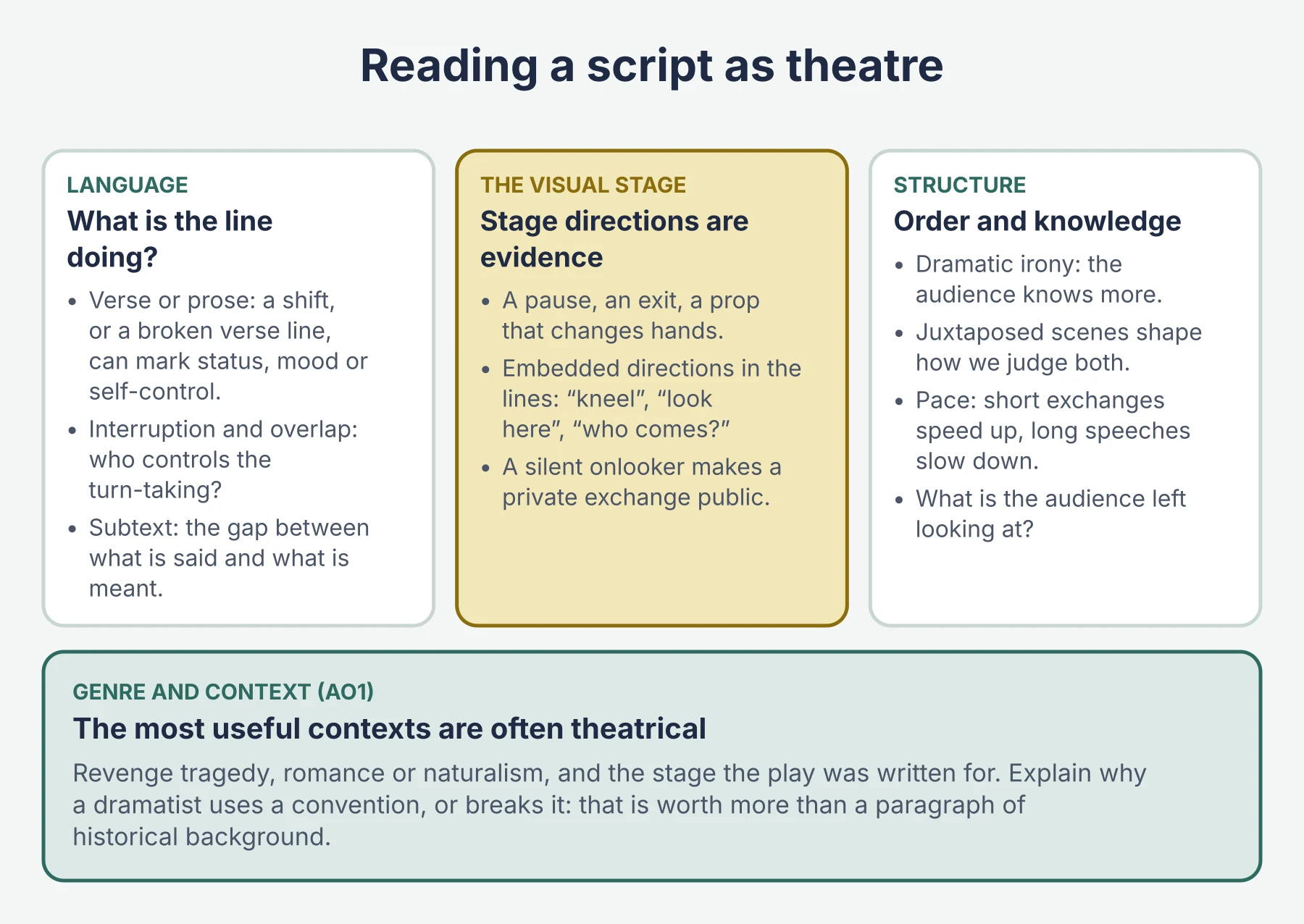
Language, staging, structure: a checklist for any scene
Language
- Verse or prose? Does the form break or change?
- Who speaks most, who is silent, who interrupts?
- Imagery that recurs across the play (and so links the passage outward).
Staging
- Entrances and exits: who arrives at the worst possible moment?
- Props and costume: objects that pass between characters or are hidden.
- Silent characters on stage: an onlooker makes a private moment public.
- Pauses and silences: what fills the gap?
Structure
- What does the audience know that the characters do not?
- How does this scene contrast with the one before or after?
- Where is the turning point within the passage?
- What image ends the scene or act?
Answer shapes
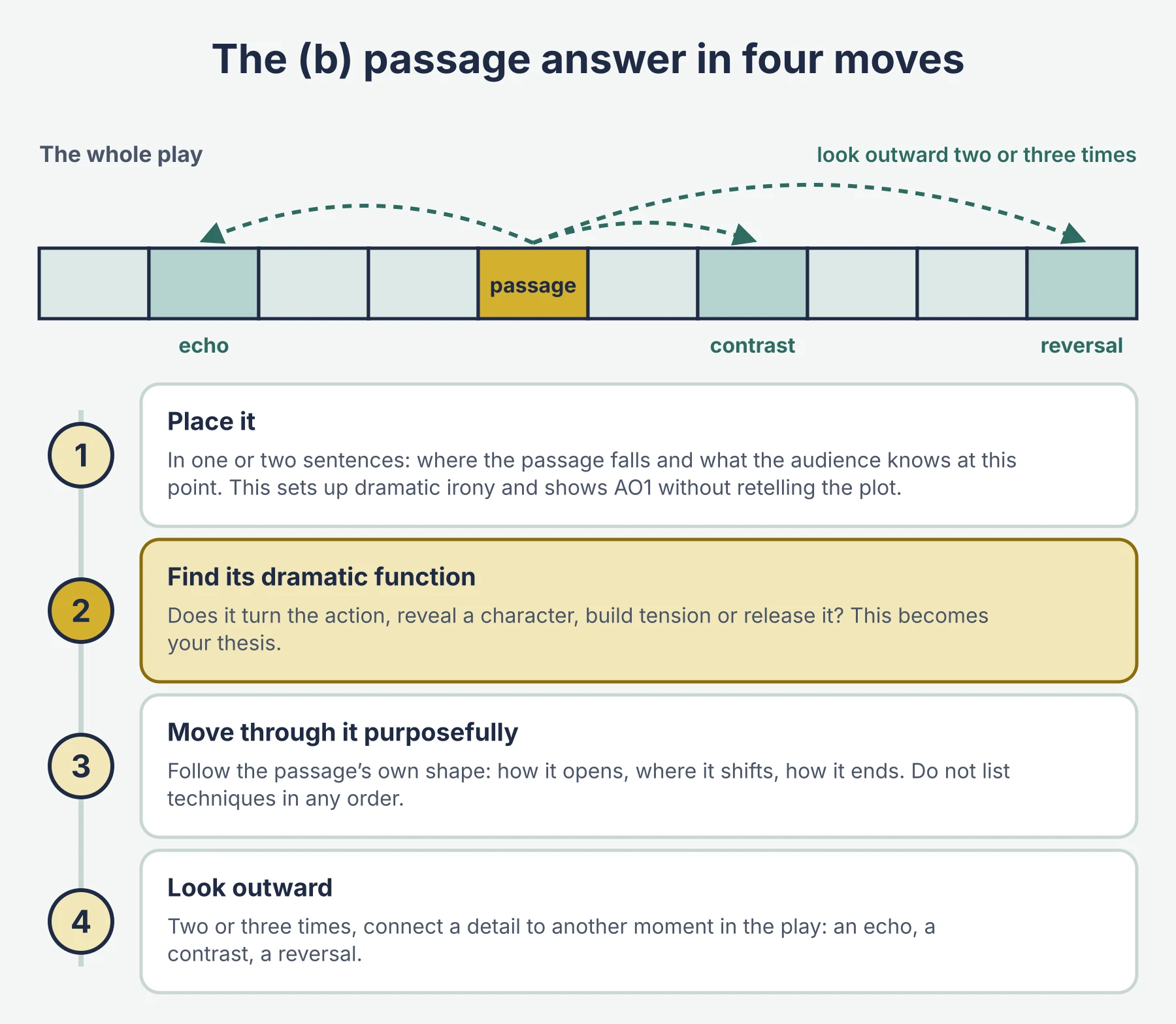
(b) passage answer
- Place the passage in the play (one or two sentences).
- State its dramatic function as your thesis.
- Analyse in the passage’s own order: opening, shift, ending.
- Link outward two or three times to other moments.
- Conclude by answering the question’s exact wording.
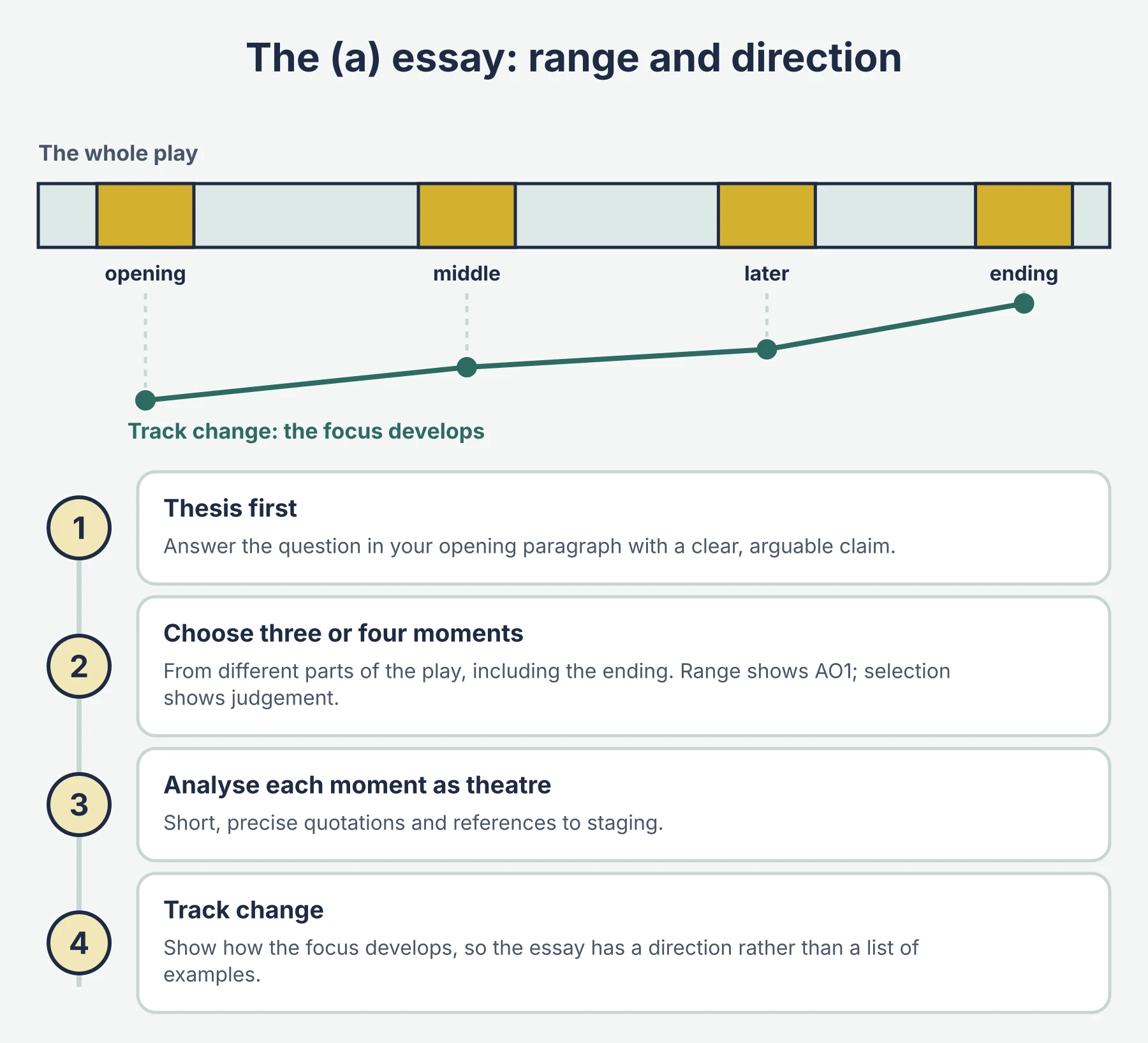
(a) whole-play essay
- Thesis that answers the question directly.
- Three or four moments from across the play, including the ending.
- Each moment analysed as theatre, with short quotation.
- Show development: how the focus changes from beginning to end.
Command words
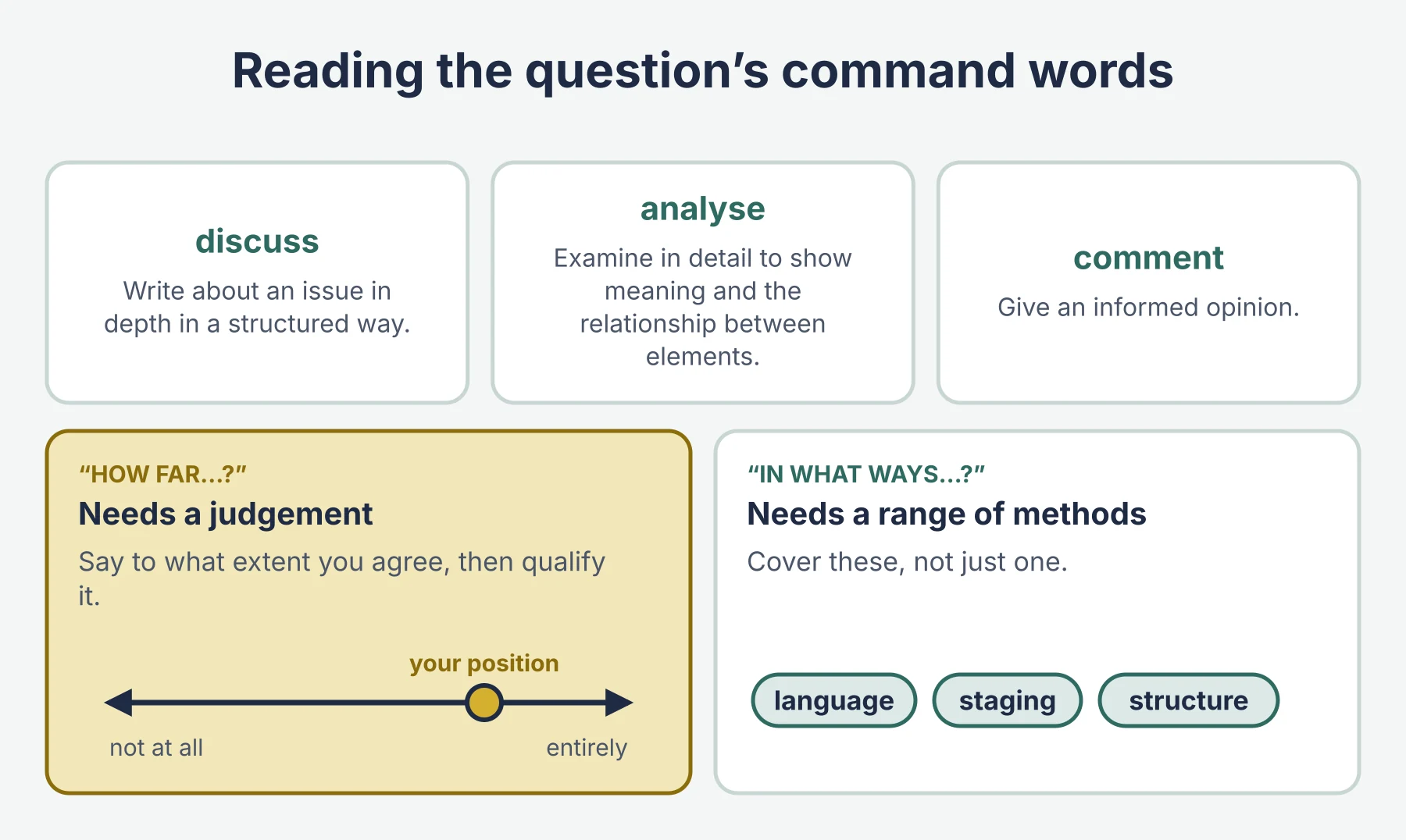
| Wording | What it wants |
|---|---|
| Discuss | An in-depth, structured exploration |
| Analyse | Detailed examination of how elements create meaning |
| Comment | An informed opinion, supported |
| In what ways…? | A range of methods: language, staging, structure |
| How far, and in what ways…? | Methods and a judgement on the extent |
Exam traps
- The novel trap: writing about characters’ inner lives with no reference to performance.
- The real-person trap: speculating about what a character did off stage or “would have” felt.
- The narrated passage: retelling the (b) passage line by line.
- The sealed passage: never leaving the printed extract, which limits knowledge of the whole play.
- The context lecture: a paragraph on the period that never explains a dramatic choice.
- The technique list: naming dramatic irony, a soliloquy or a pause without saying what it does to an audience at that point.
- Ignoring the ending: an (a) essay that never reaches the final act misses how the play resolves (or refuses to resolve) its focus.
Making context work in a drama answer
Strong context for drama is usually theatrical: genre conventions, the stage the play was written for, and how a modern audience might respond differently. One sentence that connects a convention to a choice (“Bosola begins as the malcontent hired by more powerful men, a familiar figure in Jacobean tragedy, so his late turn against the brothers unsettles the audience’s expectations”) does more than a page of history.
Set plays
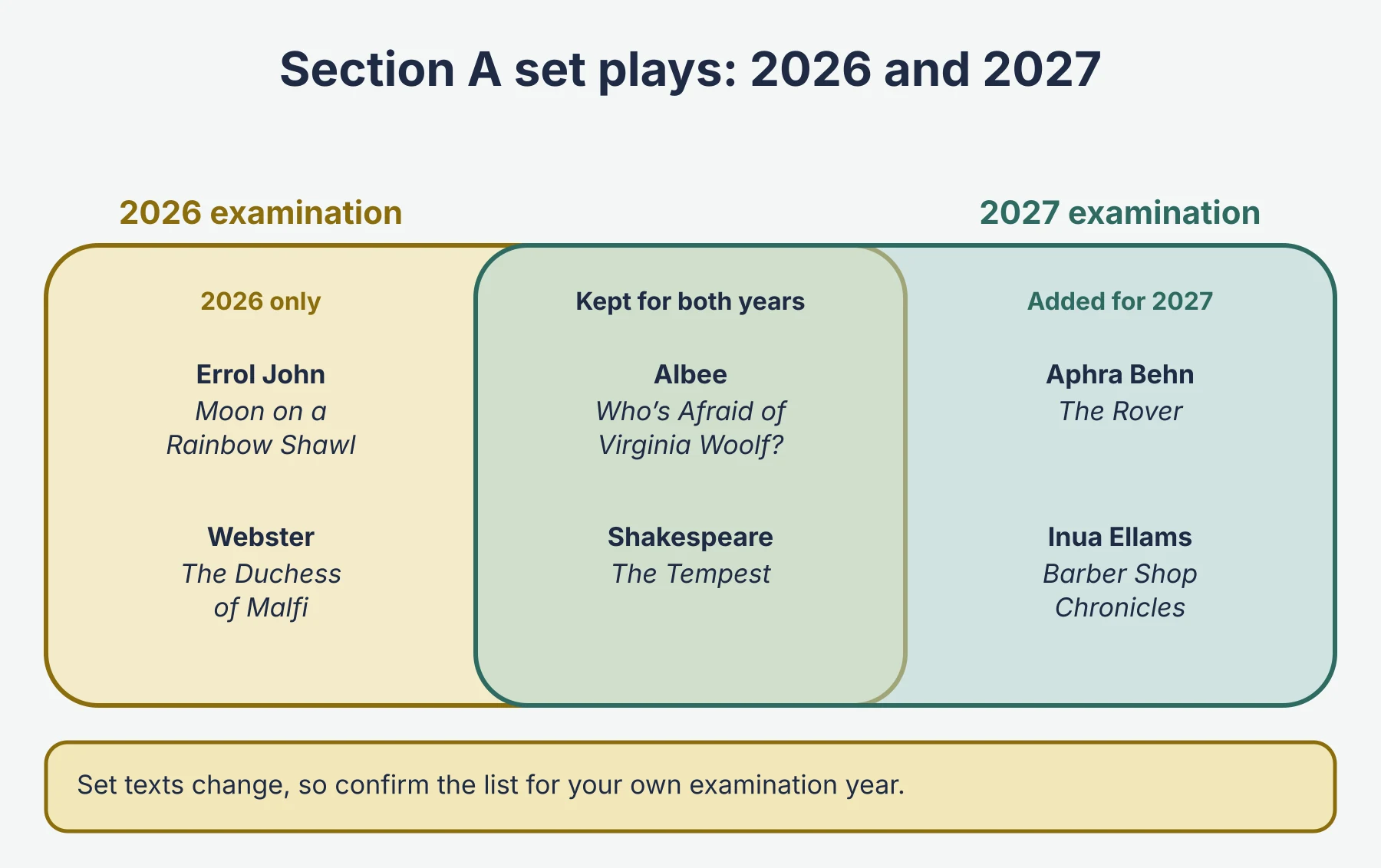
For 2026: Who’s Afraid of Virginia Woolf?, Moon on a Rainbow Shawl, The Tempest, The Duchess of Malfi. For 2027: Who’s Afraid of Virginia Woolf?, The Rover, Barber Shop Chronicles, The Tempest. Check the syllabus for your own examination year.
Self-test
- How many marks is Section A worth, and which assessment objectives does it test?
- What is printed on the paper for a (b) question?
- Why should you usually write “the audience” rather than “the reader”?
- Define dramatic irony and give its usual effect.
- What is an embedded stage direction?
- What is the difference between a soliloquy and an aside?
- What does stichomythia usually suggest about a relationship at that moment?
- Name two things to check about who is on stage in a passage.
- What should the first one or two sentences of a (b) answer do?
- What extra does “How far, and in what ways…?” require beyond “In what ways…?”
- Give one reason an (a) essay should include the play’s ending.
- What makes context relevant in a drama answer?
Answers: 1. 25 marks; AO1 to AO4. 2. A passage from the set play. 3. Plays are written for performance, so meaning is created through what an audience sees and hears. 4. The audience knows something a character does not; lines gain a second meaning, raising tension or comedy. 5. An instruction to the actor contained within the dialogue itself. 6. A soliloquy is spoken alone on stage; an aside is spoken with others present but heard only by the audience. 7. Conflict, rivalry or a battle of wit, through its rapid alternating rhythm. 8. Who is present but silent, and who enters or exits during the passage. 9. Place the passage in the play and state its dramatic function. 10. A judgement on the extent to which you agree, not just a range of methods. 11. Plays develop, and the ending shows how the focus is finally resolved or left open. 12. When it explains why the dramatist made a particular choice.
Related resources
-
Study guides
Cambridge A Level Literature in English (9695): Paper 1 Section B – Poetry
Close reading for Cambridge 9695 Paper 1 Section B Poetry: voice, form, metre and imagery, (a) essays across a selection and (b) answers on a printed poem.
English Literature · Cambridge · AS Level
Read guide -
Practice questions
Cambridge A Level Literature in English (9695): Paper 1 Section B – Poetry – Practice Questions
Original practice for Cambridge 9695 Paper 1 Section B Poetry: terms, metre and form, plus structured analysis of new poems, with mark-scheme style answers.
English Literature · Cambridge · AS Level
Try questions -
Revision notes
Cambridge A Level Literature in English (9695): Paper 1 Section B – Poetry – Revision Notes
Quick-recall notes for Cambridge 9695 Paper 1 Section B Poetry: metre, form and imagery terms, (a) and (b) answer shapes, traps and a 12-question self-test.
English Literature · Cambridge · AS Level
Revise topic
Get free revision emails (optional)
Occasional emails with practice questions, worked explanations and links to free resources for the qualification and subjects you choose. No spam, and you can unsubscribe from any email. The free tools on this site never need an email.