
Study Guides
Cambridge A Level Literature in English (9695): Paper 1 Section A – Drama
How to read a set play as theatre for Cambridge 9695 Paper 1 Section A, with methods for (a) essays and (b) passage questions and an annotated model paragraph.
- Subject
- English Literature
- Level
- AS LEVEL
- Topic
- Paper 1 – Drama and Poetry
- Author
- Marlbridge Academic Team
- Updated
- Reviewed by
- Ammar Bilal (what this means)
Aligned to Cambridge A Level English Literature (9695), 2024-2026. Official specification .
Syllabus page (what it covers and how it is assessed): Cambridge A Level English Literature.
Syllabus points this page covers
9695 (AS Level)
- 1.1 Section A: Drama
Found an error? Report a correction.
Need help with this topic? Request a free trial class for A Level English Literature (9695).
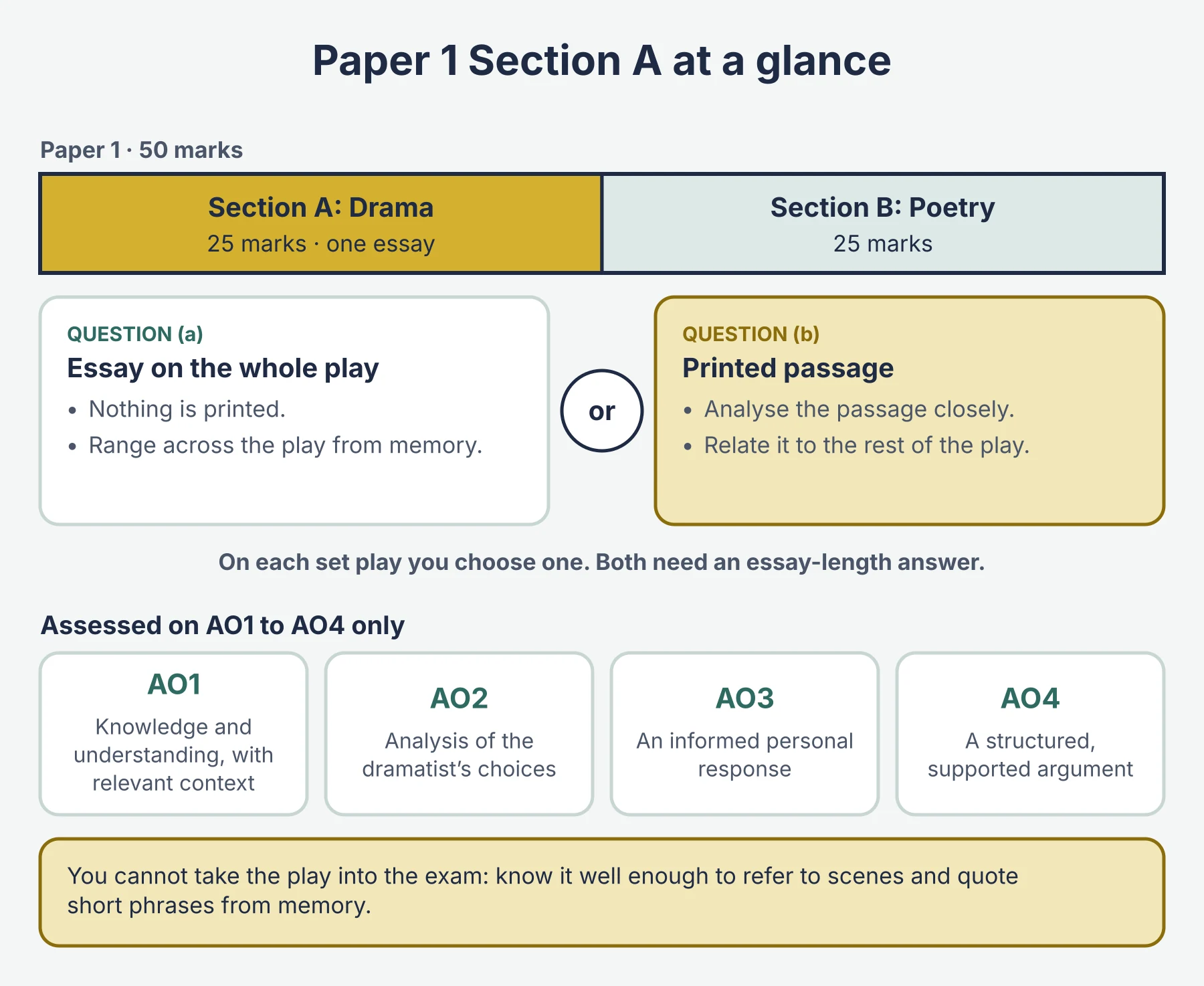
Section A of Paper 1 asks for one essay on a drama set text. It is worth 25 of the paper’s 50 marks, and it is assessed on AO1 to AO4 only: knowledge and understanding with relevant context, analysis of the dramatist’s choices, an informed personal response, and a structured, supported argument. This guide goes deeper than the Paper 1 overview on one question: what does it mean to write about a play as a play?
What the section asks of you
On each set play you choose between two questions. The (a) question is an essay on the play as a whole, with nothing printed. The (b) question prints a passage from the play and asks you to analyse it closely, while relating it to the rest of the text. Both need an essay-length answer, and you cannot take the play into the exam, so you must know it well enough to refer to scenes and quote short phrases from memory.
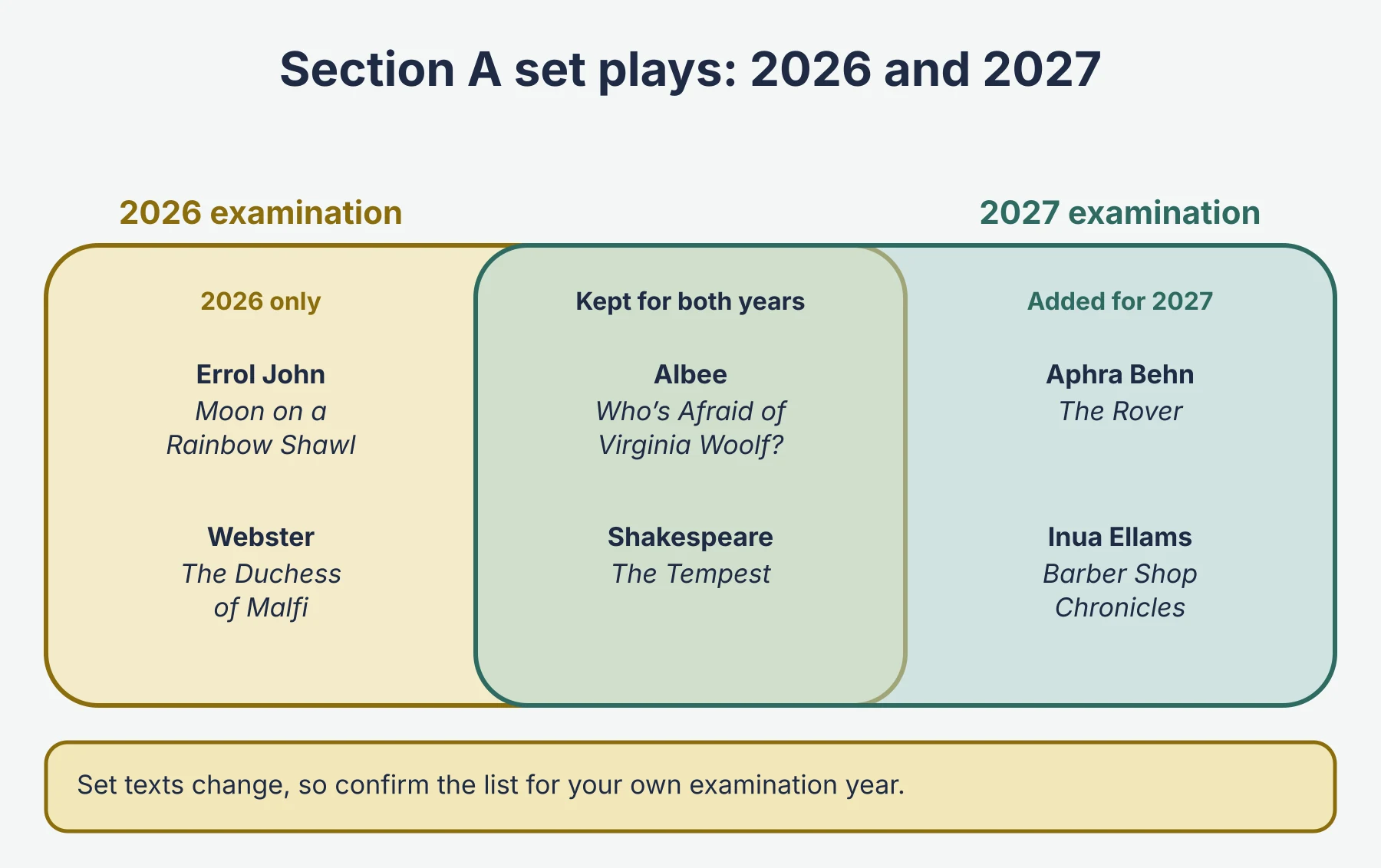
For the 2026 examination the Section A plays are Albee’s Who’s Afraid of Virginia Woolf?, Errol John’s Moon on a Rainbow Shawl, Shakespeare’s The Tempest and Webster’s The Duchess of Malfi. The 2027 list keeps the Albee and The Tempest and adds Aphra Behn’s The Rover and Inua Ellams’s Barber Shop Chronicles. Set texts change, so confirm the list for your own examination year.
The key idea: a script is a set of instructions for performance
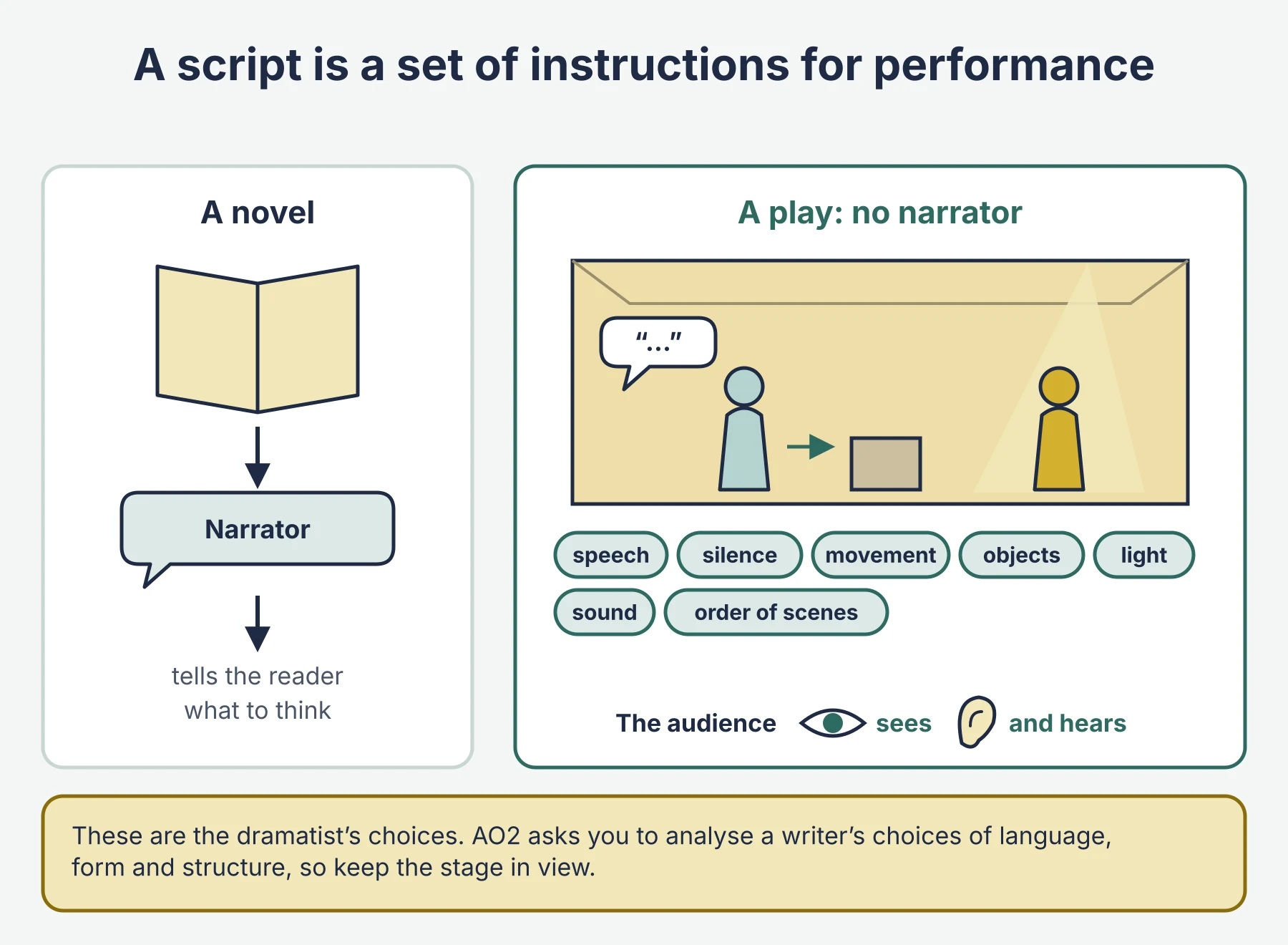
A novel tells you what to think through a narrator. A play has no narrator. Meaning reaches the audience through what they see and hear: speech, silence, movement, objects, light, sound, and the order in which scenes unfold. Examiners reward answers that keep this in view, because it is the dramatist’s distinctive set of choices, and AO2 asks you to analyse a writer’s choices of language, form and structure.
Dramatic language
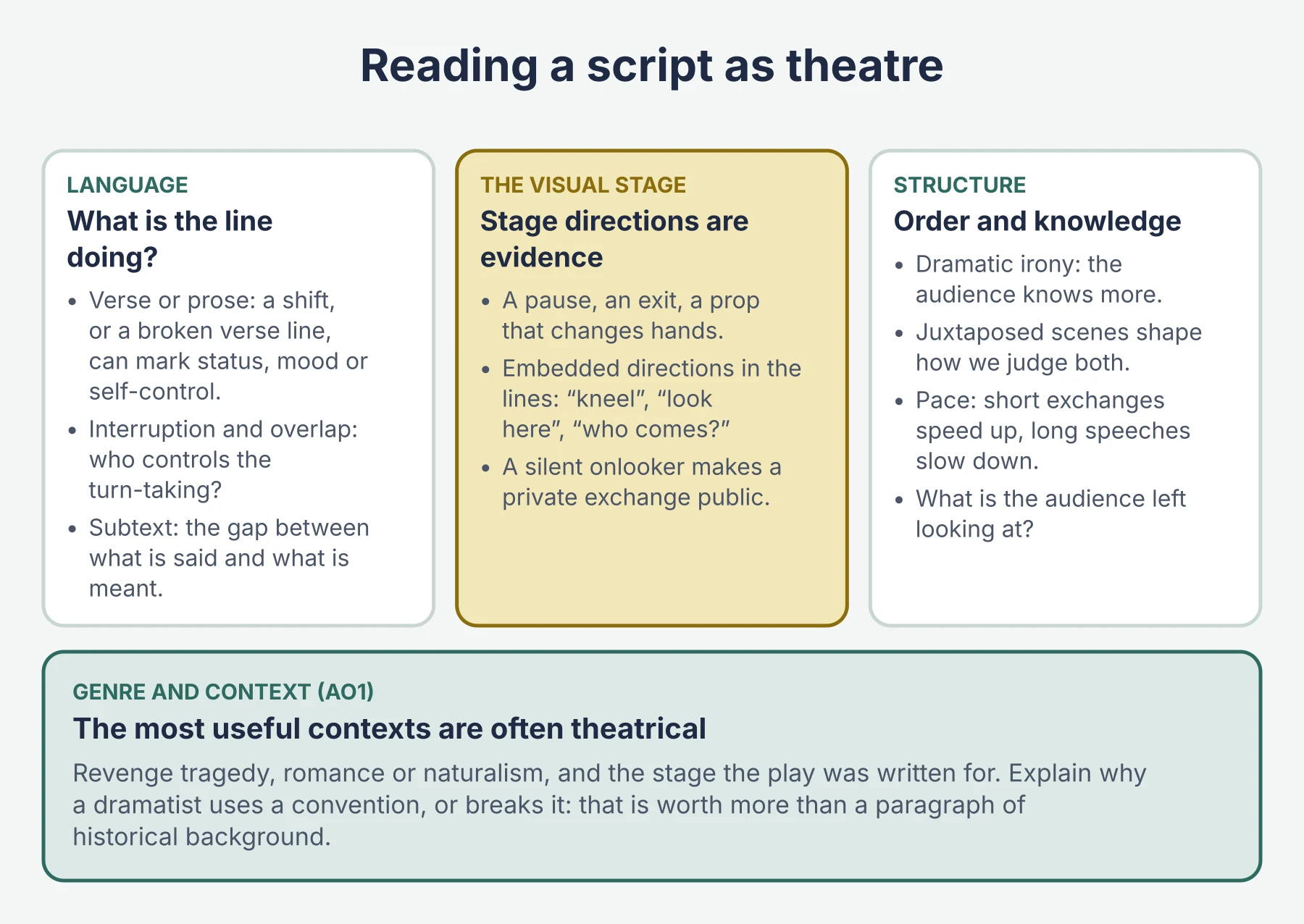
Dialogue in drama does two jobs at once: it reveals the speaker and it acts on the listener. Ask what a line is doing in the scene, not just what it says. A question might be a trap, a plea or a stalling tactic. Look at:
- Register and verse or prose. In early modern plays such as The Tempest or The Duchess of Malfi, a move from verse to prose, or a broken verse line, often marks a change in status, mood or self-control.
- Interruption and overlap. Who finishes whose lines? Who is cut off? Power in a scene often shows in who controls the turn-taking.
- Subtext. The gap between what is said and what is meant. Modern domestic drama, such as Albee’s, relies on characters attacking one another through jokes, games and apparently trivial talk.
Stage directions and the visual stage
Treat stage directions as evidence, quoted and analysed like dialogue. A pause, an exit, a character who remains on stage silently, or a prop that changes hands can carry as much meaning as a speech. Where a play has few directions, as most early modern plays do, look for embedded directions: lines that tell the actors what to do (“kneel”, “look here”, “who comes?”). Ask also who is on stage and does not speak. A silent onlooker turns a private exchange into a public one.
Dramatic structure
Structure in drama is the arrangement of scenes and the control of what the audience knows.
- Dramatic irony: the audience knows something a character does not, so every line the character speaks gains a second meaning.
- Juxtaposition of scenes: a comic scene placed straight after a violent one, or a public scene after a private one, shapes how we judge both.
- Pace and tension: short exchanges speed a scene up; long speeches slow it down; an interruption or entrance breaks a rhythm the audience has settled into.
- Openings and endings of scenes and acts: what is the audience left looking at when the lights go down?
Genre and context
AO1 asks for “an appreciation of relevant contexts”. For drama, the most useful contexts are often theatrical: the conventions of revenge tragedy, romance or naturalism, and the stage the play was written for. A comment that explains why a dramatist uses a convention, or breaks it, is worth more than a paragraph of historical background.
Writing the (b) passage answer
The passage is the evidence; your knowledge of the whole play is the frame.
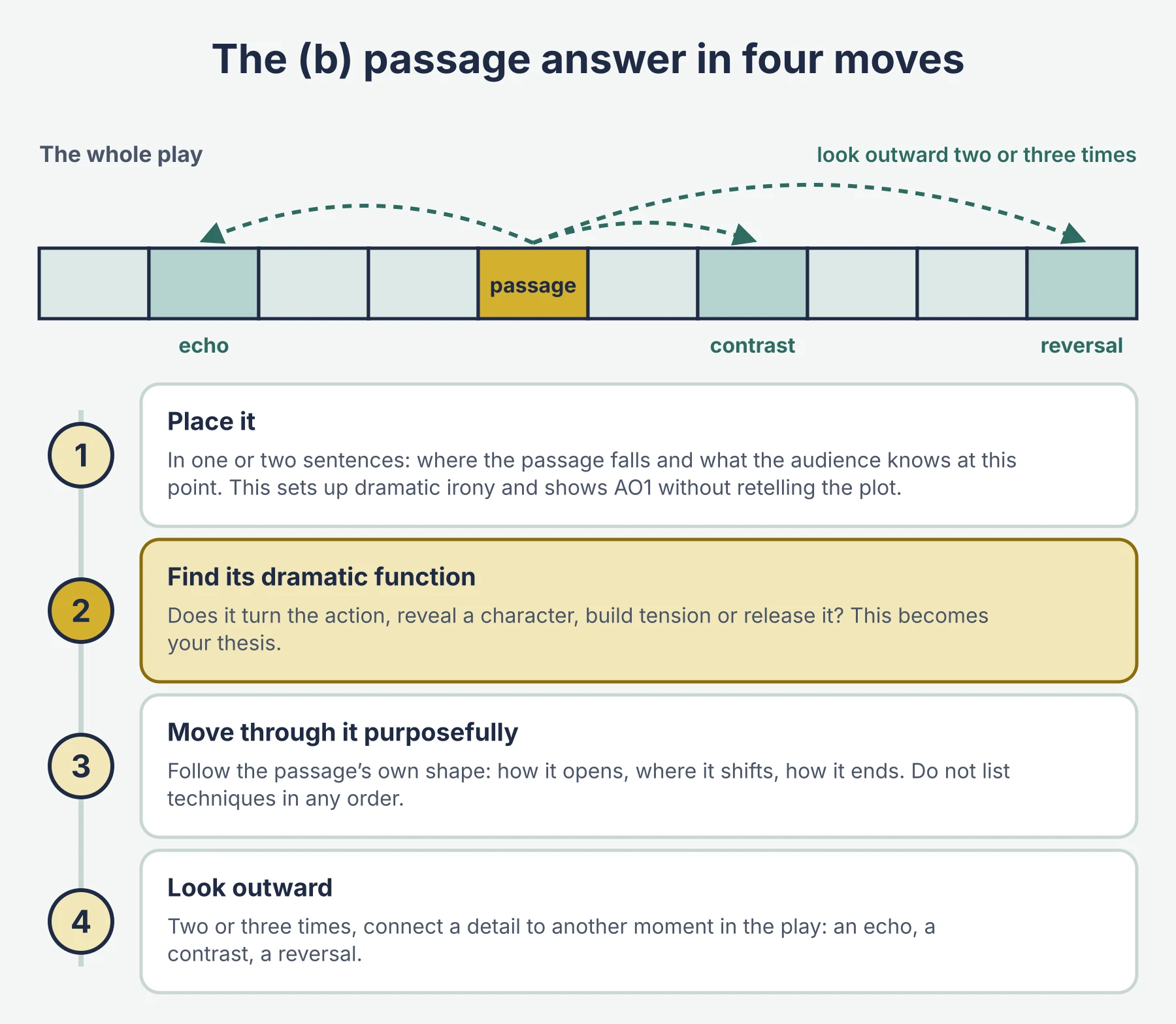
- Place it. In one or two sentences, say where the passage falls and what the audience knows at this point. This sets up dramatic irony and shows AO1 without retelling the plot.
- Find its dramatic function. Does it turn the action, reveal a character, build tension, or release it? This becomes your thesis.
- Move through it purposefully. Follow the passage’s own shape (how it opens, where it shifts, how it ends) rather than listing techniques in any order.
- Look outward. Two or three times, connect a detail to another moment in the play: an echo, a contrast, a reversal.
Annotated model paragraph
The extract below is original, written for this guide.
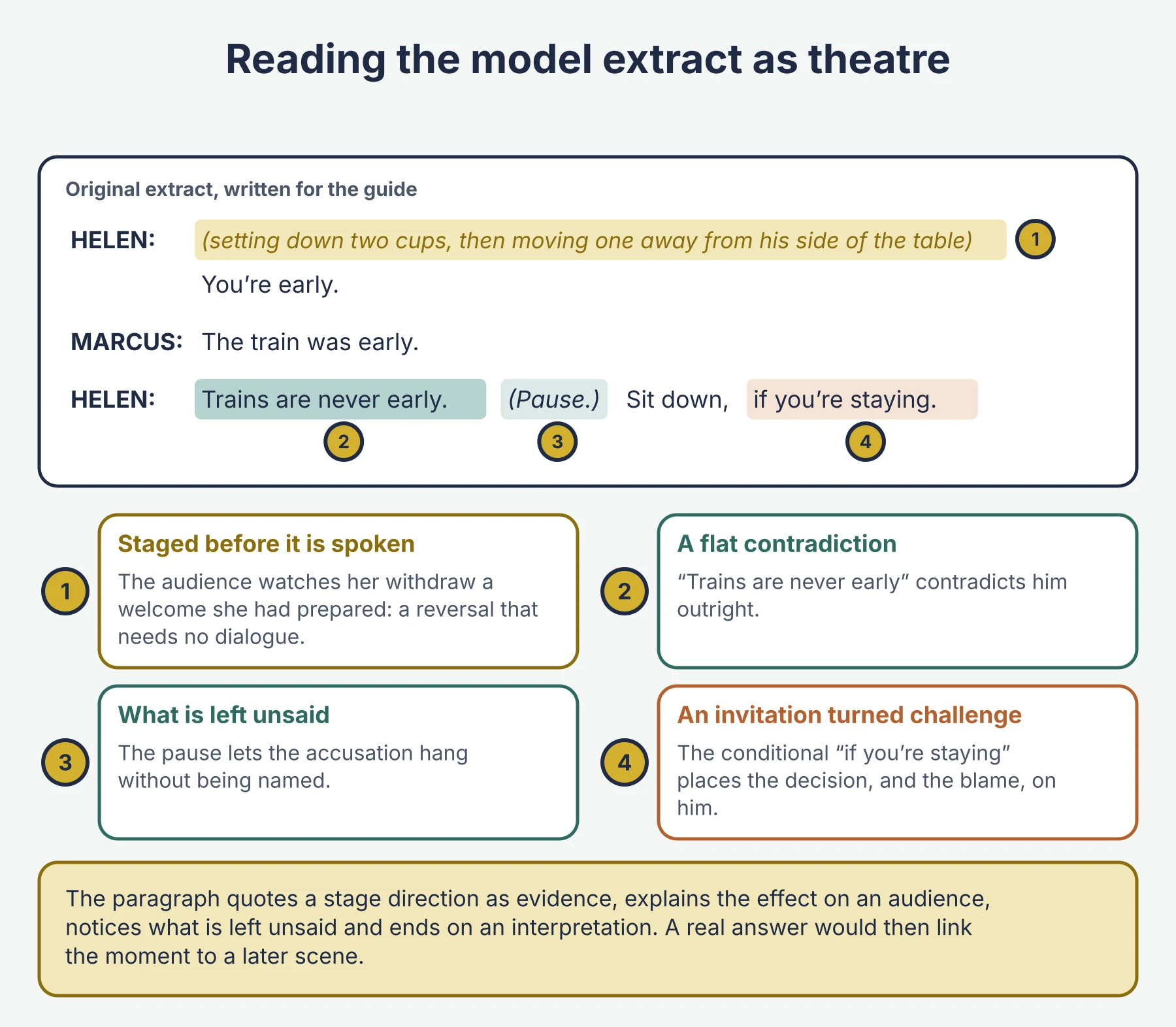
HELEN: (setting down two cups, then moving one away from his side of the table) You’re early.
MARCUS: The train was early.
HELEN: Trains are never early. (Pause.) Sit down, if you’re staying.
A strong paragraph might read:
The scene’s tension is staged before it is spoken. Helen sets down two cups and then moves one away from Marcus’s side, so the audience watches her withdraw a welcome she had prepared, a reversal that needs no dialogue. Her line “Trains are never early” flatly contradicts him, and the pause that follows lets the accusation hang without being named. Her conditional “if you’re staying” turns an ordinary invitation into a challenge, placing the decision, and the blame, on him.
The paragraph quotes a stage direction as evidence, explains the effect on an audience, notices what is left unsaid, and ends on an interpretation. In a real answer it would then link the moment to a later scene.
Writing the (a) essay
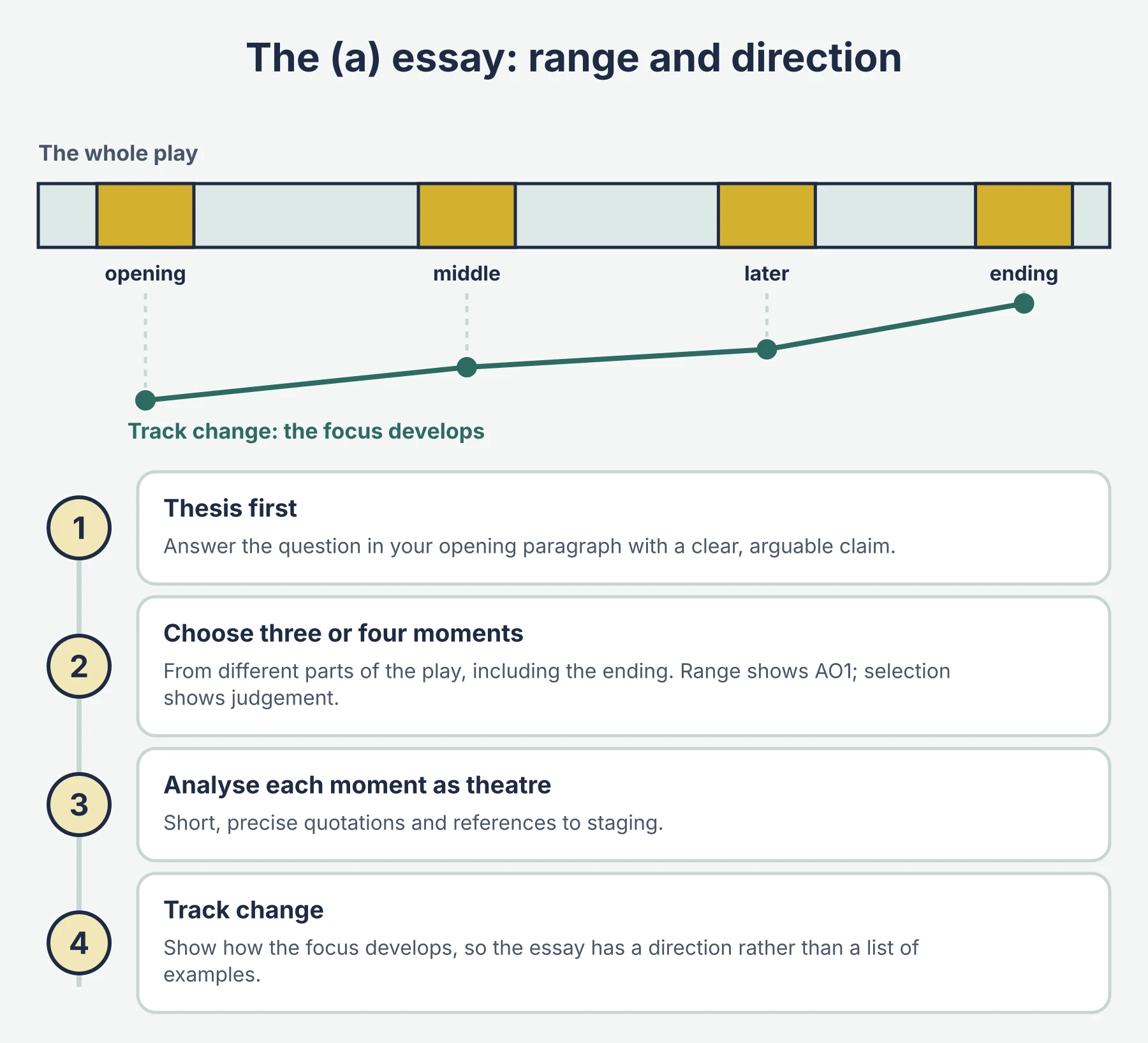
An (a) question names a focus (a character, a relationship, a theme or a dramatic method) and asks you to discuss it across the play. Build the answer like this:
- Thesis first. Answer the question in your opening paragraph with a clear, arguable claim.
- Choose three or four moments from different parts of the play, including the ending. Range shows AO1; selection shows judgement.
- Analyse each moment as theatre, with short, precise quotations and references to staging.
- Track change. Plays move. Show how the focus develops, so your essay has a direction rather than a list of examples.
Command words in Section A questions
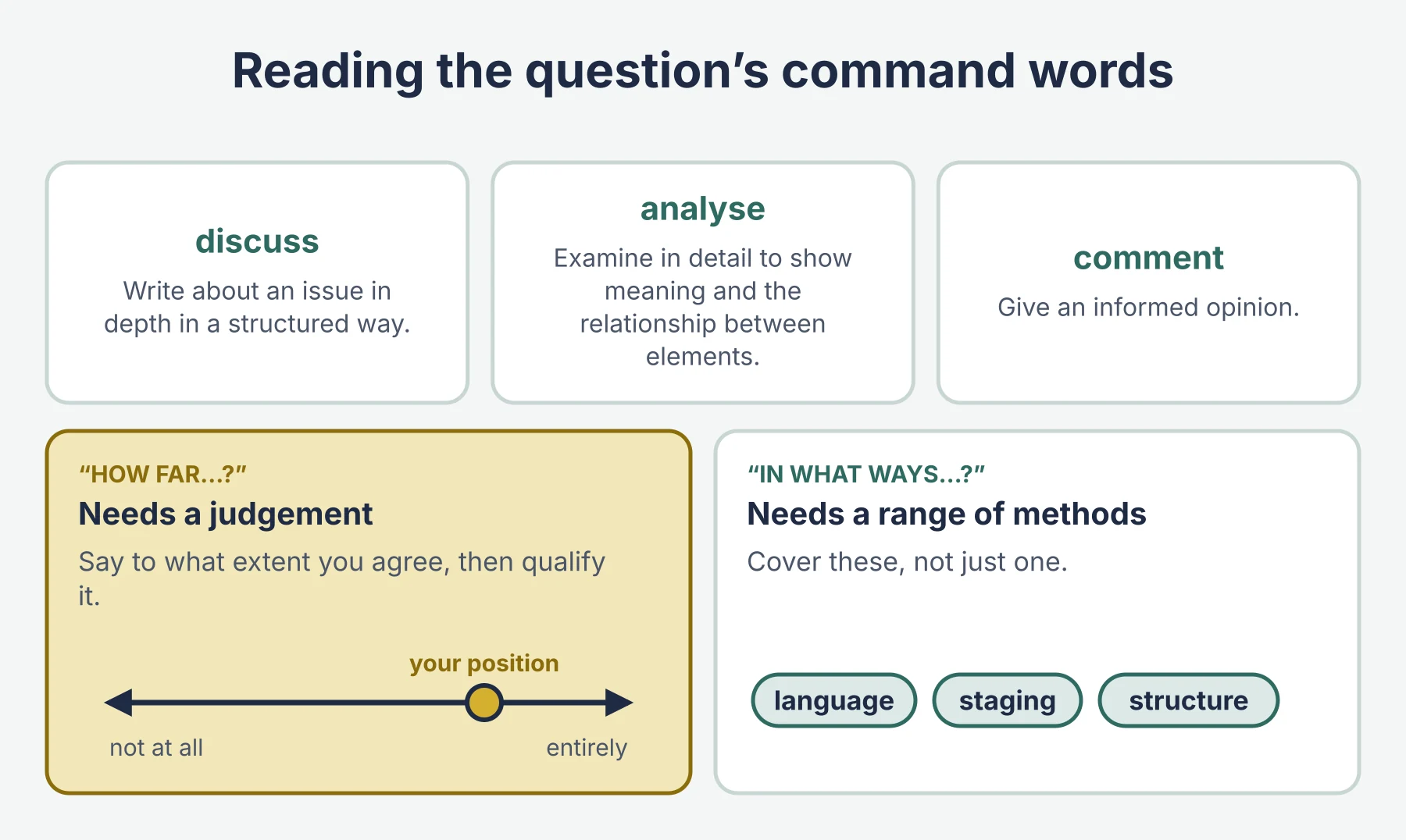
Cambridge’s command words for 9695 include discuss (write about an issue in depth in a structured way), analyse (examine in detail to show meaning and the relationship between elements) and comment (give an informed opinion). You will also meet phrases such as “In what ways…?” and “How far, and in what ways…?”. “How far” needs a judgement: say to what extent you agree, then qualify it. “In what ways” needs a range of methods, so cover language, staging and structure, not just one.
Common mistakes
- Reading the play as a novel. Calling the audience “the reader” throughout, and never mentioning what is seen on stage.
- Character as real person. Discussing what a character “would have felt” off stage, rather than how the dramatist presents them.
- Plot retelling. In the (b) answer, narrating what happens next in the passage instead of analysing how it happens.
- Stopping at the passage edge. A (b) answer that never mentions the rest of the play limits AO1.
- Context bolted on. A separate paragraph of history that is never tied to a dramatic choice.
Practise and revise this section
- Paper 1 Section A Drama revision notes — key dramatic terms, exam traps and a self-test.
- Paper 1 Section A Drama practice questions — original extracts with mark-scheme style answers.
- Paper 1 Section B Poetry study guide — the other half of the paper.
Written against the Cambridge International AS & A Level Literature in English 9695 syllabus for 2024, 2025 and 2026.
Related resources
-
Practice questions
Cambridge A Level Literature in English (9695): Paper 1 Section A – Drama – Practice Questions
Original practice for Cambridge 9695 Paper 1 Section A Drama: dramatic terms, staging analysis and structured work on new extracts, with full answers.
English Literature · Cambridge · AS Level
Try questions -
Revision notes
Cambridge A Level Literature in English (9695): Paper 1 Section A – Drama – Revision Notes
Quick-recall notes for Cambridge 9695 Paper 1 Section A Drama: dramatic terms, staging evidence, (a) and (b) answer shapes, exam traps and a self-test.
English Literature · Cambridge · AS Level
Revise topic -
Study guides
Cambridge A Level Literature in English (9695): Paper 1 Section B – Poetry
Close reading for Cambridge 9695 Paper 1 Section B Poetry: voice, form, metre and imagery, (a) essays across a selection and (b) answers on a printed poem.
English Literature · Cambridge · AS Level
Read guide
Get free revision emails (optional)
Occasional emails with practice questions, worked explanations and links to free resources for the qualification and subjects you choose. No spam, and you can unsubscribe from any email. The free tools on this site never need an email.