
Study Guides
Cambridge International AS & A Level Global Perspectives & Research (9239): Essay – Reflection and Further Research
How to meet the AO2 demands of the 9239 Essay: reflecting on how other perspectives changed your view, and suggesting specific further research.
- Subject
- Global Perspectives
- Level
- AS LEVEL
- Topic
- Component 2 – Essay
- Author
- Marlbridge Academic Team
- Updated
- Reviewed by
- Ammar Bilal (what this means)
Aligned to Cambridge A Level Global Perspectives (9239), 2026-2028. Official specification .
Syllabus page (what it covers and how it is assessed): Cambridge A Level Global Perspectives.
Syllabus topics and points this page is mapped to
9239 (AS Level)
- 2 Component 2 – Essay (topic-level mapping)
"Topic-level mapping" means this page belongs to that topic; it does not claim to cover every point in it.
This guide covers the two AO2 assessment points in Component 2, the Essay, of the Cambridge International AS & A Level Global Perspectives & Research (9239) syllabus for 2026-2028: “reflect on the impact of alternative perspectives on their viewpoint (AO2)” and “suggest further relevant research (AO2)”. The syllabus also says that candidates “should reach a personal, supported view on the question”. For the essay as a whole, read the Component 2 Essay study guide first.
Why reflection is a separate skill
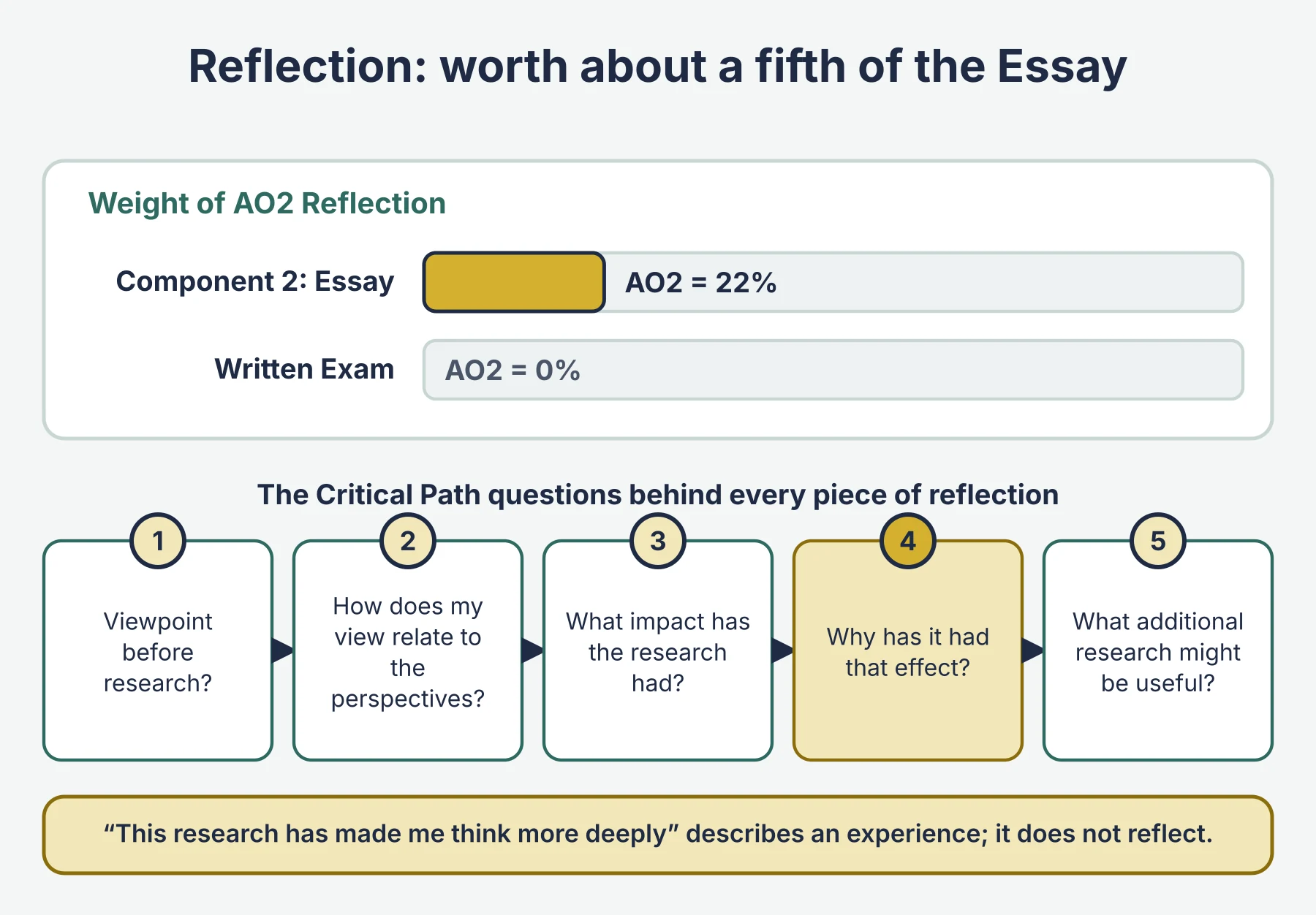
The syllabus weights AO2 Reflection at 22% of Component 2, against 0% in the Written Exam. So reflection is worth roughly a fifth of the essay, yet it is the part many candidates leave to a final sentence such as “This research has made me think more deeply.” That sentence describes an experience; it does not reflect.
The AO2 objectives describe what reflection involves at AS Level:
- “acknowledge different perspectives and evaluate their impact on the learner’s own standpoint”
- “consider the extent and limits of the learning and research that has been undertaken”.
The Critical Path breaks the first of these into a sequence of questions: “What was your personal viewpoint before carrying out research?”, “How does your own viewpoint relate to the perspectives identified in the research?”, “What impact has the research had on any views you had before?”, “Why has the research had an effect on your previous views?” and “What additional research might be useful?”
Those five questions give you a structure for every piece of reflection in the essay.
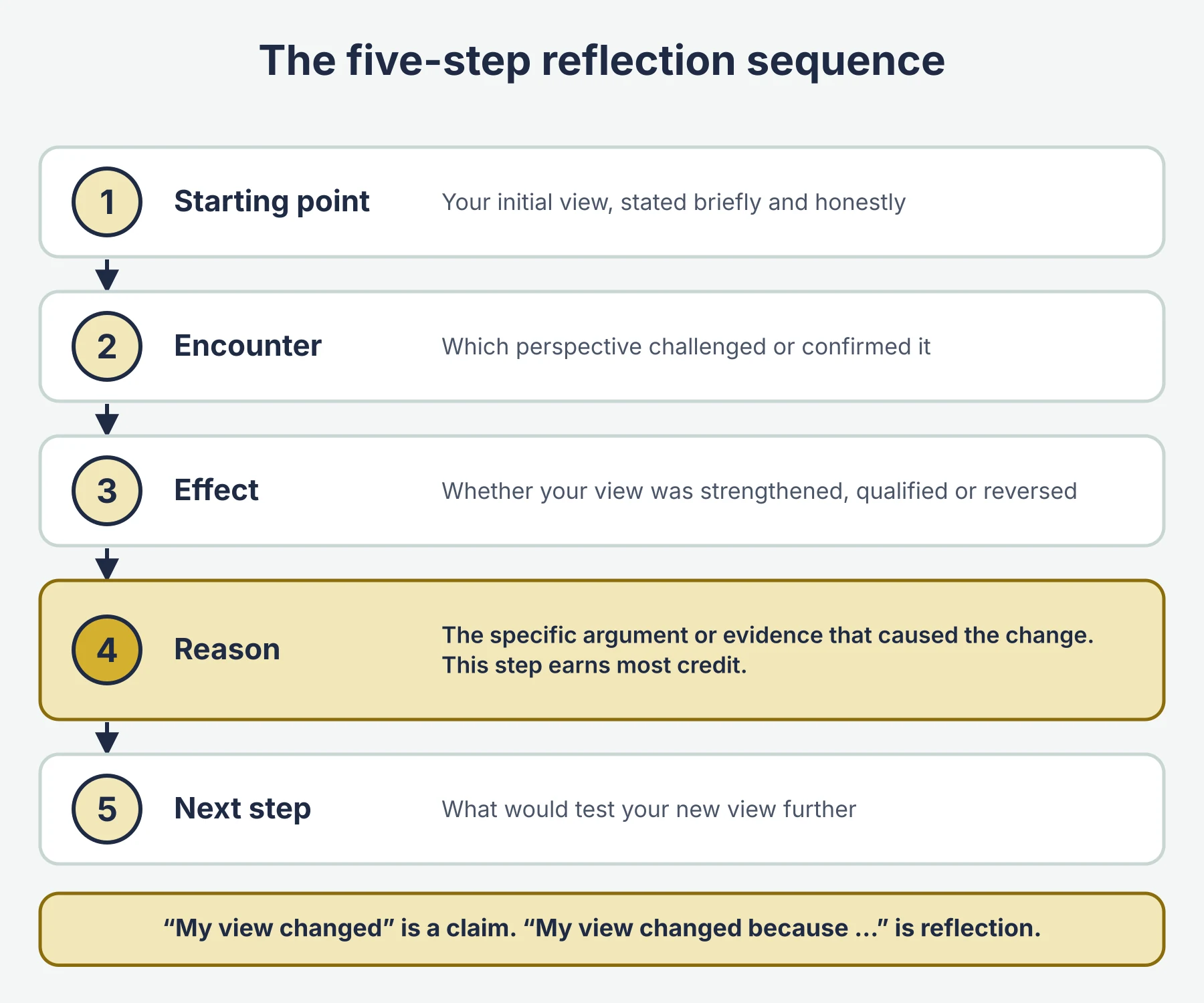
The reflection sequence
| Step | Critical Path question | What to write |
|---|---|---|
| 1 Starting point | Viewpoint before research | Your initial view, stated briefly and honestly |
| 2 Encounter | How your view relates to the perspectives | Which perspective challenged or confirmed it |
| 3 Effect | Impact on previous views | Whether your view was strengthened, qualified or reversed |
| 4 Reason | Why the research had that effect | The specific argument or evidence that caused the change |
| 5 Next step | Additional research | What would test your new view further |
The step that earns most credit is step 4. “My view changed” is a claim; “my view changed because the comparison of three countries showed that …” is reflection, because it shows the reasoning that moved you.
Three ways a view can move
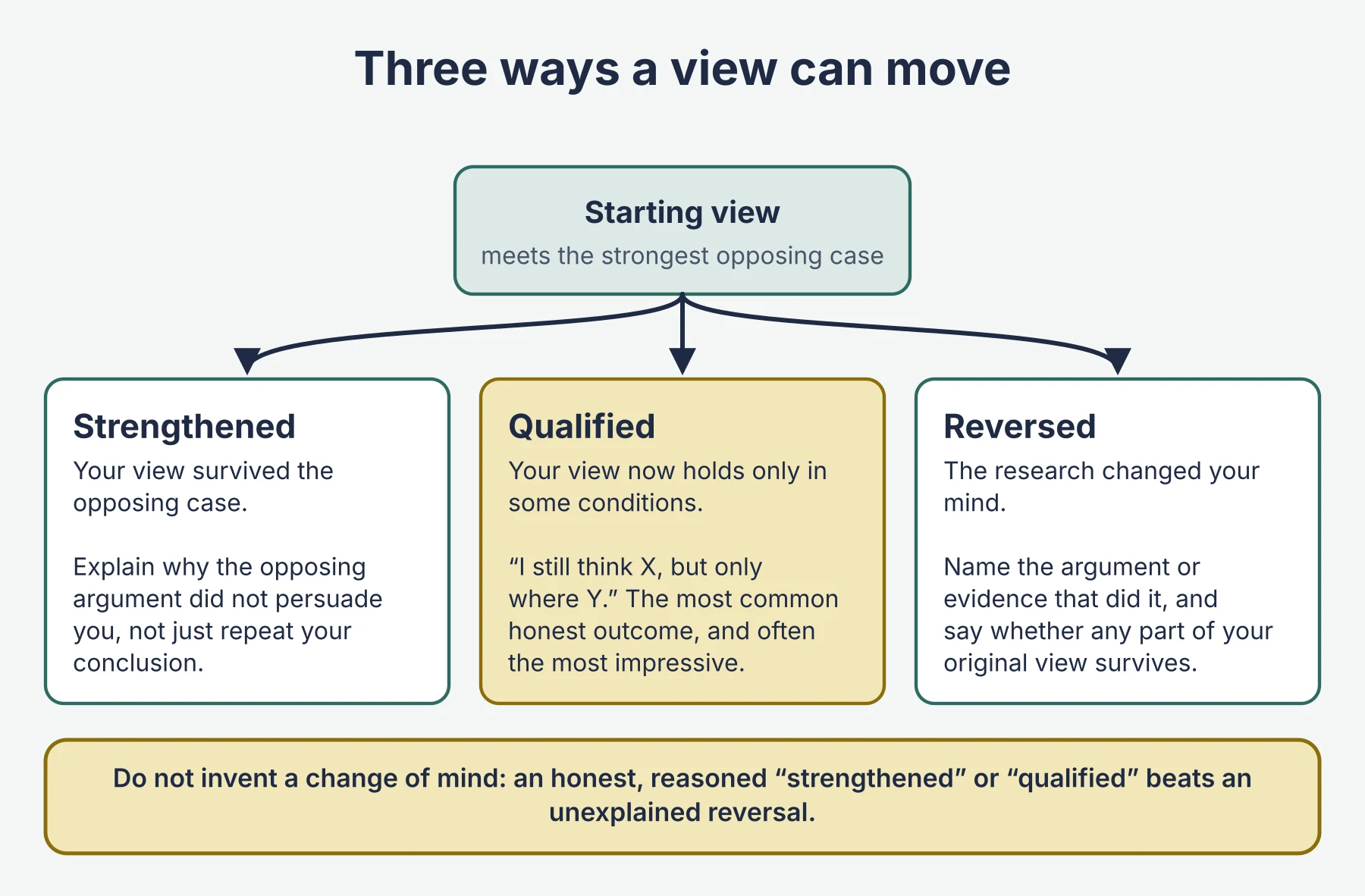
Reflection does not require a dramatic change of mind. The syllabus asks you to evaluate the impact of alternative perspectives, and the impact can take three forms:
- Strengthened. You met the strongest opposing case and your view survived it. Reflection explains why the opposing argument did not persuade you, which is more than repeating your conclusion.
- Qualified. Your view now holds only in some conditions. This is the most common honest outcome and often the most impressive, because it shows you have weighed the evidence: “I still think X, but only where Y.”
- Reversed. The research changed your mind. Explain which argument or evidence did it, and whether any part of your original view survives.
Do not invent a change of mind to look reflective. An honest account of a strengthened or qualified view, with reasons, is stronger than a reversal with no explanation.
Where reflection goes in the essay
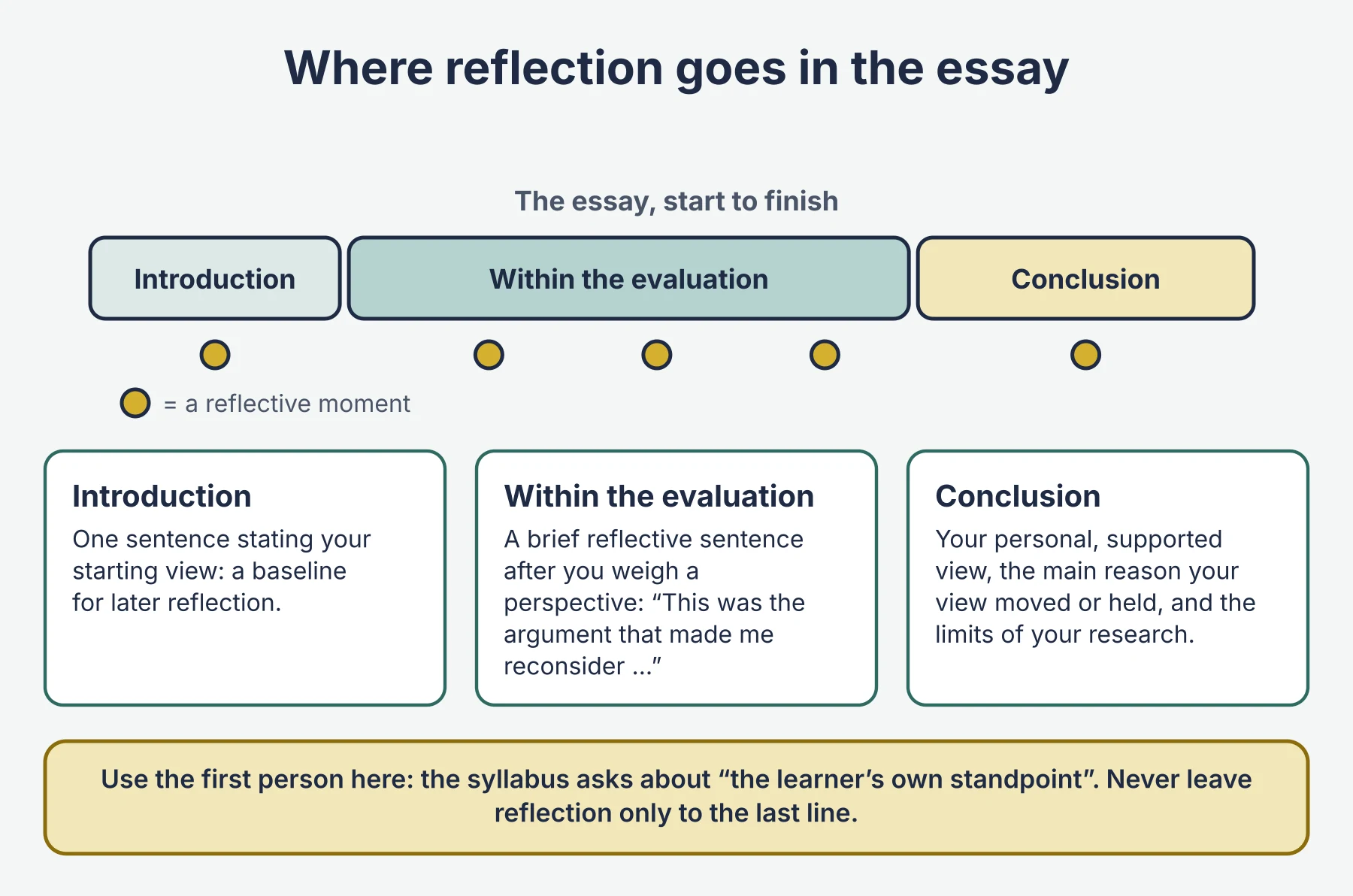
Reflection can be woven through the essay or concentrated near the end, but it should not appear only in the last sentence.
- Introduction: one sentence stating your starting view gives the reader a baseline for later reflection.
- Within the evaluation: a brief reflective sentence after you weigh a perspective can show its effect at the moment it happens: “This was the argument that made me reconsider …”
- Conclusion: your personal, supported view, with the main reason your view moved or held, and the limits of your research.
Reflection uses the first person. That is appropriate here: the syllabus asks about the impact on “the learner’s own standpoint”.
Reflecting on the limits of your research
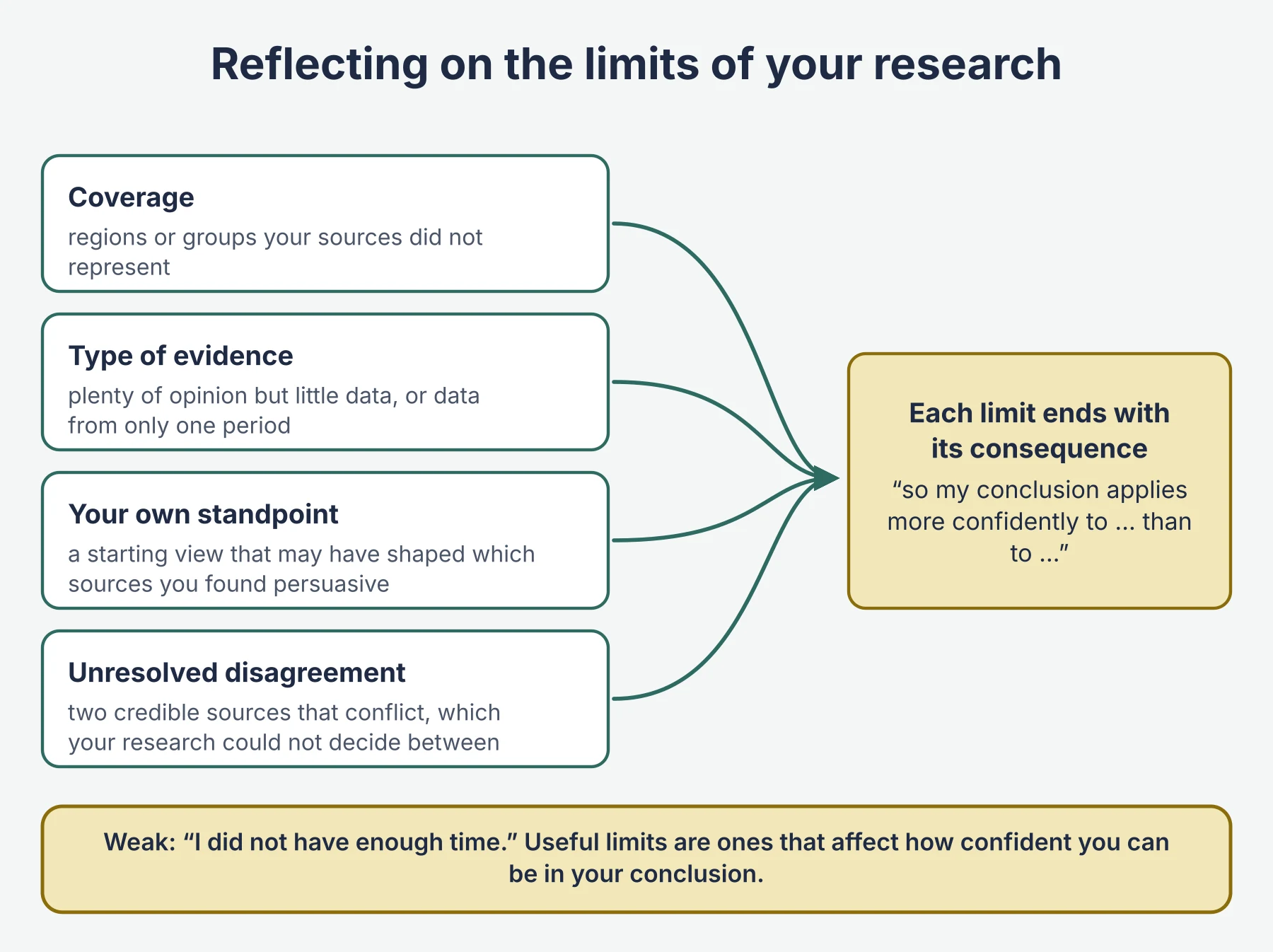
The second AO2 objective asks you to “consider the extent and limits of the learning and research that has been undertaken”. Useful limits to reflect on are ones that affect how confident you can be in your conclusion:
- Coverage: regions or groups your sources did not represent.
- Type of evidence: for example, plenty of opinion but little data, or data from only one period.
- Your own standpoint: a view you started with that may have shaped which sources you found persuasive.
- Disagreement you could not resolve: two credible sources that conflict and that your research could not decide between.
Each limit should end with its consequence: “so my conclusion applies more confidently to … than to …”
Suggesting further relevant research
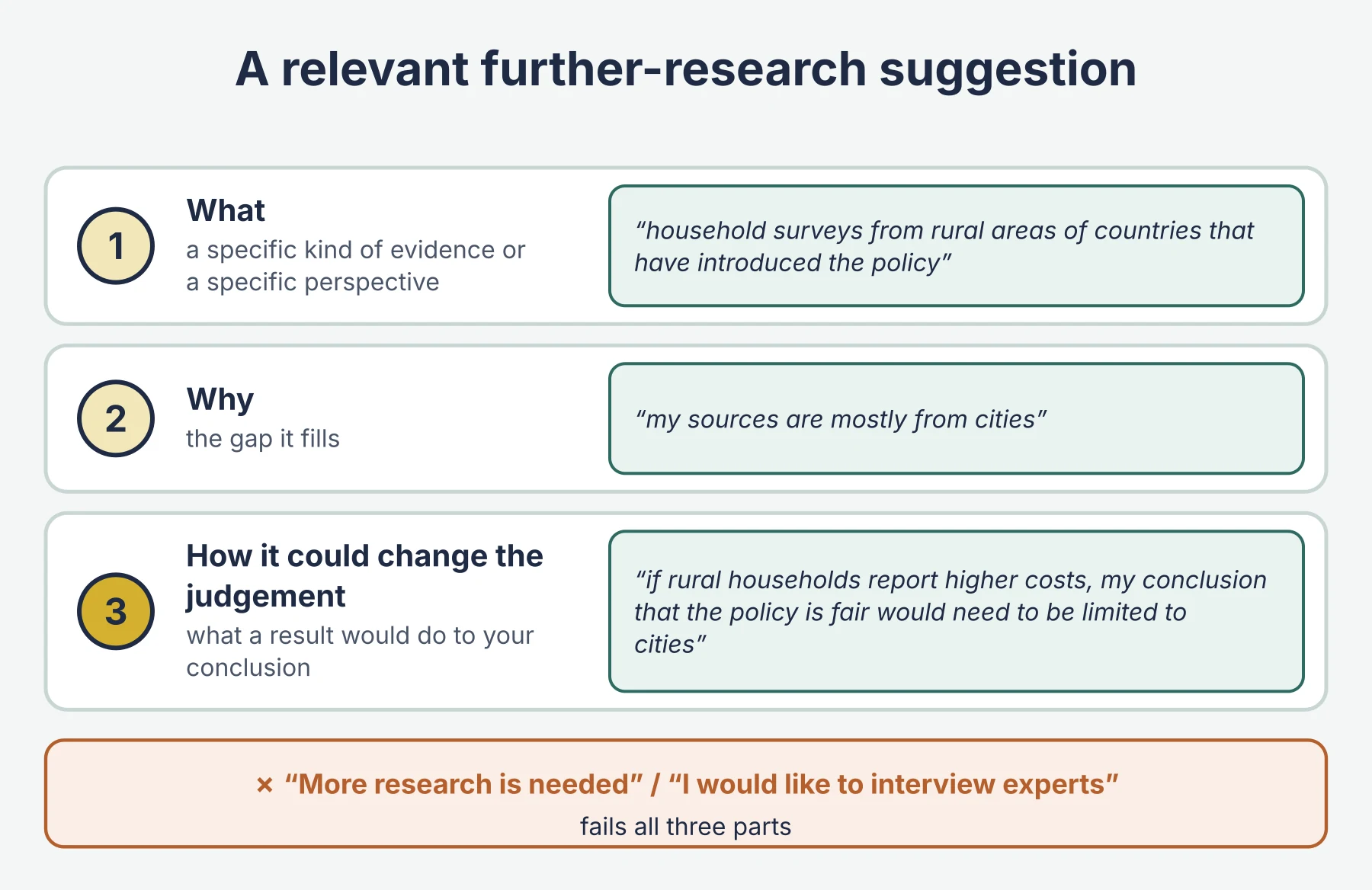
The word relevant matters. A suggestion is relevant when it would help answer your essay question more securely, usually by filling one of the limits you have just identified. A strong suggestion has three parts:
- What: a specific kind of evidence or a specific perspective, for example “household surveys from rural areas of countries that have introduced the policy”.
- Why: the gap it fills: “my sources are mostly from cities”.
- How it could change the judgement: “if rural households report higher costs, my conclusion that the policy is fair would need to be limited to cities”.
“More research is needed” or “I would like to interview experts” fails all three parts.
Worked example
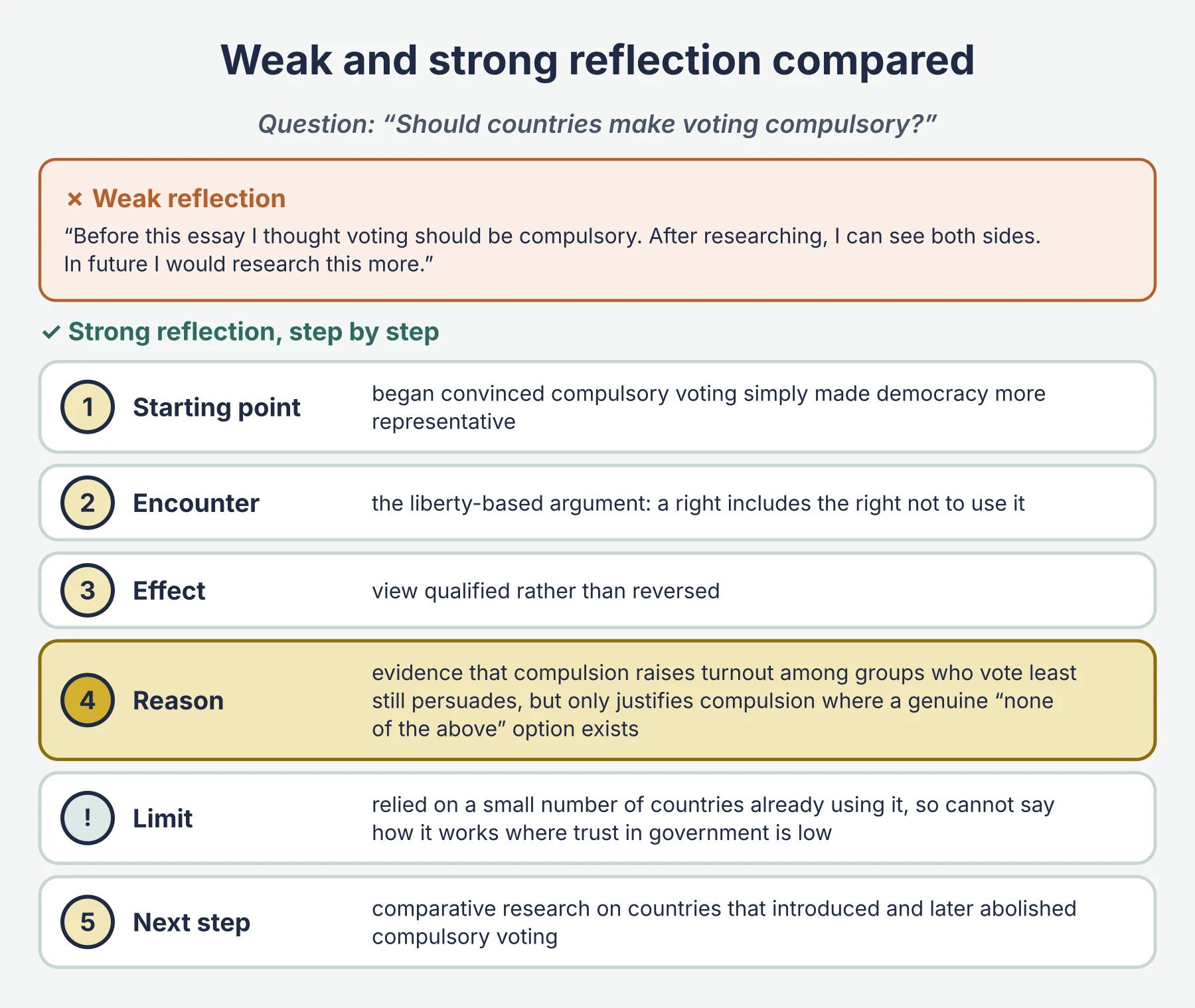
Essay question: “Should countries make voting compulsory?”
Weak reflection. “Before this essay I thought voting should be compulsory. After researching, I can see both sides. In future I would research this more.”
Strong reflection. “I began this essay convinced that compulsory voting was simply a way of making democracy more representative. The perspective that most challenged me was the liberty-based argument that a right includes the right not to use it; I had assumed that the only cost of compulsion was a small fine, and this argument showed me that the deeper question is what the state may demand of citizens. My view has therefore been qualified rather than reversed: the evidence that compulsion raises turnout among groups who usually vote least still persuades me that it improves representation, but I now think this only justifies compulsion where a genuine ‘none of the above’ option exists. My research relied mainly on studies of a small number of countries that already use compulsory voting, so I cannot say how it would work where trust in government is low. Comparative research on countries that introduced and later abolished compulsory voting would test whether the benefits I found last, and would show whether my conditional support is justified.”
The strong version includes all five steps of the sequence, names the argument that moved the writer, states the kind of movement (qualified), gives a limit with its consequence, and makes a specific, relevant suggestion for further research.
Common mistakes
- Reflection only in the last line, so it cannot show the effect of perspectives as they were evaluated.
- Describing feelings instead of reasoning: “I found this topic fascinating.”
- No starting point, so the reader cannot see what changed.
- Claiming a change without the cause: “My view has changed” with no argument or evidence named.
- Generic limits: “I did not have enough time” instead of a limit that affects the conclusion.
- Irrelevant further research: suggestions that would not help answer the question.
- Summary posing as reflection: restating both perspectives and calling it a personal view.
Condense this with the essay reflection revision notes and practise it with the essay reflection practice questions. The companion unit on selecting, assessing and justifying sources covers the AO1 points that reflection builds on.
Frequently asked questions
Can I use “I” in a 9239 essay? In the reflective parts, yes. The AO2 objective concerns the impact of perspectives on “the learner’s own standpoint”, which is naturally written in the first person.
Do I have to change my mind to reflect well? No. The syllabus asks you to evaluate the impact of alternative perspectives. A view that was strengthened or qualified, with reasons, is valid reflection.
How much of the essay should be reflection? The syllabus does not set a length. AO2 is weighted at 22% of the component, so it deserves more than a closing sentence; integrate it where perspectives are weighed and develop it in the conclusion.
Related resources
-
Practice questions
Cambridge International AS & A Level Global Perspectives & Research (9239): Essay – Reflection and Further Research – Practice Questions
Original practice on AO2 in the 9239 Essay: diagnosing weak reflection, classifying changes of view, stating limits and writing relevant further research.
Global Perspectives · Cambridge · AS Level
Try questions -
Revision notes
Cambridge International AS & A Level Global Perspectives & Research (9239): Essay – Reflection and Further Research – Revision Notes
Recall notes on AO2 in the 9239 Essay: the five-step reflection sequence, ways a view can move, limits of research and relevant further research.
Global Perspectives · Cambridge · AS Level
Revise topic -
Study guides
Cambridge International AS & A Level Global Perspectives & Research (9239): Essay – Selecting, Assessing and Justifying Sources
How to build a range of sources for the 9239 Essay and assess and justify them inside your argument, with source-audit methods and model paragraphs.
Global Perspectives · Cambridge · AS Level
Read guide
Studying Global Perspectives?
This page is free and stays free. Marlbridge is not offering Global Perspectives classes at the moment, so there is no tuition to book for it. The free study resources stay open to everyone.
Get free revision emails (optional)
Occasional emails with practice questions, worked explanations and links to free resources for the qualification and subjects you choose. No spam, and you can unsubscribe from any email. The free tools on this site never need an email.