
Revision Notes
Cambridge International AS & A Level Global Perspectives & Research (9239): Essay – Selecting, Assessing and Justifying Sources – Revision Notes
Recall notes on sources in the 9239 Essay: range, assessing versus justifying, the source audit, in-text evaluation techniques, traps and a self-test.
- Subject
- Global Perspectives
- Level
- AS LEVEL
- Topic
- Component 2 – Essay
- Author
- Marlbridge Academic Team
- Updated
- Reviewed by
- Ammar Bilal (what this means)
Aligned to Cambridge A Level Global Perspectives (9239), 2026-2028. Official specification .
Syllabus page (what it covers and how it is assessed): Cambridge A Level Global Perspectives.
Syllabus topics and points this page is mapped to
9239 (AS Level)
- 2 Component 2 – Essay (topic-level mapping)
"Topic-level mapping" means this page belongs to that topic; it does not claim to cover every point in it.
These notes cover two AO1 assessment points in Component 2, the Essay, of Cambridge International AS & A Level Global Perspectives & Research (9239), 2026-2028: “select and refer to a range of sources” and “assess and justify the appropriateness of the sources selected”. For the essay as a whole, see the Component 2 Essay study guide; for full explanations and model paragraphs, read the essay sources study guide.
What the syllabus says
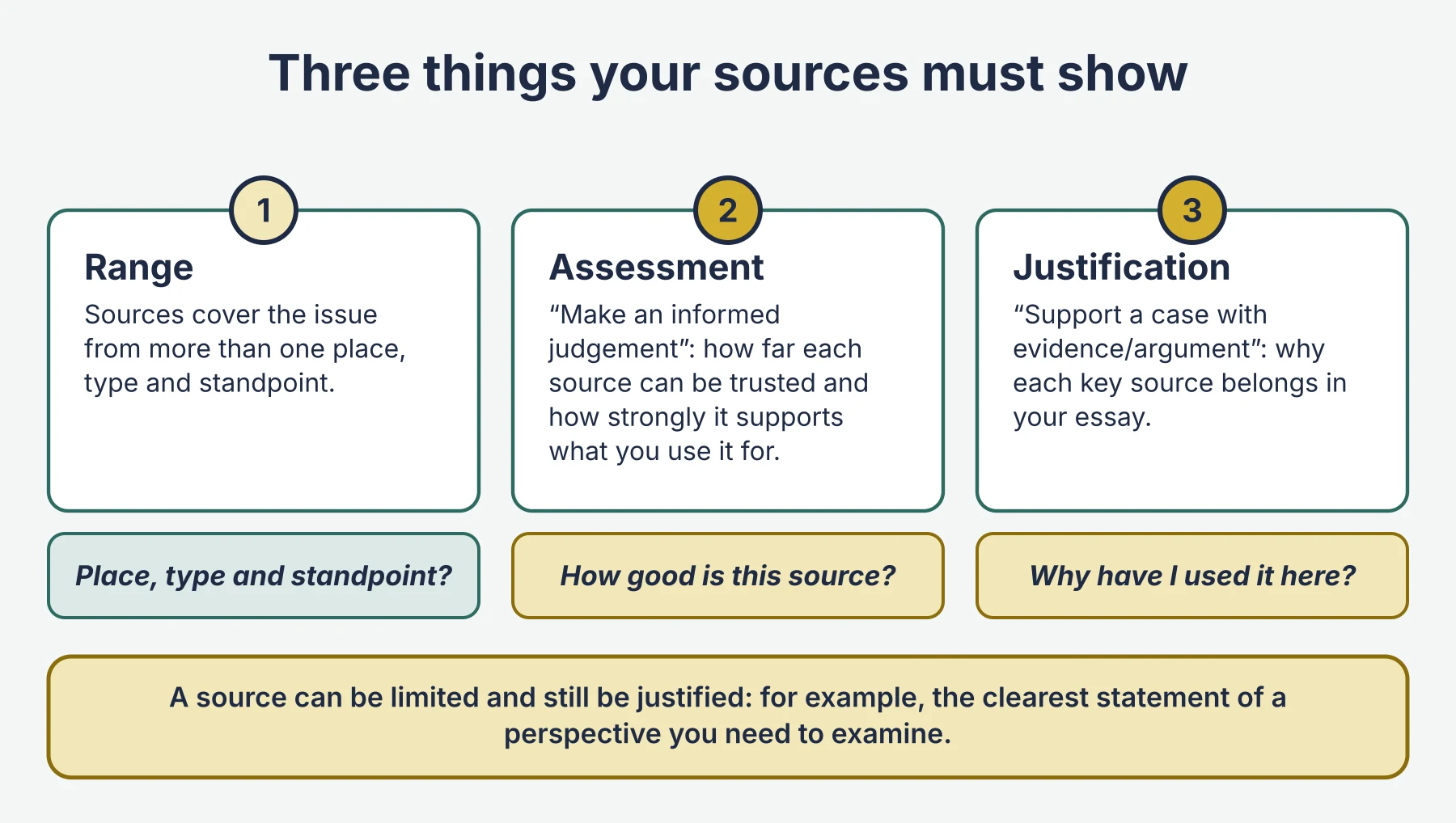
- Assessed on the ability to “select and refer to a range of sources (AO1)” and “assess and justify the appropriateness of the sources selected (AO1)”.
- “Sources selected should offer firmly supported judgements or conclusions.”
- “Evaluation of sources and perspectives should form a substantial element of candidates’ essays.”
- “Quotations must be fully referenced”; the essay must “include a list of sources used”.
- Word count “excludes the title, references and citations”.
- AO1 is 63% of the Component 2 weighting.
Key terms
| Term | Meaning |
|---|---|
| Range | Sources spread across regions, types and standpoints |
| Assess | Syllabus: “make an informed judgement” (here, about a source’s quality and support) |
| Justify | Syllabus: “support a case with evidence/argument” (here, why the source is used) |
| Appropriateness | How far a source suits its purpose in your essay: relevant, credible, well supported |
| Provenance | Syllabus: a source’s “author and where or when it was written” |
| Credibility | How far a source can be believed, given its expertise, method and interests |
| Relevance | How directly a source addresses your question |
| Vested interest | What the producer could gain from a particular conclusion |
| Corroboration | Independent agreement between sources |
| Evaluative clause | A short phrase beside a citation that says why the evidence deserves weight |
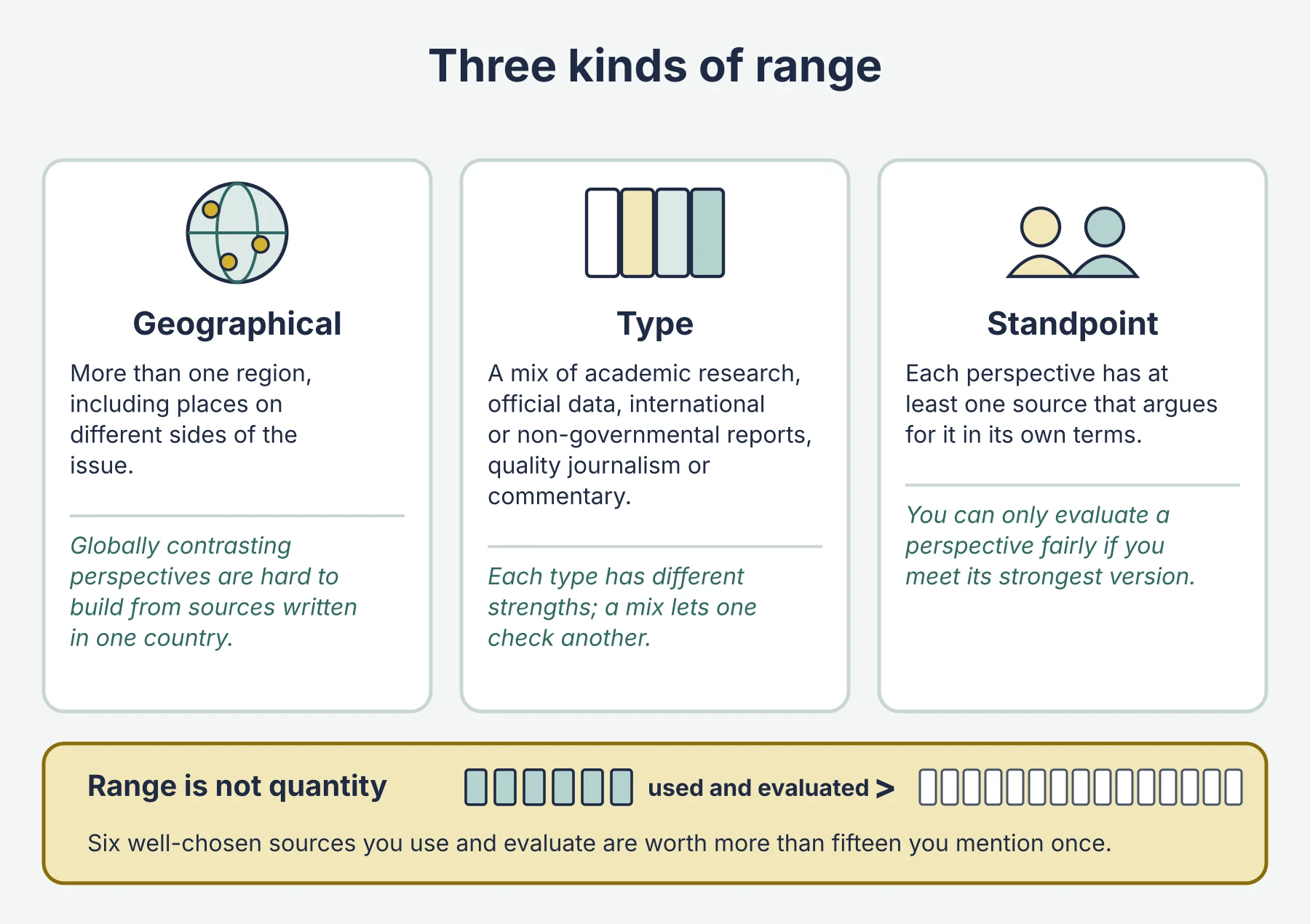
Three kinds of range
- Geographical: more than one region, including those on different sides of the issue.
- Type: academic research, official data, international or non-governmental reports, quality journalism.
- Standpoint: each perspective represented by a source that argues for it in its own terms.
Range is not quantity: fewer sources, used and evaluated, beat a long list mentioned once.
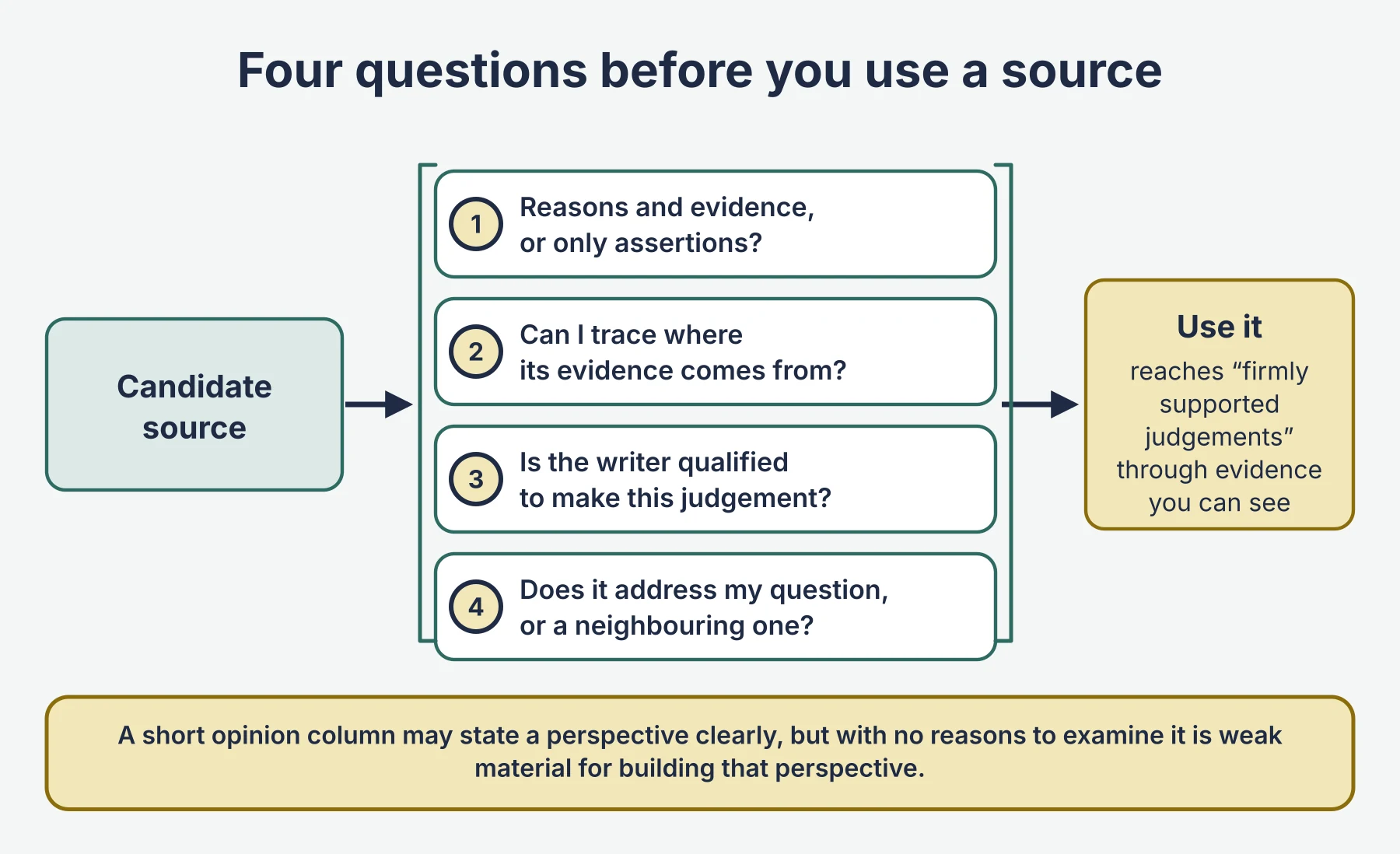
The “firmly supported” selection test
Prefer sources that:
- give reasons and evidence, not only assertions;
- show where their evidence comes from;
- are written by people qualified to judge;
- address your exact question, not a neighbouring one.
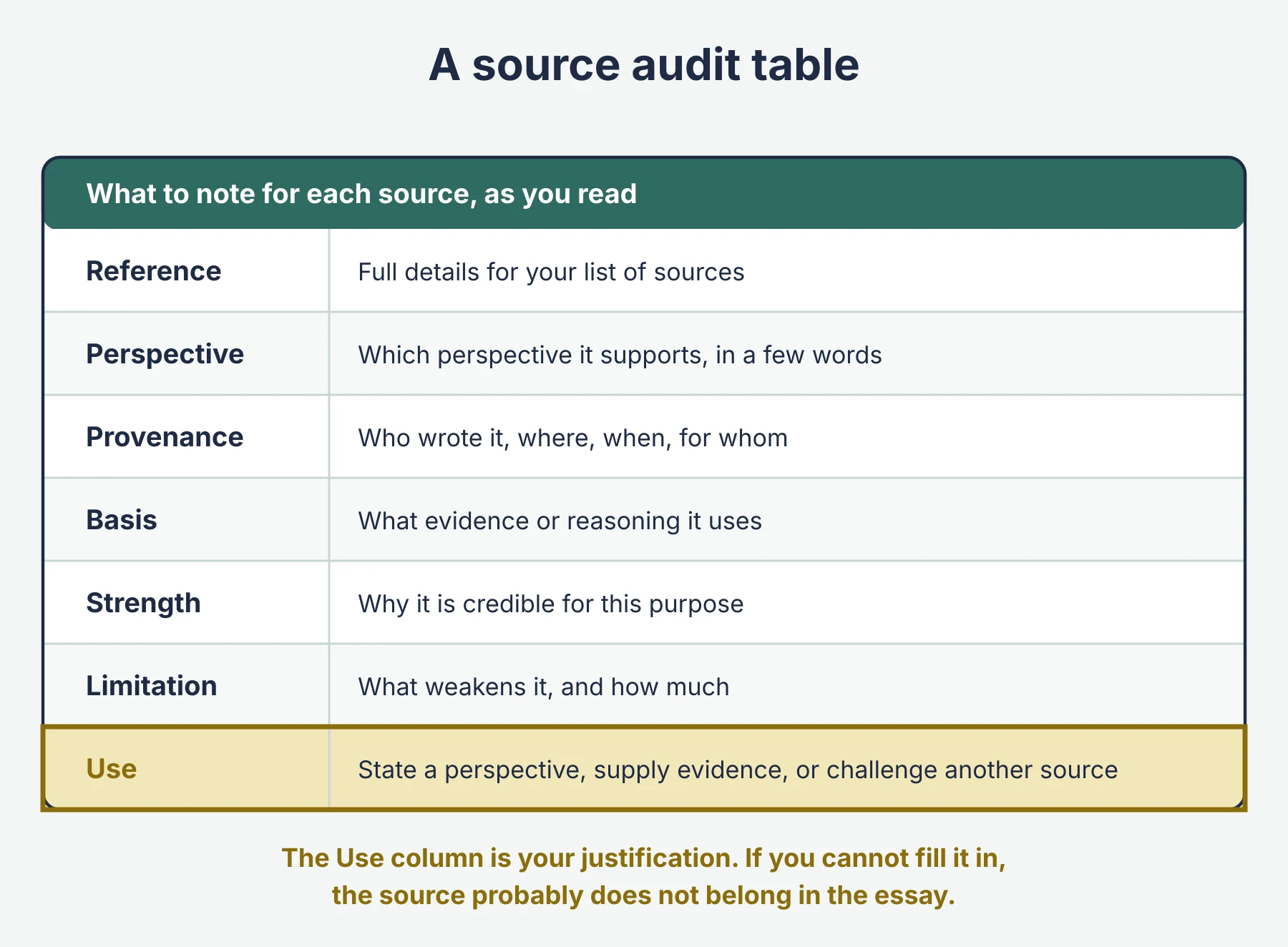
Source audit columns
Reference | Perspective | Provenance | Basis | Strength | Limitation | Use in essay.
The Use column is your justification. A source with an empty Use column does not belong.
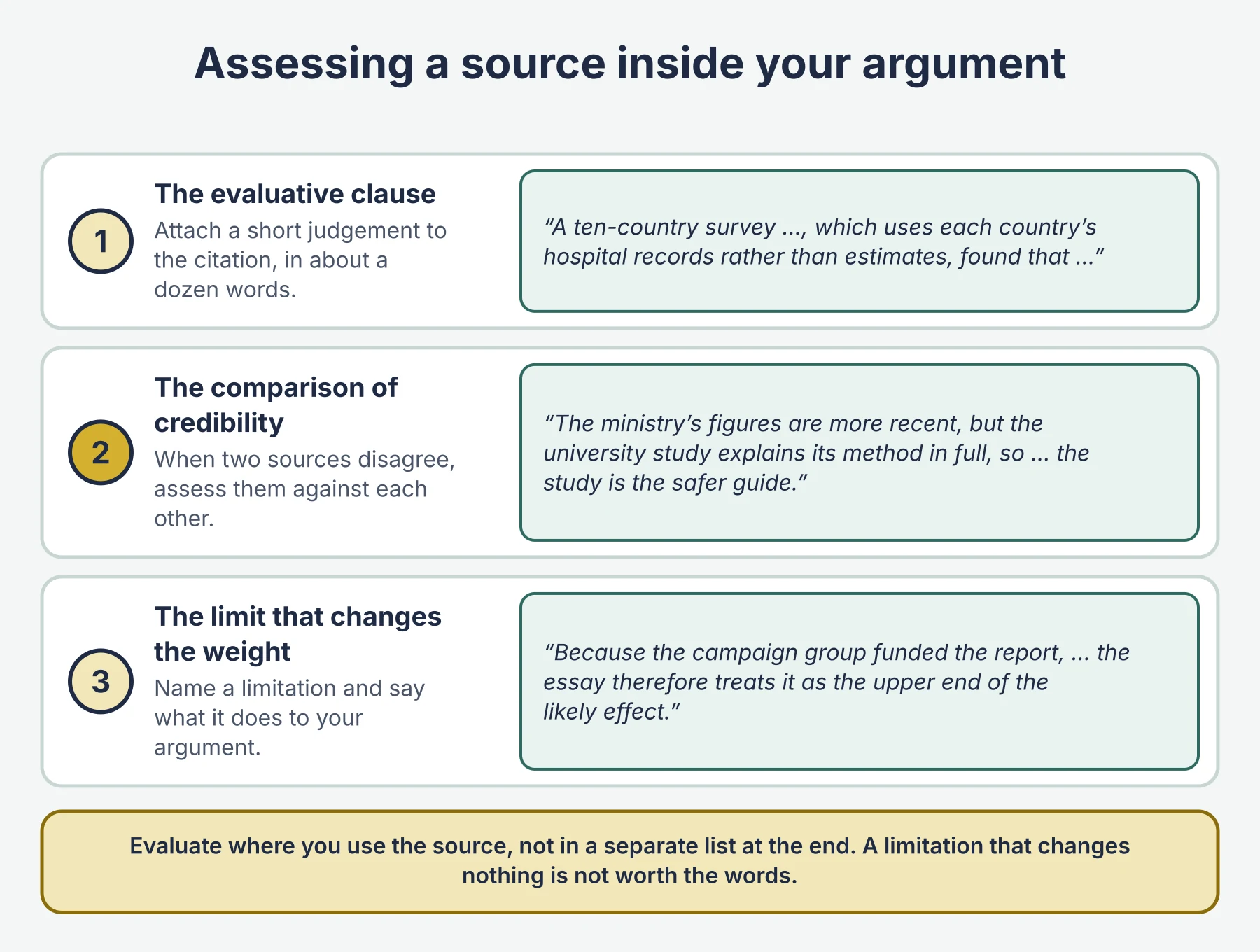
Three in-text evaluation techniques
| Technique | What it does | Model wording |
|---|---|---|
| Evaluative clause | Gives the reason for trusting evidence in a few words | “… a ten-country survey that uses hospital records rather than estimates …” |
| Comparison of credibility | Decides between disagreeing sources | “Where the two conflict, the study is the safer guide because …” |
| Limit that changes the weight | Shows how a weakness affects your argument | “… so the essay treats this as the upper end of the likely effect.” |
Assessing versus justifying
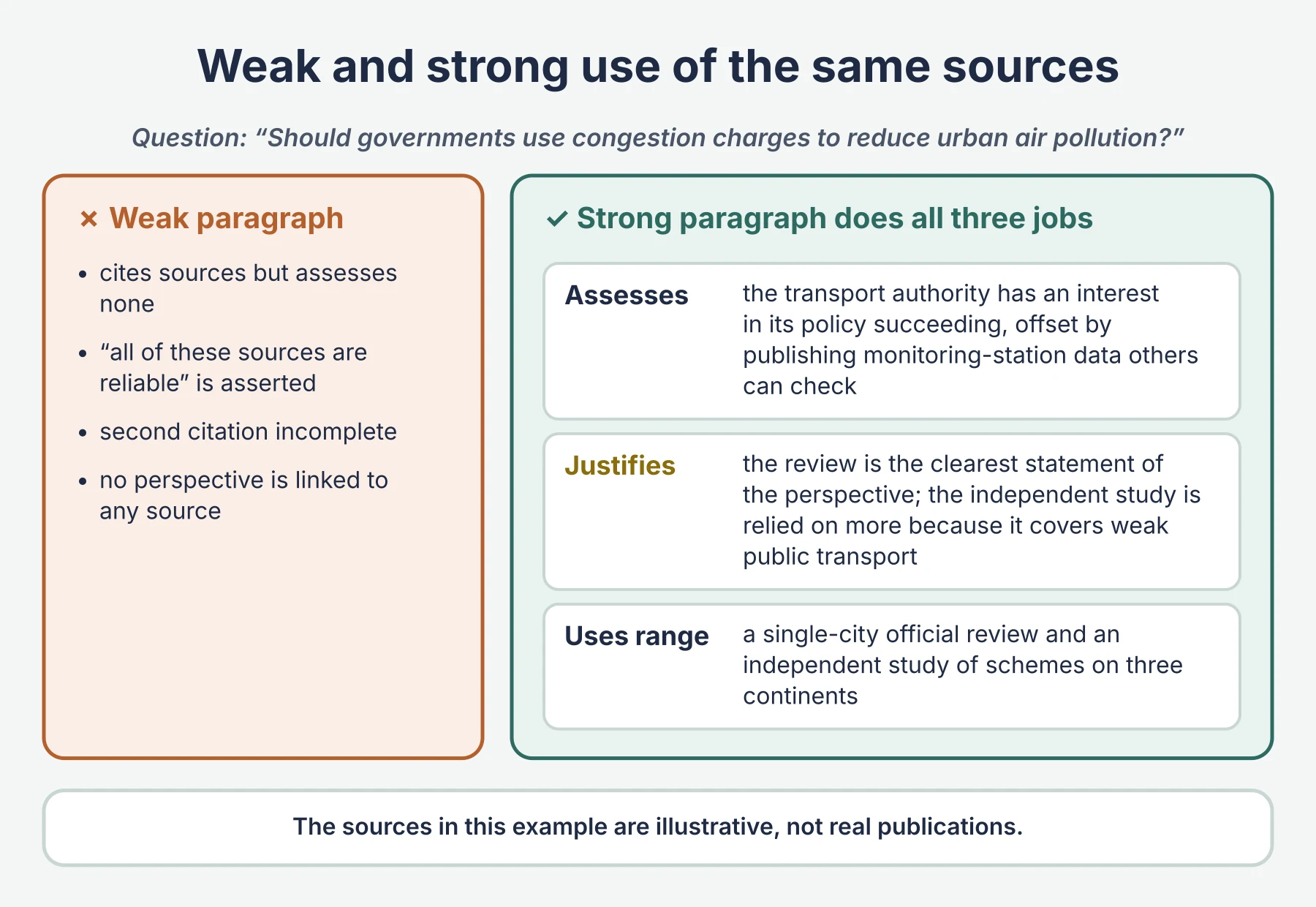
- Assess: “How good is this source for this claim?”
- Justify: “Why is this source in my essay?”
- A limited source can still be justified, for example as the clearest statement of a perspective you must examine.
Exam traps
- Evaluating sources in a separate section rather than where they are used.
- “All my sources are reliable” or “this is a reputable website”.
- A credible source that answers a different question.
- Sources from one country for a global question.
- Dismissing a source as biased without saying how its interest affects the claim used.
- Relying on a summary when the original study is available.
- Listing sources the essay never uses.
- Incomplete citations: a quotation without a full reference.
Self-test
- Quote the two AO1 assessment points about sources in the essay.
- What does the syllabus say about the role of evaluation in the essay?
- Give the syllabus definition of “justify”.
- Name the three kinds of range.
- What test does the phrase “firmly supported judgements or conclusions” suggest?
- Which column of a source audit holds your justification?
- What is an evaluative clause? Give an example.
- Why compare the credibility of two sources that disagree?
- Do references count towards the word limit? Do evaluative sentences?
- Can a source with clear limitations still be justified? Explain.
- What is wrong with “This source is biased so I did not trust it”?
- Why is a long source list not the same as a range?
Answers
- “Select and refer to a range of sources” and “assess and justify the appropriateness of the sources selected”.
- “Evaluation of sources and perspectives should form a substantial element of candidates’ essays.”
- “Support a case with evidence/argument”.
- Geographical, type and standpoint.
- Prefer sources that reach conclusions through visible evidence and reasoning rather than assertion.
- The “Use in essay” column.
- A short phrase beside a citation saying why the evidence deserves weight, for example “a national census, which counts every household”.
- It decides which source to rely on where they conflict, which turns source evaluation into evaluation of perspectives.
- References and citations do not count; evaluative sentences do.
- Yes. For example, a campaign group’s report may be one-sided but still the clearest statement of a perspective the essay must evaluate.
- It does not say what the bias is, where it comes from or how it affects the specific claim, and it rejects rather than weighs the source.
- Range is about spread across regions, types and standpoints; many sources from one region, type or standpoint is still narrow.
Practise with the essay sources practice questions.
Related resources
-
Study guides
Cambridge A-Level Global Perspectives & Research: The Essay (9239)
How the 1750-2000 word Component 2 essay works in Cambridge AS & A Level Global Perspectives 9239: choosing a question, contrasting perspectives and AO1-AO3.
Global Perspectives · Cambridge · AS Level
Read guide -
Practice questions
Cambridge A-Level Global Perspectives & Research: The Essay — Practice Questions
Practice questions with worked answers on essay titles, source selection, contrasting perspectives and referencing for the Cambridge 9239 Component 2 Essay.
Global Perspectives · Cambridge · AS Level
Try questions -
Revision notes
Cambridge A-Level Global Perspectives & Research: The Essay — Revision Notes (9239)
Condensed revision notes on choosing a question, sourcing, evaluating perspectives and referencing for the Cambridge AS Level Global Perspectives 9239 Essay.
Global Perspectives · Cambridge · AS Level
Revise topic
Studying Global Perspectives?
This page is free and stays free. Marlbridge is not offering Global Perspectives classes at the moment, so there is no tuition to book for it. The free study resources stay open to everyone.
Get free revision emails (optional)
Occasional emails with practice questions, worked explanations and links to free resources for the qualification and subjects you choose. No spam, and you can unsubscribe from any email. The free tools on this site never need an email.