
Study Guides
Cambridge International AS & A Level Global Perspectives & Research (9239): Essay – Selecting, Assessing and Justifying Sources
How to build a range of sources for the 9239 Essay and assess and justify them inside your argument, with source-audit methods and model paragraphs.
- Subject
- Global Perspectives
- Level
- AS LEVEL
- Topic
- Component 2 – Essay
- Author
- Marlbridge Academic Team
- Updated
- Reviewed by
- Ammar Bilal (what this means)
Aligned to Cambridge A Level Global Perspectives (9239), 2026-2028. Official specification .
Syllabus page (what it covers and how it is assessed): Cambridge A Level Global Perspectives.
Syllabus topics and points this page is mapped to
9239 (AS Level)
- 2 Component 2 – Essay (topic-level mapping)
"Topic-level mapping" means this page belongs to that topic; it does not claim to cover every point in it.
This guide covers two assessment points in Component 2, the Essay, of the Cambridge International AS & A Level Global Perspectives & Research (9239) syllabus for 2026-2028: “select and refer to a range of sources (AO1)” and “assess and justify the appropriateness of the sources selected (AO1)”. The syllabus adds that “Sources selected should offer firmly supported judgements or conclusions” and that “Evaluation of sources and perspectives should form a substantial element of candidates’ essays.” For the essay as a whole, read the Component 2 Essay study guide first.
Why sources matter so much in this essay
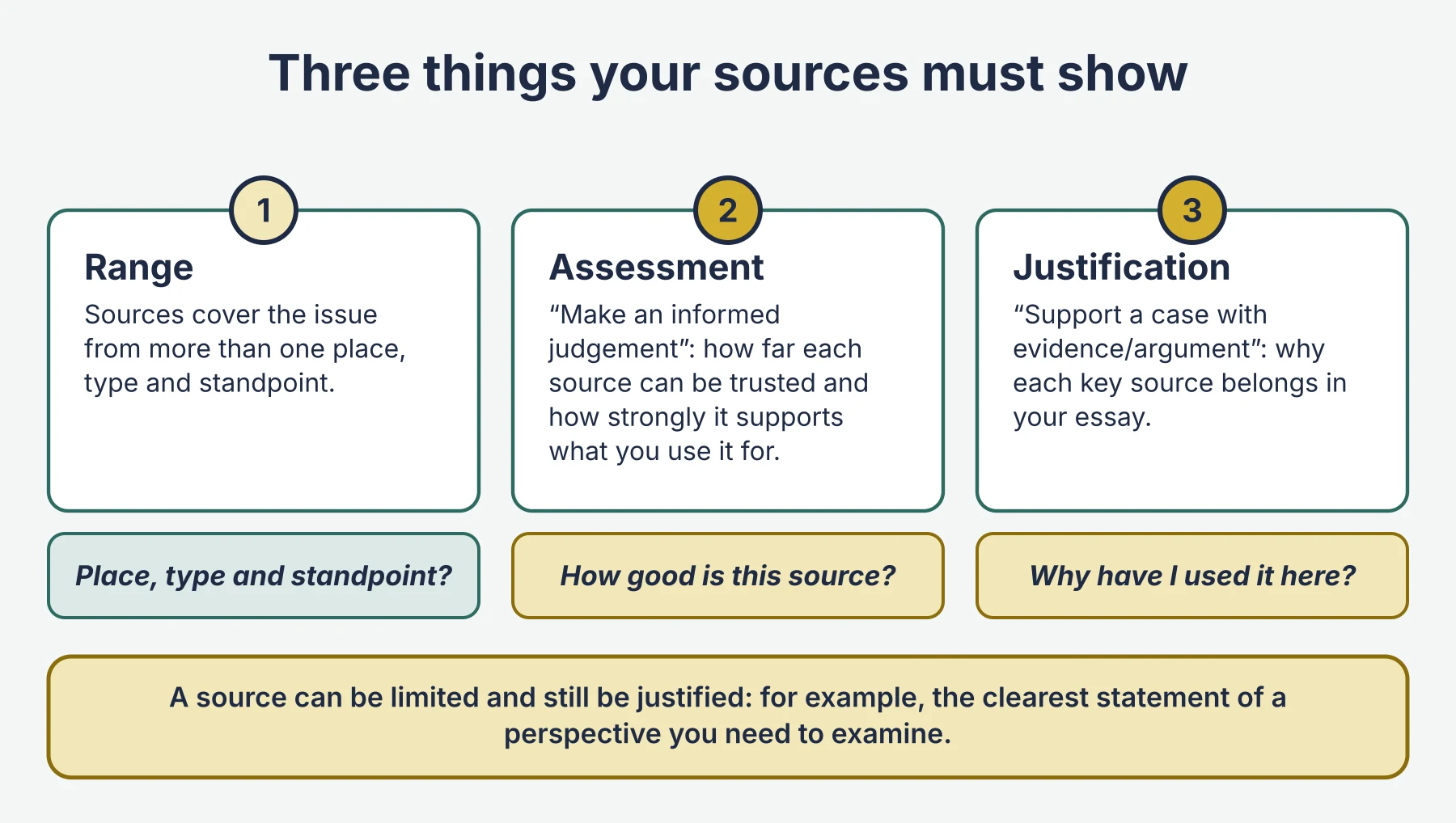
The essay is 1750-2000 words on a question you choose. Your perspectives are built from other people’s arguments and evidence, so the quality of your sources sets a ceiling on the quality of your perspectives. The syllabus does not want sources used as decoration. It wants you to show three things:
- Range: the sources cover the issue from more than one place, type and standpoint.
- Assessment: you judge how far each source can be trusted and how strongly it supports what you use it for. The syllabus defines assess as “make an informed judgement”.
- Justification: you explain why each key source belongs in your essay. The syllabus defines justify as “support a case with evidence/argument”.
Assessment and justification are related but different. Assessment asks “how good is this source?” Justification asks “why have I used it here?” A source can be limited and still be justified, for example because it is the clearest statement of a perspective you need to examine.
What a “range” of sources looks like
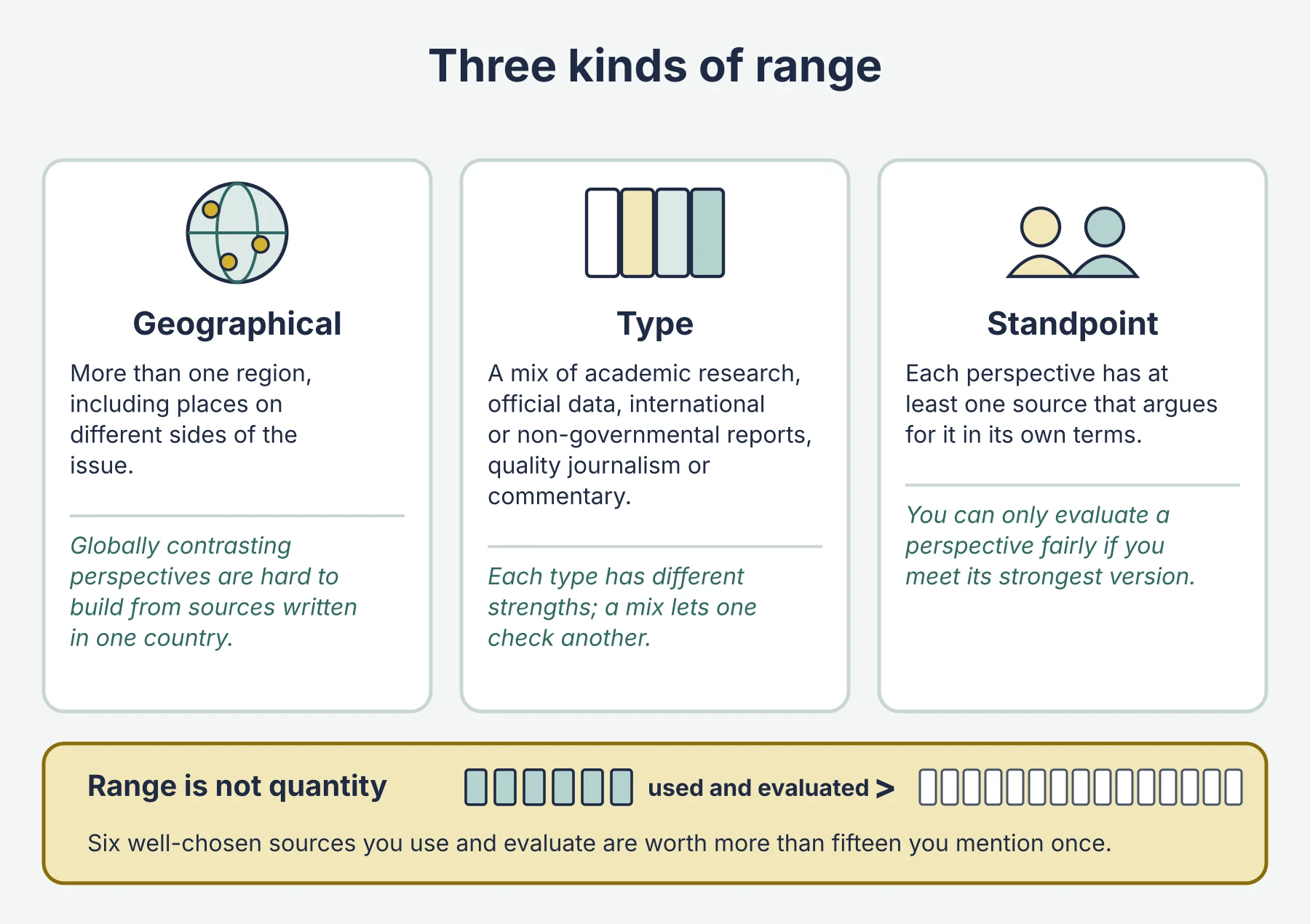
The syllabus describes the responsible learner as “selecting suitable material from a globally diverse range of sources”. For a global question, check your list against three kinds of range.
| Kind of range | Check | Why it matters |
|---|---|---|
| Geographical | Do sources come from more than one region, including places on different sides of the issue? | Globally contrasting perspectives are hard to build from sources written in one country |
| Type | Is there a mix of academic research, official data, reports from international or non-governmental organisations, and quality journalism or commentary? | Each type has different strengths; a mix lets one check another |
| Standpoint | Does each perspective have at least one source that argues for it in its own terms? | You can only evaluate a perspective fairly if you meet its strongest version |
Range is not the same as quantity. Six well-chosen sources that you use and evaluate are worth more than fifteen you mention once.
Choosing sources that “offer firmly supported judgements”
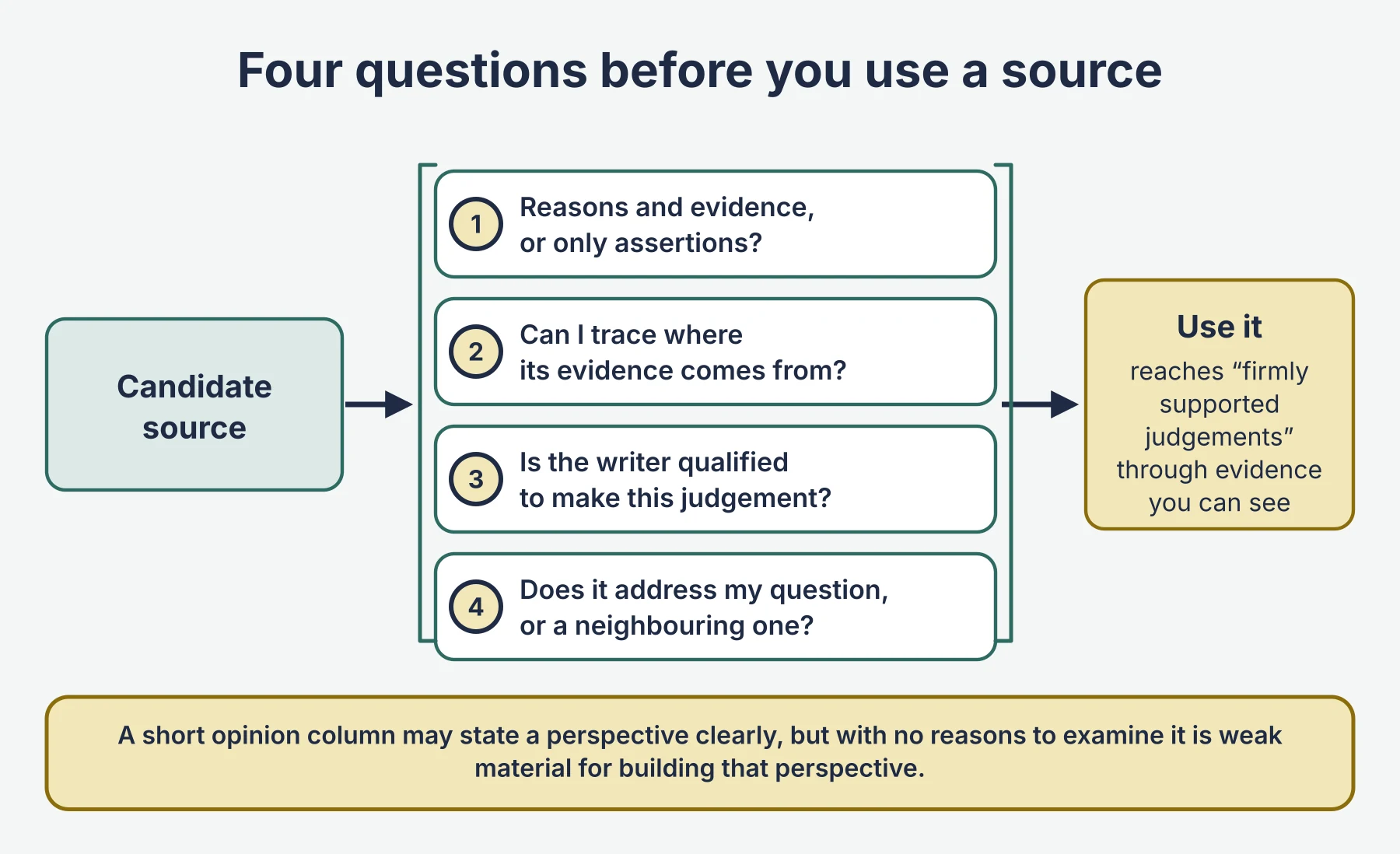
The syllabus phrase “firmly supported judgements or conclusions” gives a useful selection test. Prefer sources that reach their conclusions through evidence and reasoning you can see. A short opinion column may state a perspective clearly, but if it gives no reasons you can examine, it is weak material for building that perspective. Ask of each candidate source:
- Does it give reasons and evidence, or only assertions?
- Can I trace where its evidence comes from?
- Is the writer qualified to make this judgement?
- Does it address the issue my question asks about, or a neighbouring one?
Keeping a source audit while you research
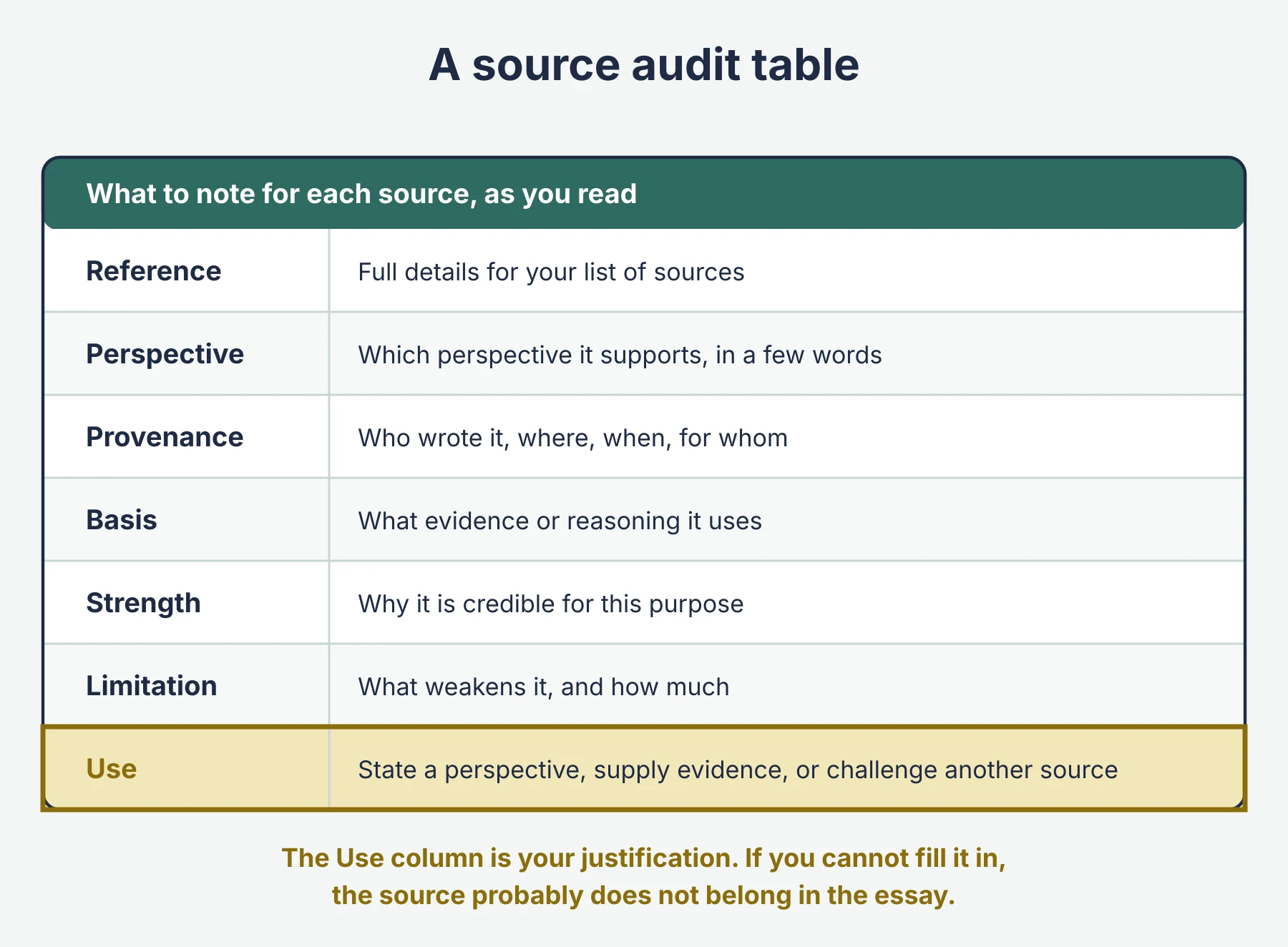
Write the evaluation as you read, not from memory at the end. A simple audit table for each source saves time and gives you the sentences you will need when drafting.
| Column | What to note |
|---|---|
| Reference | Full details for your list of sources |
| Perspective | Which perspective it supports, in a few words |
| Provenance | Who wrote it, where, when, for whom |
| Basis | What evidence or reasoning it uses |
| Strength | Why it is credible for this purpose |
| Limitation | What weakens it, and how much |
| Use | What it will do in the essay: state a perspective, supply evidence, challenge another source |
The final column is your justification. If you cannot fill it in, the source probably does not belong in the essay.
Assessing a source inside your argument
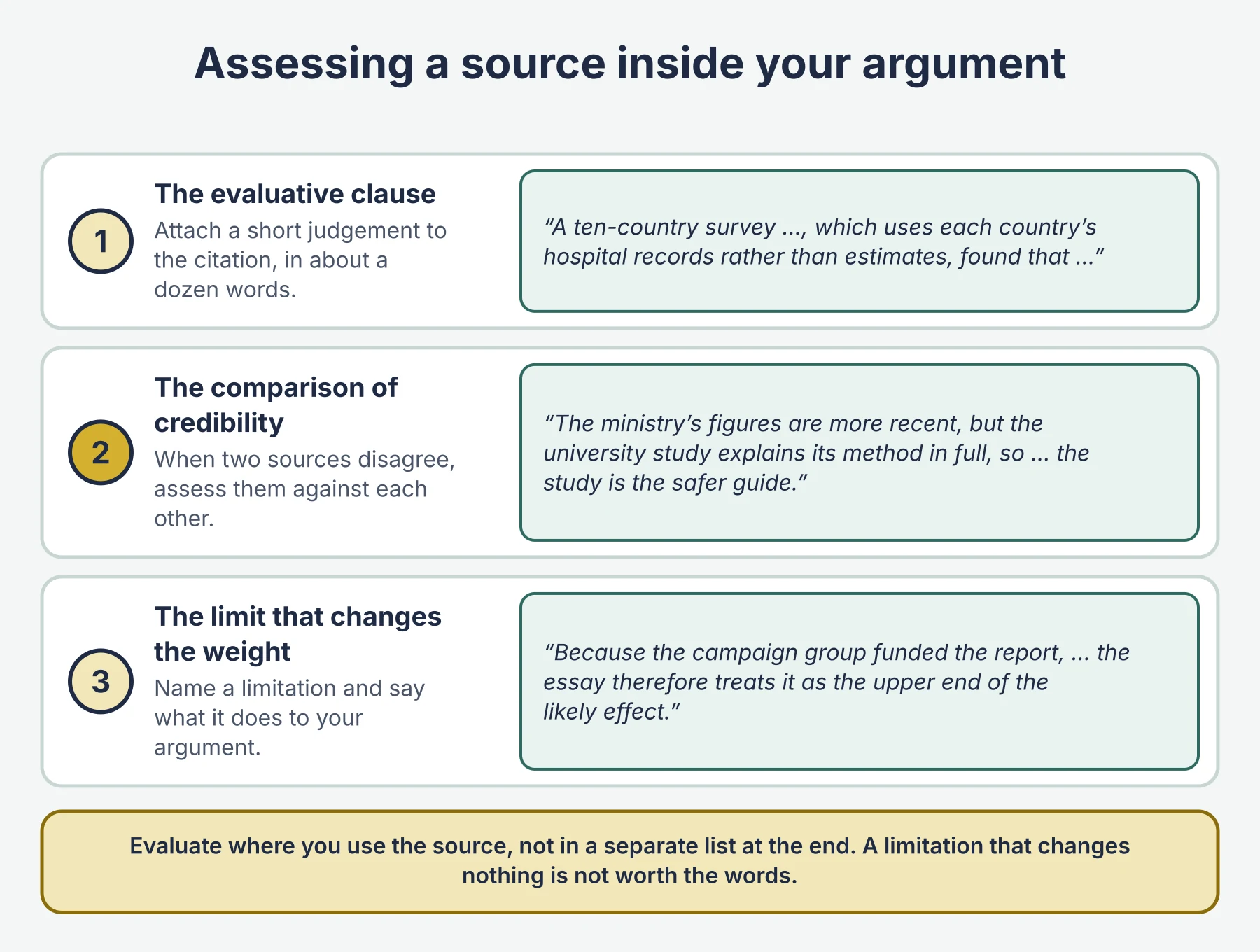
Evaluation should appear where you use the source, not in a separate list at the end. Three techniques make this efficient within the word limit.
1. The evaluative clause. Attach a short judgement to the citation: “A ten-country survey by the regional health observatory, which uses each country’s hospital records rather than estimates, found that …” The clause tells the reader why the evidence deserves weight, in about a dozen words.
2. The comparison of credibility. When two sources disagree, assess them against each other: “The ministry’s figures are more recent, but the university study explains its method in full, so where the two conflict on rural access, the study is the safer guide.” This turns source evaluation into evaluation of perspectives, which is what the essay is assessed on.
3. The limit that changes the weight. Name a limitation and say what it does to your argument: “Because the campaign group funded the report, its finding that tolls cut congestion by a third needs independent confirmation; the essay therefore treats it as the upper end of the likely effect.” A limitation that changes nothing is not worth the words.
Worked example: weak and strong use of the same sources
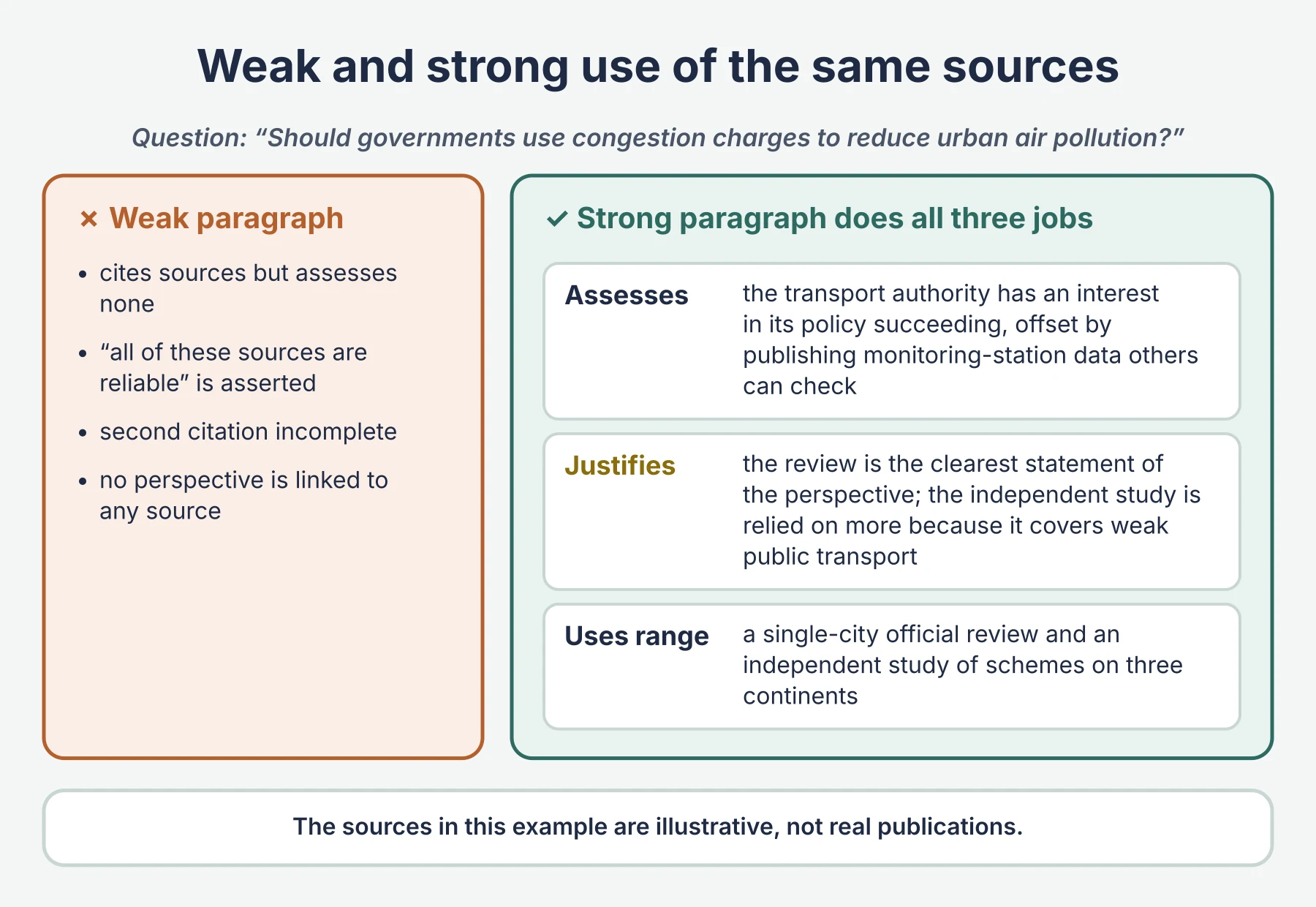
The essay question is “Should governments use congestion charges to reduce urban air pollution?” The sources described are illustrative, not real publications.
Weak paragraph. “Congestion charges work. A report says pollution fell after a charge was introduced (Report, 2022). Another article says they are unfair to poorer drivers (Smith). However, some people disagree. All of these sources are reliable.”
The paragraph cites sources but does not assess or justify any of them. “Reliable” is asserted for all, the second citation is incomplete, and the reader cannot tell which perspective each source represents.
Strong paragraph. “Supporters of charging argue that pricing road space is the quickest way to cut traffic emissions. The clearest statement of this view is a city transport authority’s review of its own scheme, which reports lower roadside nitrogen dioxide in the charging zone in the two years after introduction. The authority has an interest in showing its policy succeeded, but its review publishes monitoring-station data that others can check, so the finding is credible for that city. It is less useful for the question as a whole, because the city already had a dense metro network; where public transport is weak, drivers may have no alternative. A comparative study of charging schemes in three continents, written by independent transport economists, addresses this gap directly, which is why the essay relies on it more heavily when judging whether charging works beyond wealthy cities.”
The strong paragraph does all three jobs. It assesses (an interest, offset by checkable data), it justifies (the clearest statement of the perspective; then the reason for leaning on the second source) and it uses range (a single-city official review and an independent multi-continent study).
Referencing and the word limit
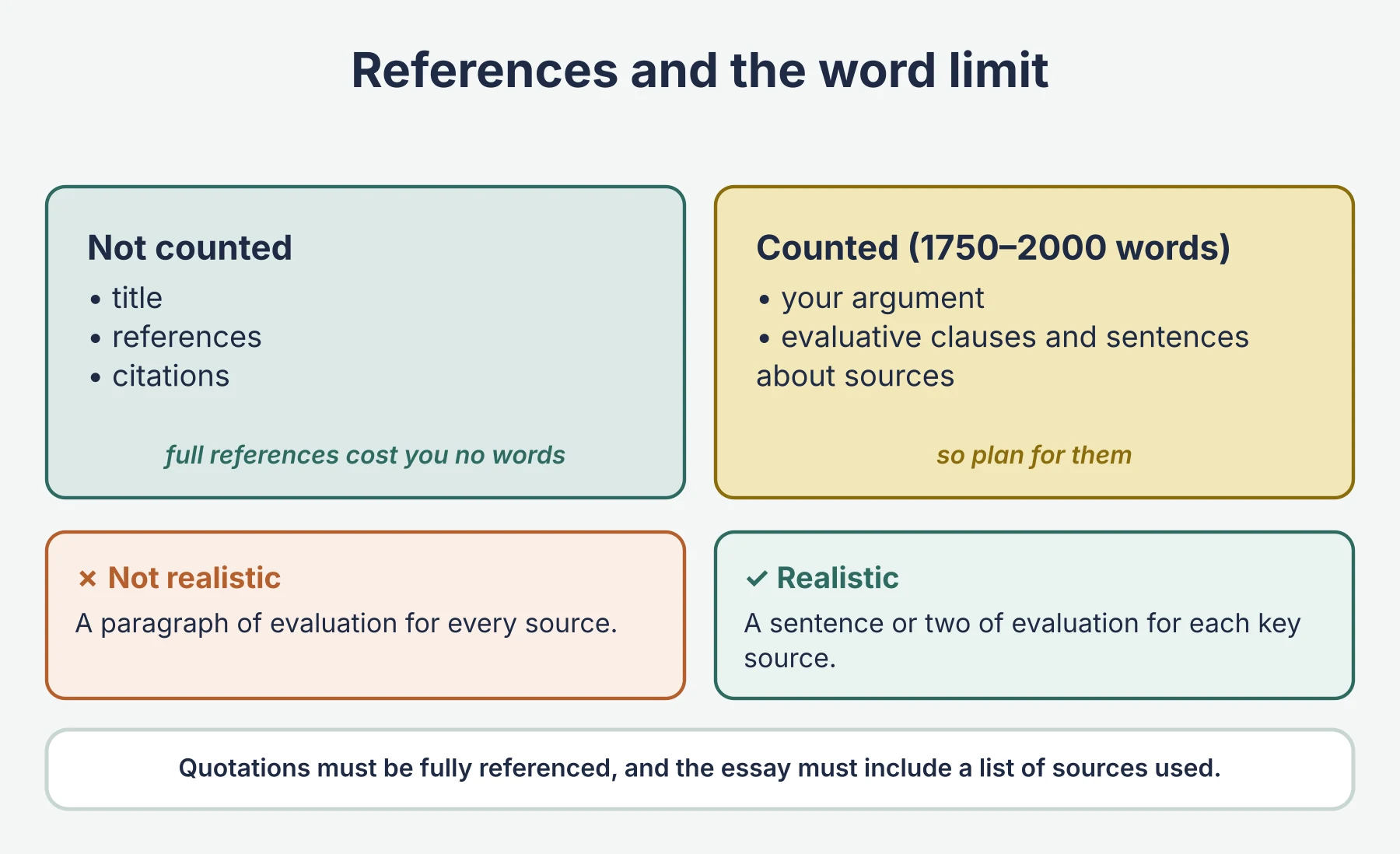
The syllabus requires that “Quotations must be fully referenced” and that the essay “include a list of sources used”. The word count “excludes the title, references and citations”, so full references do not cost you words, but evaluative clauses do. Plan for them: in a 1750-2000-word essay, a sentence or two of evaluation for each key source is realistic; a paragraph for every source is not.
Common mistakes
- A separate “source evaluation” section that evaluates sources away from the arguments they support.
- Blanket judgements such as “all sources are reliable” or “this is a reputable website”.
- Credibility without relevance: a highly credible source on a neighbouring issue.
- One-region source lists for a question that claims to be global.
- Dismissing a source for bias instead of saying how its interest affects the particular claim you use.
- Citing a summary of a study instead of the study when the original is available, so you cannot assess its method.
- Unjustified sources: entries in the list of sources that the essay never uses.
Condense this with the essay sources revision notes and test yourself with the essay sources practice questions. The companion unit on reflection and further research in the essay covers the AO2 points.
Frequently asked questions
How many sources should a 9239 essay use? The syllabus asks for “a range of sources” but sets no number. Choose enough to build each perspective from its own strongest material and to let sources check one another, and evaluate the ones you rely on.
What is the difference between assessing and justifying a source? Assessing judges how far the source can be trusted and how strongly it supports a claim. Justifying explains why you chose it and what it does in your essay.
Do references count towards the 2000-word limit? No. The syllabus says the word count excludes the title, references and citations. Evaluative sentences about sources do count.
Related resources
-
Practice questions
Cambridge International AS & A Level Global Perspectives & Research (9239): Essay – Selecting, Assessing and Justifying Sources – Practice Questions
Original practice on sources in the 9239 Essay: building range, evaluative clauses, comparing credibility, source audits and rewriting weak evaluation.
Global Perspectives · Cambridge · AS Level
Try questions -
Revision notes
Cambridge International AS & A Level Global Perspectives & Research (9239): Essay – Selecting, Assessing and Justifying Sources – Revision Notes
Recall notes on sources in the 9239 Essay: range, assessing versus justifying, the source audit, in-text evaluation techniques, traps and a self-test.
Global Perspectives · Cambridge · AS Level
Revise topic -
Study guides
Cambridge A-Level Global Perspectives & Research: The Essay (9239)
How the 1750-2000 word Component 2 essay works in Cambridge AS & A Level Global Perspectives 9239: choosing a question, contrasting perspectives and AO1-AO3.
Global Perspectives · Cambridge · AS Level
Read guide
Studying Global Perspectives?
This page is free and stays free. Marlbridge is not offering Global Perspectives classes at the moment, so there is no tuition to book for it. The free study resources stay open to everyone.
Get free revision emails (optional)
Occasional emails with practice questions, worked explanations and links to free resources for the qualification and subjects you choose. No spam, and you can unsubscribe from any email. The free tools on this site never need an email.