
Revision Notes
Cambridge International AS & A Level Global Perspectives & Research (9239): Written Exam Question 3 – Comparing Arguments and Perspectives – Revision Notes
Recall notes for the 25-mark 9239 Written Exam Question 3: comparison criteria, arguments versus perspectives, judgement rules, AO3 and a self-test.
- Subject
- Global Perspectives
- Level
- AS LEVEL
- Topic
- Component 1 – Written Exam
- Author
- Marlbridge Academic Team
- Updated
- Reviewed by
- Ammar Bilal (what this means)
Aligned to Cambridge A Level Global Perspectives (9239), 2026-2028. Official specification .
Syllabus page (what it covers and how it is assessed): Cambridge A Level Global Perspectives.
Syllabus topics and points this page is mapped to
9239 (AS Level)
- 1 Component 1 – Written Exam (topic-level mapping)
"Topic-level mapping" means this page belongs to that topic; it does not claim to cover every point in it.
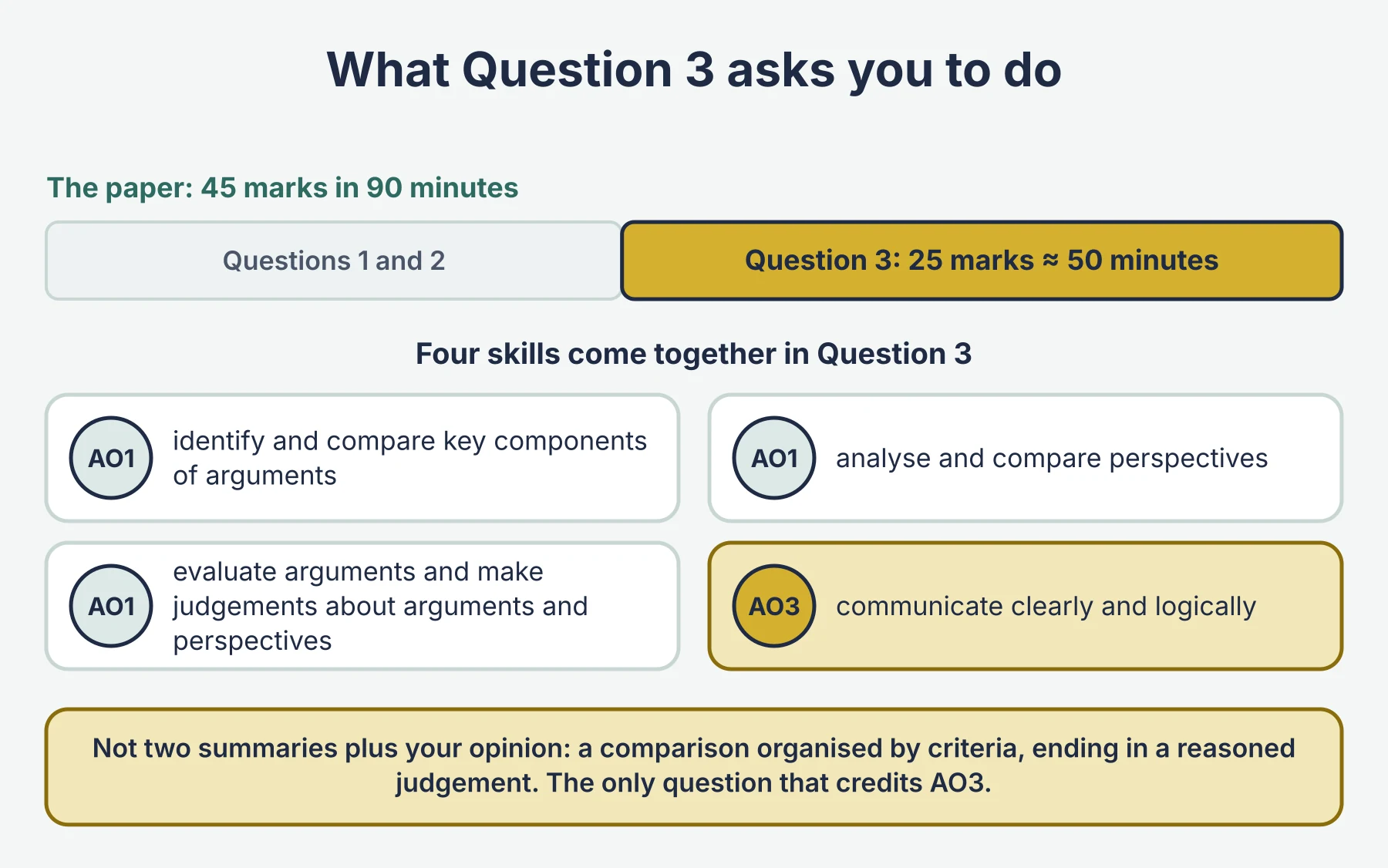
These notes cover Question 3 of Component 1 in Cambridge International AS & A Level Global Perspectives & Research (9239), 2026-2028. The syllabus wording: “Question 3 (25 marks) requires a longer, essay response based on the two source documents. Candidates are required to focus on the arguments and perspectives given in the documents and provide a reasoned judgement, demonstrating AO1 and AO3 skills.” For the paper as a whole, see the Component 1 Written Exam study guide; for full explanations and a worked example, read the Question 3 study guide.
Core facts
- 25 of 45 marks: about 50 of the 90 minutes.
- Both sources; focus on arguments and perspectives.
- Assesses AO1 and AO3 (the only Component 1 question that does).
- Must end in a reasoned judgement. Phrases such as “To what extent …?” and “Make an overall judgement” may be used.
- Not assessed on knowledge of the issue itself.
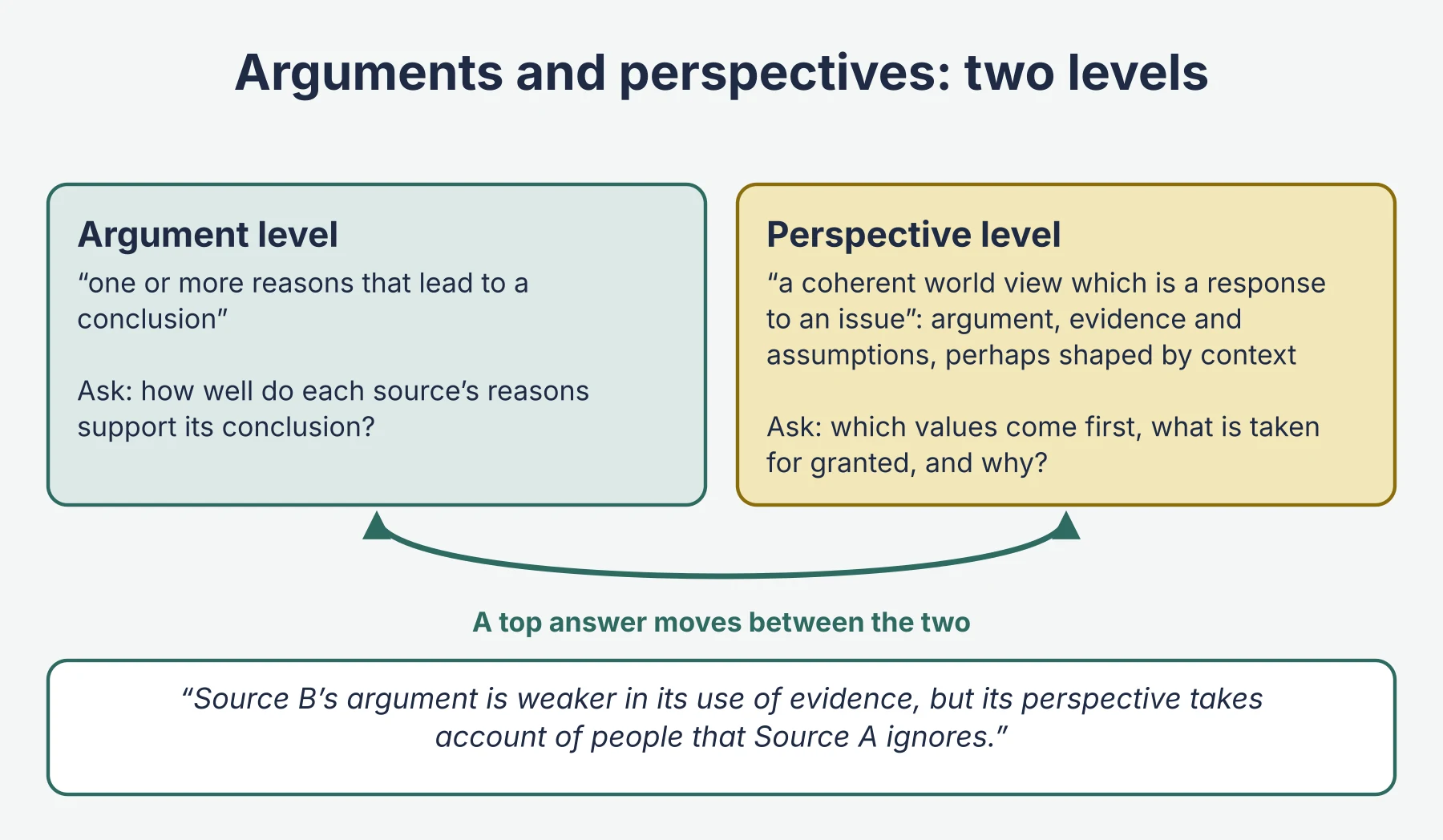
Two levels of comparison
| Level | Syllabus definition | What to compare |
|---|---|---|
| Argument | “one or more reasons that lead to a conclusion” | How well each source’s reasons support its conclusion |
| Perspective | “a coherent world view which is a response to an issue”, made of “argument, evidence and assumptions”, possibly “influenced by a particular context” | The values, assumptions and context behind each source |
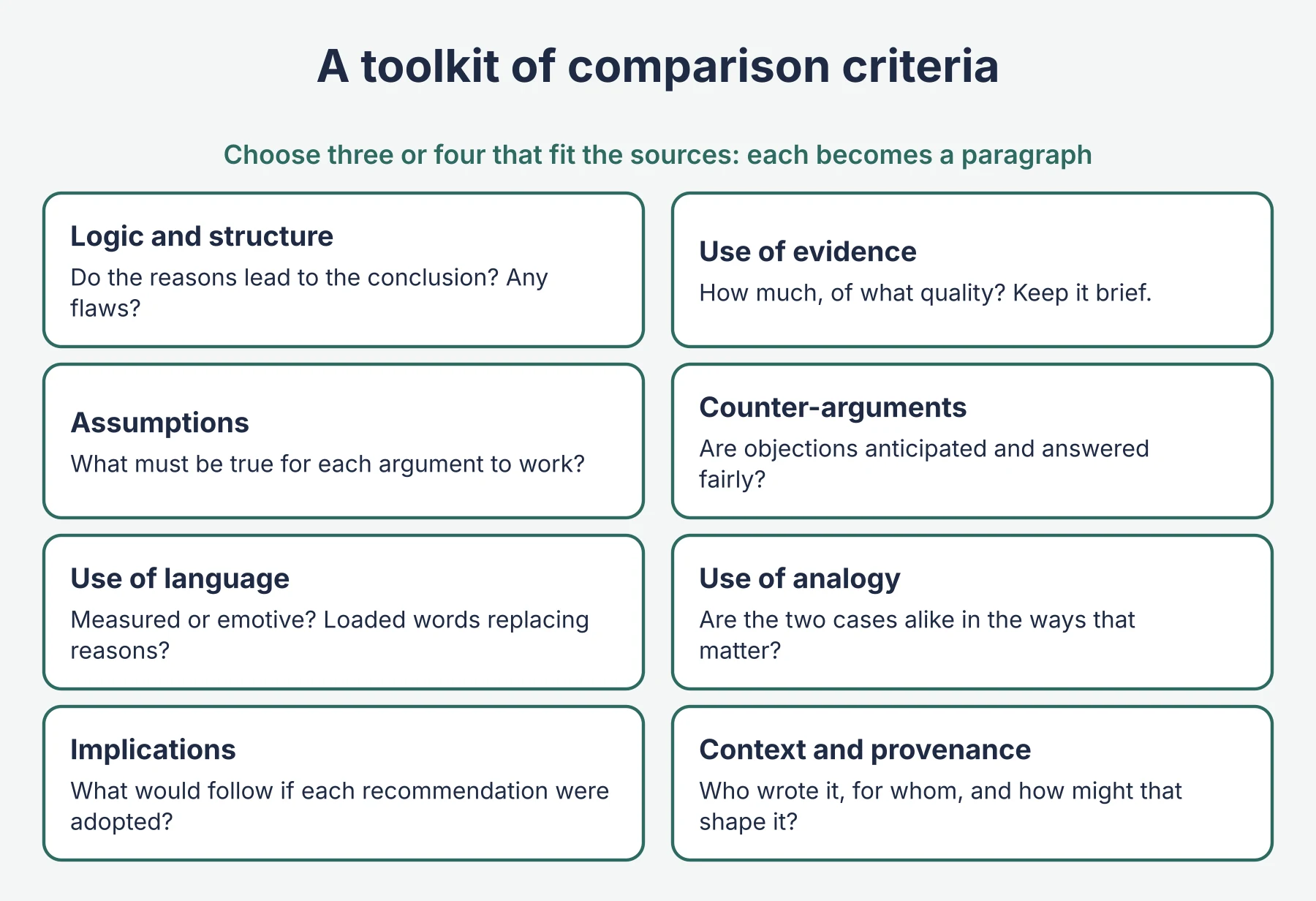
Comparison criteria
| Criterion | One-line test |
|---|---|
| Logic and structure | Do the reasons lead to the conclusion without flaws? |
| Use of evidence | How much support, of what quality? (Brief; detail belongs to Question 2.) |
| Assumptions | What must be true, and is it reasonable? |
| Counter-arguments | Raised and answered fairly, or ignored? |
| Language | Measured, or emotive and loaded? |
| Analogy | Are the compared cases alike in the ways that matter? |
| Implications | What follows if the recommendation is adopted? Acknowledged? |
| Context and provenance | Who wrote it, for whom, and how does that shape the argument? |
The analogy, implications and context criteria all come from the Critical Path’s deconstruction and reconstruction questions.
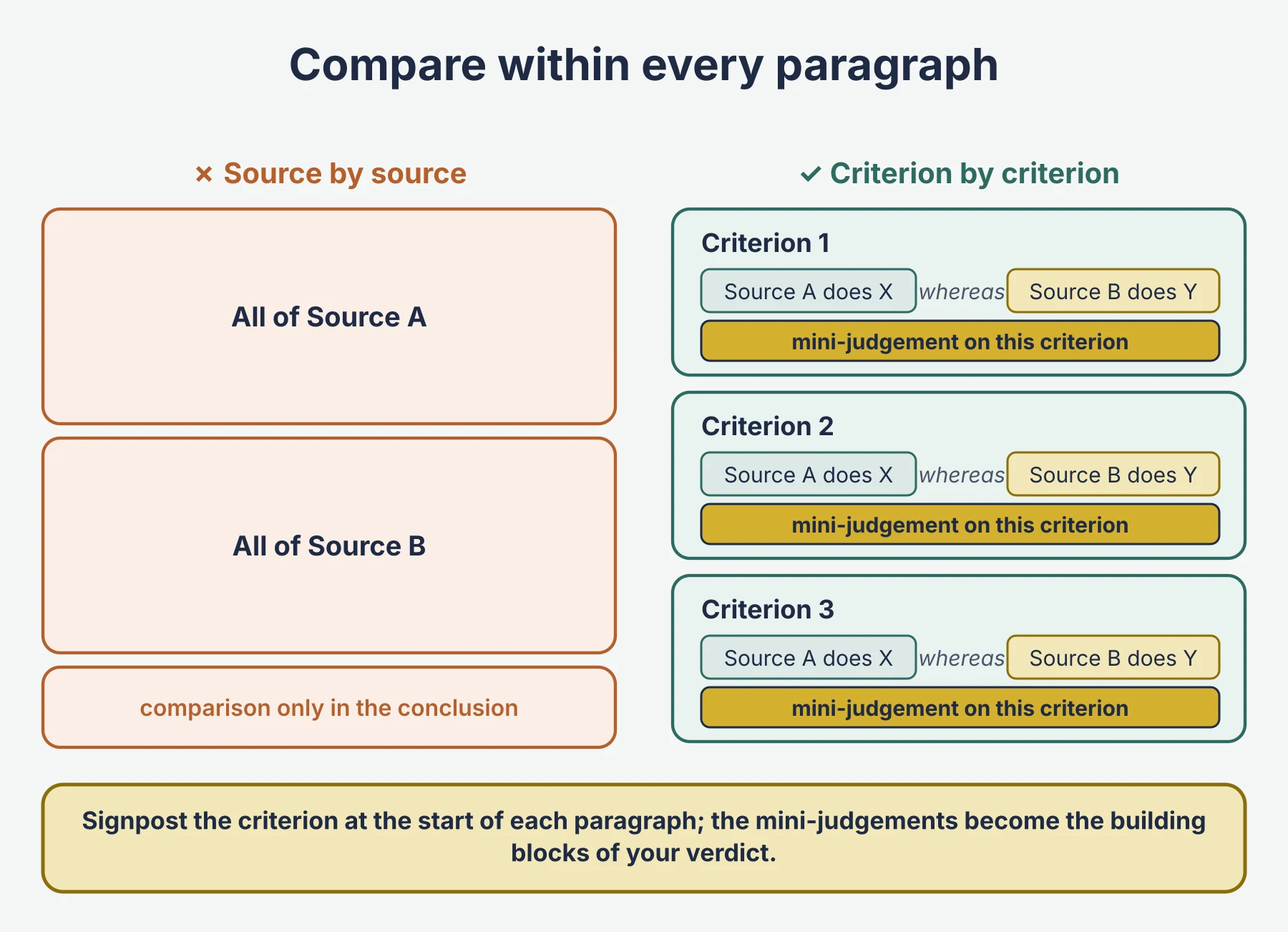
Paragraph formula
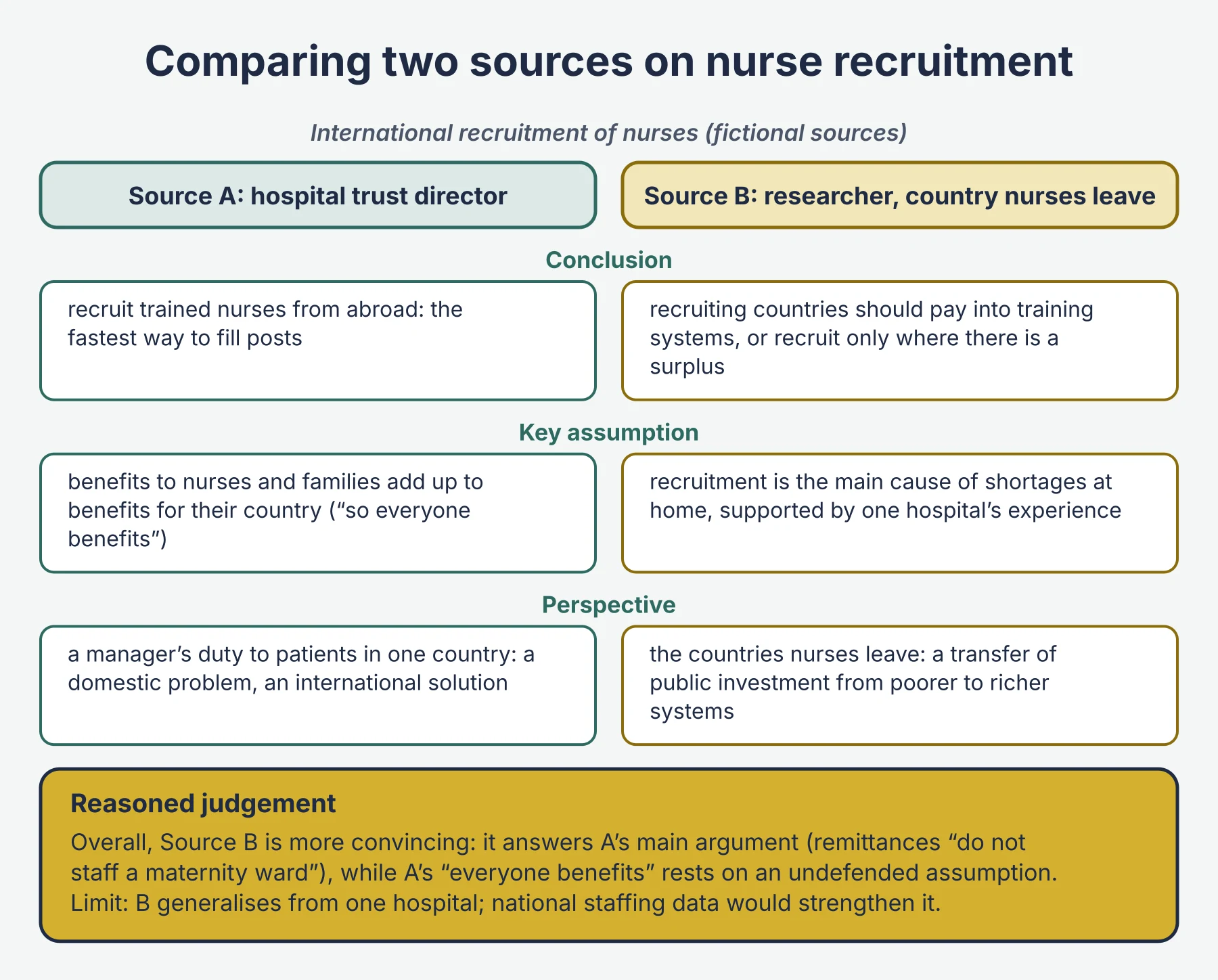
Criterion signpost → Source A on this criterion, with a short quotation → Source B on the same criterion, with a short quotation → why one is stronger here (mini-judgement).
Comparison sentence frames
- Shared ground: “Both sources accept that …, but they draw opposite conclusions because …”
- Direct contrast: “Source A supports its claim with …, whereas Source B relies on …”
- Exposing an assumption: “Source A’s conclusion only follows if …; Source B challenges this when it says …”
- Answering each other: “Source B’s point that … directly undermines Source A’s claim that …”
- Mini-judgement: “On this criterion Source … is stronger, because …”
Weighing criteria: a condensed example
Suppose Source A (a fictional water company) argues for metered water pricing with clear national data but uses dismissive language about critics, while Source B (a fictional consumer group) uses calm language but bases its case on two household stories and assumes that metering would raise every bill. A weighed verdict might read: “Source A is more convincing. Its tone is a weakness, but tone affects persuasion, not validity; Source B’s central assumption is unsupported, and that failure goes to the heart of its argument.” The verdict names the deciding criterion (the soundness of the central assumption) and explains why it outweighs the other (tone).
Judgement rules
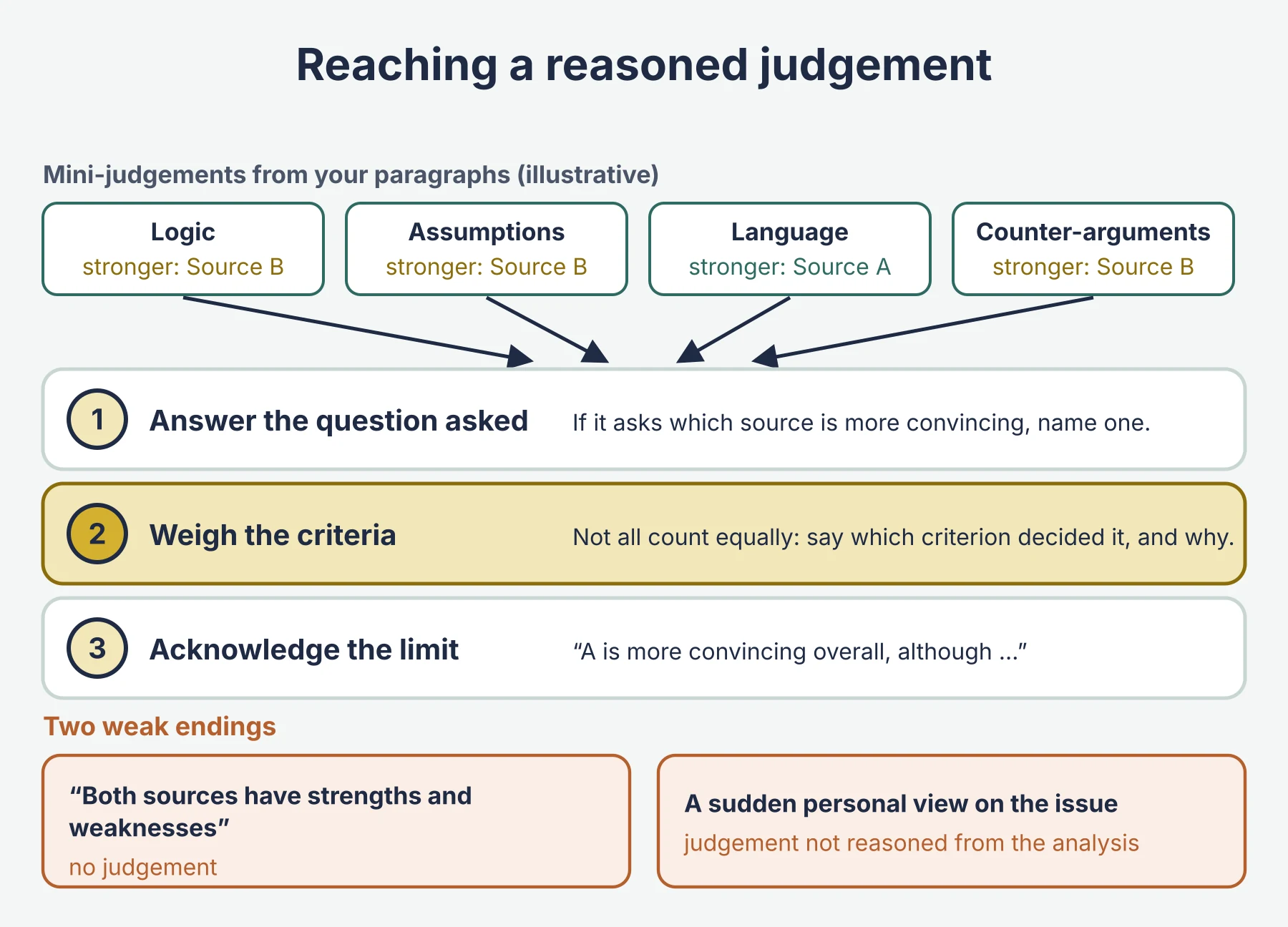
- Answer the question asked (name the more convincing source if asked).
- Say which criterion decided it, and why it outweighs the others.
- Acknowledge the main limit of your verdict.
- Keep the verdict consistent with your paragraph mini-judgements.
AO3: communicating clearly and logically
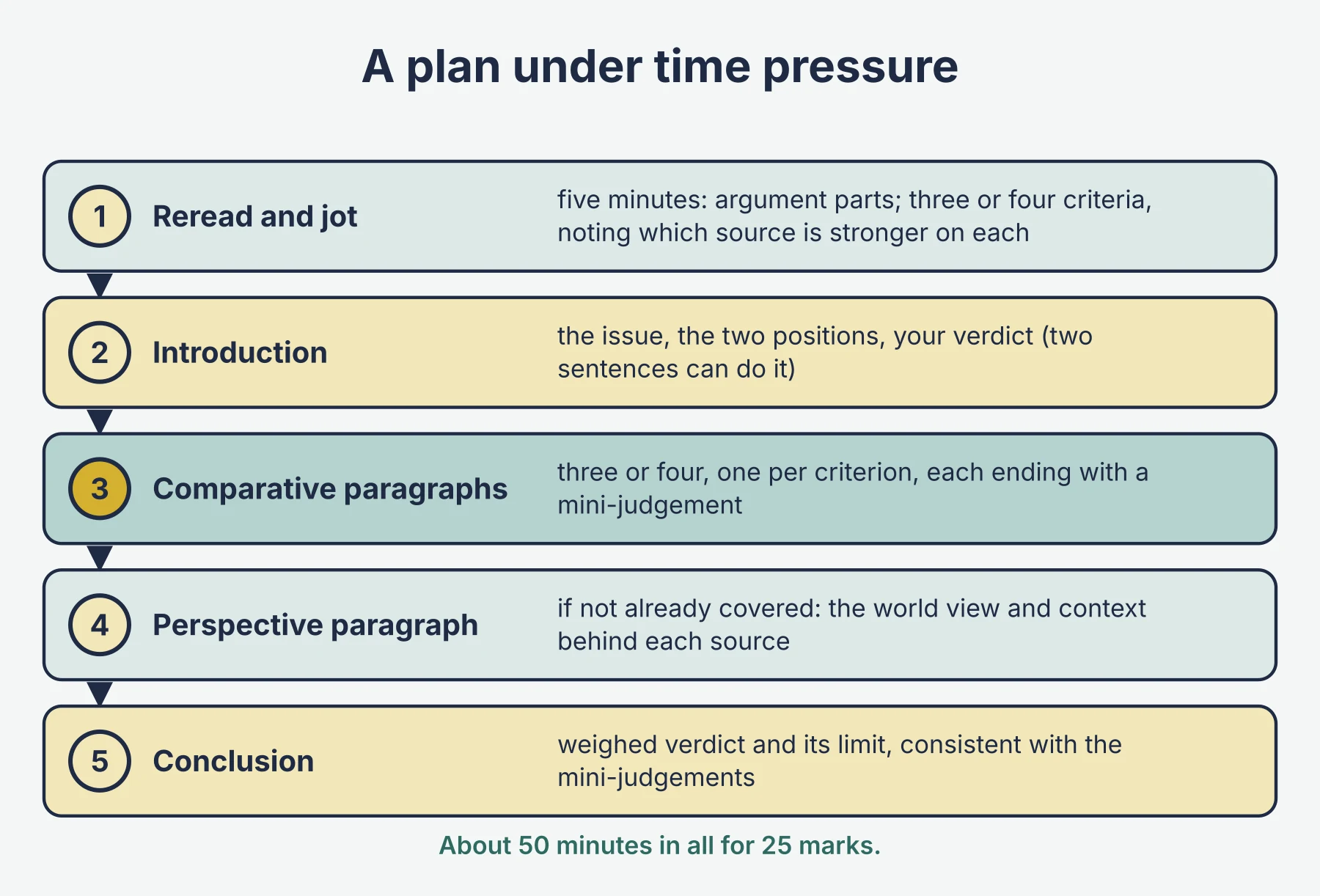
- A two-sentence introduction stating the verdict and main reason.
- Each paragraph signposted by its criterion.
- Precise terms: conclusion, reason, assumption, counter-argument, perspective, context.
- Short embedded quotations.
- A conclusion that follows from the paragraphs.
Exam traps
- Summarising Source A, then Source B, and comparing only at the end.
- Comparing what the sources are about rather than how they argue.
- Spending the time on evidence detail and neglecting logic, assumptions and perspective.
- Giving a personal view on the issue with little reference to the sources.
- Naming a flaw without quoting it or showing why the step fails.
- “Both have strengths and weaknesses” as a conclusion.
- Using the writer’s background to dismiss a source instead of explaining how it shapes the argument.
Self-test
- How many marks is Question 3 worth, and which assessment objectives does it test?
- Give the syllabus definition of an argument.
- What three things make up a perspective, according to the syllabus?
- Which three comparison criteria come directly from Critical Path questions?
- Why is a source-by-source structure weak?
- What is a mini-judgement?
- A source has emotive language but sound logic and strong evidence. Can it still be the more convincing? Explain.
- Give two features of AO3 communication in Question 3.
- What is wrong with “Both sources have strengths and weaknesses” as a conclusion?
- How should context be used in a comparison?
- Name one phrase the syllabus says may appear in assessments that requires a judgement.
Answers
- 25 marks; AO1 and AO3.
- “One or more reasons that lead to a conclusion”.
- Argument, evidence and assumptions (and it may be influenced by context).
- Use of analogy (“assess the use of analogy”), implications (“suggest the consequences of the conclusions”) and context (“explain the context in which the arguments have been made”).
- It leaves the comparison to the reader and usually produces a summary rather than analysis.
- A short verdict at the end of a paragraph saying which source is stronger on that criterion and why.
- Yes. Weigh the criteria: sound logic and strong evidence can outweigh emotive language, as long as you say why.
- Any two: an introduction stating the verdict; signposted paragraphs; precise terms; short embedded quotations; a consistent conclusion.
- It gives no judgement, so it does not answer the question.
- Explain how the writer’s position or audience shapes the argument and perspective, rather than using it to dismiss the source.
- “To what extent …?” or “Make an overall judgement”.
Practise with the Question 3 practice questions.
Related resources
-
Study guides
Cambridge A-Level Global Perspectives & Research: The Written Exam (9239)
How the 45-mark, source-based Written Exam works in Cambridge AS & A Level Global Perspectives & Research 9239, built around the Critical Path approach.
Global Perspectives · Cambridge · AS Level
Read guide -
Practice questions
Component 1 Written Exam (9239): Practice Questions
Original exam-style practice questions with full worked answers on Component 1 of Cambridge International AS & A Level Global Perspectives & Research (9239).
Global Perspectives · Cambridge · AS Level
Try questions -
Revision notes
Component 1 Written Exam (9239): Revision Notes
Condensed recall notes on the Critical Path approach and the reasoning skills in Component 1 of Cambridge AS & A Level Global Perspectives & Research 9239.
Global Perspectives · Cambridge · AS Level
Revise topic
Studying Global Perspectives?
This page is free and stays free. Marlbridge is not offering Global Perspectives classes at the moment, so there is no tuition to book for it. The free study resources stay open to everyone.
Get free revision emails (optional)
Occasional emails with practice questions, worked explanations and links to free resources for the qualification and subjects you choose. No spam, and you can unsubscribe from any email. The free tools on this site never need an email.