
Study Guides
Cambridge International AS & A Level Global Perspectives & Research (9239): Written Exam Question 3 – Comparing Arguments and Perspectives
How to write the 25-mark Question 3 essay in the 9239 Written Exam: comparing two sources' arguments by criteria and reaching a reasoned judgement.
- Subject
- Global Perspectives
- Level
- AS LEVEL
- Topic
- Component 1 – Written Exam
- Author
- Marlbridge Academic Team
- Updated
- Reviewed by
- Ammar Bilal (what this means)
Aligned to Cambridge A Level Global Perspectives (9239), 2026-2028. Official specification .
Syllabus page (what it covers and how it is assessed): Cambridge A Level Global Perspectives.
Syllabus topics and points this page is mapped to
9239 (AS Level)
- 1 Component 1 – Written Exam (topic-level mapping)
"Topic-level mapping" means this page belongs to that topic; it does not claim to cover every point in it.
This guide covers one named part of Component 1 in the Cambridge International AS & A Level Global Perspectives & Research (9239) syllabus for 2026-2028: “Question 3 (25 marks) requires a longer, essay response based on the two source documents. Candidates are required to focus on the arguments and perspectives given in the documents and provide a reasoned judgement, demonstrating AO1 and AO3 skills.” For the structure of the whole paper and the Critical Path, read the Component 1 Written Exam study guide first.
What Question 3 asks you to do
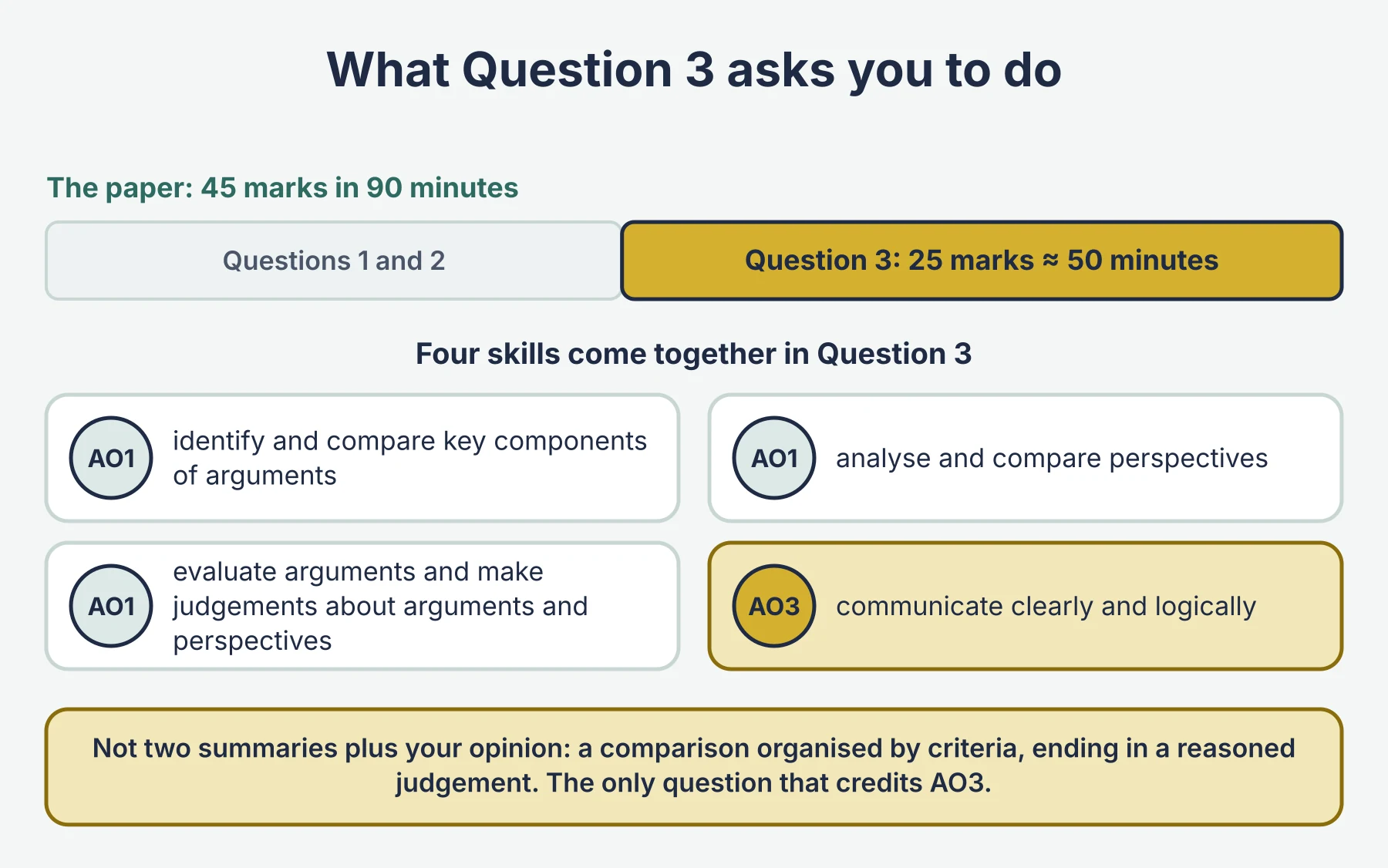
Question 3 is the largest question on the paper: 25 of the 45 marks, so a proportionate share is about 50 of the 90 minutes. It is also the only question that credits AO3, communication. The syllabus lists the skills assessed across the paper, and four of them come together here:
- “identify and compare key components of arguments” (AO1)
- “analyse and compare perspectives” (AO1)
- “evaluate arguments and make judgements about arguments and perspectives” (AO1)
- “communicate clearly and logically” (AO3).
So Question 3 is not two separate summaries followed by your opinion. It is a comparison, organised by criteria, that ends in a judgement you have reasoned your way to. Phrases such as “To what extent …?” and “Make an overall judgement”, which the syllabus says may appear, both demand that judgement.
Arguments and perspectives: keep the two levels apart
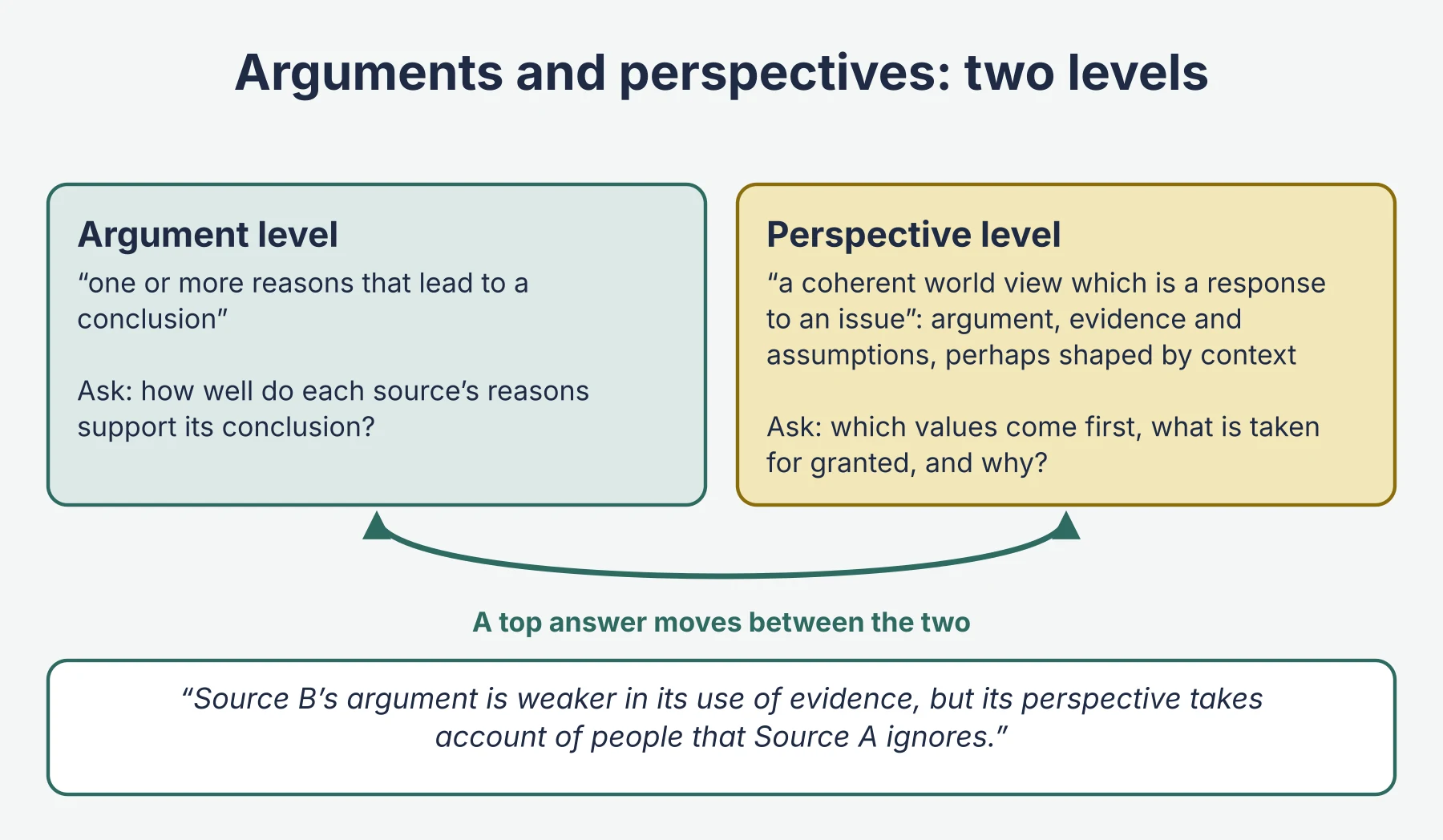
The syllabus key terms make a useful distinction:
- An argument consists of “one or more reasons that lead to a conclusion”.
- A perspective is “a coherent world view which is a response to an issue”, made up of “argument, evidence and assumptions” and possibly “influenced by a particular context”.
In practice, compare at both levels. At the argument level, ask how well each source’s reasons support its conclusion. At the perspective level, ask what view of the world sits behind each source: which values come first, what is taken for granted, and why someone in that position might see the issue that way. A top answer moves between the two: “Source B’s argument is weaker in its use of evidence, but its perspective takes account of people that Source A ignores.”
A toolkit of comparison criteria
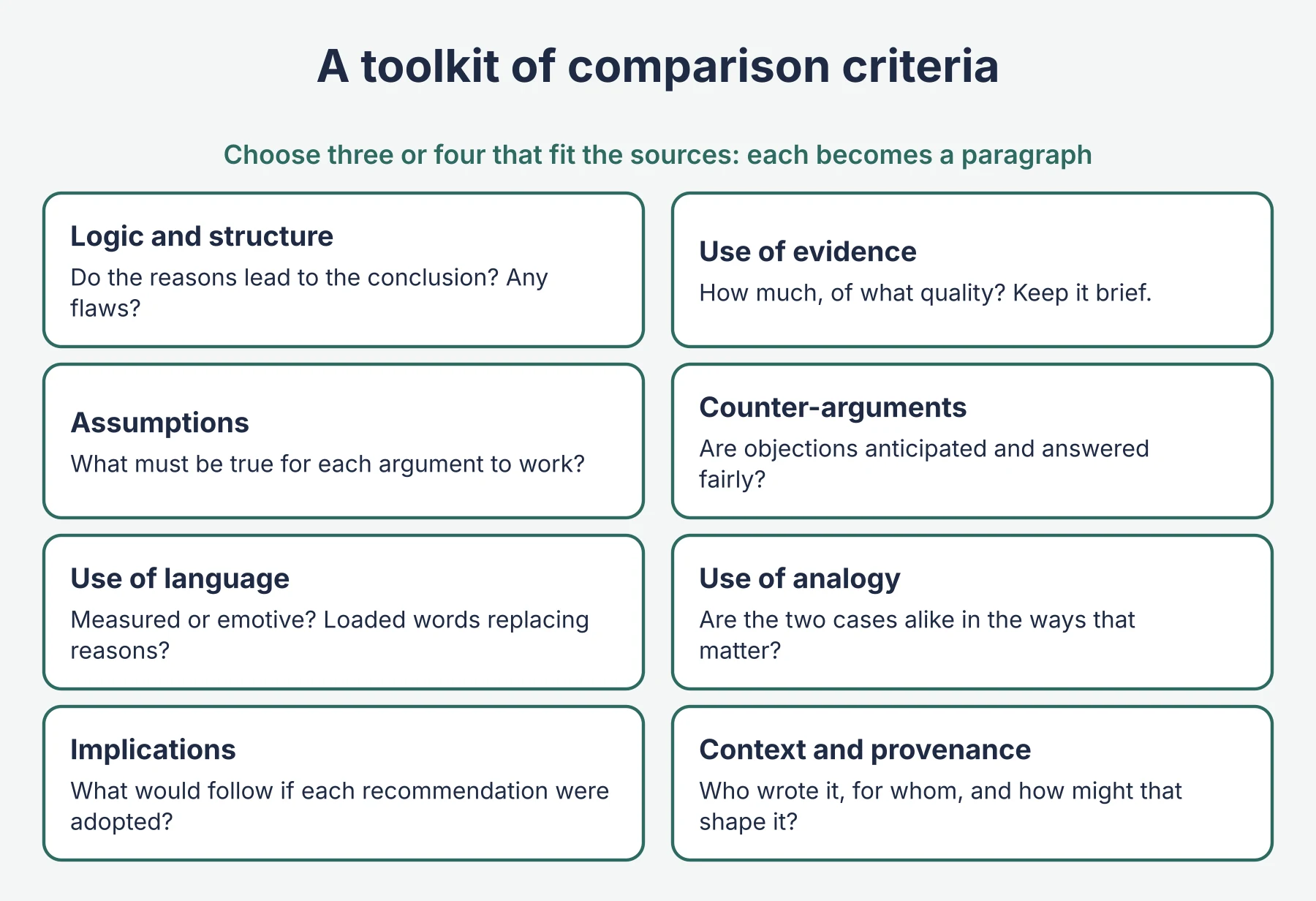
Choose three or four criteria that fit the sources in front of you. Each criterion becomes a paragraph in which both sources appear.
| Criterion | Questions to ask of both sources |
|---|---|
| Logic and structure | Do the reasons lead to the conclusion? Are there flaws, such as a hasty generalisation or false cause? |
| Use of evidence | How much evidence supports each argument, and of what quality? (Keep this brief; Question 2 handled detail.) |
| Assumptions | What must be true for each argument to work? Are those assumptions reasonable? |
| Counter-arguments | Does each source anticipate objections and answer them fairly, or ignore them? |
| Use of language | Is the language measured or emotive? Does loaded wording replace reasoning? |
| Use of analogy | The Critical Path asks you to “assess the use of analogy”. Are the two cases being compared really alike in the ways that matter? |
| Implications | The Critical Path asks you to “suggest the consequences of the conclusions”. What would follow if each recommendation were adopted? Are the consequences acknowledged? |
| Context and provenance | The Critical Path asks you to “explain the context in which the arguments have been made”. Who wrote each source, for whom, and how might that shape the argument? |
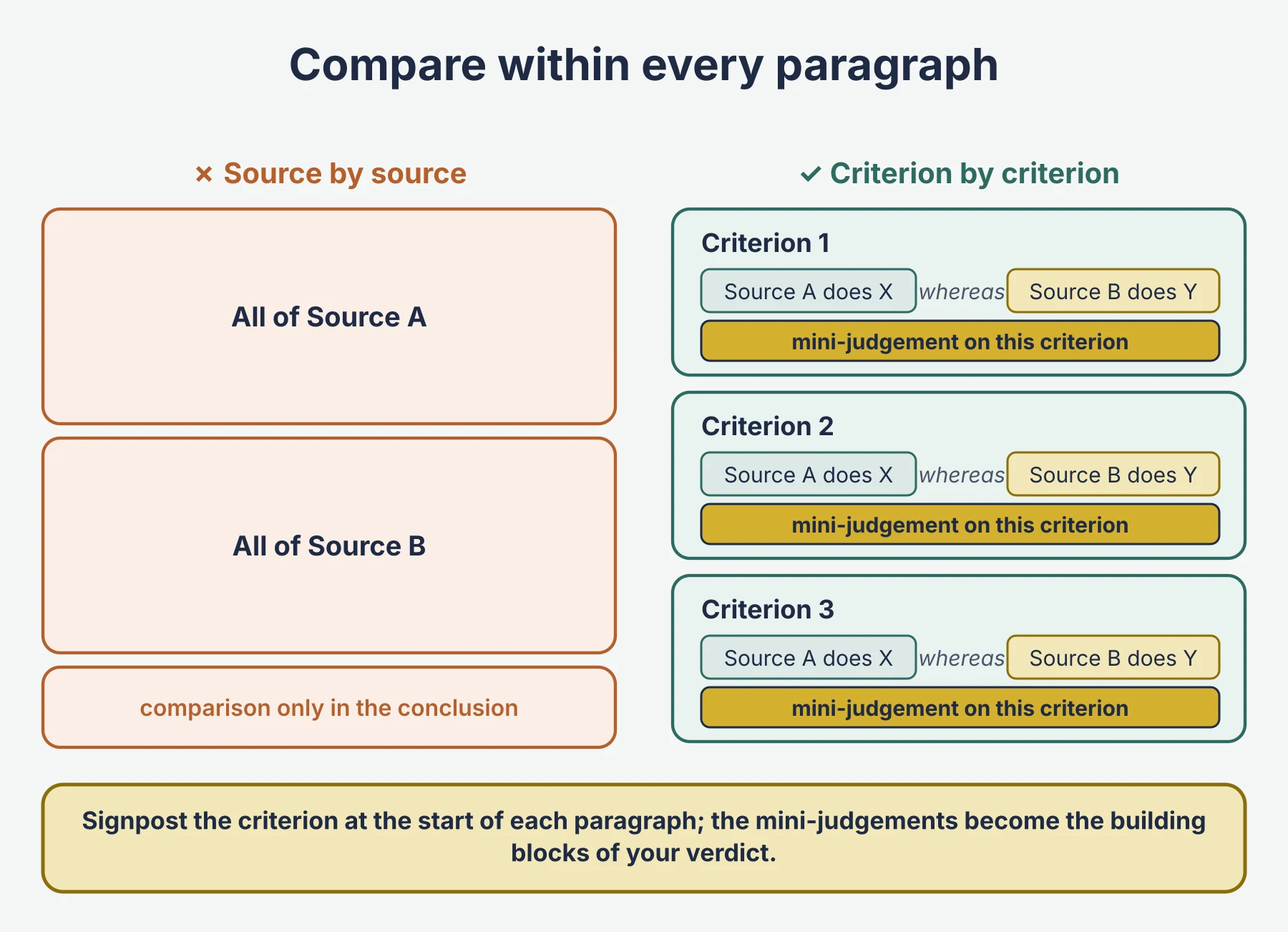
Two rules for using the toolkit:
- Compare within each paragraph. “Source A does X, whereas Source B does Y” in the same paragraph is the core move. Writing all of Source A, then all of Source B, leaves the comparison to the reader.
- Make each paragraph end with a mini-judgement. “On this criterion, Source B is stronger because …” These mini-judgements become the building blocks of your overall verdict.
Reaching a reasoned judgement
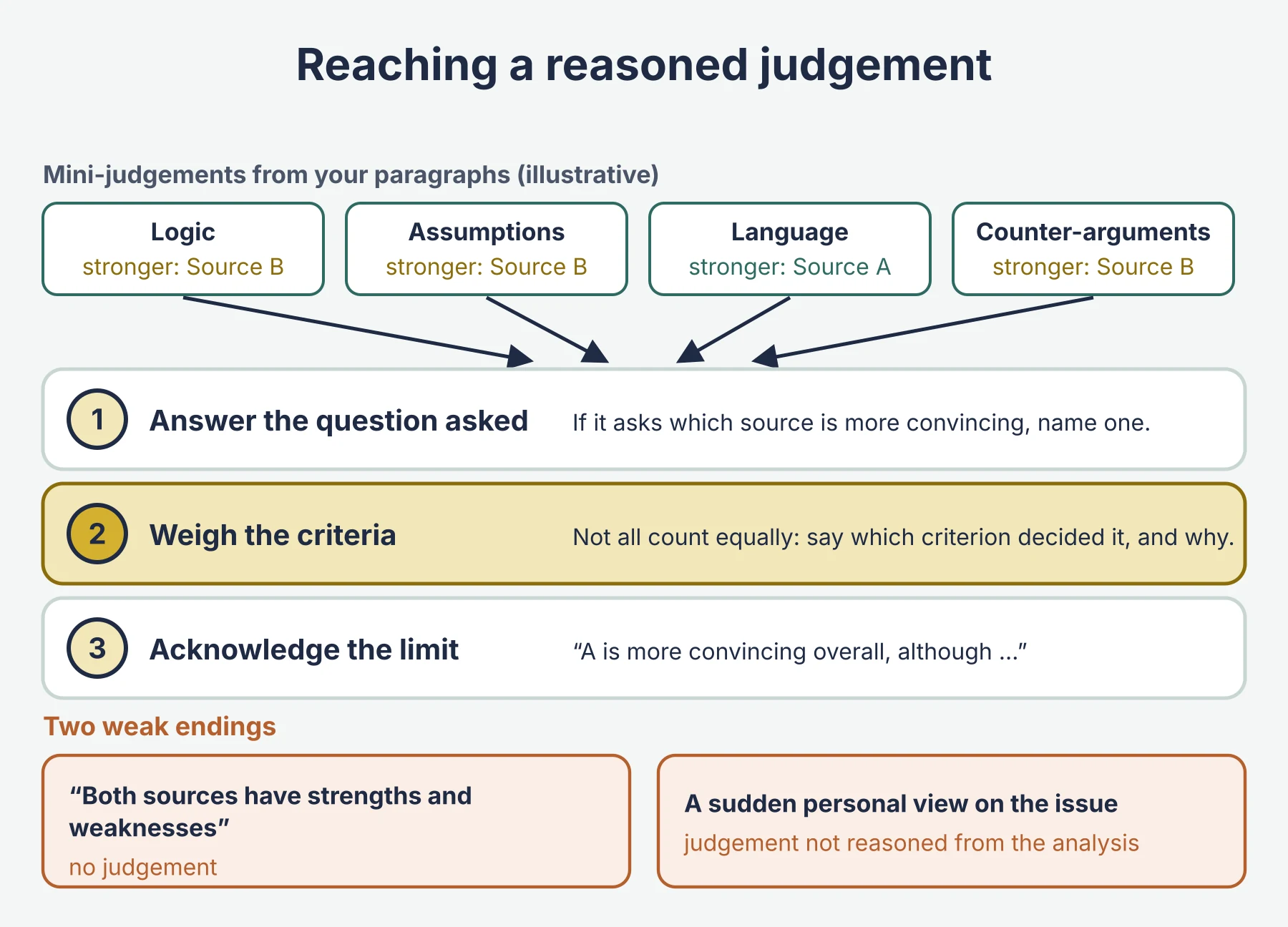
A reasoned judgement does three things:
- Answers the question asked. If it asks which source is more convincing, name one.
- Weighs the criteria. Not all criteria matter equally. A source with emotive language but sound logic and good evidence may still be more convincing than a calm source with a broken central assumption. Say which criterion decided it and why.
- Acknowledges the limit. “Source A is more convincing overall, although its perspective overlooks …” This is not sitting on the fence; it shows you have weighed the other side and still reached a verdict.
Avoid two weak endings: “Both sources have strengths and weaknesses” (no judgement) and a sudden personal view on the issue with no link to the sources (judgement not reasoned from the analysis).
Communicating clearly and logically (AO3)
- Open with your line of argument. A two-sentence introduction that states which source you judge more convincing and the main reason gives the reader a map.
- Signpost the criterion at the start of each paragraph: “The sources differ most sharply in their assumptions.”
- Use the vocabulary precisely: conclusion, reason, assumption, counter-argument, perspective, context. Precise terms are part of clear communication.
- Quote briefly. Short phrases embedded in your sentences show close reading without filling space.
- Keep the conclusion consistent with the mini-judgements. If three paragraphs favoured Source B, a conclusion favouring Source A needs a stated reason.
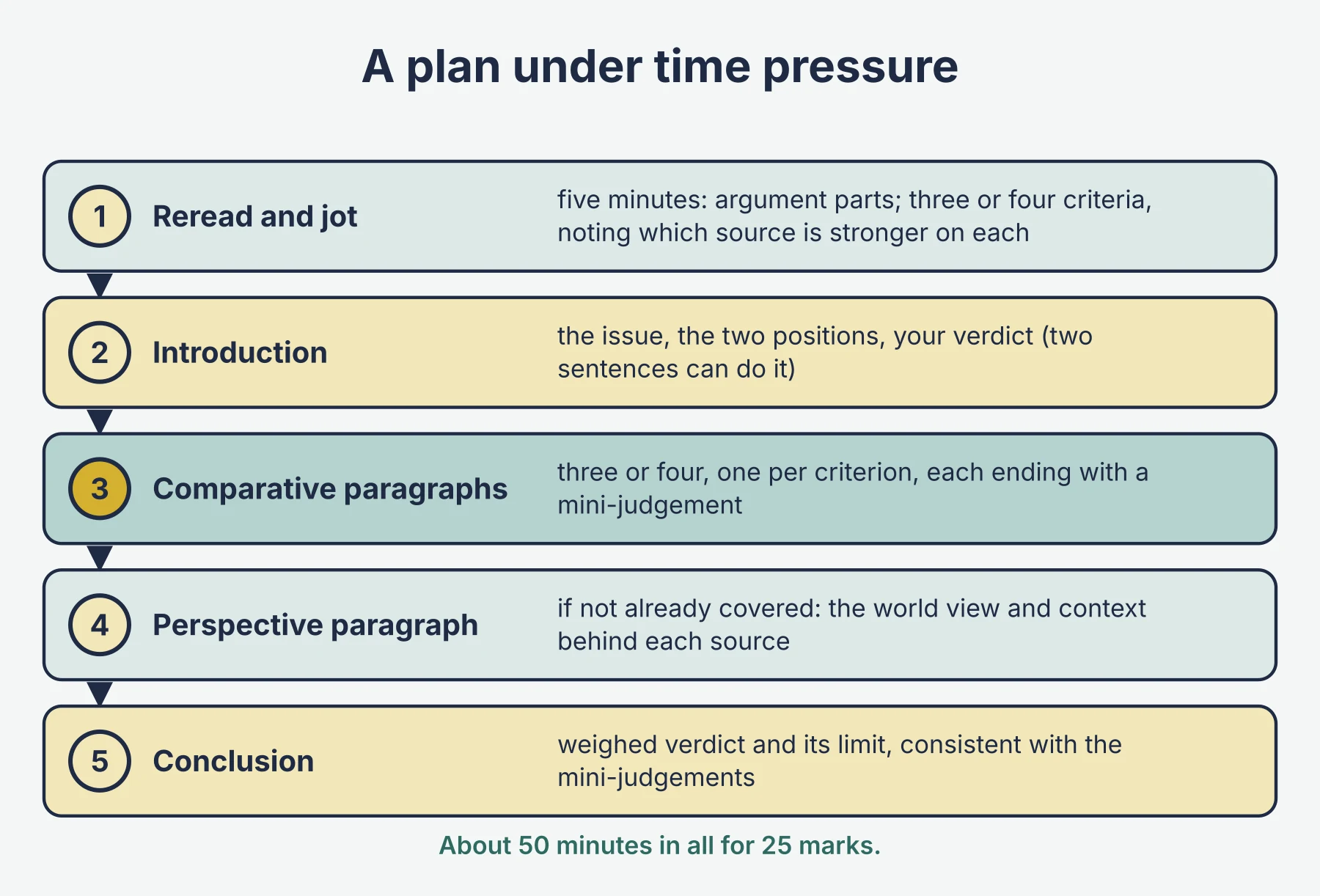
A plan you can use under time pressure
- Five minutes: reread both sources for argument parts; jot three or four criteria with a note of which source is stronger on each.
- Introduction: issue, the two positions, your verdict.
- Three or four comparative paragraphs, one per criterion, each ending with a mini-judgement.
- Perspective paragraph (if not already covered): the world view and context behind each source.
- Conclusion: weighed verdict and its limit.
Worked example
The two short sources below are original and written for this guide.
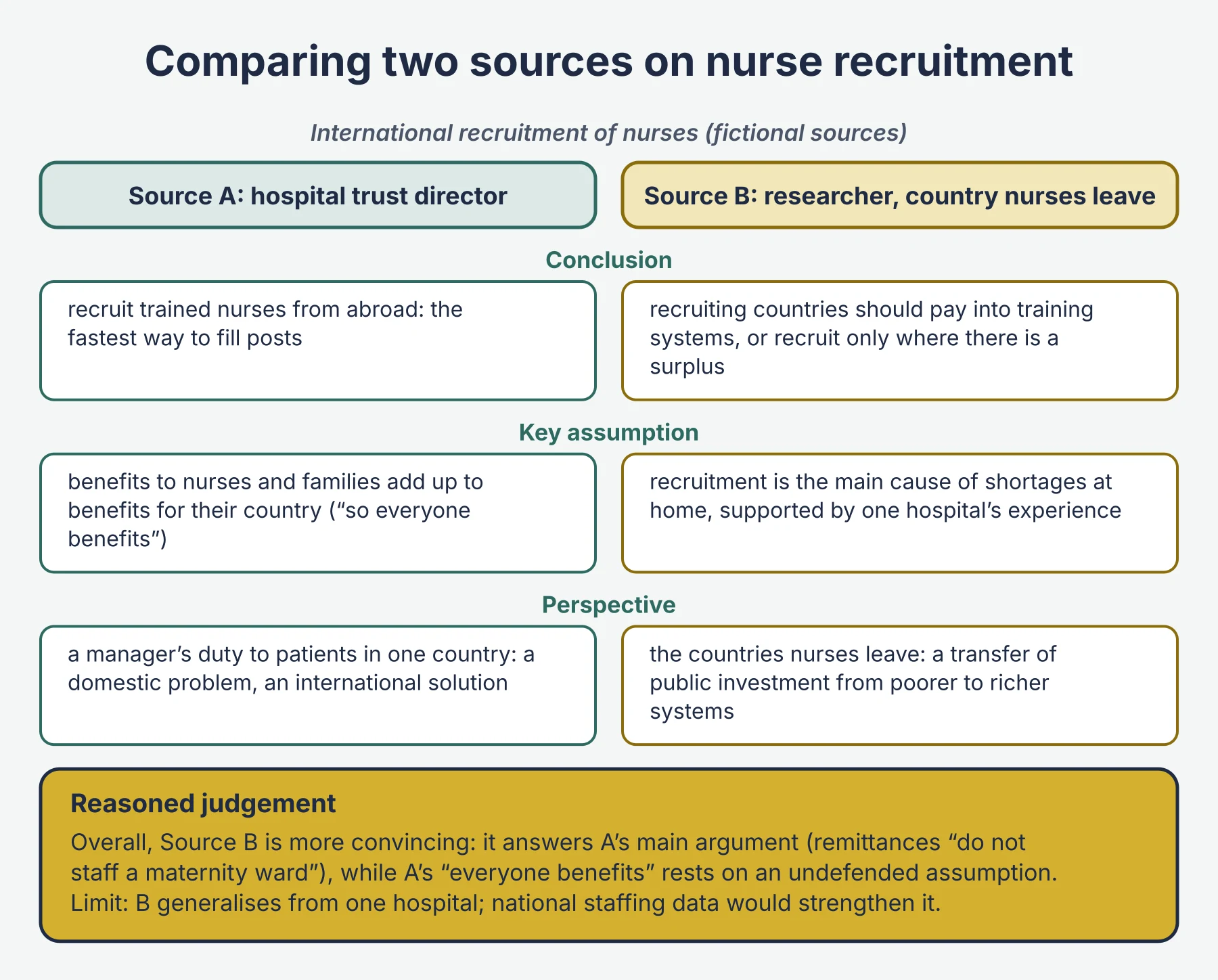
Source A (fictional hospital trust director, writing in a national newspaper). Our wards are short of 4,000 nurses, and patients are waiting longer every month. Recruiting trained nurses from abroad is the fastest way to fill those posts. Nurses who come here earn far more than at home and send money back to their families, so everyone benefits. Training our own nurses takes years; patients cannot wait that long. Countries already trade engineers and doctors; nurses are no different.
Source B (fictional health researcher in a country that nurses leave). When a regional hospital loses ten experienced nurses in a year, the wards they leave behind do not refill. Our training colleges were paid for by our taxpayers, and wealthy countries recruit the graduates without contributing to the cost. Money sent home helps individual families, but it does not staff a maternity ward. Recruiting countries should pay into the training systems they draw on, or recruit only from countries with a surplus of nurses.
Model comparative paragraph (assumptions and analogy): “The sources differ most in what they take for granted. Source A assumes that benefits to individual nurses and their families add up to benefits for their country (‘so everyone benefits’), but this does not follow: Source B’s point that remittances ‘do not staff a maternity ward’ exposes the gap between private gain and public health care. Source A’s analogy with the trade in engineers and doctors is also weak, because it compares nurses with other skilled workers without addressing whether their departure leaves gaps that cannot be filled. Source B assumes that recruitment is the main cause of shortages at home, which it supports only with one hospital’s experience. On this criterion Source B is stronger, because its central assumption is narrower and its reply to the remittance argument is direct, while Source A’s key inference is unsupported.”
Model perspective sentence: “Source A’s perspective is shaped by a manager’s duty to patients in one country, so it treats the shortage as a domestic problem with an international solution; Source B’s is shaped by the experience of the countries nurses leave, so it treats the same movement as a transfer of public investment from poorer to richer health systems.”
Model conclusion: “Overall, Source B is more convincing. Both rely on limited evidence, but Source B answers its opponent’s main argument, while Source A’s claim that ‘everyone benefits’ depends on an assumption it never defends. Source B’s weakness is that it generalises from one hospital, so its case would be stronger with national staffing data; even so, its reasoning is sounder.”
Common mistakes
- Source-by-source summary. Two halves with a comparison only in the conclusion.
- Comparing topics, not arguments. “Both talk about nurses” is not a comparison.
- Repeating Question 2. A long evaluation of one source’s evidence at the expense of logic, assumptions and perspectives.
- Judging the issue, not the sources. Arguing your own view on nurse recruitment with little reference to how well each source argues.
- Naming flaws without showing them. Give the quotation and explain why the step does not follow.
- Undefended verdict. “Source A is better” with no criterion that decides it.
- Context as guesswork. Comments on the writer’s position must be tied to how it shapes the argument, not used to dismiss the source.
Condense the toolkit with the Question 3 revision notes and practise it with the Question 3 practice questions. The earlier questions on the paper are covered in Question 1: short answers on two sources and Question 2: evaluating evidence.
Frequently asked questions
Is Question 3 my personal opinion on the issue? No. The syllabus asks you to focus on “the arguments and perspectives given in the documents and provide a reasoned judgement”. The judgement is about the sources’ arguments and perspectives, reached through your comparison.
How many criteria should I use? Three or four, developed with both sources in each paragraph, usually fit the time better than six or seven touched briefly.
Is it acceptable to conclude that the sources are equally convincing? Only if you show which criteria balance out and why. Most questions ask for a decision, so a clear verdict with its limits is safer.
Related resources
-
Practice questions
Cambridge International AS & A Level Global Perspectives & Research (9239): Written Exam Question 3 – Comparing Arguments and Perspectives – Practice Questions
Original practice for 9239 Written Exam Question 3: comparing two new sources on car-free city centres, building paragraphs and a 25-mark judgement.
Global Perspectives · Cambridge · AS Level
Try questions -
Revision notes
Cambridge International AS & A Level Global Perspectives & Research (9239): Written Exam Question 3 – Comparing Arguments and Perspectives – Revision Notes
Recall notes for the 25-mark 9239 Written Exam Question 3: comparison criteria, arguments versus perspectives, judgement rules, AO3 and a self-test.
Global Perspectives · Cambridge · AS Level
Revise topic -
Study guides
Cambridge A-Level Global Perspectives & Research: The Written Exam (9239)
How the 45-mark, source-based Written Exam works in Cambridge AS & A Level Global Perspectives & Research 9239, built around the Critical Path approach.
Global Perspectives · Cambridge · AS Level
Read guide
Studying Global Perspectives?
This page is free and stays free. Marlbridge is not offering Global Perspectives classes at the moment, so there is no tuition to book for it. The free study resources stay open to everyone.
Get free revision emails (optional)
Occasional emails with practice questions, worked explanations and links to free resources for the qualification and subjects you choose. No spam, and you can unsubscribe from any email. The free tools on this site never need an email.