
Revision Notes
Cambridge International AS & A Level Global Perspectives & Research (9239): Written Exam Question 1 – Short Answers on Two Sources – Revision Notes
Recall notes for 9239 Written Exam Question 1: statement types, argument parts, indicator words, comparing two sources, exam traps and a self-test.
- Subject
- Global Perspectives
- Level
- AS LEVEL
- Topic
- Component 1 – Written Exam
- Author
- Marlbridge Academic Team
- Updated
- Reviewed by
- Ammar Bilal (what this means)
Aligned to Cambridge A Level Global Perspectives (9239), 2026-2028. Official specification .
Syllabus page (what it covers and how it is assessed): Cambridge A Level Global Perspectives.
Syllabus topics and points this page is mapped to
9239 (AS Level)
- 1 Component 1 – Written Exam (topic-level mapping)
"Topic-level mapping" means this page belongs to that topic; it does not claim to cover every point in it.
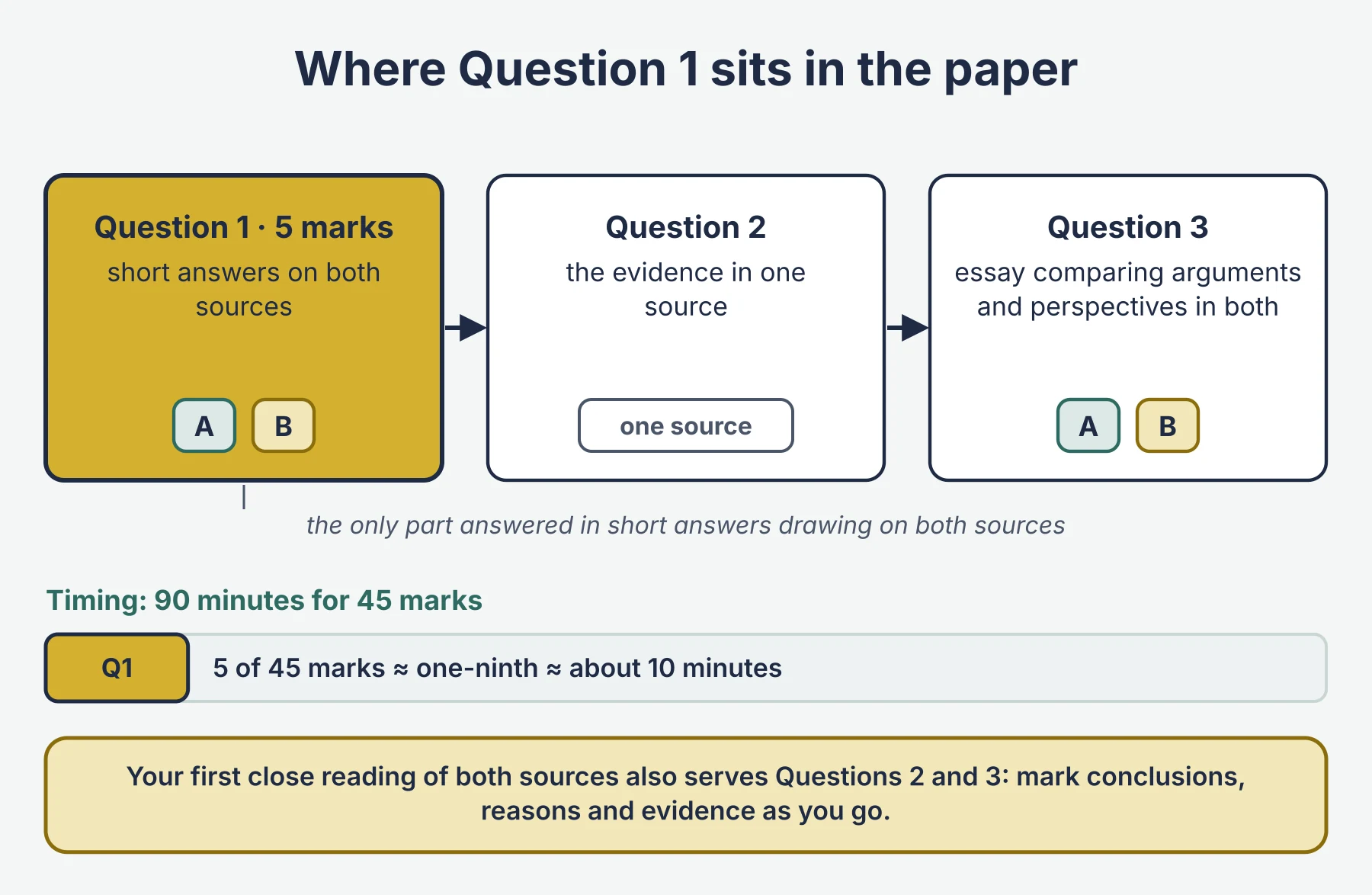
These notes cover Question 1 of Component 1 in Cambridge International AS & A Level Global Perspectives & Research (9239), 2026-2028. The syllabus wording: “Question 1 (5 marks) is a structured question based on two source documents. Candidates are required to read both sources and answer short questions that require candidates to demonstrate AO1 skills.” For the whole paper, see the Component 1 Written Exam study guide; for full explanations of this question, read the Question 1 study guide.
Core facts
- 5 marks of the paper’s 45; the paper lasts 1 hour 30 minutes, so Question 1 is worth roughly ten minutes of writing time.
- Based on both source documents; Question 2 then uses one source, Question 3 both.
- Short questions, AO1 only (research, analysis and evaluation). AO3 communication is credited in Question 3, not here.
- Not assessed on topic knowledge: everything you need is in the sources.
- The split of the 5 marks between parts is not printed in the syllabus and can vary. Check specimen and past papers.
The ten statement types (Critical Path list)
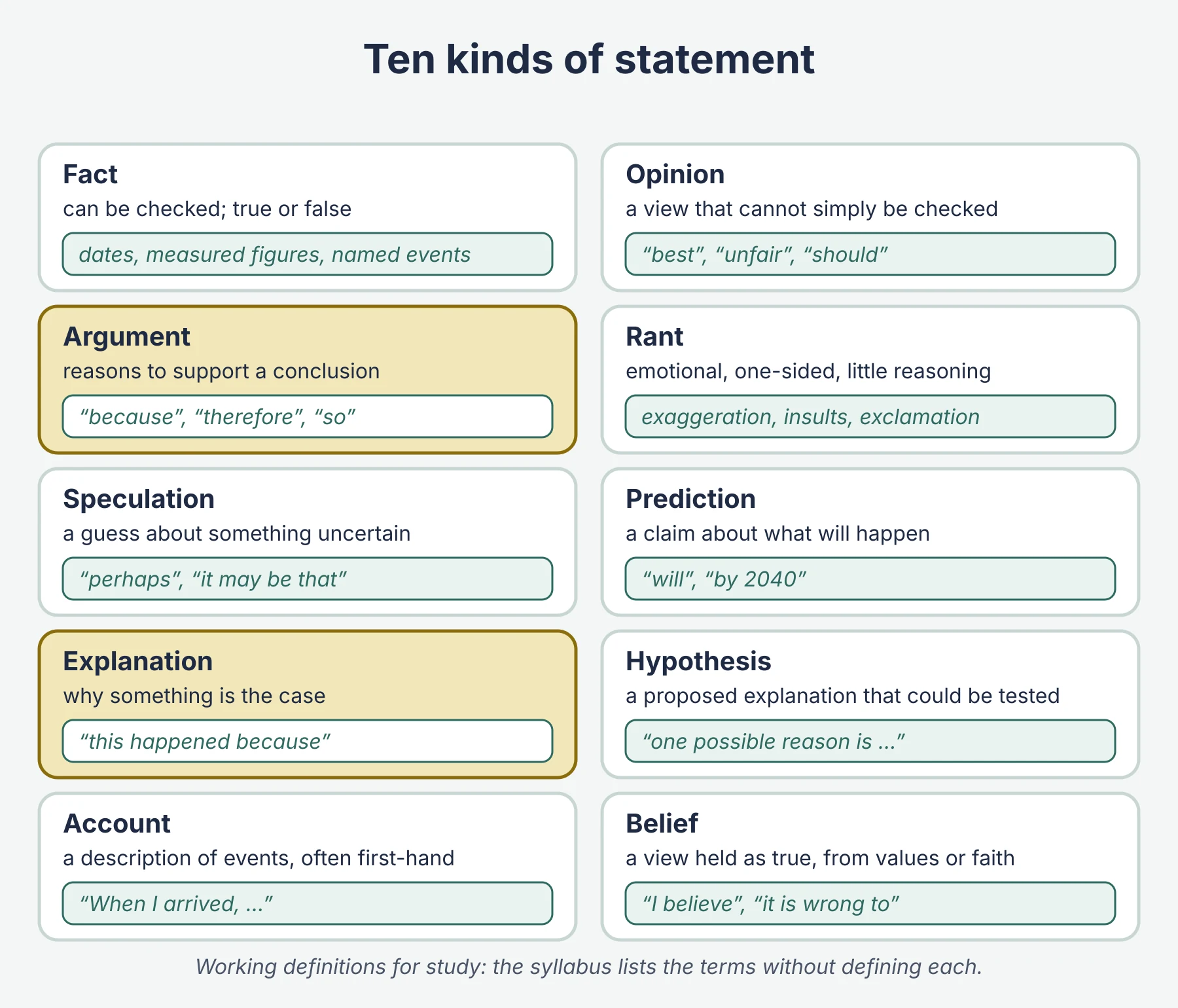
The syllabus asks you to “differentiate between fact, argument, opinion, rant, speculation, prediction, explanation, hypothesis, account and belief”. Working definitions:
| Term | Recall cue |
|---|---|
| Fact | Checkable; true or false |
| Opinion | A judgement; cannot simply be checked |
| Argument | Reasons offered to make you accept a conclusion |
| Rant | Emotional, one-sided, little reasoning |
| Speculation | A loose guess about something uncertain |
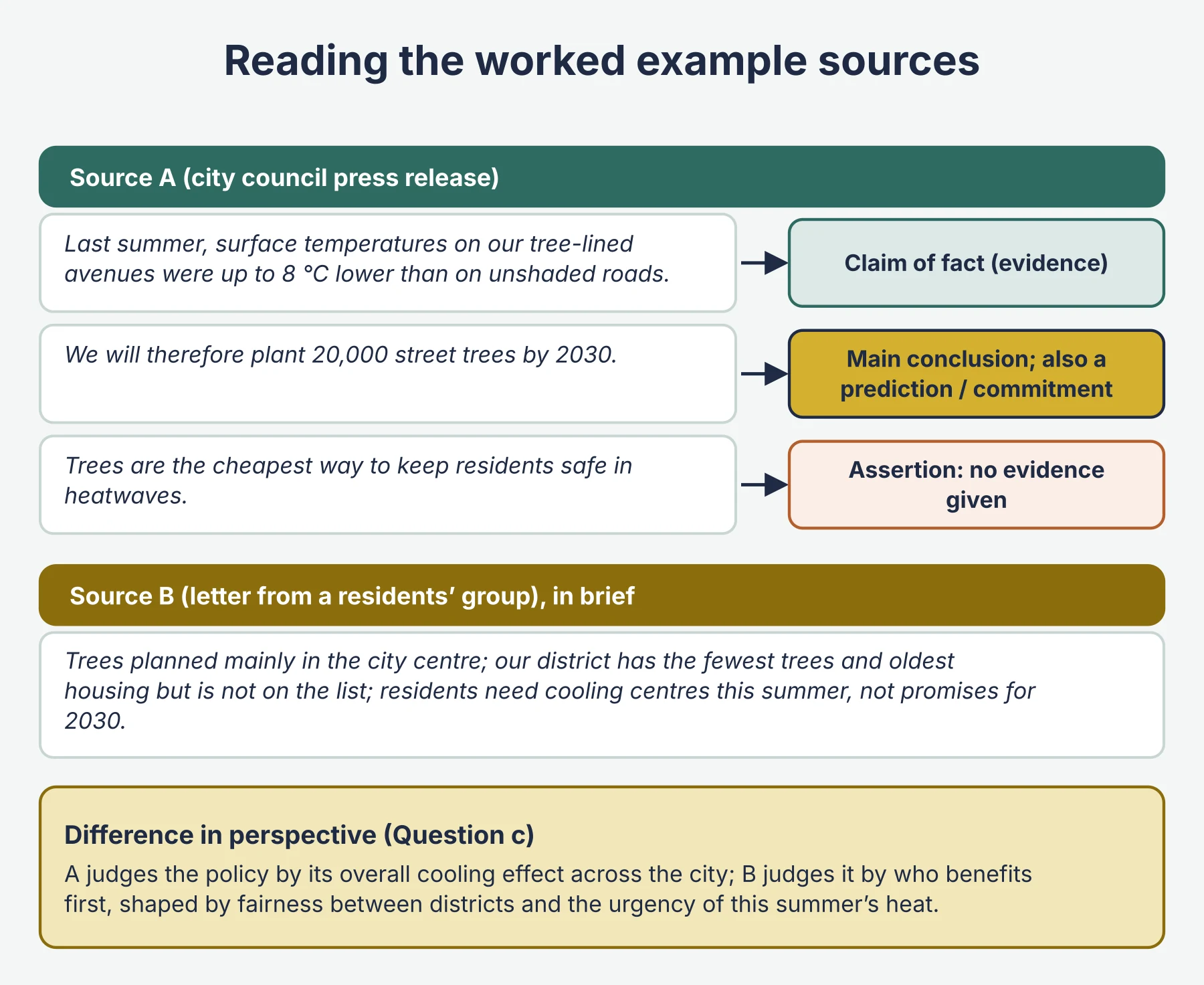
| Prediction | A claim about the future |
| Explanation | Why something accepted is the case |
| Hypothesis | A testable proposed explanation |
| Account | A description of events, often first-hand |
| Belief | A view held as true, often from values |
Parts of an argument
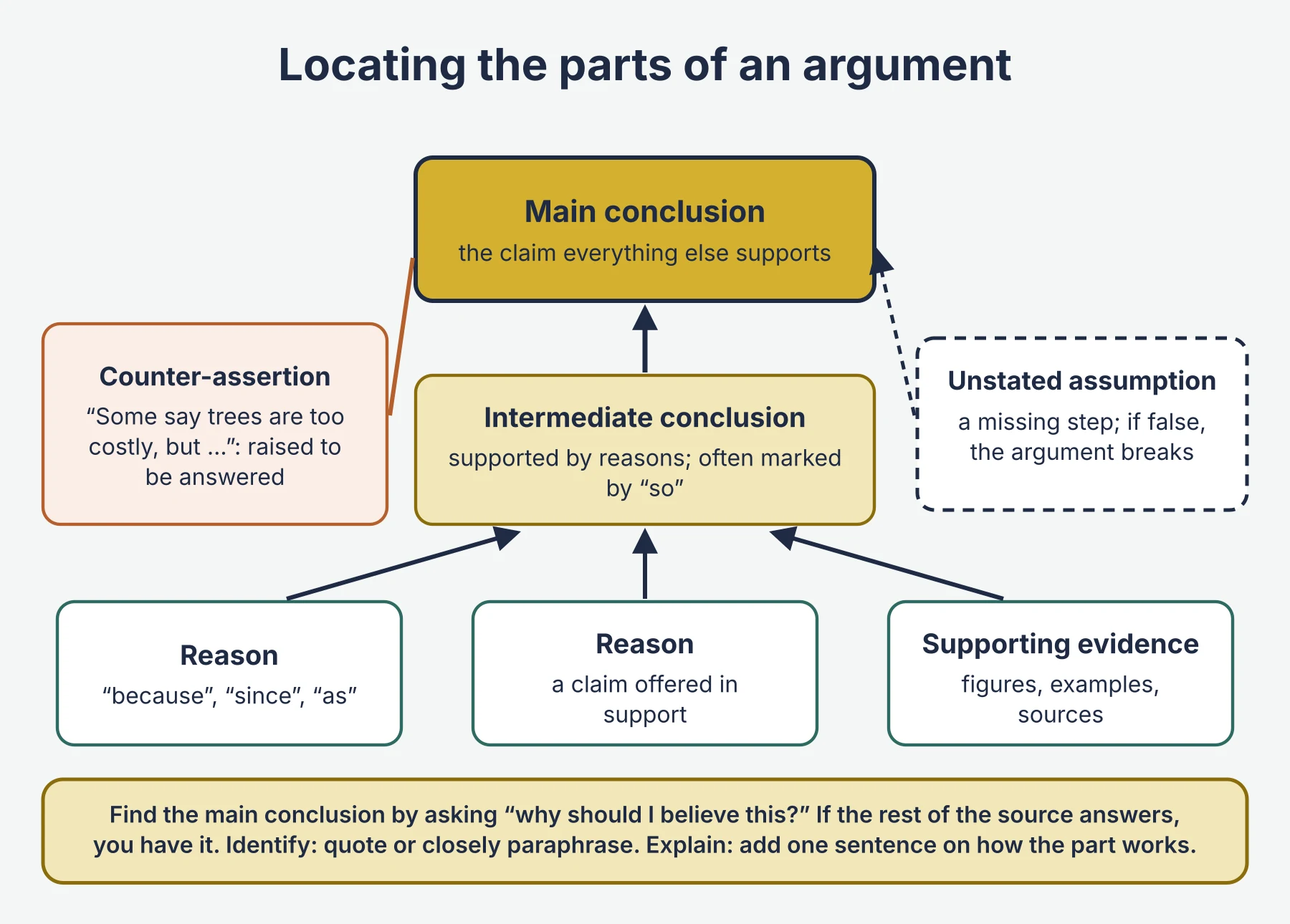
| Part | How to find it |
|---|---|
| Main conclusion | Ask “why should I believe this?”; the rest of the source answers |
| Intermediate conclusion | Supported by reasons, then supports the main conclusion |
| Reason (premise) | Offered in support; often after “because”, “since”, “as” |
| Evidence | Data, examples or testimony backing a reason |
| Stated assumption | A premise the writer says is taken for granted |
| Unstated assumption | A missing step; if false, the argument fails |
| Assertion | A claim given without support |
| Counter-assertion | An opposing view raised in order to answer it |
Indicator words. Conclusion: therefore, so, thus, consequently, we should. Reason: because, since, as, given that. Counter-assertion: some argue, critics claim, admittedly, although. Indicator words help, but test the logic: “so” can also introduce an explanation.
Must-know distinctions
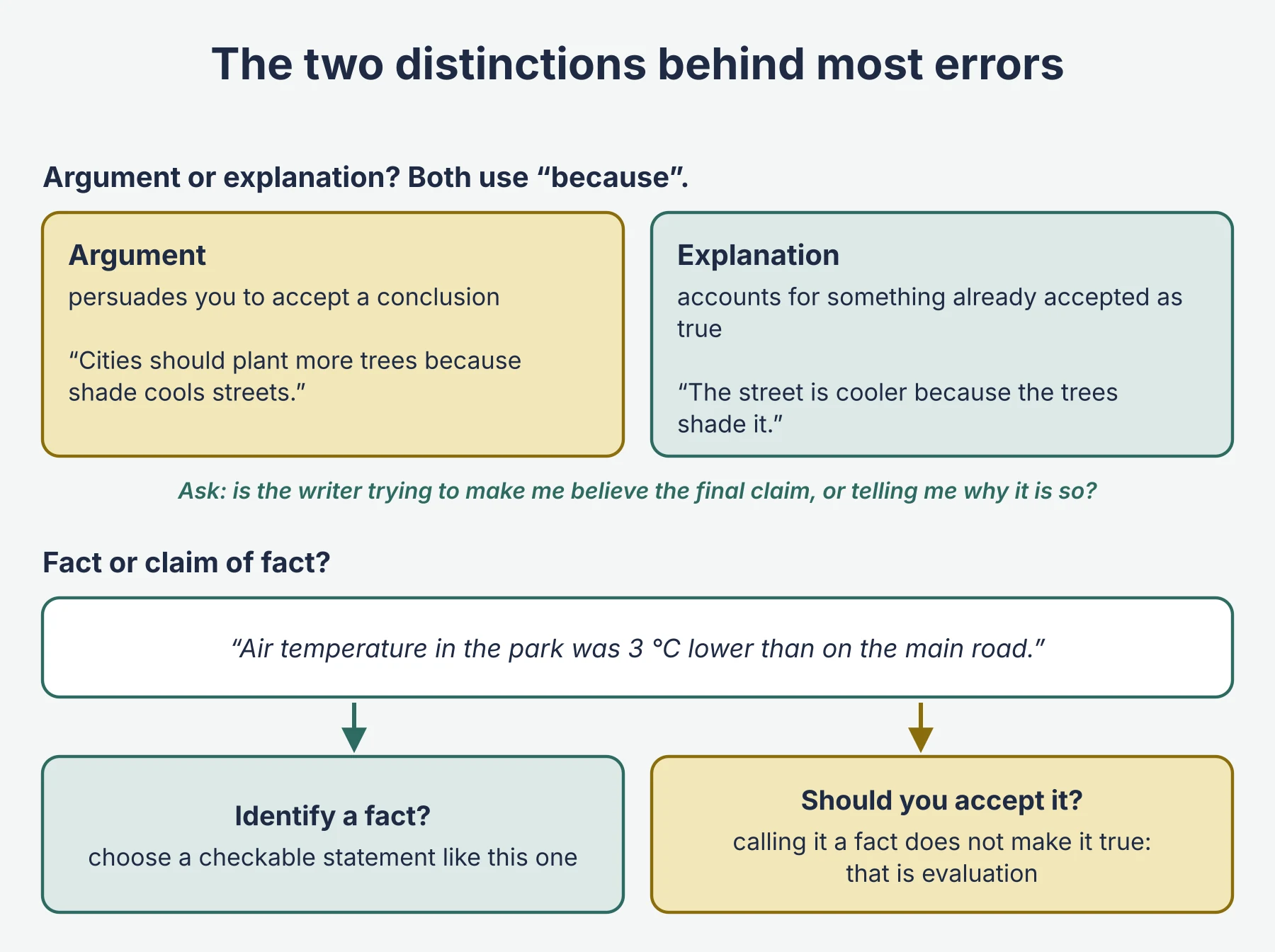
- Argument vs explanation. Argument persuades you to accept a claim; explanation tells you why an accepted fact holds.
- Fact vs claim of fact. A checkable statement is a claim of fact; whether it is true or reliable is an evaluation question.
- Topic vs conclusion. “Water prices” is a topic; “water should be priced by use” is a conclusion.
- Prediction vs speculation. A prediction may rest on reasons or trends; speculation is a loose guess with little support.
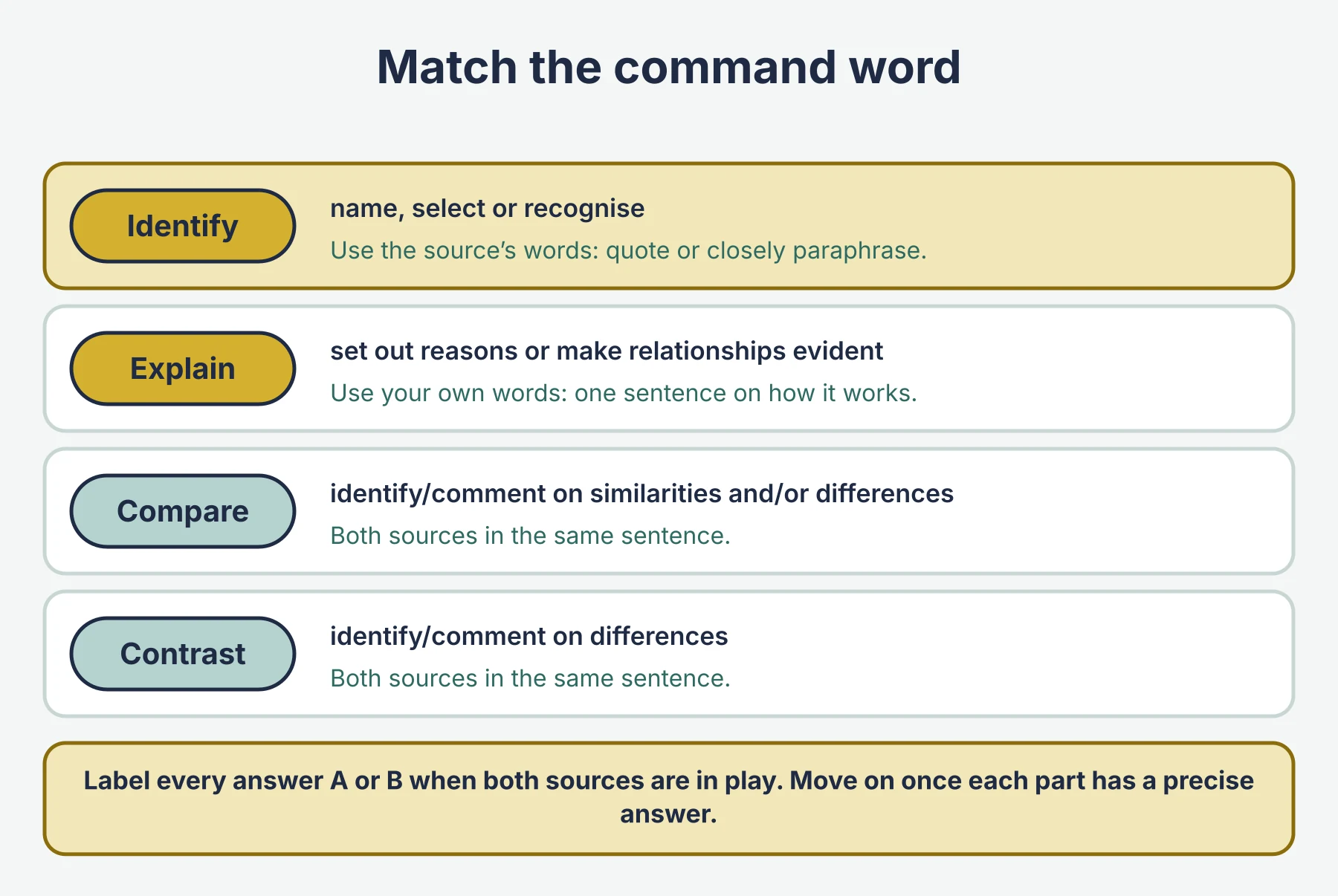
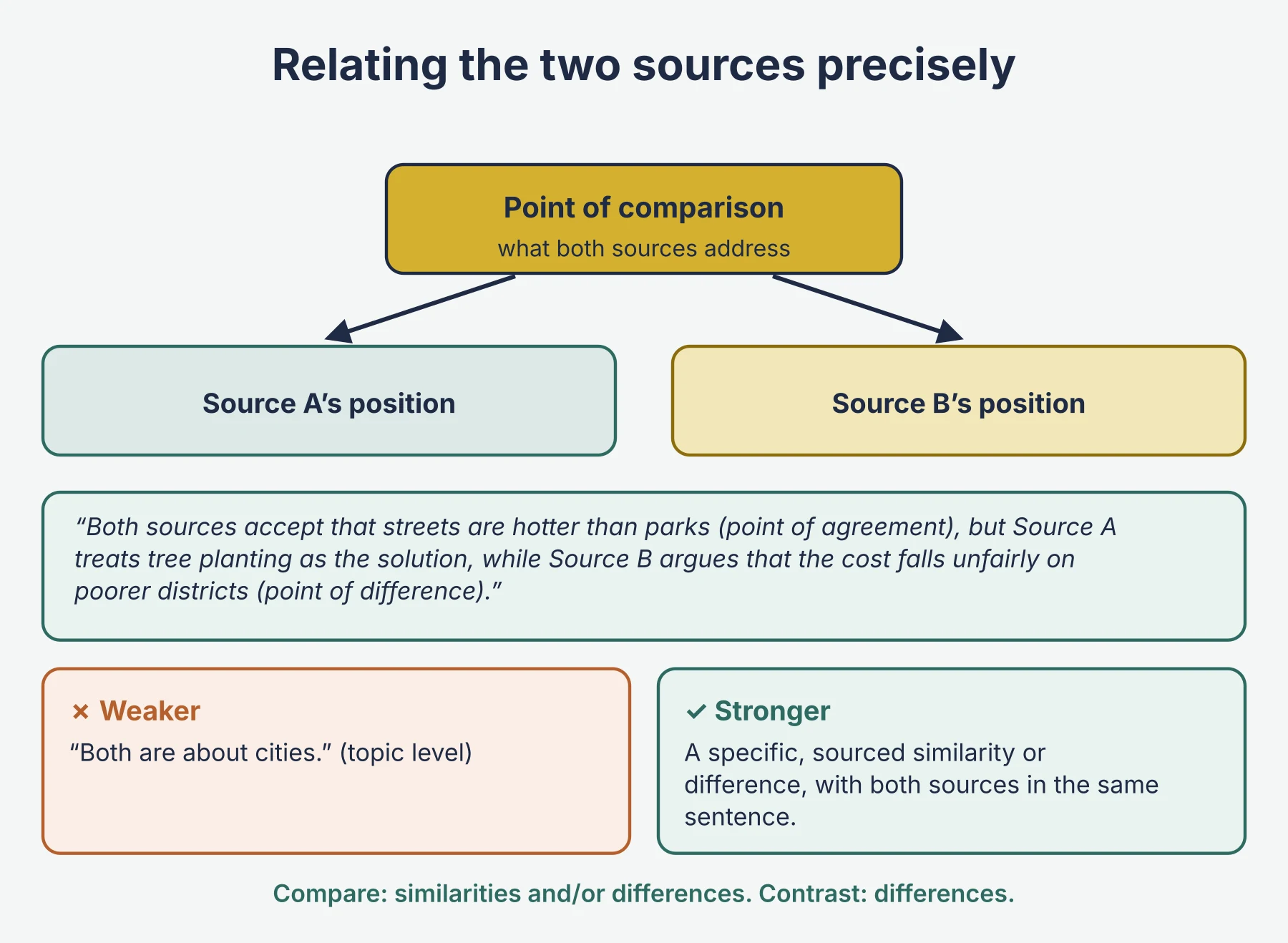
- Compare vs contrast. The syllabus defines compare as “identify/comment on similarities and/or differences” and contrast as “identify/comment on differences”.
- Identify vs explain. Identify: name or select, close to the source wording. Explain: add how or why, in your own words.
A precise comparison in one sentence
Template: On [specific point], Source A [position], whereas Source B [position], because [basis of each perspective].
Example: “On who should pay for flood barriers, Source A wants the national government to fund them, whereas Source B wants local property owners to contribute, because A treats flooding as a national risk and B treats it as a local benefit.”
Exam traps
- Writing an essay-length answer to a short part, then running short of time for Question 3.
- Answering from the wrong source, or not saying which source you mean.
- Labelling a number as “a fact” when the question really asks whether it can be trusted.
- Giving the topic of a source when asked for its conclusion.
- Calling an explanation an argument because it contains “because”.
- Forcing a label on to a sentence that does not fit it; if a part is missing from a source, choose the best-supported answer and quote it accurately.
- Comparing at topic level (“both discuss water”) instead of naming a specific point of similarity or difference.
Self-test
- How many marks is Question 1 worth, and how many sources does it draw on?
- Which assessment objective does Question 1 test?
- Define a prediction and give a signal word.
- “Rents rose because more people moved into the city.” Argument or explanation?
- What test identifies a main conclusion?
- What makes an assumption “unstated”?
- Give two words that often introduce a reason.
- What is a counter-assertion?
- What does the syllabus say “contrast” means?
- “Bottled water is a waste of money!!! Anyone who buys it is a fool.” Which statement type is this?
- Why is it risky to call a statistic in a source “a fact”?
- How should you word an “identify” answer?
Answers
- 5 marks; both source documents.
- AO1 (research, analysis and evaluation).
- A claim about what will happen; for example “will” or a future date.
- Explanation: it accounts for an accepted rise rather than persuading you of a conclusion.
- Ask “why should I believe this?”; the claim the rest of the passage supports is the main conclusion.
- The writer does not say it, but the argument needs it to be true.
- Any two of: because, since, as, given that.
- An opposing view that the writer raises in order to respond to it.
- “Identify/comment on differences”.
- A rant: emotional, one-sided, with an insult and no reasoning.
- It is only a claim of fact; its reliability depends on who produced it and how, which is an evaluation question.
- Name or select the item using words close to the source, labelled with the source letter.
Practise these skills with the Question 1 practice questions.
Related resources
-
Study guides
Cambridge International AS & A Level Global Perspectives & Research (9239): Written Exam Question 2 – Evaluating the Evidence in One Source
How to plan and write the 15-mark Question 2 in the 9239 Written Exam: mapping the evidence in one source, testing each piece and reaching a judgement.
Global Perspectives · Cambridge · AS Level
Read guide -
Practice questions
Cambridge International AS & A Level Global Perspectives & Research (9239): Written Exam Question 2 – Evaluating the Evidence in One Source – Practice Questions
Original practice for 9239 Written Exam Question 2: evaluating statistics, a survey, expert and anecdotal evidence in one new source, with full answers.
Global Perspectives · Cambridge · AS Level
Try questions -
Revision notes
Cambridge International AS & A Level Global Perspectives & Research (9239): Written Exam Question 2 – Evaluating the Evidence in One Source – Revision Notes
Recall notes for 9239 Written Exam Question 2: testing evidence by type, the five evidence-claim gaps, suggesting further evidence and a 15-mark plan.
Global Perspectives · Cambridge · AS Level
Revise topic
Studying Global Perspectives?
This page is free and stays free. Marlbridge is not offering Global Perspectives classes at the moment, so there is no tuition to book for it. The free study resources stay open to everyone.
Get free revision emails (optional)
Occasional emails with practice questions, worked explanations and links to free resources for the qualification and subjects you choose. No spam, and you can unsubscribe from any email. The free tools on this site never need an email.