
Study Guides
Cambridge International AS & A Level Global Perspectives & Research (9239): Written Exam Question 1 – Short Answers on Two Sources
How to answer Question 1 of the 9239 Written Exam: short, precise answers that identify claims, reasons, evidence and perspectives across two sources.
- Subject
- Global Perspectives
- Level
- AS LEVEL
- Topic
- Component 1 – Written Exam
- Author
- Marlbridge Academic Team
- Updated
- Reviewed by
- Ammar Bilal (what this means)
Aligned to Cambridge A Level Global Perspectives (9239), 2026-2028. Official specification .
Syllabus page (what it covers and how it is assessed): Cambridge A Level Global Perspectives.
Syllabus topics and points this page is mapped to
9239 (AS Level)
- 1 Component 1 – Written Exam (topic-level mapping)
"Topic-level mapping" means this page belongs to that topic; it does not claim to cover every point in it.
This guide covers one named part of Component 1 in the Cambridge International AS & A Level Global Perspectives & Research (9239) syllabus for 2026-2028. The syllabus describes it in one sentence: “Question 1 (5 marks) is a structured question based on two source documents. Candidates are required to read both sources and answer short questions that require candidates to demonstrate AO1 skills.” For the shape of the whole paper and the Critical Path, start with the Component 1 Written Exam study guide. This page goes deeper on the short-answer skills that Question 1 rewards.
What Question 1 is testing
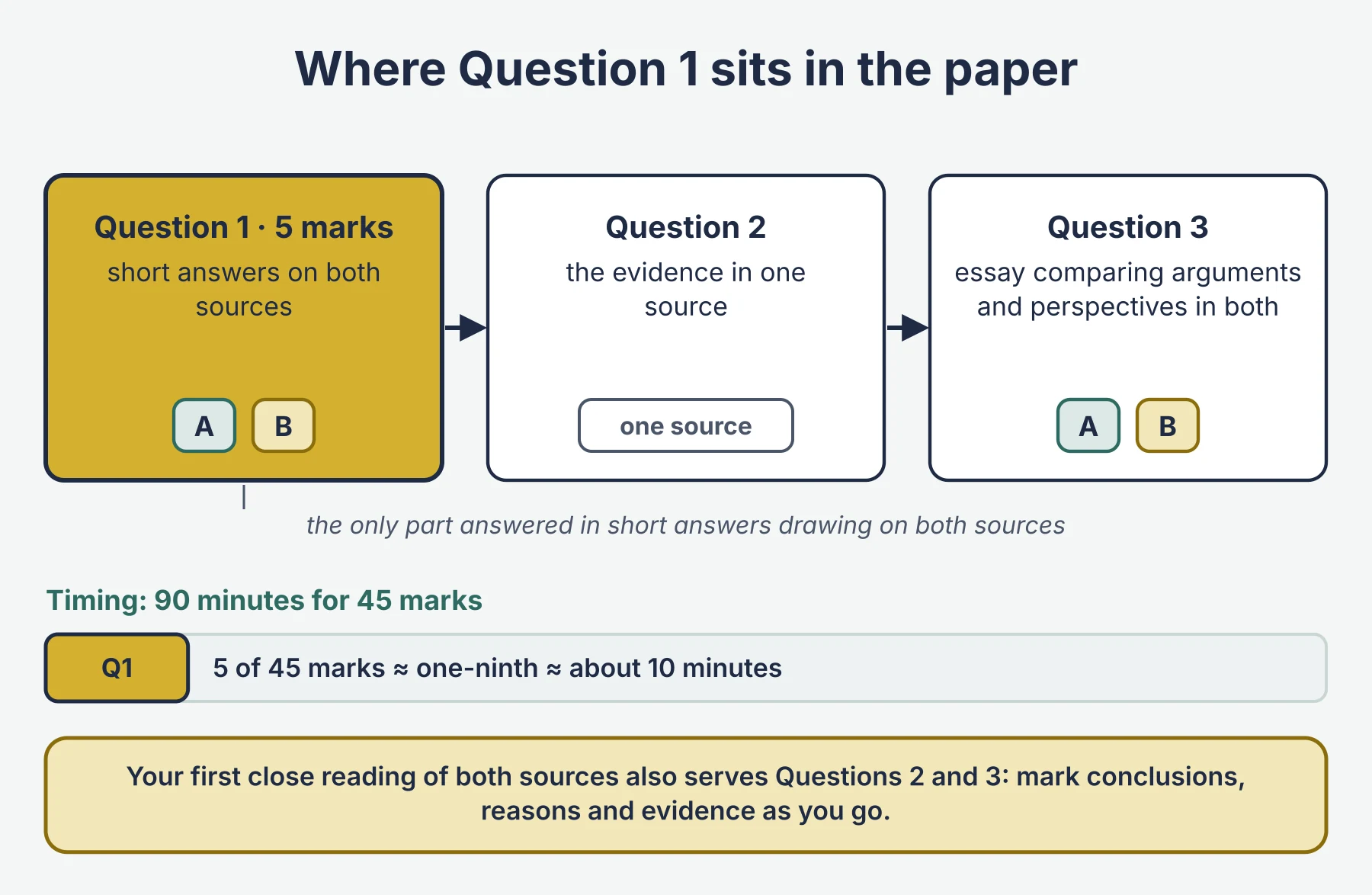
Question 1 is the only part of the paper that draws on both sources through short answers. Question 2 then works on the evidence in one source, and Question 3 asks for an essay comparing the arguments and perspectives in both. Question 1 is therefore your first close reading of the material, and the work you do here feeds the two longer answers.
The AO1 skills named for Component 1 include “identify evidence”, “identify and compare key components of arguments” and “analyse and compare perspectives”. In a short-answer question these become three practical jobs:
- Recognise what kind of statement a sentence is (a fact, an opinion, a prediction and so on).
- Locate the parts of an argument (conclusion, reasons, evidence, assumptions) in the source’s own words.
- Say briefly how the two sources relate: where they agree, where they differ and why.
The syllabus does not print how the five marks are divided between parts, and the structure can vary between papers. Use the specimen and past papers your teacher provides to see the range of short questions that have been set. On timing, five marks out of 45 is about one-ninth of the paper, which is roughly ten minutes of the 90, although the careful first reading of both sources also serves Questions 2 and 3.
Skill 1: classifying statements
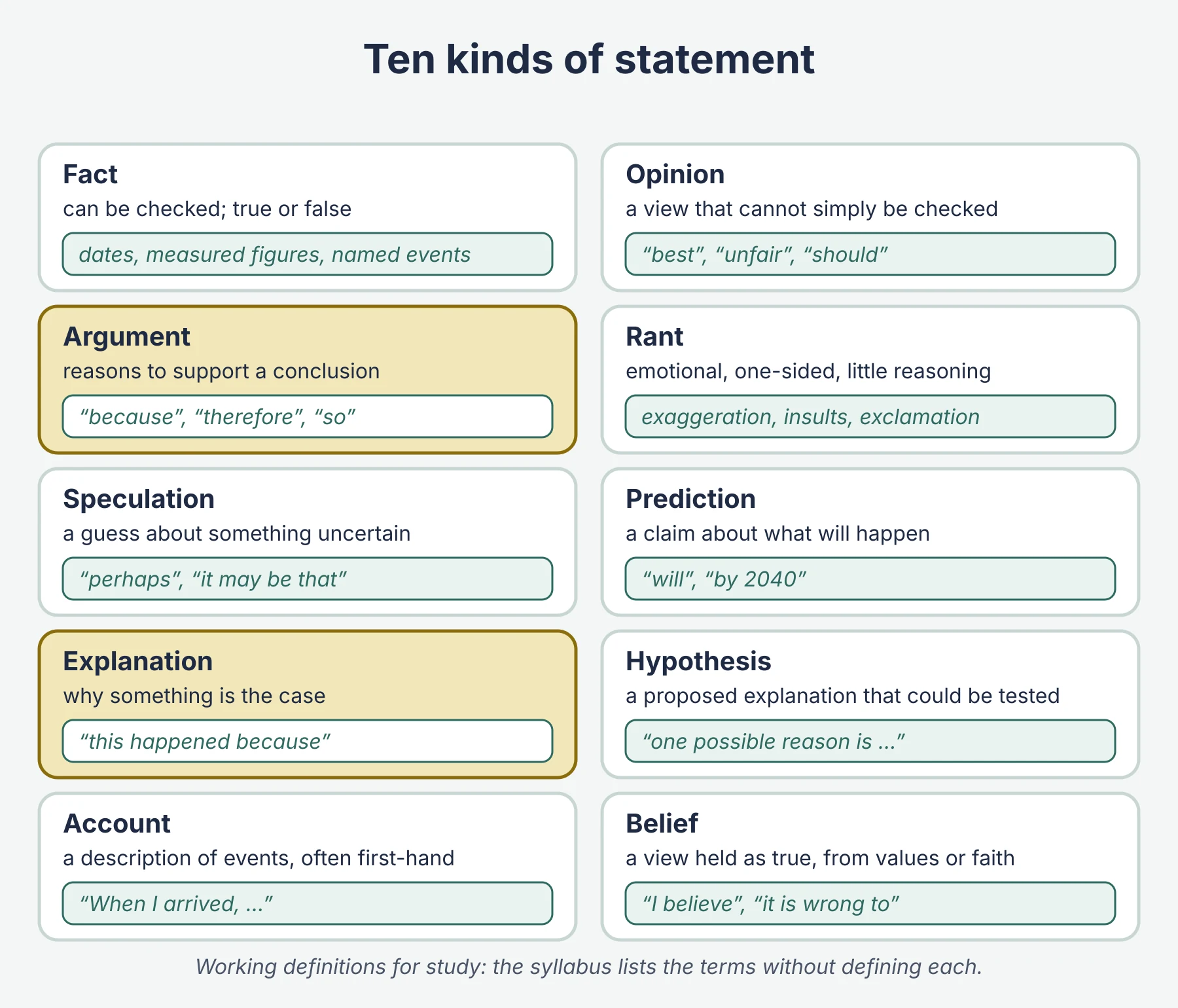
The Critical Path asks learners to “differentiate between fact, argument, opinion, rant, speculation, prediction, explanation, hypothesis, account and belief”. Short questions often turn on this kind of precision. The definitions below are working definitions for study; the syllabus lists the terms without defining each one.
| Type | What it is | Signal you might see |
|---|---|---|
| Fact | A statement that can be checked and is true or false | Dates, measured figures, named events |
| Opinion | A view or judgement that cannot simply be checked | “best”, “unfair”, “should” |
| Argument | Reasons given to support a conclusion | “because”, “therefore”, “so” |
| Rant | Emotional, one-sided outburst with little reasoning | Exaggeration, insults, exclamation |
| Speculation | A guess about something uncertain, with little support | “perhaps”, “it may be that” |
| Prediction | A claim about what will happen | “will”, “by 2040” |
| Explanation | Reasons why something is the case, not why to accept it | “this happened because” |
| Hypothesis | A proposed explanation that could be tested | “one possible reason is … which a study could test” |
| Account | A description of events, often first-hand | “When I arrived, the water was …” |
| Belief | A view held as true, often from values or faith | “I believe”, “it is wrong to” |
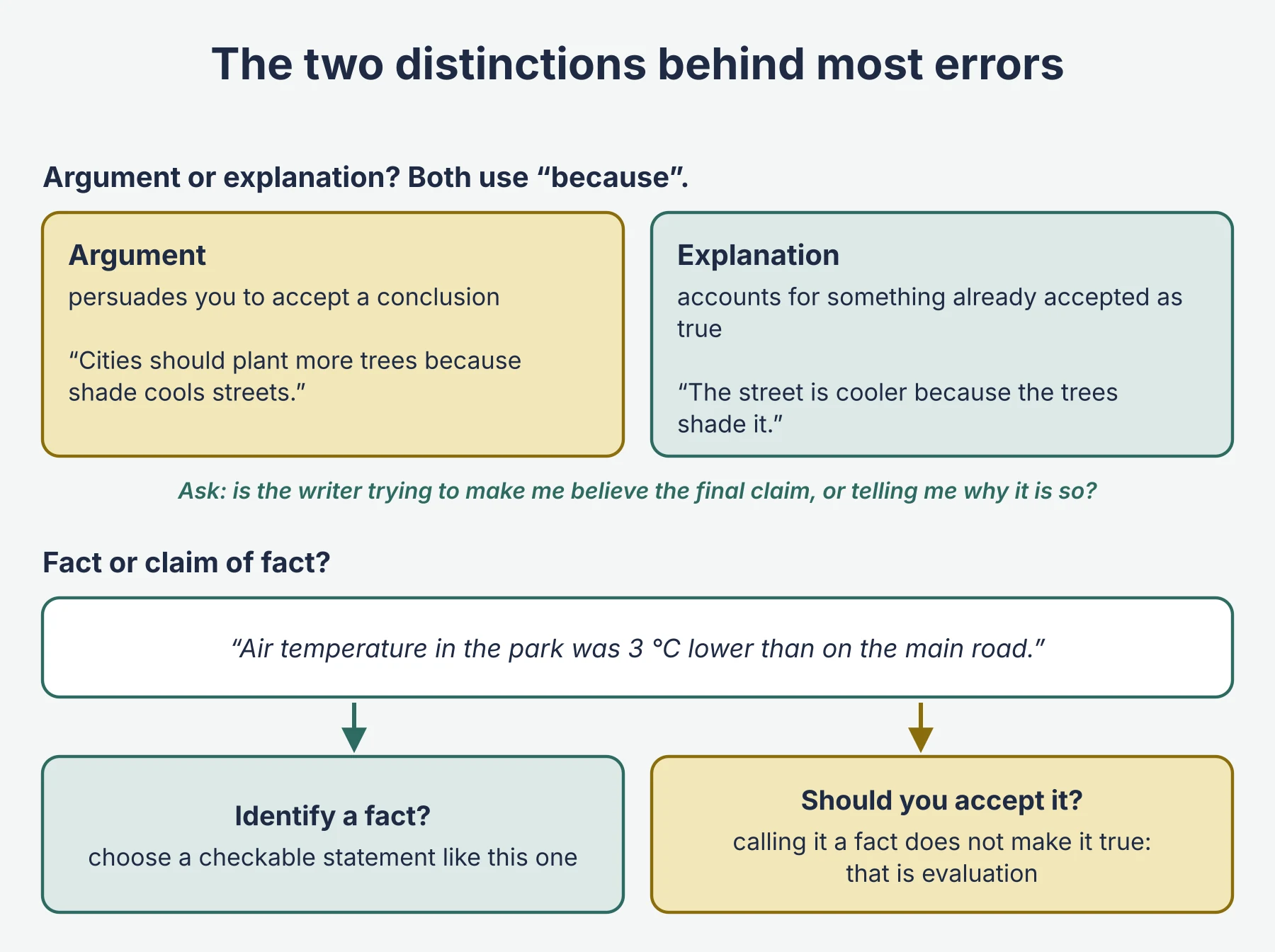
Two distinctions cause most errors:
- Argument or explanation? Both use “because”. An argument tries to persuade you to accept a conclusion (“Cities should plant more trees because shade cools streets”). An explanation accounts for something already accepted as true (“The street is cooler because the trees shade it”). Ask: is the writer trying to make me believe the final claim, or telling me why it is so?
- Fact or claim of fact? “Air temperature in the park was 3 °C lower than on the main road” is a claim of fact: it is the kind of statement that could be checked. Calling it a fact does not mean it is true. If a question asks you to identify a fact, choose a checkable statement; if it asks whether you should accept it, you are moving into evaluation.
Skill 2: locating the parts of an argument
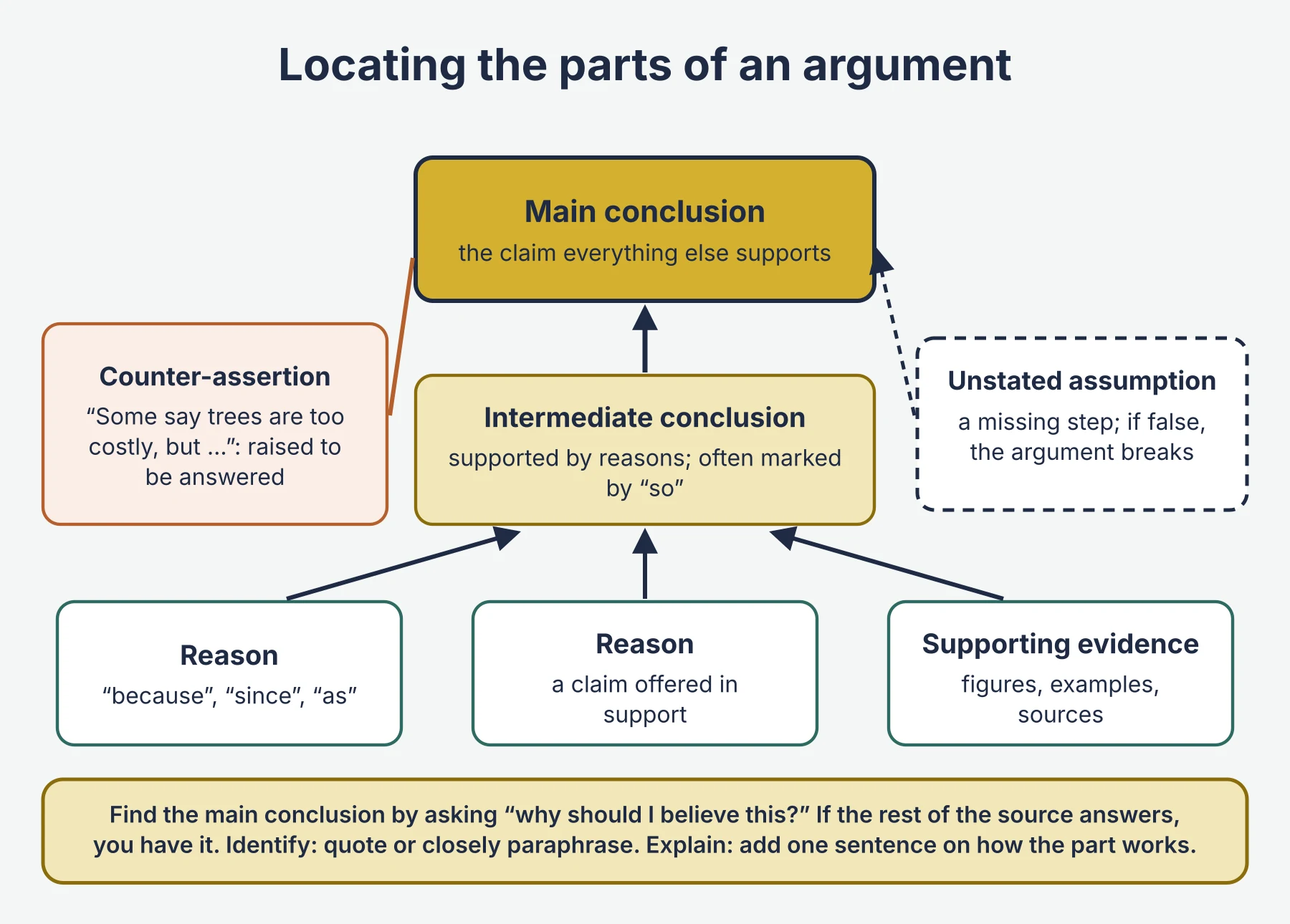
The syllabus vocabulary is “conclusions, reasons (premises), assumptions (stated and unstated), assertions (and counter-assertions) and supporting evidence”. In a short answer, the mark usually goes to finding the right sentence and naming its role.
- Main conclusion: the claim everything else supports. Test it by asking “why should I believe this?”; if the rest of the source answers, you have found it. It is often, but not always, in the first or last sentence.
- Intermediate conclusion: a claim supported by reasons that then supports the main conclusion. Words such as “so” in the middle of a passage often mark one.
- Reason: a claim offered in support. Look for “because”, “since”, “as”.
- Counter-assertion: a view the writer raises in order to answer it (“Some say trees are too costly, but …”).
- Unstated assumption: a missing step the argument needs. Write it as a full sentence that, if false, would break the argument.
When a question says “identify”, quote or closely paraphrase the source. When it says “explain”, add one sentence on how the part works in the argument.
Skill 3: relating the two sources
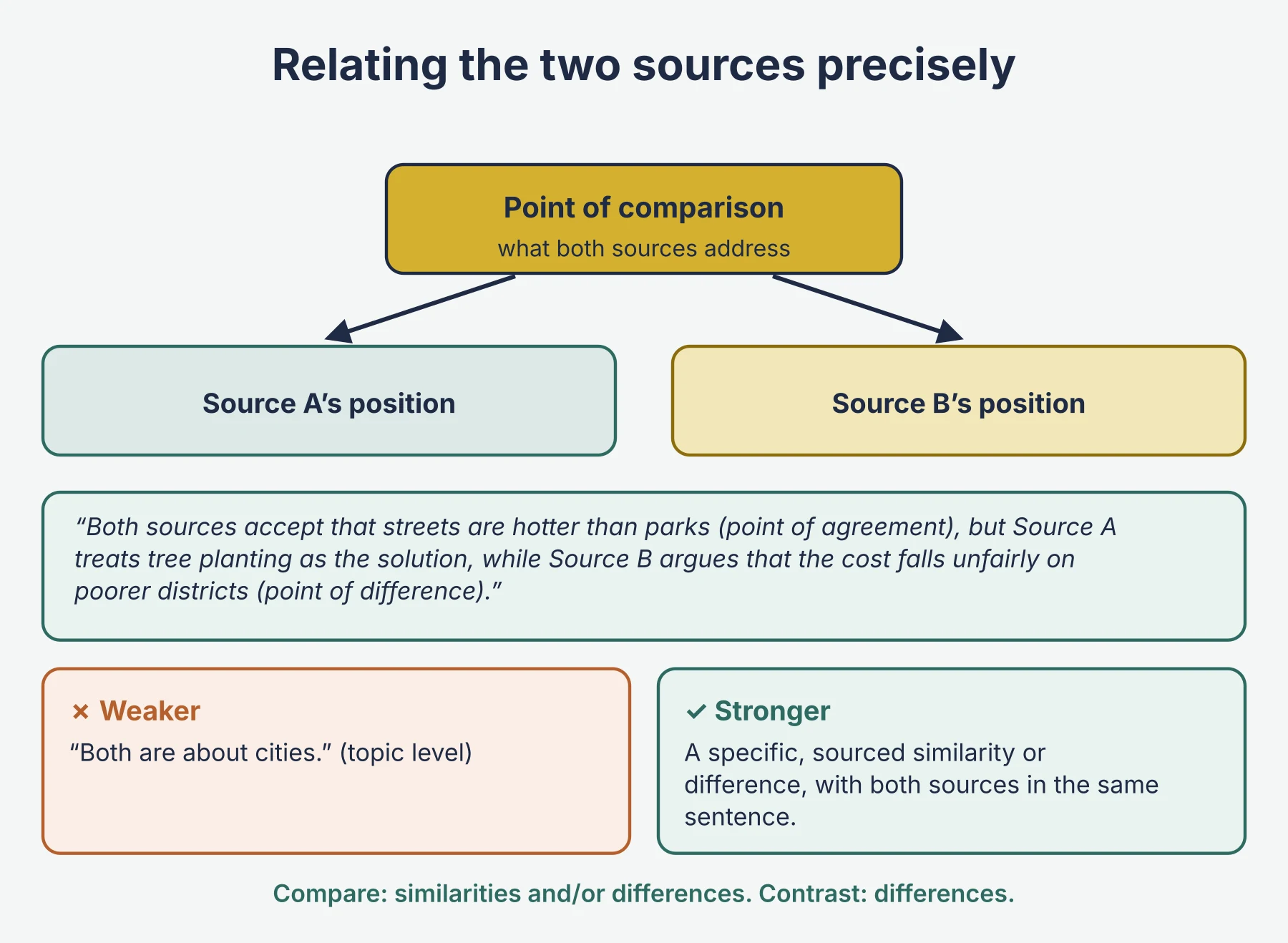
Short questions may ask you to compare or contrast. The syllabus defines compare as “identify/comment on similarities and/or differences” and contrast as “identify/comment on differences”. A precise comparison names the point of comparison, then states each source’s position on it:
“Both sources accept that streets are hotter than parks (point of agreement), but Source A treats tree planting as the solution, while Source B argues that the cost falls unfairly on poorer districts (point of difference).”
Avoid comparing at the level of topic (“both are about cities”). A short answer earns credit for a specific, sourced similarity or difference.
Worked example
The two short sources below are original and written for this guide.
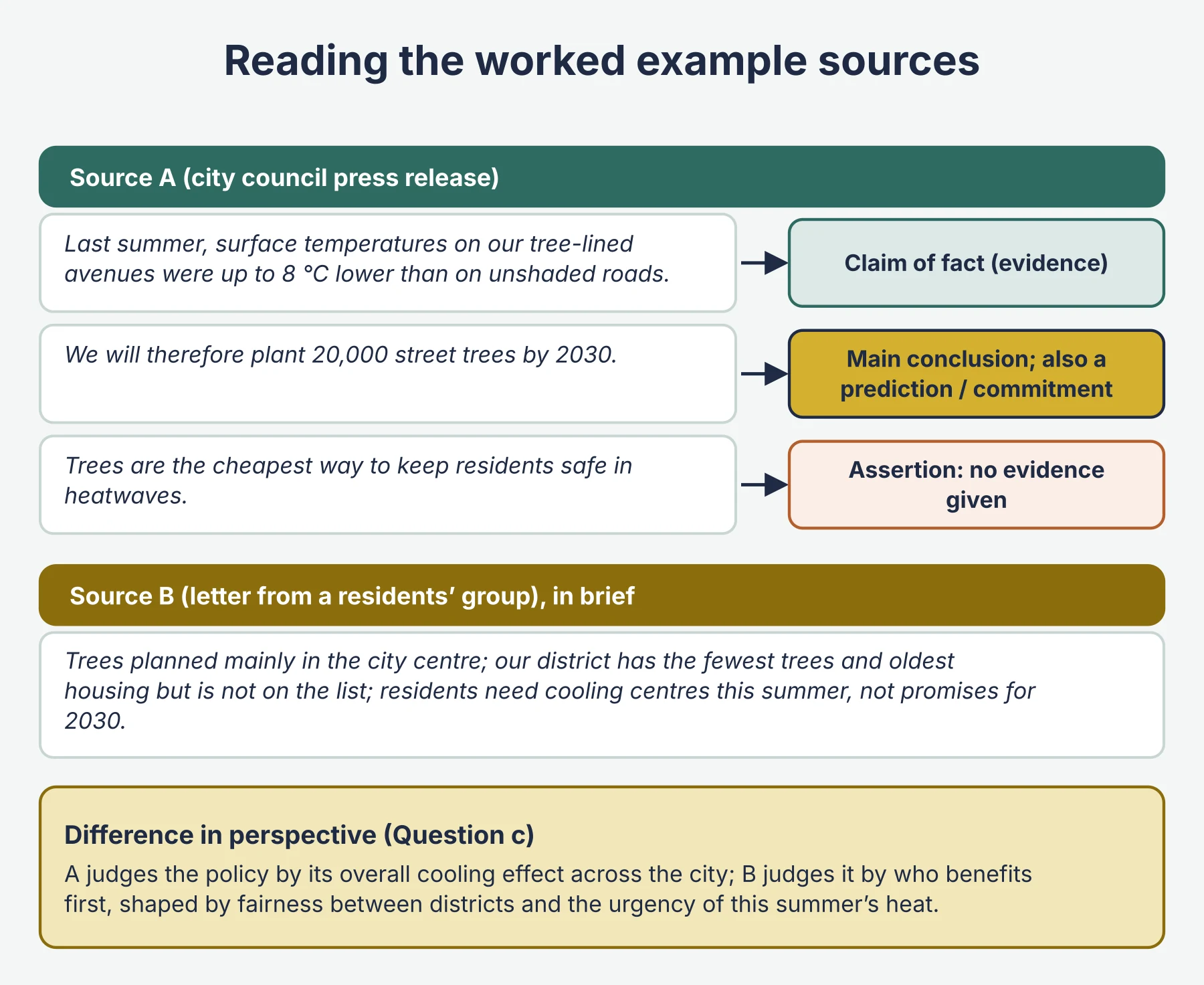
Source A (city council press release). Last summer, surface temperatures on our tree-lined avenues were up to 8 °C lower than on unshaded roads. We will therefore plant 20,000 street trees by 2030. Trees are the cheapest way to keep residents safe in heatwaves.
Source B (letter from a residents’ group). The council plans to plant trees mainly in the city centre. Our district has the fewest trees and the oldest housing, yet it is not on the list. Trees take years to give shade. Residents need cooling centres this summer, not promises for 2030.
Question (a): Identify the main conclusion of Source A. Model answer: “The council will plant 20,000 street trees by 2030.” This is the claim supported by the temperature figure and signalled by “therefore”.
Question (b): Identify one claim in Source A that the source gives no evidence for. Model answer: “Trees are the cheapest way to keep residents safe in heatwaves.” This is an assertion: it could in principle be checked, but no costs of any alternative are given, so the source asks you to accept it without support. The temperature figure, by contrast, is a claim of fact, and “We will … plant 20,000 street trees by 2030” is a prediction (and a commitment). Separating these three in one short source is exactly the precision Question 1 rewards.
Question (c): Explain one difference between the perspectives in the two sources. Model answer: “Source A judges the policy by its overall cooling effect across the city, while Source B judges it by who benefits first, so B’s perspective is shaped by fairness between districts and by the urgency of this summer’s heat.”
The answer to (c) names the basis of each perspective, not just its conclusion. That is what “analyse and compare perspectives” asks for, even in a short answer.
Common mistakes
- Writing too much. A short-answer part rewards precision. A paragraph of discussion where a sentence was needed costs time you need for Question 3.
- Paraphrasing so loosely that the meaning changes. If you identify a reason, keep the source’s wording close.
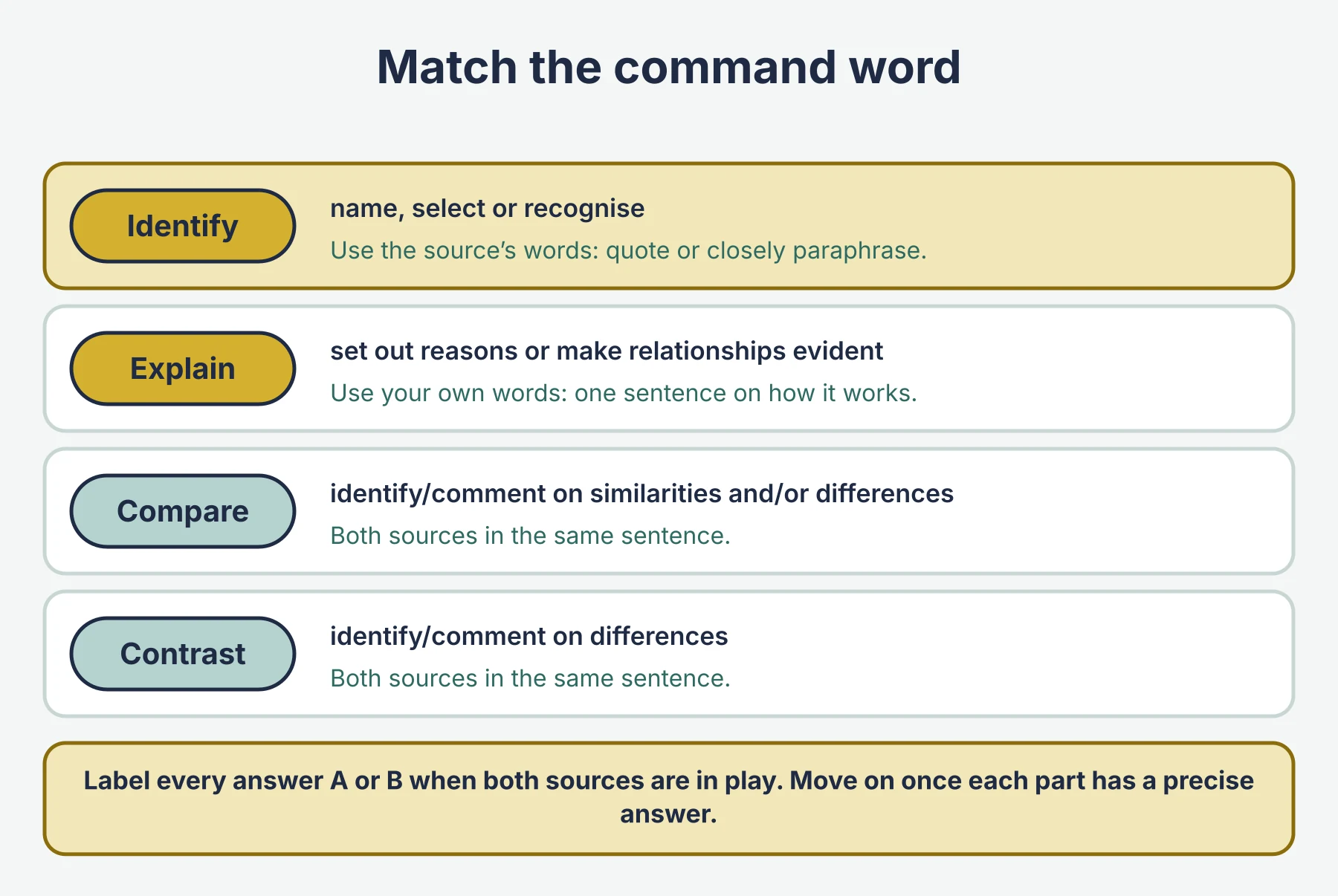
- Confusing the sources. Label every answer with A or B when both are in play.
- Calling every number a fact. A figure is a claim of fact; its reliability is a separate question, which belongs mainly to Question 2.
- Giving the topic, not the conclusion. “Trees in cities” is a topic; “the council should plant 20,000 trees” is a conclusion.
- Labelling an explanation as an argument. Check whether the writer is persuading you or accounting for something.
Exam technique
- Read both sources fully once, then read the question parts, then reread with a pen. Mark conclusions, reasons and evidence in each source as you go; you will reuse these marks in Questions 2 and 3.
- Match the command word. Identify means name, select or recognise. Explain means set out reasons or make relationships evident. Compare and contrast need both sources in the same sentence.
- Use the source’s words for identification and your own words for explanation.
- Keep to time. Move on once each part has a precise answer.
Condense these skills with the Question 1 revision notes and test them with the Question 1 practice questions. For the longer questions, see Question 2: evaluating evidence and Question 3: comparing arguments and perspectives.
Frequently asked questions
How many marks is Question 1 worth in the 9239 Written Exam? The syllabus gives Question 1 five marks out of the paper’s 45. It is a structured question with short parts based on both source documents.
Do I need to know about the topic of the sources? No. The syllabus says candidates are not assessed on their knowledge of the specific issues in the sources. Marks come from how precisely you read and analyse what is printed.
What is the difference between an argument and an explanation? An argument gives reasons to persuade you to accept a conclusion. An explanation gives reasons why something already accepted is the case.
Related resources
-
Practice questions
Cambridge International AS & A Level Global Perspectives & Research (9239): Written Exam Question 1 – Short Answers on Two Sources – Practice Questions
Original short-answer practice for 9239 Written Exam Question 1, using two new sources on short-haul flights, with mark-scheme style answers.
Global Perspectives · Cambridge · AS Level
Try questions -
Revision notes
Cambridge International AS & A Level Global Perspectives & Research (9239): Written Exam Question 1 – Short Answers on Two Sources – Revision Notes
Recall notes for 9239 Written Exam Question 1: statement types, argument parts, indicator words, comparing two sources, exam traps and a self-test.
Global Perspectives · Cambridge · AS Level
Revise topic -
Study guides
Cambridge International AS & A Level Global Perspectives & Research (9239): Written Exam Question 2 – Evaluating the Evidence in One Source
How to plan and write the 15-mark Question 2 in the 9239 Written Exam: mapping the evidence in one source, testing each piece and reaching a judgement.
Global Perspectives · Cambridge · AS Level
Read guide
Studying Global Perspectives?
This page is free and stays free. Marlbridge is not offering Global Perspectives classes at the moment, so there is no tuition to book for it. The free study resources stay open to everyone.
Get free revision emails (optional)
Occasional emails with practice questions, worked explanations and links to free resources for the qualification and subjects you choose. No spam, and you can unsubscribe from any email. The free tools on this site never need an email.