
Study Guides
Cambridge International AS & A Level Global Perspectives & Research (9239): Written Exam Question 2 – Evaluating the Evidence in One Source
How to plan and write the 15-mark Question 2 in the 9239 Written Exam: mapping the evidence in one source, testing each piece and reaching a judgement.
- Subject
- Global Perspectives
- Level
- AS LEVEL
- Topic
- Component 1 – Written Exam
- Author
- Marlbridge Academic Team
- Updated
- Reviewed by
- Ammar Bilal (what this means)
Aligned to Cambridge A Level Global Perspectives (9239), 2026-2028. Official specification .
Syllabus page (what it covers and how it is assessed): Cambridge A Level Global Perspectives.
Syllabus topics and points this page is mapped to
9239 (AS Level)
- 1 Component 1 – Written Exam (topic-level mapping)
"Topic-level mapping" means this page belongs to that topic; it does not claim to cover every point in it.
This guide covers one named part of Component 1 in the Cambridge International AS & A Level Global Perspectives & Research (9239) syllabus for 2026-2028: “Question 2 (15 marks) requires a longer response based on one of the source documents. Candidates are required to focus on the evidence in the document and demonstrate AO1 skills.” The matching assessment bullet is to “identify evidence, analyse its strengths and weaknesses and evaluate the evidence”. For the shape of the whole paper, read the Component 1 Written Exam study guide first.
What Question 2 asks you to do
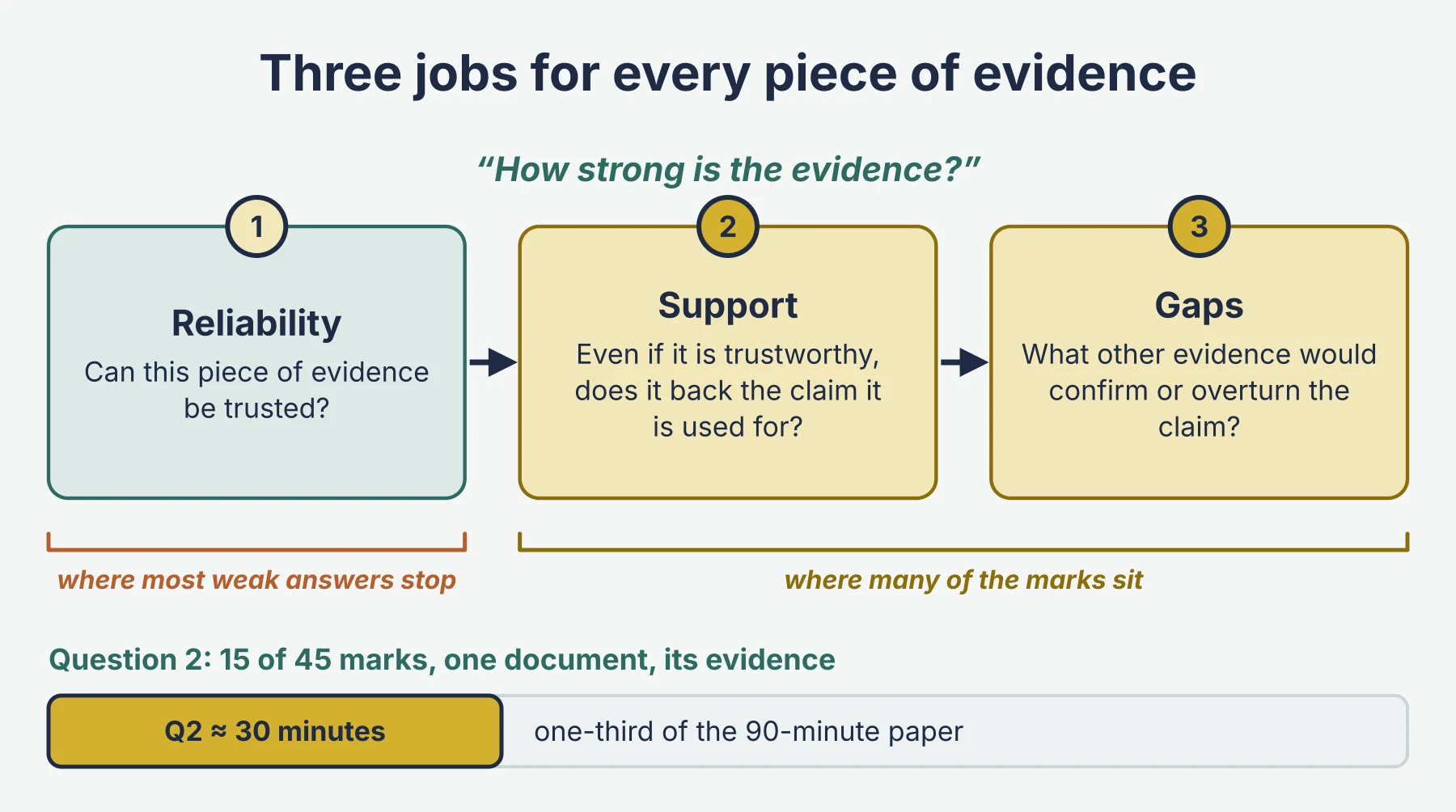
Question 2 narrows the focus in two ways. It works on one document, and it works on the evidence in that document rather than on the whole argument. At 15 of the paper’s 45 marks it is one-third of the paper, which is about 30 minutes of the 90.
The Critical Path frames the task with one question: “How strong is the evidence?” It then breaks that into three jobs: “Identify whether evidence gives strong or weak support to the conclusion or claim. Consider the reliability of the evidence and suggest other evidence required to substantiate or refute claims or counterclaims.” A high-level answer does all three:
- Reliability: can this piece of evidence be trusted?
- Support: even if it is trustworthy, does it actually back the claim it is used for?
- Gaps: what other evidence would be needed to confirm or overturn the claim?
Most weak answers do only the first job, and do it with generic phrases such as “it may be biased”. The marks sit in the second and third jobs as much as the first.
Step 1: map the evidence
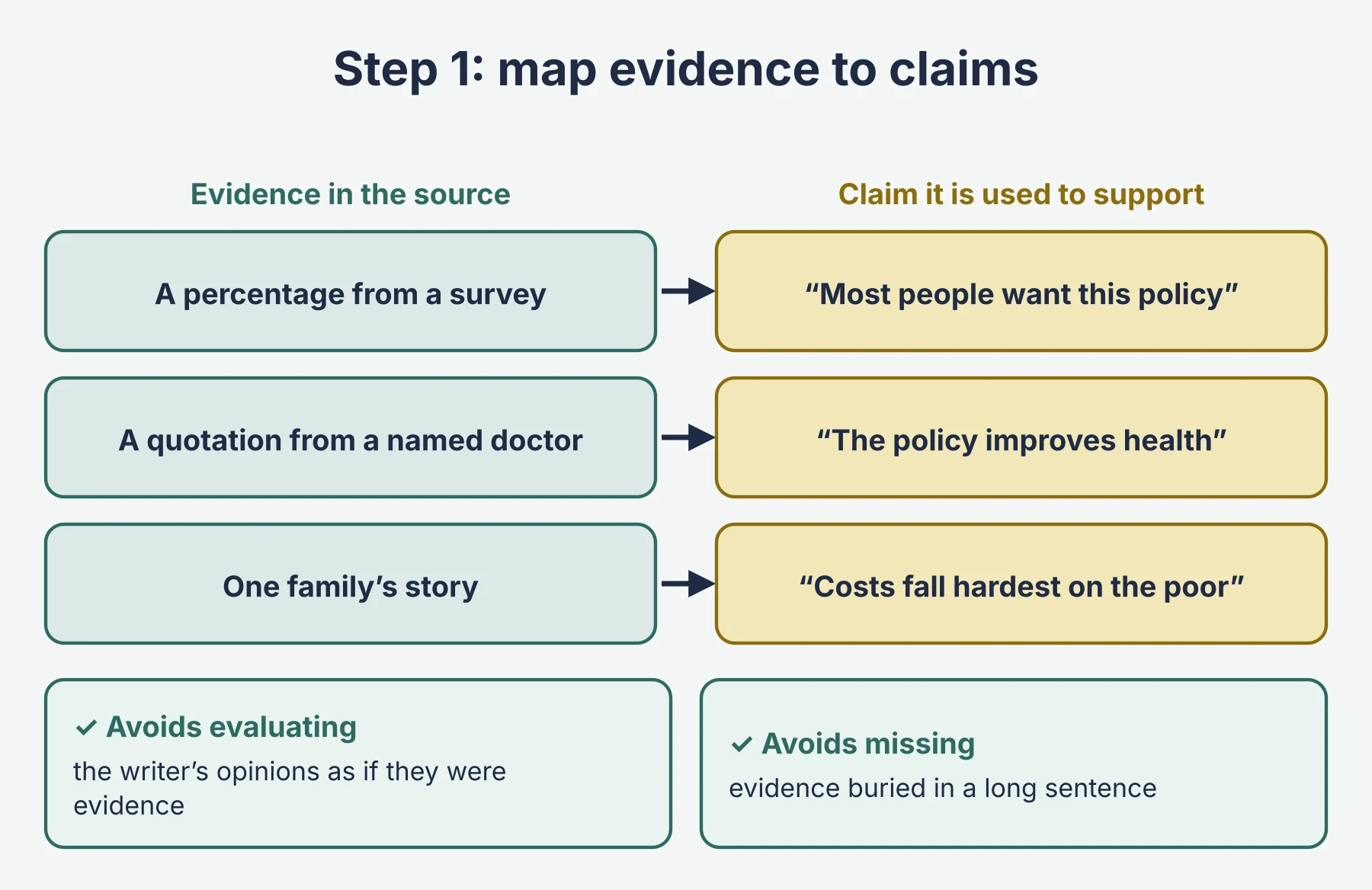
Before you evaluate anything, list every piece of evidence and the claim it is attached to. A two-column note in the margin is enough:
| Evidence in the source | Claim it is used to support |
|---|---|
| A percentage from a survey | “Most people want this policy” |
| A quotation from a named doctor | “The policy improves health” |
| One family’s story | “Costs fall hardest on the poor” |
This step stops two common errors: evaluating the writer’s opinions as if they were evidence, and missing a piece of evidence that is buried in a long sentence.
Step 2: test each piece by its type
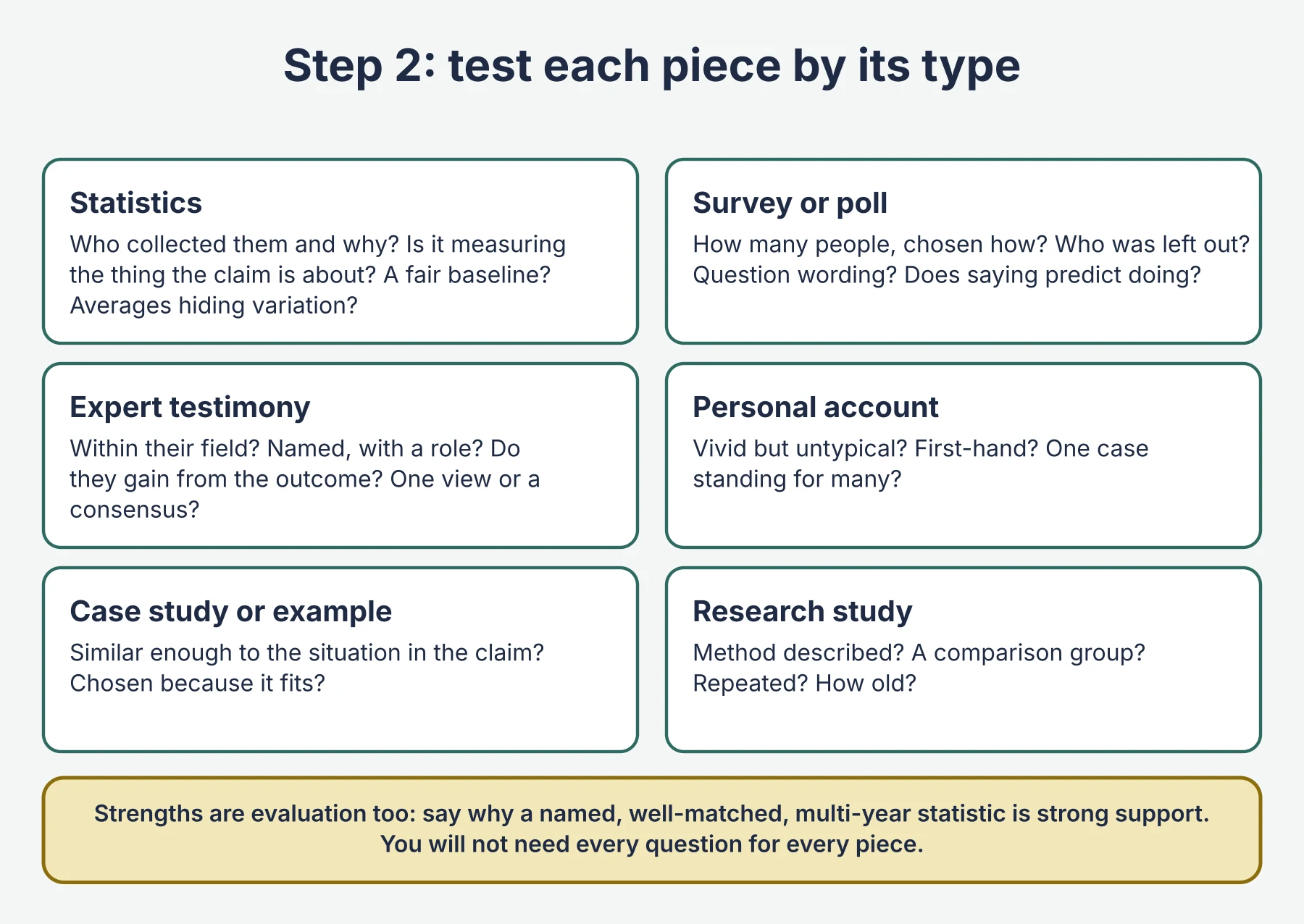
Different kinds of evidence fail in different ways, so the questions you ask should change with the type. The table gives questions to ask; you will not need every one for every piece.
| Type of evidence | Questions that expose strengths and weaknesses |
|---|---|
| Statistics | Who collected them and why? What is being measured, and is it the thing the claim is about? Is a comparison made with a fair baseline? Are averages hiding wide variation? |
| Survey or poll | How many people, chosen how? Who was left out? How were the questions worded? Does what people say they would do predict what they actually do? |
| Expert testimony | Is the expert speaking within their field? Are they named and their role given? Do they gain from the outcome? Is this one expert’s view or a consensus? |
| Personal account or anecdote | Is it vivid but untypical? Is it first-hand? Does the writer use one case to stand for many? |
| Case study or example | Is the example similar enough to the situation the claim is about? Was it chosen because it fits? |
| Research study | Is the method described? Was there a comparison group? Has it been repeated? How old is it? |
Strengths are evaluation too. If a statistic comes from a named national statistics office, measures exactly what the claim is about and covers several years, say so and explain why that makes it strong support. An answer that only criticises looks unbalanced and often misses marks for analysing strengths.
Step 3: test the link between evidence and claim
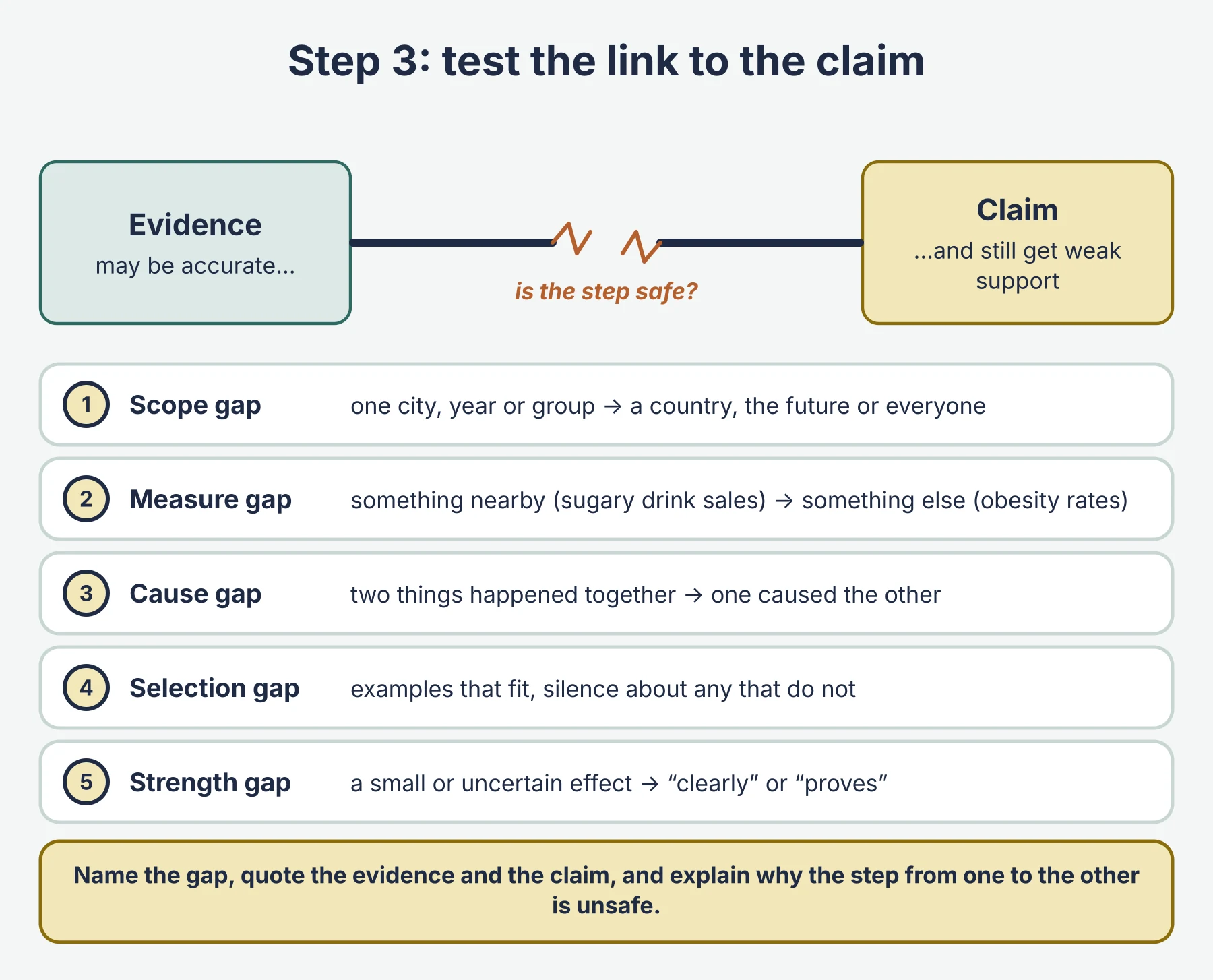
This is the step that separates the top band. Evidence can be accurate and still give weak support. Look for these gaps:
- Scope gap. The evidence covers one city, one year or one group; the claim covers a country, the future or everyone.
- Measure gap. The evidence measures something nearby (sales of sugary drinks) but the claim is about something else (obesity rates).
- Cause gap. The evidence shows two things happened together; the claim says one caused the other.
- Selection gap. The writer gives examples that fit and is silent about any that do not.
- Strength gap. The evidence shows a small or uncertain effect; the claim uses words such as “clearly” or “proves”.
Name the gap, quote the evidence and the claim, and explain why the step from one to the other is unsafe.
Step 4: suggest other evidence
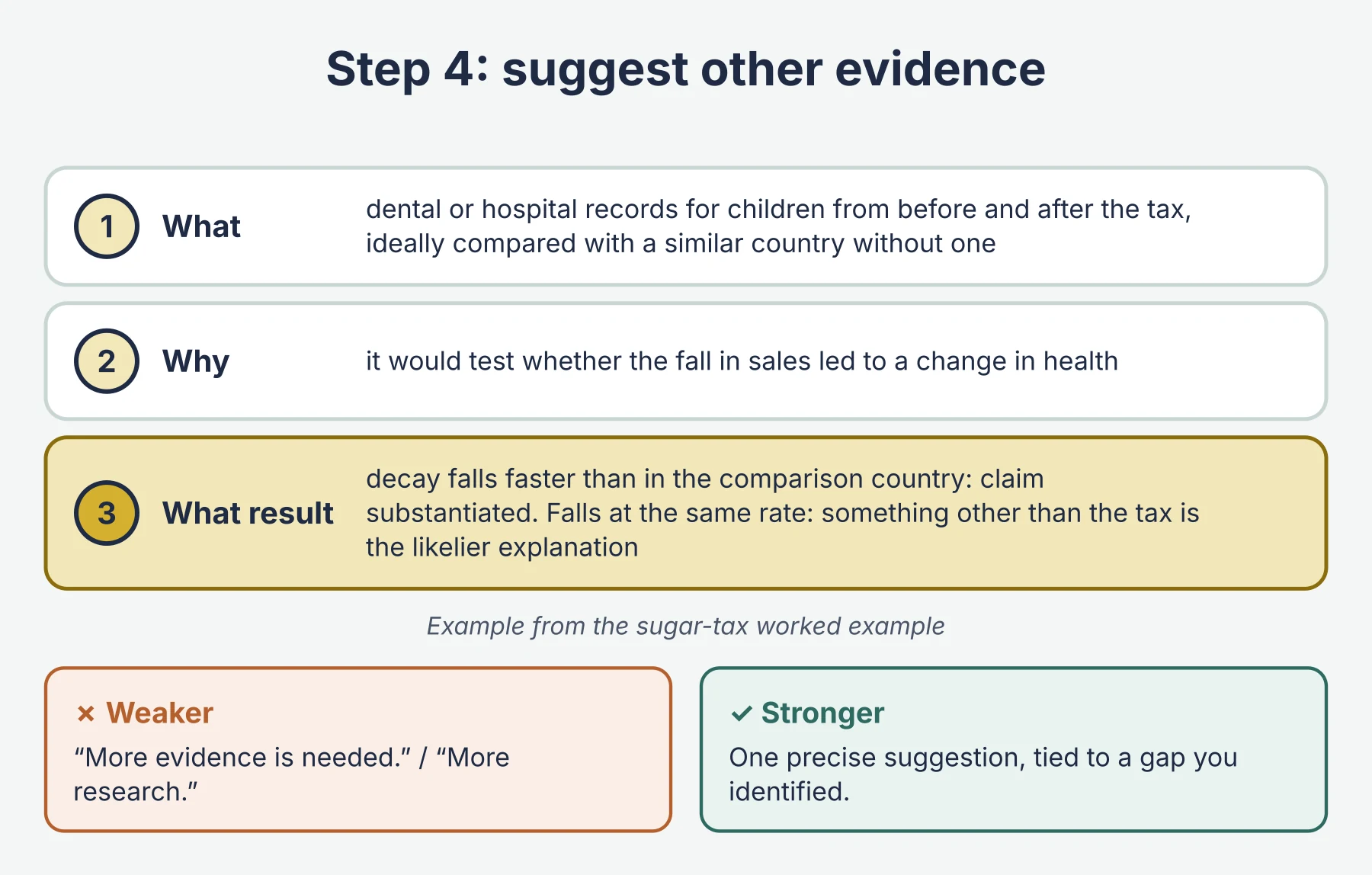
“Suggest other evidence required to substantiate or refute claims or counterclaims” asks for specific evidence, not a general wish for “more research”. A useful suggestion states:
- what evidence (for example, hospital admission figures for the five years before and after the policy),
- why it is needed (it would test whether the drop in sales led to a change in health), and
- what result would strengthen or weaken the claim.
One precise suggestion, tied to a gap you have identified, is worth more than a list of vague ones.
Step 5: reach an overall judgement
The command word evaluate is defined in the syllabus as “judge or calculate the quality, importance, amount, or value of something”. So the answer needs a verdict: how far does the evidence, taken together, support the source’s main claim? Weigh the pieces. A single strong study can outweigh several anecdotes; one serious scope gap can undermine an otherwise reliable data set.
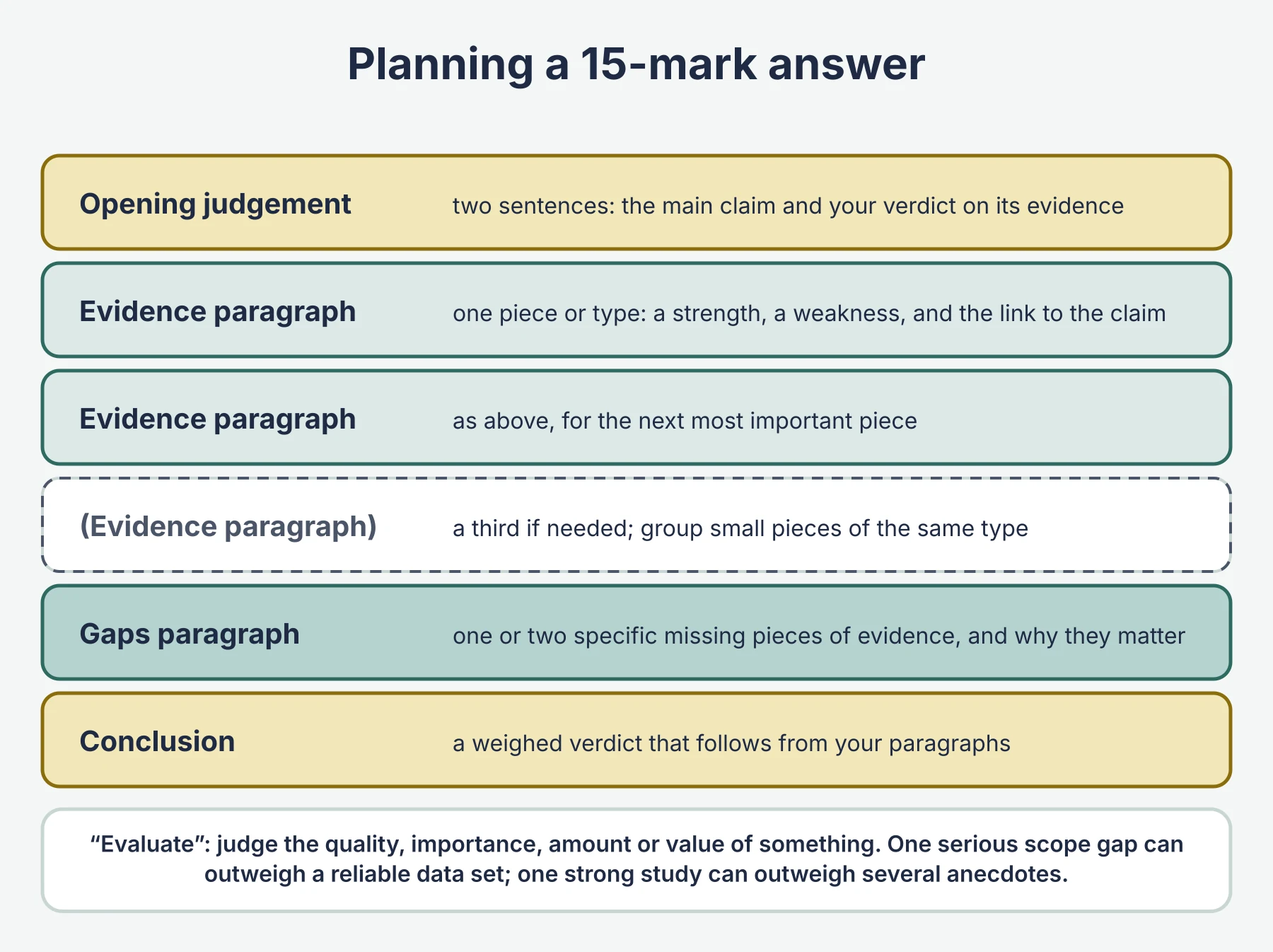
Planning a 15-mark answer
- Opening judgement (two sentences): the source’s main claim and your verdict on how well its evidence supports it.
- Two or three evidence paragraphs: each takes one piece or type of evidence, gives a strength and a weakness, and tests the link to the claim.
- Gaps paragraph: one or two specific pieces of evidence that are missing and why they matter.
- Conclusion: a weighed verdict that follows from your paragraphs.
Group small pieces of evidence of the same type together, so that you have time to go deep on the most important ones.
Worked example
The source below is original and written for this guide.
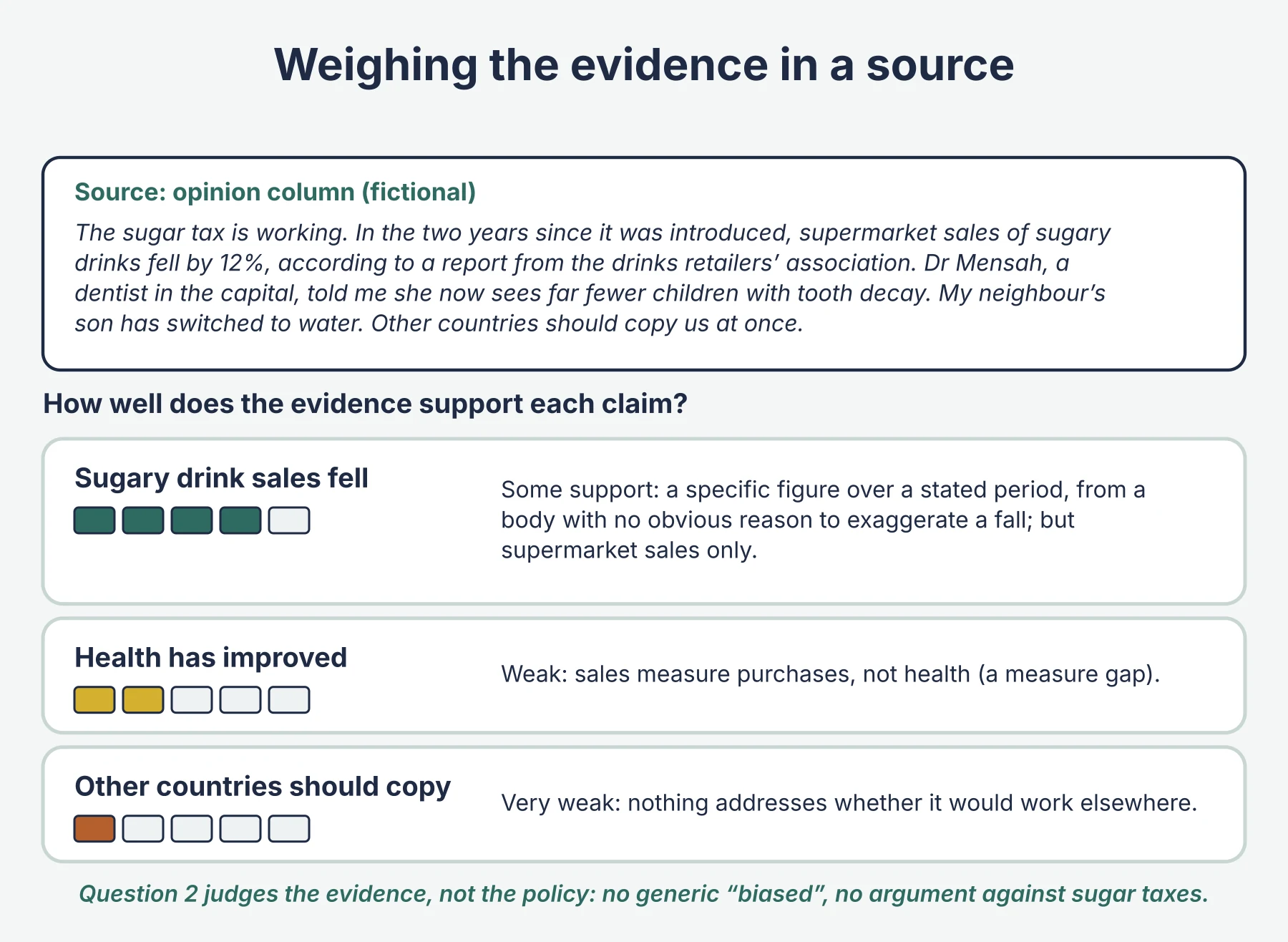
Source (opinion column in a fictional national newspaper). The sugar tax is working. In the two years since it was introduced, supermarket sales of sugary drinks fell by 12%, according to a report from the drinks retailers’ association. Dr Mensah, a dentist in the capital, told me she now sees far fewer children with tooth decay. My neighbour’s son has switched to water. Other countries should copy us at once.
Model opening: “The column claims that the sugar tax is improving health and should be copied elsewhere. Its evidence gives some support for the narrower claim that sugary drink sales fell, but weak support for the claim that health has improved, and very weak support for the recommendation to other countries.”
Model evidence paragraph: “The 12% fall in sales is the strongest evidence. It is a specific figure over a stated period, and it comes from the retailers’ association, which has no obvious reason to exaggerate a fall in its members’ sales, so it is more credible than if it came from a health campaign. However, it measures supermarket sales only, not drinks bought in cafés or shops, so total consumption may have fallen by less. More importantly, it measures purchases, not health: there is a measure gap between fewer sugary drinks sold and the column’s conclusion that ‘the tax is working’ for health.”
Model gap suggestion: “To test the health claim, the writer would need dental or hospital records for children from before and after the tax, ideally compared with a similar country without one. If decay rates fell faster than in the comparison country, the claim would be substantiated; if they fell at the same rate, something other than the tax would be a likelier explanation.”
Model conclusion: “Overall, the evidence supports a fall in sales but does not establish an improvement in health, and nothing in the source addresses whether a tax that worked in one country would work in others. The evidence is therefore weak support for the column’s main recommendation.”
Notice what the model does not do. It does not dismiss the dentist as “biased” without a reason, and it does not argue against sugar taxes. Question 2 is about the evidence, not your view of the policy.
Common mistakes
- Evaluating opinions as evidence. “Other countries should copy us” is a conclusion, not evidence.
- Generic criticism. “The source could be biased” earns little unless you say who, why and what effect that would have on this evidence.
- Only weaknesses. Analysing strengths is part of the assessment bullet.
- Ignoring the claim. Judging evidence in isolation, without asking whether it supports the conclusion it is used for.
- Vague suggestions. “More evidence is needed” without saying what evidence and what it would show.
- Using the wrong source. Check which document the question names.
- No verdict. Ending with a summary of points rather than a judgement on the evidence as a whole.
Condense the method with the Question 2 revision notes and practise it with the Question 2 practice questions. For the other questions on the paper, see Question 1: short answers on two sources and Question 3: comparing arguments and perspectives.
Frequently asked questions
How long should I spend on Question 2? It carries 15 of the 45 marks, so about one-third of the 90 minutes is a proportionate share.
Should I give my own view on the issue in Question 2? No. The syllabus says Question 2 focuses on the evidence in the document. Your judgement should be about how well the evidence supports the claims, not about the issue itself.
Is it enough to say a source is biased? No. Explain who produced the evidence, what interest they might have and how that could affect this particular piece of evidence.
Related resources
-
Practice questions
Cambridge International AS & A Level Global Perspectives & Research (9239): Written Exam Question 2 – Evaluating the Evidence in One Source – Practice Questions
Original practice for 9239 Written Exam Question 2: evaluating statistics, a survey, expert and anecdotal evidence in one new source, with full answers.
Global Perspectives · Cambridge · AS Level
Try questions -
Revision notes
Cambridge International AS & A Level Global Perspectives & Research (9239): Written Exam Question 2 – Evaluating the Evidence in One Source – Revision Notes
Recall notes for 9239 Written Exam Question 2: testing evidence by type, the five evidence-claim gaps, suggesting further evidence and a 15-mark plan.
Global Perspectives · Cambridge · AS Level
Revise topic -
Study guides
Cambridge International AS & A Level Global Perspectives & Research (9239): Written Exam Question 3 – Comparing Arguments and Perspectives
How to write the 25-mark Question 3 essay in the 9239 Written Exam: comparing two sources' arguments by criteria and reaching a reasoned judgement.
Global Perspectives · Cambridge · AS Level
Read guide
Studying Global Perspectives?
This page is free and stays free. Marlbridge is not offering Global Perspectives classes at the moment, so there is no tuition to book for it. The free study resources stay open to everyone.
Get free revision emails (optional)
Occasional emails with practice questions, worked explanations and links to free resources for the qualification and subjects you choose. No spam, and you can unsubscribe from any email. The free tools on this site never need an email.