
Revision Notes
Cambridge International AS & A Level Global Perspectives & Research (9239): Written Exam Question 2 – Evaluating the Evidence in One Source – Revision Notes
Recall notes for 9239 Written Exam Question 2: testing evidence by type, the five evidence-claim gaps, suggesting further evidence and a 15-mark plan.
- Subject
- Global Perspectives
- Level
- AS LEVEL
- Topic
- Component 1 – Written Exam
- Author
- Marlbridge Academic Team
- Updated
- Reviewed by
- Ammar Bilal (what this means)
Aligned to Cambridge A Level Global Perspectives (9239), 2026-2028. Official specification .
Syllabus page (what it covers and how it is assessed): Cambridge A Level Global Perspectives.
Syllabus topics and points this page is mapped to
9239 (AS Level)
- 1 Component 1 – Written Exam (topic-level mapping)
"Topic-level mapping" means this page belongs to that topic; it does not claim to cover every point in it.
These notes cover Question 2 of Component 1 in Cambridge International AS & A Level Global Perspectives & Research (9239), 2026-2028. The syllabus wording: “Question 2 (15 marks) requires a longer response based on one of the source documents. Candidates are required to focus on the evidence in the document and demonstrate AO1 skills.” For the paper as a whole, see the Component 1 Written Exam study guide; for the full method with a worked example, read the Question 2 study guide.
Core facts
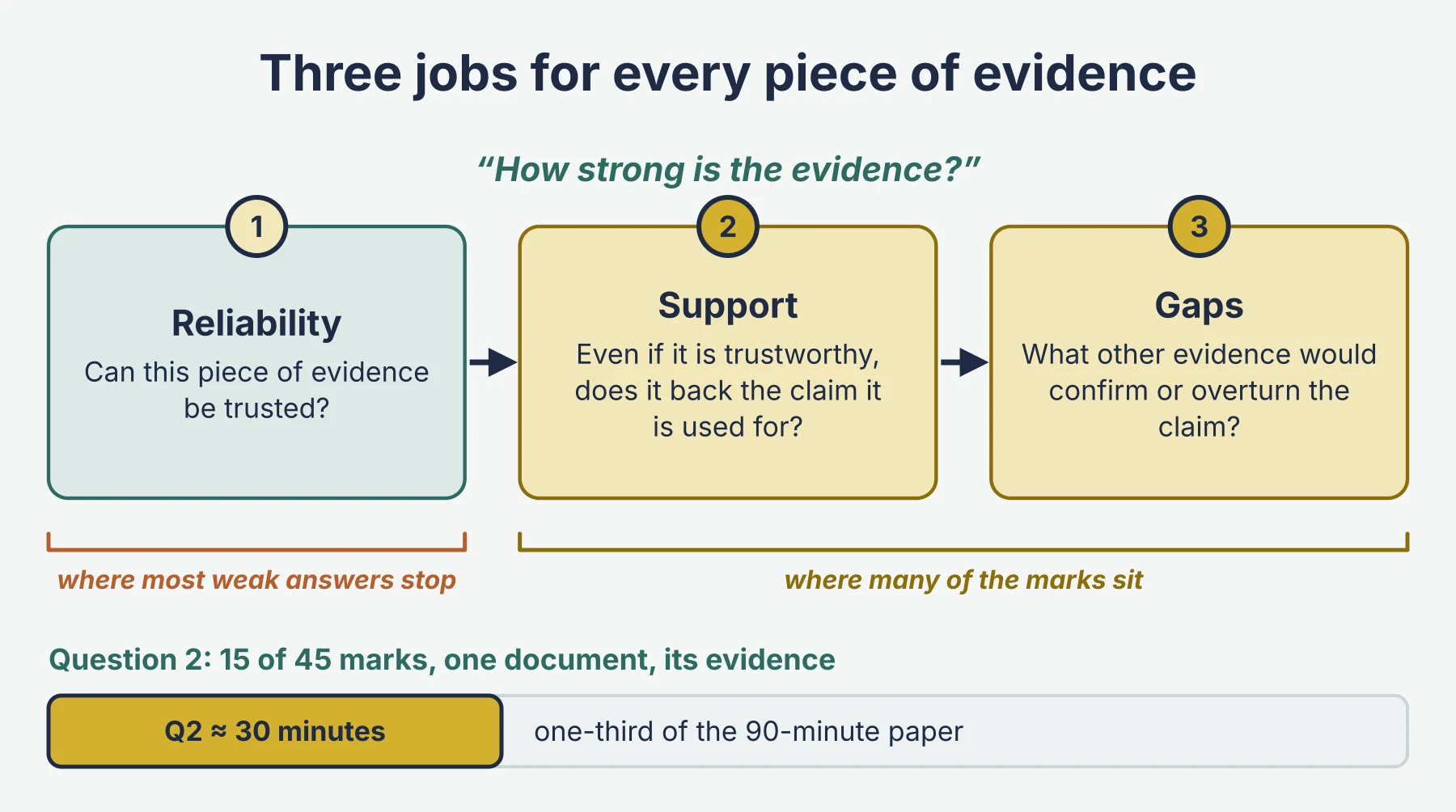
- 15 marks of 45: about 30 minutes of the 90.
- One source document; check which one the question names.
- Focus: the evidence, not the whole argument and not your view of the issue.
- Assessment bullet: “identify evidence, analyse its strengths and weaknesses and evaluate the evidence” (AO1).
- Critical Path question: “How strong is the evidence?” Three jobs: support (strong or weak?), reliability, and “suggest other evidence required to substantiate or refute claims or counterclaims”.
The three jobs in one line each
- Reliability: can this evidence be trusted, given who produced it and how?
- Support: if it is true, does it back the claim it is attached to?
- Gaps: what specific evidence would confirm or overturn the claim?
Key terms
| Term | Meaning in Question 2 |
|---|---|
| Evidence | Facts, data, examples or testimony offered to support a claim |
| Claim | The statement the evidence is used to support |
| Reliability | How far the evidence can be trusted, given its source and method |
| Provenance | Who produced the source, where and when (syllabus definition: author and where or when written) |
| Primary evidence | First-hand information (syllabus wording) |
| Secondary evidence | Based on primary evidence but not from the situation itself |
| Vested interest | A gain the producer of the evidence could get from a particular conclusion |
| Representative sample | A sample that reflects the wider group the claim is about |
| Corroboration | Agreement from an independent source |
| Substantiate | Provide evidence that confirms a claim |
| Refute | Provide evidence that shows a claim is false |
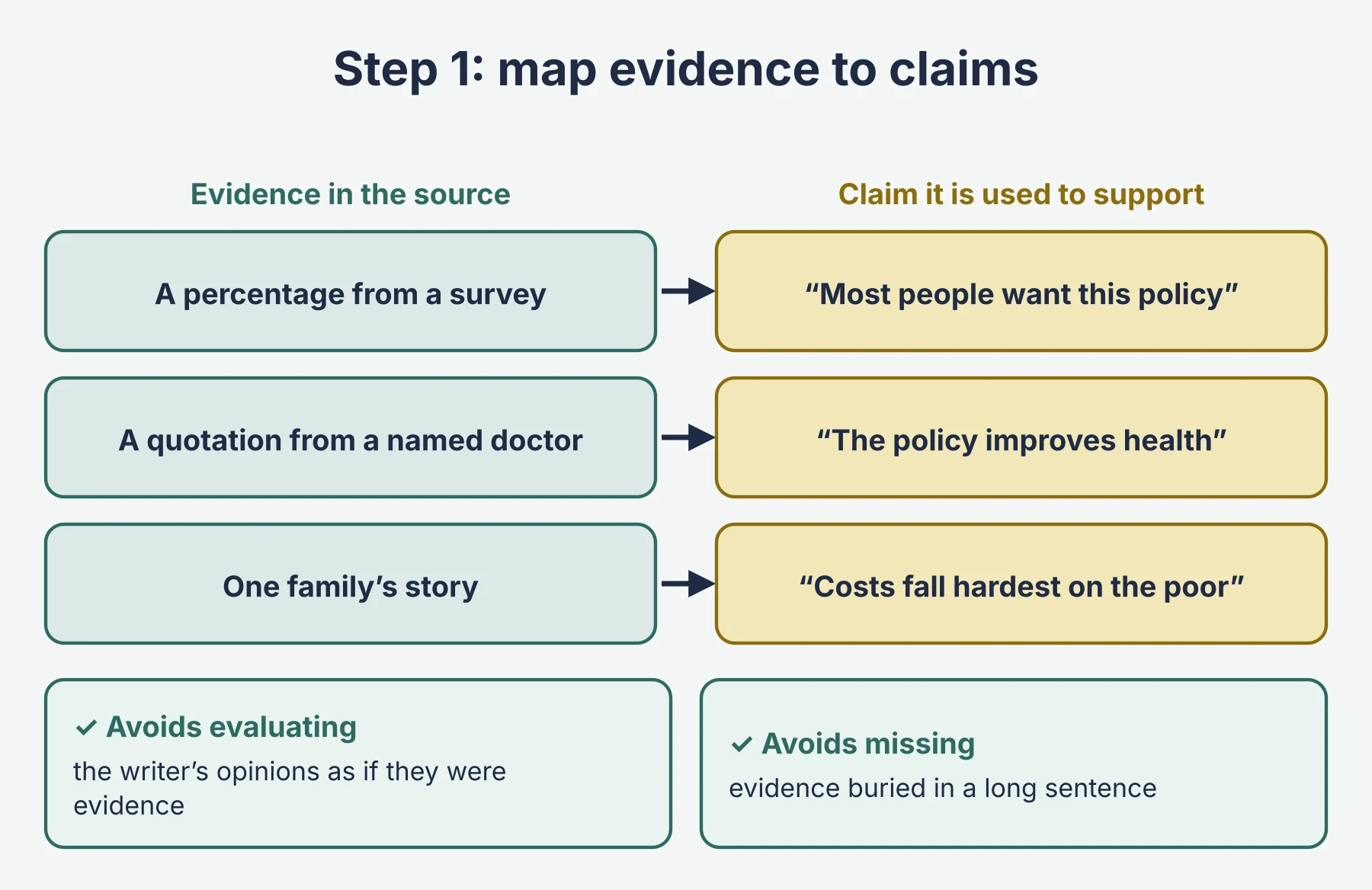
Testing evidence by type
| Type | Strongest when | Weakest when |
|---|---|---|
| Statistics | Named producer, clear measure, fair baseline, several years | Unclear source, measures something nearby, cherry-picked period |
| Survey | Large, randomly chosen sample, neutral questions | Small or self-selected sample, leading questions, stated intentions only |
| Expert testimony | Named, within field, reflects wider consensus | Outside field, unnamed, stands to gain |
| Anecdote | Illustrates a well-evidenced pattern | Used as if it proved a general rule |
| Case study | Closely similar to the case the claim is about | Chosen because it fits; different context |
| Research study | Method stated, comparison group, repeated | Old, unrepeated, method unknown |
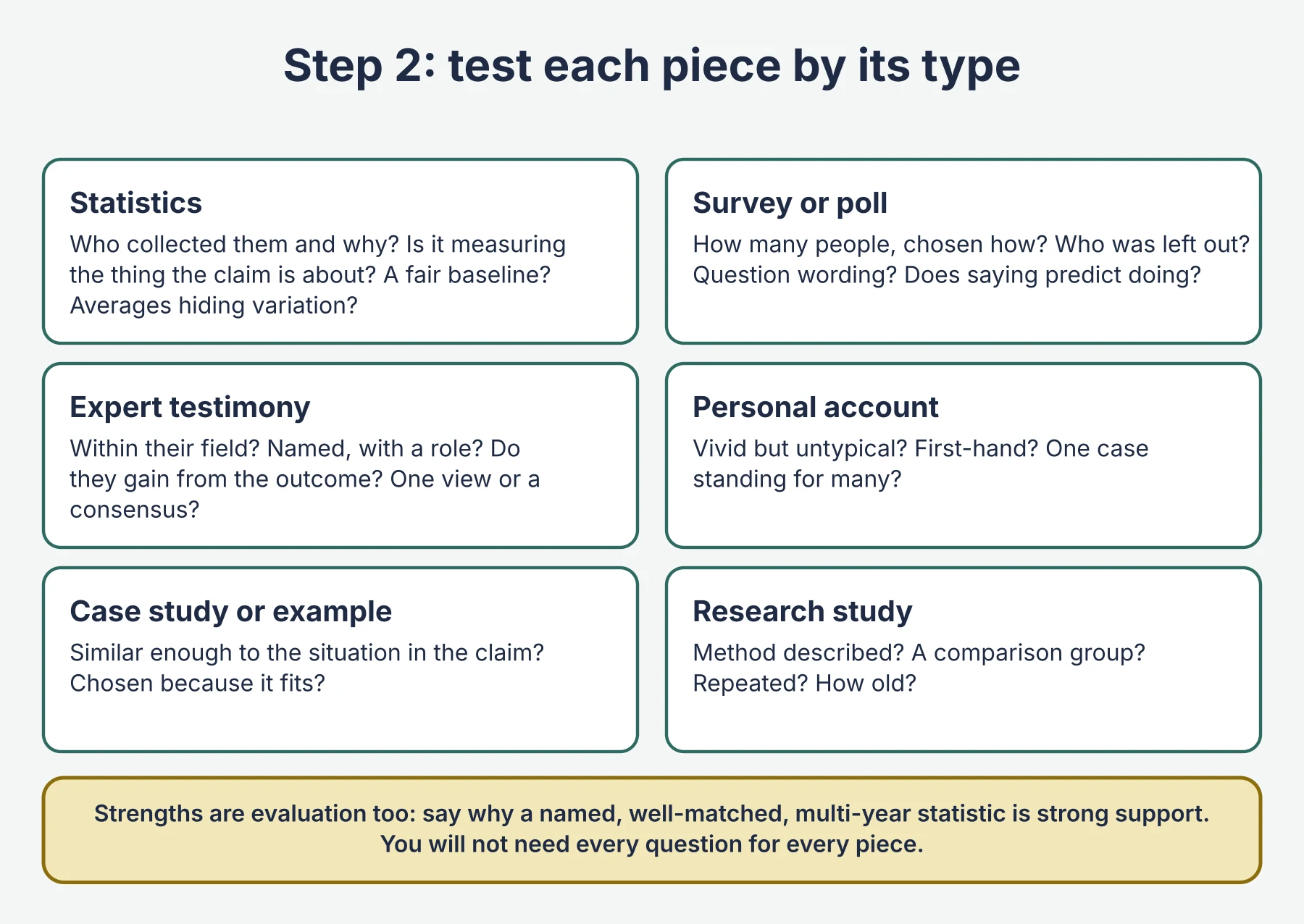
The five evidence-claim gaps
| Gap | The evidence … | The claim … |
|---|---|---|
| Scope | covers one place, time or group | covers many or all |
| Measure | measures something related | is about something else |
| Cause | shows two things together | says one caused the other |
| Selection | gives examples that fit | ignores ones that do not |
| Strength | shows a small or uncertain effect | says “clearly” or “proves” |
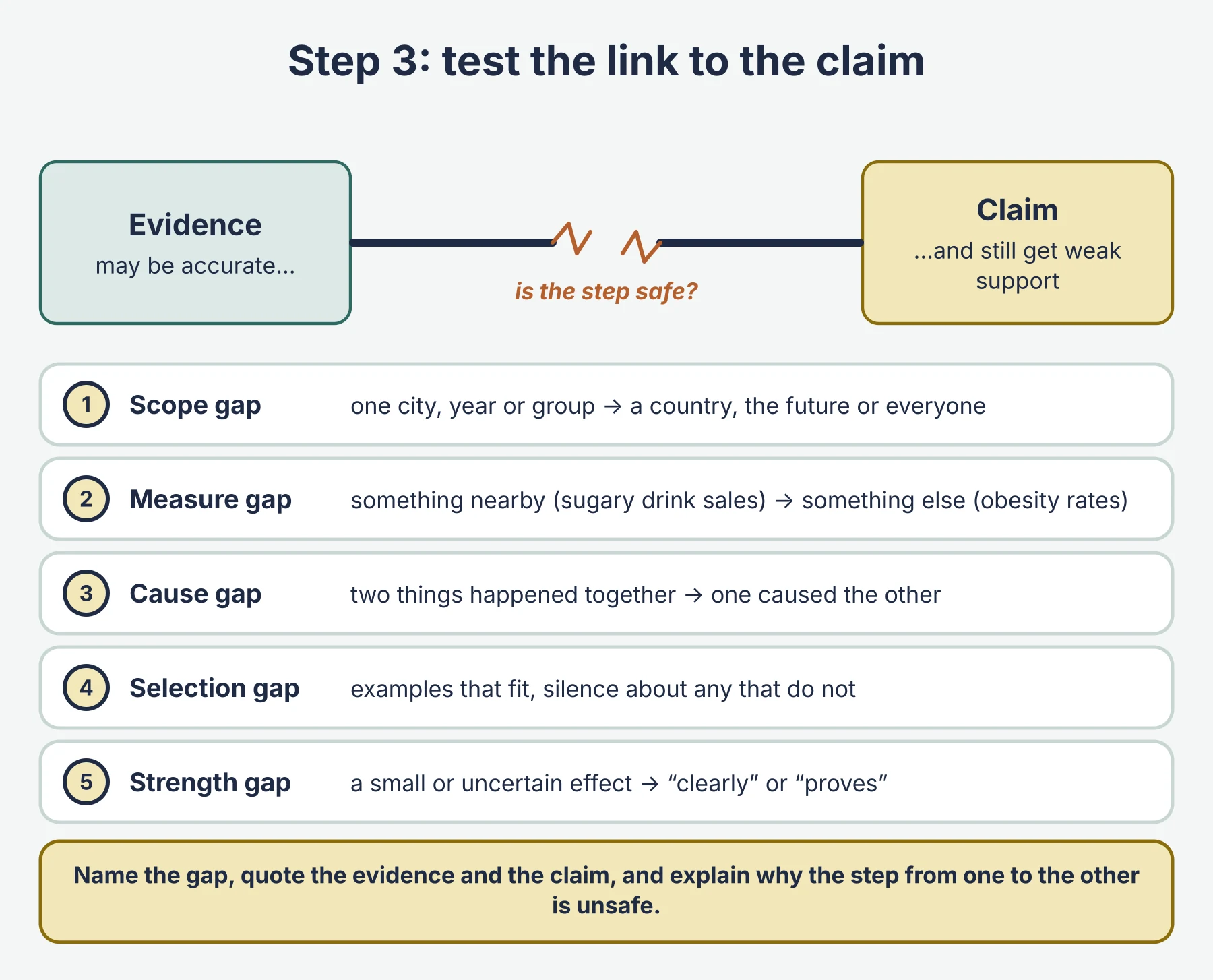
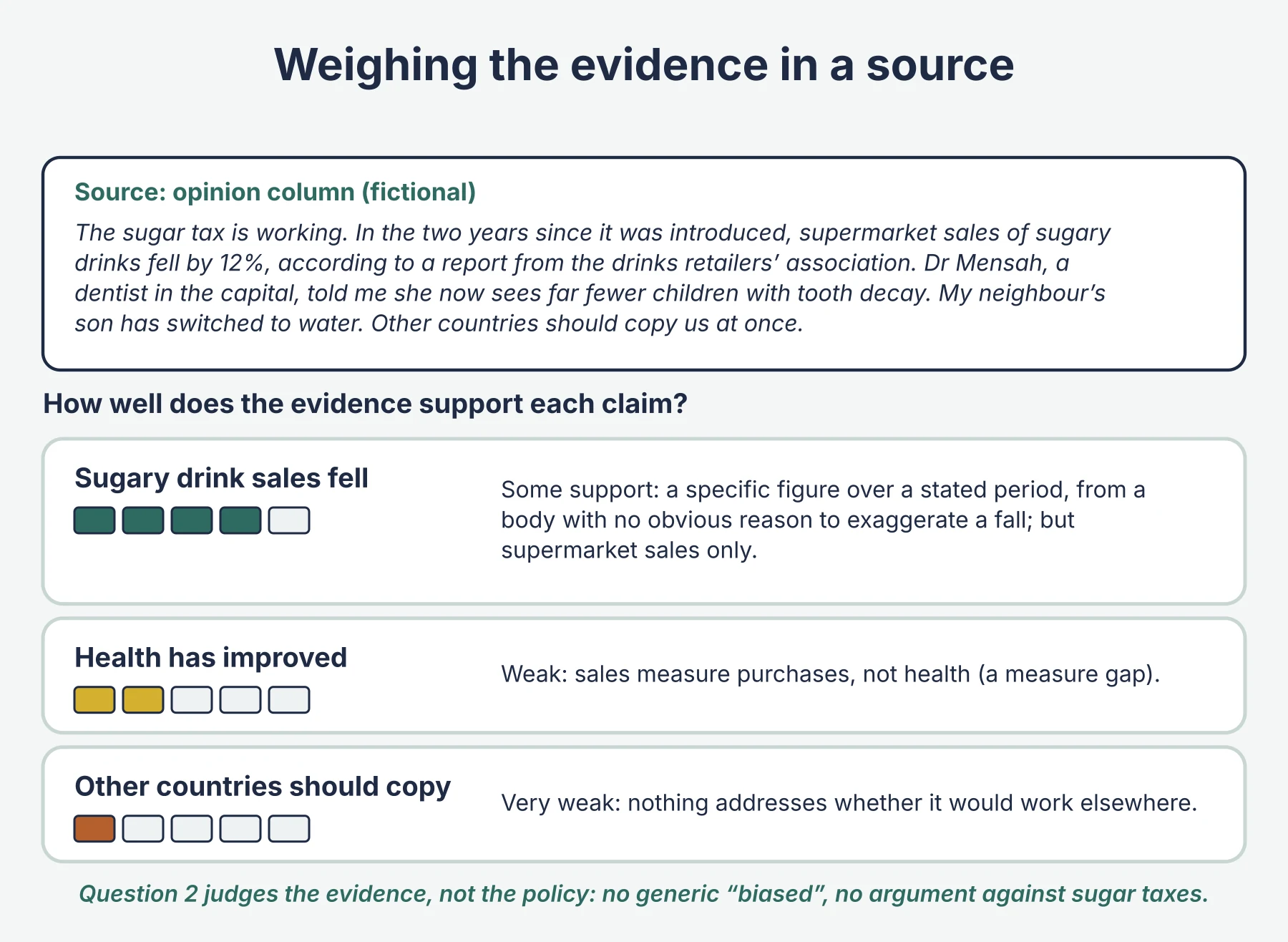
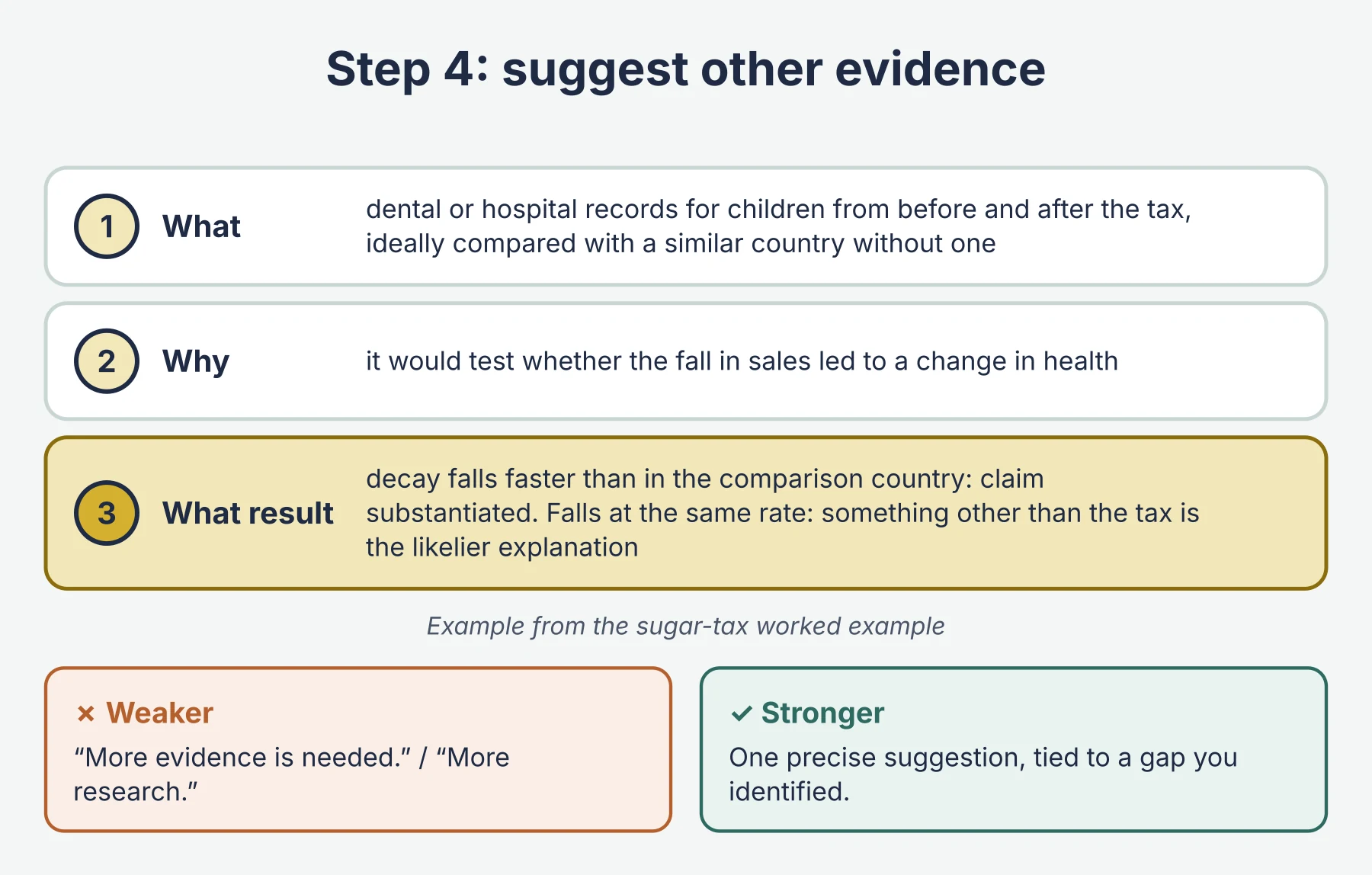
Suggesting other evidence: the what-why-result test
A good suggestion says what evidence (specific type, place and period), why (which gap it fills) and what result would substantiate or refute the claim. “More research is needed” passes none of these tests.
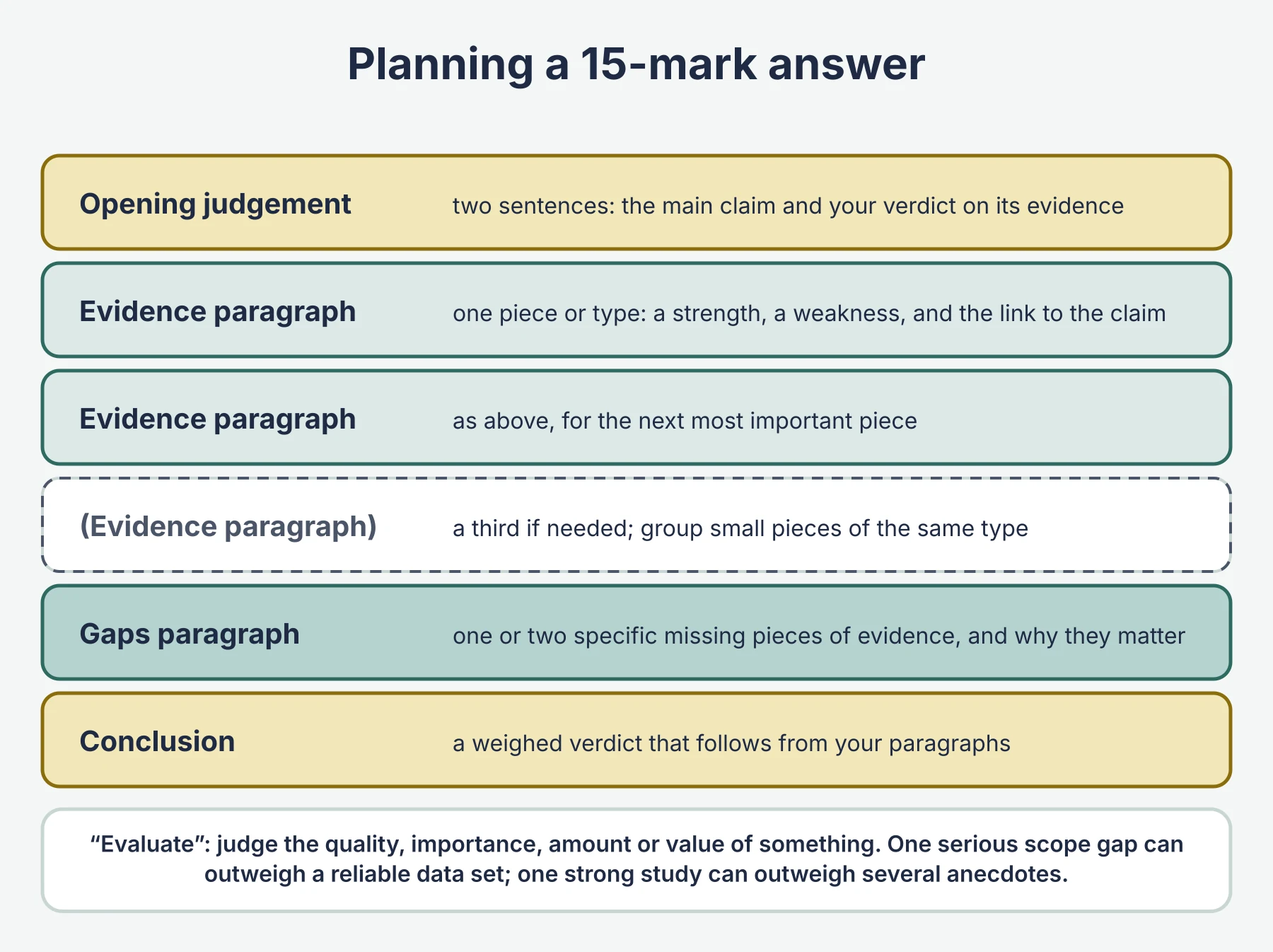
15-mark plan
- Opening: the main claim and your verdict on the evidence.
- Two or three paragraphs, one per key piece or type of evidence: strength, weakness, link to claim.
- Gaps: one or two specific missing pieces of evidence.
- Weighed conclusion.
Exam traps
- Treating the writer’s opinions or conclusion as evidence.
- “It could be biased” with no who, why or effect.
- Criticising every piece of evidence and never noting a strength.
- Judging evidence alone without asking what claim it is meant to support.
- Arguing for or against the policy instead of evaluating the evidence.
- Using the other source when the question names one.
- Ending with a list rather than a judgement.
Self-test
- How many marks is Question 2 worth, and how many sources does it use?
- State the three jobs the Critical Path sets for evaluating evidence.
- Give the syllabus definition of provenance.
- A survey found that 70% of people said they would cycle more if lanes were built. Name one weakness of this as evidence that cycling will increase.
- What is a measure gap?
- A source uses one village’s success to argue a policy should be national. Which gap is this?
- When is expert testimony strongest?
- Why should you note strengths of evidence as well as weaknesses?
- What does the syllabus mean by “evaluate”?
- What three things should a suggestion for other evidence include?
- Is “Governments must act now” evidence? Explain.
Answers
- 15 marks; one source document.
- Decide whether evidence gives strong or weak support to the claim; consider its reliability; suggest other evidence needed to substantiate or refute claims.
- Its author and where or when it was written.
- It records stated intentions, not behaviour; people may not do what they say (also accept sample or wording points with a reason).
- The evidence measures something related to the claim, not the thing the claim is about.
- A scope gap.
- When the expert is named, speaking within their field, without a stake in the outcome, and reflecting a wider consensus.
- Analysing strengths is part of the assessment bullet, and a judgement needs both sides weighed.
- “Judge or calculate the quality, importance, amount, or value of something”.
- What evidence, why it is needed (the gap it fills), and what result would substantiate or refute the claim.
- No. It is a conclusion or recommendation, not information offered in support of a claim.
Practise with the Question 2 practice questions.
Related resources
-
Study guides
Cambridge International AS & A Level Global Perspectives & Research (9239): Written Exam Question 3 – Comparing Arguments and Perspectives
How to write the 25-mark Question 3 essay in the 9239 Written Exam: comparing two sources' arguments by criteria and reaching a reasoned judgement.
Global Perspectives · Cambridge · AS Level
Read guide -
Practice questions
Cambridge International AS & A Level Global Perspectives & Research (9239): Written Exam Question 3 – Comparing Arguments and Perspectives – Practice Questions
Original practice for 9239 Written Exam Question 3: comparing two new sources on car-free city centres, building paragraphs and a 25-mark judgement.
Global Perspectives · Cambridge · AS Level
Try questions -
Revision notes
Cambridge International AS & A Level Global Perspectives & Research (9239): Written Exam Question 3 – Comparing Arguments and Perspectives – Revision Notes
Recall notes for the 25-mark 9239 Written Exam Question 3: comparison criteria, arguments versus perspectives, judgement rules, AO3 and a self-test.
Global Perspectives · Cambridge · AS Level
Revise topic
Studying Global Perspectives?
This page is free and stays free. Marlbridge is not offering Global Perspectives classes at the moment, so there is no tuition to book for it. The free study resources stay open to everyone.
Get free revision emails (optional)
Occasional emails with practice questions, worked explanations and links to free resources for the qualification and subjects you choose. No spam, and you can unsubscribe from any email. The free tools on this site never need an email.