
Study Guides
Cambridge A Level Law (9084): Contents of a contract
Express terms, the parol evidence rule, Consumer Rights Act 2015 implied terms, status of terms and exemption clauses for Cambridge A Level Law 9084, 3.2.
- Subject
- Law
- Level
- A LEVEL
- Topic
- Topic 3: Law of contract
- Author
- Marlbridge Academic Team
- Updated
- Reviewed by
- Aizaz Raoof Ali (what this means)
Aligned to Cambridge A Level Law (9084), 2026-2028. Official specification .
Syllabus page (what it covers and how it is assessed): Cambridge A Level Law.
Syllabus points this page covers
9084 (A Level)
- 3.2 Contents of a contract
Found an error? Report a correction.
Need help with this topic? Request a free trial class for A Level Law (9084).
Sub-topic 3.2 asks what a contract actually contains once it has been formed: which statements are binding terms, which terms the law adds whether the parties mention them or not, how serious each term is, and whether a clause excluding liability will work. It is assessed on Paper 3 Law of Contract through scenario problems and essays. This guide goes deeper than the Topic 3 overview on each of the four syllabus strands.
What the syllabus lists
- 3.2.1 Express terms: the distinction between representations and terms and why it matters; written terms, incorporation by signature and the parol evidence rule.
- 3.2.2 Terms implied by the Consumer Rights Act 2015: for goods, s9, s10 and s11 with the remedies in s20, s22, s23 and s24; for services, s49 and s52 with the remedies in s55 and s56.
- 3.2.3 Status of terms: conditions, warranties and innominate terms, their nature and the effects of breach.
- 3.2.4 Control of exemption clauses: common-law incorporation and the contra proferentem rule; the Unfair Contract Terms Act 1977 (business to business only) and the Consumer Rights Act 2015 (trader and consumer contracts).
3.2.1 Terms and representations
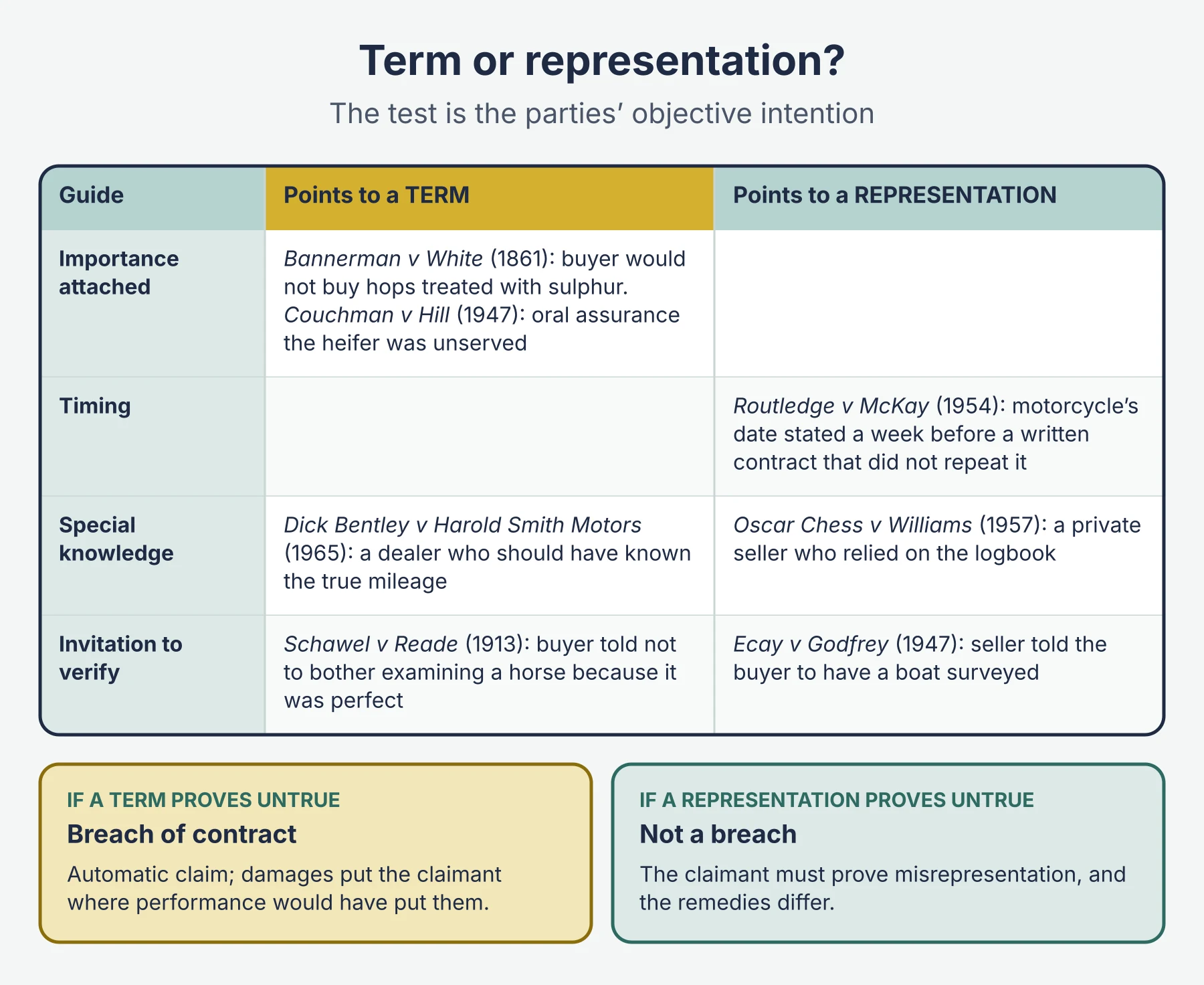
A representation is a statement of fact that induces a contract but is not a promise within it. A term is part of the contract, so if it proves untrue there is a breach of contract. The test is the parties’ objective intention, guided by:
- Importance attached to the statement. In Bannerman v White (1861) the buyer said he would not buy hops treated with sulphur; the assurance was a term. In Couchman v Hill (1947) an oral assurance that a heifer was unserved was a term even though the auction conditions said there were no warranties.
- Timing. In Routledge v McKay (1954) a statement about a motorcycle’s date made a week before a written contract that did not repeat it was only a representation.
- Special knowledge. A private seller who relied on the logbook was not giving a term in Oscar Chess v Williams (1957); a dealer who should have known the true mileage was, in Dick Bentley Productions v Harold Smith Motors (1965).
- Invitation to verify. In Ecay v Godfrey (1947) a seller who told the buyer to have a boat surveyed was making a representation, whereas in Schawel v Reade (1913) a seller who told a buyer not to bother examining a horse because it was perfect gave a term.
Why it matters. Breach of a term gives an automatic claim for breach of contract, with damages measured to put the claimant where performance would have put them. An untrue representation is not a breach; the claimant must prove misrepresentation, and the remedies differ. Classify the statement first.
Written terms
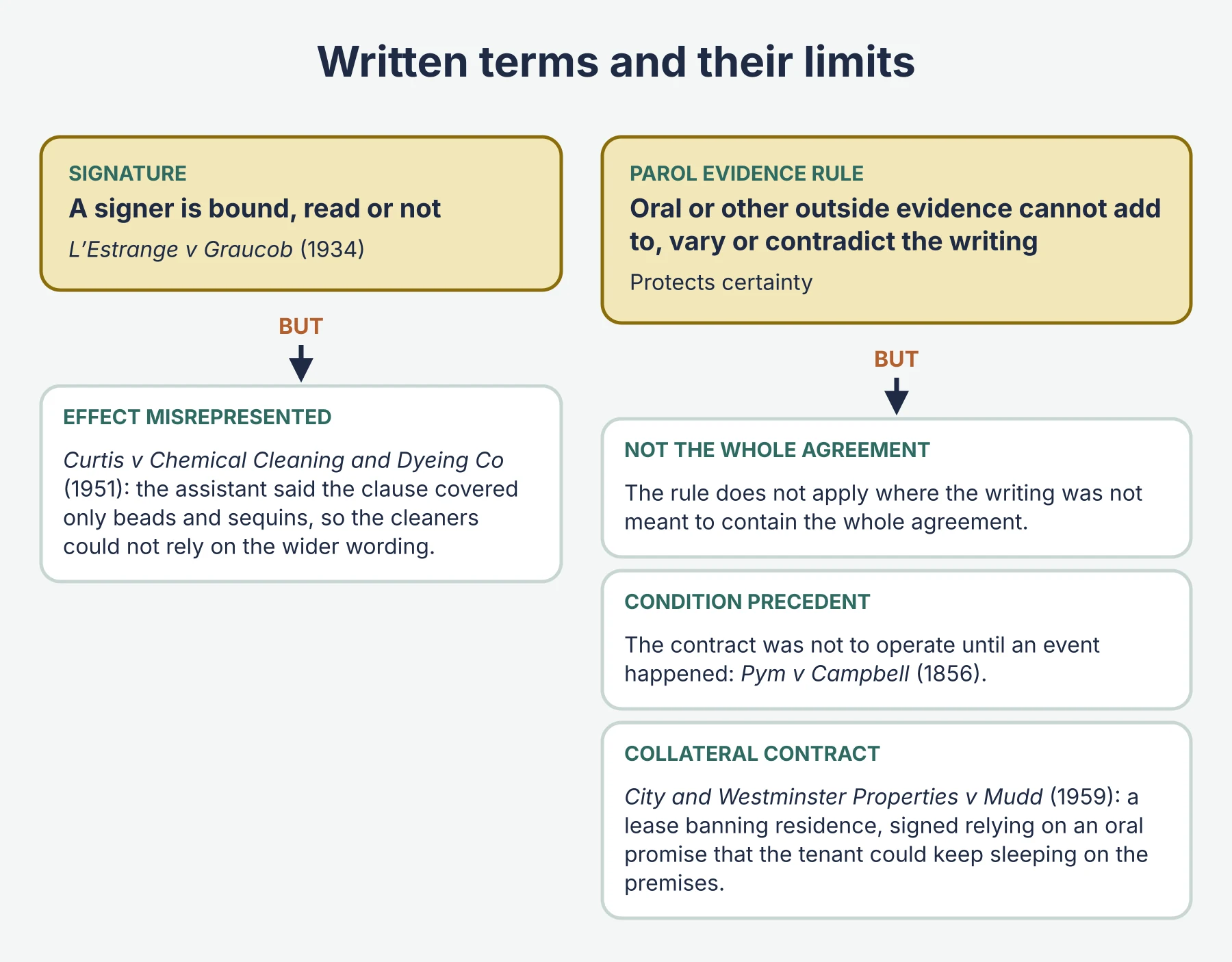
Where a party signs a contractual document, they are bound by its terms whether or not they read them (L’Estrange v Graucob, 1934). The exception is where the other party misrepresents the effect of the document: in Curtis v Chemical Cleaning and Dyeing Co (1951) an assistant told the customer a clause covered only beads and sequins, so the cleaners could not rely on the wider wording.
The parol evidence rule says that oral or other extrinsic evidence cannot be used to add to, vary or contradict a written contract. It protects certainty but does not apply where the writing was not meant to contain the whole agreement, and oral evidence may show a condition precedent that the contract was not to operate until an event happened (Pym v Campbell, 1856) or a collateral contract, as in City and Westminster Properties v Mudd (1959), where a tenant signed a lease banning residence in reliance on an oral promise that he could continue to sleep on the premises.
3.2.2 Terms implied by the Consumer Rights Act 2015
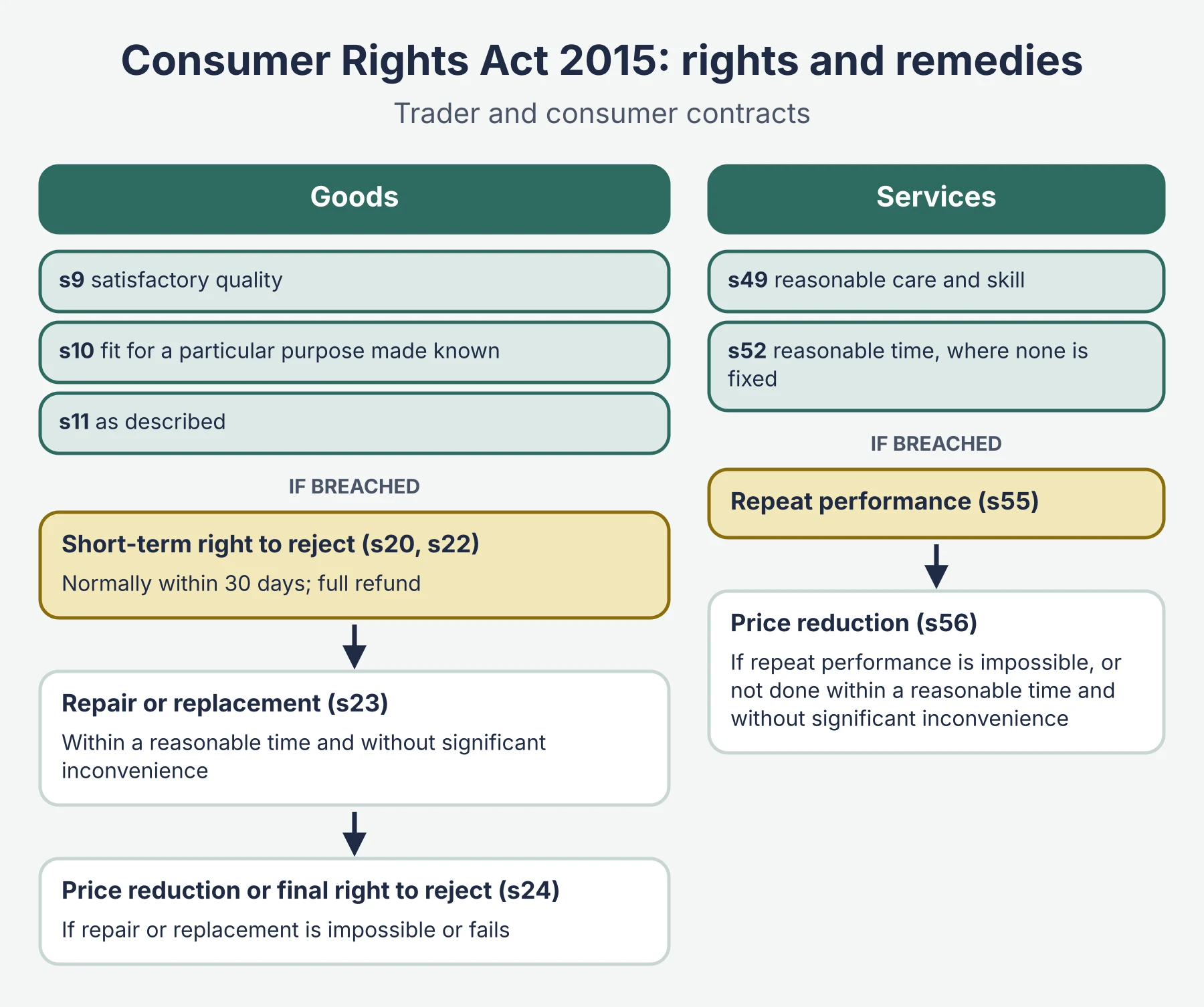
The Act applies to contracts between a trader and a consumer. For goods:
- s9 satisfactory quality: the standard a reasonable person would consider satisfactory, taking account of description, price and other relevant circumstances. Aspects include fitness for all the purposes for which goods of that kind are usually supplied, appearance and finish, freedom from minor defects, safety and durability. Defects drawn to the consumer’s attention before the contract, or which their own examination ought to have revealed, do not count.
- s10 fit for a particular purpose: where the consumer makes known a particular purpose, the goods must be reasonably fit for it, unless the consumer did not rely, or it was unreasonable to rely, on the trader’s skill and judgement.
- s11 as described: goods must match their description.
The consumer’s remedies are tiered. The short-term right to reject (s20 and s22) must normally be exercised within 30 days and gives a full refund. Alternatively, or afterwards, the consumer may require repair or replacement (s23), which the trader must carry out within a reasonable time and without significant inconvenience. If repair or replacement is impossible, or fails, the consumer can claim a price reduction or the final right to reject (s24).
For services, s49 requires the service to be performed with reasonable care and skill, and s52 requires performance within a reasonable time where no time is fixed. Breach gives a right to repeat performance (s55) or, where that is impossible or not done within a reasonable time and without significant inconvenience, a price reduction (s56).
3.2.3 Conditions, warranties and innominate terms
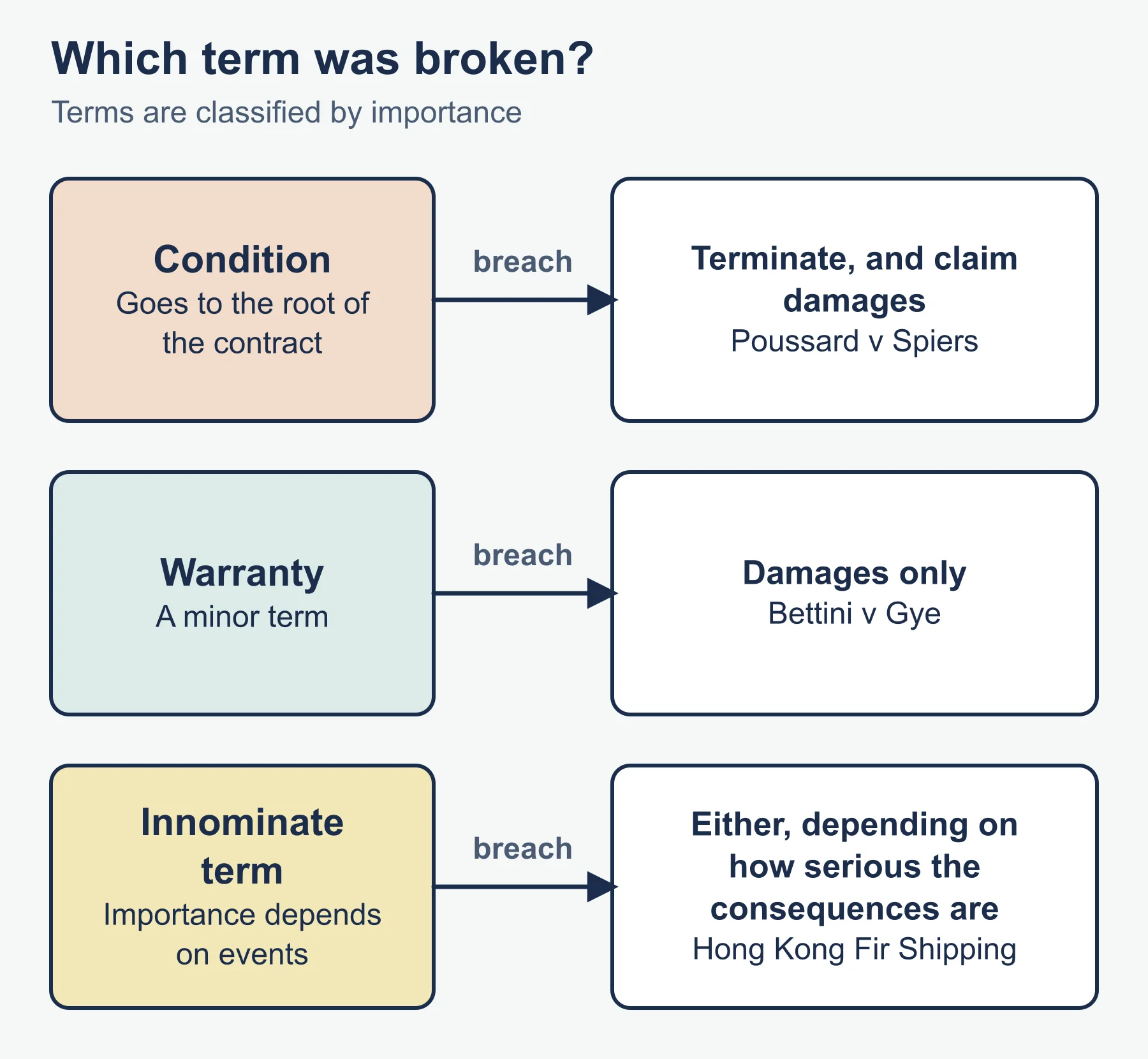
A condition goes to the root of the contract; breach allows the innocent party to treat the contract as ended and claim damages. A warranty is subsidiary; breach gives damages only. The contrast is shown by Poussard v Spiers and Pond (1876) and Bettini v Gye (1876).
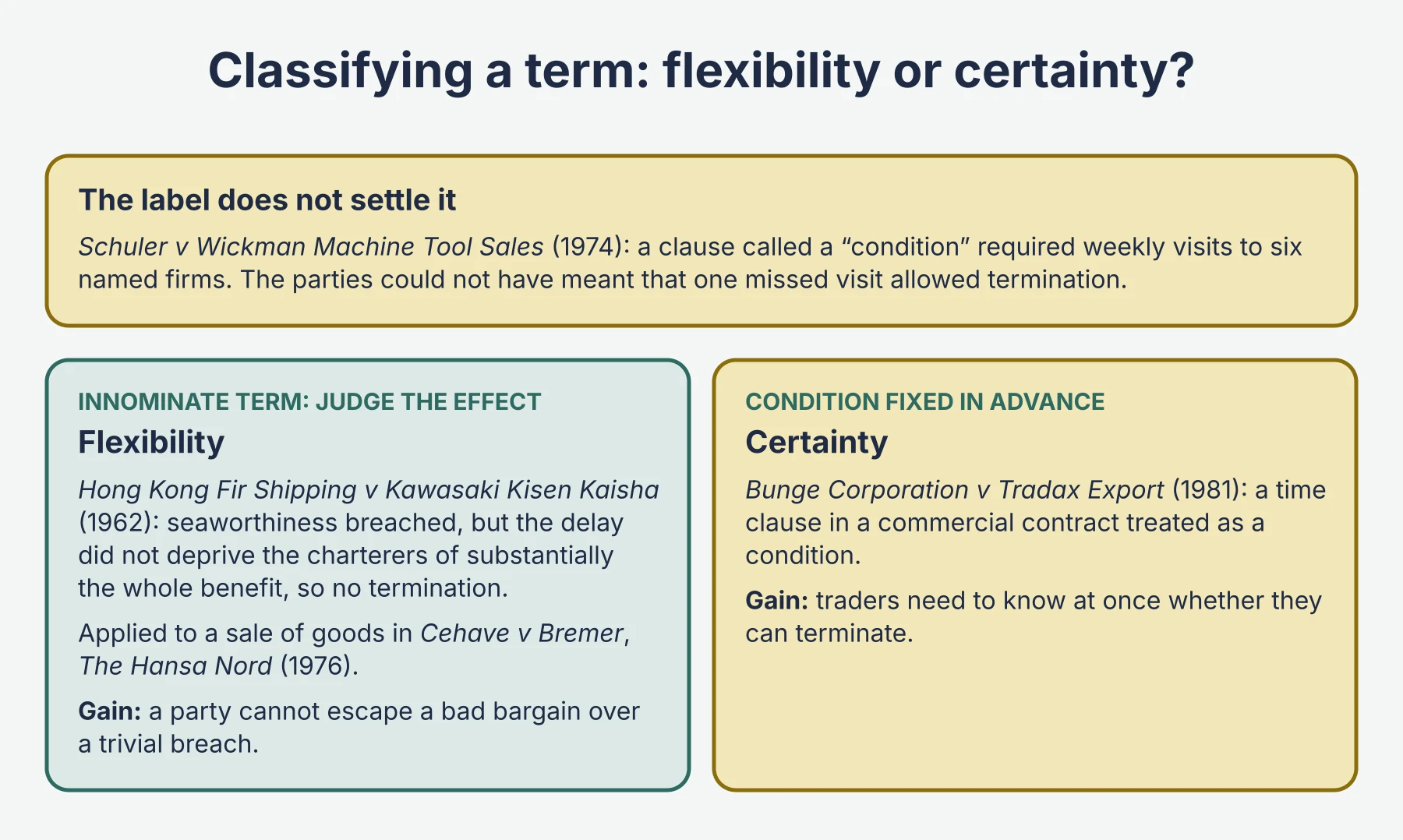
Calling a term a condition does not settle the matter. In Schuler v Wickman Machine Tool Sales (1974) a clause described as a condition required weekly visits to six named firms; the House of Lords held the parties could not have meant that one missed visit allowed termination.
An innominate term is classified by the effect of the breach, not in advance. In Hong Kong Fir Shipping v Kawasaki Kisen Kaisha (1962) a seaworthiness obligation was breached, but the delay did not deprive the charterers of substantially the whole benefit, so they could not terminate. The approach was applied to a sale of goods in Cehave v Bremer (The Hansa Nord, 1976). The tension is between flexibility, which stops a party escaping a bad bargain over a trivial breach, and certainty: in Bunge Corporation v Tradax Export (1981) the House of Lords treated a time clause in a commercial contract as a condition, because traders need to know at once whether they can terminate.
3.2.4 Exemption clauses
Common law
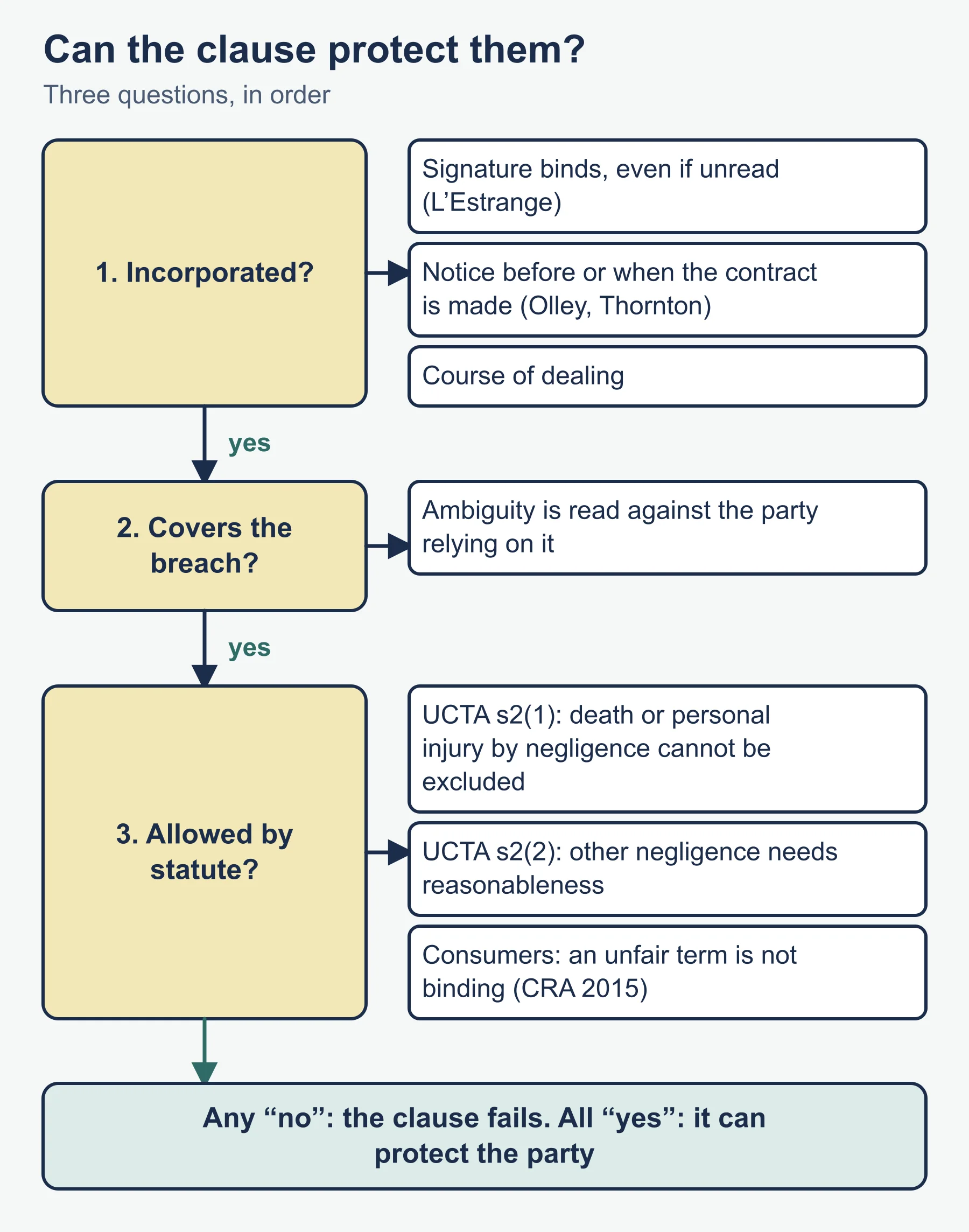
A clause must first be incorporated: by signature; by reasonable notice given before or at the time of contracting (Parker v South Eastern Railway, 1877; Olley v Marlborough Court Hotel, 1949; Thornton v Shoe Lane Parking, 1971); or by a consistent course of dealing (contrast McCutcheon v David MacBrayne, 1964, where previous dealings were inconsistent, and Hollier v Rambler Motors, 1972, where three or four dealings over five years were not enough). The more onerous or unusual the clause, the clearer the notice must be (Interfoto Picture Library v Stiletto Visual Programmes, 1989).
Next the clause must cover the breach on its true construction. Under the contra proferentem rule, ambiguity is read against the party relying on the clause. In Houghton v Trafalgar Insurance (1954) an exclusion for an “excess load” was held not to cover carrying too many passengers.
Statute
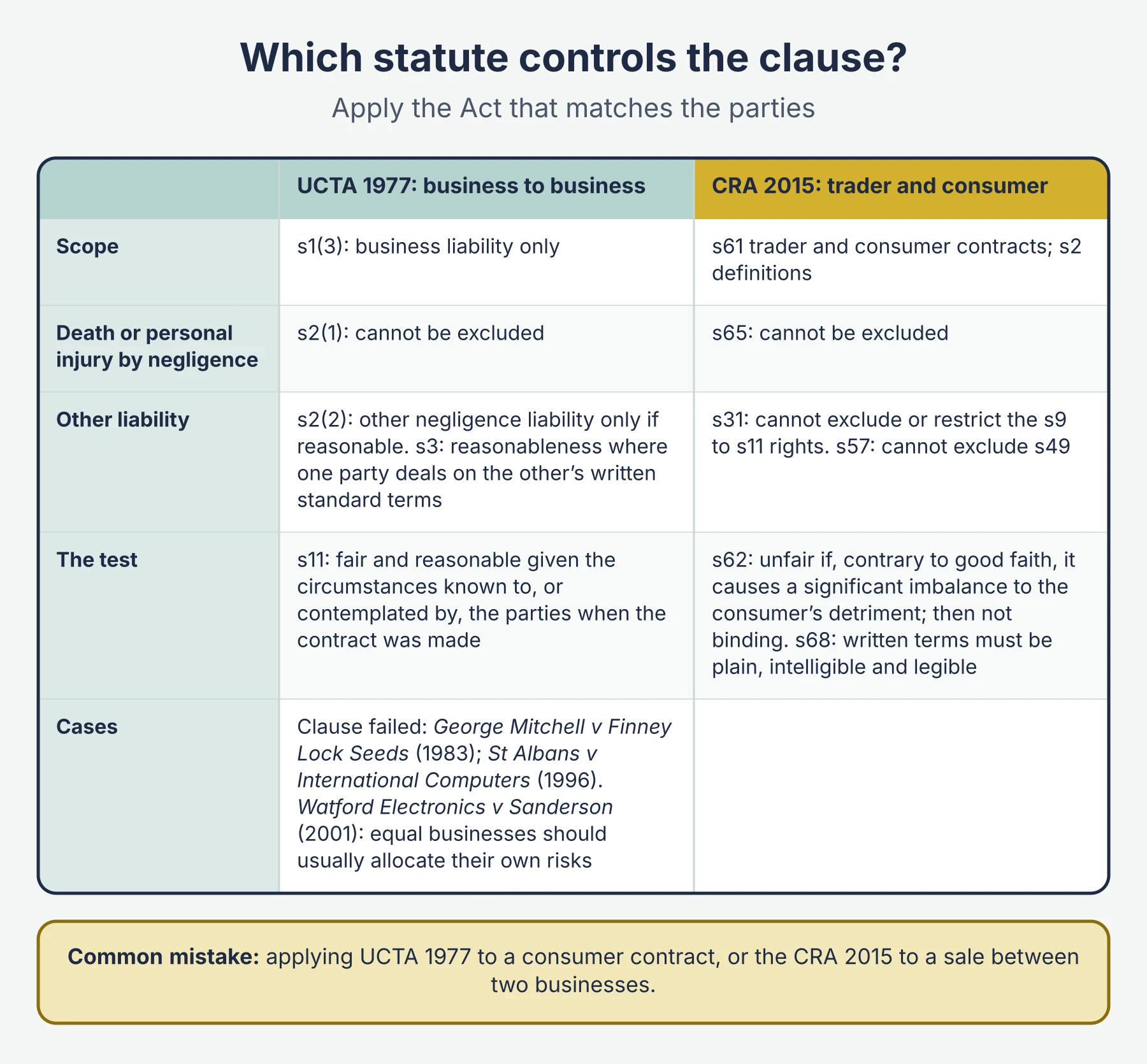
Unfair Contract Terms Act 1977 (business to business): s1(3) confines the Act to business liability. Under s2(1) liability for death or personal injury caused by negligence cannot be excluded; under s2(2) other negligence liability can be excluded only if reasonable. Section 3 applies the reasonableness test where one party deals on the other’s written standard terms. The s11 test asks whether the term was fair and reasonable given the circumstances known to, or contemplated by, the parties when the contract was made. The clause failed in George Mitchell v Finney Lock Seeds (1983) and St Albans City and District Council v International Computers (1996), but the Court of Appeal in Watford Electronics v Sanderson (2001) stressed that experienced businesses of equal bargaining power should usually be left to allocate their own risks.
Consumer Rights Act 2015 (s61 trader and consumer contracts; s2 definitions): under s31 a term cannot exclude or restrict the s9 to s11 rights, and under s57 a term cannot exclude s49. Section 65 bars excluding liability for negligently caused death or personal injury. Section 62 makes an unfair term not binding on the consumer: a term is unfair if, contrary to good faith, it causes a significant imbalance in the parties’ rights and obligations to the consumer’s detriment. Section 68 requires written terms to be transparent: plain, intelligible and legible.
Annotated model answer
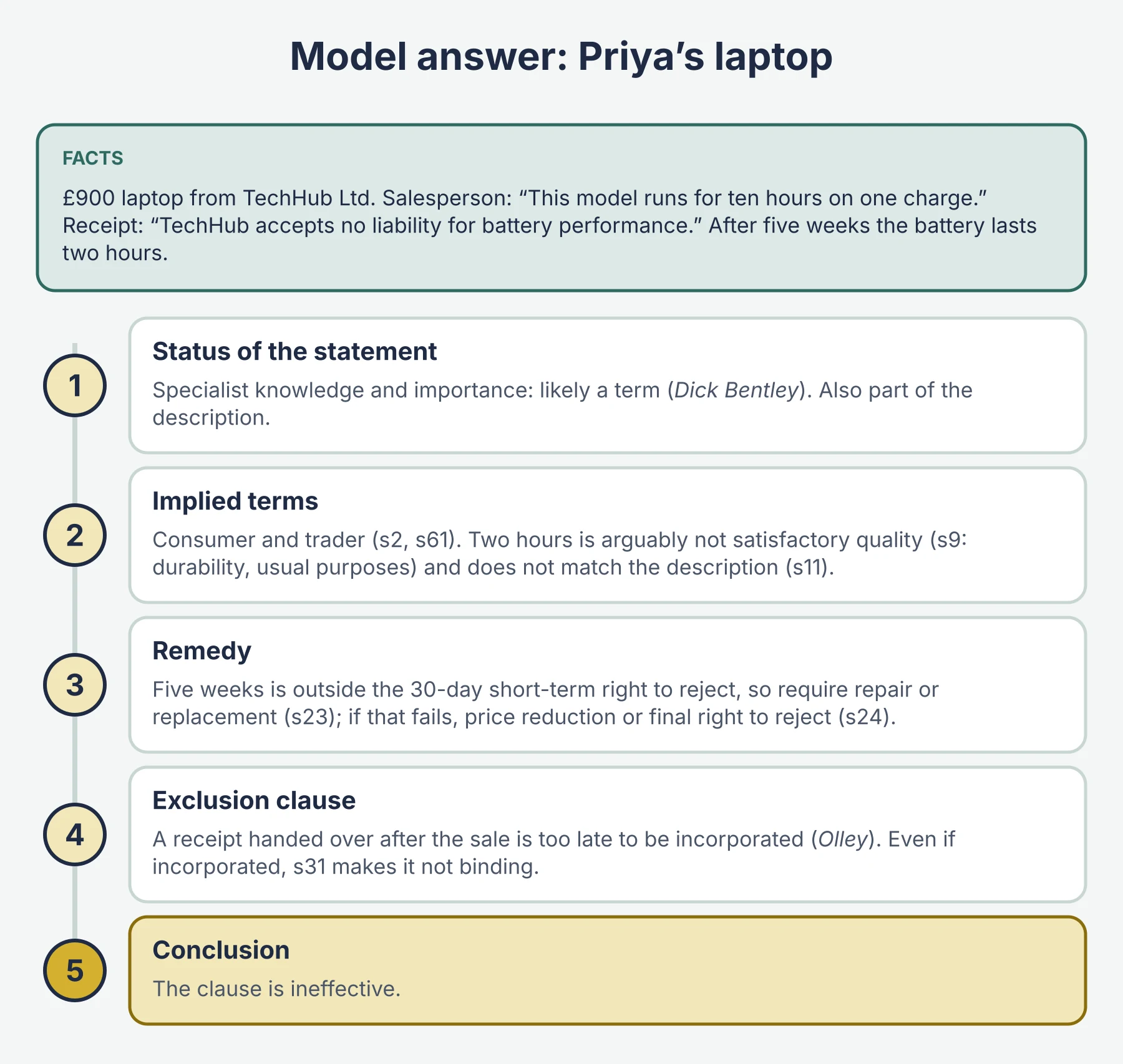
Scenario: Priya buys a laptop for £900 from TechHub Ltd after the salesperson says, “This model runs for ten hours on one charge.” The receipt states: “TechHub accepts no liability for battery performance.” After five weeks the battery lasts two hours.
- Status of the statement. The salesperson has specialist knowledge and the statement was important to the purchase, so it is likely to be a term (Dick Bentley). It also forms part of the description and is relevant to satisfactory quality.
- Implied terms. Priya is a consumer and TechHub a trader (s2, s61). A two-hour battery is arguably not of satisfactory quality (s9: durability, fitness for usual purposes) and does not match the description given (s11).
- Remedy. Five weeks is outside the 30-day short-term right to reject, so Priya should require repair or replacement (s23). If that fails, she can claim a price reduction or exercise the final right to reject (s24).
- Exclusion clause. A receipt handed over after the sale is too late to be incorporated (Olley). Even if incorporated, s31 makes it not binding because it restricts s9 and s11 rights.
- Conclusion. The clause is ineffective.
Common mistakes
- Applying UCTA 1977 to a consumer contract, or the CRA 2015 to a sale between two businesses.
- Forgetting that the clause must be incorporated before asking whether it is reasonable or fair.
- Assuming a term labelled “condition” is always a condition (Schuler).
Exam technique
Advise questions need a conclusion for each party. Assess, evaluate and discuss essays need argument: for example, whether the innominate term approach sacrifices certainty, or whether the CRA 2015 has made the common-law rules on exemption clauses almost redundant in consumer cases. Use the revision notes on contents of a contract for recall and the contents of a contract practice questions to test application.
Related resources
-
Practice questions
Cambridge A Level Law (9084): Contents of a contract – Practice Questions
Twelve original questions with mark-scheme answers on terms, the parol evidence rule, CRA 2015 rights and exemption clauses for Cambridge A Level Law 9084.
Law · Cambridge · A Level
Try questions -
Revision notes
Cambridge A Level Law (9084): Contents of a contract – Revision Notes
Condensed notes on terms and representations, CRA 2015 implied terms and remedies, status of terms and exemption clauses for Cambridge A Level Law 9084.
Law · Cambridge · A Level
Revise topic -
Study guides
Cambridge A Level Law (9084): Discharge of a contract
Performance and its exceptions, actual and anticipatory breach, and frustration with the 1943 Act for Cambridge A Level Law 9084, sub-topic 3.3, with cases.
Law · Cambridge · A Level
Read guide
Get free revision emails (optional)
Occasional emails with practice questions, worked explanations and links to free resources for the qualification and subjects you choose. No spam, and you can unsubscribe from any email. The free tools on this site never need an email.