
Revision Notes
Cambridge A Level Law (9084): Contents of a contract – Revision Notes
Condensed notes on terms and representations, CRA 2015 implied terms and remedies, status of terms and exemption clauses for Cambridge A Level Law 9084.
- Subject
- Law
- Level
- A LEVEL
- Topic
- Topic 3: Law of contract
- Author
- Marlbridge Academic Team
- Updated
- Reviewed by
- Aizaz Raoof Ali (what this means)
Aligned to Cambridge A Level Law (9084), 2026-2028. Official specification .
Syllabus page (what it covers and how it is assessed): Cambridge A Level Law.
Syllabus points this page covers
9084 (A Level)
- 3.2 Contents of a contract
Found an error? Report a correction.
Need help with this topic? Request a free trial class for A Level Law (9084).
Related: contents of a contract study guide and contents of a contract practice questions.
Sub-topic 3.2 of Cambridge International A Level Law (9084), assessed on Paper 3. Four strands: express terms, Consumer Rights Act 2015 implied terms, status of terms, and exemption clauses.
3.2.1 Express terms: condensed recall
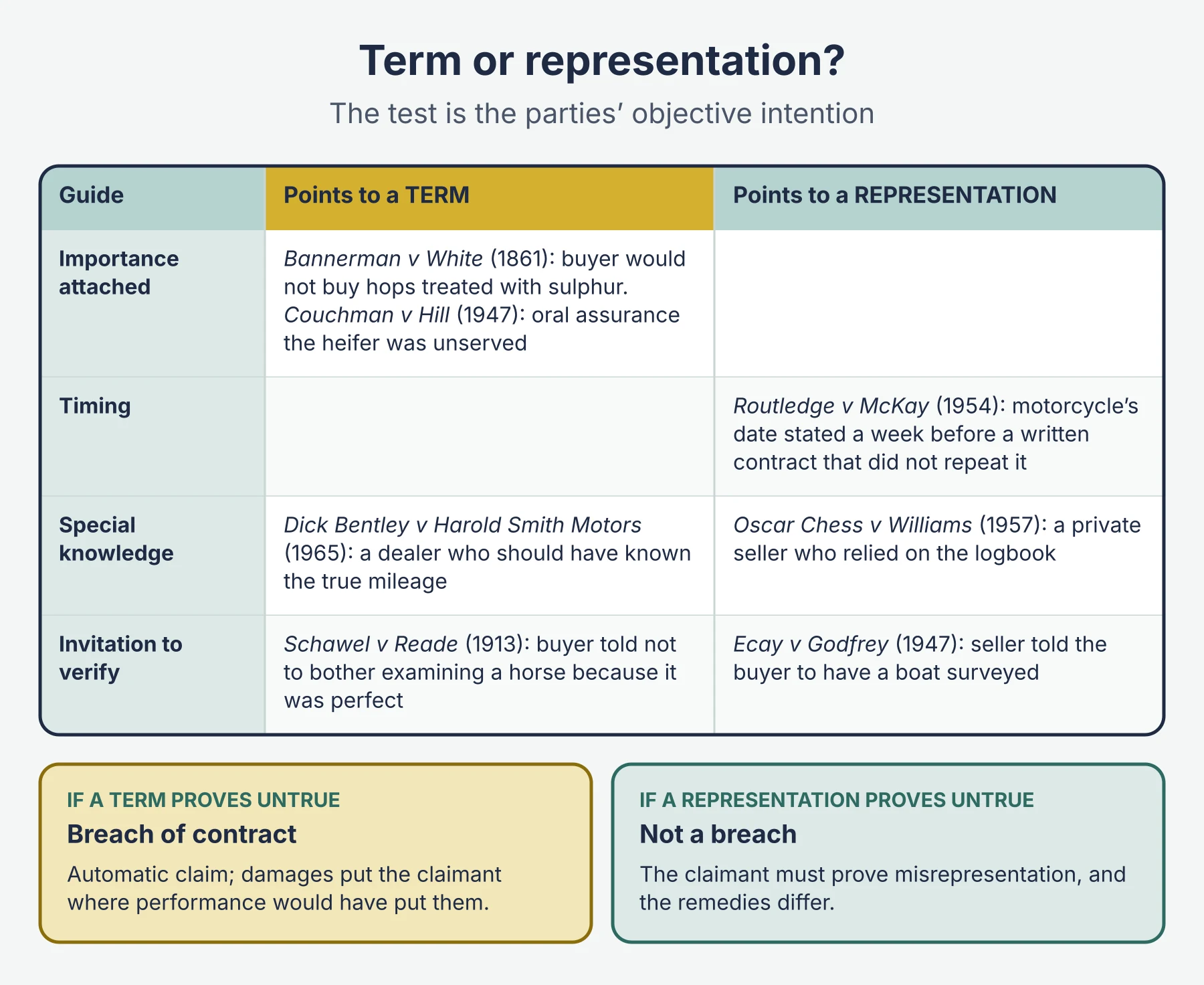
Term or representation? Objective intention, judged from what a reasonable person would infer.
| Guide | Points towards a term | Points towards a representation |
|---|---|---|
| Importance | Bannerman v White (1861): sulphur on hops; Couchman v Hill (1947): heifer unserved | Statement of minor importance |
| Timing | Made at the moment of agreement | Routledge v McKay (1954): a week before the written contract |
| Knowledge | Dick Bentley v Harold Smith Motors (1965): dealer | Oscar Chess v Williams (1957): private seller relying on logbook |
| Verification | Schawel v Reade (1913): “need not look” | Ecay v Godfrey (1947): “have it surveyed” |
Consequence: untrue term = breach of contract; untrue representation = possible misrepresentation claim, a different cause of action with different remedies.
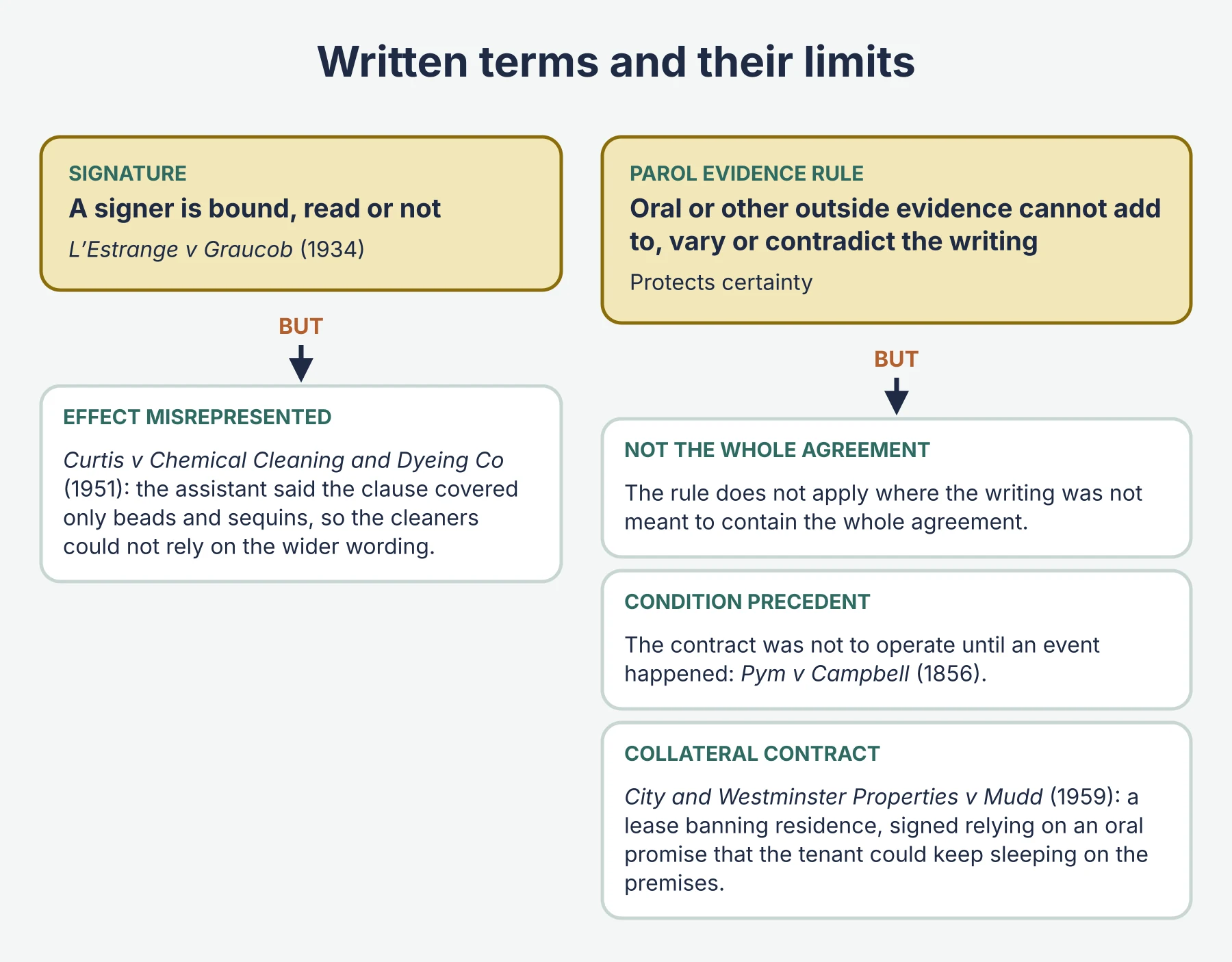
Signature: signed document binds whether read or not (L’Estrange v Graucob, 1934), unless its effect was misrepresented (Curtis v Chemical Cleaning and Dyeing Co, 1951).
Parol evidence rule: extrinsic evidence cannot add to, vary or contradict a written contract. Escape routes: the writing was not the whole agreement; a condition precedent (Pym v Campbell, 1856); a collateral contract (City and Westminster Properties v Mudd, 1959).
3.2.2 Consumer Rights Act 2015: implied terms and rights
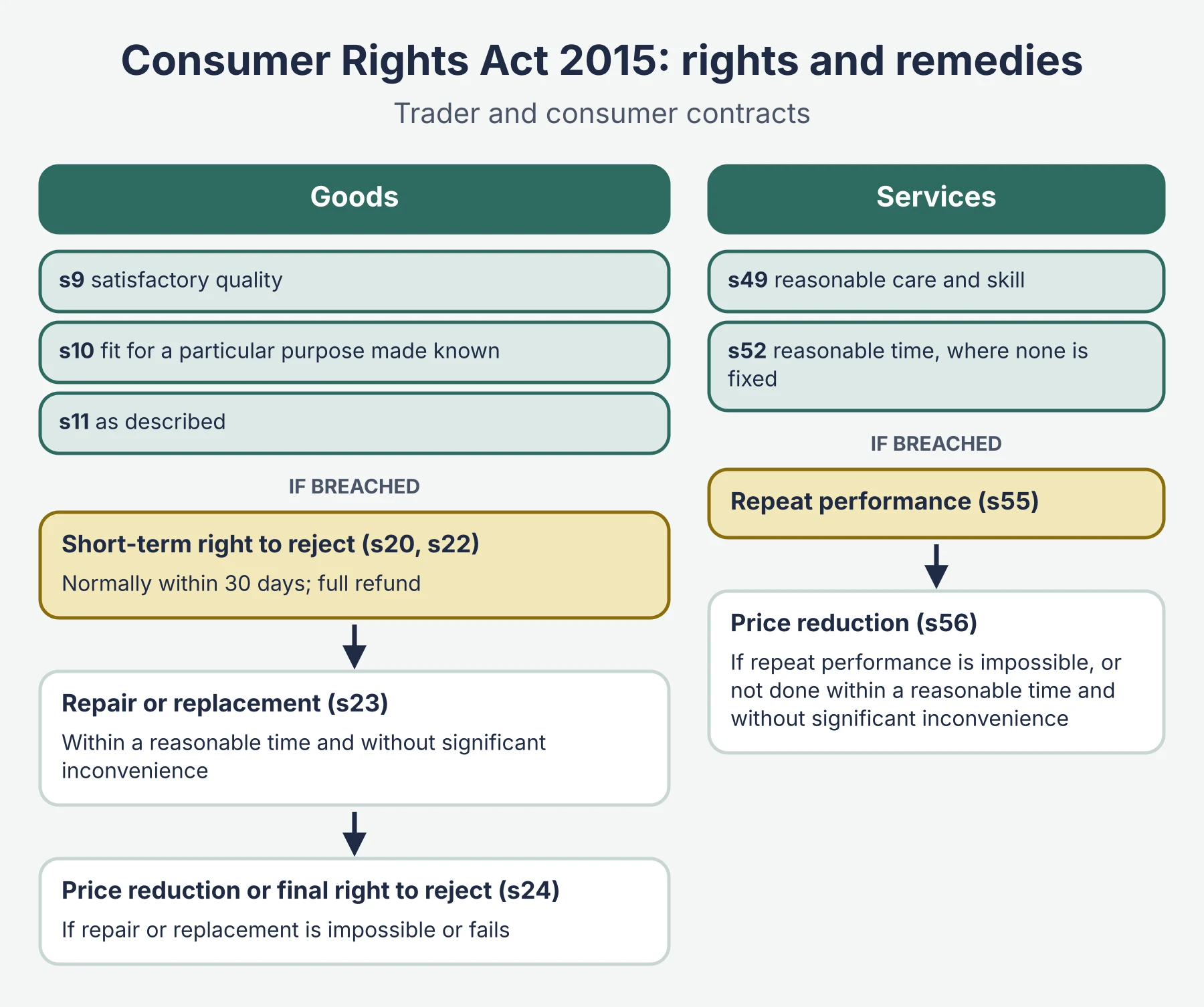
| Section | Content |
|---|---|
| s9 | Goods of satisfactory quality: reasonable person test; description, price and circumstances; aspects include usual purposes, appearance and finish, minor defects, safety, durability |
| s10 | Goods fit for a particular purpose the consumer made known |
| s11 | Goods match their description |
| s20 | Right to reject: treat the contract as at an end |
| s22 | Short-term right to reject: normally 30 days |
| s23 | Repair or replacement: reasonable time, no significant inconvenience |
| s24 | Price reduction or final right to reject, once repair or replacement fails or is impossible |
| s49 | Service performed with reasonable care and skill |
| s52 | Service performed within a reasonable time, where no time is fixed |
| s55 | Right to repeat performance |
| s56 | Right to a price reduction for services |
Sequence for goods: reject within the short-term period; or ask for repair or replacement; then price reduction or final rejection. Sequence for services: repeat performance first; price reduction if that is impossible or not done within a reasonable time without significant inconvenience.
3.2.3 Status of terms
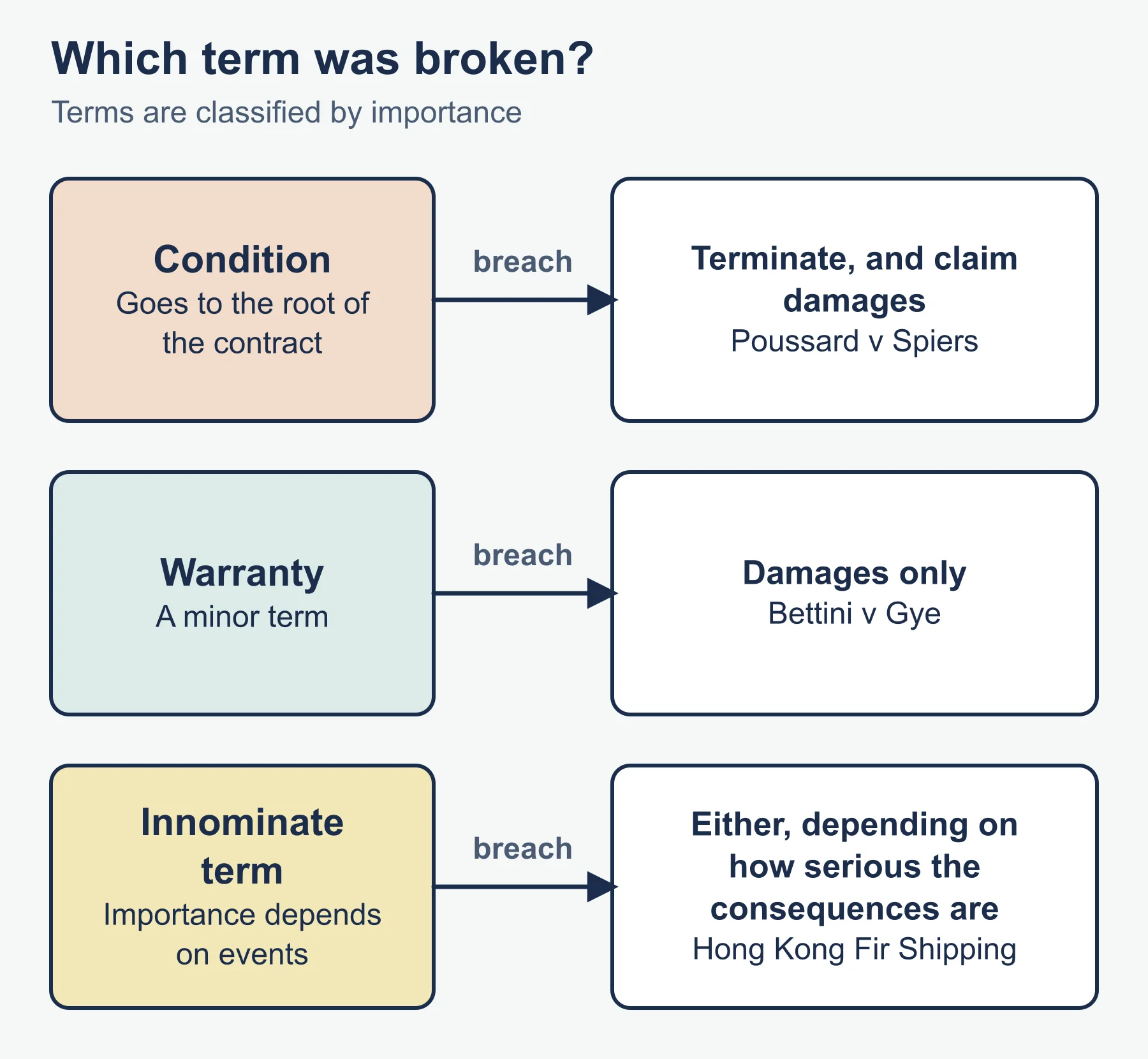
- Condition: essential term; breach allows termination and damages (Poussard v Spiers and Pond, 1876).
- Warranty: minor term; damages only (Bettini v Gye, 1876).
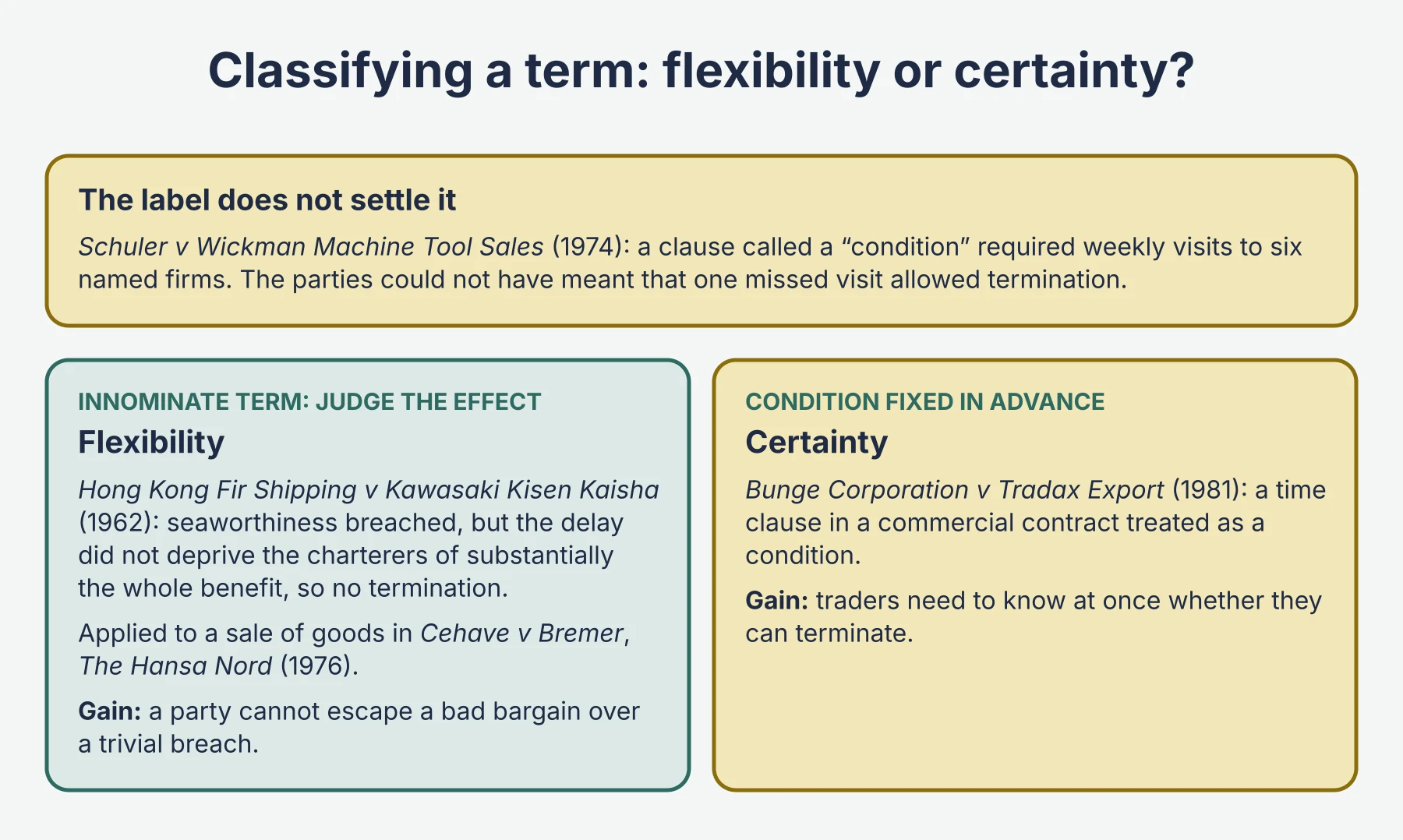
- Innominate term: consequences of breach decide. Termination only if the innocent party is deprived of substantially the whole benefit (Hong Kong Fir Shipping v Kawasaki Kisen Kaisha, 1962; Cehave v Bremer, The Hansa Nord, 1976).
- Labels are not conclusive: Schuler v Wickman Machine Tool Sales (1974).
- Commercial time clauses are usually conditions: Bunge Corporation v Tradax Export (1981).
3.2.4 Exemption clauses
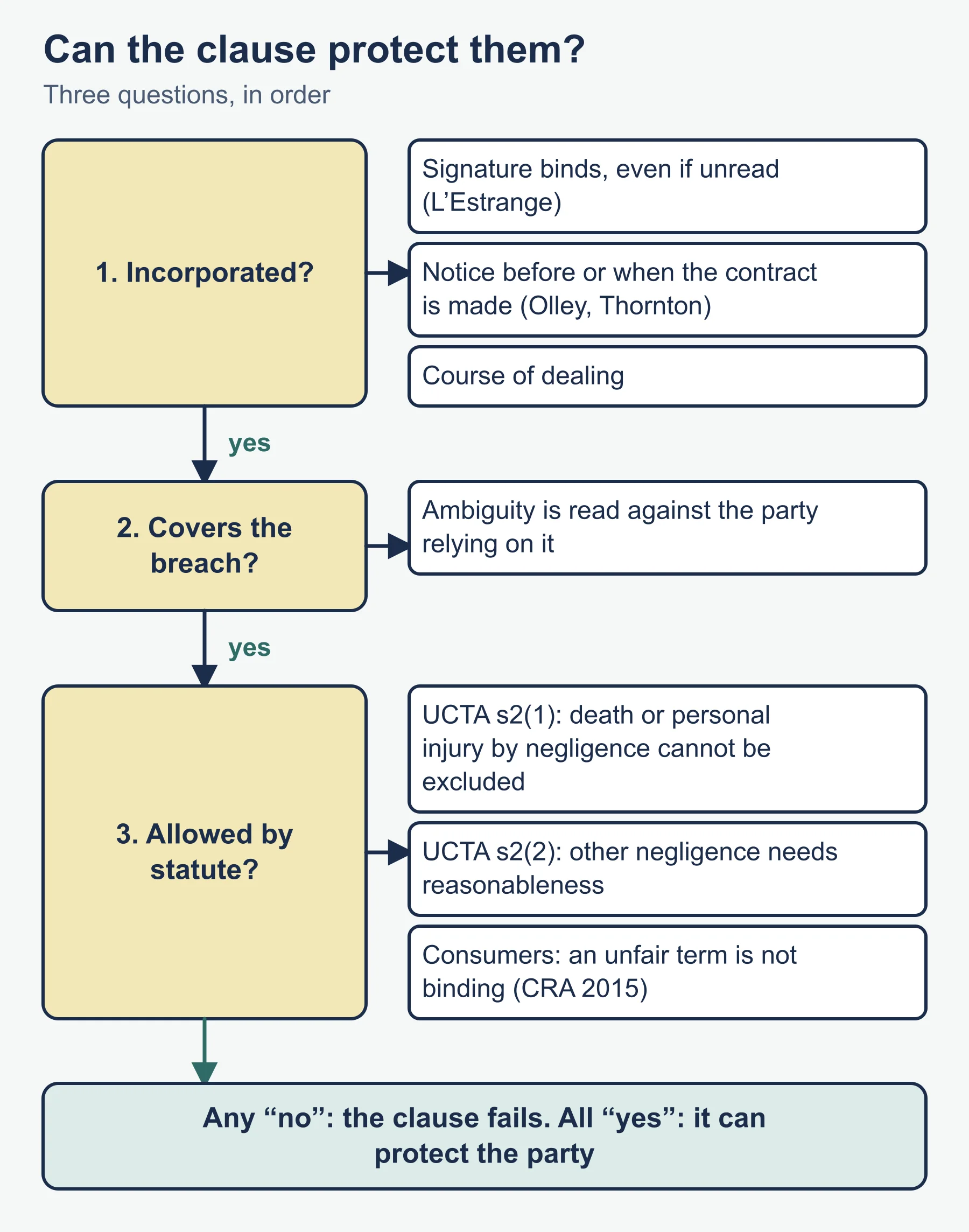
Step 1: incorporation (common law).
- Signature: L’Estrange v Graucob.
- Reasonable notice, given in time: Parker v South Eastern Railway (1877); Olley v Marlborough Court Hotel (1949); Thornton v Shoe Lane Parking (1971); Chapelton v Barry UDC (1940), where a ticket was only a receipt.
- Course of dealing must be regular and consistent: McCutcheon v David MacBrayne (1964); Hollier v Rambler Motors (1972).
- Onerous terms need special notice: Interfoto v Stiletto (1989).
Step 2: construction. Contra proferentem: ambiguity read against the party relying on the clause (Houghton v Trafalgar Insurance, 1954).
Step 3: statute.
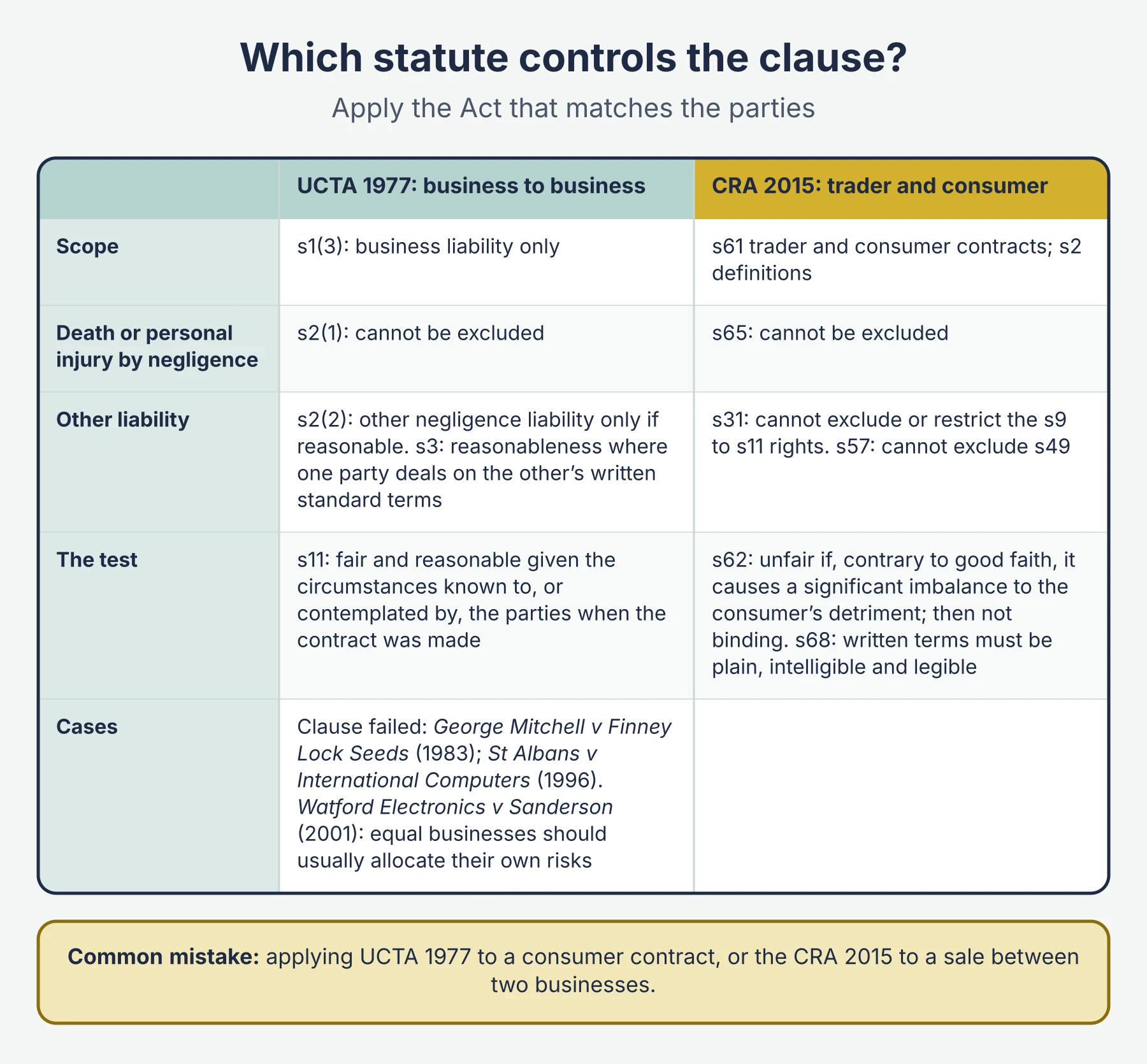
| UCTA 1977 (business to business) | CRA 2015 (trader and consumer, s61) |
|---|---|
| s1(3): business liability only | s2: definitions of trader and consumer |
| s2(1): no exclusion of negligent death or personal injury | s65: no exclusion of negligent death or personal injury |
| s2(2): other negligence liability, only if reasonable | s31: goods rights in s9 to s11 cannot be excluded or restricted |
| s3: standard terms, only if reasonable | s57: service rights, including s49, cannot be excluded |
| s11: fair and reasonable, judged at the time of contracting | s62: unfair terms not binding; s68: transparency |
Reasonableness cases: George Mitchell v Finney Lock Seeds (1983) and St Albans v ICL (1996), clause failed; Watford Electronics v Sanderson (2001), equal commercial parties left to their bargain.
Key terms
| Term | Meaning |
|---|---|
| Express term | A term stated by the parties, orally or in writing |
| Implied term | A term added by statute, custom or the courts |
| Representation | A pre-contractual statement that induces the contract but is not part of it |
| Parol evidence rule | Extrinsic evidence cannot alter a written contract |
| Collateral contract | A separate contract whose consideration is entering the main contract |
| Condition | A term going to the root of the contract |
| Warranty | A term subsidiary to the main purpose |
| Innominate term | A term classified by the seriousness of the effect of breach |
| Exemption clause | A term excluding or limiting liability |
| Contra proferentem | Ambiguity construed against the party relying on the clause |
| Consumer | An individual acting wholly or mainly outside their trade, business, craft or profession |
Exam traps
- Wrong statute. UCTA 1977 in this syllabus is business to business; CRA 2015 covers trader and consumer. Identify the parties before choosing.
- Skipping incorporation. A clause that was never part of the contract needs no reasonableness or fairness analysis, but say so.
- Ignoring dates. The short-term right to reject turns on the 30-day period; count from the facts.
- Treating s62 as an exclusion ban. A term that is unfair under s62 is not binding on the consumer; that is different from the outright ban on excluding s9 to s11 in s31.
- Over-reading labels. “Condition” in the document may not be a condition (Schuler).
Self-test
- Which case shows that an oral assurance can override printed auction conditions?
- Why was the statement in Routledge v McKay only a representation?
- State the parol evidence rule and one exception.
- Under the CRA 2015, which section covers fitness for a particular purpose?
- What is the normal period for the short-term right to reject?
- When can a consumer use the final right to reject?
- What two rights does a consumer have for a service performed without reasonable care and skill?
- What did Hong Kong Fir decide about seaworthiness obligations?
- Why did the clause in Schuler v Wickman not operate as a condition?
- What did Houghton v Trafalgar Insurance decide?
- What does UCTA s2(1) provide?
- When is a term unfair under s62 CRA 2015?
Answers:
- Couchman v Hill (1947).
- It was made a week before the written contract and was not repeated in it.
- Extrinsic evidence cannot add to, vary or contradict a written contract; exceptions include a collateral contract (City and Westminster Properties v Mudd) and a condition precedent (Pym v Campbell).
- Section 10.
- Normally 30 days.
- After one repair or replacement has failed, or where repair or replacement is impossible (s24).
- Repeat performance (s55) and, failing that, a price reduction (s56).
- It was an innominate term; termination was only allowed if the breach deprived the charterers of substantially the whole benefit, which the delay did not.
- The parties could not have intended that a single missed visit would allow termination.
- “Excess load” did not clearly cover extra passengers, so the ambiguity was read against the insurer.
- Liability for death or personal injury caused by negligence cannot be excluded or restricted.
- If, contrary to good faith, it causes a significant imbalance in the parties’ rights and obligations to the consumer’s detriment.
Related resources
-
Study guides
Cambridge A Level Law (9084): Discharge of a contract
Performance and its exceptions, actual and anticipatory breach, and frustration with the 1943 Act for Cambridge A Level Law 9084, sub-topic 3.3, with cases.
Law · Cambridge · A Level
Read guide -
Practice questions
Cambridge A Level Law (9084): Discharge of a contract – Practice Questions
Twelve original questions with mark-scheme answers on performance, anticipatory breach, frustration and the 1943 Act for Cambridge A Level Law 9084, 3.3.
Law · Cambridge · A Level
Try questions -
Revision notes
Cambridge A Level Law (9084): Discharge of a contract – Revision Notes
Condensed notes on strict performance and its exceptions, actual and anticipatory breach, and frustration for Cambridge A Level Law 9084, with a self-test.
Law · Cambridge · A Level
Revise topic
Get free revision emails (optional)
Occasional emails with practice questions, worked explanations and links to free resources for the qualification and subjects you choose. No spam, and you can unsubscribe from any email. The free tools on this site never need an email.