
Revision Notes
Cambridge A Level Law (9084): Discharge of a contract – Revision Notes
Condensed notes on strict performance and its exceptions, actual and anticipatory breach, and frustration for Cambridge A Level Law 9084, with a self-test.
- Subject
- Law
- Level
- A LEVEL
- Topic
- Topic 3: Law of contract
- Author
- Marlbridge Academic Team
- Updated
- Reviewed by
- Aizaz Raoof Ali (what this means)
Aligned to Cambridge A Level Law (9084), 2026-2028. Official specification .
Syllabus page (what it covers and how it is assessed): Cambridge A Level Law.
Syllabus points this page covers
9084 (A Level)
- 3.3 Discharge of a contract
Found an error? Report a correction.
Need help with this topic? Request a free trial class for A Level Law (9084).
Related: discharge of a contract study guide and discharge of a contract practice questions.
Sub-topic 3.3 of Cambridge International A Level Law (9084), assessed on Paper 3. Three routes to discharge: performance, breach and frustration.
3.3.1 Performance
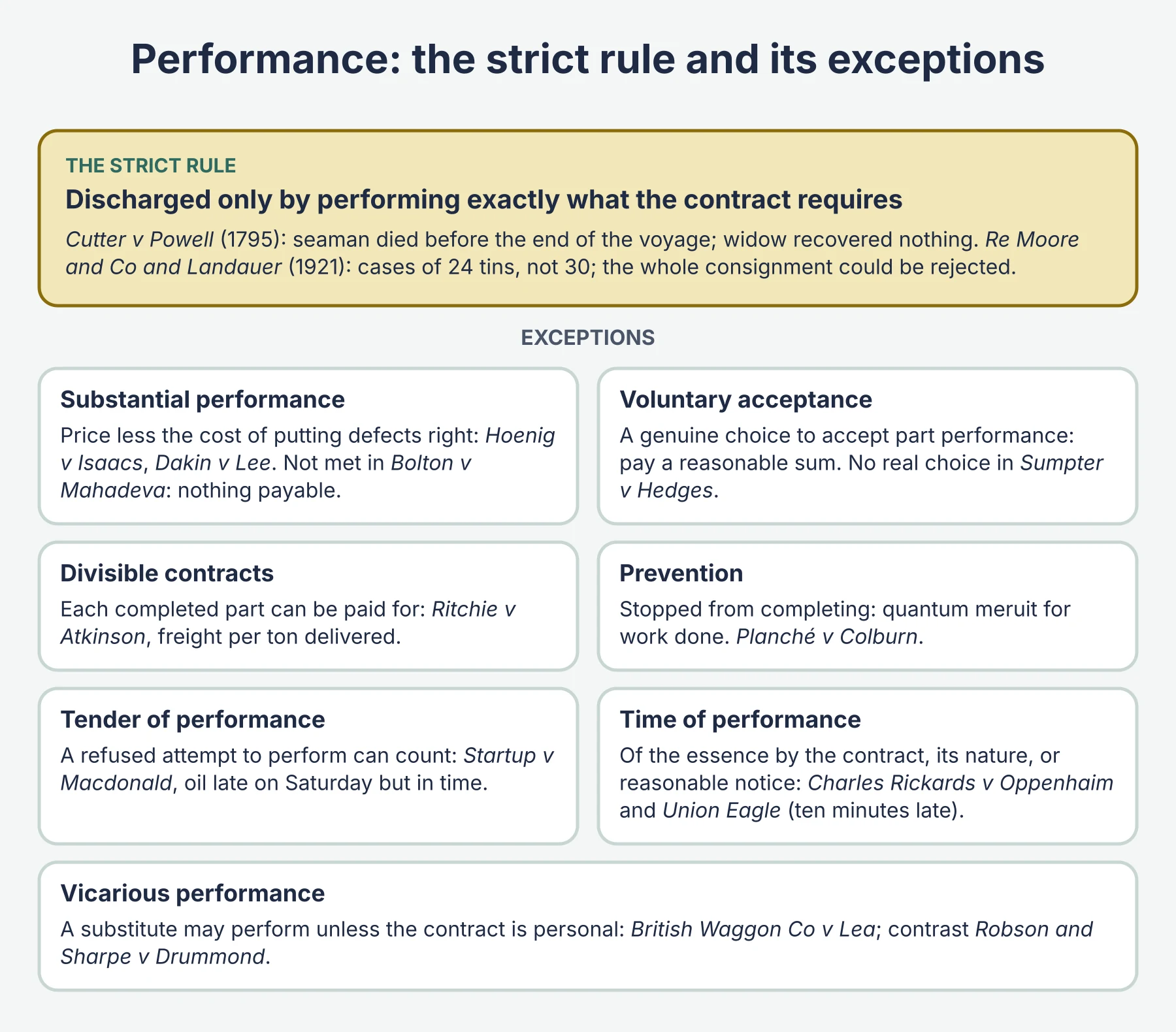
Rule: performance must be exact and complete before the other side must pay.
- Cutter v Powell (1795): lump sum on completion of voyage; seaman died part-way; nothing recoverable.
- Re Moore and Co and Landauer (1921): right total, wrong packing (24 not 30 per case); buyer could reject.
Exceptions:
| Exception | Rule | Authority |
|---|---|---|
| Substantial performance | Price payable minus cost of remedying minor defects | Hoenig v Isaacs (1952); Dakin v Lee (1916); contrast Bolton v Mahadeva (1972) |
| Voluntary acceptance of partial performance | Reasonable sum if the other party genuinely chose to accept the benefit | Sumpter v Hedges (1898): no genuine choice, no payment for the buildings |
| Divisible contract | Each completed part paid for | Ritchie v Atkinson (1808): freight per ton |
| Prevention of performance | Quantum meruit for work done | Planché v Colburn (1831) |
| Tender of performance | A refused valid tender counts as performance | Startup v Macdonald (1843) |
| Time of performance | Time essential if stated, implied by the nature of the contract, or made so by reasonable notice | Charles Rickards v Oppenhaim (1950); Union Eagle v Golden Achievement (1997) |
| Vicarious performance | Substitute allowed unless personal skill is essential | British Waggon Co v Lea (1880); Robson and Sharpe v Drummond (1831) |
3.3.2 Breach
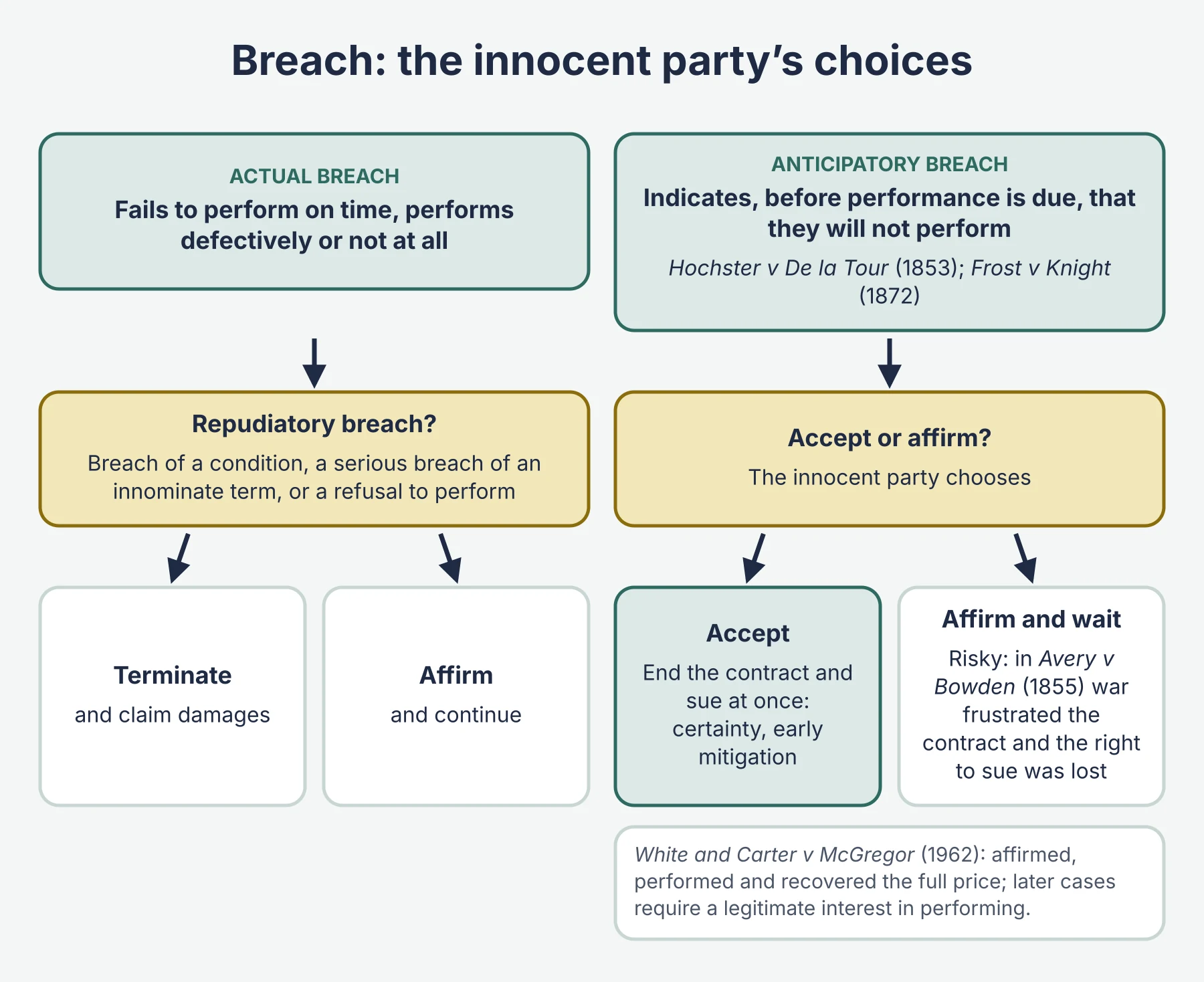
- Actual breach: failure to perform at the time due, defective performance or non-performance.
- Repudiatory breach (breach of a condition, serious breach of an innominate term, refusal to perform) gives the innocent party a choice: terminate and claim damages, or affirm.
- Anticipatory breach: a party indicates before the due date that they will not perform.
- Hochster v De la Tour (1853): sue at once.
- Frost v Knight (1872): sue at once even though performance depended on a future event.
- Avery v Bowden (1855): the innocent party waited and lost the claim when war frustrated the contract.
- White and Carter v McGregor (1962): affirmation and performance allowed; full price recovered.
3.3.3 Frustration
Definition: an event after formation, without the fault of either party, makes performance impossible, illegal or radically different from what was agreed (Davis Contractors v Fareham UDC, 1956).
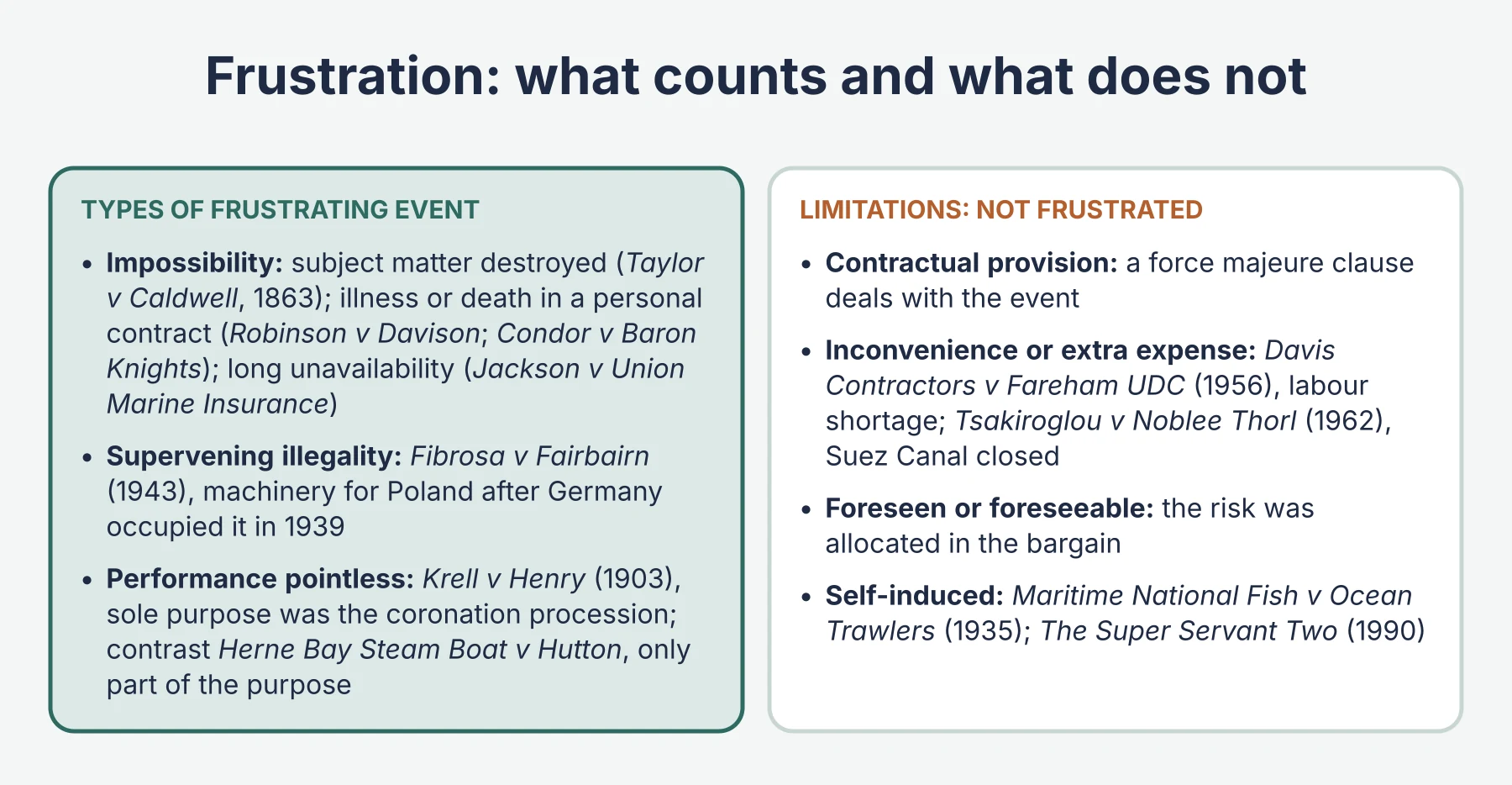
Types:
- Impossibility: Taylor v Caldwell (1863), music hall burned down; Robinson v Davison (1871) and Condor v Baron Knights (1966), illness of a performer; Jackson v Union Marine Insurance (1874), long delay.
- Supervening illegality: Fibrosa v Fairbairn (1943), wartime occupation of the buyer’s country.
- Performance pointless: Krell v Henry (1903) contrasted with Herne Bay Steam Boat v Hutton (1903).
Limitations:
- Contractual provision, such as a force majeure clause, covering the event.
- Inconvenience or extra expense: Davis Contractors (labour shortage); Tsakiroglou v Noblee Thorl (1962), Suez closure.
- Foreseen or reasonably foreseeable events: risk taken to be allocated by the parties.
- Self-induced: Maritime National Fish v Ocean Trawlers (1935); The Super Servant Two (1990).
Effects:
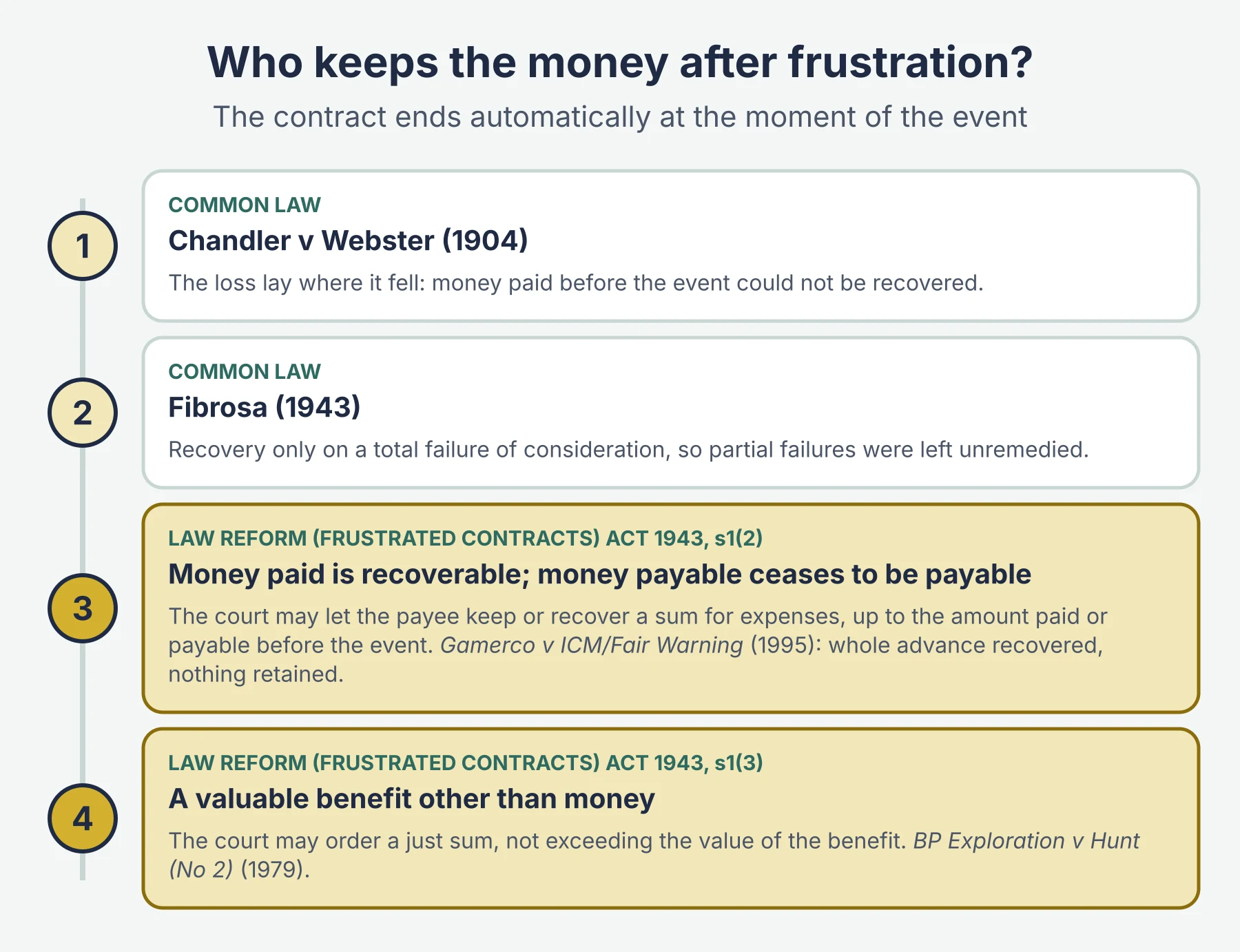
- Common law: contract ends automatically at the moment of the event. Chandler v Webster (1904): loss lies where it falls. Fibrosa (1943): recovery for total failure of consideration only.
- Law Reform (Frustrated Contracts) Act 1943:
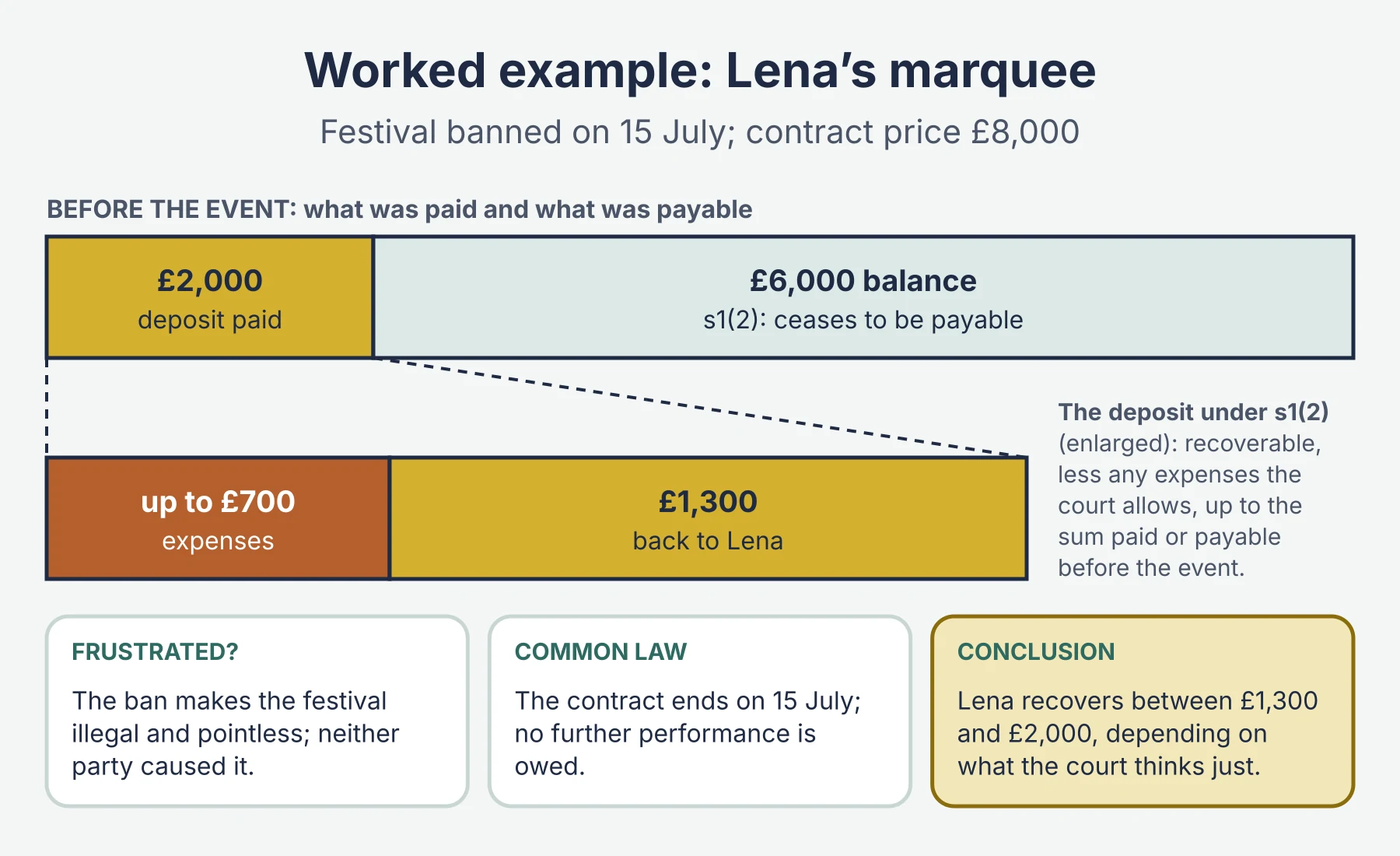
- s1(2): money paid is recoverable; money payable ceases to be payable; court may allow the payee to keep or recover expenses, capped at the amount paid or payable before the event. Gamerco v ICM/Fair Warning (1995): no deduction allowed.
- s1(3): just sum for a valuable non-money benefit, capped at the value of the benefit. BP Exploration v Hunt (No 2) (1979).
Key terms
| Term | Meaning |
|---|---|
| Discharge | Release of the parties from their contractual obligations |
| Entire contract | A contract under which payment is due only on complete performance |
| Substantial performance | Performance complete except for minor defects |
| Quantum meruit | A reasonable sum for work done |
| Tender | An offer to perform in accordance with the contract |
| Time of the essence | Timing treated as a condition, so lateness allows termination |
| Repudiatory breach | A breach serious enough to allow termination |
| Anticipatory breach | A refusal to perform indicated before the time for performance |
| Affirmation | The innocent party’s choice to keep the contract alive |
| Frustration | Automatic discharge by a supervening event that is no one’s fault |
| Force majeure clause | A term providing for the consequences of specified outside events |
Exam traps
- Frustration versus breach. If the event was within a party’s control, it is self-induced and the failure to perform is a breach, so the remedies for breach apply instead.
- Cost is not enough. A rise in price or a longer route does not frustrate (Davis Contractors; Tsakiroglou).
- Expenses under s1(2) are capped. The payee can keep or recover expenses only up to what was paid or payable before the frustrating event; with no advance, s1(2) gives nothing for expenses.
- Substantial performance is a question of degree. Compare cost of remedying with the contract price: small in Hoenig v Isaacs, large in Bolton v Mahadeva.
- Waiting after an anticipatory breach keeps the contract alive for both sides (Avery v Bowden).
- Voluntary acceptance requires a real choice (Sumpter v Hedges).
Self-test
- What did Re Moore and Co and Landauer show about strict performance?
- Why was nothing payable in Bolton v Mahadeva?
- When is a party who has partly performed entitled to a quantum meruit for prevention?
- What three ways can time become of the essence?
- When is vicarious performance not allowed?
- What two choices does the innocent party have after an anticipatory breach?
- Why did the claimant lose in Avery v Bowden?
- Name the three types of frustrating event in the syllabus.
- Why was Davis Contractors v Fareham UDC not a case of frustration?
- What happened in The Super Servant Two?
- What does s1(2) of the 1943 Act provide?
- What does s1(3) of the 1943 Act provide?
Answers:
- Even a technical departure (wrong packing, correct total) allowed the buyer to reject the goods.
- The defects were too serious and costly to remedy for the work to count as substantially performed.
- When the other party has prevented completion of the work (Planché v Colburn).
- By an express term, by the nature of the contract, or by reasonable notice after delay.
- Where the contract relies on the personal skill or qualities of the party.
- Accept the repudiation and sue at once, or affirm and wait for the date of performance.
- He affirmed and waited; the Crimean War then frustrated the contract before performance was due.
- Impossibility, supervening illegality, and change of circumstance making performance pointless.
- The labour shortage only made performance slower and more expensive.
- The carrier’s choice to use its remaining vessel for other contracts made the frustration self-induced.
- Money paid is recoverable and money payable ceases to be payable, subject to a discretionary allowance for the payee’s expenses.
- A just sum may be awarded for a valuable benefit obtained before the event, not exceeding its value.
Related resources
-
Study guides
Cambridge A Level Law (9084): Remedies for breach of a contract
Expectation, reliance and non-pecuniary damages, causation, remoteness, mitigation and equitable remedies for Cambridge A Level Law 9084, sub-topic 3.4.
Law · Cambridge · A Level
Read guide -
Practice questions
Cambridge A Level Law (9084): Remedies for breach of a contract – Practice Questions
Twelve original questions with mark-scheme answers on damages, remoteness, mitigation and equitable remedies for Cambridge A Level Law 9084, sub-topic 3.4.
Law · Cambridge · A Level
Try questions -
Revision notes
Cambridge A Level Law (9084): Remedies for breach of a contract – Revision Notes
Condensed notes on contract damages, remoteness, mitigation, specific performance, rescission and injunctions for Cambridge A Level Law 9084, with a self-test.
Law · Cambridge · A Level
Revise topic
Get free revision emails (optional)
Occasional emails with practice questions, worked explanations and links to free resources for the qualification and subjects you choose. No spam, and you can unsubscribe from any email. The free tools on this site never need an email.