
Study Guides
Cambridge A Level Law (9084): Remedies for breach of a contract
Expectation, reliance and non-pecuniary damages, causation, remoteness, mitigation and equitable remedies for Cambridge A Level Law 9084, sub-topic 3.4.
- Subject
- Law
- Level
- A LEVEL
- Topic
- Topic 3: Law of contract
- Author
- Marlbridge Academic Team
- Updated
- Reviewed by
- Aizaz Raoof Ali (what this means)
Aligned to Cambridge A Level Law (9084), 2026-2028. Official specification .
Syllabus page (what it covers and how it is assessed): Cambridge A Level Law.
Syllabus points this page covers
9084 (A Level)
- 3.4 Remedies for breach of a contract
Found an error? Report a correction.
Need help with this topic? Request a free trial class for A Level Law (9084).
Sub-topic 3.4 of Cambridge International A Level Law (9084) asks what a court can order when a contract is broken, how damages are measured, what limits the recovery, and when equity steps in. Paper 3 tests it both in scenarios, where you must calculate and justify an award, and in essays that ask you to evaluate damages and equitable remedies. This guide builds on the Topic 3 overview with fuller cases and a worked calculation.
What the syllabus lists
- 3.4.1 Common law: purpose and nature of damages; the measure of damages through expectation loss, reliance loss and non-pecuniary loss; limitations through causation, remoteness and mitigation; evaluation of damages as a remedy.
- 3.4.2 Equitable: the purpose of equitable remedies; the nature of specific performance, specific restitution, rescission and injunction; limitations on their award; evaluation of their use.
3.4.1 Damages
Purpose and nature
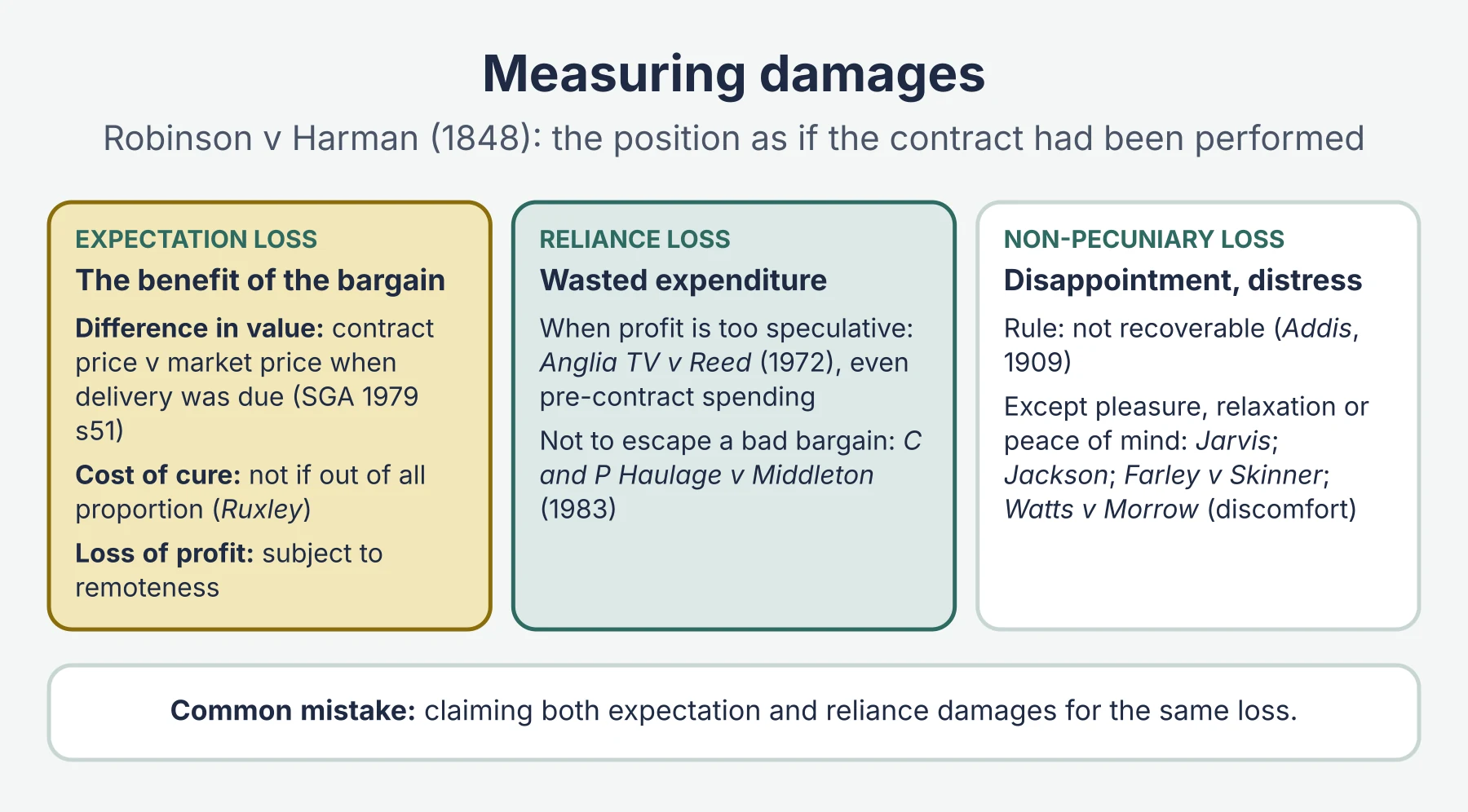
Damages for breach of contract are compensatory. The classic statement in Robinson v Harman (1848) is that the claimant should be placed, so far as money can do it, in the same position as if the contract had been performed. Damages are not intended to punish the defendant, and they are available as of right once breach and loss are proved, unlike equitable remedies.
Expectation loss
Expectation damages protect the benefit of the bargain. Common measures are:
- Difference in value: for non-delivery of goods, the difference between the contract price and the market price at the time delivery should have occurred (Sale of Goods Act 1979, s51).
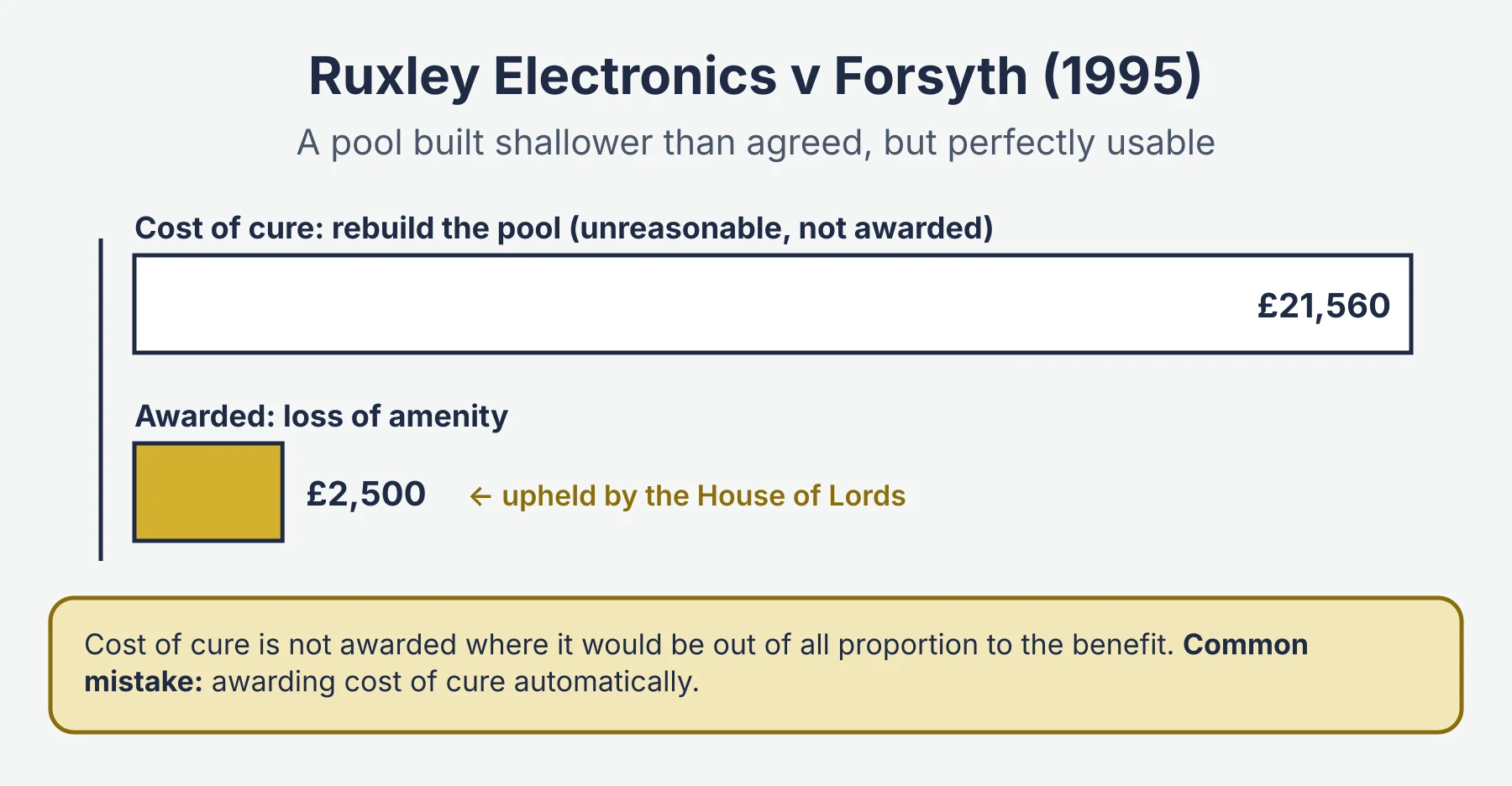
- Cost of cure: the cost of putting the defective performance right. It is not awarded where it would be out of all proportion to the benefit. In Ruxley Electronics v Forsyth (1995) a swimming pool was built shallower than agreed but was perfectly usable; rebuilding would cost £21,560, which was unreasonable, so the House of Lords upheld an award of £2,500 for loss of amenity.
- Loss of profit: profits the claimant would have made from performance, subject to remoteness.
Reliance loss
Where expected profit is too speculative to prove, the claimant can recover wasted expenditure instead. In Anglia Television v Reed (1972) an actor’s withdrawal wasted the company’s spending on a film, including expenditure before the contract was made, because it was within the parties’ contemplation that it would be wasted by breach. But reliance damages cannot be used to escape a bad bargain: in C and P Haulage v Middleton (1983) the claimant could not recover expenditure he would have lost even if the contract had been performed.
Non-pecuniary loss
The traditional rule is that damages are not recoverable for disappointment or injured feelings (Addis v Gramophone Co, 1909). Exceptions exist where the purpose of the contract was to provide pleasure, relaxation or peace of mind:
- Jarvis v Swans Tours (1973): a disappointing skiing holiday.
- Jackson v Horizon Holidays (1975): a family holiday, with damages reflecting the family’s loss.
- Farley v Skinner (2001): a surveyor told to check for aircraft noise negligently failed to report it; damages for loss of amenity were recoverable because peace and quiet was an important object of the contract.
- Watts v Morrow (1991): damages for physical discomfort and inconvenience caused by a breach.
Causation
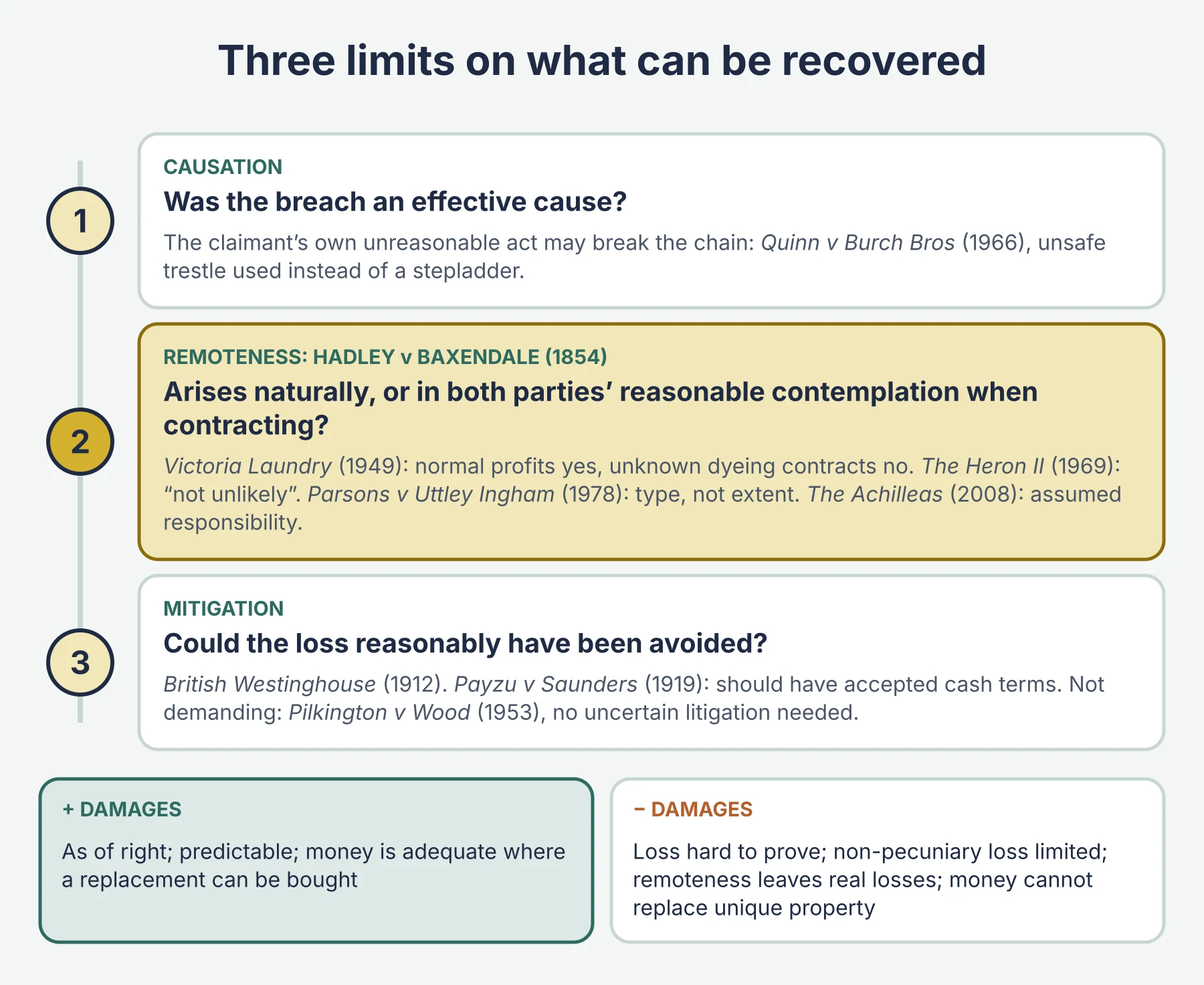
The breach must be an effective cause of the loss. A claimant’s own unreasonable act may break the chain. In Quinn v Burch Bros (1966) a failure to supply a stepladder merely gave the claimant the opportunity to use an unsafe trestle; his own choice caused his injury.
Remoteness
Under Hadley v Baxendale (1854), losses are recoverable if they arise naturally from the breach, or if they were in the reasonable contemplation of both parties at the time of contracting as a probable result of breach. Later cases refined the test:
- Victoria Laundry v Newman Industries (1949): a late boiler cost the laundry its normal profits, which were recoverable, but not the exceptionally lucrative dyeing contracts the defendants knew nothing about.
- The Heron II (Koufos v Czarnikow, 1969): a shipowner who delivered sugar late was liable for the fall in market price because such a loss was “not unlikely” to result.
- Parsons v Uttley Ingham (1978): if the type of loss was within contemplation, it does not matter that its extent was greater than expected.
- The Achilleas (Transfield Shipping v Mercator, 2008): a party is not liable for a type of loss for which, in the commercial context, it cannot reasonably be taken to have assumed responsibility.
Mitigation
The claimant cannot recover loss they could reasonably have avoided (British Westinghouse v Underground Electric Railways, 1912). In Payzu v Saunders (1919) the buyer should have accepted the seller’s offer to continue supplying on cash terms. The standard is not demanding: in Pilkington v Wood (1953) the claimant did not have to start uncertain litigation against a third party.
Evaluation of damages
- Strengths: available as of right, predictable rules, and money is an adequate substitute in most commercial cases where a replacement can be bought.
- Weaknesses: a claimant may be under-compensated where loss is hard to prove, non-pecuniary loss is recoverable only in limited categories, remoteness can leave real losses uncompensated, and money cannot replace unique property.
3.4.2 Equitable remedies
Purpose
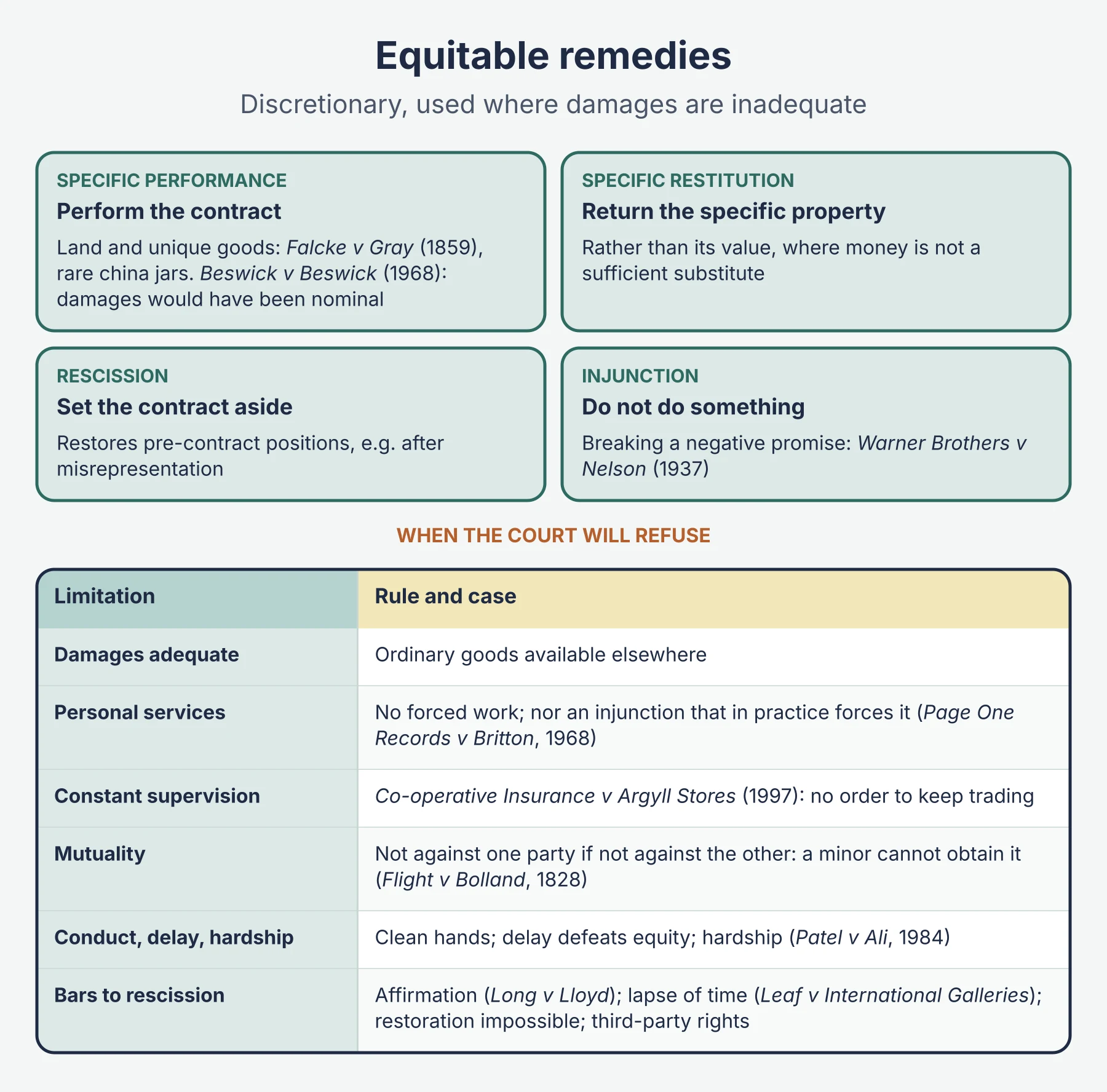
Equitable remedies developed to give justice where damages are inadequate. They are discretionary: the court may refuse them even where breach is proved.
Nature
- Specific performance orders the party to perform. It is typical for land and unique goods: in Falcke v Gray (1859) the court recognised that rare china jars could be the subject of specific performance. In Beswick v Beswick (1968) it was ordered because damages to the estate would have been nominal.
- Specific restitution orders the return of specific property, rather than its value, where money would not be a sufficient substitute.
- Rescission sets the contract aside and restores the parties to their pre-contract positions, for example after misrepresentation.
- Injunction orders a party not to do something, such as breaking a negative promise. In Warner Brothers v Nelson (1937) an actress was restrained from working for another studio in breach of an exclusive contract.
Limitations
- Damages adequate: no specific performance for ordinary goods available elsewhere.
- Personal services: courts will not compel a person to work for another, and an injunction that in practice forces performance is refused (Page One Records v Britton, 1968).
- Constant supervision: in Co-operative Insurance v Argyll Stores (1997) the House of Lords refused to order a supermarket to keep trading.
- Mutuality: specific performance is not ordered against one party if it could not be ordered against the other, so a minor cannot obtain it (Flight v Bolland, 1828).
- Conduct and delay: “he who comes to equity must come with clean hands”, and delay defeats equity. Hardship to the defendant may lead to refusal (Patel v Ali, 1984).
- Bars to rescission: affirmation (Long v Lloyd, 1958), lapse of time (Leaf v International Galleries, 1950), impossibility of restoring the parties, and the intervention of third-party rights.
Evaluation of equitable remedies
Discretion allows the court to fit the remedy to the case and protect interests that money cannot, but it reduces predictability. Refusal for personal services protects individual liberty, though it can leave employers or promoters without an effective remedy.
Worked example: calculating damages
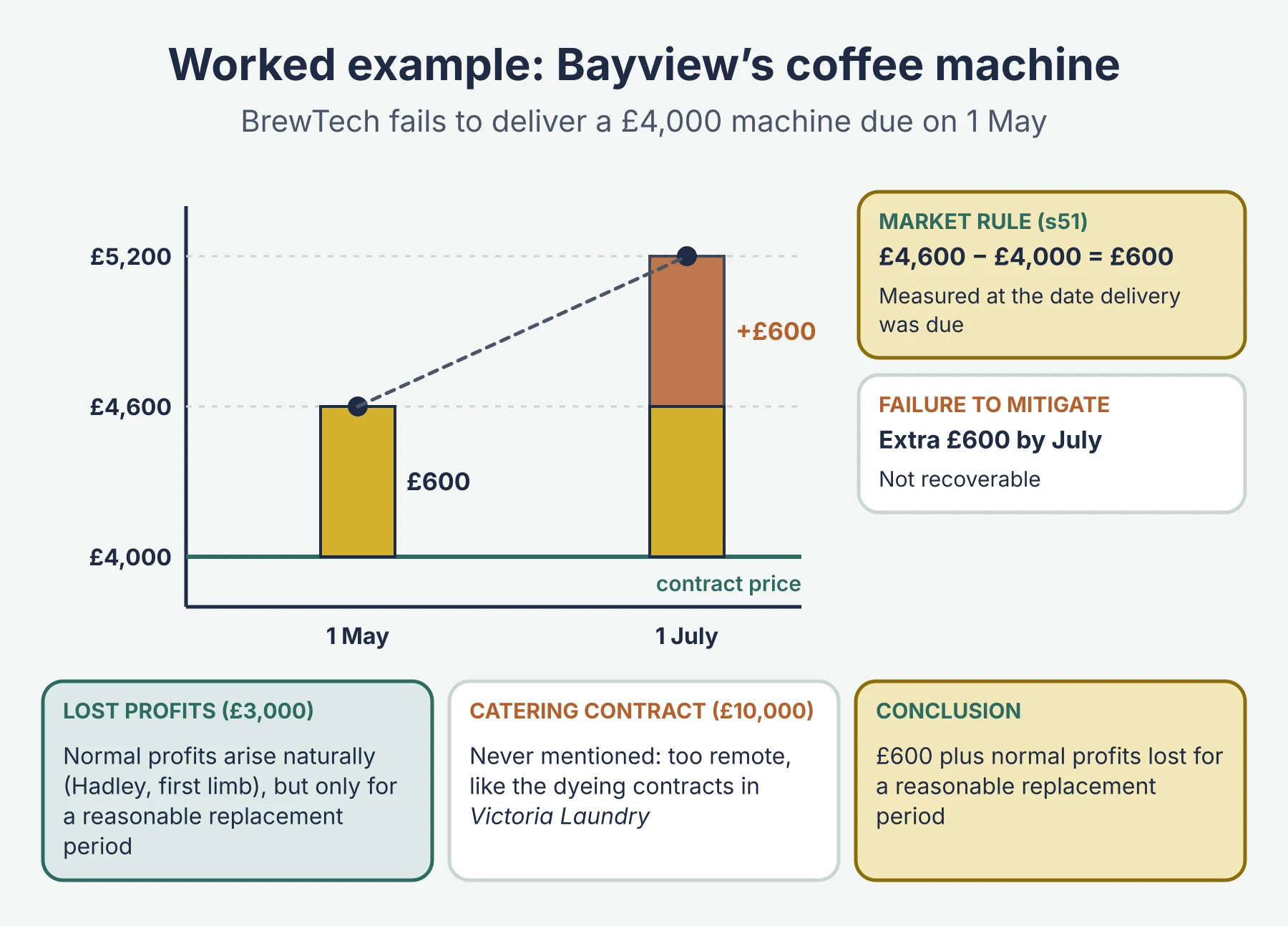
Scenario: Bayview Café orders a coffee machine for £4,000 from BrewTech Ltd, delivery 1 May. BrewTech fails to deliver. On 1 May the market price for the same machine is £4,600. Bayview does not buy a replacement until 1 July, by which time the price is £5,200. Bayview also claims £3,000 profit lost while it had no machine, and £10,000 from a lucrative catering contract it had not mentioned.
- Market rule: damages are £4,600 − £4,000 = £600, measured at the date delivery should have occurred (s51). The extra £600 from delaying until July is a failure to mitigate.
- Lost profits: ordinary profits from using the machine arise naturally from non-delivery (Hadley, first limb), but only for the period Bayview reasonably needed to buy a replacement.
- Catering contract: like the dyeing contracts in Victoria Laundry, it was not communicated, so the £10,000 is too remote.
- Conclusion: £600 plus normal profits lost for a reasonable replacement period.
Common mistakes
- Awarding cost of cure automatically, without asking whether it is reasonable (Ruxley).
- Claiming both expectation and reliance damages for the same loss.
- Treating equitable remedies as available as of right.
- Ignoring the date at which market loss is measured, or forgetting mitigation.
Exam technique
In advise questions, set out the purpose of damages, choose the measure, then test causation, remoteness and mitigation in turn. In evaluate essays, compare damages with equitable remedies and reach a judgement. Revise with the remedies for breach revision notes and practise with the remedies for breach practice questions.
Related resources
-
Practice questions
Cambridge A Level Law (9084): Remedies for breach of a contract – Practice Questions
Twelve original questions with mark-scheme answers on damages, remoteness, mitigation and equitable remedies for Cambridge A Level Law 9084, sub-topic 3.4.
Law · Cambridge · A Level
Try questions -
Revision notes
Cambridge A Level Law (9084): Remedies for breach of a contract – Revision Notes
Condensed notes on contract damages, remoteness, mitigation, specific performance, rescission and injunctions for Cambridge A Level Law 9084, with a self-test.
Law · Cambridge · A Level
Revise topic -
Practice questions
Cambridge A-Level Law: Law of Contract — Practice Questions (9084)
Original Paper 3-style scenarios and essays with indicative answers on formation, capacity, CRA terms, frustration and remedies for Cambridge A Level Law 9084.
Law · Cambridge · A Level
Try questions
Get free revision emails (optional)
Occasional emails with practice questions, worked explanations and links to free resources for the qualification and subjects you choose. No spam, and you can unsubscribe from any email. The free tools on this site never need an email.