
Revision Notes
Cambridge A Level Law (9084): Remedies for breach of a contract – Revision Notes
Condensed notes on contract damages, remoteness, mitigation, specific performance, rescission and injunctions for Cambridge A Level Law 9084, with a self-test.
- Subject
- Law
- Level
- A LEVEL
- Topic
- Topic 3: Law of contract
- Author
- Marlbridge Academic Team
- Updated
- Reviewed by
- Aizaz Raoof Ali (what this means)
Aligned to Cambridge A Level Law (9084), 2026-2028. Official specification .
Syllabus page (what it covers and how it is assessed): Cambridge A Level Law.
Syllabus points this page covers
9084 (A Level)
- 3.4 Remedies for breach of a contract
Found an error? Report a correction.
Need help with this topic? Request a free trial class for A Level Law (9084).
Related: remedies for breach study guide and remedies for breach practice questions.
Sub-topic 3.4 of Cambridge International A Level Law (9084), assessed on Paper 3: common-law damages (3.4.1) and equitable remedies (3.4.2), each with its limits and an evaluation.
3.4.1 Damages: condensed recall
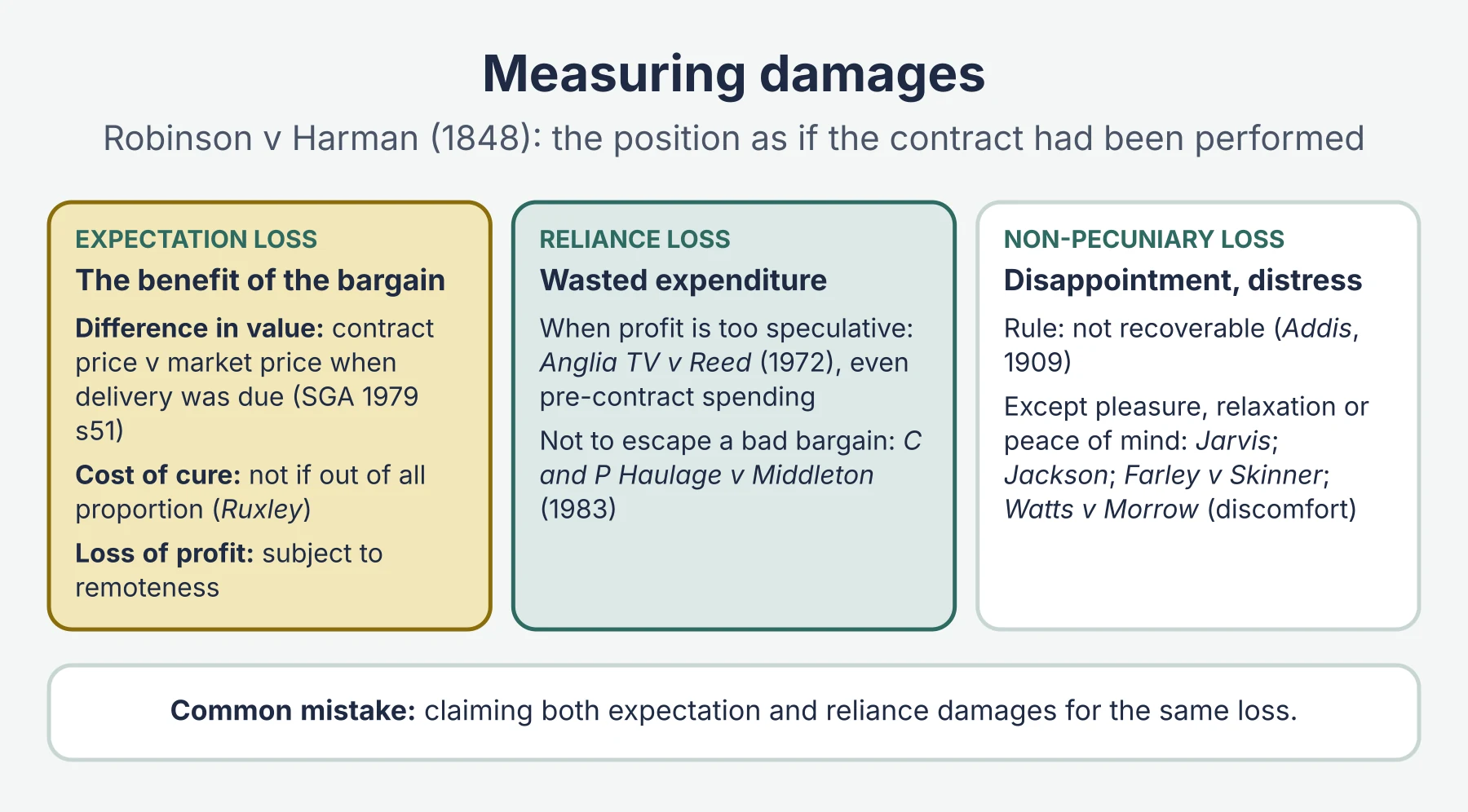
Purpose: compensation, not punishment. Put the claimant, so far as money can, where performance would have put them (Robinson v Harman, 1848). Available as of right once breach is proved; nominal damages if no loss.
Measures of loss:
| Category | What it protects | Key authorities |
|---|---|---|
| Expectation | The benefit of the bargain: difference in value, cost of cure, lost profit | Robinson v Harman; Ruxley Electronics v Forsyth (1995) |
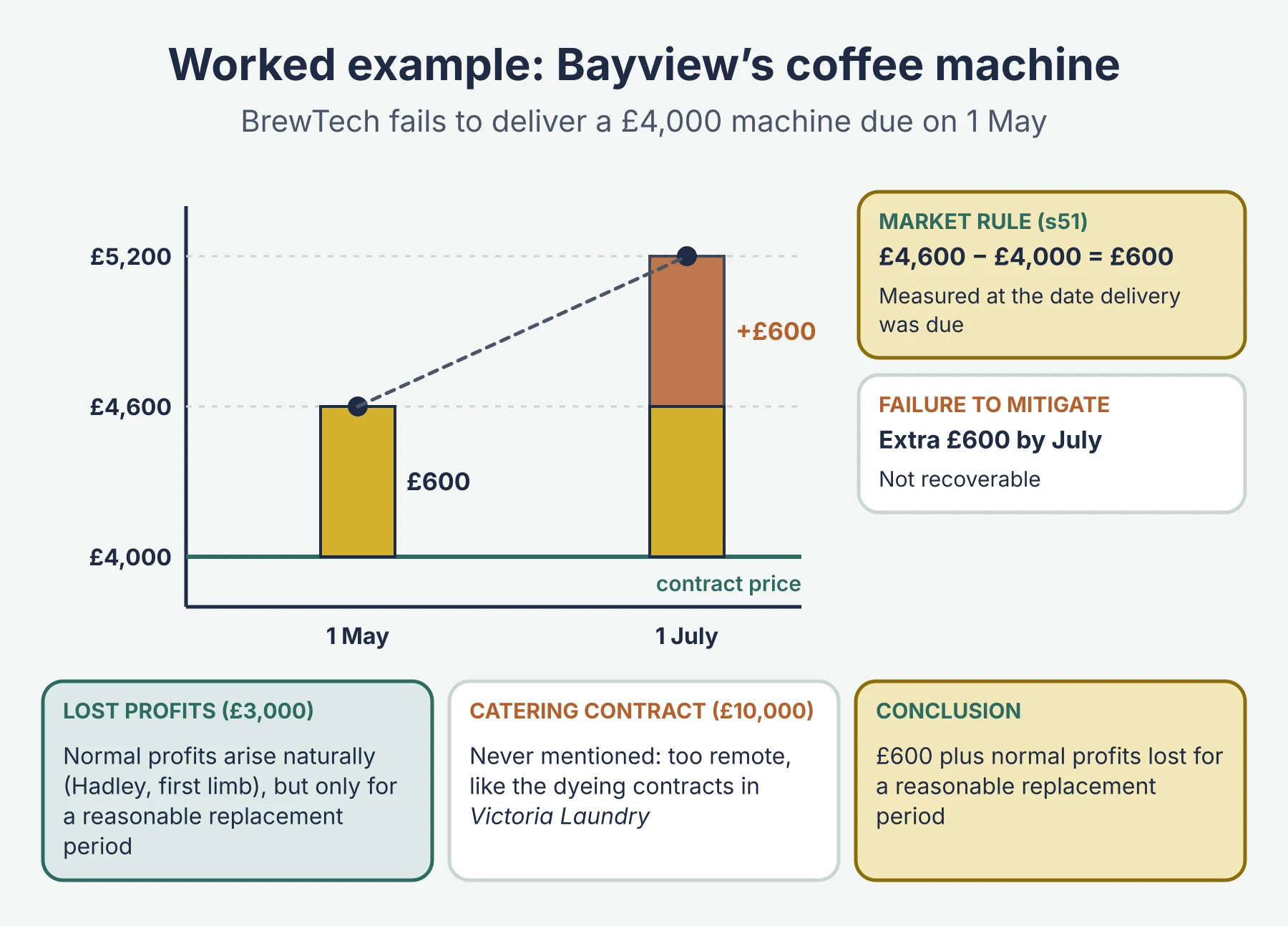
| Market rule | Contract price against market price when delivery was due | Sale of Goods Act 1979, s51 |
| Reliance | Wasted expenditure, including pre-contract spending within contemplation | Anglia Television v Reed (1972); C and P Haulage v Middleton (1983) |
| Non-pecuniary | Distress or lost enjoyment where pleasure or peace of mind was the object | Jarvis v Swans Tours (1973); Jackson v Horizon Holidays (1975); Farley v Skinner (2001); Watts v Morrow (1991) |
General rule against non-pecuniary loss: Addis v Gramophone Co (1909), no damages for injured feelings from the manner of dismissal.
Limits on recovery:
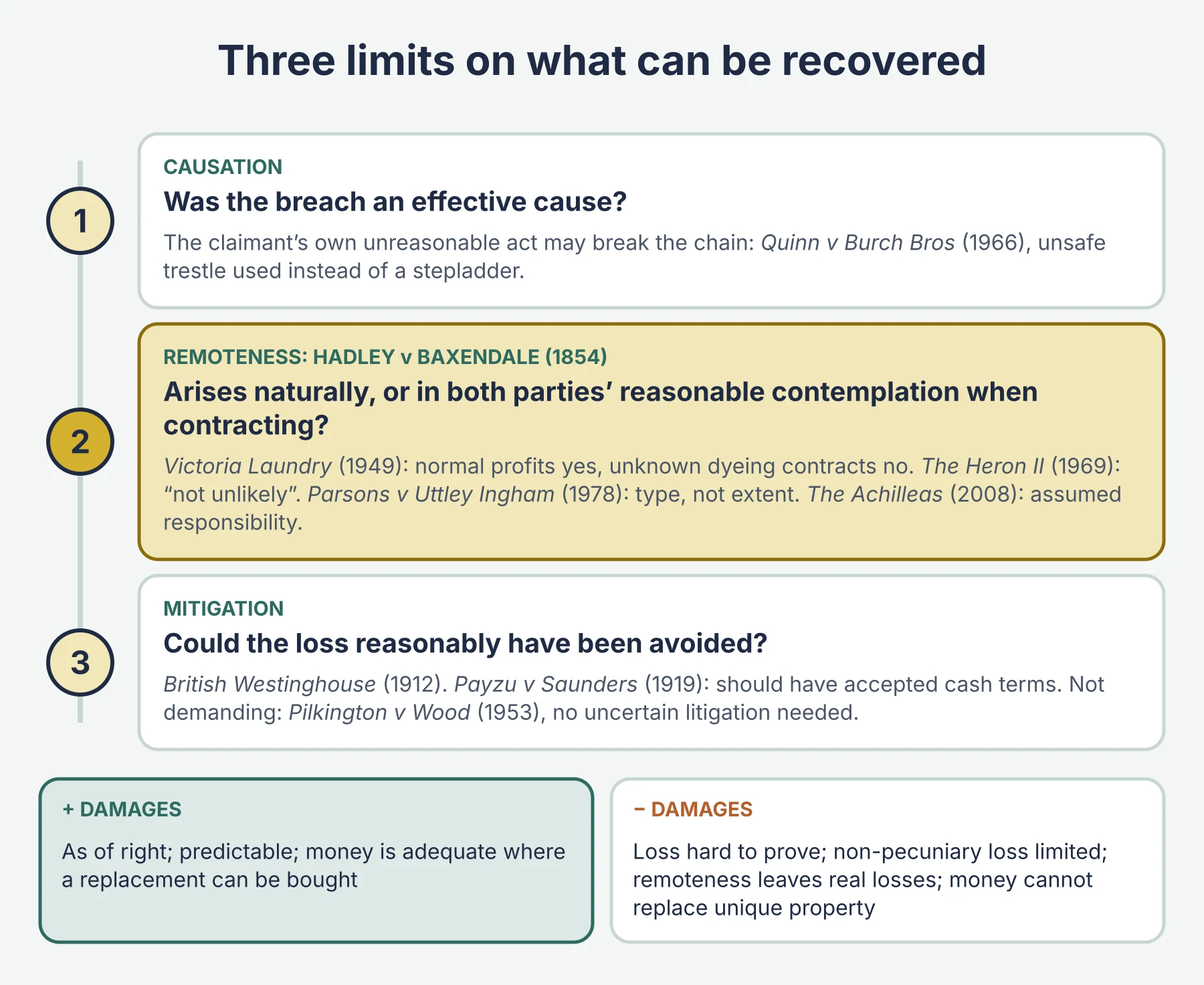
- Causation: breach must be an effective cause; the claimant’s own act may break the chain (Quinn v Burch Bros, 1966).
- Remoteness: Hadley v Baxendale (1854), two limbs: losses arising naturally, and losses in both
parties’ reasonable contemplation at the time of contracting.
- Victoria Laundry v Newman (1949): normal profits yes; special lucrative contracts no.
- The Heron II (1969): “not unlikely” loss from market fall recoverable.
- Parsons v Uttley Ingham (1978): type of loss, not extent.
- The Achilleas (2008): no liability for a type of loss not assumed in the commercial context.
- Mitigation: no recovery for avoidable loss (British Westinghouse, 1912); accept a reasonable offer (Payzu v Saunders, 1919); no duty to take risky steps (Pilkington v Wood, 1953).
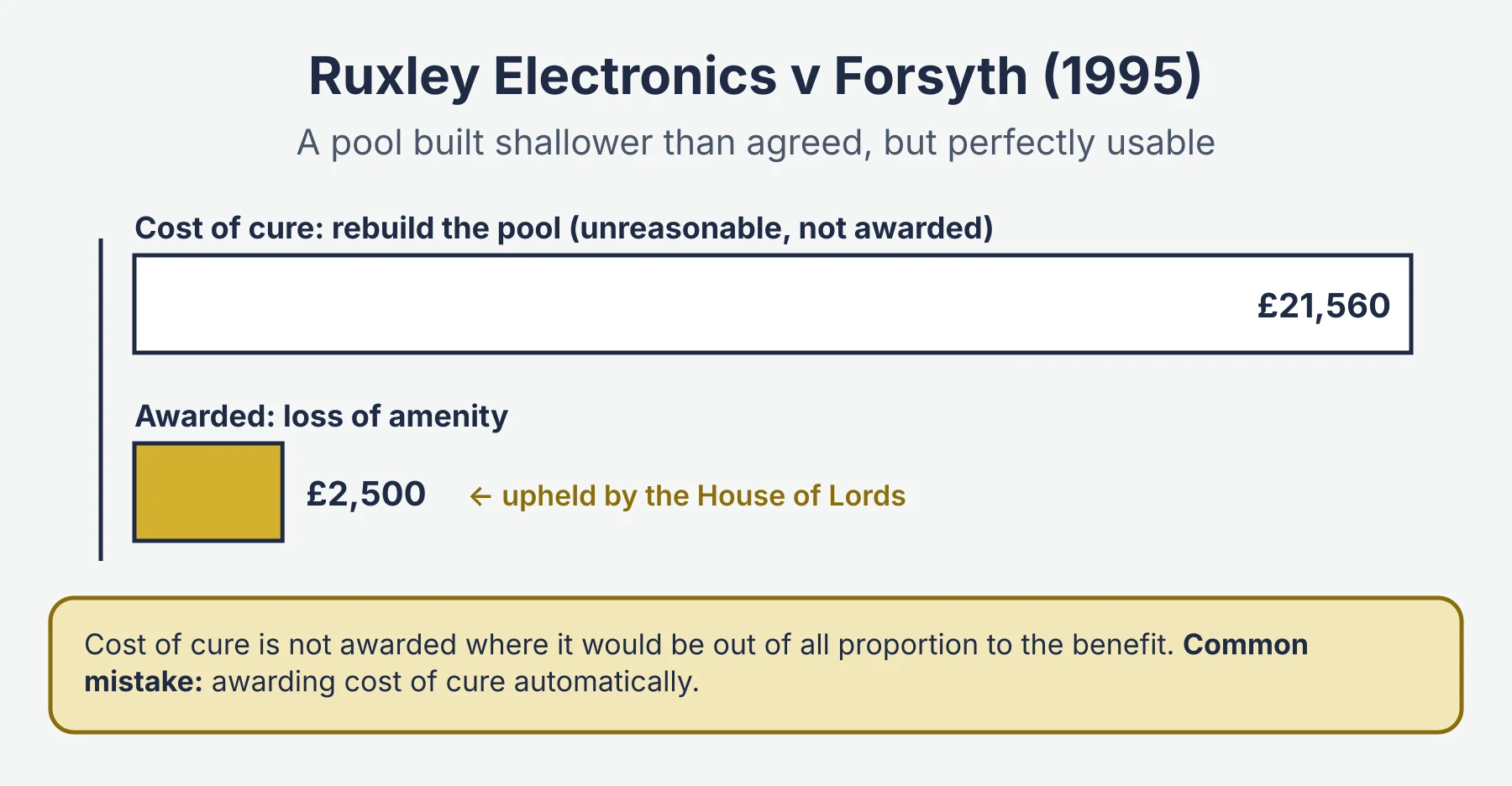
Cost of cure versus difference in value: Ruxley, pool shallower than agreed but safe and usable; £21,560 rebuild unreasonable; £2,500 for loss of amenity.
3.4.2 Equitable remedies: condensed recall
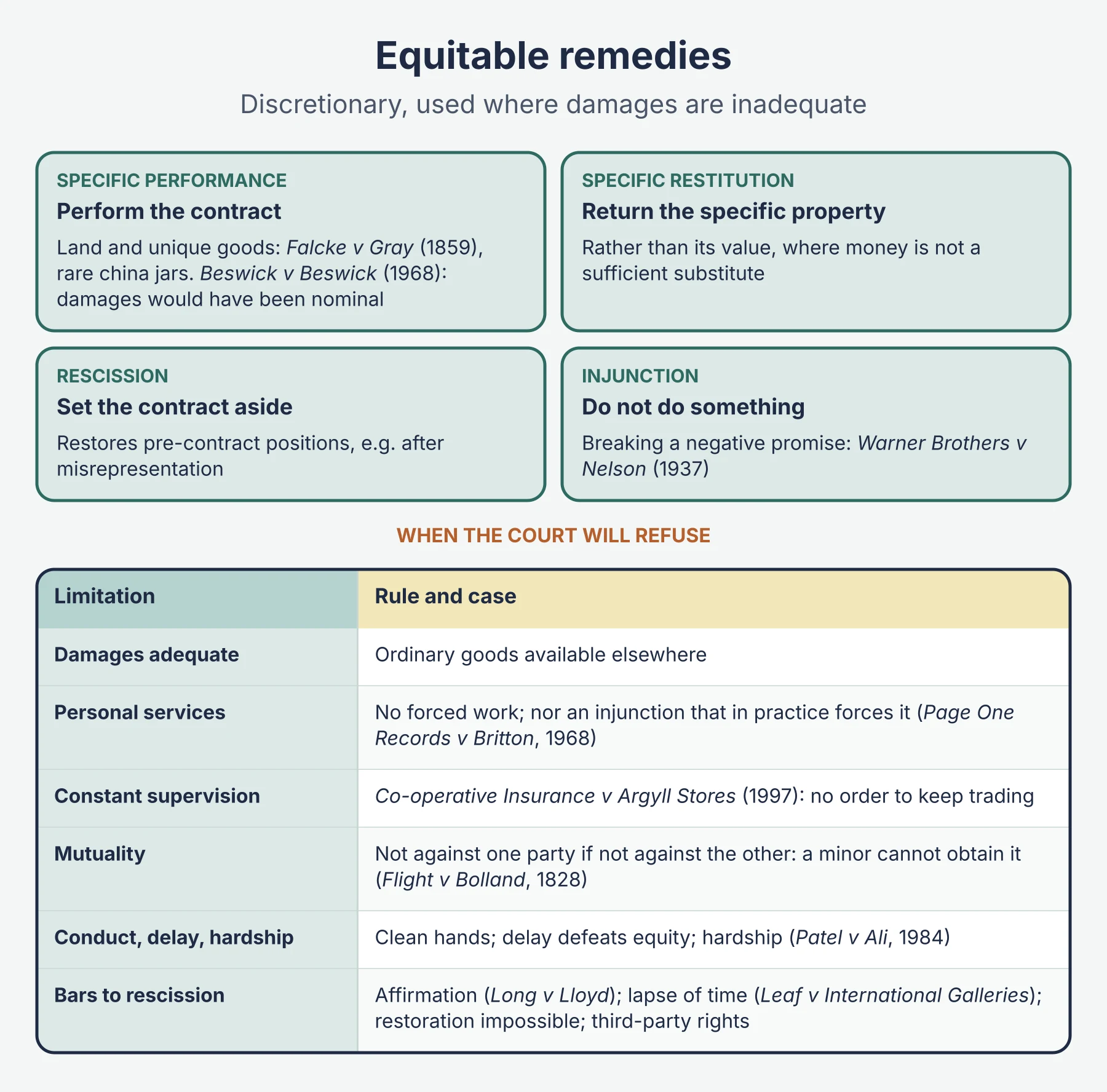
Purpose: to do justice where damages are inadequate. Nature: discretionary, in personam orders.
| Remedy | Nature | Authorities |
|---|---|---|
| Specific performance | Order to perform the contract | Beswick v Beswick (1968); Falcke v Gray (1859), unique goods |
| Specific restitution | Order to return specific property rather than pay its value | Used where the item itself matters |
| Rescission | Contract set aside; parties restored to their original positions | Long v Lloyd (1958); Leaf v International Galleries (1950) |
| Injunction | Order not to act, often to enforce a negative promise | Warner Brothers v Nelson (1937); Page One Records v Britton (1968) |
Limits:
- Damages adequate, for example ordinary goods.
- Personal services not compelled; no injunction that forces performance (Page One Records).
- Constant supervision (Co-operative Insurance v Argyll Stores, 1997).
- Lack of mutuality (Flight v Bolland, 1828).
- Clean hands, delay and severe hardship (Patel v Ali, 1984).
- Bars to rescission: affirmation, lapse of time, restoration impossible, third-party rights.
Evaluation points
| Damages | Equitable remedies |
|---|---|
| Certain and predictable rules | Flexible; can protect unique interests |
| Available as of right | Discretion may be refused even where breach is proved |
| Money substitute works for most commercial goods | Needed for land, unique goods and nominal-damage cases (Beswick) |
| Under-compensates hard-to-prove and emotional loss | Limited for personal services and continuing obligations |
| Remoteness may leave real losses unrecovered | Bars to rescission can leave a misled party only with damages |
Key terms
| Term | Meaning |
|---|---|
| Expectation loss | Loss of the benefit the claimant would have received from performance |
| Reliance loss | Expenditure wasted because of the breach |
| Non-pecuniary loss | Loss not measurable directly in money, such as disappointment or discomfort |
| Loss of amenity | Loss of the pleasure or use the contract was meant to provide |
| Remoteness | Limit excluding losses outside the parties’ reasonable contemplation |
| Mitigation | The claimant’s duty to take reasonable steps to reduce loss |
| Specific performance | Equitable order compelling performance |
| Rescission | Setting aside a contract and restoring the parties |
| Prohibitory injunction | Order forbidding a party from acting |
| Mutuality | Requirement that a remedy be available to both parties |
Exam traps
- Measuring market loss at the wrong date. The market rule uses the date delivery was due; later price rises reflect failure to mitigate.
- Cost of cure on autopilot. Ask whether reinstatement is reasonable (Ruxley).
- Mixing measures. A claimant elects between expectation and reliance for the same loss; reliance cannot recover a loss the bad bargain would have caused anyway (C and P Haulage).
- Forgetting the knowledge test. Second-limb losses need communication at the time of contracting, not after.
- Treating equity as automatic. Always state that specific performance and injunctions are discretionary, then apply a limit.
- Missing the injunction distinction. Enforcing a negative promise is allowed (Warner Brothers); compelling work in practice is not (Page One Records).
Self-test
- What is the purpose of contract damages, and which case states it?
- Why was cost of cure refused in Ruxley v Forsyth?
- When will a claimant choose reliance damages?
- What limit on reliance damages did C and P Haulage v Middleton establish?
- Name two cases where damages for disappointment were awarded.
- State the two limbs of Hadley v Baxendale.
- Why could the laundry not recover for the dyeing contracts in Victoria Laundry?
- What did Payzu v Saunders decide about mitigation?
- Why are equitable remedies called discretionary?
- Why was specific performance ordered in Beswick v Beswick?
- Why was an injunction refused in Page One Records v Britton?
- Name three bars to rescission.
Answers:
- To put the claimant in the position they would have been in had the contract been performed; Robinson v Harman (1848).
- Rebuilding cost was out of all proportion to the benefit because the pool was usable.
- When expected profit is too speculative to prove, as in Anglia Television v Reed.
- Reliance damages cannot put the claimant in a better position than performance would have.
- Jarvis v Swans Tours (1973) and Jackson v Horizon Holidays (1975); also Farley v Skinner (2001).
- Losses arising naturally from the breach, and losses in the reasonable contemplation of both parties when the contract was made.
- The defendants did not know about them, so they were outside the parties’ contemplation.
- The buyer should have accepted the seller’s offer to supply on cash terms; failing to do so was unreasonable.
- The court may refuse them even when breach is proved, for example where damages are adequate.
- Damages to the estate would have been nominal, so they were inadequate.
- It would in practice have compelled the group to keep working with the manager.
- Affirmation, lapse of time, impossibility of restoring the parties, and third-party rights (any three).
Related resources
-
Practice questions
Cambridge A-Level Law: Law of Contract — Practice Questions (9084)
Original Paper 3-style scenarios and essays with indicative answers on formation, capacity, CRA terms, frustration and remedies for Cambridge A Level Law 9084.
Law · Cambridge · A Level
Try questions -
Revision notes
Cambridge A-Level Law: Law of Contract — Revision Notes (9084)
Revision notes for Cambridge A Level Law 9084 Topic 3: formation, minors' capacity, CRA 2015 terms, exemption clauses, frustration and contract remedies.
Law · Cambridge · A Level
Revise topic -
Study guides
Cambridge A Level Law (9084): Law of contract – Study Guide
Formation, contents, discharge and remedies in the law of contract, with cases and a worked damages problem, for Cambridge A Level Law.
Law · Cambridge · A Level
Read guide
Get free revision emails (optional)
Occasional emails with practice questions, worked explanations and links to free resources for the qualification and subjects you choose. No spam, and you can unsubscribe from any email. The free tools on this site never need an email.