
Study Guides
Cambridge A Level Law (9084): Discharge of a contract
Performance and its exceptions, actual and anticipatory breach, and frustration with the 1943 Act for Cambridge A Level Law 9084, sub-topic 3.3, with cases.
- Subject
- Law
- Level
- A LEVEL
- Topic
- Topic 3: Law of contract
- Author
- Marlbridge Academic Team
- Updated
- Reviewed by
- Aizaz Raoof Ali (what this means)
Aligned to Cambridge A Level Law (9084), 2026-2028. Official specification .
Syllabus page (what it covers and how it is assessed): Cambridge A Level Law.
Syllabus points this page covers
9084 (A Level)
- 3.3 Discharge of a contract
Found an error? Report a correction.
Need help with this topic? Request a free trial class for A Level Law (9084).
Discharge means the parties are released from their obligations under a contract. Sub-topic 3.3 of Cambridge International A Level Law (9084) covers three routes: performance, breach and frustration. It is examined on Paper 3 Law of Contract, often in scenarios where a job is left unfinished, a supplier pulls out early or an unexpected event intervenes. This guide develops each route in more depth than the Topic 3 overview.
What the syllabus lists
- 3.3.1 Performance: the entire or strict performance rule, and its exceptions: substantial performance, voluntary acceptance of partial performance, divisible contracts, prevention of performance, tender of performance, time of performance and vicarious performance.
- 3.3.2 Breach: actual breach and anticipatory breach.
- 3.3.3 Frustration: types of frustrating event (impossibility, supervening illegality, change of circumstance making performance pointless); limitations (contractual provision, inconvenience or additional expense, foreseen or foreseeable events, self-induced frustration); the effect at common law; and the Law Reform (Frustrated Contracts) Act 1943, s1(2) and s1(3).
3.3.1 Performance
The strict rule
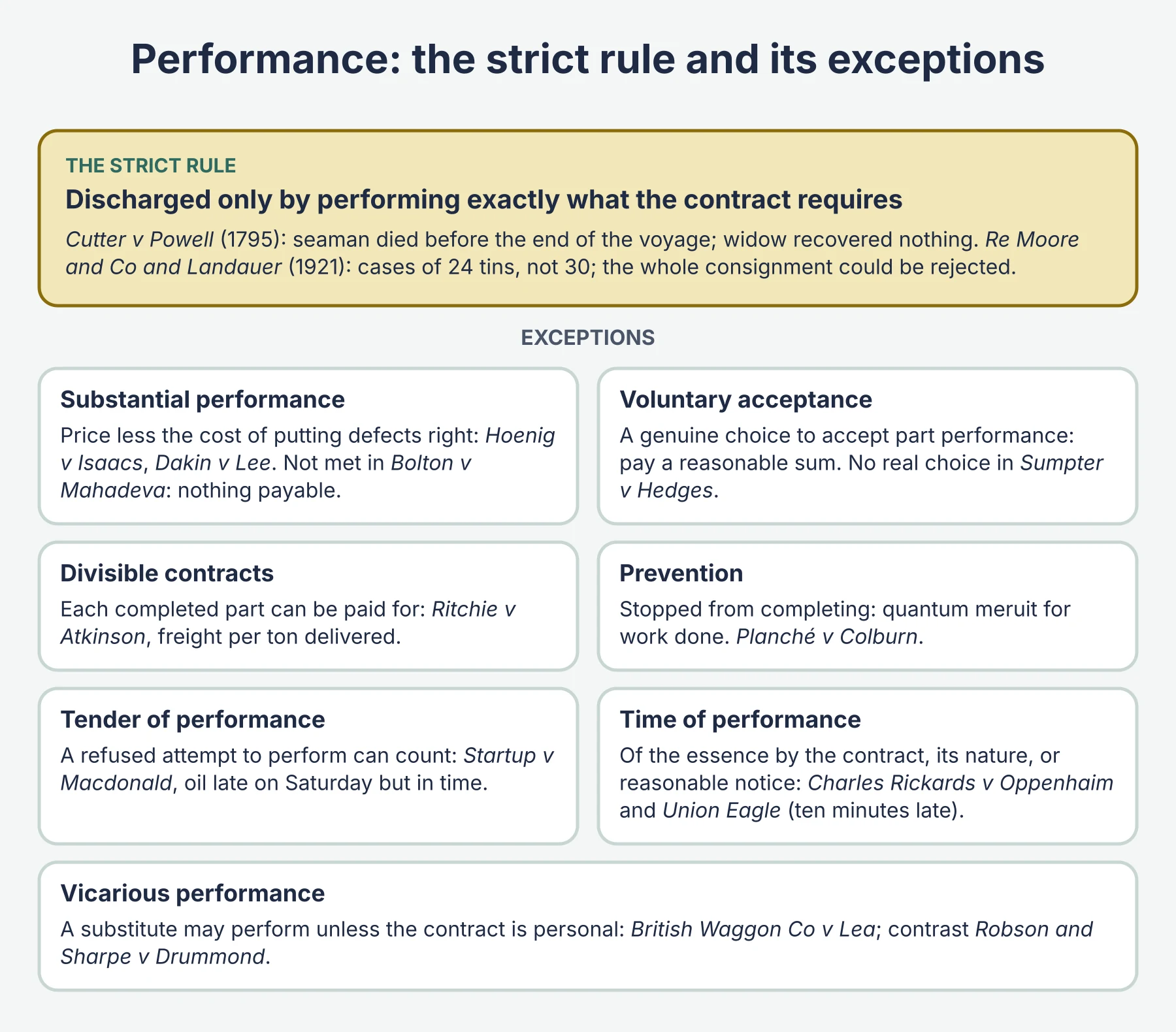
A party is discharged only by performing exactly what the contract requires. In Cutter v Powell (1795) a seaman who died before the end of the voyage had been promised a lump sum on completion; his widow recovered nothing. In Re Moore and Co and Landauer (1921) tinned fruit was delivered in cases of 24 tins rather than the agreed 30; although the total quantity was right, the buyer could reject the whole consignment. The rule gives certainty but can be harsh where almost all the work is done.
The exceptions
- Substantial performance. Where the work is done but with minor defects, the price is payable less the cost of putting the defects right. Hoenig v Isaacs (1952) and Dakin v Lee (1916) are examples. Contrast Bolton v Mahadeva (1972), where a central heating system that gave out uneven heat and fumes was not substantially performed, so nothing was payable.
- Voluntary acceptance of partial performance. If the other party freely chooses to accept the benefit of part performance, they must pay a reasonable sum. The choice must be genuine: in Sumpter v Hedges (1898) a landowner who finished abandoned buildings on his own land had no real choice but to use them, so he did not have to pay for the unfinished work, although he paid for loose materials he used.
- Divisible contracts. Where payment is due for separate stages or units, each completed part can be paid for. In Ritchie v Atkinson (1808) freight payable per ton was recoverable for the cargo actually delivered.
- Prevention of performance. If one party stops the other from completing, the innocent party can claim a reasonable sum (quantum meruit) for work done. In Planché v Colburn (1831) an author recovered for work on a book after the publisher abandoned the series.
- Tender of performance. An attempt to perform that is refused can count as performance. In Startup v Macdonald (1843) oil delivered late on a Saturday evening, but within the agreed time, was wrongly refused, and the seller recovered damages.
- Time of performance. Time is “of the essence” if the contract says so, if the nature of the contract requires it, or if one party serves reasonable notice after a delay. In Charles Rickards v Oppenhaim (1950) a buyer who waived the original delivery date could make time of the essence again by giving reasonable notice. In Union Eagle v Golden Achievement (1997) a purchaser ten minutes late under a time-of-the-essence clause lost the right to complete.
- Vicarious performance. Performance by a substitute is allowed where personal skill is not essential, as in British Waggon Co v Lea (1880). Where the contract is personal, as in Robson and Sharpe v Drummond (1831), it is not.
3.3.2 Breach
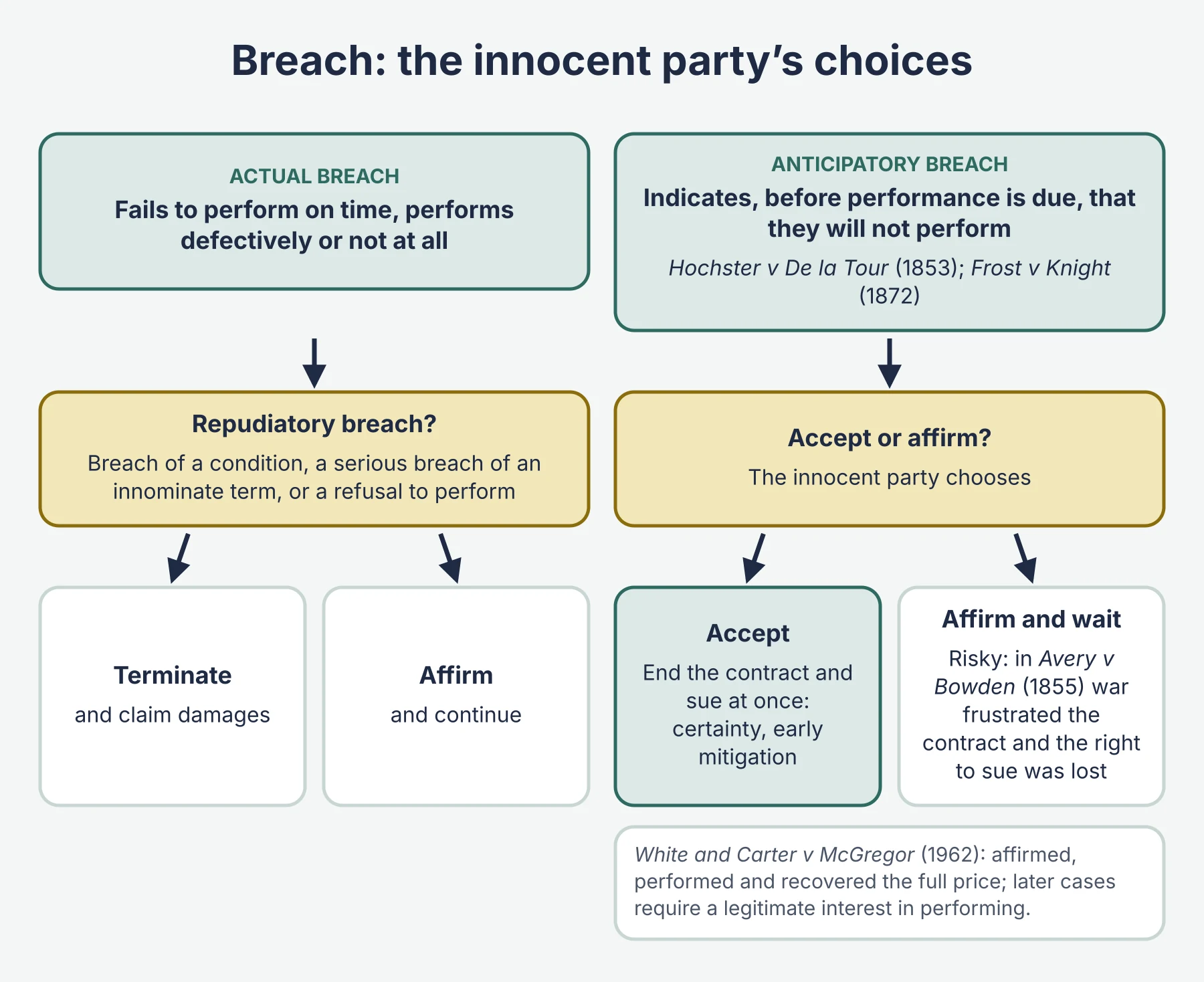
An actual breach occurs when a party fails to perform on time, performs defectively or does not perform at all. Not every breach discharges the contract. The innocent party may terminate only for a repudiatory breach: breach of a condition, a serious breach of an innominate term, or a refusal to perform. Even then the innocent party has a choice: terminate and claim damages, or affirm and continue.
An anticipatory breach occurs when a party indicates, before performance is due, that they will not perform. In Hochster v De la Tour (1853) the claimant was told in May that he would not be needed as a courier from June and could sue at once. Frost v Knight (1872) allowed an immediate action where a man said he would not marry the claimant after his father’s death. The innocent party may:
- accept the repudiation, end the contract and sue immediately, which gives certainty and allows early mitigation; or
- affirm the contract and wait for the date of performance. This is risky: in Avery v Bowden (1855) the claimant waited, the Crimean War broke out and frustrated the contract, and the right to sue was lost. In White and Carter v McGregor (1962) a company that affirmed and performed an advertising contract recovered the full price, though later cases require a legitimate interest in performing.
3.3.3 Frustration
Types of frustrating event
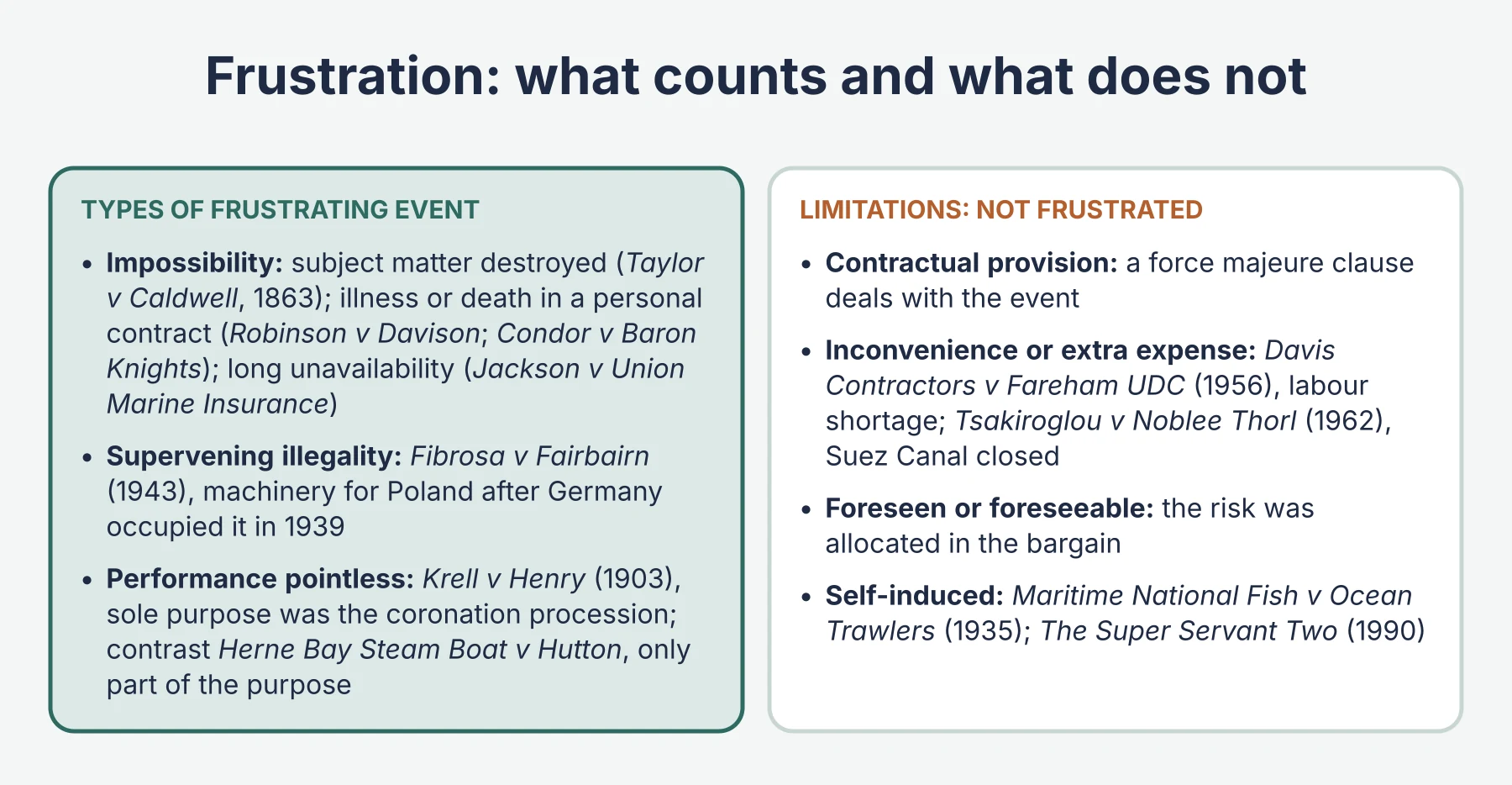
- Impossibility. Destruction of the subject matter (Taylor v Caldwell, 1863); illness or death in a personal contract (Robinson v Davison, 1871; Condor v Baron Knights, 1966); unavailability for so long that the commercial purpose is defeated (Jackson v Union Marine Insurance, 1874).
- Supervening illegality. A change in the law or outbreak of war making performance illegal: in Fibrosa v Fairbairn (1943) a contract to deliver machinery to Poland was frustrated when Germany occupied Poland in 1939.
- Change of circumstance making performance pointless. Krell v Henry (1903), where the sole purpose of hiring rooms was to view the coronation procession; contrast Herne Bay Steam Boat v Hutton (1903), where viewing the naval review was only part of the purpose.
Limitations
- Contractual provision. If the contract already provides for the event, for example through a force majeure clause, the event is dealt with by that clause and frustration does not apply.
- Inconvenience or additional expense. In Davis Contractors v Fareham UDC (1956) a labour shortage made building slower and dearer, but the contract was not frustrated. In Tsakiroglou v Noblee Thorl (1962) closure of the Suez Canal lengthened the voyage but did not frustrate a sale of goods.
- Foreseen or reasonably foreseeable events. If the parties foresaw, or should have foreseen, the risk, they are taken to have allocated it in their bargain.
- Self-induced frustration. In Maritime National Fish v Ocean Trawlers (1935) the defendant chose which trawlers to license; in The Super Servant Two (1990) the carrier chose to use its remaining vessel for other contracts. In both, the “frustration” was the party’s own choice.
Effect at common law
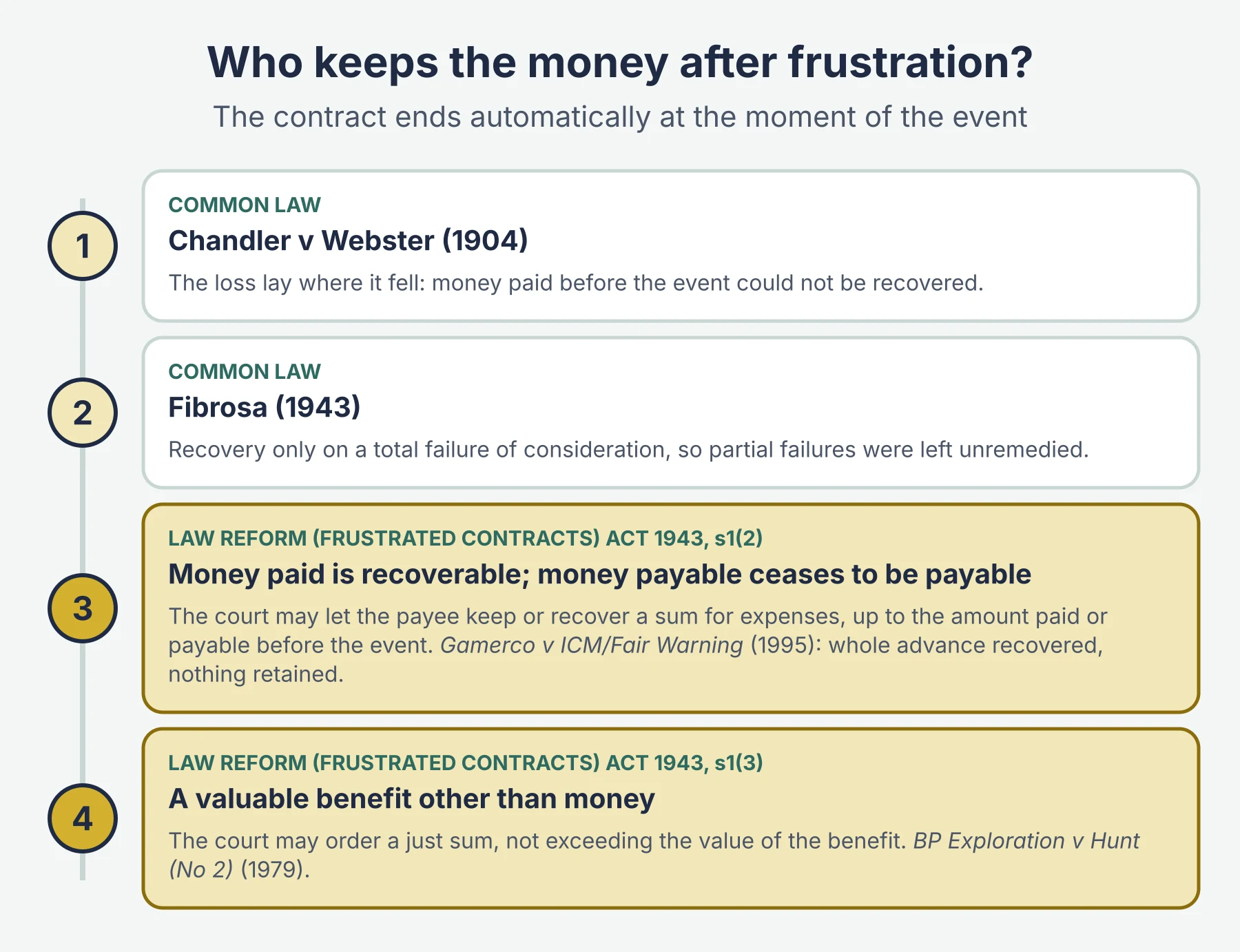
Frustration ends the contract automatically from the moment of the event; future obligations are discharged. Under Chandler v Webster (1904) the loss lay where it fell, so money paid before the event was irrecoverable. Fibrosa (1943) allowed recovery only where there had been a total failure of consideration, which left partial failures unremedied.
The Law Reform (Frustrated Contracts) Act 1943
- s1(2): money paid before the frustrating event is recoverable, and money payable ceases to be payable. The court may allow the payee to keep, or recover, a sum for expenses incurred, up to the amount paid or payable before the event. In Gamerco v ICM/Fair Warning (1995) the court used its discretion to allow the promoters to recover their whole advance, with nothing retained for the defendants’ expenses.
- s1(3): where one party has obtained a valuable benefit (other than money) before the event, the court may order a just sum to be paid, not exceeding the value of the benefit. BP Exploration v Hunt (No 2) (1979) is the leading example.
Worked example
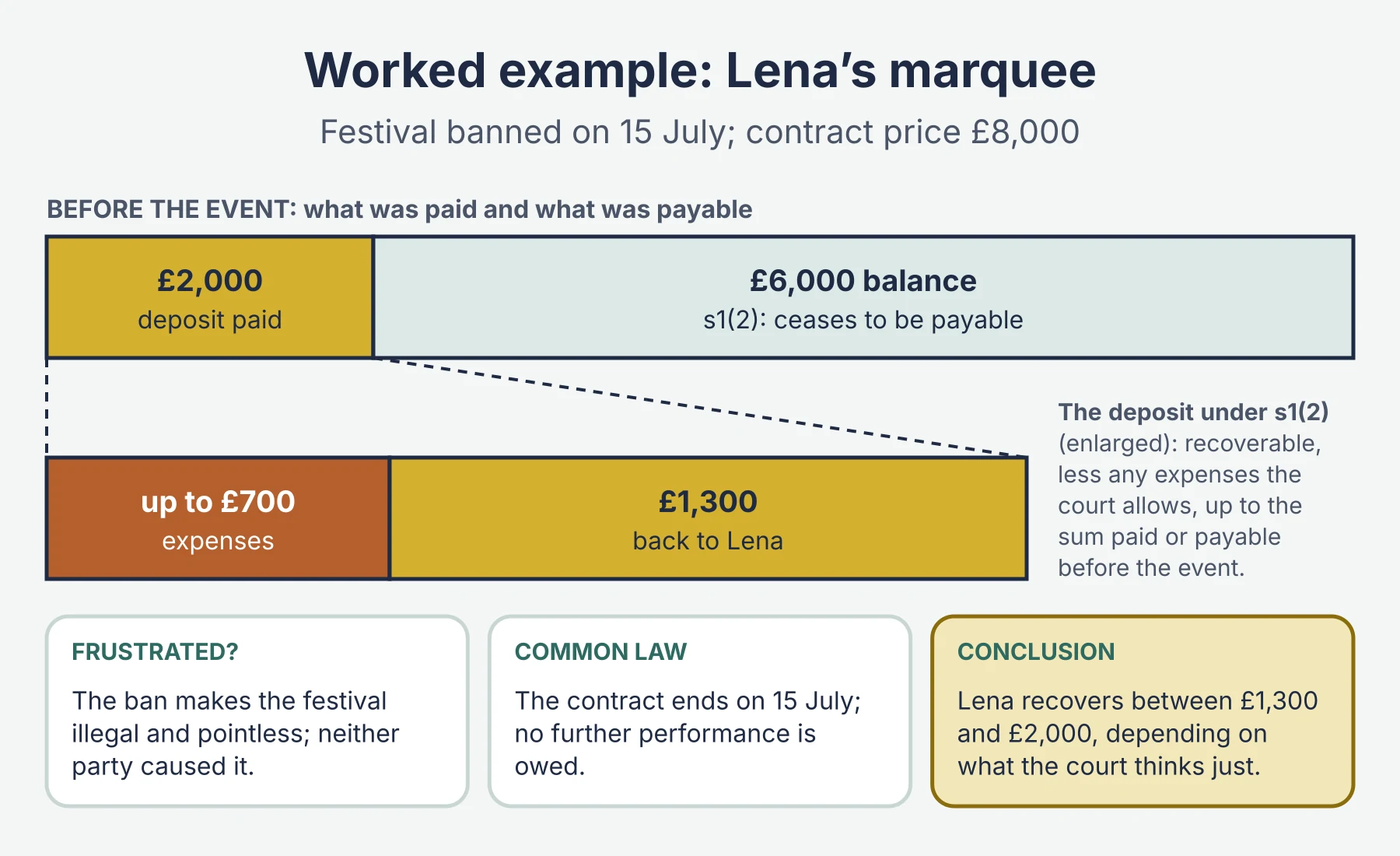
Scenario: Lena hires Marquee Masters to supply a marquee for her outdoor festival on 20 July for £8,000, paying a £2,000 deposit. On 15 July the local authority bans all outdoor events in the area because of a disease outbreak. Marquee Masters has spent £700 preparing the marquee.
- Frustration? A ban by law makes the festival illegal, so performance is illegal and pointless. Neither party caused the ban, and nothing suggests it was foreseeable or covered by a clause.
- Effect at common law. The contract ends on 15 July; neither party owes further performance.
- s1(2). Lena can recover her £2,000 deposit, and the £6,000 balance is no longer payable.
- Expenses. The court may allow Marquee Masters to retain up to £700 of the deposit for its expenses, because that is within the sum paid before the event. If it allows the full amount, Lena recovers £2,000 − £700 = £1,300.
- Conclusion. Lena recovers between £1,300 and £2,000, depending on the court’s view of what is just.
Common mistakes
- Treating a contract as frustrated because it has become more expensive (Davis Contractors).
- Forgetting that the innocent party chooses whether to accept an anticipatory breach.
- Stating that substantial performance means full payment: the cost of remedying defects is deducted.
- Applying s1(2) expenses to money that was neither paid nor payable before the event.
Exam technique
For advise questions, deal with each route in turn and reach a conclusion on what money is owed. For evaluate or assess essays, weigh the certainty of the strict performance rule against its harshness, or the narrowness of frustration against the risk allocation the parties could have made. Recall the authorities with the discharge of a contract revision notes and apply them with the discharge of a contract practice questions.
Related resources
-
Practice questions
Cambridge A Level Law (9084): Discharge of a contract – Practice Questions
Twelve original questions with mark-scheme answers on performance, anticipatory breach, frustration and the 1943 Act for Cambridge A Level Law 9084, 3.3.
Law · Cambridge · A Level
Try questions -
Revision notes
Cambridge A Level Law (9084): Discharge of a contract – Revision Notes
Condensed notes on strict performance and its exceptions, actual and anticipatory breach, and frustration for Cambridge A Level Law 9084, with a self-test.
Law · Cambridge · A Level
Revise topic -
Study guides
Cambridge A Level Law (9084): Remedies for breach of a contract
Expectation, reliance and non-pecuniary damages, causation, remoteness, mitigation and equitable remedies for Cambridge A Level Law 9084, sub-topic 3.4.
Law · Cambridge · A Level
Read guide
Get free revision emails (optional)
Occasional emails with practice questions, worked explanations and links to free resources for the qualification and subjects you choose. No spam, and you can unsubscribe from any email. The free tools on this site never need an email.