
Revision Notes
Cambridge A Level Law (9084): Formation of a valid contract – Revision Notes
Case tables on offer, acceptance, tenders, auctions, intention, consideration, estoppel and minors' contracts, with a self-test, for Cambridge Law 9084.
- Subject
- Law
- Level
- A LEVEL
- Topic
- Topic 3 – Law of Contract
- Author
- Marlbridge Academic Team
- Updated
- Reviewed by
- Aizaz Raoof Ali (what this means)
Aligned to Cambridge A Level Law (9084), 2026-2028. Official specification .
Syllabus page (what it covers and how it is assessed): Cambridge A Level Law.
Syllabus points this page covers
9084 (A Level)
- 3.1 Formation of a valid contract
Found an error? Report a correction.
Need help with this topic? Request a free trial class for A Level Law (9084).
Recall notes for subtopic 3.1 of Cambridge International AS & A Level Law (9084). The formation study guide explains each rule and includes an annotated answer.
3.1.1 Nature of a contract
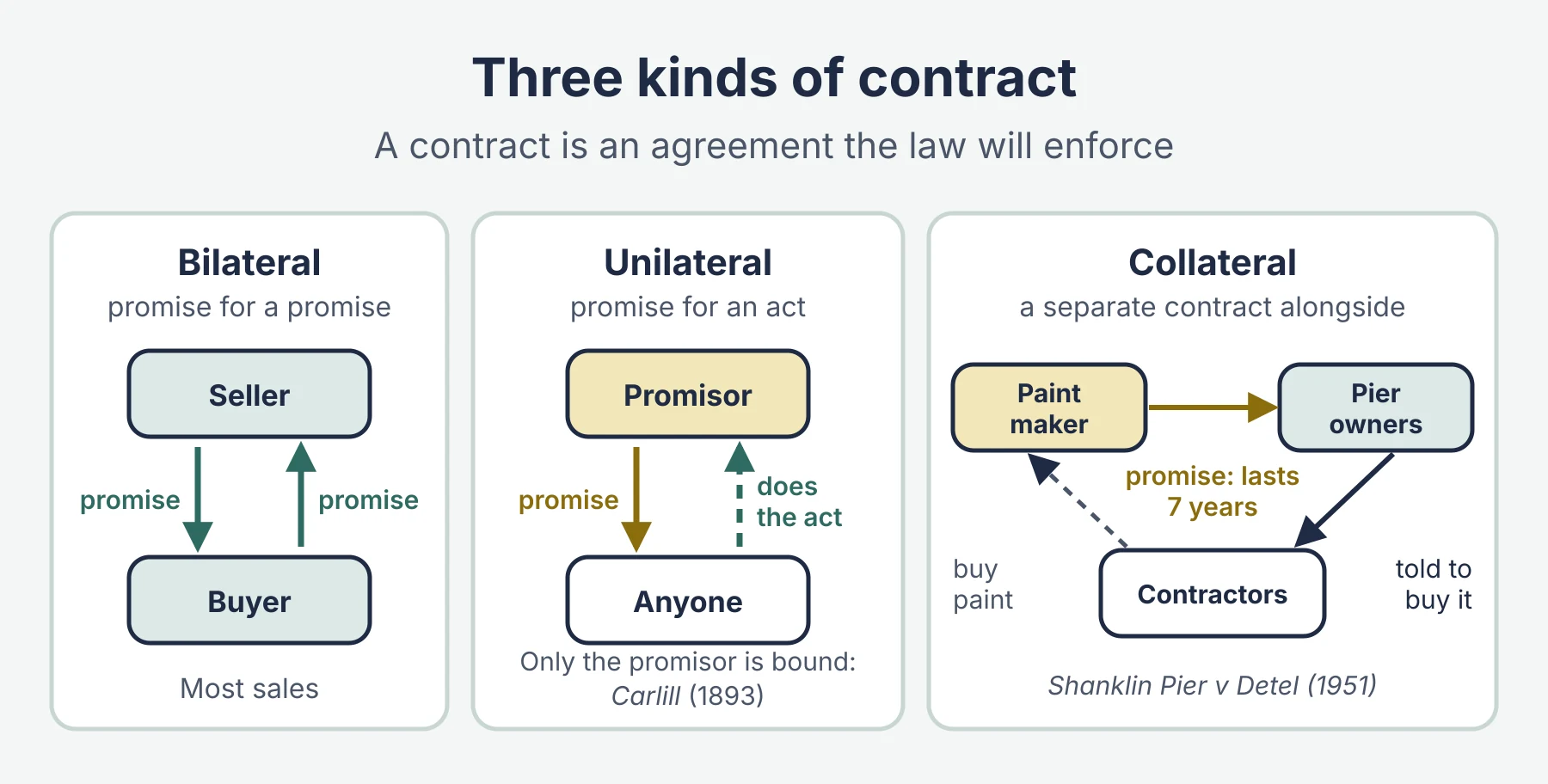
- Agreement the law will enforce.
- Bilateral: promise for promise.
- Unilateral: promise for an act (Carlill (1893)).
- Collateral: a separate contract beside the main one (Shanklin Pier v Detel (1951)).
3.1.2 Offer and acceptance
Offer or invitation to treat?
| Situation | Classification | Case |
|---|---|---|
| Shop window or shelf | Invitation to treat | Fisher v Bell (1961); Boots (1953) |
| Advertisement | Usually invitation to treat | Partridge v Crittenden (1968) |
| Reward-style advertisement | Unilateral offer | Carlill (1893) |
| “May be prepared to sell” | Not an offer | Gibson v Manchester CC (1979) |
| Auction request for bids | Invitation to treat; bid is the offer | Payne v Cave (1789) |
| Invitation to tender | Usually invitation to treat; tender is the offer | Spencer v Harding (1870) |
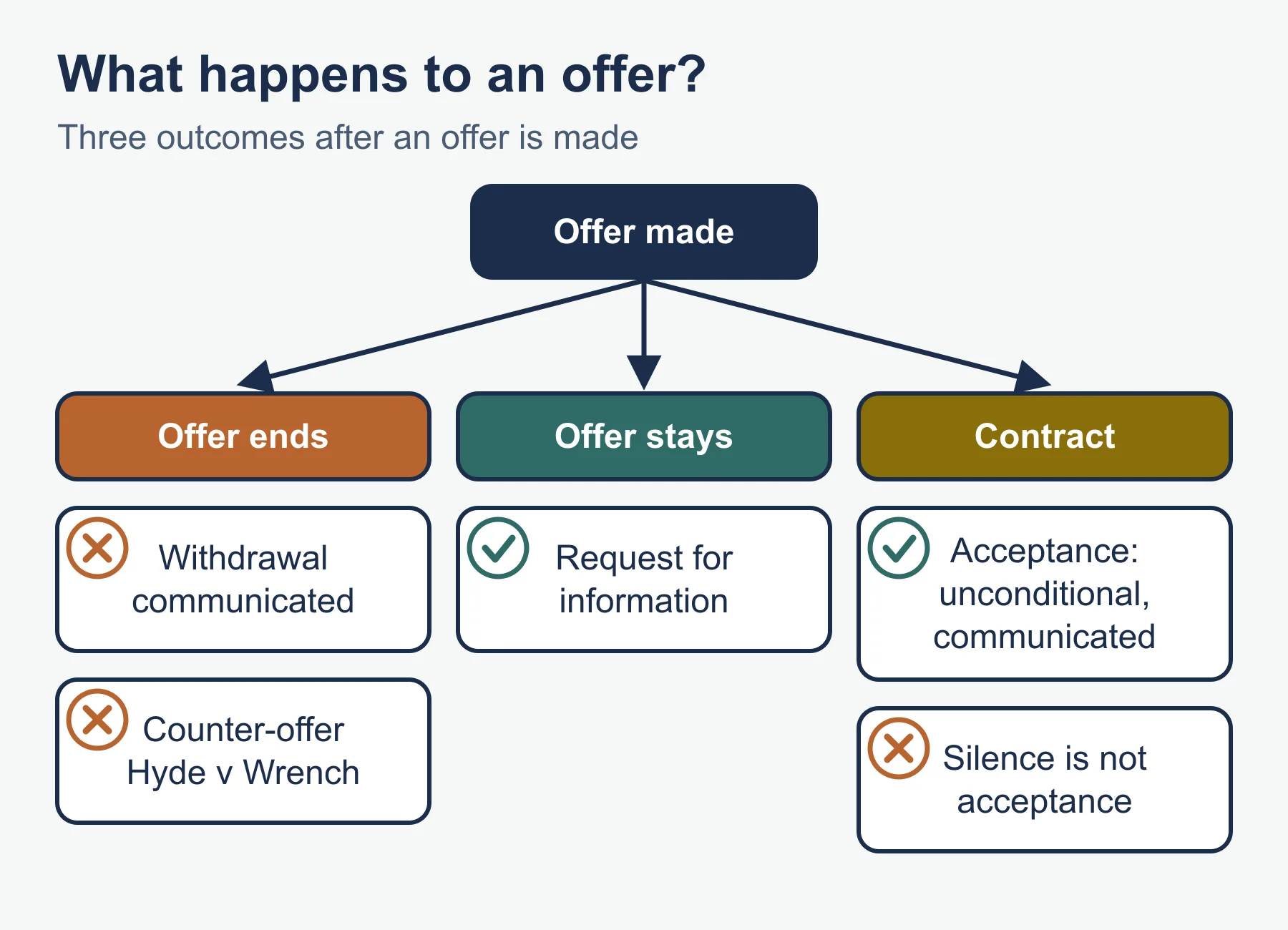
Ending an offer: revocation communicated before acceptance (Routledge v Grant; Byrne v Van Tienhoven), including via a reliable third party (Dickinson v Dodds); not once unilateral performance begins (Errington); rejection or counter offer (Hyde v Wrench); lapse (Ramsgate Hotel v Montefiore); failed condition (Financings v Stimson). Request for information does not end it (Stevenson v McLean).
Acceptance:
- Mirror image; unconditional.
- By conduct (Brogden); never by silence (Felthouse).
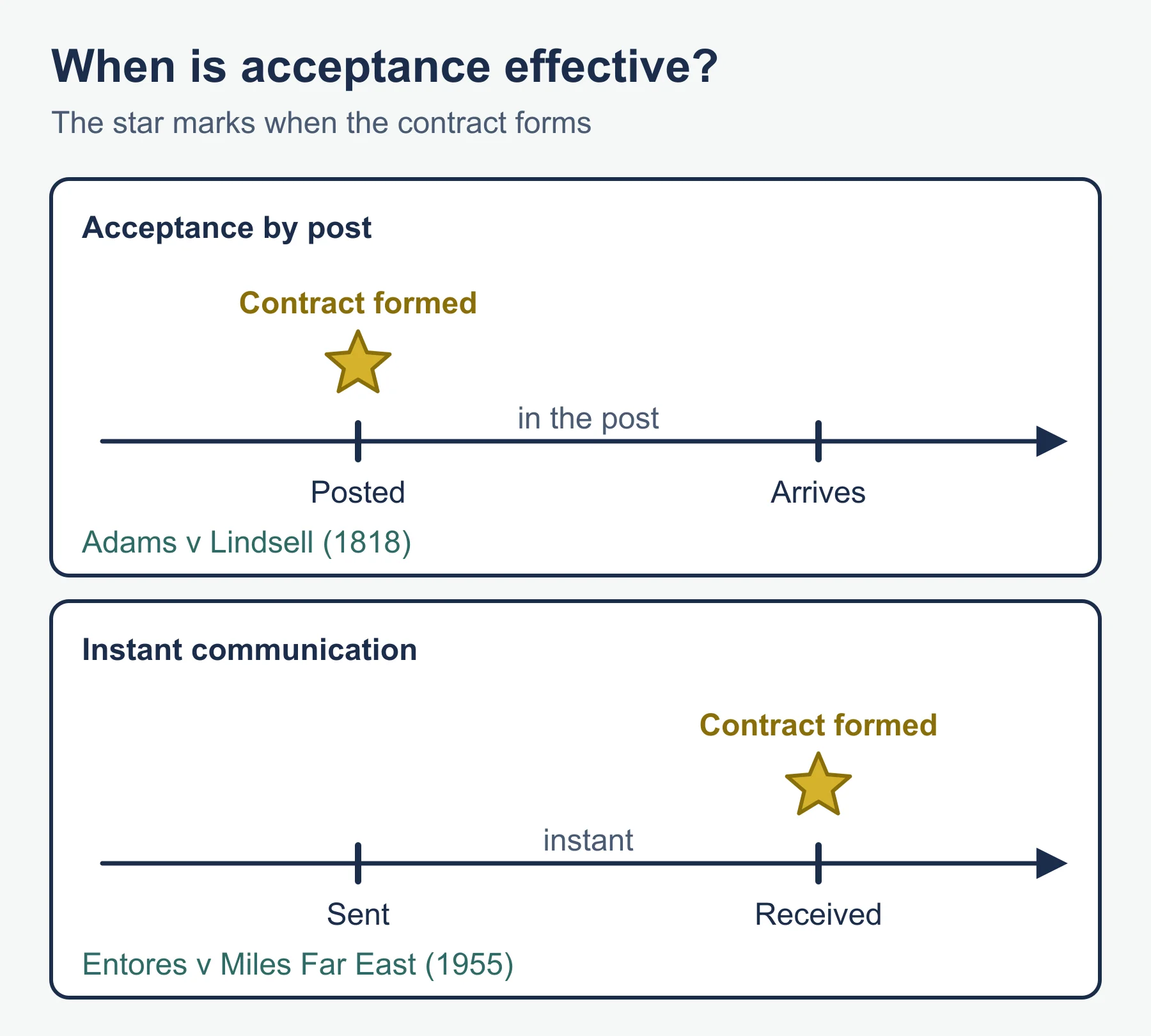
- Instant methods – on receipt (Entores).
- Post – on posting (Adams v Lindsell), even if lost (Household Fire v Grant), unless notice required (Holwell v Hughes).
Applications:
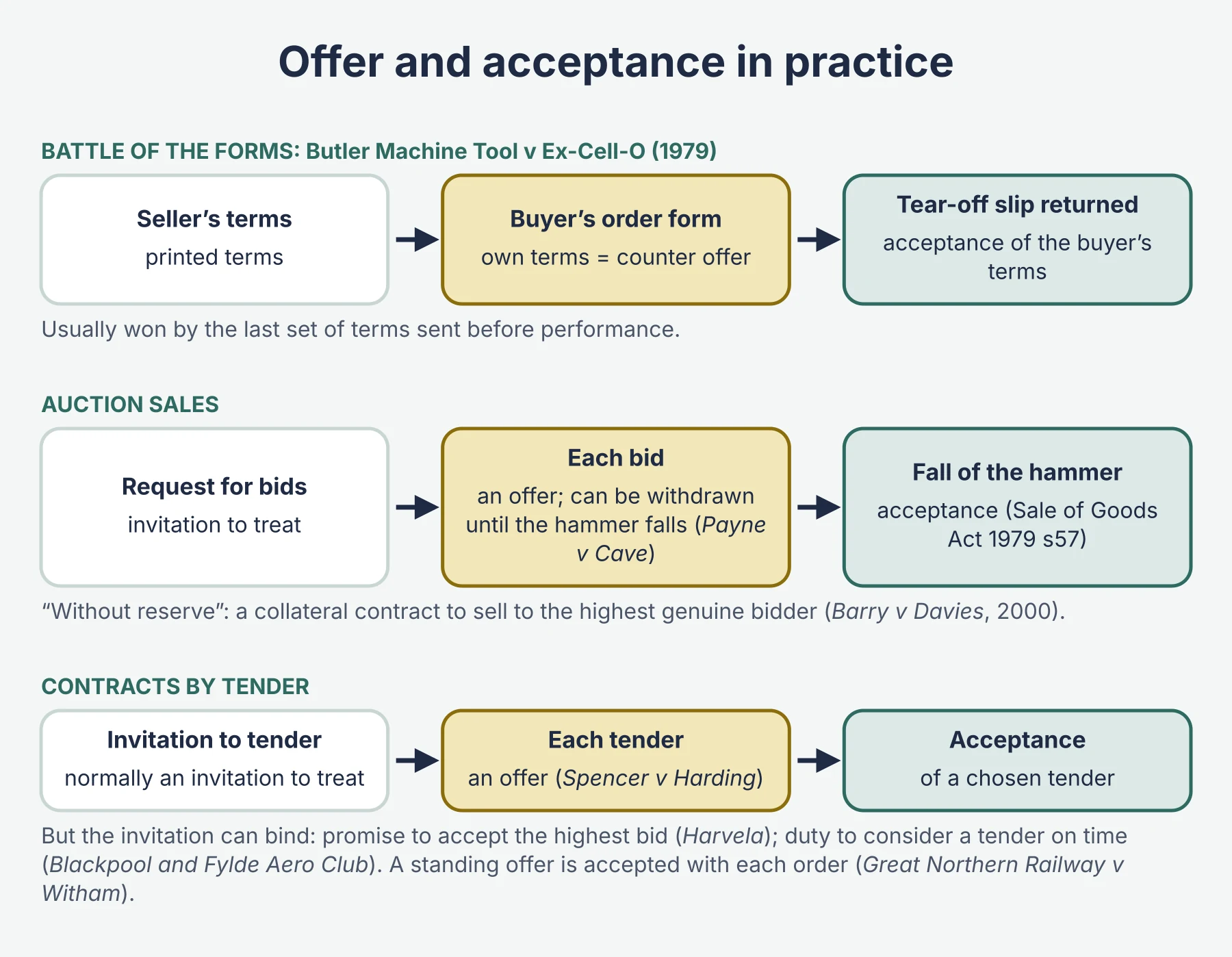
- Standard forms: battle of forms; last shot often wins (Butler Machine Tool v Ex-Cell-O (1979)).
- Auctions: acceptance on fall of hammer (Sale of Goods Act 1979 s57); “without reserve” collateral contract (Barry v Davies (2000)).
- Tenders: promise to accept highest bid binds; referential bids invalid (Harvela (1986)); duty to consider conforming tenders (Blackpool Aero Club (1990)); standing offers accepted order by order (GNR v Witham (1873)).
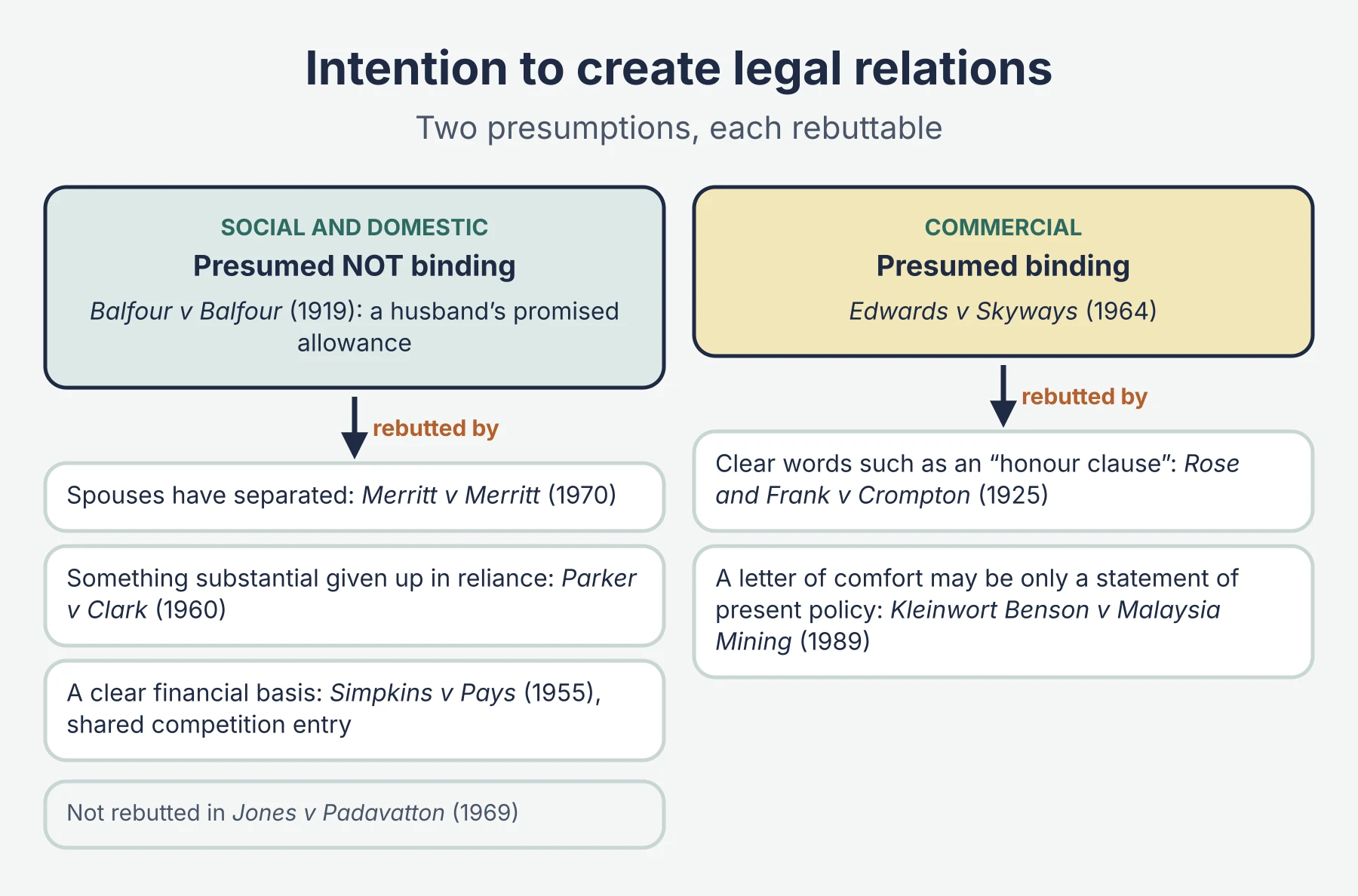
3.1.3 Intention to create legal relations
| Context | Presumption | Rebutted by | Cases |
|---|---|---|---|
| Social and domestic | No intention | Separation, reliance, financial basis | Balfour (presumption); Merritt, Parker v Clark, Simpkins v Pays (rebutted); Jones v Padavatton (not rebutted) |
| Commercial | Intention | Clear words – honour clause; letters of comfort | Edwards v Skyways; Rose and Frank v Crompton; Kleinwort Benson v Malaysia Mining |
Why required: avoid enforcing agreements never meant to be binding; keep trivial disputes out of court.
3.1.4 Consideration
| Rule | Case |
|---|---|
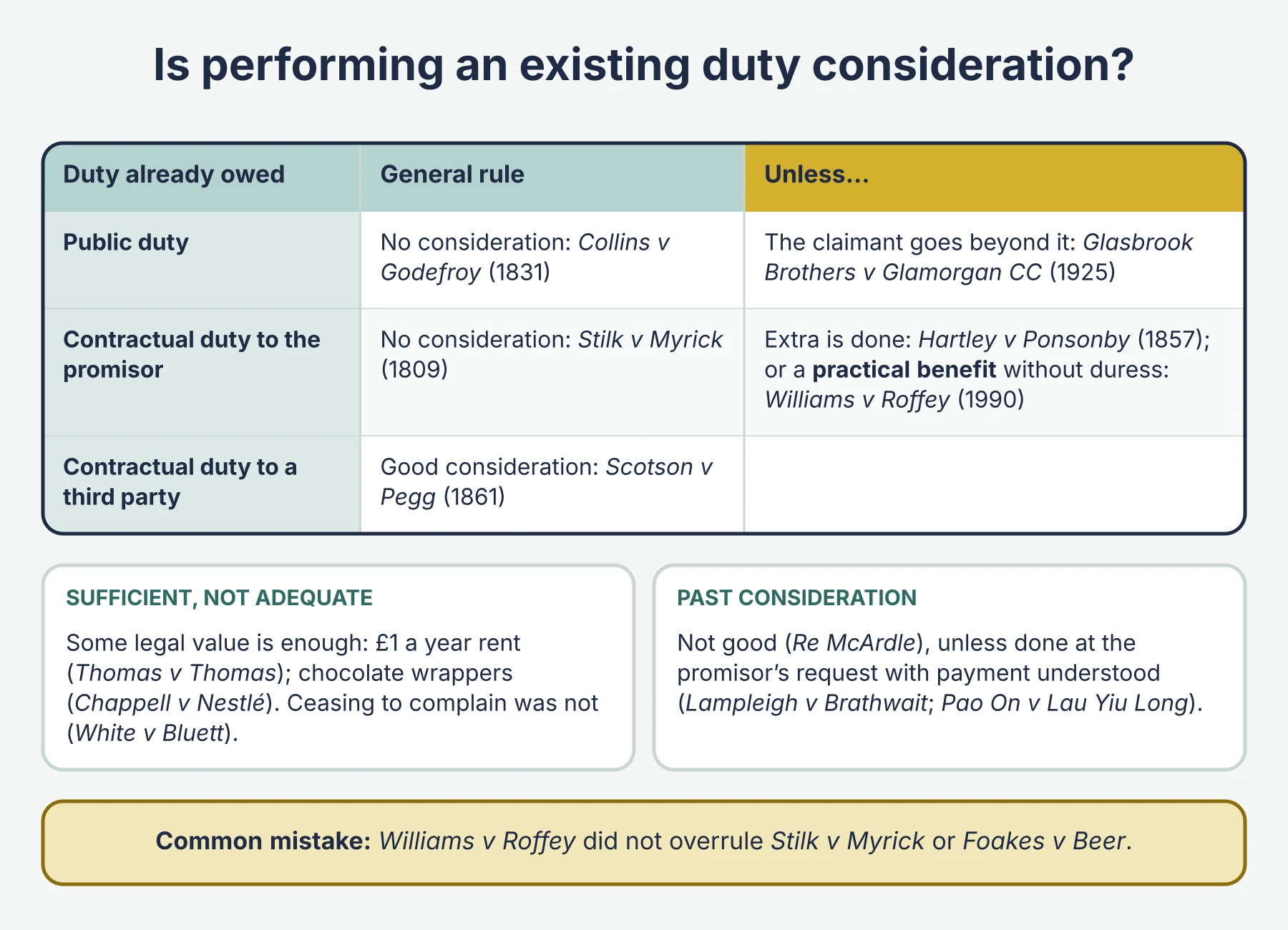
| Definition – price of the promise | Dunlop v Selfridge (1915); Currie v Misa (1875) |
| Sufficient, need not be adequate | Thomas v Thomas (1842); Chappell v Nestlé (1960) |
| Must have some value | White v Bluett (1853) |
| Past consideration fails | Re McArdle (1951) |
| Exception: requested act, payment understood | Lampleigh v Brathwait (1615); Pao On v Lau Yiu Long (1980) |
| Public duty – not unless exceeded | Collins v Godefroy; Glasbrook Brothers |
| Contractual duty to promisor – not unless extra | Stilk v Myrick; Hartley v Ponsonby |
| Practical benefit | Williams v Roffey (1990) |
| Duty to third party – good | Scotson v Pegg (1861) |
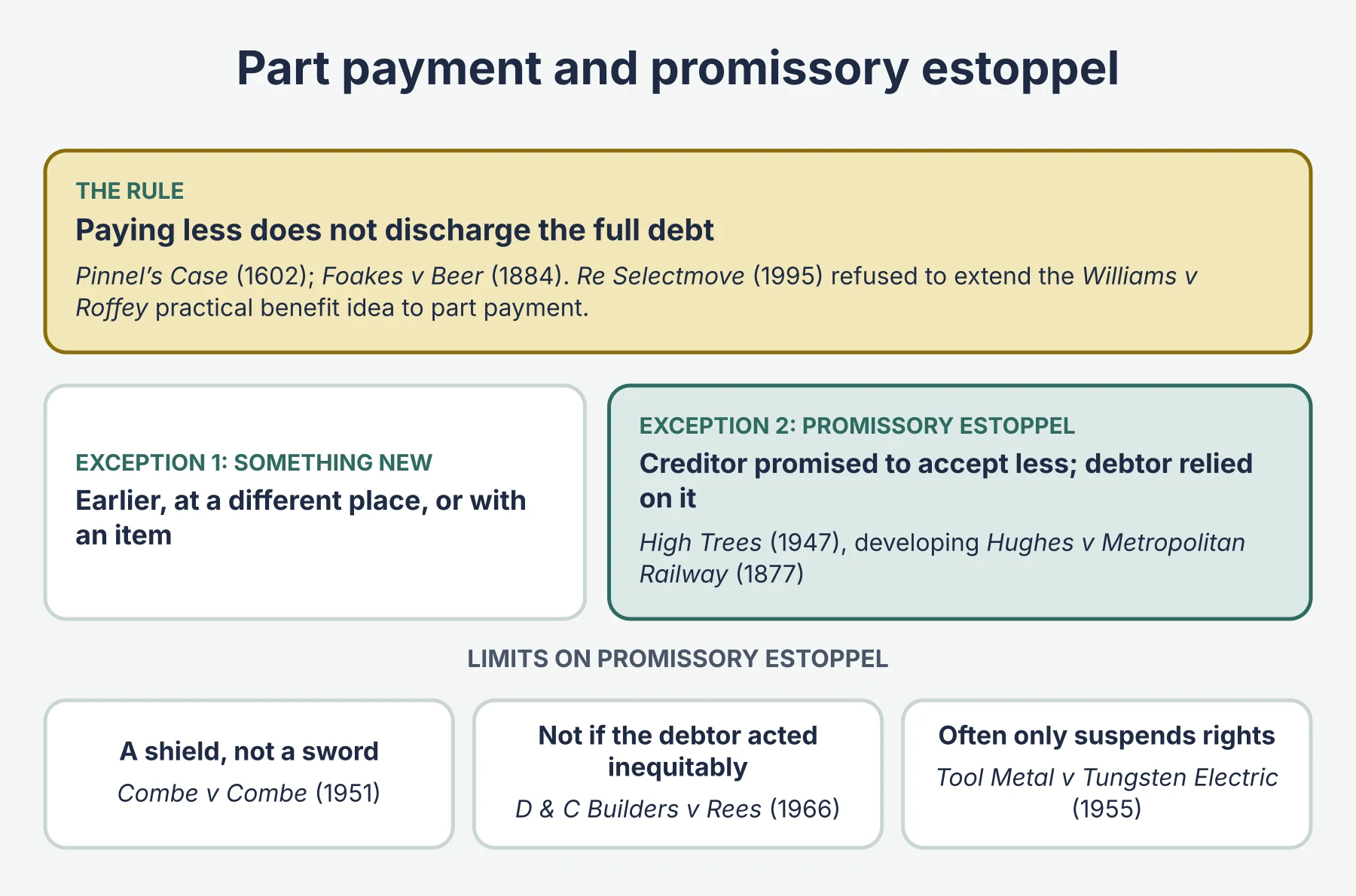
| Part payment – no discharge | Pinnel’s Case; Foakes v Beer (1884) |
| Practical benefit not for part payment | Re Selectmove (1995) |
Promissory estoppel: clear promise + reliance + inequitable to go back (High Trees (1947); Hughes v Metropolitan Railway). Shield not sword (Combe v Combe); no estoppel if debtor acted inequitably (D & C Builders v Rees); usually suspensory (Tool Metal v Tungsten Electric).
3.1.5 Capacity – minors
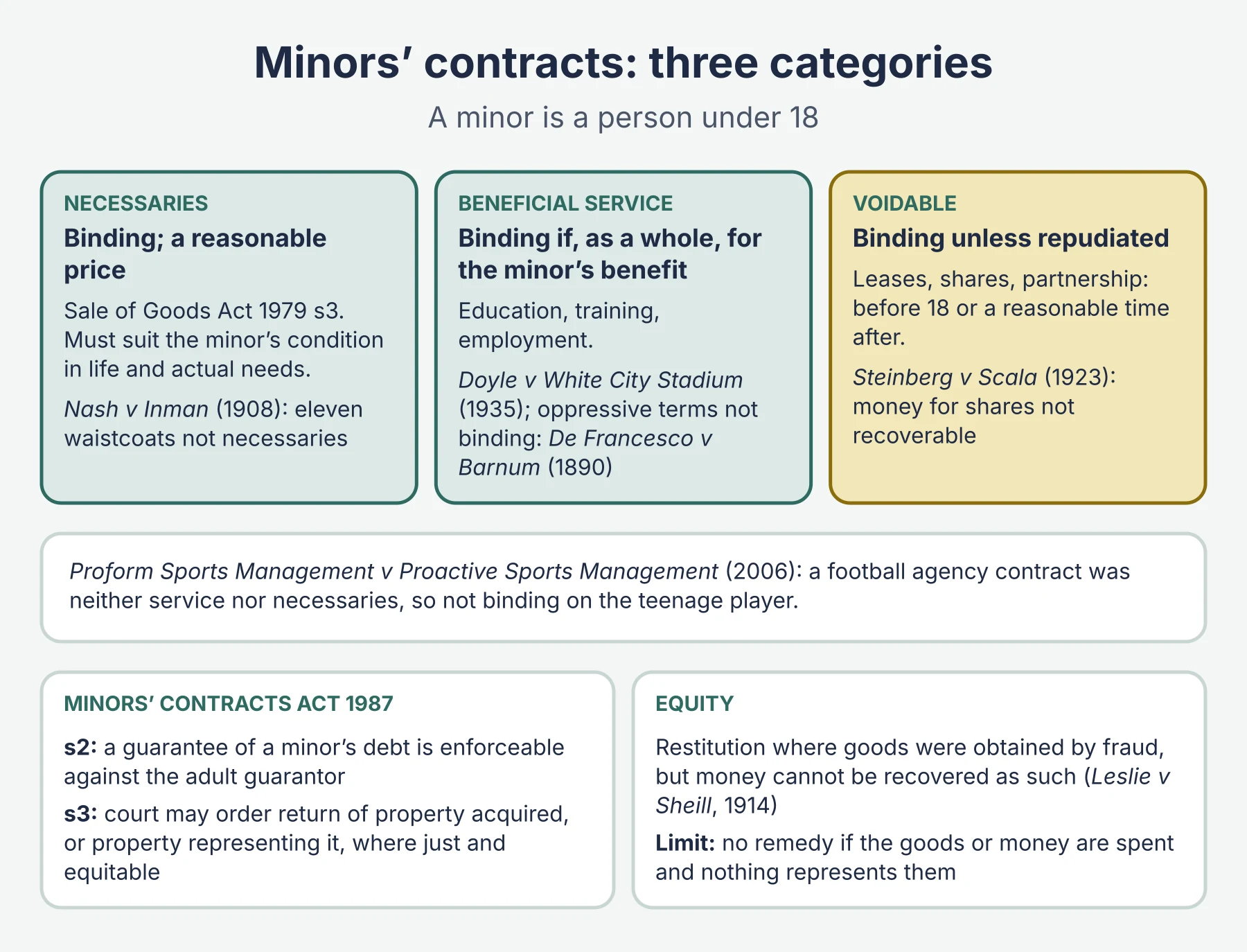
- Minor: under 18. Reason: protection from exploitation and inexperience.
- Necessaries: reasonable price (Sale of Goods Act 1979 s3); condition in life and actual needs (Nash v Inman).
- Beneficial contracts of service: binding if beneficial overall (Doyle v White City); not if oppressive (De Francesco v Barnum); agency contract not covered (Proform v Proactive (2006)).
- Voidable: continuing obligations – leases, shares, partnership – binding unless repudiated before or soon after 18 (Steinberg v Scala).
- Remedies: Minors’ Contracts Act 1987 s2 (guarantor liable), s3 (return of property or its proceeds if just and equitable); equity – restitution of goods obtained by fraud, not money (Leslie v Sheill).
- Limits: nothing to recover once spent. Reform: age 16 as in Scotland; fairness-based enforcement.
Key terms
| Term | Meaning |
|---|---|
| Invitation to treat | Invitation to make an offer |
| Counter offer | New terms that reject the original offer |
| Postal rule | Acceptance complete on posting |
| Referential bid | Bid defined by reference to others’ bids |
| Sufficiency | Some legal value |
| Adequacy | Equal value – not required |
| Promissory estoppel | Equitable bar on going back on a promise relied on |
| Necessaries | Goods or services suited to a minor’s condition and needs |
Exam traps
- Ignoring that the postal rule applies only where post is a reasonable method.
- Confusing a request for information with a counter offer.
- Claiming the battle of forms is always won by the first form.
- Treating Williams v Roffey as applying to part payment of debts.
- Using promissory estoppel to start a claim.
- Saying a minor’s voidable contract is void.
Self-test
- Name the three types of contract in 3.1.1.
- Is a bid at auction an offer?
- What did Harvela Investments decide?
- When can a unilateral offer no longer be revoked?
- When is a posted acceptance effective, and when is the rule excluded?
- Which presumption applies to commercial agreements, and how is it rebutted?
- What is the difference between sufficiency and adequacy of consideration?
- State the exception to the past consideration rule.
- What did Williams v Roffey add to the law on existing duties?
- Give two limits on promissory estoppel.
- Why were the waistcoats in Nash v Inman not necessaries?
- What does s3 Minors’ Contracts Act 1987 allow?
Answers
- Bilateral, unilateral and collateral.
- Yes; the auctioneer accepts on the fall of the hammer.
- A promise to accept the highest bid bound the seller, and a referential bid was invalid.
- Once the offeree has begun performance (Errington).
- On posting, if post is a reasonable method; excluded if the offer requires actual notice (Holwell v Hughes).
- Intention is presumed; rebutted by clear words such as an honour clause (Rose and Frank).
- Sufficiency means some legal value; adequacy means equal value, which is not required.
- An act done at the promisor’s request, with an understanding of payment (Lampleigh; Pao On).
- A practical benefit to the promisor can be consideration for a promise to pay more.
- Any two: shield not a sword; not available to a debtor who acted inequitably; usually only suspends rights.
- The minor already had an adequate supply, so they were not needed.
- The court may order the minor to return property acquired under the contract, or property representing it, where just and equitable.
Apply the rules to scenarios with the formation practice questions.
Related resources
-
Study guides
Cambridge A Level Law (9084): Formation of a valid contract
Offer and acceptance, tenders and auctions, intention, consideration, promissory estoppel and minors' capacity, with cases, for Cambridge Law 9084 subtopic 3.1.
Law · Cambridge · A Level
Read guide -
Practice questions
Cambridge A Level Law (9084): Formation of a valid contract – Practice Questions
Original scenario and essay questions with mark-scheme answers on offer, acceptance, tenders, intention, consideration and minors for Cambridge Law 9084.
Law · Cambridge · A Level
Try questions -
Study guides
Cambridge A Level Law (9084): General defences and remedies
Volenti, contributory negligence, other general defences, tort damages and injunctions for Cambridge A Level Law 9084, sub-topic 4.4, with a calculation.
Law · Cambridge · A Level
Read guide
Get free revision emails (optional)
Occasional emails with practice questions, worked explanations and links to free resources for the qualification and subjects you choose. No spam, and you can unsubscribe from any email. The free tools on this site never need an email.