
Study Guides
Cambridge A Level Law (9084): Formation of a valid contract
Offer and acceptance, tenders and auctions, intention, consideration, promissory estoppel and minors' capacity, with cases, for Cambridge Law 9084 subtopic 3.1.
- Subject
- Law
- Level
- A LEVEL
- Topic
- Topic 3 – Law of Contract
- Author
- Marlbridge Academic Team
- Updated
- Reviewed by
- Aizaz Raoof Ali (what this means)
Aligned to Cambridge A Level Law (9084), 2026-2028. Official specification .
Syllabus page (what it covers and how it is assessed): Cambridge A Level Law.
Syllabus points this page covers
9084 (A Level)
- 3.1 Formation of a valid contract
Found an error? Report a correction.
Need help with this topic? Request a free trial class for A Level Law (9084).
Subtopic 3.1 opens Paper 3 Law of Contract. The syllabus lists five strands: the nature of a contract (3.1.1), offer and acceptance (3.1.2), intention to create legal relations (3.1.3), consideration (3.1.4) and capacity, limited to minors (3.1.5). The law of contract study guide introduces the basic rules; this guide adds the applications the syllabus names – standard form contracts, auctions and tenders – and the detail on consideration and minors.
3.1.1 Nature of a contract
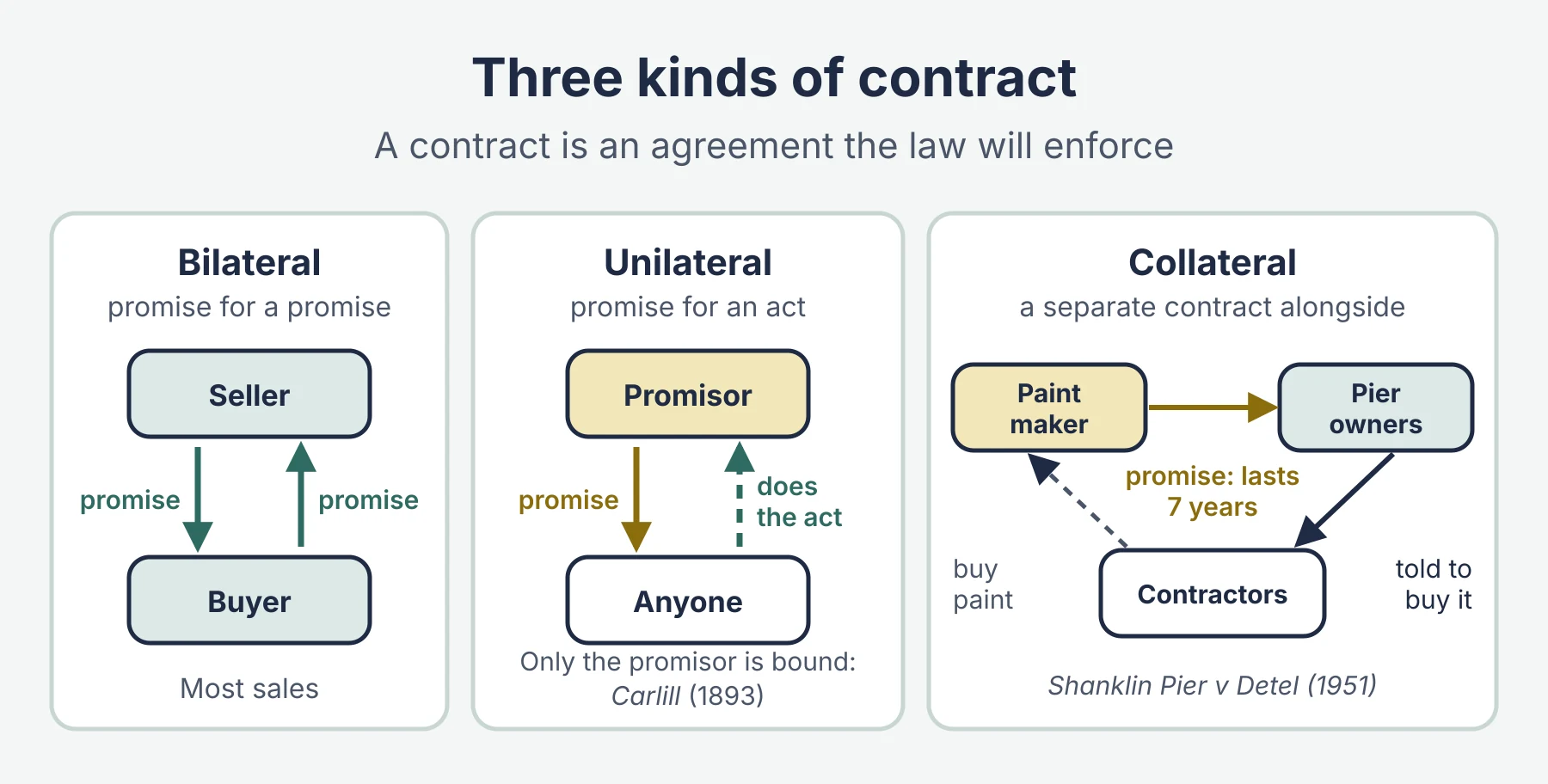
A contract is an agreement the law will enforce.
- Bilateral contract – a promise is exchanged for a promise, as in most sales.
- Unilateral contract – a promise is exchanged for an act; only the promisor is bound until someone performs (Carlill v Carbolic Smoke Ball Co (1893)).
- Collateral contract – a separate contract alongside the main one. In Shanklin Pier v Detel Products (1951) a paint maker promised the pier owners its paint would last seven years; the owners told their contractors to buy it, and the promise was enforceable in a collateral contract, with the instruction as consideration.
3.1.2 Offer and acceptance
Offers and invitations to treat
An offer is a definite promise to be bound on specific terms once accepted. Words such as “may be prepared to sell” showed no firm offer in Gibson v Manchester City Council (1979). An invitation to treat invites offers: goods displayed in a shop window (Fisher v Bell (1961)) or on shelves (Pharmaceutical Society v Boots (1953)), and most advertisements (Partridge v Crittenden (1968)). An advertisement can be an offer where it is unilateral and shows intention to be bound, as in Carlill.
Counter offers and requests for information
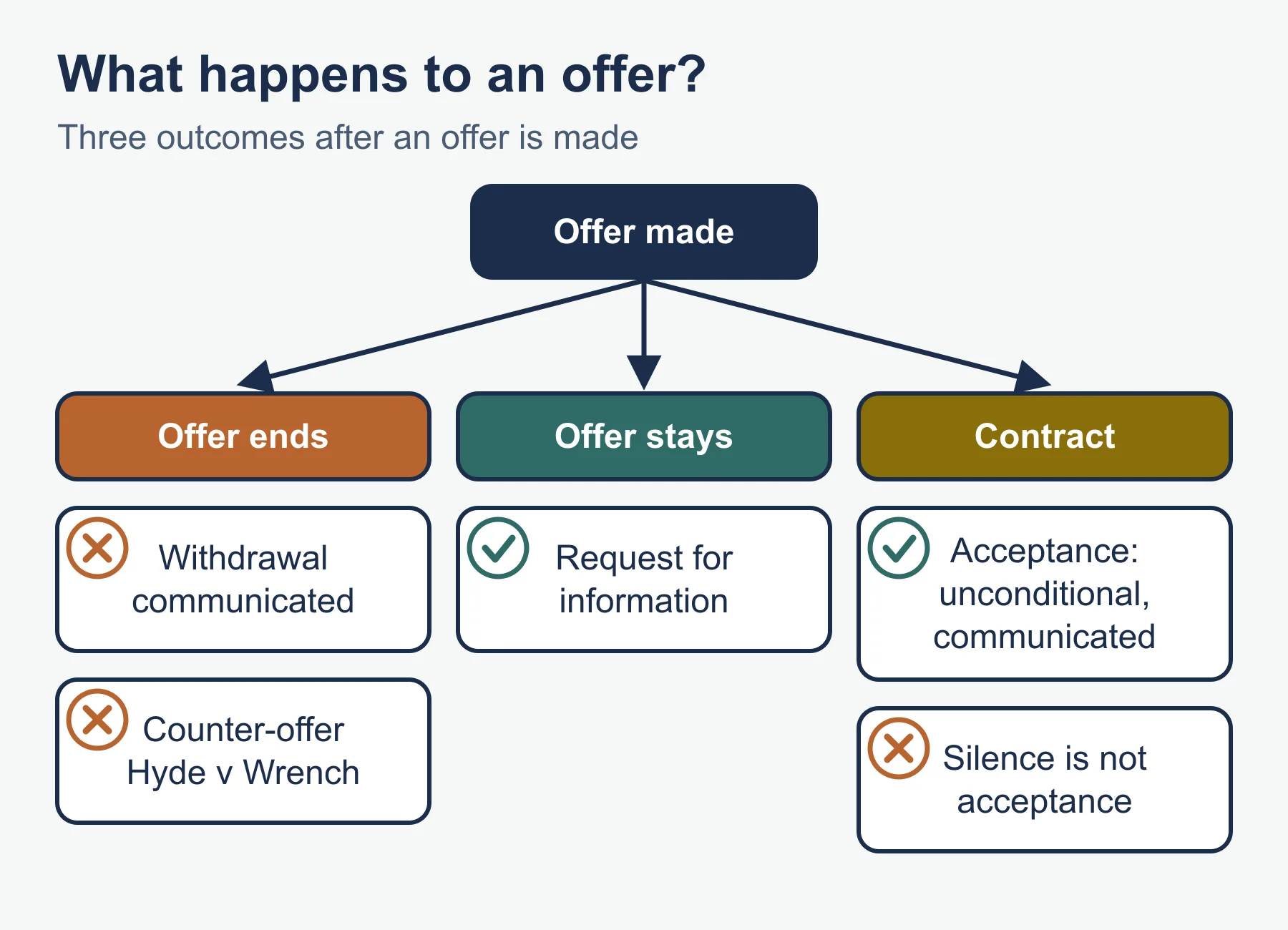
A counter offer rejects and replaces the original offer, which cannot then be accepted (Hyde v Wrench (1840)). A request for information leaves the offer open (Stevenson, Jacques v McLean (1880)).
Termination of an offer
| Method | Rule | Case |
|---|---|---|
| Revocation | Possible any time before acceptance, even if promised to stay open, but must be communicated | Routledge v Grant (1828); Byrne v Van Tienhoven (1880) |
| Revocation by third party | Effective if from a reliable source | Dickinson v Dodds (1876) |
| Revocation of unilateral offer | Not once performance has begun | Errington v Errington (1952) |
| Rejection or counter offer | Ends the offer | Hyde v Wrench (1840) |
| Lapse of time | After a stated time or a reasonable time | Ramsgate Victoria Hotel v Montefiore (1866) |
| Failure of a condition | Offer ends if an implied condition fails | Financings Ltd v Stimson (1962) |
Acceptance
Acceptance must be an unconditional agreement to all the terms of the offer (the mirror image rule) and be communicated to the offeror.
- Conduct can amount to acceptance (Brogden v Metropolitan Railway (1877)).
- Silence cannot (Felthouse v Bindley (1862)).
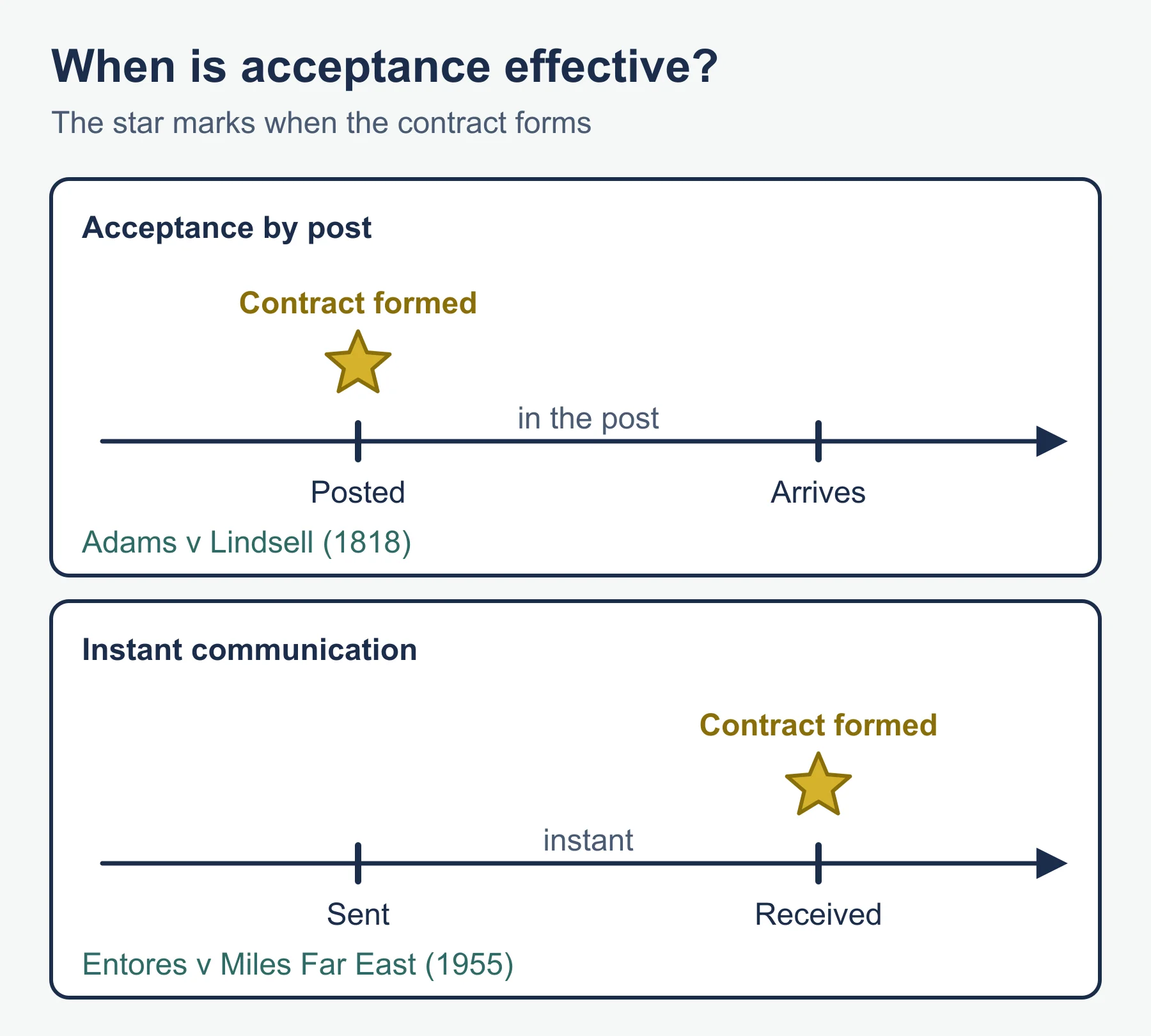
- Instantaneous methods take effect when received (Entores v Miles Far East (1955)).
- The postal rule: acceptance by post is complete when posted (Adams v Lindsell (1818)), even if lost (Household Fire Insurance v Grant (1879)), unless the offer requires actual notice (Holwell Securities v Hughes (1974)).
Applying the rules
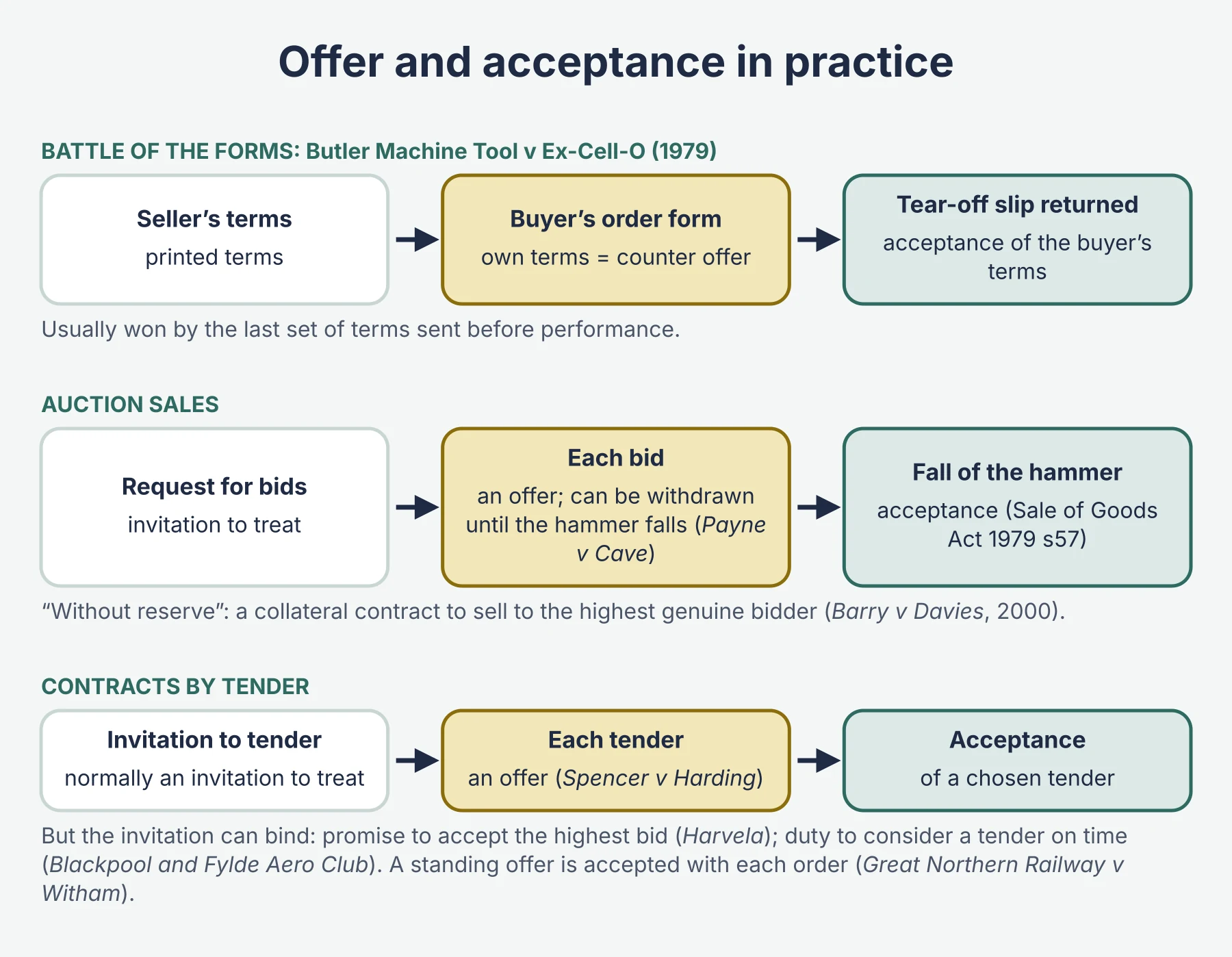
Standard form contracts. Where businesses exchange printed terms, each new set is a counter offer. In Butler Machine Tool v Ex-Cell-O (1979) the buyer’s order form with its own terms was a counter offer, accepted when the seller returned the buyer’s tear-off slip – the “battle of the forms”, usually won by the last set of terms sent before performance.
Auction sales. The auctioneer’s request for bids is an invitation to treat; each bid is an offer, which can be withdrawn until the hammer falls (Payne v Cave (1789)), and acceptance is the fall of the hammer (Sale of Goods Act 1979 s57). Where the auction is advertised “without reserve”, the auctioneer is bound by a collateral contract to sell to the highest genuine bidder (Barry v Davies (2000)).
Contracts by tender. An invitation to tender is normally an invitation to treat, and each tender is an offer (Spencer v Harding (1870)). But an invitation can contain a binding promise: in Harvela Investments v Royal Trust Co of Canada (1986) a promise to accept the highest bid was a unilateral offer that excluded “referential” bids, and in Blackpool and Fylde Aero Club v Blackpool Borough Council (1990) a council was bound to consider a tender submitted on time. A standing offer to supply as required is accepted each time an order is placed (Great Northern Railway v Witham (1873)).
3.1.3 Intention to create legal relations
Reason for the requirement. The law will not enforce agreements the parties never meant to be legally binding, which keeps courts free of trivial domestic disputes and respects the parties’ freedom.
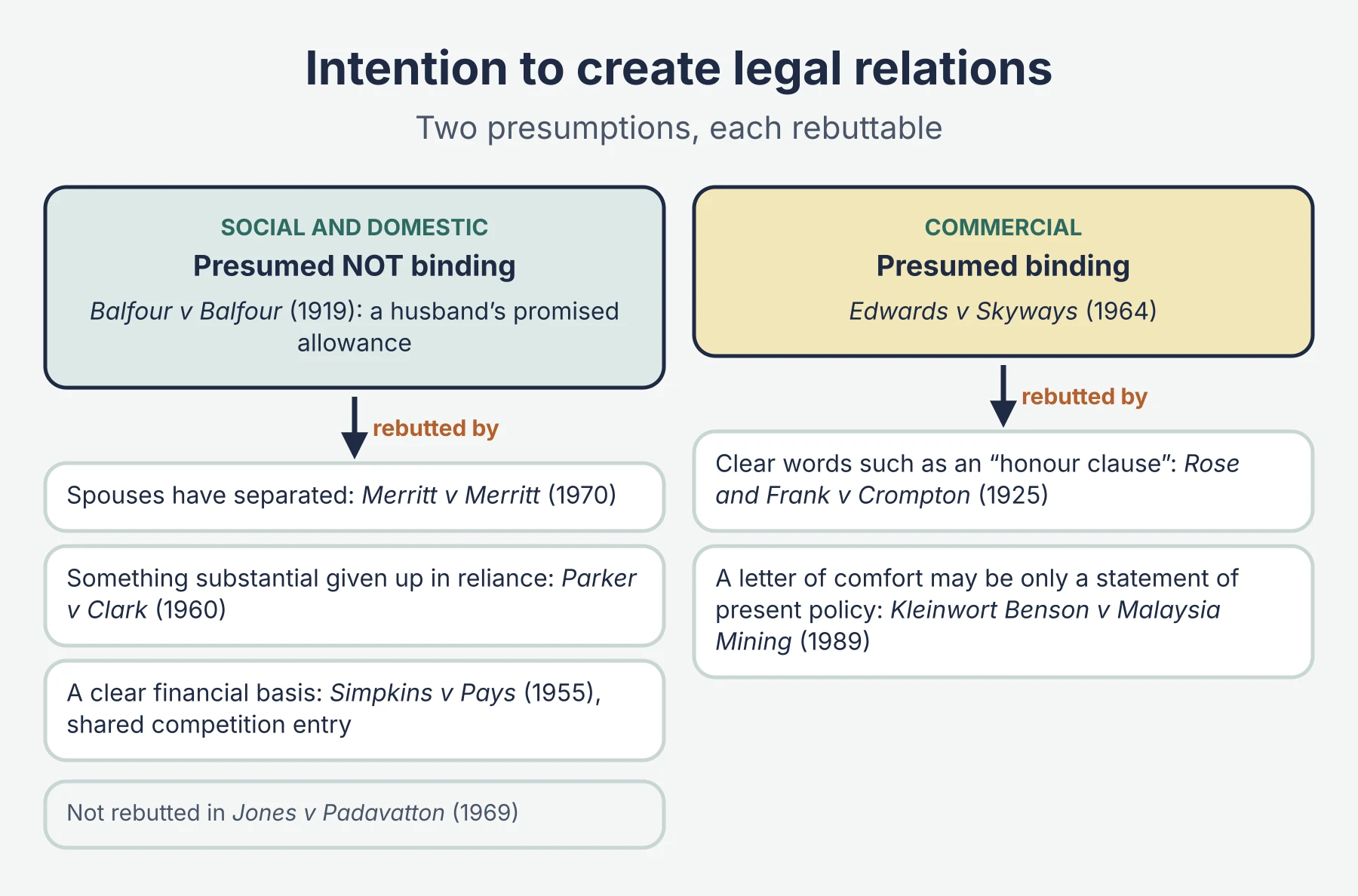
Social and domestic agreements are presumed not to be binding (Balfour v Balfour (1919), a husband’s promised allowance). The presumption is rebutted where spouses have separated (Merritt v Merritt (1970)), where a person has given up something substantial in reliance (Parker v Clark (1960)), or where a shared arrangement has a clear financial basis (Simpkins v Pays (1955), a shared competition entry). It was not rebutted in Jones v Padavatton (1969).
Commercial agreements are presumed binding (Edwards v Skyways (1964)). The presumption is rebutted by clear words such as an “honour clause” (Rose and Frank v Crompton (1925)), and a letter of comfort may be only a statement of present policy (Kleinwort Benson v Malaysia Mining (1989)).
3.1.4 Consideration
Nature and function. Consideration is the price for which the other’s promise is bought (Dunlop v Selfridge (1915)), often described as a benefit to one party or a detriment to the other (Currie v Misa (1875)). It distinguishes a bargain from a gift.
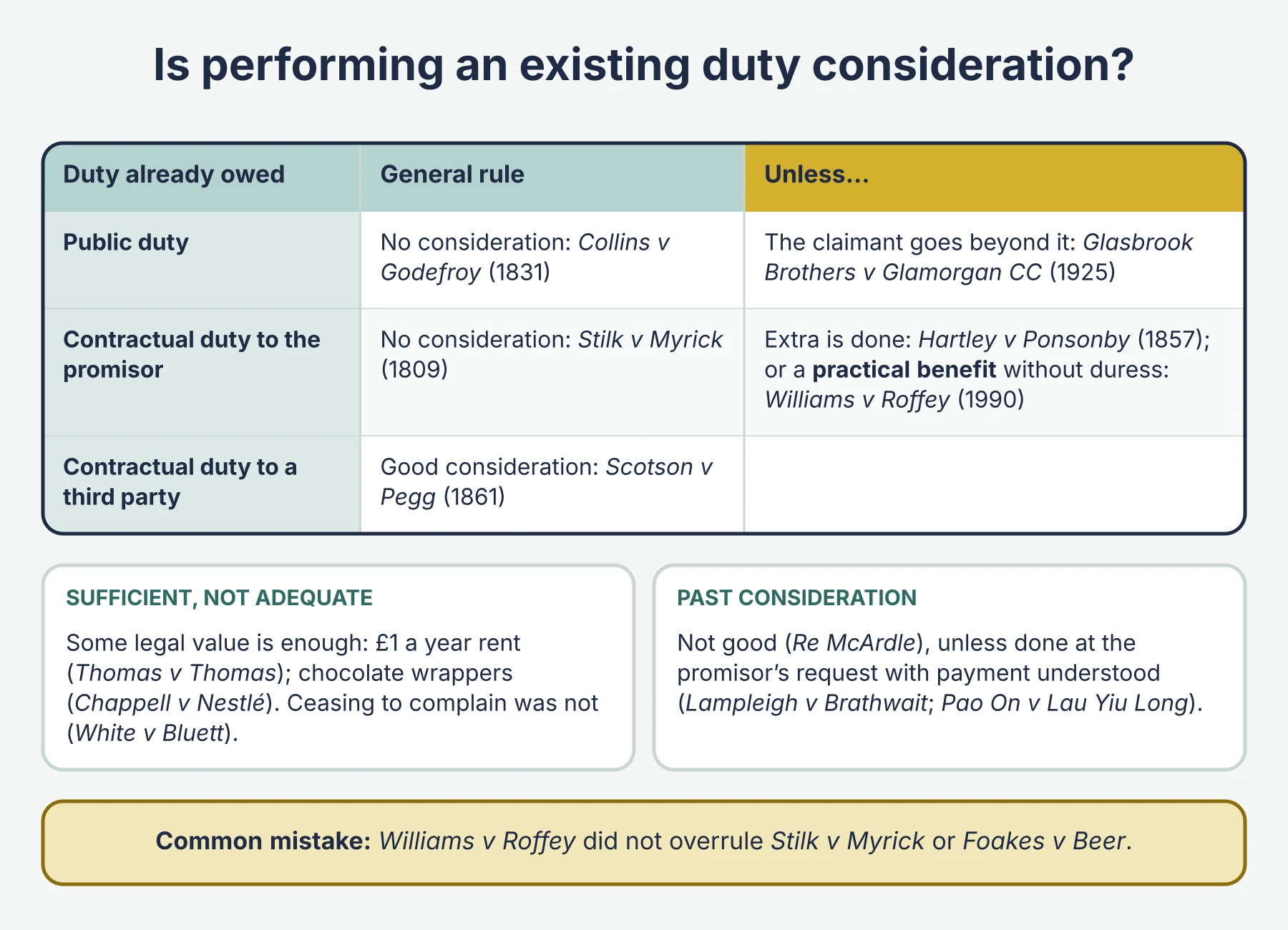
Sufficiency and adequacy. Consideration must be sufficient (of some legal value) but need not be adequate (equal in value): £1 a year rent was enough in Thomas v Thomas (1842), and chocolate wrappers in Chappell v Nestlé (1960). Ceasing to complain was not sufficient in White v Bluett (1853).
Past consideration is not good consideration (Re McArdle (1951)), unless the act was done at the promisor’s request with an understanding that it would be paid for, as in Lampleigh v Brathwait (1615) and Pao On v Lau Yiu Long (1980).
Performance of existing duties.
- Public duty: no consideration (Collins v Godefroy (1831)) unless the claimant goes beyond it (Glasbrook Brothers v Glamorgan County Council (1925)).
- Existing contractual duty to the promisor: no consideration (Stilk v Myrick (1809)) unless extra is done (Hartley v Ponsonby (1857)) or the promisor obtains a practical benefit without duress (Williams v Roffey Brothers (1990)).
- Contractual duty owed to a third party: good consideration (Scotson v Pegg (1861)).
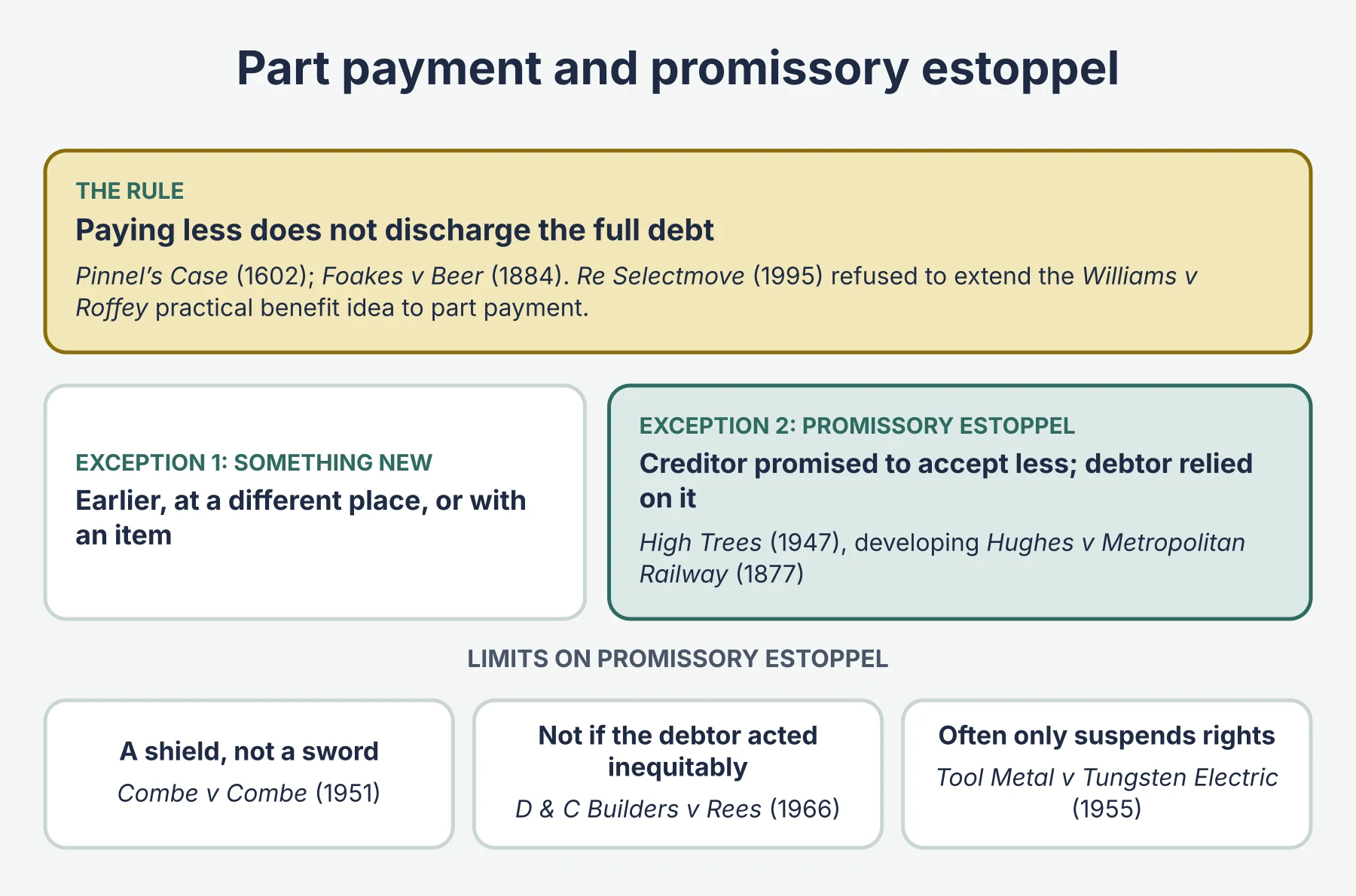
Part payment of a debt. Paying less does not discharge the full debt (Pinnel’s Case (1602); Foakes v Beer (1884)), unless something new is given, such as payment earlier, at a different place or with an item. Re Selectmove (1995) refused to extend the Williams v Roffey practical benefit idea to part payment.
Promissory estoppel. Where a creditor promises to accept less and the debtor relies on that promise, the creditor may be stopped from going back on it (Central London Property Trust v High Trees House (1947), developing Hughes v Metropolitan Railway (1877)). It is a shield, not a sword (Combe v Combe (1951)); it is not available where the debtor has acted inequitably (D & C Builders v Rees (1966)); and it often only suspends rights (Tool Metal Manufacturing v Tungsten Electric (1955)).
3.1.5 Capacity (minors only)
A minor is a person under 18. Reason for limitation: to protect young people from exploitation and their own inexperience, while not preventing them from obtaining what they genuinely need.
Categories of contract.
| Category | Effect | Cases |
|---|---|---|
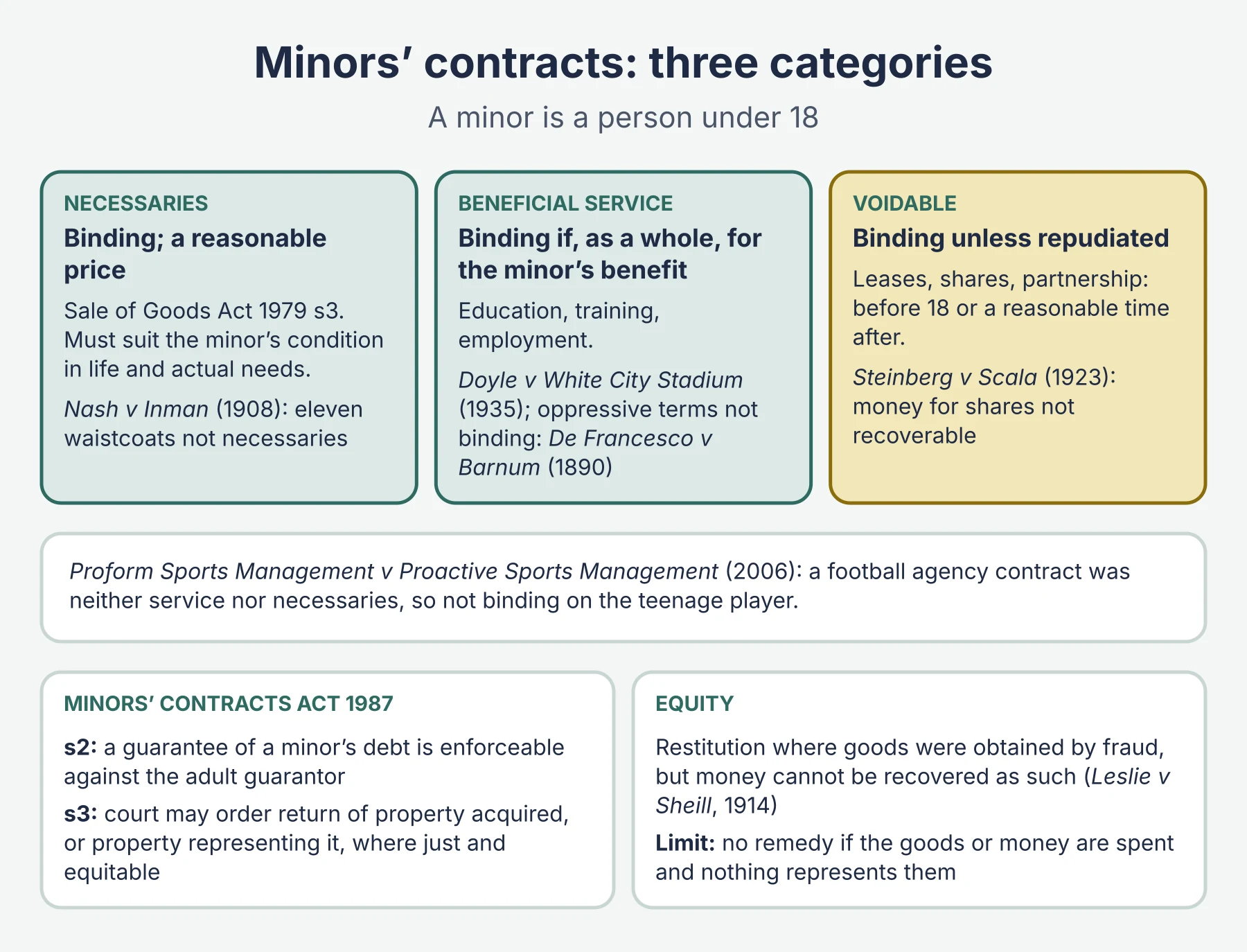
| Necessaries | Binding; minor pays a reasonable price (Sale of Goods Act 1979 s3). Goods must suit the minor’s condition in life and actual needs | Nash v Inman (1908): eleven waistcoats not necessaries for a student already well supplied |
| Beneficial contracts of service (education, training, employment) | Binding if, taken as a whole, for the minor’s benefit | Doyle v White City Stadium (1935); De Francesco v Barnum (1890): oppressive terms not binding |
| Voidable contracts with continuing obligations (leases, shares, partnership) | Binding unless the minor repudiates before 18 or within a reasonable time after | Steinberg v Scala (Leeds) (1923): money paid for shares not recoverable once benefit received |
In Proform Sports Management v Proactive Sports Management (2006) a football agency contract with a teenage player was not a contract of service or for necessaries, so it was not binding on him.
Remedies against minors. Under the Minors’ Contracts Act 1987, s2 makes a guarantee of a minor’s debt enforceable against the adult guarantor, and s3 allows a court, where just and equitable, to order the minor to return property acquired under the contract or property representing it. In equity, restitution may be ordered where a minor obtained goods by fraud, but money cannot be recovered as such (Leslie v Sheill (1914)). Limits: there is no remedy where the goods or money have been spent and nothing represents them.
Possible reform. The rules turn on fine distinctions, such as what is “necessary”. Options include lowering the age of full capacity to 16, as in Scotland, or making all contracts enforceable where fair and reasonable.
Annotated model answer
Advise whether a contract was formed when Kai posted an acceptance that never arrived.
An acceptance must normally be communicated (Entores). [general rule] However, where post is a reasonable method of acceptance, the postal rule makes acceptance complete when the letter is posted (Adams v Lindsell), even if it is lost (Household Fire Insurance v Grant). [exception + case] The rule does not apply if the offer required actual notice (Holwell v Hughes). [limit] As Kai’s offeror asked for a reply “by post” and set no notice requirement, a contract was formed on posting. [application + conclusion]
Common mistakes
- Calling every advertisement an invitation to treat, ignoring unilateral offers.
- Treating Williams v Roffey as overruling Stilk v Myrick or Foakes v Beer.
- Using promissory estoppel as a cause of action.
- Writing that all minors’ contracts are void.
Exam technique
In scenarios, take each formation issue in turn: rule, case, application, conclusion. Essays that assess or evaluate – for example whether consideration still serves a useful purpose – need both sides and a judgement. Revise with the formation revision notes and practise with the formation practice questions.
Related resources
-
Practice questions
Cambridge A Level Law (9084): Formation of a valid contract – Practice Questions
Original scenario and essay questions with mark-scheme answers on offer, acceptance, tenders, intention, consideration and minors for Cambridge Law 9084.
Law · Cambridge · A Level
Try questions -
Revision notes
Cambridge A Level Law (9084): Formation of a valid contract – Revision Notes
Case tables on offer, acceptance, tenders, auctions, intention, consideration, estoppel and minors' contracts, with a self-test, for Cambridge Law 9084.
Law · Cambridge · A Level
Revise topic -
Study guides
Cambridge A Level Law (9084): General defences and remedies
Volenti, contributory negligence, other general defences, tort damages and injunctions for Cambridge A Level Law 9084, sub-topic 4.4, with a calculation.
Law · Cambridge · A Level
Read guide
Get free revision emails (optional)
Occasional emails with practice questions, worked explanations and links to free resources for the qualification and subjects you choose. No spam, and you can unsubscribe from any email. The free tools on this site never need an email.