
Study Guides
Cambridge A Level Law (9084): General defences and remedies
Volenti, contributory negligence, other general defences, tort damages and injunctions for Cambridge A Level Law 9084, sub-topic 4.4, with a calculation.
- Subject
- Law
- Level
- A LEVEL
- Topic
- Topic 4: Law of tort
- Author
- Marlbridge Academic Team
- Updated
- Reviewed by
- Aizaz Raoof Ali (what this means)
Aligned to Cambridge A Level Law (9084), 2026-2028. Official specification .
Syllabus page (what it covers and how it is assessed): Cambridge A Level Law.
Syllabus points this page covers
9084 (A Level)
- 4.4 General defences and remedies
Found an error? Report a correction.
Need help with this topic? Request a free trial class for A Level Law (9084).
Sub-topic 4.4 of Cambridge International A Level Law (9084) completes Topic 4. It covers the general defences, which can be raised against most torts, and the remedies a court can award. On Paper 4 Law of Tort almost every scenario ends with defences and remedies, and essays often ask you to evaluate damages or injunctions. This guide goes beyond the Topic 4 overview by covering every defence the syllabus names and the full range of damages and injunctions.
What the syllabus lists
- 4.4.1 Defences: volenti non fit injuria (meaning of consent, knowledge and understanding, application in employment, medical treatment and sport); contributory negligence (a partial defence, apportionment and reduction of damages); inevitable accident, Act of God, statutory authority, illegality and necessity.
- 4.4.2 Remedies: the purpose and calculation of damages; special and general damages; non-compensatory damages; damages for personal injury, future losses and death; policy issues and possible reforms; injunctions (mandatory, prohibitory and interlocutory), damages in lieu, and evaluation of injunctions in tort.
4.4.1 Defences
Volenti non fit injuria
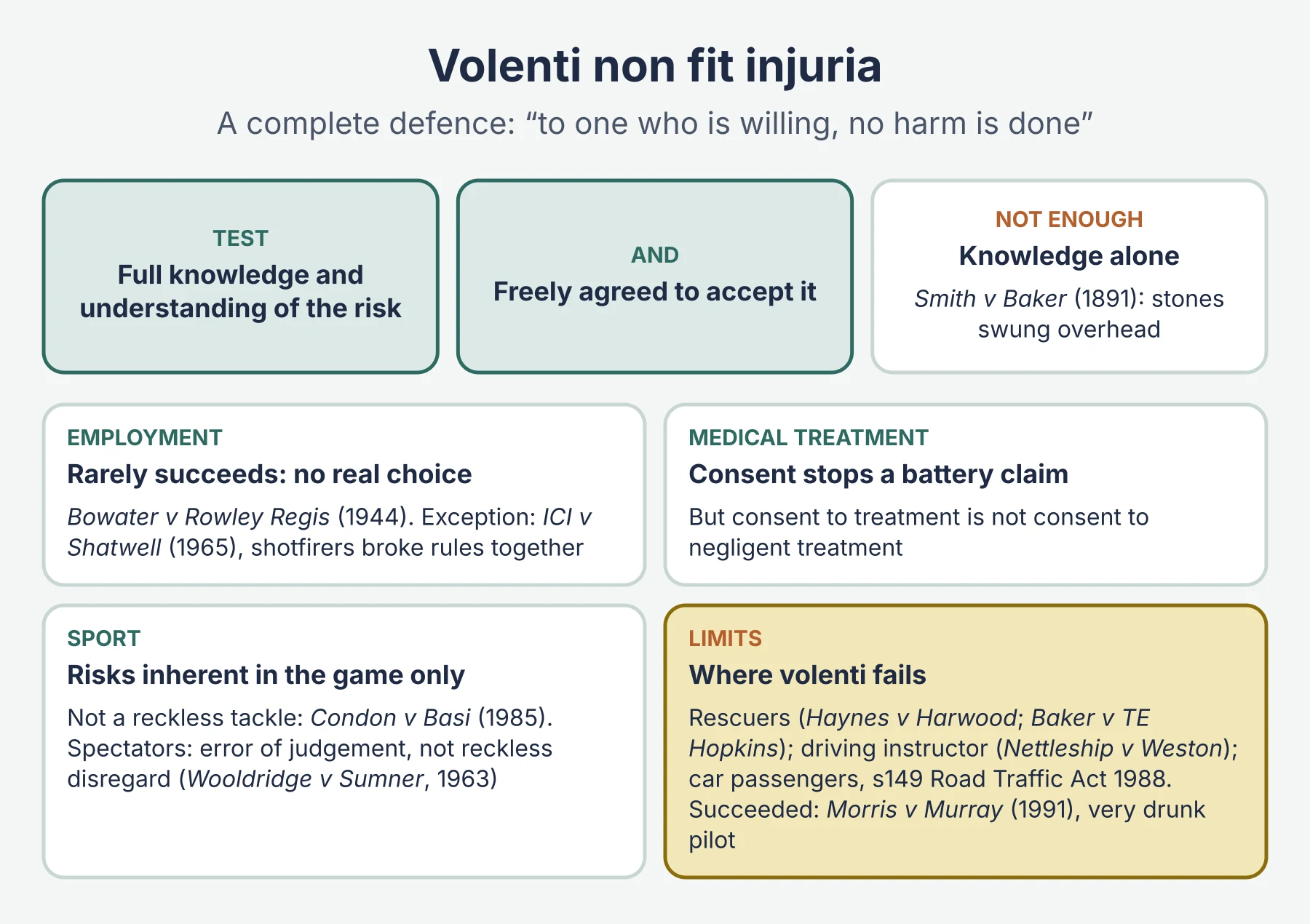
Volenti (“to one who is willing, no harm is done”) is a complete defence. The defendant must show that the claimant, with full knowledge and understanding of the nature and extent of the risk, freely agreed to accept it. Knowledge alone is not consent: in Smith v Baker (1891) a quarry worker who knew stones were being swung overhead had not agreed to run the risk.
- Employment. Because employees often have no real choice, the defence rarely succeeds (Bowater v Rowley Regis Corporation, 1944). An exception is ICI v Shatwell (1965), where two experienced shotfirers deliberately broke safety rules together.
- Medical treatment. A patient’s consent to a procedure prevents a claim in battery, but consenting to treatment is not consenting to negligent treatment.
- Sport. Participants accept the risks inherent in the game but not reckless or deliberate conduct outside it (Condon v Basi, 1985, a reckless tackle). Spectators accept the risk of an error of judgement in the heat of competition, not a reckless disregard for their safety (Wooldridge v Sumner, 1963).
- Limits. Rescuers are not treated as volunteers (Haynes v Harwood, 1935; Baker v TE Hopkins, 1959). A driving instructor was not volens in Nettleship v Weston (1971). For car passengers, s149 of the Road Traffic Act 1988 prevents the defence. It did succeed in Morris v Murray (1991), where the claimant flew with a pilot he knew was very drunk.
Contributory negligence
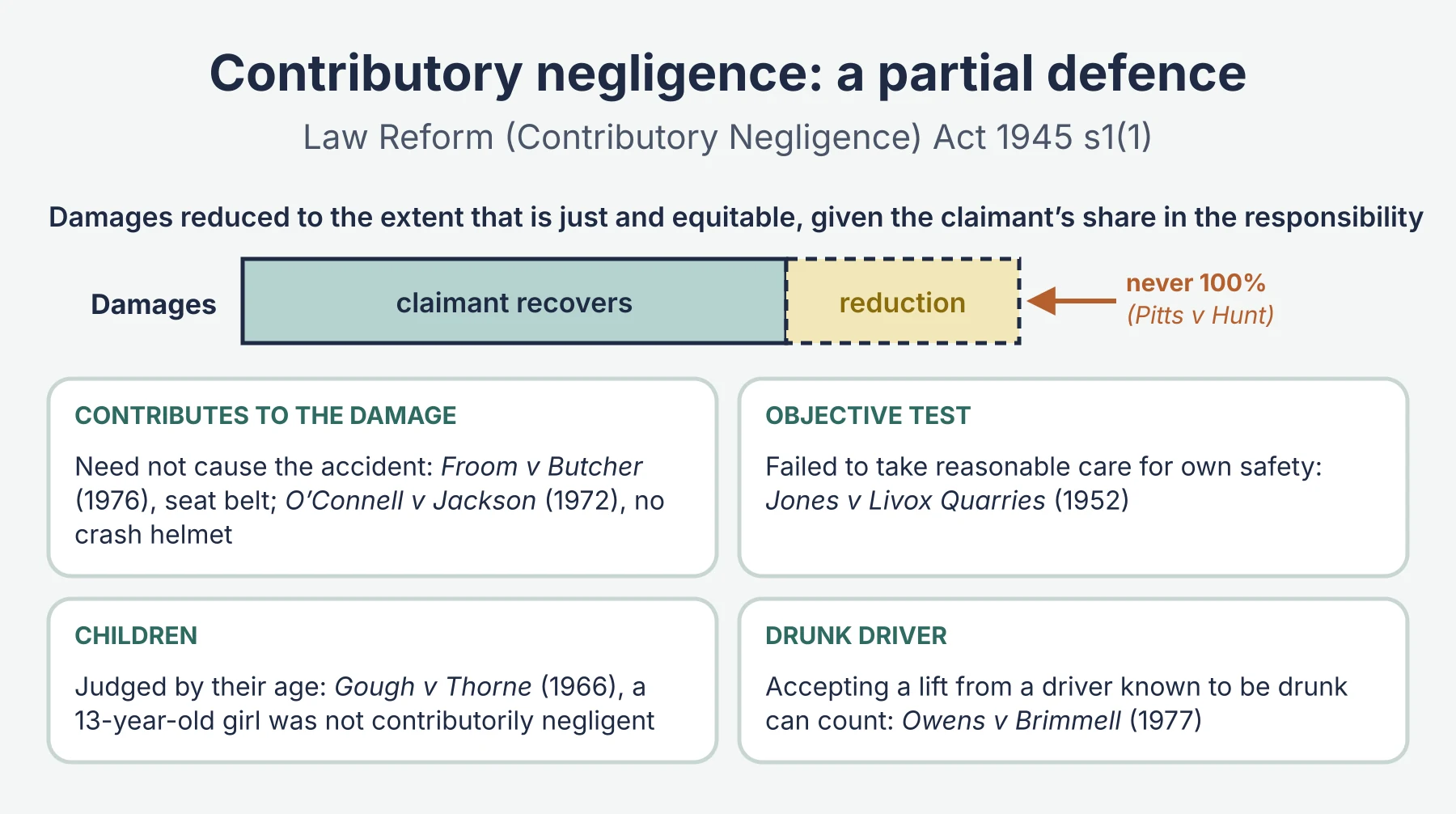
Under s1(1) of the Law Reform (Contributory Negligence) Act 1945, where the claimant’s own fault contributes to the damage, damages are reduced to the extent the court thinks just and equitable, having regard to the claimant’s share in the responsibility. It is a partial defence.
- The claimant’s fault need not cause the accident, only contribute to the damage (Froom v Butcher, 1976, seat belts; O’Connell v Jackson, 1972, a moped rider without a crash helmet).
- The test is objective: the claimant failed to take reasonable care for their own safety (Jones v Livox Quarries, 1952). Children are judged by their age: in Gough v Thorne (1966) a 13-year-old girl was not contributorily negligent.
- Accepting a lift from a driver known to be drunk can be contributory negligence (Owens v Brimmell, 1977).
- A 100 per cent reduction is not possible, because the claimant would then recover nothing, which the Act does not contemplate (Pitts v Hunt, 1991).
Other general defences
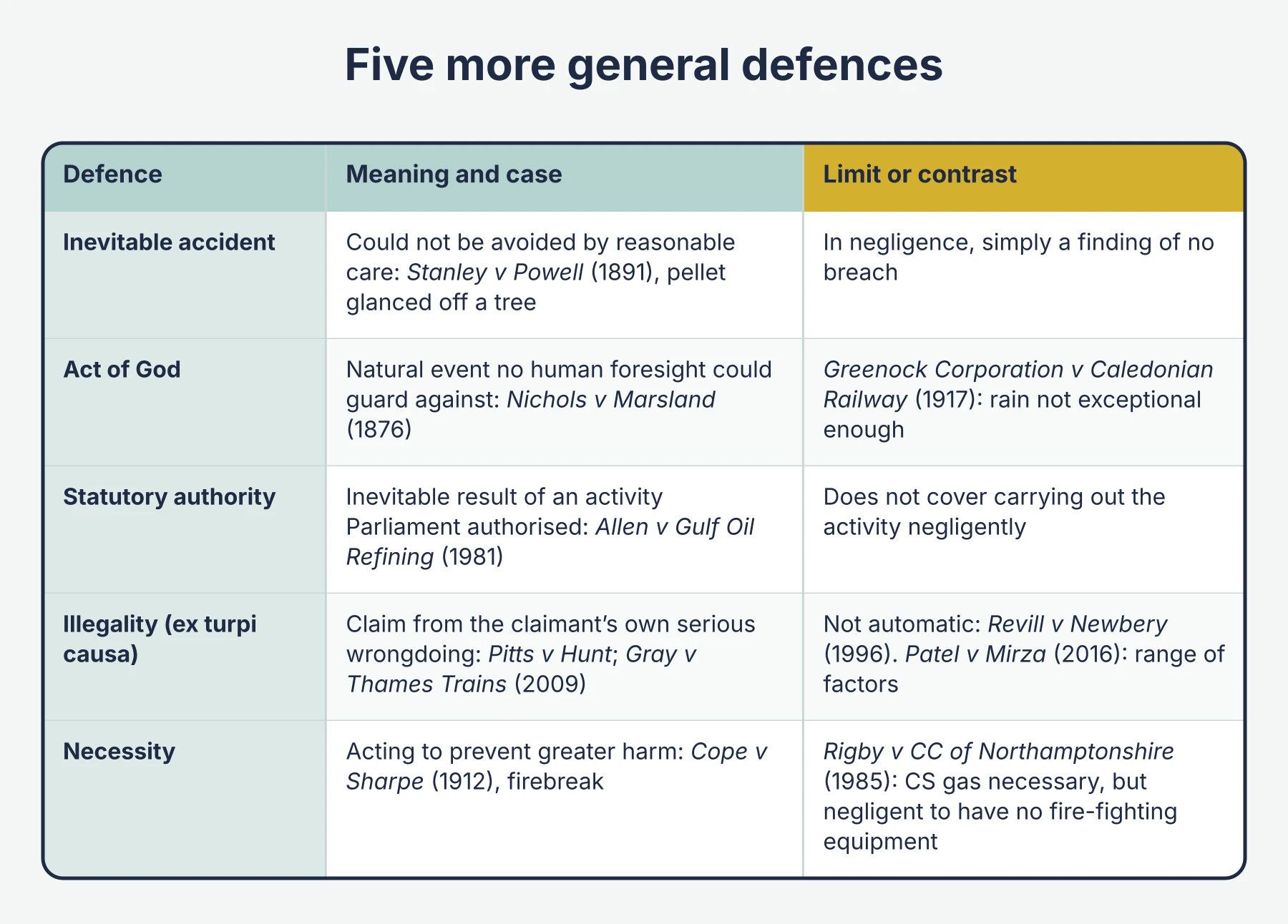
- Inevitable accident. The harm could not have been avoided by reasonable care. In Stanley v Powell (1891) a pellet that glanced off a tree and hit a beater gave no liability. In negligence this is simply a finding of no breach.
- Act of God. A natural event that no human foresight could guard against (Nichols v Marsland, 1876, an extraordinary rainfall). Contrast Greenock Corporation v Caledonian Railway (1917), where heavy rain was not exceptional enough.
- Statutory authority. Where Parliament authorises an activity, harm that is its inevitable result is not actionable (Allen v Gulf Oil Refining, 1981). The defence does not cover harm caused by carrying out the activity negligently.
- Illegality (ex turpi causa). A claim arising from the claimant’s own serious wrongdoing may be barred (Pitts v Hunt, joint illegal enterprise; Gray v Thames Trains, 2009, losses flowing from the claimant’s own criminal act of manslaughter). It is not automatic: in Revill v Newbery (1996) a burglar shot by a householder recovered damages, reduced for contributory negligence. In Patel v Mirza (2016) the Supreme Court adopted a range-of-factors approach based on the purpose of the rule broken and proportionality.
- Necessity. The defendant acted to prevent greater harm to others or property. In Cope v Sharpe (1912) a gamekeeper who burned a firebreak on another’s land was not liable. In Rigby v Chief Constable of Northamptonshire (1985) firing CS gas into a shop to flush out a gunman was necessary, though the police were liable in negligence for having no fire-fighting equipment ready.
4.4.2 Remedies
Purpose and types of damages
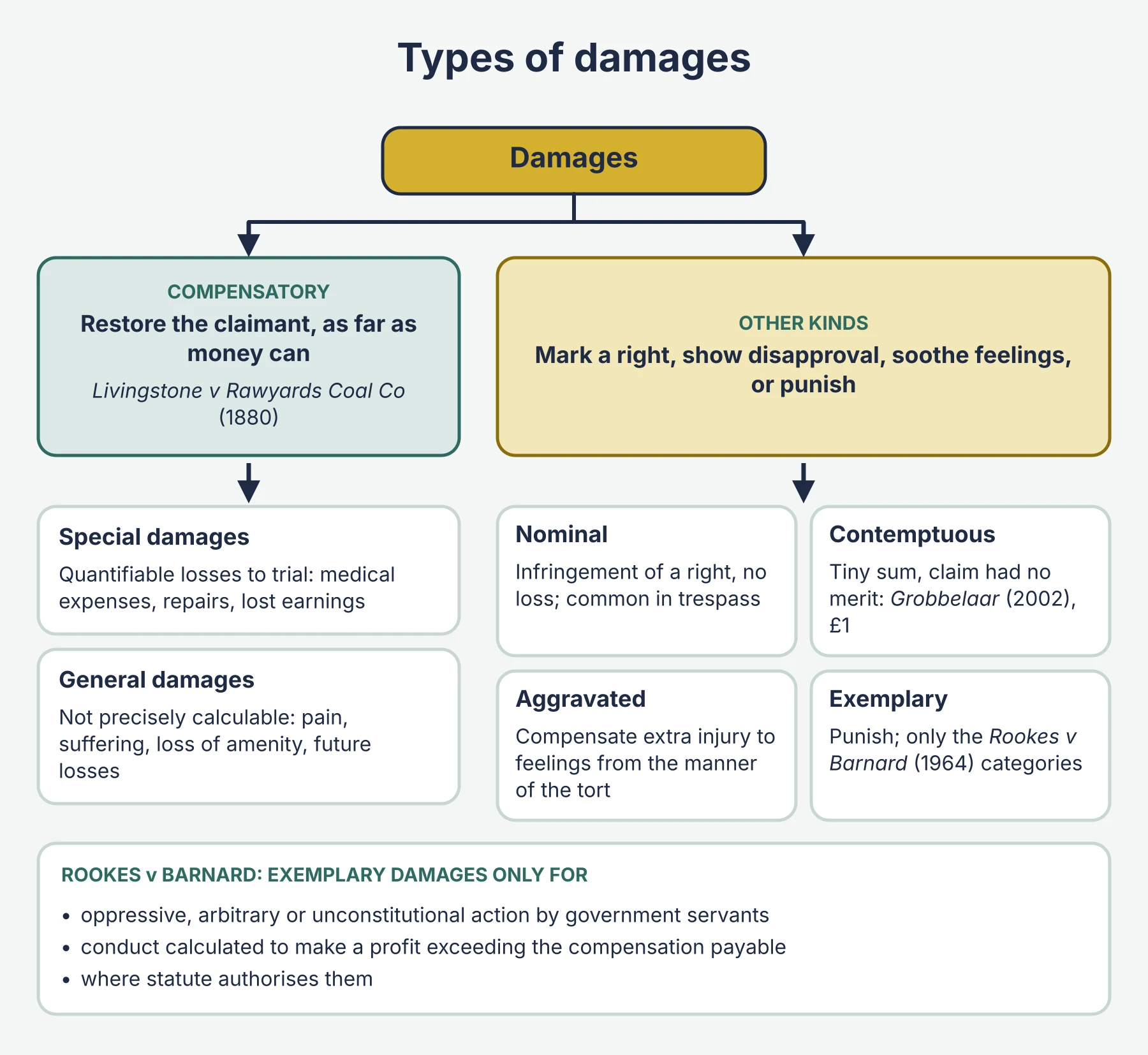
Compensatory damages aim to restore the claimant, as far as money can, to the position they would have been in had the tort not been committed (Livingstone v Rawyards Coal Co, 1880). They are divided into:
- Special damages: quantifiable losses to the date of trial, such as medical expenses, repairs and lost earnings;
- General damages: losses not precisely calculable, including pain, suffering and loss of amenity, and future losses.
Other kinds of damages include:
- Nominal damages to mark the infringement of a right where there is no loss, common in trespass.
- Contemptuous damages, a tiny sum showing the court’s view that the claim, though technically successful, had no merit (Grobbelaar v News Group Newspapers, 2002, £1).
- Aggravated damages, compensating extra injury to feelings caused by the manner of the tort.
- Exemplary damages, punishing the defendant, available only in limited categories set out in Rookes v Barnard (1964): oppressive, arbitrary or unconstitutional action by government servants; conduct calculated to make a profit exceeding the compensation payable; and where statute authorises them.
Personal injury, future losses and death
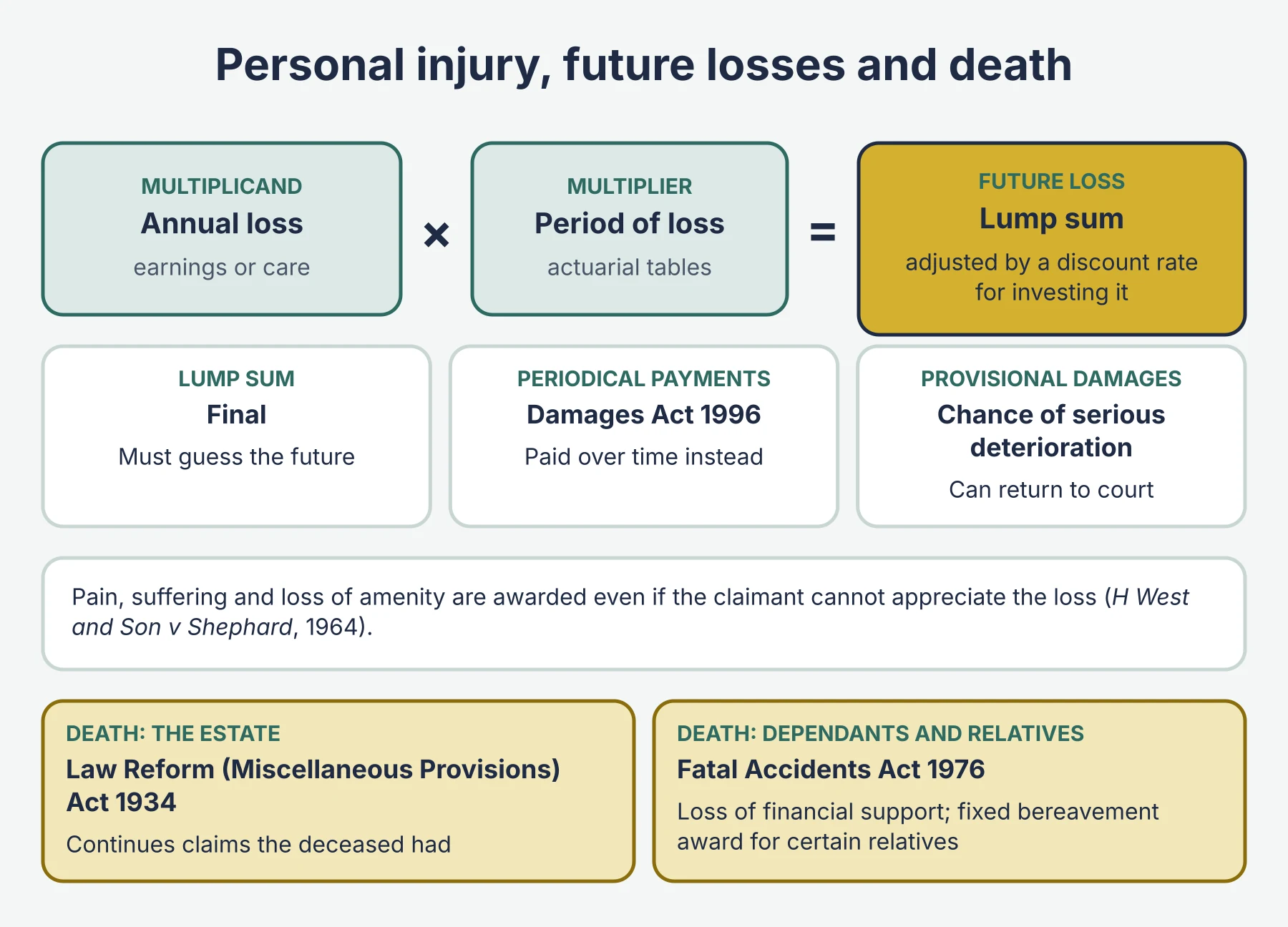
- Pain, suffering and loss of amenity are awarded even where the claimant cannot appreciate the loss (H West and Son v Shephard, 1964).
- Future loss of earnings and care are calculated by multiplying the annual loss (the multiplicand) by a figure reflecting the period of loss (the multiplier), adjusted using actuarial tables and a discount rate for the return on investing the lump sum.
- A lump sum is final and must guess the future. The courts may instead make periodical payment orders under the Damages Act 1996, or award provisional damages where there is a chance of serious deterioration.
- Death: the Law Reform (Miscellaneous Provisions) Act 1934 allows the deceased’s estate to continue claims the deceased had; the Fatal Accidents Act 1976 allows dependants to claim for loss of financial support and certain relatives to claim a fixed bereavement award.
Policy and reform
Lump sums can over- or under-compensate; litigation is slow and expensive; the fault requirement means two people with identical injuries may receive very different outcomes; and the costs fall partly on insurers and public bodies. Reform options include wider use of periodical payments, no-fault compensation schemes for particular injuries, and fixed tariffs for minor claims.
Injunctions
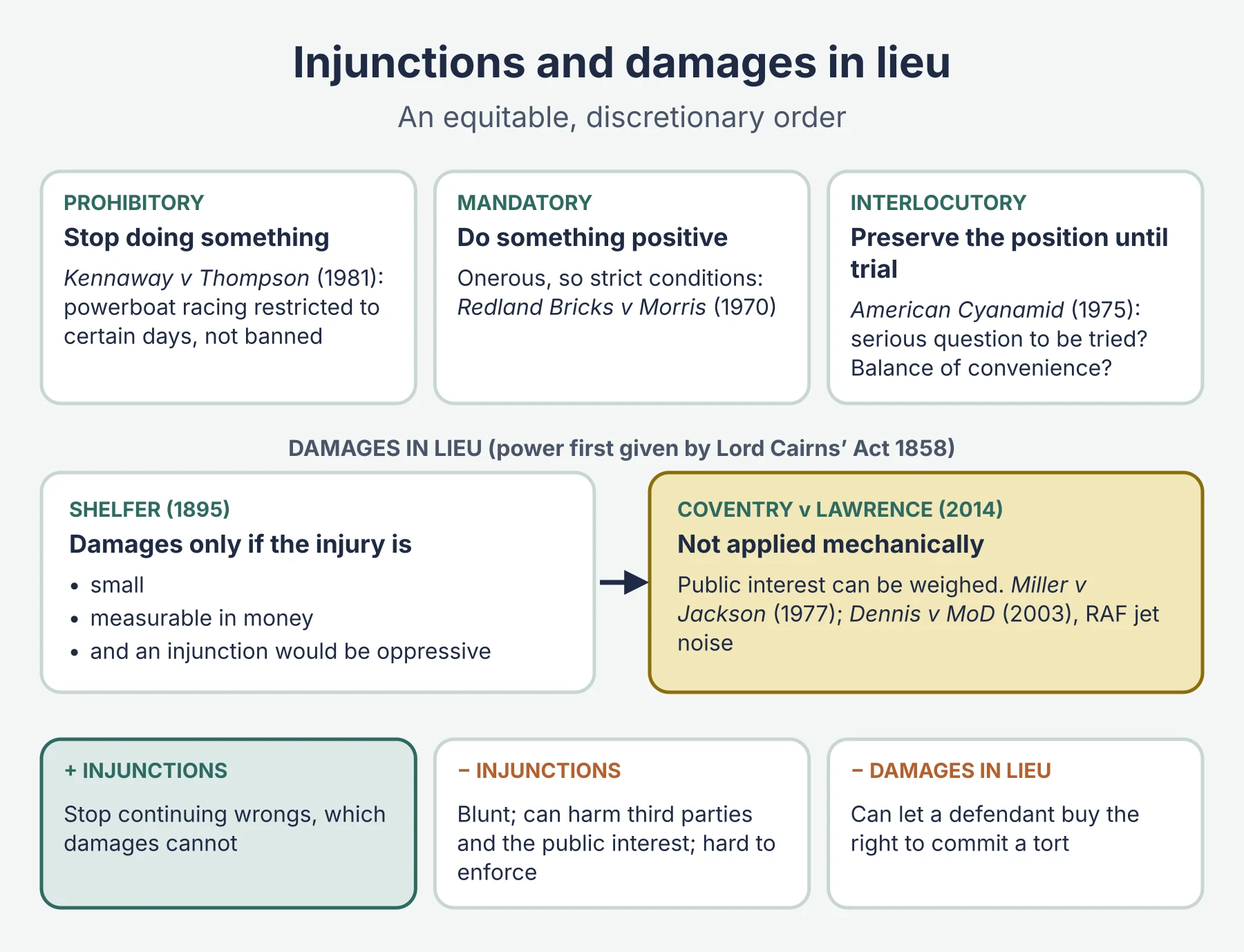
An injunction is an equitable, discretionary order.
- Prohibitory injunctions order the defendant to stop, for example to limit a nuisance. In Kennaway v Thompson (1981) powerboat racing was restricted to certain days rather than banned.
- Mandatory injunctions order the defendant to do something positive. Because they are onerous, the courts apply strict conditions (Redland Bricks v Morris, 1970).
- Interlocutory (interim) injunctions preserve the position until trial. American Cyanamid v Ethicon (1975) asks whether there is a serious question to be tried and where the balance of convenience lies.
- Damages in lieu of an injunction may be awarded under the court’s statutory power, first given by Lord Cairns’ Act 1858. Shelfer v City of London Electric Lighting (1895) suggested damages only where the injury is small, can be measured in money and an injunction would be oppressive; Coventry v Lawrence (2014) said that test should not be applied mechanically, and public interest can be weighed. Examples include Miller v Jackson (1977) and Dennis v Ministry of Defence (2003), noise from RAF jets.
Evaluation. Injunctions stop continuing wrongs, which damages cannot, but they can be blunt, harm third parties and the public interest, and are hard to enforce. Damages in lieu let the court balance interests but can amount to allowing a defendant to buy the right to commit a tort.
Worked example
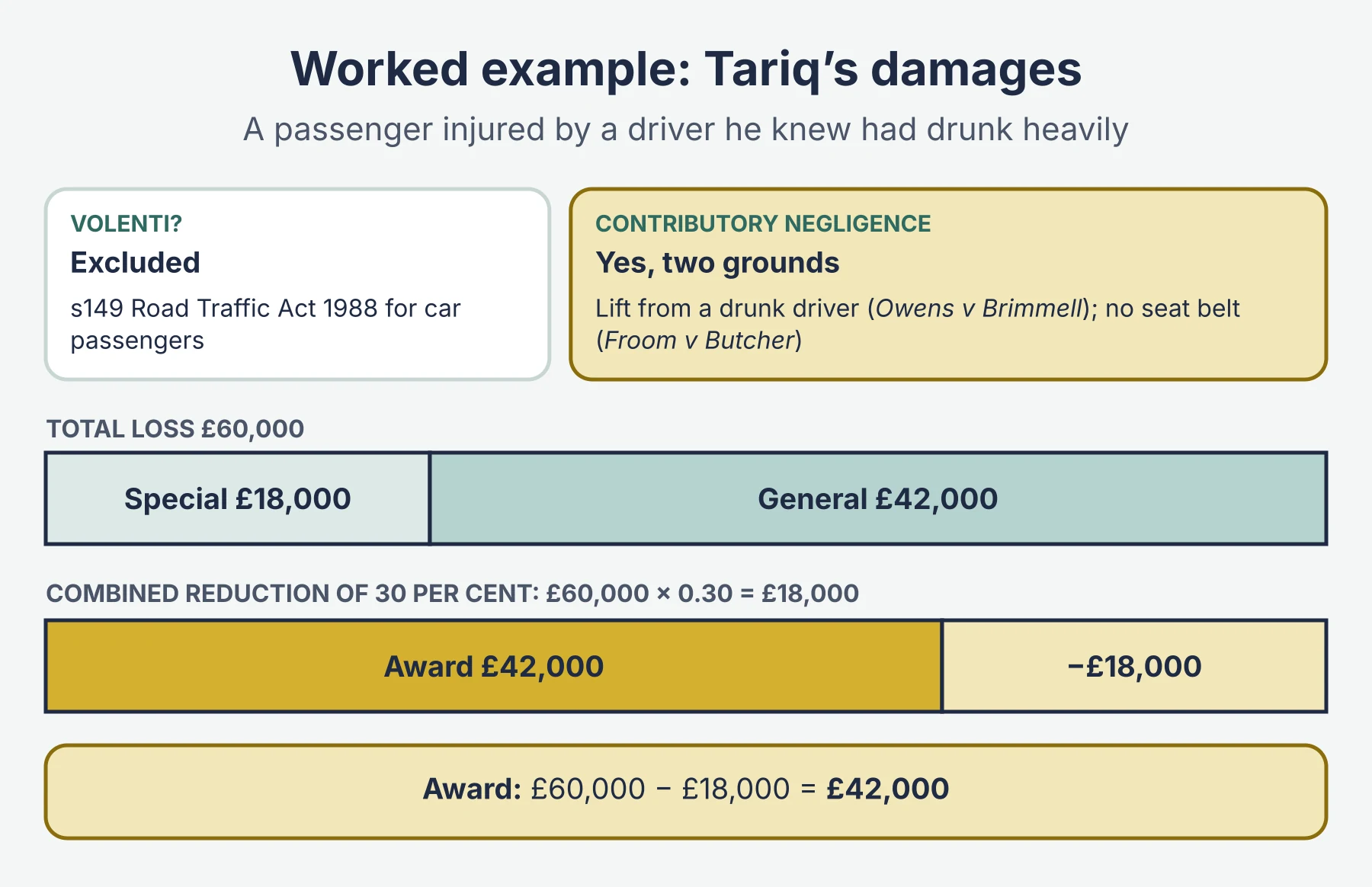
Scenario: Tariq, a passenger, is injured when his friend Lewis, whom he knew had drunk heavily, crashes. Tariq was not wearing a seat belt; wearing it would have reduced but not prevented his injuries. His losses: special damages £18,000 and general damages £42,000.
- Volenti: excluded for passengers by s149 Road Traffic Act 1988.
- Contributory negligence: accepting a lift from a drunk driver (Owens v Brimmell) and not wearing a belt (Froom v Butcher, 15 per cent where injuries would have been reduced) both count.
- Total loss: £18,000 + £42,000 = £60,000. If the court sets a combined reduction of 30 per cent, £60,000 × 0.30 = £18,000 is deducted.
- Award: £60,000 − £18,000 = £42,000.
Common mistakes
- Treating knowledge of a risk as consent (Smith v Baker).
- Applying contributory negligence as a complete defence, or reducing by 100 per cent.
- Confusing aggravated damages (compensation) with exemplary damages (punishment).
- Assuming an injunction follows automatically from a successful nuisance claim.
Exam technique
In advise questions, consider each relevant defence, then calculate damages step by step. In evaluate essays, weigh lump sums against periodical payments, or injunctions against damages in lieu. Revise with the general defences and remedies revision notes and practise with the general defences and remedies practice questions.
Related resources
-
Practice questions
Cambridge A Level Law (9084): General defences and remedies – Practice Questions
Twelve original questions with mark-scheme answers on volenti, contributory negligence, illegality, tort damages and injunctions for Cambridge A Level Law 9084.
Law · Cambridge · A Level
Try questions -
Revision notes
Cambridge A Level Law (9084): General defences and remedies – Revision Notes
Condensed notes on volenti, contributory negligence, other tort defences, damages and injunctions for Cambridge A Level Law 9084, with a self-test.
Law · Cambridge · A Level
Revise topic -
Study guides
Cambridge A Level Law (9084): The tort of negligence
Nature of liability, duty of care and policy, breach, causation and remoteness, economic loss and nervous shock for Cambridge A Level Law 9084, sub-topic 4.1.
Law · Cambridge · A Level
Read guide
Get free revision emails (optional)
Occasional emails with practice questions, worked explanations and links to free resources for the qualification and subjects you choose. No spam, and you can unsubscribe from any email. The free tools on this site never need an email.