
Revision Notes
Cambridge A Level Law (9084): Torts affecting the person – Revision Notes
Condensed notes on assault, battery, false imprisonment and the defences to battery for Cambridge A Level Law 9084, sub-topic 4.3, with a self-test.
- Subject
- Law
- Level
- A LEVEL
- Topic
- Topic 4: Law of tort
- Author
- Marlbridge Academic Team
- Updated
- Reviewed by
- Aizaz Raoof Ali (what this means)
Aligned to Cambridge A Level Law (9084), 2026-2028. Official specification .
Syllabus page (what it covers and how it is assessed): Cambridge A Level Law.
Syllabus points this page covers
9084 (A Level)
- 4.3 Torts affecting the person
Found an error? Report a correction.
Need help with this topic? Request a free trial class for A Level Law (9084).
Related: torts affecting the person study guide and torts affecting the person practice questions.
Sub-topic 4.3 of Cambridge International A Level Law (9084), assessed on Paper 4. Trespass to the person: assault, battery and false imprisonment.
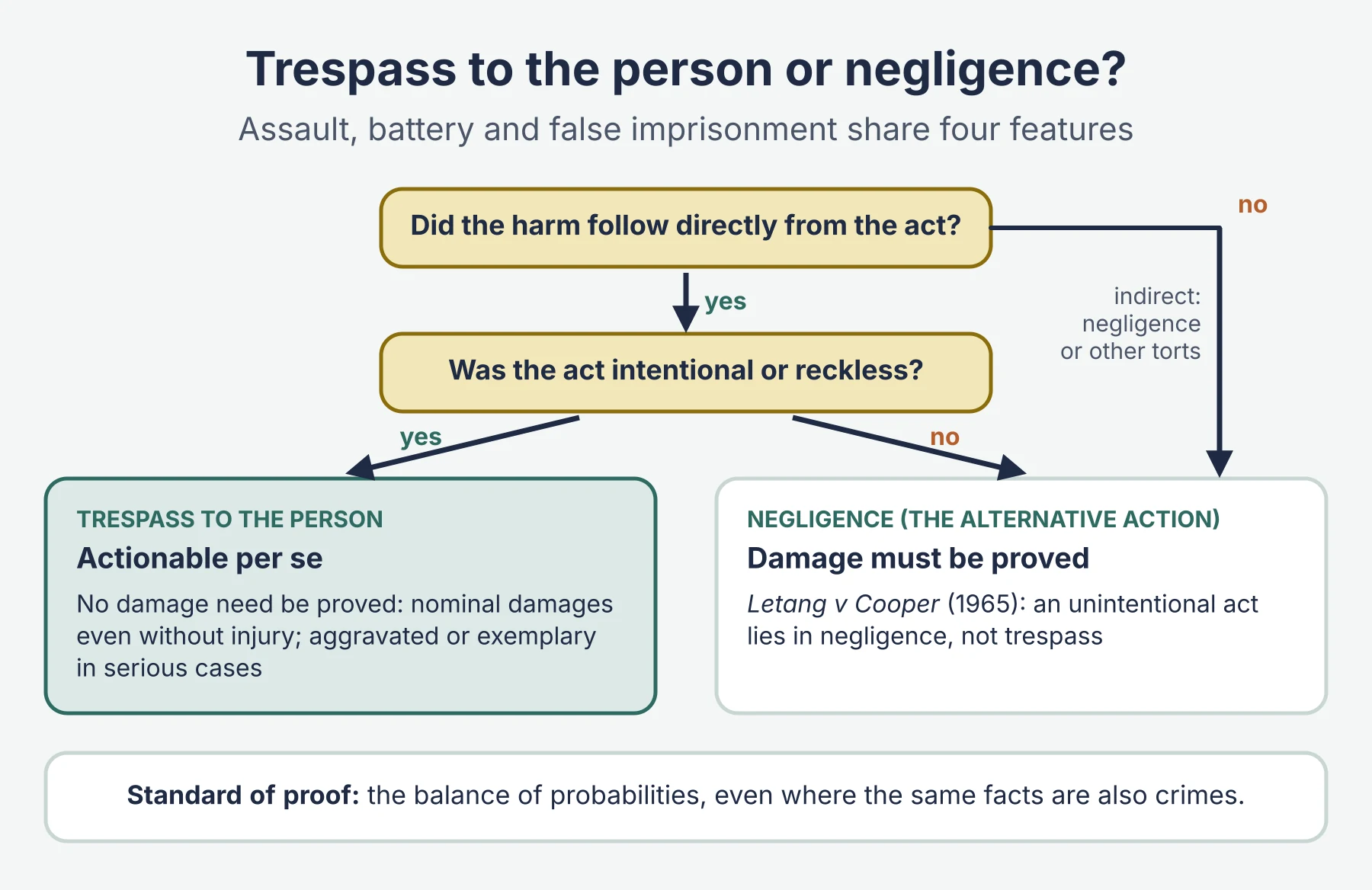
Common features
| Feature | Rule | Authority |
|---|---|---|
| Directness | Harm must follow directly from the act | General principle of trespass |
| Fault | Intentional or reckless; unintentional harm lies in negligence | Letang v Cooper (1965) |
| Damage | Actionable per se; nominal damages without injury | General principle of trespass |
| Proof | Balance of probabilities | Civil standard |
Alternative action: where intention cannot be shown, sue in negligence and prove damage.
4.3.1 Assault
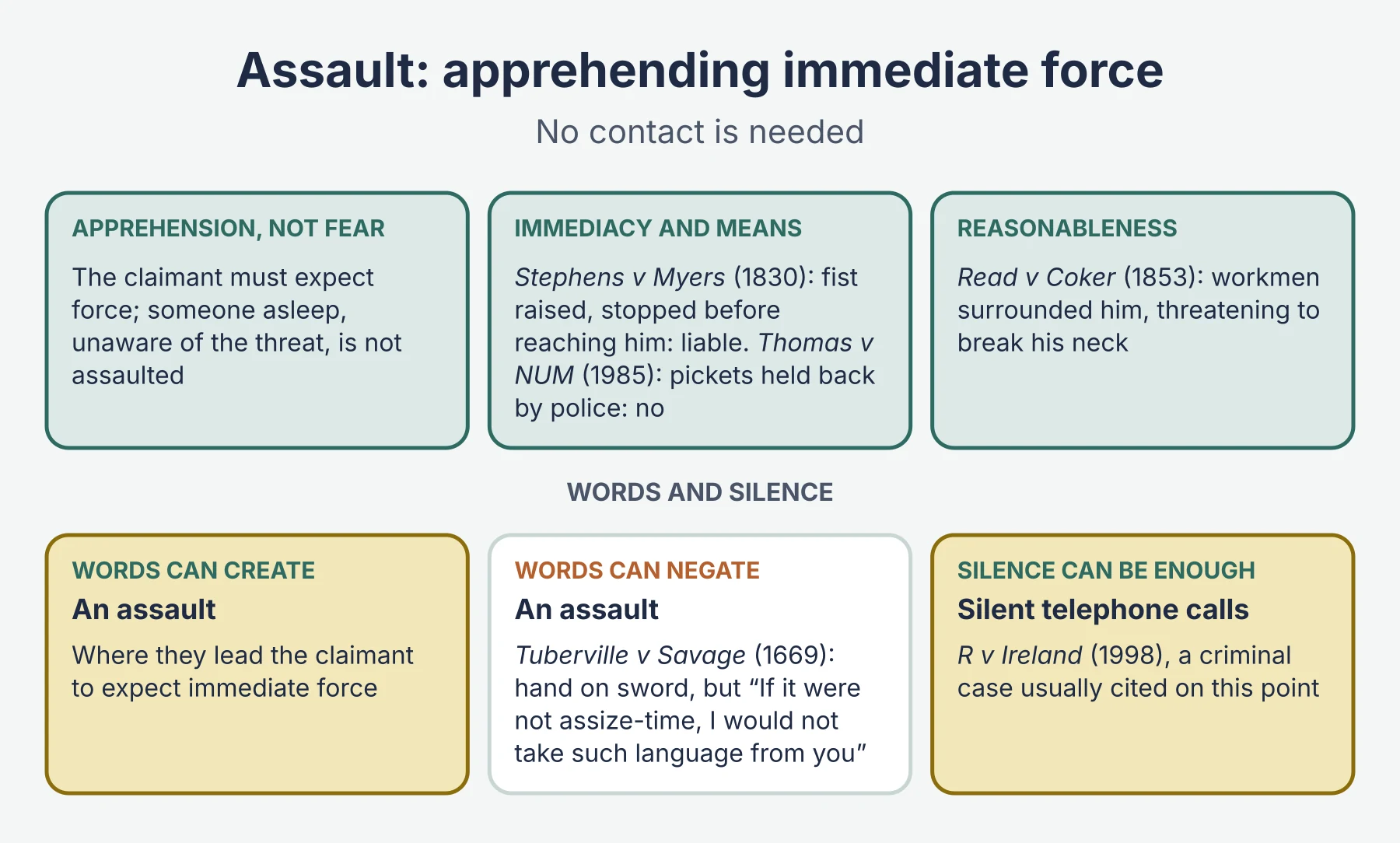
Definition: an act causing the claimant reasonably to apprehend immediate unlawful force.
- Apprehension of force is needed; no contact required.
- Immediacy: Stephens v Myers (1830), advancing fist, liable; Thomas v NUM (1985), pickets held back by police, not liable.
- Threat with ability to carry it out: Read v Coker (1853).
- Words can negate: Tuberville v Savage (1669).
- Words and silence can amount to assault: R v Ireland (1998), silent calls (criminal case).
4.3.2 Battery
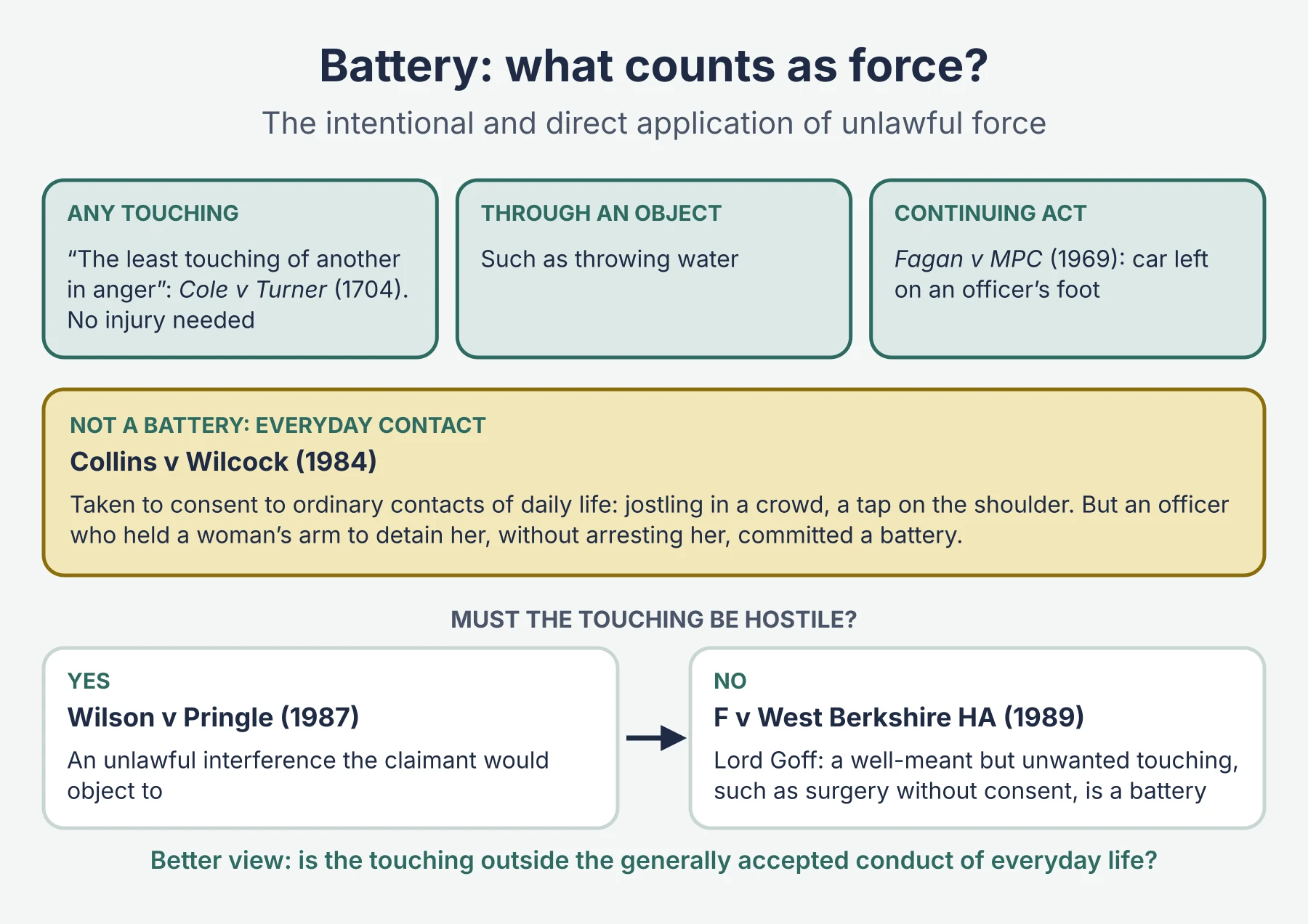
Definition: intentional and direct application of unlawful force to another.
- Force: the least touching (Cole v Turner, 1704); through an object; continuing act (Fagan v MPC, 1969).
- Everyday contact excluded: Collins v Wilcock (1984); but holding someone’s arm to detain them without arrest is a battery.
- Hostility: required in Wilson v Pringle (1987); rejected by Lord Goff in F v West Berkshire HA (1989). Better view: touching outside generally accepted everyday conduct.
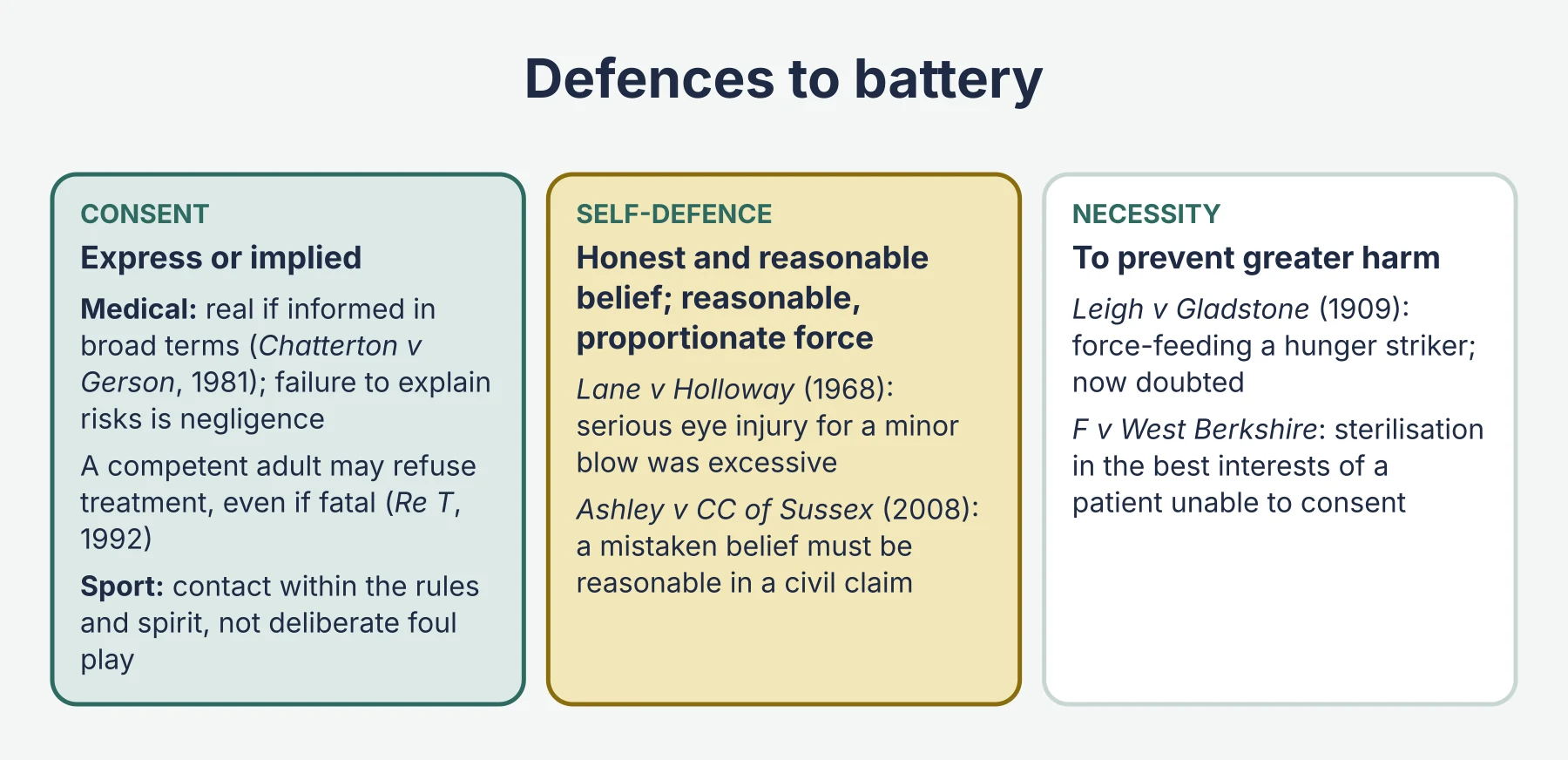
Defences:
| Defence | Rule | Authority |
|---|---|---|
| Consent: medical | Valid if informed in broad terms of the nature of the procedure | Chatterton v Gerson (1981) |
| Consent: refusal | A competent adult may refuse treatment | Re T (1992) |
| Consent: sport | Contact within the rules and spirit of the game | Implied consent of players |
| Self-defence | Honest and reasonable belief; reasonable, proportionate force | Lane v Holloway (1968); Ashley v Chief Constable of Sussex (2008) |
| Necessity | Force to prevent greater harm or in the best interests of a patient unable to consent | Leigh v Gladstone (1909), now doubted; F v West Berkshire HA (1989) |
4.3.3 False imprisonment
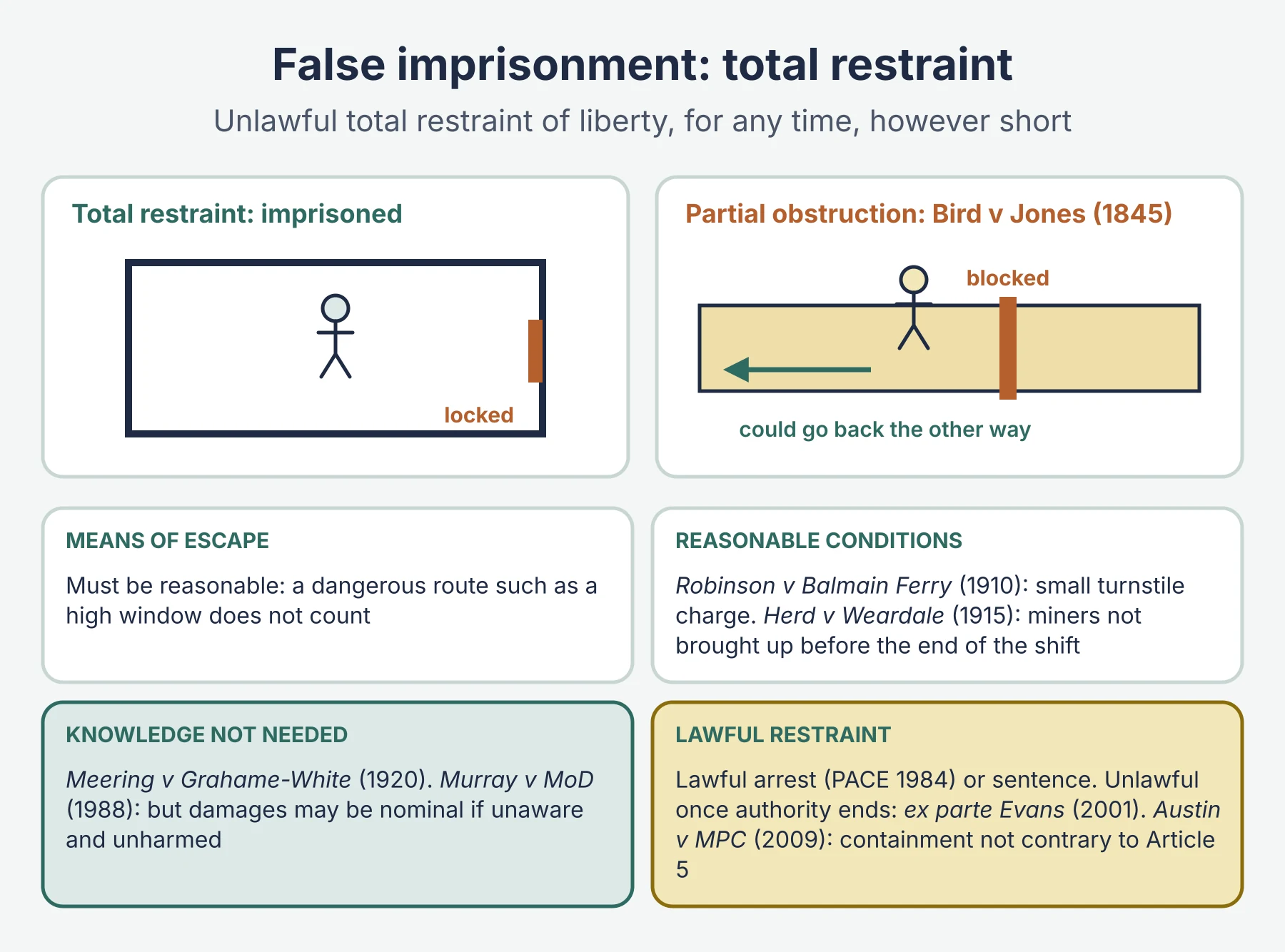
Definition: unlawful total restraint of a person’s liberty, for any length of time.
- Total restraint: Bird v Jones (1845), path blocked one way only, no tort.
- Reasonable means of escape defeats the claim; a dangerous escape route does not.
- Reasonable conditions on leaving: Robinson v Balmain New Ferry (1910); Herd v Weardale Steel (1915).
- Knowledge not required: Meering v Grahame-White Aviation (1920); Murray v MoD (1988), but damages may be nominal.
- Lawful restraint: lawful arrest, for example under PACE 1984; sentence of a court.
- Authority ending: R v Governor of Brockhill Prison, ex p Evans (2001), detention beyond release date unlawful despite good faith.
- Crowd containment: Austin v Commissioner of Police (2009), no breach of Article 5.
Key terms
| Term | Meaning |
|---|---|
| Trespass to the person | Direct, intentional interference with a person’s body or liberty |
| Actionable per se | Actionable without proof of damage |
| Assault | Causing reasonable apprehension of immediate unlawful force |
| Battery | Direct, intentional application of unlawful force |
| False imprisonment | Unlawful total restraint of liberty |
| Hostility | Unwelcome or unlawful quality of a touching |
| Implied consent | Consent inferred from conduct or circumstances |
| Self-defence | Reasonable and proportionate force in response to a threat |
| Necessity | Justification for force to prevent greater harm |
| Nominal damages | Small sum marking infringement of a right without loss |
Exam traps
- Asking for damage. Trespass torts are actionable per se; say so and mention nominal damages.
- Fear versus apprehension. A brave claimant who expects force but is not afraid is still assaulted.
- Ignoring immediacy. Threats about the distant future, or where the defendant cannot reach the claimant, are not assaults (Thomas v NUM).
- Consent in medicine. Failure to explain risks is negligence, not battery (Chatterton v Gerson).
- Partial restraint. Blocking one route is not false imprisonment (Bird v Jones).
- Self-defence and mistake. In civil law the mistaken belief must be reasonable (Ashley).
Self-test
- Why is a claimant who is asleep not assaulted by a threat made at them?
- What did Thomas v NUM decide about immediacy?
- How did Tuberville v Savage show words can negate an assault?
- What did Fagan v MPC add to the meaning of battery?
- Why was the officer liable for battery in Collins v Wilcock?
- What was Lord Goff’s view of the hostility requirement?
- When is a patient’s consent real, according to Chatterton v Gerson?
- What did Ashley v Chief Constable of Sussex decide about mistaken self-defence?
- Why did the claim fail in Bird v Jones?
- Does a claimant need to know of their imprisonment?
- What happened in R v Governor of Brockhill Prison, ex p Evans?
- What did Letang v Cooper decide?
Answers:
- Assault needs apprehension of immediate force; a sleeping claimant apprehends nothing.
- Pickets held back by police could not cause working miners in vehicles to apprehend immediate force.
- The defendant’s words showed he would not use force, so there was no reasonable apprehension.
- Battery can be a continuing act, so later intention can coincide with force already being applied.
- Holding the woman’s arm to detain her went beyond acceptable everyday contact and was not an arrest.
- Hostility is not required; the question is whether touching is outside accepted everyday conduct.
- When the patient is informed in broad terms of the nature of the procedure.
- In a civil claim, a mistaken belief in the need for force must be reasonable as well as honest.
- The claimant could go back the way he came, so the restraint was not total.
- No (Meering; Murray), though damages may be nominal if they were unaware and unharmed.
- A prisoner kept beyond her correct release date recovered damages, despite the governor’s good faith.
- Unintentional direct harm must be sued for in negligence, not trespass.
Related resources
-
Practice questions
Cambridge A-Level Law: Law of Tort — Practice Questions (9084)
Paper 4-style tort scenarios and essays with indicative answers on negligence, occupiers' liability, nuisance, trespass and remedies for Cambridge 9084.
Law · Cambridge · A Level
Try questions -
Revision notes
Cambridge A-Level Law: Law of Tort — Revision Notes (9084)
Revision notes for Cambridge A Level Law 9084 Topic 4: negligence, occupiers' liability, nuisance, Rylands, trespass, defences and tort remedies with key cases.
Law · Cambridge · A Level
Revise topic -
Study guides
Cambridge A Level Law (9084): Law of tort – Study Guide
Negligence, nuisance, Rylands v Fletcher, trespass, defences and remedies for Cambridge A Level Law 9084, with key cases and a worked damages calculation.
Law · Cambridge · A Level
Read guide
Get free revision emails (optional)
Occasional emails with practice questions, worked explanations and links to free resources for the qualification and subjects you choose. No spam, and you can unsubscribe from any email. The free tools on this site never need an email.