
Study Guides
Cambridge A Level Law (9084): Torts affecting the person
Assault, battery and false imprisonment, with consent, self-defence and necessity, for Cambridge A Level Law 9084, sub-topic 4.3, with cases and a model answer.
- Subject
- Law
- Level
- A LEVEL
- Topic
- Topic 4: Law of tort
- Author
- Marlbridge Academic Team
- Updated
- Reviewed by
- Aizaz Raoof Ali (what this means)
Aligned to Cambridge A Level Law (9084), 2026-2028. Official specification .
Syllabus page (what it covers and how it is assessed): Cambridge A Level Law.
Syllabus points this page covers
9084 (A Level)
- 4.3 Torts affecting the person
Found an error? Report a correction.
Need help with this topic? Request a free trial class for A Level Law (9084).
Sub-topic 4.3 of Cambridge International A Level Law (9084) is about trespass to the person: the torts that protect a person’s bodily integrity and freedom of movement. The three torts are assault, battery and false imprisonment. They are examined on Paper 4 Law of Tort, both in scenarios involving confrontations, medical treatment, sport or detention, and in essays about whether the law protects personal rights effectively. This guide develops the elements, the defences to battery and the requirements for false imprisonment in more depth than the Topic 4 overview.
What the syllabus lists
- 4.3.1 Assault: definition and elements; actionable per se; actions that may amount to assault, including words and silence.
- 4.3.2 Battery: definition and elements; actionable per se; meaning of force and relevance of hostility; defences of consent, self-defence and necessity.
- 4.3.3 False imprisonment: definition and elements; total restraint and knowledge of restraint; lawful restraint.
Features shared by all three torts
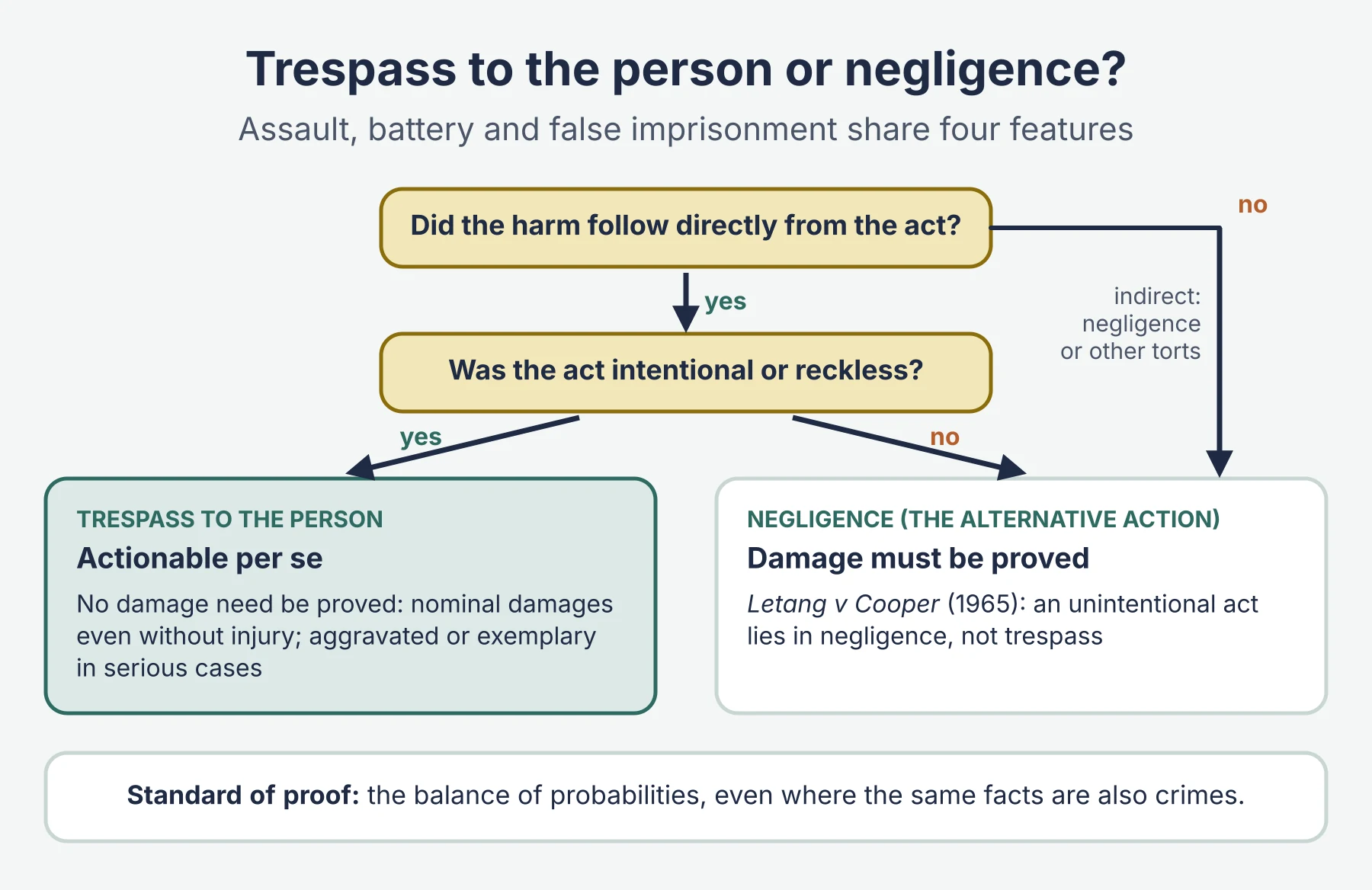
- Direct interference. The harm must follow directly from the defendant’s act. Indirect harm is dealt with by negligence or by other torts.
- Intention or recklessness. In Letang v Cooper (1965) the Court of Appeal held that where the defendant’s act was unintentional, the claim lies in negligence, not trespass. This is the main alternative action: a claimant who cannot prove intention may still sue in negligence, but must then prove damage.
- Actionable per se. No damage need be proved. The tort protects the right itself, so nominal damages are available even where there is no injury, and aggravated or exemplary damages may be awarded in serious cases.
- Standard of proof. As civil wrongs, they are proved on the balance of probabilities, even though the same facts may also be crimes.
4.3.1 Assault
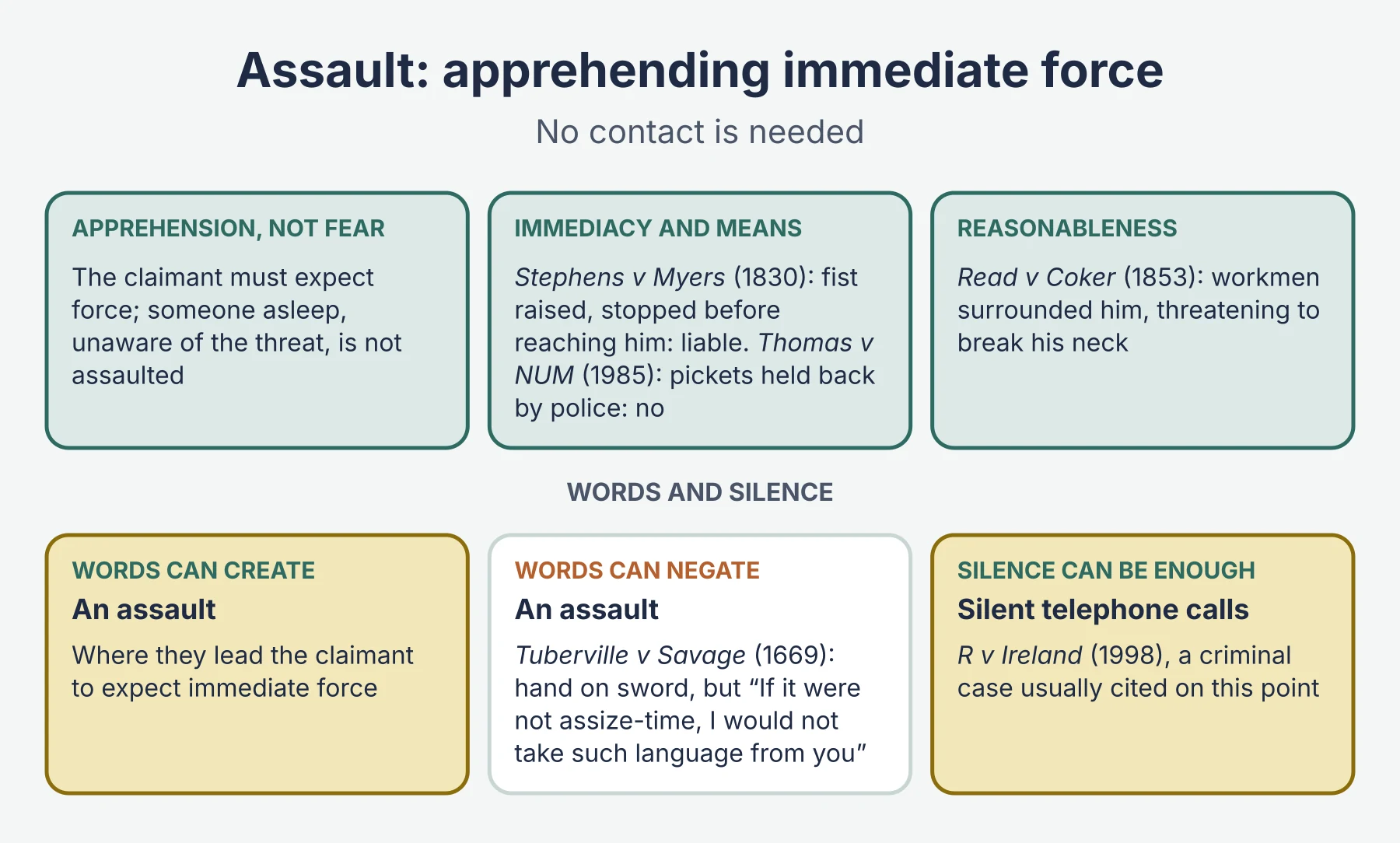
An assault is an act that causes the claimant reasonably to apprehend the immediate infliction of unlawful force. No contact is needed.
- Apprehension, not fear. The claimant must expect force; a claimant who does not know of the threat, for example because they are asleep, is not assaulted.
- Immediacy and means. In Stephens v Myers (1830) a man advancing on the chairman of a meeting with a clenched fist was liable even though he was stopped before reaching him. In Thomas v National Union of Mineworkers (1985) working miners driven into a colliery past shouting pickets held back by police could not reasonably apprehend immediate force.
- Reasonableness. In Read v Coker (1853) workmen who surrounded the claimant and threatened to break his neck if he did not leave committed an assault.
Words and silence
Words can create an assault where they lead the claimant to expect immediate force. Words can also negate an assault: in Tuberville v Savage (1669) a man laid his hand on his sword but said, “If it were not assize-time, I would not take such language from you”, which showed he did not intend to use force. Silence can be enough: in R v Ireland (1998), a criminal case usually cited on this point, silent telephone calls were capable of causing the victim to fear immediate violence.
4.3.2 Battery
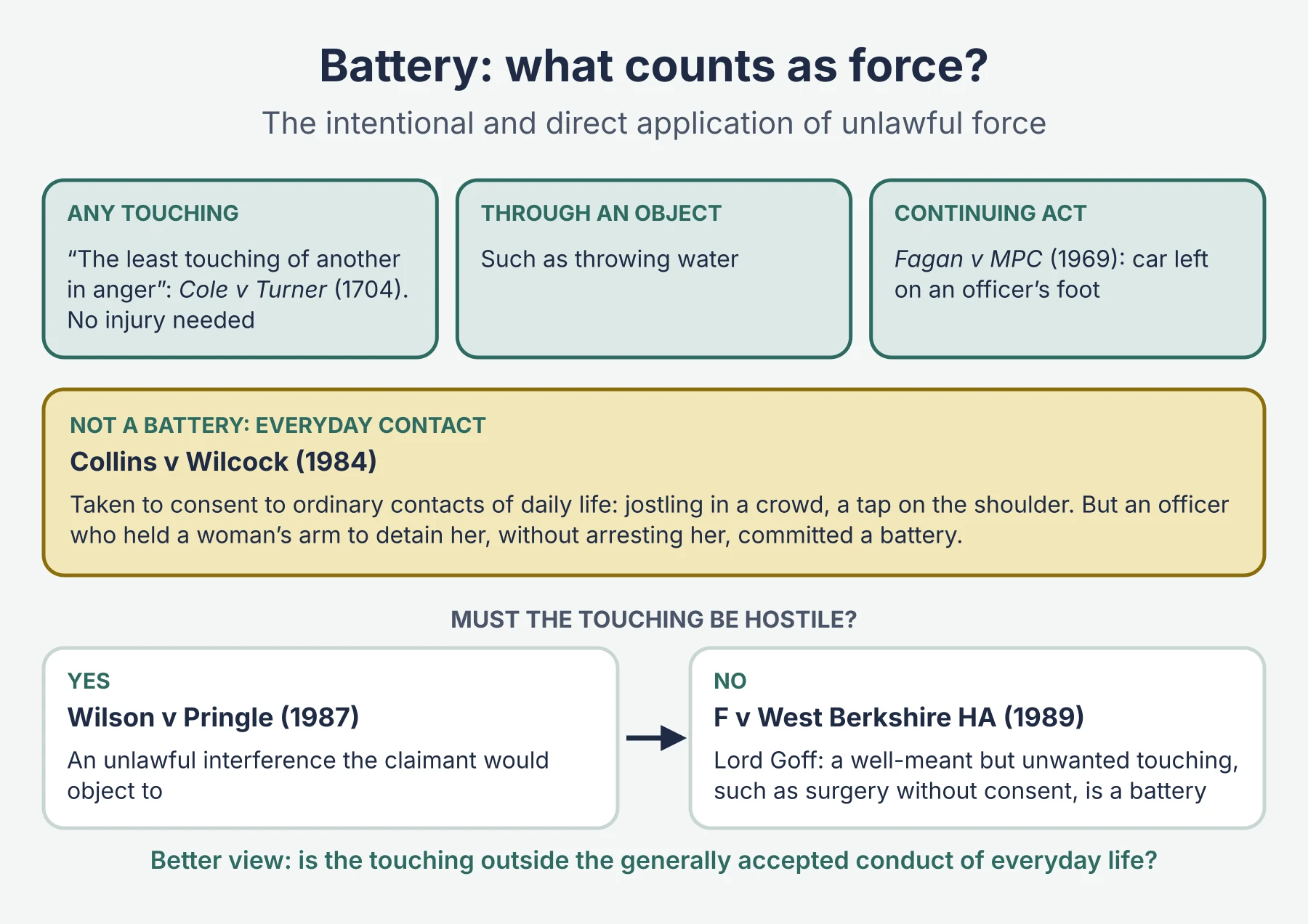
A battery is the intentional and direct application of unlawful force to another person.
Meaning of force
Any touching can be force; no injury is needed. Holt CJ in Cole v Turner (1704) said “the least touching of another in anger is a battery”. The force may be applied through an object, such as throwing water, and may be a continuing act (Fagan v Metropolitan Police Commissioner, 1969, a car left on a police officer’s foot).
Everyday contact is not a battery. In Collins v Wilcock (1984) Robert Goff LJ explained that people are taken to consent to the ordinary contacts of daily life, such as jostling in a crowd or a tap on the shoulder to attract attention; but a police officer who held a woman’s arm to detain her, without arresting her, committed a battery.
Relevance of hostility
In Wilson v Pringle (1987) the Court of Appeal said the touching must be “hostile”, in the sense of being an unlawful interference the claimant would object to. That approach was criticised in F v West Berkshire Health Authority (1989), where Lord Goff said hostility was not required, so that a well-meant but unwanted touching, such as a surgeon’s operation without consent, is a battery. The better view is that the question is whether the touching is outside the generally accepted conduct of everyday life.
Defences to battery
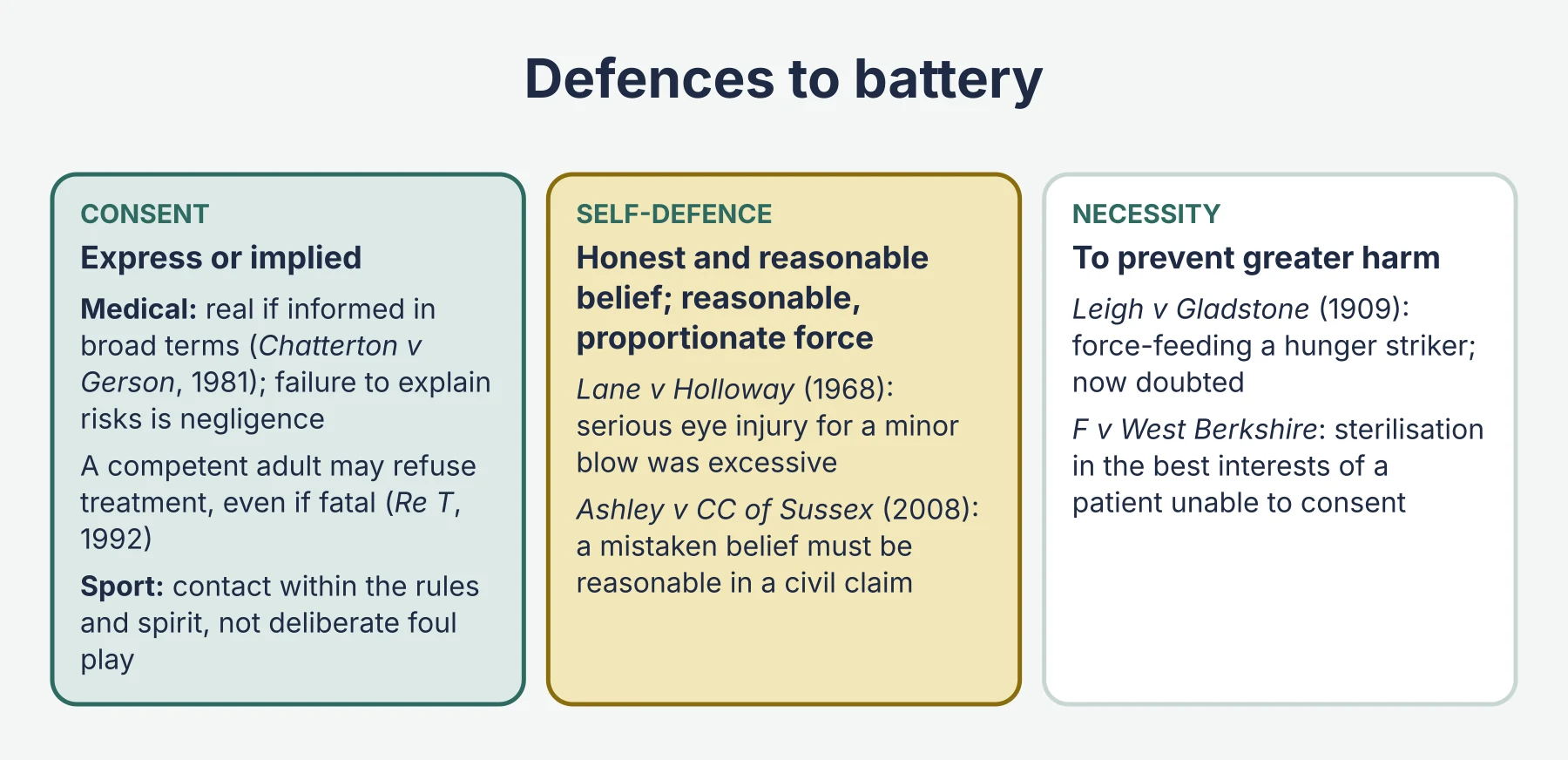
- Consent. Consent may be express or implied. In medical treatment, consent is real if the patient is informed in broad terms of the nature of the procedure (Chatterton v Gerson, 1981); a failure to explain risks is a matter for negligence, not battery. A competent adult may refuse treatment even if refusal will lead to death (Re T, 1992). In sport, players consent to contact within the rules and spirit of the game, but not to deliberate foul play outside it.
- Self-defence. The defendant must honestly and reasonably believe it necessary to use force, and the force must be reasonable and proportionate. In Lane v Holloway (1968) a punch that caused a serious eye injury in response to a minor blow was excessive. In Ashley v Chief Constable of Sussex Police (2008) the House of Lords held that, in a civil claim, a mistaken belief that force was needed must be a reasonable one.
- Necessity. Force may be justified to prevent greater harm. In Leigh v Gladstone (1909) the force-feeding of a suffragette prisoner on hunger strike was held justified, a decision now doubted. In F v West Berkshire Health Authority a sterilisation was lawful because it was in the best interests of a patient unable to consent.
4.3.3 False imprisonment
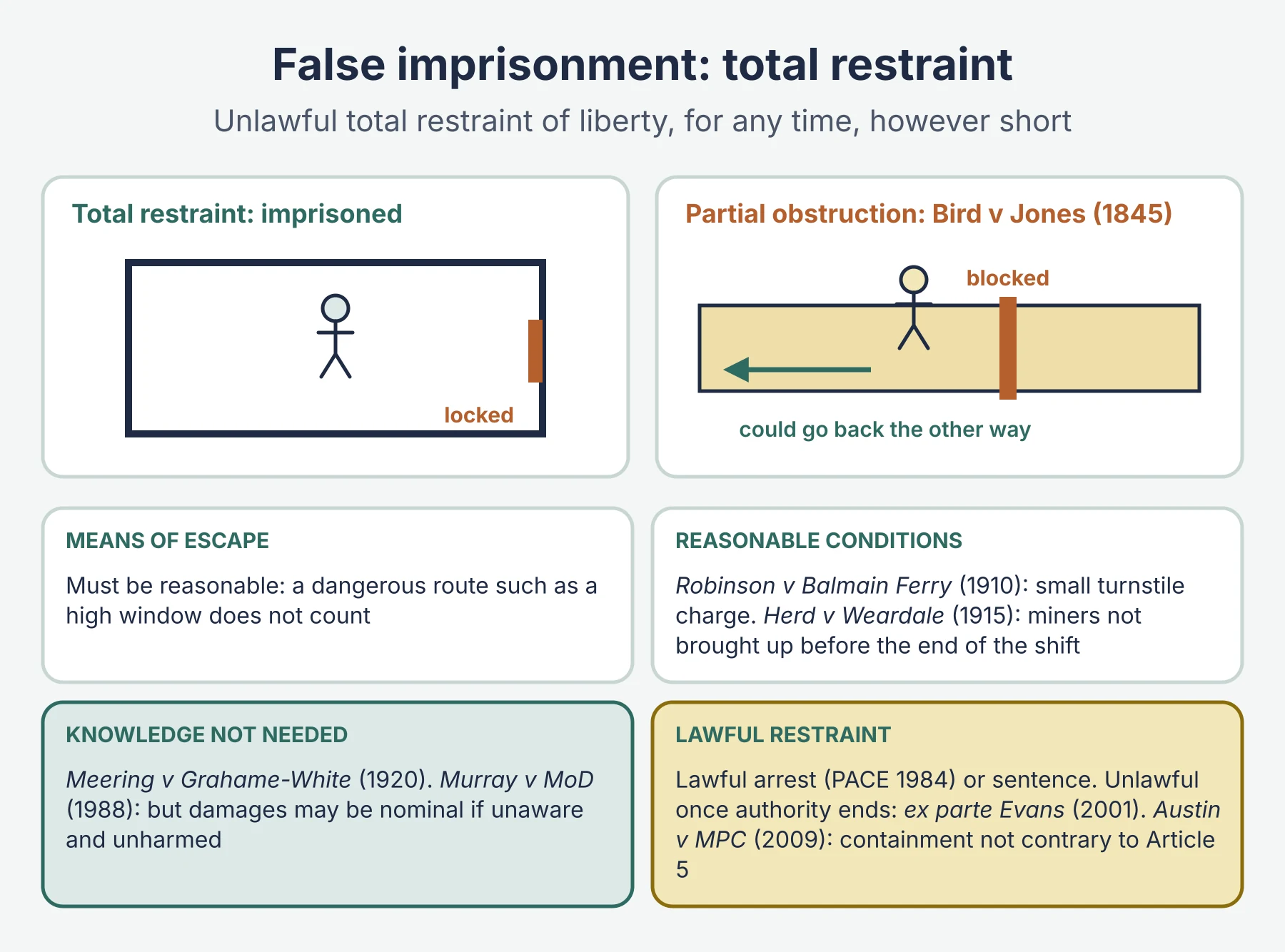
False imprisonment is the unlawful total restraint of a person’s liberty, for any time, however short. No physical barrier or force is needed; a threat or an assertion of authority can be enough.
Total restraint
The restraint must be complete. In Bird v Jones (1845) the claimant was prevented from walking along part of a bridge but could go back the other way, so there was no false imprisonment. A means of escape must be reasonable; a dangerous route, such as climbing from a high window, does not count.
Reasonable conditions on leaving may be imposed. In Robinson v Balmain New Ferry Co (1910) a passenger who wanted to leave a wharf was required to pay a small charge to pass the turnstile, which was reasonable. In Herd v Weardale Steel, Coal and Coke Co (1915) miners who stopped work in breach of contract could not complain when the employer refused to bring them up before the end of the shift.
Knowledge of the restraint
The claimant does not need to know of the restraint at the time. In Meering v Grahame-White Aviation (1920) a man who did not know he was being watched to prevent him leaving was imprisoned. In Murray v Ministry of Defence (1988) Lord Griffiths confirmed this, but noted that damages may be nominal where the claimant was unaware and suffered no harm.
Lawful restraint
Restraint is justified where the law authorises it, for example a lawful arrest under the Police and Criminal Evidence Act 1984, or a sentence of imprisonment. Restraint becomes unlawful once the legal authority ends: in R v Governor of Brockhill Prison, ex parte Evans (2001) a prisoner held beyond her correct release date, because of a miscalculation, recovered damages even though the governor acted in good faith. In Austin v Commissioner of Police of the Metropolis (2009) the House of Lords held that containing protesters for several hours to prevent violence was not a deprivation of liberty contrary to Article 5 of the European Convention on Human Rights.
Annotated model answer
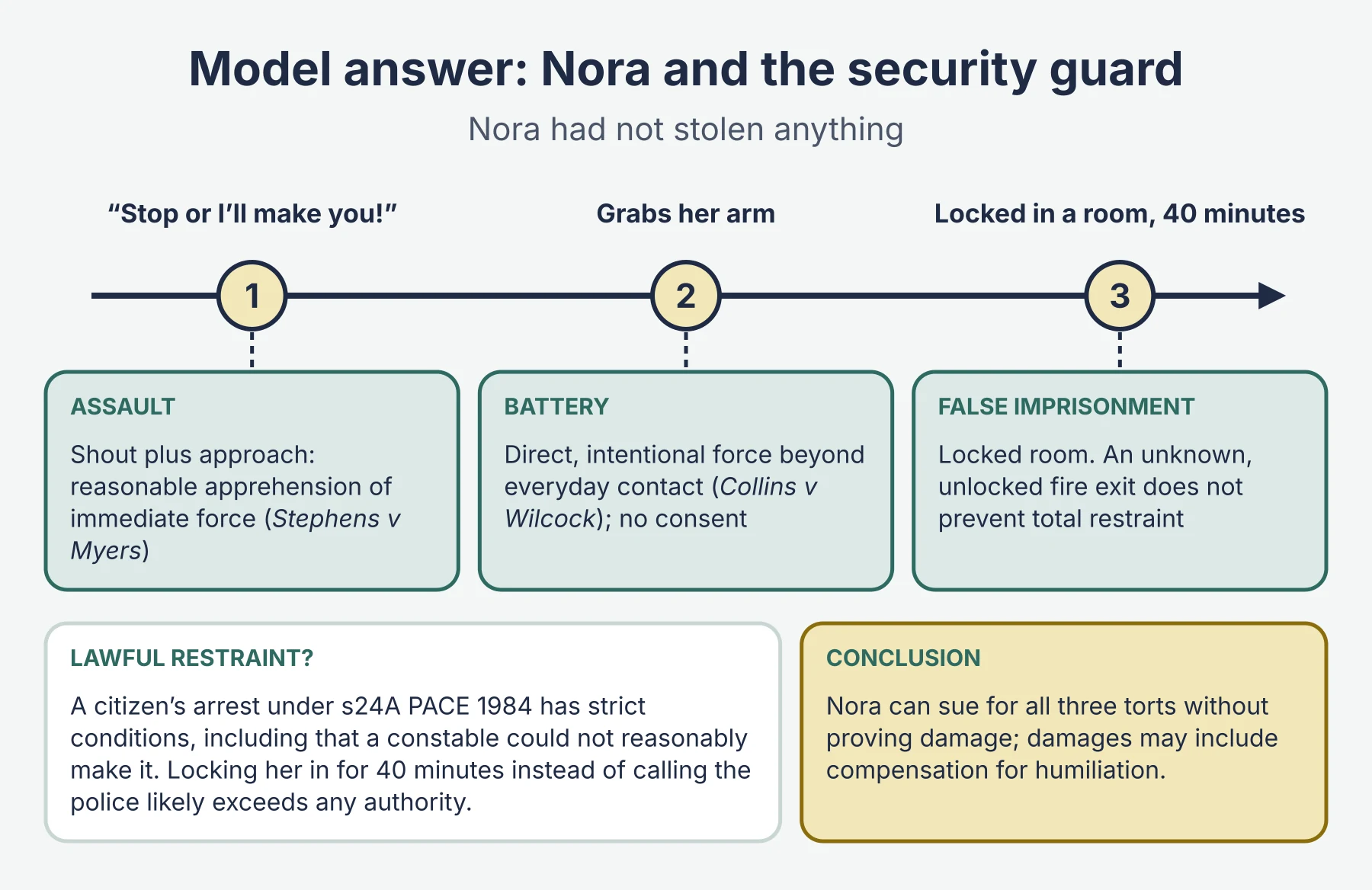
Scenario: At a supermarket, a security guard, Ali, suspects Nora of shoplifting. He shouts, “Stop or I’ll make you!”, grabs her arm and takes her to a back room, locking the door for 40 minutes. A side door to a fire escape is unlocked, but Nora does not know this. Nora had not stolen anything.
- Assault: the shout combined with Ali’s approach makes Nora reasonably apprehend immediate force (Stephens v Myers).
- Battery: grabbing her arm is direct, intentional force beyond everyday contact (Collins v Wilcock). No consent was given.
- False imprisonment: the locked room is a restraint. The unlocked fire escape door matters only if it was a reasonable, known means of escape; an unknown exit does not prevent total restraint.
- Lawful restraint: a citizen’s arrest under s24A of the Police and Criminal Evidence Act 1984 is lawful only within strict conditions, including that it was not reasonably practicable for a constable to make the arrest. Locking Nora in a room for 40 minutes instead of calling the police is likely to exceed any lawful authority Ali had.
- Conclusion: Nora can sue for all three torts without proving damage, and her damages may include compensation for humiliation.
Common mistakes
- Requiring proof of injury: all three torts are actionable per se.
- Treating any physical contact as a battery, ignoring Collins v Wilcock.
- Treating partial obstruction as false imprisonment (Bird v Jones).
- Forgetting that unintentional contact is negligence, not battery (Letang v Cooper).
Exam technique
For advise questions, deal with each tort and then each defence. For evaluate or discuss essays, consider the hostility debate, the role of consent in medical treatment and sport, or whether the law balances liberty against public order. Revise with the torts affecting the person revision notes and practise with the torts affecting the person practice questions.
Related resources
-
Practice questions
Cambridge A Level Law (9084): Torts affecting the person – Practice Questions
Twelve original questions with mark-scheme answers on assault, battery, false imprisonment and defences to battery for Cambridge A Level Law 9084, 4.3.
Law · Cambridge · A Level
Try questions -
Revision notes
Cambridge A Level Law (9084): Torts affecting the person – Revision Notes
Condensed notes on assault, battery, false imprisonment and the defences to battery for Cambridge A Level Law 9084, sub-topic 4.3, with a self-test.
Law · Cambridge · A Level
Revise topic -
Practice questions
Cambridge A-Level Law: Law of Tort — Practice Questions (9084)
Paper 4-style tort scenarios and essays with indicative answers on negligence, occupiers' liability, nuisance, trespass and remedies for Cambridge 9084.
Law · Cambridge · A Level
Try questions
Get free revision emails (optional)
Occasional emails with practice questions, worked explanations and links to free resources for the qualification and subjects you choose. No spam, and you can unsubscribe from any email. The free tools on this site never need an email.