
Revision Notes
Cambridge A Level Law (9084): Torts affecting land – Revision Notes
Condensed notes on occupiers' liability, private nuisance, Rylands v Fletcher and trespass to land for Cambridge A Level Law 9084, with a self-test.
- Subject
- Law
- Level
- A LEVEL
- Topic
- Topic 4: Law of tort
- Author
- Marlbridge Academic Team
- Updated
- Reviewed by
- Aizaz Raoof Ali (what this means)
Aligned to Cambridge A Level Law (9084), 2026-2028. Official specification .
Syllabus page (what it covers and how it is assessed): Cambridge A Level Law.
Syllabus points this page covers
9084 (A Level)
- 4.2 Torts affecting land
Found an error? Report a correction.
Need help with this topic? Request a free trial class for A Level Law (9084).
Related: torts affecting land study guide and torts affecting land practice questions.
Sub-topic 4.2 of Cambridge International A Level Law (9084), assessed on Paper 4. Four torts: occupiers’ liability, private nuisance, Rylands v Fletcher and trespass to land.
4.2.1 Occupiers’ liability
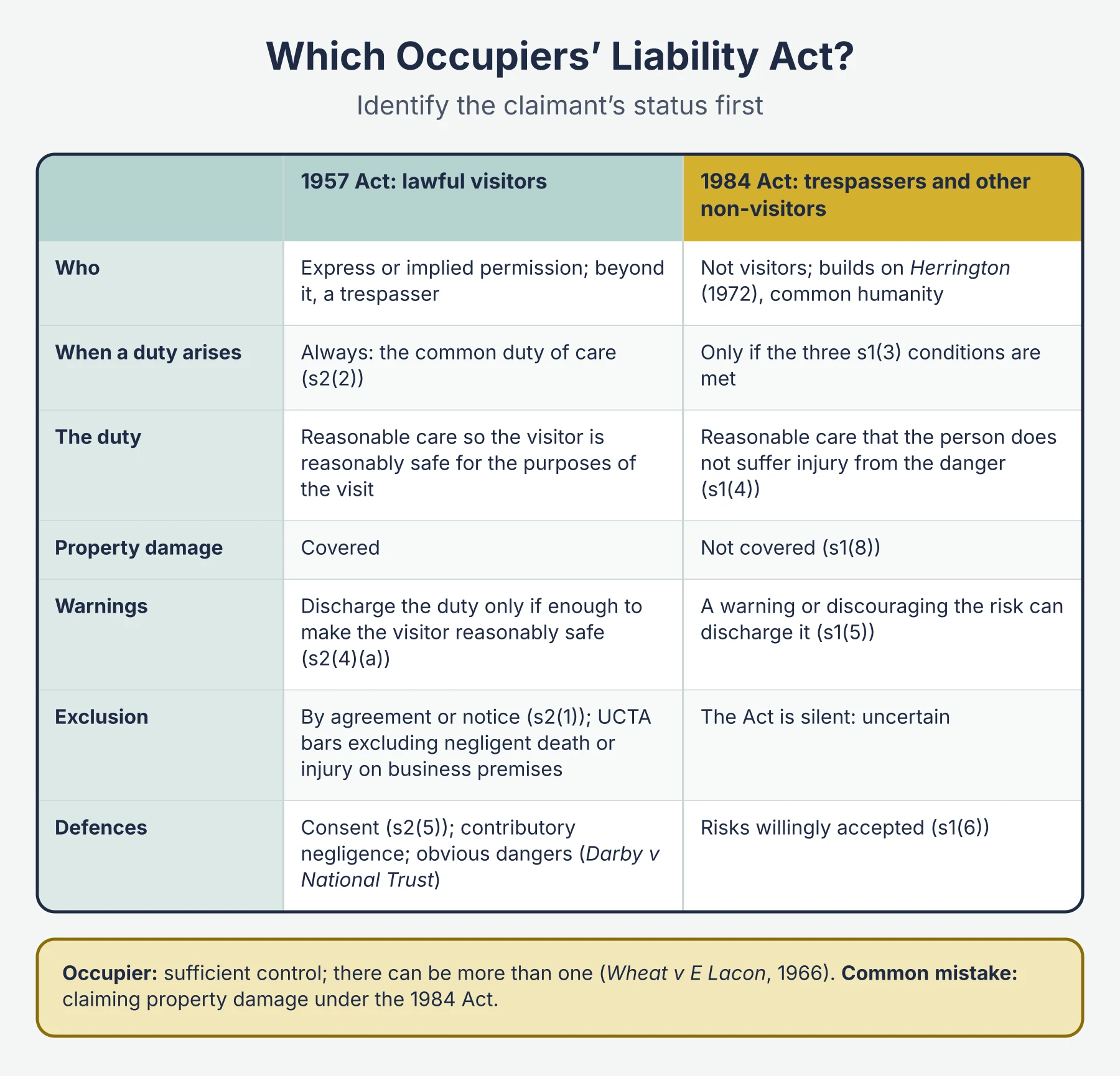
Occupier: person with sufficient control; can be several (Wheat v E Lacon, 1966).
| Occupiers’ Liability Act 1957 | Occupiers’ Liability Act 1984 | |
|---|---|---|
| Who is protected | Lawful visitors (express or implied permission) | Persons other than visitors, mainly trespassers |
| When a duty arises | Always owed to visitors | Only if all three s1(3) conditions are met |
| Content of duty | s2(2) common duty of care: visitor reasonably safe for permitted purposes | s1(4) reasonable care to prevent injury by reason of the danger |
| Loss covered | Personal injury and property | Personal injury only (s1(8)) |
| Warnings | s2(4)(a): must make visitor reasonably safe | s1(5): reasonable steps to warn or discourage |
| Consent | s2(5) | s1(6) |
| Exclusion | s2(1), limited by UCTA 1977 for business premises | Act silent; uncertain |
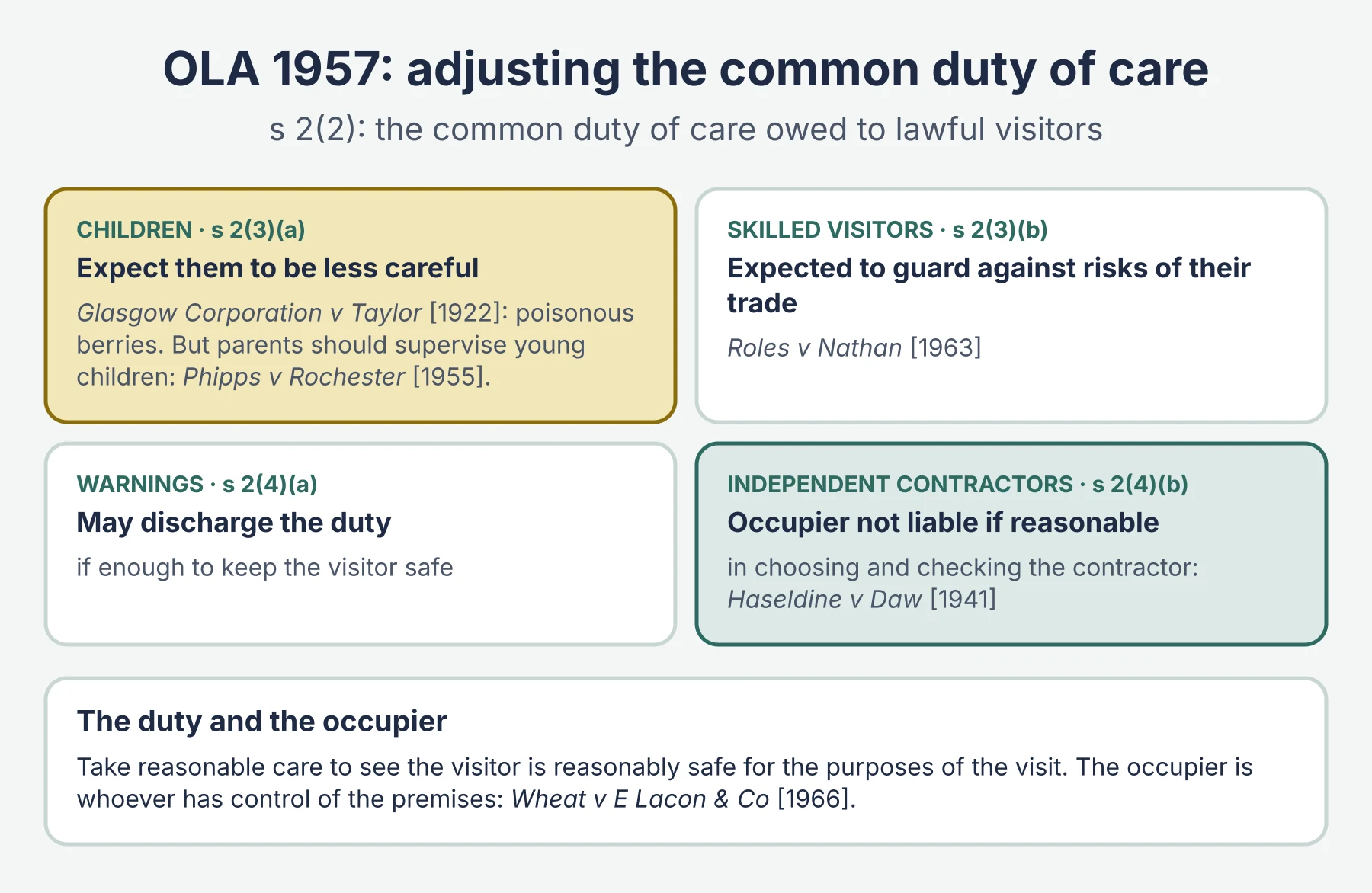
1957 Act special rules:
- Children, s2(3)(a): expect less care; allurements (Glasgow Corporation v Taylor, 1922); parents of very young children expected to supervise (Phipps v Rochester Corporation, 1955).
- Trade or calling, s2(3)(b): specialists guard against risks of their job (Roles v Nathan, 1963).
- Independent contractors, s2(4)(b): occupier not liable if reasonable to entrust the work, competent contractor chosen, and work checked where possible. Haseldine v Daw (1941), technical lift work, not liable; Woodward v Mayor of Hastings (1945), icy step easily checked, liable.
- Obvious dangers: Darby v National Trust (2001).
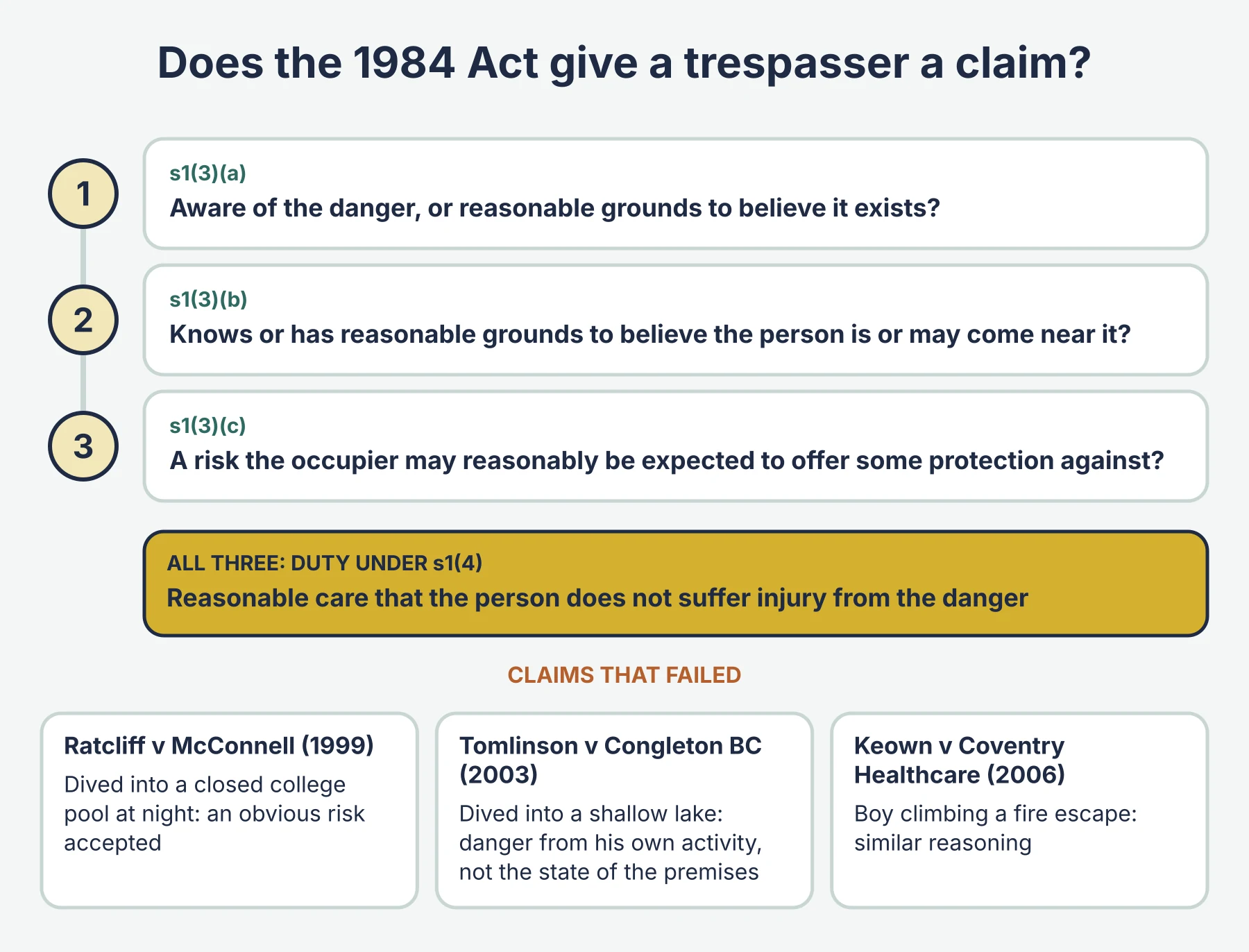
1984 Act s1(3) conditions: (a) aware, or reasonable grounds to believe, danger exists; (b) knows, or has reasonable grounds to believe, the person is or may come into the vicinity; (c) risk is one the occupier may reasonably be expected to protect against.
1984 Act cases: British Railways Board v Herrington (1972), common-law origin; Ratcliff v McConnell (1999), obvious risk accepted; Tomlinson v Congleton BC (2003) and Keown v Coventry Healthcare (2006), danger from the claimant’s activity, not the premises.
4.2.2 Private nuisance
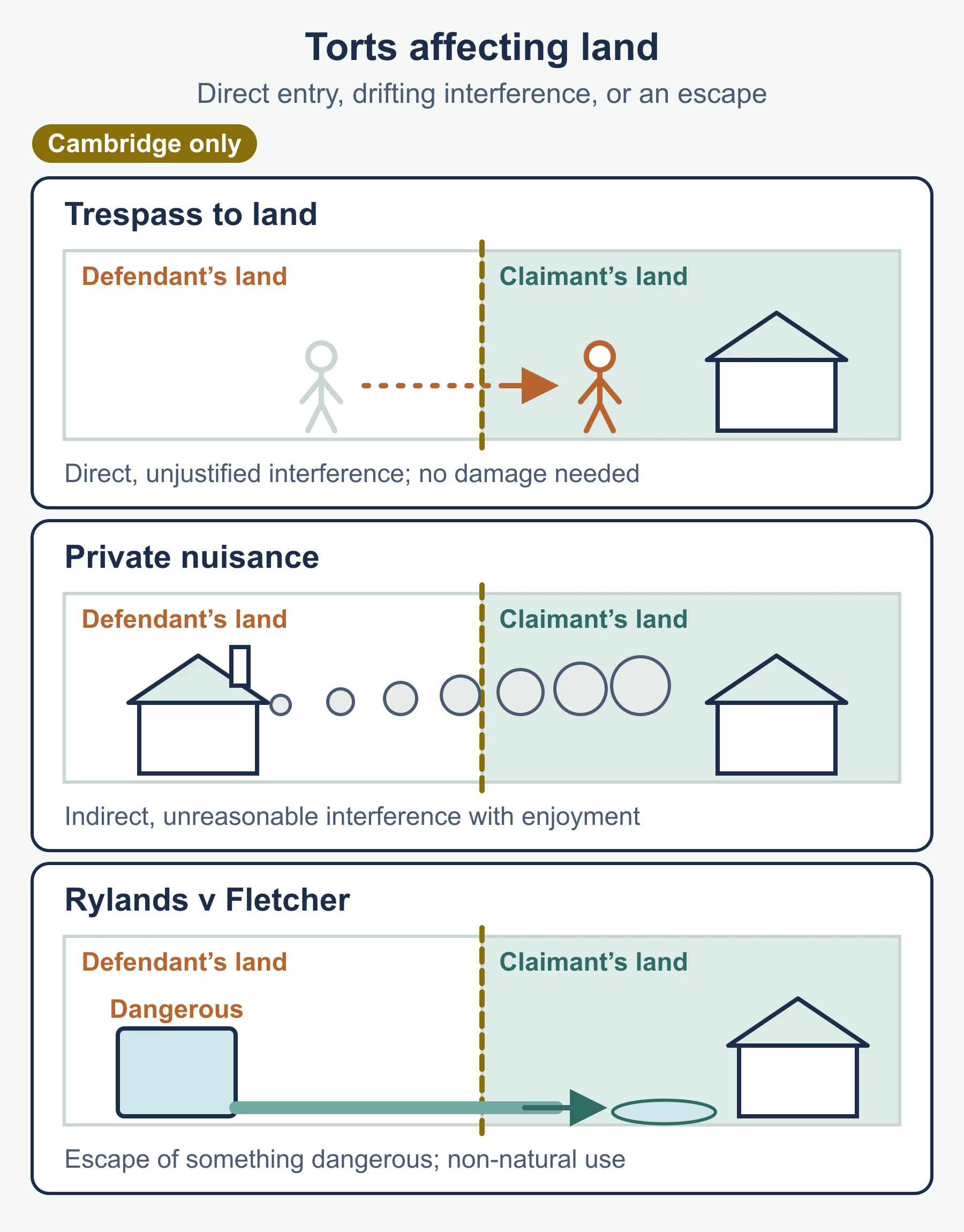
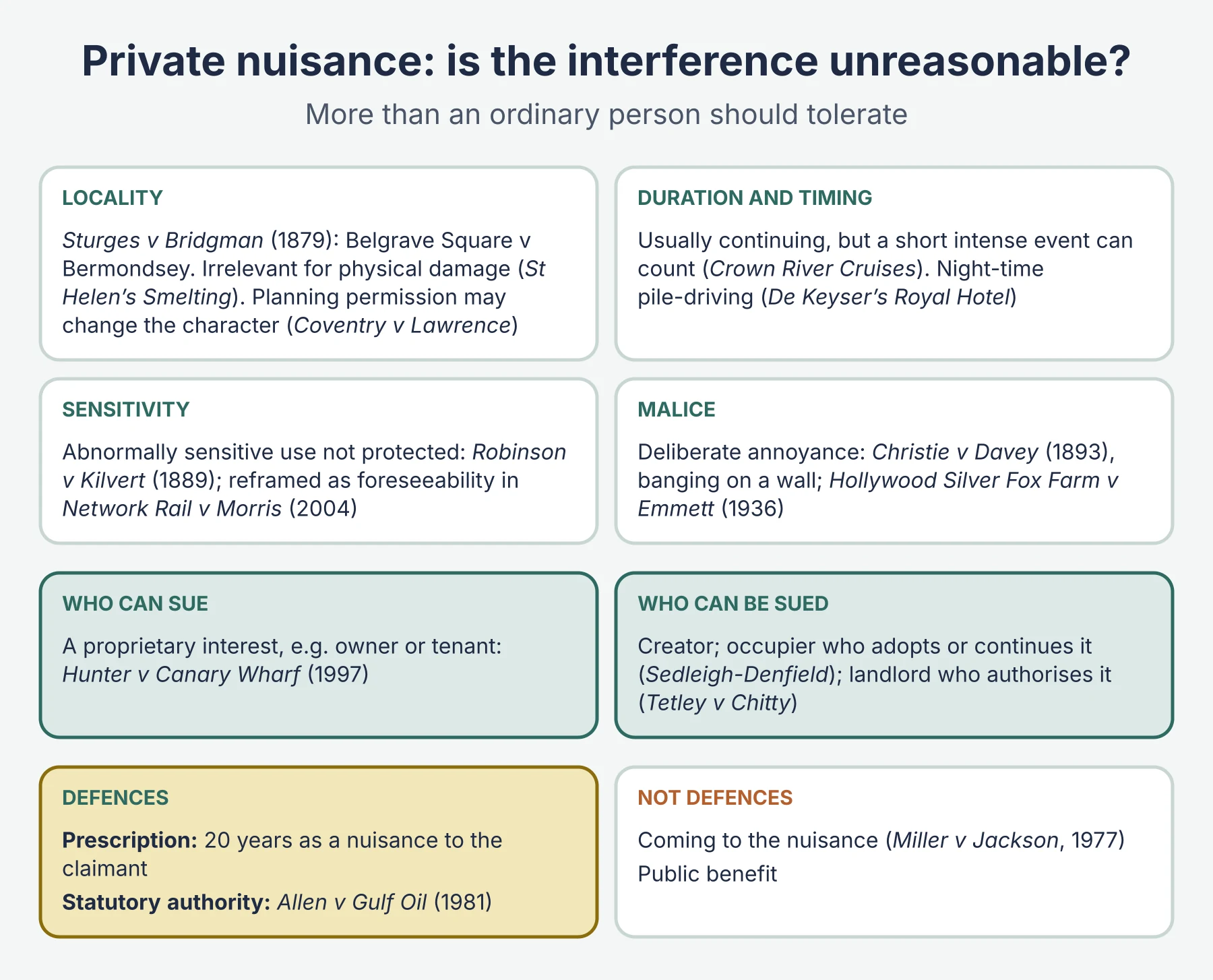
Definition: unlawful interference with use or enjoyment of land, or a right over it.
Parties: claimant needs a proprietary interest (Hunter v Canary Wharf, 1997). Defendant: creator; occupier who adopts or continues (Sedleigh-Denfield v O’Callaghan, 1940); landlord who authorises (Tetley v Chitty, 1986).
| Factor | Authority |
|---|---|
| Locality | Sturges v Bridgman (1879); not relevant to physical damage (St Helen’s Smelting v Tipping, 1865); planning permission can alter locality (Coventry v Lawrence, 2014) |
| Duration and time | Crown River Cruises v Kimbolton Fireworks (1996); De Keyser’s Royal Hotel v Spicer Bros (1914) |
| Sensitivity | Robinson v Kilvert (1889); Network Rail v Morris (2004) |
| Malice | Christie v Davey (1893); Hollywood Silver Fox Farm v Emmett (1936) |
Defences: prescription after 20 years of actionable nuisance (Sturges v Bridgman; Coventry v Lawrence); statutory authority where the nuisance is inevitable (Allen v Gulf Oil Refining, 1981). Not defences: coming to the nuisance (Miller v Jackson, 1977); public benefit.
4.2.3 Rylands v Fletcher
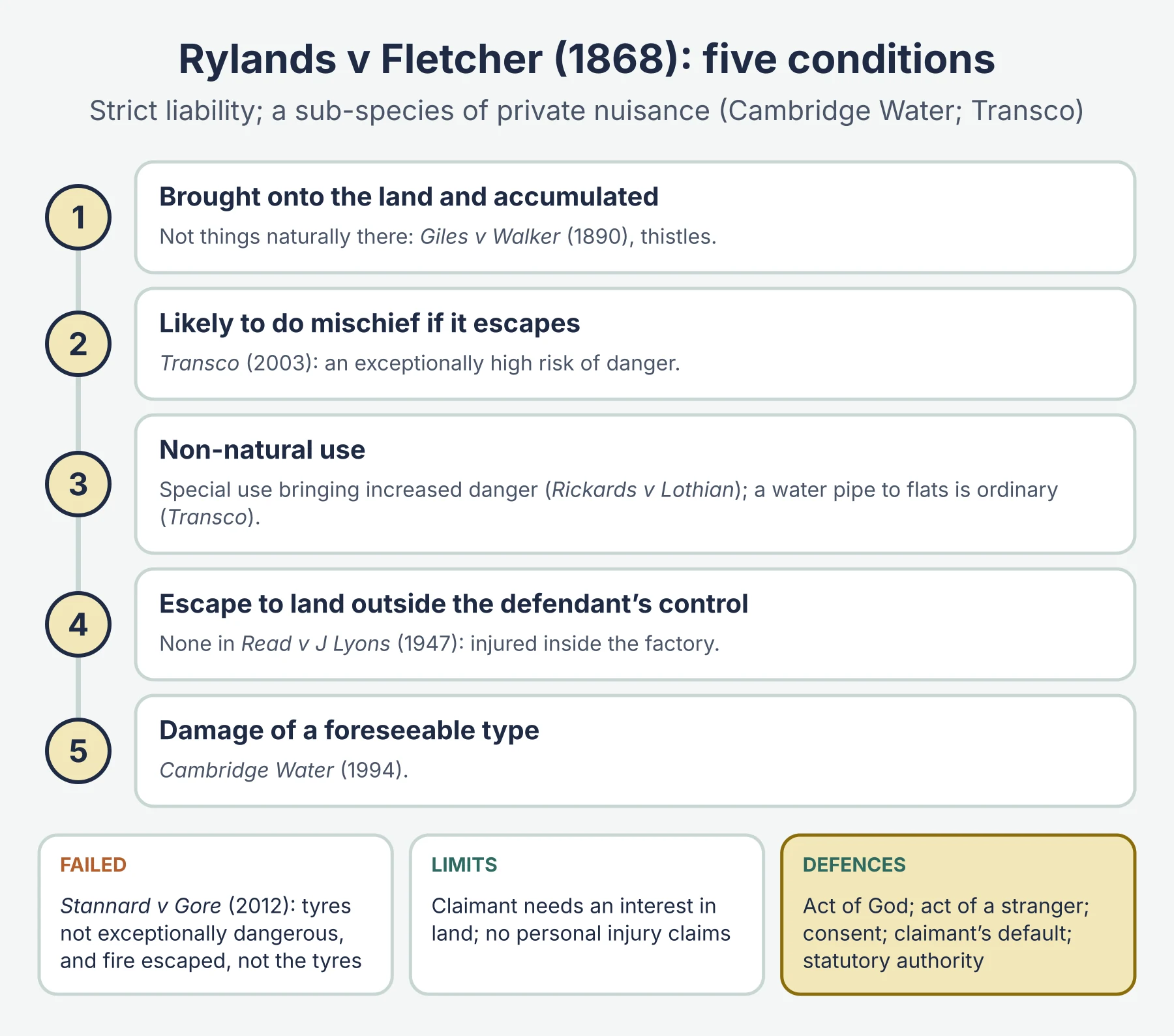
Nature: strict liability; a sub-species of nuisance for isolated escapes (Cambridge Water, 1994; Transco, 2003). Claimant needs an interest in land; no personal injury claims.
Conditions:
- Defendant brings onto land and accumulates something (not naturally there: Giles v Walker, 1890).
- Thing likely to do mischief if it escapes (exceptionally high risk: Transco).
- Non-natural use (Rickards v Lothian, 1913; Transco, domestic water pipe ordinary).
- Escape from the defendant’s land (Read v J Lyons, 1947).
- Damage of a foreseeable type (Cambridge Water v Eastern Counties Leather, 1994).
Defences: Act of God (Nichols v Marsland, 1876); act of a stranger (Rickards v Lothian); consent; claimant’s default; statutory authority.
Fire: Stannard v Gore (2012), tyre fire outside the rule.
4.2.4 Trespass to land
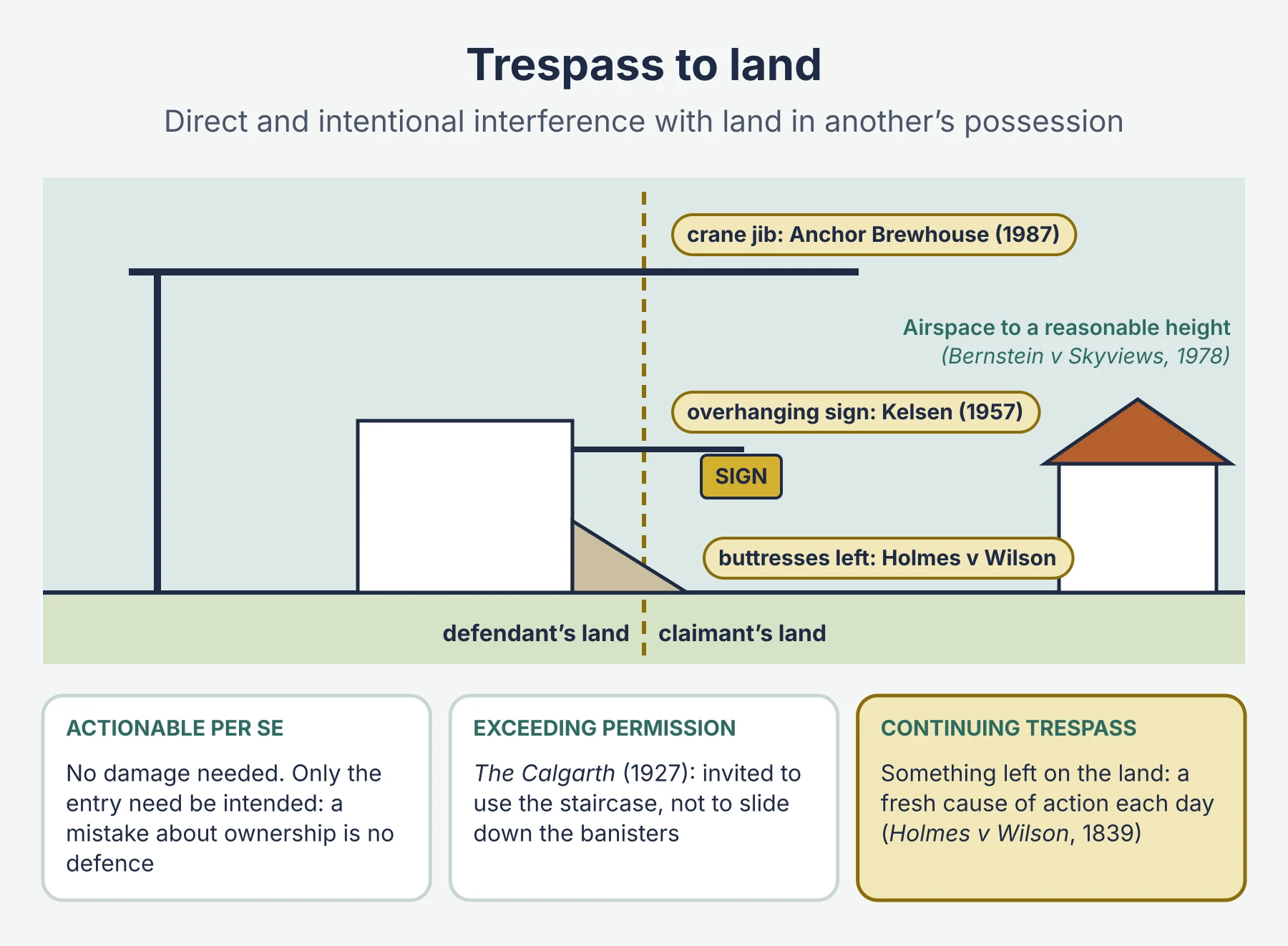
- Direct, intentional interference with land in another’s possession; actionable per se.
- Exceeding permission: The Calgarth (1927).
- Airspace to a reasonable height: Bernstein v Skyviews (1978); Kelsen v Imperial Tobacco (1957); Anchor Brewhouse v Berkley House (1987).
- Continuing trespass: Holmes v Wilson (1839).
Key terms
| Term | Meaning |
|---|---|
| Occupier | Person with sufficient control over premises |
| Lawful visitor | Person with express or implied permission to enter |
| Common duty of care | Duty to take reasonable care that visitors are reasonably safe |
| Allurement | Feature likely to attract a child into danger |
| Private nuisance | Unreasonable indirect interference with use or enjoyment of land |
| Prescription | Right acquired by 20 years of actionable nuisance |
| Statutory authority | Defence where statute authorises the activity causing the nuisance |
| Non-natural use | Special use of land bringing increased danger |
| Strict liability | Liability without proof of fault |
| Trespass to land | Direct, intentional interference with land in another’s possession |
| Continuing trespass | Trespass that persists while the thing remains on the land |
Exam traps
- Wrong Act. Decide visitor or trespasser first; a visitor exceeding permission becomes a trespasser.
- Property damage under the 1984 Act is not recoverable.
- Activity, not premises. Tomlinson and Keown fail because the danger came from the claimant’s activity.
- Nuisance without an interest in land fails after Hunter.
- Personal injury under Rylands is not recoverable after Transco.
- Prescription timing: 20 years run only once the activity became a nuisance to the claimant.
Self-test
- What did Wheat v E Lacon decide?
- What is the common duty of care under s2(2) OLA 1957?
- Why was the occupier liable in Woodward v Mayor of Hastings but not in Haseldine v Daw?
- State the three conditions for a duty under s1(3) OLA 1984.
- Why did the claimant fail in Tomlinson v Congleton BC?
- Who can sue in private nuisance after Hunter v Canary Wharf?
- Give two factors courts consider in deciding unreasonable interference, with a case for each.
- What did Christie v Davey show?
- When is statutory authority a defence to nuisance?
- What did Cambridge Water add to Rylands v Fletcher?
- Why did the claim fail in Read v J Lyons?
- What is a continuing trespass?
Answers:
- There can be more than one occupier of the same premises.
- To take reasonable care to see that the visitor will be reasonably safe in using the premises for the purposes for which they are permitted to be there.
- Checking an icy step needs no expertise, but checking technical lift work does.
- Awareness of the danger; knowledge the person is or may come into the vicinity; a risk the occupier may reasonably be expected to protect against.
- The danger came from his own activity of diving, not from the state of the premises.
- Only those with a proprietary interest in the land, such as owners and tenants.
- Locality (Sturges v Bridgman); malice (Christie v Davey); duration (De Keyser’s Royal Hotel); sensitivity (Robinson v Kilvert). Any two.
- Malicious noise made to annoy a neighbour can be a nuisance.
- When the nuisance is the inevitable result of an activity authorised by statute (Allen v Gulf Oil).
- The damage must be of a foreseeable type.
- There was no escape: the injury happened inside the defendant’s premises.
- A trespass that continues while an object remains on the land, giving a fresh cause of action each day.
Related resources
-
Study guides
Cambridge A Level Law (9084): Torts affecting the person
Assault, battery and false imprisonment, with consent, self-defence and necessity, for Cambridge A Level Law 9084, sub-topic 4.3, with cases and a model answer.
Law · Cambridge · A Level
Read guide -
Practice questions
Cambridge A Level Law (9084): Torts affecting the person – Practice Questions
Twelve original questions with mark-scheme answers on assault, battery, false imprisonment and defences to battery for Cambridge A Level Law 9084, 4.3.
Law · Cambridge · A Level
Try questions -
Revision notes
Cambridge A Level Law (9084): Torts affecting the person – Revision Notes
Condensed notes on assault, battery, false imprisonment and the defences to battery for Cambridge A Level Law 9084, sub-topic 4.3, with a self-test.
Law · Cambridge · A Level
Revise topic
Get free revision emails (optional)
Occasional emails with practice questions, worked explanations and links to free resources for the qualification and subjects you choose. No spam, and you can unsubscribe from any email. The free tools on this site never need an email.