
Study Guides
Cambridge A Level Law (9084): Torts affecting land
Occupiers' liability under the 1957 and 1984 Acts, private nuisance, Rylands v Fletcher and trespass to land for Cambridge A Level Law 9084, sub-topic 4.2.
- Subject
- Law
- Level
- A LEVEL
- Topic
- Topic 4: Law of tort
- Author
- Marlbridge Academic Team
- Updated
- Reviewed by
- Aizaz Raoof Ali (what this means)
Aligned to Cambridge A Level Law (9084), 2026-2028. Official specification .
Syllabus page (what it covers and how it is assessed): Cambridge A Level Law.
Syllabus points this page covers
9084 (A Level)
- 4.2 Torts affecting land
Found an error? Report a correction.
Need help with this topic? Request a free trial class for A Level Law (9084).
Sub-topic 4.2 of Cambridge International A Level Law (9084) covers four torts connected with land: occupiers’ liability, private nuisance, Rylands v Fletcher and trespass to land. It is examined on Paper 4 Law of Tort, where one scenario often raises several of them. This guide extends the Topic 4 overview, adding full coverage of occupiers’ liability.
What the syllabus lists
- 4.2.1 Occupiers’ liability: lawful visitors and the Occupiers’ Liability Act 1957 (children, persons carrying out a trade or calling, independent contractors, exclusion and defences); unlawful visitors and the Occupiers’ Liability Act 1984 (scope of the duty, exclusion and defences).
- 4.2.2 Private nuisance: nature of liability and parties; unreasonable interference and factors such as locality, duration, sensitivity and malice; the defences of prescription and statutory authority.
- 4.2.3 Rylands v Fletcher: strict liability and its relationship with other land torts; definition and conditions of liability.
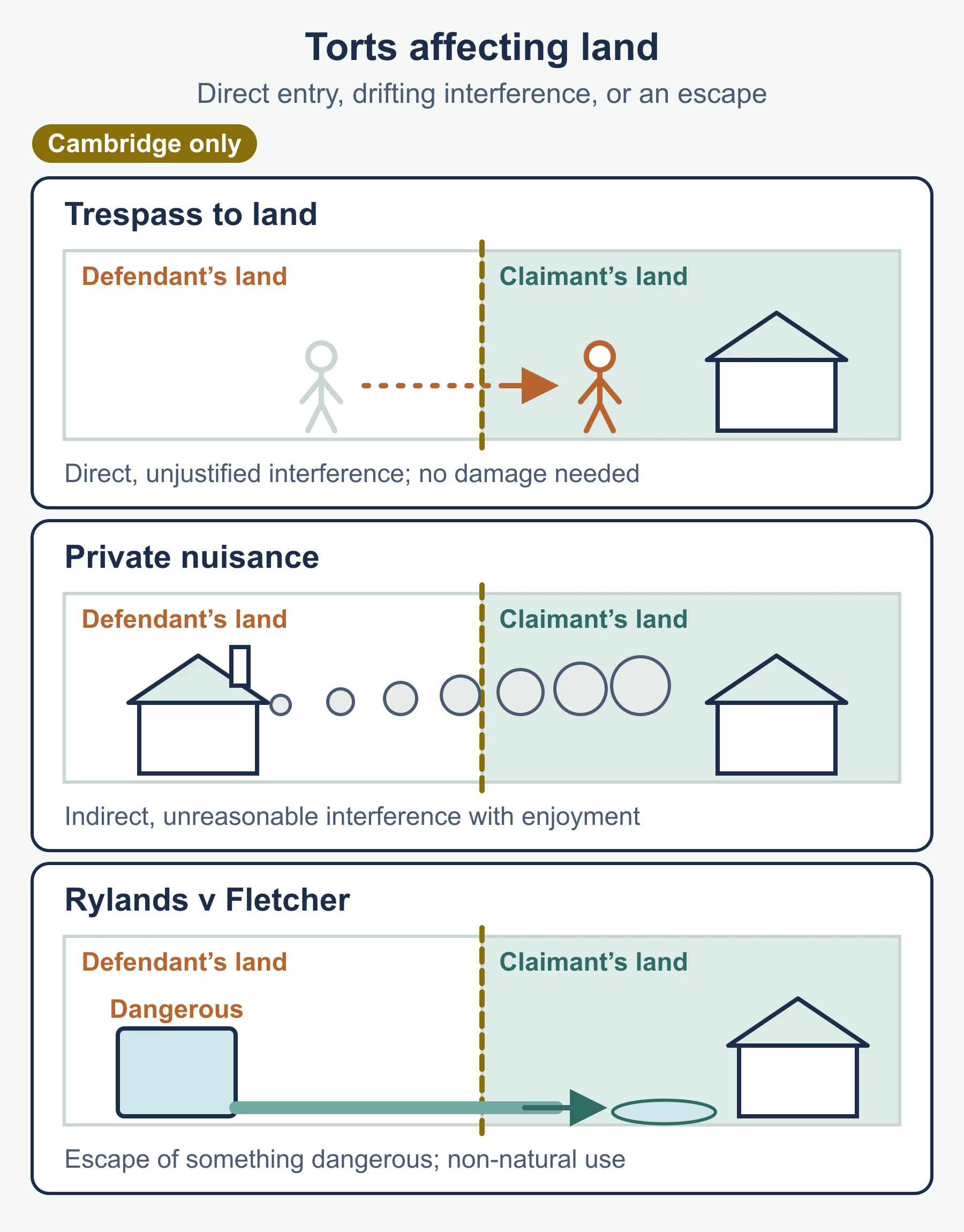
- 4.2.4 Trespass to land: unlawful entry; intentional and direct interference; continuing trespass.
4.2.1 Occupiers’ liability
Who is an occupier?
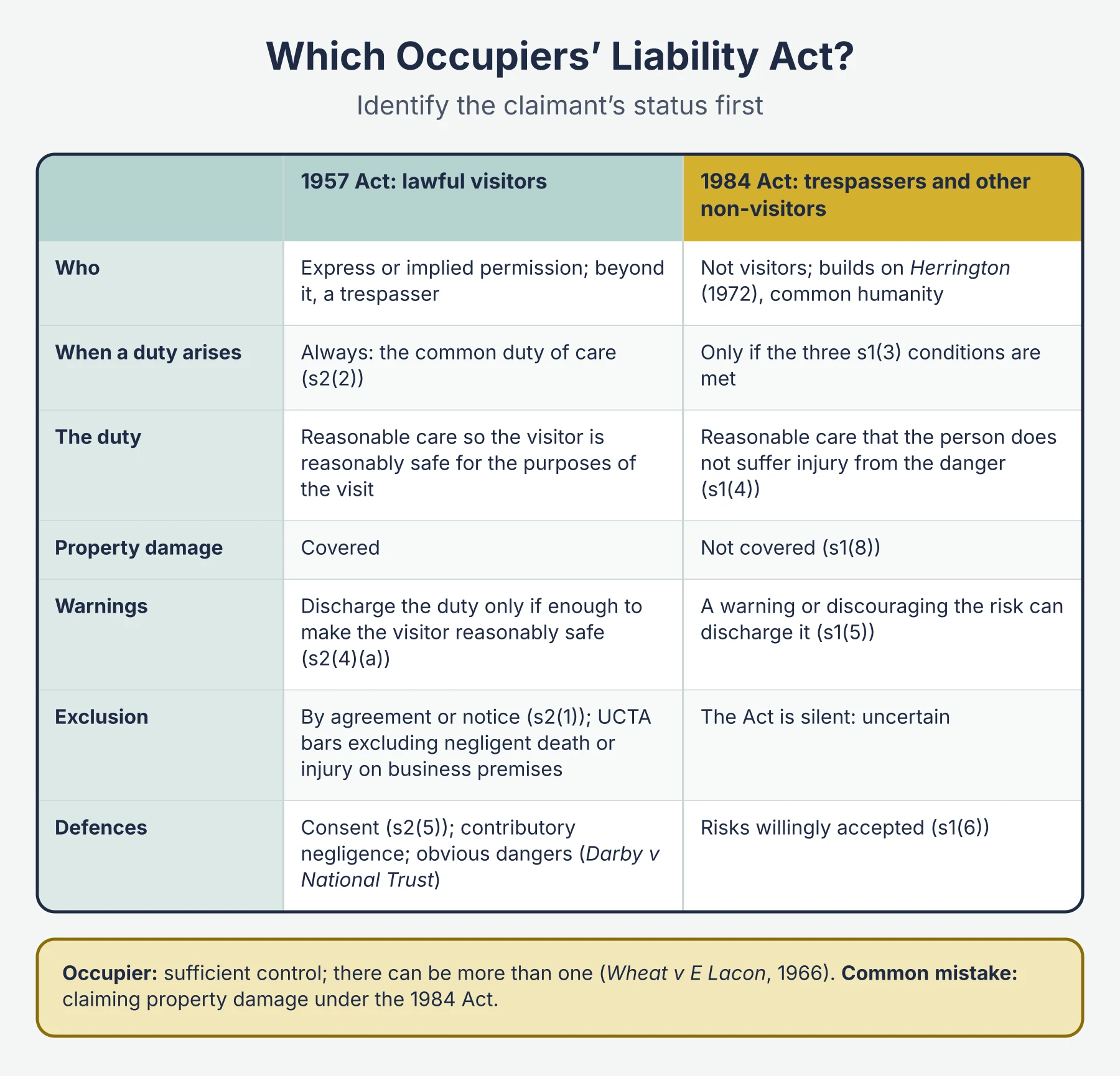
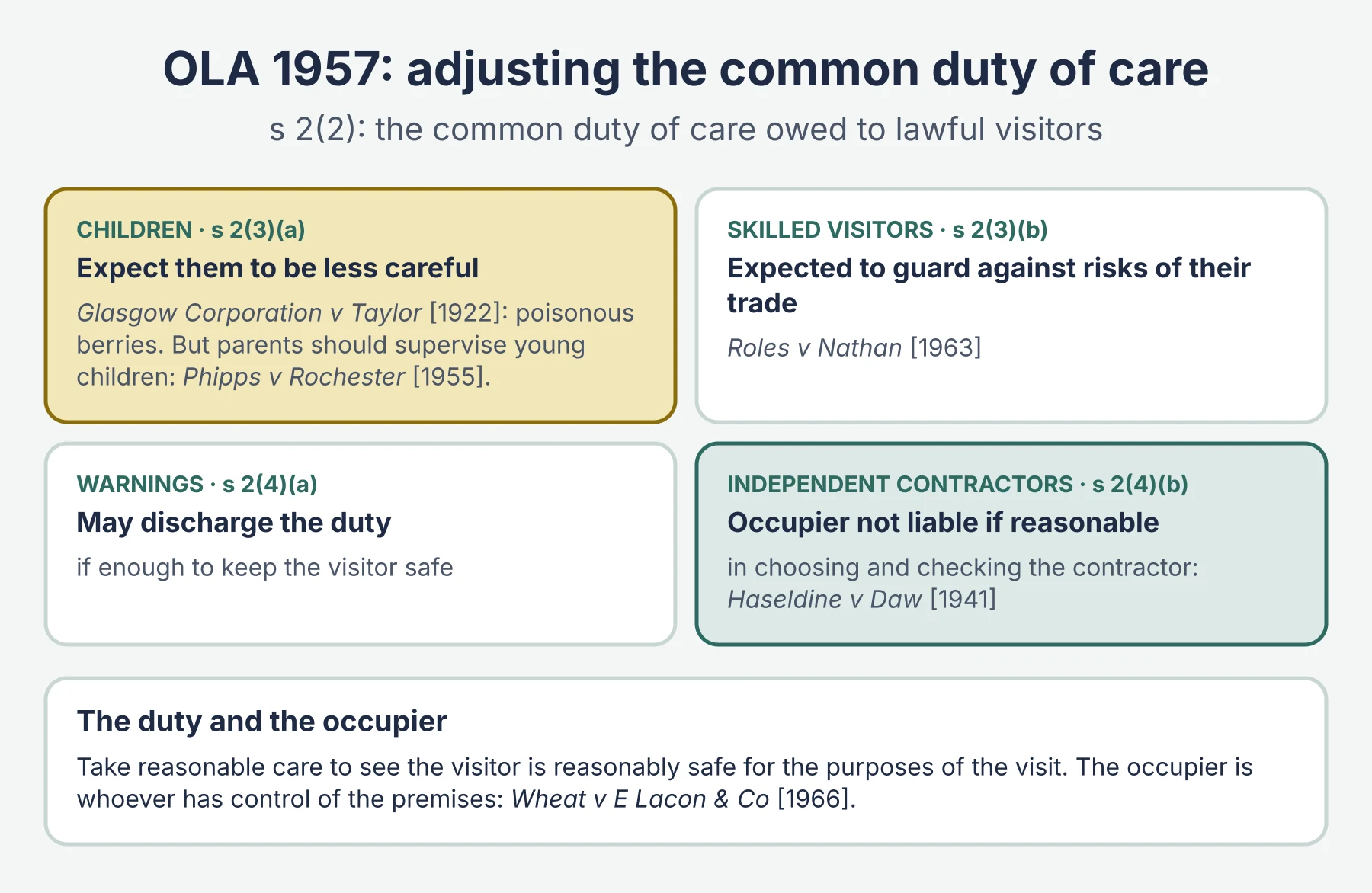
An occupier has sufficient control over the premises, and there can be more than one: in Wheat v E Lacon and Co (1966) both the brewery and the pub manager were occupiers.
Lawful visitors: the 1957 Act
A visitor is a person with express or implied permission to be there. Under s2(2) the occupier owes the common duty of care: to take such care as in all the circumstances is reasonable to see that the visitor will be reasonably safe in using the premises for the purposes for which they are invited or permitted to be there. A visitor who goes beyond their permission becomes a trespasser.
- Children (s2(3)(a)). An occupier must be prepared for children to be less careful than adults. In Glasgow Corporation v Taylor (1922) poisonous berries that looked attractive to a child were an allurement. For very young children, the occupier may expect parents to supervise (Phipps v Rochester Corporation, 1955).
- Trade or calling (s2(3)(b)). An occupier may expect a person exercising their calling to guard against risks ordinarily incidental to it. In Roles v Nathan (1963) chimney sweeps warned of the danger of carbon monoxide fumes could not recover.
- Independent contractors (s2(4)(b)). The occupier is not liable for a contractor’s faulty work if they acted reasonably in entrusting the work, took reasonable steps to check the contractor was competent and, where the work allows, checked that it was properly done. In Haseldine v Daw (1941) an occupier was not liable for a negligent lift repair, a technical job; in Woodward v Mayor of Hastings (1945) the occupier was liable for an icy step left by a cleaner, because checking needed no expertise.
- Warnings (s2(4)(a)) discharge the duty only if enough to make the visitor reasonably safe.
- Exclusion. Under s2(1) the occupier may restrict or exclude the duty by agreement or notice, but for business premises the Unfair Contract Terms Act 1977 prevents exclusion of liability for death or personal injury caused by negligence.
- Defences. Consent to the risk (s2(5)) and contributory negligence. There is no duty to protect against obvious dangers: in Darby v National Trust (2001) no warning was needed about the risk of drowning in a pond.
Unlawful visitors: the 1984 Act
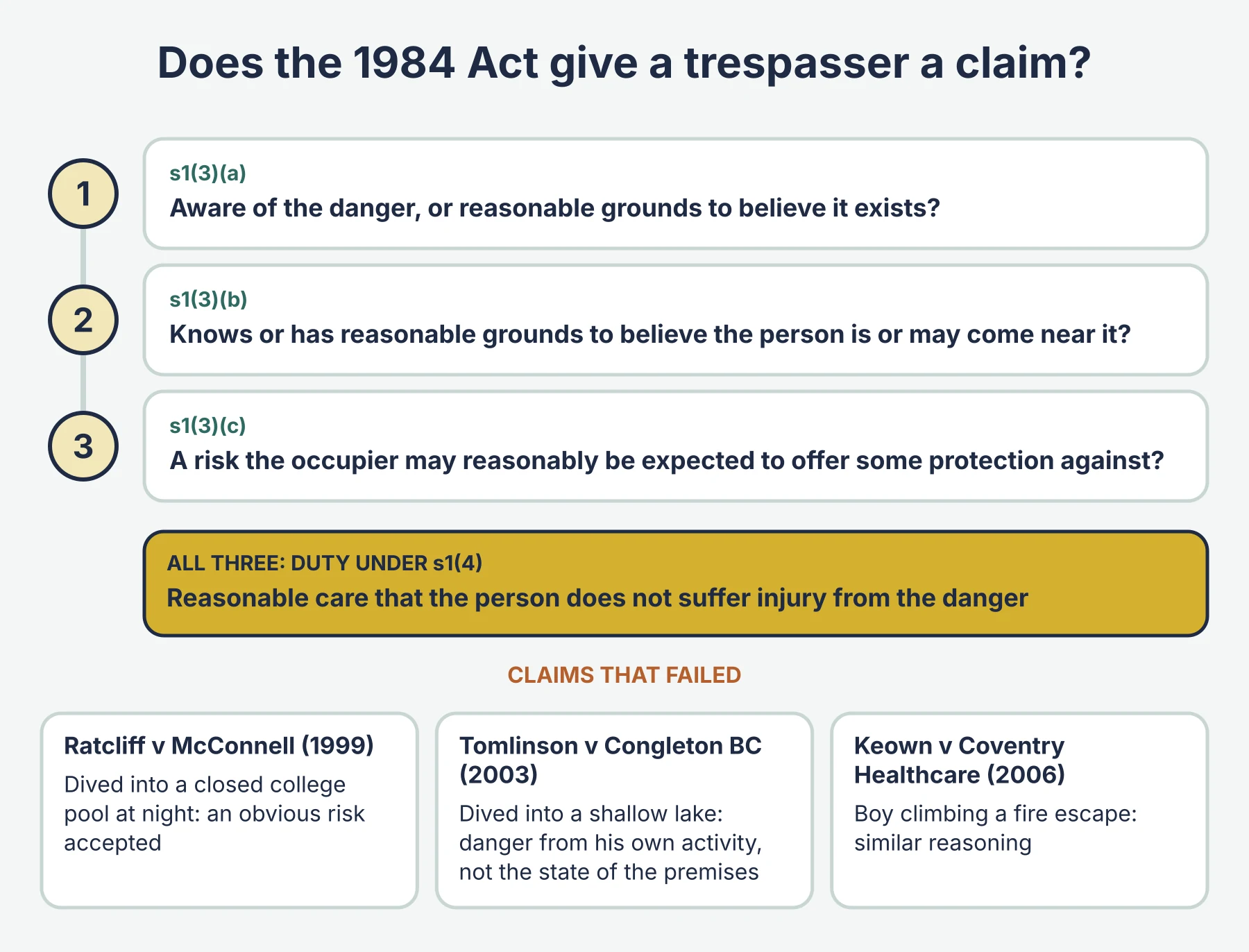
The 1984 Act protects trespassers and others who are not visitors, building on the common-law duty of common humanity recognised in British Railways Board v Herrington (1972). Under s1(3) a duty arises only if the occupier:
- is aware of the danger or has reasonable grounds to believe it exists;
- knows or has reasonable grounds to believe the other person is in, or may come into, the vicinity of the danger; and
- the risk is one against which, in all the circumstances, the occupier may reasonably be expected to offer some protection.
The duty under s1(4) is to take reasonable care to see that the person does not suffer injury on the premises by reason of the danger. Property damage is not covered (s1(8)). The duty may be discharged by a warning or by discouraging people from incurring the risk (s1(5)), and no duty is owed for risks willingly accepted (s1(6)).
In Ratcliff v McConnell (1999) a student who dived into a closed college pool at night accepted an obvious risk. In Tomlinson v Congleton Borough Council (2003) a man who dived into a shallow lake failed because the danger came from his own activity, not the state of the premises. Keown v Coventry Healthcare NHS Trust (2006), a boy climbing a fire escape, is similar. The Act is silent on exclusion, so whether the duty can be excluded is uncertain.
4.2.2 Private nuisance
Nature and parties
Private nuisance is an unlawful interference with a person’s use or enjoyment of land, or some right over it. The claimant must have a proprietary interest, such as owner or tenant (Hunter v Canary Wharf, 1997, overruling Khorasandjian v Bush, 1993, on this point). The defendant may be the creator of the nuisance, an occupier who adopts or continues a nuisance created by someone else (Sedleigh-Denfield v O’Callaghan, 1940), or a landlord who authorises it (Tetley v Chitty, 1986).
Unreasonable interference
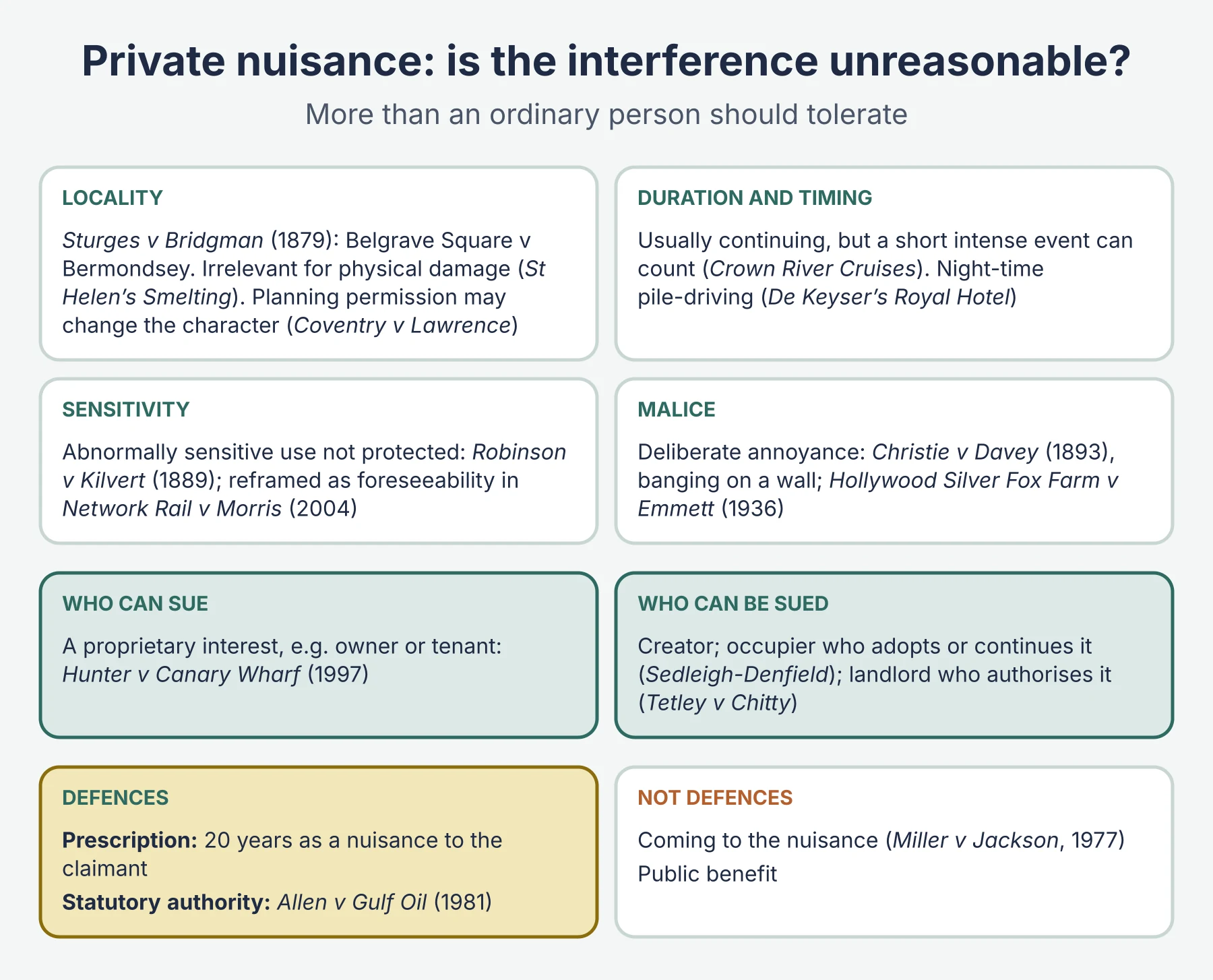
The court balances neighbours’ interests, asking whether the interference exceeds what an ordinary person should tolerate:
- Locality. Sturges v Bridgman (1879): what would be a nuisance in Belgrave Square would not necessarily be so in Bermondsey. Locality is irrelevant where there is physical damage (St Helen’s Smelting v Tipping, 1865). Planning permission is no defence but may change a locality’s character (Coventry v Lawrence, 2014).
- Duration. Usually the interference must be continuing, but a short event can be enough if intense (Crown River Cruises v Kimbolton Fireworks, 1996). Timing matters: night-time pile-driving was a nuisance in De Keyser’s Royal Hotel v Spicer Bros (1914).
- Sensitivity. An abnormally sensitive claimant or use is not protected (Robinson v Kilvert, 1889, heat-sensitive paper); Network Rail v Morris (2004) reframed this in terms of foreseeability.
- Malice. Deliberately causing annoyance can make otherwise reasonable conduct a nuisance: Christie v Davey (1893), banging on a party wall; Hollywood Silver Fox Farm v Emmett (1936), guns fired to disrupt breeding foxes.
In Fearn v Board of Trustees of the Tate Gallery (2023) intensive overlooking of flats from a viewing platform was held a nuisance.
Defences
- Prescription: a nuisance carried on for 20 years can become lawful, but time runs only from when it became a nuisance to the claimant (Sturges v Bridgman). Coventry v Lawrence accepted that a right to make noise could in principle be acquired.
- Statutory authority: a nuisance that is the inevitable result of an activity authorised by statute is a defence (Allen v Gulf Oil Refining, 1981).
- Not defences: coming to the nuisance (Miller v Jackson, 1977) and public benefit.
4.2.3 Rylands v Fletcher
Nature
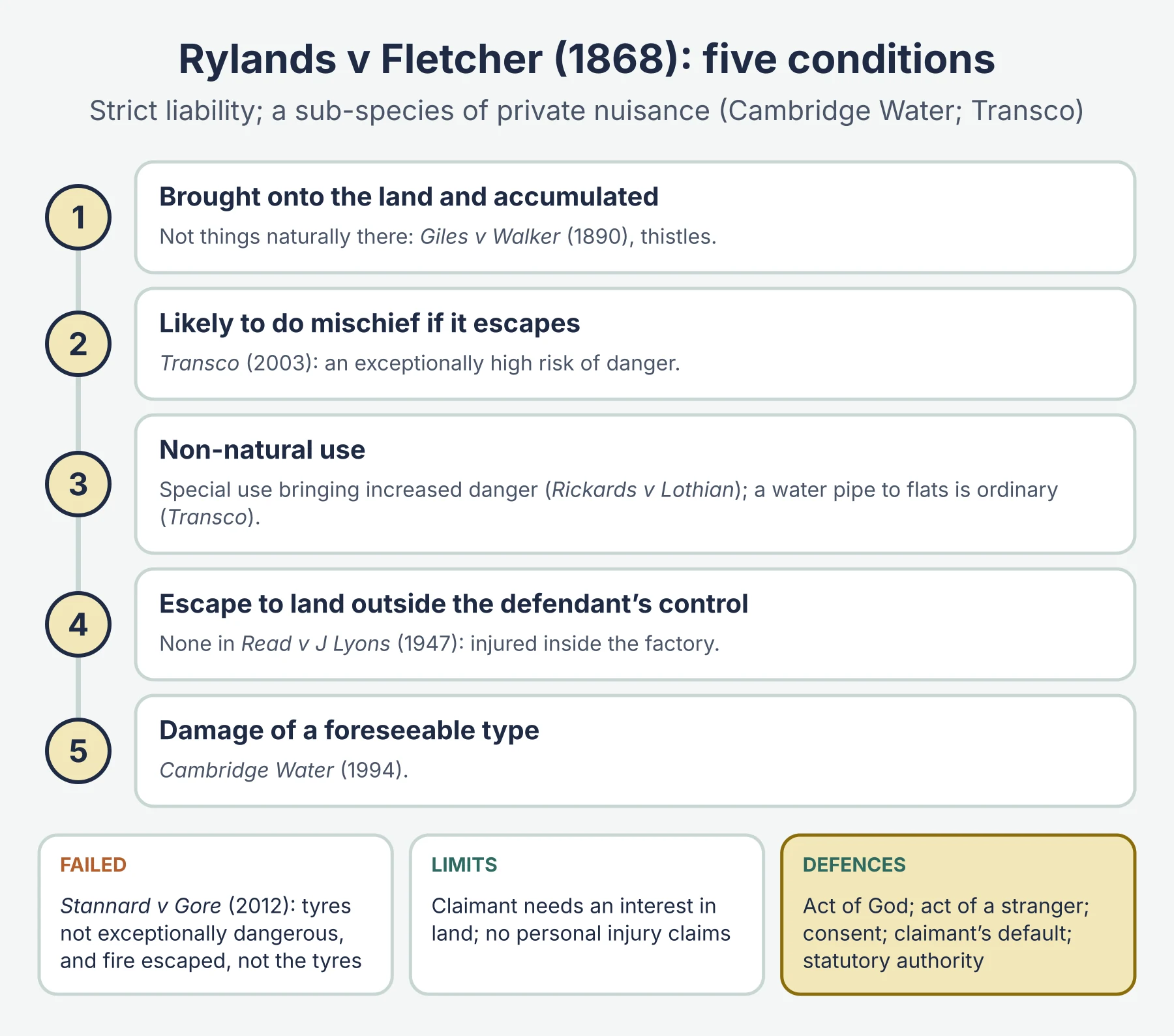
The rule in Rylands v Fletcher (1868) is a form of strict liability: the defendant can be liable without proof of negligence. Blackburn J stated that a person who for their own purposes brings onto their land and keeps there anything likely to do mischief if it escapes must keep it in at their peril; the House of Lords added the requirement of non-natural use. The House of Lords has since treated the rule as a sub-species of private nuisance for isolated escapes (Cambridge Water v Eastern Counties Leather, 1994; Transco v Stockport MBC, 2003), so the claimant must have an interest in land and cannot recover for personal injury.
Conditions of liability
- Bringing onto land and accumulation. Things naturally there are excluded (Giles v Walker, 1890, thistles).
- Something likely to do mischief if it escapes. In Transco the test was whether there was an exceptionally high risk of danger.
- Non-natural use. A special use bringing increased danger, not the ordinary use of land (Rickards v Lothian, 1913); Transco called it extraordinary and unusual and held a water pipe supplying flats to be ordinary.
- Escape from land the defendant controls to land outside it: none in Read v J Lyons (1947), where the claimant was injured inside a munitions factory.
- Damage of a foreseeable type (Cambridge Water).
In Stannard v Gore (2012) the Court of Appeal held that a fire spreading from stored tyres was not within the rule: the tyres were not exceptionally dangerous, and what escaped was the fire, not the tyres. Defences include Act of God (Nichols v Marsland, 1876), act of a stranger (Rickards v Lothian), consent, the claimant’s own default and statutory authority.
4.2.4 Trespass to land
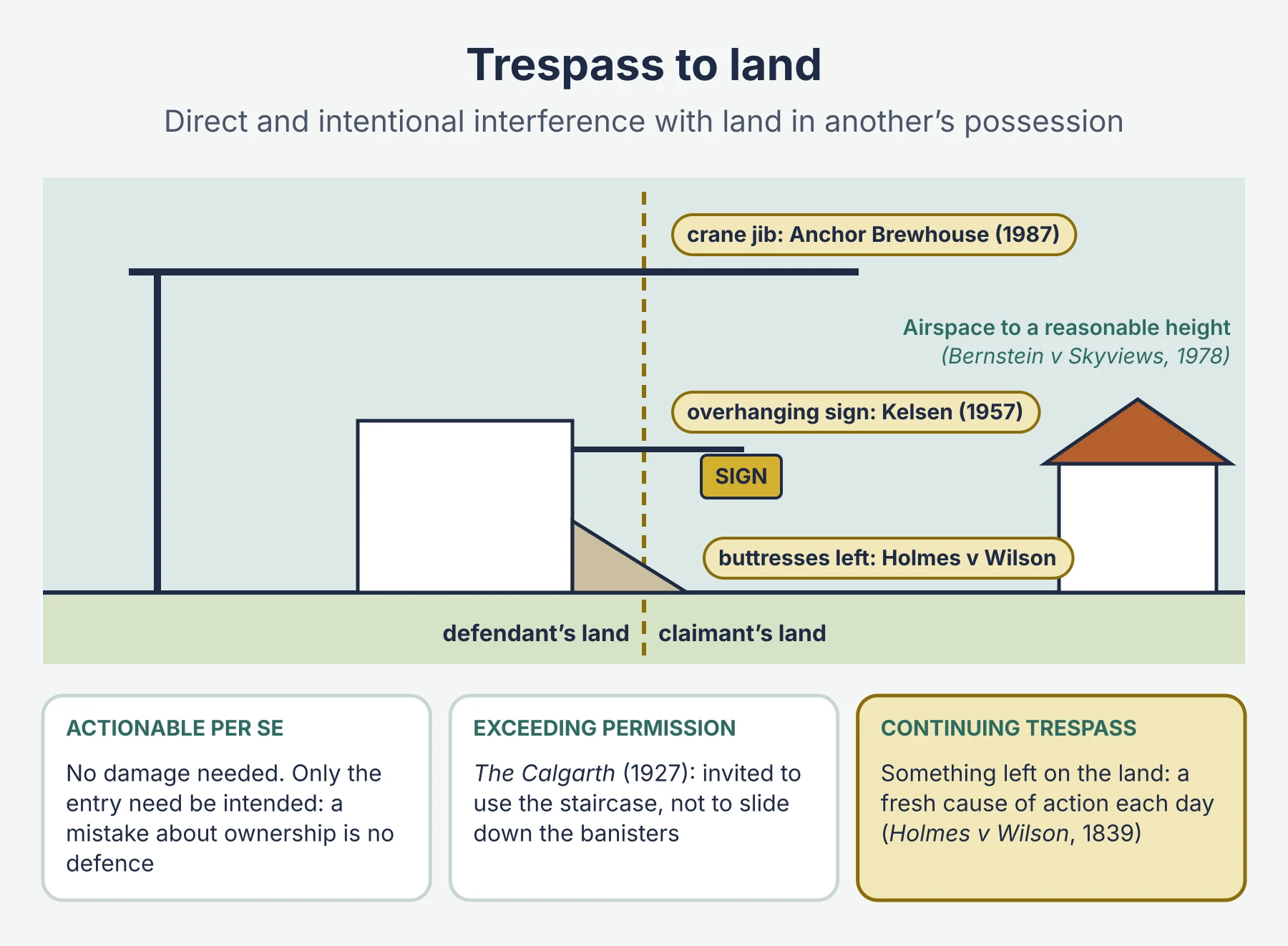
Trespass is a direct and intentional interference with land in the possession of another. It is actionable per se, and only the entry need be intended: a mistake about ownership is no defence. A person who exceeds their permission becomes a trespasser: in The Calgarth (1927) Scrutton LJ observed that a person invited to use a staircase is not invited to slide down the banisters. Trespass covers airspace to a reasonable height (Bernstein v Skyviews, 1978), so an overhanging sign (Kelsen v Imperial Tobacco, 1957) or crane jib (Anchor Brewhouse v Berkley House, 1987) can be a trespass. A continuing trespass occurs when something is left on the land, giving a fresh cause of action each day it remains (Holmes v Wilson, 1839, buttresses left on the claimant’s land).
Worked example
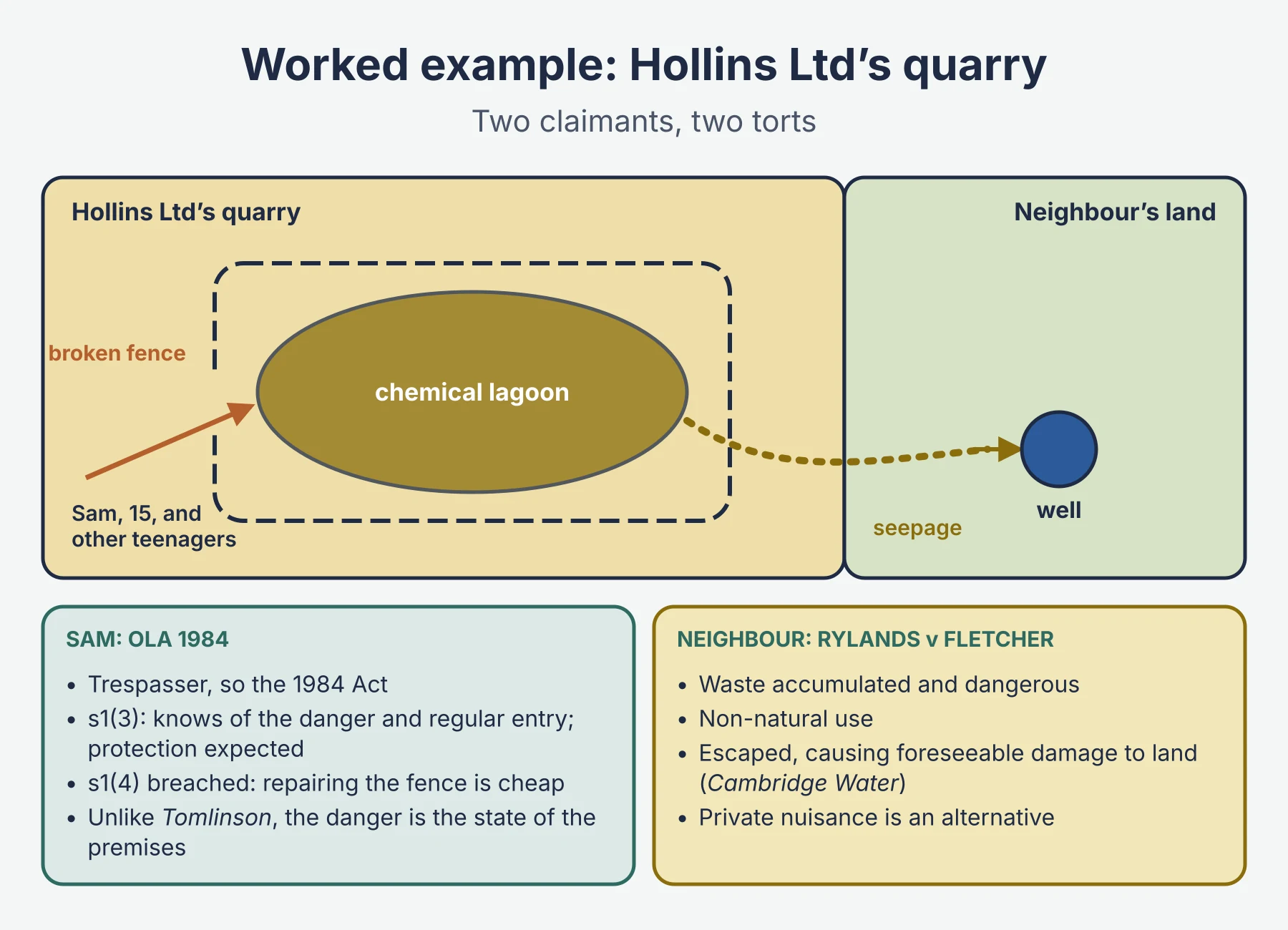
Scenario: Hollins Ltd occupies a quarry with a fenced lagoon of chemical waste. Teenagers regularly climb through a broken section of fence, which Hollins knows about. Fifteen-year-old Sam does so and is burned by chemicals. Waste also seeps under the boundary into a neighbour’s well.
- Sam is a trespasser, so the 1984 Act applies. Hollins knows of the danger and of regular entry, and a chemical lagoon is a risk against which protection is reasonably expected (s1(3)). Repairing the fence is cheap, so the s1(4) duty is breached; unlike Tomlinson, the danger comes from the state of the premises.
- The neighbour may sue in Rylands v Fletcher: waste is accumulated, dangerous, a non-natural use, and has escaped, causing foreseeable damage to land (Cambridge Water). Private nuisance is an alternative.
Common mistakes
- Applying the 1957 Act to a trespasser, or claiming property damage under the 1984 Act.
- Ignoring whether the danger comes from the premises or the claimant’s own activity.
- Allowing personal injury claims under Rylands after Transco.
Exam technique
In advise questions, identify each claimant’s status first, then choose the tort. In evaluate essays, ask whether Rylands still has a purpose, or whether the 1984 Act balances landowners and trespassers fairly. Revise with the torts affecting land revision notes and apply them in the torts affecting land practice questions.
Related resources
-
Practice questions
Cambridge A Level Law (9084): Torts affecting land – Practice Questions
Twelve original questions with mark-scheme answers on occupiers' liability, nuisance, Rylands v Fletcher and trespass to land for Cambridge A Level Law 9084.
Law · Cambridge · A Level
Try questions -
Revision notes
Cambridge A Level Law (9084): Torts affecting land – Revision Notes
Condensed notes on occupiers' liability, private nuisance, Rylands v Fletcher and trespass to land for Cambridge A Level Law 9084, with a self-test.
Law · Cambridge · A Level
Revise topic -
Study guides
Cambridge A Level Law (9084): Torts affecting the person
Assault, battery and false imprisonment, with consent, self-defence and necessity, for Cambridge A Level Law 9084, sub-topic 4.3, with cases and a model answer.
Law · Cambridge · A Level
Read guide
Get free revision emails (optional)
Occasional emails with practice questions, worked explanations and links to free resources for the qualification and subjects you choose. No spam, and you can unsubscribe from any email. The free tools on this site never need an email.