
Revision Notes
Cambridge A Level Law (9084): The tort of negligence – Revision Notes
Condensed notes on duty, policy, breach, causation, remoteness, economic loss and nervous shock in negligence for Cambridge A Level Law 9084, with a self-test.
- Subject
- Law
- Level
- A LEVEL
- Topic
- Topic 4: Law of tort
- Author
- Marlbridge Academic Team
- Updated
- Reviewed by
- Aizaz Raoof Ali (what this means)
Aligned to Cambridge A Level Law (9084), 2026-2028. Official specification .
Syllabus page (what it covers and how it is assessed): Cambridge A Level Law.
Syllabus points this page covers
9084 (A Level)
- 4.1 The tort of negligence
Found an error? Report a correction.
Need help with this topic? Request a free trial class for A Level Law (9084).
Related: negligence study guide and negligence practice questions.
Sub-topic 4.1 of Cambridge International A Level Law (9084), assessed on Paper 4. Elements to prove on the balance of probabilities: duty, breach, causation and damage that is not too remote.
4.1.1 Nature of liability
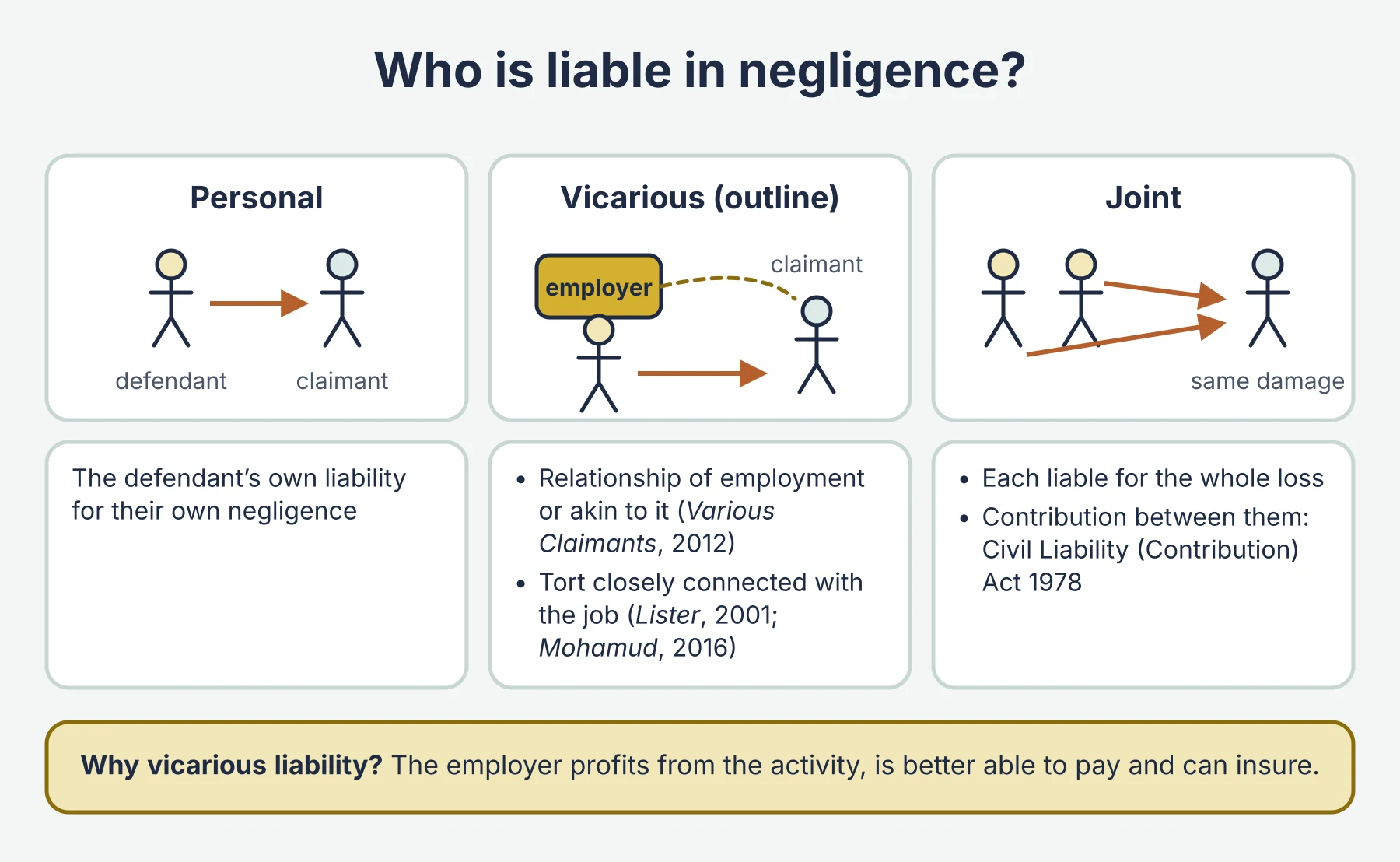
- Personal: liability for one’s own negligent act or omission.
- Vicarious (outline): employer liable for an employee’s tort in the course of employment. Relationship of employment or akin to it (Various Claimants v Catholic Child Welfare Society, 2012); close connection test (Lister v Hesley Hall, 2001; Mohamud v WM Morrison Supermarkets, 2016).
- Joint: several defendants causing the same damage are each liable for the whole; contribution between them under the Civil Liability (Contribution) Act 1978.
4.1.2 Duty of care
| Stage | Authority | Point |
|---|---|---|
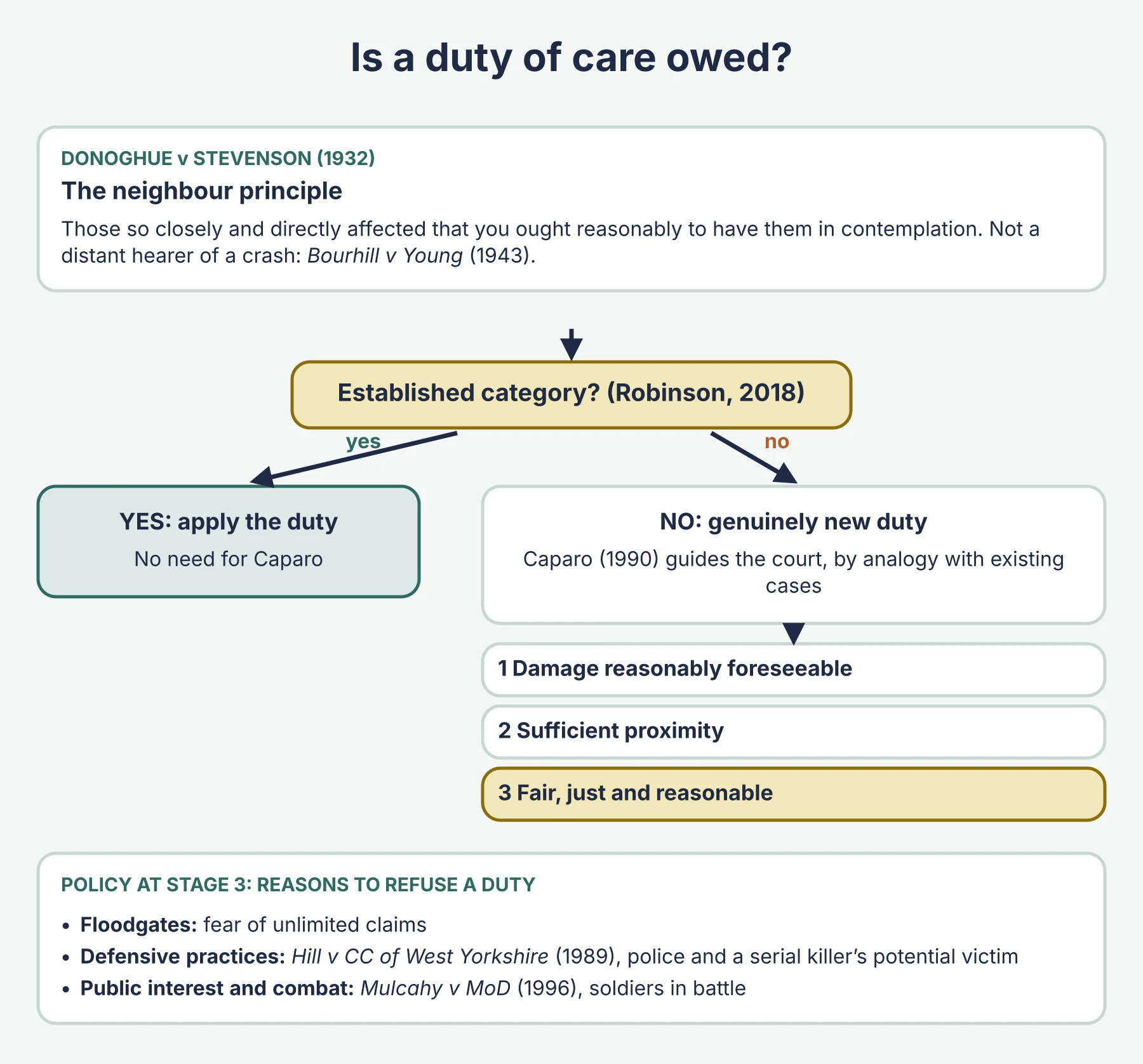
| Neighbour principle | Donoghue v Stevenson (1932) | Persons closely and directly affected |
| Foreseeable claimant | Bourhill v Young (1943) | No duty to an unforeseeable claimant |
| Two-stage test, later departed from | Anns v Merton LBC (1978) | Broad prima facie duty; overruled by Murphy v Brentwood DC (1990) |
| Three-part test | Caparo v Dickman (1990) | Foreseeability, proximity, fair, just and reasonable |
| Incremental approach | Robinson v Chief Constable of West Yorkshire (2018) | Apply established categories; Caparo guides novel cases |
Policy reasons to deny a duty: floodgates; defensive practices and resources (Hill v Chief Constable of West Yorkshire, 1989); battlefield conditions (Mulcahy v MoD, 1996).
4.1.3 Breach of duty
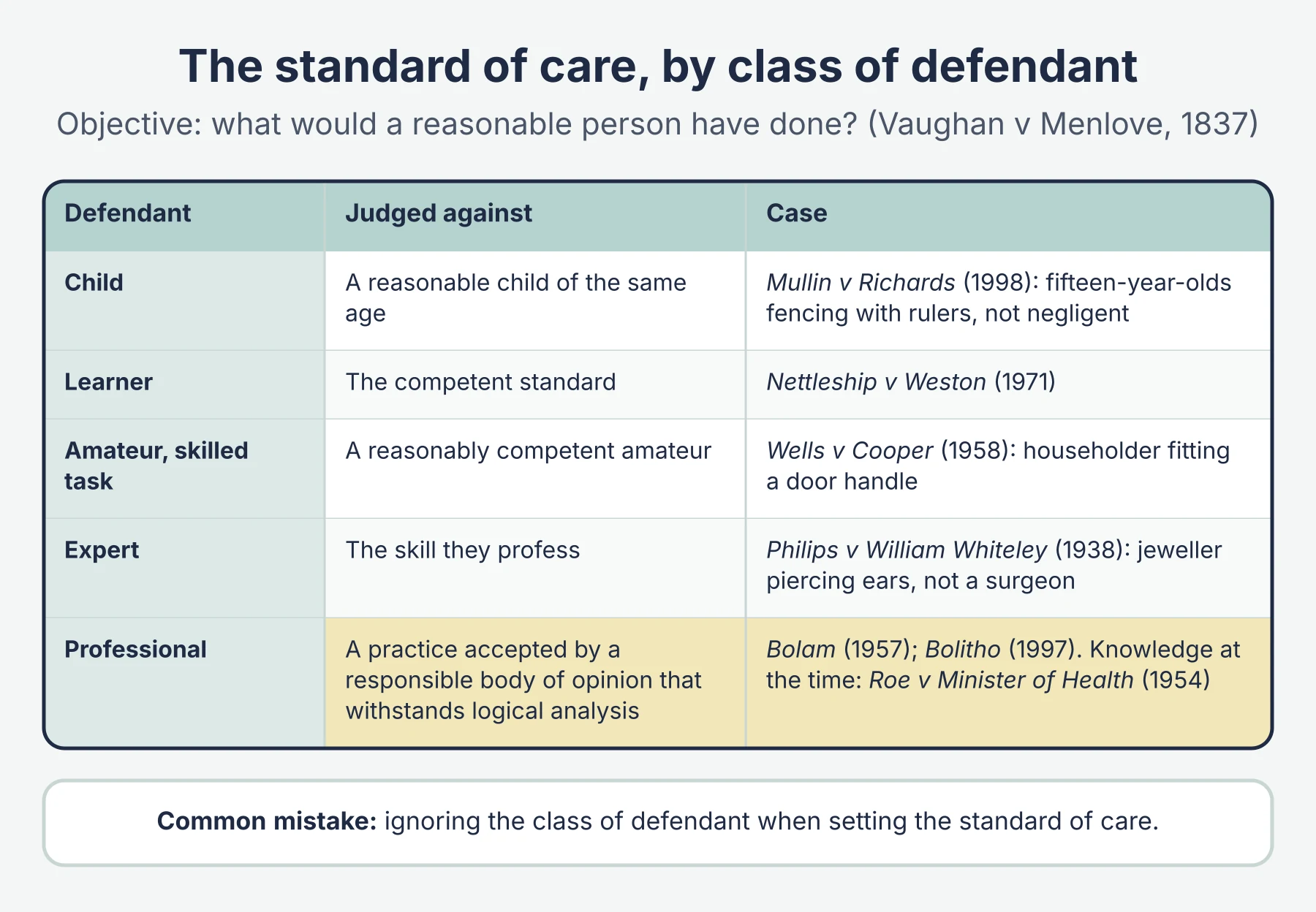
Objective standard: Vaughan v Menlove (1837).
| Defendant | Standard | Authority |
|---|---|---|
| Child | Reasonable child of that age | Mullin v Richards (1998) |
| Learner | Reasonably competent person doing the task | Nettleship v Weston (1971) |
| Amateur doing DIY | Reasonably competent amateur | Wells v Cooper (1958) |
| Person professing a skill | Skill professed | Philips v William Whiteley (1938) |
| Professional | Responsible body of opinion that withstands logical analysis | Bolam (1957); Bolitho (1997) |
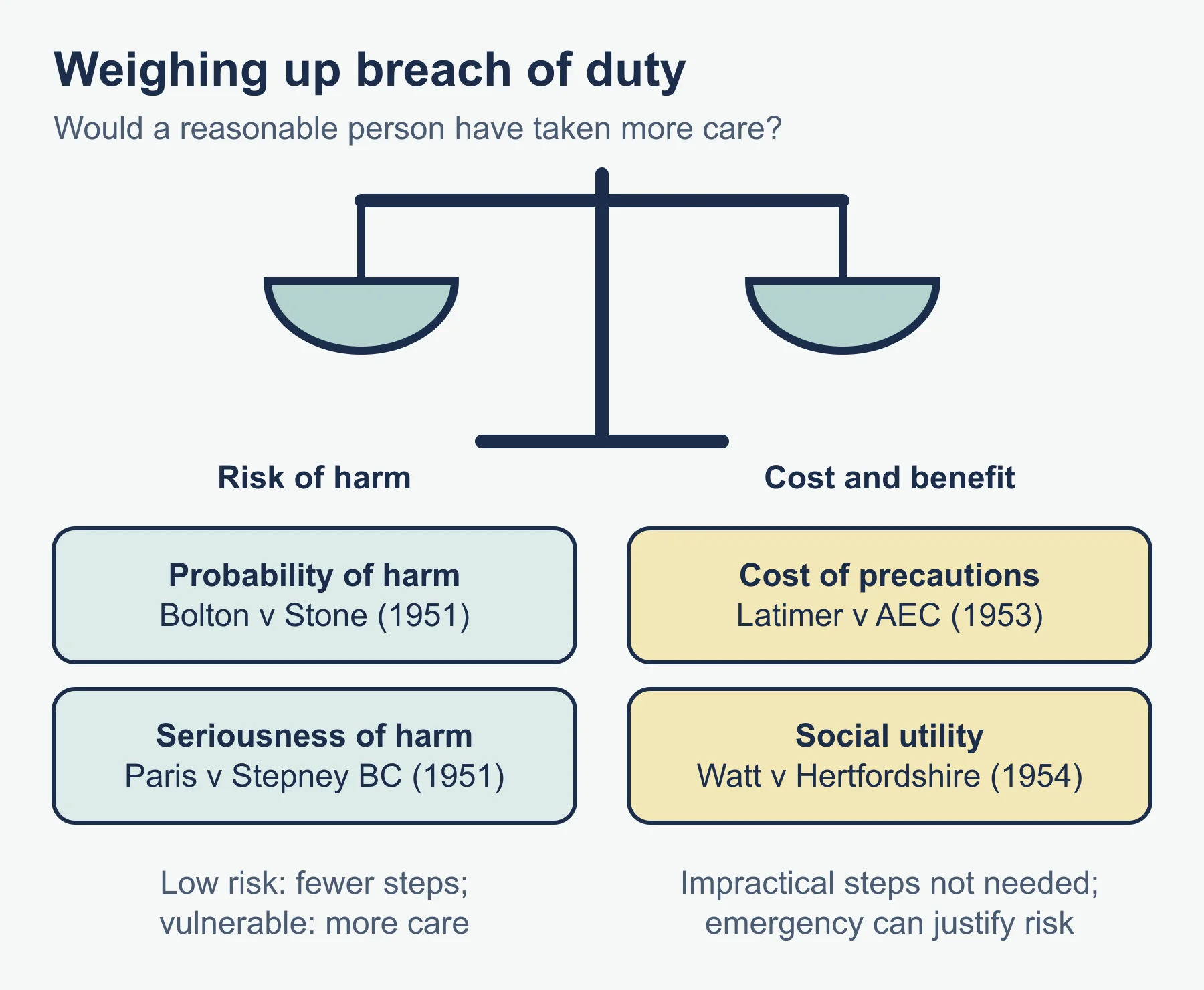
Risk factors: probability (Bolton v Stone, 1951); vulnerability of claimant (Paris v Stepney BC, 1951); cost and practicality of precautions (Latimer v AEC, 1953); social utility (Watt v Hertfordshire CC, 1954); state of knowledge at the time (Roe v Minister of Health, 1954).
4.1.4 Causation and remoteness
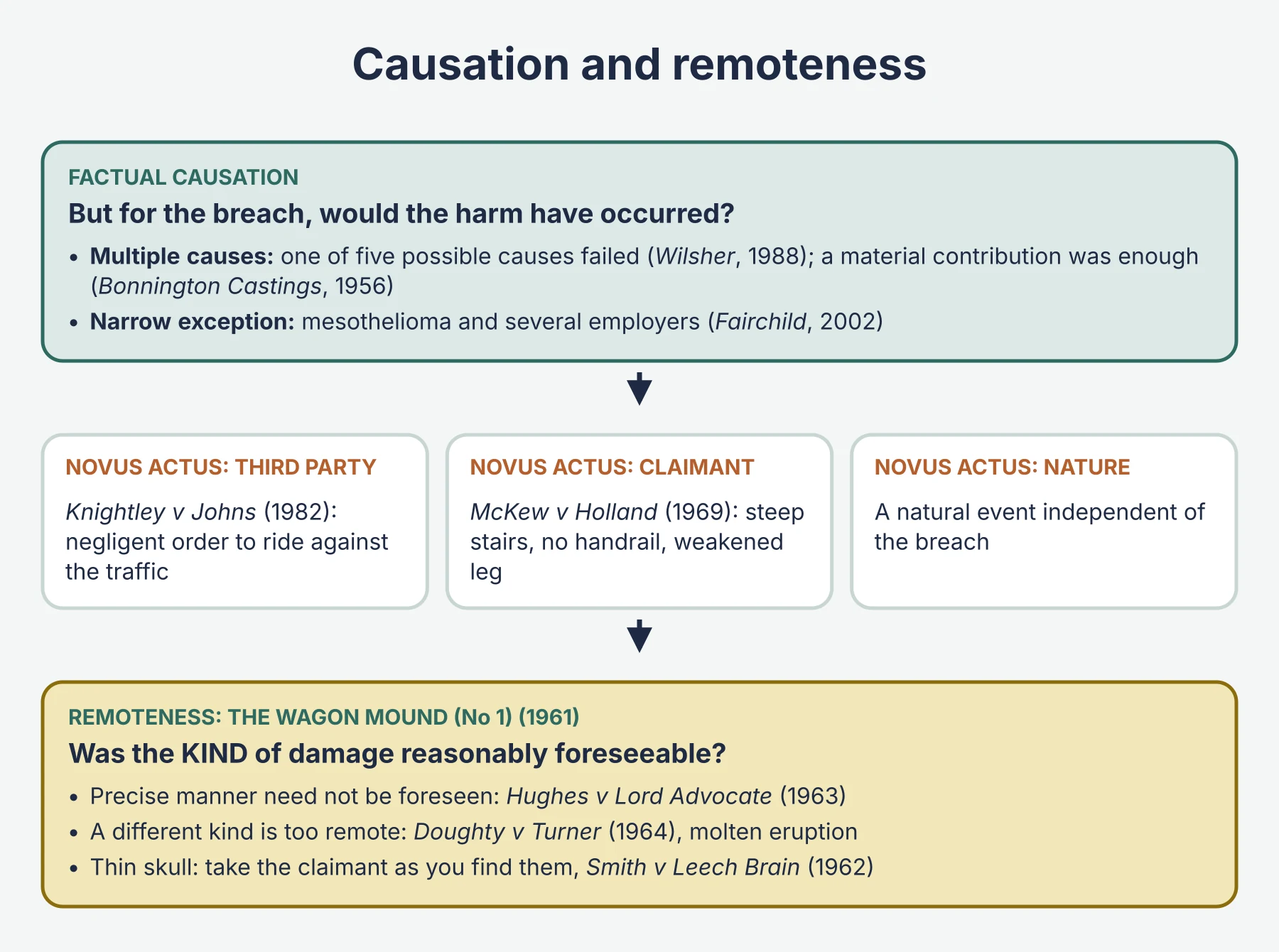
- But for: Barnett v Chelsea and Kensington Hospital (1969).
- Multiple causes: Wilsher v Essex AHA (1988), one of five possible causes, claim failed; Bonnington Castings v Wardlaw (1956), material contribution sufficient; Fairchild (2002), mesothelioma exception.
- Intervening acts (novus actus interveniens): third party, Knightley v Johns (1982); claimant’s unreasonable conduct, McKew v Holland (1969).
- Remoteness: kind of damage reasonably foreseeable, The Wagon Mound (No 1) (1961). Manner need not be foreseen, Hughes v Lord Advocate (1963); different kind too remote, Doughty v Turner (1964).
- Thin skull rule: Smith v Leech Brain (1962).
4.1.5 Novel duty situations
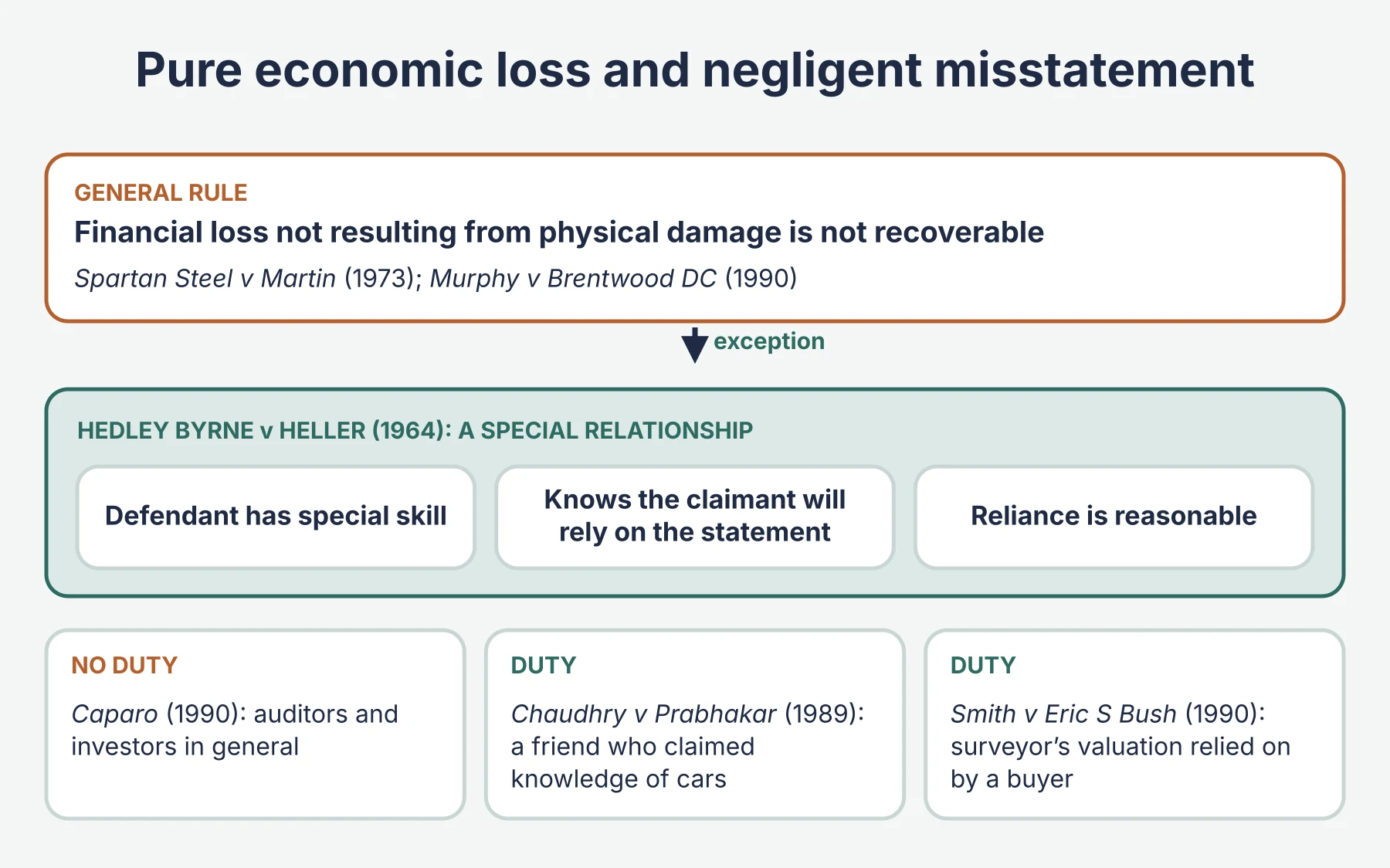
Pure economic loss: generally not recoverable (Spartan Steel v Martin, 1973; Murphy v Brentwood DC, 1990).
Negligent misstatement (Hedley Byrne v Heller, 1964): special relationship, meaning special skill, knowledge that the claimant will rely, reasonable reliance. Caparo: auditors owe no duty to general investors. Chaudhry v Prabhakar (1989): friend liable. Smith v Eric S Bush (1990): surveyor to buyer.
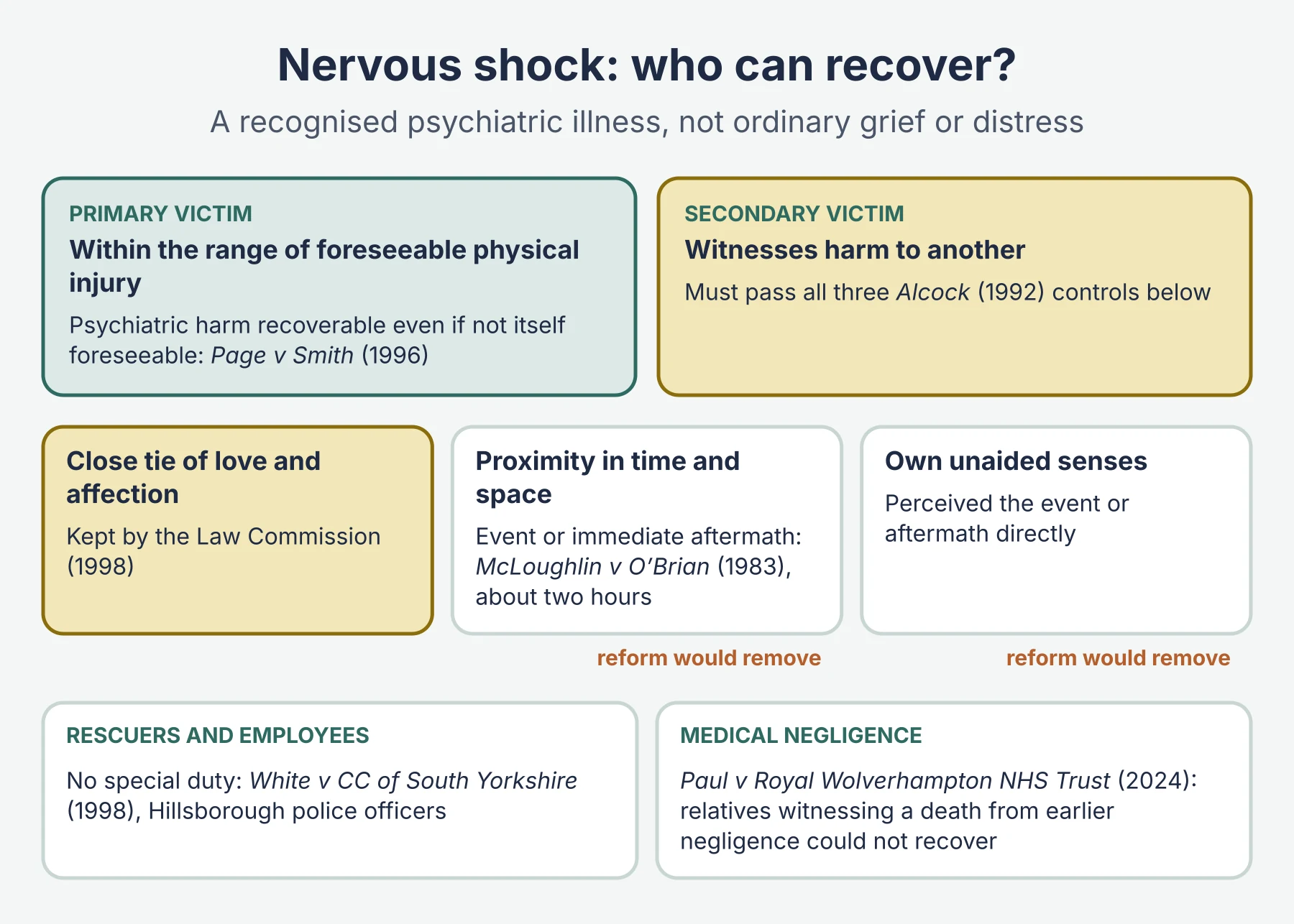
Nervous shock: recognised psychiatric illness required.
| Claimant | Rule | Authority |
|---|---|---|
| Primary victim | In range of foreseeable physical injury | Dulieu v White (1901); Page v Smith (1996) |
| Secondary victim | Close tie, proximity in time and space, own unaided senses | Alcock (1992); McLoughlin v O’Brian (1983) |
| Rescuer or employee | No special status; ordinary rules | White v Chief Constable of South Yorkshire (1998) |
| Relative witnessing later effect of medical negligence | Not a secondary victim | Paul v Royal Wolverhampton NHS Trust (2024) |
Reform: Law Commission report (1998) recommended removing proximity in time and space and the own-senses requirement for those with a close tie; not enacted.
Key terms
| Term | Meaning |
|---|---|
| Duty of care | Legal obligation to take reasonable care to avoid harming others |
| Proximity | Closeness of relationship between claimant and defendant |
| Objective standard | Measured by the reasonable person, not the defendant’s own abilities |
| Bolam test | Professional standard set by a responsible body of opinion |
| But for test | Would the harm have happened without the breach? |
| Novus actus interveniens | New intervening act breaking the chain of causation |
| Remoteness | Limit excluding damage of an unforeseeable kind |
| Pure economic loss | Financial loss not consequent on physical damage |
| Primary victim | Claimant in the zone of physical danger |
| Secondary victim | Claimant who witnesses injury or danger to another |
| Vicarious liability | Liability for another’s tort without personal fault |
Exam traps
- Caparo everywhere: after Robinson, apply it only to genuinely new situations.
- Subjective standard: inexperience is never an excuse (Nettleship).
- Single “causation” heading: separate factual cause, intervening acts and remoteness.
- Grief as nervous shock: a recognised psychiatric illness is required.
- Treating Page v Smith as applying to secondary victims: it concerns primary victims only.
- Overstating vicarious liability: the syllabus wants an outline; state the two questions briefly.
Self-test
- What did Robinson v Chief Constable of West Yorkshire (2018) say about the Caparo test?
- Give one policy reason the House of Lords gave in Hill v Chief Constable of West Yorkshire.
- What standard applies to a fifteen-year-old defendant?
- How did Bolitho qualify the Bolam test?
- Why did the claim fail in Wilsher v Essex AHA?
- What is the effect of a novus actus interveniens?
- What was the difference between Hughes v Lord Advocate and Doughty v Turner?
- What are the requirements of a special relationship under Hedley Byrne?
- What did Page v Smith decide?
- List the three Alcock control mechanisms for secondary victims.
- What did White v Chief Constable of South Yorkshire decide about police rescuers?
- Under what statute may joint tortfeasors claim contribution from each other?
Answers:
- It is not a universal test; established categories apply directly and Caparo guides novel cases.
- A duty could lead to defensive policing and divert resources (or floodgates).
- That of a reasonable fifteen-year-old (Mullin v Richards).
- The body of professional opinion must be capable of withstanding logical analysis.
- The breach was only one of five possible causes, so causation was not proved.
- It breaks the chain of causation, so the defendant is not liable for harm after it.
- In Hughes the kind of harm (burns) was foreseeable though the manner was not; in Doughty the eruption caused a different kind of harm, so it was too remote.
- Special skill, knowledge that the claimant will rely, and reasonable reliance.
- A primary victim can recover for psychiatric harm if physical injury was foreseeable.
- Close tie of love and affection; proximity in time and space to the event or immediate aftermath; perception with one’s own unaided senses.
- They had no special status as rescuers or employees and had to meet the ordinary rules.
- The Civil Liability (Contribution) Act 1978.
Related resources
-
Study guides
Cambridge A Level Law (9084): Torts affecting land
Occupiers' liability under the 1957 and 1984 Acts, private nuisance, Rylands v Fletcher and trespass to land for Cambridge A Level Law 9084, sub-topic 4.2.
Law · Cambridge · A Level
Read guide -
Practice questions
Cambridge A Level Law (9084): Torts affecting land – Practice Questions
Twelve original questions with mark-scheme answers on occupiers' liability, nuisance, Rylands v Fletcher and trespass to land for Cambridge A Level Law 9084.
Law · Cambridge · A Level
Try questions -
Revision notes
Cambridge A Level Law (9084): Torts affecting land – Revision Notes
Condensed notes on occupiers' liability, private nuisance, Rylands v Fletcher and trespass to land for Cambridge A Level Law 9084, with a self-test.
Law · Cambridge · A Level
Revise topic
Get free revision emails (optional)
Occasional emails with practice questions, worked explanations and links to free resources for the qualification and subjects you choose. No spam, and you can unsubscribe from any email. The free tools on this site never need an email.