
Study Guides
Cambridge A Level Law (9084): The tort of negligence
Nature of liability, duty of care and policy, breach, causation and remoteness, economic loss and nervous shock for Cambridge A Level Law 9084, sub-topic 4.1.
- Subject
- Law
- Level
- A LEVEL
- Topic
- Topic 4: Law of tort
- Author
- Marlbridge Academic Team
- Updated
- Reviewed by
- Aizaz Raoof Ali (what this means)
Aligned to Cambridge A Level Law (9084), 2026-2028. Official specification .
Syllabus page (what it covers and how it is assessed): Cambridge A Level Law.
Syllabus points this page covers
9084 (A Level)
- 4.1 The tort of negligence
Found an error? Report a correction.
Need help with this topic? Request a free trial class for A Level Law (9084).
Negligence is the most frequently litigated tort and the foundation of Paper 4 Law of Tort in Cambridge International A Level Law (9084). Sub-topic 4.1 asks you to understand who can be liable, how the courts decide whether a duty exists, how breach and causation are proved, and why special restrictions apply to economic loss and psychiatric injury. This guide goes beyond the Topic 4 overview, adding policy, classes of defendant, multiple causes and intervening acts.
What the syllabus lists
- 4.1.1 Nature of liability: personal liability, vicarious liability (in outline only) and joint liability.
- 4.1.2 Duty of care: the neighbour principle and the Caparo three-part test; the importance of policy.
- 4.1.3 Breach of duty: the objective standard of care; children, experts and professionals.
- 4.1.4 Causation and remoteness: factual and legal causation, multiple causes and intervening acts; the test for remoteness.
- 4.1.5 Novel duty situations: pure economic loss and negligent misstatement; nervous shock, the restrictions on duty, policy and possible reforms.
4.1.1 Who is liable?
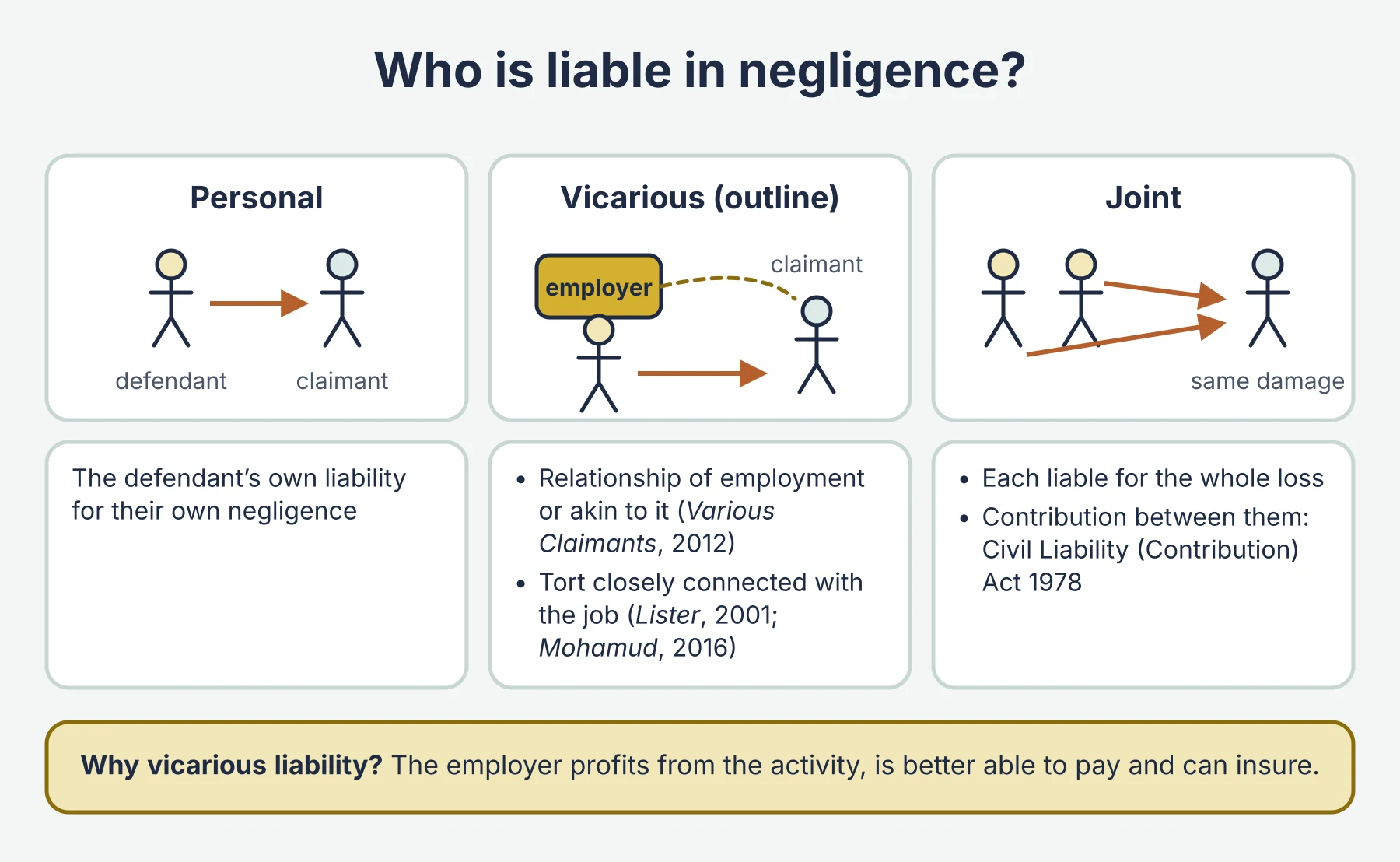
Personal liability is the defendant’s own liability for their own negligence.
Vicarious liability (outline only) makes one person liable for the tort of another without fault of their own, most commonly an employer for an employee’s tort committed in the course of employment. Two questions are asked: is the relationship one of employment or akin to it (Various Claimants v Catholic Child Welfare Society, 2012), and is the tort closely connected with what the employee was employed to do (Lister v Hesley Hall, 2001; Mohamud v WM Morrison Supermarkets, 2016)? The policy is that the employer profits from the activity, is better able to pay and can insure.
Joint liability arises where two or more defendants cause the same damage. Each is liable to the claimant for the whole loss, and they may claim contribution from each other under the Civil Liability (Contribution) Act 1978. The claimant is protected if one defendant cannot pay.
4.1.2 Duty of care
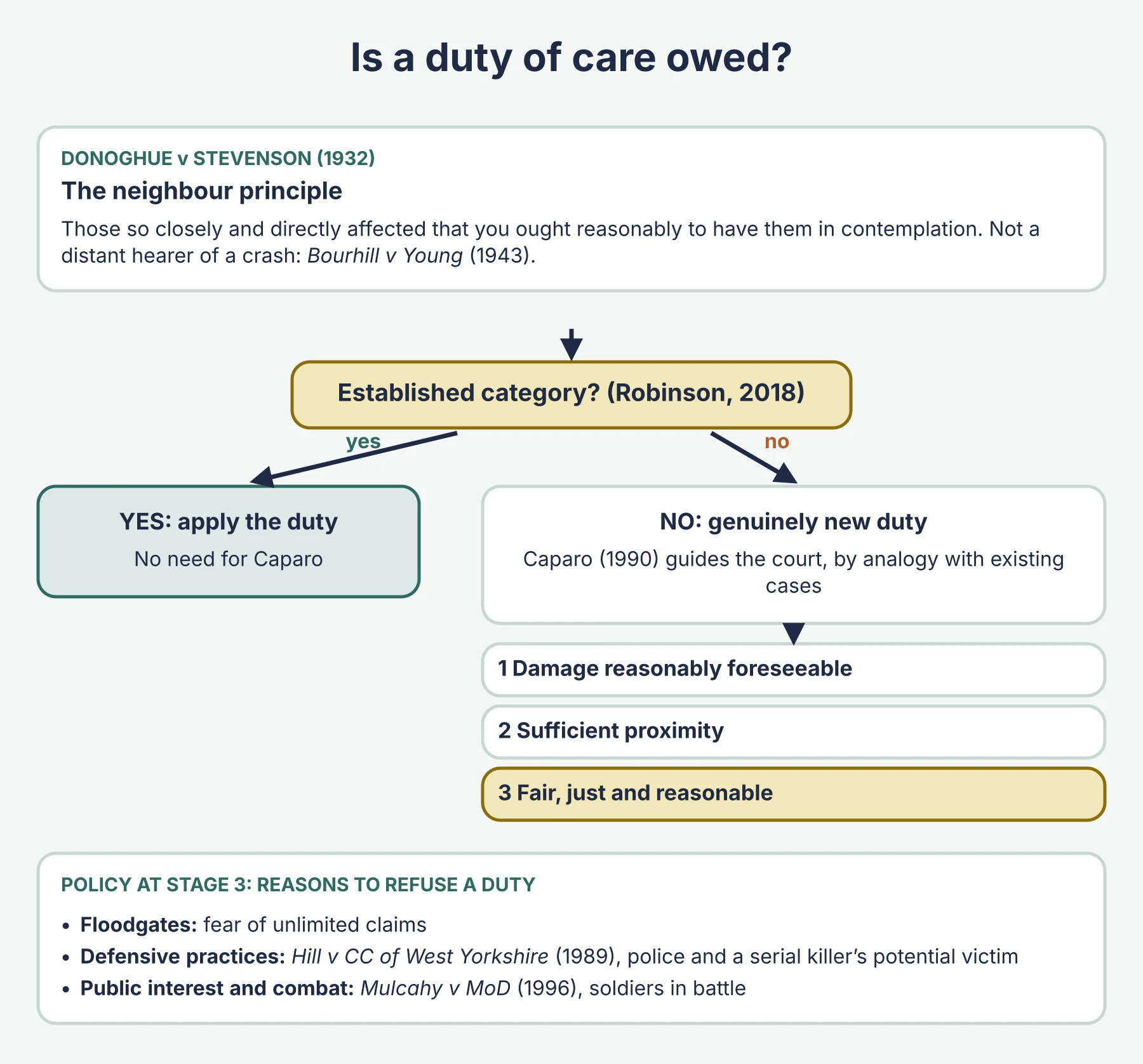
Donoghue v Stevenson (1932) established a general principle: a duty is owed to those so closely and directly affected by your acts that you ought reasonably to have them in contemplation. The claimant must be a foreseeable victim; in Bourhill v Young (1943) a woman who heard a crash from a distance was not.
After a period in which Anns v Merton LBC (1978) appeared to create a broad two-stage test, the House of Lords returned to an incremental approach. Caparo Industries v Dickman (1990) asks whether:
- damage to the claimant was reasonably foreseeable;
- there was a relationship of sufficient proximity; and
- it is fair, just and reasonable to impose a duty.
In Robinson v Chief Constable of West Yorkshire (2018) the Supreme Court explained that Caparo is not a test to be applied in every case. Where the situation falls within an established category, the duty is simply applied; the three stages guide the court when it is asked to recognise a genuinely new duty, developing the law by analogy with existing cases.
Policy
The third stage brings policy openly into the decision. Reasons for refusing a duty include:
- Floodgates: fear of unlimited claims.
- Defensive practices: in Hill v Chief Constable of West Yorkshire (1989) no duty was owed by police to a potential victim of a serial killer, partly because a duty might divert police resources into defensive work.
- Public interest and combat: in Mulcahy v Ministry of Defence (1996) no duty was owed between soldiers in battle conditions.
Policy gives flexibility but is criticised for uncertainty and for judges making value choices without evidence.
4.1.3 Breach of duty
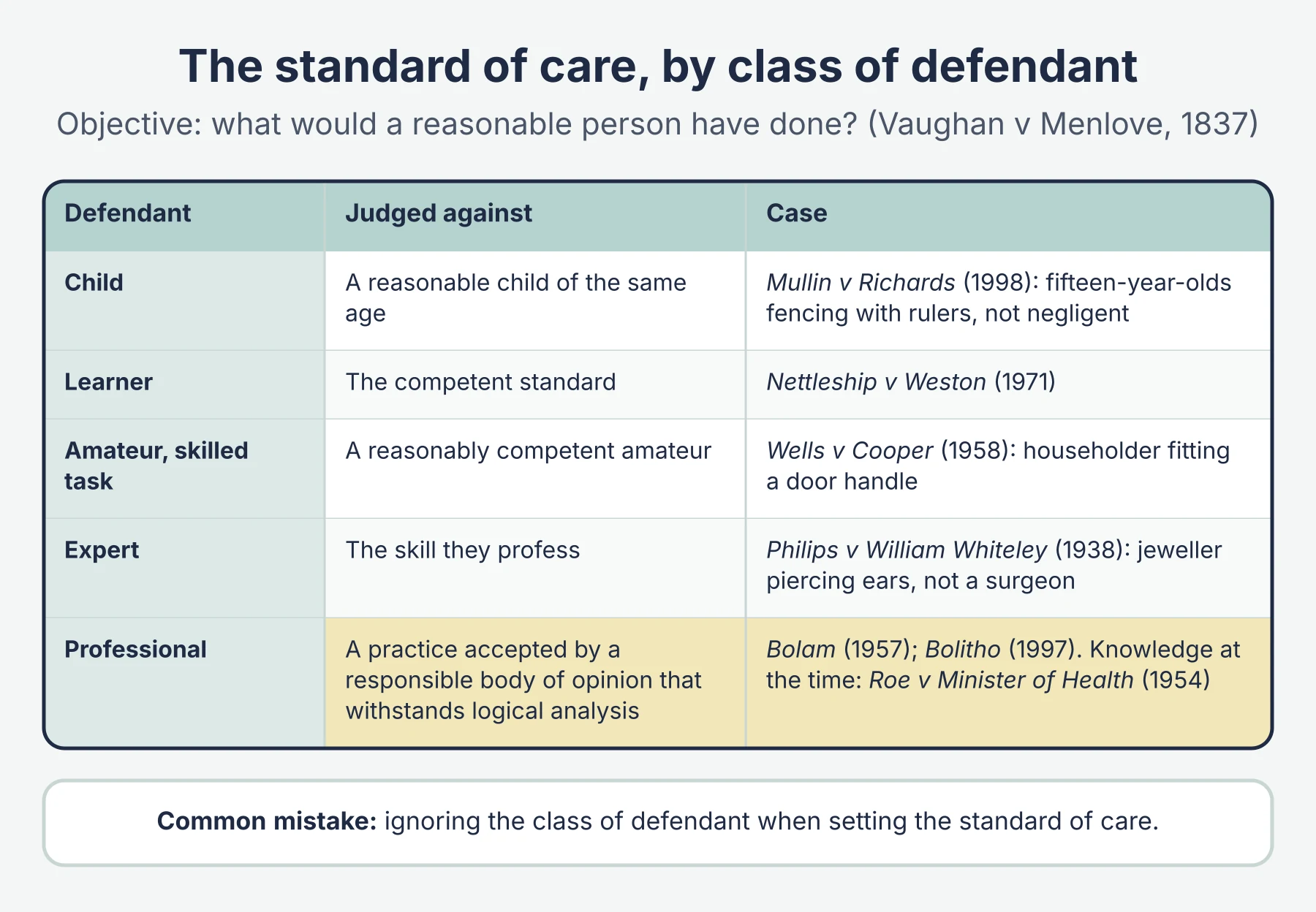
The standard is objective: what would a reasonable person have done? In Vaughan v Menlove (1837) a defendant who acted “to the best of his judgement” was still liable. The standard varies with the class of defendant:
- Children are judged against a reasonable child of the same age. In Mullin v Richards (1998) two fifteen-year-olds fencing with rulers were not negligent because a reasonable fifteen-year-old would not have foreseen the injury.
- Learners are judged by the competent standard (Nettleship v Weston, 1971).
- Amateurs doing skilled tasks are judged by a reasonably competent amateur: in Wells v Cooper (1958) a householder fitting a door handle was not liable.
- Experts are judged by the skill they profess: a jeweller piercing ears was judged as a jeweller, not a surgeon (Philips v William Whiteley, 1938).
- Professionals are not negligent if they acted in accordance with a practice accepted as proper by a responsible body of professional opinion (Bolam v Friern Hospital Management Committee, 1957), provided that opinion withstands logical analysis (Bolitho v City and Hackney Health Authority, 1997). Knowledge is judged at the time: in Roe v Minister of Health (1954) a risk unknown when the anaesthetic was given could not be guarded against.
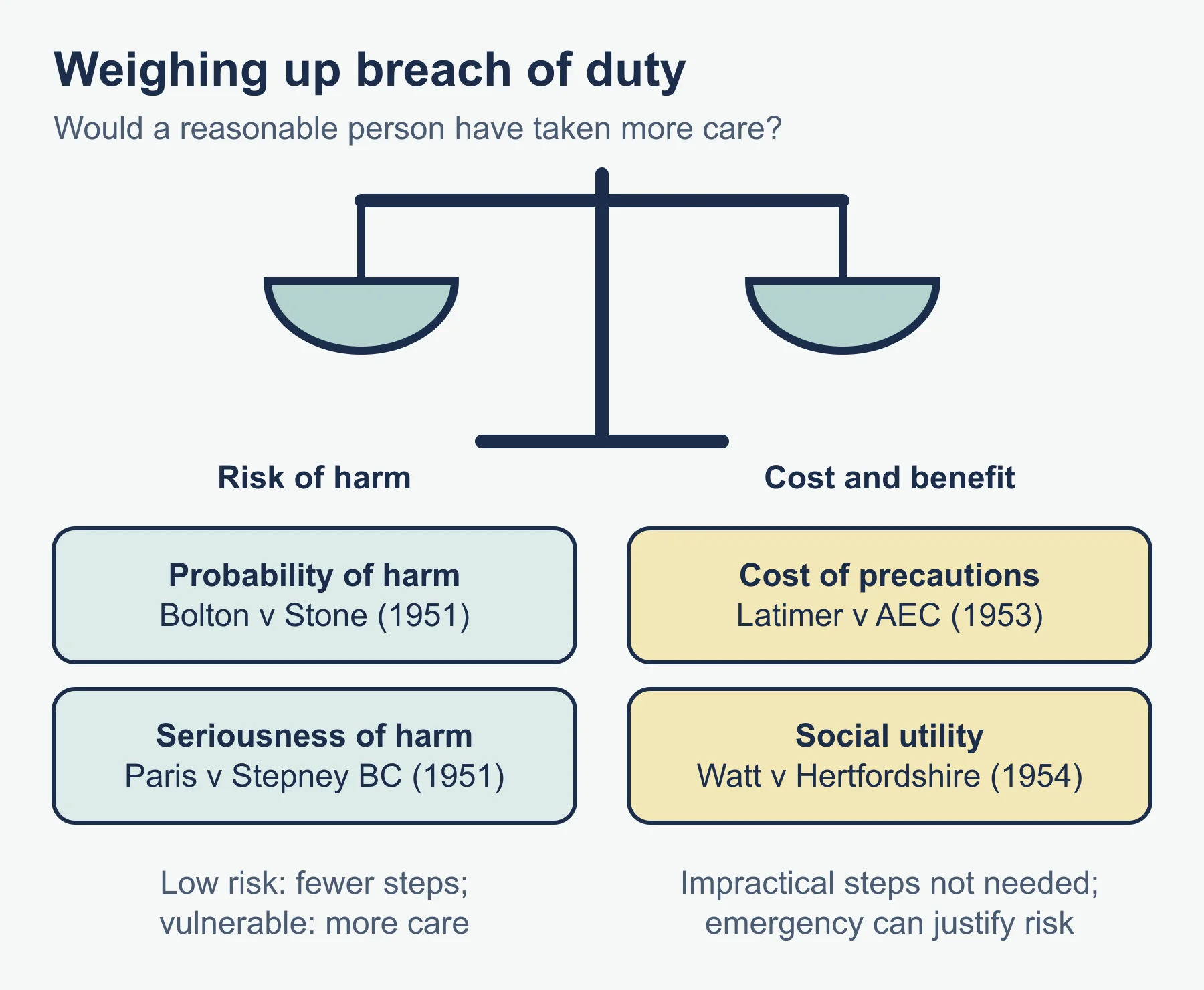
Factors that raise or lower the standard include the probability of harm (Bolton v Stone, 1951), the claimant’s known vulnerability (Paris v Stepney Borough Council, 1951), the cost of precautions (Latimer v AEC, 1953) and the social utility of the activity (Watt v Hertfordshire County Council, 1954, a fire service responding to an emergency).
4.1.4 Causation and remoteness
Factual causation
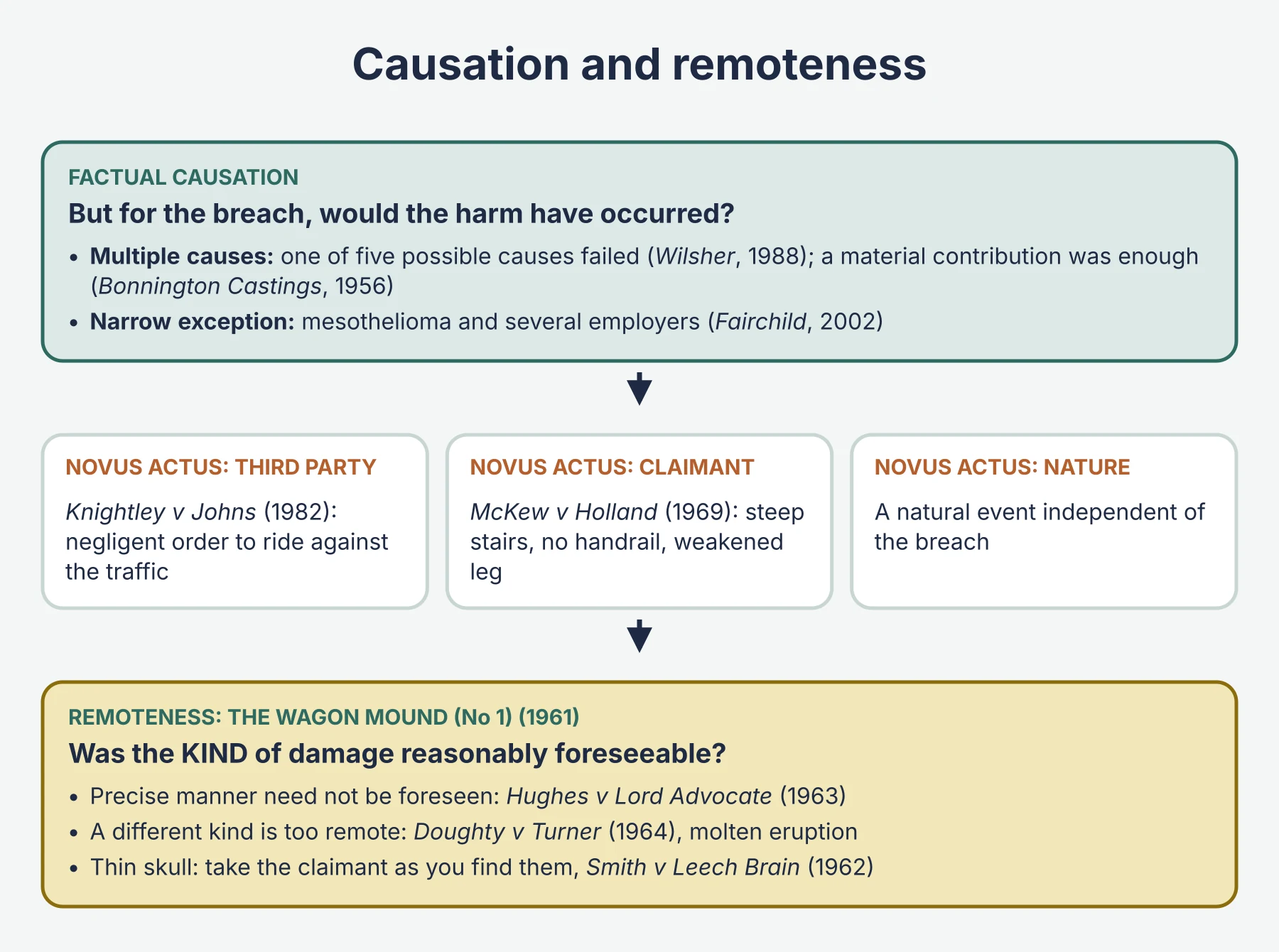
The but for test asks whether the harm would have occurred without the breach. Where there are multiple causes, the claimant must still prove the breach caused or materially contributed to the harm. In Wilsher v Essex Area Health Authority (1988) the breach was one of five possible causes of blindness, and the claim failed. In Bonnington Castings v Wardlaw (1956) a material contribution to lung disease was enough. Fairchild v Glenhaven Funeral Services (2002) created a narrow exception for mesothelioma where several employers each exposed the claimant to asbestos.
Legal causation and intervening acts
A novus actus interveniens breaks the chain of causation. It may be:
- an act of a third party: in Knightley v Johns (1982) a police inspector’s negligent order to ride against the traffic broke the chain from the original accident;
- the claimant’s own unreasonable act: in McKew v Holland and Hannen and Cubitts (1969) the claimant, with a weakened leg, descended steep stairs without a handrail and was injured again;
- a natural event that is independent of the breach.
Remoteness
The damage must be of a kind that was reasonably foreseeable (The Wagon Mound (No 1), 1961). The precise manner need not be foreseen (Hughes v Lord Advocate, 1963), but a different kind of harm is too remote (Doughty v Turner Manufacturing, 1964, an unforeseeable eruption of molten liquid). Under the thin skull rule, the defendant takes the claimant as they find them (Smith v Leech Brain, 1962).
4.1.5 Novel duty situations
Pure economic loss and negligent misstatement
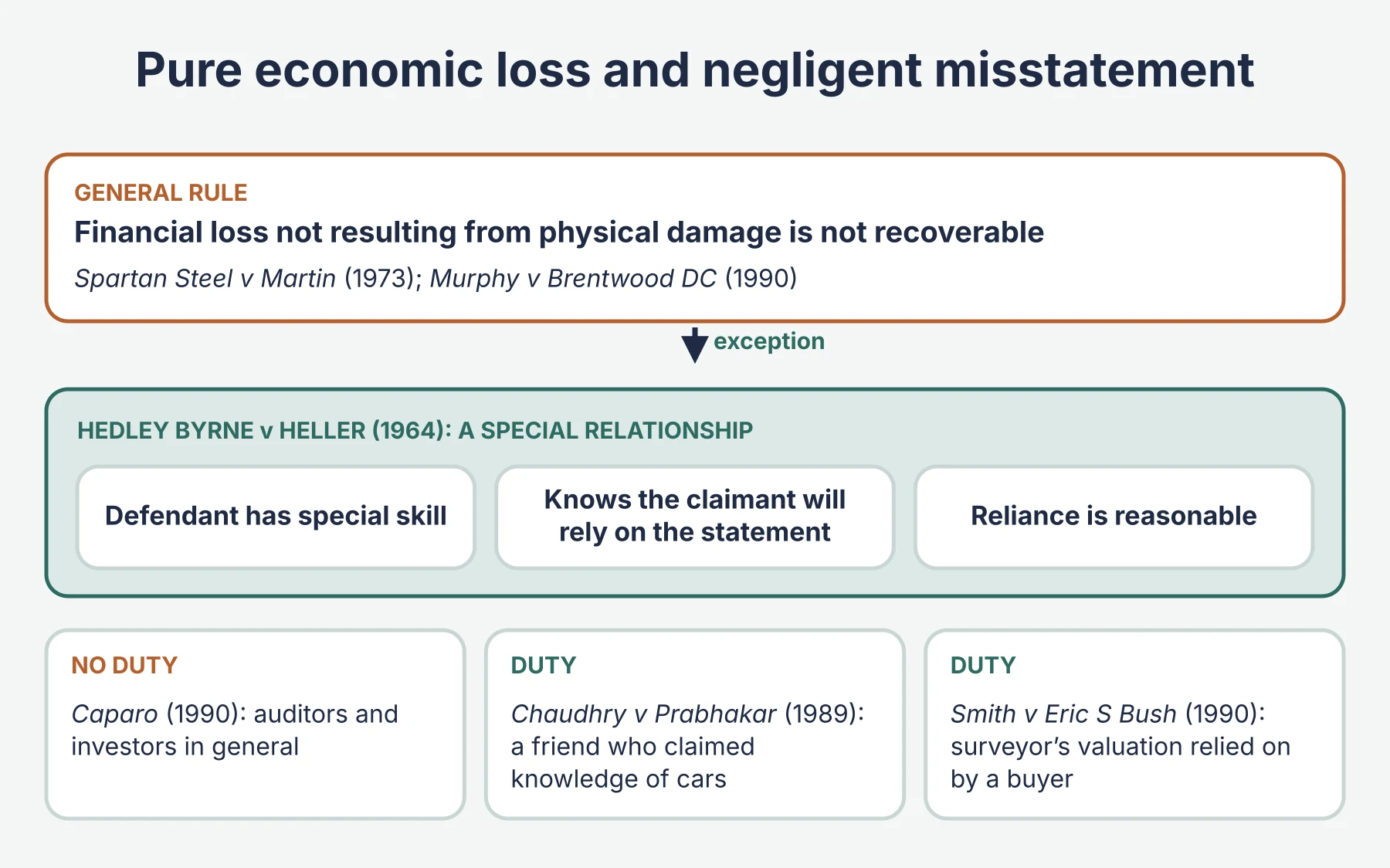
Pure economic loss, which is financial loss not resulting from physical damage, is generally not recoverable in negligence (Spartan Steel and Alloys v Martin, 1973; Murphy v Brentwood DC, 1990). The main exception is negligent misstatement. Hedley Byrne v Heller (1964) recognised a duty where there is a special relationship: the defendant has special skill, knows the claimant will rely on the statement, and reliance is reasonable. In Caparo itself, auditors owed no duty to investors in general. A friend who claimed knowledge of cars was liable in Chaudhry v Prabhakar (1989), and a surveyor’s valuation could be relied on by a house buyer in Smith v Eric S Bush (1990).
Nervous shock
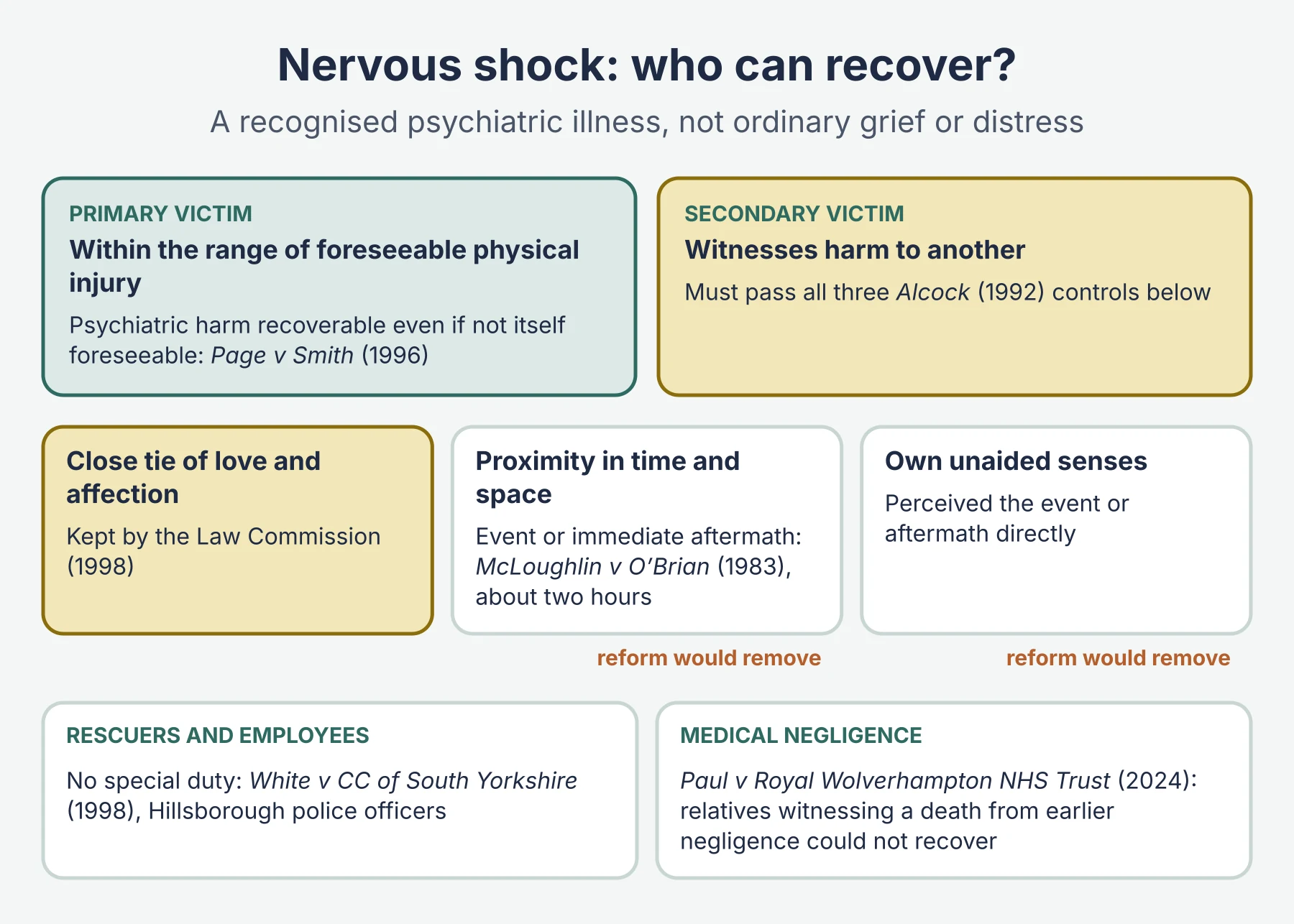
The claimant must suffer a recognised psychiatric illness, not ordinary grief or distress.
- Primary victims are within the range of foreseeable physical injury; if physical injury is foreseeable, psychiatric harm is recoverable even if not itself foreseeable (Page v Smith, 1996).
- Secondary victims witness harm to another. Alcock v Chief Constable of South Yorkshire (1992) requires a close tie of love and affection, proximity in time and space to the event or its immediate aftermath, and perception with one’s own unaided senses. McLoughlin v O’Brian (1983), where a mother saw her family in hospital within about two hours, is the aftermath example.
- Rescuers and employees are not owed a special duty: in White v Chief Constable of South Yorkshire (1998) police officers at Hillsborough had to satisfy the ordinary rules.
- In Paul v Royal Wolverhampton NHS Trust (2024) the Supreme Court held that relatives who witnessed a death caused by earlier medical negligence could not recover as secondary victims.
Policy and reform. The restrictions limit floodgates and fraudulent claims but produce arbitrary lines, such as the distinction between watching an event live and seeing its aftermath later. The Law Commission’s 1998 report on liability for psychiatric illness recommended keeping the close-tie requirement but removing the requirements of proximity in time and space and of perception with one’s own senses; Parliament has not acted on it.
Worked example
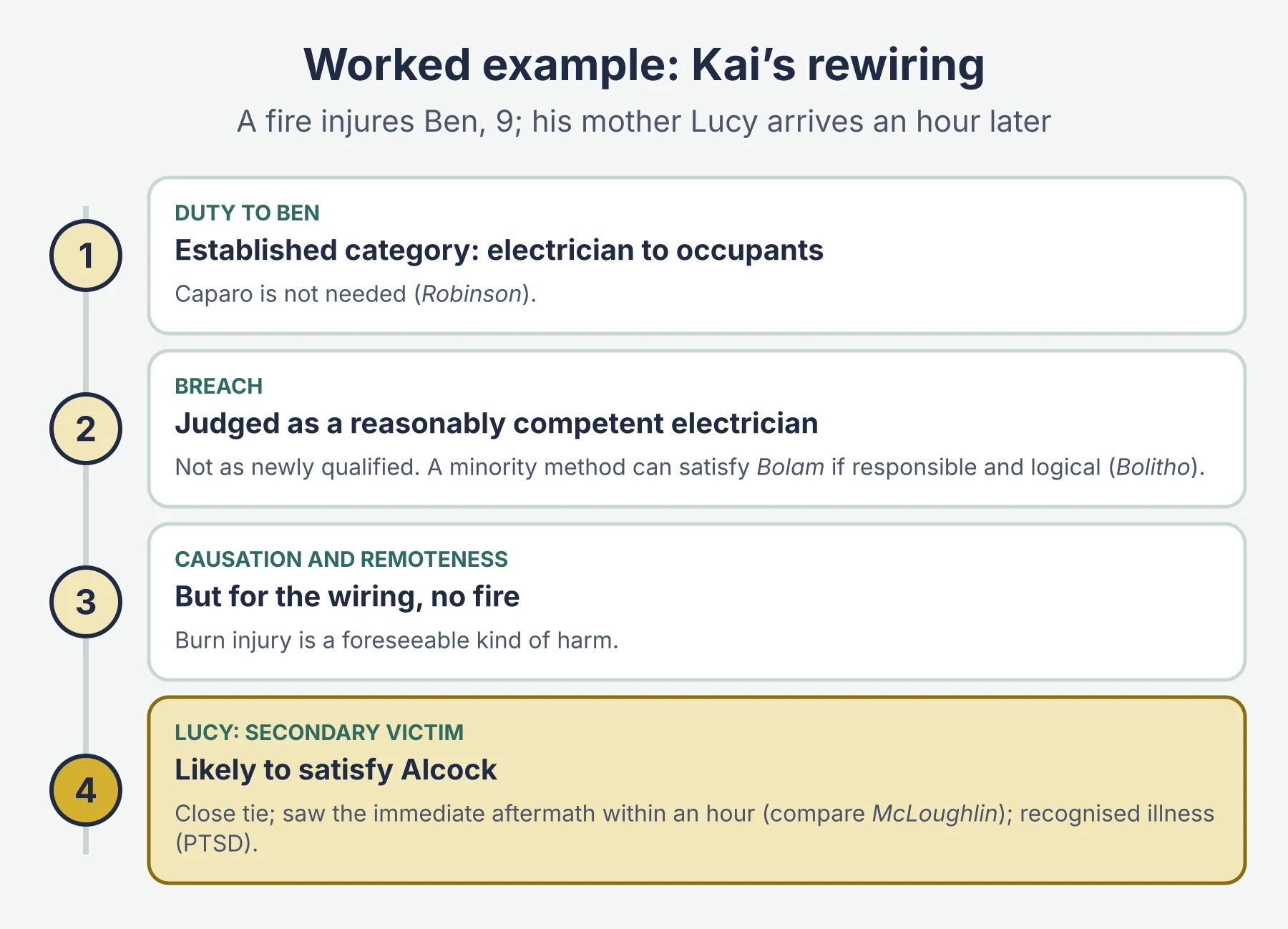
Scenario: Kai, a newly qualified electrician, rewires Lucy’s kitchen. He follows a method a small minority of electricians use. A fault causes a fire. Lucy’s son Ben, aged nine, is burned. Lucy, who was at work, arrives an hour later and sees Ben being treated in the ambulance; she develops post-traumatic stress disorder.
- Duty to Ben: an electrician owes a duty to occupants of the property; this is an established category, so Caparo is not needed (Robinson).
- Breach: Kai is judged as a reasonably competent electrician, not as a newly qualified one. A minority practice can satisfy Bolam if it is responsible and logical (Bolitho).
- Causation: but for the faulty wiring there would be no fire; burn injury is a foreseeable kind of harm.
- Lucy: a secondary victim with a close tie of love and affection; she saw the immediate aftermath within an hour, comparable to McLoughlin; she has a recognised illness, so she is likely to satisfy Alcock.
Common mistakes
- Applying Caparo to every duty question after Robinson.
- Ignoring the class of defendant when setting the standard of care.
- Treating any later event as a novus actus without asking whether it was independent and unreasonable.
- Describing secondary victim rules without applying each Alcock control mechanism to the facts.
Exam technique
In advise questions take duty, breach, causation and remoteness in order. In discuss or evaluate essays, use policy, the Law Commission proposals and the arbitrariness of the control mechanisms. Revise with the negligence revision notes and test yourself with the negligence practice questions.
Related resources
-
Practice questions
Cambridge A Level Law (9084): The tort of negligence – Practice Questions
Twelve original questions with mark-scheme answers on duty, breach, causation, economic loss and nervous shock for Cambridge A Level Law 9084, sub-topic 4.1.
Law · Cambridge · A Level
Try questions -
Revision notes
Cambridge A Level Law (9084): The tort of negligence – Revision Notes
Condensed notes on duty, policy, breach, causation, remoteness, economic loss and nervous shock in negligence for Cambridge A Level Law 9084, with a self-test.
Law · Cambridge · A Level
Revise topic -
Study guides
Cambridge A Level Law (9084): Torts affecting land
Occupiers' liability under the 1957 and 1984 Acts, private nuisance, Rylands v Fletcher and trespass to land for Cambridge A Level Law 9084, sub-topic 4.2.
Law · Cambridge · A Level
Read guide
Get free revision emails (optional)
Occasional emails with practice questions, worked explanations and links to free resources for the qualification and subjects you choose. No spam, and you can unsubscribe from any email. The free tools on this site never need an email.