
Revision Notes
Cambridge A Level Law (9084): General defences and remedies – Revision Notes
Condensed notes on volenti, contributory negligence, other tort defences, damages and injunctions for Cambridge A Level Law 9084, with a self-test.
- Subject
- Law
- Level
- A LEVEL
- Topic
- Topic 4: Law of tort
- Author
- Marlbridge Academic Team
- Updated
- Reviewed by
- Aizaz Raoof Ali (what this means)
Aligned to Cambridge A Level Law (9084), 2026-2028. Official specification .
Syllabus page (what it covers and how it is assessed): Cambridge A Level Law.
Syllabus points this page covers
9084 (A Level)
- 4.4 General defences and remedies
Found an error? Report a correction.
Need help with this topic? Request a free trial class for A Level Law (9084).
Related: general defences and remedies study guide and general defences and remedies practice questions.
Sub-topic 4.4 of Cambridge International A Level Law (9084), assessed on Paper 4: general defences (4.4.1) and remedies (4.4.2).
4.4.1 Defences: condensed recall
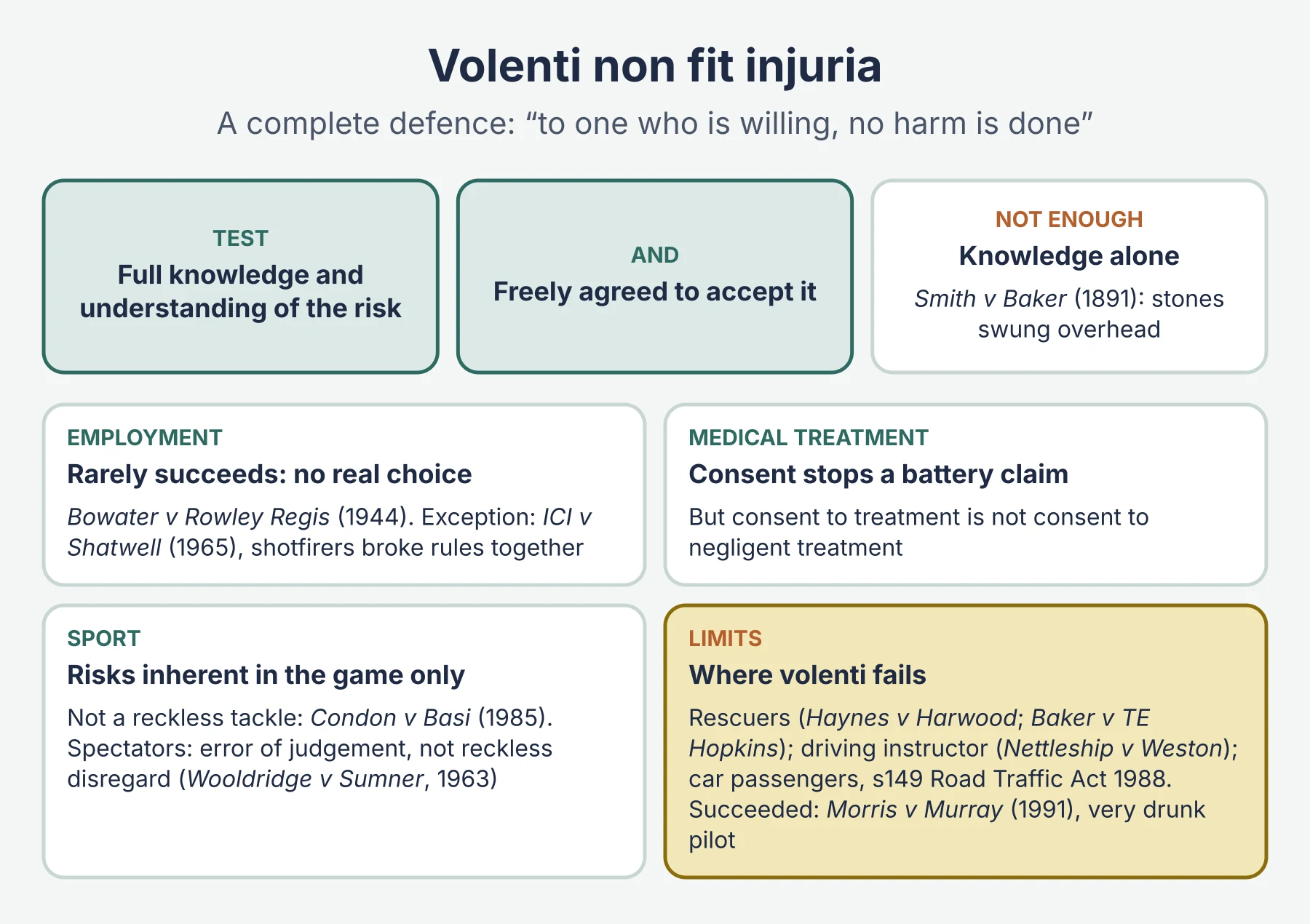
Volenti non fit injuria (complete defence)
Requirements: full knowledge and understanding of the risk, and free agreement to accept it. Knowledge alone is not enough (Smith v Baker, 1891).
| Context | Rule | Authority |
|---|---|---|
| Employment | Rarely succeeds; employees lack free choice | Bowater v Rowley Regis (1944); exception ICI v Shatwell (1965) |
| Medical treatment | Consent to a procedure, not to negligence | General principle |
| Sport: players | Inherent risks only, not reckless play | Condon v Basi (1985) |
| Sport: spectators | Errors of judgement, not reckless disregard | Wooldridge v Sumner (1963) |
| Rescuers | Not volunteers | Haynes v Harwood (1935); Baker v TE Hopkins (1959) |
| Passengers in cars | Defence excluded | s149 Road Traffic Act 1988 |
| Drunk pilot | Defence succeeded | Morris v Murray (1991) |
Contributory negligence (partial defence)
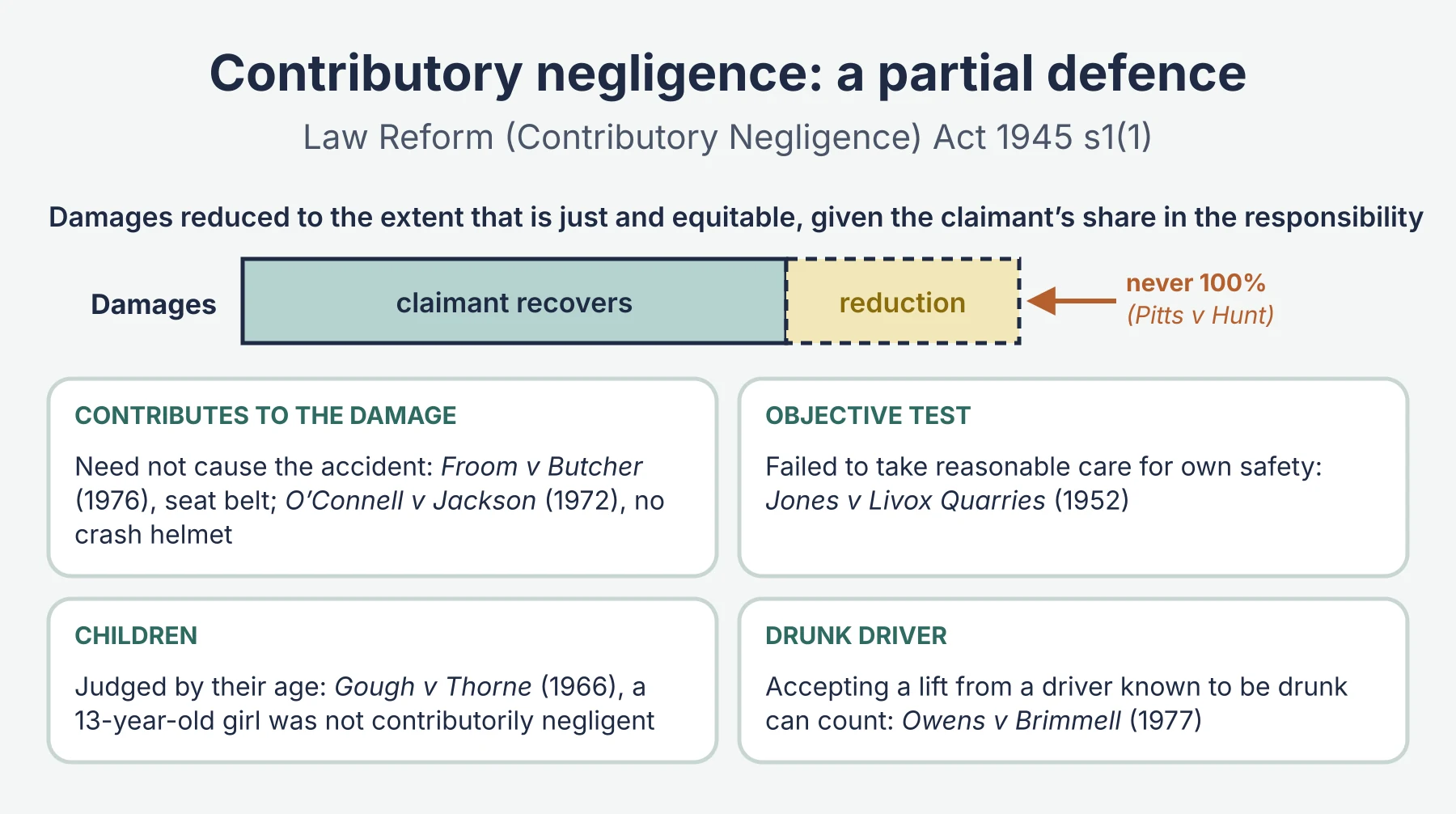
- Statute: Law Reform (Contributory Negligence) Act 1945, s1(1); damages reduced as just and equitable having regard to the claimant’s share in responsibility.
- Fault contributes to damage, not necessarily the accident: Froom v Butcher (1976), 25 per cent if a seat belt would have prevented injury, 15 per cent if it would have reduced it; O’Connell v Jackson (1972), no crash helmet.
- Objective test: Jones v Livox Quarries (1952). Children: Gough v Thorne (1966).
- Drunk driver: Owens v Brimmell (1977).
- No 100 per cent reduction: Pitts v Hunt (1991).
Other general defences
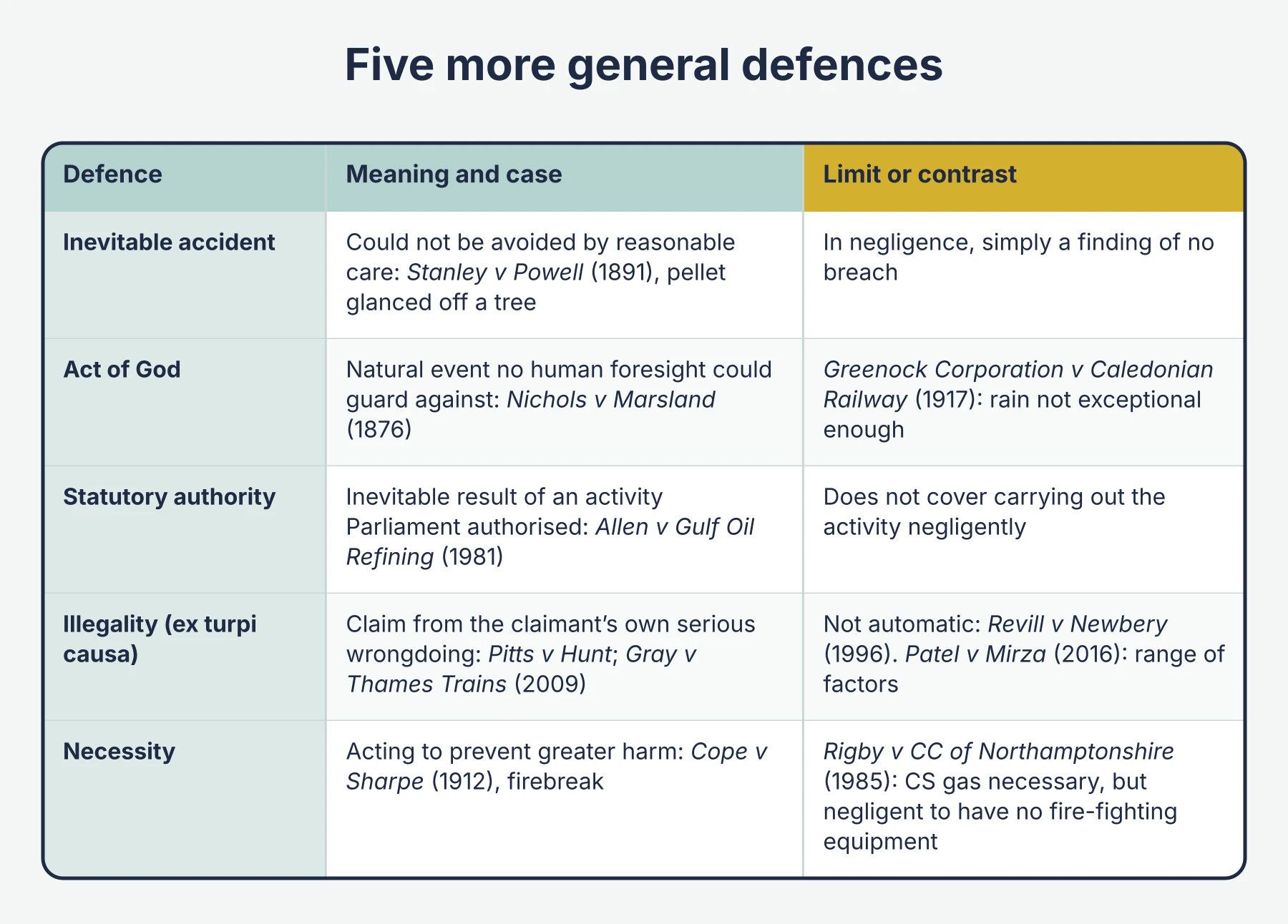
| Defence | Meaning | Authority |
|---|---|---|
| Inevitable accident | Harm not avoidable by reasonable care | Stanley v Powell (1891) |
| Act of God | Natural event no foresight could guard against | Nichols v Marsland (1876); contrast Greenock Corporation v Caledonian Railway (1917) |
| Statutory authority | Inevitable result of an authorised activity | Allen v Gulf Oil Refining (1981) |
| Illegality | Claim arising from the claimant’s serious wrongdoing | Pitts v Hunt (1991); Gray v Thames Trains (2009); Patel v Mirza (2016); contrast Revill v Newbery (1996) |
| Necessity | Action to prevent greater harm | Cope v Sharpe (1912); Rigby v Chief Constable of Northamptonshire (1985) |
4.4.2 Remedies: condensed recall
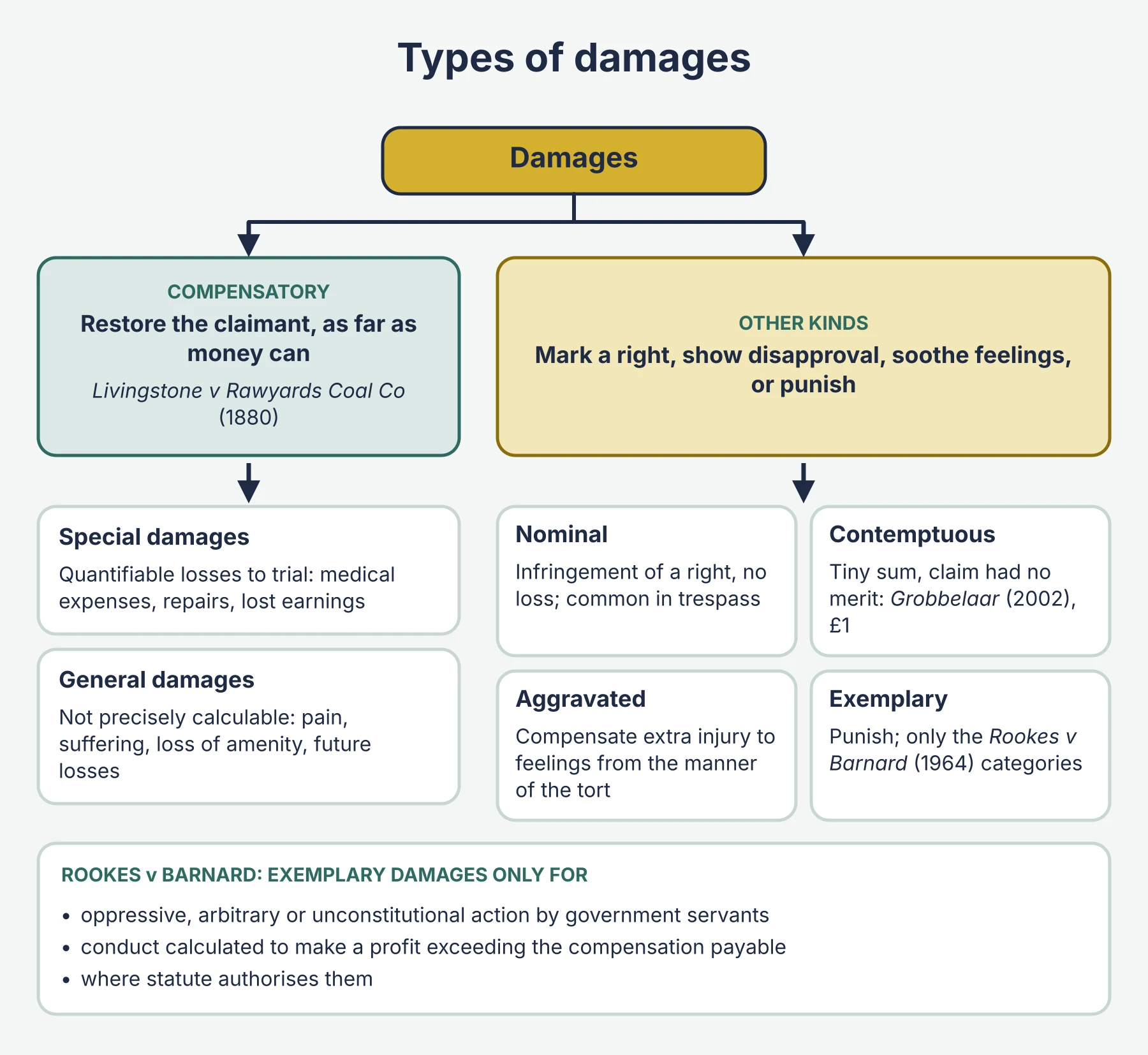
Purpose of damages: restore the claimant to the position before the tort (Livingstone v Rawyards Coal, 1880).
| Type | Content |
|---|---|
| Special damages | Quantified losses to trial: medical bills, repairs, lost earnings |
| General damages | Pain, suffering, loss of amenity; future losses |
| Nominal | Small sum for infringement without loss |
| Contemptuous | Tiny sum for a technically successful but unmeritorious claim (Grobbelaar, 2002) |
| Aggravated | Compensation for extra injury to feelings from the manner of the tort |
| Exemplary | Punishment; only in Rookes v Barnard (1964) categories |
Rookes v Barnard categories: oppressive, arbitrary or unconstitutional action by government servants; conduct calculated to make a profit exceeding compensation; authorised by statute.
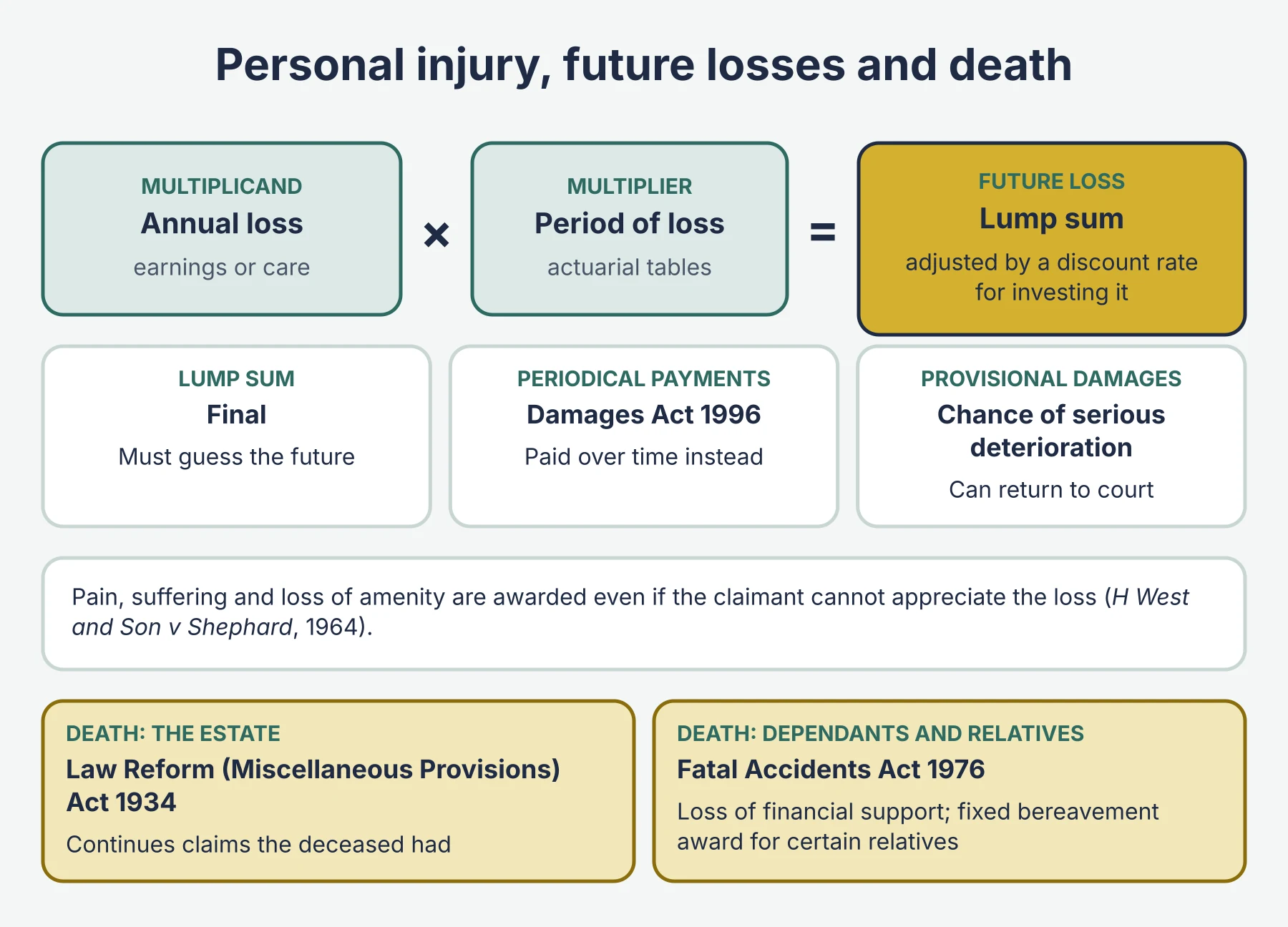
Personal injury:
- Pain, suffering and loss of amenity even if unaware (H West and Son v Shephard, 1964).
- Future loss: multiplicand (annual loss) × multiplier (period, adjusted for discount rate and actuarial tables).
- Lump sum versus periodical payment orders (Damages Act 1996); provisional damages for risk of serious deterioration.
Death: estate claims survive (Law Reform (Miscellaneous Provisions) Act 1934); dependants’ loss of support and bereavement award (Fatal Accidents Act 1976).
Policy issues: guesswork in lump sums; cost and delay; fault-based inequality between similar injuries; burden on insurers and public bodies. Reforms: more periodical payments, no-fault schemes, tariffs for minor claims.
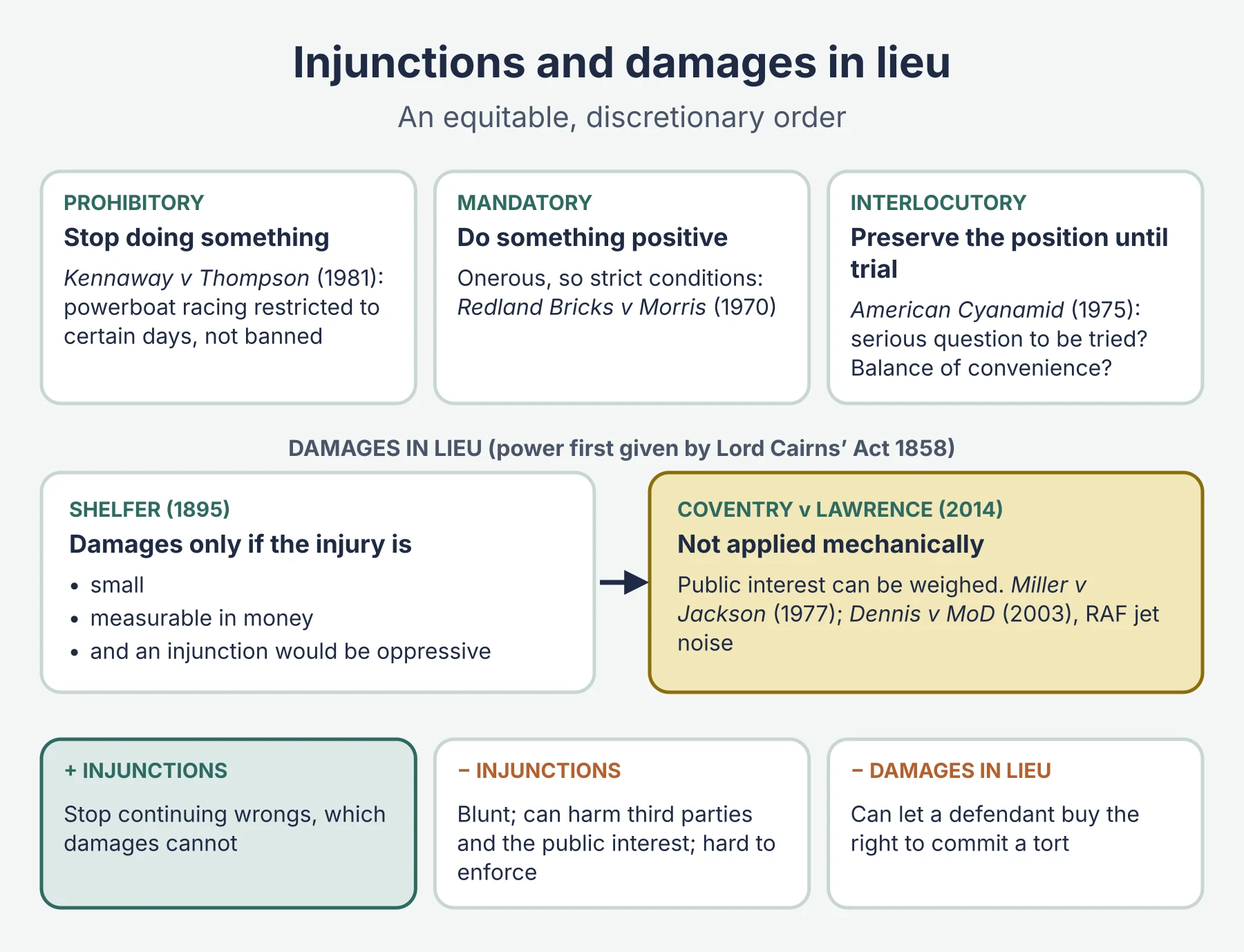
Injunctions:
| Type | Purpose | Authority |
|---|---|---|
| Prohibitory | Stop a continuing tort | Kennaway v Thompson (1981), limited racing |
| Mandatory | Require positive action; strict conditions | Redland Bricks v Morris (1970) |
| Interlocutory | Preserve position before trial | American Cyanamid v Ethicon (1975) |
| Damages in lieu | Money instead of an injunction | Shelfer (1895); Coventry v Lawrence (2014); Miller v Jackson (1977); Dennis v MoD (2003) |
Key terms
| Term | Meaning |
|---|---|
| Volenti non fit injuria | No harm is done to one who consents to the risk |
| Contributory negligence | Claimant’s own fault contributing to the damage |
| Apportionment | Division of responsibility between claimant and defendant |
| Act of God | Natural event beyond human foresight |
| Ex turpi causa | No action arises from a base cause; the illegality defence |
| Special damages | Precisely calculable past losses |
| General damages | Losses not precisely calculable, including future loss |
| Exemplary damages | Damages intended to punish |
| Multiplier | Figure reflecting the duration of future loss |
| Interlocutory injunction | Temporary order before trial |
| Damages in lieu | Damages awarded instead of an injunction |
Exam traps
- Knowledge is not consent: apply Smith v Baker before accepting volenti.
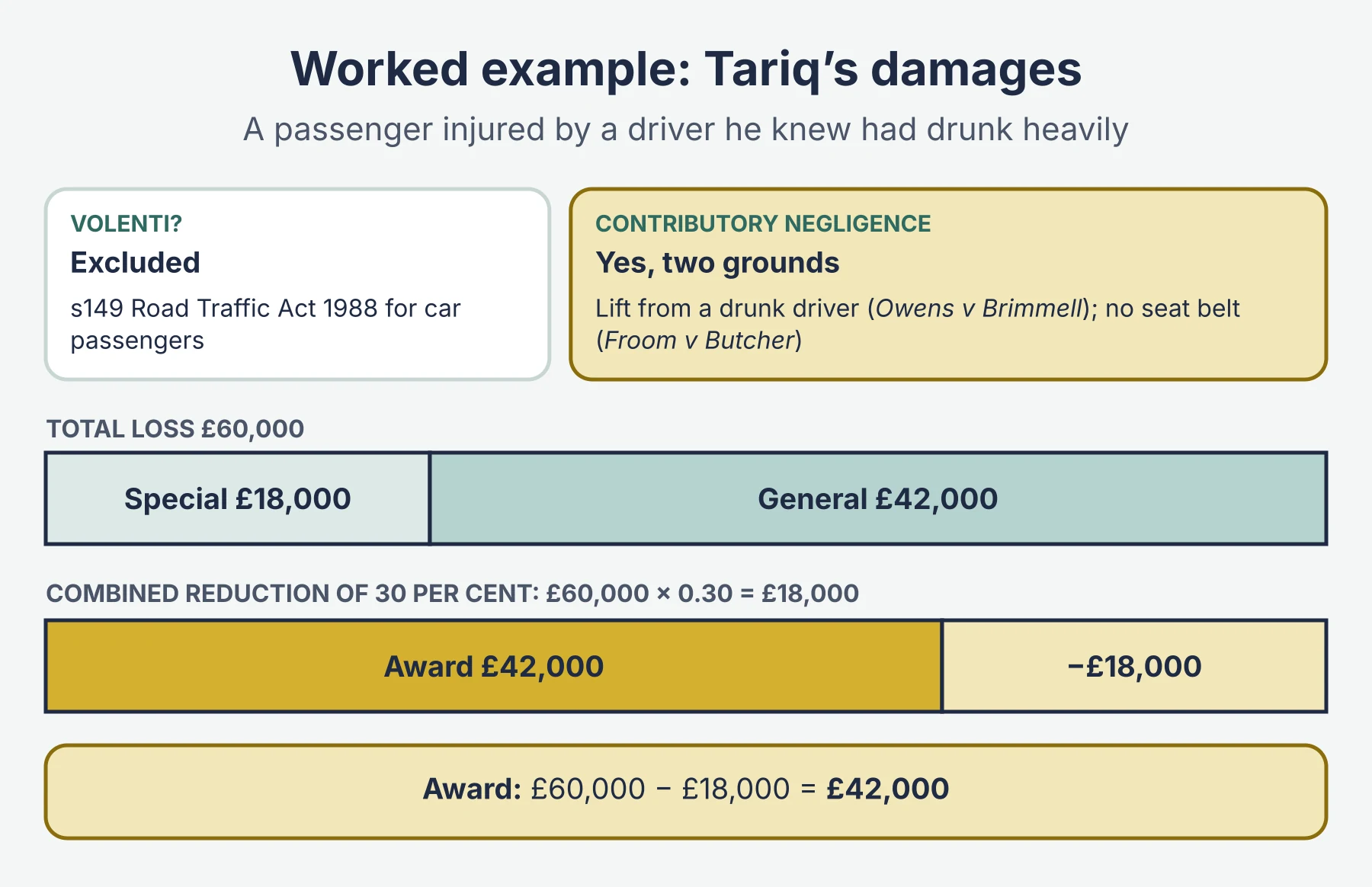
- Passengers: volenti is excluded by s149 Road Traffic Act 1988; use contributory negligence.
- Apply percentages correctly: reduce the total damages, then state the final award.
- Aggravated versus exemplary: aggravated compensate; exemplary punish.
- Injunctions are discretionary: explain why the court might award damages in lieu.
- Statutory authority does not cover negligent performance of the authorised activity.
Self-test
- Why did volenti fail in Smith v Baker?
- Why did volenti succeed in ICI v Shatwell?
- What does s149 Road Traffic Act 1988 do?
- What guideline reductions did Froom v Butcher give?
- Why can a reduction for contributory negligence not be 100 per cent?
- What is the difference between inevitable accident and Act of God?
- What did Revill v Newbery show about illegality?
- What happened in Rigby v Chief Constable of Northamptonshire?
- Distinguish special and general damages.
- Name the three Rookes v Barnard categories for exemplary damages.
- What did Kennaway v Thompson show about injunctions?
- How did Coventry v Lawrence affect the Shelfer test?
Answers:
- Knowing of the risk of stones swung overhead was not agreeing to accept it.
- Experienced shotfirers freely and jointly broke safety rules, accepting the risk.
- It prevents a driver relying on volenti against a passenger.
- 25 per cent if a seat belt would have prevented the injury; 15 per cent if it would have reduced it.
- The claimant would recover nothing, which the 1945 Act does not contemplate (Pitts v Hunt).
- Inevitable accident is harm reasonable care could not avoid; Act of God is a natural event beyond human foresight.
- Illegality is not automatic; the burglar recovered damages, reduced for contributory negligence.
- CS gas fired to flush out a gunman was justified by necessity, but the police were negligent in having no fire-fighting equipment ready.
- Special damages are calculable losses to trial; general damages cover non-pecuniary and future losses.
- Oppressive, arbitrary or unconstitutional government action; conduct calculated to make a profit; statutory authorisation.
- An injunction can be tailored to limit, rather than ban, an activity.
- The Shelfer criteria should not be applied mechanically; public interest can support damages in lieu.
Related resources
-
Study guides
Cambridge A Level Law (9084): The tort of negligence
Nature of liability, duty of care and policy, breach, causation and remoteness, economic loss and nervous shock for Cambridge A Level Law 9084, sub-topic 4.1.
Law · Cambridge · A Level
Read guide -
Practice questions
Cambridge A Level Law (9084): The tort of negligence – Practice Questions
Twelve original questions with mark-scheme answers on duty, breach, causation, economic loss and nervous shock for Cambridge A Level Law 9084, sub-topic 4.1.
Law · Cambridge · A Level
Try questions -
Revision notes
Cambridge A Level Law (9084): The tort of negligence – Revision Notes
Condensed notes on duty, policy, breach, causation, remoteness, economic loss and nervous shock in negligence for Cambridge A Level Law 9084, with a self-test.
Law · Cambridge · A Level
Revise topic
Get free revision emails (optional)
Occasional emails with practice questions, worked explanations and links to free resources for the qualification and subjects you choose. No spam, and you can unsubscribe from any email. The free tools on this site never need an email.