
Study Guides
Cambridge International AS & A Level Psychology (9990): 1.4 Anxiety disorders and fear-related disorders
Topic 1.4 for Cambridge 9990 Psychology: GAD, agoraphobia and blood-injection-injury phobia, GAD-7 and BIPI, three explanations and treatments.
- Subject
- Psychology
- Level
- A LEVEL
- Topic
- Specialist Option 1: Clinical Psychology
- Author
- Marlbridge Academic Team
- Updated
- Reviewed by
- Kanwal Aslam (what this means)
Aligned to Cambridge A Level Psychology (9990), 2024-2026. Official specification .
Syllabus page (what it covers and how it is assessed): Cambridge A Level Psychology.
Syllabus points this page covers
9990 (A Level)
- 1.4 Anxiety disorders and fear-related disorders
Topic 1.4 of Specialist Option 1, Clinical Psychology, in Cambridge International AS & A Level Psychology (9990) covers anxiety disorders and fear-related disorders. It names three conditions (generalised anxiety disorder, agoraphobia and blood-injection-injury phobia), two measures, three explanations of fear-related disorders and three treatments, including the key study by Chapman and DeLapp (2013). This page develops each part further than the Clinical Psychology study guide, with particular attention to why blood-injection-injury phobia needs a different treatment from other phobias.
Revise with the anxiety and fear-related disorders revision notes and test yourself with the anxiety and fear-related disorders practice questions.
1.4.1 Diagnosis and measurement
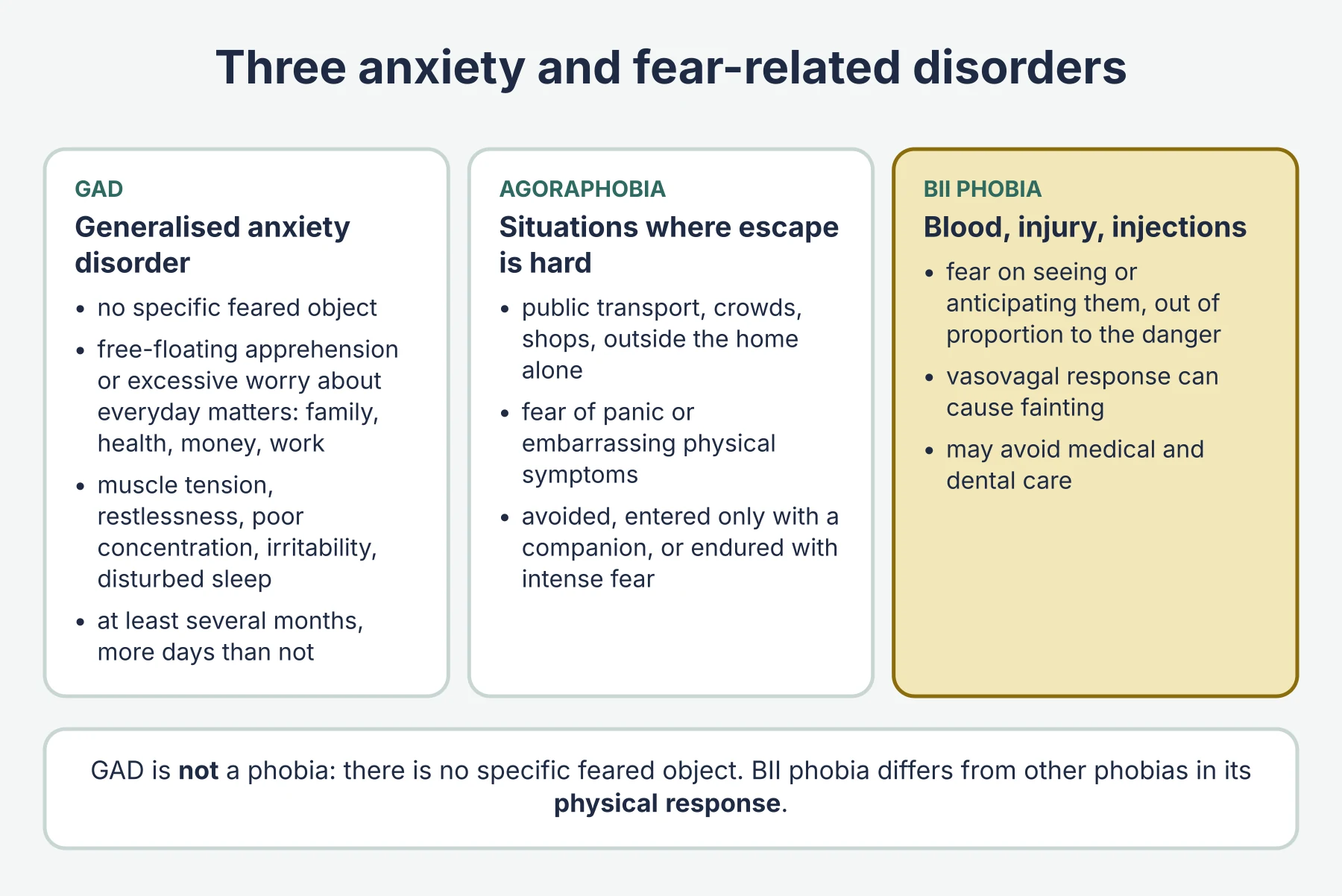
Generalised anxiety disorder (GAD). Marked anxiety lasting at least several months, on more days than not, shown either as general apprehension (“free-floating” anxiety) or as excessive worry about several everyday matters such as family, health, money and work. Other symptoms include muscle tension or restlessness, overactivity of the sympathetic nervous system, nervousness, difficulty concentrating, irritability and disturbed sleep. The symptoms cause significant distress or impairment.
Agoraphobia. Marked and excessive fear or anxiety in response to several situations where escape might be difficult or help unavailable, such as public transport, crowds, shops or being outside the home alone. The person fears specific negative outcomes, such as panic or embarrassing physical symptoms. The situations are avoided, entered only with a companion, or endured with intense fear, for at least several months.
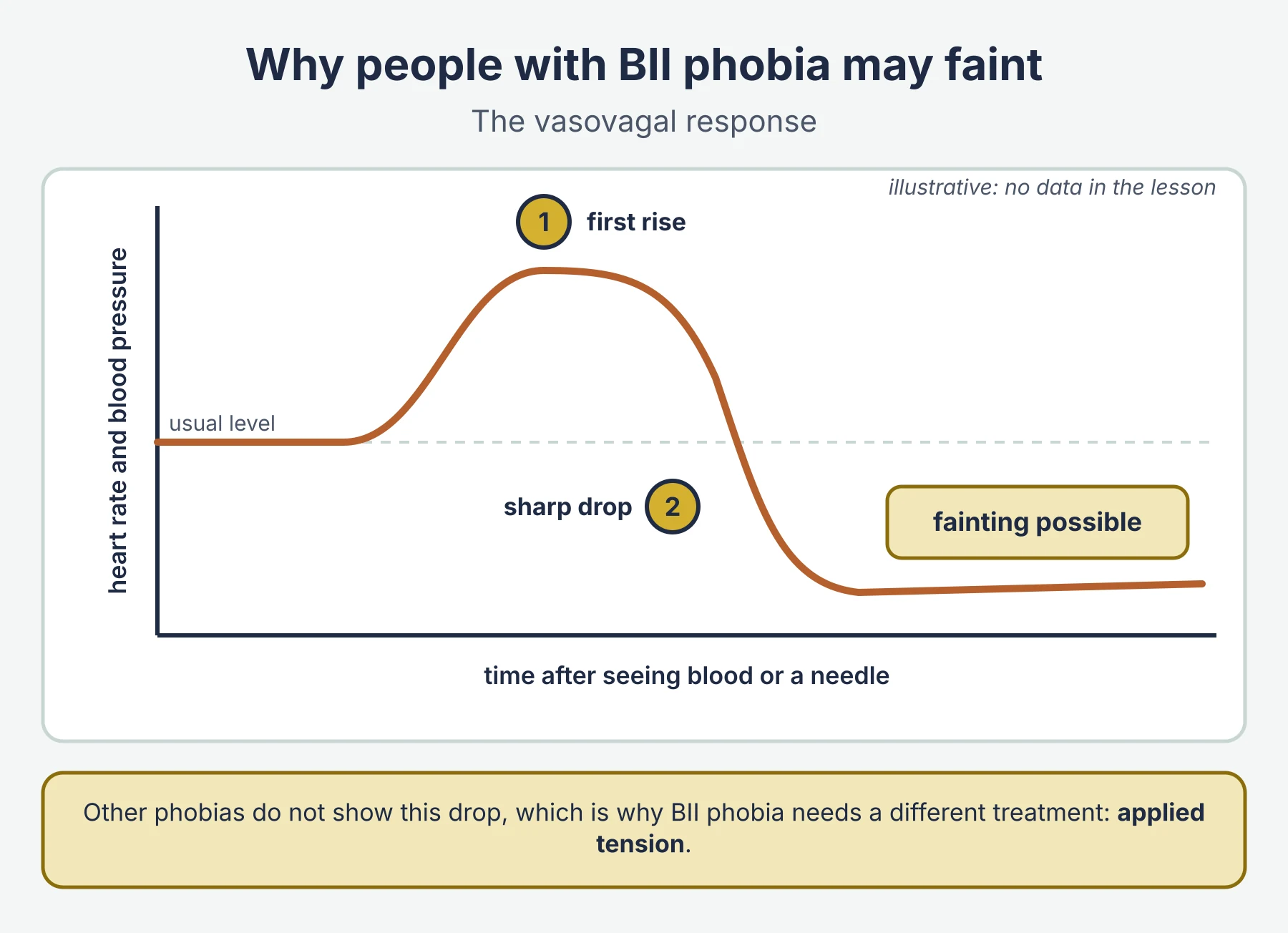
Specific phobia: blood-injection-injury (BII). Marked, excessive fear on seeing blood, injury or injections, or on anticipating them, out of proportion to the real danger and leading to avoidance. BII phobia differs from other phobias in its physical response: heart rate and blood pressure first rise, then drop sharply (a vasovagal response), which can cause fainting. People may avoid medical and dental care as a result.
| Measure | Format | What it shows |
|---|---|---|
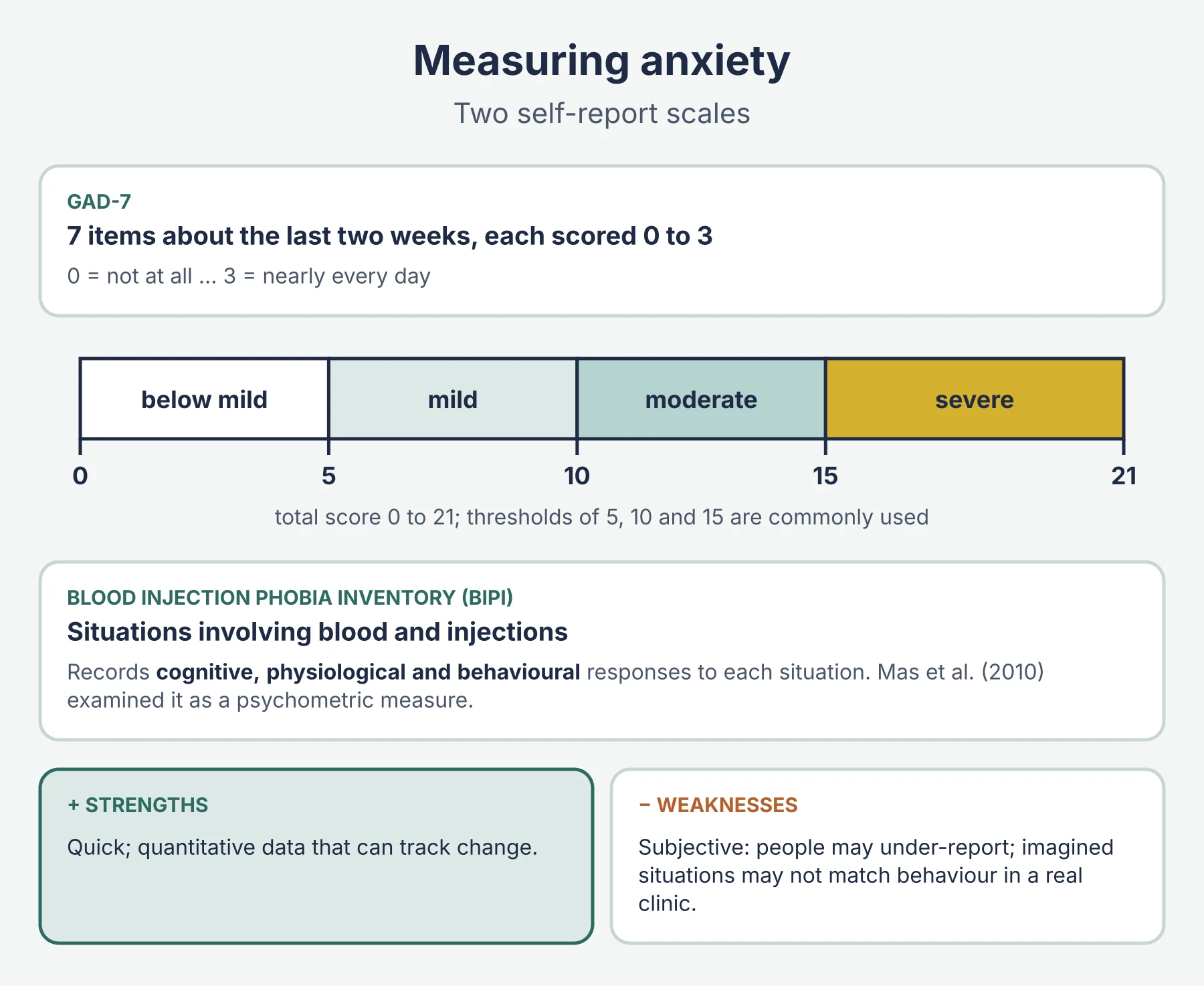
| GAD-7 | Seven self-report items about the last two weeks, each scored 0 (not at all) to 3 (nearly every day); total 0–21 | Scores of 5, 10 and 15 are commonly used as thresholds for mild, moderate and severe anxiety |
| Blood Injection Phobia Inventory (BIPI) | Self-report inventory of situations involving blood and injections | Cognitive, physiological and behavioural responses to each situation |
Mas et al. (2010) is the syllabus’s suggested study for the BIPI, examining it as a psychometric measure. Both scales are quick and give quantitative data that can track change, but both are subjective self-report: people may under-report anxiety, and a questionnaire about imagined situations may not match behaviour in a real clinic. The syllabus lists validity and reliability alongside these measures, so be ready to discuss test-retest reliability and whether scores match clinical interviews.
1.4.2 Explanations of fear-related disorders
Biological: genetic
Öst (1992) studied people with blood and injection phobias and found that many had a close family member with the same fear. BII phobia appears to run in families more strongly than many other phobias, and the inherited element may be the vasovagal fainting response itself. Evaluation: a family pattern does not separate genes from environment, since children may also learn fear by watching a parent faint or avoid injections.
Behavioural: classical conditioning
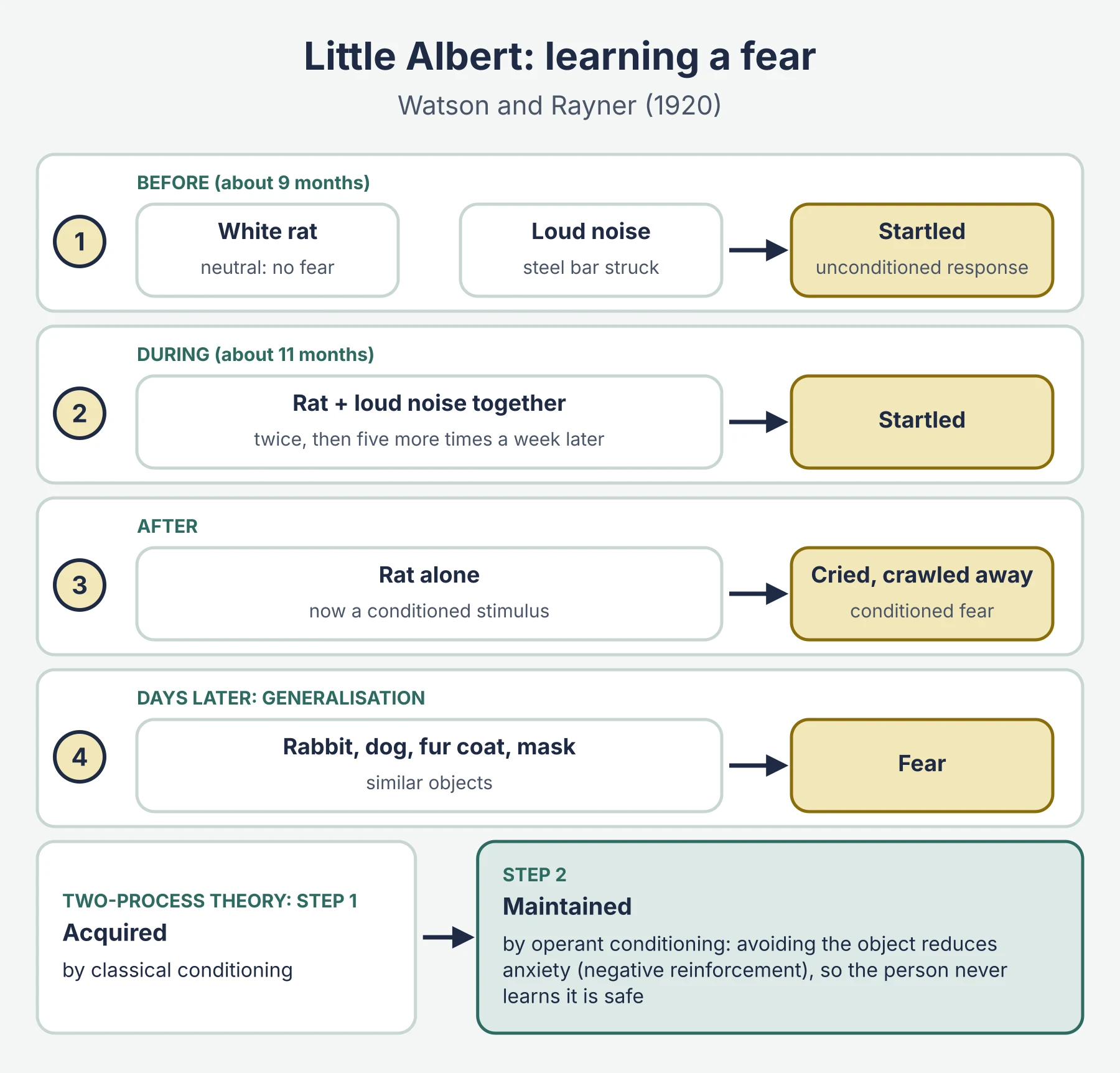
Watson and Rayner (1920) tested “Little Albert”, an infant who at about nine months showed no fear of a white rat, a rabbit, a dog, masks or cotton wool, but was startled by a loud noise made by striking a steel bar behind him. At about 11 months the rat was presented together with the noise, twice in the first session and five more times a week later. Albert then cried and crawled away when the rat appeared alone. Days later the fear had generalised to similar objects such as a rabbit, a dog, a fur coat and a mask. He left before any attempt to remove the fear.
Two-process theory extends this: fear is acquired through classical conditioning and maintained through operant conditioning, because avoiding the feared object reduces anxiety (negative reinforcement), so the person never learns it is safe.
Evaluation: the study shows fear can be learned, and it leads directly to exposure-based therapies. But it is a single case, the conditioning was not fully standardised, and it breaks ethical guidelines on harm and on removing the fear before the child left. Many people with phobias recall no traumatic event, and conditioning cannot explain why some fears are far more common than others.
Psychodynamic: Little Hans
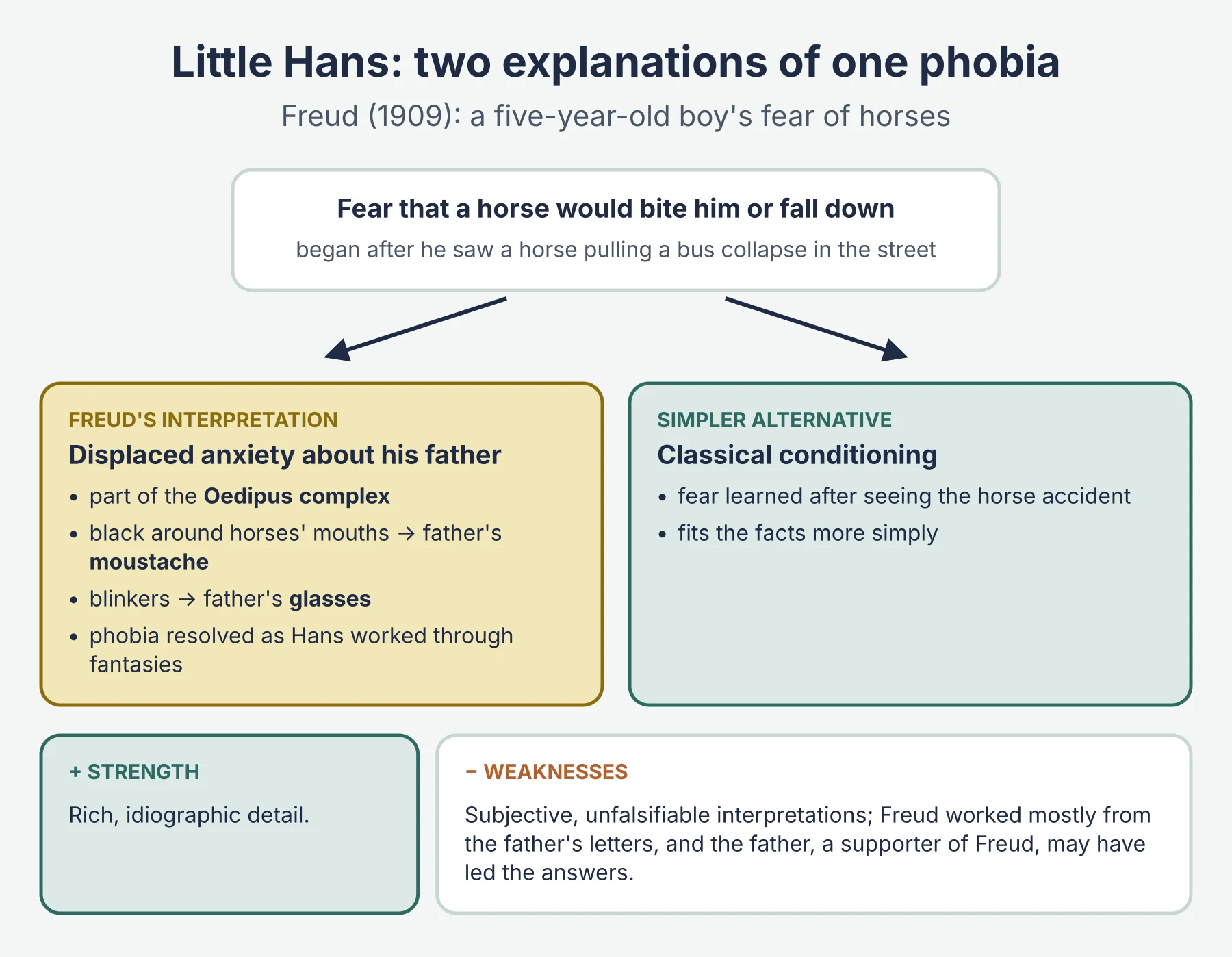
Freud (1909) analysed “Little Hans”, a five-year-old boy with a fear of horses, especially that a horse would bite him or fall down. The fear began after he saw a horse pulling a bus collapse in the street. Freud, working mostly from letters by Hans’s father and meeting Hans only briefly, interpreted the phobia as displaced anxiety about his father, part of the Oedipus complex: features Hans mentioned, such as the black around horses’ mouths and their blinkers, were linked to his father’s moustache and glasses. The phobia resolved as Hans worked through fantasies that Freud saw as resolving the complex.
Evaluation: the case gives rich, idiographic detail, but interpretations are subjective and unfalsifiable, the father was a supporter of Freud and may have led his son’s answers, and a simpler explanation (classical conditioning after seeing the accident) fits the facts.
1.4.3 Treatment and management
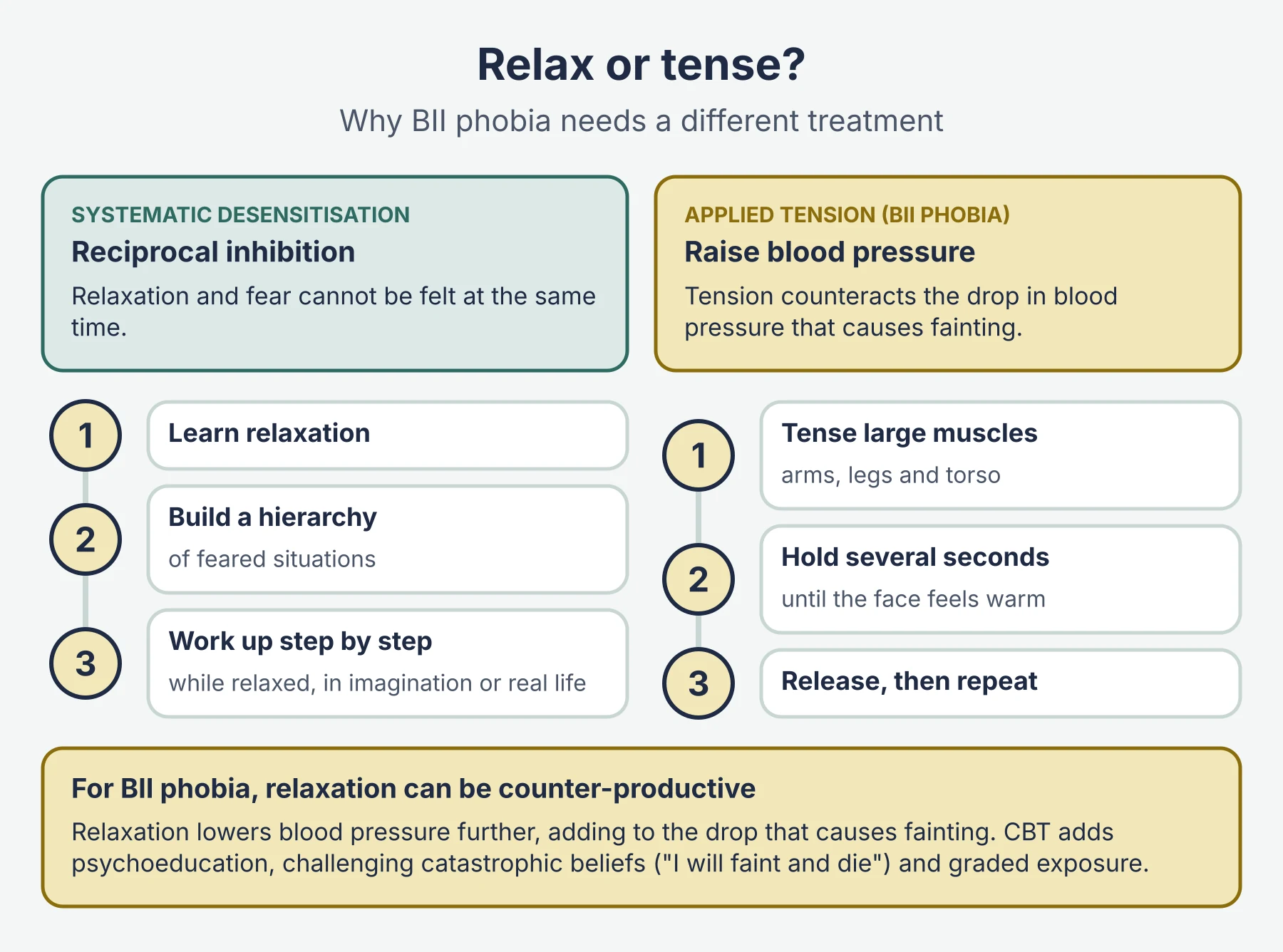
Systematic desensitisation, applied to any fear-related disorder, relies on reciprocal inhibition: relaxation and fear cannot be felt at the same time. The client learns relaxation, builds a hierarchy of feared situations, and works up it step by step while relaxed, either in imagination or in real life.
Cognitive-behavioural therapy adds work on thoughts: psychoeducation about anxiety, identifying and challenging catastrophic beliefs (“I will faint and die”), and graded exposure.
Applied tension is used for BII phobia. The client tenses the large muscles of the arms, legs and torso for several seconds until the face feels warm, then releases, and repeats. Tension raises blood pressure, counteracting the drop that causes fainting. This is why relaxation, the core of systematic desensitisation, can be counter-productive for BII phobia: it lowers blood pressure further.
Key study: Chapman and DeLapp (2013)
| Element | Detail |
|---|---|
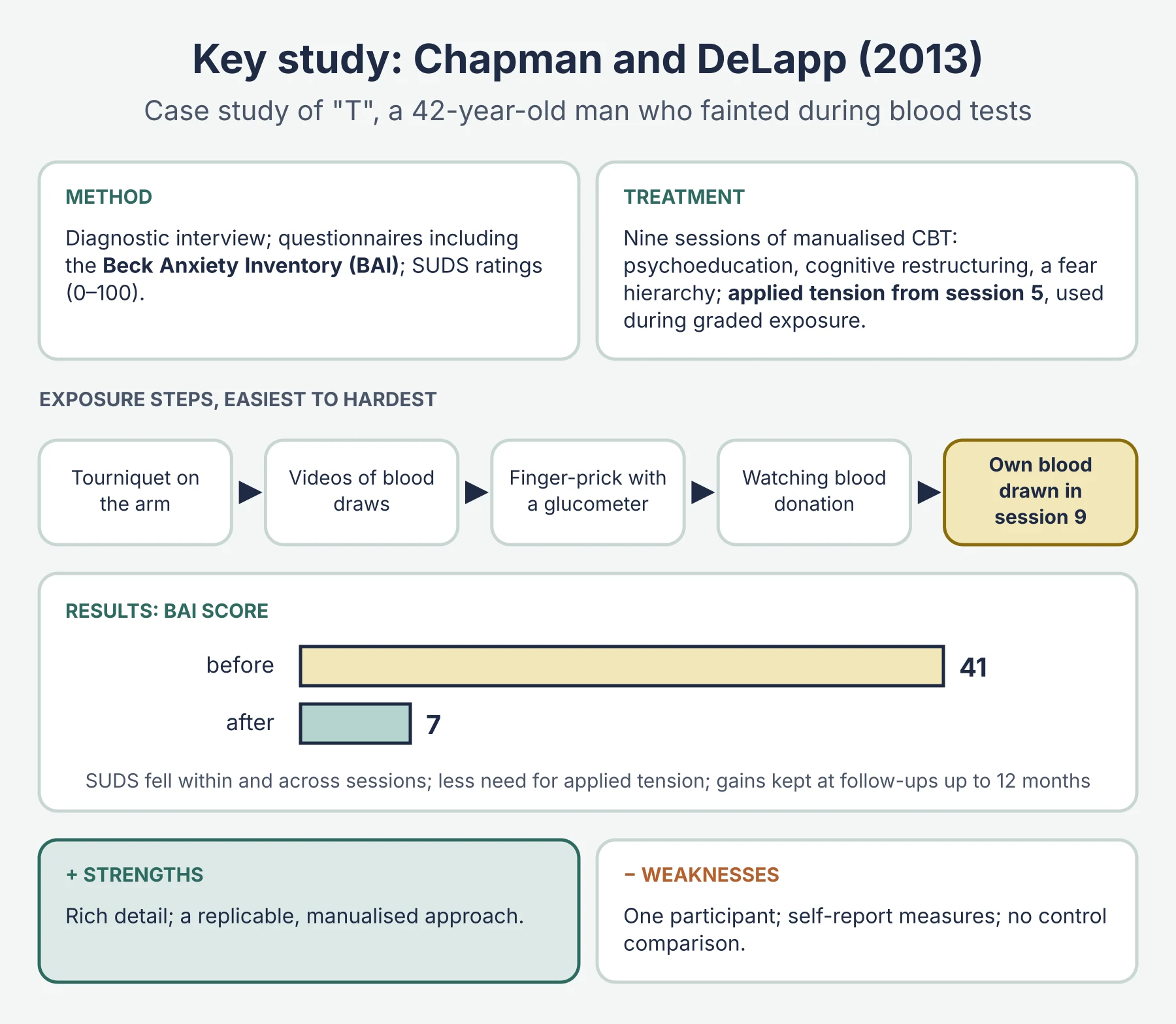
| Participant | “T”, a 42-year-old man who self-referred; panic-like fear and fainting during blood tests; avoided check-ups |
| Method | Case study; diagnostic interview; questionnaires including the Beck Anxiety Inventory (BAI); SUDS ratings (0–100) |
| Treatment | Nine sessions of manualised CBT: assessment and psychoeducation; cognitive restructuring; a fear hierarchy; applied tension introduced in session 5 and used during graded exposure |
| Exposure steps | Tourniquet on the arm; videos of blood draws; finger-prick with a glucometer; watching blood donation; finally having his own blood drawn in session 9 |
| Results | SUDS ratings fell within and across sessions; less need for applied tension; BAI fell from 41 to 7; gains maintained at follow-ups up to 12 months |
| Evaluation | Rich detail and a replicable manualised approach; but one participant, self-report measures, and no control comparison |
Common mistakes
- Treating GAD as a phobia: GAD has no specific feared object.
- Recommending relaxation-based systematic desensitisation for BII phobia without noting the fainting problem.
- Saying Freud treated Little Hans directly: the father did most of the work.
- Forgetting the generalisation stage of Little Albert.
Exam technique
For Paper 3, part (a) may ask you to describe an explanation or a treatment; part (b) asks you to evaluate, and this topic’s issues include nature versus nurture, determinism and idiographic versus nomothetic. For Paper 4, Chapman and DeLapp is the key study, and questions may focus on case studies, self-reports, longitudinal follow-up and generalisation.
Official syllabus
Cambridge International AS & A Level Psychology 9990 syllabus for 2024, 2025 and 2026, Specialist Option 1, 1.4 Anxiety disorders and fear-related disorders — cambridgeinternational.org.
More resources on this topic
Related resources
-
Practice questions
Cambridge International AS & A Level Psychology (9990): 1.4 Anxiety disorders and fear-related disorders – Practice Questions
Original Paper 3 and Paper 4 style questions with answers on 9990 topic 1.4 anxiety and fear-related disorders, from GAD-7 to Chapman and DeLapp.
Psychology · Cambridge · A Level
Try questions -
Revision notes
Cambridge International AS & A Level Psychology (9990): 1.4 Anxiety disorders and fear-related disorders – Revision Notes
Revision notes for 9990 topic 1.4 anxiety and fear-related disorders: diagnosis, GAD-7, BIPI, Little Albert, Little Hans, applied tension and a self-test.
Psychology · Cambridge · A Level
Revise topic -
Study guides
Cambridge International AS & A Level Psychology (9990): 1.3 Impulse control disorders
Topic 1.3 for Cambridge 9990 Psychology: kleptomania, pyromania and gambling disorder, the K-SAS, dopamine, reinforcement, feeling-state theory and treatments.
Psychology · Cambridge · A Level
Read guide
Studying Psychology?
This page is free and stays free. Marlbridge is not offering Psychology classes at the moment, so there is no tuition to book for it. The free study resources stay open to everyone.
Get free revision emails (optional)
Occasional emails with practice questions, worked explanations and links to free resources for the qualification and subjects you choose. No spam, and you can unsubscribe from any email. The free tools on this site never need an email.