
Revision Notes
Cambridge International AS & A Level Psychology (9990): 1.3 Impulse control disorders – Revision Notes
Revision notes for 9990 topic 1.3 impulse control disorders: diagnosis, K-SAS, three explanations, Grant et al. and the two imagery therapies, with a self-test.
- Subject
- Psychology
- Level
- A LEVEL
- Topic
- Specialist Option 1: Clinical Psychology
- Author
- Marlbridge Academic Team
- Updated
- Reviewed by
- Kanwal Aslam (what this means)
Aligned to Cambridge A Level Psychology (9990), 2024-2026. Official specification .
Syllabus page (what it covers and how it is assessed): Cambridge A Level Psychology.
Syllabus points this page covers
9990 (A Level)
- 1.3 Impulse control disorders
These notes condense topic 1.3, impulse control disorders, from Specialist Option 1, Clinical Psychology, of Cambridge International AS & A Level Psychology (9990), syllabus for 2024 to 2026. The topic names three disorders, one measure, three explanations, one key study and two named psychological therapies. Full explanations are in the impulse control disorders study guide; test yourself with the impulse control disorders practice questions.
The shared pattern
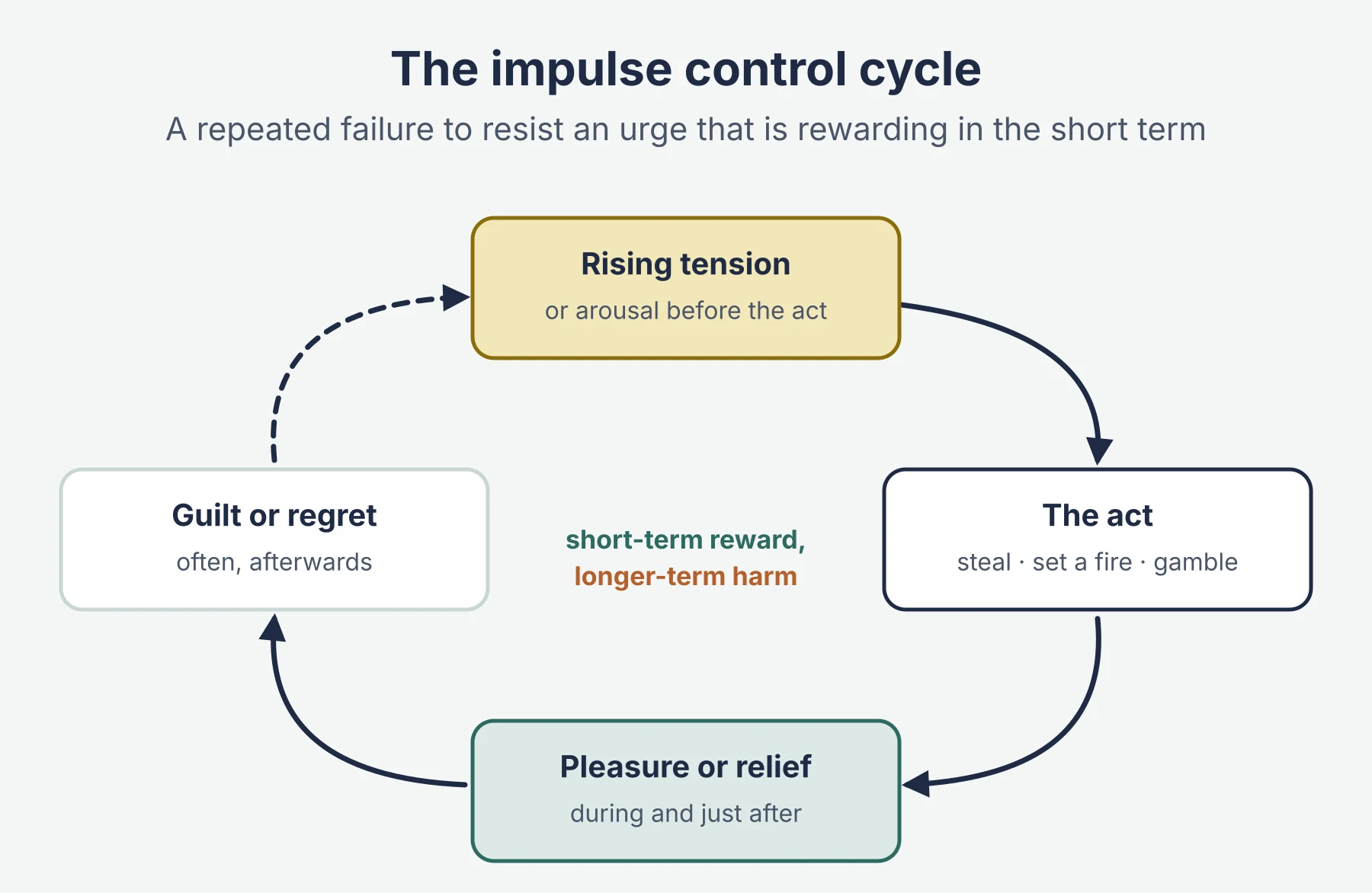
Urge or tension builds → act is carried out → pleasure, excitement or relief → often guilt afterwards → urge returns.
1.3.1 Diagnosis
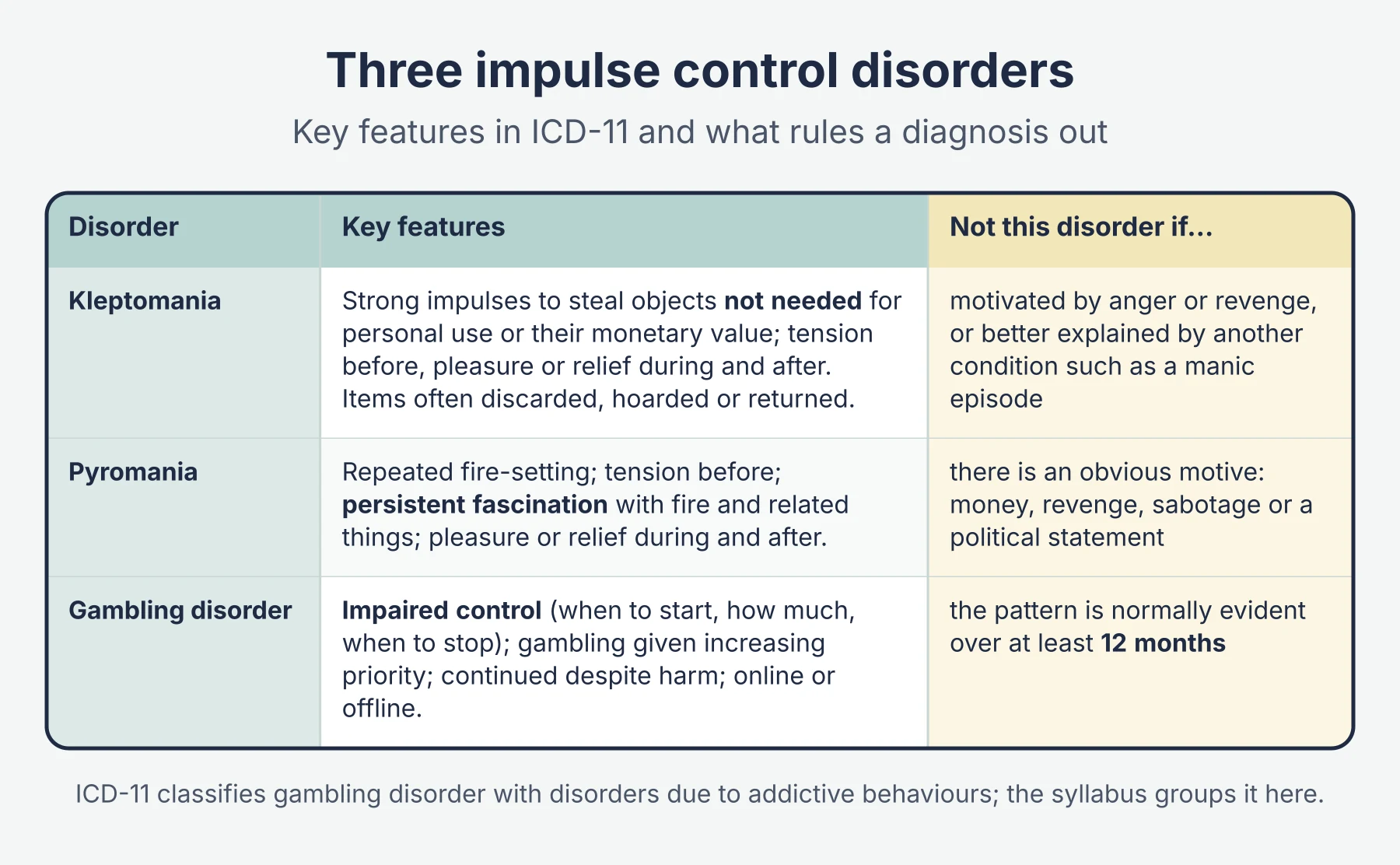
| Disorder | Core feature | What rules it out or distinguishes it |
|---|---|---|
| Kleptomania | Recurrent failure to resist impulses to steal items not needed for use or money; tension before, relief or pleasure during and after | Stealing for gain, anger or revenge; better explained by another condition |
| Pyromania | Repeated fire-setting without obvious motive; tension before; fascination with fire; pleasure or relief | Motives such as money, revenge, sabotage or a political statement |
| Gambling disorder | Impaired control; increasing priority over other activities; continuing despite harm; usually over at least 12 months | ICD-11 places it with disorders due to addictive behaviours |
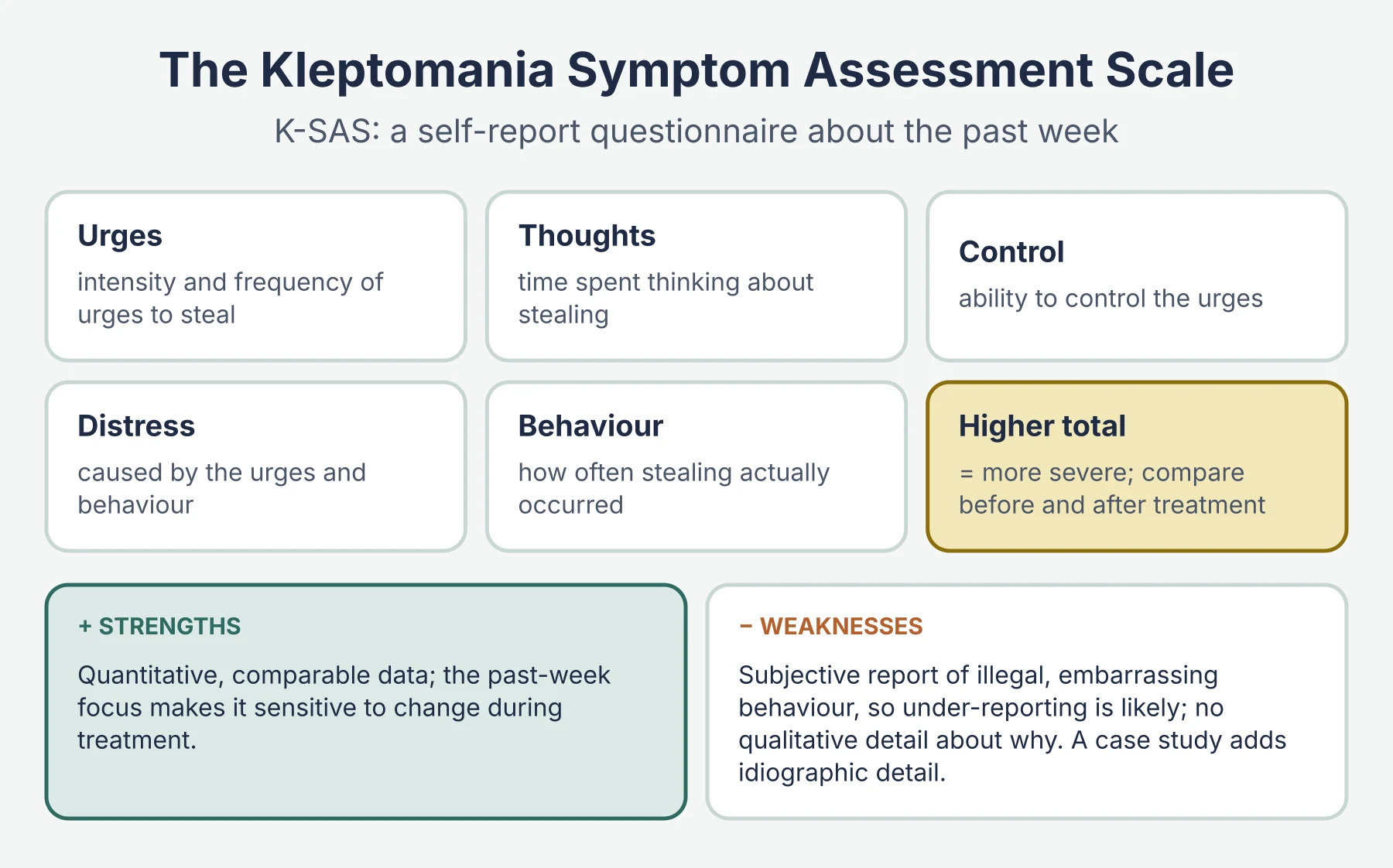
K-SAS: self-report; past week; urges, thoughts, control, distress and stealing frequency; higher total = more severe.
- Strengths: quantitative; sensitive to change; quick.
- Weaknesses: self-report of illegal, embarrassing behaviour, so likely under-reporting; no qualitative reasons.
1.3.2 Explanations
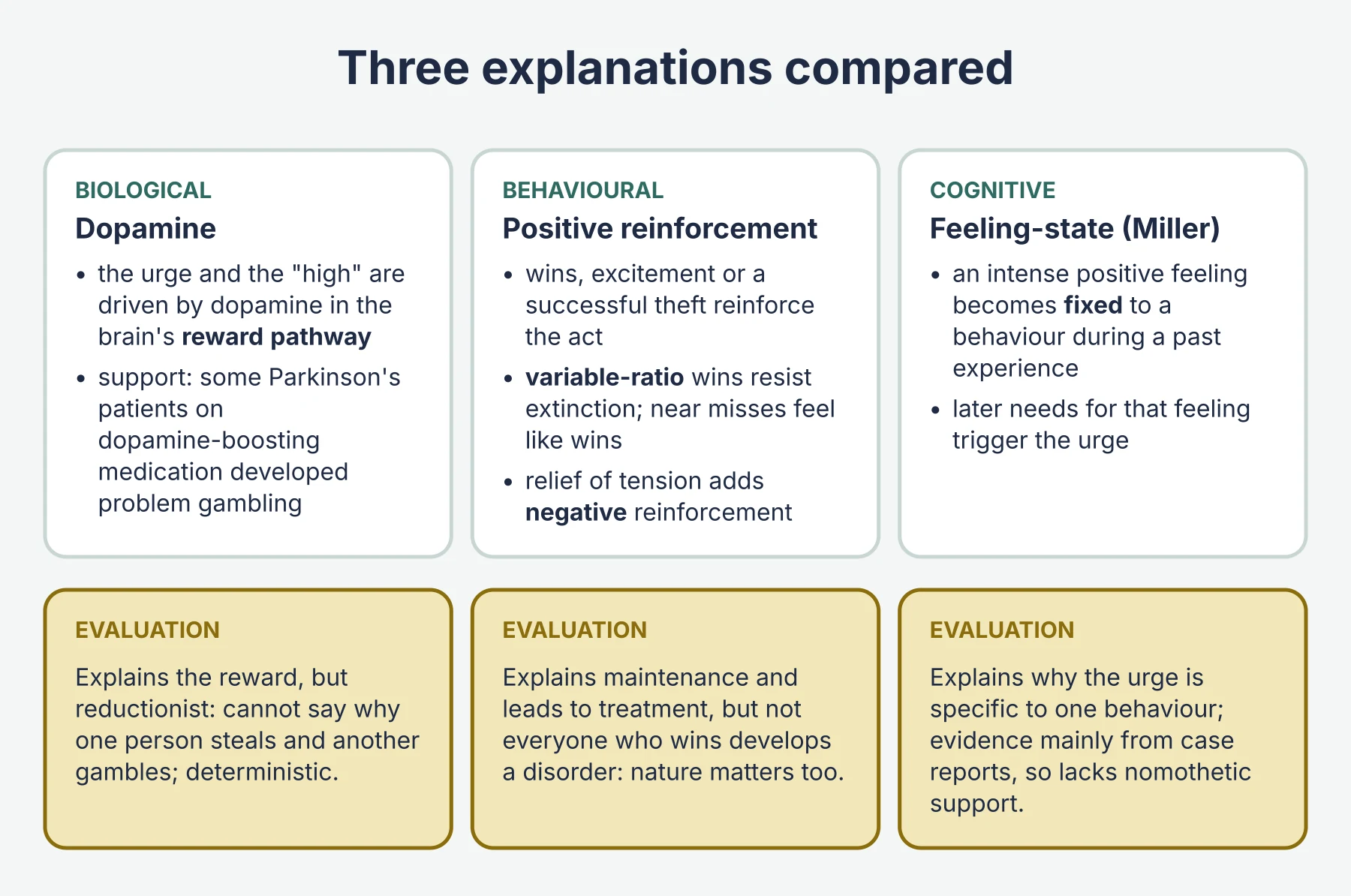
| Explanation | Claim | Evaluation |
|---|---|---|
| Dopamine | Reward-pathway dopamine drives the urge and the “high” | Supported by impulsive behaviour in some patients on dopamine-boosting drugs; reductionist; cannot explain which act a person chooses |
| Positive reinforcement | Wins and thrills reinforce the act; variable-ratio schedule resists extinction | Explains maintenance and leads to treatment; not everyone reinforced develops a disorder |
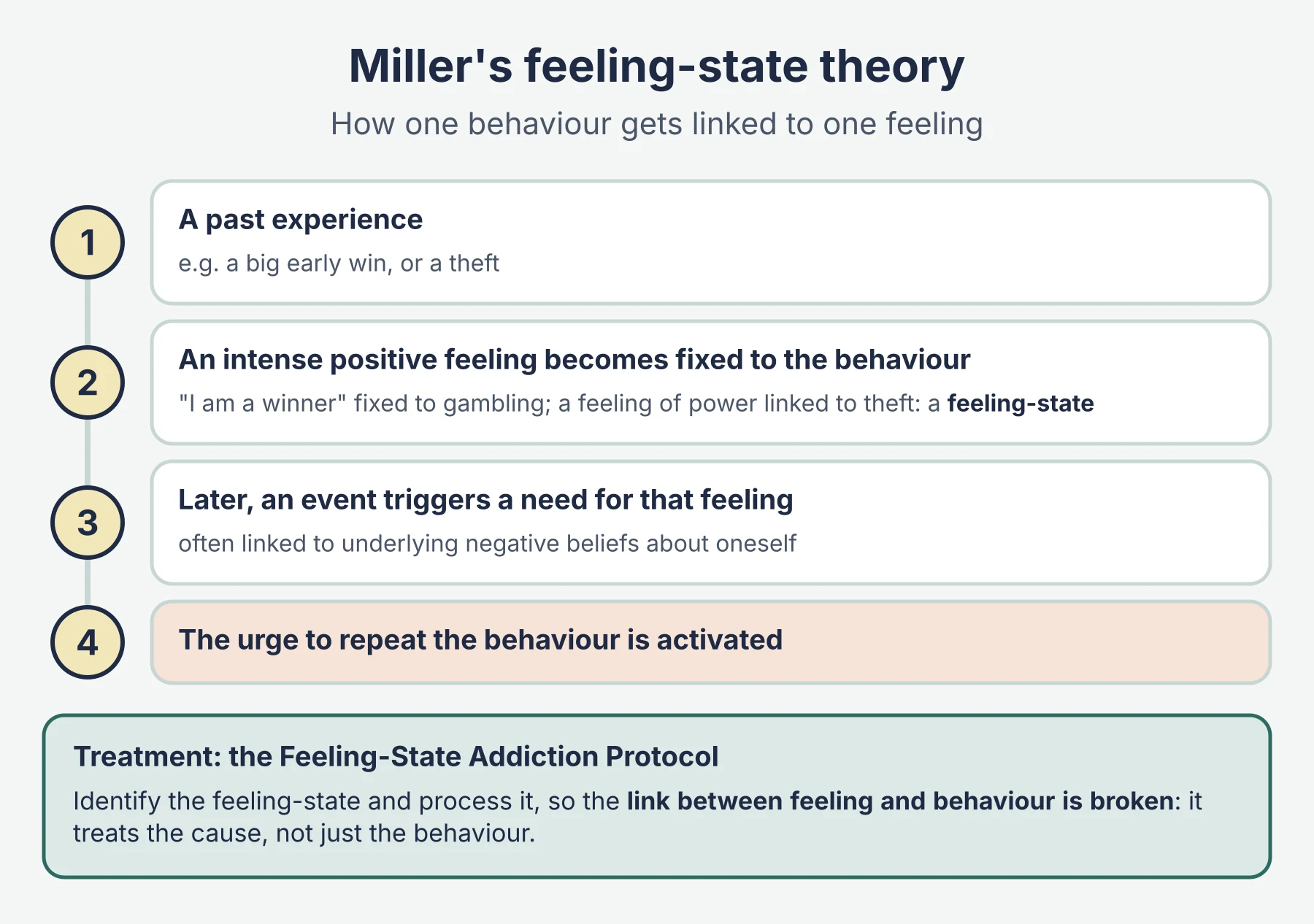
| Miller’s feeling-state theory | An intense positive feeling becomes fixed to one behaviour; later triggers activate the urge | Explains specificity; treats the cause; evidence mainly case reports |
Key study: Grant et al. (2008)
| Element | Detail |
|---|---|
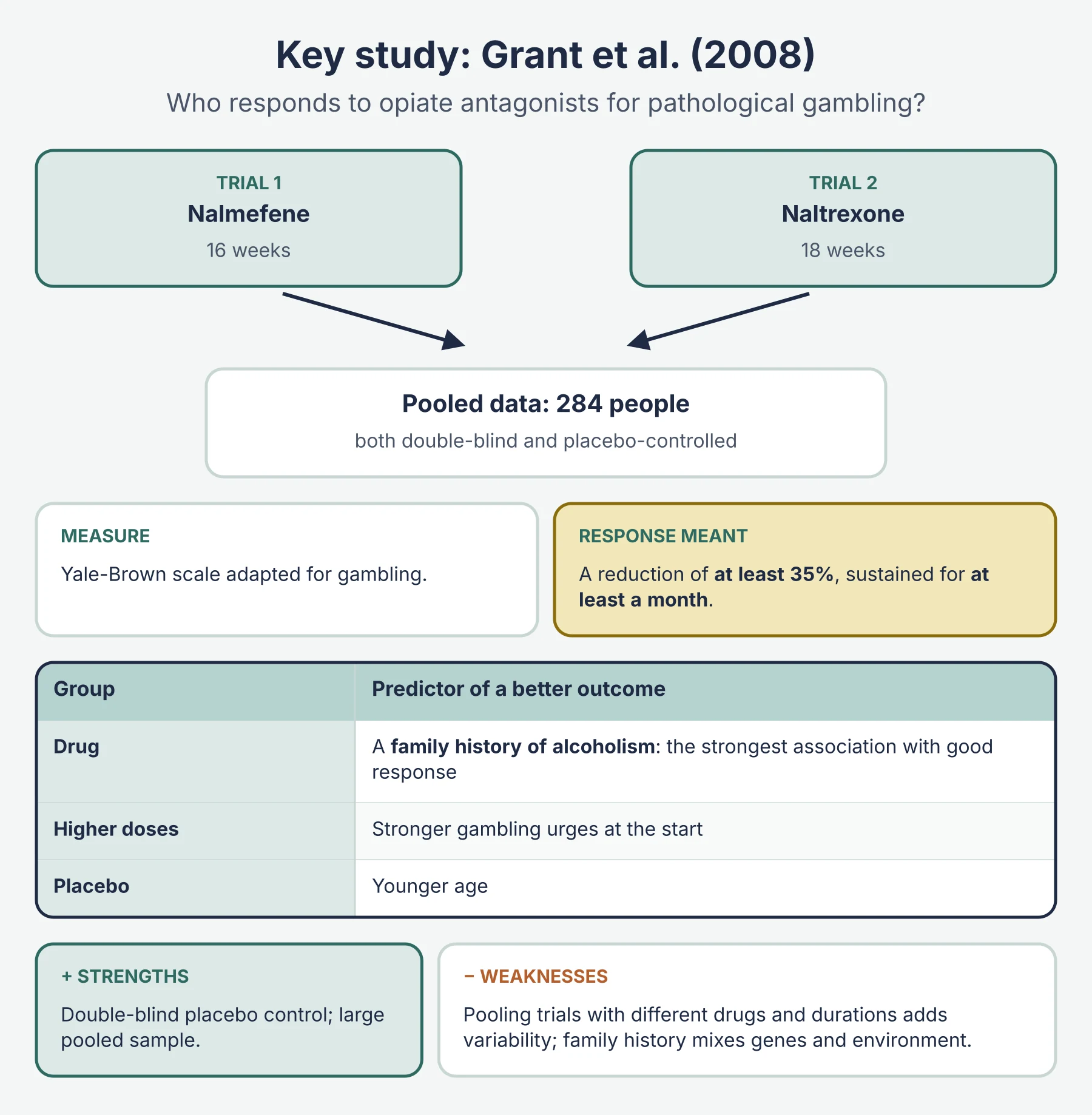
| Aim | Find predictors of response to opiate antagonists and placebo in pathological gambling |
| Method | Pooled data from two double-blind, placebo-controlled trials: nalmefene (16 weeks), naltrexone (18 weeks) |
| Sample | 284 people with pathological gambling |
| Measure | Yale-Brown scale adapted for gambling; response = at least 35% reduction for at least a month |
| Main result | Family history of alcoholism best predicted drug response |
| Other results | Higher-dose group: stronger baseline urges predicted response; placebo: younger age predicted better outcome |
| Evaluation | Placebo and double-blind control; large sample; two different drugs pooled; family history mixes genes and environment |
1.3.3 Psychological therapies
| Therapy | What happens | Example study |
|---|---|---|
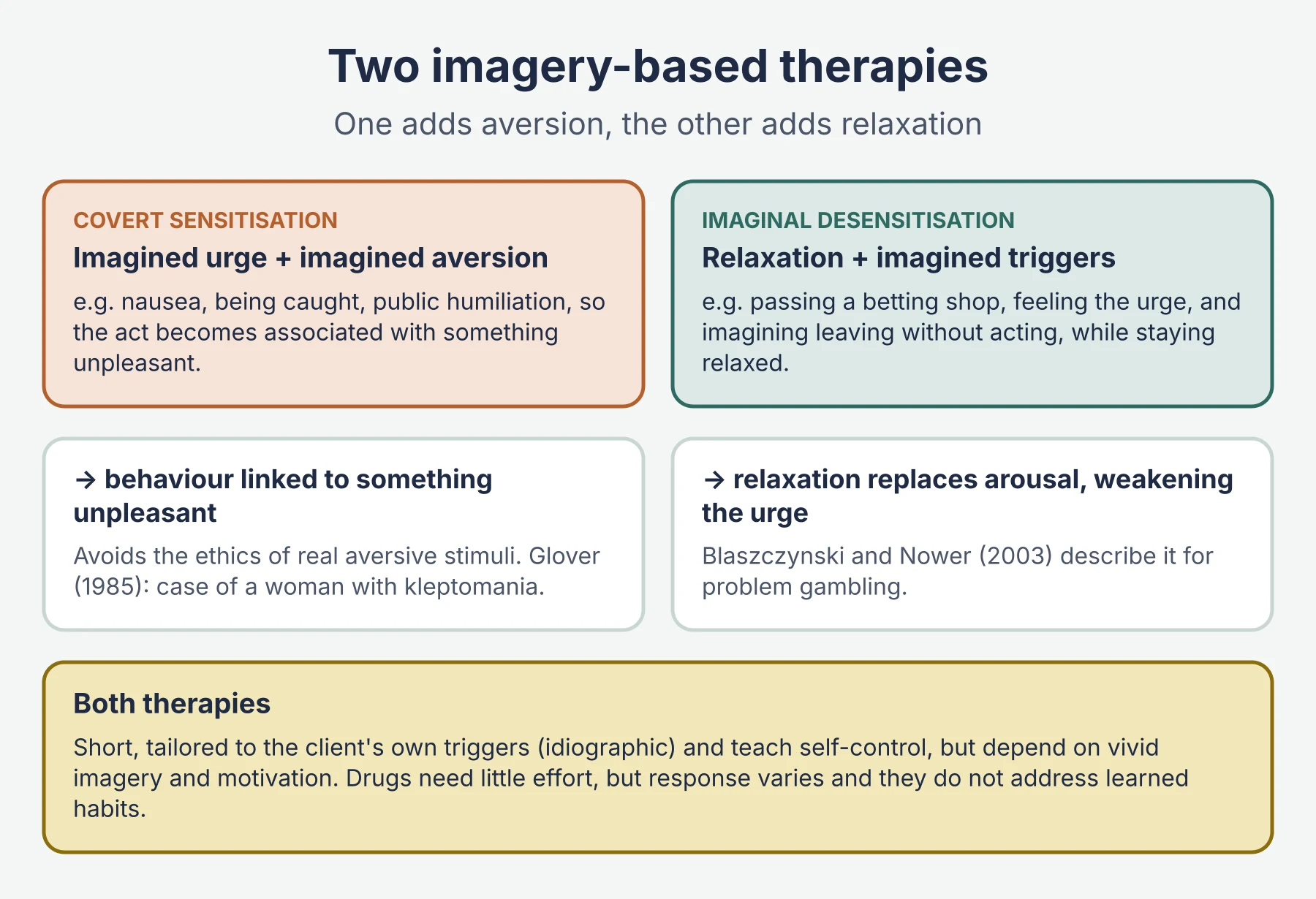
| Covert sensitisation | Imagined act paired with an imagined aversive outcome (e.g. nausea, being caught) | Glover (1985), woman with kleptomania |
| Imaginal desensitisation | Relaxation, then imagining triggers and leaving without acting | Blaszczynski and Nower (2003), gambling |
Key terms
| Term | Meaning |
|---|---|
| Impulse | A sudden strong urge to act |
| Opiate antagonist | Drug that blocks opioid receptors, reducing reward signals |
| Placebo | Inactive treatment used for comparison |
| Variable-ratio schedule | Reinforcement after an unpredictable number of responses |
| Near miss | An outcome close to a win, which can feel rewarding |
| Feeling-state | An intense feeling fixed to a specific behaviour |
| Aversive stimulus | Something unpleasant that reduces a behaviour |
| Relaxation training | Learning to reduce physical arousal, e.g. through breathing and muscle relaxation |
| Response criterion | The amount of improvement defined in advance as success |
Issues and debates hooks
- Nature versus nurture: dopamine and family history (nature) versus reinforcement and learned associations (nurture).
- Reductionism: dopamine alone versus feeling-state and learning accounts.
- Determinism versus free will: biological accounts may reduce blame; therapies aim to restore control.
- Idiographic versus nomothetic: Glover’s case study versus Grant et al.’s trial data.
- Application to everyday life: tailoring drug treatment; designing gambling regulation around reinforcement schedules.
Exam traps
- Writing that pyromania includes fires set for insurance money.
- Saying kleptomania is about wanting the objects.
- Describing Grant et al.’s result as “the drug worked for everyone”.
- Confusing covert sensitisation with systematic desensitisation.
- Forgetting the placebo findings when describing Grant et al.
Self-test
- What do the three disorders have in common?
- How does kleptomania differ from ordinary theft?
- Name two motives that exclude a diagnosis of pyromania.
- Over what period is gambling disorder normally evident?
- What time period does the K-SAS ask about?
- What evidence links dopamine to impulse control problems?
- Why does a variable-ratio schedule make gambling hard to stop?
- What is a feeling-state?
- Which two drugs were tested in the trials pooled by Grant et al.?
- What defined a “response” in Grant et al.?
- What was the strongest predictor of drug response?
- What is the key difference between covert sensitisation and imaginal desensitisation?
Answers: (1) repeated failure to resist an urge to perform a short-term rewarding but harmful act. (2) the items are not needed for use or money, and there is tension before and relief or pleasure after. (3) any two of money, revenge, sabotage, a political statement. (4) at least 12 months. (5) the past week. (6) some patients on dopamine-boosting medication for Parkinson’s disease develop problem gambling. (7) wins are unpredictable, so the behaviour persists through long runs of losses. (8) an intense positive feeling fixed to a specific behaviour. (9) nalmefene and naltrexone. (10) at least a 35% reduction in severity lasting at least a month. (11) a family history of alcoholism. (12) covert sensitisation pairs the act with an imagined aversive outcome; imaginal desensitisation pairs imagined triggers with relaxation and leaving without acting.
Official syllabus
Cambridge International AS & A Level Psychology 9990 syllabus for 2024, 2025 and 2026, Specialist Option 1, 1.3 Impulse control disorders — cambridgeinternational.org.
More resources on this topic
Related resources
-
Study guides
Cambridge International AS & A Level Psychology (9990): 1.2 Mood (affective) disorders: depressive disorder (unipolar) and bipolar disorder
Topic 1.2 mood disorders for Cambridge 9990 Psychology: ICD-11 depression and bipolar, the BDI, Oruč et al., Beck, learned helplessness and treatments.
Psychology · Cambridge · A Level
Read guide -
Practice questions
Cambridge International AS & A Level Psychology (9990): 1.2 Mood (affective) disorders: depressive disorder (unipolar) and bipolar disorder – Practice Questions
Original Paper 3 and Paper 4 style questions with answers on 9990 topic 1.2 mood disorders: diagnosis, the BDI, Oruč et al., Beck, REBT and antidepressants.
Psychology · Cambridge · A Level
Try questions -
Revision notes
Cambridge International AS & A Level Psychology (9990): 1.2 Mood (affective) disorders: depressive disorder (unipolar) and bipolar disorder – Revision Notes
Revision notes for 9990 topic 1.2 mood disorders: ICD-11 episodes, the BDI, Oruč et al., Beck, attributional style, antidepressants, REBT and a self-test.
Psychology · Cambridge · A Level
Revise topic
Studying Psychology?
This page is free and stays free. Marlbridge is not offering Psychology classes at the moment, so there is no tuition to book for it. The free study resources stay open to everyone.
Get free revision emails (optional)
Occasional emails with practice questions, worked explanations and links to free resources for the qualification and subjects you choose. No spam, and you can unsubscribe from any email. The free tools on this site never need an email.